



Content Curator
A square number is a result of multiplying an integer by itself. In general, a square number is a result of multiplying two identical numbers. The best example of a square number in geometry is the area of a square with side lengths of "n" (where n is an integer).
Square numbers are typically always positive. Considering that the negative sign is multiplied by itself, it gives a positive sign (+). For instance, (-4)2 = 16. Thus, 16 is a positive square number, which has a square root in the form of an integer, i.e.√16 = 4.
| Table of Content |
Key Terms: Square Numbers, Multiplication, Integers, Whole Numbers, Fraction, Square Root
What are Square Numbers?
[Click Here for Sample Questions]
Square Numbers are numbers that can be multiplied by themselves.
- A Square Number can be formed if a natural number is multiplied by itself.
- For example, 2 multiplied by itself, forming 2 x 2 can be defined as a Square Number.
- If we multiply two equal integers by one another, the result is a perfect square.
- Square numbers can be always found in the positive form because a negative number multiplied by the same negative number gives a positive number.
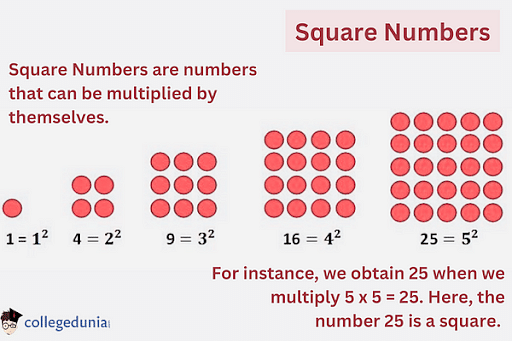
Square Numbers
How do Square Numbers Work?
[Click Here for Sample Questions]
A number is referred to as a square number when an integer is multiplied by another integer. For instance, we obtain 25 when we multiply 5 x 5 = 25. Here, the number 25 is a square.
Because a negative number produces a positive result when it is multiplied by another negative integer, square numbers can never be negative.
Thus, (-7)2 = -7 x -7 = 49 (two negative signs multiplied by each other result in a positive sign). The result of multiplying -7 by -7 is 49, which is a positive square number.
Examples of square numbers are shown below.
- -8 × -8 = 64
- 12 × 12 = 144
- -2 × -2 = 4
- 34 × 34 =1156
Because every side of a square is equal, in geometry, the area of a square equals Side x Side = Side2. The area of a square is therefore always a square number.
Also Check:
| Chapter Related Concepts | ||
|---|---|---|
| Rationalize the Denominator | Coplanar Vector | Angle between Two Lines |
| Plane | Angle between Two Planes | Angle between a Line and a plane |
List of Square Numbers
[Click Here for Sample Questions]
The list of square numbers can be classified as:
Square Root 1 to 100
Upto 100, there are ten square numbers: 1, 4, 9, 16, 25, 36, 49, 64, 81, and 100. A square of 11, or 121, will be the next number on this list, and it will be higher than 100.
- 12 = 1 × 1 = 1
- 22 = 2 × 2 = 4
- 32 = 3 × 3 = 9
- 42 = 4 × 4 = 16
- 52 = 5 × 5 = 25
- 62 = 6 × 6 = 36
- 72 = 7 × 7 = 49
- 82 = 8 × 8 = 64
- 92 = 9 × 9 = 81
- 102 = 10 × 10 = 100
Square Numbers Upto 1000
Upto 1000, 31 square numbers can be demonstrated as 1, 4, 9, 16, 25, 36, 49, 64, 81, 100, 121, 144, 169, 225, 256, 289, 324, 361, 400, 441, 484, 529, 576, 625, 676, 729, 784, 841, 900, and 961. These are the whole numbers 1 to 31's perfect squares.
Properties of Square Numbers
[Click Here for Sample Questions]
The characteristics of square numbers are mentioned below to make it simple to recognize them.
- There are only four digits that can end a square number: 0, 1, 4, 5, 6, and 9. For instance, the numbers 25, 49, 81, 100, etc. are perfect squares, while the numbers 37, 48, 22, etc. are not.
- A square integer will always have an even number of zeros at the end. A number is not a square number if it ends with an odd number of zeros. For instance, 10, 250, and 360 are non-square numbers while 400 and 3600 are square numbers.
- A number's square number terminates with 1 if either 1 or 9 makes up the last digit. For instance, squares 9 and 11 are 81 and 121 respectively.
- A number's square number ends with 6 if its last digit is either 4 or 6. The square of 4 is 16, for instance, whereas the square of 26 is 676.
- Odd numbers always make up an odd square, while even numbers always make up an even square. For instance, squares 12 and 13 both equal 144 and 169.
- Square numbers are always positive because a positive sign arises when two negative signs are multiplied by one another. Thus, (-6)2 = -6 x -6 = 36. The product in this case is 36, which is a positive square number.
- The square root of a square number is almost always an integer. For instance, 441 is a square number because its square root is 21. This means that a number is not a perfect square number if its square root is a fraction or a decimal value. For instance, 0.25 is not a square number because 0.25 = 0.5.
Two and Three-Digit Square Number
Six "two-digit square numbers" are present, and they 16, 25, 36, 49, 64, and 81. The 22 "three-digit square numbers" are: 100, 121, 144, 169, 225, 256, 289, 324, 361, 400, 441, 484, 529, 576, 625, 676, 729, 784, 841, 900, 961
Odd and Even Square Numbers
Even-numbered squares are even, hence (2n)2 = 4n2
Odd integers have odd squares, so (2n + 1)2= 4(n2 + n) + 1 is an example.
The odd integers that have the form 4n + 3 are not square numbers because every odd square has the form 4n + 1.
Also Read:
| Chapter-Related Topics | ||
|---|---|---|
| HCF | Relation Between HCF and LCM | Properties of LCM and HCF |
| LCM of Two Numbers | Addition and Subtraction of Integers | LCM Formula |
Sum of Square Numbers
[Click Here for Sample Questions]
The expression [n(n+1)(2n+1)] / 6 can be used to calculate the sum of the first "n" square numbers (counting from 1), which is represented by the number n2, i.e.,
| Σ n2 = [n(n+1)(2n+1)] / 6 |
For instance, if we manually add up the first six square numbers, we obtain 1 + 4 + 9 + 16 + 25 + 36 = 91. Let's now calculate the same amount using the formula above.
First six square numbers added together equal [6(6+1)(2(6)+1)] / six = [6(7)(13)] / six = 91. In both cases, the same response is received.
Square Roots
[Click Here for Sample Questions]
Square numbers are produced when an integer is multiplied by itself. We must now get the square root of the square number to return to the original number.
For instance,
7 x 7 = 49
√49 = 7
The value that can be squared to obtain the original number is what the square root of any number offers us.
Things to Remember
- Square numbers are always whole numbers and positive in form.
- A square number's square root is almost always an integer.
- Even numbers have squares that are also even and Odd numbers have squares that are also odd.
- The sum of square numbers can be expressed by using Σ n2 = [n(n+1)(2n+1)] / 6.
Sample Questions
Ques. Which of the following 242, 492, 772, 1312, or 1892 end with digit 1? (1 mark)
Ans: Only 492, 1312, and 1892 ended with the digit 1.
Ques. Find the product of the following: (2 marks)
(i) 23 × 25
(ii) 41 × 43
Ans: (i) 23 × 25 = (24 – 1) (24 + 1) = 242 – 1 = 576 – 1 = 575
(ii) 41 × 43 = (42 – 1) (42 + 1) = 422 – 1 = 1764 – 1 = 1763
Ques. −37 (2 marks)
(ii) −917
Ans: Thus,
(i) \((-\frac{3}{7})^2 = (-\frac{3}{7})(-\frac{3}{7}) = \frac{9}{49}\)
(ii) \((-\frac{9}{17})^2 = (-\frac{9}{17})(-\frac{9}{17}) = \frac{81}{289}\)
Ques. Find the least square number which is divisible by each of the numbers 4, 8, and 12. (2 marks)
Ans: LCM of 4, 8, and 12 is the least number divisible by each of them.
LCM of 4, 8, and 12 = 24
24 = 2 × 2 × 2 × 3
To make it a perfect square multiply 24 by the product of unpaired numbers, i.e., 2 × 3 = 6
Required number = 24 × 6 = 144

Ques. How many numbers lie between squares of the following numbers? (3 marks)
(i) 12 and 13
(ii) 25 and 26
(iii) 99 and 100
Ans: As we know, between n2 and (n+1)2, the number of non–perfect square numbers are 2n.
(i) Between 122 and 132 there are 2×12 = 24 natural numbers.
(ii) Between 252 and 262 there are 2×25 = 50 natural numbers.
(iii) Between 992 and 1002 there are 2×99 =198 natural numbers.
Ques. Show that the sum of two consecutive natural numbers is 132. (3 marks)
Ans: Let 2n + 1 = 13
So, n = 6
So, ( 2n + 1)2 = 4n2 + 4n + 1
= (2n2 + 2n) + (2n2 + 2n + 1)
Substitute n = 6,
(13)2 = ( 2 x 62 + 2 x 6) + (2 x 62 + 2 x 6 + 1)
= (72 + 12) + (72 + 12 + 1)
= 84 + 85
Ques. The difference between the squares of each of the ensuing integers should be written. (3 marks)
I) 49
(ii) 75
(iii) 125
Ans: The answer is
I) 49 = 2 x 24 + 1 \s49 = 252 - 242.
(ii) 75 = 2 × 37 + 1 \s75 = 382 – 372
(iii) 125 = 2 × 62 + 1 \s125 = 632 – 622
Ques. Find the square root of 729 using the factorization method. (3 marks)
Ans: 
729 = 3×3×3×3×3×3×1
⇒ 729 = (3×3)×(3×3)×(3×3)
⇒ 729 = (3×3×3)×(3×3×3)
⇒ 729 = (3×3×3)2
Therefore,
⇒ √729 = 3×3×3 = 27
Ques. Find the smallest square number that is divisible by each of the numbers 8, 15, and 20. (3 marks)
Ans: 
L.C.M of 8, 15, and 20 is (2×2×5×2×3) = 120.
120 = 2×2×3×5×2 = (2×2)×3×5×2
Here, 3, 5, and 2 cannot be paired.
Therefore, we need to multiply 120 by (3×5×2) i.e. 30 to get a perfect square.
Hence, the smallest squared number which is divisible by numbers 8, 15, and 20 = 120×30 = 3600.
Ques. A ladder 10 m long rests against a vertical wall. If the foot of the ladder is 6 m away from the wall and the ladder just reaches the top of the wall, how high is the wall? (NCERT Exemplar) (3 marks)

Ans: Let AC be the ladder.
Therefore, AC = 10 m
Let BC be the distance between the foot of the ladder and the wall.
Therefore, BC = 6 m
∆ABC forms a right-angled triangle, right-angled at B.
By Pythagoras’ theorem,
AC2 = AB2 + BC2
102 = AB2 + 62
or AB2 = 102 – 62 = 100 – 36 = 64
or AB = √64 = 8m
Hence, the wall is 8 m high.
Ques. Find the square roots of the following decimal numbers (5 marks)
(i) 1056.25
(ii) 10020.01
Ans: As per the question,

Read Also:



Comments