



Content Curator
STP stands for Standard Temperature and Pressure, as per this elementary concept both temperature and pressure are in their normal forms in STP system. At zero degree centigrade which is equal to 273K and the pressure equals to the atmosphere which is always one for gases, one mole of any gas at STP occupies a volume of 22.414 L. It is obvious that the volume of a given mass of a gas changes when temperature and pressure are changed. The pressure is measured in torr and the temperature is measured in Kelvin.
Read More: Stress and Strain
| Table of Content |
Key terms: Ideal gas, STP, Molar, Temperature, Pressure, Volume, Avogadro’s Constant, Density
Equation of State for an Ideal Gas
[Click Here for Sample Questions]
Boyle’s law gives the effect of pressure on the volume of gas at constant temperature whereas Charle’s Law gives the effect of temperature on the volume of gas at constant pressure.
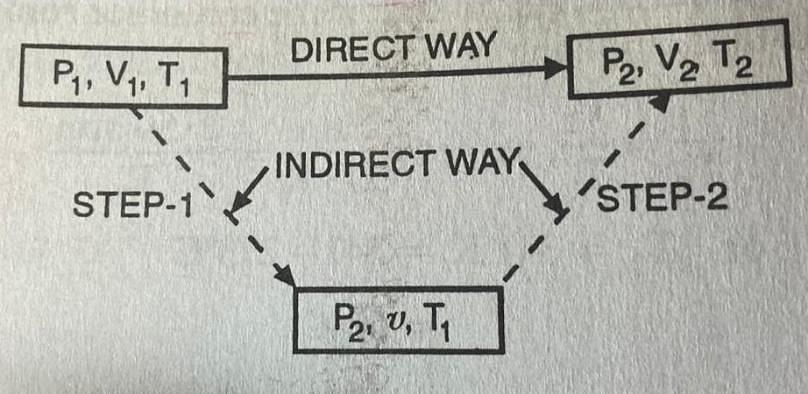
Direct and Indirect way
Step 1: Suppose Volume of a given mass of a gas changes from V1 to v when the pressure is changed from P1 to P2 at constant T1:
Then according to Boyle’s law
P2 × v = P1 × V1 ………….. (i)
Step 2: Suppose volume v changes to V2 when the temperature is changed from T1 to T2 at constant pressure P2.
\(\frac{v}{T_1} = \frac{V_2}{T_2}\) ………….. (ii)
After substituting the values of v from (i) and (ii) we get:
V2 = \(\frac{P_1V_1}{P_2} \times \frac{T_1}{T_2}\)
\(\frac{P_1V_1}{T_1} = \frac{P_2 V_2} {T_2}\)
PV = n RT
Read Also: Reynolds Number
Alternative Derivation of Ideal Gas Equation
[Click Here for Sample Questions]
According to Boyle’s Law:
\(V \propto \frac{1}{P}\) at constant temperature T
According to Charles’s Law:
V \(\propto\) T at constant temperature P
According to Avogadro’s Law:
V \(\propto\) n at constant T and P,
n is the no. of moles of the gas
PV = RT,
where R is the molar gas constant
Ideal Gas Equation in terms of Density
[Click Here for Sample Questions]
n = \(\frac{m}{M}\)
PV = RT = \(\frac{m}{M}\) RT
P = \(\frac{m}{V} \frac{RT}{M}\) = d \(\frac{RT}{M}\)
M = d \(\frac{RT}{P}\)
Ideal gas equation is a relation between four variables and it describes the state of any gas, therefore, it is also called the equation of state.
Deduction of Avogadro’s Law from Ideal Gas Law
[Click Here for Sample Questions]
According to ideal gas law:
PV = n RT
Thus, if two gases have the same values of P and T, then their Volumes V are equal, the values of n must be the same.
Read More: Bulk Modulus
Things to Remember
- STP is used in many thermodynamics’ calculations. The volume of a gas changes when the temperature and pressure are changed.
- STP or NTP implies that temperature = 0°C = 273.15K = 273 K
Pressure = 1 atm = 76 cm = 760mm = 760 torr = 101.325 k Pa or 1 bar = 105 Pa = 102 k Pa - Gay Lussac’s law states that at constant volume, pressure of a fixed amount of a gas varies directly with the temperature.
- Kelvin scale of temperature is also called Thermodynamic scale of temperature and is used in all scientific works.
- Avogadro law states that equal volumes of all gases under the same conditions of temperature and pressure contain equal number of molecules.
- A gas that follows Boyle’s law, Charles’ law and Avogadro law is called an ideal gas.
Read More: Young's Modulus
Sample Questions
Ques. 40ml of oxygen was collected at 5°C and 800 mm pressure. Calculate its volume at NTP? (3 Marks)
Ans. V1 = 40 ml V2 = ? P1 = 800 mm P2 = 760 mm T1 = 5 + 273 = 278 K T2 = 0 + 273 K = 273 K
Applying the gas equation \(\frac{P_1V_1}{T_1} = \frac{P_2 V_2} {T_2}\)
\(\frac{800 \times 40}{278} = \frac{760 \times V_2}{273}\)
V2 = 11.05 ml
Ques. At 30 °C and one atmospheric pressure a gas has a volume V. What will be its volume at 200°C and a pressure of 1.5 atmosphere? (3 Marks)
Ans. V1 = V V2 = ? P1 = 1 atm P2 = 1.5 atm T1 = 27 + 273 = 300 K T2 = 200 + 273 K = 473 K
Applying the gas equation \(\frac{P_1V_1}{T_1} = \frac{P_2 V_2} {T_2}\)
\(\frac{1 \times V}{300} = \frac{1.5 \times V_2}{473}\)
V2 = 1.05 V
Ques. Calculate the molar volume of a gas at STP? (3 Marks)
Ans. We know at STP, P = 1 atm, T = 273 K , n = 1 mol , R = .0821 L atm K-1 mol-1
We will take Gas constant R = .0821 L atm K-1 mol-1
We are applying the formula
PV = n RT
1 × V = 1 × 0.0821 × 273
V = 22.4 litres
Read More: Relation Between Celsius and Fahrenheit
Ques. Calculate the temperature of 5.0 moles of a gas occupying 5 dm3 at 3.32 bar (R = 0.083 bar dm3 K-1 mol-1) (3 Marks)
Ans. T = ?, P = 5 dm3, V = 3.32 bar , n = 5 mol , R = 0.083 bar dm3 K-1 mol-1
We will take Gas constant R = 0.083 bar dm3 K-1 mol-1 at NTP conditions
We are applying the formula
PV = n RT
T = PV / n R
T = 3.32 × 5 / 5 × 0.083
T = 40 K
Ques. The density of a gas is 4 gL-1 at STP. Calculate its density at 27° C and 700 torr pressure? (3 Marks)
Ans. We will apply the formula M = d \(\frac{RT}{P}\) for the same gas at two different pressures and temperatures.
d1 / d2 = P1 / P2 × T2 / T1
d1 = 4 gL-1 , P1 = 760 torr, T1 = 273 K, d2 = ? , P2 = 700 torr , T2 = 300 K
4 / d2 = 760 / 700 × 300 / 273
d2 = 3.36 g L-1
Ques. A balloon of diameter 20m weighs 100kg. Calculate its pay-load if it is filed with He at 1.0 atm and 27°C . Density of air is 1.2 kg cm-3 ? (Gas constant R = .082 dm3 atm K-1 mol-1) (4 Marks)
Ans. We will calculate the radius of the balloon which is 20/2 = 10m
Volume of the balloon to be calculate i.e. 4/3 π r3
4/3 × 22/7 × 10 × 10 × 10 = 4190.5 m3
Volume of He gas at 1 atm and 27°C = 4190.5 m3
P = 1 atm, T = 273 + 27 = 300 K , V = 4190.5 m3, R = .0821 L atm K-1 mol-1
We will take Gas constant R = .082 dm3 atm K-1 mol-1
We are applying the formula
PV = n RT
n = PV / RT
n = 4190.5 × 1 / 0.82 × 300
n = 170345.5 moles
Read More: Rotational Kinetic Energy
Ques. An open flask contains air at 27°C. To what temperature it must be heated to expel one-fourth of the air? (4 Marks)
Ans. Suppose the volume of the air after expansion = V cm3
Volume of air expelled 1/4 V
Therefore volume of flask i.e. volume of air at 27°C.
= V – V / 4 = 3/4 V so V1 = 3/4 V
T1 = 27 + 273 = 300 K , V2 = V, T2 = ?
We are applying the formula,
\(\frac{V_1}{T_1} = \frac{ V_2} {T_2}\)
3/4 V / 300 = V / T2, T2 = 400 – 273 = 127 °C
Alternatively, suppose volume of flask = V cm3
Volume of air expelled = V / 4 cm3
Which implies that \(\frac{3}{4}\) V cm3 at 27 °C should become equal to V cm3 at the required temperature.
Ques. What is the density of SO2 gas at 27°C and 2 atmospheric pressure? (Wtgs S = 32, O = 16, R = .0821 L atm K-1 mol-1) (4 Marks)
Ans. d = ?, P = 2 atm, R = 0.083 bar dm3 K-1 mol-1
We will take Gas constant R = 0.083 bar dm3 K-1 mol-1 at NTP conditions
We are applying the formula
PV = n RT
Where n = \(\frac{w}{M}\)
PV = \(\frac{w}{M}\) RT
PM = \(\frac{w}{V}\) RT (d = \(\frac{w}{M}\))
PM = d RT
d = \(\frac{PM}{RT}\) = 2 × 64 / 0.083 × 300 (For SO2 w = 32 + 16×2)
d = 5.1969 g L-1
Ques. At 18 °C and 765 torr, 1.299 L of a gas weights 2.71g. Calculate the approximate molecular weight of the gas? (2 Marks)
Ans. We have V1= 1.299L, P1 = 765 torr, R = 0.083 bar dm3 K-1 mol-1 , T1 = 291K
Converting to volume at NTP,
Applying the gas equation \(\frac{P_1V_1}{T_1} = \frac{P_2 V_2} {T_2}\)
We get 765 × 1.299 / 291 = 760 × V2 / 273
V2 = 1.2267 L
Ques. An iron cylinder contains helium at a pressure of 250 kPa at 300K. The cylinder can withstand a pressure of 1 x 10⁶ Pa. The room in which the cylinder is placed catches fire. Predict whether the cylinder will blow up before it melts or not? (3 Marks)
Ans. P1 = 250 K Pa, T1 = 300K, T2 = 1800K, P2 = ?
Applying the pressure – temperature law
\(\frac{P_1}{T_1} = \frac{P_2}{T_2} \)
250 / 300 = P2 / 1800
P2 = 1500 kPa
As the cylinder an withstand a pressure of 106 Pa = 102 kPa = 1000 kPa, hence it will blow up.
Read More:



Comments