



Content Curator
Relation between the Celsius and the Fahrenheit is directly proportional to each other which means that if the temperature in the Celsius scale increases, then temperature in the Fahrenheit scale will also increase. The Celsius and Fahrenheit are the two most important measuring scales with different values and the various units on temperature deal with various concepts in concern with the relation between the two.
| Table of Content |
Keyterms: Celsius, Fahrenheit, temperature, Celsius scale, Fahrenheit scale, Freezing point, melting point, boiling point
What are the Centigrade Scale and the Fahrenheit Scale?
[Click Here for Sample Questions]
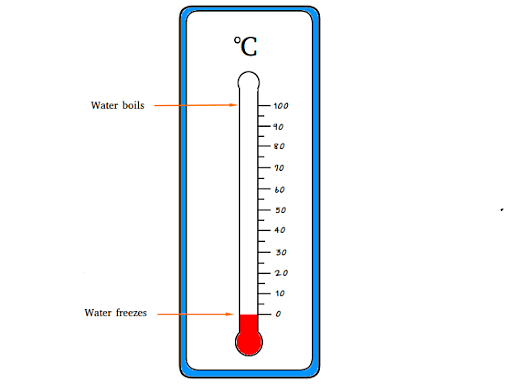
The Celsius scale was Invented in 1742 by the Swedish astronomer Anders Celsius. It is also called the centigrade scale because of the 100-degree interval between the defined points. The temperature in the centigrade scale shall be expressed in degrees Celsius.
Centigrade Scale
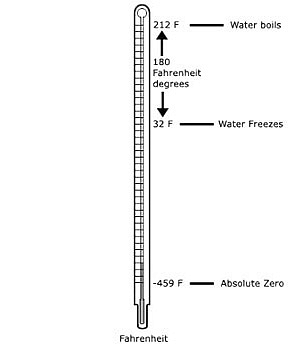
The Fahrenheit scale is a temperature scale which was proposed in 1724 by the physicist Daniel Gabriel Fahrenheit. It uses the degree Fahrenheit as the unit.
Fahrenheit Scale
Relation Between Celsius and Fahrenheit
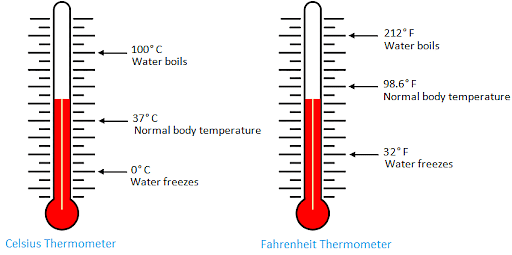
The relation between the Celsius and the Fahrenheit is directly proportional to each other which means that if the temperature in the Celsius scale increases, then the temperature in the Fahrenheit scale will also increase. But both have a different freezing point in case of water and both tend to follow the varied unit differences between each scale on the basis of their different nature, for instance,
On the Celsius scale, the temperatures are as follows
0°C = the freezing point of water.
100°C = the boiling point of water.
On the Fahrenheit scale, the temperatures are as follows
32°F = the freezing point of water.
212°F = the boiling point of water.
Relation Between Celsius and Fahrenheit
Units of Celsius and Fahrenheit
[Click Here for Sample Questions]
The units of temperature can be measured using different scales which prove to be useful in determining the different temperatures from one scale to another. Such as:
- The temperature in the Celsius scale is denoted by °C. Example: 2°C
- The temperature in the Fahrenheit scale is denoted by °F. Example: 2°F
Derivation of the relation between Celsius and Fahrenheit
[Click Here for Sample Questions]
The derivation of the relation between the two units of the temperature, that is, the Celsius and the Fahrenheit, could be proved with the help of the mathematical equation as mentioned below.
As the freezing point of water in celsius scale is 0°C and in fahrenheit scale is 32°F, we get the equation,
C − 0 = F − 32
Dividing it by the total number of intervals in the scale (100 degree interval for celsius scale and 180 degree interval for fahrenheit scale) we get,
→ (C − 0) / 100 = (F − 32) / 180
→ C / 100 = (F − 32) / 180
→ C / 5 = (F − 32) / 9
In the above proving equations
F → Temperature in Fahrenheit.
C → Temperature in Celsius.
Conversions
[Click Here for Sample Questions]
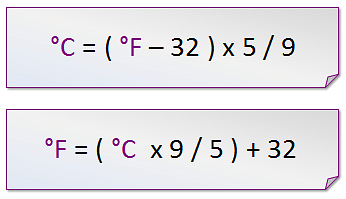
From Celsius to Fahrenheit: The conversion of units from Celsius to Fahrenheit could be expressed through a mathematical equation as mentioned below.
F = (9 / 5 × C) + 32
For instance, In order to convert 2 degree Celsius into Fahrenheit, the above given formula shall be used such as:
F = (9 / 5 X 2) + 32
Therefore, the value of F shall be 35. 6 °F
From Celsius to Fahrenheit
From Fahrenheit to Celsius: The conversion of units from Fahrenheit to Celsius could be expressed through a mathematical equation as mentioned below.
C = 5 / 9 (F − 32)
For instance, In order to convert 2 degrees Fahrenheit into Celsius, the above given formula shall be used such as:
C = 5 / 9 (2 – 32)
Therefore, the value of C shall be 16. 666 °C
The derivation relation and the function between the Fahrenheit and the Celsius represents the ease in measuring temperature and contribute in understanding the counter effects of each other.
Things to Remember
- The temperature in the centigrade scale shall be expressed in degrees Celsius.
- The temperature in the fahrenheit scale shall be expressed in degrees Fahrenheit.
- 0 °C is the freezing point of water on a celsius scale whereas 32 °F is the freezing point on a fahrenheit scale.
- 100 °C is the boiling point of water on a celsius scale whereas 212 °F is the freezing point on a fahrenheit scale.
- The Celsius scale has a 100 degree interval and Fahrenheit scale has 180 degree interval.
- The formula to convert celsius to fahrenheit is F = (9 / 5 × C) + 32
- The formula to convert fahrenheit to celsius scale is C = 5 / 9 (F − 32)
Sample Questions
Ques. What is Kelvin Scale? And mention the freezing point and the boiling point on the Kelvin scale. (2 marks)
Ans. Just like the Centigrade scale and the Fahrenheit scale, the kelvin scale is also used for measuring the temperature and its own relation between the other two scales. The freezing point on the kelvin scale is 273k while the boiling point is 373k. Here, k represents the unit of kelvin.
Ques. Which unit is used to express temperature in the centigrade scale? (2 marks)
Ans. Celsius is used to express unit temperature in the centigrade scale, such as 2 degrees Celsius.
Ques. What will be the value of 30° C to Fahrenheit? Show with the help of formula application. (2 marks)
Ans. In order to convert 30° C into Fahrenheit, the following formula shall be applied.
F = (9 / 5 X C) + 32
Here, F refers to the temperature in Fahrenheit
While C refers to the temperature in the Centigrade scale.
In this particular case, the value of C = 30. So, we will substitute the value of C in the formula and we will get the value of F.
F = (9 / 5 X 30) + 32
F = ( 9 X 6) + 32
F = 54 + 32
F = 86
So, 30° C = 86° F
Ques. What is the boiling point of water on the Fahrenheit scale and the centigrade scale? (2 marks)
Ans. The Fahrenheit scale and the centigrade scale, both uses their own different thermometers and different values of scales for measuring the temperature, therefore the boiling point of water varies in both the scales, such as, the boiling point of water in the Centigrade scale is 100 degrees Celsius and on the Fahrenheit scale it is 212 degrees Fahrenheit.
Ques. What is the relation between the Celsius and the Fahrenheit? (2 marks)
Ans. The Celsius and Fahrenheit are directly proportional to each other, such that, if the equivalent temperature in the Celsius unit increases then the temperature in Fahrenheit shall also increase and vice versa.
Ques. What is the temperature in Fahrenheit of 20 °C? (2 marks)
Ans. The conversion formula for °C to °F is
TF = 9/5(TC) + 32
TF = 9/5(20) + 32
TF = 36 + 32
TF = 68 °F
The temperature in Fahrenheit of 20 °C is 68 °F.
Celsius and Fahrenheit are the same at -40°, but at ordinary temperatures, the Fahrenheit temperature will be higher than the Celsius value.
Ques. Convert 40 °C to the Fahrenheit scale. (2 marks)
Ans. The conversion formula for °C to °F is
TF = 9/5(TC) + 32
40° × 9 = 360°
= 360° ÷ 5 = 72°
= 72 + 32
= 104° F
Therefore, 40° C = 104° F
Ques. Convert 30°C to the Fahrenheit scale. (2 marks)
Ans. The conversion formula for °C to °F is
TF = 9/5(TC) + 32
= 30° × 9
= 270°
= 270° ÷ 5
= 54°
= 54 + 32
= 86° F
Therefore, 30° C = 86° F
Ques. Convert 75°C to the Fahrenheit scale. (2 marks)
Ans. The conversion formula for °C to °F is
TF = 9/5(TC) + 32
= 75° × 9
= 675°
= 675° ÷ 5
= 135°
= 135 + 32
= 167° F
Therefore, 75° C = 167° F
Ques. Convert 20°C to the Fahrenheit scale. (2 marks)
Ans. The conversion formula for °C to °F is
TF = 9/5(TC) + 32
= 20° × 9
= 180°
= 180° ÷ 5
= 36°
= 36 + 32
= 68° F
Therefore, 20° C = 68° F
For Latest Updates on Upcoming Board Exams, Click Here: https://t.me/class_10_12_board_updates
Do Check Out:



Comments