



Content Curator
Fluid friction refers to the force that resists the movement of liquid within itself or in another medium.
- The molecules in liquid move constantly due to less attractive forces between them.
- Due to this movement, the conflict occurs within the fluid and with the external medium as well.
- So, internal friction occurs all along the layers of liquid that are relative to each other.
- The fluid Friction depends on the thickness of the fluid.
- Viscosity infers the internal resistance to flow, lesser the viscosity of the fluid, the greater the frictional force.
- It is usually used in the water slides allowing the people to slide down gently.
| Table of Content |
Key Terms: Viscosity, Fluids, Fluid friction, Dry friction, Water, Air, Solid, Force, Lubricants, Resistance, Internal resistance, Atoms, Interatomic force
Types of Friction
[Click Here for Sample Questions]
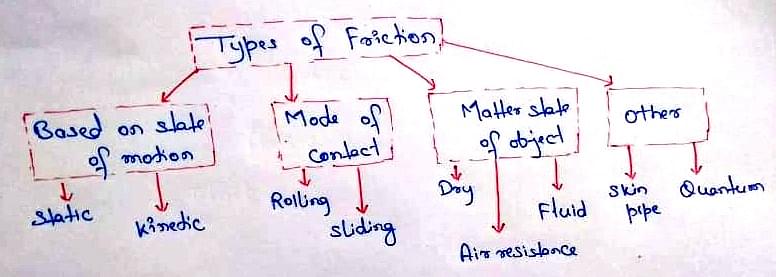
Different types of friction are as follows
- Dry Friction: It refers to the resistance to relative lateral motion produced between two solid surfaces.
- Fluid Friction: It refers to the friction produced between the thick fluid layers moving parallel to each other.
- Lubrication Friction: It refers to the fluid friction where the surfaces of two solids are lubricated with the materials to make the surface smooth.
- Skin Friction: It refers to the force that resists the motion of a fluid throughout the body surface.
- Internal Friction: It refers to the force between the particles of a solid surface that resists their motion while it deforms.
What is Fluid Friction?
[Click Here for Sample Questions]
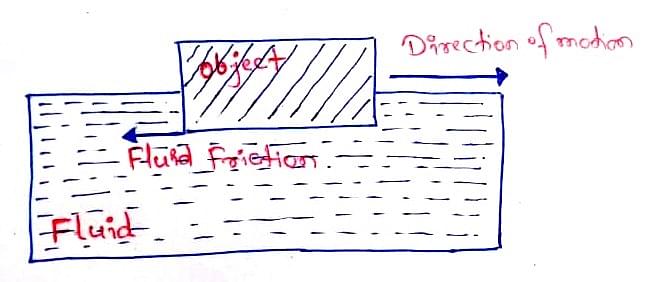
The internal resistance that arises when fluid layers move relative to one another is known as fluid friction.
- This internal resistance is known as viscosity.
- Any material that can flow is known as fluid.
- Therefore water and air are both considered as fluid.
- Air resistance is caused by fluid friction between air and a surface.
- When an object moves through the air, it pushes the air out of the path and the air pushes back.
- This push of air on the moving object causes friction, which slows it down.
-
As a result, moving vehicles such as cars, buses, aircraft, and rockets experience frictional forces.
Also check:
| Related Concepts | ||
|---|---|---|
| Types of Friction | Friction in Automobiles | Fluid Flow |
| Mechanical Properties of Fluids | Properties of Fluids | Fluid Mechanics Formula |
Factors Affecting Fluid Friction
[Click Here for Sample Questions]
Usually, friction occurs in liquids. So it is called the fluid Friction. The factors on which the fluid Friction depends and is affected are as follows:
Speed of Object
The friction increases with the speed of the Object.
- The higher the speed of the Object, the greater the fluid Friction.
- The lesser the speed of the Object, the lesser the fluid Friction.
Shape of Object
An object with a streamlined shape experiences less friction. While the non-streamlined objects have more fluid Friction.
Size of Object
The larger object faces more friction. The small object faces less friction. It is due to the surface area of the object.
Nature of Fluid
The fluids with more thickness and viscosity face more friction. It is due to the close arrangement of molecules, greater friction occurs.
Viscosity of Fluid
The more is the density of the fluid, the more viscosity, and more friction. Due to the density, molecules inside are restricted from motion, and hence the resistance is increased.
Temperature of Fluid
The fluid friction is directly proportional to the temperature. The fluid friction increases along with the increase in temperature.
Examples of Fluid Friction
[Click Here for Sample Questions]
The following are examples of fluid friction
Shaving cream
When we apply shaving cream on the face, a foamy layer is formed. This causes friction between the face and cream reducing harm to the skin.
The flow of ink in a pen
The ink is packed in the refills for all pens.
- It doesn’t flow and doesn’t get leaked.
- It is due to the internal friction that the fluid remains without flowing.
Cleaning on a wet place
We always clean a place by pouring some water on the area. This makes our job easier with less amount of water.
Air pushing against the hand
The air flows so fast that we cannot stand it at times. When we place our hand firmly against it, friction between hand and air occurs.
Moving of submarine into the water
The submarine is a heavy body that runs with the fuel inside the water. Due to its heavy weight and contact with water, there is friction occurring.
Also check:
Things to Remember
- Fluids are non-fixed-shape substances that flow easily due to larger intermolecular spaces.
- Friction is the force that resists the relative motion between two bodies in contact.
- Fluid Friction is the force that opposes the motion of molecules within the fluid and the external medium it is in contact with.
- The fluid friction depends on the shape, size, speed, and nature of fluid or objects.
- The two conditions where fluid friction occurs are due to the internal movement of molecules and the interaction of the fluid with the external medium.
- There are five types of friction which include fluid friction, skin friction, lubricant friction, dry friction, and internal friction.
Sample Questions
Ques. What do you mean by fluid? (1 mark)
Ans. Fluids are non-fixed-shape substances that flow easily due to larger intermolecular spaces. Fluids include both liquids and gases.
Ques. What is friction? (1 mark)
Ans. Friction is the force that resists solid surfaces, fluid layers, and material components from sliding against each other.
Ques. Why is fluid Friction important? (3 marks)
Ans. The fluid Friction resists the motion of fluids and avoids flowing. It may slow down the motion of the fluids or objects. In most cases, it is only due to the friction that the water moves in a particular direction, drinks can be filled in certain containers to drink and use the liquids. So, fluid friction is highly important in order to enhance the movement of fluids without any obstacles.
Ques. How to reduce fluid Friction? (2 marks)
Ans. Fluid friction can be reduced by designing a streamlined shape for the objects, maintaining the speed of the fluid, placing the fluids in a properly placed container, and taking thick viscous fluids. These are the factors which affect the fluid friction. So when the factors are well balanced and taken care of, the fluid friction can be reduced.
Ques. State the law of fluid friction. (3 marks)
Ans. The laws of fluid friction are:
- Different lubricants have different fluid friction.
- The friction is indirectly proportional to the temperature of the lubricant.
- The friction doesn’t depend on the load or surfaces of the fluids.
Ques. How does fluid friction occur? (3 marks)
Ans. Each particle or molecule moves constantly around exerting a force within the fluid. Also, when these molecules come in contact with the external medium a resistant force is created. It is only due to the movement of molecules that interactions occur between the particles causing disturbances and getting displaced. So, the entire fluid exerts a force on the external medium. Opposing this force, internal friction called fluid friction is exerted by the liquid.
Ques. Is fluid friction the same for all objects? (2 marks)
Ans. No. The fluid friction varies for all the fluids and objects. It is entirely based on the shape, size, nature, temperature, and surface area of the fluids. Also, the objects having more speed face more friction. And the objects with less speed face less friction. Streamlined objects have less friction when compared to non-streamlined objects. So, the fluid friction is different for all fluids and depends on factors such as speed, size, nature, and shape of fluids.
Ques. What is fluid friction? (2 marks)
Ans. Fluid friction refers to the resistance produced to the motion of an object within a liquid or gas. When the resistance is taking place within the liquid it is called the viscous resistance. When a lubricant is added in between the two solid surfaces, fluid friction occurs and it reduces the erosion caused by friction between the solid surfaces without the lubricant.
Ques. Name the factors that affect fluid friction. (3 marks)
Ans. The factors include:
- Speed of the object
- Shape of the object
- Size of the object
- Nature of the fluid
- Viscosity of the fluid
- Temperature of the fluid
Ques. What are the different types of friction? (2 marks)
Ans. Following are the different types of friction
- Dry friction
- Fluid friction
- Lubricated friction
- Skin friction
- Internal friction
For Latest Updates on Upcoming Board Exams, Click Here: https://t.me/class_10_12_board_updates
Also Read:



Comments