



Content Curator
Sum of Cubes Formula is the formula used to find the result of two polynomials upon addition (a3+ b3). The sum of cubes formula is derived by calculating the area of a particular region by using two different methods. The first is to square a side’s length and then add the smaller squares’ areas. It can be said alternatively that the first n natural numbers’ sum will be the sum of the first n cubes. The sum of cubes formula proves to be very useful while solving algebraic expressions of various types. The formula is quite similar to the difference in cubes formula as well.
| Table of Content |
Key Terms: Sum of Cubes Formula, Cube, Variable, Multiplication, Power, Algebraic Identities, Polynomial, Factoring Formula
Also Read: Mathematics Preparation Tips
Sum of Cubes Formula
[Click Here for Sample Questions]
The formula of the sum of cubes is also known as the factoring formula. The following formula is used to determine the sum of cubes of any polynomial:
a3 + b3 = (a + b)(a2 - ab + b2)
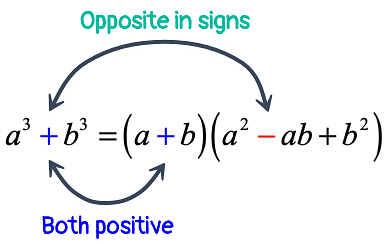
Sum of Cubes Formula
Here, a is the first variable, and b is the second variable.
Also Read: Sum of Squares Formula
Proof For Sum of Cubes Formula
[Click Here for Sample Questions]
The proof or the verification of the formula of the sum of cubes {a3 + b3 = (a + b) (a2 - ab + b2} is given by proving that LHS = RHS here.
LHS = a3 + b3
After the solution of RHS term, we find,
= (a + b) (a2 - ab + b2)
After the multiplication of a and b with (a2 + ab + b2), we get
= a (a2 - ab + b2) + b(a2 - ab + b2)
= a3 - a2b + ab2 + a2b - ab2 + b3
= a3 - a2b + a2b + ab2- ab2 + b3
= a3 - 0 + 0 + b3
= a3 + b3
LHS = RHS
Hence, the Sum of Cubes Formula is proved.
Also Read: Statistics
How to Solve a Question With Sum of Cubes Formula?
[Click Here for Sample Questions]
For solving a question with the sum of cubes formula, we shall use the following steps.
- Take note of the pattern of the two numbers and check if they have the power of 3 on them or not.
- Now, note down the formula for the sum of cubes that is a3 + b3 = (a + b) (a2 - ab + b2)
- Substitute the values of b and a in the formula of the sum of cubes and simplify it.
For Example: Find the value of (1003 + 23) using the formula for the sum of cubes.
Solution: To Find: 1003 + 23
Let's take a = 100 and b = 2.
Substitute these values in the formula of the sum of cubes that is, a3 + b3
a3 + b3 = (a + b) (a2 - ab + b2)
=1003+23 = (100+2)(1002 - (100)(2)+22)
= (102) (10000-200+4)
= (102)(9804)
= 1000008
Therefore the Answer is: 1003 + 23 = 1000008.
Things to Remember
- The formula for the Sum of the cubes is the formula that is used to find the resultant of the addition of two polynomials (a3+ b3).
- The formula of the sum of cubes is also known as the factoring formula.
- The extended form of the formula is a3 + b3 = (a + b)(a2 - ab + b2). Here, b is the second variable, and a is the first variable.
- The values given in a question should have a power of 3 upon them on each variable.
Also Read: Distance Time Graph
Solved Questions
Ques. Simplify the following equation 193+ 203 with the use of the sum of cubes formula. (3 marks)
Ans. To find 193 + 203
Let a = 19 and b = 20
By Using the sum of cubes formula a3 + b3 = (a + b) (a2 - ab + b2)
We now substitute the values in the a3 + b3 formula
a3 + b3 = (a + b) (a2 - ab + b2)
=193+203 = (19+20)(192 - (19)(20)+202)
= (39)(361-380+400)
= (39)(381)
= 14,859
Therefore the answer is: 193 + 203 = 14859.
Ques. Factorise the following equation 27x3 + 1. (3 marks)
Ans. To factorise 27x3 + 1
Let a = 3x and b = 1
By Using the sum of cubes formula a3 + b3 = (a + b) (a2 - ab + b2)
We now substitute the values in the a3 + b3 formula
= 27x3 + 1 = (3 x)3 + 13
= (3 x+1)[(3 x)2 − (3 x)(1) + 12)]
= (3 x + 1)(9 x2 – 3 x + 1)
Ques. Factorise the following equation: 8x3 +125 (3 marks)
Ans. To factorise: 8x3 + 125
Let a = 2x and b = 5
By Using the sum of cubes formula a3 + b3 = (a + b) (a2 - ab + b2)
We now substitute the values in the a3 + b3 formula
=8x3 + 125 = (2x)3 + 53
a3 + b3 = (a + b)(a2 – ab + b2)
Therefore, 8x3 + 125 = (2x + 5)[(2x)2 – (2x)(5) + 52] = (2x + 5)(4x2 – 10x + 25)
Ques. Factorise the following equation: 64x3 + 27y3 (3 marks)
Ans. To factorise: 64x3 + 27y3
64x3 + 27y3 = (4x)3 + (3y)3
Let a = 4x and b = 3y
By Using the sum of cubes formula a3 + b3 = (a + b) (a2 - ab + b2)
We now substitute the values in the a3 + b3 formula
a3 + b3 = (a + b)(a2 – ab + b2)
Therefore, 64x3 + 27y3 = (4x + 3y)[(4x)2 – (4x)(3y) + (3y)2] = (4x + 3y)(16x2 – 12xy + 9y2)
Ques. Factorise the following equation: x3 – 8. (3 marks)
Ans. To factorise: x3 - 8.
x3 – 8 = x3 – 23
Let a = x and b = 2
By Using the sum of cubes formula a3 + b3 = (a + b) (a2 - ab + b2)
We now substitute the values in the a3 + b3 formula
= (x – 2)(x2 + 2x + 22)
= (x – 2)(x2 + 2x + 4)
Ques. Factorise the following equation: 27x3 + 1 (3 marks)
Ans. To factorise: 27x3 + 1
27x3 + 1 = (3x)3 + 13
Let a = 3x and b = 1
By Using the sum of cubes formula a3 + b3 = (a + b) (a2 - ab + b2)
We now substitute the values in the a3 + b3 formula
= (3x + 1)((3x)2 – (3x)(1) + 12)
= (3x + 1)(9x2 – 3x + 1)
Ques. Factorise the following equation x3y6 + 64. (3 marks)
Ans. X3y6 + 64 = (xy2)3 – 43
Let a = xy.2 and b = 4
By Using the sum of cubes formula a3 + b3 = (a + b) (a2 - ab + b2)
We now substitute the values in the a3 + b3 formula
x3y6 – 64 = (xy2)3 – 43
= (xy2 – 4)((xy2)2 + (xy2)(4) + 42)
= (xy2 – 4)(x2y4 + 4xy2 + 16)
Ques. If the value of a3 + b3 = 405 and the value of a + b = 9, then find the value of ab. (3 marks)
Ans. Given: a3 + b3 = 405
→ a + b = 9
The Formula to be used: (a + b)3 = a3 + b3 + 3ab(a + b)
Now, Substituting the values in the formula
⇒ (9)3 = 405 + 3ab (9)
⇒ 729 = 405 + 27ab
⇒ 27ab = 324
⇒ ab = 12
Therefore, The value of ab is found to be 12.
Ques. Find the value of a3 + b3, if a/b + b/a = 1. (3 marks)
Ans. To find: a3 + b3
Since, a/b + b/a = 1,
So, (a2 + b2)/ab = 1 → a2 + b2 = ab
Now, a2 + b2 = ab (eq 1)
= a2 = ab - b2
= a2 = b(a-b)
= a2.a= a.b(a-b)
= a3 = ab(a-b) (eq 2)
Using eq 1 we can write,
b2 = ab - a2
b2.b = b.a(b-a)
b3 = ab(b-a) (eq 3)
So, a3 + b3 = ab(a-b) + ab(b-a) (by using eq 2 and eq 3)
a3+ b3 = ab
Therefore, a3 + b3 = 0.
Ques. Use the sum of cubes formula to find the factor of 216x3 + 64. (3 marks)
Ans. To find: The Factor of 216x3 + 64 by using the sum of cubes formula.
216x3+ 64 = (6x)3 + 43
Now, Use the sum of cubes formula,
a3 + b3 = (a + b)(a2 - ab + b2)
Putting the particular values,
(6x)3 + 43 = (6x + 4)((6x)2 - 6x × 4 + 42)
(6x)3 + 43 = (6x + 4)(36x2 - 24x +16)
(6x)3 + 43 = 8(3x + 2)(9x2 - 6x + 4)
Therefore, the factor of 216x3 + 64 is 2(3x + 2)(9x2 - 6x + 4).
Ques. Find the factor of 8x3 + 125y3. (3 marks)
Ans. To find: The Factor of 8x3 + 125y3 by using the sum of cubes formula.
8x3 + 125y3 = (2x)3 + (5y)3
Now Use the sum of cubes formula,
a3+b3 = (a + b)(a2 - ab + b2)
Putting the required values,
(2x)3 + (5y)3 = (2x + 5y)((2x)2 – (2x)(5y) + (5y)2)
(2x)3 + (5y)3 = (2x + 5y)(4x2 – 10xy + 25y2)
Therefore, the factor of 8x3 + 125y3 is (2x + 5y)(4x2 – 10xy + 25y2).
Check More:



Comments