



Content Curator
Taxonomy is the branch of science that deals with naming and classifying organisms. Taxonomic hierarchy refers to the systematic arrangement of taxonomic groups in classification. The arrangement of categories can be done in either ascending order or descending order. When all the categories are put together, it is called the taxonomic hierarchy. Every category in a taxonomical hierarchy called a unit represents a rank which is called a taxon. The taxonomic hierarchies are divided into categories that will be discussed in detail here.
| Table of Content |
Read Also: Heterotrophic Bacteria
What is Taxonomic Hierarchy?
The word “Taxonomy” is a union of two words derived from the Greek language. “Taxis” means arrangement or division, and “nomos” means method. Therefore, taxonomy is the process of classifying different living organisms. Taxonomic hierarchy is the framework through which taxonomic groups are arranged in a definite order from higher to lower categories. In the hierarchy, the kingdom is at the highest rank and species is at the lowest rank. Taxonomic hierarchy is also known as Linnaean hierarchy since it was first proposed by Swedish botanist Carolus Linnaeus. Initially, Linnaeus used only five categories namely class, order, genus, species, variety. Later, it was modified and the variety was discarded. Few more categories were added such as kingdom, phylum and family.
Taxonomic Hierarchy Categories:
Taxonomic hierarchies have seven categories. The Linnean hierarchy was modified by discarding variety as a taxonomic category and adding three new categories. The final seven obligate categories that are now widely accepted are:
- Kingdom
- Phylum/Division
- Class
- Order
- Family
- Genus
- Species
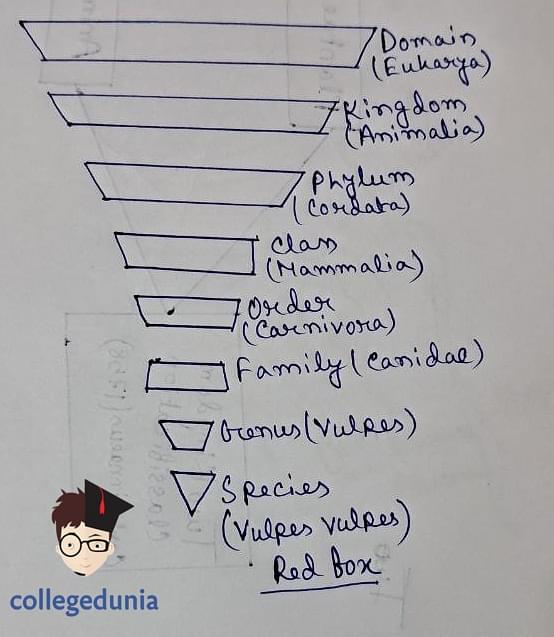
Species: It occupies the lowest position in the taxonomic classification. They are a group of individuals with basic similarities.
- They are the basic unit to understand the taxonomy as well as the evolution of any organism.
- Species resemble each other and have the same morphological and reproductive characteristics.
- They also carry the same amount of genetic material so that breeding is possible amongst individuals of the same species to produce offspring.
- Examples of species are Mango (Mangifera indica), Lion (Panthera leo) and Potato (Solanum tuberosum). In this, indica, leo and tuberosum are species of genera Mangifera, Panthera and Solanum respectively.
Genus: Genus refers to the group of species that are related and have fewer characters in common. They are above the level of species.
- They are divided into two categories namely monotypic and polytypic. Those that have only one species are called monotypic. For example, Nandina domestica is the only species in the genus Nandina.
- Polytypic species refers to the genus that has more than one species. For example, the African elephant belongs to the genus Loxodonta under the Elephantidae family. The African elephant species is divided into two subspecies: the African forest elephant and the African savanna elephant.
- Few more examples of the genus are lion (Panthera leo), leopard (Panthera pardus) and tiger (Panthera tigris). All of them belong to the same genus Panthera.
- Genus resembles correlated characters or common features and indicates a common ancestry for all the species of a genus.
Family: Family is represented by a group of related genera that are more similar to each other than with families of other genera.
- Solanum, Petunia, Datura etc share similarities among themselves and are placed in the family Solanaceae.
- Animals such as lion, leopard, tiger from Panther genus and cat from Felis genus are both included in the family Felidae.
- If we look at cats and dogs, we will notice that they have different features and the prime reason for the same is because cats belong to the family Felidae while dogs belong to the family Canidae.
- In plants, the family ends with the suffix -aceae while in animals the suffix used is -ideae.
Order: Order refers to the aggregates of characters or assemblage of families that represent one another with some traits.
- The order ends in the suffix -ales in plants.
- An example of the order will be order Carnivora that contains related families of Canidae and Felidae.
Class: It is a taxonomic category that is made up of one or more related orders.
- An example of the same can be class Mammalia that has several orders such as Carnivora, Rodentia, Insectivora etc.
- It ends in suffixes -phyceae and -opsida and -ae in plants.
Phylum: It consists of one to several related classes having similar correlated characters.
- In the case of plants, the term “division” is used instead of the phylum.
- Among animals, phylum Chordata includes classes Pisces, Amphibia, Reptiles, Aves and Mammals.
- The suffix used in phylum is -phyta.
Kingdom: It is the highest category of biological classification. It includes all organisms that share a set of distinguishing common characters.
- Plants are kept under the Plant Kingdom while the animals are kept under Animal Kingdom.
- R.H Whittaker has proposed five kingdoms of organisms which are Monera, Protista, Fungi, Plantae and Animalia.
Examples of Taxonomic Hierarchy
Few examples of the taxonomic hierarchies are listed below.
| Plant Example | Taxonomic Hierarchy | Animal Example |
|---|---|---|
| Plantae | Kingdom | Animalia |
| Angiospermophyta | Phylum | Chordata |
| Eudicotidae | Class | Mammalia |
| Ranunculales | Order | Primate |
| Ranunculaceae | Family | Hominidae |
| Ranunculus | Genus | Homo |
| acris | Species | Sapiens |
| Buttercup | Common Name | Human |
Things to Remember
- Taxonomic hierarchies refer to the systematic arrangement of taxonomic groups in classification. The arrangement of categories can be done in either ascending order or descending order.
- A taxon is a rank that represents a category in a taxonomic hierarchy. It represents real biological objects that are being classified.
- In the taxonomic hierarchy, the kingdom is at the highest rank and species is at the lowest rank. Taxonomic hierarchy is also known as Linnaean hierarchy since it was first proposed by Swedish botanist Carolus Linnaeus.
- There are seven taxonomic ranks namely kingdom, division, class, order, family, genus and species.
- The example of taxonomic rank for humans will be Kingdom-Animalia, Phylum-Chordata, Class-Mammalia, Order-Primate, Family-Hominidae, Genus-Homo, Species-Sapiens.
Read Also: Salient Features Of The Kingdom
Sample Questions
Ques. What is a taxonomic hierarchy?
Ans: Taxonomical hierarchy is defined as the systematic arrangement of taxonomic groups in classification. The arrangement of categories can be done in either ascending order or descending order. When all the categories are put together, it is called taxonomic hierarchy
Ques. How many taxonomic ranks are accepted in modern times?
Ans: In modern times, there are seven taxonomic ranks. These are kingdom, phylum, class, order, family, genus and species.
Ques. Who is known as the father of taxonomy and why?
Ans: Carolus Linnaeus, a Swedish botanist is known as the father of taxonomy since he gave the very first system of classification of plants and animals. According to his two-kingdom system of classification, all living organisms were divided into two kingdoms namely plant and animal.
Ques. Distinguish between class and order.
Ans: Class refers to the taxonomic category that is made up of one or more related orders. For example, Mammalia has several orders such as Carnivora, Rodentia, Insectivora etc.
Order refers to the aggregates of characters or assemblage of families that represent one another with some traits. For example, Carnivora contains related families of Canidae and Felidae.
Ques. Differentiate between genus and family with example.
Ans: Genus refers to the group of species that are related and have fewer characters in common. They are above the level of species and resemble correlated characters or common features and indicate a common ancestor for all the species of a genus. For example, lion (Panthera leo), leopard (Panthera pardus) and tiger (Panthera tigris)- all belong to the same genus Panthera.
Family is represented by a group of related genera that are more similar to each other than with families of other genera. Animals such as lion, leopard, tiger from Panther genus and cat from Felis genus are both included in the family Felidae.
Ques. How is R.H Whittaker’s classification different from Linnaeus' classification?
Ans: R.H Whittaker classified the five kingdoms of organisms in 1969. These were Monera, Protista, Fungi, Plantae and Animalia. While Monera consisted of unicellular prokaryotic organisms, the remaining four were composed of eukaryotic organisms.
On the contrary, Linnaeus’ classification was done in two categories namely Plant and Animal kingdom. Since Linnaeus was a precursor of Whittaker, his classification had limitations.
Ques. What is the scientific name of Mango? What is the correct way to write it?
Ans: The scientific name of Mango is Mangifera indica. It must be noted that for writing binomial nomenclature of organisms, the genus name is written in a capital first letter while for species name, all small letters are used.
Ques. Define the lowest category of classification.
Ans: The lowest category of classification is species. It is a group of individuals with basic similarities. Species carry the same genetic material and share the same morphological and reproductive characteristics.



Comments