



Education Journalist | Study Abroad Lead
Movement is defined as a change in the location of an object. It occurs in the human body whenever a single or a group of body parts move. Similarly, we can define locomotion as any movement that results in a change in the location of the entire organism. Movement can be classified as one of the most important characteristics of living beings. Animals and plants can move in a variety of ways. In unicellular organisms like Amoeba, protoplasm streaming is a primitive kind of locomotion. Many species display cilia, flagella, and tentacle movement. Humans can move their limbs, jaws, eyelids, tongue, and other body parts. As we get older, our body movement becomes more refined. We usually start with simple movements like rolling, crawling, and eventually walking when we are young. A change of place or location occurs as a result of movement. Walking, running, climbing, and flying are all movements. Because of joints, these movements are possible. Joints are the sites on our bodies where two or more skeleton elements are joined. Different types of joints assist our bodies in performing various activities and actions.
Table of Contents
| Table of Content |
Key Terms: Movement, Locomotion, Types of Movement, Joints, Amoeboid Movement, Ciliary Movement, Muscular Movement, Life Processes, Amoeba, Cells, Human Body
Types of Movement
[Click Here for Sample Questions]
Being one of the most important characteristics of living organisms, Movement can be of different types as mentioned below. Movement can be differentiated between plants and animals.
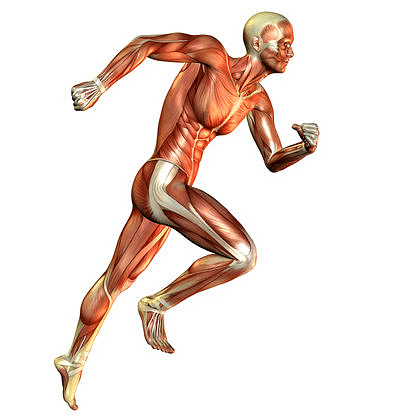
Movement
The three main types in which movement has been classified are as follows:
Amoeboid Movement
In eukaryotic cells, amoeboid movement is the most prevalent mechanism of motility. It is a crawling-like action including the development of pseudopodia (false-feet) and posterior uropods, which is performed by the protrusion of the cell's cytoplasm.
- Amoebae exhibit this form of locomotion (e.g. Amoeba proteus).
- Plasmasol (central fluid) is surrounded by a more viscous plasma gel in their cytoplasm.
- To drive the cell forward, the plasma gel is converted to plasma sol, allowing the cytoplasm to slide and form a pseudopodium in front.
- Amoeboids are cells that migrate in this direction. Cellular slime moulds (e.g. Dictyostelium discoideum) and human cells, particularly Kupffer cells of the liver, monocytes, neutrophils, macrophages, and malignant cells, are further instances.
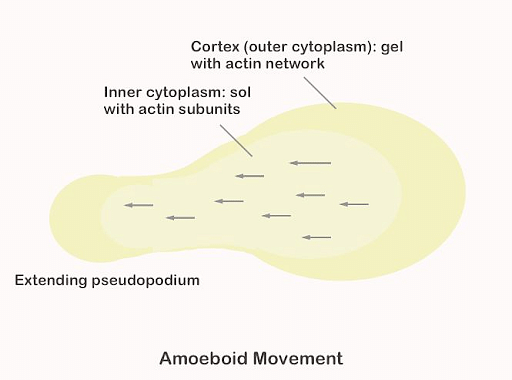
Amoeboid Movement
Ciliary Movement
Cilia are hair-like, microtubule-based organelles. They protrude from the surface of nearly all human cell types. Sensory cilia serve as cellular antennas during the development stages by detecting environmental and morphogenic signals.
- Cilia are hair-like outgrowths that arise from the plasma membrane.
- Cilia play an important function in locomotion as well as mechanoreception.
- Ciliated organisms are those that have cilia. Their cilia are used for feeding and movement.
- Cilia are made up of microtubules and the motor protein dynein.
- Tubulin is a type of globular protein that is made up of linear polymers.
- Ciliary movement is defined as the rhythmic movement of cilia that generates fluid or cell movement. Eukaryotic cells contain cilia.

Ciliary Movement
Muscular Movement
The muscular system is the main in charge of the mobility of a living body. Around 700 identified muscles are attached to the bones of the skeletal system that accounts for nearly half of a person's total weight. They are individual organs made up of skeletal muscle tissue, blood vessels, tendons, and nerves. The heart, digestive organs, and blood vessels all comprise muscle tissue. Muscles present in these organs help to transport chemicals throughout the body.
Visceral, cardiac, and skeletal muscle tissue are the three forms of muscle tissue.
- Visceral Muscles: The stomach, intestines, and blood arteries all have visceral muscles inside them. Visceral muscle, the weakest of all muscular tissues, causes organs to contract in order to transport substances through them.
- Cardiac Muscles: Cardiac muscle is exclusively found in the heart and is responsible for pumping blood throughout the body. Cardiac muscle tissue is an involuntary muscle since it cannot be regulated intentionally. The pace of contraction is adjusted through hormones and impulses from the brain, but the cardiac muscle stimulates itself to contract.
- Skeletal Muscles: The only voluntary muscle tissue in the human body is skeletal muscle, which can be manipulated consciously. Skeletal muscle is required for any conscious physical activity (e.g., speaking, walking, or writing). The purpose of skeletal muscle contraction is to bring sections of the body closer to the bone to which it is linked. Because most skeletal muscles are linked across a joint to two bones, they help to bring those bones closer together.

Muscular Movement
Also Read: Difference between Cardiac Muscle and Skeletal Muscle
Types of Joints and Their Functions
[Click Here for Sample Questions]
The various movements in our body are possible due to the presence of joints. Joints are the sites on our bodies where two or more skeleton elements are joined. Different joints assist our bodies in performing various activities and actions. Here are the main types of joints along with their specific function:
- Ball and Socket Joint: Joint with a ball and socket design. It is made up of one bone's rounded head sitting in the cup of another bone, allowing movement in all directions. The shoulder joint and hip joint are two examples of ball and socket joints.
- Hinge Joint: This joint functions similarly to a door, opening and closing in a single plane. The Elbow joint and your knee joint are two examples of hinge joints.
- Pivot Joint: The pivot joint, also known as the rotary or trochoid joint, is produced by one bone spinning in a ring formed by another bone. The first and second vertebrae in the neck, as well as the joints between the ulna and radius bones, which rotate the forearm, are two examples of the pivot joint.
- Saddle Joint: This joint allow for back and forth movement as well as side to side movement although it does not allow for rotation. The joint at the base of your thumb is an example of the saddle joint.
- Gliding Joint: The plane joint is another name for the gliding joint. This joint smooth surfaces that can slip over one another, despite the fact that it only allows restricted mobility. The wrist joint is an example of the gliding joint.

Types of Joints
Types of Body Movements in Humans
[Click Here for Sample Questions]
A change in position of a bodily component with relation to the total frame is referred to as movement. It is one of the most significant characteristics of all living beings. Blinking, breathing, and eating are considered to be the examples of movement.
- Flexion: The medical term for bending an arm or leg is flexion. It is a physical position that reduces the angle between the limb's bones at a joint. When your muscles tighten, your bones and joints bend into a bowed position.
- Extension: The opposite of flexion is an extension, which describes a straightening motion that increases the angle between bodily parts.
- Lateral Flexion: Lateral flexion is the movement of a bodily part to the side. The neck and spine are frequently associated with this type of movement.
- Abduction: Abduction is a movement in which one or more abductor muscles pull a structure or part away from the body's midline.
- Adduction: The movement of a body portion toward the body's midline is known as adduction.
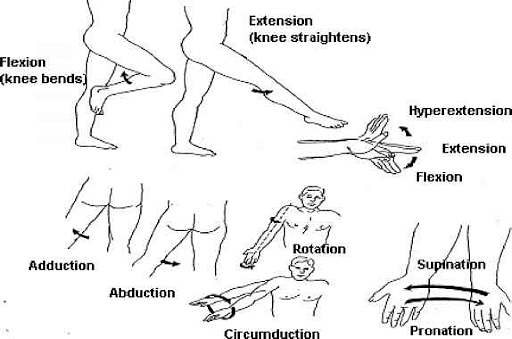
Types of Body Movements in Humans
Locomotion
[Click Here for Sample Questions]
The different movements of animals, be it single-celled or multicellular creatures, that allows them to transport themselves from one place to another are referred to as locomotion.
- Walking, crawling, climbing, swimming, flying, galloping, running, jumping, slithering, and others are examples of multicellular actions.
- Depending on the animal's habitat, its motions may differ. Terrestrial animals, for example, are capable of terrestrial mobility due to particular adaptations such as powerful limbs and feet for sprinting and walking.
- Snakes, for example, are capable of crawling across a surface despite their lack of limbs.
- Longer hind limbs enable animals to jump higher.
Also Read: Difference between Locomotion and Movement
Movement In Other Organisms
[Click Here for Sample Questions]
Given below is the detailed information on the types of movement in other organisms apart from humans:
- Snail: Snails have a rounded structure on their backs. A snail's shell and outer skeleton are formed of cartilage rather than bones. It can be counted as a single unit and has no bearing on the body's overall movement. Snails have a muscular foot that allows them to move.
- Birds: Birds have a combination of light bones and strong muscles that allow them to develop motions that allow them to fly. The wings are flapped by birds to fly.
- Fish: A fish's tail and head are usually smaller than the rest of its body. Fish bodies are usually streamlined and spindle-shaped. This particular shape allows them to move in water and there are air-filled swim bladders in order to make the body buoyant. As a result, the design allows the water to flow freely for the fish to move around in the water.
- Snakes: Snakes can move in four different ways. Because they don't have legs, they must rely on their muscles and scales to move. Sidewinding, rectilinear method, concertina method, and serpentine method are the four movements.
- Cockroaches: Cockroaches walk on their hind legs and can fly through the air. The breast region is surrounded by three pairs of connected legs. These assist in walking. The breast is adorned with two pairs of wings. The forewings are short and slender. The hind wings are large and narrow, with veins that support them.
Also Read:
Things to Remember
- A movement is defined as a change in the location of an object. It occurs in the human body whenever a single or a group of body parts move.
- A change in position of a bodily component with relation to the total frame is referred to as movement.
- The different movements of animals, be it single-celled or multicellular creatures, to transport themselves from one place to another are referred to as locomotion.
- In eukaryotic cells, amoeboid movement is the most prevalent mechanism of motility. It is a crawling-like action including the development of pseudopodia (false-feet) and posterior uropods, which is performed by the protrusion of the cell's cytoplasm.
- The muscular system is the main in charge of the mobility of a living body
- The ball and socket joint is made up of one bone's head sitting in the cup of another.
- The hinge joint works similarly to a door, opening and closing in a single plane.
- The plane join is another name for the gliding joint, which only allows restricted mobility.
- A snail's shell and outer skeleton are formed of cartilage rather than bones. Snails have a muscular foot that allows them to move.
- A fish's tail and head are usually smaller than the rest of its body. This allows the water to flow freely for it to move around.
Sample Questions
Ques. What are Joints? How many different types of joints do we have in our bodies? (3 Marks)
Ans. Joints are the sites in the bodies where two or more skeleton elements are joined. The various movements in our body are possible due to the presence of joints. Our bodies have five different types of joints:
- Ball and Socket Joint
- Hinge Joint
- Pivot Joint
- Saddle Joint
- Gliding Joint
Ques. How does a snake move? (3 Marks)
Ans. Snakes can move in four different ways. Since they don't have legs, they must rely on their muscles and scales to move. The four movements that are present in a snake are as follows:
- Sidewinding
- Rectilinear Method
- Concertina Method
- Serpentine Method
Ques. What is the function of the pivot joint? (3 Marks)
Ans. The pivot joint, also known as the rotary or trochoid joint, is produced by one bone spinning in a ring formed by another bone. The two examples of the pivot joint are as follows:
- The first and second vertebrae in the neck
- The joints between the ulna and radius bones that rotate the forearm.
Ques. How do Cockroaches move? (3 Marks)
Ans. The movement in cockroaches can be summed up in the following points:
- Cockroaches walk on their hind legs and can fly through the air.
- The breast region is surrounded by three pairs of connected legs. These assist in walking. The breast is adorned with two pairs of wings.
- The forewings are short and slender. The hind wings are large and narrow, with veins that support them.
Ques. What is the swimming mechanism of fish? (2 Marks)
Ans. The bodies of Fish are usually streamlined and spindle-shaped. This allows them to move around in the water. To make the body buoyant, there are also air-filled swim bladders. As a result, the design allows the water to flow freely for the fish to move around in the water.
Ques. What are Skeletal Muscles? (3 Marks)
Ans. Skeletal muscle is the only voluntary muscle tissue in the human body that can be controlled consciously.
- Any conscious physical movement necessitates the use of skeletal muscle (e.g., speaking, walking, or writing).
- The goal of skeletal muscle contraction is to pull body parts closer to the bone to which they are attached.
- Since most skeletal muscles connect two bones across a joint, they aid in bringing them closer together.
Ques. What is amoeboid movement? (3 Marks)
Ans. Amoeboid movement is the most prevalent mechanism of motility in eukaryotic cells. It is a crawling-like action including the development of pseudopodia (false-feet) and posterior uropods, which is performed by the protrusion of the cell's cytoplasm.
Amoeboids are cells that migrate in this direction. Some of the examples are Cellular slime moulds (e.g. Dictyostelium discoideum), human cells, particularly Kupffer cells of the liver, monocytes, neutrophils, macrophages, and malignant cells.
Ques. What are Cilia? (3 Marks)
Ans. Cilia are hair-like outgrowths that arise from the plasma membrane and they play an important function in locomotion as well as mechanoreception.
Eukaryotic cells contain cilia. Cilia are made up of microtubules and the motor protein dynein. Ciliary movement is defined as the rhythmic movement of cilia that generates fluid or cell movement.



Comments