



Content Curator
Mechanism of breathing is an involuntary process which the human body carries out without conscious effort. If it stops even for a few minutes, it might prove fatal for a person. Respiratory system consists of specific organs and structures that are used for gas exchange in animals and plants. Anatomy and physiology that make this happen vary based on size of organism, environment in which it lives, and evolutionary history.
Read about: Aerobic and Anaerobic Respiration
| Table of Content |
Key Terms: Breathing mechanism, inhalation, exhalation, inspiration, expiration
What is Breathing?
[Click Here for Sample Questions]
Breathing is the process of drawing air in and pushing air out of the lungs to facilitate the gaseous exchange essential for proper functioning of the human body. Process of intake of oxygen-rich air is called inhalation while process of giving out carbon dioxide air is called exhalation.
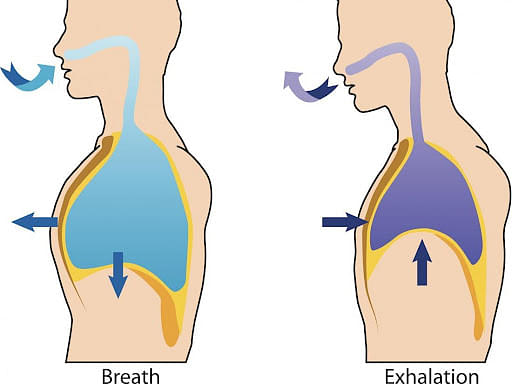
Mechanism of Breathing
Anatomy and Physiology of Breathing
[Click Here for Sample Questions]
Two lungs are the primary organs of the respiratory system. They are placed to the left and right of the heart, within a space called the thoracic cavity. Size of the left lung is smaller than the right lung in order to accommodate the heart.
Thoracic cavity is protected by a rib cage. At the base of the thorax lies a sheet of muscle called the diaphragm which separates it from the abdominal cavity. The trachea, or windpipe, and bronchi, conduct air to the lungs. While the pleural membranes, and the pleural fluid, allow the lungs to move smoothly within the cavity.
Lungs are made up of large and small airways – the trachea being the largest and first of 23 generations of airways. The smaller airways (respiratory bronchioles) contain alveoli in their walls. Alveoli is the site of gas exchange.
Also read: Lung - The Respiratory Organ

Human Respiratory System
Components of Breathing and Respiration
[Click Here for Sample Questions]
Breathing consists of two main components:
- Ventilation: the physical process of moving air in (inhalation) and moving air out (exhalation) of the lungs.
- Gaseous exchange: the chemical process of getting BECBiCl110152(O2) into the body and carbon dioxide (CO2) out.
Ventilation
As per Boyle’s law, air naturally moves from an area of high pressure to an area of low pressure. Breathing occurs when contraction or relaxation of muscles around lungs changes the total volume of air within the air passages (bronchi, bronchioles) inside the lungs.
When the volume of the lungs changes, pressure of air in the lungs changes. If the pressure is greater in the lungs than outside the lungs, then air rushes out. If the opposite occurs, then air rushes in.
Gaseous exchange
Ventilation provides air to the alveoli where gaseous exchange occurs by a simple process of diffusion. A gas will move from an area of high concentration to an area of low concentration. Partial pressure of O2 in the atmosphere is higher relative to that in the body and the bloodstream contains a higher partial pressure of CO2 than the atmosphere. For effective gas exchange to take place, air breathed into the lungs must travel to the alveolar membrane where the capillary walls are thin and there is an overall large surface area.
Also Read: Respiration
Phases of Breathing
[Click Here for Sample Questions]
Mechanism of breathing is divided into two phases: Inhalation and Exhalation. During inhalation atmospheric air is drawn in and during exhalation alveolar air is expelled out. The inward and outward movement of air from lungs takes place due to the difference in pressure between the lungs and the atmosphere.
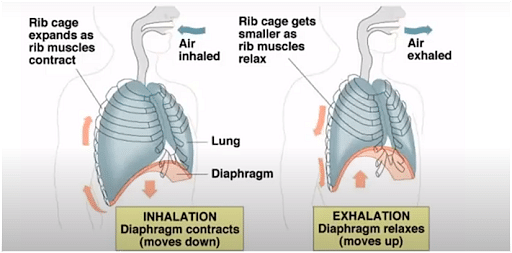
Phases of Breathing
Inhalation
The first phase is called inspiration, or inhaling. When the lungs inhale, the diaphragm contracts and pulls downward. This increases the size of the thoracic cavity and decreases the pressure inside. As a result, air rushes in and fills the lungs.
Exhalation
The second phase is called expiration, or exhaling. When the lungs exhale, the diaphragm relaxes, and the volume of the thoracic cavity decreases, while the pressure within it increases. As a result, the lungs contract and air is forced out.
Respiratory Volumes and Capacities
[Click Here for Sample Questions]
Following terms describe the various lung (respiratory) volumes:
- Tidal volume (TV) is the amount of air a person inspires during normal relaxed breathing. It is about 500 mL.
- Inspiratory reserve volume (IRV) is the additional amount of air that can be forcibly inhaled by a person after the inspiration of a normal tidal volume. It is about 2500 to 3000 mL,
- Expiratory reserve volume (ERV) is the additional air that can be forcibly exhaled by a person after the expiration of a normal tidal volume. It is about 1000 to 1,100 mL
- Residual volume (RV) is the volume of air still remaining in the lungs after the expiratory reserve volume is exhaled. It is about 1,200 mL.
Addition of specific respiratory volumes given above, aids in deriving various pulmonary/lung capacities used for clinical diagnosis.
- Total lung capacity (TLC) is the maximum amount of air that can fill the lungs.
TLC = TV + IRV + ERV + RV
- Vital capacity (VC) is the total amount of air that can be expired after fully inhaling
VC = TV + IRV + ERV = approximately 80 percent TLC
- Inspiratory capacity (IC) is the maximum amount of air that can be inspired
IC = TV + IRV
- Functional residual capacity (FRC) is the amount of air remaining in the lungs after a normal expiration.
FRC = RV + ERV
Some of the air in the lungs which does not participate in the gas exchange is located in the anatomical dead space within bronchi and bronchioles outside the alveoli.
Things to Remember [Click Here for Sample Questions]
- The simple process of inhaling oxygen and exhaling carbon dioxide is called breathing.
- The exchange of gases takes place in accordance with Boyle’s law, which states that if the volume increases, then the pressure must decrease (or vice versa).
- The organs facilitating the breathing process include nose, thorax, lungs, rib cage, windpipe, bronchi, alveolar ducts, pleural membrane and diaphragm.
- Respiratory system delivers air to the lungs, brings oxygen into the body, and expels the carbon dioxide back into the air.
- External respiration is the process of gas exchange between the atmosphere and the body tissues.
- Internal respiration is the process of gas exchange between the blood, the interstitial fluids (fluids surrounding the cells), and the cells.
- A healthy man can inspire or expire approximately 6000 to 8000 mL of air per minute.
Also read:
Sample Questions
Ques. What is inhalation? (2 Marks)
Ans. In the process of inhalation, the diaphragm contracts and pulls downward. At the same time, the muscles between the ribs contract and pull upward. This increases the size of the thoracic cavity and decreases the pressure inside. Air thus rushes in and fills the lungs.
Ques. What are the lung capacities? (3 Marks)
Ans. Various lung capacities are as follows:
- The total lung capacity (TLC) is the maximum amount of air that can fill the lungs.
TLC = TV + IRV + ERV + RV
- The vital capacity (VC) is the total amount of air that can be expired after fully inhaling
VC = TV + IRV + ERV = approximately 80 percent TLC
- The inspiratory capacity (IC) is the maximum amount of air that can be inspired
IC = TV + IRV
- The functional residual capacity (FRC) is the amount of air remaining in the lungs after a normal expiration.
FRC = RV + ERV
Ques. How does the gaseous exchange occur in the lungs? (3 Marks)
Ans. The process of ventilation delivers air to the alveoli where gaseous exchange occurs by a simple process of diffusion. A gas will move from an area of high concentration to an area of low concentration.
Partial pressure of O2 in the atmosphere is higher relative to that in the body and the bloodstream contains a higher partial pressure of CO2 than the atmosphere. For effective gas exchange to take place, air breathed into the lungs must travel to the alveolar membrane where the capillary walls are thin and there is an overall large surface area.
Ques. What is exhalation? (2 Marks)
Ans. When the lungs exhale, the diaphragm relaxes, and the volume of the thoracic cavity decreases, while the pressure within it increases. As a result, the lungs contract and air is forced out.
Ques. Breathing occurs in accordance with which law? (3 Marks)
Ans. In accordance with Boyle’s law, air naturally moves from an area of high pressure to an area of low pressure. Breathing occurs when the contraction or relaxation of muscles around the lungs changes the total volume of air within the air passages (bronchi, bronchioles) inside the lungs. When the volume of the lungs changes, the pressure of the air in the lungs changes. If the pressure is greater in the lungs than outside the lungs, then air rushes out. If the opposite occurs, then air rushes in.



Comments