NCERT Solutions for Class 12 English (Suppl.) Chapter 1 Kaleidoscope: I Sell My Dreams help students write precise, text-backed answers for the short story by Gabriel Garcia Marquez. The PDF below follows the 2026-27 NCERT question order, adds expert explanations, and keeps the focus on dream symbols, narrative tone, magical realism and answer framing.
Student Feedback: Most students asked for a solution set that separates plot recall from interpretation. This page therefore marks where an answer needs direct story evidence, where it needs an inference, and where a short literary term can improve the final paragraph.
Includes all 18 solved questions from the PDF with Solution and Expert Solution tabs.
Useful for CBSE 2026-27 English Elective revision, notebook completion and oral discussion prep.
Highlights dream symbolism, magical realism, prophecy, irony and answer-writing cues.
What Class 12 English Chapter 1 I Sell My Dreams Solutions Cover
Chapter 1 of the Class 12 English supplementary Kaleidoscope short story section asks students to read beyond plot summary. The narrator meets a woman known as Frau Frieda, remembers her unusual profession, and slowly builds a story where ordinary conversation, travel memories, superstition and dream interpretation sit in the same frame. These NCERT Solutions keep every answer grounded in that frame.
The central task is not to prove whether the dreams are literally true. It is to explain how the story makes the possibility feel persuasive. The solutions therefore show how to combine textual detail with literary judgement: what the dream image suggests, how the narrator's tone remains calm, why the final newspaper clipping matters, and how Marquez makes doubt part of the reading experience.
Question area
What to focus on
Answer cue
Stop and Think
Direct story incidents
Use compact evidence and avoid over-explaining.
Understanding the Text
Theme, narration and symbolism
Connect incident to meaning in two or three steps.
Appreciation
Magical realism and craft
Name the device, then show its effect in the story.
The story opens in a realistic world: hotels, embassies, travel, conversation and newspaper reports. Into that world comes a woman who earns her living by interpreting dreams. The narrator does not turn her into a fantasy figure. Instead, he presents her as socially believable, practical and oddly authoritative, which is why the story's supernatural suggestion feels unsettling rather than decorative.
For exam answers, students should notice three movements. First, Frau Frieda is introduced through memory and conversation. Second, her dream warnings are treated by others as important enough to affect decisions. Third, the later accident and newspaper detail create a final twist. The best answers hold belief and doubt together, because the story itself never reduces the dreams to either fraud or fact.
How to Use These NCERT Solutions for Better Answers
The PDF is designed for quick revision as well as fuller written practice. Start with the direct questions to settle who Frau Frieda is, how she meets the narrator, and why her dreams matter to the people around her. Then move to interpretive questions, where the answer must explain narrative method, not just retell events.
Underline exact story clues: names, places, the profession of selling dreams, and the final accident report.
Separate summary from analysis: one sentence for the event, one sentence for what it reveals.
Use literary terms sparingly: magical realism, irony, foreshadowing and ambiguity are enough for this chapter.
A strong answer usually follows this pattern: begin with the direct response, add one specific detail from the story, and close with the larger meaning. This keeps answers crisp while still showing interpretation. For long answers, the Expert Solution tabs add a second route so students can compare a direct classroom answer with a richer literary reading.
Magical Realism, Prophecy and Dream Symbolism
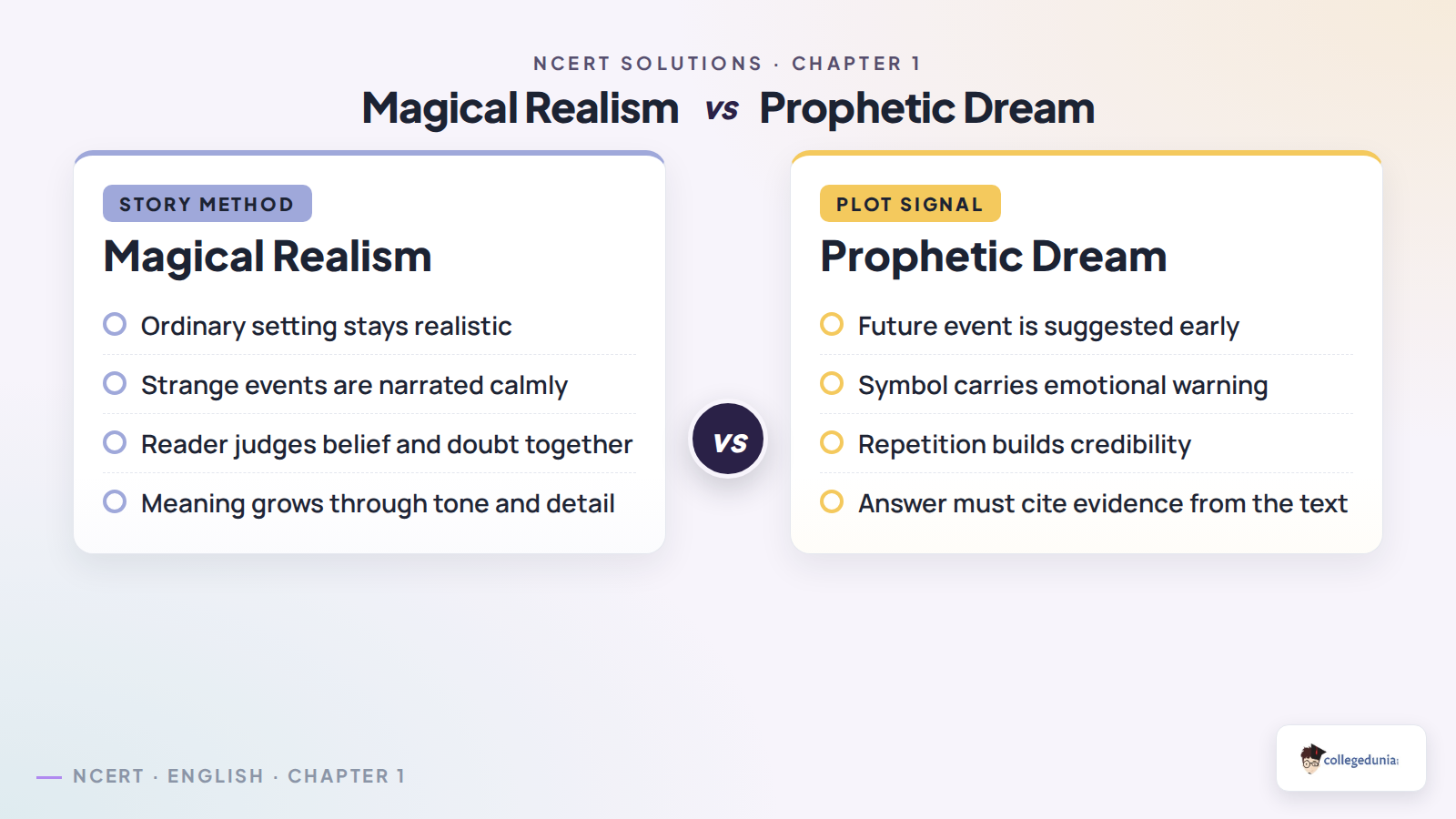
Marquez is associated with magical realism, but in this chapter the magic is quiet. There are no dramatic spells or impossible worlds. Instead, the unusual element is reported in the same tone as ordinary events. That calm tone is the reason the chapter is useful for literary appreciation questions.
Dream symbolism works through suggestion. A snake, a flood or a repeated image does not need a single fixed meaning. It becomes meaningful because characters act on it, remember it or connect it to later events. Prophecy in the story also depends on timing: a dream seems ordinary at first, then a later incident makes students reconsider it.
Term
Meaning in this story
How to use it in answers
Magical realism
Unusual events are placed inside ordinary reality.
Explain the calm tone and realistic setting.
Foreshadowing
An early dream or warning prepares a later event.
Connect the earlier clue to the ending.
Ambiguity
The story keeps more than one interpretation open.
Do not force a single final explanation.
Common Mistakes Students Should Avoid
Many weak answers turn the chapter into a simple ghost-story summary. That misses the central craft of the story. The narrator's calm voice, the social details and the delayed ending all matter because they make the strange element believable without fully confirming it. Students should also avoid writing that Frau Frieda is only a trickster unless the answer explains why the text keeps her power uncertain.
Do not replace interpretation with a long plot retelling.
Do not call every dream a confirmed prediction; use words like suggests, hints and appears.
Do not ignore the final newspaper detail, because it changes how earlier scenes are read.
Do not use a literary term unless the next sentence explains its effect in the chapter.
Class 12 English Supplementary Chapter 1 Resource Links
Use these related resources when you want the same chapter in another format. The links are kept above the FAQ so students can move from solutions to notes, book PDF and handwritten revision without losing the chapter context.
All NCERT Solutions for Class 12 English Supplementary Chapters
The table below keeps the same resource type together, so students can move chapter by chapter through the Class 12 English supplementary Kaleidoscope question set.
All NCERT Solutions for Class 12 English (Suppl.) Chapter 1 Kaleidoscope: I Sell My Dreams with Step-by-Step Solutions
The expandable cards below reproduce the full solution set from the PDF. Use the Solution tab for a direct exam-ready answer and the Expert Solution tab for a deeper explanation of tone, symbolism and structure.
Questions
Q 1.1
How did the author recognise the lady who was extricated from the car encrusted in the wall of Havana Riviera Hotel after the storm?
Concept used. In a literary comprehension answer, recognition is
explained by connecting a present clue with an earlier memory from the text.
Here, the clue is the serpent-shaped ring with emerald eyes.
Text clue
The author does not identify the dead woman by her face or name. He is drawn
to the ring because he has seen a similar one before.
After the storm, a car was found embedded in the side of the Havana
Riviera Hotel. A woman's body was discovered inside it.
Her face was destroyed, but the newspaper report mentioned a gold
ring shaped like a serpent, with emerald eyes.
The author remembered a woman he had met years earlier in Vienna.
She wore a similar serpent ring on her right forefinger.
This unusual ring made him suspect that the dead woman was Frau Frieda,
the dream seller he had once known.
The author recognised her through the rare serpent-shaped gold ring
with emerald eyes, which reminded him of Frau Frieda from Vienna.
AS
Aditi Sen
M.A English Literature, University of Delhi
Verified Expert
Strategic angle. Treat the ring as a narrative clue. Marquez makes
the body almost unrecognisable, then gives one precise object that opens the
author's memory.
The dead woman cannot be identified by ordinary physical detail because
the accident has destroyed her face and body.
The report of the serpent ring is therefore vital. It is strange enough
to be remembered after decades.
The author links that ring with Frau Frieda, whom he had met thirty-four
years earlier in Vienna.
His recognition is not complete proof at first. It is a strong suspicion
built from memory, symbol, and coincidence.
This answer should mention both the ring and the earlier meeting. Without both,
the recognition remains unexplained.
He recognised the possibility of Frau Frieda because the serpent ring
matched the unforgettable ring worn by the woman he had met in Vienna.
Q 1.2
Why did the author leave Vienna never to return again?
Concept used. Cause and effect in a story should be traced through
the character's action and the belief that pushes that action. The author's
departure follows Frau Frieda's warning dream.
Answer focus
Do not say only that he left because of superstition. Mention Frau Frieda's
specific warning and his later feeling that he had escaped an unknown disaster.
In Vienna, Frau Frieda told the author that she had dreamed about him.
She warned him that he must leave Vienna immediately and not return
for five years.
Her conviction was so strong that the author boarded the last train
to Rome that same night.
After that, he felt as if he had survived a catastrophe he never saw.
Even years later, he chose not to go back.
He left Vienna because Frau Frieda's warning dream frightened and
persuaded him; he obeyed her and never returned, just in case the warning was true.
RM
Rohan Mehta
M.Phil English, Jadavpur University
Verified Expert
Strategic angle. The key is not whether the dream was true. The key is
that the author acted as if it might be true.
Frau Frieda had already built a reputation for reading dreams as omens.
When she warned the author to leave Vienna, she spoke with total
certainty, not casual doubt.
The author was suggestible in that moment. Poverty, exile, and the
strange atmosphere of Vienna made the warning feel powerful.
His later refusal to return shows that the dream kept its hold on him
long after the immediate fear passed.
The answer is strongest when it connects fear, belief, and action.
He left because Frau Frieda's dream-warning seemed urgent and
credible to him, so he escaped Vienna and avoided returning out of lingering fear.
Q 1.3
How did Pablo Neruda know that somebody behind him was looking at him?
Concept used. Character response can be understood from sensory
detail and intuition. Neruda senses attention before he actually turns to
confirm it.
Scene recall
The scene happens in a restaurant in Barcelona, while Neruda is eating and
talking with the narrator and others.
Neruda suddenly stopped eating and became alert.
He said quietly that someone behind him would not stop looking at him.
The narrator glanced over Neruda's shoulder and saw Frau Frieda sitting
three tables away.
She was staring at Neruda while eating without haste.
Neruda sensed her gaze intuitively; when the narrator looked, he saw
Frau Frieda staring at Neruda from three tables away.
MN
Meera Nair
M.A Comparative Literature, EFLU Hyderabad
Verified Expert
Strategic angle. This moment presents Neruda as unusually alert to
human presence. It also prepares the playful dream exchange that follows.
Neruda does not receive spoken information about the watcher.
His reaction is physical and instinctive: he stops eating and seems to
tune himself to the room.
The narrator then verifies the feeling by looking behind him.
The watcher is Frau Frieda, whose presence links the Barcelona episode
with the earlier Vienna memory.
This scene gently balances rational observation and mysterious sensitivity.
He knew through a sharp intuitive awareness of being watched, which
the narrator confirmed by spotting Frau Frieda behind him.
Q 1.4
How did Pablo Neruda counter Frau Frieda's claims to clairvoyance?
Concept used. A counter-claim in literature is shown through a
character's words and behaviour. Neruda resists Frau Frieda's dream prophecy
by giving poetry, not dreams, the power of vision.
Poetry and vision
Neruda's reply turns the discussion from superstition to imagination. He
suggests that poets, not dream interpreters, truly see beyond the ordinary.
Frau Frieda spoke about dreams as if they could reveal the future.
Neruda openly said that he did not believe in prophetic dreams.
He declared, "Only poetry is clairvoyant."
Later, he playfully matched her dream by saying that he dreamed she was
dreaming about him.
Neruda countered her claim by denying prophetic dreams and saying
that only poetry has true clairvoyant power.
KI
Kavya Iyer
Ph.D English, University of Hyderabad
Verified Expert
Strategic angle. Neruda does not argue like a scientist. He counters
one imaginative system with another.
Frau Frieda's authority rests on the idea that dreams can predict or
direct life.
Neruda refuses that authority and shifts power to poetry.
His statement, "Only poetry is clairvoyant," means poetic imagination
can see truth more deeply than superstition can.
His later dream about Frau Frieda is playful. It mirrors her claim but
also turns it into art, wit, and paradox.
The counter is therefore both serious and humorous.
He challenged her clairvoyance by trusting poetic imagination over
prophetic dreams and by playfully turning her dream logic back on her.
Q 1.5
Did the author believe in the prophetic ability of Frau Frieda?
Concept used. A balanced interpretation must notice mixed evidence.
The author doubts Frau Frieda's gift, but his actions show that he is still
affected by it.
Balanced answer
Use both sides: he calls her dreams a survival device, yet he obeys her warning
and avoids Vienna for years.
The author does not fully accept Frau Frieda as a true prophet.
He later says he had always thought her dreams were a stratagem for
surviving.
Yet he obeys her warning in Vienna and leaves immediately.
He also refuses to return to Vienna even after thirteen years, saying
he will not go back "just in case."
The author is sceptical in thought but suggestible in action; he does
not fully believe Frau Frieda, yet he cannot ignore her dreams.
NR
Nandini Rao
M.A English, Presidency University
Verified Expert
Strategic angle. The answer lies in contradiction. The narrator's mind
and behaviour do not perfectly agree.
Intellectually, he sees Frau Frieda's dream trade as a clever way to
survive among wealthy and superstitious people.
Emotionally, he remains vulnerable to the fear that her dreams may be
true.
His flight from Vienna is the strongest proof of that emotional effect.
His later comment to Frau Frieda shows caution rather than belief: even
if her dreams are false, he will not risk returning.
So the story does not present him as a blind believer. It presents him as human.
He half-believes her: his reason doubts her, but fear and memory make
him act as if her dreams might be prophetic.
Q 1.6
Why did he think that Frau Frieda's dreams were a stratagem for surviving?
Concept used. A stratagem is a planned device used to gain advantage.
The author sees Frau Frieda's dream reading as a practical way to earn security.
Word meaning
Explain "stratagem" in your own words before applying it to Frau Frieda.
Frau Frieda had no ordinary profession that could support her in
difficult European winters.
She presented her dream-reading talent as a useful service to wealthy,
superstitious households.
In Vienna, a family hired her to interpret dreams before breakfast and
guide their daily decisions.
Over time, she gained comfort, authority, and even a share of the
family's estate.
The author thought her dreams were a survival strategy because they
gave her money, shelter, influence, and long-term security.
DM
Devika Menon
Ph.D Literary Studies, Calicut University
Verified Expert
Strategic angle. Look at what the dream trade produces in material
terms. It is not only mystical talk; it becomes food, lodging, income, and power.
Frau Frieda turns a family habit from childhood into an adult means of
livelihood.
Her employers want certainty and guidance, so they treat her dreams as
valuable information.
Because they believe her, she becomes necessary to the household.
The author reads this necessity as her clever method of survival in an
unstable world.
The word "stratagem" does not mean the author proves she is a fraud. It means
he suspects practical calculation behind the mystery.
He saw her dream-reading as a clever device that turned other
people's superstition into her own protection and prosperity.
Q 1.7
Why does the author compare Neruda to a Renaissance pope?
Concept used. A comparison in prose often highlights a cluster of
qualities. Here, the phrase suggests grandeur, refinement, appetite, and a
commanding presence.
Context
The comparison appears during the Barcelona episode, especially around
Neruda's behaviour at the table.
The author describes Neruda as gluttonous and refined at the same time.
Neruda presides at the table even when he does not intend to.
He eats with great appetite, curiosity, and ceremony.
The image of a Renaissance pope suggests worldly enjoyment joined with
artistic and cultural authority.
The comparison shows Neruda as grand, refined, indulgent, and
commanding, like a cultured figure who naturally presides over others.
SB
Samarjit Bose
M.A English, University of Calcutta
Verified Expert
Strategic angle. The phrase is affectionate satire. It makes Neruda
larger than life without making him ridiculous.
Renaissance popes are often imagined as powerful patrons of art,
ceremony, and pleasure.
Neruda shares that aura in the narrator's memory: he loves food, books,
conversation, and performance.
The bib, the lobsters, and the attention of the table add comic detail.
Yet the description still respects him as a poet of immense presence.
The comparison works because it joins dignity and appetite in one image.
The author compares him to a Renaissance pope to capture his mixture
of cultural majesty, sensual enjoyment, and effortless authority at the table.
Q 1.8
Discuss: In spite of all the rationality that human beings are capable of, most of us are suggestible and yield to archaic superstitions.
Concept used. A discussion answer should state a position, support it
with the text, and then widen it to human behaviour. The story shows that
rational people can still be moved by fear, mystery, and suggestion.
Human weakness
The story is not only about one dream seller. It asks why intelligent people
allow signs, omens, and predictions to guide them.
The Viennese family is educated and wealthy, yet it depends on Frau
Frieda's dream interpretations.
The author himself doubts her gift, but he still leaves Vienna after
her warning.
The mother in Frau Frieda's childhood also accepts the dream warning
and controls her son's behaviour.
These examples show that reason often weakens when people face fear,
uncertainty, loss, or danger.
The story supports the view that rational people remain suggestible,
because fear and uncertainty make old superstitions emotionally powerful.
IB
Ishita Banerjee
M.A English, Jamia Millia Islamia
Verified Expert
Strategic angle. The best answer avoids mocking superstition too
quickly. Marquez shows why it survives.
Human beings use reason, but they also want protection from the
unknown.
Dreams, omens, and prophecies appear to offer a pattern when life feels
random.
Frau Frieda gains power because people want her dreams to reduce risk.
Even the narrator, who can analyse her as a survivor, acts cautiously
when her warning touches his own life.
Thus, superstition is shown as a response to vulnerability, not just ignorance.
Yes. The chapter shows that intelligence does not erase
suggestibility; people still yield to superstition when mystery promises safety.
Q 1.9
Discuss: Dreams and clairvoyance are as much an element of the poetic vision as religious superstition.
Concept used. A thematic discussion compares two ways of seeing beyond
ordinary reality. In the story, dream prophecy and poetic imagination both claim
access to hidden truth.
Compare both sides
Mention Frau Frieda for dreams, and Neruda for poetry. The contrast is central
to this question.
Frau Frieda treats dreams as messages that can guide future action.
Her employers treat this gift almost like a sacred authority.
Neruda rejects prophetic dreams but says that only poetry is
clairvoyant.
The story therefore places superstition and poetic imagination close
together, since both try to see what ordinary logic cannot.
The story suggests that dreams, clairvoyance, and poetry all express
the human desire to see beyond visible facts, though they do so in different ways.
AK
Arjun Kapoor
M.A English, Panjab University
Verified Expert
Strategic angle. Neruda's statement is the hinge. He does not accept
Frau Frieda's prophecy, but he keeps the idea of special vision alive through
poetry.
Religious superstition gives dreams sacred or magical authority.
Frau Frieda builds her identity around that authority.
Poetic vision also moves beyond literal fact, but it does so through
image, rhythm, intuition, and imagination.
Neruda's dream of Frau Frieda dreaming of him turns prophecy into a
playful poetic pattern.
The story does not settle the debate. It lets poetry and superstition mirror
each other.
Dreams and clairvoyance resemble poetic vision because each reaches
past plain fact, but poetry transforms that reach into art rather than doctrine.
Q 1.10
The story hinges on a gold ring shaped like a serpent with emerald eyes. Comment on the responses that this image evokes in the reader.
Concept used. A symbol in a story gathers meaning beyond its physical
form. The serpent ring becomes a clue, a mark of mystery, and a link between
past and present.
Symbol focus
Write about the effect of the image, not only its appearance.
The ring is visually striking because a serpent with emerald eyes feels
unusual, secretive, and almost magical.
It evokes curiosity because the narrator cannot forget it even after
many years.
It creates suspense by linking the dead woman in Havana with Frau
Frieda in Vienna.
It also suits Frau Frieda's character, since serpents often suggest
danger, wisdom, temptation, and hidden power.
The serpent ring evokes mystery, danger, fascination, and recognition;
it becomes the symbolic clue around which the story turns.
PD
Priyanka Dutta
Ph.D English, Visva-Bharati University
Verified Expert
Strategic angle. The ring works because it is both concrete and
suggestive. We can picture it clearly, yet it also feels charged with meaning.
As an object, it helps the narrator connect two different moments in
time.
As an image, it hints at secrecy and power, qualities linked with Frau
Frieda's dream trade.
Its emerald eyes make it seem watchful, almost alive.
Because the body is damaged beyond recognition, the ring becomes the
surviving identity marker.
The reader responds with curiosity because the object seems to know more than
the characters can prove.
The image makes the reader feel suspense and fascination, because the
ring turns memory, identity, and mystery into one unforgettable symbol.
Q 1.11
The craft of a master story-teller lies in the ability to interweave imagination and reality. Do you think that this story illustrates this?
Concept used. Magical realism blends ordinary realistic detail with
events or beliefs that feel mysterious, without separating the two sharply.
Magical realism
Marquez often lets the fantastic enter everyday life calmly. That is why the
story feels both believable and strange.
The story begins with a realistic disaster at the Havana Riviera Hotel.
It then moves into memories of Vienna, poverty, exile, students, and
post-war life.
Into these realistic settings, Marquez places Frau Frieda's dream
trade and her strange authority.
The Barcelona episode with Neruda adds humour, literary imagination,
and the mirrored dream of two dreamers.
Yes. The story illustrates masterly craft because realistic places,
historical figures, and ordinary events are woven with dream, omen, and mystery.
FS
Farah Siddiqui
M.A English, Aligarh Muslim University
Verified Expert
Strategic angle. Notice how calmly the story shifts from fact to
fantasy. The tone never announces that the reader has entered a separate world.
Havana, Vienna, Barcelona, embassies, hotels, restaurants, and ships
create a recognisable world.
Frau Frieda's dreams disturb that world but do not break it.
The narrator records impossible or doubtful things with the same calm
voice used for ordinary events.
That even tone makes imagination feel like part of reality.
This is why the story remains credible even when it deals with clairvoyance.
The story fully illustrates this craft: it joins documentary detail
with fantasy so smoothly that each strengthens the other.
Q 1.12
Bring out the contradiction in the last exchange between the author and the Portuguese ambassador: "In concrete terms," I asked at last, "what did she do?" "Nothing," he said, with a certain disenchantment. "She dreamed."
Concept used. A contradiction appears when two meanings pull against
each other. Here, "nothing" is immediately followed by the action that defined
Frau Frieda's life.
Quote use
Use the quoted exchange, then explain why "nothing" and "she dreamed" do not
fit together in an ordinary sense.
The author asks what Frau Frieda did in practical terms.
The ambassador first answers, "Nothing," as if she had no real job.
He then adds, "She dreamed," which was exactly the source of her value
and influence.
The contradiction is that dreaming appears passive, yet in her case it
controlled households, money, travel, and reputation.
The contradiction is that the ambassador calls her work "nothing",
but her dreaming was the powerful activity by which she lived and influenced others.
TS
Tanvi Sharma
M.A English, Banaras Hindu University
Verified Expert
Strategic angle. The ending compresses the whole story into one
paradox. It asks whether dreaming is empty or active.
In ordinary social terms, Frau Frieda does not seem to perform labour
like a cook, secretary, or diplomat.
Yet the story has already shown that her dreams shape other people's
choices.
The ambassador's disappointment suggests that he cannot name her power
in practical language.
The final phrase restores the mystery: her doing was dreaming.
The contradiction is therefore ironic and revealing.
The exchange is contradictory because "nothing" dismisses her, while
"she dreamed" names the very power that made her extraordinary.
Q 1.13
Comment on the ironical element in the story.
Concept used. Irony occurs when the real meaning of a situation differs
from its surface appearance. This story uses irony in Frau Frieda's power, the
narrator's scepticism, and the ending.
Where irony appears
Look at the narrator's doubt, Neruda's joke about dreams, and the ambassador's
final answer.
Frau Frieda seems to do "nothing," yet her dreams give her great control.
The narrator doubts her power, but he lets her warning shape his own
life.
Neruda says only poetry is clairvoyant, yet he also dreams about the
woman who dreams.
The dead woman in Havana may be identified not by life history, but by
a strange ring and an old memory.
The irony lies in the gap between disbelief and behaviour: people
mock or doubt dreams, yet they still allow dreams to rule choices and memory.
KM
Kabir Malhotra
M.A English, Christ University
Verified Expert
Strategic angle. The story's irony is gentle but persistent. It does
not laugh loudly at superstition; it exposes how strongly it works.
The narrator believes he is rational, but his escape from Vienna proves
he is suggestible.
Frau Frieda's passive act of dreaming becomes an active career.
Neruda rejects prophecy while entering a dream-play of his own.
The ambassador's final "Nothing... She dreamed" makes the largest irony
explicit.
The ironic effect is that dreams, which seem unreal, create real consequences.
The story is ironic because unreal-seeming dreams produce real power,
while rational people keep behaving as if the dreams might be true.
Q 1.14
Give the meanings of these phrases with "dream": dream on, dream something away, not dream of doing something, dream something up, look like a dream.
Concept used. Vocabulary answers should give a short meaning and a
simple usage sense. The phrase meaning may differ from the literal meaning of
the word "dream."
Phrase meanings
Do not translate word by word. Treat each phrase as a fixed expression.
dream on: used to say that someone's hope is unrealistic.
dream something away: to waste time, chances, or life by
imagining instead of acting.
not dream of doing something: to never consider doing it,
usually because it seems wrong or impossible.
dream something up: to invent an idea, plan, or story,
often imaginatively.
look like a dream: to look extremely beautiful or pleasing.
The phrases mean: keep hoping unrealistically; waste through idle
dreaming; never consider; invent imaginatively; and look very beautiful.
NT
Neha Thomas
M.A Linguistics, University of Kerala
Verified Expert
Strategic angle. Learn these as idioms. Their meaning comes from use,
not from the separate meanings of "dream" and the following word.
"Dream on" often has a teasing or dismissive tone.
"Dream something away" criticises passivity.
"Not dream of doing something" marks a strong refusal or disbelief.
"Dream something up" praises or questions invention, depending on
context.
"Look like a dream" is complimentary and visual.
These meanings also connect nicely with the story, where dreams are both
imaginative and practical.
They are idiomatic uses: unrealistic hope, wasted time, refusal,
invention, and exceptional beauty.
Q 1.15
Give the meanings of these phrases with "sell": sell-by date, selling-point, sell-out, selling price, seller's market.
Concept used. Compound expressions often carry a specialised meaning.
Each phrase with "sell" belongs to trade, marketing, or social usage.
Dictionary habit
When a phrase has a hyphen, check it as a complete entry before guessing from
the base verb.
sell-by date: the date by which a shop should sell a product,
especially food.
selling-point: a feature that makes something attractive to
buyers.
sell-out: an event for which all tickets or goods are sold;
it can also mean betrayal of one's principles for gain.
selling price: the price at which something is actually sold.
seller's market: a market situation where sellers have an
advantage because demand is higher than supply.
The phrases refer to a sale deadline, an attractive feature, a fully
sold event or betrayal, an actual sale price, and a market favouring sellers.
OQ
Omar Qureshi
M.A English, Mumbai University
Verified Expert
Strategic angle. These phrases show how one verb can create several
practical business terms.
"Sell-by date" protects freshness and retail timing.
"Selling-point" explains persuasion: it is what helps the item sell.
"Sell-out" has two common senses, one commercial and one moral.
"Selling price" is the final price in a transaction.
"Seller's market" describes bargaining power on the seller's side.
In the story title, "sell" is unusual because Frau Frieda sells not goods, but
dreams and their interpretations.
They mean a retail deadline, a persuasive feature, a full sale or
moral compromise, the actual price, and a demand-heavy market.
Q 1.16
In the five Grammar: Emphasis sentences, identify the part that receives the main emphasis.
Concept used. In English prose, emphasis often falls at the beginning
or end of a sentence. The end position is usually the strongest, while the
opening position is also prominent.
Emphasis rule
For these answers, ask what information the sentence leaves ringing in the
reader's mind.
In "I never saw her again..." the emphasis falls on the snake
ring on the woman who died in the Havana Riviera disaster.
In "That did not surprise me..." the emphasis falls on her
dreams were no more than a stratagem for surviving.
In "Although she did not say so..." the emphasis falls on dream
by dream, she had taken over the entire fortune of her patrons in Vienna.
In "Three tables away sat..." the emphasis falls first on
Three tables away and finally on staring at him.
In "I stayed in Vienna..." the emphasis falls on money that
never arrived.
The emphatic parts are the final or opening units that carry the main
new idea: the snake ring, survival stratagem, fortune, staring gaze, and money
that never arrived.
SF
Sara Fernandes
M.A English, St. Xavier's College Mumbai
Verified Expert
Strategic angle. This task tests sentence position. The writer places
important details where they will be noticed most.
Sentence one builds toward the ring and the Havana disaster, so that
final detail receives force.
Sentence two places the narrator's judgement at the end: the dreams
are a survival device.
Sentence three delays the strongest idea until the fortune is named.
Sentence four begins with location and ends with the gaze; both are
highlighted by position.
Sentence five closes on the failed arrival of money, which explains
the narrator's hardship.
These choices show how syntax guides attention.
The main emphasis falls on the sentence units placed at strong
positions, especially the ending details that complete each thought.
Q 1.17
How can you decide how many syllables there are in your name and in the names of your classmates?
Concept used. A syllable is a beat of pronunciation built around a
vowel sound. Counting syllables means listening for spoken beats, not counting
letters.
Sound test
Say the word slowly and clap once for each natural beat you hear.
Say the name aloud naturally.
Break it into sound beats, each with a vowel sound.
Clap or tap once for each beat.
Check with examples: "A-nil" has two beats; "Sa-mee-ra" has three
beats; "A-ru-na-va" has four beats.
Say each name aloud, listen for vowel-centred beats, and count one
syllable for each beat.
MK
Mihir Kulkarni
M.A Linguistics, Deccan College
Verified Expert
Strategic angle. Pronunciation tasks are sound tasks. Spelling may
mislead you because English letters and sounds do not always match neatly.
Speak the name at normal speed first, then slowly.
Mark every separate vowel sound you can hear.
If two vowels glide together in one beat, count one syllable.
Compare with classmates and say the names again to confirm the rhythm.
The aim is accurate listening, not a written spelling rule.
Count syllables by spoken rhythm: each clear vowel beat in the name
counts as one syllable.
Q 1.18
Pick out five words each for two syllable, three syllable and four syllable words from the lesson.
Concept used. Classification by syllable count depends on how words
are pronounced. The examples below are taken from the chapter's language and
introduction sections.
Check aloud
If a word looks long, do not assume it has many syllables. Say it aloud and
count the beats.
Two syllables: morning, hotel, serpent, market, poet.
Three syllables: disaster, Havana, memory, prophecy,
magical.
Four syllables: authority, Barcelona, oracular, devastating,
admiration.
Pronunciation may vary slightly, so the safest method is to say each
word aloud and count its beats.
Sample lists are: two syllables: morning, hotel, serpent, market,
poet; three syllables: disaster, Havana, memory, prophecy, magical; four
syllables: authority, Barcelona, oracular, devastating, admiration.
RJ
Ritika Jain
M.A Applied Linguistics, University of Lucknow
Verified Expert
Strategic angle. The task is practice in hearing rhythm. A good answer
can use other chapter words too, if the syllable count is correct.
For two syllables, choose words with two clear beats, such as
"hotel" and "serpent."
For three syllables, choose words like "disaster" or "prophecy."
For four syllables, choose longer words like "authority" and
"Barcelona."
Recheck each by clapping the beats while saying it.
This habit improves pronunciation and helps students notice word rhythm.
The given sample words correctly group chapter vocabulary into two,
three, and four-syllable sets.
Frequently Asked Questions on Class 12 English I Sell My Dreams NCERT Solutions
Ques. How many questions are solved in the Class 12 English I Sell My Dreams PDF?
Ans. The PDF solves 18 questions from Chapter 1, including Stop and Think, Understanding the Text, Talking about the Text, Appreciation, vocabulary, grammar and pronunciation tasks.
Ques. Are these NCERT Solutions useful for the 2026-27 syllabus?
Ans. Yes. The article and PDF are prepared for the 2026-27 NCERT Class 12 English supplementary Kaleidoscope chapter and keep the answers aligned with the official question order.
Ques. What is the main theme of I Sell My Dreams?
Ans. The story explores dream interpretation, belief, coincidence and magical realism. It shows how an ordinary setting can make a strange or prophetic event feel believable.
Ques. How should students write long answers for this chapter?
Ans. Students should begin with a direct point, add a precise story detail, and then explain the larger literary effect. For this chapter, tone, ambiguity and dream symbolism are especially important.





Chapter1Kaleidoscope:ISellMyDreamsSolutions.pdf?page=1&dpi=150)
Chapter1Kaleidoscope:ISellMyDreamsSolutions.pdf?page=2&dpi=150)
Chapter1Kaleidoscope:ISellMyDreamsSolutions.pdf?page=3&dpi=150)
Chapter1Kaleidoscope:ISellMyDreamsSolutions.pdf?page=4&dpi=150)
Chapter1Kaleidoscope:ISellMyDreamsSolutions.pdf?page=5&dpi=150)
Chapter1Kaleidoscope:ISellMyDreamsSolutions.pdf?page=6&dpi=150)
Chapter1Kaleidoscope:ISellMyDreamsSolutions.pdf?page=7&dpi=150)
Chapter1Kaleidoscope:ISellMyDreamsSolutions.pdf?page=8&dpi=150)
Chapter1Kaleidoscope:ISellMyDreamsSolutions.pdf?page=9&dpi=150)
Chapter1Kaleidoscope:ISellMyDreamsSolutions.pdf?page=10&dpi=150)
Chapter1Kaleidoscope:ISellMyDreamsSolutions.pdf?page=11&dpi=150)
Chapter1Kaleidoscope:ISellMyDreamsSolutions.pdf?page=12&dpi=150)
Chapter1Kaleidoscope:ISellMyDreamsSolutions.pdf?page=13&dpi=150)
Chapter1Kaleidoscope:ISellMyDreamsSolutions.pdf?page=14&dpi=150)
Chapter1Kaleidoscope:ISellMyDreamsSolutions.pdf?page=15&dpi=150)
Chapter1Kaleidoscope:ISellMyDreamsSolutions.pdf?page=16&dpi=150)
Chapter1Kaleidoscope:ISellMyDreamsSolutions.pdf?page=17&dpi=150)
Chapter1Kaleidoscope:ISellMyDreamsSolutions.pdf?page=18&dpi=150)
Chapter1Kaleidoscope:ISellMyDreamsSolutions.pdf?page=19&dpi=150)
Chapter1Kaleidoscope:ISellMyDreamsSolutions.pdf?page=20&dpi=150)
Chapter1Kaleidoscope:ISellMyDreamsSolutions.pdf?page=21&dpi=150)
Chapter1Kaleidoscope:ISellMyDreamsSolutions.pdf?page=22&dpi=150)
Chapter1Kaleidoscope:ISellMyDreamsSolutions.pdf?page=23&dpi=150)
Chapter1Kaleidoscope:ISellMyDreamsSolutions_flat_MobileCard.pdf?page=1&dpi=150)
Chapter1Kaleidoscope:ISellMyDreamsSolutions_flat_MobileCard.pdf?page=2&dpi=150)
Chapter1Kaleidoscope:ISellMyDreamsSolutions_flat_MobileCard.pdf?page=3&dpi=150)
Chapter1Kaleidoscope:ISellMyDreamsSolutions_flat_MobileCard.pdf?page=4&dpi=150)
Chapter1Kaleidoscope:ISellMyDreamsSolutions_flat_MobileCard.pdf?page=5&dpi=150)
Chapter1Kaleidoscope:ISellMyDreamsSolutions_flat_MobileCard.pdf?page=6&dpi=150)
Chapter1Kaleidoscope:ISellMyDreamsSolutions_flat_MobileCard.pdf?page=7&dpi=150)
Chapter1Kaleidoscope:ISellMyDreamsSolutions_flat_MobileCard.pdf?page=8&dpi=150)
Chapter1Kaleidoscope:ISellMyDreamsSolutions_flat_MobileCard.pdf?page=9&dpi=150)
Chapter1Kaleidoscope:ISellMyDreamsSolutions_flat_MobileCard.pdf?page=10&dpi=150)
Chapter1Kaleidoscope:ISellMyDreamsSolutions_flat_MobileCard.pdf?page=11&dpi=150)
Chapter1Kaleidoscope:ISellMyDreamsSolutions_flat_MobileCard.pdf?page=12&dpi=150)
Chapter1Kaleidoscope:ISellMyDreamsSolutions_flat_MobileCard.pdf?page=13&dpi=150)
Chapter1Kaleidoscope:ISellMyDreamsSolutions_flat_MobileCard.pdf?page=14&dpi=150)
Chapter1Kaleidoscope:ISellMyDreamsSolutions_flat_MobileCard.pdf?page=15&dpi=150)
Chapter1Kaleidoscope:ISellMyDreamsSolutions_flat_MobileCard.pdf?page=16&dpi=150)
Chapter1Kaleidoscope:ISellMyDreamsSolutions_flat_MobileCard.pdf?page=17&dpi=150)
Chapter1Kaleidoscope:ISellMyDreamsSolutions_flat_MobileCard.pdf?page=18&dpi=150)
Chapter1Kaleidoscope:ISellMyDreamsSolutions_flat_MobileCard.pdf?page=19&dpi=150)
Chapter1Kaleidoscope:ISellMyDreamsSolutions_flat_MobileCard.pdf?page=20&dpi=150)
Chapter1Kaleidoscope:ISellMyDreamsSolutions_flat_MobileCard.pdf?page=21&dpi=150)
Chapter1Kaleidoscope:ISellMyDreamsSolutions_flat_MobileCard.pdf?page=22&dpi=150)
Chapter1Kaleidoscope:ISellMyDreamsSolutions_flat_MobileCard.pdf?page=23&dpi=150)
Chapter1Kaleidoscope:ISellMyDreamsSolutions_flat_MobileCard.pdf?page=24&dpi=150)
Chapter1Kaleidoscope:ISellMyDreamsSolutions_flat_MobileCard.pdf?page=25&dpi=150)
Chapter1Kaleidoscope:ISellMyDreamsSolutions_flat_MobileCard.pdf?page=26&dpi=150)
Chapter1Kaleidoscope:ISellMyDreamsSolutions_flat_MobileCard.pdf?page=27&dpi=150)
Chapter1Kaleidoscope:ISellMyDreamsSolutions_flat_MobileCard.pdf?page=28&dpi=150)
Chapter1Kaleidoscope:ISellMyDreamsSolutions_flat_MobileCard.pdf?page=29&dpi=150)
Chapter1Kaleidoscope:ISellMyDreamsSolutions_flat_MobileCard.pdf?page=30&dpi=150)
Chapter1Kaleidoscope:ISellMyDreamsSolutions_flat_MobileCard.pdf?page=31&dpi=150)
Chapter1Kaleidoscope:ISellMyDreamsSolutions_flat_MobileCard.pdf?page=32&dpi=150)
Chapter1Kaleidoscope:ISellMyDreamsSolutions_flat_MobileCard.pdf?page=33&dpi=150)
Chapter1Kaleidoscope:ISellMyDreamsSolutions_flat_MobileCard.pdf?page=34&dpi=150)
Chapter1Kaleidoscope:ISellMyDreamsSolutions_flat_MobileCard.pdf?page=35&dpi=150)
Chapter1Kaleidoscope:ISellMyDreamsSolutions_flat_MobileCard.pdf?page=36&dpi=150)
Chapter1Kaleidoscope:ISellMyDreamsSolutions_flat_MobileCard.pdf?page=37&dpi=150)
Chapter1Kaleidoscope:ISellMyDreamsSolutions_flat_MobileCard.pdf?page=38&dpi=150)
Chapter1Kaleidoscope:ISellMyDreamsSolutions_flat_MobileCard.pdf?page=39&dpi=150)
Chapter1Kaleidoscope:ISellMyDreamsSolutions_flat_MobileCard.pdf?page=40&dpi=150)
Chapter1Kaleidoscope:ISellMyDreamsSolutions_flat_MobileCard.pdf?page=41&dpi=150)
Chapter1Kaleidoscope:ISellMyDreamsSolutions_flat_MobileCard.pdf?page=42&dpi=150)
Chapter1Kaleidoscope:ISellMyDreamsSolutions_flat_MobileCard.pdf?page=43&dpi=150)
Chapter1Kaleidoscope:ISellMyDreamsSolutions_flat_MobileCard.pdf?page=44&dpi=150)
Chapter1Kaleidoscope:ISellMyDreamsSolutions_flat_MobileCard.pdf?page=45&dpi=150)
Chapter1Kaleidoscope:ISellMyDreamsSolutions_flat_MobileCard.pdf?page=46&dpi=150)
Chapter1Kaleidoscope:ISellMyDreamsSolutions_flat_MobileCard.pdf?page=47&dpi=150)





Comments