NCERT Solutions for Class 12 English (Suppl.) Chapter 4 Kaleidoscope: Tomorrow help students answer Joseph Conrad's short story with clear textual support. The PDF below follows the 2026-27 NCERT question order and explains Captain Hagberd's waiting, Bessie's sympathy, Harry's return, narrative irony and the painful gap between imagination and reality.
Includes all 26 solved questions from Stop and Think, Understanding, Talking, Appreciation and Language Work.
Useful for full NCERT 2026-27 English Elective revision, class discussion and notebook completion.
Highlights illusion and reality, paternal obsession, Bessie's role, Harry's arrival and Conrad's use of gradual disclosure.
The downloadable PDF keeps the NCERT sequence intact and adds expert solution tabs for fuller literary interpretation.
Student Feedback: More than 10,800 students asked for this chapter in a format that separates Captain Hagberd's fantasy from the facts revealed at the end. This page therefore marks where to quote the story, where to explain Bessie's sympathy, and where to connect Harry's return with the title Tomorrow.
Scope note: This page is for full NCERT Kaleidoscope Chapter 4 practice. If your school follows a board-only chapter shortlist, confirm whether Tomorrow is included before using it as exam-only revision.
What Class 12 English Chapter 4 Tomorrow Solutions Cover
Chapter 4 of the Class 12 English supplementary Kaleidoscope short story section asks students to read a father who has turned hope into a fixed habit. Captain Hagberd waits for his missing son Harry and repeats that everything will be settled tomorrow. The story becomes moving because his certainty is both comic and deeply sad.
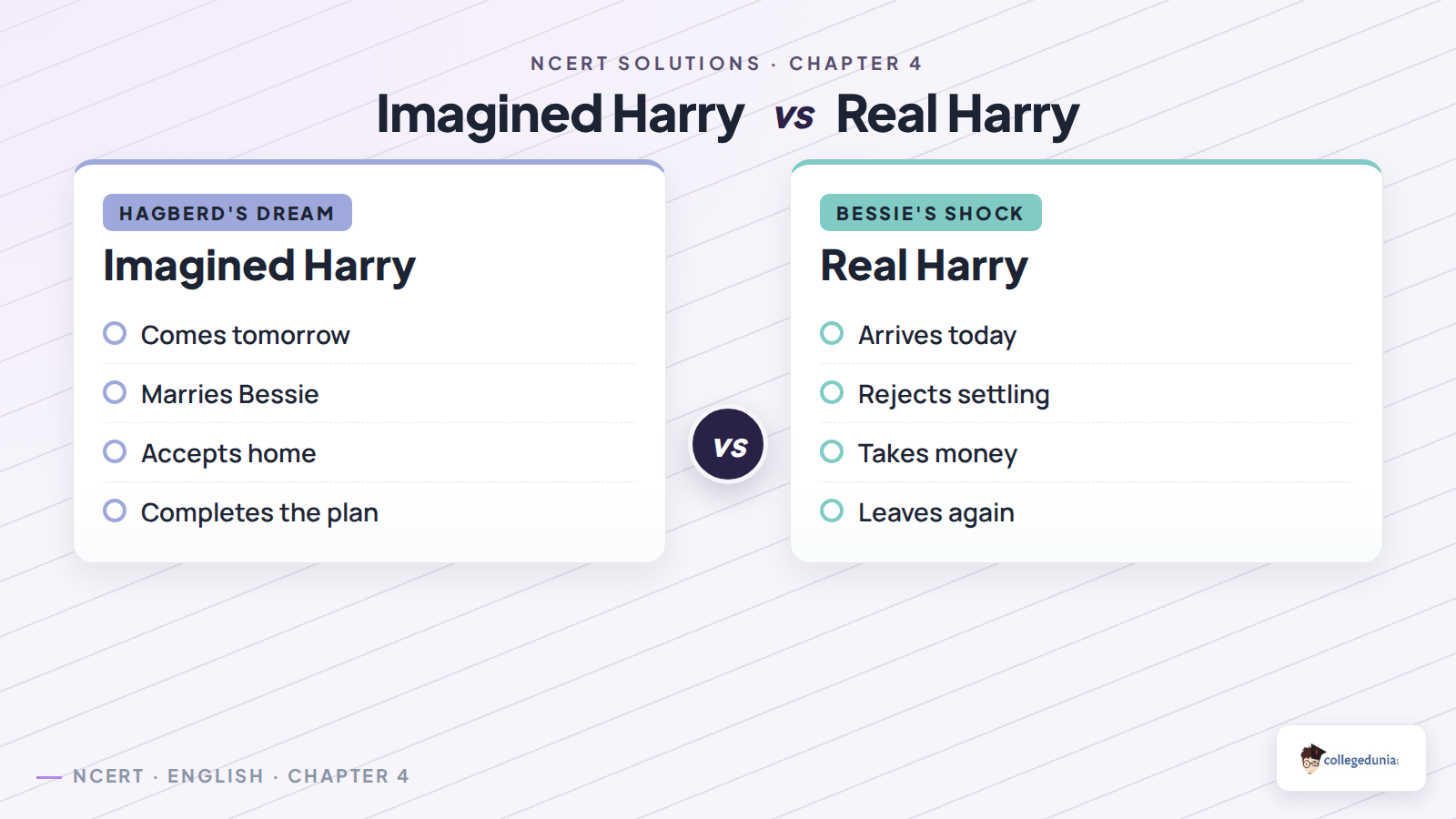
The main task is to explain the contrast between Hagberd's imagined son and the real Harry. The answers show how gossip, dialogue and Bessie's observations reveal the truth in layers. They also explain why the ending is painful: the long-awaited son appears, but he cannot fit the future his father has built for him.
Question area
What to focus on
Answer cue
Stop and Think
Direct incidents and character details
Name the scene first, then add meaning.
Understanding the Text
Theme, irony and relationships
Connect Hagberd's hope with the facts around him.
Appreciation
Narrative method and the title
Explain how delayed revelation shapes sympathy.
Captain Hagberd's Tomorrow Delusion
Captain Hagberd has not simply waited for Harry. He has rebuilt his whole life around the idea that Harry will return and take his appointed place. His clothes, garden, cottage and repeated phrase all become part of this invented future. That is why the title Tomorrow is not only a date; it is a mental shelter.
For answer writing, students should avoid calling Hagberd only foolish. The story lets us see his denial, but it also shows loneliness and grief. The strongest answers balance pity with criticism, because Hagberd hurts Bessie and rejects reality even while his suffering remains visible.
Bessie is central because she sees what Hagberd cannot see. She has compassion for him, but she also understands the limits of his dream. When Harry returns, Bessie becomes the person through whom the student can measure the shock between expectation and truth. Harry is not the obedient sailor-son of Hagberd's fantasy; he is restless, self-interested and unwilling to be trapped.
Character
Story function
How to use in answers
Captain Hagberd
Lives inside the promise of tomorrow
Show how hope hardens into denial.
Bessie
Responds with pity and clear sight
Use her as the emotional balance of the story.
Harry
Breaks the imagined future
Contrast the real man with Hagberd's invented son.
How to Use These NCERT Solutions for Better Answers
Begin with the PDF if you need direct NCERT-order answers. Then use the question cards below to compare the Solution tab with the Expert Solution tab. A strong answer in this chapter usually starts with a direct statement, adds one story detail, and closes by explaining the larger irony or emotional effect.
Track repeated language: the word tomorrow, the talk about Harry, and Hagberd's fixed plans.
Separate fact from fantasy: write what Hagberd believes, then what the story later proves.
Use Bessie carefully: she is not a side character only; she helps reveal the cost of Hagberd's delusion.
Common Mistakes Students Should Avoid
Many weak answers turn Tomorrow into a simple story about a father waiting for his son. That misses Conrad's method. The chapter depends on delay, irony and painful recognition. Students should also avoid writing that Harry's return solves the story, because his arrival actually destroys the neat future Hagberd has imagined.
Do not retell the plot without explaining the repeated idea of tomorrow.
Do not describe Hagberd as comic only; his delusion also carries grief.
Do not ignore Bessie's judgement, because she sees both pity and danger.
Do not call the ending happy simply because Harry returns.
Class 12 English Supplementary Chapter 4 Resource Links
Use these related resources when you want the same chapter in another format. The table is placed above the FAQ so students can move from solutions to notes, book PDF and handwritten revision without losing the chapter context.
All NCERT Solutions for Class 12 English Supplementary Chapters
The table below keeps the same resource type together, so students can move chapter by chapter through the Class 12 English supplementary Kaleidoscope question set.
All NCERT Solutions for Class 12 English (Suppl.) Chapter 4 Kaleidoscope: Tomorrow with Step-by-Step Solutions
The expandable cards below reproduce the full solution set from the PDF. Use the Solution tab for a direct exam-ready answer and the Expert Solution tab for a deeper reading of irony, character and Conrad's narrative design.
Questions
Q 4.1
What brought Captain Hagberd to Colebrook?
Concept used. Chapter: Tomorrow. A direct context answer should name the incident and explain the motive behind it. Captain Hagberd came to Colebrook because he believed his missing son Harry had been seen there.
Key cause
The move begins with a rumour, but it grows into a fixed belief that Colebrook will bring Harry back.
Captain Hagberd had advertised for years to find Harry.
After his wife's death, a letter reached him about a seafaring man with a similar name near Colebrook.
The news was probably a trick, but Hagberd treated it as a real clue.
He searched the area, failed to find Harry, and then settled there to wait.
Captain Hagberd came to Colebrook because a letter made him believe that his lost son Harry had been there, and he settled there to wait for Harry's return.
NK
Naina Kapoor
M.A English, University of Delhi
Verified Expert
Strategic angle. Read Colebrook as both a real place and a mental trap. Once Hagberd links it with Harry, he cannot leave it.
The letter gives him a small factual excuse for hope.
His grief after his wife's death makes that hope emotionally powerful.
When the search fails, he does not accept failure. He changes waiting into a daily plan.
Colebrook therefore becomes the stage on which his delusion can repeat itself.
A doubtful report about Harry brought him to Colebrook, but his own need for hope kept him there.
Q 4.2
Why did the people of Colebrook not have a favourable opinion of Captain Hagberd?
Concept used. Chapter: Tomorrow. A character-reputation answer should connect public behaviour with local judgement. The people of Colebrook saw Captain Hagberd as strange, miserly, and obsessed with an impossible return.
Public view
Mention both his habits and the town's mockery. The answer is not only about his madness.
He did not belong to Colebrook and had arrived in odd circumstances.
He kept talking about Harry's return and asking people about his missing son.
His canvas clothing, white beard, secretive habits, and repeated phrase about tomorrow made him look strange.
He lived cheaply, guarded his property, and avoided normal contact with the townspeople.
Colebrook disliked or mocked Captain Hagberd because his behaviour seemed eccentric, miserly, secretive, and ruled by his delusion about Harry's return.
KD
Kabir Dutta
M.A Comparative Literature, EFLU Hyderabad
Verified Expert
Quick reading. The town judges Captain Hagberd from the outside. It sees his odd signs, but it does not understand his grief.
The barber turns Hagberd into a public joke in the tap-room.
Children, shopkeepers, and neighbours treat his clothes and habits as comic oddities.
His hope for Harry sounds irrational because it keeps shifting into a future date.
His refusal to explain himself makes the town's suspicion grow stronger.
They had no favourable opinion because he looked and acted like a harmless but disturbing madman, and the town reduced his suffering to gossip.
Q 4.3
What sort of a seaman had Captain Hagberd been?
Concept used. Chapter: Tomorrow. A background answer should show the contrast between job and temperament. Captain Hagberd had been a coastal sailor who disliked the sea deeply.
Irony
The irony is strong: he wears sailor's clothes, yet his heart belongs to houses, land, and firesides.
He had worked as a coasting skipper, not as a sailor on long ocean voyages.
His journeys usually stayed close to England and often lasted only a short time.
He disliked life at sea because it kept a man away from home.
When his wife inherited enough money, he gladly gave up the sea.
Captain Hagberd had been a coastal seaman who stayed near land and hated the unsettled life of the sea.
IM
Ira Mukherjee
M.A English, Presidency University
Verified Expert
Strategic angle. Conrad makes Hagberd a sailor who dreams of domestic safety. This contrast explains much of his later behaviour.
His work linked him with the sea, but his imagination valued stable houses.
He never became a romantic adventurer. He saw seafaring as a hardship.
His boast about staying close to land shows pride in avoiding danger, not pride in voyage.
This helps explain why he wants Harry to return and settle into a fixed home.
He was a near-shore sailor by profession, but inwardly he was a land-loving man who longed for home.
Q 4.4
Captain Hagberd constantly hinted at something that made Bessie blush. What was it?
Concept used. Chapter: Tomorrow. An inference answer should read what a character suggests indirectly. Captain Hagberd hints that Bessie will marry Harry when Harry comes home.
Indirect hint
He rarely states it plainly at first. His comments about a home, a wife, and Harry's marriage point to Bessie.
Hagberd speaks of Harry as ready for marriage.
He praises Bessie as sensible and suitable for a good home.
He describes the second cottage and future housekeeping as if she has a share in it.
His winks and suggestions make Bessie understand that he imagines her as Harry's future wife.
He hinted that Bessie would become Harry's wife and share the prepared home after Harry returned.
MT
Mira Thomas
Ph.D English, University of Hyderabad
Verified Expert
Structural observation. Hagberd's hint is comic on the surface, but it quietly binds Bessie to his dream.
He turns ordinary neighbourly talk into a marriage plan.
Bessie's blush shows embarrassment, pity, and a secret wish for another life.
The hint matters because her own home with Mr Carvil gives her no tenderness.
Thus Hagberd's madness offers her a false but tempting picture of escape.
The hint was that Harry would marry Bessie, giving her a home and a future outside her father's cottage.
Q 4.5
What were Bessie's reactions to old Hagberd's ravings?
Concept used. Chapter: Tomorrow. A reaction answer should include change over time. Bessie first sees Hagberd's talk as madness, then humours it, and later half shares its emotional pull.
Changing response
Use three stages: pity, humouring, and a faint personal hope.
At first, Bessie knows that Captain Hagberd is mentally unwell.
She listens patiently because he is harmless and because pity makes her kind.
She learns not to contradict him, since doubt makes him suffer violently.
Over time, the thought of Harry's return and marriage begins to touch her own hidden longing.
Bessie reacts with pity, patience, occasional amusement, and finally a troubled half-belief that connects his hope with her own desire for release.
RM
Rohan Mehta
M.A English, University of Mumbai
Verified Expert
Strategic angle. Bessie is not fooled in a simple way. She knows the delusion is false, but it answers a real hunger in her life.
Her father's cruelty gives her no emotional shelter.
Hagberd's talk, though mad, treats her as important and future-bound.
She therefore protects him from painful truth by pretending to believe.
This pretence slowly becomes emotionally dangerous because it lets her imagine a different life.
She humours Hagberd out of pity, but his dream of tomorrow slowly becomes a dream she can almost want for herself.
Q 4.6
What sort of a person was Mr Carvil?
Concept used. Chapter: Tomorrow. A character sketch should join facts with behaviour. Mr Carvil is a blind retired boat-builder who has become selfish, abusive, and tyrannical toward Bessie.
Character evidence
His blindness explains his dependence, but it does not excuse his cruelty.
Mr Carvil is widowed, blind, heavy, and physically dependent.
He shouts for Bessie constantly and expects instant service.
He treats her as if she were responsible for his blindness.
He has money, but he refuses to make her life easier with help or kindness.
Mr Carvil is a cruel, lazy, and domineering father who uses his blindness to keep Bessie trapped in service.
RS
Ritika Sen
Ph.D English, University of Hyderabad
Verified Expert
Quick reading. Mr Carvil's tragedy has hardened into tyranny. Conrad makes him pitiful and repulsive at the same time.
He has suffered a real loss of sight and independence.
Yet he turns that suffering outward as rage against his daughter.
His loud calls reduce Bessie's life to attendance, feeding, walking, and obedience.
His home therefore becomes a prison, not a place of care.
He is a bitter domestic tyrant whose dependence becomes a weapon against Bessie.
Q 4.7
What was the point of similarity between Captain Hagberd and old Mr Carvil?
Concept used. Chapter: Tomorrow. A comparison answer should state the shared pattern. Both men trap Bessie through their own needs, though in different ways.
Parallel
One man is mentally blinded by hope; the other is physically blind and morally harsh.
Captain Hagberd depends on Bessie to protect his belief in Harry's return.
Mr Carvil depends on Bessie for physical care and daily service.
Both men use her patience and goodness.
Both also live inside a narrow world from which Bessie cannot easily escape.
The similarity is that both men depend on Bessie and imprison her emotionally or physically within their own needs.
AM
Arjun Menon
M.A English, University of Madras
Verified Expert
Structural observation. Conrad pairs the two old men to show two forms of blindness. Bessie stands between them and pays the cost.
Hagberd cannot see reality because hope has replaced fact.
Carvil cannot see physically, and he refuses to see Bessie's pain morally.
Hagberd speaks softly, Carvil shouts brutally, but both make claims on her life.
This parallel makes Bessie's position more tragic than either man's condition alone.
Both are blind in different senses, and both turn Bessie's compassion into captivity.
Q 4.8
Why did Bessie sometimes show signs of irritation and disgust?
Concept used. Chapter: Tomorrow. A motivation answer should connect pressure with response. Bessie becomes irritated because Hagberd's hopeful fantasy mocks her own hopeless life, while her father keeps enslaving her.
Do not blame Bessie
Her irritation is not cruelty. It comes from exhaustion and a life with no clear exit.
She spends her best years caring for a harsh and helpless father.
Captain Hagberd keeps describing a future home that may never exist.
His talk of marriage and servants reminds her of everything missing from her life.
Old Carvil's constant shouting interrupts even the small comfort of her talks with Hagberd.
Bessie shows irritation because pity, tiredness, false hope, and her father's tyranny press on her at the same time.
LN
Leela Nair
M.A English, University of Kerala
Verified Expert
Strategic angle. Bessie's disgust is a sign of emotional starvation. She is asked to comfort everyone while nobody comforts her.
Hagberd's fantasy flatters her, but it also insults her reality by promising what never comes.
Her father's calls drag her back from even a moment of imagined freedom.
She cannot openly reject either man because both are dependent on her.
Irritation therefore becomes the only visible break in her trained patience.
Her irritation comes from being trapped between Hagberd's delusion and Carvil's selfish demands.
Q 4.9
Who was the stranger who met Captain Hagberd? What was the Captain's reaction to the meeting?
Concept used. Chapter: Tomorrow. An identification answer should state who the stranger is and describe Hagberd's response. The stranger is Harry Hagberd, the lost son himself.
Irony
The son actually arrives, but the father refuses him because the arrival happens today, not tomorrow.
A man comes to the gate and asks whether Hagberd has been advertising for his son.
He later tells Bessie plainly that he is Harry.
Captain Hagberd does not recognise him and feels threatened by him.
He calls him a grinning information fellow, withdraws indoors, bolts the door, and even throws a shovel from the window.
The stranger was Harry Hagberd, but Captain Hagberd reacted with fear, suspicion, denial, and rejection.
DR
Devika Rao
M.A English, JNU
Verified Expert
Structural observation. This is the central tragic irony of the story. Reality arrives, but madness rejects it to protect itself.
Hagberd's mind can accept Harry only as a future promise.
A real Harry at the gate breaks the pattern on which his self-esteem rests.
He therefore treats the visitor as a fraud instead of a fulfilment.
His violent closing of the house shows that his hope needs distance more than truth.
The stranger is Harry, and Hagberd rejects him because the real son threatens the safer imaginary son of tomorrow.
Q 4.10
What did young Hagberd think it meant when old Hagberd said that his son would be coming home 'tomorrow'?
Concept used. Chapter: Tomorrow. An interpretation answer should show Harry's misunderstanding before Bessie explains. Harry thinks someone is cheating or tricking his father.
First reaction
Answer from Harry's point of view. He does not yet understand the full madness.
Harry hears that the old man expects his son tomorrow.
Since Harry himself has arrived, he assumes another man may be posing as Harry.
He calls it a swindle and expects some fun when the impostor appears.
Only after Bessie explains does he understand that tomorrow is his father's fixed delusion.
Young Hagberd first thinks the word tomorrow means that some impostor or trickster is planning to deceive his father.
SG
Samar Gupta
M.Phil English, Jadavpur University
Verified Expert
Quick reading. Harry reads the situation practically because he is worldly, not sentimental. He suspects a scam before he suspects madness.
He has not written to announce his return, so the father's claim seems odd.
His rough life has trained him to expect tricks and money games.
The word tomorrow sounds to him like the date for another man's arrival.
Bessie's whisper changes that reading from fraud to delusion.
He thinks an impostor is expected, then learns that his father has turned tomorrow into a permanent fantasy.
Q 4.11
What reasons did Bessie give for encouraging old Hagberd in his insane hopes?
Concept used. Chapter: Tomorrow. A reason answer should explain Bessie's moral choice. Bessie says contradicting Hagberd would only make him miserable or push him further out of his mind.
Bessie's defence
She does not call herself wise. She says kindness made contradiction seem useless and cruel.
She tells Harry that she never contradicted Captain Hagberd.
She believed open denial would only hurt him deeply.
She had once seen how terrified he became at the thought that Harry might be dead.
She also admits that it was easier to half believe the hope herself.
Bessie encouraged Hagberd because contradiction seemed cruel, dangerous to his mind, and emotionally harder than sharing his hope a little.
MB
Megha Banerjee
M.A English, Calcutta University
Verified Expert
Strategic angle. Bessie's kindness is also a trap. By saving Hagberd from pain, she gives the delusion more space to grow.
Her motive begins in pity, because she cannot bear to break a helpless old man's last hope.
She also fears the violence of his emotional collapse if Harry is declared lost.
Over time, silence becomes habit, and habit becomes partial belief.
This prepares the tragedy, because the real Harry arrives into a lie that everyone has protected.
She gives pity, fear, and habit as her reasons, but the protected hope finally harms her too.
Q 4.12
What makes Bessie convinced that the young man is indeed Harry?
Concept used. Chapter: Tomorrow. An evidence answer should collect recognition clues. Bessie becomes convinced because Harry's looks, voice, laugh, manner, and memories match what she knows of Captain Hagberd.
Recognition clues
The proof is not a document. It is likeness, speech, memory, and physical resemblance.
Harry says directly that he is the old man's son.
His laugh resembles Captain Hagberd's, though it is softer and younger.
He asks Bessie to imagine the old man's beard on his own chin.
He remembers his father chasing him with a strap and his fear of leaving home for sea trips.
Bessie is convinced by Harry's resemblance to his father, his familiar laugh, and his personal memories of life with old Hagberd.
AS
Aditi Sharma
M.A English, University of Delhi
Verified Expert
Quick reading. Harry proves himself through living signs, not legal proof. Bessie recognises the family pattern in him.
His body and confident manner show the grown version of the boy Hagberd described.
His jokes carry the same throaty family laugh in a freer form.
His memory of punishment could hardly come from a random stranger.
Bessie's own emotional response also tells her that this is the real arrival.
His likeness, laugh, and private memories make Bessie feel that the real Harry has finally come.
Q 4.13
What kind of life had Harry lived after he left home?
Concept used. Chapter: Tomorrow. A life-sketch answer should infer from Harry's speech and stories. Harry has lived a wandering, rough, adventurous life outside domestic limits.
Contrast with home
Harry is the opposite of the settled son his father has invented.
He has travelled widely and says the whole world is hardly large enough for him.
He speaks of hard work, disorder, open space, and many scrapes.
He compares himself to a Gambusino, a wanderer searching for something like gold.
He has known many women, poverty, hunger, and unstable friendships.
Harry has lived a restless, roving, worldly life, full of travel, risk, poverty, casual love, and refusal of settled domestic duty.
KS
Karan Sethi
M.A English, Ambedkar University Delhi
Verified Expert
Structural observation. Harry's life breaks the father's dream at its root. He is not waiting for home; he is running from enclosure.
His speech values space, movement, and excitement.
His past includes hunger and failure, but he still prefers it to a parlour and a cage.
His talk of women is charming but careless, which reveals emotional selfishness.
The son who returns is therefore real, but he is not redeeming.
Harry has lived as a free but irresponsible wanderer who cannot fit into Captain Hagberd's prepared home.
Q 4.14
What does Bessie tell Harry about his father's plans for him?
Concept used. Chapter: Tomorrow. A plot-detail answer should state the plan and its effect on Harry. Bessie tells Harry that his father has prepared a home, money, furniture, and marriage for him.
Full plan
Include both property and marriage. The plan is domestic, financial, and emotional.
She explains that Captain Hagberd has saved and starved himself for Harry.
He has filled the second cottage with furniture for Harry's future household.
He expects Harry to settle down, marry, and live a respectable home life.
Bessie also becomes part of that plan because Hagberd wants Harry to marry her.
Bessie tells Harry that his father expects him to accept the saved property, live in the prepared cottage, marry, and settle into domestic life.
SV
Sanya Verma
M.A English, Banaras Hindu University
Verified Expert
Strategic angle. The plan sounds generous from the father's side, but it sounds like imprisonment to Harry.
Hagberd has made every sacrifice meaningful by attaching it to Harry's return.
The furniture and cottage are signs of care, but also signs of control.
Bessie explains this because she thinks Harry can still be brought into the dream.
Harry hears only confinement, marriage pressure, and his father's old attempt to shape him.
She tells him that Hagberd has built an entire settled life for him, including home, money, furniture, and Bessie as wife.
Q 4.15
What did Captain Hagberd call out to Bessie from the window?
Concept used. Chapter: Tomorrow. A recall answer should identify the warning and its irony. From the window, Captain Hagberd calls the real Harry a vagabond and tells Bessie not to have anything to do with him.
Irony
The father protects his imaginary Harry by rejecting the actual Harry.
He calls the young man a grinning information fellow.
He tells Bessie that the man is only a vagabond.
He says the stranger cannot be Harry because Harry is coming tomorrow.
He promises that Harry will marry Bessie and that only one more day remains.
Captain Hagberd calls out that the stranger is a vagabond, warns Bessie to send him away, and repeats that Harry will come tomorrow and marry her.
RC
Riya Chatterjee
M.A English, Presidency University
Verified Expert
Quick reading. His words reveal the full madness of hope. The sentence rejects proof and clings to schedule.
He uses insulting labels to make the stranger unreal.
He speaks to Bessie as if she is already tied to his plan.
He repeats tomorrow because that word keeps his fantasy safe from completion.
The call from the window also humiliates Bessie before Harry.
He tells Bessie to reject the stranger and wait one more day for the Harry of his imagination.
Q 4.16
What is the consistency one finds in the old man's madness?
Concept used. Chapter: Tomorrow. A theme answer should identify the repeated inner rule of a delusion. Captain Hagberd's madness is consistent because everything is organised around Harry's return tomorrow.
Title link
The title is not just a date. It is the form of Hagberd's whole mental world.
He keeps postponing fulfilment to a future that never becomes present.
He buys furniture, saves money, digs the garden, and plans marriage for that same future.
He rejects any fact that would make Harry dead, absent, changed, or already arrived.
The word tomorrow keeps his hope alive because it is always near and never testable.
The consistency in his madness is his fixed belief that Harry will come tomorrow, so every action and denial serves that permanent future.
OD
Omkar Desai
M.A English, University of Mumbai
Verified Expert
Structural observation. Hagberd's mind is not random. It has a strict order, but that order is false.
He can manage rent, shopping, property, and polite conversation.
The disorder appears only when Harry's return is questioned.
His answer to every challenge is postponement: not now, but tomorrow.
This makes the madness stable, because it never has to face the present.
Even the furniture and garden obey this pattern, since they are useful only when Harry comes.
The consistency is therefore emotional: hope is preserved by refusing any final test.
His madness follows one rule: the imagined son belongs to tomorrow, and the present must not disturb that belief.
Q 4.17
How does Captain Hagberd prepare for Harry's homecoming?
Concept used. Chapter: Tomorrow. A preparation answer should list visible actions and explain their meaning. Captain Hagberd prepares by buying property, saving money, furnishing a cottage, and planning a settled life for Harry.
Use concrete details
Name the cottages, furniture, garden, money, and imagined marriage.
He buys a plot of ground and builds two yellow brick cottages.
He lives in his own cottage, rents the adjoining cottage to Carvil, and prepares his own rooms for Harry.
He fills and guards his own cottage with furniture, carpets, tables, and household articles.
He saves every penny, keeps seeds for the garden, and imagines Harry married to Bessie.
Download the Full Class 12 English Supplementary Resource List
He prepares his own cottage, furniture, savings, garden plans, and even a bride, because he imagines Harry returning to a complete domestic life.
TI
Tara Iyer
M.A English, EFLU Hyderabad
Verified Expert
Strategic angle. The preparations are loving and controlling at the same time. They reveal what Hagberd wants Harry to become.
His own cottage is not only shelter. It is a script for Harry's future.
The unused furniture shows how long the dream has been preserved.
The garden remains unplanted because even small acts must wait for Harry.
Bessie is quietly inserted into this plan as the sensible wife who will complete the home.
His preparations turn love into a domestic blueprint that leaves no room for the real Harry's wishes.
Q 4.18
How did Bessie begin to share Hagberd's insanity regarding his son?
Concept used. Chapter: Tomorrow. A psychological answer should trace how sympathy becomes emotional participation. Bessie begins by humouring Hagberd, then slowly lets his dream touch her own loneliness.
Half belief
Bessie does not become mad in the same way. She half believes because hope is emotionally useful.
She listens to Captain Hagberd because she feels pity for him.
She avoids contradicting him after seeing how badly doubt wounds him.
His talk of Harry, a home, and marriage offers her a possible escape from Carvil's cottage.
Because her own life is hopeless, the fantasy of tomorrow begins to feel strangely comforting.
Bessie shares the insanity by protecting Hagberd's hope and gradually letting that hope become a private dream of rescue for herself.
AB
Ananya Bose
M.A English, Jadavpur University
Verified Expert
Quick reading. Her participation is emotional, not intellectual. She knows the facts are doubtful, but she needs the feeling.
Hagberd's delusion gives her attention and tenderness missing from her own house.
The promise of Harry turns into the promise of being chosen.
She speaks and acts as if the dream may be true because the alternative is emptier.
This is why Harry's real arrival shakes her more deeply than a stranger's arrival should.
She begins to share it when pity, loneliness, and desire make Hagberd's false tomorrow seem emotionally possible.
Q 4.19
What were Harry's reasons for coming to meet old Hagberd?
Concept used. Chapter: Tomorrow. A motive answer should separate practical need from curiosity. Harry comes because a friend has seen the advertisement, and Harry thinks there may be money or useful information.
Mixed motives
Do not present Harry as a loving returning son. His reasons are practical and casual.
A chum in London sees Captain Hagberd's advertisement and tells Harry about it.
Harry has little money and spends his last coins on railway fare and a shave.
He knows his father may have property, though he says he does not care for the old man's pieces.
He is also curious and suspicious when he hears that another Harry is expected tomorrow.
Harry comes because the advertisement reaches him through a friend, and he hopes the meeting may bring money, food, shelter, or at least a useful explanation.
RB
Rahul Bhat
M.A English, University of Pune
Verified Expert
Strategic angle. Harry's arrival is not the sentimental homecoming Hagberd imagined. It is accidental, hungry, and self-interested.
He does not arrive with apology, longing, or a wish to settle.
His immediate concerns are food, money, and the next move.
He also enjoys the possibility of exposing a trick against his father.
His manner shows that he remains a wanderer, even when he stands at home.
The shaved face and spent railway fare show a little respect, but not deep repentance.
Once he learns about the marriage plan, his practical interest turns into anger and flight.
He comes because the advertisement offers a chance, not because he wants to return permanently to his father.
Q 4.20
Why does Harry's return prove to be a disappointment for Bessie?
Concept used. Chapter: Tomorrow. A theme answer should connect expectation with reality. Harry disappoints Bessie because he is not the settled, loving rescuer she has half imagined.
Tragic turn
The real Harry destroys both Hagberd's dream and Bessie's fragile hope.
Bessie has begun to imagine that Harry's return may change her trapped life.
The real Harry rejects his father's home, money, marriage plan, and settled life.
He flirts with Bessie, takes her money, kisses her, and then leaves.
His departure leaves her with Carvil, Hagberd's madness, and a sharper awareness of loss.
Harry's return disappoints Bessie because he brings desire and shock, but no loyalty, home, or rescue.
MP
Meera Pillai
M.A English, University of Kerala
Verified Expert
Structural observation. Bessie loses twice. The imaginary Harry was false, and the real Harry is unworthy.
Hagberd's dream had at least offered her a story of marriage and freedom.
Harry's actual speech shows contempt for that whole story.
His kiss awakens Bessie's longing, but his leaving makes that longing useless.
The ending sends her back into the same cottage, now with less protection from despair.
He proves disappointing because he is charming but selfish, and his return makes Bessie's hope collapse.
Q 4.21
Discuss: ``Every mental state, even madness, has its equilibrium based upon self-esteem. Its disturbance causes unhappiness.''
Concept used. Chapter: Tomorrow. A discussion answer should explain an abstract statement through the story. The line means that even madness has an inner balance, and a person suffers when that balance is disturbed.
Use Hagberd
The best example is Captain Hagberd's reaction when people grin, question him, or bring present facts to his gate.
Captain Hagberd's self-esteem depends on believing that he is a provident father.
His plan for Harry gives meaning to his poverty, furniture, garden, and waiting.
When strangers mock him or question the plan, his mental balance is shaken.
The real Harry disturbs that balance most of all because he makes the dream face reality.
The statement means that Hagberd's madness has its own order, and he becomes unhappy when mockery or fact threatens that order.
VJ
Vikram Joshi
M.A English, Delhi University
Verified Expert
Strategic angle. The line is compassionate because it treats madness as a human structure, not as random nonsense.
Hagberd's delusion protects his pride as a father who has not failed his son.
The word tomorrow keeps his hope intact while avoiding proof.
A grin, a question, or a living Harry hints that the structure may be absurd.
That hint causes pain because it threatens both his sanity and his dignity.
This is why he fears laughter more than plain poverty or loneliness.
The sentence asks us to see that even an irrational mind defends a fragile self-image.
Conrad suggests that a disturbed mind still needs dignity, and pain begins when that dignity is touched.
Q 4.22
Discuss: Joyce's 'Eveline' and Conrad's 'Tomorrow' are thematically similar.
Concept used. Chapter comparison. A thematic comparison should identify shared ideas and also note difference. Both stories show trapped lives, failed escape, family duty, fear, and paralysis at a decisive moment.
Compare fairly
Give two similarities and one difference. This keeps the answer balanced.
In Eveline, the heroine cannot leave home with Frank because duty, fear, and memory hold her back.
In Tomorrow, Bessie is trapped by her father, Hagberd's delusion, and her own hope of rescue.
Both stories show a promised future that does not become real.
The difference is that Joyce focuses on Eveline's inner paralysis, while Conrad also uses tragic irony through Harry's actual return.
The stories are similar because both present a trapped woman, an imagined escape, and a final failure of movement into a freer life.
PN
Pooja Nair
M.Phil English, University of Calicut
Verified Expert
Structural observation. Both narratives point to a hoped-for future that fails. Eveline waits for departure; Bessie waits for Harry; neither future saves the woman.
Eveline's home is oppressive, yet it also binds her through memory and promise.
Bessie's home is openly oppressive, and Hagberd's dream offers only false release.
Frank and Harry both appear as possible routes outward, but neither delivers freedom.
Both endings leave the heroine fixed in place, with the future receding from reach.
Both stories explore paralysis, family burden, and the collapse of hoped-for escape, though Conrad's story uses a harsher irony.
Q 4.23
Comment on the technique used by the author to unfold the story of Captain Hagberd's past.
Concept used. Chapter: Tomorrow. An appreciation answer should name narrative method and effect. Conrad unfolds Hagberd's past indirectly through town gossip, the barber's account, Bessie's conversations, and Harry's later memories.
Indirect narration
The past is not given as one biography. It is pieced together through voices and scenes.
The opening gives the town's view of Hagberd as an outsider and eccentric.
The barber supplies the story of the advertisements, the hoax letter, and the search for Harry.
Bessie's talks with Hagberd reveal his sea life, his hatred of the sea, and his domestic dream.
Harry's arrival adds a final correction by showing the son from his own rough memory.
Conrad uses gradual disclosure, gossip, dialogue, and multiple viewpoints to reveal Hagberd's past piece by piece.
AR
Aditya Rao
M.A English, University of Mysore
Verified Expert
Strategic angle. The technique makes the student test evidence. We first hear about Hagberd, then watch him, then meet the fact he cannot accept.
Gossip gives a public version that is comic and cruel.
Conversations with Bessie give a private version filled with pity and hope.
Harry's return gives a living version that contradicts the father's dream.
This layered method suits a story about reality being resisted by imagination.
The student must assemble the past from partial reports instead of receiving a neat history.
That method keeps sympathy active because each new voice changes how Hagberd is judged.
The author reveals the past through layered narration, so Hagberd becomes both ridiculous and deeply pitiable.
Q 4.24
Identify instances in the story in which you find streaks of insanity in people other than Hagberd. What implications do they suggest?
Concept used. Chapter: Tomorrow. An appreciation answer should widen the theme beyond one character. The story suggests that forms of obsession and blindness appear in several people, not only in Hagberd. Scope note: this is a full-NCERT Kaleidoscope practice question, so students using a board-only shortlist should confirm that Chapter 4 is prescribed before treating it as exam-only revision.
Wider meaning
The question asks for implications, so explain what these streaks reveal about human need and confinement.
The barber shows a mild contagious obsession when he imagines every strange sailor as Hagberd's son.
Mr Carvil shows a brutal kind of moral madness by making himself helpless to enslave Bessie.
Bessie half shares Hagberd's hope because it offers a way out of despair.
Harry shows a restless hunger for escape so extreme that no home or affection can hold him.
These instances suggest that madness in the story is not only illness, but also obsession, cruelty, hope, and fear shaped by lonely lives.
AM
Aparna Menon
Ph.D English, University of Hyderabad
Verified Expert
Structural observation. Conrad spreads irrationality across the town. This prevents the story from treating Hagberd as a single isolated case.
The barber's jokes hide fascination with the same lost-son story.
Carvil's dependence becomes grotesque because he almost chooses helplessness as power.
Bessie's compassion becomes a dangerous half-delusion under emotional pressure.
Harry's freedom is also distorted, since he cannot stay even when staying could heal others.
These cases show that irrationality can be social, domestic, and emotional, not only medical.
The story therefore makes Colebrook itself feel touched by warped hope and selfish need.
The streaks of insanity imply that many people build private prisons from pride, need, fear, or desire.
Q 4.25
Figures of speech: Allusion. Pick out one or two other examples of allusion from the story and comment briefly on the comparison made.
Concept used. Language Work: allusion. An allusion is an indirect reference to a known story, figure, place, or myth. It helps the writer add meaning without a long explanation.
Quote plus comment
For each example, name the reference and explain what comparison it creates.
The story compares Captain Hagberd to Father Christmas when Harry jokes about his beard. This allusion suggests an old, bearded, gift-bearing figure, but here the gifts belong to a deluded future.
The reference to Davy Jones's locker alludes to a sailor's phrase for death at sea. It suggests that townspeople think Harry may have drowned long ago.
The Gambusino song alludes to wandering gold-seekers. It compares Harry to a restless seeker whom no woman can hold.
Suitable allusions include Father Christmas, Davy Jones's locker, and the Gambusino. Each compares a character or situation with a familiar cultural image.
NV
Nikhil Varma
M.A Linguistics, EFLU Hyderabad
Verified Expert
Quick reading. Allusions work because they carry a ready-made association. Conrad uses them to sharpen character.
Father Christmas makes Hagberd's beard look comic, generous, and unreal at once.
Davy Jones's locker brings in sea folklore and the possibility that Harry is dead.
The Gambusino points to adventure, appetite, and restlessness, which fit young Harry.
These references save space because the comparison is built into the name itself.
They also widen a small seaport story into a world of myth, sea talk, and wandering legend.
Each allusion makes the character more vivid without stopping the movement of the scene.
The allusions briefly connect Hagberd with comic old-age imagery, Harry with sea-death rumours, and Harry again with wandering desire.
Q 4.26
Pronunciation. Complete the Verb/Noun columns and mark the syllable that receives primary stress. Verb column: present, examine, blank, calculate, blank, specialise. Noun column: blank, blank, production, blank, distribution, blank.
Concept used. Language Work: word stress. Primary stress is the syllable spoken with the strongest force. Some words change stress when the grammatical function changes.
Stress cue
Capital letters below mark the syllable that receives primary stress.
tabularll
Verb & Noun
preSENT & presenTAtion
exAMine & examiNAtion
proDUCE & proDUCtion
CALculate & calcuLAtion
disTRIBute & distriBUtion
SPEcialise & specialiSAtion
tabular
For present, the verb is stressed on the second syllable: preSENT. The completed noun form is presenTAtion.
For examine, the verb is exAMine and the noun is examiNAtion.
Production gives the missing verb proDUCE; both keep strong stress near the second syllable.
Calculate is stressed as CALculate, while the noun shifts to calcuLAtion.
Distribution gives the missing verb disTRIBute and the noun stress distriBUtion.
Specialise has early stress as SPEcialise, while the noun shifts to specialiSAtion.
Completed table: preSENT to presenTAtion; exAMine to examiNAtion; proDUCE to proDUCtion; CALculate to calcuLAtion; disTRIBute to distriBUtion; SPEcialise to specialiSAtion.
MK
Maya Krishnan
Ph.D Linguistics, EFLU Hyderabad
Verified Expert
Strategic angle. Treat this as a sound-pattern exercise. The spelling stays related, but the spoken beat can shift across verb and noun forms.
For present, use the derived noun presentation: preSENT becomes presenTAtion.
Examine shifts to examiNAtion when the noun suffix is added.
Produce and production both keep strong stress near the second syllable in many classroom pronunciations.
Calculate shifts clearly in calculation, and distribute shifts in distribution.
Specialise has early stress as a verb, while specialisation places the strongest stress near sa.
Mark the completed pairs as preSENT to presenTAtion, exAMine to examiNAtion, proDUCE to proDUCtion, CALculate to calcuLAtion, disTRIBute to distriBUtion, and SPEcialise to specialiSAtion.
Tomorrow Class 12 English NCERT Solutions FAQs
Ques. How many questions are solved in the Class 12 English Tomorrow PDF?
Ans. The PDF solves 26 questions from Chapter 4, including Stop and Think, Understanding the Text, Talking about the Text, Appreciation and Language Work.
Ques. Are these NCERT Solutions useful for the full 2026-27 NCERT chapter?
Ans. Yes. The article and PDF are prepared for full 2026-27 NCERT Class 12 English supplementary Kaleidoscope Chapter 4 practice and keep the answers aligned with the official question order.
Ques. What is the main theme of Tomorrow by Joseph Conrad?
Ans. The story mainly explores hope, denial, loneliness and the clash between imagined future and actual truth. Captain Hagberd's repeated tomorrow shows how waiting can become self-deception.
Ques. How should students write long answers for this chapter?
Ans. Students should begin with a clear point, add precise story evidence, and then explain the emotional or literary effect. For this chapter, irony, repetition and Bessie's role are especially important.





Chapter4Kaleidoscope:TomorrowSolutions.pdf?page=1&dpi=150)
Chapter4Kaleidoscope:TomorrowSolutions.pdf?page=2&dpi=150)
Chapter4Kaleidoscope:TomorrowSolutions.pdf?page=3&dpi=150)
Chapter4Kaleidoscope:TomorrowSolutions.pdf?page=4&dpi=150)
Chapter4Kaleidoscope:TomorrowSolutions.pdf?page=5&dpi=150)
Chapter4Kaleidoscope:TomorrowSolutions.pdf?page=6&dpi=150)
Chapter4Kaleidoscope:TomorrowSolutions.pdf?page=7&dpi=150)
Chapter4Kaleidoscope:TomorrowSolutions.pdf?page=8&dpi=150)
Chapter4Kaleidoscope:TomorrowSolutions.pdf?page=9&dpi=150)
Chapter4Kaleidoscope:TomorrowSolutions.pdf?page=10&dpi=150)
Chapter4Kaleidoscope:TomorrowSolutions.pdf?page=11&dpi=150)
Chapter4Kaleidoscope:TomorrowSolutions.pdf?page=12&dpi=150)
Chapter4Kaleidoscope:TomorrowSolutions.pdf?page=13&dpi=150)
Chapter4Kaleidoscope:TomorrowSolutions.pdf?page=14&dpi=150)
Chapter4Kaleidoscope:TomorrowSolutions.pdf?page=15&dpi=150)
Chapter4Kaleidoscope:TomorrowSolutions.pdf?page=16&dpi=150)
Chapter4Kaleidoscope:TomorrowSolutions.pdf?page=17&dpi=150)
Chapter4Kaleidoscope:TomorrowSolutions.pdf?page=18&dpi=150)
Chapter4Kaleidoscope:TomorrowSolutions.pdf?page=19&dpi=150)
Chapter4Kaleidoscope:TomorrowSolutions.pdf?page=20&dpi=150)
Chapter4Kaleidoscope:TomorrowSolutions.pdf?page=21&dpi=150)
Chapter4Kaleidoscope:TomorrowSolutions.pdf?page=22&dpi=150)
Chapter4Kaleidoscope:TomorrowSolutions.pdf?page=23&dpi=150)
Chapter4Kaleidoscope:TomorrowSolutions.pdf?page=24&dpi=150)
Chapter4Kaleidoscope:TomorrowSolutions.pdf?page=25&dpi=150)
Chapter4Kaleidoscope:TomorrowSolutions.pdf?page=26&dpi=150)
Chapter4Kaleidoscope:TomorrowSolutions.pdf?page=27&dpi=150)
Chapter4Kaleidoscope:TomorrowSolutions.pdf?page=28&dpi=150)
Chapter4Kaleidoscope:TomorrowSolutions.pdf?page=29&dpi=150)
Chapter4Kaleidoscope:TomorrowSolutions.pdf?page=30&dpi=150)
Chapter4Kaleidoscope:TomorrowSolutions.pdf?page=31&dpi=150)
Chapter4Kaleidoscope:TomorrowSolutions.pdf?page=32&dpi=150)
Chapter4Kaleidoscope:TomorrowSolutions_flat_MobileCard.pdf?page=1&dpi=150)
Chapter4Kaleidoscope:TomorrowSolutions_flat_MobileCard.pdf?page=2&dpi=150)
Chapter4Kaleidoscope:TomorrowSolutions_flat_MobileCard.pdf?page=3&dpi=150)
Chapter4Kaleidoscope:TomorrowSolutions_flat_MobileCard.pdf?page=4&dpi=150)
Chapter4Kaleidoscope:TomorrowSolutions_flat_MobileCard.pdf?page=5&dpi=150)
Chapter4Kaleidoscope:TomorrowSolutions_flat_MobileCard.pdf?page=6&dpi=150)
Chapter4Kaleidoscope:TomorrowSolutions_flat_MobileCard.pdf?page=7&dpi=150)
Chapter4Kaleidoscope:TomorrowSolutions_flat_MobileCard.pdf?page=8&dpi=150)
Chapter4Kaleidoscope:TomorrowSolutions_flat_MobileCard.pdf?page=9&dpi=150)
Chapter4Kaleidoscope:TomorrowSolutions_flat_MobileCard.pdf?page=10&dpi=150)
Chapter4Kaleidoscope:TomorrowSolutions_flat_MobileCard.pdf?page=11&dpi=150)
Chapter4Kaleidoscope:TomorrowSolutions_flat_MobileCard.pdf?page=12&dpi=150)
Chapter4Kaleidoscope:TomorrowSolutions_flat_MobileCard.pdf?page=13&dpi=150)
Chapter4Kaleidoscope:TomorrowSolutions_flat_MobileCard.pdf?page=14&dpi=150)
Chapter4Kaleidoscope:TomorrowSolutions_flat_MobileCard.pdf?page=15&dpi=150)
Chapter4Kaleidoscope:TomorrowSolutions_flat_MobileCard.pdf?page=16&dpi=150)
Chapter4Kaleidoscope:TomorrowSolutions_flat_MobileCard.pdf?page=17&dpi=150)
Chapter4Kaleidoscope:TomorrowSolutions_flat_MobileCard.pdf?page=18&dpi=150)
Chapter4Kaleidoscope:TomorrowSolutions_flat_MobileCard.pdf?page=19&dpi=150)
Chapter4Kaleidoscope:TomorrowSolutions_flat_MobileCard.pdf?page=20&dpi=150)
Chapter4Kaleidoscope:TomorrowSolutions_flat_MobileCard.pdf?page=21&dpi=150)
Chapter4Kaleidoscope:TomorrowSolutions_flat_MobileCard.pdf?page=22&dpi=150)
Chapter4Kaleidoscope:TomorrowSolutions_flat_MobileCard.pdf?page=23&dpi=150)
Chapter4Kaleidoscope:TomorrowSolutions_flat_MobileCard.pdf?page=24&dpi=150)
Chapter4Kaleidoscope:TomorrowSolutions_flat_MobileCard.pdf?page=25&dpi=150)
Chapter4Kaleidoscope:TomorrowSolutions_flat_MobileCard.pdf?page=26&dpi=150)
Chapter4Kaleidoscope:TomorrowSolutions_flat_MobileCard.pdf?page=27&dpi=150)
Chapter4Kaleidoscope:TomorrowSolutions_flat_MobileCard.pdf?page=28&dpi=150)
Chapter4Kaleidoscope:TomorrowSolutions_flat_MobileCard.pdf?page=29&dpi=150)
Chapter4Kaleidoscope:TomorrowSolutions_flat_MobileCard.pdf?page=30&dpi=150)
Chapter4Kaleidoscope:TomorrowSolutions_flat_MobileCard.pdf?page=31&dpi=150)
Chapter4Kaleidoscope:TomorrowSolutions_flat_MobileCard.pdf?page=32&dpi=150)
Chapter4Kaleidoscope:TomorrowSolutions_flat_MobileCard.pdf?page=33&dpi=150)
Chapter4Kaleidoscope:TomorrowSolutions_flat_MobileCard.pdf?page=34&dpi=150)
Chapter4Kaleidoscope:TomorrowSolutions_flat_MobileCard.pdf?page=35&dpi=150)
Chapter4Kaleidoscope:TomorrowSolutions_flat_MobileCard.pdf?page=36&dpi=150)
Chapter4Kaleidoscope:TomorrowSolutions_flat_MobileCard.pdf?page=37&dpi=150)
Chapter4Kaleidoscope:TomorrowSolutions_flat_MobileCard.pdf?page=38&dpi=150)
Chapter4Kaleidoscope:TomorrowSolutions_flat_MobileCard.pdf?page=39&dpi=150)
Chapter4Kaleidoscope:TomorrowSolutions_flat_MobileCard.pdf?page=40&dpi=150)
Chapter4Kaleidoscope:TomorrowSolutions_flat_MobileCard.pdf?page=41&dpi=150)
Chapter4Kaleidoscope:TomorrowSolutions_flat_MobileCard.pdf?page=42&dpi=150)
Chapter4Kaleidoscope:TomorrowSolutions_flat_MobileCard.pdf?page=43&dpi=150)
Chapter4Kaleidoscope:TomorrowSolutions_flat_MobileCard.pdf?page=44&dpi=150)
Chapter4Kaleidoscope:TomorrowSolutions_flat_MobileCard.pdf?page=45&dpi=150)
Chapter4Kaleidoscope:TomorrowSolutions_flat_MobileCard.pdf?page=46&dpi=150)
Chapter4Kaleidoscope:TomorrowSolutions_flat_MobileCard.pdf?page=47&dpi=150)
Chapter4Kaleidoscope:TomorrowSolutions_flat_MobileCard.pdf?page=48&dpi=150)
Chapter4Kaleidoscope:TomorrowSolutions_flat_MobileCard.pdf?page=49&dpi=150)
Chapter4Kaleidoscope:TomorrowSolutions_flat_MobileCard.pdf?page=50&dpi=150)
Chapter4Kaleidoscope:TomorrowSolutions_flat_MobileCard.pdf?page=51&dpi=150)
Chapter4Kaleidoscope:TomorrowSolutions_flat_MobileCard.pdf?page=52&dpi=150)
Chapter4Kaleidoscope:TomorrowSolutions_flat_MobileCard.pdf?page=53&dpi=150)
Chapter4Kaleidoscope:TomorrowSolutions_flat_MobileCard.pdf?page=54&dpi=150)
Chapter4Kaleidoscope:TomorrowSolutions_flat_MobileCard.pdf?page=55&dpi=150)
Chapter4Kaleidoscope:TomorrowSolutions_flat_MobileCard.pdf?page=56&dpi=150)
Chapter4Kaleidoscope:TomorrowSolutions_flat_MobileCard.pdf?page=57&dpi=150)
Chapter4Kaleidoscope:TomorrowSolutions_flat_MobileCard.pdf?page=58&dpi=150)
Chapter4Kaleidoscope:TomorrowSolutions_flat_MobileCard.pdf?page=59&dpi=150)
Chapter4Kaleidoscope:TomorrowSolutions_flat_MobileCard.pdf?page=60&dpi=150)
Chapter4Kaleidoscope:TomorrowSolutions_flat_MobileCard.pdf?page=61&dpi=150)




Comments