


Commonwealth Scholarship

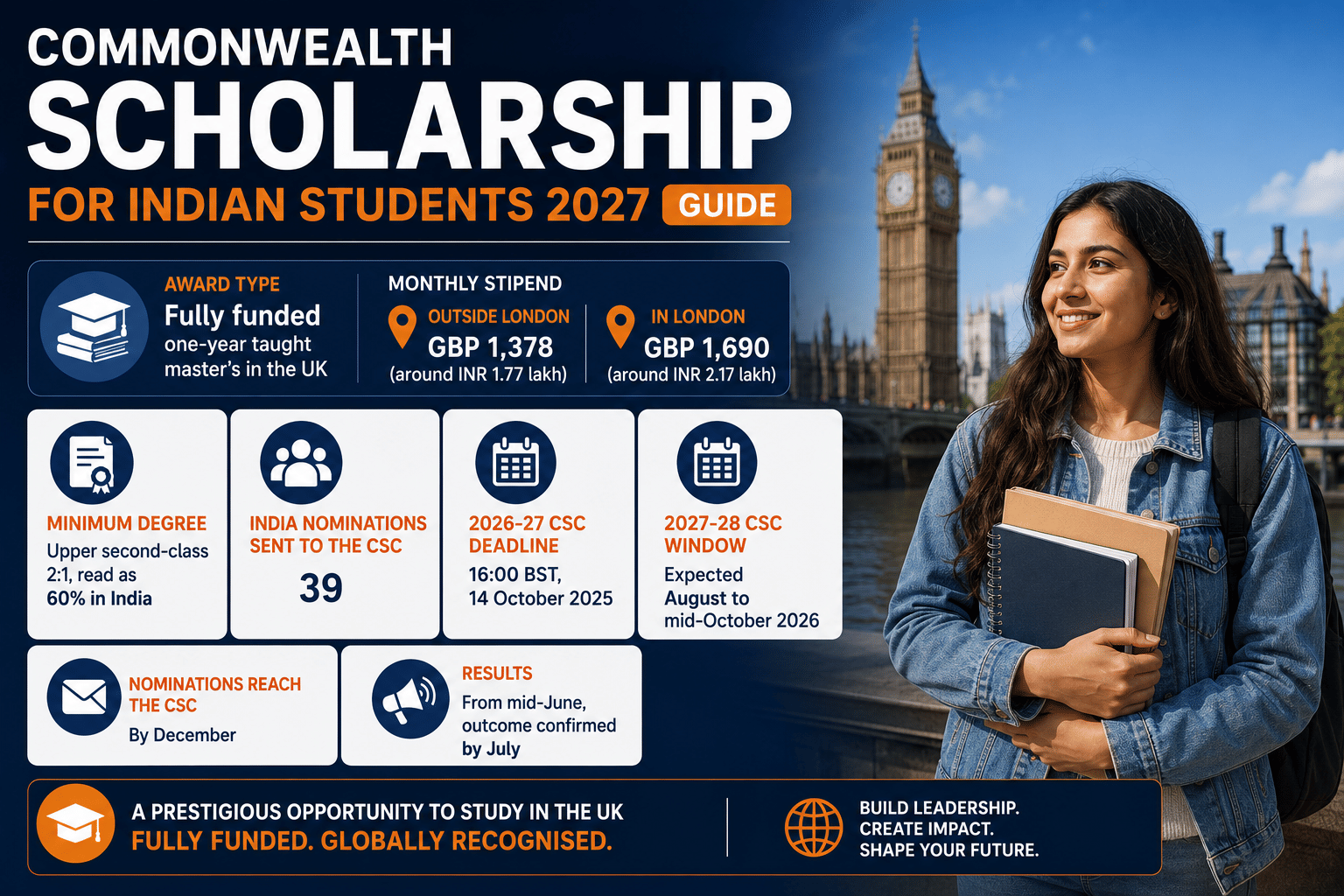
The Commonwealth Scholarship for Indian students is a fully funded UK master's award with no MBA option. It pays full tuition, a monthly stipend, return airfare, and several smaller grants. Applications run through the Ministry of Education, not directly to the UK.
- Financial need is a formal eligibility rule here, not a tiebreaker.
- India's Ministry of Education controls the nomination, so a strong CSC form alone is not enough.
- The award funds development impact at home, not career ambition abroad.
- Time already spent studying or working in a rich country can end your claim.
More than 31,000 people have taken up a Commonwealth award since the first 175 scholars reached the UK in 1960. The Commission is blunt about the odds. A nomination from your country is no guarantee of selection. Source: British Council Study UK and the Commonwealth Scholarship Commission. India sends only 39 nominations to the Commission in a typical cycle, so the domestic filter is the hard part.
| Parameter | Detail |
|---|---|
| Award type | Fully funded one-year taught master's in the UK |
| Stipend outside London | GBP 1,378 per month (around INR 1.77 lakh) |
| Stipend in London | GBP 1,690 per month (around INR 2.17 lakh) |
| Minimum degree | Upper second-class 2:1, read as 60% in India |
| India nominations sent to the CSC | 39 |
| 2026-27 CSC deadline | 16:00 BST, 14 October 2025 |
| 2027-28 CSC window | Expected August to mid-October 2026 |
| Nominations reach the CSC | By December |
| Results | From mid-June, outcome confirmed by July |
Also Read,
- GREAT Scholarship: Eligibility, Application, and Selection
- Chevening Scholarship for Indian Students: 2027 Guide
- Charpak Scholarship 2026: Benefits, Eligibility, How to Apply
Highlights
| Scholarship Type | Full-Ride-Scholarships, Merit-Based, Need-Based |
| Offered by | Corporate |
| Organization | N/A |
| Application Deadline | Oct 14 ,2026 |
| Number of Scholarships | 175 |
| Amount | Variable Amount |
| Renewability | No |
| International Student Eligible | Yes |
| Scholarship Website Link | http://cscuk.dfid.gov.uk/ |
Eligibility Criteria
You must clear the Commission's rules and the Ministry of Education's rules together. Failing either one ends the application.
Commission criteria
- Be a citizen and permanent resident of an eligible Commonwealth country.
- Hold a first degree of upper second-class (2:1) standard by September of the intake year.
- A lower second-class degree works only with a relevant postgraduate qualification.
- Be unable to afford UK study without this scholarship.
- Be ready to start in the UK by the start of the academic year.
The Ministry of Education adds sharper numbers for India. It reads the 2:1 standard as 60% in graduation. Candidates with 50 to 59% qualify only with a relevant postgraduate degree. MBA courses are excluded outright. Course choice matters early because you need an admission offer in hand. Shortlist targets from the full list of UK universities open to Indian postgraduate applicants well before the portal opens.
Who gets ruled out
- Anyone who has studied or worked one academic year or more in a high-income country.
- Indian applicants who spent over six months abroad for study, training or specialisation.
- Applicants seeking a second UK master's without a strong written justification.
- Anyone applying for an MBA or any non-taught research degree.
The six CSC themes
Every application must sit under one Commission theme. Pick the theme your course and career actually serve. A mismatched theme weakens an otherwise strong file.
- Science and technology for development.
- Strengthening health systems and capacity.
- Promoting global prosperity.
- Peace, security and governance.
- Resilience and response to crises.
- Access, inclusion and opportunity.
Application Process
Indian applicants fill two separate forms, on CSC Central and on the SAKSHAT portal. Skipping either one voids the application.
Admission comes first. You apply to UK universities running CSC-supported courses and secure an offer. The Ministry does not nominate candidates without a confirmed admission letter. If your offer arrives after the cut-off, then your file is set aside. That means starting university applications almost a year ahead.
Cycle timeline
| Stage | When it happens |
|---|---|
| CSC Central opens | Around August or September |
| CSC Central closes | Mid-October, 16:00 UK time |
| SAKSHAT portal window | Set separately by the Ministry of Education |
| Nominations sent to the CSC | By December |
| Eligibility and panel review | January to May |
| Results announced | From mid-June onwards |
| Course begins | September or October |
Draft everything offline first. The CSC form covers academic history, work history, three references and a study plan. It also asks for a development impact statement tied to one of six CSC themes. No edits are possible after you submit.
Commission rule on submissions: the CSC cannot accept any application or document sent outside CSC Central. Email attachments and posted copies are not read.
The SAKSHAT step is simpler but easy to forget. You save your completed CSC application as a PDF and upload it on the Ministry's portal. Ministry dates are announced separately on education.gov.in and have been extended in past cycles.
The other two Commonwealth master's routes
The agency-nominated award is only one of three master's schemes. Commonwealth Shared Scholarships run through selected UK universities, and India is on that eligible list. Commonwealth Distance Learning Scholarships fund a part-time UK master's while you stay in India. Both have their own deadlines and skip the Ministry stage entirely.
English requirements come from your university, not the Commission. Confirm the exact band your course wants, and check which UK universities accept alternative English proof from Indian students.
Check, Russell Group entry standards before finalising your course choice
Selection Process
Selection runs in two layers, one in India and one in the UK. India narrows thousands of applicants down to 39 nominations.
The Ministry scores nominations on a points system and spreads them across the six themes. Points reward candidates who commit to returning to India and working here for two years. Reserved category applicants and women also receive weightage. The academic standing of your admitting university counts too.
What happens after nomination
| Stage | What the CSC does |
|---|---|
| Eligibility check | Secretariat verifies documents, references and transcripts |
| Panel assessment | Scores merit, study plan and development impact |
| Final decision | Selection panel picks scholars from the nomination pool |
| Outcome | All applicants emailed from mid-June onwards |
| Confirmation | Conditional scholars submit any pending documents |
Three criteria decide the UK stage. Panels weigh candidate merit, the quality of the study plan and the likely impact on your home country. A polished CV without a development argument scores badly here.
What the Commission states: a nomination is not a guarantee of a scholarship. Nominating agencies cannot influence the decision once they have nominated you.
Check your spam folder through June and July. The CSC warns that an offer can be withdrawn if a candidate does not reply in time. Many scholars also succeed only on a second or third attempt.
Chevening runs on leadership and networking instead of financial need. Applicants blocked by the Commonwealth affordability rule often fit there better. Compare the Chevening Scholarship criteria for Indian applicants before you commit a cycle.
Read More: Every fully funded UK route worth stacking against this one
Grant Details
This is the most complete UK package available to Indian master's applicants. Tuition, living costs and flights are all covered.
What the award covers
- Approved tuition fees in full, settled between the CSC and your university.
- A stipend of GBP 1,378 per month, or GBP 1,690 at London institutions.
- Return economy airfare from India to the UK at the start and end of the award.
- A warm clothing allowance for scholars arriving in a UK winter.
- A study travel grant for approved academic travel.
- A thesis grant where the course requires one.
Support widens for a few personal situations. Single, widowed or divorced parents can claim a child allowance of GBP 590 a month for the first child. The second and third child under sixteen attract GBP 146 each. Scholars who declare a disability are offered a full needs assessment.
Even so, the stipend is calculated for one person living modestly. Compare it against a realistic monthly cost of living estimate for the UK before you plan a London course.
What the award does not cover
- Airfare for dependants, which the CSC does not reimburse.
- Journeys made before your award is finally confirmed.
- Any costs beyond your agreed tenure, including extra months in the UK.
- MBA tuition, since the scheme funds no MBA course at all.
Budget separately for visa charges and the health surcharge, using this breakdown of UK student visa costs for Indian students.
Also Check:
| UK Government Scholarships | Rhodes Scholarship 2027 | Part-Time Jobs in the UK |
| Student Accommodation in the UK | UK Minimum Wage 2026 | Opening a UK Bank Account |
The Commonwealth Scholarship suits Indian applicants who can prove genuine financial need and a concrete plan for home. It pays more than any other UK master's award open to Indians. The bottleneck is the Ministry of Education stage, where thousands compete for 39 nominations. Applicants who secure a UK offer early and write a specific development case survive that filter. Those who submit a generic study plan rarely reach the UK panel at all.
Similar Scholarship
SUBSCRIBE TO OUR NEWS LETTER


