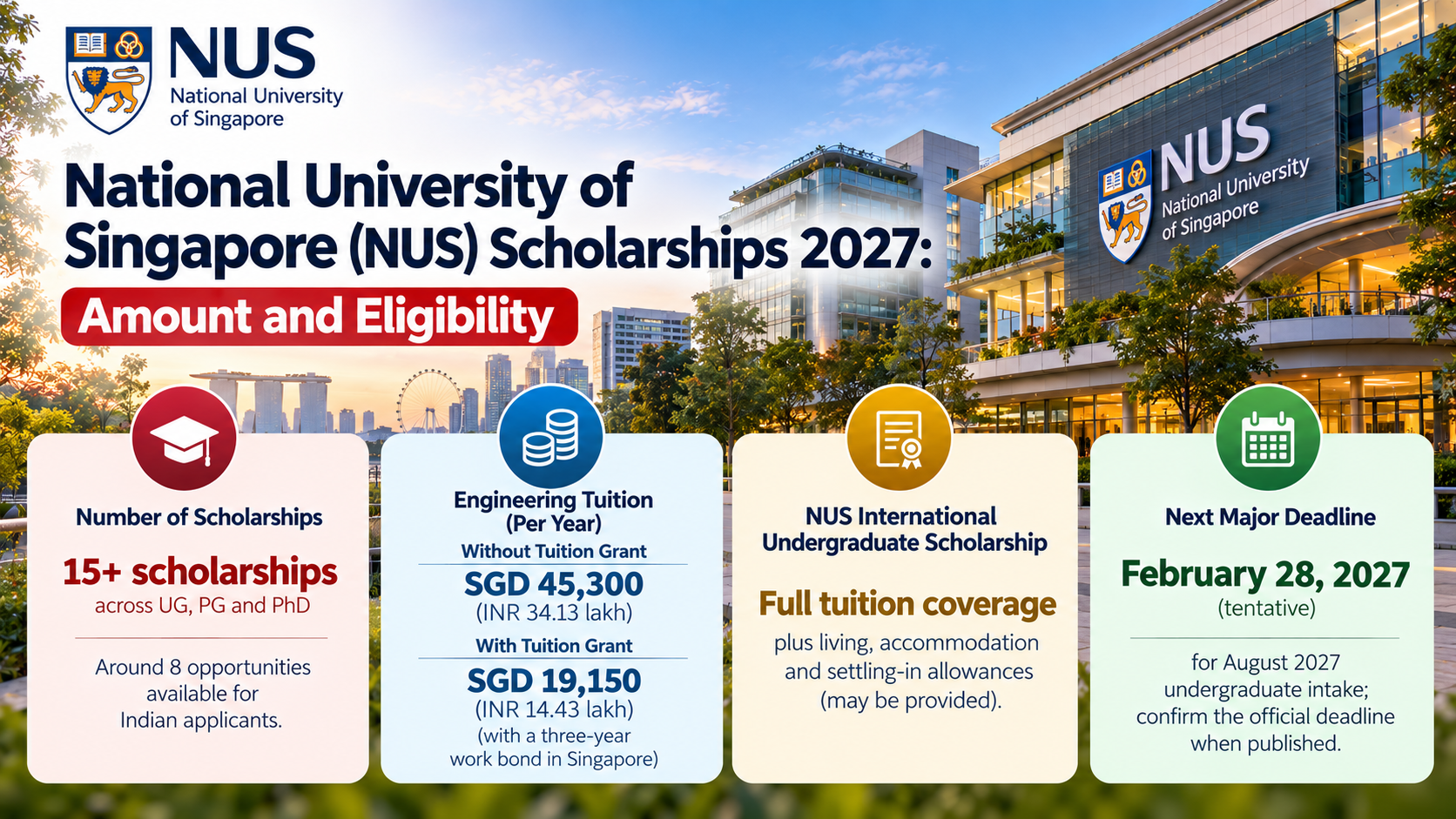
The National University of Singapore (NUS) offers over 15 scholarships across bachelor’s, master’s and PhD programmes, with around 8 opportunities available to Indian applicants. These include full scholarships and tuition subsidies. Indian students often combine the NUS International Undergraduate Scholarship or Science and Technology grant with the Ministry of Education Tuition Grant. The Tuition Grant can reduce tuition by 50 - 70%, subject to eligibility, in exchange for a three-year work bond in Singapore after graduation.
- Engineering tuition without the Tuition Grant: SGD 45,300 (INR 34.13 lakh) per year for international students.
- With the Tuition Grant: SGD 19,150 (INR 14.43 lakh) per year, with a three-year post-study work obligation.
- With the NUS International Undergraduate Scholarship: Tuition may be fully covered, along with living, accommodation and settling-in allowances.
- Next major deadline: February 28, 2027, is a tentative date for the August 2027 undergraduate intake; confirm the official deadline when published.
Indian applicants should review the eligibility criteria and conditions of each award before applying, particularly the Tuition Grant’s work-bond requirement.
Currency Note: All INR conversions use the live rate of 1 SGD = INR 75.34 as of September 2026.
![]()
Also check, National University of Singapore (NUS) Overview
National University of Singapore Scholarships for UG Students
Indian undergraduate applicants can apply for three main scholarships at the National University of Singapore (NUS). They are automatically considered through their admission application, so no separate scholarship application is required.
| Scholarship |
Coverage |
Eligibility |
Bond |
| NUS International Undergraduate Scholarship |
Full tuition after Tuition Grant; annual living allowance SGD 6,000 (INR 4.52 Lakhs); one-time accommodation and settling-in allowances |
Non-Singaporean applicants with outstanding academic and co-curricular record; auto-considered on admission |
None on scholarship; 3-year Singapore work obligation via Tuition Grant |
| NUS Science and Technology Undergraduate Scholarship |
Full tuition (post-subsidy); yearly stipend of SGD 6,000 (approximately INR 4.52 Lakhs); computer allowance SGD 2,000 (INR 1.51 Lakhs); return airfare |
Indian, Chinese, Bangladeshi and other Asia applicants entering Computing, Engineering or Science; minimum 70 percent in Class XII |
Identical Tuition Grant bond obligation |
| Faculty and NUS College Scholarships (auto-considered) |
Partial to full tuition offsets; one-time awards ranging SGD 2,000 to 5,000 (INR 1.51 to 3.77 Lakhs) |
Applicants to specific NUS faculties or the NUS College honours programme |
Standard Tuition Grant bond applies |
Indian students applying for NUS undergraduate scholarships should note two key conditions. Recipients must accept the Tuition Grant, which comes with a post-study work obligation in Singapore. Declining the grant makes applicants ineligible for NUS-administered scholarship schemes covered by this requirement.
Also check, National University of Singapore (NUS) Courses 2027
National University of Singapore Scholarships for PG / Master’s Students
NUS master’s coursework programmes rarely carry a headline scholarship for Indian applicants. Research-track master’s candidates access the NUS Research Scholarship on terms similar to those given to PhD candidates.
| Scholarship |
Coverage |
Eligibility |
Bond |
| NUS Research Scholarship (Master’s by Research) |
Full tuition waiver; monthly stipend SGD 2,900 (INR 2.19 Lakhs) for up to 24 months |
Admitted MSc-by-Research or MEng candidates with Second-Class Honours or equivalent |
None |
| Tuition Grant Subsidy (Coursework Master’s) |
50 to 70 percent tuition reduction applied at billing |
Most NUS coursework master’s programmes accept the subsidy; opt-in at admission |
Three-year work-in-Singapore obligation |
| Departmental Teaching Assistantships |
Monthly stipend SGD 800 to 2,000 (INR 60,272 to 1.51 Lakhs) |
Research master’s students; assigned by the supervising principal investigator |
None |
| Business School and Public Policy Merit Awards |
One-time tuition offset SGD 5,000 to 15,000 (INR 3.77 to 11.30 Lakhs) |
Top applicants to MBA, MSc Business Analytics, MPP and similar programmes |
None |
Indian applicants to NUS Business School often rely on external funding, such as the JN Tata Endowment or the KC Mahindra loan-scholarship, to cover tuition costs. The Tuition Grant is generally unavailable for full-time MBA and Executive MBA programmes, making external financial support more important.
Reddit Insight: Indian students pursuing NUS’s MSc in Business Analytics report that accepting the Tuition Grant is optional for this programme. Students who decline it must cover the full tuition fee of SGD 65,500 (INR 49.35 lakh) themselves.
Also check, National University of Singapore (NUS) Admissions 27
India-Specific Scholarships at National University of Singapore
The National University of Singapore (NUS) does not offer scholarships exclusively for Indian nationals. However, Indian students can apply for two NUS scholarships that list India among the eligible countries, along with donor-funded and department-specific grants.
| Award |
Coverage |
Where India Sits |
Notes |
| Science and Technology Undergraduate Award (NUS-STUS) |
Complete tuition offset once the Tuition Grant applies, plus living stipend, computer stipend and return airfare |
India named as an eligible source country in the award terms |
Around 100 offers annually across Asia; Indian cohort forms a significant share |
| SINGA Indian Cohort at NUS |
Complete tuition; monthly stipend of SGD 2,700 (roughly INR 2.03 Lakhs), moving up to SGD 3,200 (about INR 2.41 Lakhs) post-QE |
Indian applicants form one of the largest cohorts in the annual STEM PhD intake |
Applications close 1 December each year for the following August intake |
| Faculty of Engineering and School of Computing Departmental Research Awards |
Partial tuition offset plus project stipend SGD 500 to 1,500 (INR 37,670 to 1.13 Lakhs) monthly |
Awarded on a project-by-project basis to Indian PhD and Master’s-by-Research hires |
Negotiated directly with the supervising principal investigator |
The NUS ASEAN Undergraduate Scholarship and the NUS ASEAN Research Scholarship are closed to Indian nationals. India is not an ASEAN member, so any Indian applicant should route effort into the International Undergraduate award instead.
National University of Singapore PhD Scholarships
National University of Singapore funds most full-time PhD students through four distinct scholarship tracks. Indian applicants have historically won heavy shares of the Research Scholarship and SINGA cohorts in Science and Engineering.
- Full tuition waiver is standard on the Research Scholarship, SINGA and the President’s Graduate Fellowship.
- Monthly stipend begins at SGD 2,700 per month pre-Qualifying Examination on every PhD funding track.
- Airfare and settling-in allowances appear only on the President’s Graduate Fellowship and on SINGA.
| PhD Scholarship |
Coverage |
Eligibility |
Duration |
| NUS Research Scholarship |
Full tuition waiver; SGD 2,700 (INR 2.03 Lakhs) monthly stipend, rising to SGD 3,200 (INR 2.41 Lakhs) after passing the Qualifying Examination |
Second-Class Honours (Upper Division) or equivalent; admitted full-time PhD candidate |
Up to 4 years |
| SINGA (Singapore International Graduate Award) |
Same stipend structure; airfare grant SGD 1,500 (INR 1.13 Lakhs); settling-in allowance SGD 1,000 (INR 75,340) |
International STEM PhD applicants; first-time study in Singapore |
4 years |
| President’s Graduate Fellowship |
Complete tuition waiver plus a monthly stipend ranging SGD 3,400 to 3,900 (INR 2.56 to 2.94 Lakhs); airfare and settling-in included |
Nomination-based; awarded to top-ranked PhD candidates each semester |
4 years |
| NUS Industrial PhD Scholarship |
Full tuition; industry-funded monthly stipend; project-linked internship pay |
PhD candidates on an industry-partnered research project |
4 years |
Indian applicants commonly target the NUS Research Scholarship and SINGA for the August intake. Deadlines vary: the Research Scholarship follows the relevant department’s PhD application deadline, while SINGA applications generally close on December 1 for the following August intake.
Reddit Insight: Indian PhD scholars at NUS’s Kent Ridge campus report that the SGD 2,700 pre-qualifying examination (QE) stipend can cover a shared PGP Residence room and meals. Shared rooms typically cost SGD 700 - 900 per month, while private one-bedroom flats near campus start at around SGD 2,200 monthly, putting greater pressure on the budget.
Also check,
External Government Scholarships for National University of Singapore Applicants
Indian students at the National University of Singapore (NUS) can explore external government and trust-funded scholarships alongside university awards. Five key funding schemes are worth considering for Indian applicants pursuing bachelor’s, master’s and PhD programmes.
| External Scheme |
Coverage |
Eligibility |
Deadline (Tentative) |
| Ministry of Education Tuition Grant (Singapore Government) |
50 to 70 percent tuition subsidy on published fees |
Any international admit at NUS; opt-in during admission |
July 17, 2027 (annual acceptance window) |
| National Overseas Scholarship, Ministry of Social Justice (India) |
Full tuition plus maintenance up to INR 15.4 Lakhs annually |
SC and DNT candidates; family income under INR 8 Lakhs; Master’s or PhD abroad |
March 31, 2027 |
| National Overseas Scholarship, Ministry of Tribal Affairs (India) |
Tuition plus maintenance grant; 20 slots per cycle |
ST candidates; family income under INR 6 Lakhs; targeted at postgraduate research programmes overseas |
March 31, 2027 |
| JN Tata Endowment Loan Scholarship |
Base loan INR 1 to 10 Lakhs; travel grant up to INR 3 Lakhs; top-performer gift INR 7.5 Lakhs |
Indian graduates in any discipline; no income cap; interview-based selection |
March 31, 2027 |
| KC Mahindra Post-Graduate Scholarship |
Up to INR 10 Lakhs; top three recipients receive INR 8 to 10 Lakhs as an outright grant |
Indian postgraduate students admitted abroad; academic and interview merit |
April 30, 2027 |
The Tuition Grant is the single most valuable external subsidy an Indian NUS student can claim. It applies before any NUS scholarship and effectively halves the sticker tuition on most undergraduate programmes. Indian government scholarships suit specific applicant profiles. The National Overseas Scholarship is only open to reserved categories with strict income caps. The JN Tata and KC Mahindra schemes screen on academic and interview performance without category limits.
Reddit Insight: Indian PhD applicants report that combining SINGA funding with an INR 7.5 lakh JN Tata Endowment award can help cover living expenses in Singapore. However, flights, health insurance and initial deposits can add to first-semester costs. Students should confirm whether both awards can be combined.
Also check,
FAQs
Ques. What is the maximum funding an Indian student can stack at National University of Singapore?
Ans. An Indian undergraduate admit can combine the International Undergraduate award with the Tuition Grant. This combination waives 100 percent of tuition and adds a yearly SGD 6,000 stipend (about INR 4.52 Lakhs). Accommodation, settling-in and travel support round out the package as one-time additions.
Ques. When do NUS scholarship decisions get released for Indian applicants?
Ans. Undergraduate scholarship decisions arrive with the NUS admission offer, typically between March and May for the following August intake. PhD funding decisions are issued alongside departmental admission offers, usually 8 to 12 weeks after the application window closes.
Ques. Do Indian students need to apply for NUS scholarships separately from admission?
Ans. No separate scholarship application exists for the NUS International Undergraduate Scholarship, Science and Technology Undergraduate Scholarship or most faculty-level awards. Indian applicants are auto-evaluated from the admission form. SINGA and the Industrial PhD Scholarship do require a separate online application.
Ques. What academic threshold do Indian applicants need for the Science and Technology Undergraduate Scholarship at NUS?
Ans. The published minimum is 70 percent in Class XII (CBSE, ISC or state boards). Actual successful applicants typically post 92 to 95 percent aggregates, strong SAT or A-Level scores and a documented co-curricular record in academics, sports or arts.
Ques. Does the NUS PhD stipend cover rent near the Kent Ridge campus?
Ans. The pre-Qualifying Examination stipend is SGD 2,700 per month (about INR 2.03 Lakhs). It stretches to fund a shared PGP Residence spot at SGD 700 to 900 plus meals and transport. Private one-bedroom flats within a 15-minute commute start around SGD 2,200 and are impractical without a co-tenant.








Comments