



| Updated On - Aug 4, 2026
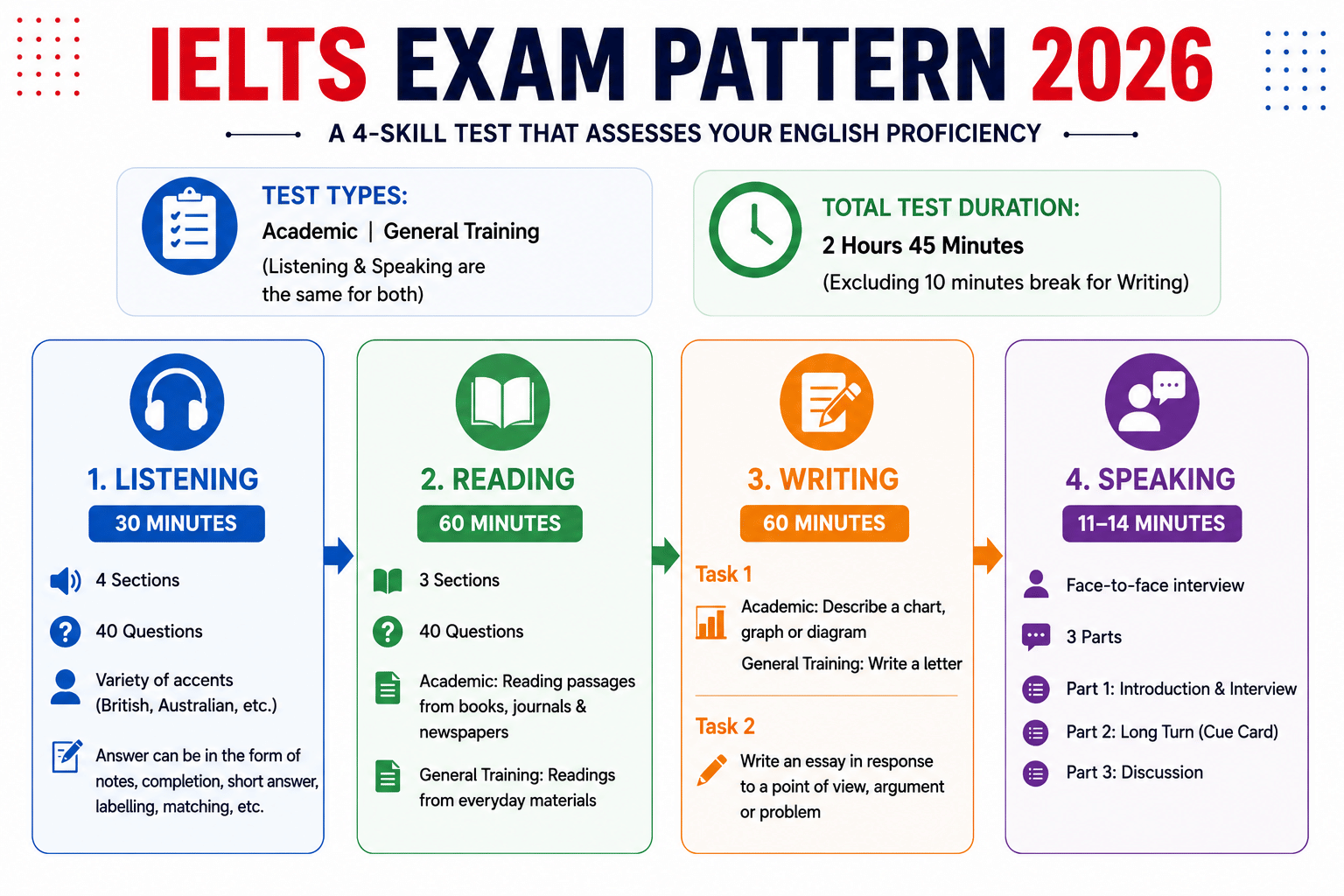
The IELTS exam is divided into 4 sections. The total time taken to conduct these 4 sections is about 2 hours and 45 minutes. Applicants get 40 questions each in Listening and Reading, 2 tasks in Writing, and 3 parts in Speaking. Each section is scored on a 0 to 9 band scale.
- The Listening and Speaking sections are identical for Academic and General Training. Only Reading and Writing differ.
- Pick the right test type first. Academic is for university, General Training is for work or migration.
- Writing Task 2 carries more weight than Task 1 and is where most Indian test takers lose bands.
- The computer-delivered format is faster and now supports One Skill Retake in India.
Quick Facts on IELTS Exam Pattern:
| Parameter | Detail |
|---|---|
| Total sections | 4 (Listening, Reading, Writing, Speaking) |
| Total test duration | 2 hours 45 minutes |
| Listening | 30 minutes, 40 questions, 4 recordings |
| Reading | 60 minutes, 40 questions, 3 passages |
| Writing | 60 minutes, 2 tasks (150 + 250 words) |
| Speaking | 11 to 14 minutes, 3 parts, face-to-face |
| Band scale | 0 to 9, in half-band steps |
| Fee in India (2026) | INR 19,000 (Academic or General Training) |
| Score validity | 2 years from the test date |
| Result timeline | 3 to 5 days (computer), 13 days (paper) |
Check the full IELTS registration steps and slot booking guide
What Is the IELTS Exam Pattern?
The IELTS exam pattern is a 4-section test conducted in about 2 hours and 45 minutes. Three sections (Listening, Reading, Writing) run back to back on the same day. Speaking is often held on a different day, either before or after.
The order of the 3 same-day sections is fixed. You do Listening first, then Reading, then Writing. There is no break between them.
- Listening: 30 minutes, 40 questions, 4 recordings played once each.
- Reading: 60 minutes, 40 questions across 3 passages.
- Writing: 60 minutes, 1 short task and 1 essay.
- Speaking: 11 to 14 minutes with a real examiner in 3 parts.
Every candidate takes the same 4 sections. Only the Reading and Writing content changes based on whether you pick Academic or General Training.
Key Insight: There is no negative marking anywhere in the IELTS. You get 1 mark for every correct answer and lose nothing for a wrong one. So attempt every question, even the ones you are unsure about.
IELTS Academic vs General Pattern
Academic and General Training share the same Listening and Speaking sections, but the Reading and Writing content is different. Academic is built for university admission and professional registration. General Training is built for work visas, migration, and secondary school entry. The table below breaks down the exam pattern for both test types:
| Section | Academic | General Training |
|---|---|---|
| Listening | Same, 40 questions | Same, 40 questions |
| Reading | 3 academic passages from journals or books | Short workplace and everyday texts, then 1 longer passage |
| Writing Task 1 | Describe a chart, graph, table or diagram (150 words) | Write a letter (formal, semi-formal or informal, 150 words) |
| Writing Task 2 | Formal essay (250 words) | Essay in a slightly less formal tone (250 words) |
| Speaking | Same 3-part interview | Same 3-part interview |
Reading in the Academic test uses longer, denser texts from journals and textbooks. General Training uses shorter texts you might see at work or in a notice. Both still have 40 questions in 60 minutes.
Read More: Full IELTS Academic vs General Training comparison
IELTS Listening Section Pattern
The IELTS Listening section runs for 30 minutes, has 40 questions, and plays 4 recordings once each. On the paper test, you get an extra 10 minutes to transfer answers. On the computer test, the transfer time is 2 minutes.
Each of the 4 recordings has 10 questions. The difficulty rises as you move from section 1 to section 4. You cannot pause or replay any recording.
- Recording 1: A conversation between 2 people in a social setting (like booking travel).
- Recording 2: A monologue on a social topic (like a museum tour or event announcement).
- Recording 3: A discussion between up to 4 people in an educational setting.
- Recording 4: An academic lecture by one speaker.
The Listening test uses British, Australian, New Zealand, and North American accents on purpose to test the accent knowledge of the applicant. This is why Indian students who prep only with one accent tend to lose 0.5 to 1 full band.
Note: The IELTS on paper will be discontinued in India after 22nd August 2026. This is the last date for the paper-based test in India.
IELTS Listening Question types
There are 11 types of questions in the Listening test. Applicants need to solve multiple choice, matching, plan or map labelling, form or note completion, sentence completion, and short answer questions. Indian applicants mainly struggle with map or plan questions as they are a bit difficult to analyse.
Key Insight: Read each set of questions in the 30 seconds the test gives you before the audio plays. Underline the question word (name, date, price, place). That single habit lifts many test takers by half a band.
IELTS Reading Section Pattern
The IELTS Reading section gives you 60 minutes for 40 questions across 3 long passages. There is no extra transfer time in Reading. You must write answers directly on the answer sheet within the given time.
Academic Reading uses passages from journals, books and magazines. The topics are broad but written for a general audience. General Training uses shorter, practical texts like notices, ads and instructions in the first two parts, plus one longer passage at the end. Here’s an overview of the Reading section pattern:
| Detail | Academic Reading | General Training Reading |
|---|---|---|
| Total questions | 40 | 40 |
| Total time | 60 minutes | 60 minutes |
| Passages | 3 long academic passages | Short workplace texts + 1 long passage |
| Word count | 2,150 to 2,750 total | Around 2,300 total |
You will face 11 question types. The most common are True or False or Not Given, matching headings, multiple choice, sentence completion, and summary completion.
Time you should spend per passage
Spend about 20 minutes on each passage. Do not get stuck on one hard question. Skip it and come back to it later. Don’t invest more than 90 seconds on any question.
The passages get harder from the 1st to the 3rd one. As the 1st passage is easy, try to solve it as soon as possible. The first 2 passages can get the marks easily as they are less difficult than the 3rd passage. Save the last 5 minutes to double-check your spelling.
IELTS Writing Section Pattern
The IELTS Writing section runs for 60 minutes and has 2 tasks, which are a short 150-word task and a 250-word essay. Task 2 carries twice the weight as Task 1 in the final Writing band. Applicants are suggested to split the time in 20:40, 20 minutes on Task 1 and 40 minutes on Task 2.
Falling below the minimum word count leads to a direct score cut. Do not go under 150 or 250 words, even by 5 words. There is no upper word cap, but experts suggest 160 to 180 for Task 1 and 260 to 280 for Task 2.
Writing Task 1
Task 1 is different in Academic and General Training. In Academic, applicants need to describe a graph in 150 words. In General Training, you need to write a letter in 150 words. The key highlights are:
- Academic Task 1: Describe a graph, chart, table, diagram or process in your own words.
- General Training Task 1: Write a letter (formal, semi-formal or informal) responding to a real-life situation.
Writing Task 2
Task 2 is the same for both tests in shape. You get a statement or question. You have to write a full essay in 250 words giving your view, weighing 2 sides, or explaining a problem and solution.
Both tasks are marked on 4 criteria, each worth 25% of the section score.
| Criteria | Testing Area |
|---|---|
| Task Achievement / Response | Did you actually answer the question fully? |
| Coherence and Cohesion | Is your writing organised and easy to follow? |
| Lexical Resource | Is your vocabulary wide and used correctly? |
| Grammatical Range and Accuracy | Are your sentences varied and mostly error-free? |
Key Insight: Task 2 is where most Indian candidates lose their overall band. It is worth twice as much as Task 1. Always finish it, even if your Task 1 ends up rushed.
IELTS Speaking Section Pattern
The IELTS Speaking section is an 11 to 14 minute face-to-face interview with a trained examiner in 3 parts. The format is identical for Academic and General Training. It is scheduled either on the same day or within 7 days of the test date.
The whole interview is recorded. You can request a re-mark later if you feel the score is not enough. The following points break down the full Speaking test:
- Part 1 (4 to 5 minutes): The examiner asks basic questions about you, your home, work or studies, and interests.
- Part 2 (3 to 4 minutes): You get a Cue Card with a topic, 1 minute to plan and 1 to 2 minutes to speak.
- Part 3 (4 to 5 minutes): A deeper discussion linked to the Part 2 topic. Expect abstract questions and follow-ups.
Speaking is marked on 4 criteria, which contribute equally at 25% each in the scores of the Speaking test:
- Fluency and coherence
- Lexical resource
- Grammatical range and accuracy
- Pronunciation
You cannot bring notes or a phone into the Speaking room. Only the cue card and pencil provided in Part 2.
IELTS Exam Pattern Scoring Rules
Every section is scored from 0 to 9, and the overall band is the average of the 4 section scores rounded to the nearest 0.5. There are no fail marks. Universities and visa offices decide the minimum overall score they want, or in some cases section-by-section score requirements.
Listening and Reading raw scores out of 40 are converted to a 9-band scale. So getting 30 out of 40 correct in Listening usually maps to band 7. Writing and Speaking are scored directly on the 4 criteria.
| Overall band average | Rounded IELTS score |
|---|---|
| 6.125 to 6.24 | 6.0 |
| 6.25 to 6.49 | 6.5 |
| 6.75 to 7.24 | 7.0 |
| 7.25 to 7.49 | 7.5 |
An average of 6.25 rounds up to 6.5. An average of 6.125 rounds down to 6.0. This indicates that small margins matter a lot and contribute to your overall Score band.
What band your target country needs
- USA: Most universities ask 6.5 to 7.0. Top schools like MIT, Harvard, and Stanford ask 7.0 to 7.5.
- UK: 6.0 to 7.0 for most courses. Russell Group universities usually want 6.5 or 7.0.
- Canada: Usually 6.5 overall with no band below 6.0.
- Australia: 6.0 to 6.5 for most courses, 7.0 with no band below 7.0 for nursing and teaching.
The IELTS score validity is for 2 years from the test date. After that, most universities and visa authorities will ask you to re-take the test.
Check the full IELTS band score guide and scoring calculator
Paper vs Computer IELTS Pattern
Both the paper and computer versions of the IELTS follow the same pattern, questions, sections, and scoring. Only the delivery method changes. The test content is identical.
The computer-delivered test gives you results in 3 to 5 days. The paper test takes 13 days. The computer test also has more slots per week, so it is easier to grab a date close to your application deadline.
| Feature | Paper-based IELTS | Computer-delivered IELTS |
|---|---|---|
| Fee in India | INR 19,000 | INR 19,000 |
| Test slots | 4 per month (Thursdays or Saturdays) | Almost every weekday |
| Result time | 13 days | 3 to 5 days |
| One Skill Retake | Not available | Available |
| Listening transfer time | 10 extra minutes | 2 extra minutes |
The Speaking section is always with a real examiner face-to-face, regardless of format. Even in the computer test, you sit in a room and talk to a person.
Important: The IELTS on paper is no more functional in India. The last slot to appear on paper is 22nd August 2026. Applicants willing to take the test should book in advance as the slots may be full due to no further extension or availabilty.
One Skill Retake explained
Applicants who are unable to achieve their aimed scores by a small or minor margin can appear for any 1 skill again rather than taking the whole test. The retake fee is around INR 12,650. You must book within 60 days of your test.
Only one skill can be retaken per attempt. If you score band 6.5 in Writing but need 7.0, you can retake Writing alone instead of paying INR 19,000 for the full test again. You then choose which score to send (the old or the new).
Note: Applicants must check on the official website of the universities if they accept IELTS One Skill Retake scores.
Check the best IELTS preparation books for band 7 and above
Preparation Tips for the IELTS Pattern
The single best prep is timing full IELTS mock tests under real exam conditions before you book your slot. Most Indian test takers fail band targets not from weak English, but from running out of time in Reading or panicking in Speaking.
Give yourself 6 to 8 weeks to prepare for the test. Aim for one full mock test every weekend. Track your scores and weak sections every week. Follow these tips to strengthen all 4 skills:
- Listening: Train your ear on BBC, ABC Australia, and NPR podcasts. Mix all accents.
- Reading: Practise skimming and scanning. Learn to spot keywords fast.
- Writing: Write 2 essays a week. Get them checked by a teacher or a scoring tool.
- Speaking: Record yourself on Part 2 cue cards daily. Listen back and fix pauses.
Do not memorise essays or speaking answers. Examiners are trained to spot canned phrases, and it can drop your band. Original but simple English scores higher than rehearsed complex sentences.
Key Insight: Book your Speaking slot on the same day as the rest if you can. Doing 4 sections in one day is tiring but it stops the anxiety of walking in fresh for Speaking a week later.
Also Check:
| IELTS Exam Complete Guide | IELTS Exam Fees in India | IELTS Exam Dates in India |
| IELTS Reading Full Guide | Top Universities Abroad | Study Abroad Scholarships |
The IELTS exam pattern is fixed, predictable, and well documented. What varies is how well you prep for each of the 4 sections. Book the right test type, time your mocks, and treat Writing Task 2 with the respect it deserves. A clear band target linked to your dream university will guide every study session. Once you know what the pattern actually rewards, the exam becomes far less scary than it looks.
FAQs
Ques. How many sections are there in the IELTS exam pattern?
Ans. The IELTS exam pattern has 4 sections: Listening, Reading, Writing and Speaking. Three sections run on the same day back to back. Speaking is usually held on a different day within a week of the main test.
Ques. What is the total duration of the IELTS test?
Ans. The full IELTS test takes about 2 hours and 45 minutes. Listening is 30 minutes, Reading is 60 minutes and Writing is 60 minutes. Speaking adds another 11 to 14 minutes on the same or a nearby day.
Ques. Is the IELTS exam pattern the same for Academic and General Training?
Ans. Partly. The Listening and Speaking sections are identical for both tests. Only the Reading and Writing sections have different content. Academic uses academic passages and a data-based Task 1; General Training uses everyday texts and a letter Task 1.
Ques. How many questions are there in each IELTS section?
Ans. Listening has 40 questions and Reading has 40 questions. Writing has 2 tasks (a 150-word task and a 250-word essay). Speaking has 3 parts and no set number of questions.
Ques. Is there negative marking in the IELTS exam?
Ans. No. There is no negative marking anywhere in IELTS. You get 1 mark for every correct answer and lose nothing for a wrong answer. So attempt every question, even ones you are unsure of.
Ques. What is the IELTS scoring pattern?
Ans. Each section is scored on a 0 to 9 band scale. Your overall band is the average of the 4 section scores, rounded to the nearest 0.5. So a 6.25 average rounds up to 6.5 and a 6.125 average rounds down to 6.0.
Ques. What is the IELTS exam fee in India for 2026?
Ans. The IELTS fee in India is INR 19,000 for both Academic and General Training. UKVI IELTS costs INR 19,250. The fee is the same for paper and computer formats. Payment can be made online through the IDP India portal.
Ques. Which section is the hardest in IELTS?
Ans. It varies by student, but Writing Task 2 is the most common weak spot for Indian test takers. Task 2 carries more marks than Task 1. Reading also trips up many students because of tight time pressure and the confusing "Not Given" answer choice.
Ques. Can I retake just one section of the IELTS in India?
Ans. Yes, if you took the computer-delivered test. The One Skill Retake option lets you re-take Listening, Reading, Writing or Speaking alone within 60 days for around INR 12,650. Paper test takers cannot use this feature.
Ques. How long is an IELTS score valid?
Ans. IELTS scores are valid for 2 years from the test date. After that, most universities and visa offices will not accept the score. A few institutions may allow exceptions if you can show ongoing English use.
Ques. How soon can I see my IELTS results?
Ans. Computer-delivered results are ready in 3 to 5 days. Paper-based results take about 13 days. You get an email when results are live and can view the Test Report Form on the IDP India portal.
Ques. What band score do top universities abroad ask for?
Ans. Most universities ask for a 6.5 to 7.0 overall band. Top US schools like MIT and Stanford ask for 7.0 to 7.5. UK Russell Group universities usually want 6.5 or 7.0. Canada asks 6.5 with no band below 6.0, and Australia asks 6.0 to 6.5 for most courses.



Comments