



| Updated On - Aug 13, 2026
Achieving a high IELTS Speaking score is always recommended for a successful application. Some universities set sectional score requirements according to their programs. The following IELTS speaking tips can help you improve your communication skills. Your speaking preparation must include practising communication regularly by talking with family members and friends.
Taking mock tests is also important to understand the question format and topics. The IELTS speaking test includes 3 tasks, and you will be allocated 11–14 minutes to complete this section. Prepare regularly with IELTS speaking test practice papers under timed conditions to improve your score range.
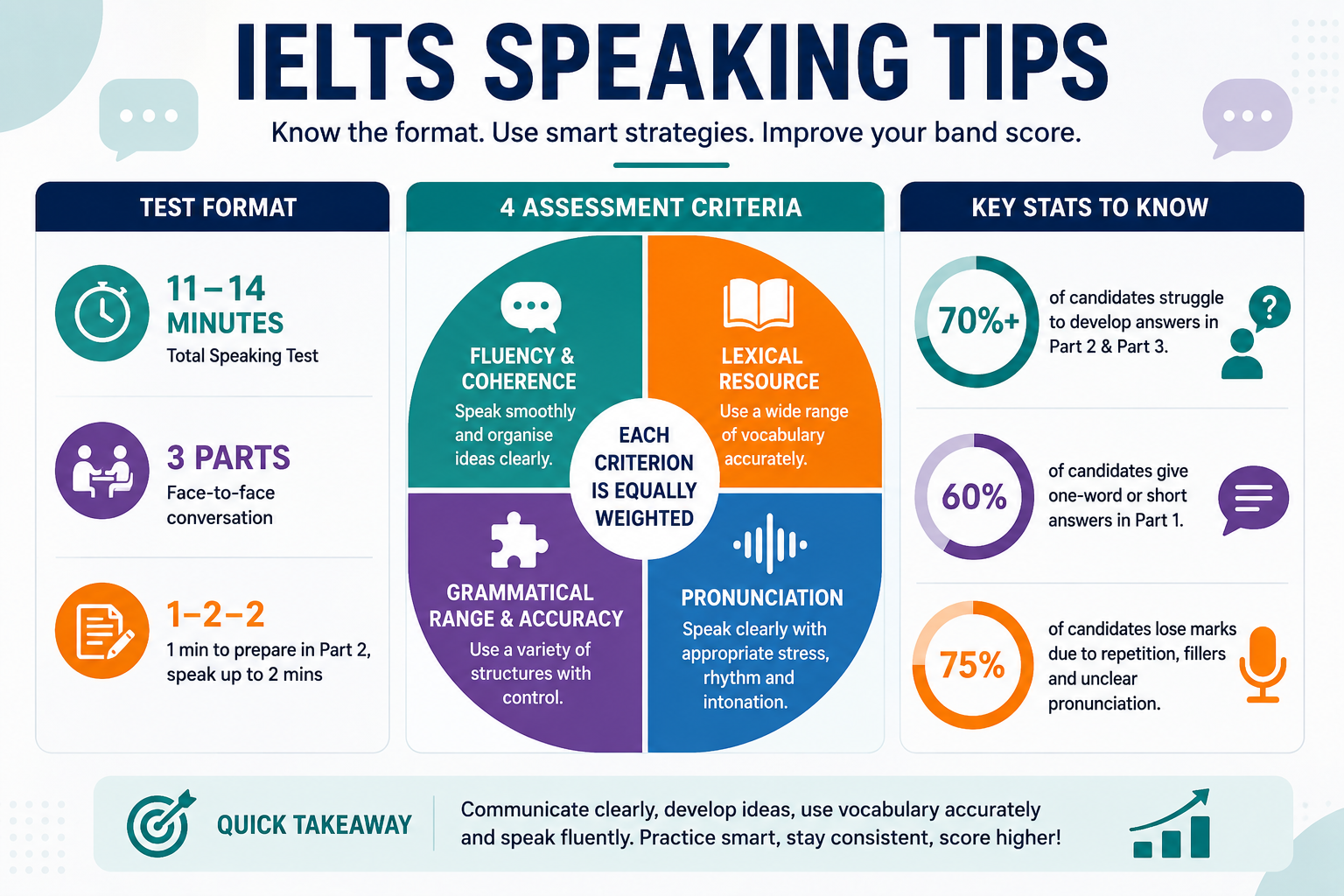
IELTS Speaking Assessment Criteria
IELTS Speaking is assessed across 4 equally weighted criteria: Fluency and Coherence, Lexical Resource, Grammatical Range and Accuracy, and Pronunciation. The Speaking test lasts 11-14 minutes, with performance across all 3 parts contributing to the final band score.
The important point for students is that these criteria overlap during a real conversation. For example, stopping repeatedly to search for a word can affect fluency, while using a word incorrectly can affect lexical resource. Similarly, trying to produce complicated grammar can actually hurt your fluency if you cannot control the structure.
| Criterion | What the examiner is really listening for | What you should actually do |
|---|---|---|
| Fluency & Coherence | Can you keep your answer moving? Can you connect and develop ideas without excessive hesitation or repetition? | Don't prepare every sentence before speaking. Start with your main idea and develop it as you talk. |
| Lexical Resource | Can you choose words precisely and adapt your vocabulary when you don't know an exact word? | If you forget a word, explain it differently instead of stopping. |
| Grammatical Range & Accuracy | Can you use different sentence structures while maintaining reasonable control? | Don't force complex grammar into every sentence. Use complex structures when they naturally fit your idea. |
| Pronunciation | Can the examiner understand you easily, and do your stress, rhythm and intonation help communicate meaning? | Work on clarity rather than trying to imitate a British, American or Australian accent. |
What this means in practice
A student might know plenty of vocabulary but still struggle with Fluency and Coherence because they spend too much time searching for the “perfect” word. Another student might speak smoothly but repeatedly make basic grammatical errors. This is why “sounding fluent” alone is not enough. Your preparation needs to address all four criteria.
The official Band 7 descriptors, for example, do not require error-free English. Some hesitation, repetition, self-correction, and grammatical errors can occur as long as the candidate can maintain effective communication and coherence.
IELTS Speaking Part 1 Tips 2026
IELTS Speaking Part 1 lasts around 4-5 minutes and focuses on familiar topics such as studies, work, family, hobbies, and daily life. The section tests how effectively you can provide information and express opinions in a natural conversation. The following are tips for Speaking Task 1:
- Answer beyond “Yes” or “No”: Give a direct answer and add a reason, detail, or example when appropriate.
- Keep answers natural: Part 1 is about familiar topics, so talk about your actual experiences rather than prepared stories.
- Don't memorise responses: Prepare ideas and vocabulary for common topics instead of complete answers.
- Use personal examples: Mention your studies, hometown, hobbies, routines or experiences when they are relevant.
- Stay on the question: Don't turn a simple question into a long, unrelated speech.
- Don't force vocabulary: Use words you understand and can pronounce and apply correctly.
- Give varied answers: Avoid starting every response with the same phrases such as “Yes, I definitely agree.”
- Practise topic switching: The examiner can move quickly from one familiar topic to another, so practise responding without relying on a fixed script.
- Don't panic over short questions: Not every Part 1 response needs to be lengthy. Focus on giving a clear and developed answer where appropriate.
- Practise common topics: Prepare ideas around hometown, studies, work, family, food, hobbies, technology, travel and daily routines.
Also read: Latest IELTS Speaking Practice Questions
IELTS Speaking Part 2 Tips 2026
In Part 2, you get 1 minute to prepare your response and then speak for up to 2 minutes on a given topic. Your preparation time should be used to organise ideas and keywords rather than write a complete answer. The following are tips for Speaking Task 2:
- Use the full one-minute preparation time: Spend it identifying your main story and writing keywords.
- Write keywords, not sentences: For example, write Goa - friends - July - beach - unexpected rain rather than a complete response.
- Turn the cue card into a story: Connect the points instead of answering each bullet as an isolated question.
- Start directly: Introduce the person, place, event or experience without a long memorised opening.
- Keep developing the story: Add details about what happened, how you felt, why it mattered, or what happened afterwards.
- Use personal experiences: Real experiences are generally easier to describe naturally than complicated invented stories.
- If you run out of ideas, add detail: Talk about the setting, people involved, your reaction, consequences, or what you learned.
- Don't stop after covering the cue-card points: Use the remaining time to explain or develop your ideas.
- Don't memorise cue-card answers: The topic can change, making a memorised response difficult to adapt.
- Practise under test conditions: Prepare for one minute and speak for up to two minutes.
- Record your practice: Check whether you pause too often, repeat words, or finish well before two minutes.
- Focus on continuity: If you make a minor mistake, continue rather than repeatedly restarting your answer.
Also read: Check IELTS Speaking Task 2 Topics and Sample Answers
IELTS Speaking Part 3 Tips 2026
IELTS Speaking Part 3 lasts around 4-5 minutes and moves from personal topics to more general and abstract discussion. Candidates are expected to explain opinions, analyse ideas, compare viewpoints, and discuss causes, effects, or future possibilities. The following are tips for Speaking Task 3:
- Answer the question first: Make your position clear before explaining it.
- Explain your opinion: Follow your main point with a reason or explanation.
- Use examples: Support general statements with a relevant example.
- Discuss causes and effects: Explain why something happens and what consequences it may have.
- Compare viewpoints: When appropriate, discuss both sides before giving your own position.
- Qualify your opinions: Use expressions such as “in most cases” or “to some extent” when the issue is not absolute.
- Think beyond personal experience: Part 3 requires discussion of broader social, cultural, educational or technological issues.
- Develop your answers: The most effective pattern to answer is to first present your opinion, followed by a reason and explanation, and then a suitable example.
- Don't give unsupported statements: Avoid answers such as “Technology is good because it is useful.”
- Don't rely on memorised opinions: Adapt your response to the exact question.
- Use a mix of sentence structures: Combine straightforward statements with complex structures where you can use them accurately.
- Don't force advanced vocabulary: Clear and appropriate language is more useful than complicated words used incorrectly.
- Practise abstract questions: Discuss topics such as education, technology, environment, employment, society and culture.
- Don't treat Part 3 like Part 1: Give more developed and analytical answers rather than only talking about your personal preferences.
Also read: Check IELTS Speaking Task 3 Question Types and Sample Answers
IELTS Speaking Do's and Don'ts During the Test
The IELTS Speaking test evaluates how effectively you communicate rather than how many memorised phrases you can reproduce. The following Do's and Don'ts focus on answer development, vocabulary control, fluency, Part 2 preparation and the analytical demands of Part 3.
| Do | Don't |
|---|---|
| Answer the question you actually hear | Don't force a memorised answer onto an unrelated question |
| Develop an idea when the question requires explanation | Don't automatically speak for the same amount of time for every question |
| Use examples from your own experience | Don't invent complicated stories simply to use vocabulary |
| Explain why you have an opinion | Don't give an opinion and immediately stop |
| Use words you can control accurately | Don't use “advanced” vocabulary whose meaning you are unsure about |
| Paraphrase when you forget a word | Don't stop completely because one word is missing |
| Use the Part 2 minute for keywords | Don't write complete sentences |
| Correct an important mistake and continue | Don't restart every sentence because of a small error |
| Treat Part 3 as a discussion | Don't answer abstract questions with only personal experiences |
| Focus on intelligibility | Don't waste preparation time trying to copy a particular accent |
| Practise under actual test conditions | Don't judge your preparation only by how much vocabulary you memorised |
Also read: Idioms for IELTS Speaking and Writing
Common IELTS Speaking Mistakes and Their Solutions
Most Speaking mistakes occur when candidates memorise responses, give underdeveloped answers, overuse fillers, misuse vocabulary, or fail to extend Part 3 ideas. The table below pairs common test-day problems with specific actions that can help prevent them.
| Mistake | Solution |
|---|---|
| Memorised answers | Memorise ideas, experiences and useful language, not complete answers |
| One-word Part 1 answers | Add a reason, detail or example when appropriate |
| Searching for the perfect word | Explain the idea using simpler words |
| Overusing fillers | Pause silently for a moment and continue |
| Speaking too fast | Slow down enough to maintain clarity and control |
| Forcing advanced vocabulary | Choose precise vocabulary you genuinely understand |
| Over-correcting grammar | Prioritise communication and continue after minor errors |
| Running out of ideas in Part 2 | Add details about feelings, consequences, unexpected events or what happened afterwards |
| Writing too much in Part 2 | Write 4-6 keywords that trigger ideas |
| Giving personal answers in Part 3 | Move from personal experience to broader reasons, effects and comparisons |
| Giving unsupported opinions | Explain the reason and illustrate it with an example |
| Trying to sound British/American | Focus on clear sounds, word stress, rhythm and intonation |
| Repeating the same vocabulary | Build topic-specific alternatives and practise using them naturally |
| Going off-topic | Stop, identify the key point of the question, and answer it directly |
Also read: How to Get 9 Band Score in IELTS Speaking?
IELTS Speaking Topics
The IELTS Speaking Task 1 is an interview or introduction, where the examiner will ask you some general questions about yourself. In Task 2, you will be given a cue card with a topic written on it. In Task 3, you will be required to have a detailed discussion on the given topic. You can refer to the list below to check some common topics of cue cards for IELTS speaking:
| Common IELTS Speaking Topics | |
|---|---|
| Birthdays | Childhood |
| Hometown | Home |
| Study | Work |
| Technologies | Art |
| Daily Routine | Travelling |
| Family and Friends | Internet |
| Hobbies | Happiness |
| Foods | Sports |
| TV | Shopping |
| Dictionaries | Newspapers |
Understand IELTS Speaking Test Format
The IELTS speaking section has 3 tasks, and you will be allocated 11 - 14 minutes to complete them. It is important to understand the question pattern and topics before completing your IELTS registration. Questions for IELTS speaking contain different types of topics and evaluate your speaking proficiency in various situations. Effective IELTS speaking exam practice includes talking in English regularly, reading books, and solving sample papers. Check the table below to understand the speaking test format and timings:
| Parts | Allocated Time | Contents |
|---|---|---|
| Part 1 | 4-5 minutes | Introduce yourself. Answer questions on family, hometown, studies, work, hobbies, and more. |
| Part 2 | 3-4 minutes | Speak at length on a given topic. The topic will be mentioned on a card. |
| Part 3 | 4-5 minutes | Have a detailed discussion with the examiner on the topic given in Task 2. |
IELTS Speaking Practice Books
Books are one of the best options for structured study. The best IELTS speaking test books include updated study materials, sample papers, and speaking advice. Some books may contain questions and answers for better study and understanding. Here are some books you can refer to improve your IELTS preparation for the speaking section:
- The Official Cambridge Guide to IELTS
- IELTS Academic+General: Speaking by Career Launcher
- IELTS Trainer 2 Academic: Six Practice Tests
- Simone Braverman’s Target Band 7
- Official IELTS Practice Materials 2 with DVD
- Focus on IELTS Foundation Coursebook
- Barron’s IELTS Superpack
- A Masterpiece Of Speaking IELTS
Effectively following IELTS speaking tips can help you boost your preparation. Many Indian students considered the speaking section the hardest. You need to do regular practice with IELTS speaking test sample questions to understand the different types of questions and improve your speaking skills.
Also Read
FAQs
Ques. How can I improve my IELTS Speaking score?
Ans. Focus on the four assessment criteria: Fluency and Coherence, Lexical Resource, Grammatical Range and Accuracy, and Pronunciation. Practise speaking regularly, record your responses, identify recurring errors, and work specifically on the areas affecting your performance.
Ques. How can I get Band 7 in IELTS Speaking?
Ans. To target Band 7, practise speaking at length without excessive hesitation, develop ideas clearly, use vocabulary flexibly, combine simple and complex grammatical structures, and maintain generally effective pronunciation. You do not need completely error-free English.
Ques. What are the best IELTS Speaking tips for beginners?
Ans. Start by practising common Part 1 topics, learn to extend answers beyond one sentence, practise the one-minute preparation strategy for Part 2, and develop opinion-based answers for Part 3. Focus on communicating clearly rather than memorising model answers.
Ques. How should I answer IELTS Speaking Part 1 questions?
Ans. Give a direct answer and add a relevant reason, explanation or example when appropriate. Keep your response natural and focused on the question rather than giving a memorised speech.
Ques. How can I speak for 2 minutes in IELTS Speaking Part 2?
Ans. Use the one-minute preparation period to write keywords covering the main points of the cue card. Develop your response with descriptions, reasons, examples, personal experiences, feelings, and consequences instead of trying to memorise a two-minute answer.
Ques. Can I use memorised answers in IELTS Speaking?
Ans. Memorising complete answers is not recommended because the examiner can change the wording or direction of questions. Prepare
Ques. How can I improve IELTS Speaking fluency?
Ans. Practise speaking continuously on unfamiliar topics, record your answers, and identify unnecessary pauses, repetition, and self-correction. Focus on developing ideas while speaking instead of mentally preparing every sentence before you say it.
Ques. Do I need a British or American accent to score well in IELTS Speaking?
Ans. No. IELTS does not require candidates to use a particular English accent. The focus is on clear and intelligible pronunciation, including appropriate stress, rhythm, and intonation.



Comments