



| Updated On - Aug 7, 2026
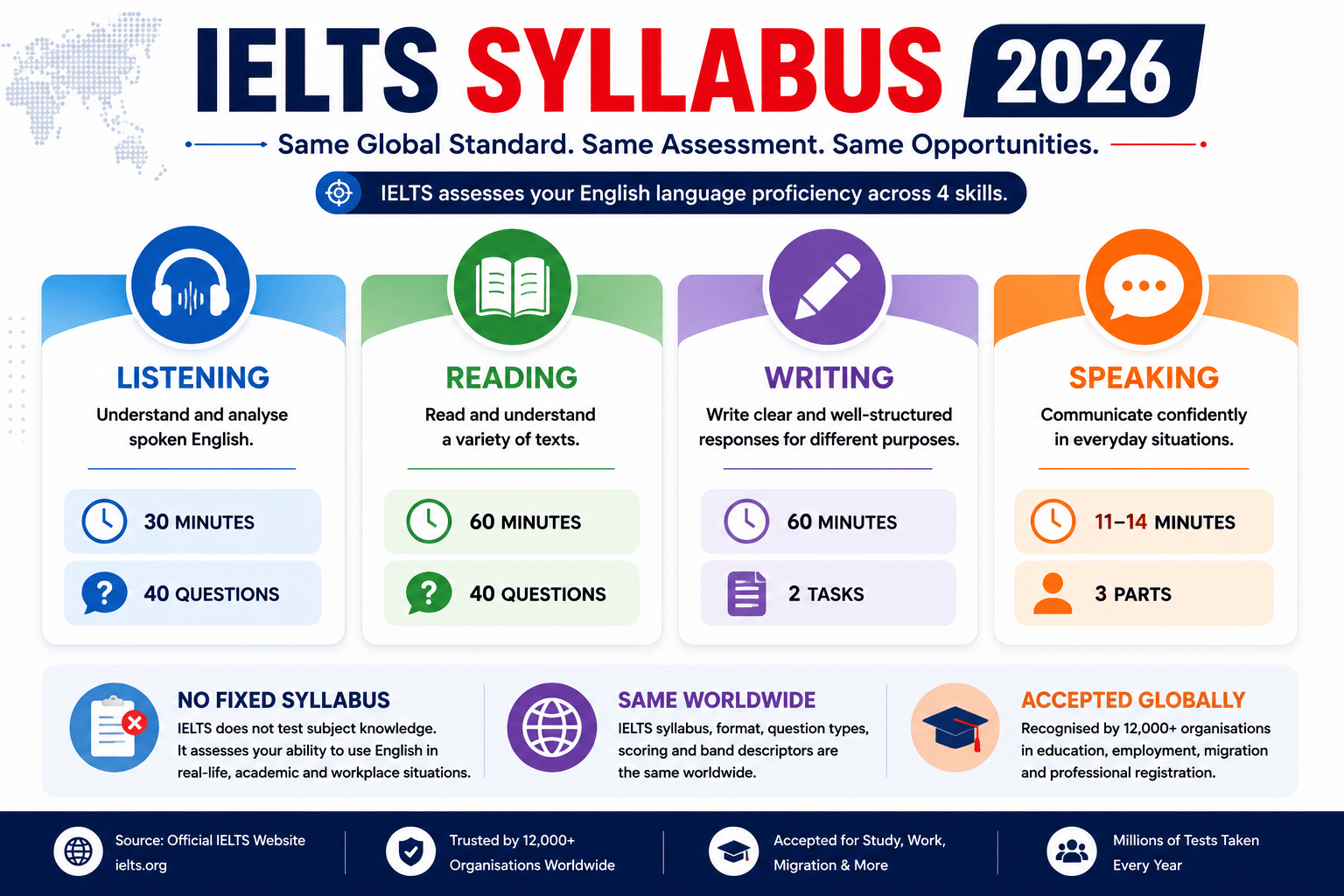
The IELTS has no fixed syllabus like the other exams. It is designed to assess your English proficiency across all 4 essential skills: Listening, Reading, Writing, and Speaking.
The IELTS exam is of 2 types: Academic and General Training. The Listening and Speaking syllabi of both tests are the same. They differ in their Reading and Writing syllabi.
- Listening: 4 recordings that test your understanding of main ideas, details, and opinions.
- Reading:
- IELTS Academic Reading includes texts from books and journals.
- General Training focuses on everyday materials like notices and workplace documents.
- Writing:
- IELTS Academic Writing requires describing a graph and writing an essay.
- General Training includes letter writing and an essay.
- Speaking: A face-to-face interview assessing fluency, coherence, and pronunciation.
| If you are planning to take the IELTS exam in 2026, check out the articles below to help you register: | |
|---|---|
| How to Register for the IELTS Exam? | What is the IELTS Exam Fee in India in 2026 |
| Upcoming ELTS Exam Dates 2026 | Find an IELTS Test Center Near You |
Free IELTS Mock Tests 2026
Check out some free IELTS mock tests for 2026 below:
IELTS Academic Syllabus 2026
The table below gives a section-wise breakdown of the IELTS Academic syllabus:
| Section | Duration | Number of Questions | Details |
|---|---|---|---|
| Listening | 30 minutes | 40 |
4 recorded monologues and conversations. Tests understanding of main ideas, opinions, and factual information. |
| Reading | 60 minutes | 40 |
|
| Writing | 60 minutes | 2 tasks |
|
| Speaking | 11-14 minutes | 3 tasks | Face-to-face interview with an examiner: Introduction, Cue Card, and Discussion. |
Note: While Listening, Reading, and Writing are conducted on the same day, the Speaking test may be scheduled on the same day or up to 7 days before or after, depending on your test center.
Also Read:
Difference Between IELTS Academic and IELTS General Training: Which One Should You Take?Which section do Indian students usually score lowest in?
According to the official IELTS test-taker performance data for the previous testing year, Indian candidates scored the lowest in Writing (average score of 6.2), followed by Listening (average score of 6.4).
IELTS Listening Syllabus 2026
The IELTS Listening test is designed to assess how well you understand spoken English across different contexts and accents. The section pattern and syllabus is given below:
| Particulars | Details |
|---|---|
| Number of recordings | 4 |
| Number of questions | 40 |
| Duration | 30 minutes |
| Recording Types |
|
| Question Types |
|
Tips:
- The recordings can only be played once, so focused listening is essential.
- The test includes a variety of English accents, including British, American, and Australian.
- Focus on synonyms and paraphrasing.
Does IELTS use British English only?
No. IELTS accepts British, American, Australian, and Canadian spelling and accents. You will hear mixed accents in the Listening test.
| Also Check | |
|---|---|
| IELTS Listening Topics | IELTS Listening Tips |
IELTS Reading Syllabus 2026
The IELTS Reading evaluates your understanding of the main ideas, details, and implied meanings in the texts. The table below explains the IELTS Reading section in detail:
| Particulars | Details |
|---|---|
| Number of passages | 3 |
| Number of questions | 40 |
| Duration | 60 minutes |
| Passage sources |
|
| Question Types |
|
| Common Reading Topics |
Environment: Climate change, conservation, pollution, renewable energy Science: scientific discoveries, biology, astronomy, medical research Technology: Artificial intelligence, robotics, digital communication Education: Learning methods, schools, universities, online education History: Historical events, civilizations, archaeology Health: Nutrition, diseases, healthcare systems, mental health |
Tips:
- Manage time (about 20 minutes per passage).
- Academic passages are more complex and require understanding of academic vocabulary.
IELTS Writing Syllabus 2026
The IELTS Writing section assesses your ability to communicate your ideas clearly and effectively in written English.
| Particulars | Details |
|---|---|
| Number of tasks | 2 |
| Duration | 60 minutes (Task 1: 20 minutes, Task 2: 40 minutes) |
| Task 1 |
|
| Task 2 |
|
| Answer length |
|
| Skills Tested |
|
Tips:
- Task 2 carries more weight, so plan your response carefully.
- Use a range of vocabulary and sentence structures, and remember that answers below the required word count will be penalised.
IELTS Speaking Syllabus 2026
The IELTS Speaking involves a face-to-face interview with an examiner followed by short questions, speaking at length about a topic, and a structured discussion. The table below gives the key information about the IELTS Speaking section:
| Particulars | Details |
|---|---|
| Number of tasks | 3 |
| Duration |
11-14 minutes (4-5 minutes for task 1, 3-4 minutes for task 2, 4-5 minutes for task 3)
|
| Tasks |
|
Tips:
- Speak clearly and naturally. Expand answers with explanations and examples.
- No need for perfect grammar; focus on communication.
IELTS Academic vs General Training 2026
The IELTS syllabus 2026 is different for the Reading and Writing sections of the Academic and General Training tests, as explained below:
| Section | IELTS Academic | IELTS General |
|---|---|---|
| Reading |
|
|
| Writing task 1 | Describe visual data, like a graph, a chart, a table, or a diagram. | Write a letter (formal, semi-formal, or informal) based on a given situation. |
| Writing task 2 | Formal essay in response to a point of view, argument, or problem. | Essay writing is similar to Academic, but the language can be slightly less formal. |
Also read: IELTS Academic vs General Training
IELTS for UK (UKVI) Syllabus 2026
UK visa authorities, as well as some universities, specifically mention the requirement of an SELT (Secure English Language Test). SELTs have the same exam pattern and syllabus as the regular exam, but they are administered under stricter conditions. You also get a special score report called the Test Report Form (TRF) to indicate that the test taken is an SELT and for a UK visa.
The UKVI IELTS test is an SELT, with different categories for different types of UK visas, as explained below:
| UKVI IELTS Type | Purpose | Question Types |
|---|---|---|
| UKVI IELTS Academic |
|
Same as the regular IELTS Academic |
| UKVI IELTS General Training | Work visas, skilled migration, vocational training, non-degree study, or some family routes | Same as the regular IELTS General Training |
| IELTS Life Skills A1 | Initial family visas (e.g., joining spouse, partner, or parent who is settled in the UK or "family of a settled person") |
|
| IELTS Life Skills A2 | Extensions to family, spouse, or partner visas (further leave to remain in the UK) |
|
| IELTS Life Skills B1 | Settlement (Indefinite Leave to Remain) or British citizenship applications |
|
Notes:
- The IELTS Life Skills exams take around 20 minutes to complete, and they involve conversation with an examiner and another test-taker.
- The IELTS Life Skills provides only a Pass or Fail status; no band score is provided.
- The IELTS Life Skills A2 exam is available only in the UK, not in India.
IELTS Syllabus 2026 Preparation Tips
To achieve a good IELTS band score, candidates need effective preparation. Here are some tips to help you prepare for the exam.
- Understand the questions carefully and focus on finding answers in the passage.
- Write within the given word limit for each question.
- Write precise, relevant answers. Avoid writing long paragraphs and sentences.
- Listen to the questions asked carefully, and answer directly.
- Be precise, grammatically correct, and to the point.
- Use an active voice. Avoid writing in the passive voice.
- Focus on vocabulary, range of tenses, grammar, and sentence structure.
- Revise and proofread for spelling and grammar errors before submission.
| Must-read Articles for IELTS Preparation | |
|---|---|
| IELTS Preparation | IELTS Preparation Apps |
| IELTS Preparation Books | IELTS Coaching in India |
The IELTS exam syllabus is designed to test a candidate's English skills for work, PR, or study abroad. The academic and general syllabi are different for the reading and writing sections. The Reading and Writing sections evaluate the candidate's ability to understand and communicate. The Listening section includes lectures and note-taking activities. For speaking, candidates need to discuss personal details and a given topic. You will be advised to practice the IELTS grammar syllabus to give effective answers.
FAQs
Ques. Does IELTS have a fixed syllabus?
Ans. No. IELTS does not have a fixed subject syllabus like school or university exams. Instead, it assesses your English language proficiency across four skills—Listening, Reading, Writing, and Speaking—in academic and everyday contexts. The test is designed to evaluate how well you can use English in real-life situations rather than your knowledge of specific subjects.
Ques. Is the IELTS syllabus the same worldwide?
Ans. Yes. The IELTS syllabus, test format, question types, scoring criteria, and band descriptors are the same worldwide. Regardless of the country where you take the test, IELTS follows the same international standards and assessment criteria.
Ques. Has the IELTS syllabus changed in 2026?
Ans. No. The IELTS syllabus and the skills assessed have not changed in 2026. The major update is the transition to computer-delivered IELTS in many regions from mid-2026. This change affects only the test delivery method and does not alter the syllabus, question types, scoring, or assessment criteria.
Ques. Is the Computer IELTS syllabus different?
Ans. No. IELTS on Computer uses the same syllabus, question types, difficulty level, timing, and scoring criteria as the paper-based test. The only difference is that candidates type their answers on a computer instead of writing them on paper, while the Speaking test remains a face-to-face interview with an examiner.
Ques. What topics are asked in IELTS?
Ans. IELTS does not publish a fixed list of topics. Reading passages, Listening recordings, Writing tasks, and Speaking questions are based on general and academic topics commonly encountered in everyday life, education, and work. These may include education, science, technology, environment, health, travel, culture, and social issues. Candidates are assessed on their English language ability rather than their subject knowledge.
Ques. Can I prepare for IELTS in one month?
Ans. Yes. The official IELTS organisations provide free preparation materials, sample tests, and practice resources that can help candidates prepare according to their current English proficiency. However, they do not specify a recommended preparation duration, as the time required varies from one candidate to another.
Ques. Does IELTS ask current affairs?
Ans. No. IELTS does not test your knowledge of current affairs or recent news events. Test materials are based on topics of general or academic interest and are designed to assess English language proficiency rather than factual knowledge.
Ques. Is there negative marking in the IELTS test?
Ans. No. IELTS does not use negative marking. You receive one mark for each correct answer in the Listening and Reading tests, and there is no penalty for incorrect answers.
Ques. Is the syllabus the same for UKVI IELTS?
Ans. Yes. IELTS for UKVI uses the same test format, syllabus, question types, timing, and scoring criteria as standard IELTS. The difference is that IELTS for UKVI is delivered in UK Home Office-approved test centres to meet UK visa requirements.
Ques. How many essays are asked in IELTS Writing?
Ans. Two Writing tasks must both be completed.
- Task 1: Describe visual information (Academic) or write a letter (General Training).
- Task 2: Write one essay in response to a point of view, argument, or problem.
Only one essay is required in Task 2, while Task 1 is a different writing task depending on the test type.
Ques. Which topics are repeated in Speaking?
Ans. The IELTS partners do not publish a fixed or repeated list of Speaking topics. Questions are drawn from familiar everyday subjects such as home, work, studies, hobbies, travel, and interests. Since topics vary from test to test, candidates should prepare to discuss a wide range of everyday subjects rather than memorising specific questions.


1787567517.png?tr=w-305,h-145,c-force?h=175&w=350&mode=stretch)



Comments