



| Updated On - Sep 3, 2026
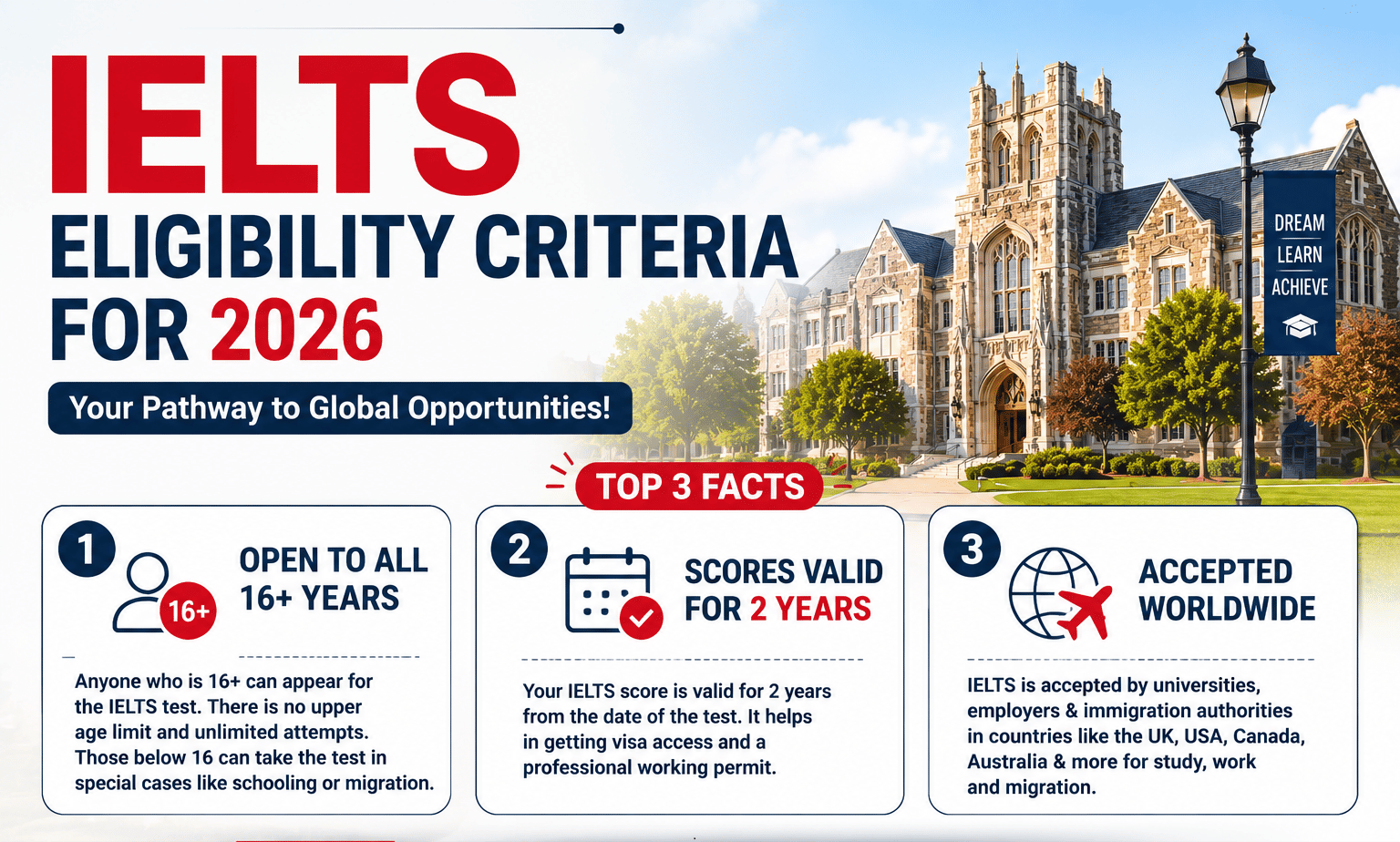
IELTS conducting body, IDP, has not specified any eligibility requirements for the IELTS exam. Anyone who is 16+ can appear for the IELTS test with unlimited attempts. Those below 16 can take the test in special cases, such as for schooling or migration. It helps in getting visa access and a professional work permit.
The IELTS exam is accessible to all people, be it young students looking for undergraduate admission, or anyone willing to relocate themselves to English-speaking countries, like the US, UK, Canada, and Australia. People who are differently abled can also take this exam. Braille papers and scribes are available for them.
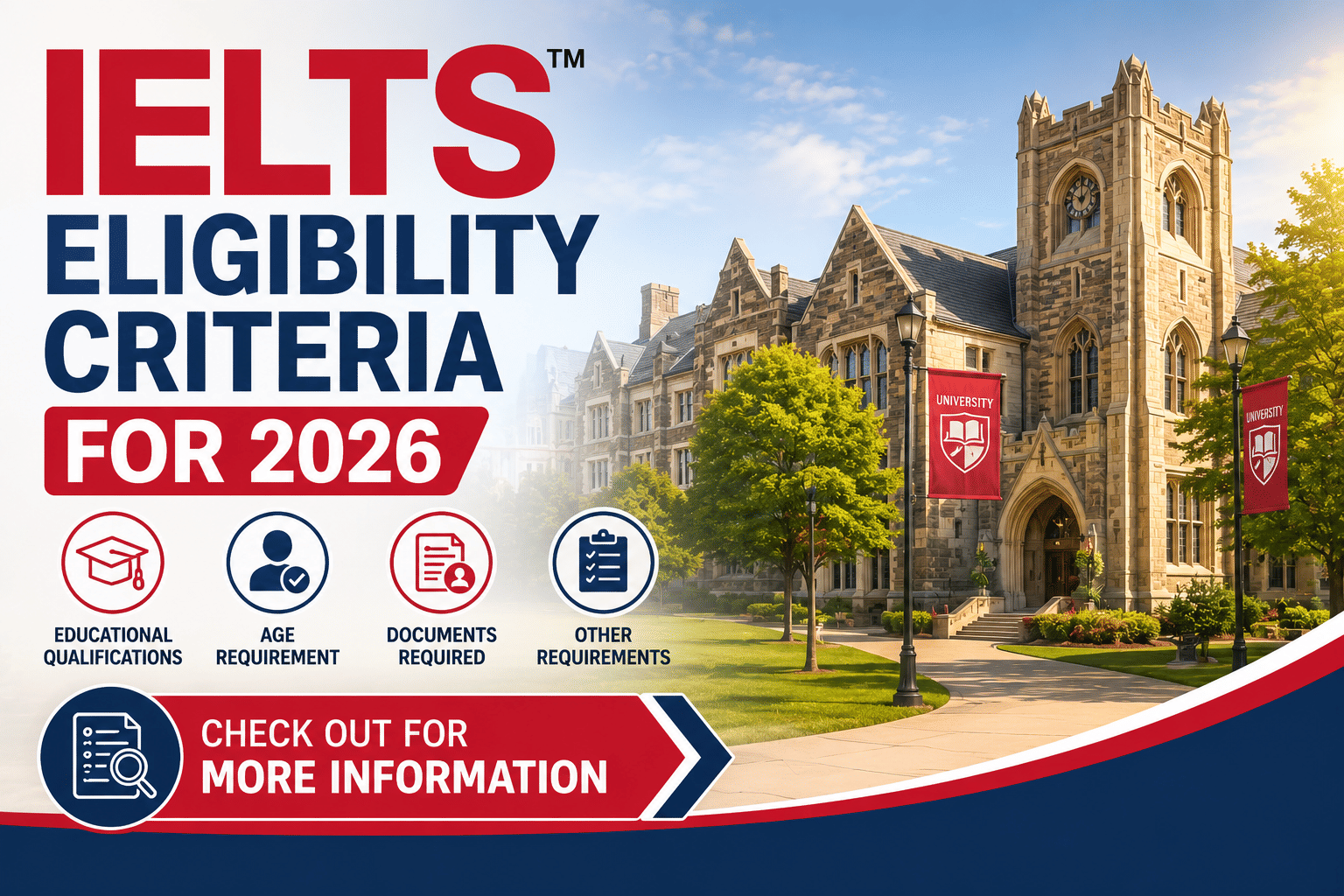
IELTS 2026 Exam Eligibility Criteria 2026
Anyone willing to travel or study abroad can appear for the IELTS exam, satisfying some basic requirements, which are:-
| Critation | Requirements | Note |
|---|---|---|
| Age | 16+ (not a mandatory requirement) | No restriction on the upper age limit. |
| Education | No specific qualification such as Class 12th or graduation is required. | Open to all who are willing to travel abroad. |
| Documents Required | A valid passport is the only primary requirement. | A passport is mandatory for filing the IELTS registration application and to sit in the exam centre. |
| IELTS Exam fees | ₹19,000 (₹19,250 for UKVI) | Depends on the type of IELTS exam you take. |
Note: Anyone below 16 can appear for the test in rare school-specific cases when the child gets admission to some international boarding school. In such a case, parents or guardians can consult nearby centres.
Also read: IELTS Academic 2026: Test Format, Fees, Practice Papers
IELTS Document Requirements
- A valid passport is the only document accepted for both the application process and the test day.
- No other ID cards, such as an Aadhaar card, PAN, or driving license, are accepted for identification.
Note: Applicant must carry the original Passport and a copy of the first/last page on the day of the test. Digital copies are not accepted.
Also read: If you meet the eligibility criteria, learn how to register step-by-step
IELTS Test Types 2026
The IELTS test is conducted in computer-based mode for all 3 types of exams. It is highly preferred as they give results fast, within 1-2 days. The types of IELTS exams are:
| Type | Purpose |
|---|---|
| IELTS Academic | For those who are willing to study abroad for undergraduate or postgraduate studies. |
| IELTS General Training | For those who are willing to go abroad for work or training purposes. |
| IELTS UKVI | Secure version for UK visas and immigration. |
Note: Speaking & Listening sections are the same across types, only the Reading & Writing differ. Always check the university or visa requirements before booking.
Also read: IELTS Academic vs General Training
IELTS Exam for Candidates With Special Needs
The IELTS exam is accessible for differently abled candidates. These services and arrangements are free of extra charges in most of the cases. Candidates need to consult with the centre at least 6 weeks in advance. Common arrangements for these candidates are:
| Differently ables | Arrangment(s) |
|---|---|
| Visual impairment | Braille-printed papers, extra time, a reader or scribe, magnifiers, screen readers, and extra time. |
| Hearing or speech | Lip-reading version of the listening task, amplification equipment, and special CDs with pauses. |
| Learning difficulties (Dyslexia, ADHD, Neurodivergent) | Extra time, word processor, voice-activated software, and modified layout papers |
| Physical conditions | Scribe, extra breaks, assistive technology. |
Note: The centers also give special arrangements for those who have temporary injuries. Women who need to feed an infant also get leverage.
IELTS Score Requirements for Undergraduate and Postgraduate Programs
The IELTS score is marked on a band of 0 to 9. Though there are no passing or failing criteria for an educational or professional visa, some universities or countries may have specific score requirements. Here's an estimated requirement guide:-
| Degree Level | Scores Required |
|---|---|
| Undergraduation | 6.0 - 6.5 |
| Post-graduation | 6.5 - 7.5+ |
| Competitive programs like the Ivy League | 7.0 - 7.5 |
Note: For a visa, the score varies from country to country. Applicants must confirm the requirements for the specific visa and university.
Tips for Indian Students Planning to Take IELTS in 2026
The best time to take the test is after the 12th class for undergraduate or after graduation for Post-graduation. Here are some efficient tips for students willing to take IELTS:-
- Preparation: Students should take practice tests to be well acquainted with the test format.
- Common myths: There is no maximum or minimum number of attempts. Anyone can sit for the IELTS test.
- IELTS Scholarships: Students scoring a high band score of 7+ may get access to IELTS-linked funding or university aid.
- Test centres: IELTS test centres are widespread across India. Candidates from Tier 2 or 3 cities should check availability beforehand for desired slots and test dates.
Note: Candidates seeking a specific date or time slot should register for the test 1-2 months in advance.
Also read:
FAQs
Ques. Can I take IELTS after Class 10?
Ans. Yes. IELTS does not require a minimum educational qualification. However, the test is generally recommended for candidates aged 16 and above, and students should take it when they have a specific academic, professional, or immigration purpose.
Ques. Is graduation required for IELTS?
Ans. No, graduation is not required to take IELTS. Students can take the exam before completing graduation if they need an IELTS score for higher education, work, or another purpose.
Ques. Is there any minimum percentage required for IELTS?
Ans. No. IELTS does not require a minimum percentage in Class 10, Class 12, or graduation. However, universities may impose their own academic percentage requirements in addition to IELTS score requirements.
Ques. Can Indian students take IELTS without a degree?
Ans. Yes. Indian students do not need a degree to take IELTS. The test can be taken by students from different educational backgrounds, provided they meet the applicable test-registration and identification requirements.
Ques. Can students below 18 take IELTS?
Ans. Yes, IELTS is available to younger candidates, although it is generally not recommended for those under 16. Different IELTS products can have different age requirements; for example, IELTS Online currently requires test takers to be at least 18.
Ques. Is IELTS required for all universities abroad?
Ans. No. IELTS is not universally mandatory for every university or programme. English-language requirements vary by institution, programme and country, and some institutions may accept alternative English proficiency tests or other forms of evidence.
Ques. What are the documents required for IELTS registration in India?
Ans. Candidates registering for IELTS in India need to follow the identification requirements specified during registration. IDP India's terms state that candidates must bring their original valid passport on the test day. Failure to present it can result in refusal of entry.
Ques. Can I combine IELTS scores from two different tests?
Ans. This is one of the most common questions for healthcare professionals like Nurses and Doctors. The Answer depends on the regulatory body, not the IELTS itself. Like, the NMC (UK Nurses) allows you to combine two scores if they were taken within 6 months of each other and no individual band fell below 6.5 in either test. Whereas the GMC (UK Doctors) does not allow it. They require a single sitting with an overall 7.5 and no band below 7.
Ques. Is IELTS mandatory for MBBS students going abroad?
Ans. It depends on the country, university, and whether the program is taught in English. For countries like the UK, Australia, Canada, the USA, and New Zealand, these require proof of English proficiency. For countries like Russia, Georgia, or Kazakhstan, IELTS is usually not required for admission. They focus on your NEET qualification.
Ques. Who is eligible for IELTS One Skill Retake (OSR)?
Ans. Only those who took the Computer-Delivered IELTS are eligible for a retake. Paper-based test-takers are currently ineligible for OSR.
Ques. Does a 10th or 12th "English Medium" waive the IELTS?
Ans. The embassies, especially for Canada, Australia, and the UK, rarely recognise class 10th or 12th English medium qualification for Indian students. Without an IELTS score, you are technically ineligible for the visa, even if you are eligible for the university.


1787567517.png?tr=w-305,h-145,c-force?h=175&w=350&mode=stretch)
1786708144.png?tr=w-305,h-145,c-force?h=175&w=350&mode=stretch)



Comments