



Study Abroad Expert | Updated On - Oct 14, 2026
Germany has two main intakes: the winter semester starting October and the summer semester starting April. Winter is the primary intake, with the general deadline on 15 July 2026 for most public universities. Summer deadlines fall around 15 January each year. Based on advisor-cycle estimates, winter carries roughly 85% of English-taught masters programs.
- Winter wins on course choice, scholarships and intake size for most applicants.
- Summer is a smaller second window with fewer English-taught masters.
- APS certification is the slowest step in the file and must start early.
- Admission standards do not drop in summer; only the course list shrinks.
Check top German universities for Indian students
Based on advisor cycle data, uni-assist receives more than 150,000 international applications between May and July. Processing then rises to 6 to 8 weeks, so a July 15 submission can miss the review window. Your intake choice sets your deadlines, your APS timing and your visa interview slot.
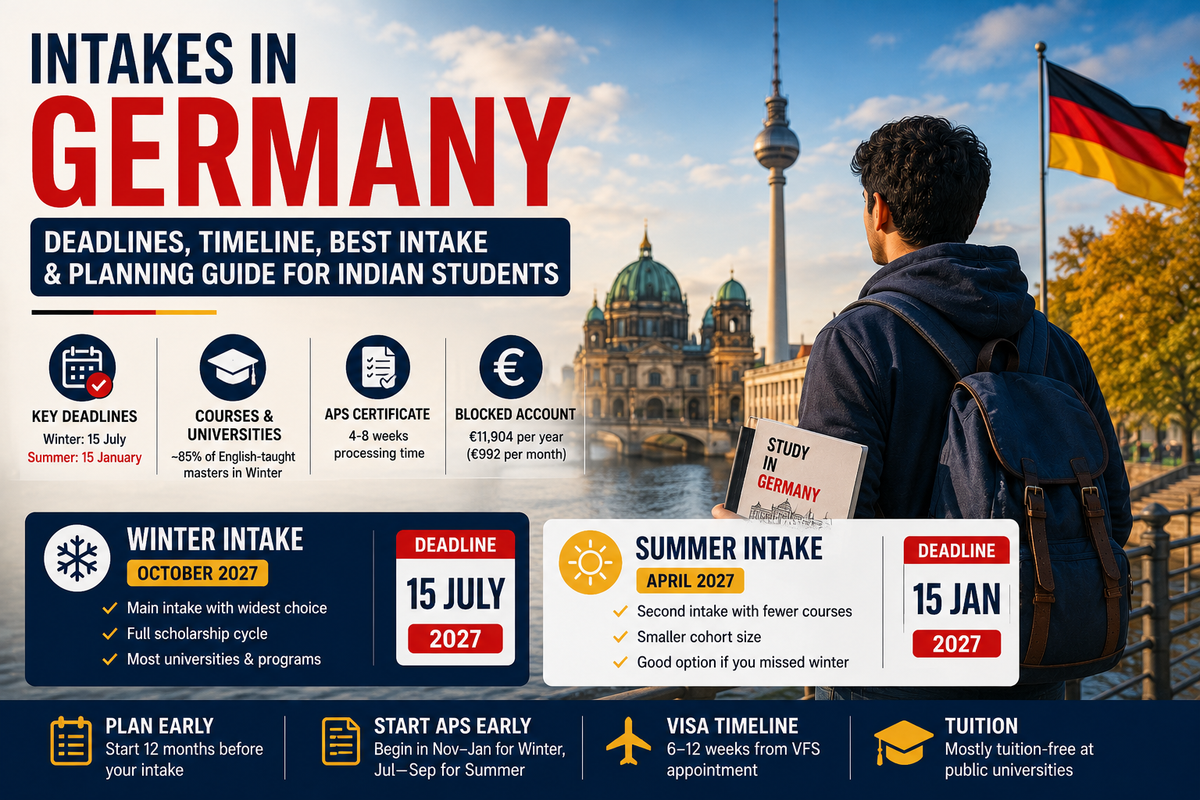
Quick Facts on Germany Intakes
| Parameter | Detail |
|---|---|
| Intakes in Germany | Winter (October) and Summer (April) |
| Winter 2027-28 general deadline | 15 July 2027 at most public universities |
| Summer 2027 general deadline | 15 January 2027 at most public universities |
| Share of English-taught masters in winter | Approximately 85% (advisor-cycle estimate) |
| APS certificate processing | 4 to 8 weeks after submission (advisor-cycle estimate) |
| Blocked account amount (2026) | EUR 11,904 per year, or EUR 992 per month |
| Planning lead time | 12 months before the semester start |
Deadline dates are typical for public universities; private universities and TUM run earlier portals. Source: German Federal Foreign Office for blocked account; advisor-cycle estimates for the rest.
- Quick Facts on Germany Intakes
- What Are the Intakes in Germany?
- Winter Intake in Germany Deadlines
- Summer Intake in Germany Deadlines
- Which Germany Intake Is Best?
- APS and Documents for Germany Intakes
- Funding and Blocked Account for Germany
- Visa Timeline Across Germany Intakes
- FAQs on Intakes in Germany
What Are the Intakes in Germany?
German universities run two intakes each year: winter and summer. The winter semester, called Wintersemester, starts in October. The summer semester, called Sommersemester, starts in April. Most masters programs run through both terms, but the main intake happens in winter.
Public and private universities differ in how they open admissions. Public universities, which Indian students mostly target to study in Germany, use fixed national-cycle deadlines. Private universities often run rolling admissions (applications open until seats fill).
| Intake | Classes Start | Typical Application Window | Scale |
|---|---|---|---|
| Winter semester | October | 1 May to 15 July | Main intake, widest course list |
| Summer semester | April | 1 December to 15 January | Smaller, fewer English masters |
Based on advisor-cycle estimates, the winter semester carries about 85% of English-taught masters admissions. Summer serves the remaining 15%, mostly in business, data and engineering fields. TUM (Technical University of Munich), RWTH Aachen, TU Berlin and FAU Erlangen only launch main masters cohorts in winter.
- A winter 2027 start finishes a 2-year masters by autumn 2029.
- A summer 2027 start finishes by spring 2029.
If you want the full catalogue of masters in Germany, winter is the default plan.
Winter Intake in Germany Deadlines
The winter intake general deadline is 15 July for most public universities. Classes start in October. Application portals typically open on 1 May, giving applicants roughly 10 weeks to submit.
The headline date hides earlier university-level cut-offs. TUM runs an earlier window (around 31 May) and some engineering programs at RWTH Aachen close by May. Specialist programs can close as early as January of the same year.
| University or Program | Winter Deadline |
|---|---|
| Public universities (general) | 15 July |
| TUM (Technical University of Munich) | Around 31 May |
| RWTH Aachen MS Computer Science and Engineering | 1 March to 31 May (direct portal or VPD) |
| TU Berlin select English masters | 15 May via uni-assist |
| University of Stuttgart MS Infotech and COMMAS | 15 January (direct portal) |
Source: advisor-cycle university data; verify each date on the official university portal before applying.
Most Indian applicants file through uni-assist, the central document-checking service used by over 170 German universities. Uni-assist processing takes 4 to 8 weeks during the peak summer window.
Based on advisor-cycle timelines, applicants following a 12-month plan start the APS certificate in November to January and submit uni-assist by mid-May. That lets the VPD or forward decision arrive by 1 July.
Read More: the full winter intake guide for German universities
Summer Intake in Germany Deadlines
The summer intake general deadline is 15 January, with classes starting in April. Application portals typically open on 1 December. TUM opens earlier, with a cut-off around 30 November.
Summer is the smaller window. Based on advisor estimates, it covers about 15% of English-taught masters programs. If you missed winter, then a summer start saves roughly half a year of waiting.
What the summer intake gives you:
- A second entry window without waiting for the next October.
- Smaller cohorts and less application volume at uni-assist.
- Extra months to retake IELTS or finish an incomplete GRE requirement.
What the summer intake does not cover:
- Many flagship masters at TUM, RWTH Aachen, TU Berlin and FAU, which skip summer.
- The main DAAD scholarship cycles, which concentrate around winter.
- The autumn orientation week and student fair season.
Admission standards stay identical across both intakes. The CGPA cut-off, ECTS requirement and English score bar do not drop in summer. Only the course list shrinks.
Key Insight: Summer is not a weaker admit route. Universities keep the academic bar the same, so a strong file wins a summer seat as decisively as a winter one. The real limitation is that your target course may simply not run in summer.
Confirm program-level summer availability before planning around it. A quick filter on the course finder for study abroad programs shows which German universities list your course in each intake.
Which Germany Intake Is Best?
Winter is the best intake for most Indian students aiming at Germany. It carries the widest course list, the full scholarship cycle and the main onboarding calendar. Summer suits late applicants whose target course also runs in April.
| Factor | Winter (October) | Summer (April) |
|---|---|---|
| Program availability | Approximately 85% of English masters | Approximately 15% |
| Top-tier universities | TUM, RWTH, TU Berlin, FAU all open | Most skip summer for flagships |
| Scholarship access | Full DAAD and university cycle | Limited awards |
| Admission standards | Same bar | Same bar |
| Fit with Indian graduation | Natural after May or June results | Needs a longer bridge |
Fit with the Indian academic calendar is a quiet winner for winter. Indian undergraduates finish by May or June, which lines up with a July deadline and an October start. Summer applicants typically bridge the gap with work or a short course.
Admit chances depend on program, not intake. Applicants balancing their shortlist can scan public universities in Germany, which charge no tuition for most masters.
Weather and housing matter too. Winter arrivals land in cold weather and face a tight housing market in October. Summer arrivals land in milder weather and share leases with fewer competitors.
Key Insight: Choose by readiness, not by season pride. A clean file in summer beats a rushed July 15 file. If your APS or test slot slips past May, then summer is often the honest answer.
APS and Documents for Germany Intakes
Every Germany intake needs the APS certificate for Indian applicants. APS, the Akademische Prüfstelle, is a document check run by the German Embassy in New Delhi. It verifies your Indian degree before any university review.
Based on advisor-cycle estimates, APS processing takes 4 to 8 weeks after document submission. Start it in November to January for a winter intake, or in July to September for the next summer intake.
The standard checklist for Indian applicants:
- APS certificate from the German Embassy in New Delhi.
- Bachelor transcripts, degree certificate and Class 12 marksheet.
- An English test score, with GRE where asked for engineering masters.
- A motivation letter and 1 or 2 academic recommendations.
- CV with internships, projects and any work experience.
Book your English test early to allow time for score reporting. German universities widely accept the IELTS exam and TOEFL exam, but confirm each course’s requirements. For engineering master’s programmes, check whether the GRE exam is required or optional.
Your motivation letter is equally important. Use your statement of purpose to explain your course choice, relevant projects and career goals.
Funding and Blocked Account for Germany
Public universities in Germany charge no tuition for most masters programs. Students pay only a semester fee of EUR 150 to 350 (around INR 14,000 to 33,000). Private universities and some specialist courses still charge full tuition.
Blocked account funding is the big-ticket item for the visa. The current amount set by the German Federal Foreign Office is EUR 11,904 per year, which equals EUR 992 per month. This amount has been in effect since the winter semester 2024, per Expatrio reporting.
- You transfer EUR 11,904 (INR 11 lakh) to a blocked account at Expatrio, Fintiba or an equivalent provider.
- You then withdraw up to EUR 992 (around INR 94,000) each month inside Germany.
- Keep a 5 to 8% currency buffer in the plan for rupee movement during the course.
Scholarships cut the real cost further. DAAD, Deutschlandstipendium and university-level awards all follow the winter calendar, with deadlines in autumn and winter of the year before. Compare award eligibility and timing on the scholarships to study in Germany listings.
Indian lenders also sanction education loans against the blocked account. Track interest rates and timelines on the education loan options hub, because the sanction letter doubles as funds proof at the visa stage.
Key Insight: The blocked account amount is a visa requirement, not a cost. You still spend that money living in Germany month by month. Treat it as rupee outflow, not sunk cost.
Visa Timeline Across Germany Intakes
German student visa processing from India takes about 6 to 12 weeks on average, so visa planning starts the moment the admit arrives. You apply at the VFS Germany appointment, not directly at the embassy, with the admit letter, APS certificate and blocked account proof.
The standard winter cycle timeline for an Indian applicant:
- June: receive the admit letter or VPD certificate from the university.
- July: book the VFS visa appointment and submit the file.
- August to September: arrange health insurance, housing and the one-way flight.
- October: fly out and start the semester.
Summer entrants shift the full cycle by six months. The admit arrives around December, visa appointments fall in January or February, and classes start in April.If the admit comes late, then book the earliest VFS slot anyway. VFS slots in Delhi, Mumbai and Bengaluru tighten in June and July. A late slot delays the whole chain, from flights to housing.
Review the full step-by-step process in the Germany student visa guide before the appointment.
Also Check:
| Jobs in Germany After Masters | MBBS in Germany for Indians | Cost of Studying in Germany |
| Best Courses in Germany | PTE Exam Scores and Dates | MS in Germany for Indian Students |
The intakes in Germany give Indian students two real entry points each year. Winter remains the strongest window for courses, scholarships and top-university access. Summer rewards prepared applicants whose target course also runs in April. Work backwards from the APS and uni-assist dates, not from the semester start, and the rest of the plan falls into place.
FAQs
Ques. How many intakes are there in Germany?
Ans. There are two intakes in Germany: winter and summer. Winter starts in October and is the main intake. Summer starts in April and is smaller, with fewer English-taught masters programs available.
Ques. Which intake is best in Germany for Indian students?
Ans. Winter is best for most Indian students. It carries about 85% of English-taught masters, the full scholarship cycle and all top-tier universities. Summer suits late applicants whose target course also opens in April.
Ques. When is the deadline for winter intake in Germany?
Ans. The general winter deadline is 15 July for most public universities. TUM runs an earlier cut-off around 31 May. Some engineering courses at RWTH Aachen close by May. Specialist courses can close as early as January.
Ques. When is the deadline for summer intake in Germany?
Ans. The general summer deadline is 15 January at most public universities. Portals typically open on 1 December. TUM runs an earlier cut-off around 30 November. Private universities often use rolling admissions.
Ques. Is the APS certificate needed for both Germany intakes?
Ans. Yes. APS is mandatory for every Indian applicant and every intake. Processing takes 4 to 8 weeks, so start it 2 to 3 months before the application deadline. No visa goes forward without it.
Ques. How much blocked account amount is needed for Germany in 2026?
Ans. EUR 11,904 per year, or EUR 992 per month. The German Federal Foreign Office sets this amount, and it has stayed unchanged since the winter semester 2024. The money is not a fee; students withdraw it monthly after arrival.
Ques. Are admission standards easier for the summer intake?
Ans. No. The CGPA cut-off, ECTS credit requirement and English score bar are identical across both intakes. Summer only offers fewer universities and courses, so the admit bar does not drop with the smaller cohort.
Ques. Do Indian students pay tuition fees in Germany?
Ans. Mostly no. Public universities charge no tuition for most masters programs. Students pay only a semester fee of EUR 150 to 350, which is around INR 14,000 to 33,000. Private universities and some specialist courses still charge full tuition.
Ques. When should I start preparing for the winter 2027 intake in Germany?
Ans. Start by October or November 2026, which gives a clean 12-month runway. That covers APS, English tests, uni-assist and the visa. Winter 2027 deadlines run by 15 July 2027 at most public universities.
Ques. Can I apply to German universities after 15 July?
Ans. Rarely. Most public universities strictly close on 15 July for winter. A few private universities and some rolling-admission masters still accept files later. Treat 15 July as a hard cut-off and submit through uni-assist by 31 May.
Ques. How long does the Germany student visa take from India?
Ans. Approximately 6 to 12 weeks from the VFS appointment to the visa decision. Book slots in June or July for winter and in January or February for summer. Delays usually trace back to late APS, late admits or missing blocked account proof.



Comments
Found 1 Comment