




CUET PG Geography Agriculture and Industry Handwritten Notes, free to download as a 20-page PDF. HUQP08 asks 75 questions at four marks each, and this section of Human Geography takes roughly two days to learn, so plan two sittings.

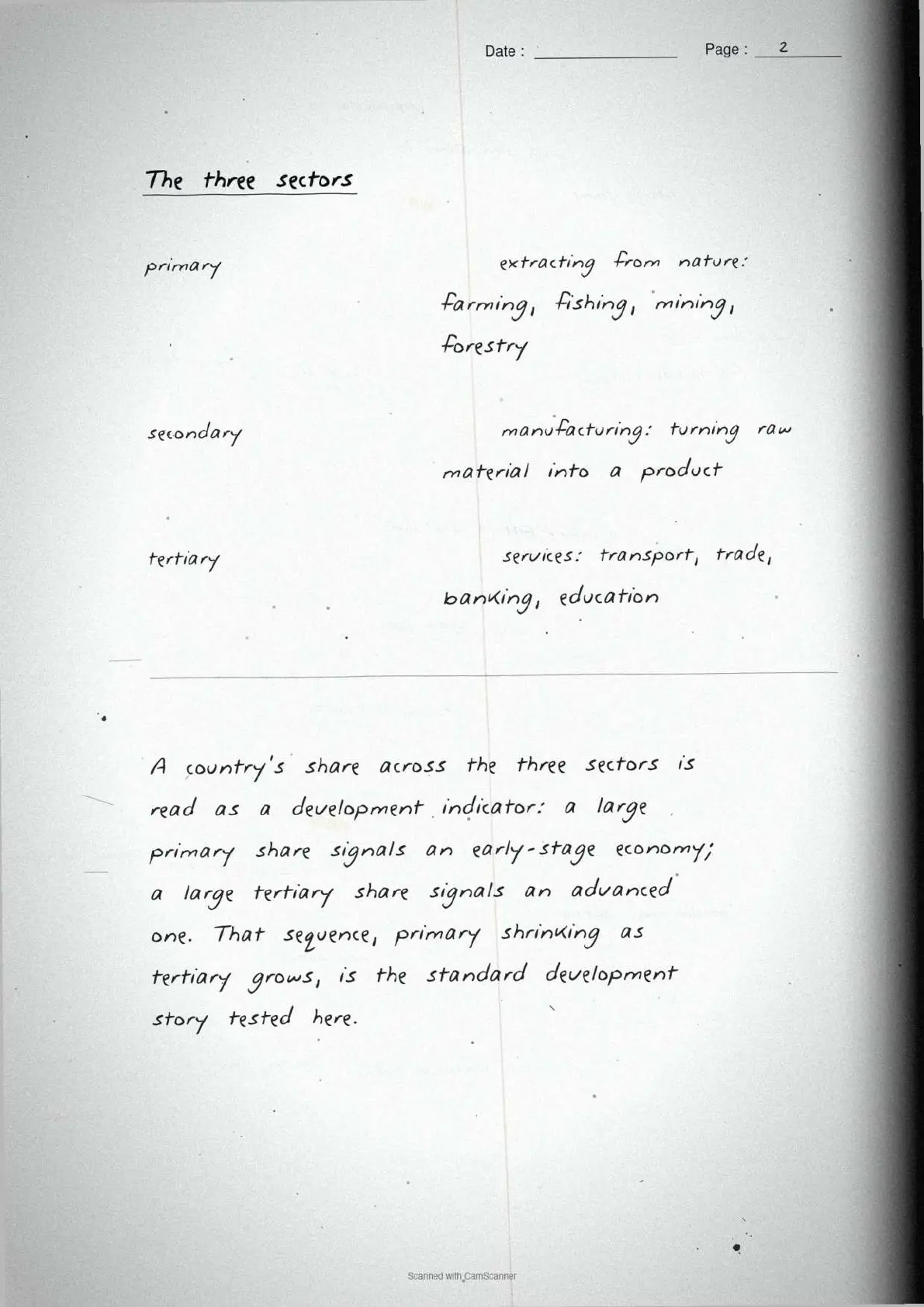


The notes are scans of a real notebook: short lines, boxed rules, and a margin note wherever something is easy to get wrong.
Where This Sits in HUQP08
Agriculture, Industry, Transport and Trade is Section IX, Economic Geography, in Part B, Human Geography, the world-scale companion to the India-focused Section X that follows it.
| Part | Content | Sections |
|---|---|---|
| A | Physical Geography | I to V |
| B | Human Geography | VI to X |
| C | Geographical Techniques | XI to XIV |
What the Notes Cover
- The three economic sectors and the favourable conditions behind each activity
- World distribution of primary crops, commercial crops, livestock and fisheries
- Mining economy and the world's major mineral reserves
- Fuel, power and non-conventional energy resources
- Factors governing where manufacturing locates, and the world's major industrial regions
- International trade patterns and the world's transport routes, canals and waterways
How to Approach the Topic
Every economic activity in this section has a favourable geographical condition behind it: a crop needs a particular climate and soil, an industry needs raw material or a market nearby, and a transport route needs a physical opening in the terrain. Locating that condition usually answers the question directly.
Manufacturing location follows one working rule worth remembering over any list of industries: a weight-losing process, where the finished product weighs far less than its raw material, locates near the source; a weight-gaining or market-oriented process locates near the consumer instead.
Japan's industrial base is worth knowing as the standard exception: a major manufacturing power built almost entirely on imported raw material, since the country itself has very few of its own mineral reserves.
Common Mistakes
- Swapping tea and sugarcane's land needs, when tea wants sloped, well-drained land and sugarcane wants flat, irrigated land
- Calling coal the largest traded commodity by value, when that is petroleum
- Assuming Japan's industry runs on its own minerals, when it imports nearly all of its raw material
- Locating a weight-losing industry at the market rather than at its raw-material source
- Confusing the purpose of the Suez and Panama canals, one bypassing Africa and the other South America
- Treating a country's largest share of its own power mix as the world's largest total output of that source
Video Revision
Source: Examrace
How to Use These Notes
Page 10 is the manufacturing-location table, and page 19 is the recall grid.
Page 6 explains why the world's richest fishing grounds cluster where cold and warm ocean currents meet, which is worth reading before any practice paper.
The previous set covers Population, Settlement and Cultural Geography, opening this unit's tour of Part B.
CUET PG Geography Agriculture and Industry Notes FAQs
Ques. What decides where a manufacturing industry locates?
Ans. Chiefly whether the process is weight-losing or weight-gaining. A weight-losing process, like turning ore into metal, locates near the raw material, since transporting the bulky input is costly. A weight-gaining or market-oriented process locates near the consumer instead.
Ques. Why does India's Chotanagpur Plateau host its core industrial belt?
Ans. It sits on both coal and iron ore reserves together, the two raw materials heavy industry needs most, which is the same location logic used for the Ruhr in Germany.
Ques. Why do the world's richest fishing grounds sit where ocean currents meet?
Ans. A cold current meeting a warm one stirs nutrients up from the sea floor into sunlit surface water, feeding the plankton at the base of the marine food chain. The Grand Banks, where the Labrador and Gulf Stream currents meet, is the standard example.
Ques. What do the Suez and Panama canals have in common?
Ans. Both exist to avoid sailing around an entire continent: Suez bypasses Africa on the Europe-Asia route, and Panama bypasses South America on the Atlantic-Pacific route.
Ques. Can the notes be downloaded free?
Ans. Yes. All 20 pages can be read on this page and downloaded at no cost.



Comments