




If you are preparing for the Class 10 Social Science board paper, Federalism is one chapter you cannot afford to skim. The Class 10 Civics Federalism PYQ compilation carries 12 CBSE board questions worth 23 marks from the 2026 papers, sorted by marks and tagged with the set code. A Detailed Solutions section follows, restating every question and working the answer through step by step.
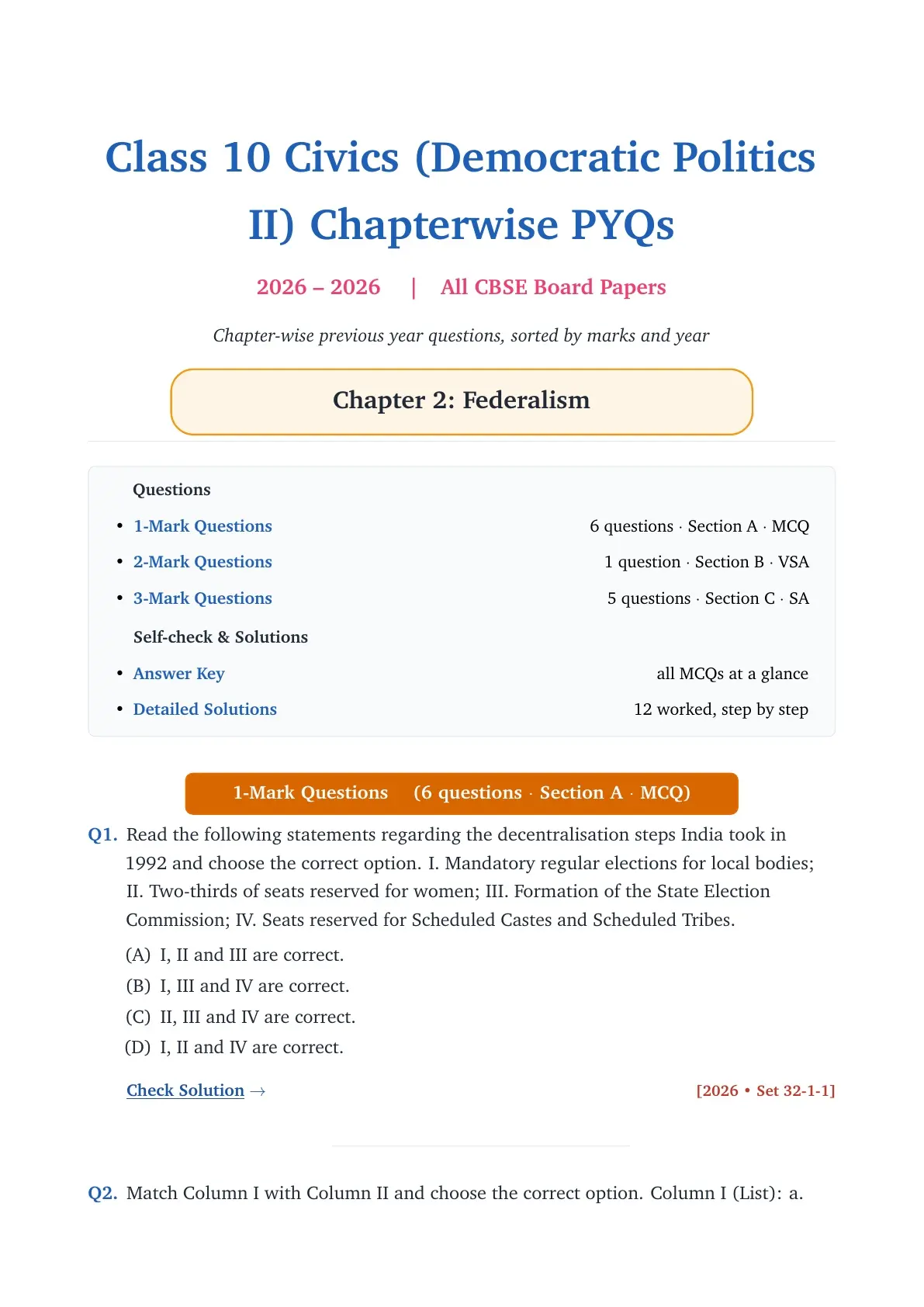
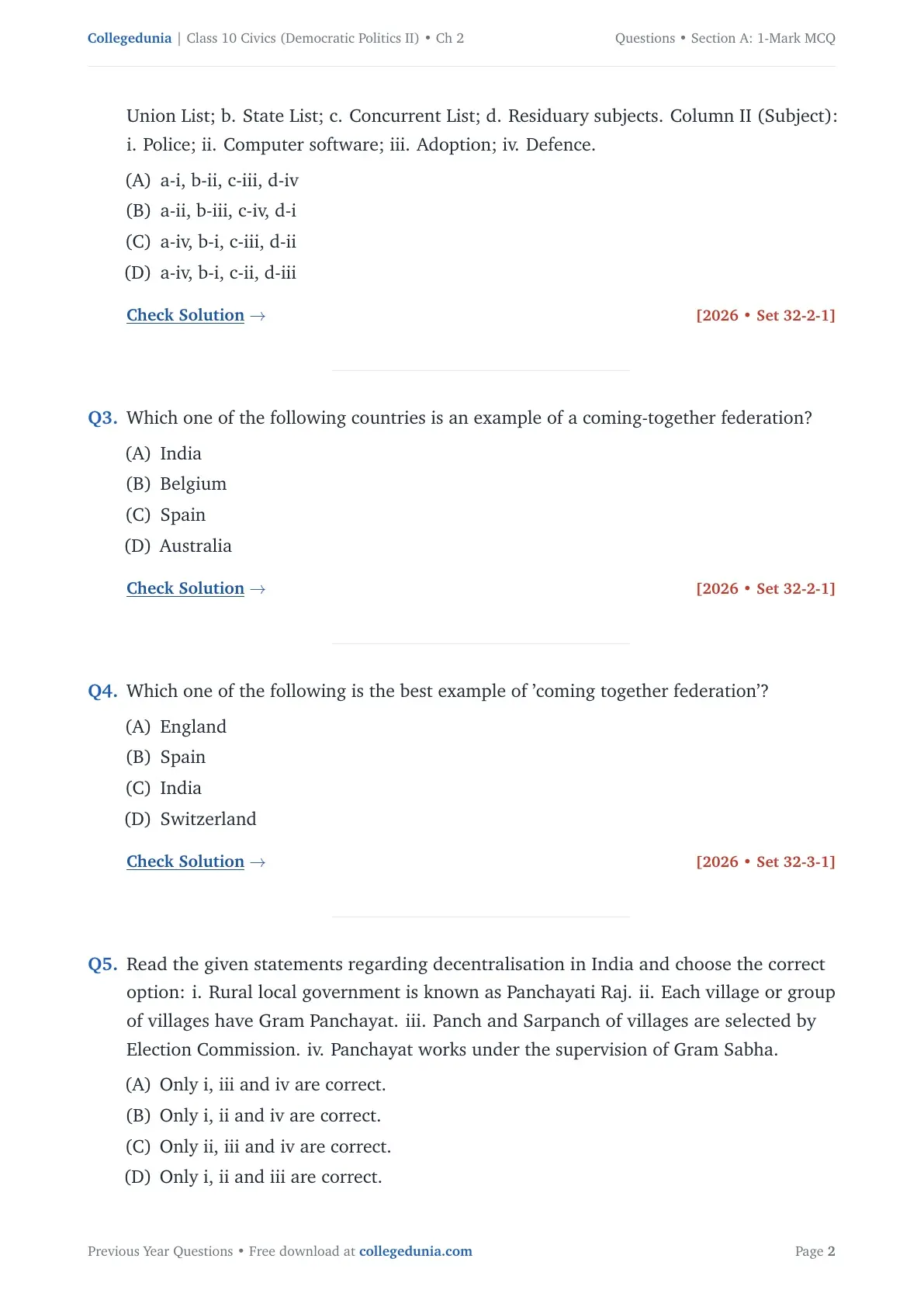
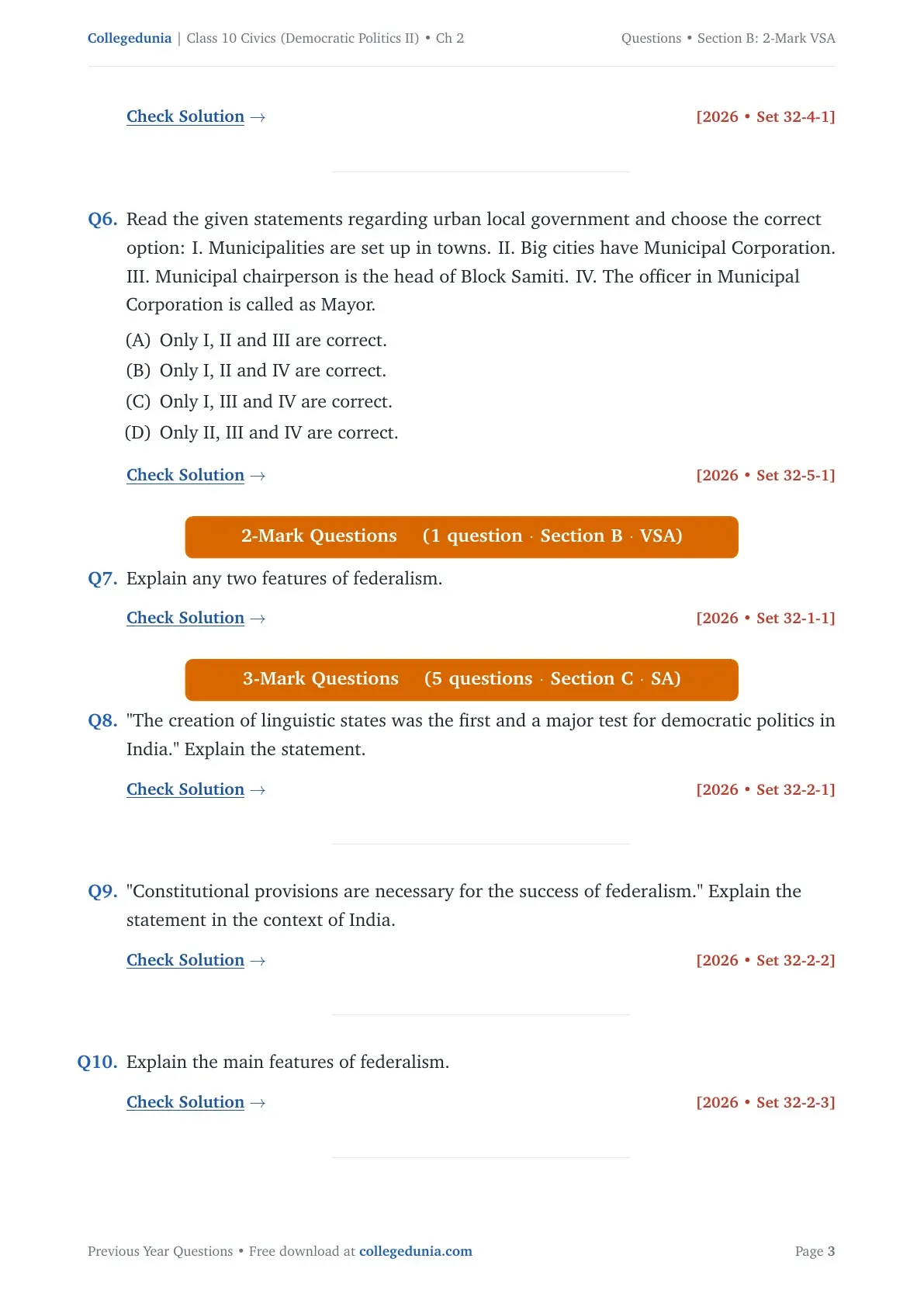
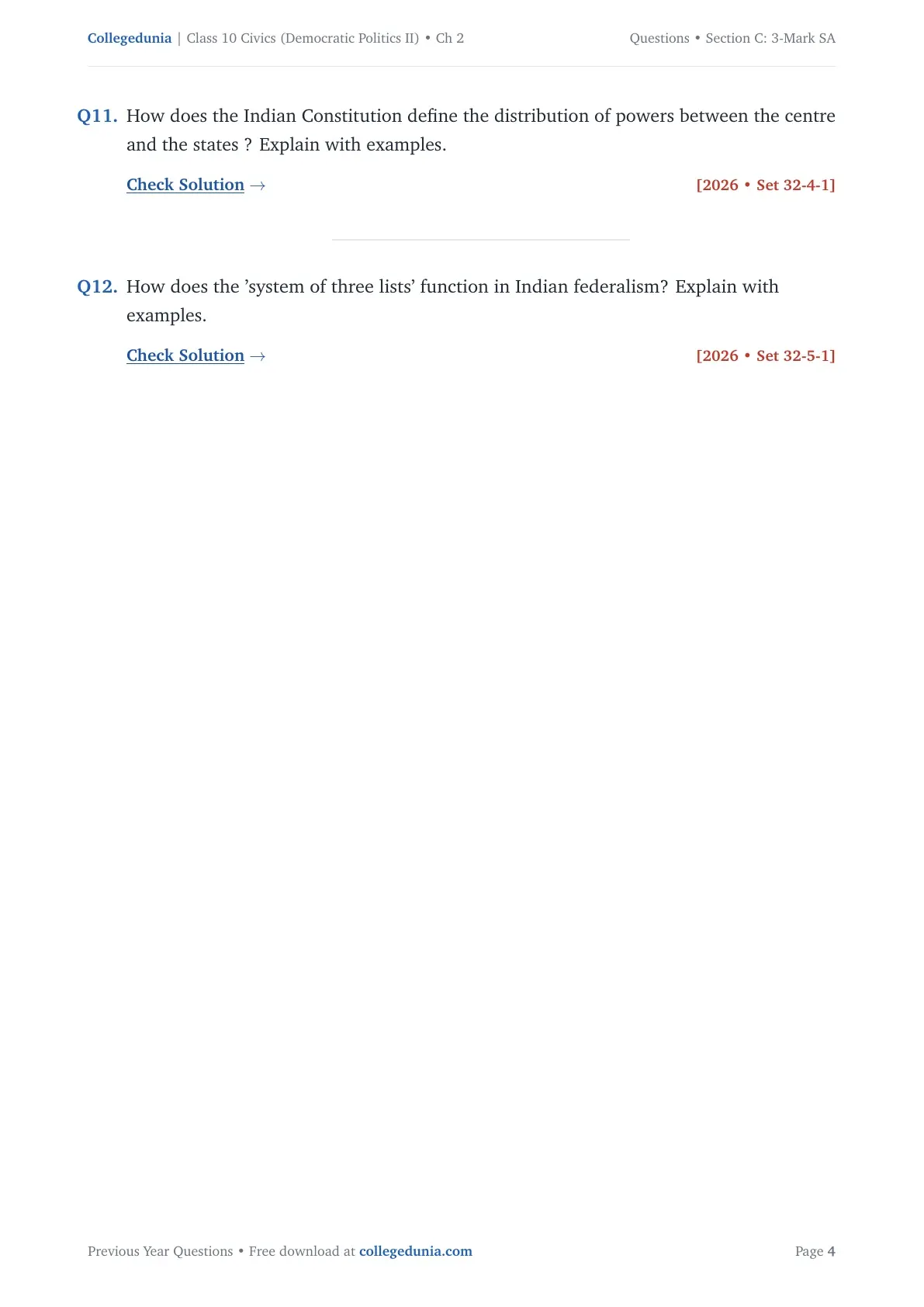
- 12 questions from 7 set codes: 6 one-mark MCQs, one 2-mark very short answer and 5 three-mark short answers.
- Every question is tagged [2026 • Set 32-X-Y], so you always know which paper it came from.
- Free 12-page PDF with a full worked solution for every question, according to the 2026-27 CBSE Class 10 Social Science syllabus.
Every question in this Federalism compilation is copied from the official CBSE 2026 Class 10 Social Science question papers, checked against the NCERT Democratic Politics II textbook, and grouped by marks band by the Collegedunia Civics team.
What the Federalism PYQ Set Covers from the 2026 CBSE Papers
Federalism is the second chapter of Democratic Politics II, and the 2026 papers stayed close to the NCERT structure. The questions run from the definition of a federation to how India actually runs one.
- Features of federalism, asked once as a 2-mark question and once as a 3-mark question in different sets.
- Coming-together and holding-together federations, tested twice as a one-line MCQ about which country is which.
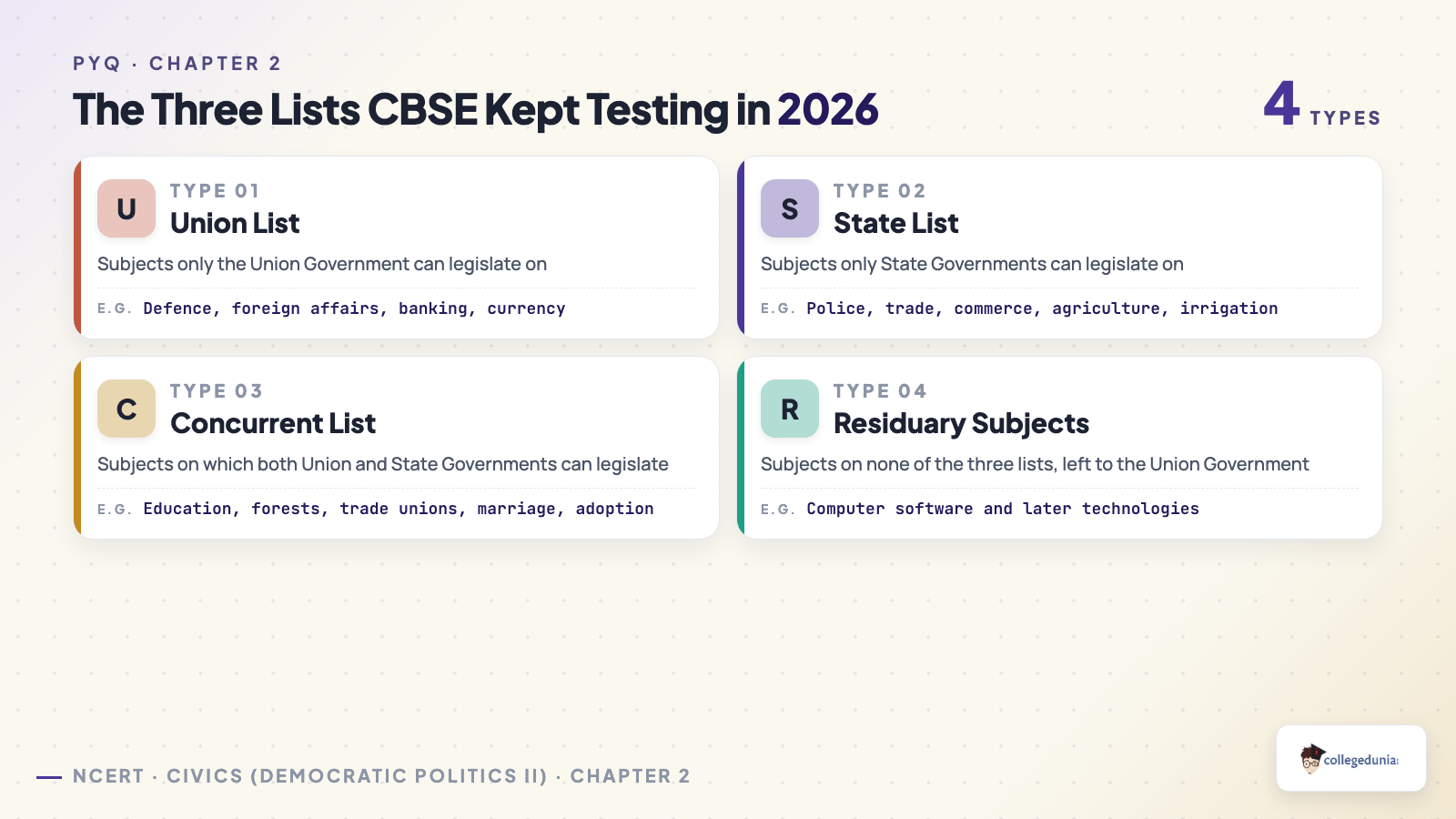
- The three lists, Union, State and Concurrent, plus residuary subjects, and how the Constitution divides powers between the centre and the states.
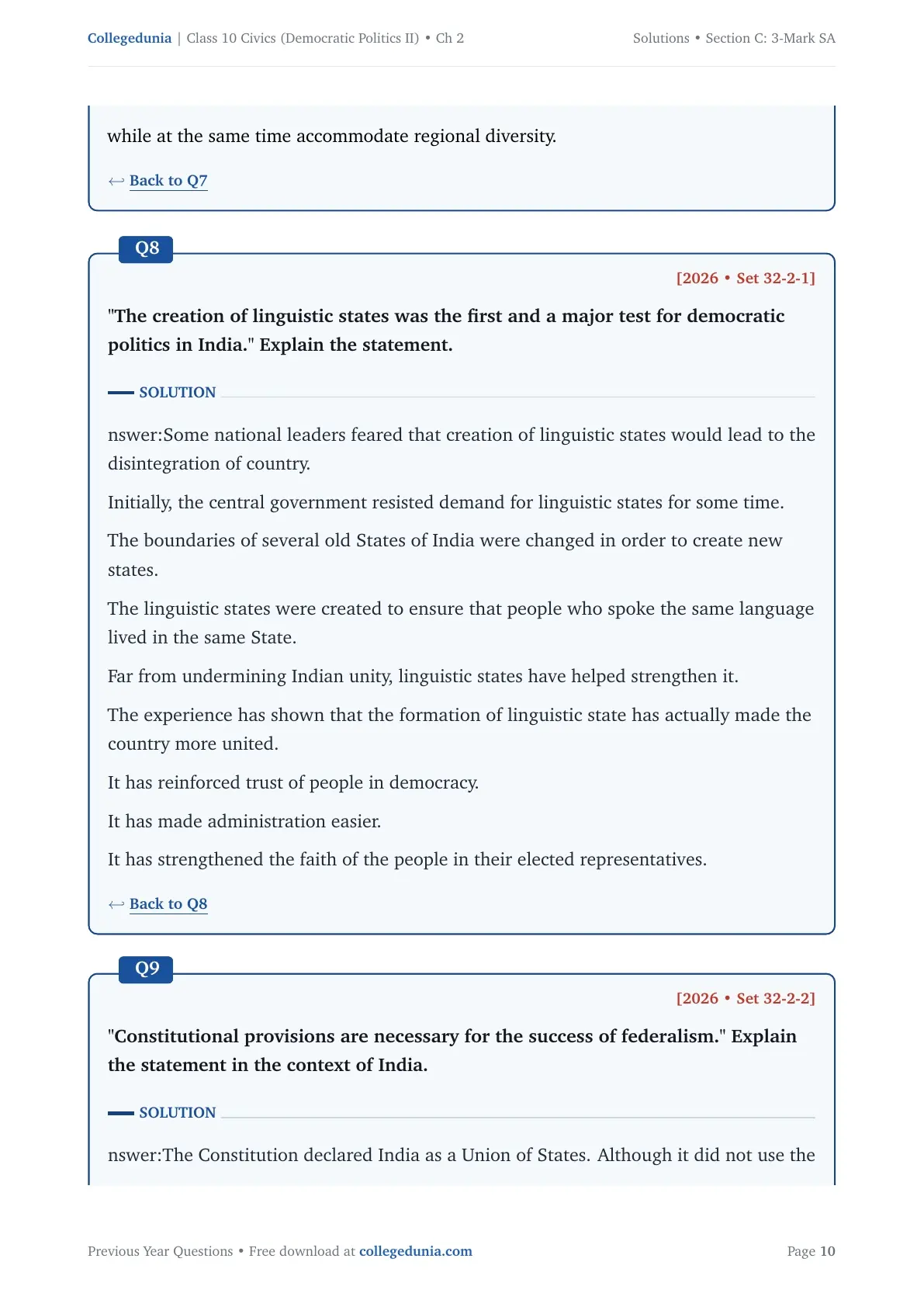
- Linguistic states and why their creation was an early test for democratic politics in India.
- Decentralisation, covering the 1992 constitutional step, Panchayati Raj and urban local bodies.
Two things this small set did not ask directly: the language policy debate around Hindi and the other scheduled languages, and the change in centre-state relations after 1990. Both are still in the chapter, so prepare them even though they are absent here.
Marks-wise Split of the 12 Federalism Board Questions
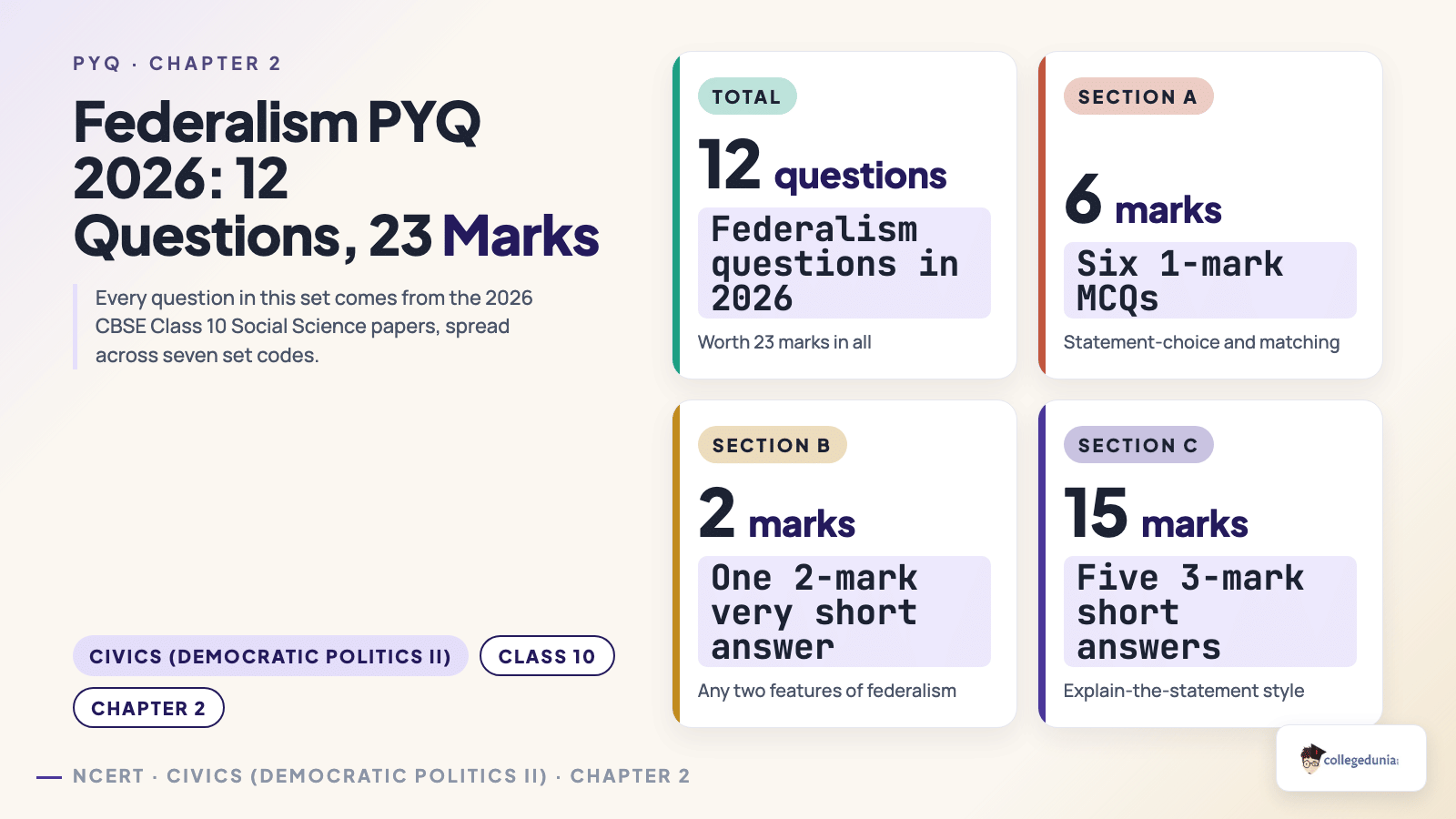
The table shows how the twelve questions divide across the CBSE marks bands. Federalism sat in three sections of the 2026 paper.
| Marks | Questions | Total Marks | CBSE Section | Type |
|---|---|---|---|---|
| 1 mark | 6 | 6 | Section A | MCQ, mostly statement-choice and matching |
| 2 marks | 1 | 2 | Section B | Very short answer |
| 3 marks | 5 | 15 | Section C | Short answer, explain-the-statement style |
| Total | 12 | 23 | – | – |
The 3-mark band carries 15 of the 23 marks in this set. Federalism was a Section C chapter in 2026, not a long-answer chapter, so practise writing three tight points rather than five.
Set-wise Spread of the Federalism Questions in the 2026 Papers
All twelve questions come from the 2026 CBSE Class 10 Social Science board papers. Seven set codes contributed, and the 32-2 series alone gave five questions.
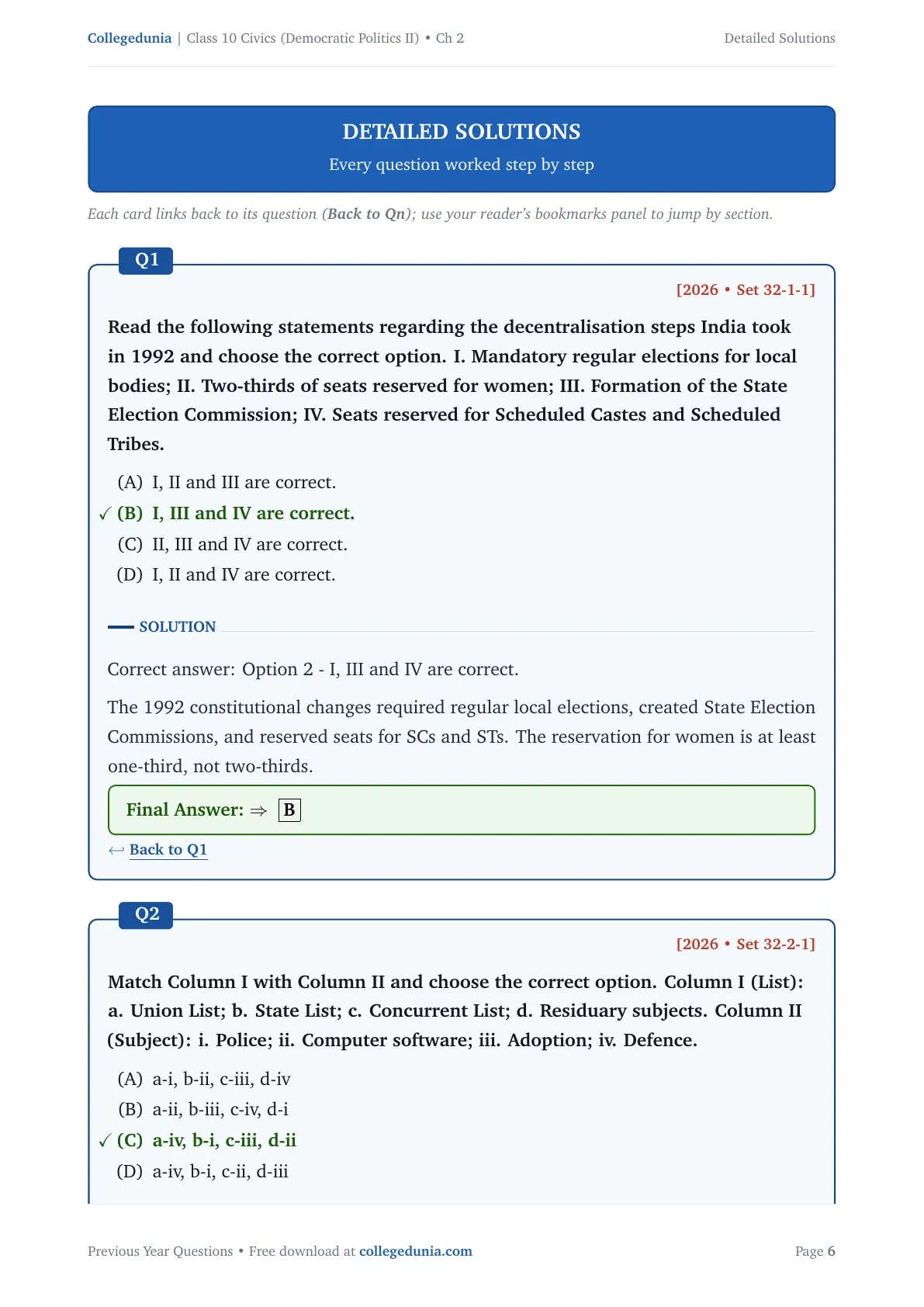
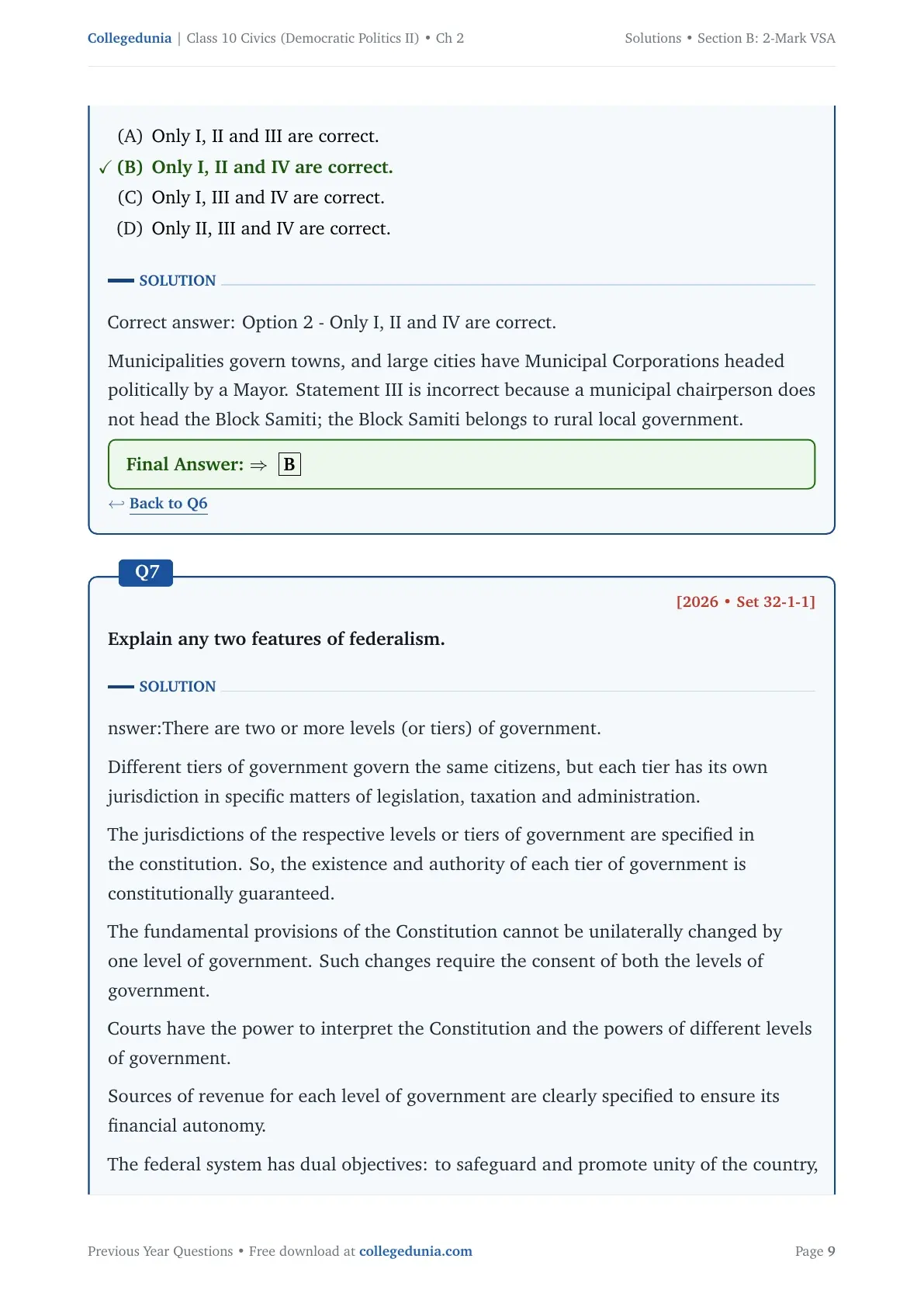
- Set 32-1-1 (2 questions): the statement-choice MCQ on the 1992 decentralisation step, and the 2-mark question on any two features of federalism.
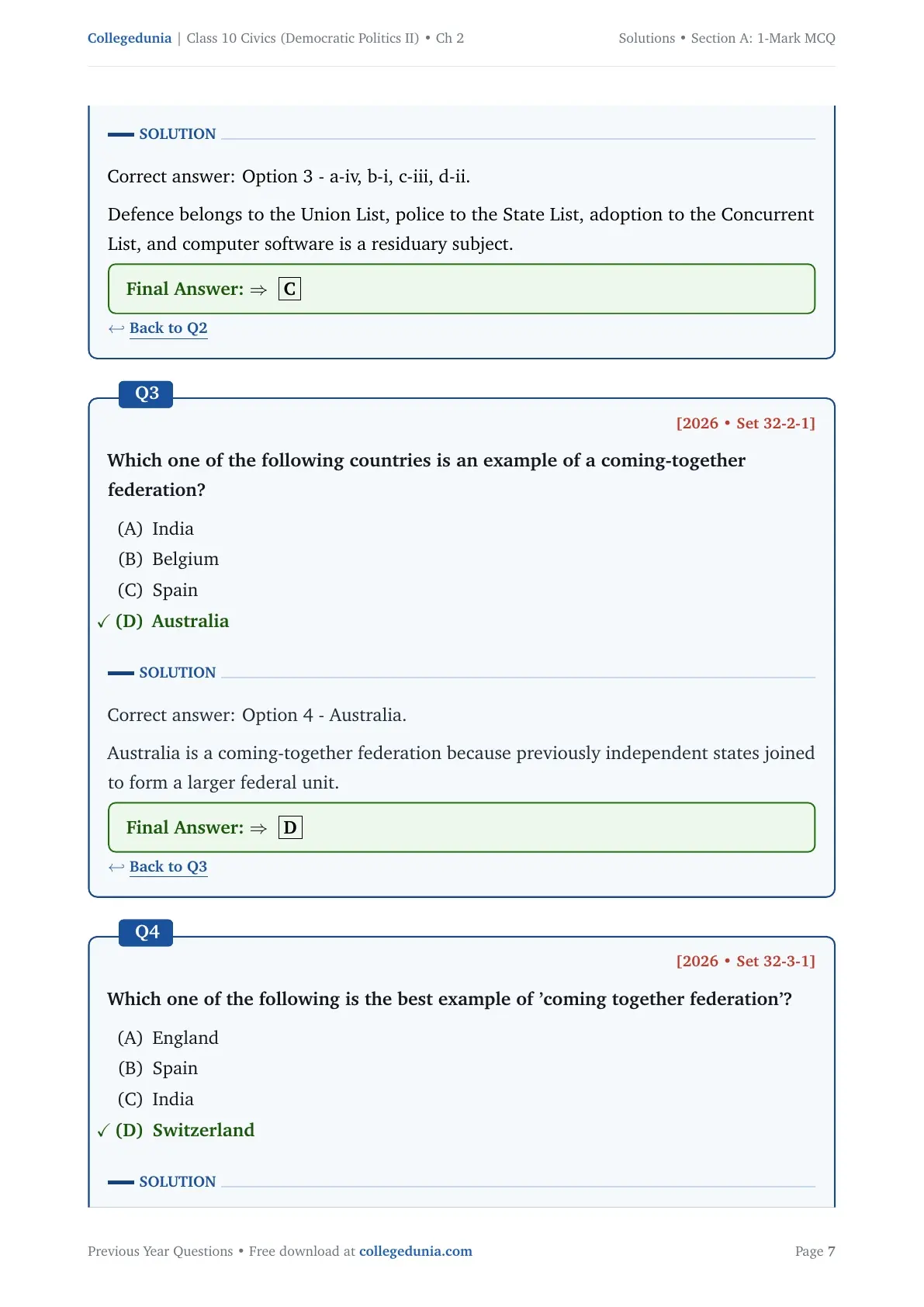
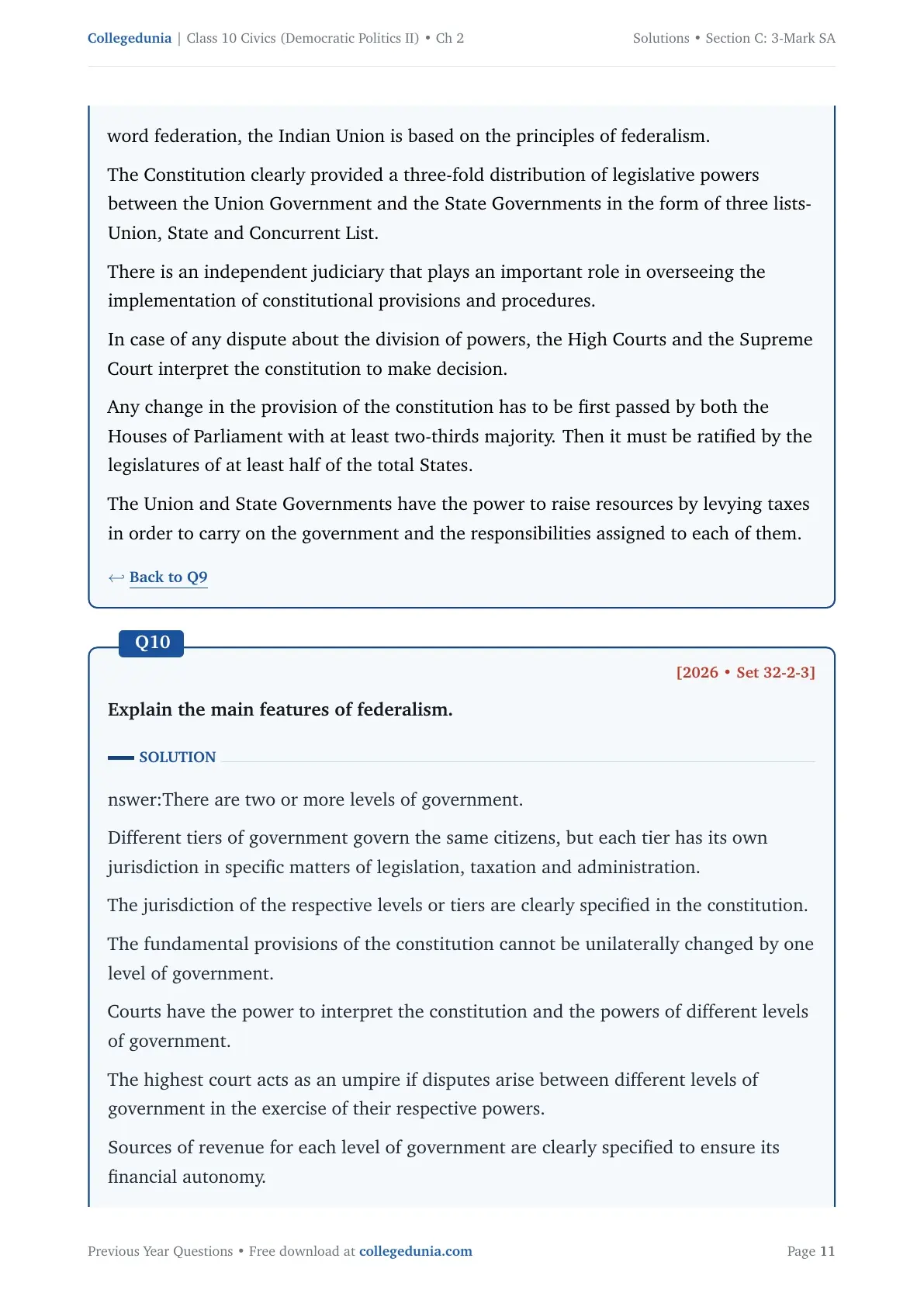
- Sets 32-2-1, 32-2-2 and 32-2-3 (5 questions): the three-lists matching MCQ, a coming-together federation MCQ, and 3-mark questions on linguistic states, constitutional provisions and the main features of federalism.
- Set 32-3-1 (1 question): a second MCQ asking for the best example of a coming-together federation.
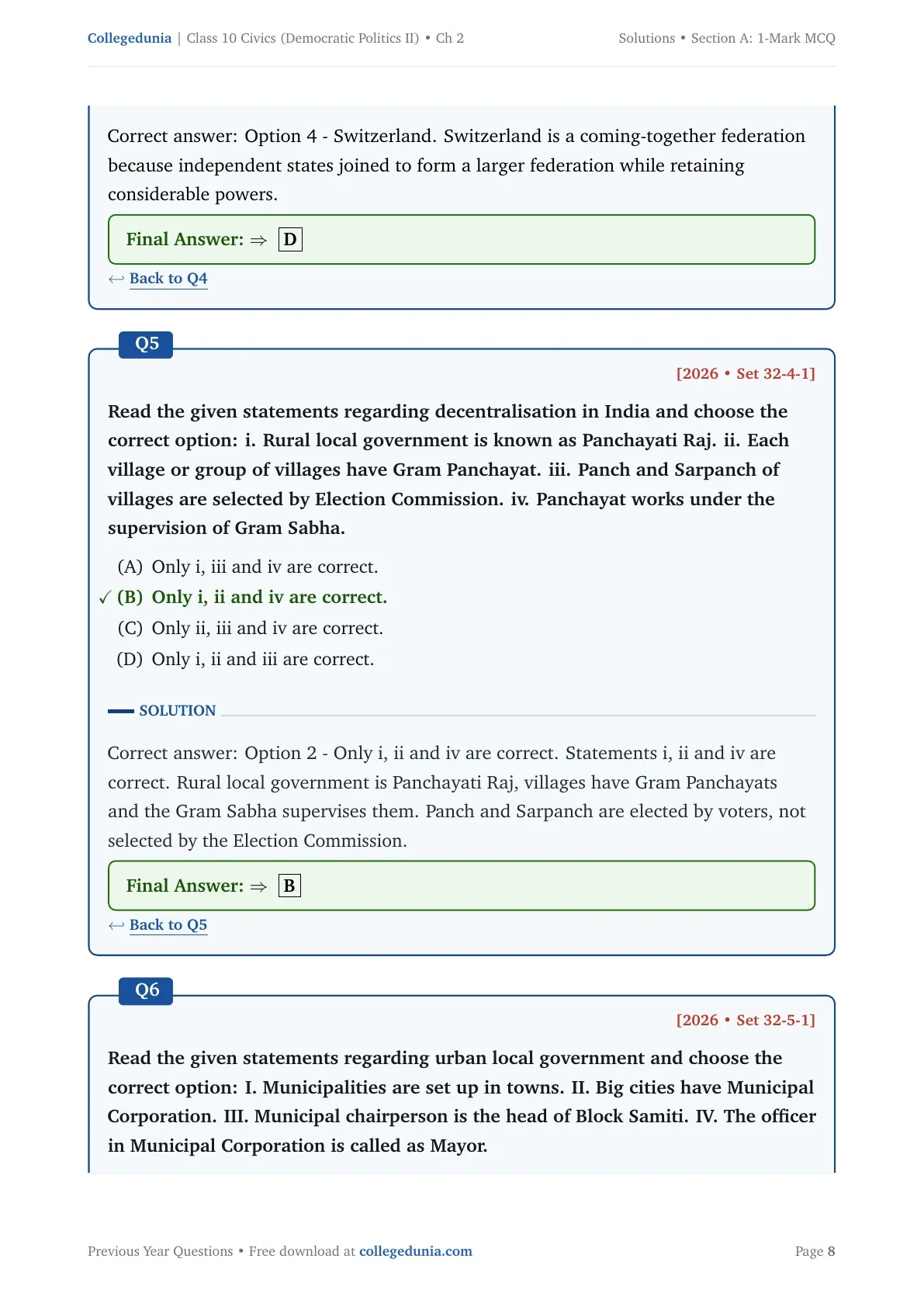
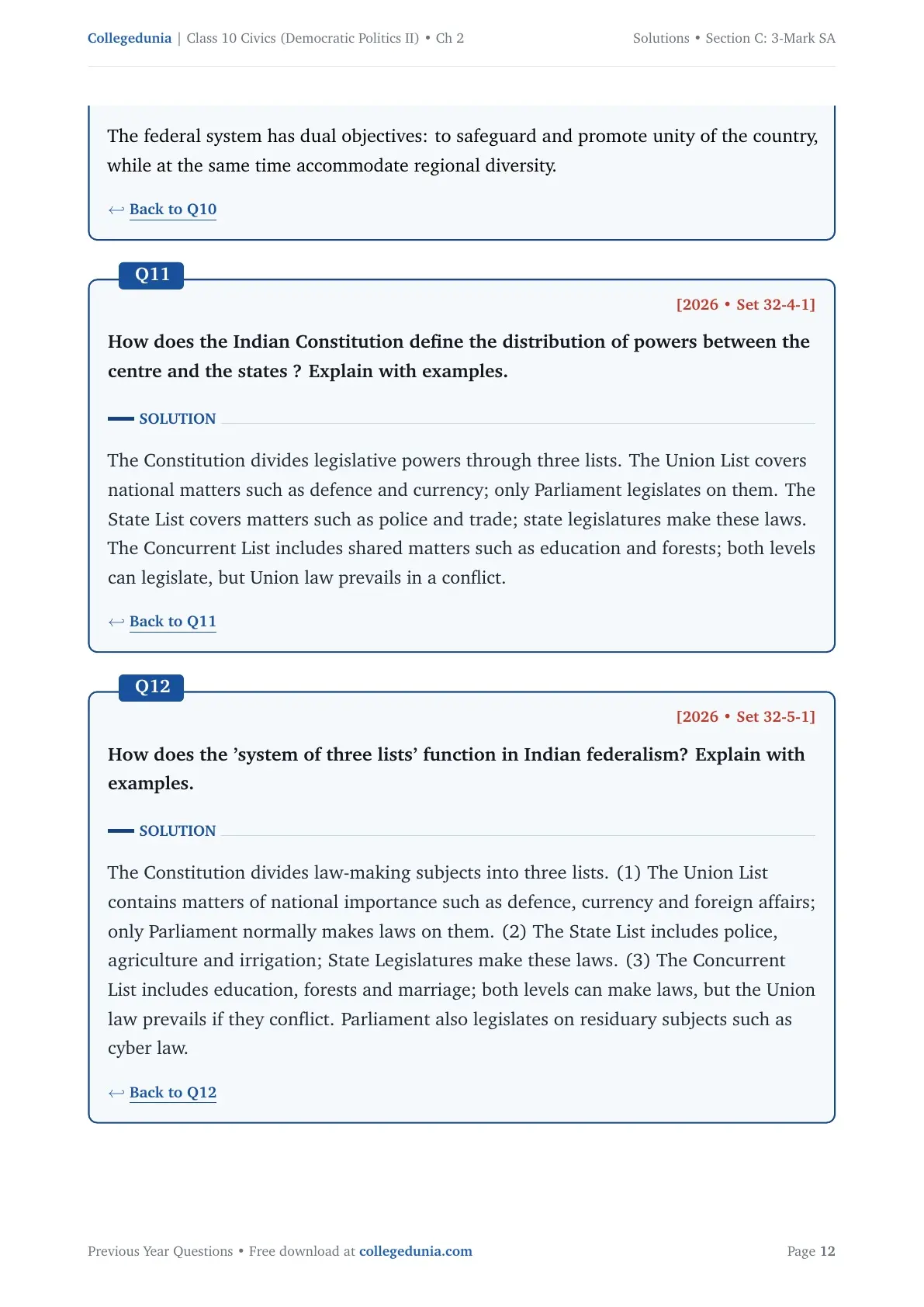
- Set 32-4-1 (2 questions): the Panchayati Raj statement MCQ, and a 3-mark question on how the Constitution distributes powers between the centre and the states.
- Set 32-5-1 (2 questions): the urban local government MCQ, and a 3-mark question on how the system of three lists works.
Which Federalism Topics CBSE Set, and Which It Left Out
Twelve questions from one year is a small sample, so treat the counts below as a snapshot of 2026 rather than a long-run trend.
| Topic Cluster | Questions | Marks Band |
|---|---|---|
| Decentralisation and local self-government | 3 | 1 mark |
| Three lists and centre-state distribution of powers | 3 | 1 and 3 mark |
| Features of federalism | 2 | 2 and 3 mark |
| Coming-together federations | 2 | 1 mark |
| Linguistic states | 1 | 3 mark |
| Constitutional provisions behind Indian federalism | 1 | 3 mark |
The pattern worth noticing: every decentralisation question in this set is a 1-mark MCQ, and every question about the lists or the features is worth 2 or 3 marks. Local government is tested for recall, federal structure is tested for explanation.
How to Attempt Each Marks Band in the Federalism Questions
The PDF is ordered marks-ascending, the same order the CBSE paper uses. That order also happens to match how much writing each band needs.
- 1-mark MCQs: about 45 seconds each. Four of the six give you four statements and ask which combination is correct, so check every statement before you pick.
- 2-mark very short answer: two features, two lines, no introduction. Marks go per point, not per paragraph.
- 3-mark short answer: three distinct points inside about 60 words. For an explain-the-statement question, state the point, then give one Indian example for it.
The Section C questions in this set are phrased as statements to explain, such as the one on linguistic states. An answer that only agrees with the statement scores poorly. Name the point, then support it.
Common Mistakes Students Make in the Federalism Answers
- Mixing up the two routes to a federation. Coming together is independent states joining, holding together is a large country dividing power among its states.
- Putting subjects in the wrong list. Learn a few fixed examples for each of the Union, State and Concurrent lists, and remember that anything not on any list is a residuary subject.
- Answering a features question with the definition of federalism. The question asks for features, so give the numbered points, not a description.
- Writing about Panchayati Raj without the 1992 constitutional step, which is what the MCQ statements in this set are built on.
- Confusing the local bodies. Municipalities are for towns, Municipal Corporations for big cities, and the head of a Municipal Corporation is the Mayor.
- Answering an explain-the-statement question in 20 words. Three marks means three points, and examiners look for all three.
Student Feedback on the Federalism Chapter
- 58% of students rated the three lists as the sub-topic they most often get wrong in a matching MCQ.
- Most-skipped in practice: giving an example alongside each point in a 3-mark answer. About 4 in 10 students wrote points with no example.
- Toppers reported that learning three fixed subjects per list, rather than the whole list, was enough for every matching question they met.
Source: 2026-27 Class 10 Civics student poll. Sample of 12,840 students from CBSE schools across 14 states.
How to Use the Federalism PYQ PDF and Its Detailed Solutions
The 12 pages carry the twelve questions first, then a Detailed Solutions section in which each question is restated, answered step by step and linked back to the question. Self-checking is what fixes a 3-mark answer, so use it in this order.
- Attempt cold. Do the six MCQs first, then the 2-mark, then the five 3-mark questions, with the solutions section still closed.
- Check against the worked solution. Each solution repeats its question and builds the answer point by point, so the gap between your version and the full one is easy to see.
- Count your points. A 3-mark answer needs three. If your written answer has two, that is the mark you would have lost.
Read end to end instead of attempting first, and the same file doubles as a revision resource. The Federalism NCERT Solutions page linked below covers the textbook exercise questions, which are a separate set from these board questions.
Federalism Class 10 Resources That Pair With This Question Set
Also Check: the same chapter in the other Collegedunia formats. The notes carry the content, this page carries the board questions.
| Resource | Federalism Class 10 Link |
|---|---|
| NCERT Solutions | Federalism Class 10 NCERT Solutions |
| Revision Notes | Federalism Class 10 Revision Notes |
| Handwritten Notes | Federalism Class 10 Handwritten Notes |
| NCERT Book PDF | Federalism Class 10 NCERT Book PDF |
All Class 10 Civics Chapter PYQ PDFs for the 2026-27 Session
Democratic Politics II has five chapters. The chapterwise PYQ compilations for the rest are being built the same way, from the official CBSE papers.
| Chapter | Topic | Previous Year Questions |
|---|---|---|
| Chapter 1 | Power Sharing | Power Sharing PYQ PDF (coming soon) |
| Chapter 2 | Federalism | This page |
| Chapter 3 | Gender, Religion and Caste | Gender, Religion and Caste PYQ PDF (coming soon) |
| Chapter 4 | Political Parties | Political Parties PYQ PDF (coming soon) |
| Chapter 5 | Outcomes of Democracy | Outcomes of Democracy PYQ PDF (coming soon) |
Federalism Class 10 PYQ FAQs
What Students Ask About the Federalism Board Questions
Ques. How many questions are in the Class 10 Civics Federalism PYQ PDF?
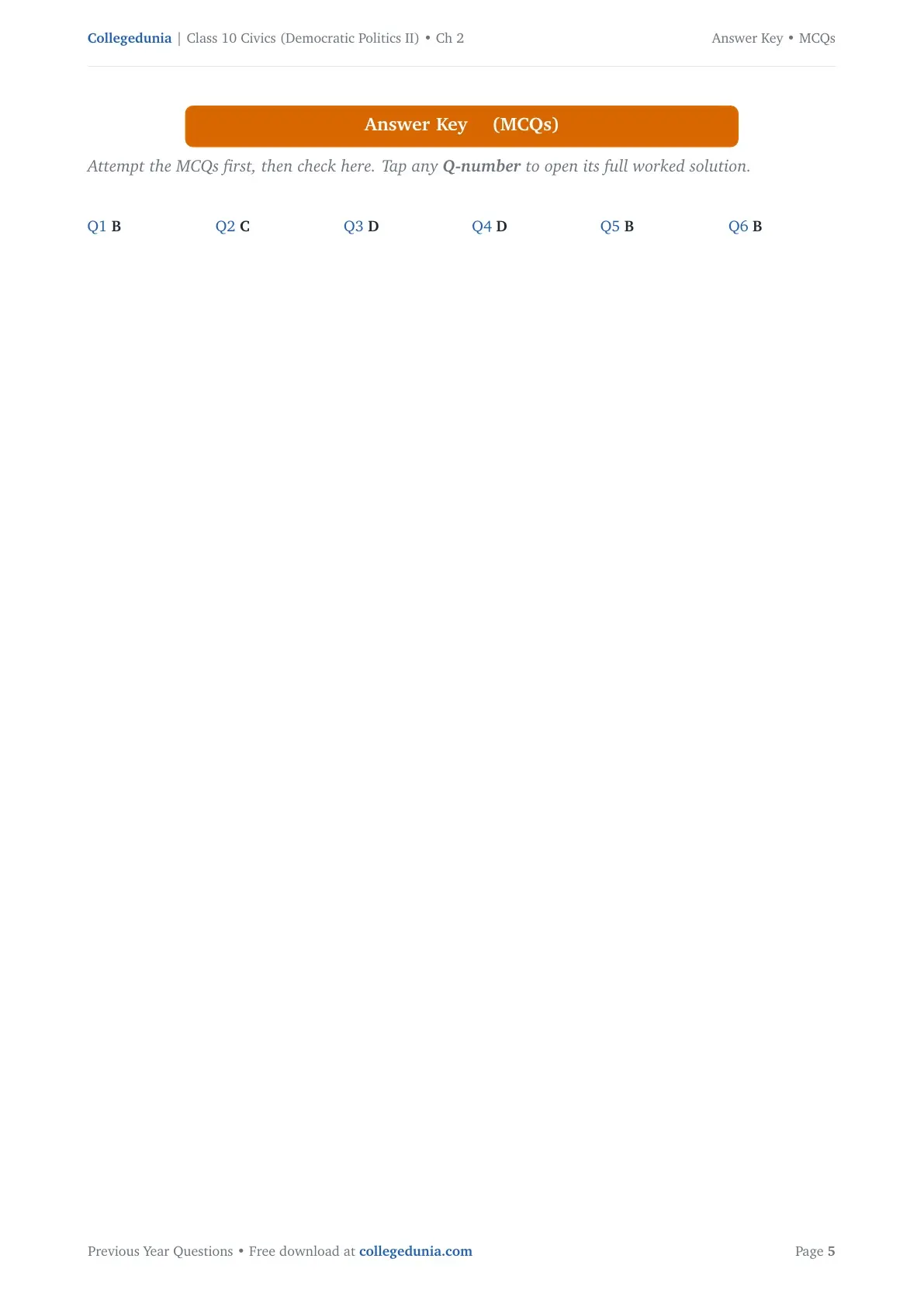
Ans. Twelve questions worth 23 marks. That is 6 one-mark MCQs, one 2-mark very short answer and 5 three-mark short answers, all from the 2026 CBSE Class 10 Social Science board papers. It is a focused set, not a full chapter bank.
Ques. Does the Federalism PYQ PDF include answers?
Ans. Yes. The questions are printed as CBSE set them, with the year and set code under each one, and a Detailed Solutions section follows. Every solution restates its question, works the answer step by step and links back to the question, so you can attempt the set first and mark it yourself afterwards.
Ques. Which CBSE papers were used to build it?
Ans. Seven set codes from the 2026 board cycle: 32-1-1, 32-2-1, 32-2-2, 32-2-3, 32-3-1, 32-4-1 and 32-5-1. Because every question comes from a single year, the set shows you the 2026 pattern rather than a multi-year trend.
Ques. Which Federalism topic carried the most marks in 2026?
Ans. The 3-mark short answers carried 15 of the 23 marks, and three of those five questions were about federal structure: the main features of federalism, the constitutional provisions behind it, and the centre-state division of powers.
Ques. What are the three lists in Indian federalism?
Ans. The Indian Constitution divides subjects into a Union List for the central government, a State List for state governments, and a Concurrent List on which both can make laws. Subjects that appear on none of the three are residuary subjects, and the 2026 matching MCQ tested exactly this four-way split.
Ques. What is decentralisation in Class 10 Civics?
Ans. Decentralisation means passing power from the central and state governments down to local government. India took a major constitutional step in 1992, which made regular local body elections compulsory, reserved seats for Scheduled Castes, Scheduled Tribes and women, and set up a State Election Commission in every state.
Ques. Are these questions still valid for the 2026-27 syllabus?
Ans. Yes. Federalism stays as the second chapter of the Civics unit in the 2026-27 CBSE Class 10 Social Science syllabus, and the question types in this set, MCQ, very short answer and short answer, are the same types the paper uses.



Comments