



If you are preparing for the Class 10 Civics board paper, Gender, Religion and Caste is one chapter the examiner keeps coming back to. This page carries a free previous year question set of 13 real CBSE board questions, sorted by marks. The PDF carries a full worked solution for every one of them in a Detailed Solutions section, so you can write your own answer first and mark it against the solution afterwards.
- 13 board questions in all: 2 one-mark objective questions, 10 two-mark questions and 1 three-mark question.
- Every question is printed with its exam year and set code, so you know which paper it came from.
- 10 pages in all: the question set first, then a Detailed Solutions section that answers every question.
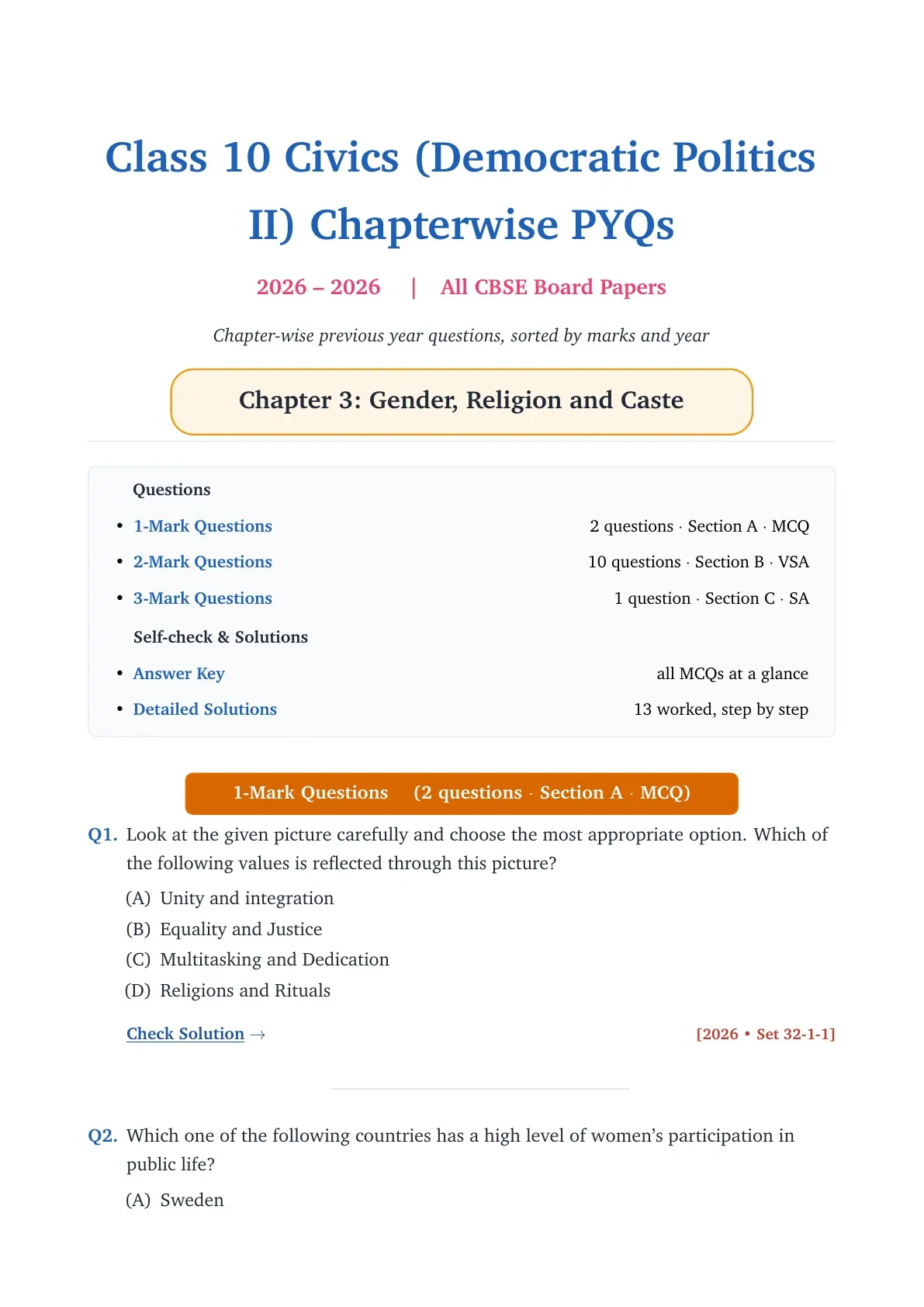
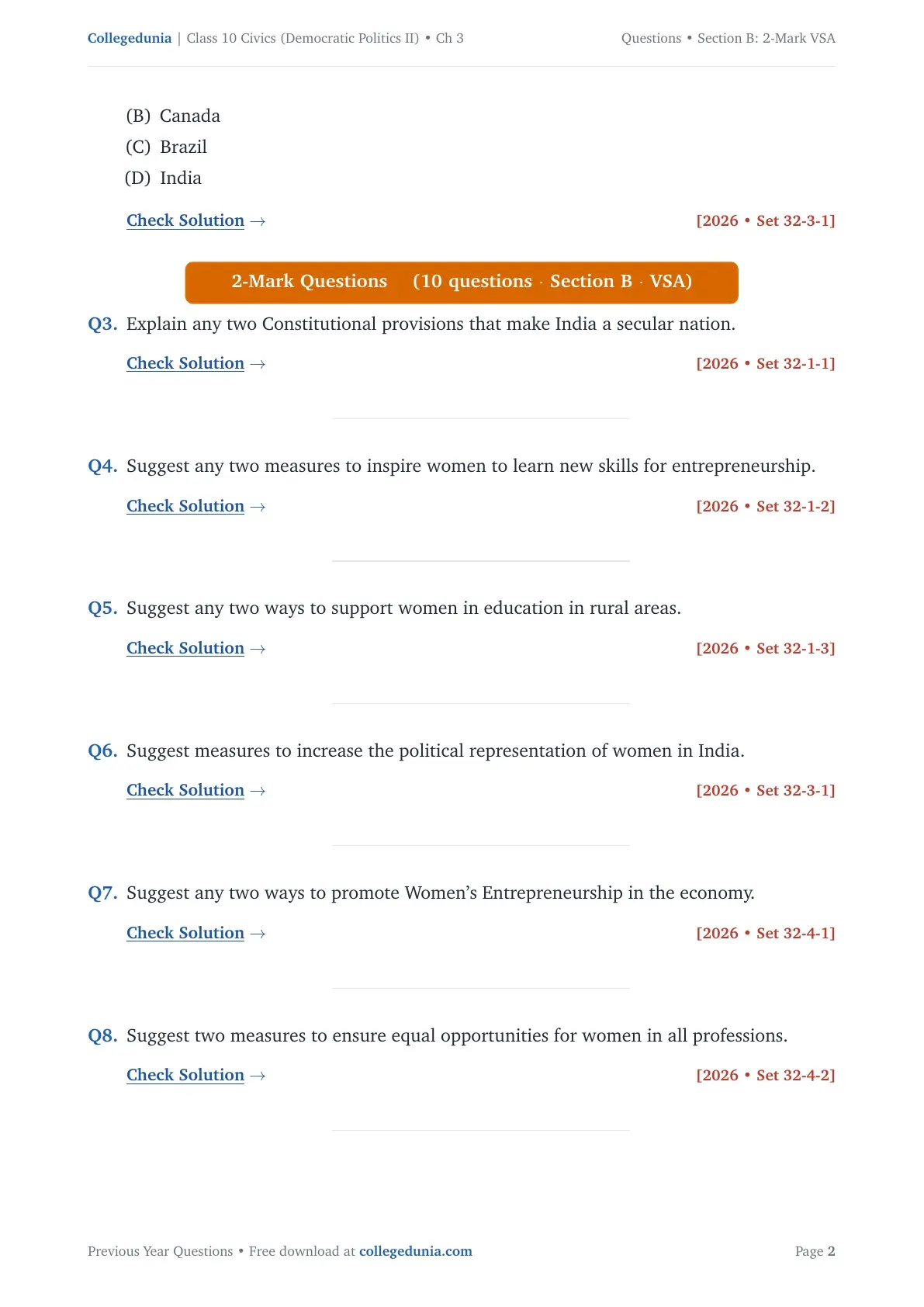
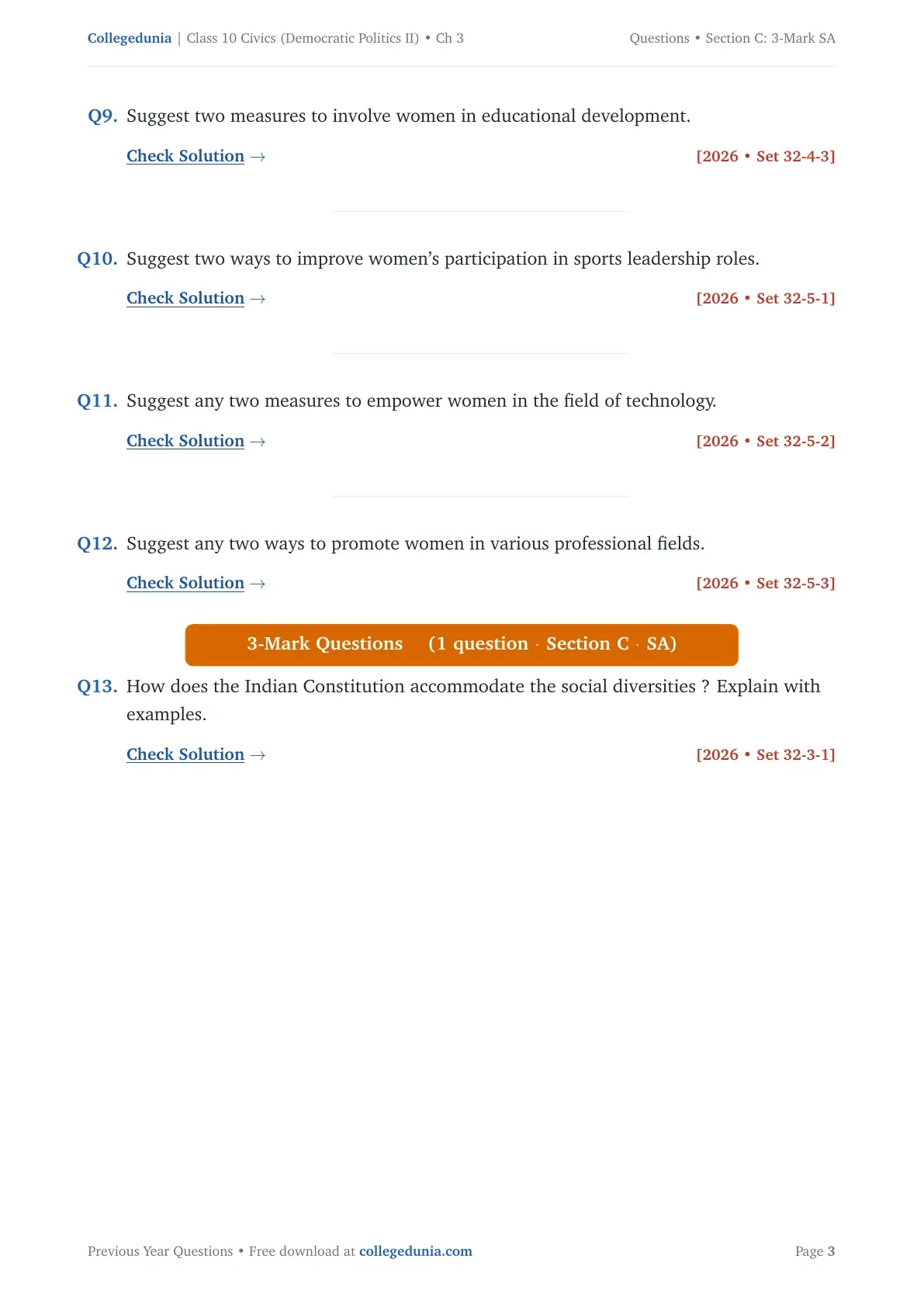
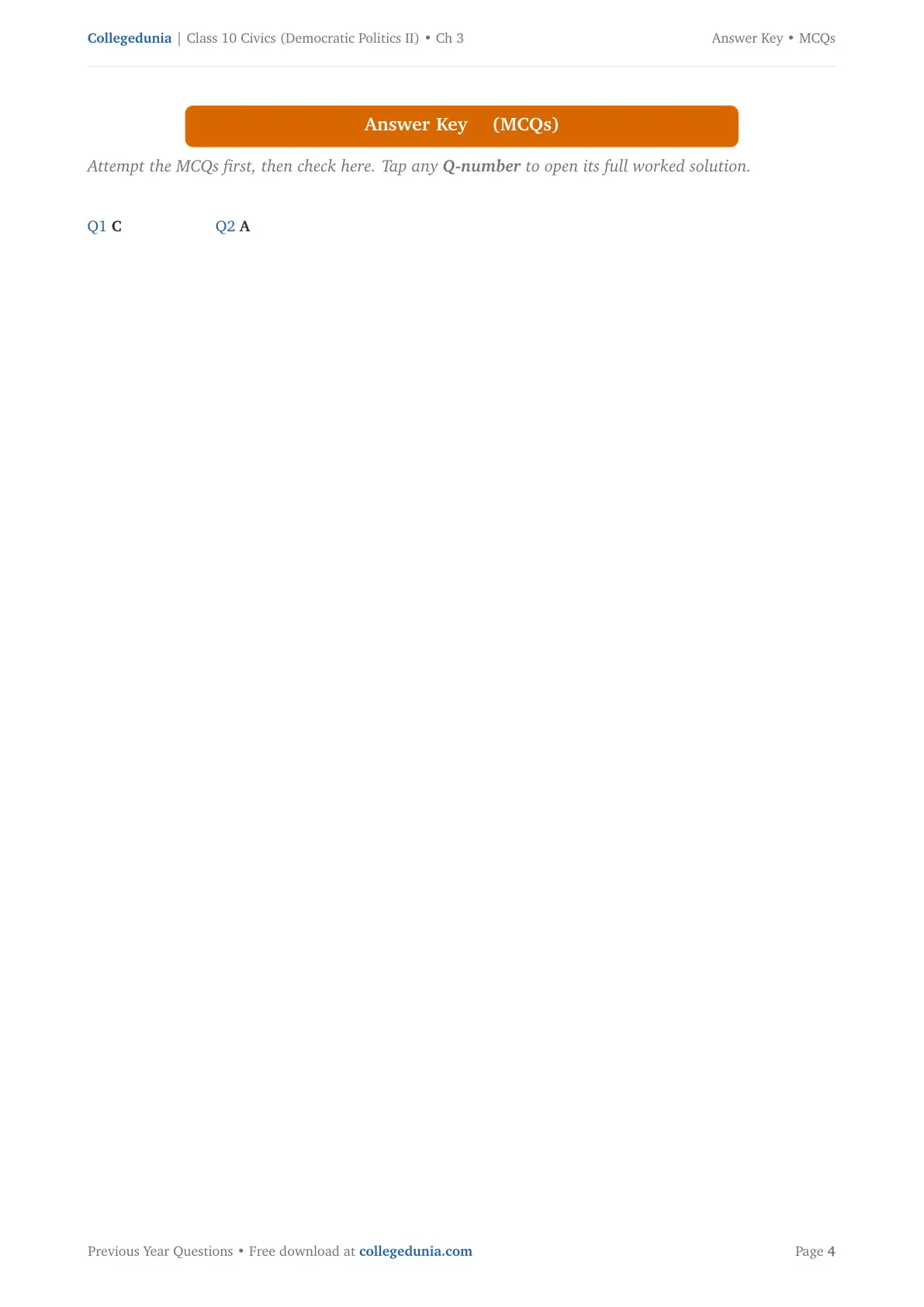
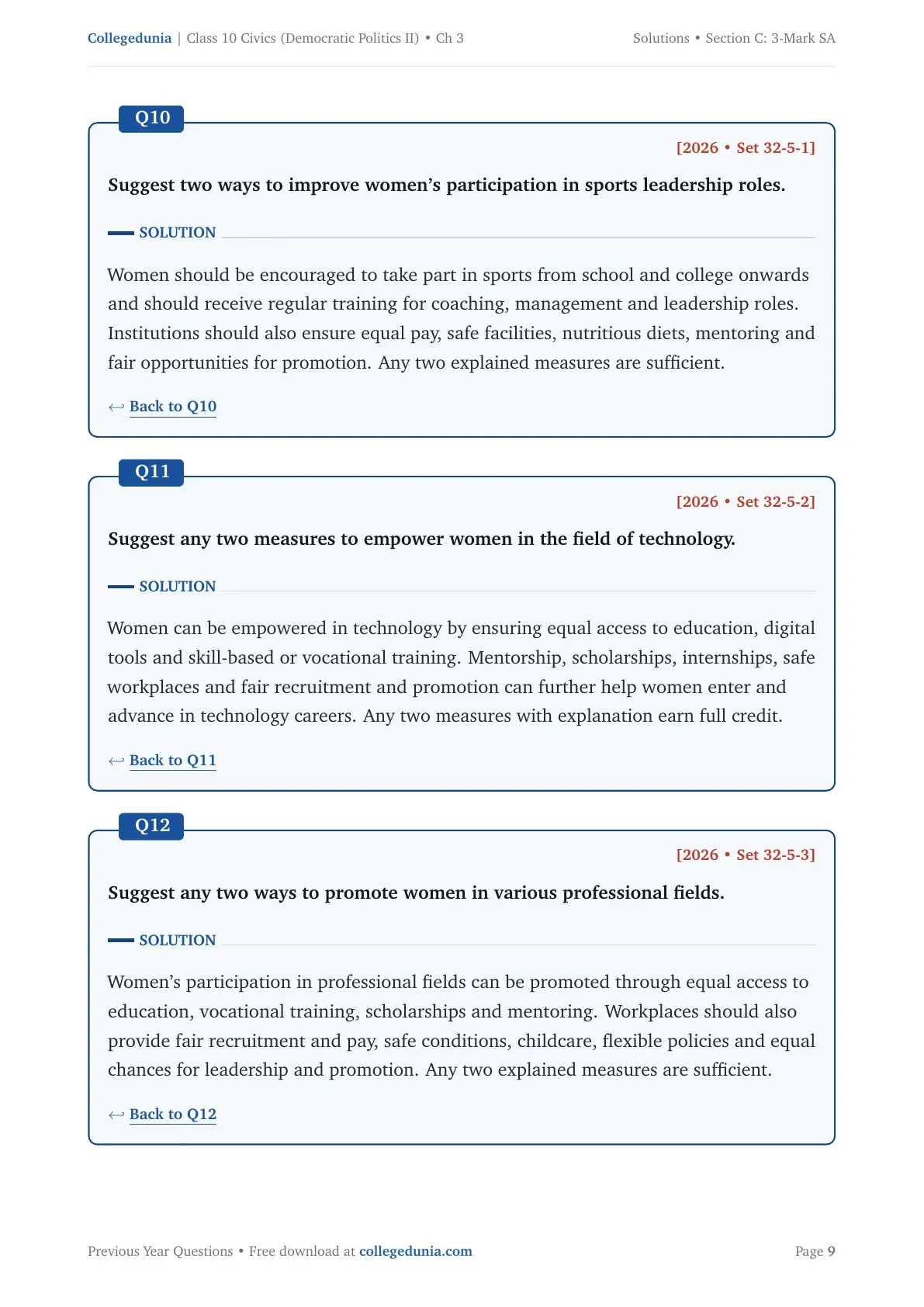
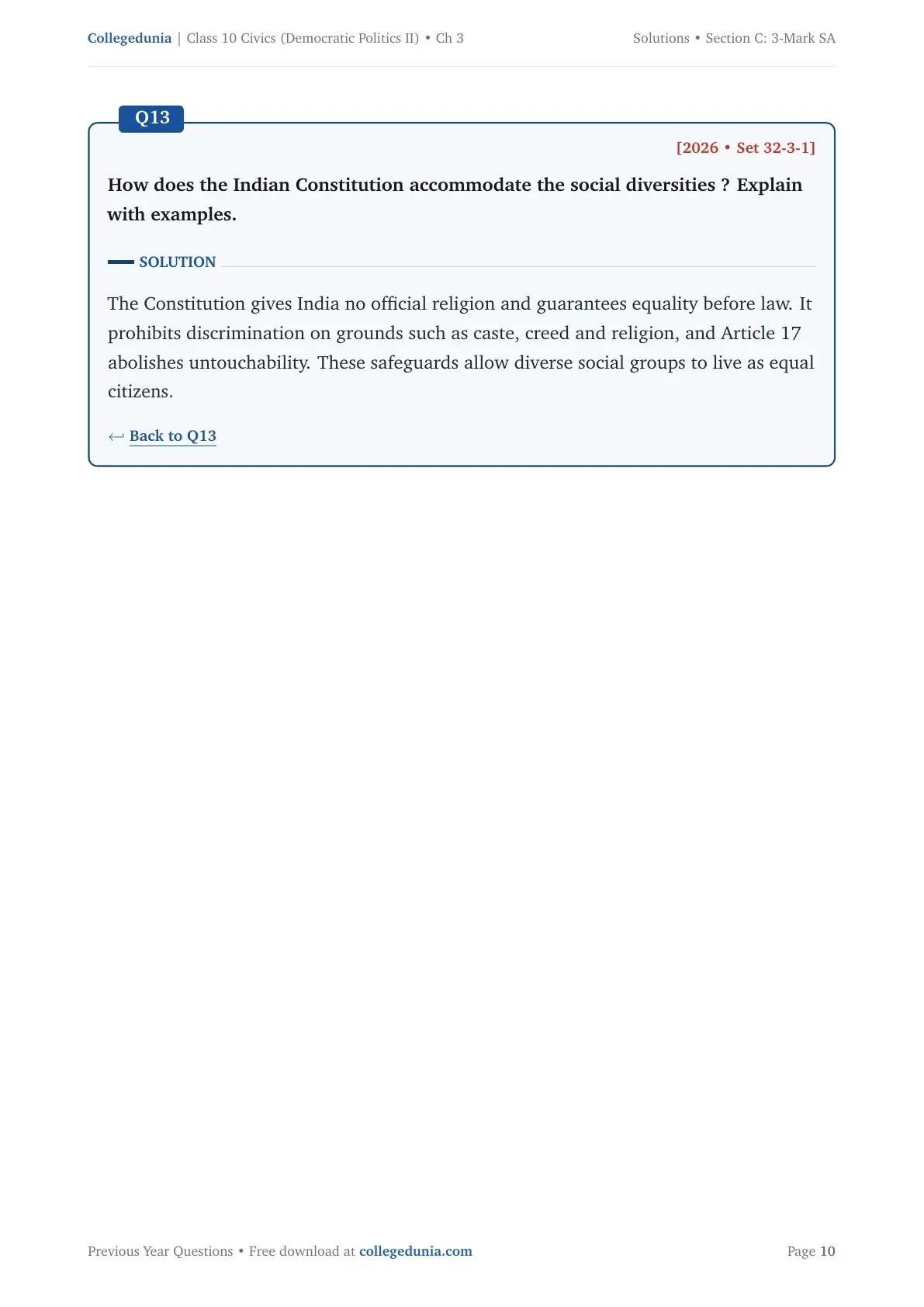
Every question in this Gender, Religion and Caste previous year question set is copied from an actual CBSE Class 10 Social Science board paper and checked against the 2026-27 NCERT Democratic Politics II textbook.
What the Gender, Religion and Caste Class 10 PYQ PDF Contains
The file works as a practice set and as a revision resource. It opens with a contents card listing the three marks buckets, prints the questions one after another, then solves every one of them.
- 13 questions lifted from CBSE Class 10 Social Science board papers, grouped by marks.
- The year and set code sit in red beside each question, for example 2026, Set 32-1-1.
- Objective questions keep all four options exactly as the board printed them.
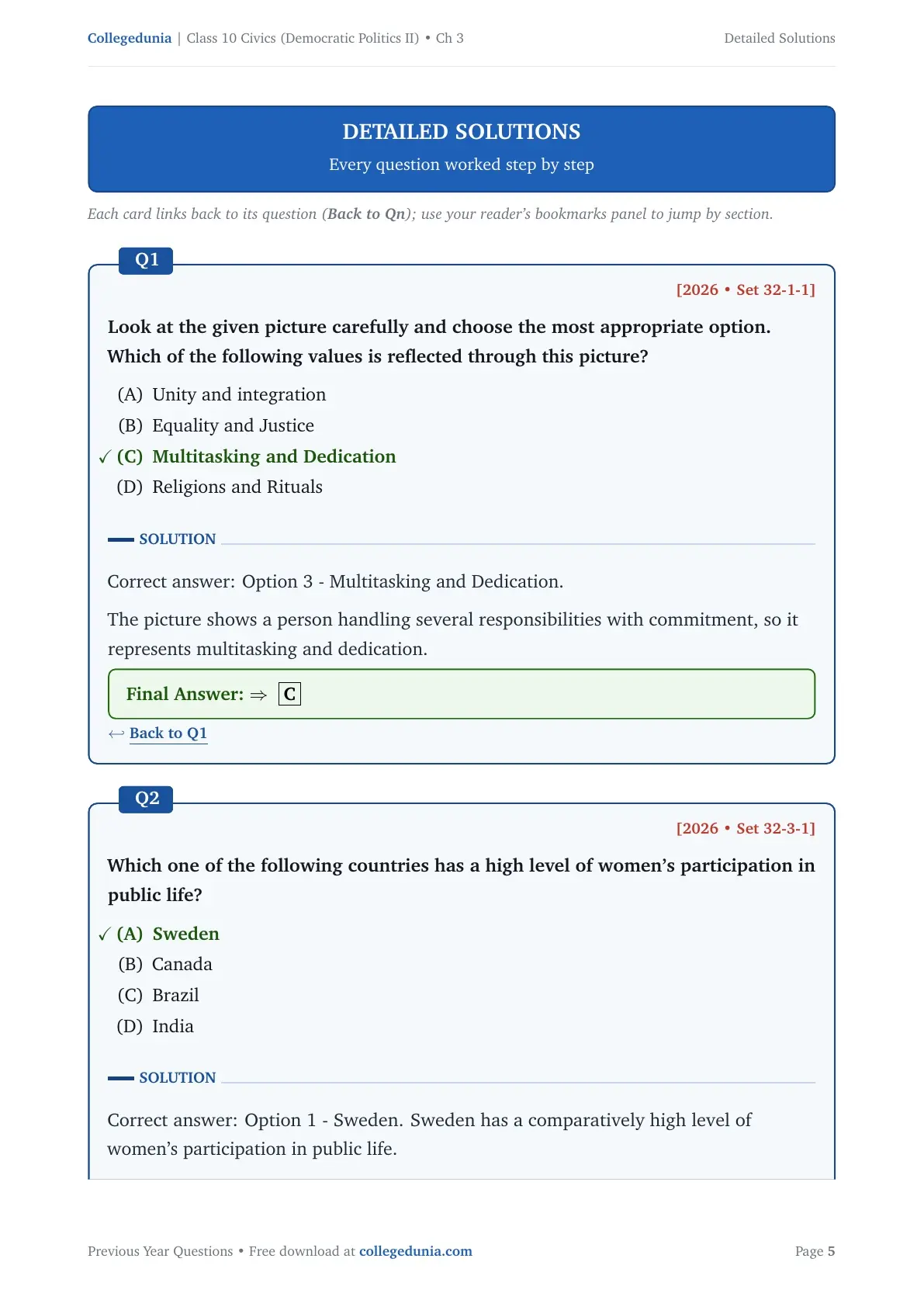
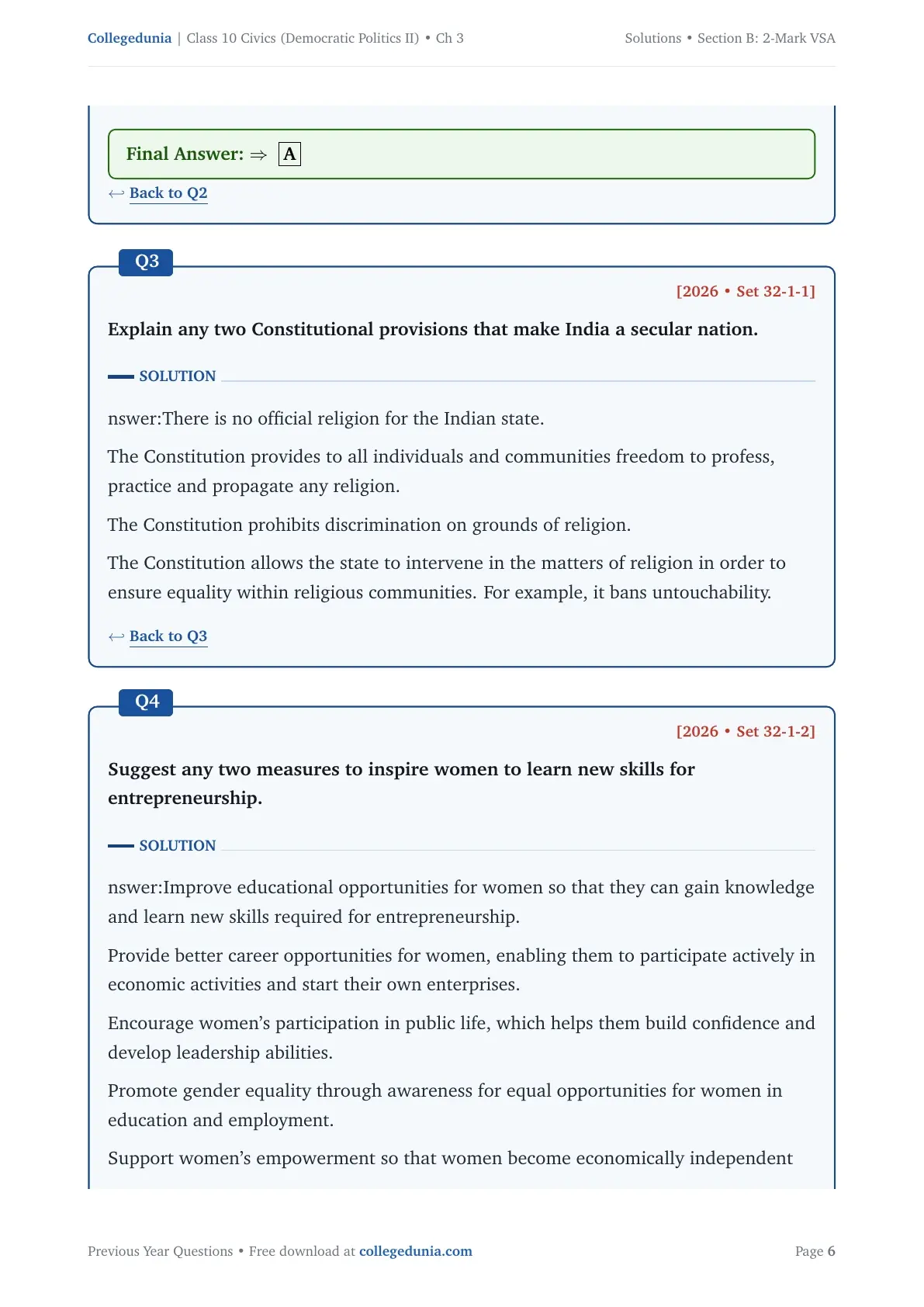
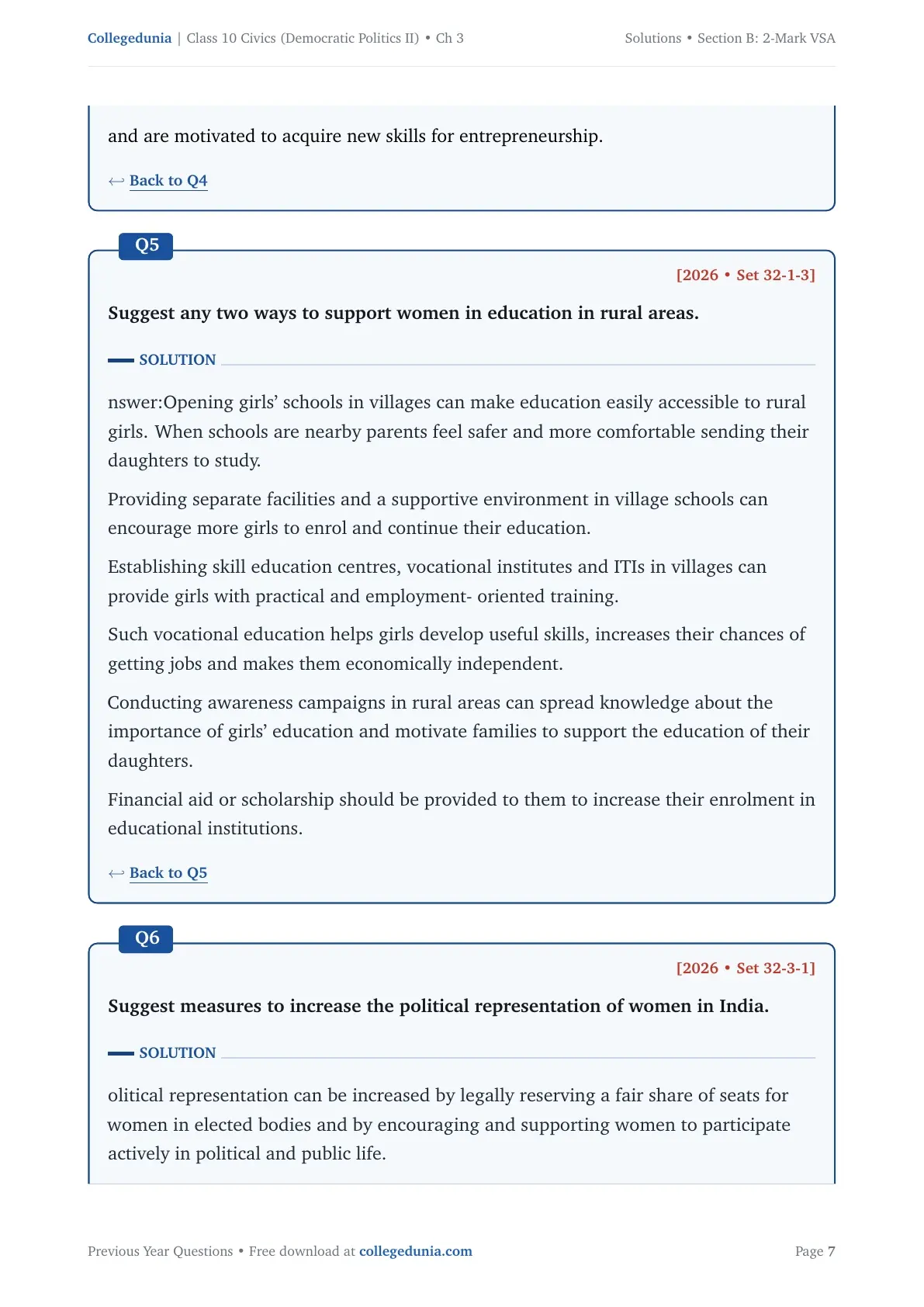
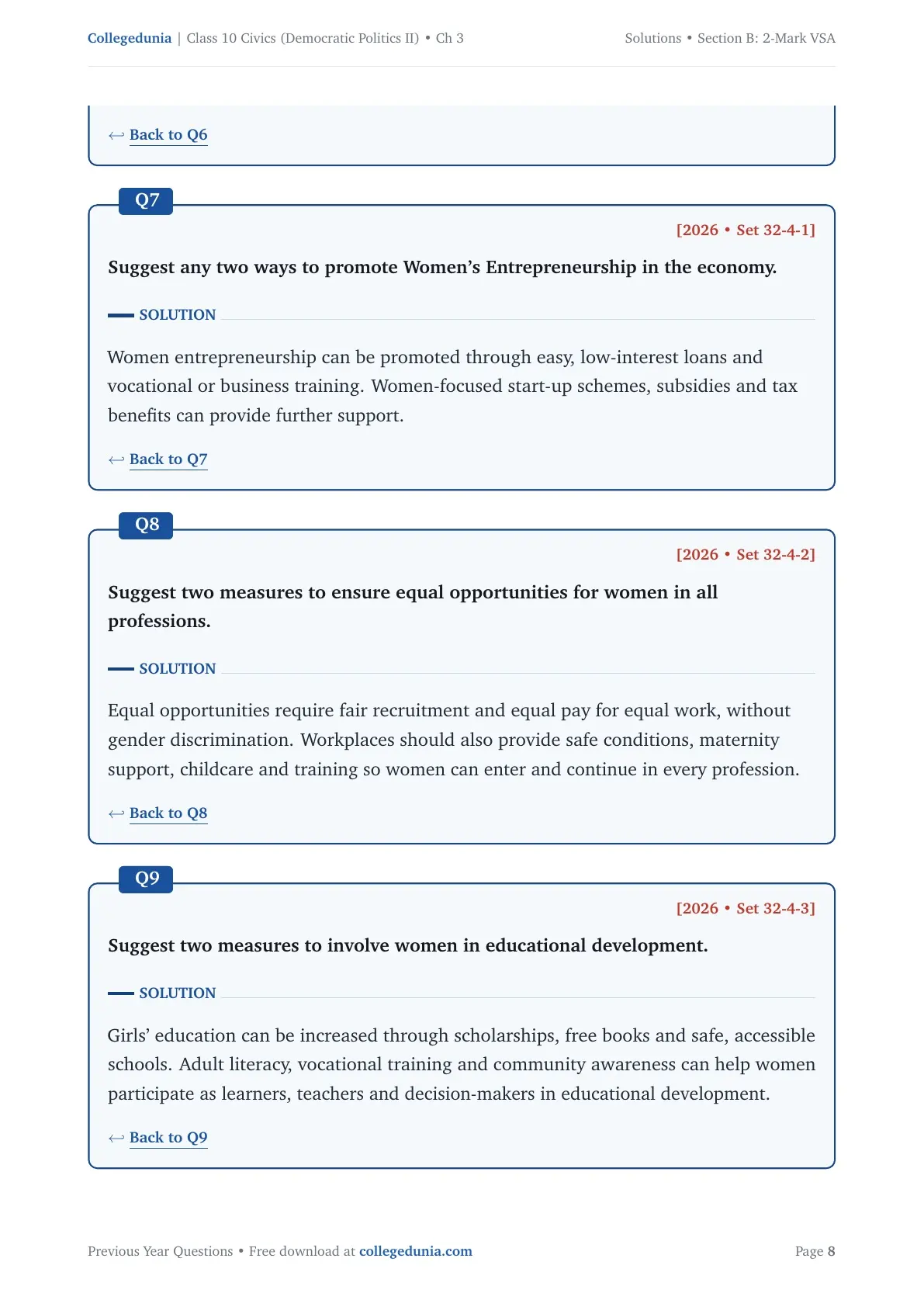
- A step-by-step worked solution for all 13 questions, in a Detailed Solutions section that fills the second half of the 10 pages. Each solution restates its question and links back to it.
This is a small, focused set, not a complete question bank for the chapter. Use it as a board-pattern check after you have already read the chapter once.
Marks-Wise Split of the Gender, Religion and Caste Board Questions
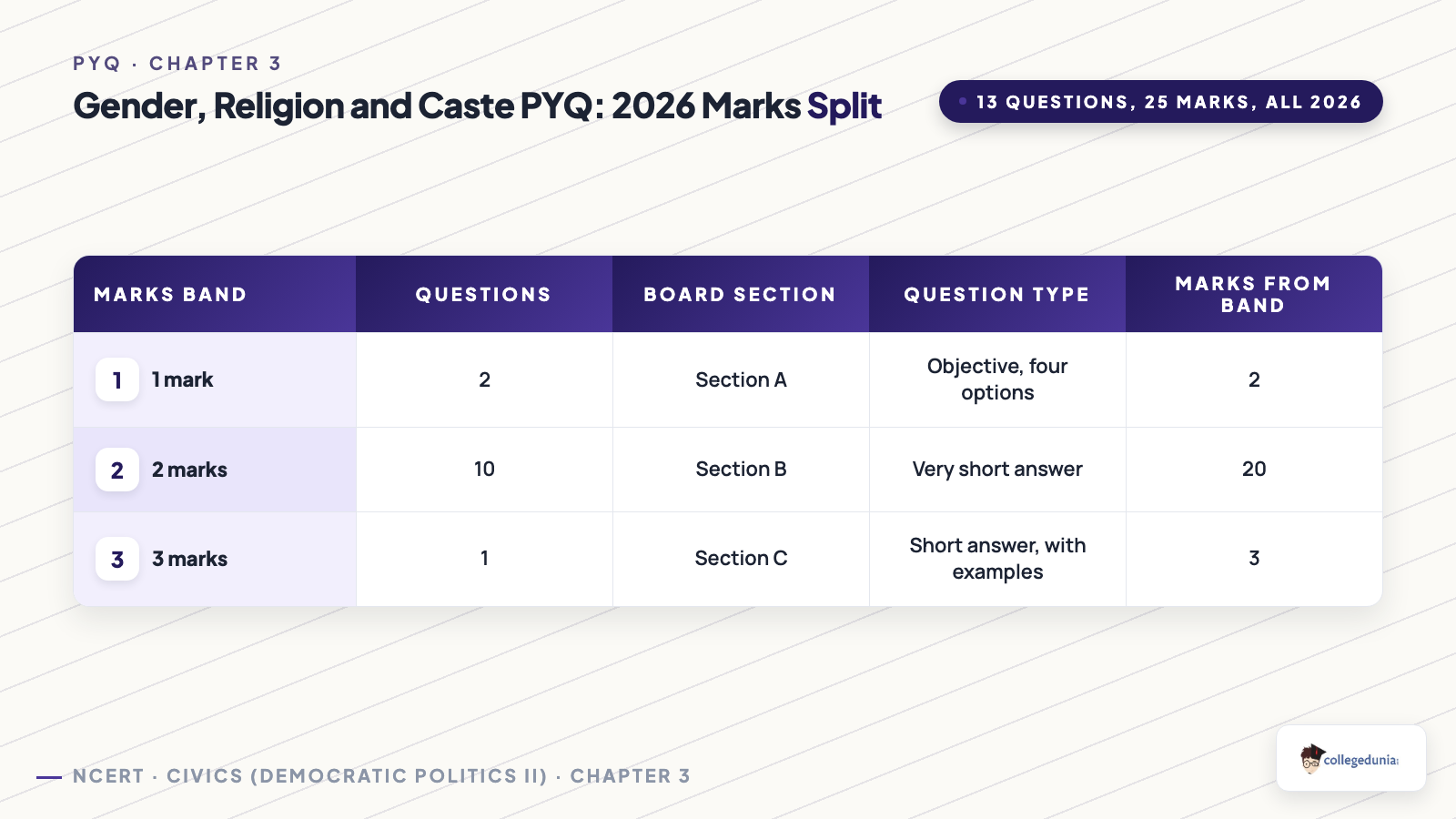
Sorting by marks tells you what the paper actually wants from this chapter. Two-mark questions dominate this set, which matches how Gender, Religion and Caste usually appears in Section B.
| Marks | Questions in the PDF | Board section | Question type |
|---|---|---|---|
| 1 mark | 2 | Section A | Objective, four options |
| 2 marks | 10 | Section B | Very short answer |
| 3 marks | 1 | Section C | Short answer |
Total: 13 questions worth 25 marks. Ten of the thirteen are two-markers, so most of your practice time here goes into writing two clean points and stopping.
Gender, Religion and Caste Topics the 2026 CBSE Papers Asked About
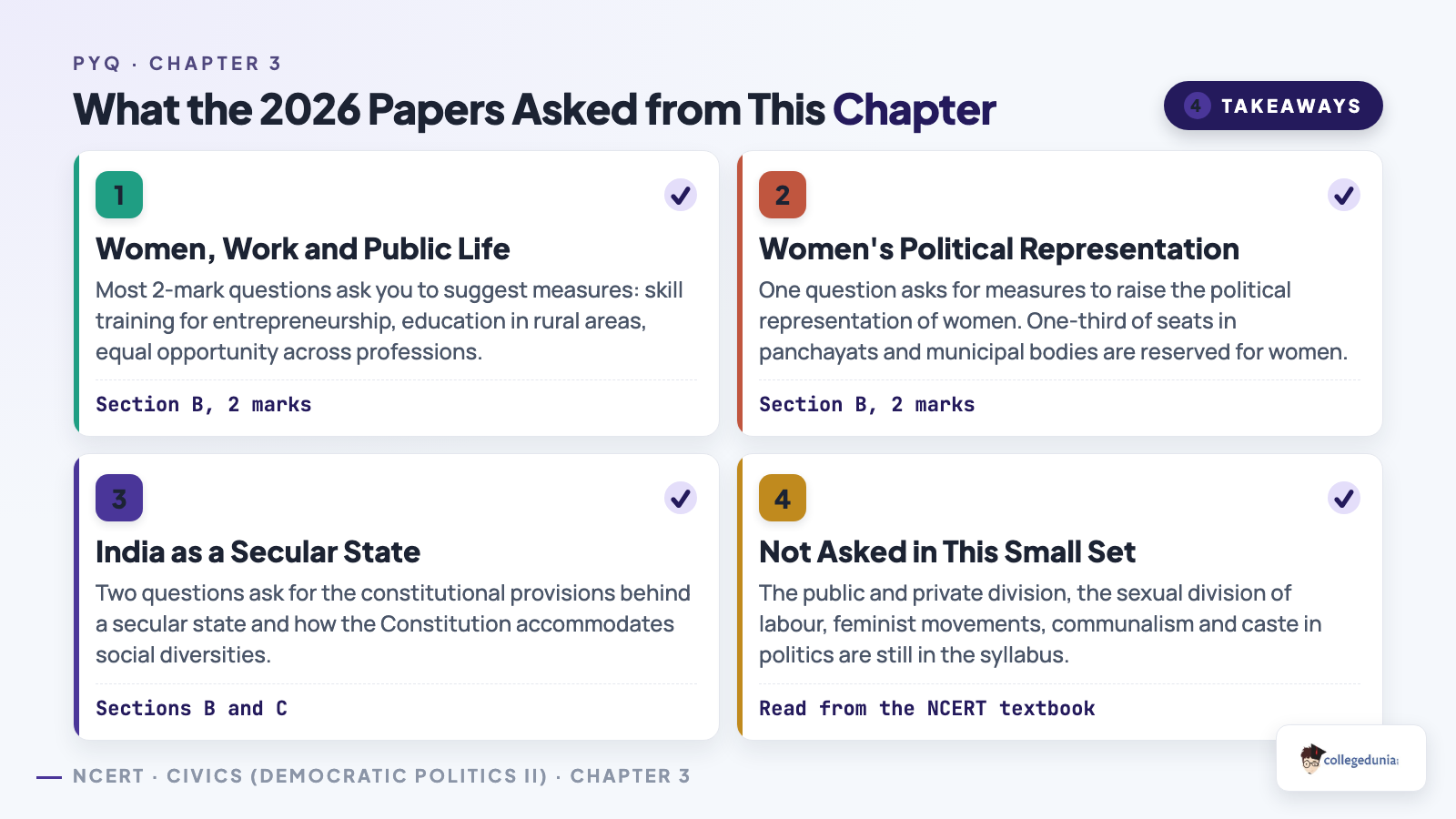
The questions in this set sit on three of the chapter's areas. The NCERT textbook covers all of them, and the wording below stays with the textbook's own terms.
- Women, work and public life. Most two-mark questions ask you to suggest measures: skills for entrepreneurship, education in rural areas, equal opportunity across professions, leadership roles in sport, and women in technology.
- Women's political representation. One question asks for measures to increase the political representation of women in India. The textbook's own reference point here is the reservation of one-third of seats in panchayats and municipal bodies.
- Secularism and social diversity. Two questions ask about the Constitution: the provisions that make India a secular nation, and how the Constitution accommodates social diversities.
The chapter's other strands, the public and private division, the sexual division of labour, feminist movements, communalism and caste in politics, are not directly asked in this small set. They still sit in the syllabus, so read them from the textbook rather than from this file.
How to Practise the Gender, Religion and Caste PYQ Set with Its Solutions
Because the worked answers sit in the same file, the order in which you open the two halves is what decides whether this is practice or revision. Keep the solutions closed until you have written something.
- Read the chapter once from the NCERT textbook. Do not open the Detailed Solutions before that.
- Set a timer. Give a two-mark question about 3 minutes and the three-mark question about 5 minutes.
- Write the answer in points, the way you would in the board paper. Two marks means two points.
- Open the worked solution for that question and check point by point. Tick the points you got, circle the ones you missed.
- Redo every circled question after two days, from memory.
Tip: for a "suggest any two measures" question, the board is testing whether you can give two separate, workable suggestions. Two versions of the same idea usually score as one point.
Common Mistakes Students Make in the Gender, Religion and Caste Chapter
These are the slips that cost marks on exactly the kind of questions printed in this set.
- Writing an essay for a two-mark question. Ten of the thirteen questions here are two-markers. Two short points, and stop.
- Listing measures without naming them. "Government should help women" is not a measure. "Skill training centres in villages" is.
- Mixing up secularism and the constitutional provisions. The question asks for provisions, so quote the Constitution's actual position: no official religion, freedom to profess, practise and propagate any religion, no discrimination on grounds of religion.
- Ignoring the command word. "Suggest" wants recommendations. "Explain" wants reasons. "How does" wants a process with an example.
- Skipping the example. The three-mark question ends with "Explain with examples", so an answer with no example loses a mark.
Student Feedback on the Gender, Religion and Caste Question Practice
What 11,540 students told us about practising this chapter before the 2026 boards.
- 68% of students said the "suggest any two measures" format was the one they under-prepared for, because notes rarely list ready-made suggestions.
- Students rated the constitutional-provisions question as the easiest to score full marks on, once the four provisions were memorised.
- The average student finished all 13 questions in about 40 minutes on the first attempt.
Source: 2026-27 Class 10 Civics student poll. Sample of 11,540 students from CBSE schools across 14 states.
How the Gender, Religion and Caste PYQ Set Pairs with Notes and Solutions
The PDF already answers its own 13 questions. The other Collegedunia pages for the same chapter take you past that small set and through the whole chapter.
| Resource | Use it for |
|---|---|
| Gender, Religion and Caste Class 10 NCERT Solutions | Checking your points against full textbook answers |
| Gender, Religion and Caste Class 10 Revision Notes | A quick read before you attempt the set |
| Gender, Religion and Caste Class 10 Handwritten Notes | Last-day recall of definitions and provisions |
| Gender, Religion and Caste Class 10 NCERT Book PDF | Reading the chapter in the board's own words |
Class 10 Civics Previous Year Question Sets for All Five Chapters
Democratic Politics II has five chapters in the 2026-27 syllabus. The practice sets and the solutions pages for each one are listed below.
| Chapter | Previous year questions | NCERT Solutions |
|---|---|---|
| Chapter 1: Power Sharing | Power Sharing Class 10 PYQ (coming soon) | Power Sharing Class 10 NCERT Solutions |
| Chapter 2: Federalism | Federalism Class 10 PYQ (coming soon) | Federalism Class 10 NCERT Solutions |
| Chapter 3: Gender, Religion and Caste | You are on this page | Gender, Religion and Caste Class 10 NCERT Solutions |
| Chapter 4: Political Parties | Political Parties Class 10 PYQ (coming soon) | Political Parties Class 10 NCERT Solutions |
| Chapter 5: Outcomes of Democracy | Outcomes of Democracy Class 10 PYQ (coming soon) | Outcomes of Democracy Class 10 NCERT Solutions |
FAQs on Gender, Religion and Caste Class 10 Previous Year Questions
Gender, Religion and Caste Class 10 Board Questions: Student Queries
Ques. How many questions are in the Gender, Religion and Caste Class 10 PYQ PDF?
Ans. There are 13 questions across 10 pages: 2 one-mark objective questions, 10 two-mark questions and 1 three-mark question, followed by a worked solution for each. All of them are real CBSE Class 10 Social Science board questions.
Ques. Does the PDF include answers?
Ans. Yes. A Detailed Solutions section answers all 13 questions step by step. Each solution restates its question and links back to it, so you can attempt the set cold and then check, or simply read the file as a revision resource.
Ques. Is this a complete question bank for the chapter?
Ans. No. It is a small, focused set of 13 questions from recent board papers. It shows you the pattern the board follows, but it does not cover every topic in the chapter.
Ques. Which year are these Gender, Religion and Caste board questions from?
Ans. All 13 questions come from the 2026 CBSE Class 10 Social Science board papers. Each question is printed with its set code, such as Set 32-1-1 or Set 32-4-2, so you can tell the sets apart.
Ques. What is secularism as the Class 10 Civics textbook explains it?
Ans. A secular state has no official religion. The Constitution gives every citizen freedom to profess, practise and propagate any religion or to follow none, and it prohibits discrimination on grounds of religion.
Ques. How does the textbook define communalism?
Ans. The chapter defines it as putting the beliefs of one religion forward as superior to others, framing one group's demands in opposition to another, or using state power to establish the domination of one religious group.
Ques. What is the sexual division of labour?
Ans. The textbook uses the term for a system in which all the work inside the home is done by the women of the family, or organised by them, while men do the work outside the home.
Ques. What does the chapter say about caste in Indian politics?
Ans. Parties keep caste composition in mind while choosing candidates, but caste alone does not decide election results, because no parliamentary constituency has a clear majority of one single caste.



Comments