



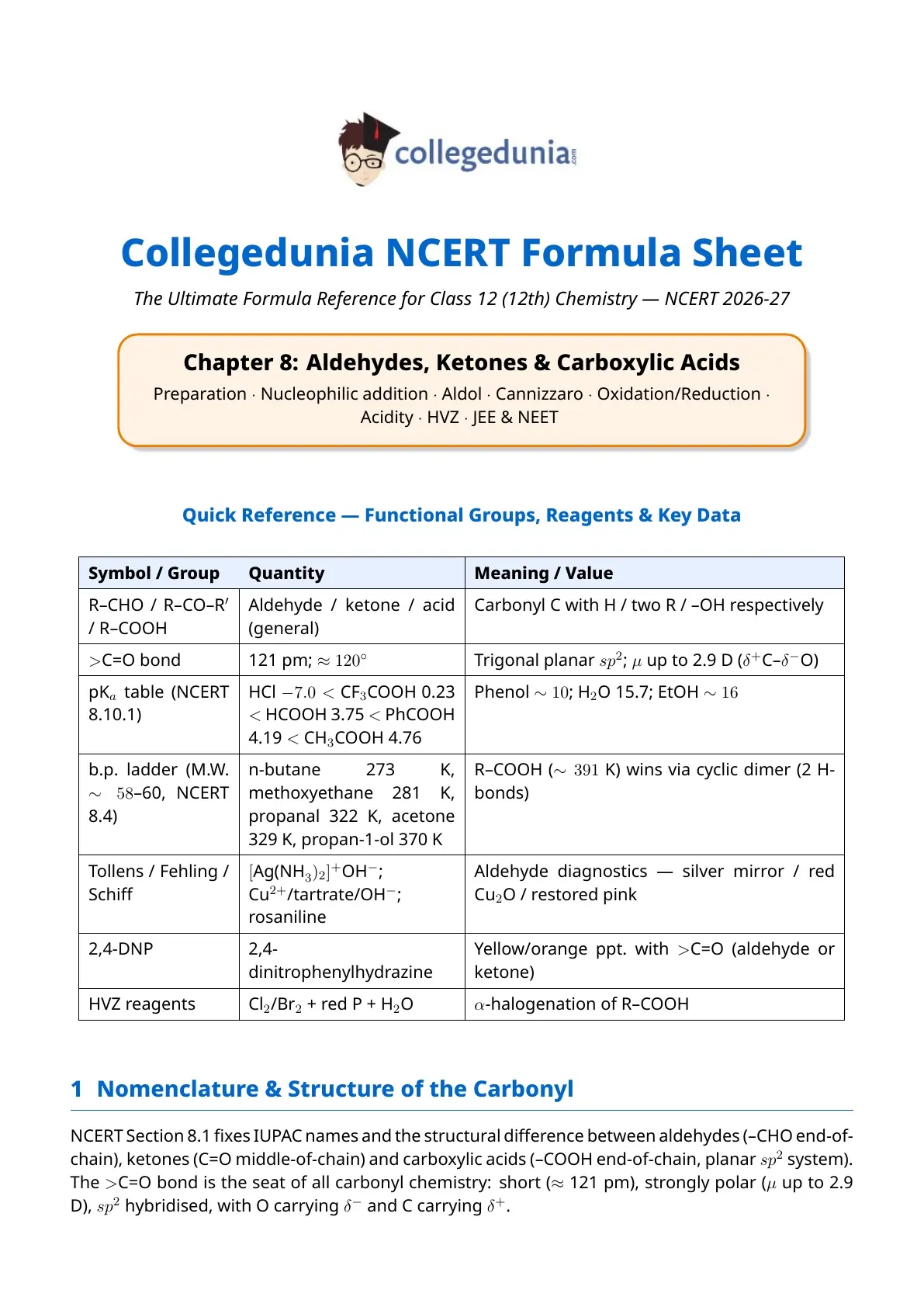
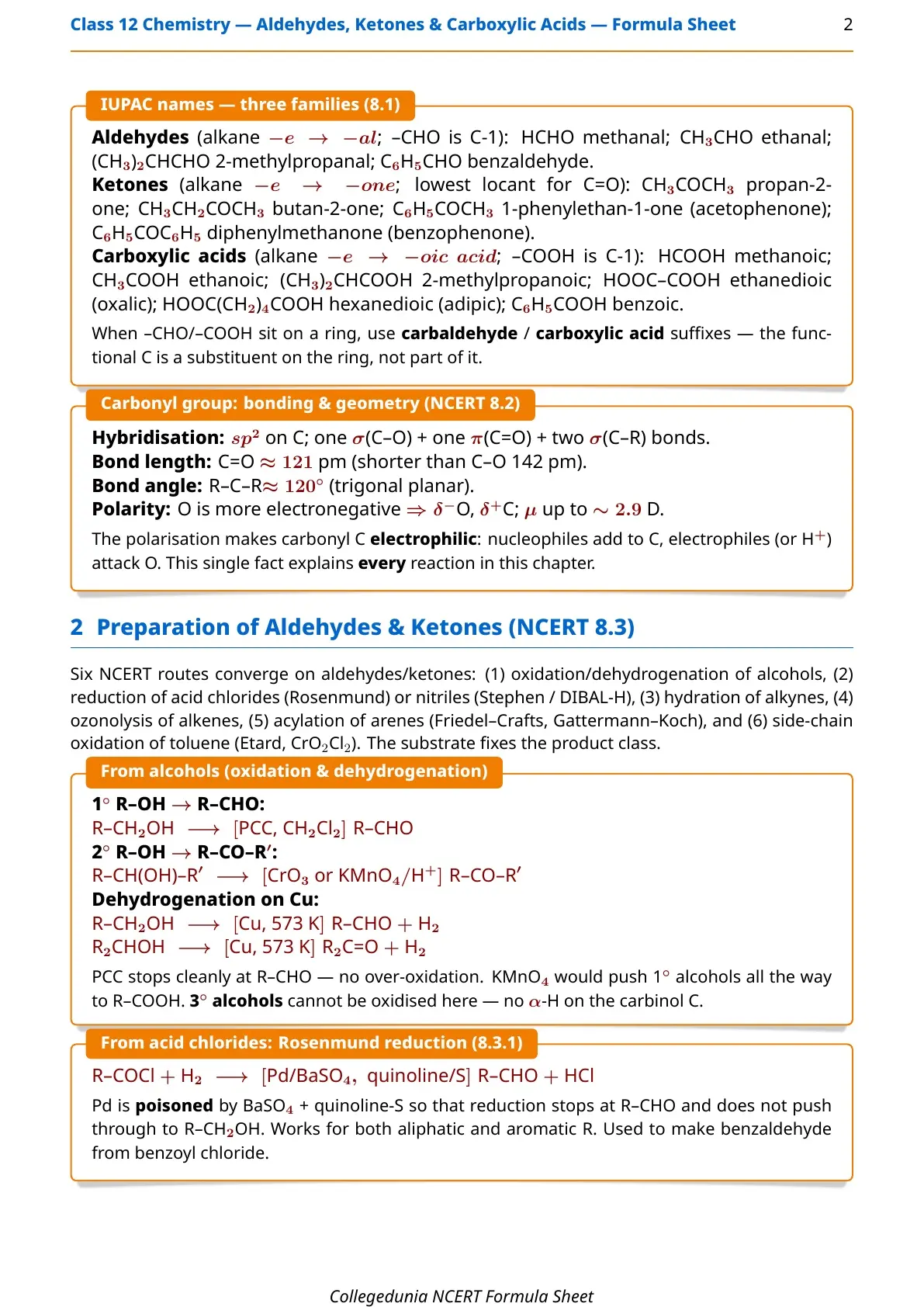
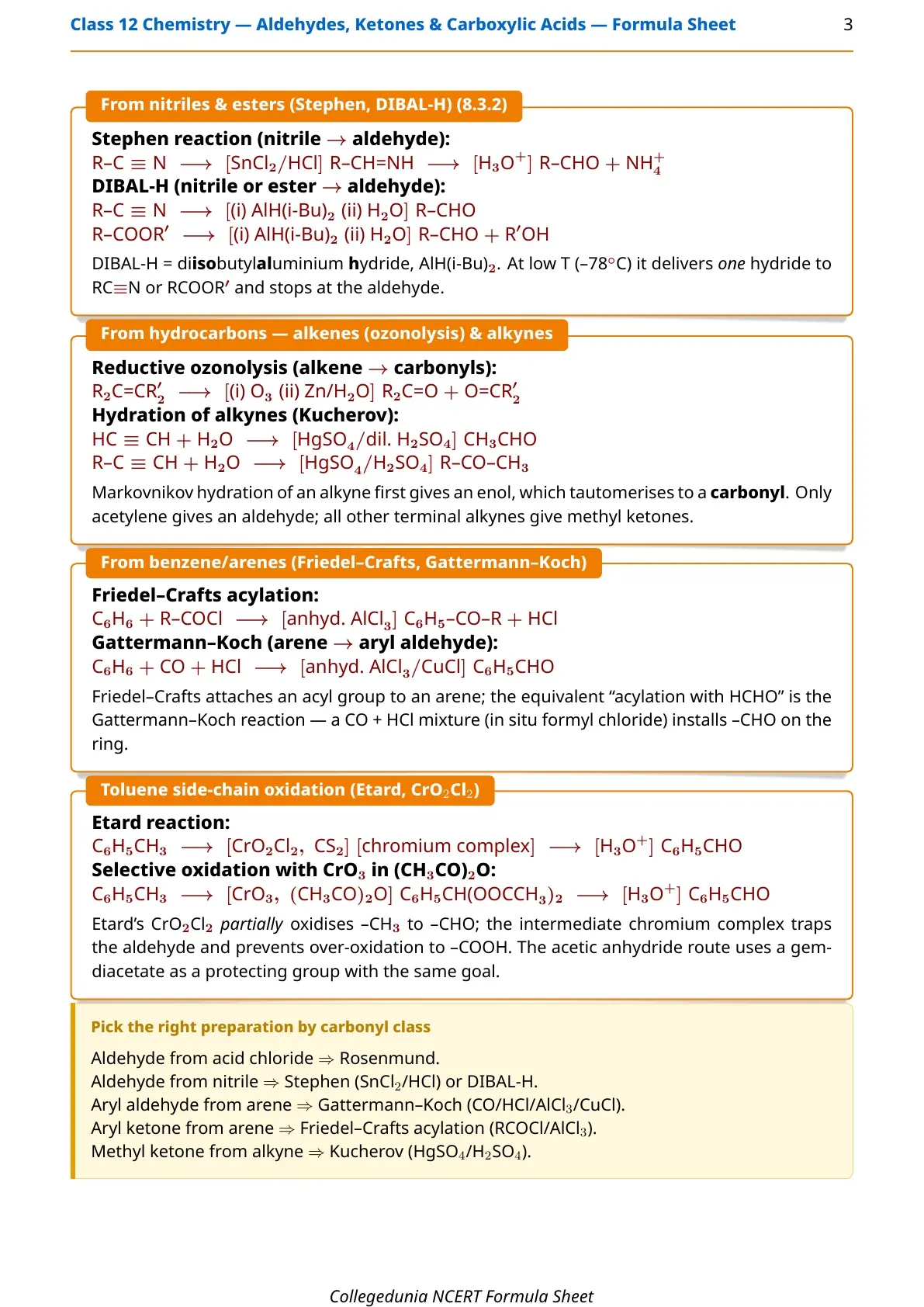
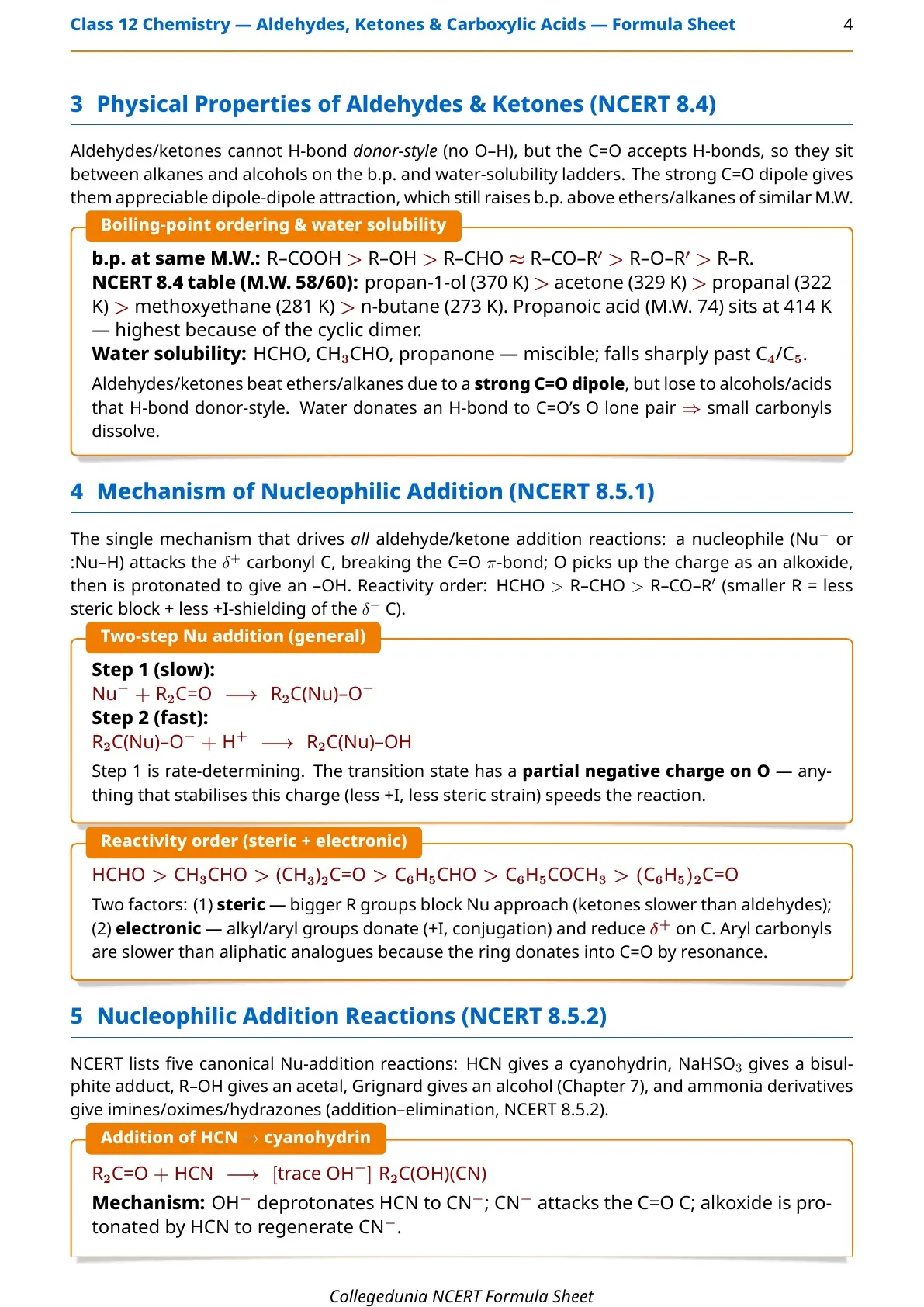
The Formula Sheet for Class 12 Chemistry Chapter 8 Aldehydes, Ketones and Carboxylic Acids covers around 47 named reactions and reagent-product relations across NCERT Sections 8.1 to 8.9.
- CBSE Weightage: 5 to 7 marks
- JEE Main Weightage: 3 to 4 percent (3 to 4 questions per paper)
- NEET Weightage: 2 to 3 questions per year
Also Check:
- Aldehydes, Ketones and Carboxylic Acids Class 12 Chemistry Notes
- Aldehydes, Ketones and Carboxylic Acids Class 12 Chemistry NCERT Solutions
- CBSE Class 12 Chemistry Syllabus 2026-27
Aldehydes, Ketones and Carboxylic Acids Symbol and Notation Glossary for 12th Chemistry
This glossary locks in the notation used in the master table. Half of the 1-mark CBSE slips on Chapter 8 come from confusing R-CHO with R-CO-R'.
| Symbol | Meaning | Typical Unit / Note |
|---|---|---|
| R-CHO | Aldehyde (-CHO on terminal sp2 C) | - |
| R-CO-R' | Ketone (C=O between two C) | R = R' symmetrical; R ≠ R' unsymmetrical |
| R-COOH | Carboxylic acid (-COOH = -C(=O)-OH) | pKa ~ 4 to 5 |
| R-COX | Acyl halide (X = Cl, Br) | Most reactive acyl derivative |
| α-C / α-H | Carbon / hydrogen next to C=O | Key for aldol, HVZ, haloform tests |
| Ar-CHO | Aromatic aldehyde (e.g. C6H5-CHO) | No α-H if -CHO sits on ring |
| 2,4-DNP | 2,4-Dinitrophenylhydrazine (Brady's reagent) | Detects C=O group (orange / red ppt) |
Aldehydes, Ketones and Carboxylic Acids Class 12 Chemistry Explained
Source: Magnet Brains on YouTube
Aldehydes, Ketones and Carboxylic Acids All Important Formulae and Reactions for Class 12 Chemistry
This master table lists the core formulae, named reactions, and reagents of NCERT Chapter 8. All entries are retained in the 2026-27 syllabus.
| Reaction / Concept | Formula & Reagents | NCERT Ref |
|---|---|---|
| General formulae | R-CHO ; R-CO-R' ; R-COOH | 8.1, 8.6 |
| -CHO from 1° alcohol | R-CH2OH → R-CHO, PCC | 8.2 |
| Ketone from 2° alcohol | R-CHOH-R' → R-CO-R', K2Cr2O7 | 8.2 |
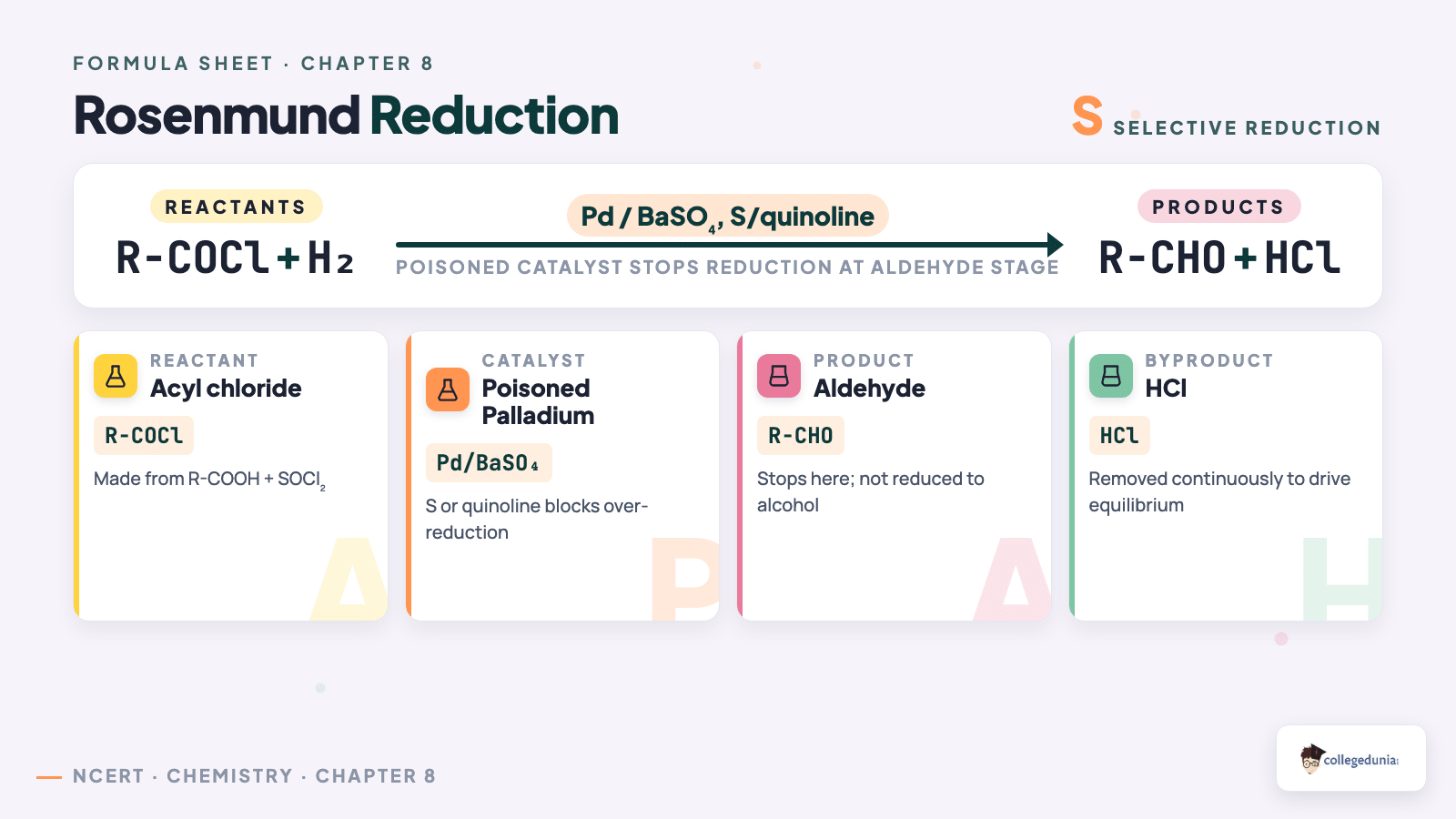
| Rosenmund | R-COCl + H2 → R-CHO, Pd/BaSO4 poisoned | 8.2 |
| Stephen | R-CN → R-CHO, SnCl2/HCl, H3O+ | 8.2 |
| DIBAL-H | R-COOR' or R-CN → R-CHO, -78°C | 8.2 |
| Gatterman-Koch | C6H6 + CO + HCl → C6H5-CHO, AlCl3/CuCl | 8.2 |
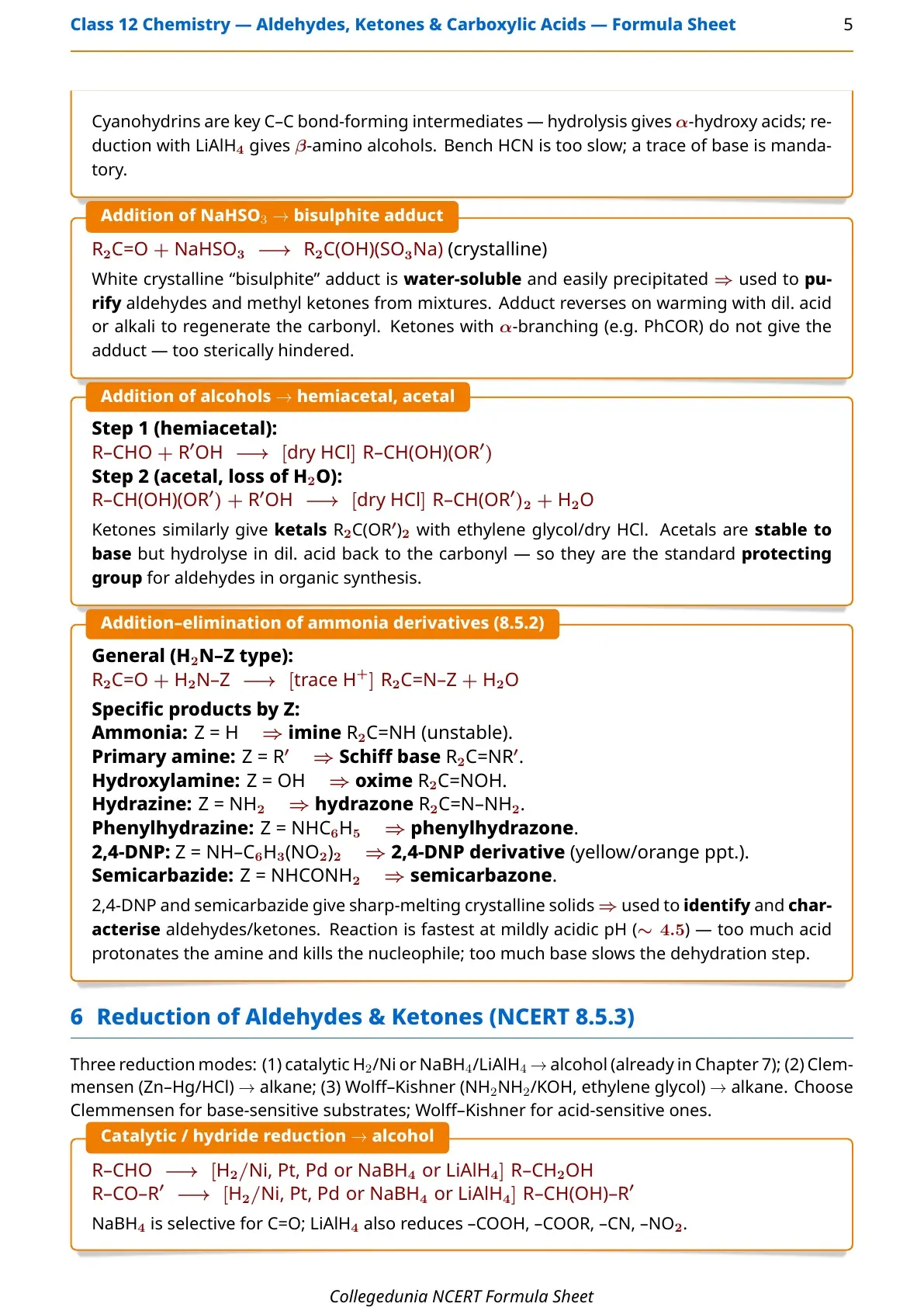
| Addition of HCN | R-CHO + HCN → R-CH(OH)-CN | 8.4 |
| Grignard | R-CHO + R'-MgX → 2° alcohol (HCHO→1°, R2CO→3°) | 8.4 |
| Reduction to alcohol | R-CO-R' → R-CHOH-R', NaBH4/LiAlH4 | 8.5 |
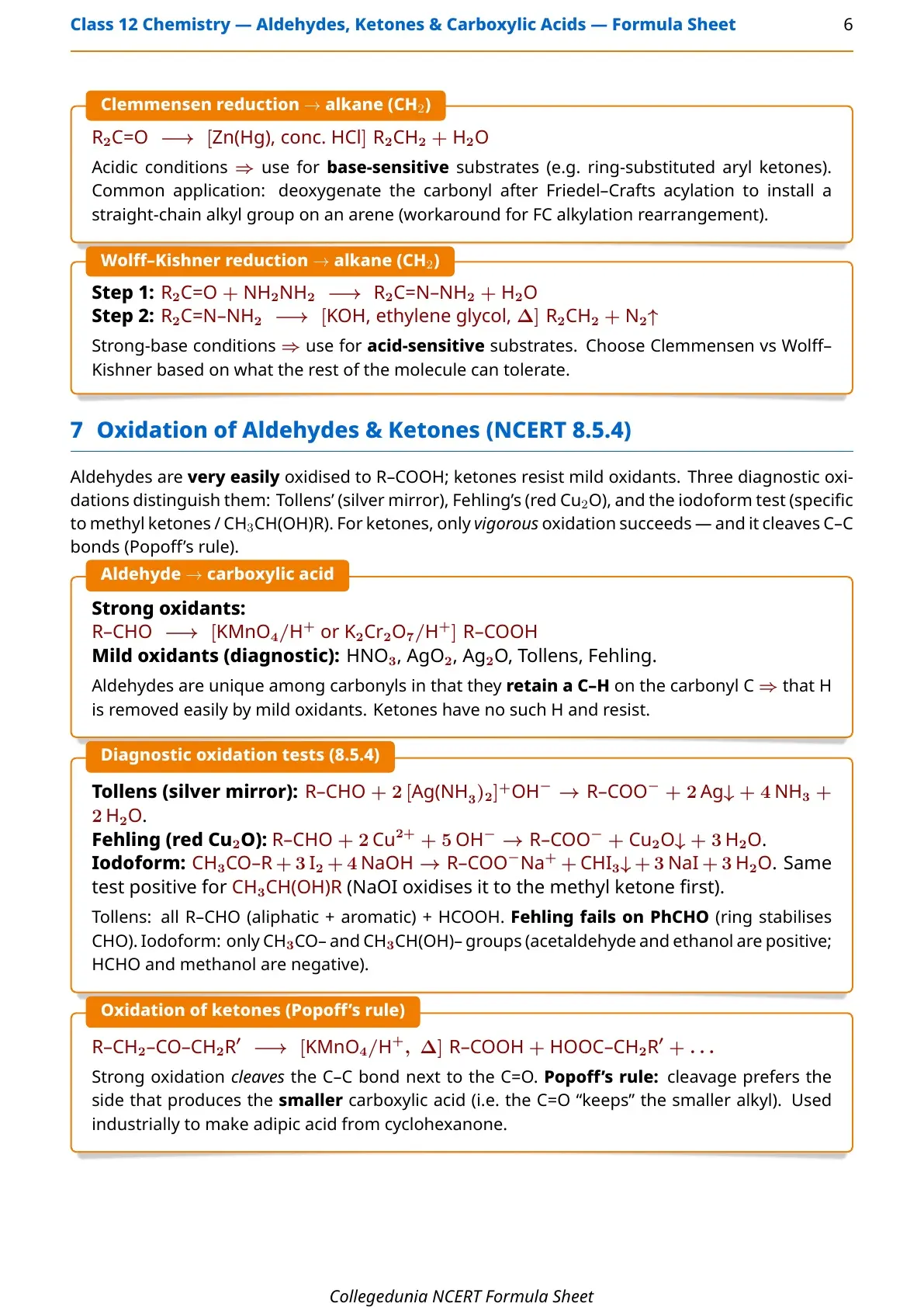
| Clemmensen (acidic) | R-CO-R' → R-CH2-R', Zn(Hg)/HCl | 8.5 |
| Wolff-Kishner (basic) | R-CO-R' → R-CH2-R', NH2NH2/KOH | 8.5 |
| Tollens | R-CHO + [Ag(NH3)2]+ → Ag↓ mirror | 8.5 |
| Fehling | R-CHO + Cu2+ → Cu2O↓ (aliphatic only) | 8.5 |
| Iodoform | CH3-CO-R + I2/NaOH → CHI3↓ | 8.5 |
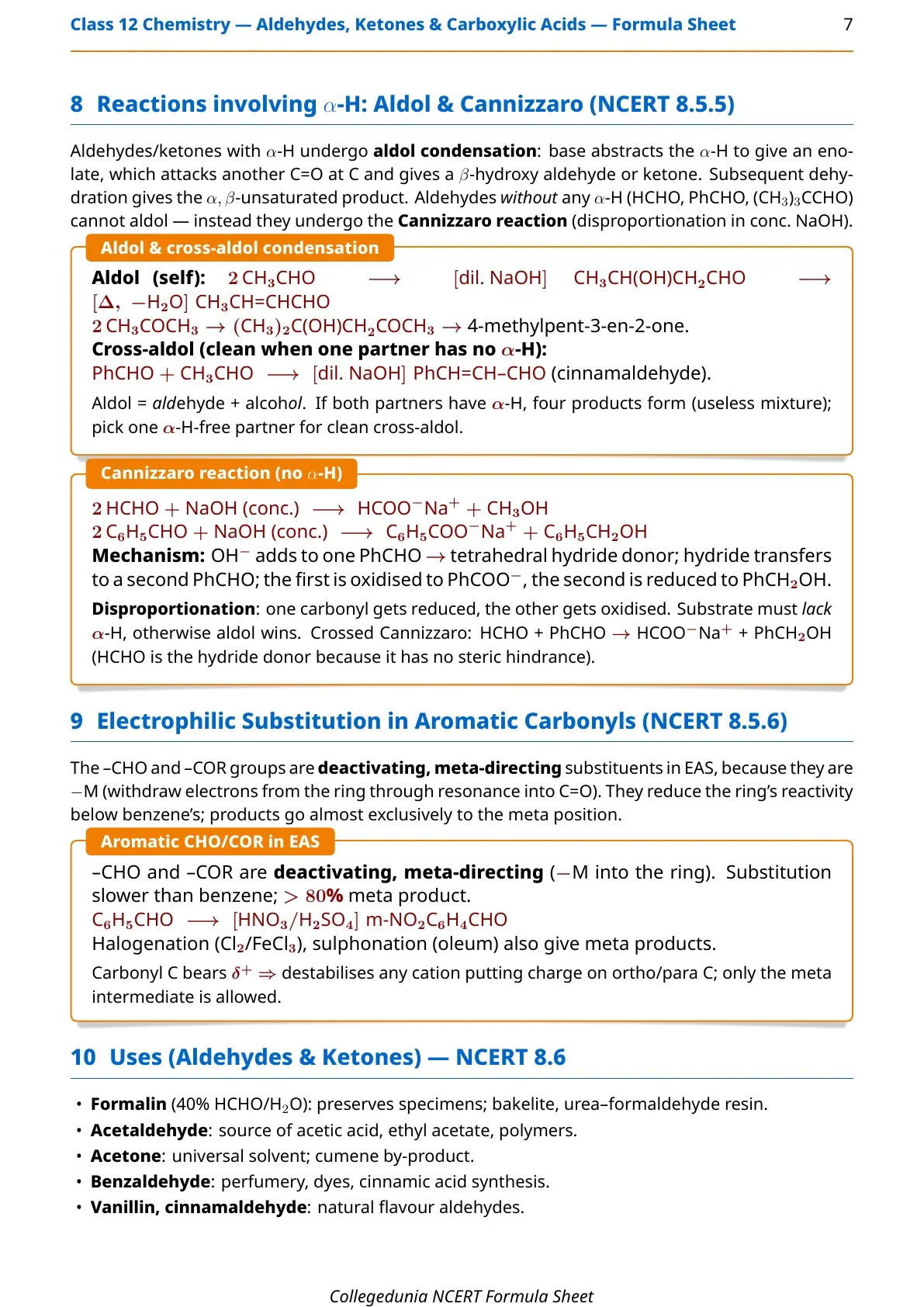
| Aldol condensation | 2 R-CH2-CHO → α,β-unsat. aldehyde (needs α-H) | 8.5 |
| Cannizzaro | 2HCHO → CH3OH + HCOO- (no α-H) | 8.5 |
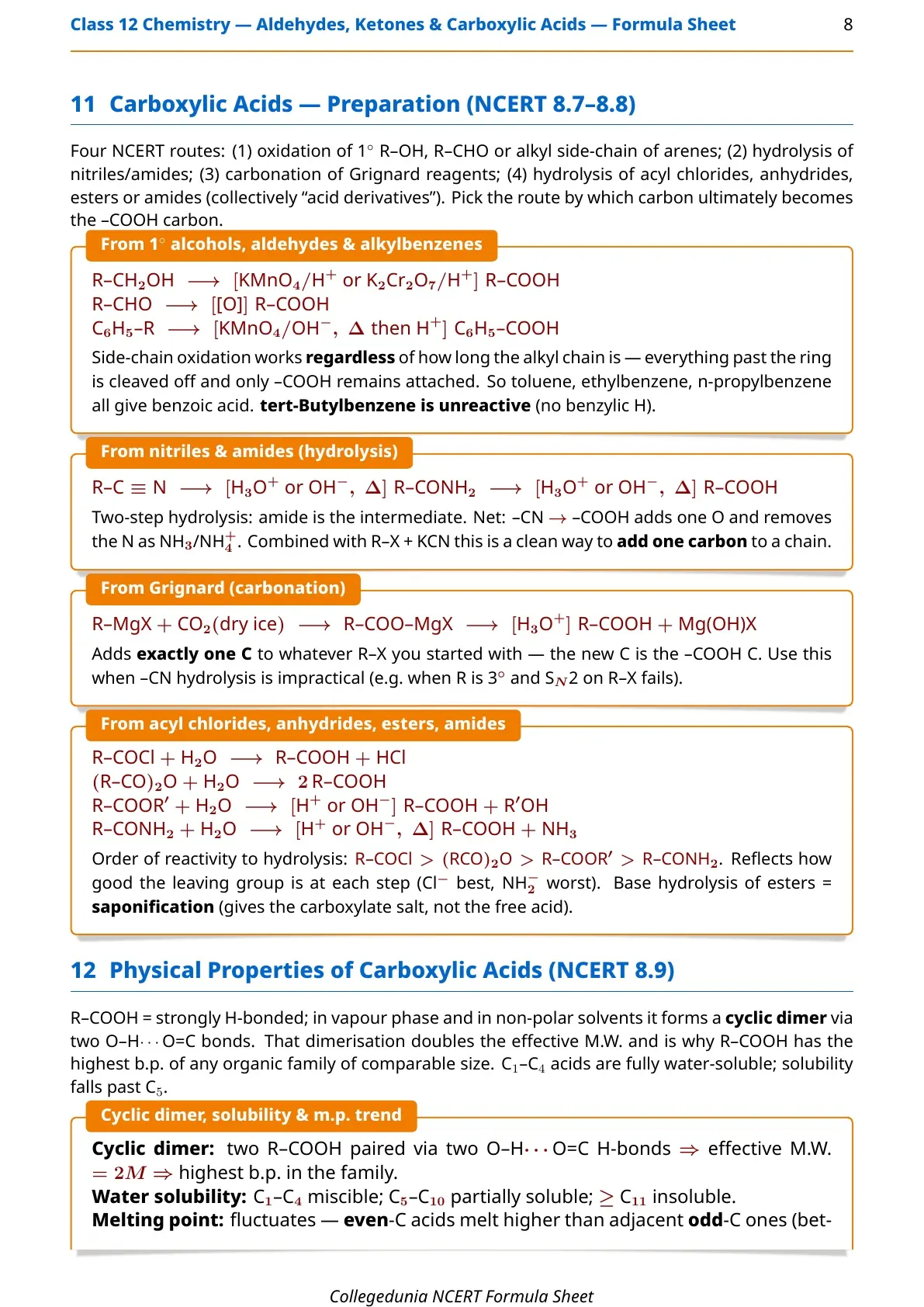
| Acid from Grignard + CO2 | R-MgX + CO2 → R-COOH (adds 1 C) | 8.7 |
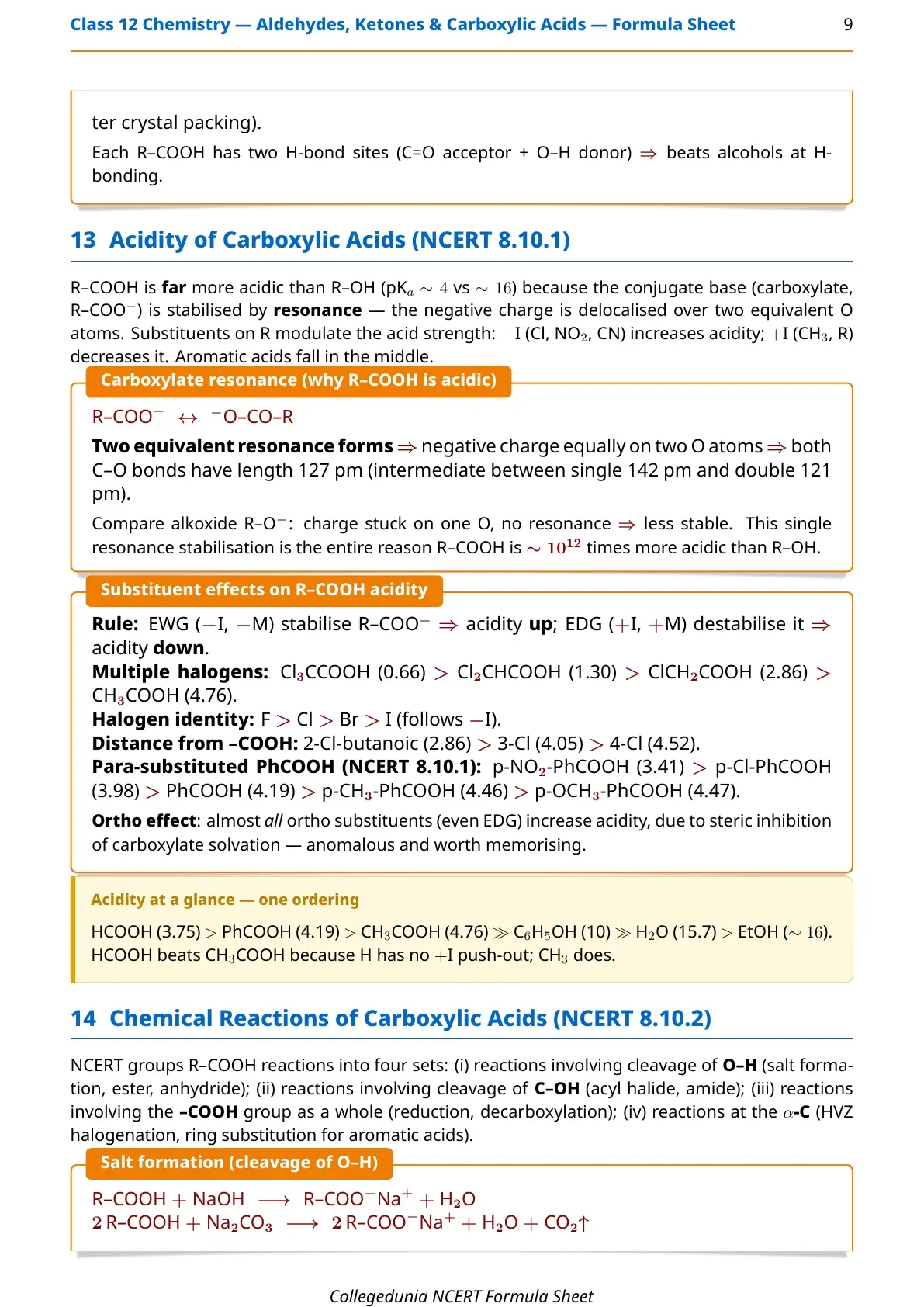
| Acidity & substituents | HCOOH > CH3COOH; EWG raises, EDG lowers | 8.8 |
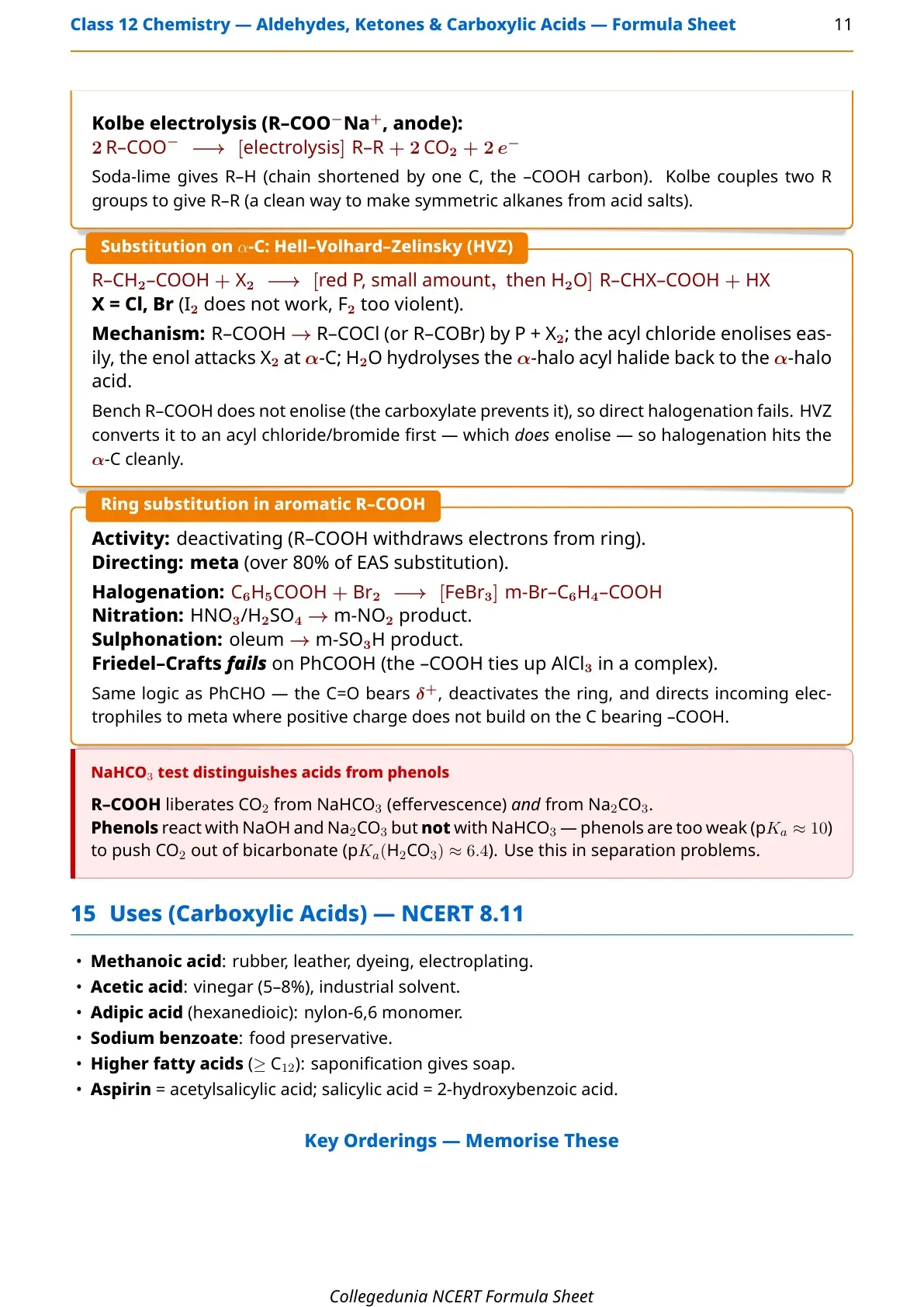
| NaHCO3 test | R-COOH + NaHCO3 → CO2↑ (vs phenol) | 8.8 |
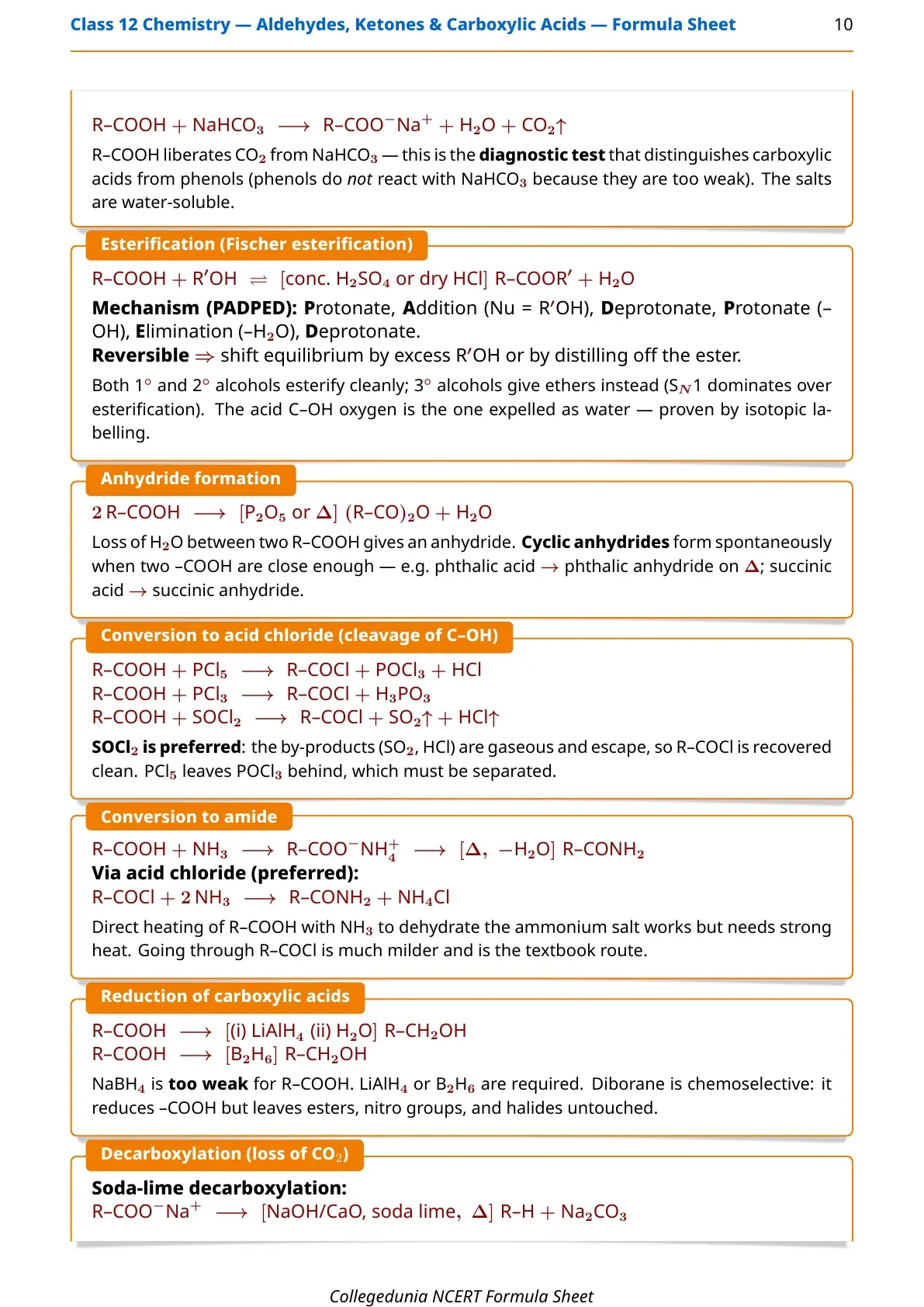
| Esterification | R-COOH + R'-OH → R-COOR', conc. H2SO4 | 8.8 |
| Acid to acyl chloride | R-COOH + SOCl2 → R-COCl | 8.8 |
| Reduction of R-COOH | R-COOH → R-CH2OH, LiAlH4 (not NaBH4) | 8.8 |
| Decarboxylation | R-COONa + NaOH → R-H, CaO/Δ | 8.8 |
| HVZ | R-CH2-COOH + X2/red P → R-CHX-COOH | 8.8 |
How Collegedunia's Aldehydes, Ketones and Carboxylic Acids Formula Sheet Helps You
The sheet is built for a 25 to 30 minute final-night revision pass.
- 2026-27 aligned: matches the current print of Sections 8.1 to 8.9.
- Named-reaction tagged: Rosenmund, Stephen, Clemmensen, Wolff-Kishner, Aldol, Cannizzaro, HVZ, Tollens.
- Expert-verified: checked against the last five CBSE, JEE Main, and NEET papers.
Acidity and Reactivity Reference Table for Aldehydes, Ketones and Carboxylic Acids
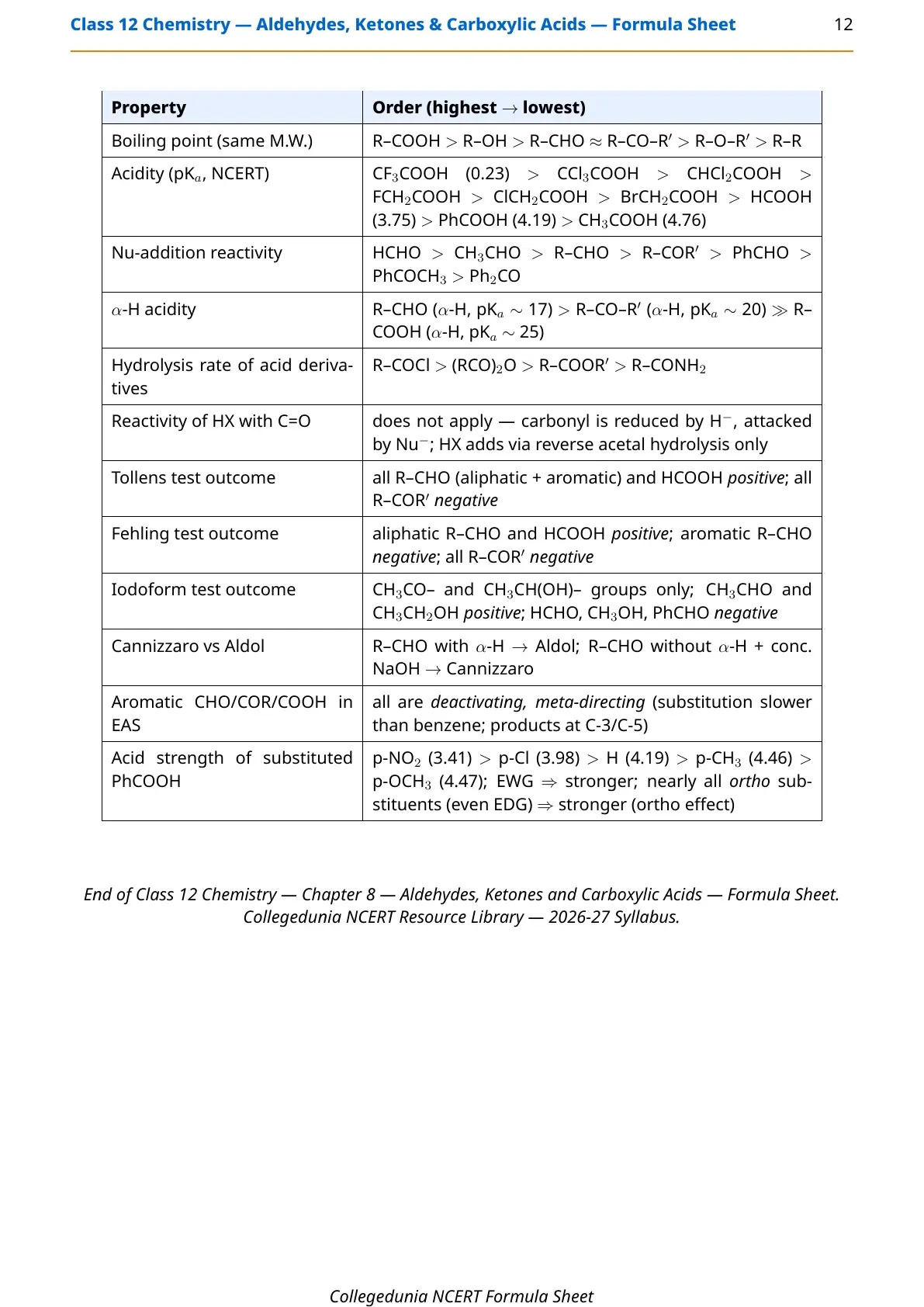
These trends power most of the 1-mark MCQs on Chapter 8.
| Compound | Structure | pKa / Reactivity Index | Boiling Point | Key Note |
|---|---|---|---|---|
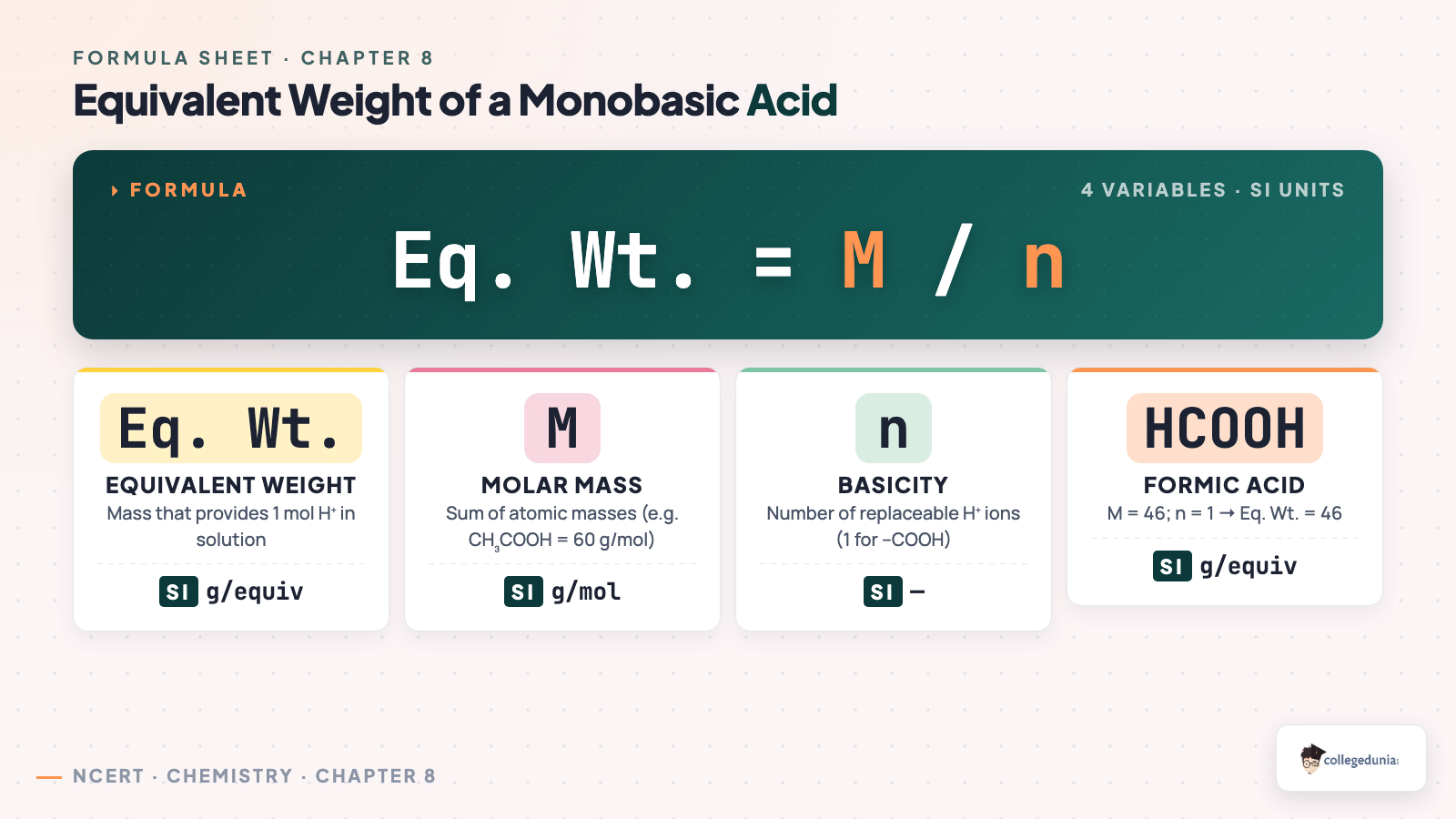
| Formic acid | HCOOH | pKa ~ 3.75 | 374 K | Strongest aliphatic carboxylic acid |
| Acetic acid | CH3-COOH | pKa ~ 4.76 | 391 K | Reference for substituent effects |
| Chloroacetic acid | Cl-CH2-COOH | pKa ~ 2.86 | 462 K | -Cl (-I) raises acidity ~80x |
| Benzoic acid | C6H5-COOH | pKa ~ 4.20 | 523 K (sublimes) | Stronger than acetic (ring is -I) |
| Acetaldehyde | CH3-CHO | most reactive to Nu addition | 294 K | R-CHO > R-CO-R' (steric + electronic) |
| Acetone | CH3-CO-CH3 | less reactive than -CHO | 329 K | Two +I alkyl lower C=O electrophilicity |
Aldehydes, Ketones and Carboxylic Acids Quick-Fact Cards for MCQ Recall
These four facts are the ones JEE Main and NEET rotate as 1-mark MCQs.
One-Shot Revision Tips for Class 12th Chemistry Aldehydes, Ketones and Carboxylic Acids
- 2,4-DNP: orange/red ppt with any carbonyl; then run Tollens to pick out -CHO.
- Schiff's reagent: pink with -CHO; ketones do not respond.
- Acetone: gives iodoform (methyl ketone) but not Tollens or Fehling.
- Decarboxylation: needs the sodium salt with soda lime (NaOH/CaO), not the free acid.
Aldehydes, Ketones and Carboxylic Acids Weightage Compared Across Class 12 Chemistry Chapters
Typical CBSE marks across the 10 chapters of the 2026-27 NCERT. This chapter sits in the upper tier.
Related Links:
- Alcohols, Phenols and Ethers Class 12 Chemistry Formula Sheet (Previous Chapter)
- Amines Class 12 Chemistry Formula Sheet (Next Chapter)
Student Feedback
In a Collegedunia poll of 900 Class 12 students, 78% said the named-reaction and distinguishing-test rows of this sheet were the fastest way to revise Chapter 8 the night before Chemistry.
Other Resources for Aldehydes, Ketones and Carboxylic Acids Class 12 Chemistry
- Aldehydes, Ketones and Carboxylic Acids Class 12 Chemistry Formula Sheet
- Aldehydes, Ketones and Carboxylic Acids Class 12 Chemistry NCERT Solutions
- Aldehydes, Ketones and Carboxylic Acids Class 12 Chemistry Notes
- Aldehydes, Ketones and Carboxylic Acids Class 12 Chemistry NCERT Book PDF
- Aldehydes, Ketones and Carboxylic Acids Class 12 Chemistry NCERT Exemplar Book PDF
- Aldehydes, Ketones and Carboxylic Acids Class 12 Chemistry NCERT Exemplar Solutions
- Aldehydes, Ketones and Carboxylic Acids Class 12 Chemistry Handwritten Notes
NCERT Formula Sheet for Class 12 Chemistry: All Chapters
Jump to the formula sheet for any other chapter of Class 12 Chemistry below.
| Chapter | Resource |
|---|---|
| Chapter 1 | Solutions Formula Sheet |
| Chapter 2 | Electrochemistry Formula Sheet |
| Chapter 3 | Chemical Kinetics Formula Sheet |
| Chapter 4 | d- and f-Block Elements Formula Sheet |
| Chapter 5 | Coordination Compounds Formula Sheet |
| Chapter 6 | Haloalkanes and Haloarenes Formula Sheet |
| Chapter 7 | Alcohols, Phenols and Ethers Formula Sheet |
| Chapter 9 | Amines Formula Sheet |
| Chapter 10 | Biomolecules Formula Sheet |
Aldehydes, Ketones and Carboxylic Acids Class 12 Chemistry Formula Sheet FAQs
Ques. Where can I download the Aldehydes, Ketones and Carboxylic Acids Class 12 Chemistry Formula Sheet PDF?
Ans. You can download the Aldehydes, Ketones and Carboxylic Acids Class 12 Chemistry Formula Sheet PDF directly from this Collegedunia page. Both the Normal and HD versions are available and free of cost.
Ques. Is this Formula Sheet aligned with the 2026-27 NCERT?
Ans. Yes. This page reflects the current 2026-27 syllabus for Class 12 Chemistry. Aldehydes, Ketones and Carboxylic Acids is fully retained in the new edition with no formula cuts; every relation in Sections 8.1 to 8.9 of the NCERT remains examinable.
Ques. How many pages is the Class 12th Chemistry Aldehydes, Ketones and Carboxylic Acids Formula Sheet PDF?
Ans. The Formula Sheet PDF runs approximately 9 pages and covers the master reaction table, symbol glossary, acidity / reactivity reference, quick-fact MCQ cards, and four common numerical pattern templates.
Ques. What is the difference between Clemmensen and Wolff-Kishner reduction?
Ans. Both reduce a C=O group to CH2. Clemmensen uses Zn-Hg amalgam with concentrated HCl (acidic medium) and is the right choice when the substrate is acid-stable but base-sensitive. Wolff-Kishner uses hydrazine (H2N-NH2) with KOH in ethylene glycol (basic medium) and is used when the substrate is base-stable but acid-sensitive. The choice is always dictated by the rest of the molecule's tolerance, not by personal preference.
Ques. Why does benzaldehyde not undergo aldol condensation?
Ans. Aldol condensation requires the aldehyde or ketone to have at least one α-hydrogen (a hydrogen on the carbon next to C=O). Benzaldehyde (C6H5-CHO) has the -CHO group attached directly to the aromatic ring, so the carbon next to C=O is the sp2 ring carbon with no α-H to deprotonate. Instead, with concentrated NaOH, benzaldehyde undergoes the Cannizzaro reaction, a self redox where one molecule is oxidised to benzoic acid and another is reduced to benzyl alcohol.
Ques. Which acid is stronger, formic acid or acetic acid, and why?
Ans. Formic acid (HCOOH, pKa 3.75) is stronger than acetic acid (CH3-COOH, pKa 4.76). The methyl group in acetic acid is electron-donating (+I effect), which destabilises the carboxylate anion (CH3-COO-) by pushing extra electron density onto the negative oxygen. Formic acid has only -H next to -COOH, so the formate anion (HCOO-) is not destabilised and the acid ionises more easily.
Ques. What is the Hell-Volhard-Zelinsky (HVZ) reaction?
Ans. The HVZ reaction is the α-halogenation of an aliphatic carboxylic acid. The acid is treated with a halogen (Cl2 or Br2) in the presence of a small amount of red phosphorus as a catalyst, followed by aqueous work-up. The product is the α-halocarboxylic acid (R-CHX-COOH), which is a precursor for α-hydroxy acids and α-amino acids. The reaction requires at least one α-hydrogen and so does not work on formic acid (HCOOH) or pivalic acid ((CH3)3C-COOH).
Ques. Why does NaBH4 not reduce carboxylic acids?
Ans. NaBH4 is a mild hydride donor. The C=O carbon of a carboxylic acid is less electrophilic than the C=O of an aldehyde or ketone because the -OH lone pair donates into the carbonyl by resonance, reducing its electrophilicity. NaBH4 can transfer hydride only to the more electrophilic carbonyls of -CHO and -CO-. For -COOH reduction you need stronger reductants like LiAlH4 or B2H6 (diborane), with B2H6 preferred when -NO2, -CN, or ester groups must be left untouched.
Ques. How are hemiacetals and acetals formed from aldehydes?
Ans. A hemiacetal forms when an aldehyde reacts with one equivalent of alcohol under acid catalysis: R-CHO + R'OH gives R-CH(OH)-OR'. A second R'OH replaces the -OH to give an acetal R-CH(OR')2, with water as the leaving group. Acetals are stable to base but hydrolyse in acid, so they are widely used as a protecting group for the carbonyl in multi-step synthesis. Ketones form similar ketals under more forcing conditions.
Ques. What is the Kolbe electrolysis and how does it differ from soda-lime decarboxylation?
Ans. Kolbe electrolysis passes electric current through a concentrated solution of a sodium carboxylate (RCOO-Na+). At the anode, the carboxylate loses an electron, releases CO2, and the resulting R. radicals couple to give R-R (a symmetric alkane). Soda-lime decarboxylation is a thermal pathway: RCOO-Na+ heated with NaOH / CaO gives R-H plus Na2CO3. Kolbe forms a new C-C bond; soda-lime simply removes one carbon as carbonate.
Ques. What is a Schiff base and how is the 2,4-DNP test used?
Ans. A Schiff base is an imine of the form R-CH=N-R' formed when an aldehyde reacts with a primary amine, losing water from the carbinolamine intermediate. The 2,4-DNP (Brady's reagent) test uses 2,4-dinitrophenylhydrazine: any C=O group (aldehyde or ketone) gives an orange to red phenylhydrazone precipitate, confirming a carbonyl. Schiff's reagent (fuchsin-bisulphite) restores its magenta colour only with aldehydes; ketones do not respond. The 2,4-DNP + Schiff combination distinguishes "any carbonyl" from "aldehyde specifically".
Ques. How does ozonolysis fit into the Chapter 8 preparation grid?
Ans. Ozonolysis (O3 followed by Zn / H2O reductive work-up) cleaves an alkene's C=C double bond and gives two carbonyl fragments: a =CHR end yields an aldehyde and a =CR2 end yields a ketone. While ozonolysis is officially introduced in Class 11 Hydrocarbons, it feeds directly into Chapter 8 preparation routes. CBSE 2024 used ozonolysis as the opening step in a 3-mark conversion problem ending in an aldol condensation.



Comments