




Chapter 7 of the new Ganita Manjari book covers Introduction to Probability. The Class 9 Maths Formula Sheet Chapter 7 Introduction to Probability gathers the probability scale, the experimental and theoretical formulas, and the counting rules on one clean page for fast revision before a test.
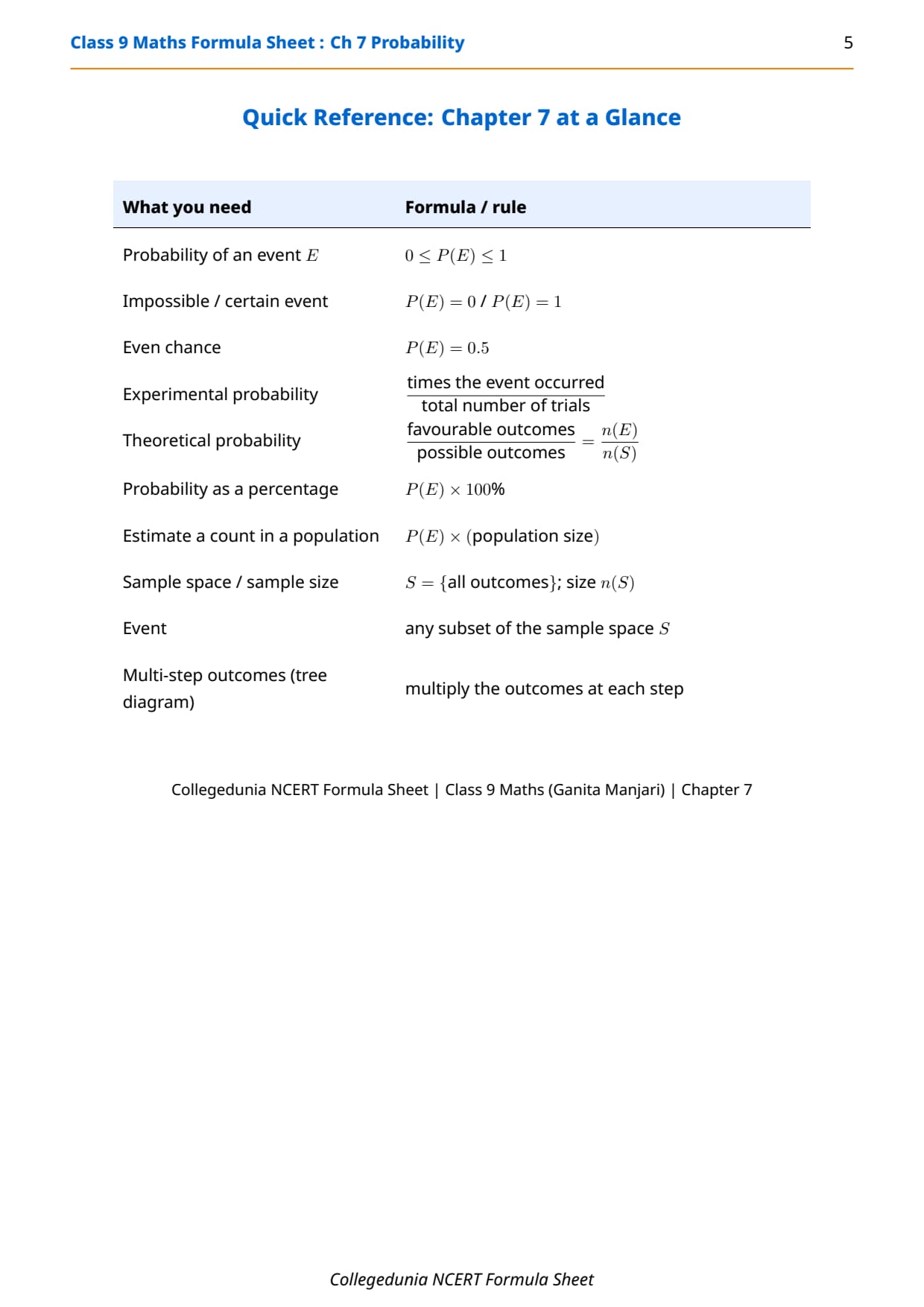
- Rules inside: about 8 key relations, from the 0 to 1 scale to the counting form of probability.
- What they cover: the probability scale, experimental and theoretical probability, sample space, and tree diagrams.
- Why one page helps: probability is more about a few rules than many formulas, so a single sheet is enough to revise fast.
This sheet is prepared by subject teachers, matched to the current 2026-27 NCERT, and checked line by line so a Class 9 student can trust every rule.
What Does the Class 9 Maths Introduction to Probability Formula Sheet Cover?
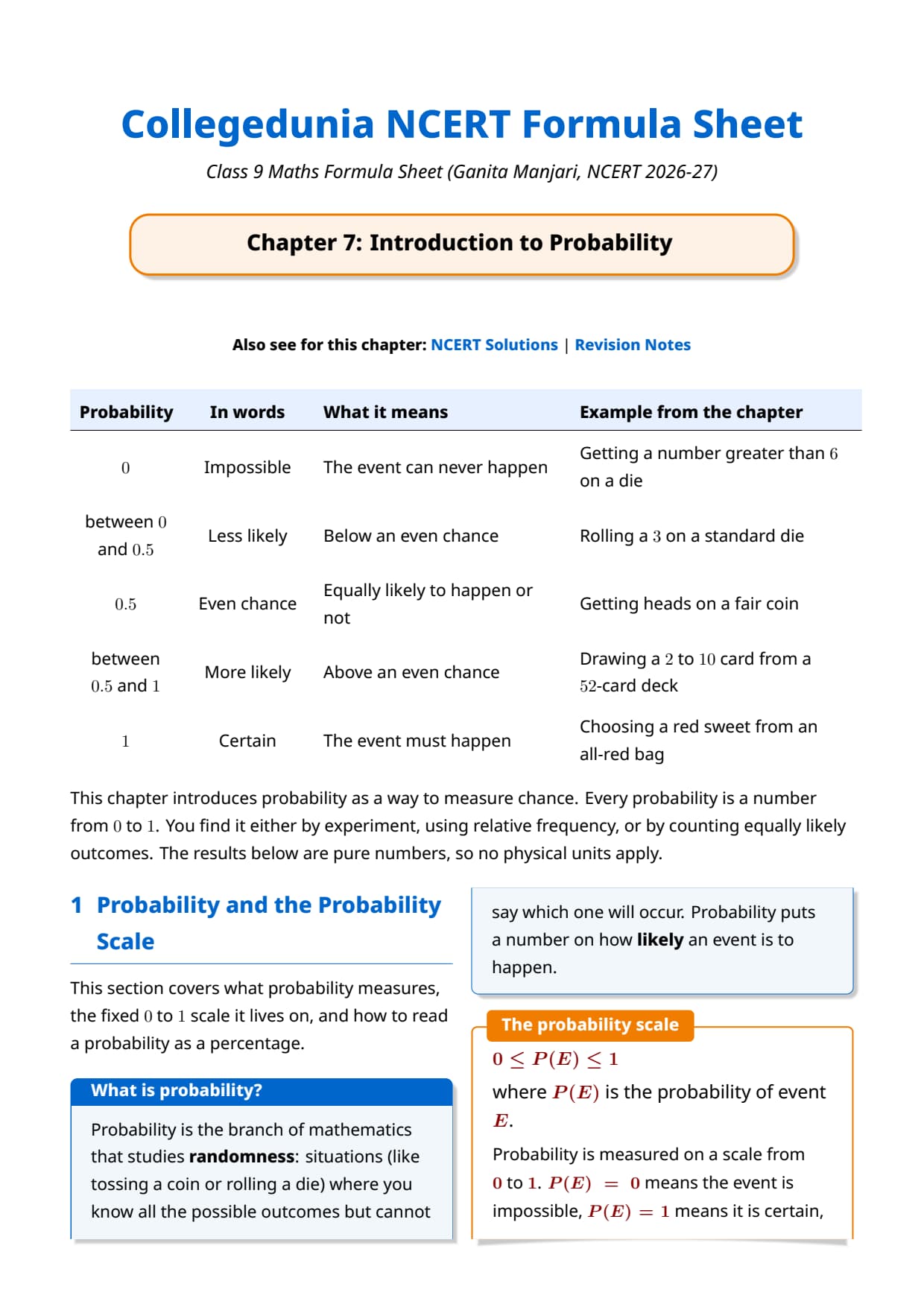
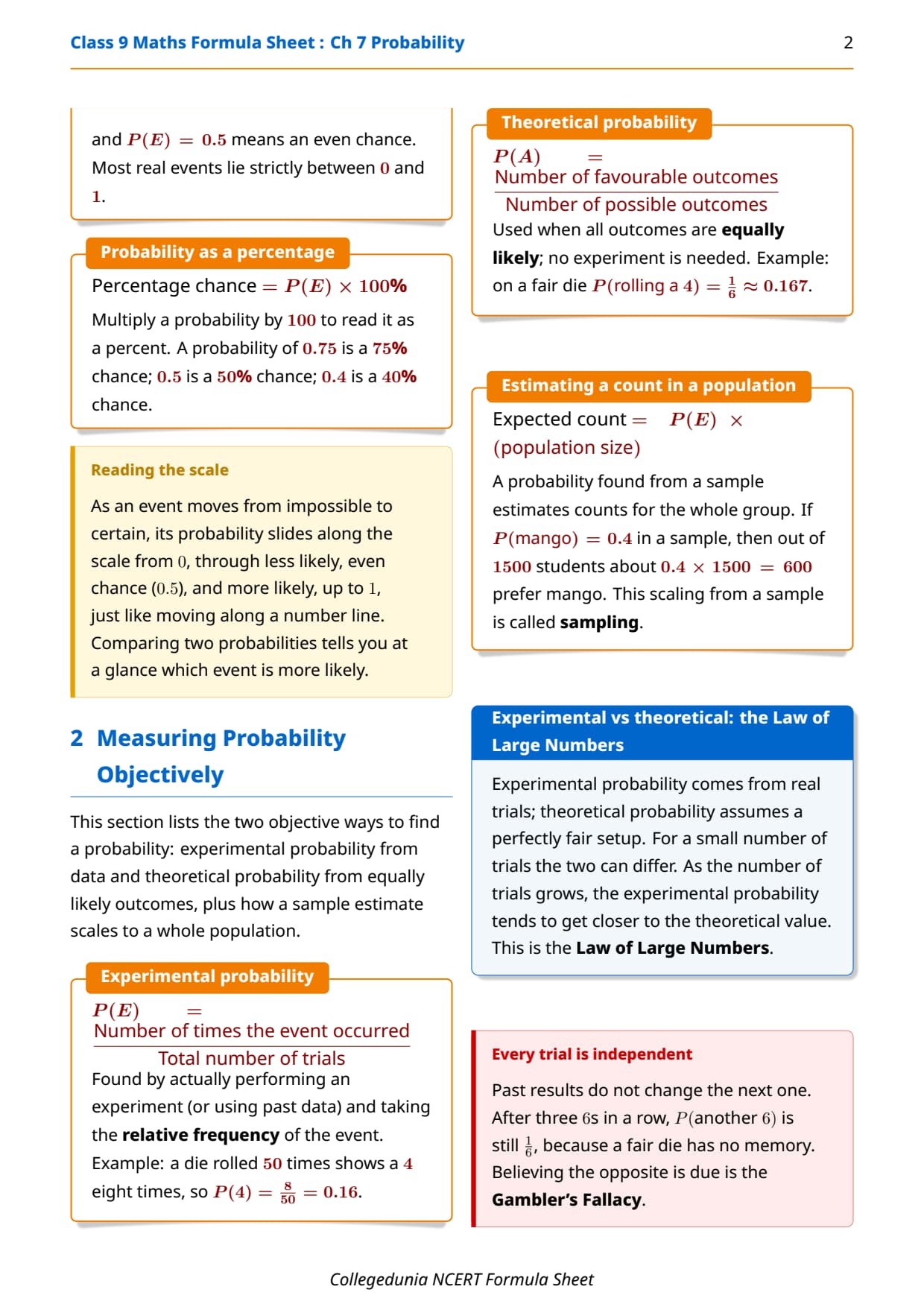
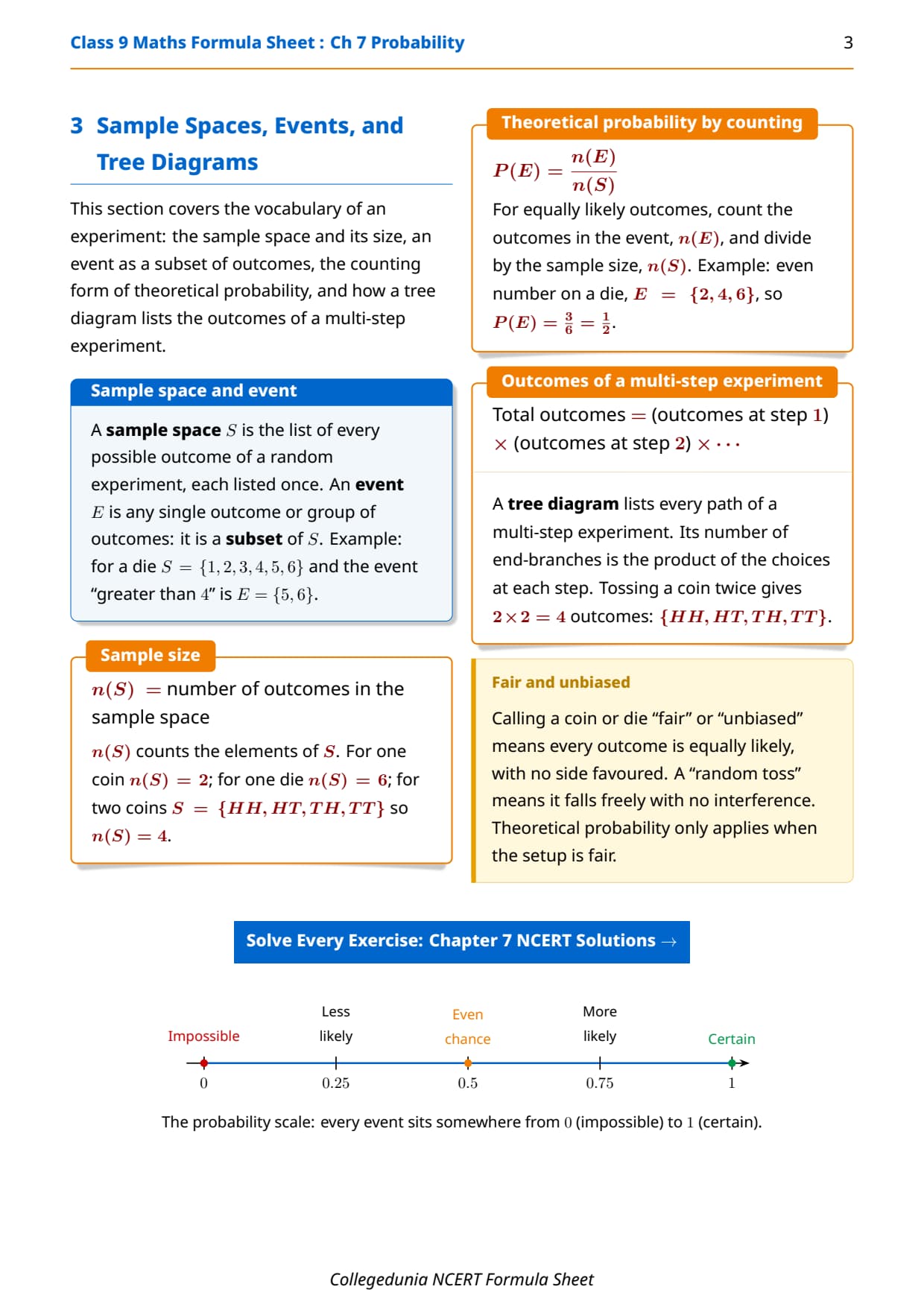
The Class 9 Maths Formula Sheet Chapter 7 Introduction to Probability covers the small but important set of rules in this chapter. You get the fixed 0 to 1 probability scale, the way to read a probability as a percentage, and the two main methods to find a probability: experimental probability from data and theoretical probability from equally likely outcomes. It also lists the counting form P(E)=n(E)n(S), the idea of a sample space and event, and how a tree diagram counts the outcomes of a multi-step experiment. Every rule matches the book.
Video Walkthrough
Source: Magnet Brains on YouTube
Introduction to Probability Class 9 Maths All Formulas at a Glance
Probability has more rules than heavy formulas. The table below lists each one for Chapter 7, with a short line on what it means.
| Concept | Formula | What it means |
|---|---|---|
| The probability scale | 0 ≤ P(E) ≤ 1 | Every probability is a number from 0 to 1. |
| Impossible / certain event | P(E)=0 / P(E)=1 | 0 can never happen; 1 must happen. |
| Even chance | P(E)=0.5 | Equally likely to happen or not, like a fair coin. |
| Experimental probability | P(E)=times the event occurredtotal number of trials | Found from real trials or past data. |
| Theoretical probability | P(A)=favourable outcomespossible outcomes | Used when all outcomes are equally likely. |
| Probability by counting | P(E)=n(E)n(S) | Event outcomes over sample size n(S). |
| Probability as a percentage | P(E) × 100% | A probability of 0.75 is a 75% chance. |
| Estimate a count in a group | P(E) × (population size) | A sample probability estimates the whole group. |
| Multi-step outcomes | step1 × step2 × ⋯ | A tree diagram multiplies the choices at each step. |
When to Use Which Rule in Introduction to Probability
Pick the right rule by reading how the question gives its information. This short list keeps the choice quick.
- If a coin or die is fair and you can list outcomes, use P(E)=n(E)n(S).
- If you are given data from many trials, use experimental probability.
- If a probability is asked as a percent, multiply by 100.
- If a sample probability must apply to a full group, multiply by the population size.
- If an experiment has two or more steps, draw a tree diagram and multiply the choices.
- If the event can never happen, its probability is 0; if it must happen, it is 1.
Quick Facts for Introduction to Probability
The cards below hold the facts students slip on most. Keep the Class 9 Maths Formula Sheet Chapter 7 Introduction to Probability next to them while you revise, and the rules will stick faster.
How will Collegedunia's Formula Sheet Help You with Introduction to Probability?
Collegedunia builds the Class 9 Maths Formula Sheet Chapter 7 Introduction to Probability as one printable page for fast revision.
- 2026-27 Ganita Manjari match: Every rule follows the new book, not the old chapter order.
- Plain meaning added: Each rule has a short line saying what it does.
- Teacher checked: Subject experts verify the scale, the counting form, and each probability rule.
- Free PDF: Download the sheet and keep it ready for your Class 9 annual exam.
More Introduction to Probability Maths Class 9 Resources
Use the links below to open the other Collegedunia resources for this chapter.
NCERT Formula Sheet for Class 9 Maths: All Chapters
Use the table below to open the Formula Sheet for any other chapter of the new Class 9 Maths book.
| Chapter | Resource |
|---|---|
| Chapter 1 | Coordinates Formula Sheet |
| Chapter 2 | Linear Polynomials Formula Sheet |
| Chapter 3 | The World of Numbers Formula Sheet |
| Chapter 4 | Algebraic Identities Formula Sheet |
| Chapter 5 | Circles Formula Sheet |
| Chapter 6 | Perimeter and Area Formula Sheet |
| Chapter 7 | Introduction to Probability Formula Sheet |
| Chapter 8 | Sequences and Progressions Formula Sheet |
Introduction to Probability Class 9 Maths Formula Sheet FAQs
Ques. Where can I download the Introduction to Probability Class 9 Maths Formula Sheet PDF?
Ans. You can download the Introduction to Probability Class 9 Maths Formula Sheet PDF directly from this page. Both the Normal and HD versions are free.
Ques. How many formulas are in the Class 9 Maths Chapter 7 Introduction to Probability Formula Sheet?
Ans. The sheet lists about 8 rules, covering the 0 to 1 scale, experimental and theoretical probability, the counting form n(E)n(S), percentages, and tree diagrams.
Ques. Is this chapter part of the new 2026-27 Ganita Manjari book?
Ans. Yes. Introduction to Probability is Chapter 7 of the new Ganita Manjari book for the 2026-27 syllabus, and it starts probability as a measure of chance for Class 9 students.
Ques. How many pages is the Introduction to Probability Formula Sheet PDF?
Ans. The Formula Sheet PDF runs about 2 pages, with a full rules table and a quick-reference section for last-day revision.
Ques. What is the difference between experimental and theoretical probability?
Ans. Experimental probability comes from real trials, times it happenedtotal trials, while theoretical probability comes from equally likely outcomes, n(E)n(S). As trials grow, the two get closer.



Comments