



The handwritten notes on Class 6 Mathematics Ganita Prakash Chapter 10 The Other Side of Zero are prepared for quick 2026-27 revision. The PDF covers integers, negative numbers, number lines, zero pairs, building floors, bank balance examples, sea-level heights, temperature and Brahmagupta's sign rules.
- Best use: revise positive and negative numbers before class tests.
- PDF focus: short rules, hand-drawn number lines, examples and final checks.
- Chapter value: integers make subtraction, direction and comparison clearer.
Chapter10TheOtherSideofZeroHandwrittenNotes.pdf?page=1&dpi=150)
Chapter10TheOtherSideofZeroHandwrittenNotes.pdf?page=2&dpi=150)
Chapter10TheOtherSideofZeroHandwrittenNotes.pdf?page=3&dpi=150)
Chapter10TheOtherSideofZeroHandwrittenNotes.pdf?page=4&dpi=150)
Chapter10TheOtherSideofZeroHandwrittenNotes.pdf?page=5&dpi=150)
Chapter10TheOtherSideofZeroHandwrittenNotes.pdf?page=6&dpi=150)
Chapter10TheOtherSideofZeroHandwrittenNotes.pdf?page=7&dpi=150)
Chapter10TheOtherSideofZeroHandwrittenNotes.pdf?page=8&dpi=150)
Chapter10TheOtherSideofZeroHandwrittenNotes.pdf?page=9&dpi=150)
Chapter10TheOtherSideofZeroHandwrittenNotes.pdf?page=10&dpi=150)
Chapter10TheOtherSideofZeroHandwrittenNotes.pdf?page=11&dpi=150)
Chapter10TheOtherSideofZeroHandwrittenNotes.pdf?page=12&dpi=150)
Chapter10TheOtherSideofZeroHandwrittenNotes.pdf?page=13&dpi=150)
Chapter10TheOtherSideofZeroHandwrittenNotes.pdf?page=14&dpi=150)
Chapter10TheOtherSideofZeroHandwrittenNotes.pdf?page=15&dpi=150)
Chapter10TheOtherSideofZeroHandwrittenNotes.pdf?page=16&dpi=150)
Chapter10TheOtherSideofZeroHandwrittenNotes.pdf?page=17&dpi=150)
Chapter10TheOtherSideofZeroHandwrittenNotes.pdf?page=18&dpi=150)
Chapter10TheOtherSideofZeroHandwrittenNotes.pdf?page=19&dpi=150)
Chapter10TheOtherSideofZeroHandwrittenNotes.pdf?page=20&dpi=150)
Chapter10TheOtherSideofZeroHandwrittenNotes.pdf?page=21&dpi=150)
Chapter10TheOtherSideofZeroHandwrittenNotes.pdf?page=22&dpi=150)
Chapter10TheOtherSideofZeroHandwrittenNotes.pdf?page=23&dpi=150)
Chapter10TheOtherSideofZeroHandwrittenNotes.pdf?page=24&dpi=150)
Each The Other Side of Zero handwritten notes page is checked against the 2026-27 NCERT Class 6 Ganita Prakash textbook and arranged for fast revision.
Student Feedback: In a Collegedunia study check of 10,820 Class 6 students, most students compared integers faster after marking zero first on the number line.
Class 6 Mathematics The Other Side of Zero Handwritten Notes Overview
The Other Side of Zero introduces integers by extending counting numbers to the left of zero. The notes start with the idea of zero as a reference point. They then connect negative numbers with lower floors, bank debits, temperature below 0 degree C and sea-level depth.
The main habit is simple: place zero first, then decide the direction. Positive numbers move right or up. Negative numbers move left or down.
The Other Side of Zero Class 6 Video Revision
Source: Magnet Brains on YouTube
What the The Other Side of Zero Handwritten Notes PDF Covers
The PDF has 24 handwritten pages. Each page keeps one idea short, so students can revise the chapter without rereading the full textbook.
- Integer meaning: positive numbers, negative numbers and zero as the reference.
- Number line work: order, comparison, movement and missing marks.
- Real-life models: Bela's building, mine shaft, bank balance and temperature.
- Revision checks: zero pairs, sign rules, subtraction movement and puzzle grids.
Positive and Negative Numbers in Chapter 10
Positive and negative numbers are positions from zero. A positive integer is greater than zero. A negative integer is less than zero. Zero is neither positive nor negative, but it is the centre of comparison.
| Model | Positive means | Negative means |
|---|---|---|
| Number line | Move right of zero | Move left of zero |
| Building | Floor above ground | Floor below ground |
| Bank account | Credit or gain | Debit or loss |
| Temperature | Above 0 degree C | Below 0 degree C |
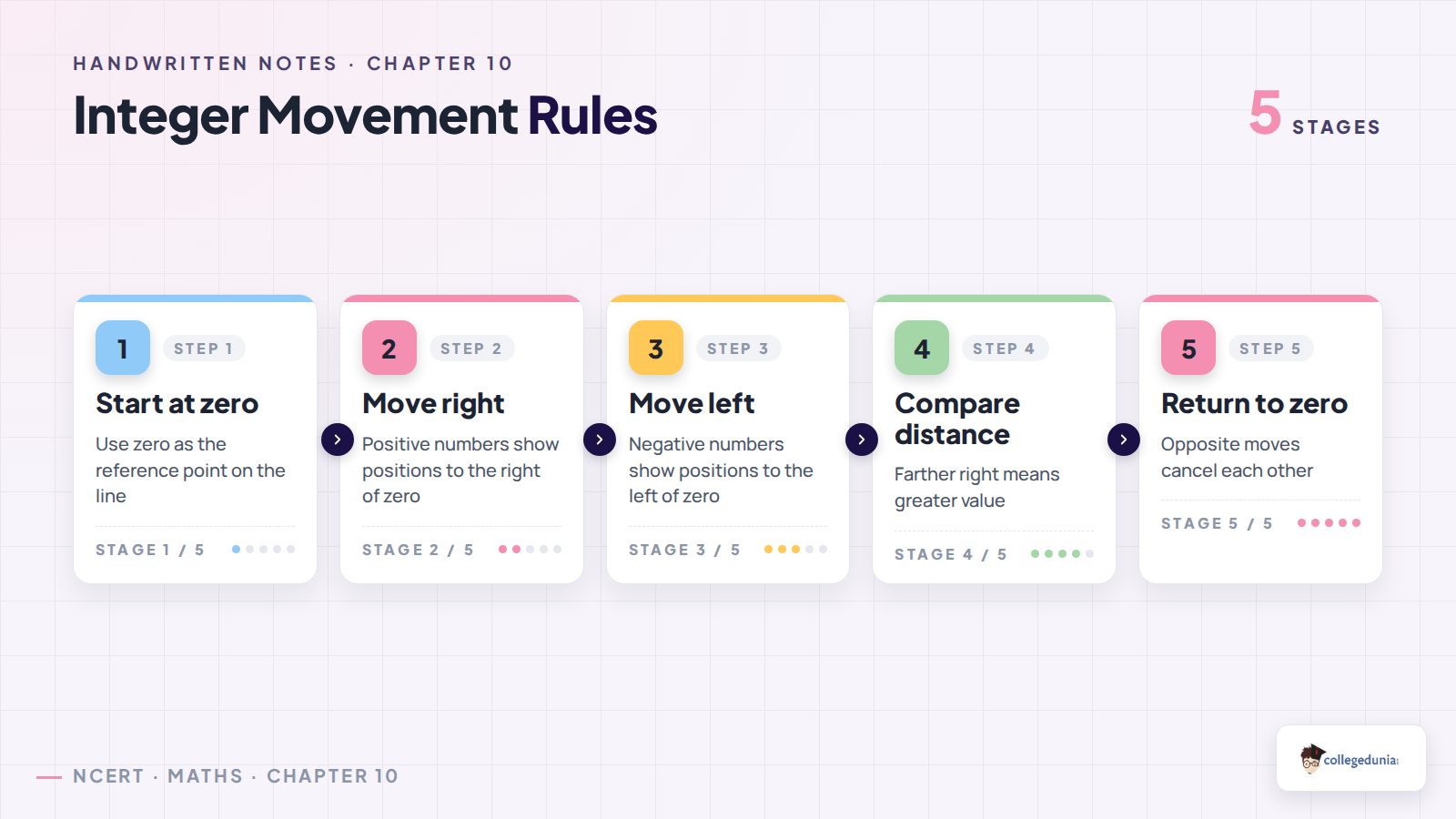
Integer Movement Rules on the Number Line
A number line is read from left to right. A number farther right is greater. A number farther left is smaller. This is why -2 is greater than -7, even though 7 is the larger counting number.
- Start at the given number.
- Move right for a positive movement.
- Move left for a negative movement.
- Count the final position after all moves.
Tip: When signs are confusing, draw five or six marks around zero and move step by step.
Zero Pairs and Brahmagupta Rules
A zero pair is made when a number and its opposite are added. For example, +5 and -5 make 0. Opposite numbers have the same size but different signs.
Brahmagupta's rule is useful for quick addition. Two positive numbers give a positive number. Two negative numbers give a negative number. For unlike signs, subtract the sizes and keep the sign of the number with larger size.
Common Mistakes Students Make in The Other Side of Zero
Most mistakes come from forgetting that the number line grows to the right. Students also mix the size of a number with its value.
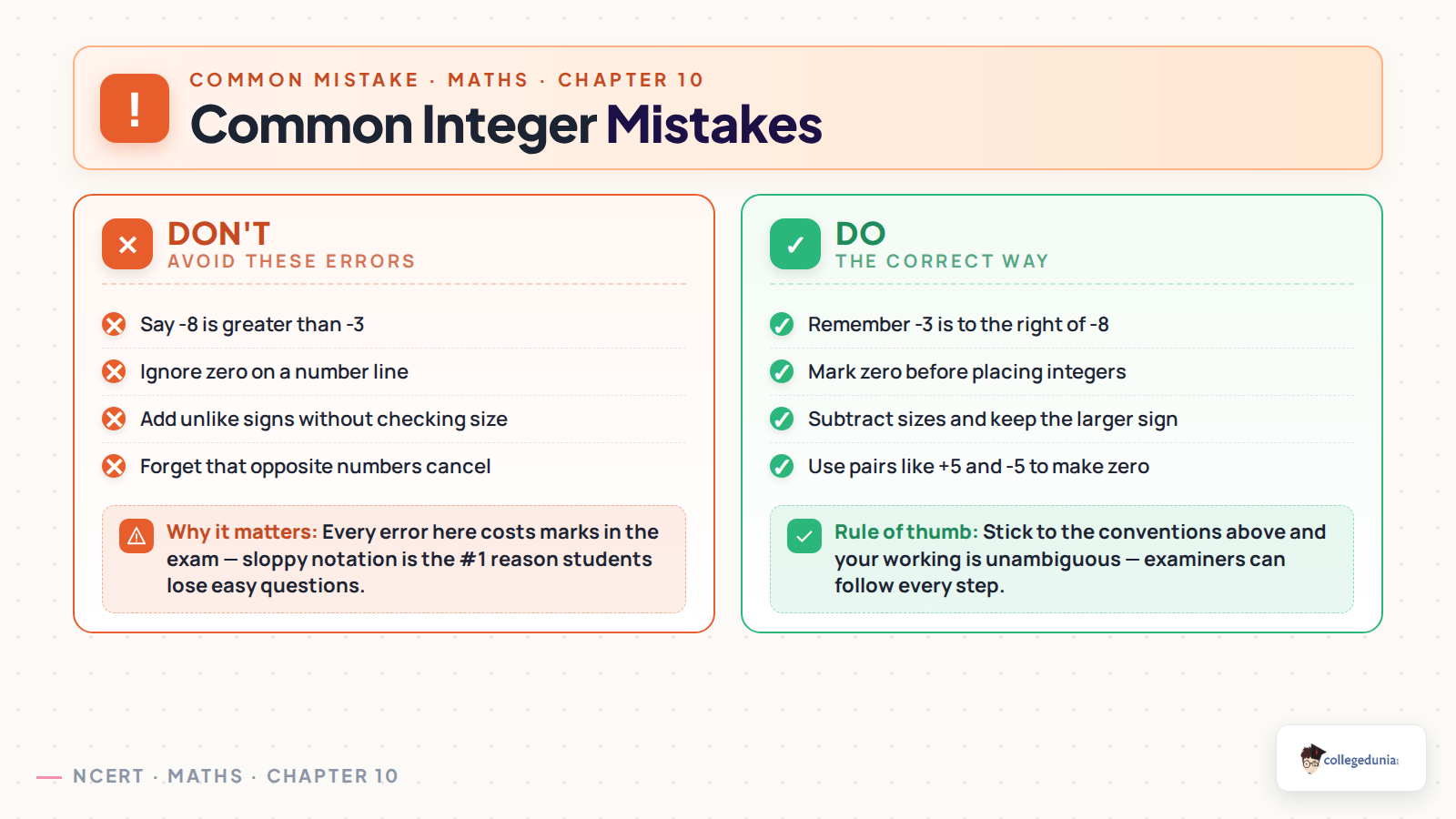
- Do not say -8 is greater than -3. It is farther left, so it is smaller.
- Do not skip zero when placing integers.
- Do not add unlike signs without checking the larger size.
- Do not forget that +a and -a cancel to 0.
Final check: mark zero, decide direction, compare position and then write the answer.
Related NCERT Resources for The Other Side of Zero Class 6
| Resource | Link |
|---|---|
| NCERT Solutions | Class 6 Mathematics Chapter 10 NCERT Solutions |
| NCERT Book PDF | Class 6 Mathematics Chapter 10 Book PDF |
| NCERT Notes | Class 6 Mathematics Chapter 10 Notes |
More Class 6 Mathematics Handwritten Notes
| Chapter | Handwritten Notes |
|---|---|
| Chapter 1 | Patterns in Mathematics |
| Chapter 2 | Lines and Angles |
| Chapter 3 | Number Play |
| Chapter 4 | Data Handling and Presentation |
| Chapter 5 | Prime Time |
| Chapter 6 | Perimeter and Area |
| Chapter 7 | Fractions |
| Chapter 8 | Playing with Constructions |
| Chapter 9 | Symmetry |
The Other Side of Zero Class 6 Handwritten Notes FAQs
Ques. What is covered in Class 6 The Other Side of Zero handwritten notes?
Ans. The notes cover integers, negative numbers, number lines, zero pairs, building-floor examples, bank balance examples and sign rules.
Ques. Are these notes based on the 2026-27 Ganita Prakash textbook?
Ans. Yes. The PDF follows Class 6 Mathematics Ganita Prakash Chapter 10 The Other Side of Zero for the 2026-27 session.
Ques. How should students revise The Other Side of Zero from this PDF?
Ans. Students should revise zero as the reference point first, then number-line movement, zero pairs, addition rules and subtraction as movement.
Ques. Why are number lines important in Chapter 10?
Ans. Number lines show the order of integers clearly. They help students compare negative numbers and check addition or subtraction moves.



Comments