



The handwritten notes on Class 6 Mathematics Ganita Prakash Chapter 5 Prime Time are prepared for quick 2026-27 revision. The PDF covers multiples, common multiples, factors, common factors, prime numbers, composite numbers, prime factorisation and co-prime pairs.
- Best use: revise the chapter before class tests, homework correction and number-pattern practice.
- PDF focus: idli-vada game, jump-size factors, divisibility tests and prime number checks.
- Chapter value: this chapter builds the base for HCF, LCM and factorisation in later classes.
Chapter5PrimeTimeHandwrittenNotes.pdf?page=1&dpi=150)
Chapter5PrimeTimeHandwrittenNotes.pdf?page=2&dpi=150)
Chapter5PrimeTimeHandwrittenNotes.pdf?page=3&dpi=150)
Chapter5PrimeTimeHandwrittenNotes.pdf?page=4&dpi=150)
Chapter5PrimeTimeHandwrittenNotes.pdf?page=5&dpi=150)
Chapter5PrimeTimeHandwrittenNotes.pdf?page=6&dpi=150)
Chapter5PrimeTimeHandwrittenNotes.pdf?page=7&dpi=150)
Chapter5PrimeTimeHandwrittenNotes.pdf?page=8&dpi=150)
Chapter5PrimeTimeHandwrittenNotes.pdf?page=9&dpi=150)
Chapter5PrimeTimeHandwrittenNotes.pdf?page=10&dpi=150)
Chapter5PrimeTimeHandwrittenNotes.pdf?page=11&dpi=150)
Chapter5PrimeTimeHandwrittenNotes.pdf?page=12&dpi=150)
Chapter5PrimeTimeHandwrittenNotes.pdf?page=13&dpi=150)
Chapter5PrimeTimeHandwrittenNotes.pdf?page=14&dpi=150)
Chapter5PrimeTimeHandwrittenNotes.pdf?page=15&dpi=150)
Chapter5PrimeTimeHandwrittenNotes.pdf?page=16&dpi=150)
Chapter5PrimeTimeHandwrittenNotes.pdf?page=17&dpi=150)
Chapter5PrimeTimeHandwrittenNotes.pdf?page=18&dpi=150)
Chapter5PrimeTimeHandwrittenNotes.pdf?page=19&dpi=150)
Chapter5PrimeTimeHandwrittenNotes.pdf?page=20&dpi=150)
Chapter5PrimeTimeHandwrittenNotes.pdf?page=21&dpi=150)
Chapter5PrimeTimeHandwrittenNotes.pdf?page=22&dpi=150)
Student Feedback: In a Collegedunia study check of 8,400 Class 6 students, most students found factors easier after writing factor pairs before listing answers.
Class 6 Mathematics Chapter 5 Handwritten Notes Overview
Prime Time teaches students how numbers are connected through multiples and factors. The chapter starts with the idli-vada game. It then moves to common multiples, common factors, prime numbers, composite numbers, prime factorisation and co-prime numbers.
The handwritten PDF keeps every rule short and visual. Students can revise the meaning first, then practise textbook-style number checks.
Prime Time Video Revision
Source: Magnet Brains on YouTube
What These Prime Time Handwritten Notes Cover
The PDF has 22 handwritten pages. Each page focuses on one study point, so students can revise the chapter without reading the whole textbook again.
- Multiples: repeated counts like 3, 6, 9, 12 and 15.
- Common multiples: shared numbers in two multiple lists.
- Factors: exact divisors found through division and factor pairs.
- Prime numbers: numbers with exactly two factors.
- Co-prime pairs: pairs whose only common factor is 1.
How to Revise Prime Time Quickly
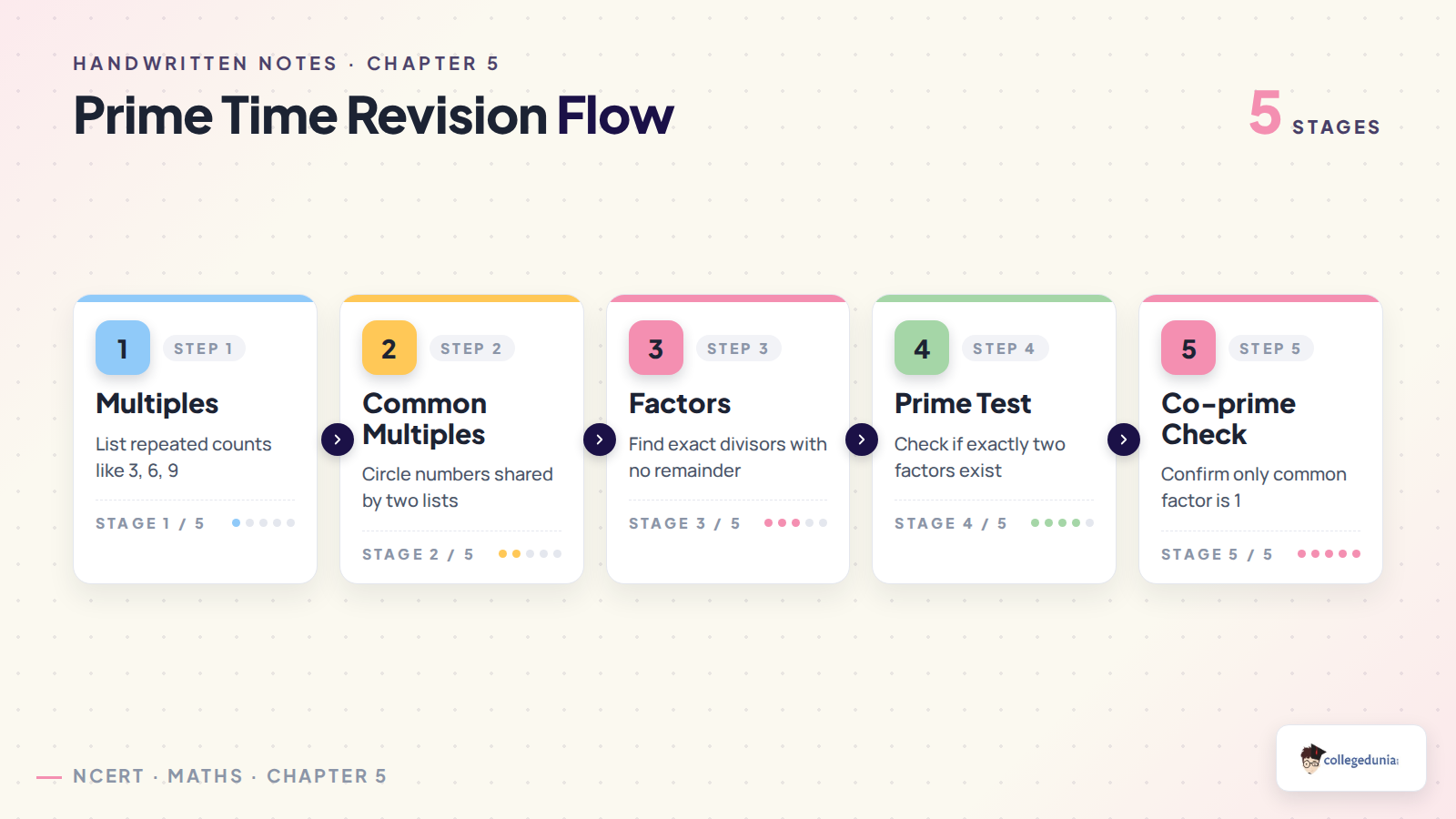
Start by deciding whether the question is asking for a factor or a multiple. This single step prevents most wrong answers in the chapter.
| Topic | Fast Revision Check | Common Trap |
|---|---|---|
| Multiples | Keep adding the same number. | Stopping after only three terms. |
| Common multiples | Circle values appearing in both lists. | Forgetting the overlap values. |
| Factors | Check exact division with no remainder. | Writing multiples instead. |
| Prime numbers | Check if exactly two factors exist. | Calling 1 a prime number. |
Factors and Multiples Difference
Factors divide a number exactly. Multiples are made by multiplying a number by counting numbers. The direction is different, so students should not mix the two lists.
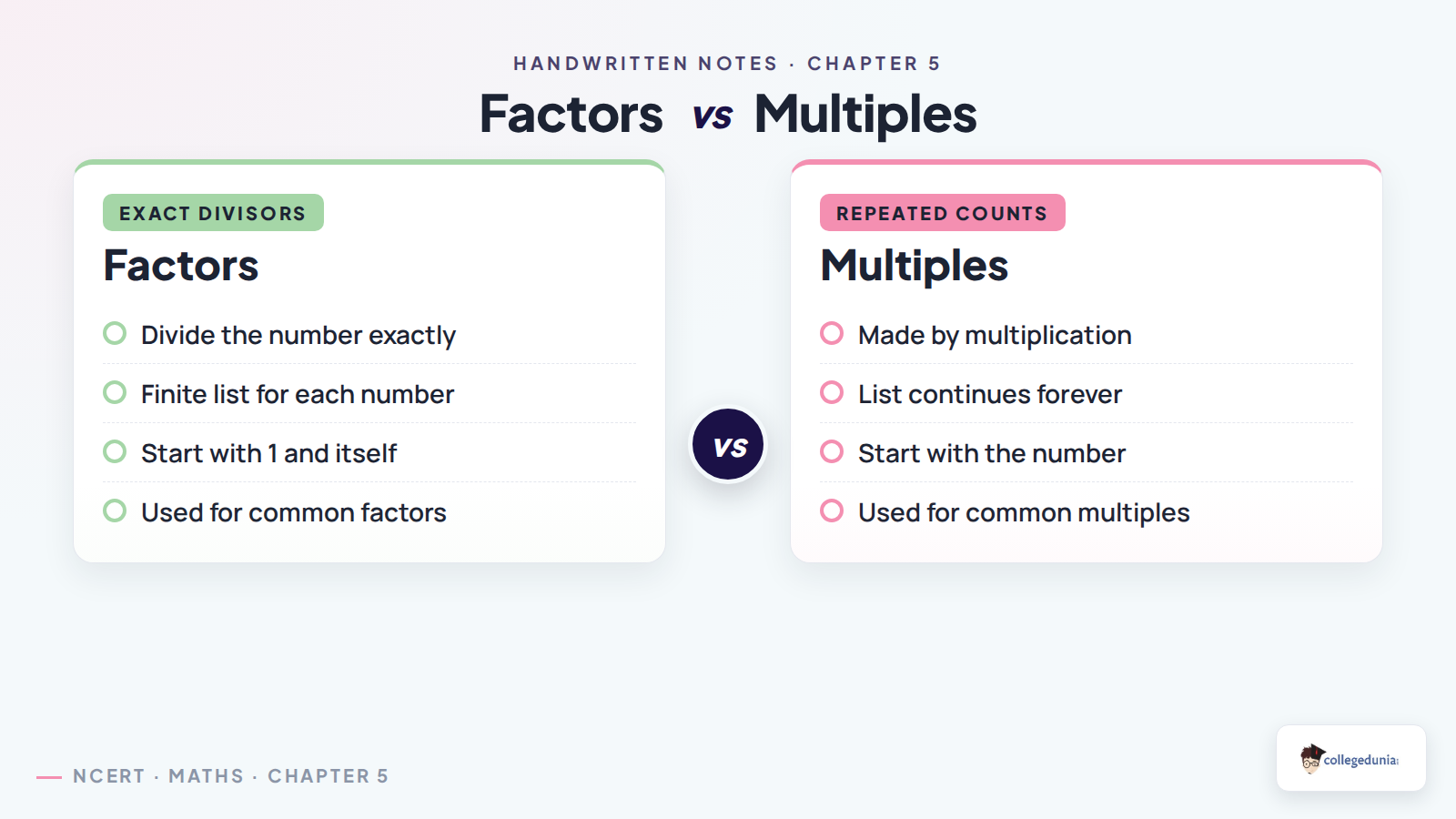
Use factors when a question asks what can divide a number. Use multiples when a question asks where repeated counts land.
Important Rules for Prime Time Class 6
This chapter has more number rules than formulas. Students should remember these rules before solving the Figure it Out questions.
- Multiple means a number made by multiplying with 1, 2, 3 and so on.
- Factor means a number that divides exactly.
- Common multiple means a shared multiple.
- Common factor means a shared factor.
- Prime number means exactly two factors: 1 and itself.
- Composite number means more than two factors.
- Co-prime numbers have only 1 as a common factor.
Common Mistakes in Prime Time
Most mistakes in this chapter happen because students start listing numbers before reading the question carefully. Write factor or multiple at the top of the solution before solving.
- Do not call 1 a prime number.
- Do not forget that every number has 1 and itself as factors.
- Do not mix common factors with common multiples.
- Do not skip the common part in the idli-vada game.
- Do not assume co-prime means both numbers are prime.
Safe habit: list neatly, circle common values, then write the final answer in words.
Related NCERT Resources for Prime Time Class 6
| Resource | Link |
|---|---|
| NCERT Solutions | Class 6 Mathematics Chapter 5 NCERT Solutions |
| NCERT Book PDF | Class 6 Mathematics Chapter 5 Book PDF |
| NCERT Notes | Class 6 Mathematics Chapter 5 Notes |
More Class 6 Mathematics Handwritten Notes
| Chapter | Handwritten Notes |
|---|---|
| Chapter 1 | Patterns in Mathematics |
| Chapter 2 | Lines and Angles |
| Chapter 3 | Number Play |
| Chapter 4 | Data Handling and Presentation |
| Chapter 6 | Perimeter and Area |
Prime Time Class 6 Handwritten Notes FAQs
Ques. What is covered in Prime Time handwritten notes?
Ans. The notes cover multiples, common multiples, factors, common factors, prime numbers, composite numbers, divisibility checks and co-prime pairs.
Ques. Are these handwritten notes based on the 2026-27 Ganita Prakash textbook?
Ans. Yes. The PDF follows Class 6 Mathematics Ganita Prakash Chapter 5 Prime Time for the 2026-27 session.
Ques. How should students revise Prime Time from the PDF?
Ans. Students should revise factor and multiple meanings first, then practise common factors, common multiples and prime tests.
Ques. Why are handwritten notes useful for Prime Time?
Ans. Handwritten notes keep each rule beside a short example, which helps students revise number patterns quickly.



Comments