


Class 7 Maths Part 1 Chapter 5 Parallel and Intersecting Lines introduces transversals and angle pairs. These class 7 maths handwritten notes chapter 5 Parallel and Intersecting Lines follow the 2026-27 NCERT and cover perpendicular lines, corresponding angles and alternate angles.
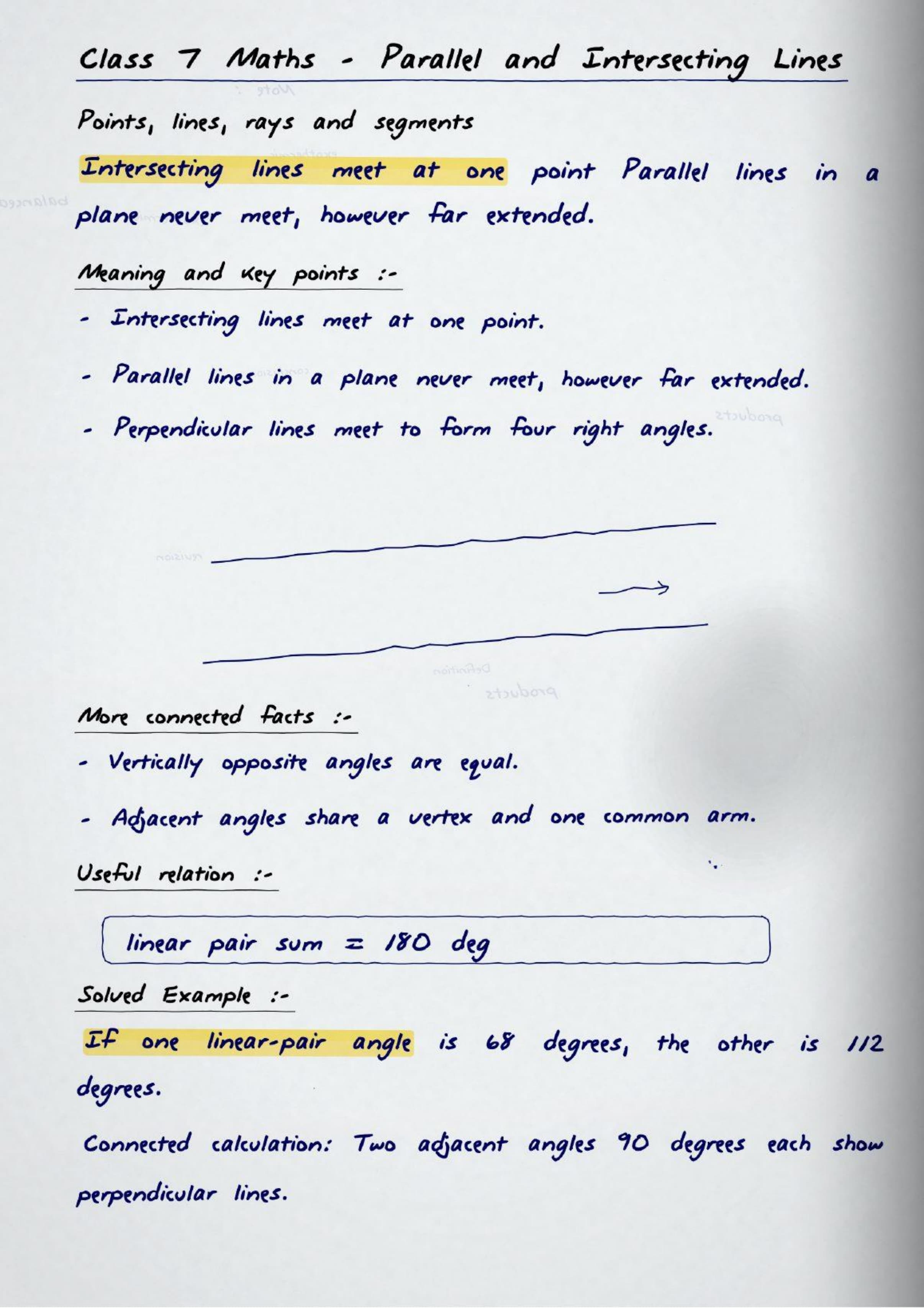
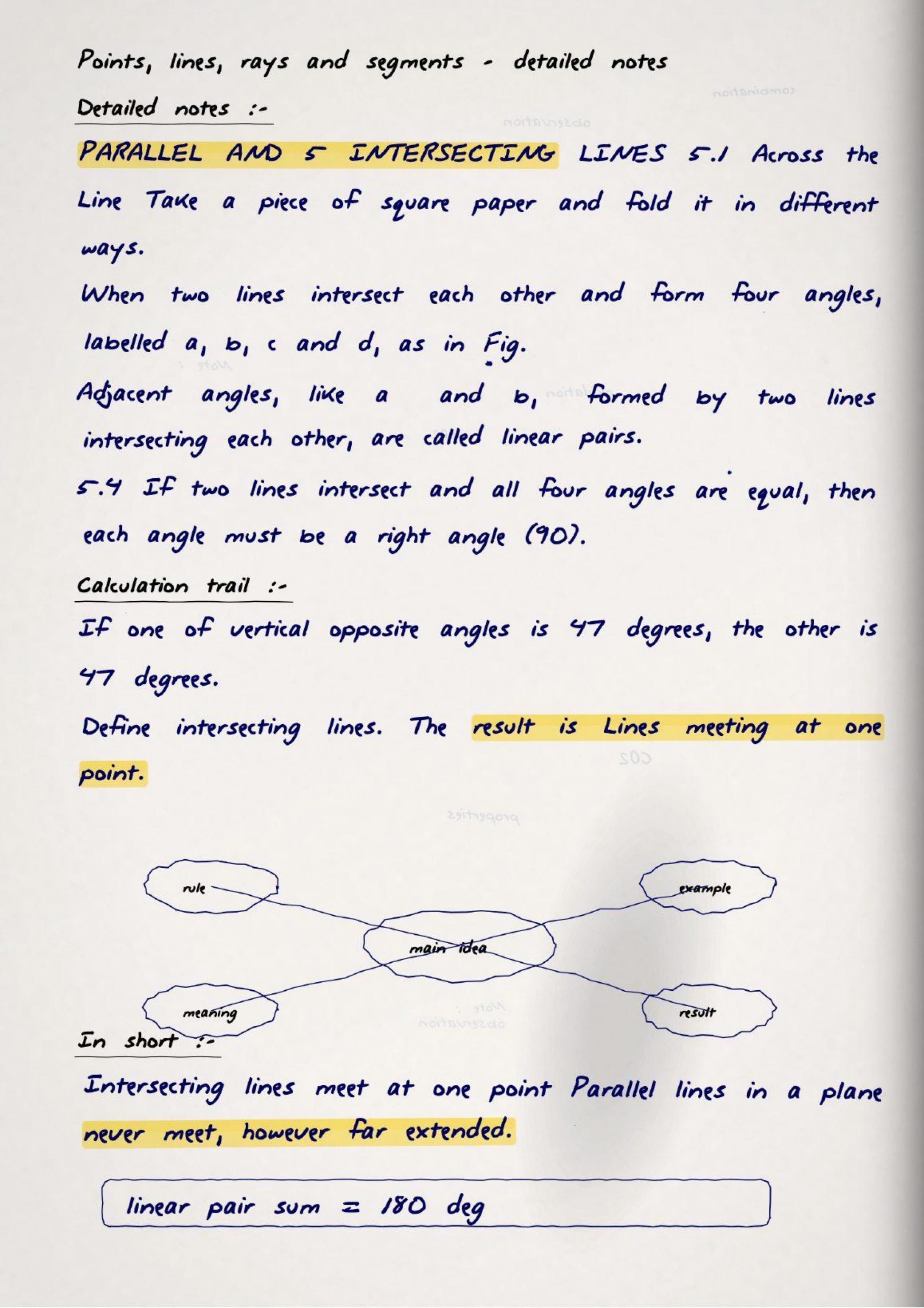
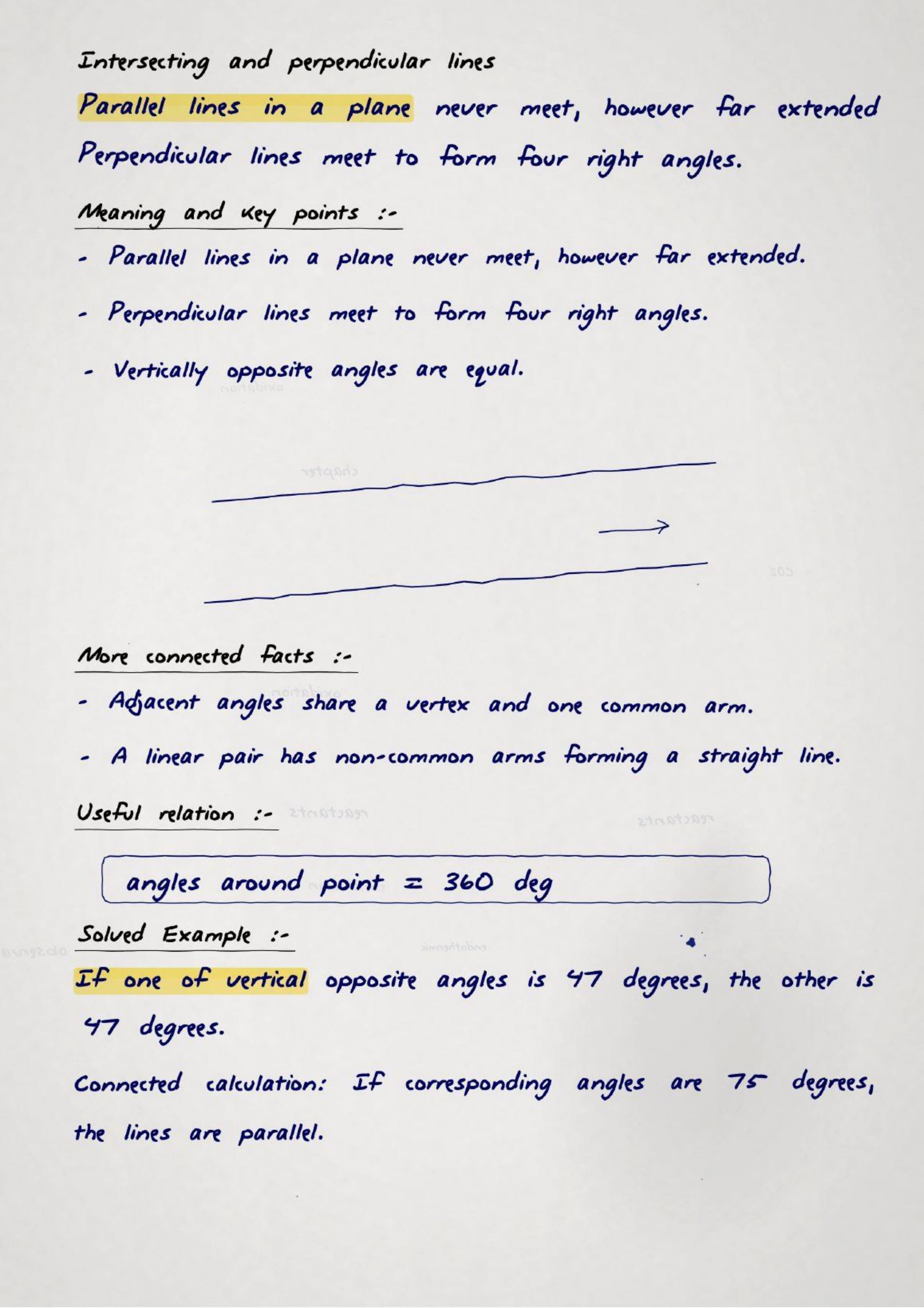
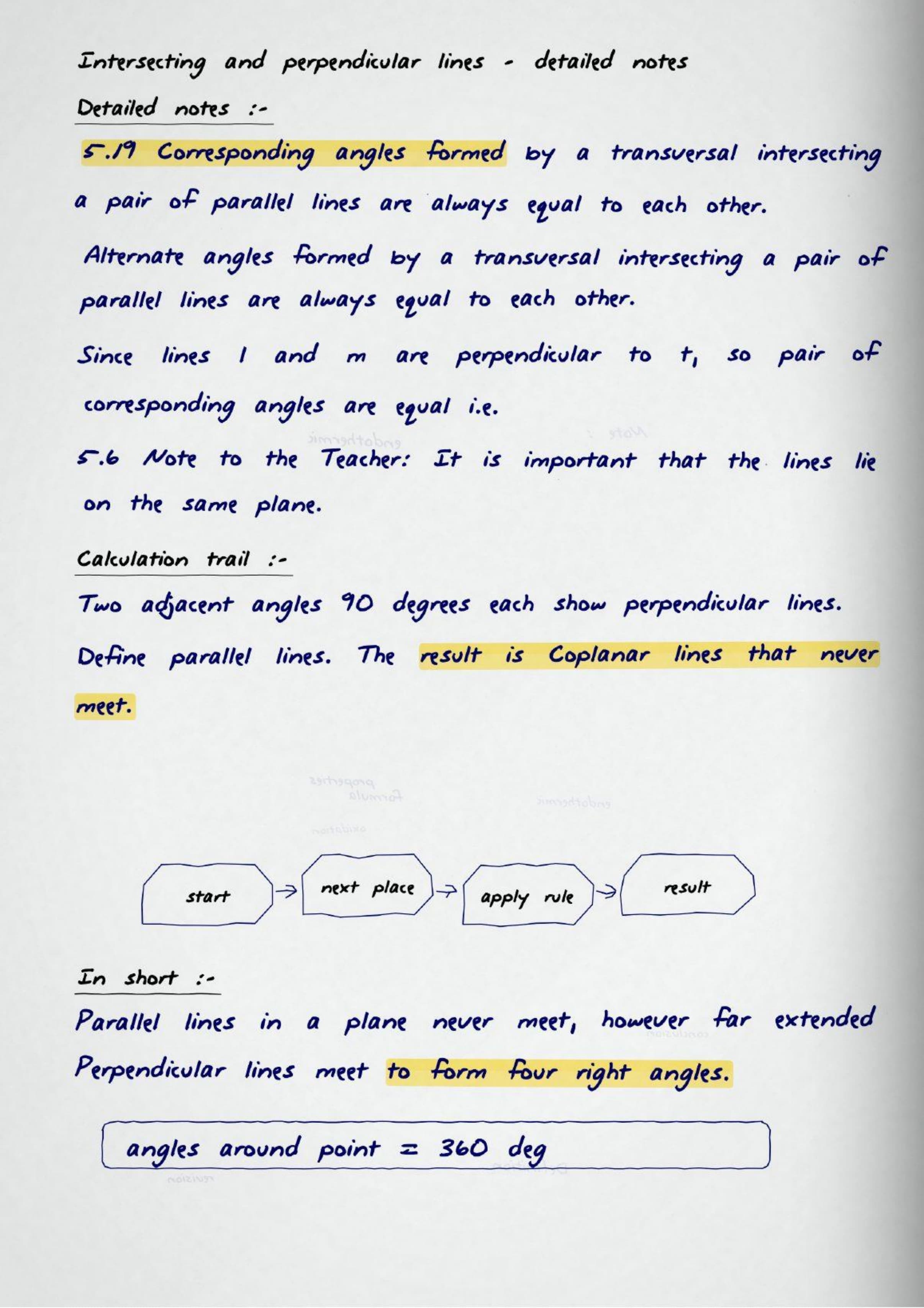
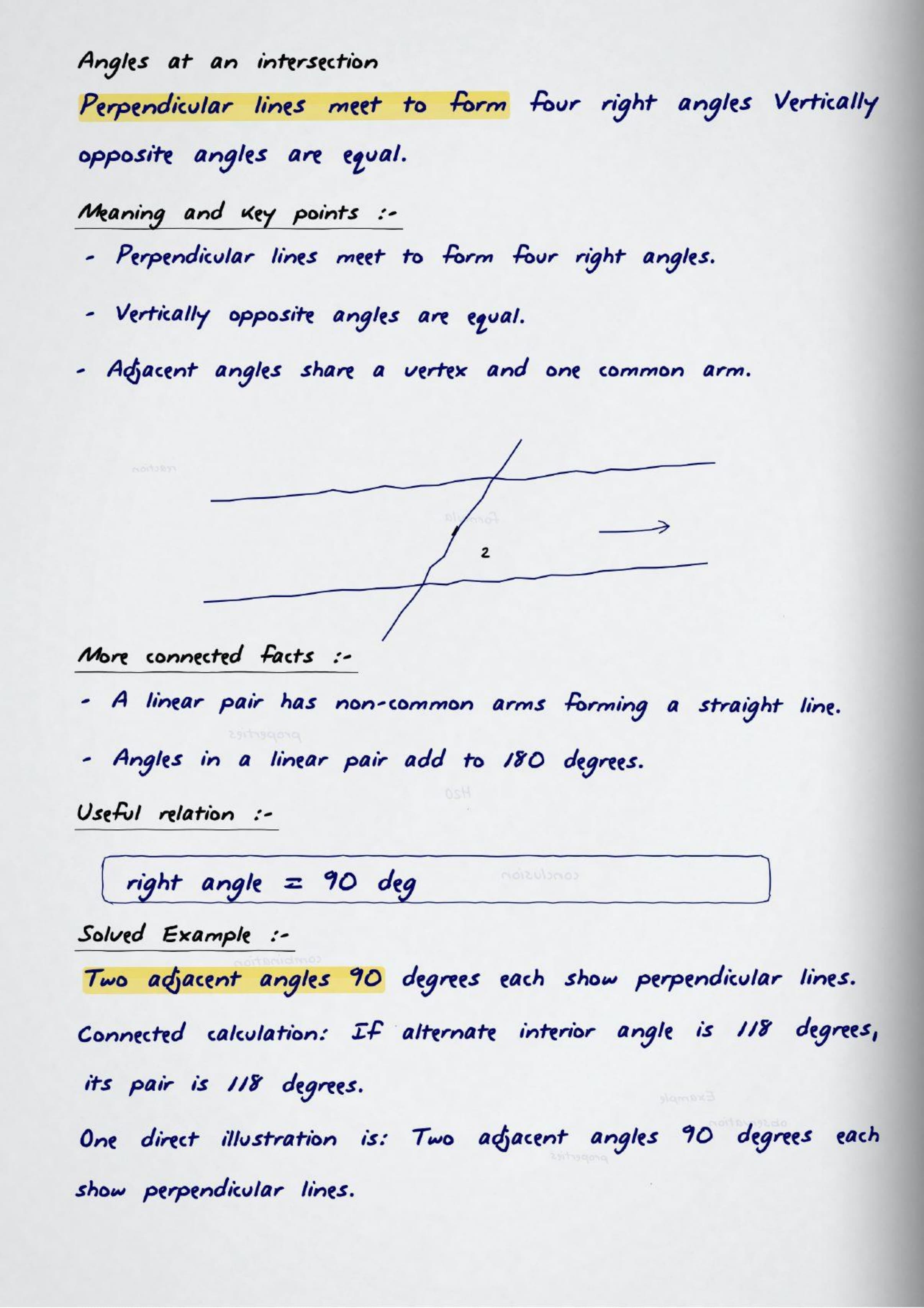
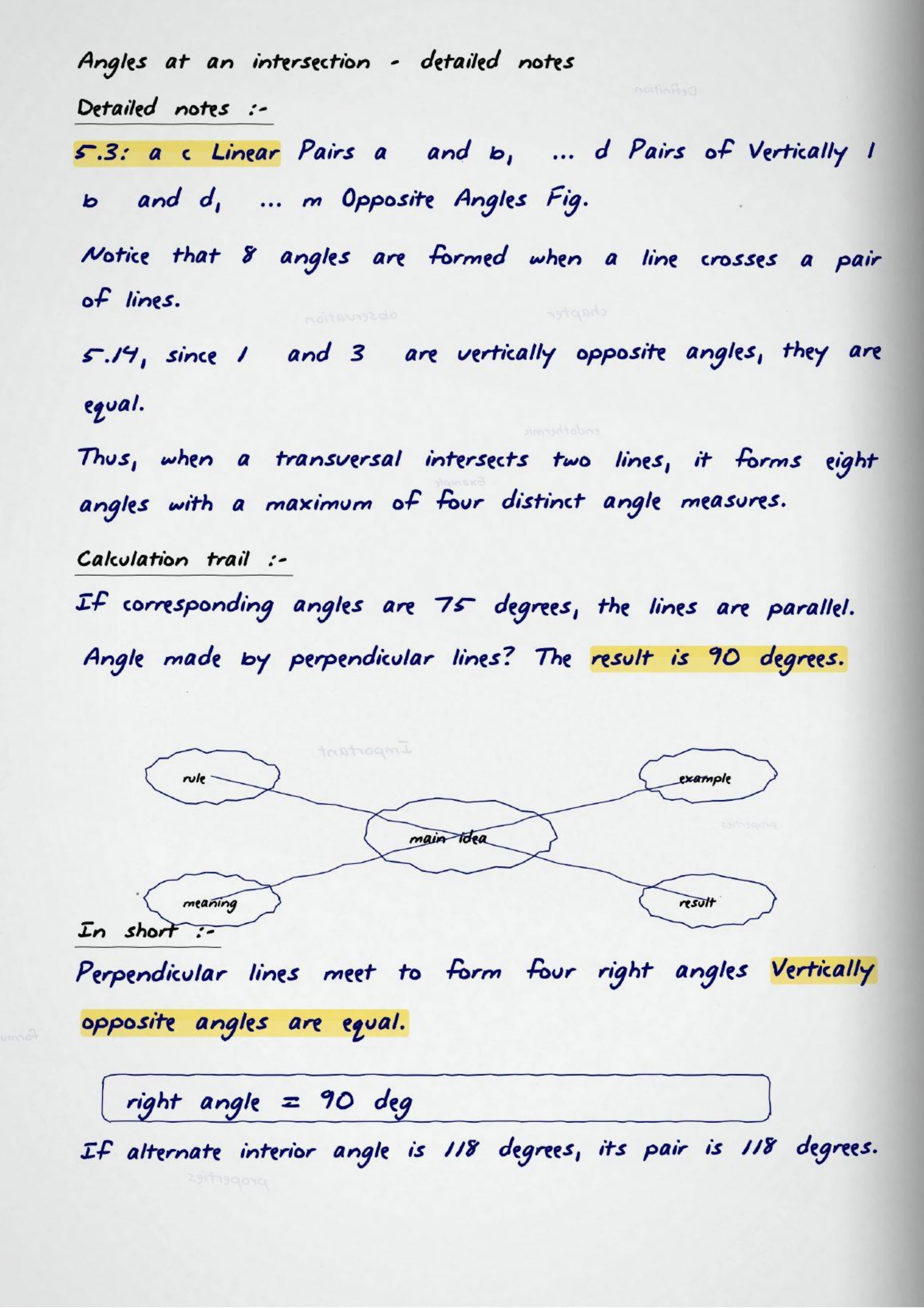
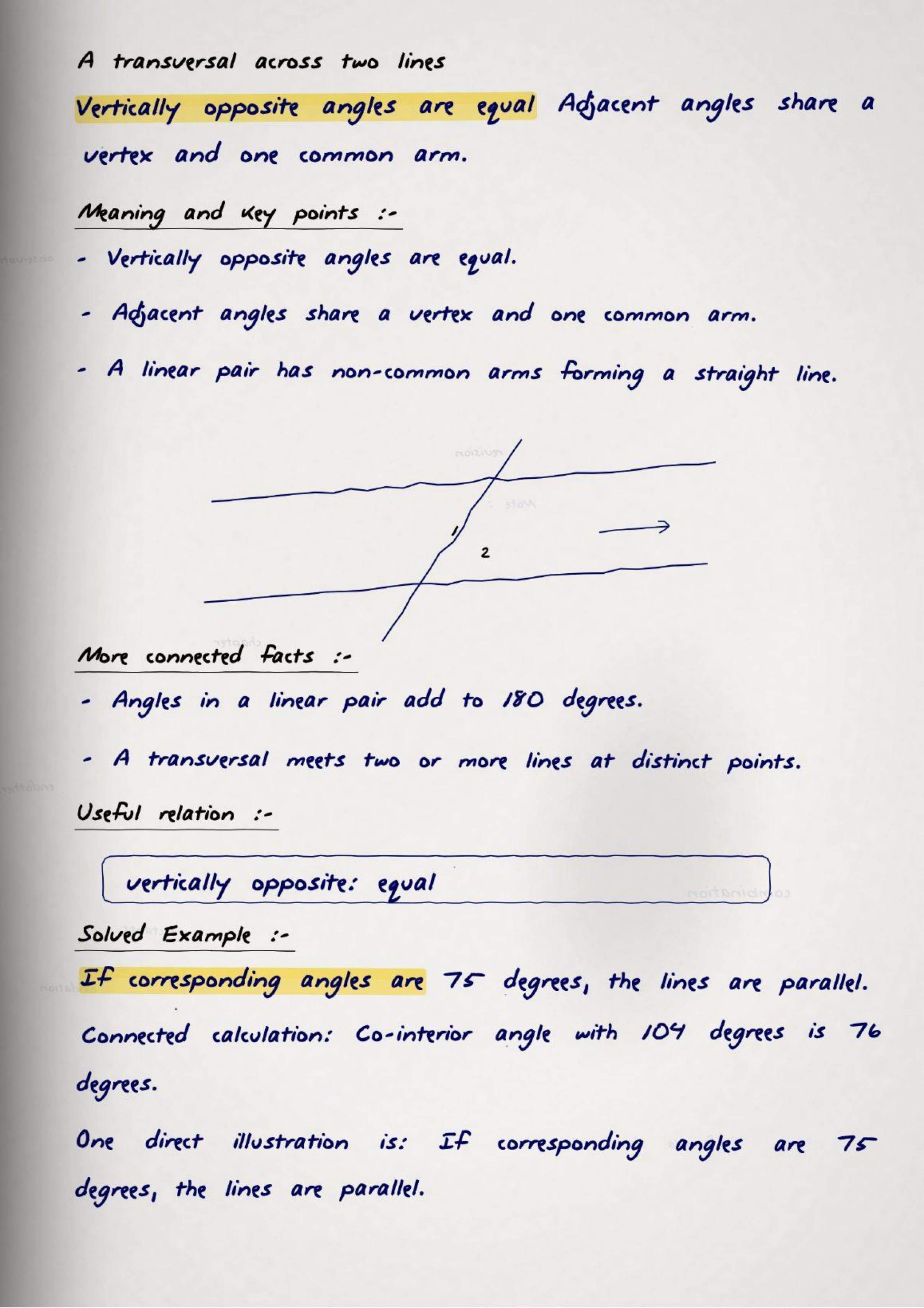
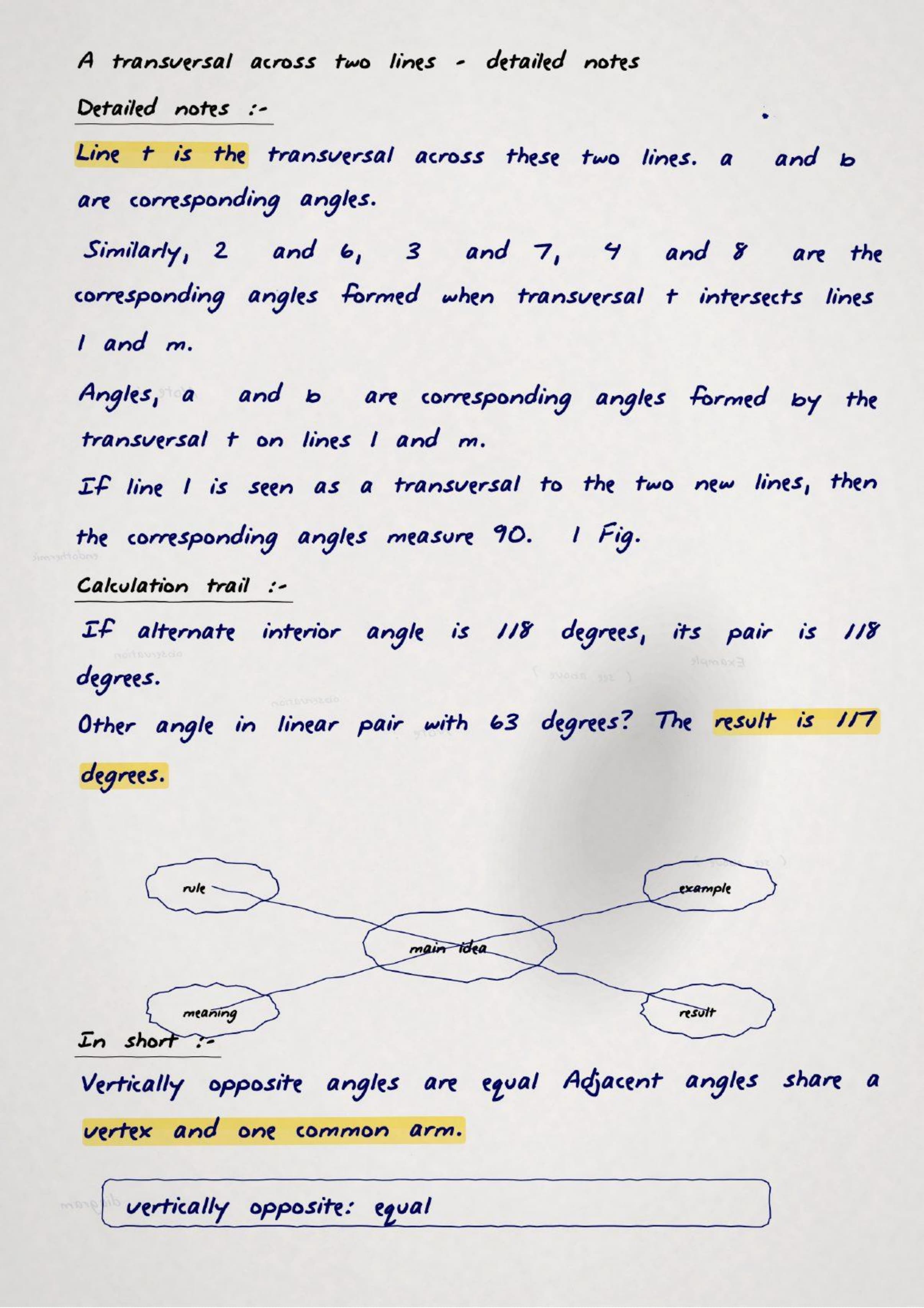
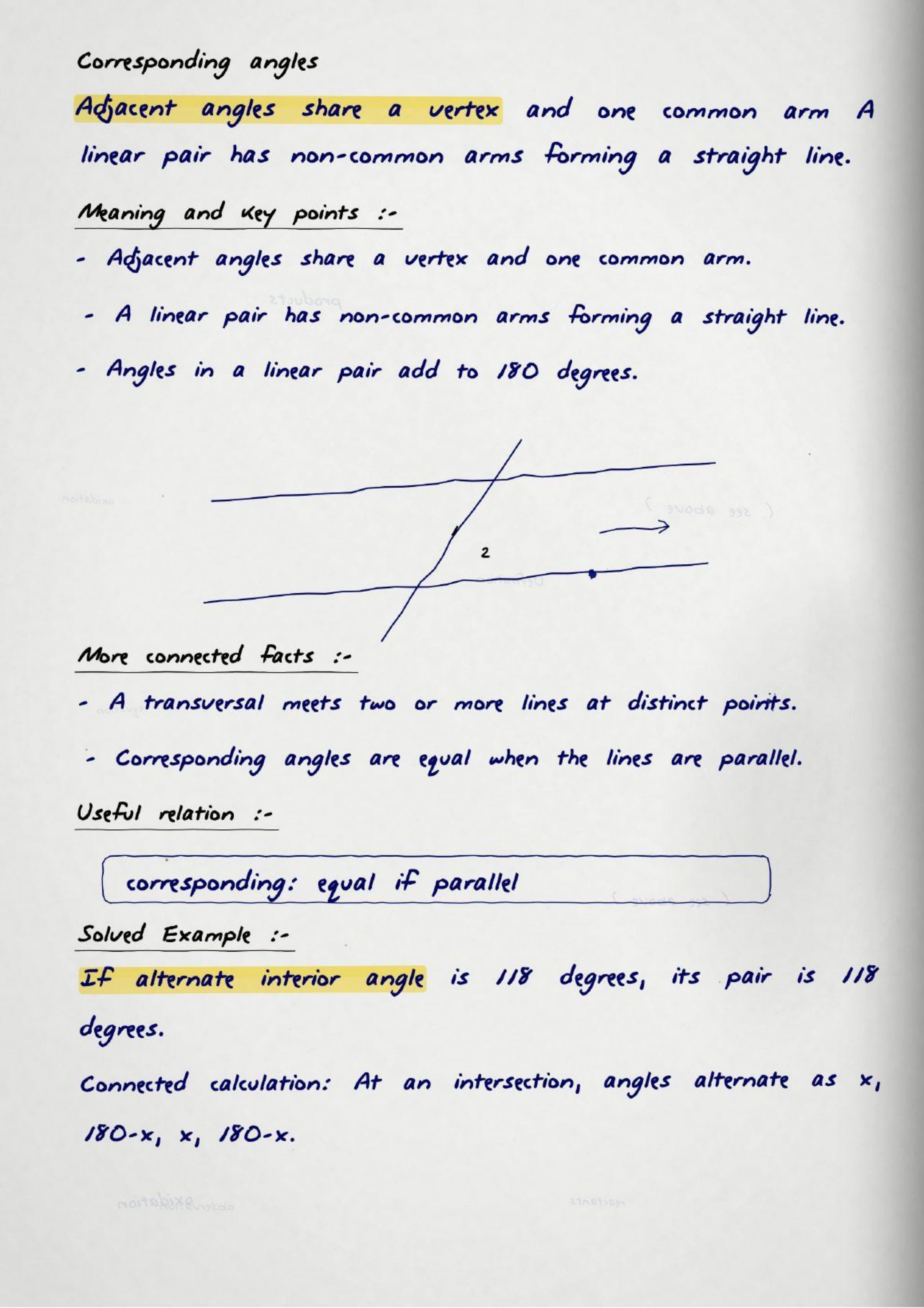
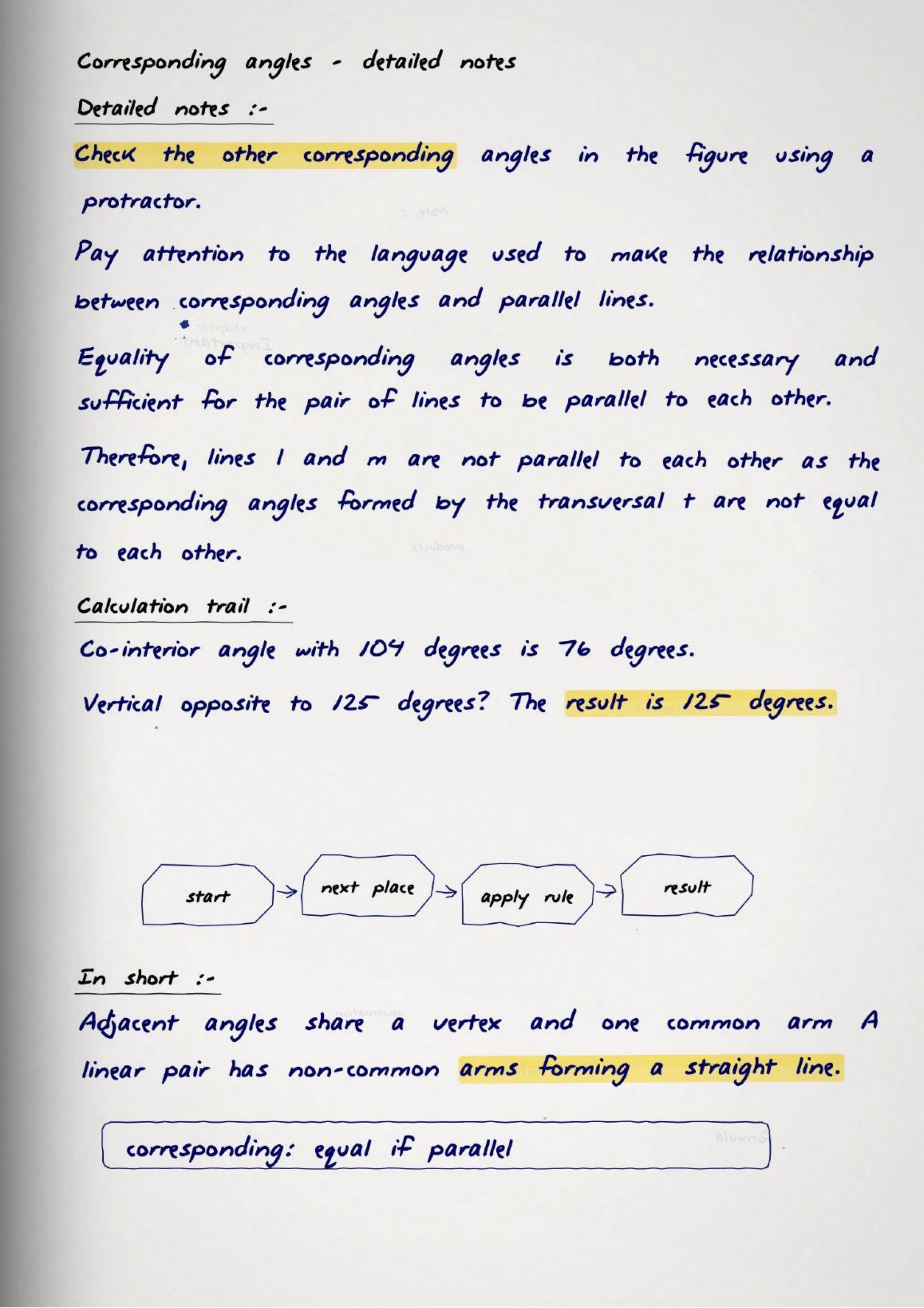
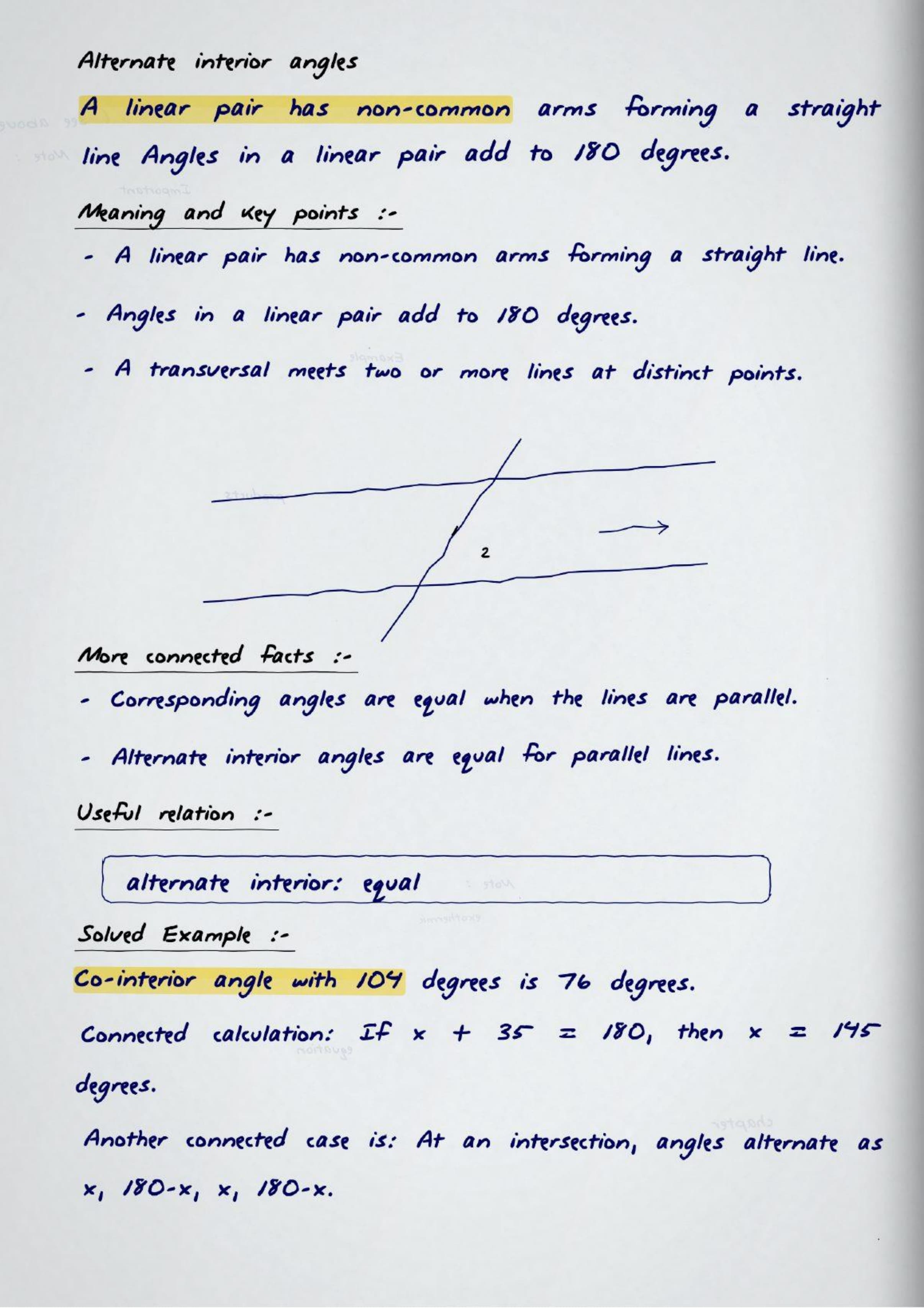
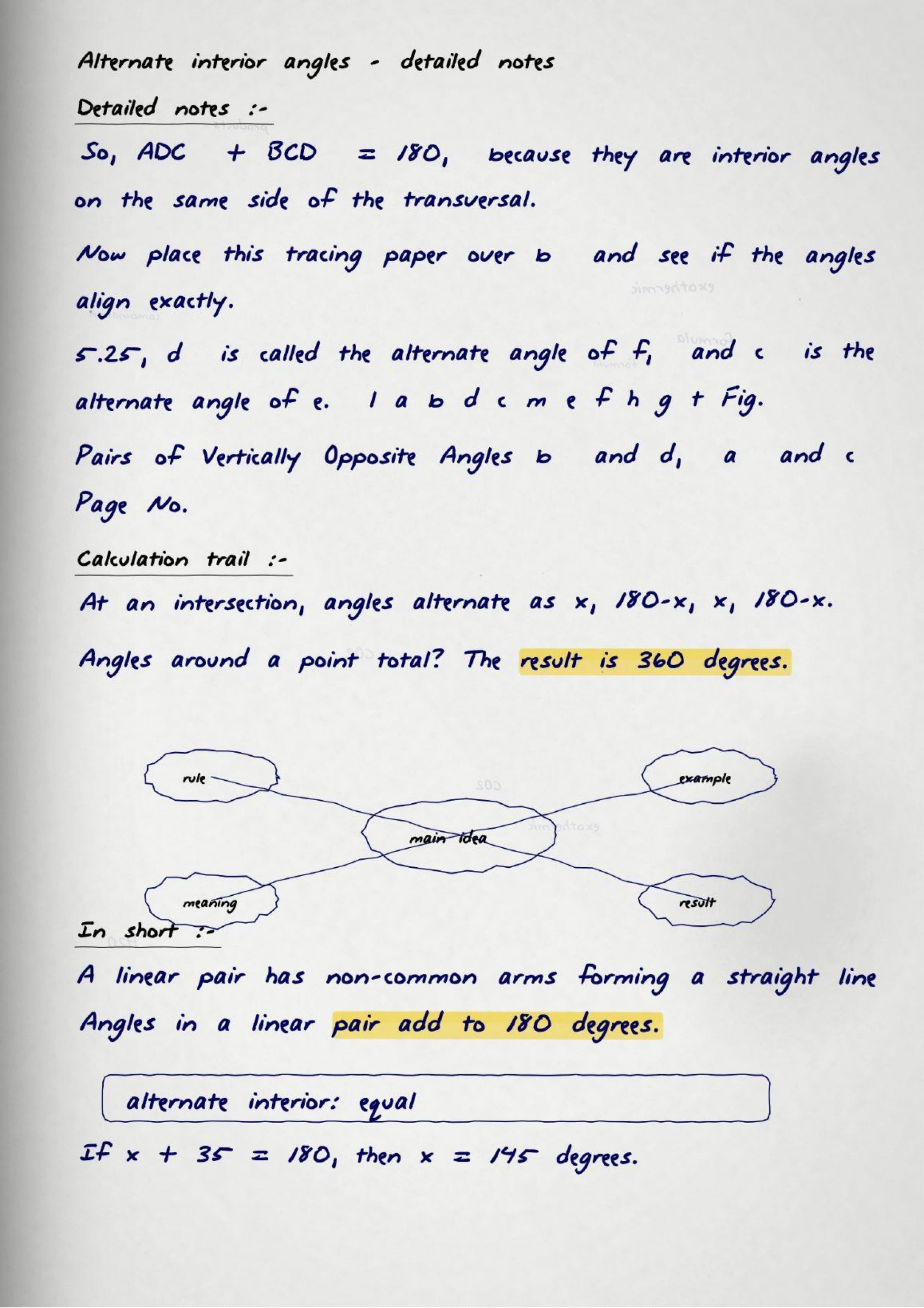
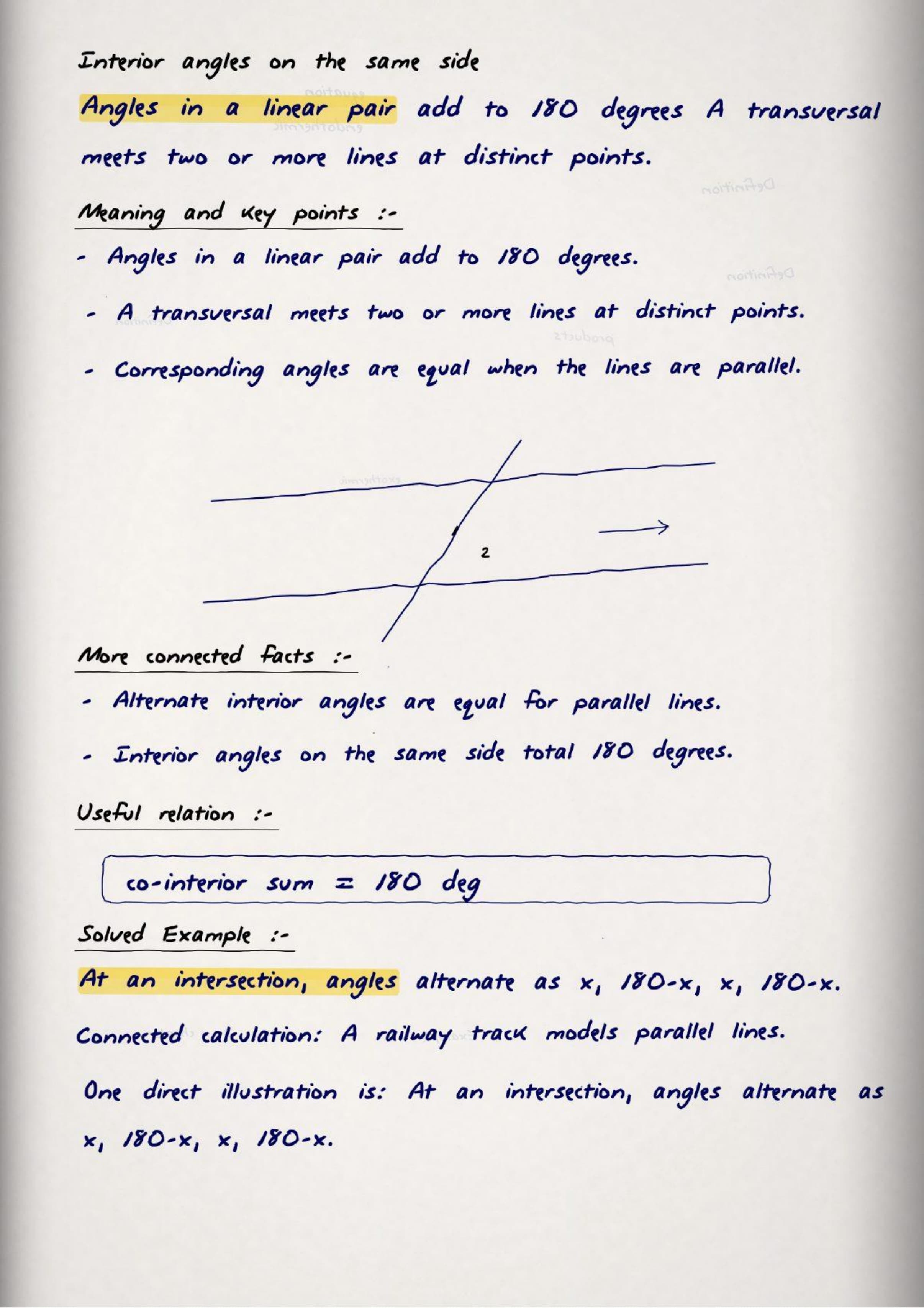
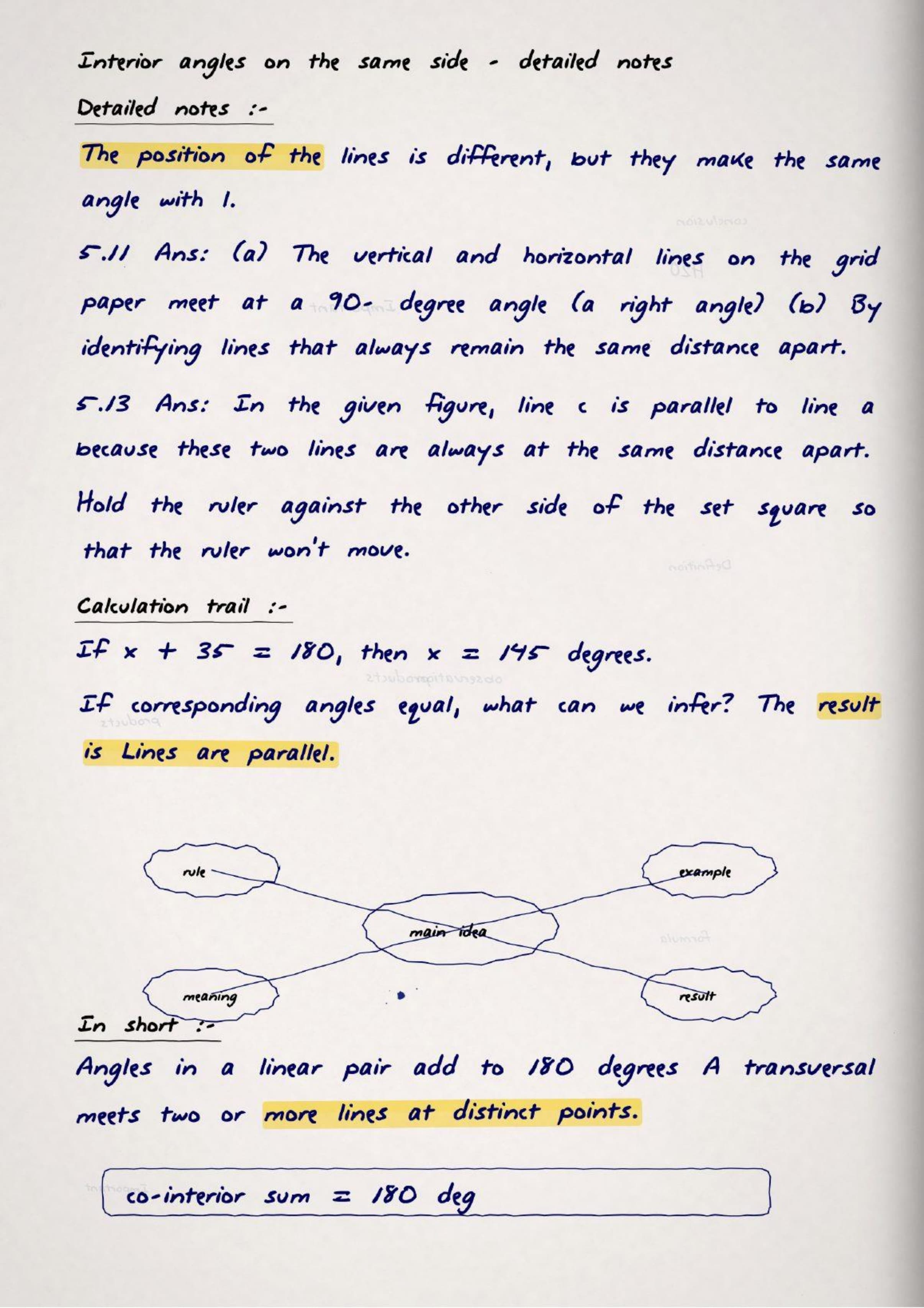
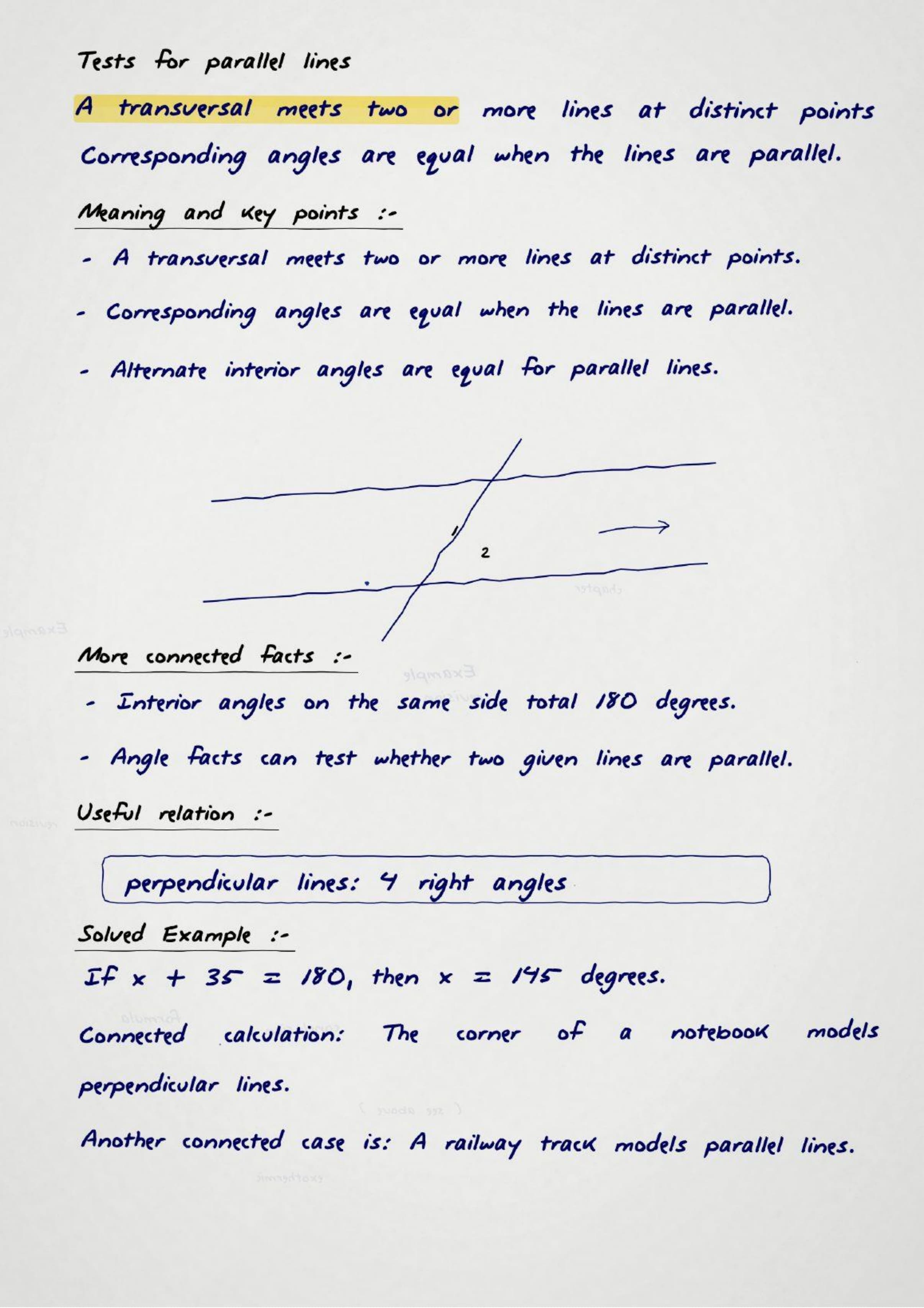
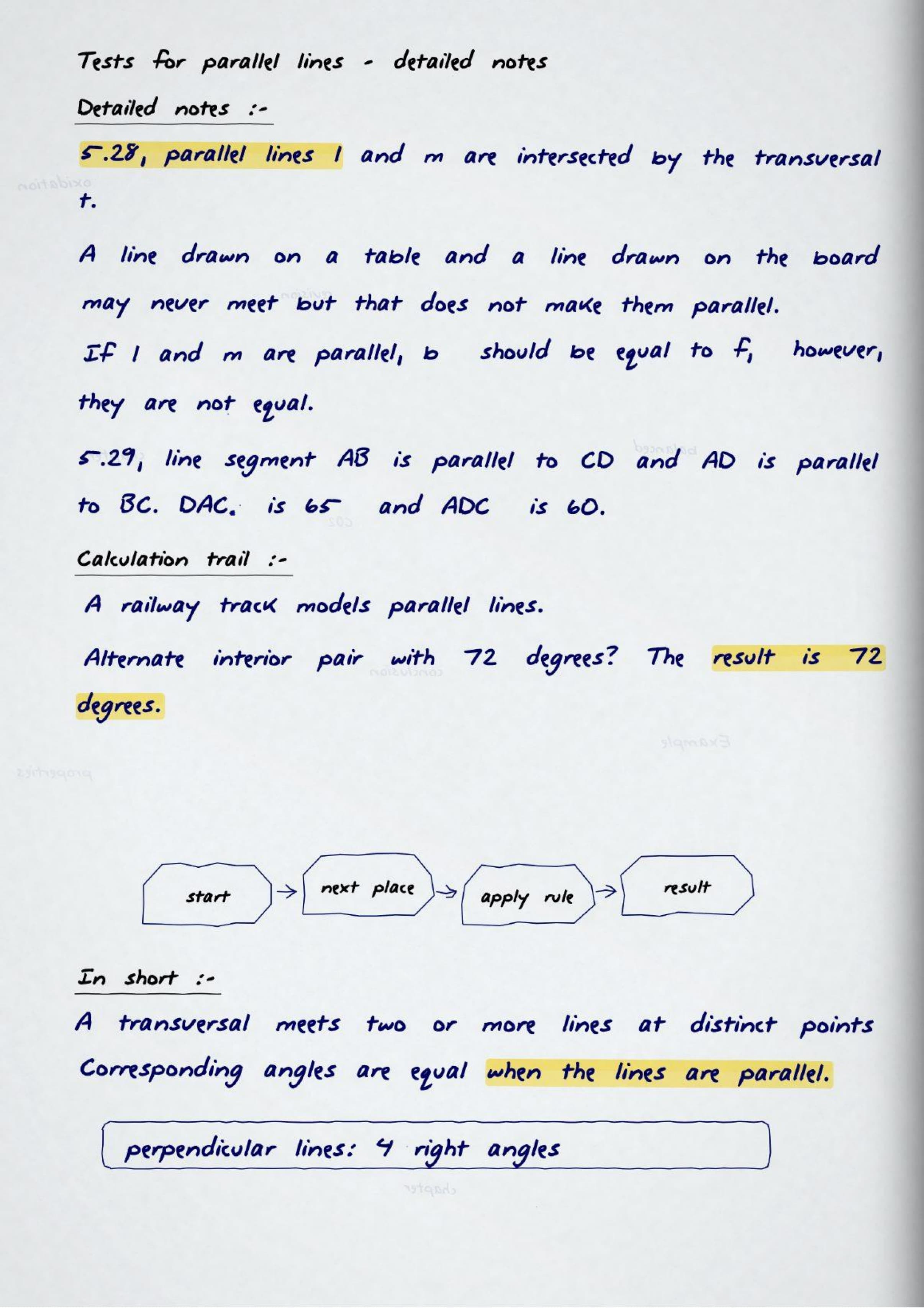
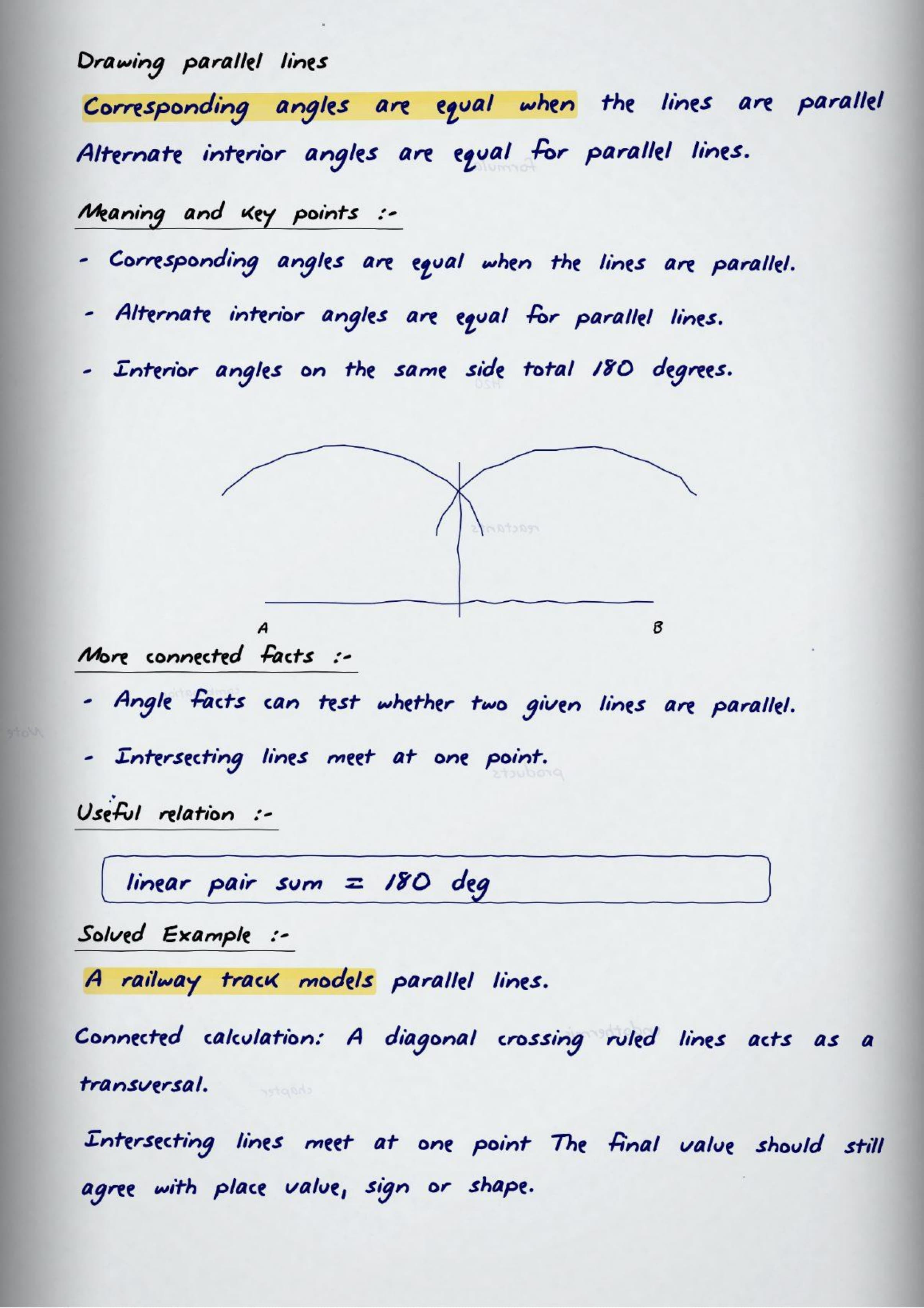
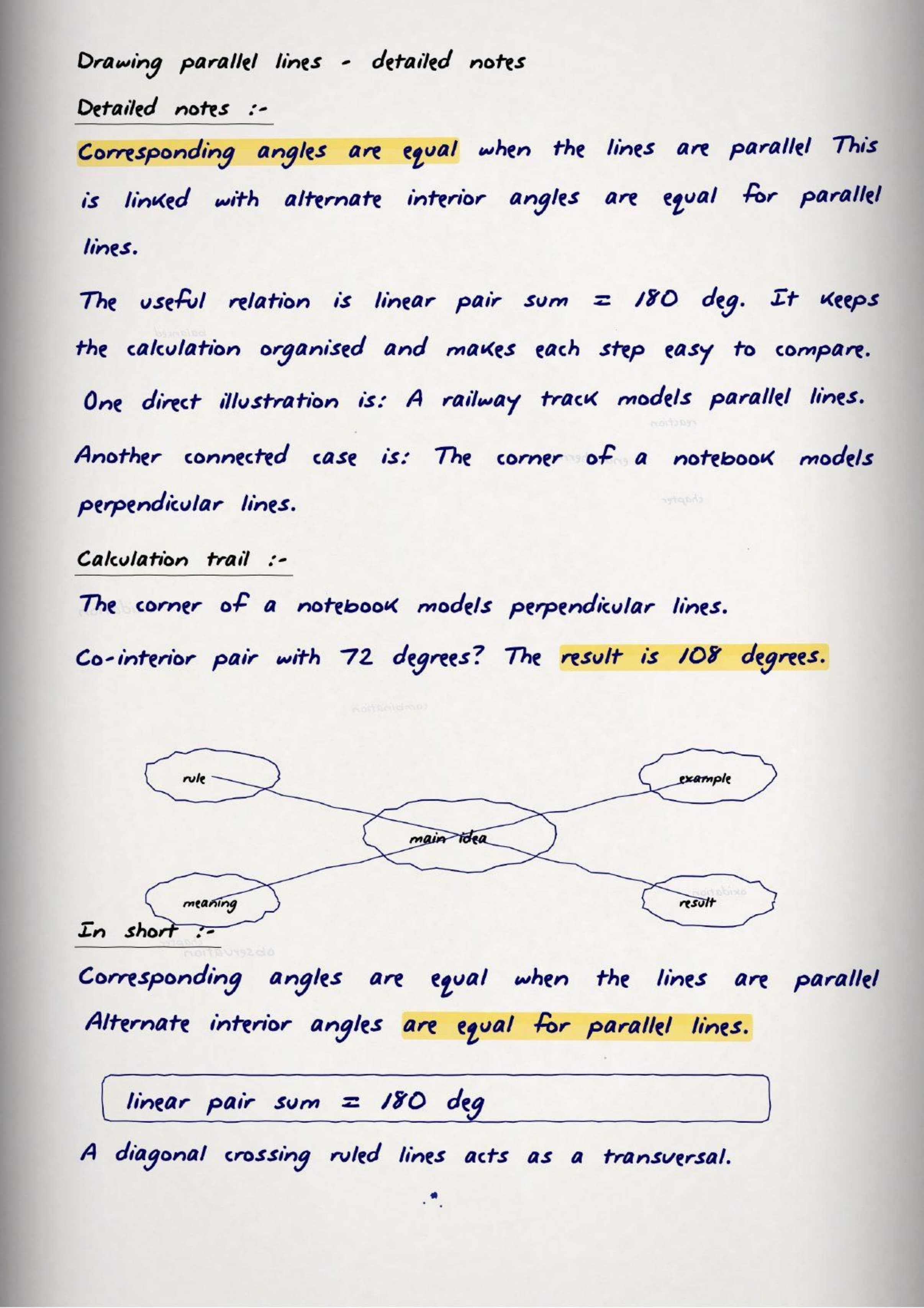
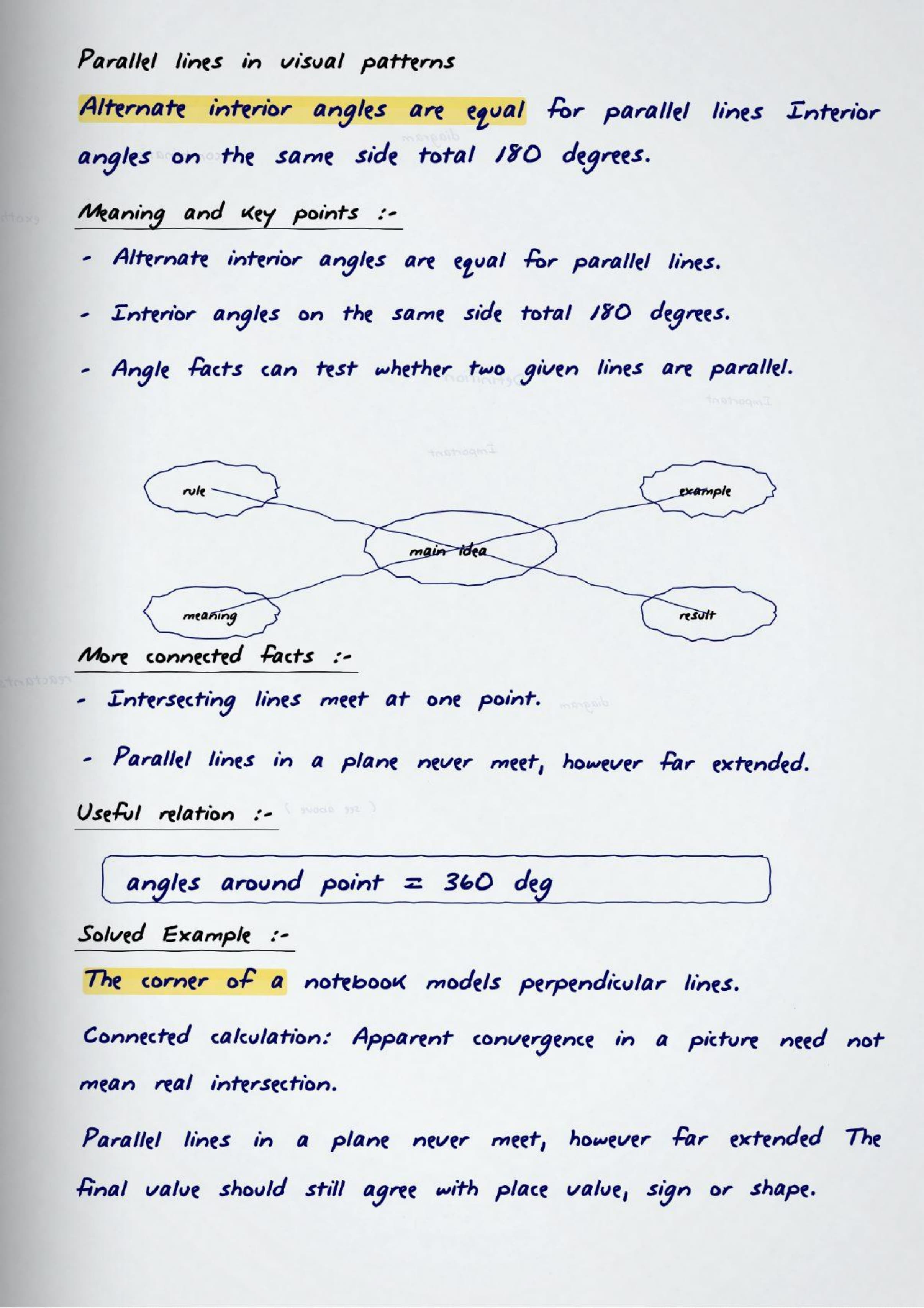
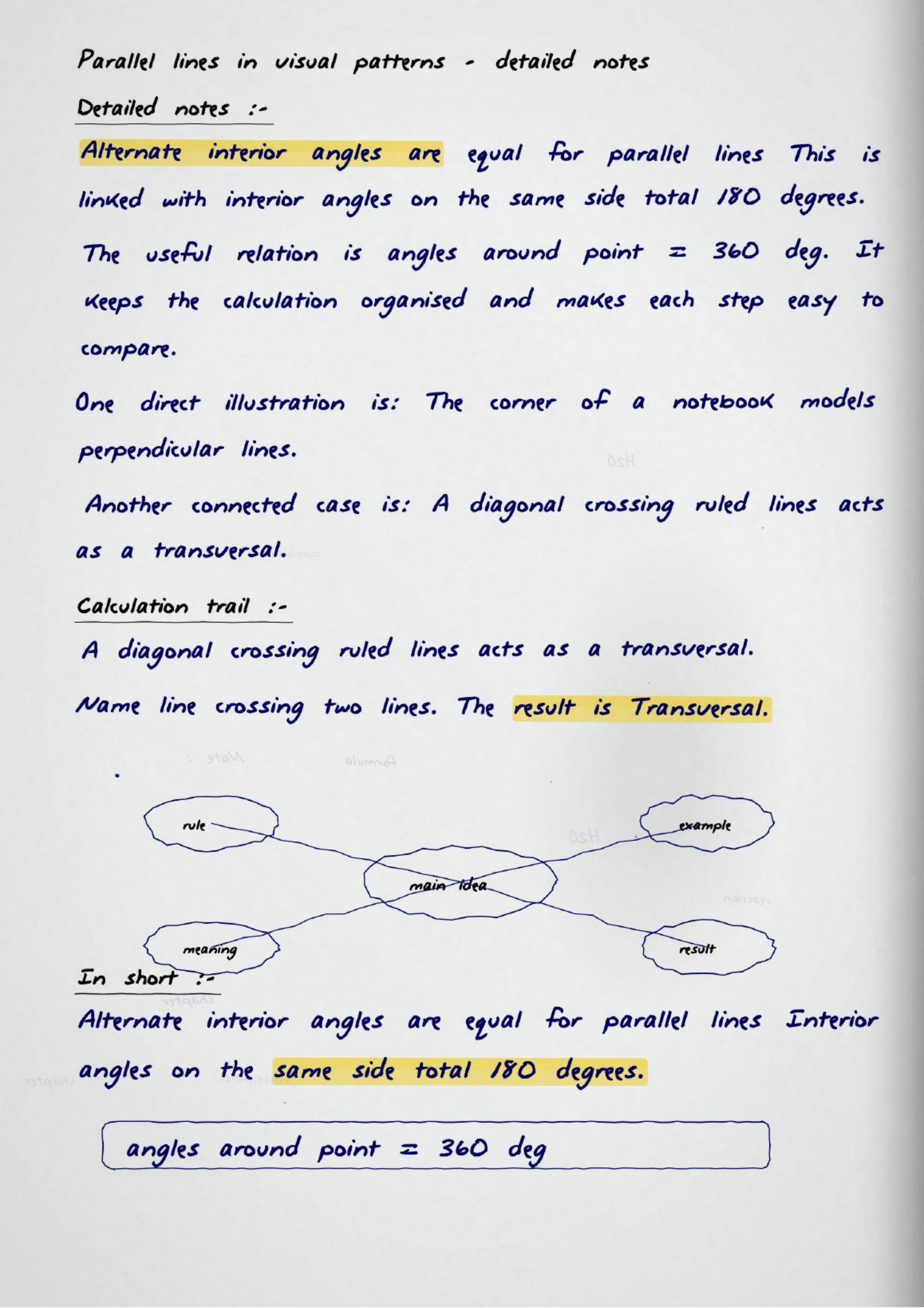
- Angle pairs boxed: corresponding and alternate angles marked on one transversal diagram
- What the notes cover: intersecting lines, perpendicular lines, transversals, angle pairs and drawing parallel lines
- Best for: the find-the-angle question, which appears in every geometry section
Open the PDF below for the complete class 7 maths handwritten notes covering Parallel and Intersecting Lines from the first page to the last.
These handwritten notes are written by Maths teachers, mapped to the 2026-27 NCERT Ganita Prakash book, and checked against Class 7 school question papers.
Where Students Lose Marks in Parallel and Intersecting Lines
Angle chasing is the skill this chapter builds, and it is used again in every geometry chapter after it.
- A find-the-angle question appears in nearly every test
- Naming the angle pair earns a separate reasoning mark
- Constructions of parallel lines are assessed in the practical work
- Part 2 Chapter 1 on congruence uses these angle rules
Why Students Pick Collegedunia's Parallel and Intersecting Lines Handwritten Notes
Collegedunia has these class 7 maths handwritten notes written by teachers who set Class 7 papers. One transversal diagram is drawn large, with every angle pair colour-marked on it.
- One full diagram: two parallel lines and a transversal with all eight angles marked
- Pair legend: corresponding and alternate pairs colour-coded on that diagram
- Construction steps: drawing a parallel line written as numbered steps
- Colour-coded sub-headings: sub-topics in red so each angle rule stands out
Test Yourself on Parallel and Intersecting Lines
Five geometry questions. Tap to check each one.
Two lines that meet at a right angle are called
(a) parallel (b) perpendicular (c) alternate (d) transversal
Answer: (b) perpendicular
A line that cuts across two other lines is a
(a) transversal (b) perpendicular (c) parallel (d) segment
Answer: (a) transversal
When a transversal cuts two parallel lines, corresponding angles are
(a) equal (b) supplementary only (c) unequal (d) always right angles
Answer: (a) equal
Parallel lines are lines that
(a) meet at one point (b) never meet however far extended (c) meet at 90 degrees (d) curve away
Answer: (b) never meet however far extended
If one corresponding angle is 65 degrees, the matching one on parallel lines is
(a) 25 degrees (b) 65 degrees (c) 115 degrees (d) 90 degrees
Answer: (b) 65 degrees
Topics Written Out in the Parallel and Intersecting Lines Notes
The chapter begins with folding square paper and drawing along the creases. From those lines it builds the whole idea of parallel and intersecting.
- Lines that meet and lines that do not
- Perpendicular lines
- The distance between two lines
- Parallel and perpendicular lines in paper folding
- Transversals
- Corresponding angles
- Drawing parallel lines
- Alternate angles
- Parallel illusions
Parallel and Intersecting Lines Sub-topic Priority List for CBSE Class 7 Maths
Angle pairs carry the marks here. Constructions are assessed separately.
| Sub-topic | Weightage | How often asked |
|---|---|---|
| Corresponding and alternate angles | High | asked often |
| Finding an unknown angle | High | asked often |
| Transversals and the angles they make | High | asked often |
| Perpendicular lines | Medium | asked sometimes |
| Drawing parallel lines | Medium | asked sometimes |
| Parallel illusions | Low | asked rarely |
Parallel and Intersecting Lines in the Last Hour Before the Exam
The card to keep open in the last few minutes.
- Parallel lines never meet; perpendicular lines meet at 90 degrees
- A transversal cuts across two or more lines
- On parallel lines, corresponding angles are equal
- On parallel lines, alternate angles are equal
- Trust the arrow marks in the figure, not how it looks
Hand-drawn Sketches Inside the Parallel and Intersecting Lines Notes
This chapter is entirely diagrams, so the notes give them full pages.
| Figure drawn by hand | What it shows |
|---|---|
| Full transversal diagram | two parallel lines cut by a transversal, all angles numbered |
| Corresponding pairs | the four matching pairs marked in one colour |
| Alternate pairs | the pairs across the transversal marked separately |
| Perpendicular lines | two lines meeting at a right angle with the square marked |
| Parallel construction | the ruler and compass steps drawn in sequence |
Words and Ideas the Parallel and Intersecting Lines Notes Box Off
Naming the angle pair correctly is what earns the reasoning mark.
| Term / Idea | What it means |
|---|---|
| Parallel lines | lines in a plane that never meet, however far they are extended |
| Intersecting lines | lines that cross at a point |
| Perpendicular lines | two lines that meet at a right angle |
| Transversal | a line that cuts across two or more other lines |
| Corresponding angles | angles in matching positions at the two crossings |
| Alternate angles | angles on opposite sides of the transversal, between the two lines |
| Right angle | an angle of 90 degrees |
Best Way to Read the Parallel and Intersecting Lines Handwritten Notes
A short plan works better than one long sitting with the class 7 maths handwritten notes. Mark the angles on the figure before you write anything. The answer usually appears as you mark.
- Draw two parallel lines and a transversal, then mark all eight angles
- Colour the corresponding pairs one colour and the alternate pairs another
- Find five unknown angles, writing the reason for each
- Before the test, revise the full angle diagram and the pair legend
Where to Go After the Parallel and Intersecting Lines Notes
Use the notes with the solved exercises and the Ganita Prakash chapter itself.
Chapter-wise Class 7 Maths Handwritten Notes
Ganita Prakash Part 1 has eight chapters and Part 2 has seven. Use the table to open the class 7 maths handwritten notes for any other chapter.
| Chapter | Resource |
|---|---|
| Part 1 Chapter 1 | Large Numbers Around Us Handwritten Notes |
| Part 1 Chapter 2 | Arithmetic Expressions Handwritten Notes |
| Part 1 Chapter 3 | A Peek Beyond the Point Handwritten Notes |
| Part 1 Chapter 4 | Expressions using Letter-Numbers Handwritten Notes |
| Part 1 Chapter 5 | Parallel and Intersecting Lines Handwritten Notes |
| Part 1 Chapter 6 | Number Play Handwritten Notes |
| Part 1 Chapter 7 | A Tale of Three Intersecting Lines Handwritten Notes |
| Part 1 Chapter 8 | Working with Fractions Handwritten Notes |
| Part 2 Chapter 1 | Geometric Twins Handwritten Notes |
| Part 2 Chapter 2 | Operations with Integers Handwritten Notes |
| Part 2 Chapter 3 | Finding Common Ground Handwritten Notes |
| Part 2 Chapter 4 | Another Peek Beyond the Point Handwritten Notes |
| Part 2 Chapter 5 | Connecting the Dots... Handwritten Notes |
| Part 2 Chapter 6 | Constructions and Tilings Handwritten Notes |
| Part 2 Chapter 7 | Finding the Unknown Handwritten Notes |
Parallel and Intersecting Lines Class 7 Maths Handwritten Notes FAQs
Ques. Where can I download the Parallel and Intersecting Lines Class 7 Handwritten Notes PDF?
Ans. The PDF is free on this page in both the normal and the HD version.
Ques. What is a transversal?
Ans. A line that cuts across two or more other lines. Where it crosses them it forms angle pairs such as corresponding angles and alternate angles.
Ques. How many pages is the Chapter 5 handwritten notes PDF?
Ans. It runs 20 pages and covers all nine sections of the chapter plus a quiz.
Ques. Are corresponding angles always equal?
Ans. Only when the two lines cut by the transversal are parallel. If the lines are not parallel, corresponding angles are not equal.
Ques. What is the difference between corresponding and alternate angles?
Ans. Corresponding angles sit in matching positions at the two crossings, on the same side of the transversal. Alternate angles sit on opposite sides of the transversal, between the two lines.



Comments