




The handwritten notes on Class 8 Arts (Kriti) Chapter 6 Musical Instruments have been carefully prepared for quick 2026-27 revision. The PDF covers vibration, resonance, frequency, timbre, instrument making, famous musicians and NCERT activities from the chapter.
- Resource focus: sound science, musical instrument families, craft work and musician profiles.
- Best use: revise one handwritten page, then match it with the NCERT activity clue.
- Exam link: follows the NCERT 2026-27 Arts (Kriti) Chapter 6 assessment points.
Chapter6MusicalInstrumentsHandwrittenNotes.pdf?page=1&dpi=150)
Chapter6MusicalInstrumentsHandwrittenNotes.pdf?page=2&dpi=150)
Chapter6MusicalInstrumentsHandwrittenNotes.pdf?page=3&dpi=150)
Chapter6MusicalInstrumentsHandwrittenNotes.pdf?page=4&dpi=150)
Chapter6MusicalInstrumentsHandwrittenNotes.pdf?page=5&dpi=150)
Chapter6MusicalInstrumentsHandwrittenNotes.pdf?page=6&dpi=150)
Chapter6MusicalInstrumentsHandwrittenNotes.pdf?page=7&dpi=150)
Chapter6MusicalInstrumentsHandwrittenNotes.pdf?page=8&dpi=150)
Chapter6MusicalInstrumentsHandwrittenNotes.pdf?page=9&dpi=150)
Chapter6MusicalInstrumentsHandwrittenNotes.pdf?page=10&dpi=150)
Chapter6MusicalInstrumentsHandwrittenNotes.pdf?page=11&dpi=150)
Chapter6MusicalInstrumentsHandwrittenNotes.pdf?page=12&dpi=150)
Chapter6MusicalInstrumentsHandwrittenNotes.pdf?page=13&dpi=150)
Chapter6MusicalInstrumentsHandwrittenNotes.pdf?page=14&dpi=150)
Chapter6MusicalInstrumentsHandwrittenNotes.pdf?page=15&dpi=150)
Chapter6MusicalInstrumentsHandwrittenNotes.pdf?page=16&dpi=150)
Chapter6MusicalInstrumentsHandwrittenNotes.pdf?page=17&dpi=150)
Chapter6MusicalInstrumentsHandwrittenNotes.pdf?page=18&dpi=150)
Chapter6MusicalInstrumentsHandwrittenNotes.pdf?page=19&dpi=150)
Chapter6MusicalInstrumentsHandwrittenNotes.pdf?page=20&dpi=150)
Chapter6MusicalInstrumentsHandwrittenNotes.pdf?page=21&dpi=150)
Chapter6MusicalInstrumentsHandwrittenNotes.pdf?page=22&dpi=150)
Chapter6MusicalInstrumentsHandwrittenNotes.pdf?page=23&dpi=150)
Chapter6MusicalInstrumentsHandwrittenNotes.pdf?page=24&dpi=150)
Chapter6MusicalInstrumentsHandwrittenNotes.pdf?page=25&dpi=150)
Student Feedback: In a Collegedunia study check with 9,800 Class 8 students, 76% said handwritten instrument charts helped them remember sound terms and musician names faster.
Musical Instruments Chapter Snapshot
Musical Instruments connects the science of sound with Indian music traditions. The chapter begins with vibration, resonance, frequency and timbre, then moves to instrument makers and musicians.
- Students revise how sound travels from a vibrating object to the ear.
- The chapter treats music as both art and science.
- Activities ask students to solve a word search, map instruments and complete a crossword.
The handwritten PDF keeps every idea short. Students can revise one page, recall one example and then return to the NCERT activity with better confidence.
Science of Sound in Class 8 Arts
Sound begins when an object vibrates. Those vibrations create sound waves that travel through air, water or another medium. The ear receives the wave and the brain understands it as sound.
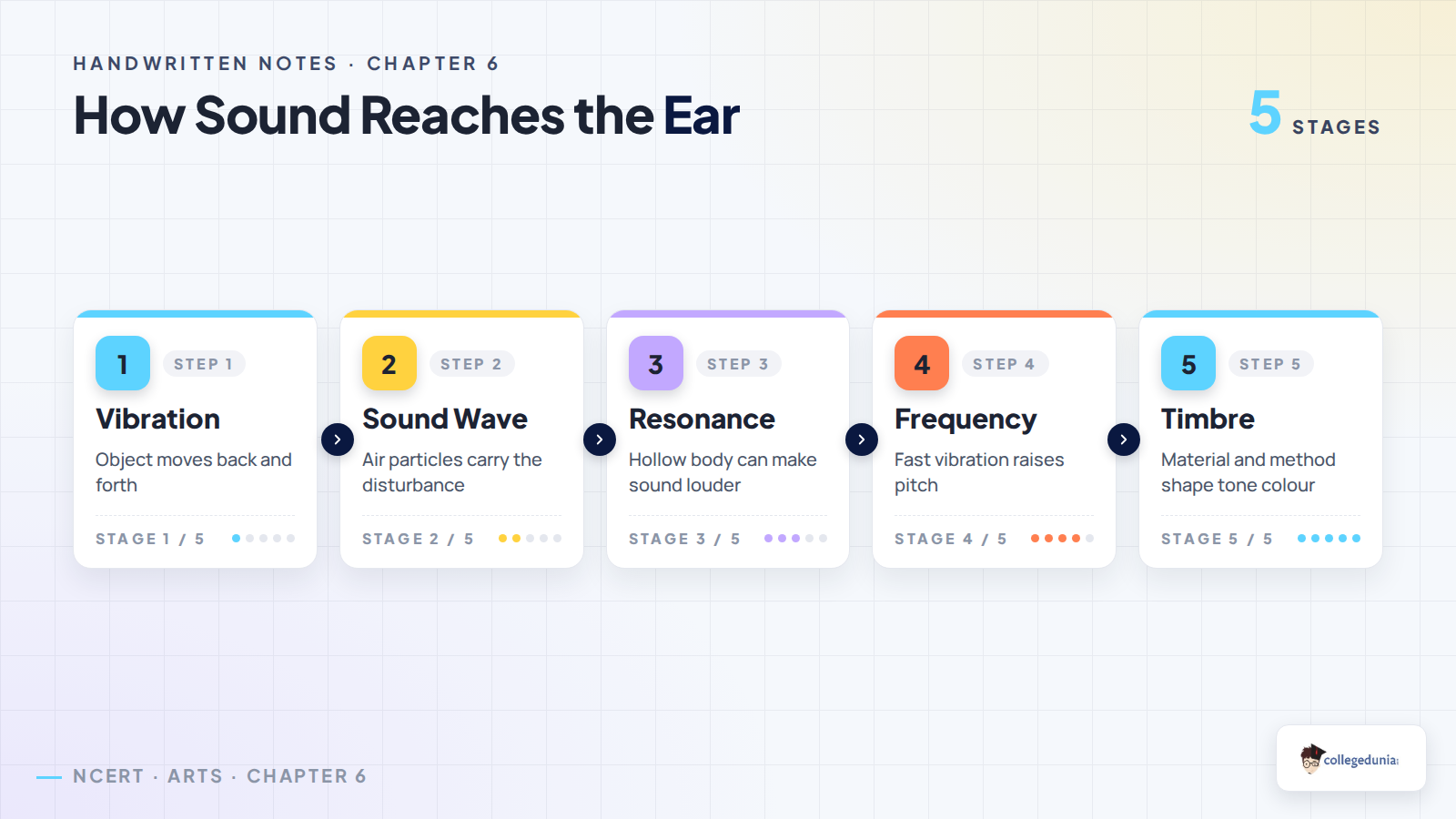
Resonance makes sound louder. A hollow drum body or cavity helps the vibration grow, so the instrument sounds stronger. Frequency means the number of vibrations per second. Faster vibration creates higher pitch.
Timbre is the tone colour of sound. It changes with the material, shape and playing technique of an instrument.
Sound Waves and Pitch Video
Source: Khan Academy on YouTube
Instrument Making and Tuning
The NCERT chapter gives a simple drum-making sequence. The maker shapes a log of wood, prepares the drum head, fixes it to the body and ties straps for tuning.
This section reminds students that instrument makers are not background workers. They keep traditional music alive through craft knowledge, material choice and repair skill.
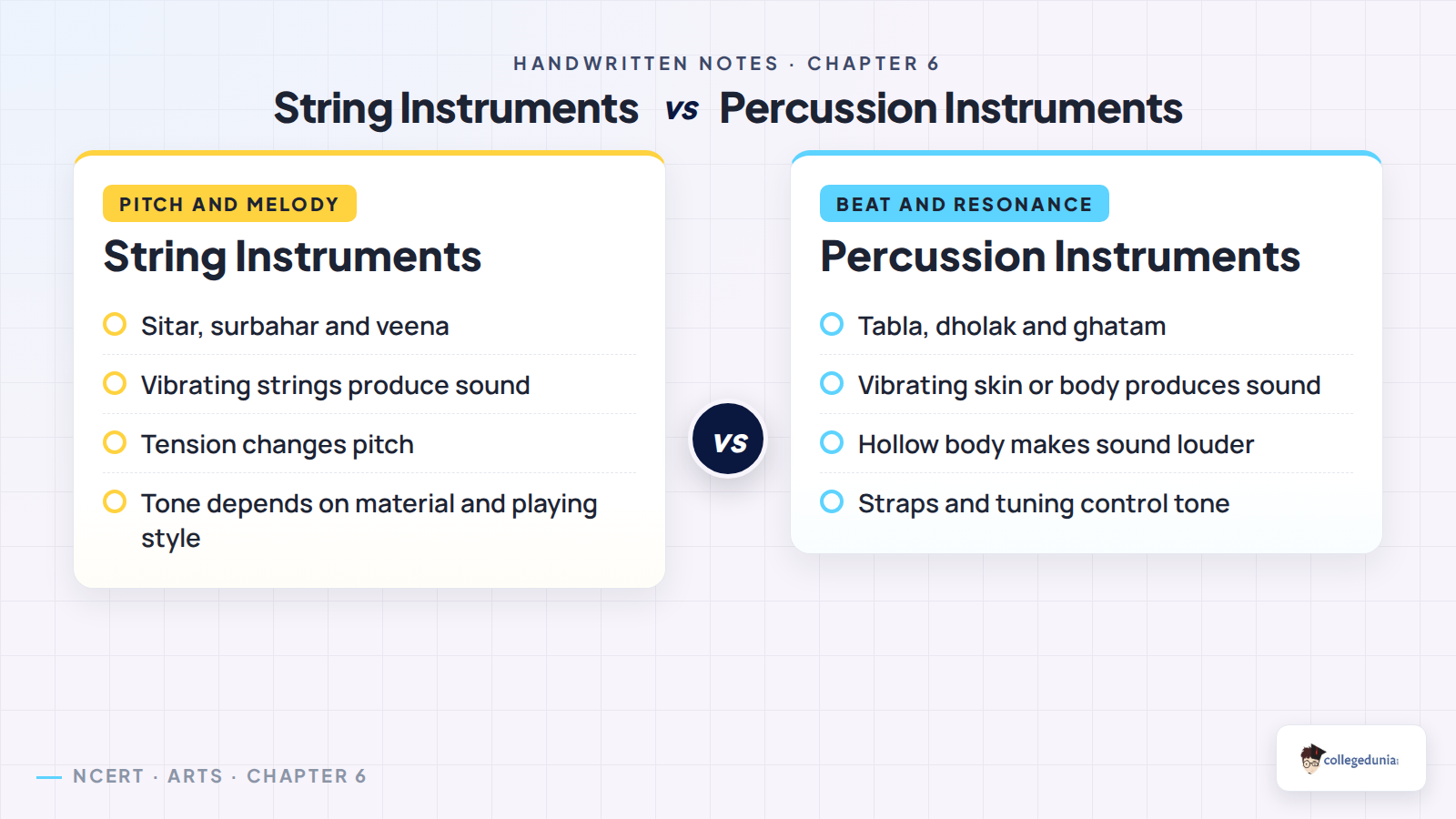
- The body gives shape and resonance.
- The head vibrates when struck.
- Straps control tightness and help tune the sound.
Famous Musicians and Their Instruments
The chapter links musicians with their instruments so students can remember Indian music traditions. Annapurna Devi is linked with the surbahar, a bass sitar with deep tones.
Pannalal Ghosh popularised the flute as a concert instrument. He chose bamboo and worked with a larger flute suited to classical and light music. Mysore Doraiswamy Iyengar is linked with the veena and the Mysore Bani style.
Activities in Musical Instruments
Activity 6.1 is a word search with instruments such as bansuri, clarinet, dholak, ektara, flute, ghatam, guitar, morsing, sarod, saxophone, shehnai and sitar. Words can move in any direction and may share letters.
Activity 6.2 asks students to mark regional percussion instruments on a map of India. This is why the handwritten notes include both names and places.
Activity 6.3 uses crossword clues. Students connect instrument material, playing method and famous musicians with the correct instrument name.
How to Use the Musical Instruments Handwritten Notes
Use the PDF as a revision checklist. Read one page, cover the points and say the main term in your own words. Then connect it with one chapter example.
- First reading: revise vibration, resonance, frequency and timbre.
- Second reading: match musicians with instruments.
- Final reading: practise word search, map and crossword clues.
Before assessment, focus on examples. A strong answer can define the term, name an instrument and connect it with the NCERT activity.
More Class 8 Arts Resources for Musical Instruments
| Resource | Link |
|---|---|
| NCERT Book PDF | Musical Instruments Class 8 Book PDF |
| Handwritten Notes | Musical Instruments Class 8 Handwritten Notes |
Class 8 Arts (Kriti) Handwritten Notes for Other Chapters
| Chapter | Handwritten Notes |
|---|---|
| Chapter 1 Bringing Words Alive: Play Reading | Download Chapter 1 Handwritten Notes |
| Chapter 2 One Stage, Many Scripts | Download Chapter 2 Handwritten Notes |
| Chapter 3 From Page to Stage | Download Chapter 3 Handwritten Notes |
| Chapter 4 Applause and Advice | Download Chapter 4 Handwritten Notes |
| Chapter 5 Discovering the Elements of Music | Download Chapter 5 Handwritten Notes |
Musical Instruments Class 8 Handwritten Notes FAQs
Ques. What is covered in the Musical Instruments handwritten notes?
Ans. The notes cover vibration, resonance, frequency, timbre, instrument making, musicians, regional percussion instruments and NCERT activities.
Ques. Are these handwritten notes based on the 2026-27 NCERT chapter?
Ans. Yes. The notes follow Class 8 Arts (Kriti) Chapter 6 Musical Instruments from the 2026-27 NCERT textbook.
Ques. Which musicians are included in Musical Instruments Class 8?
Ans. The chapter includes Annapurna Devi with surbahar, Pannalal Ghosh with flute and Mysore Doraiswamy Iyengar with veena.



Comments