




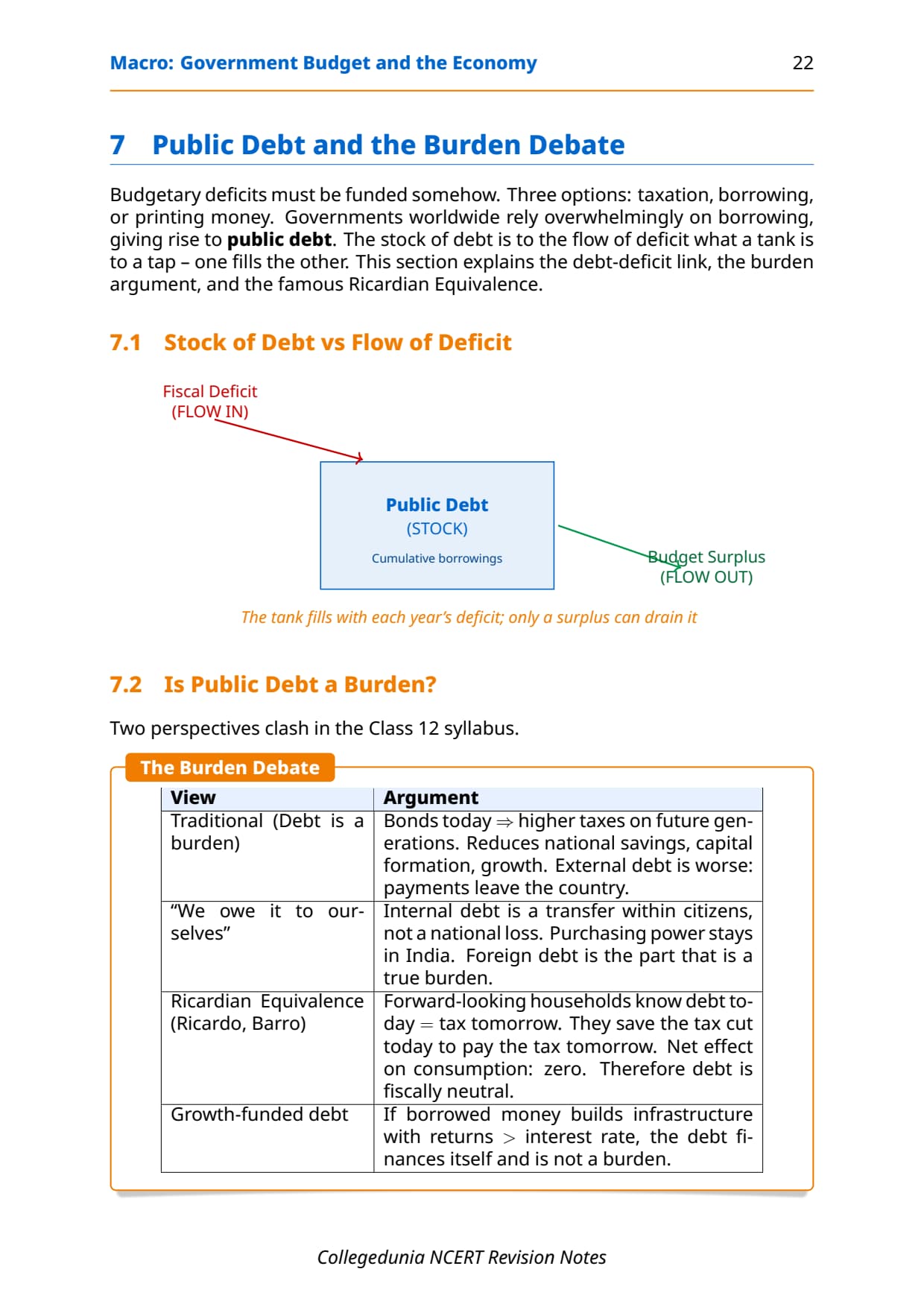
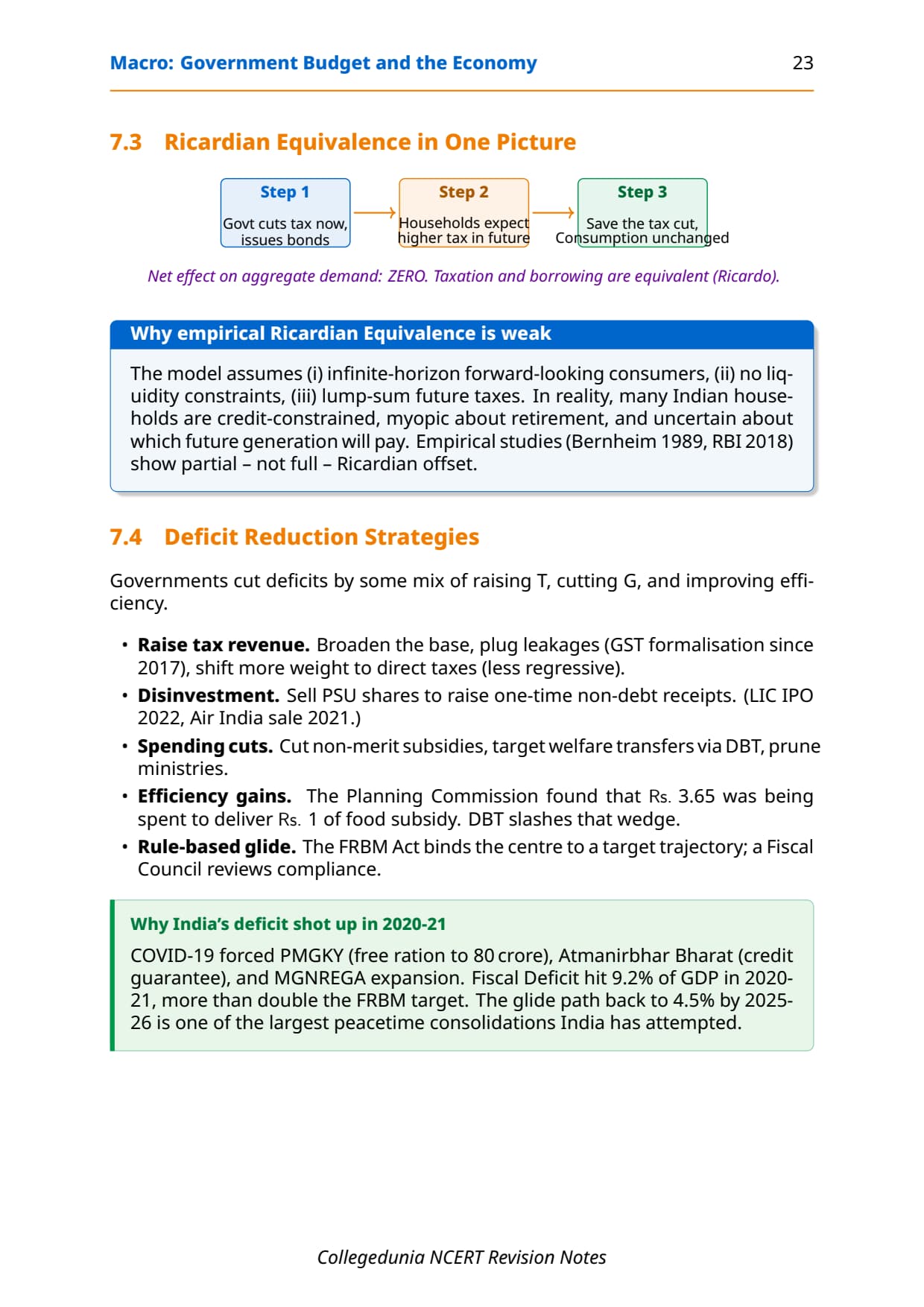
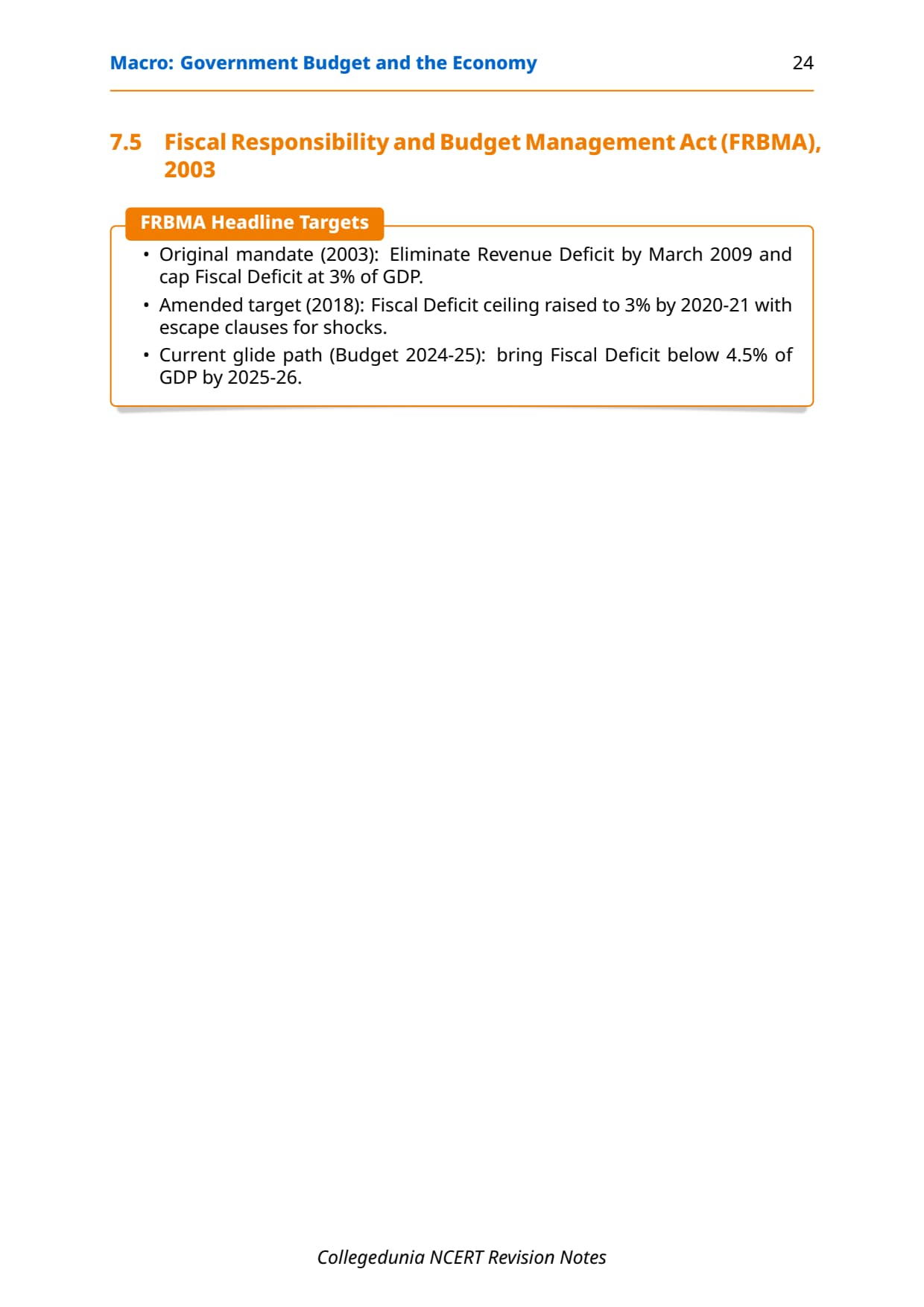
Government Budget and the Economy is Chapter 5 of the Class 12 Macroeconomics book. It covers the budget, receipts, expenditure, the three deficits and fiscal policy. This page has the full revision notes and a free PDF to download.
Here is what this chapter is worth in the exam:
- CBSE Boards: about 9 to 10 marks, theory plus deficit numericals.
- CUET: 2 to 3 questions each year on deficits and multipliers.
- Revision time: about 30 minutes with these notes.
What These Government Budget and the Economy Notes Cover
The whole chapter is one simple spine. The government plans its money for the year, splits it into receipts and expenditure, and uses tax and spending to steer the economy. These notes give each part a short, exam-ready summary:
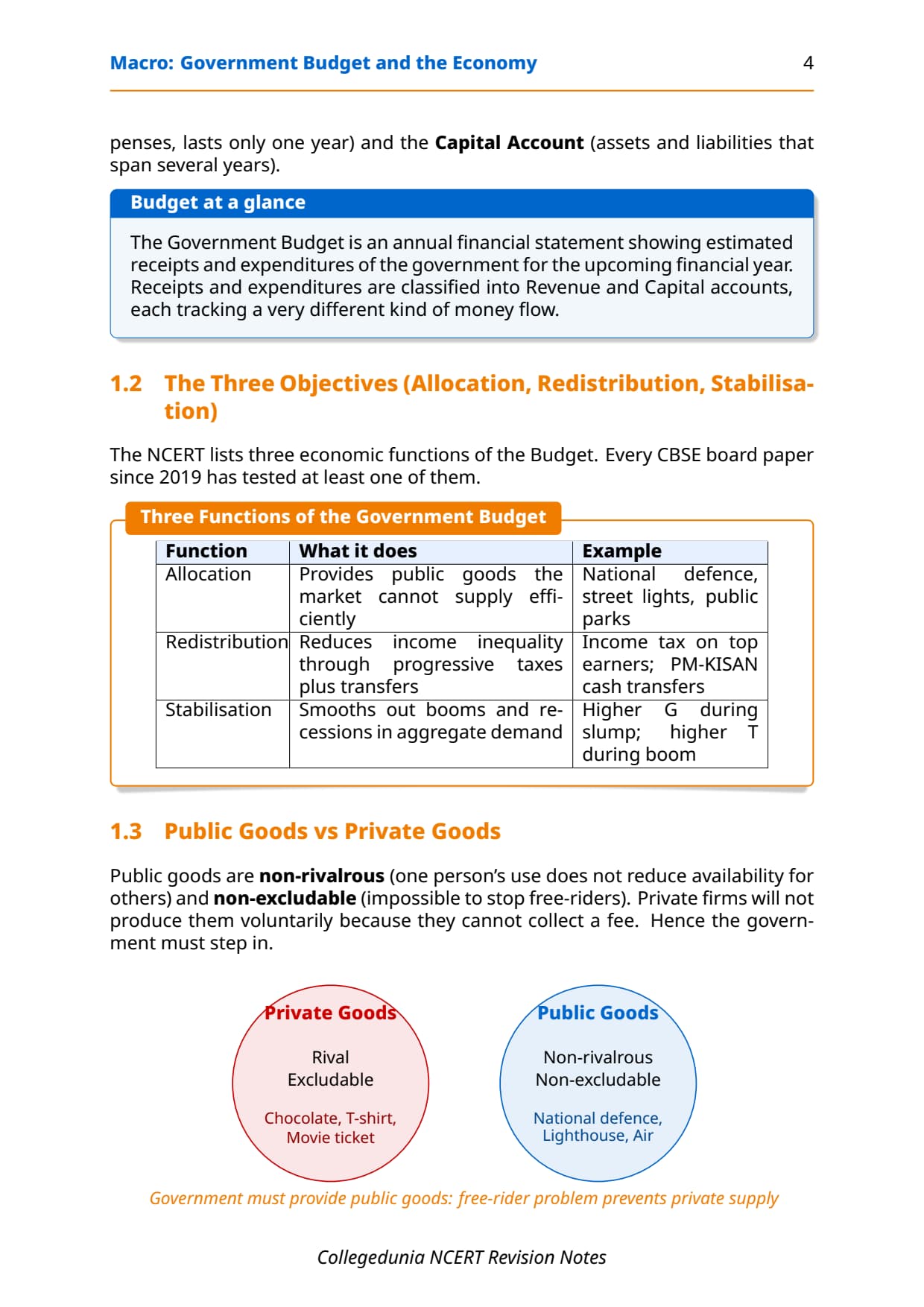
- Budget basics (1 to 3 marks): what a budget is and its main goals.
- Receipts and expenditure (6 marks): the revenue vs capital split, the most-tested part.
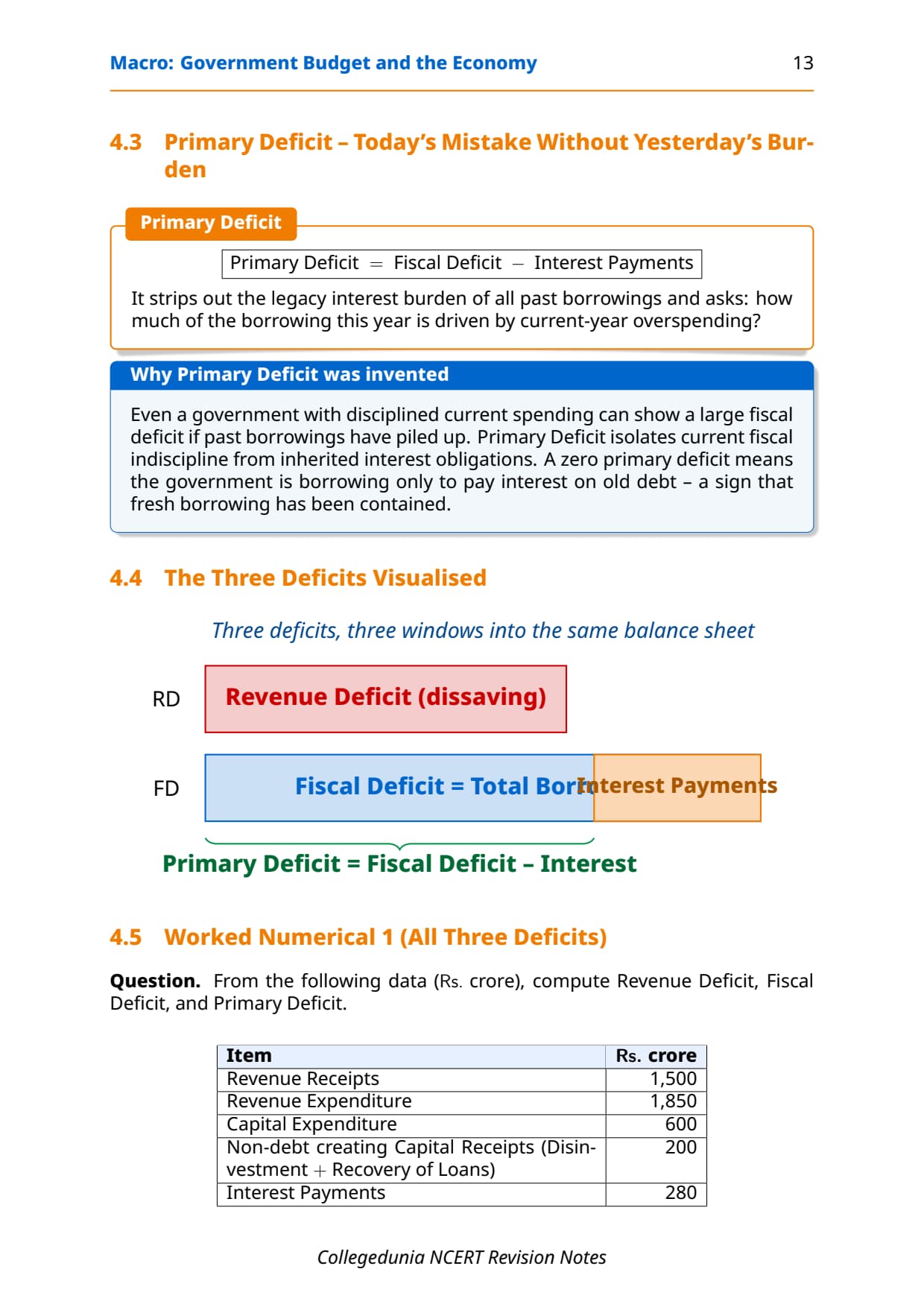
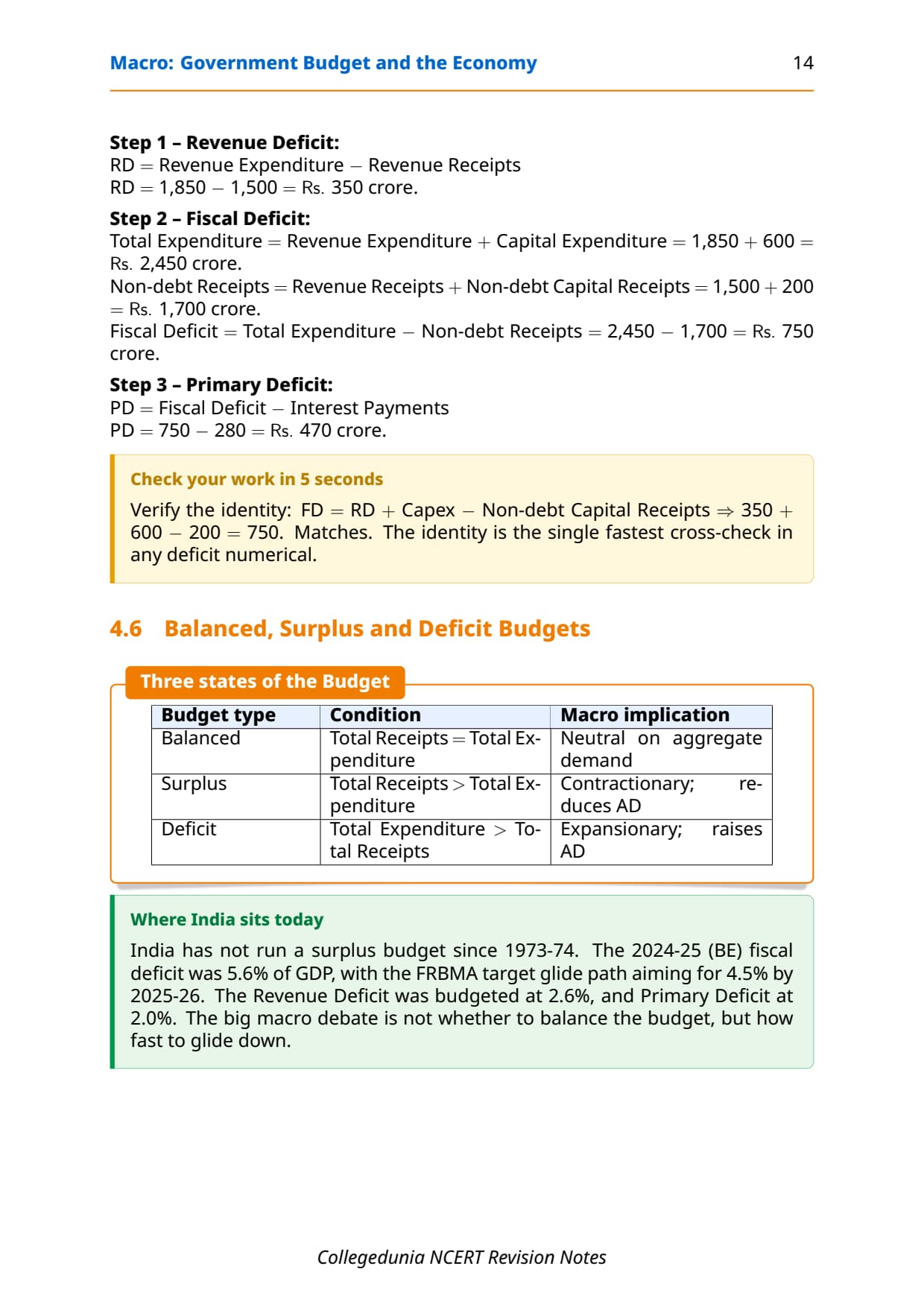
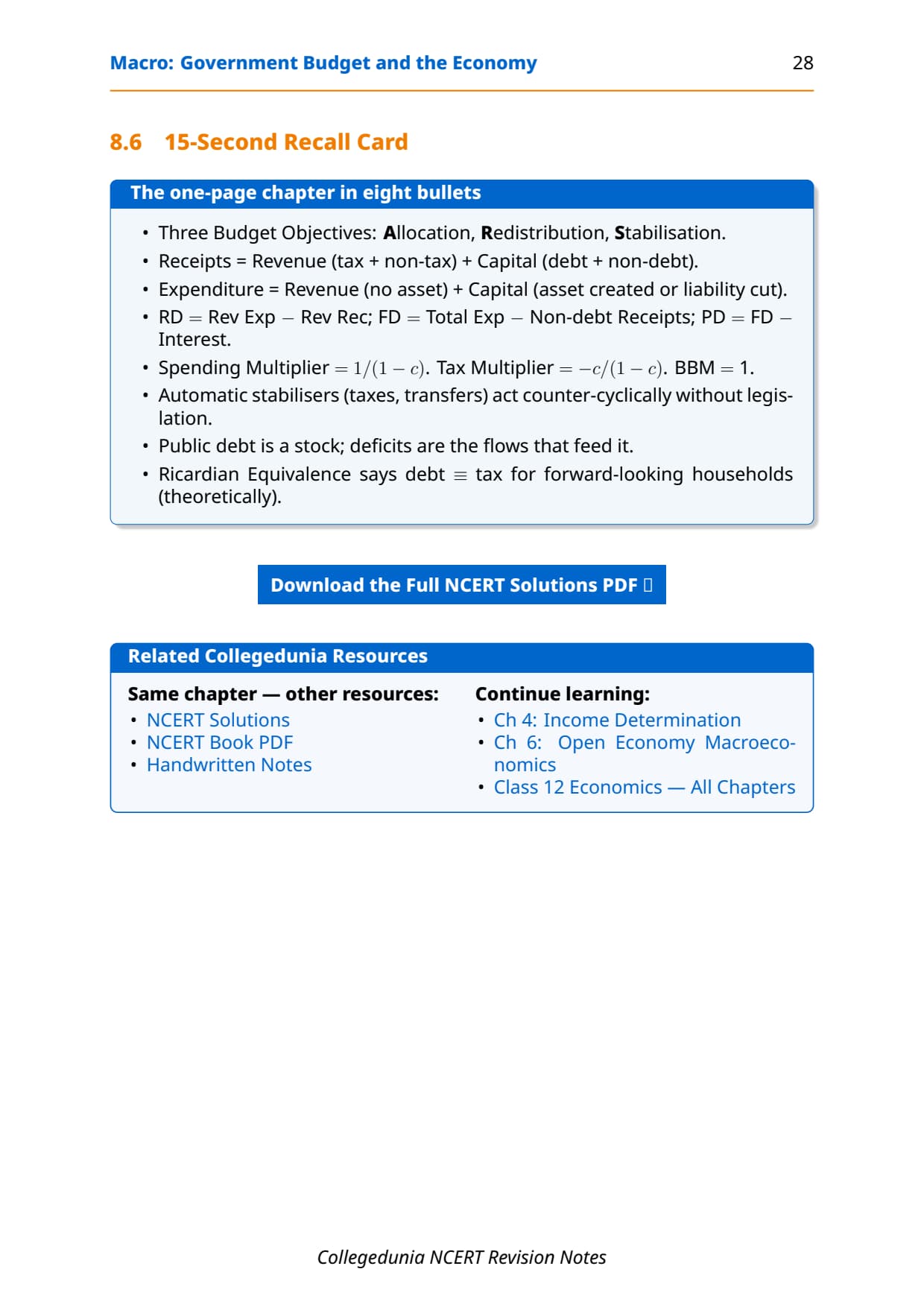
- Three deficits (4 to 7 marks): revenue, fiscal and primary deficit formulas.
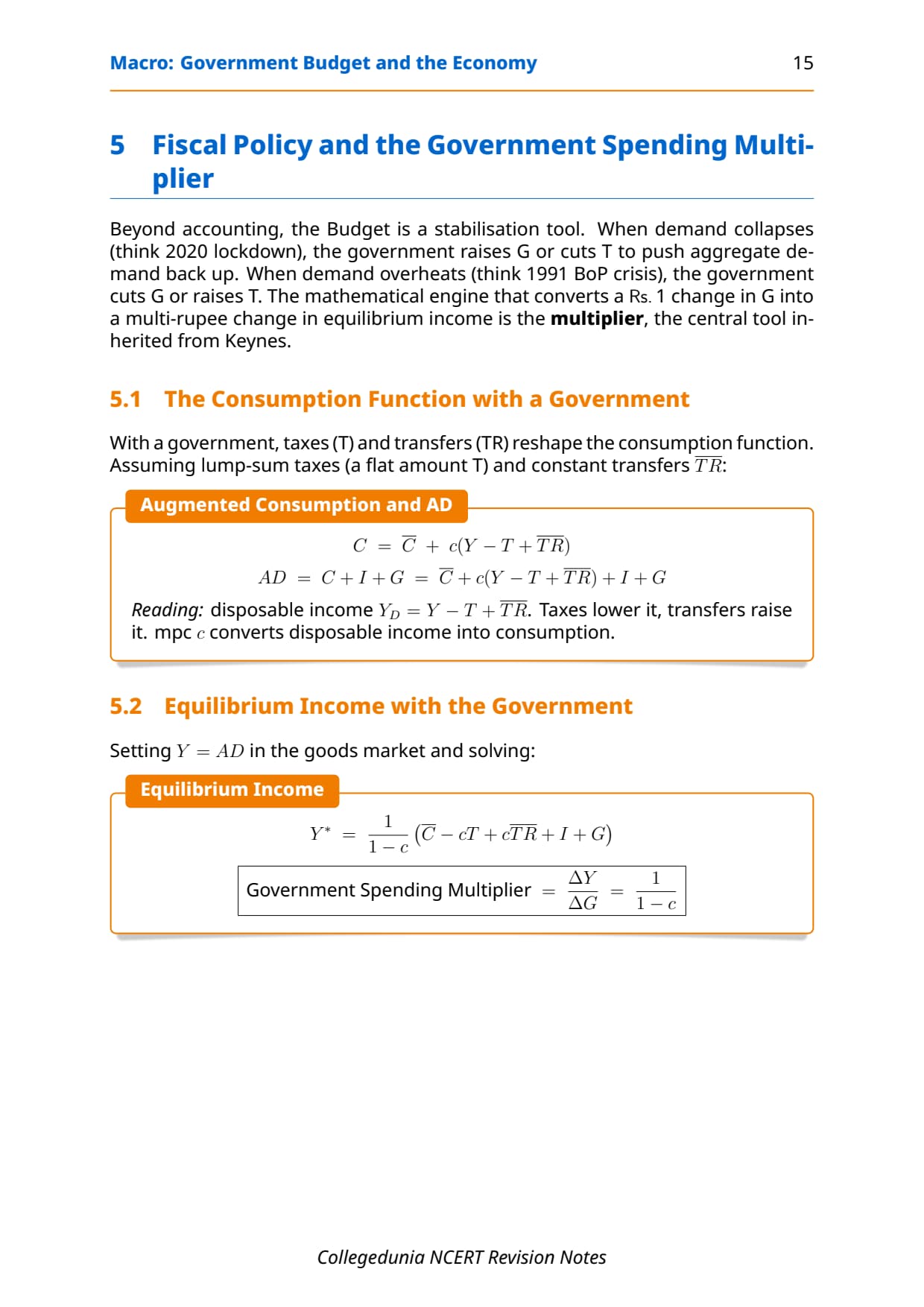
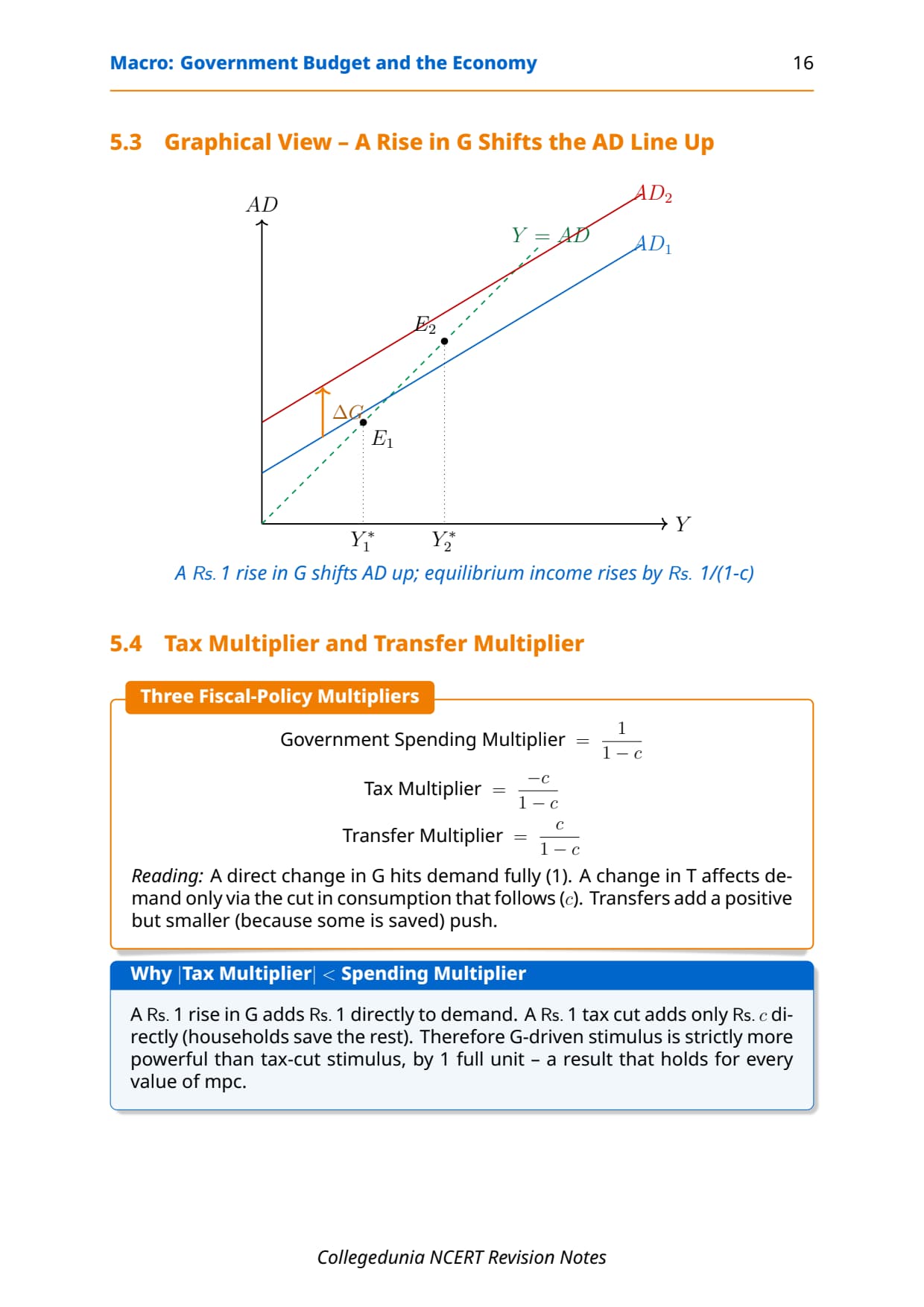
- Fiscal policy multipliers (4 marks): the tax, spending and balanced budget multipliers.
- Automatic stabilisers (1 to 3 marks): the budget's built-in shock absorbers.
Key Definitions for Government Budget Class 12
Every objective question starts with a definition. The lines below are short enough to write in a board answer.
| Term | One-line meaning |
|---|---|
| Government Budget | A yearly statement of the government's expected receipts and expenditure. |
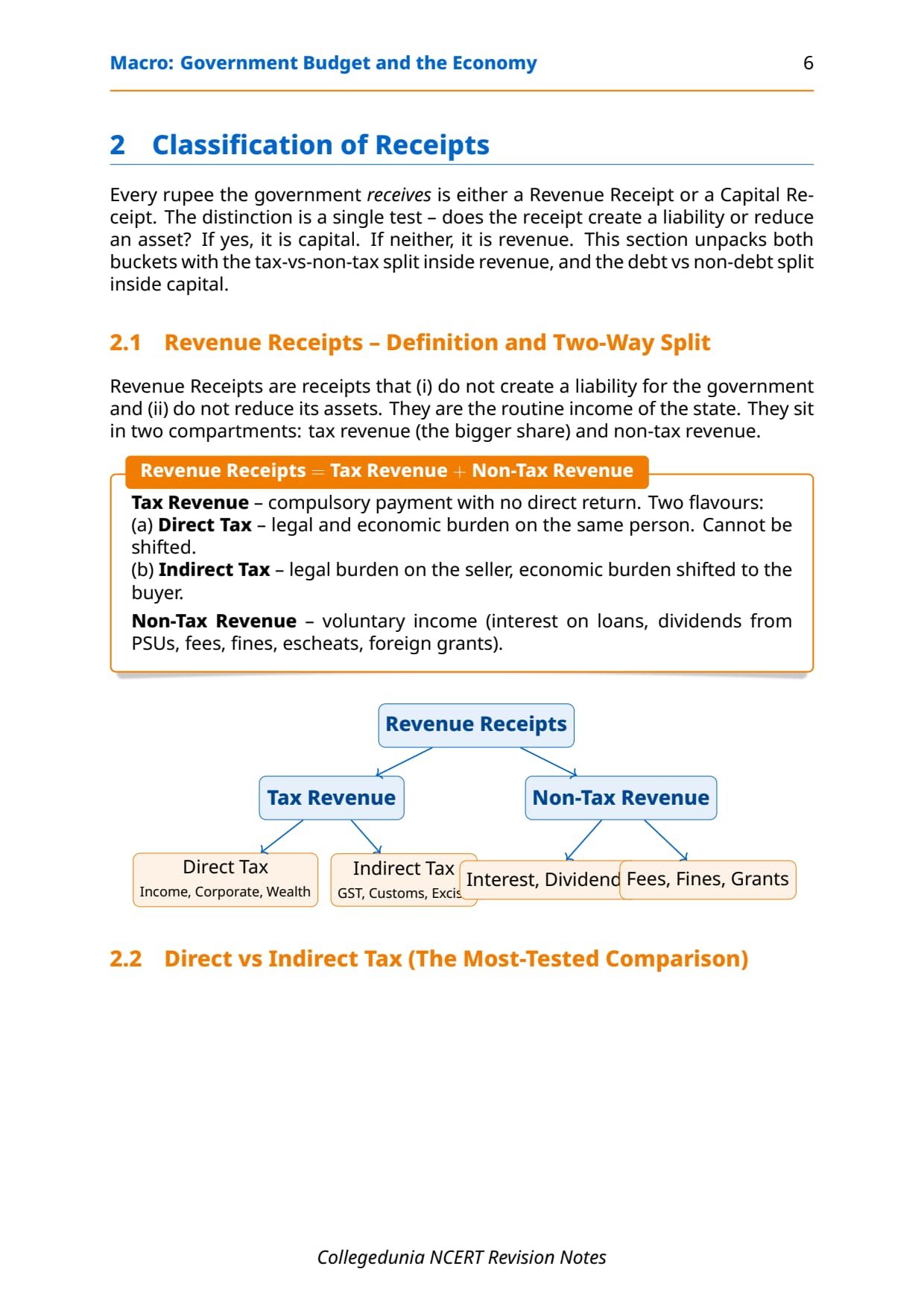
| Revenue Receipts | Receipts that neither create a liability nor reduce an asset. Tax and non-tax income. |
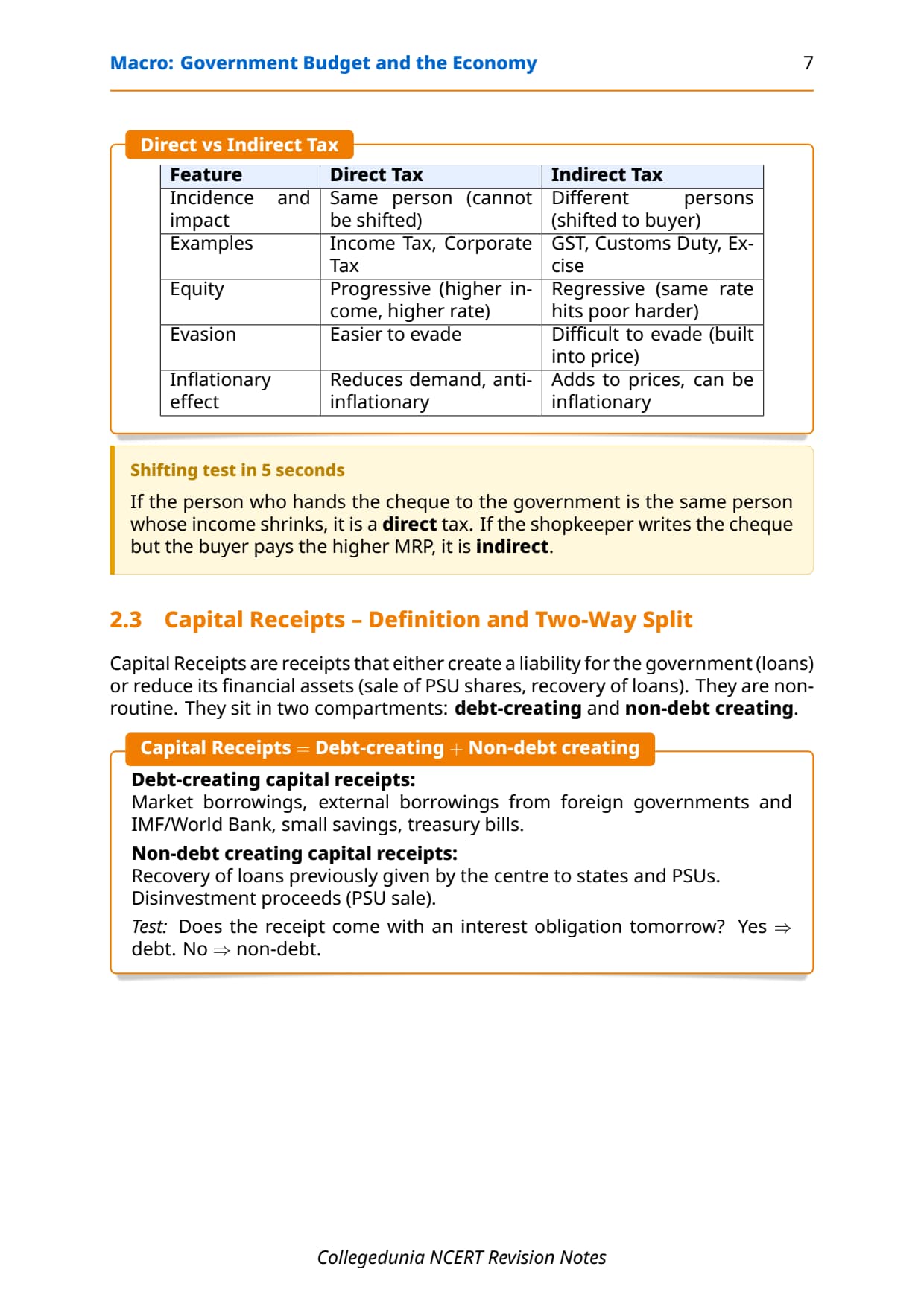
| Capital Receipts | Receipts that create a liability (borrowing) or reduce an asset (disinvestment). |
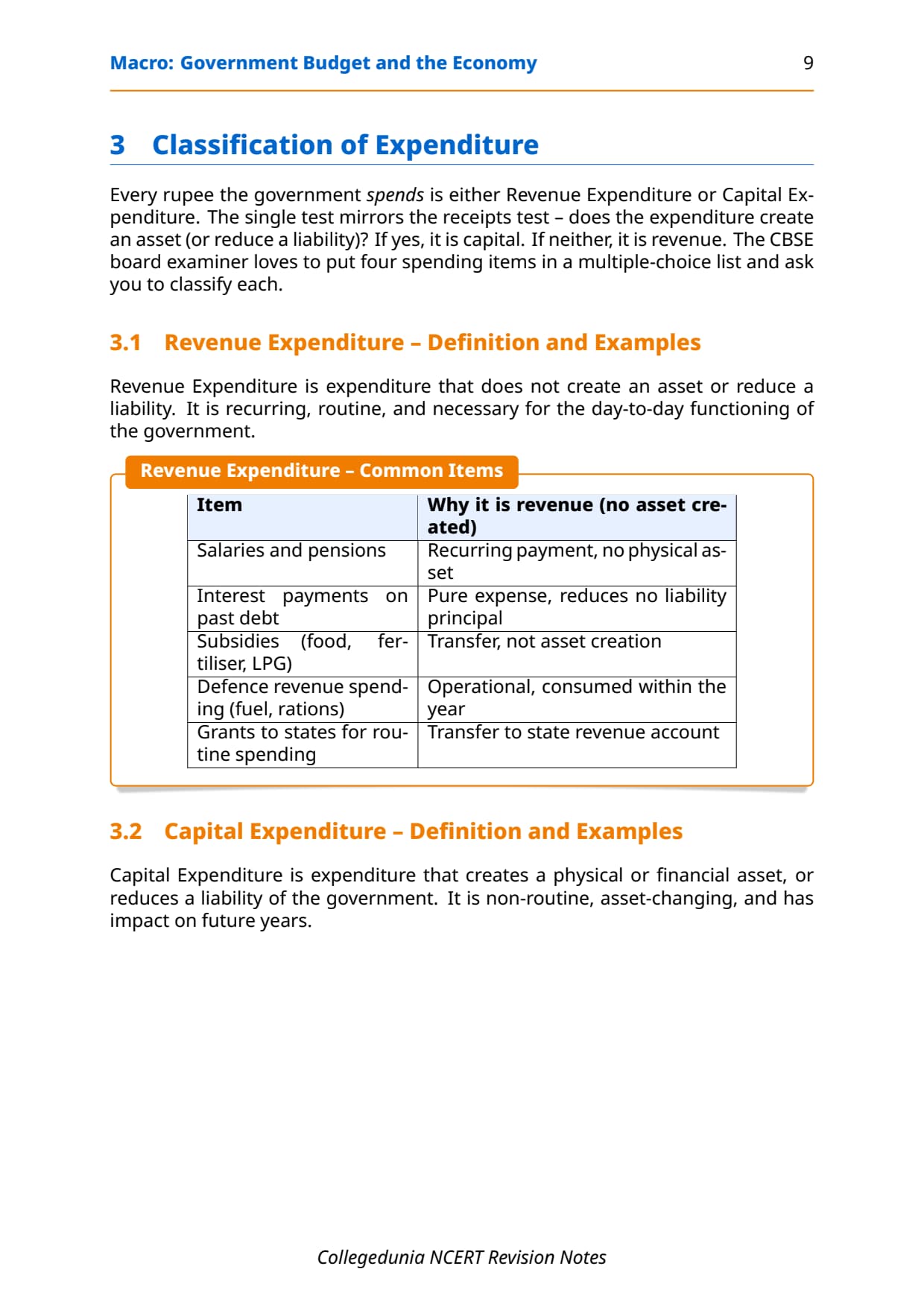
| Revenue Expenditure | Spending that creates no asset and cuts no liability. Salaries, subsidies, interest. |
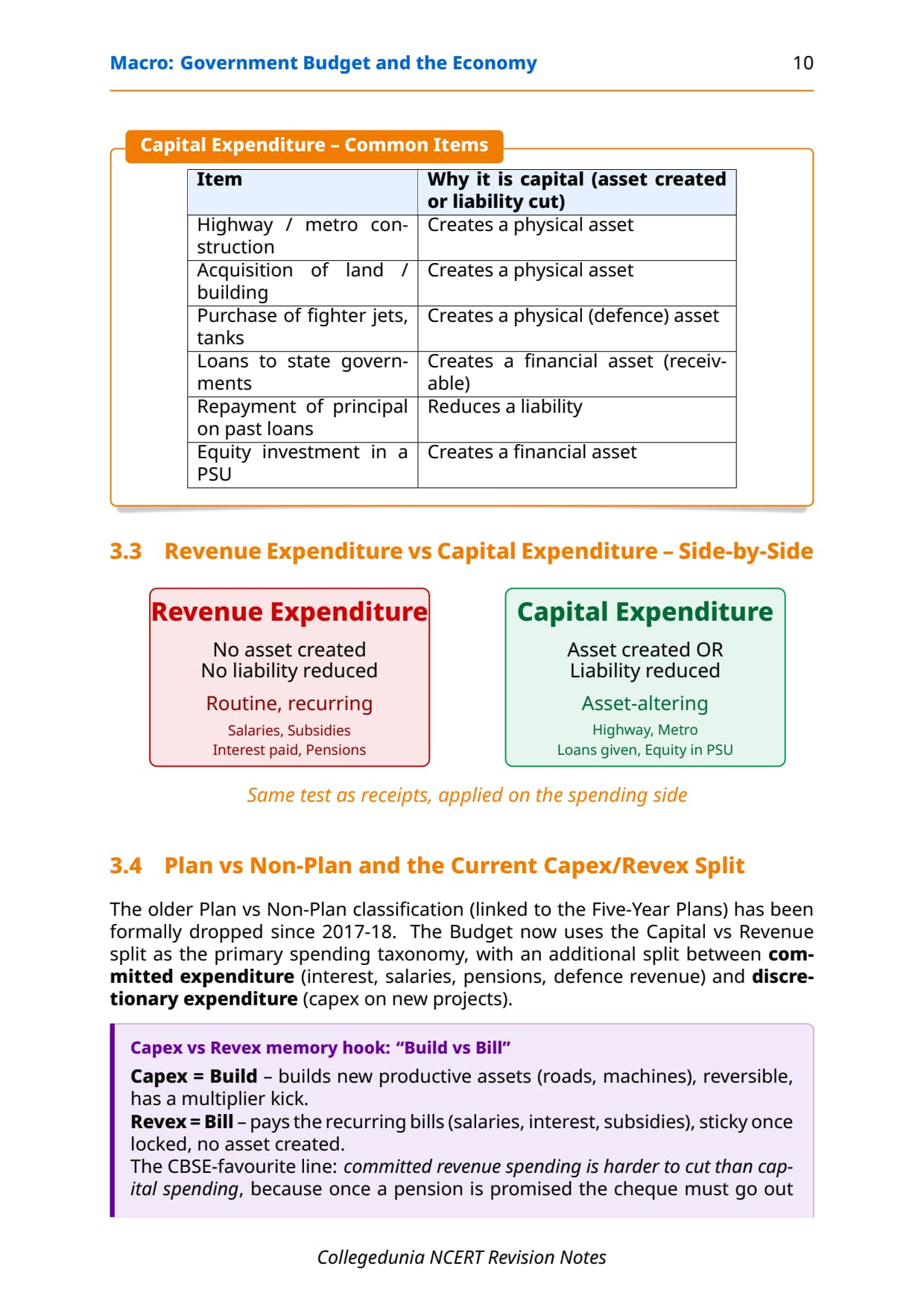
| Capital Expenditure | Spending that creates an asset (roads) or cuts a liability (loan repayment). |
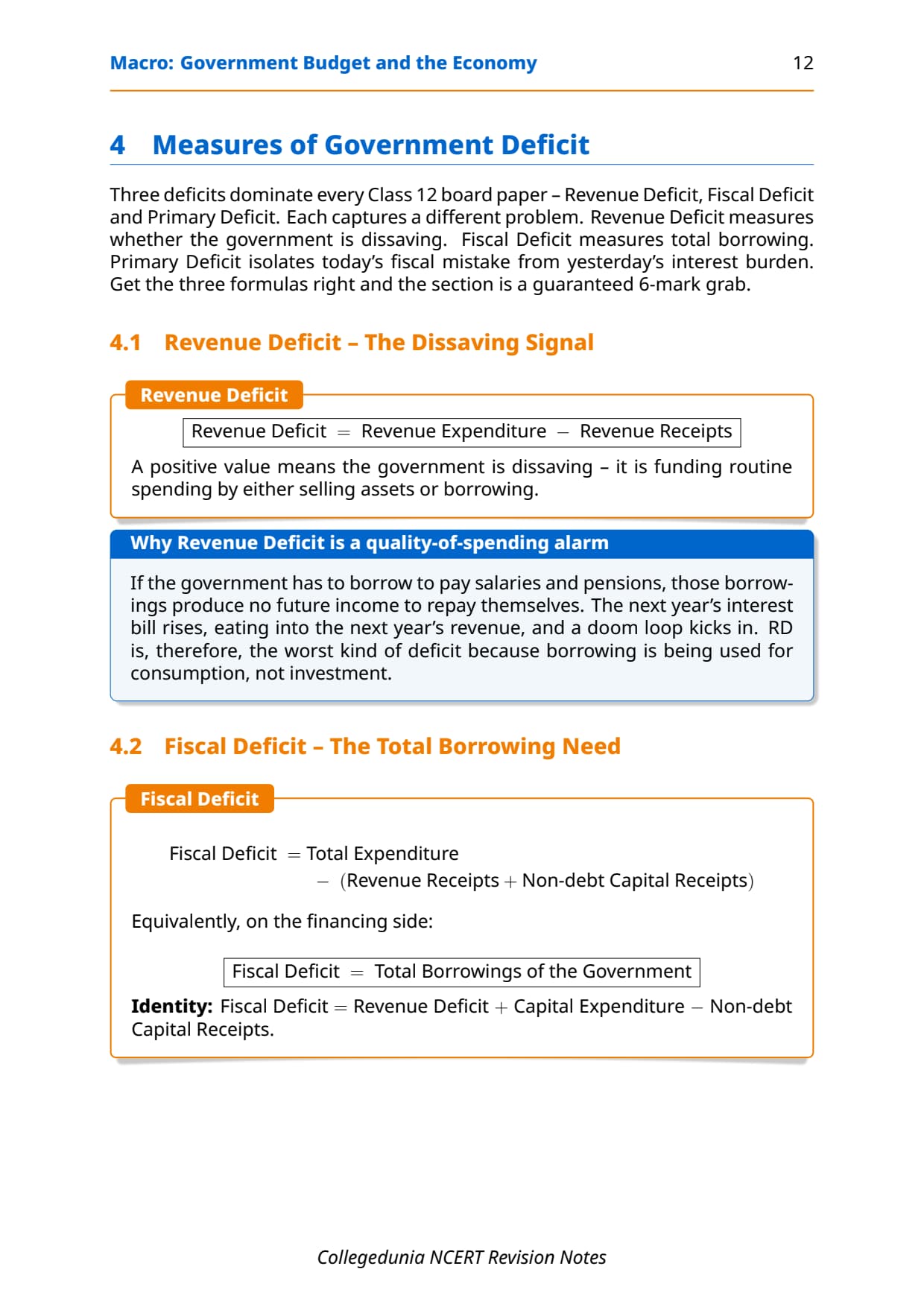
| Revenue Deficit | Revenue expenditure minus revenue receipts. |
| Fiscal Deficit | Total expenditure minus total receipts, excluding borrowings. |
| Primary Deficit | Fiscal deficit minus interest payments. |
| Direct vs Indirect Tax | A direct tax stays on the payer (income tax). An indirect tax shifts to the buyer (GST). |
These nine definitions cover most of the 1-mark and 3-mark theory questions CBSE has asked since 2021. Write them out once on paper before you move to the formula sheet.

Budget Receipts and Expenditure: Revenue vs Capital
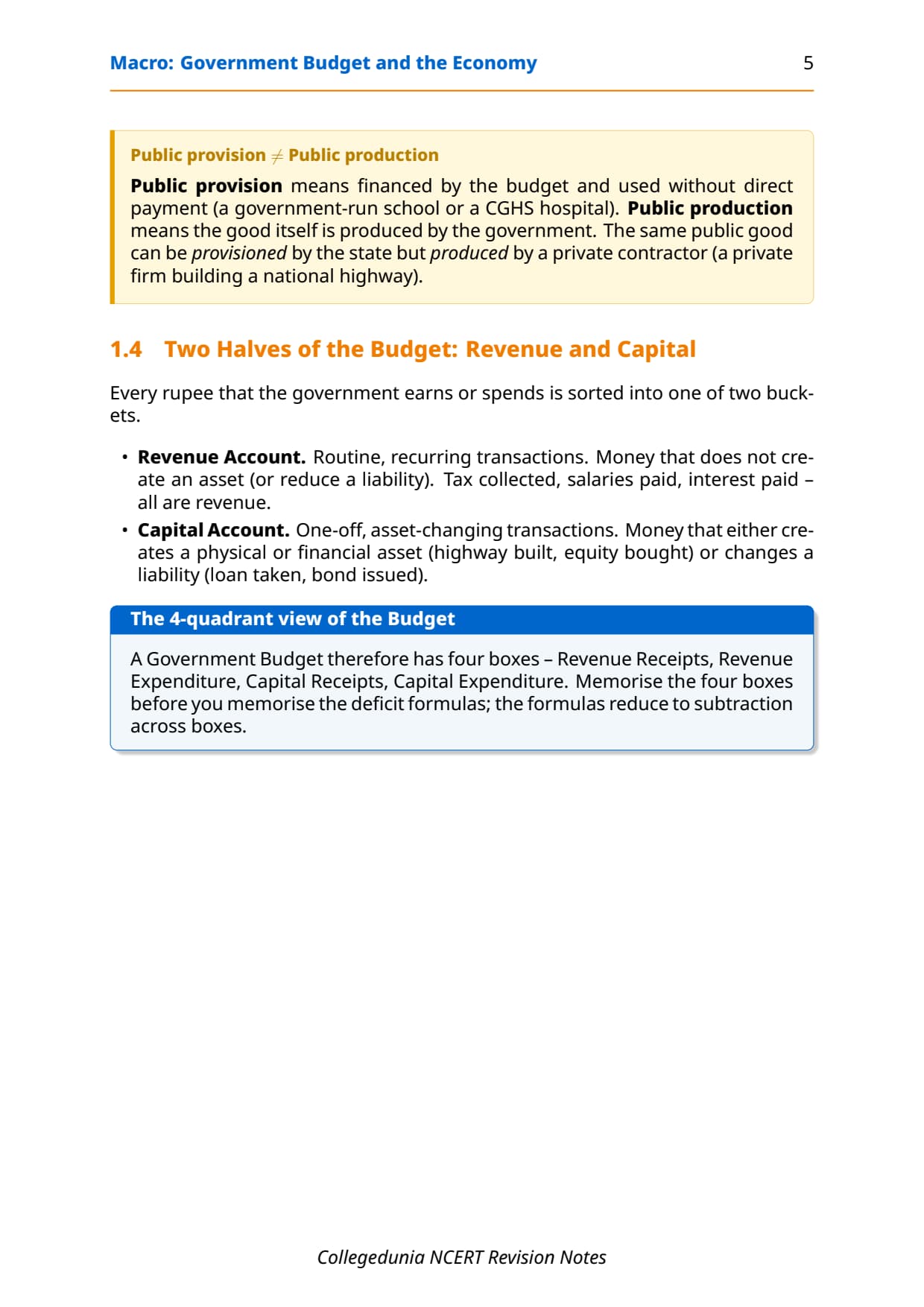
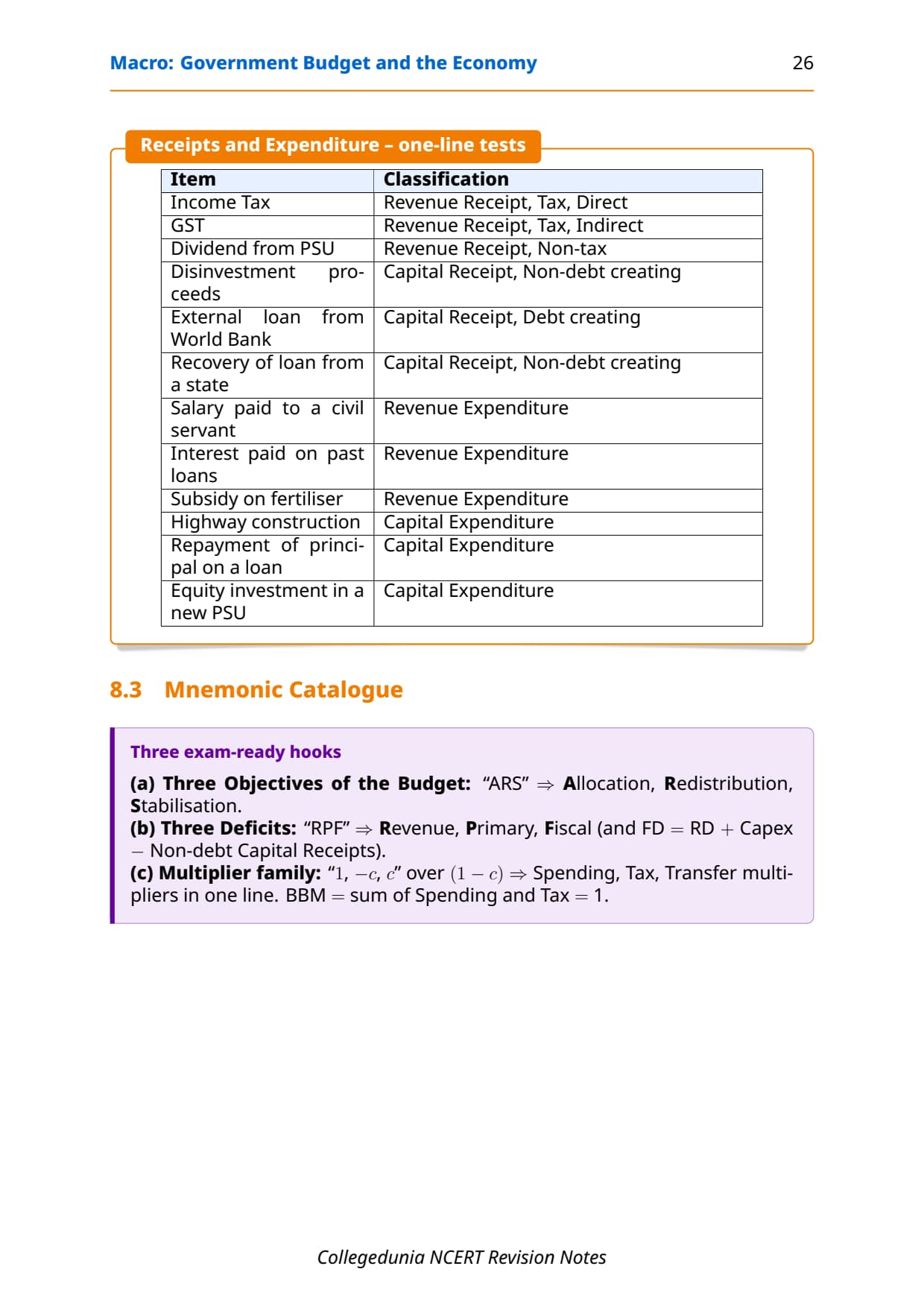
Both receipts and expenditure split the same way. The test is simple. If an item creates a liability or reduces an asset, it is capital. If not, it is revenue. CBSE rewards students who apply this one test across every item in a classification numerical.
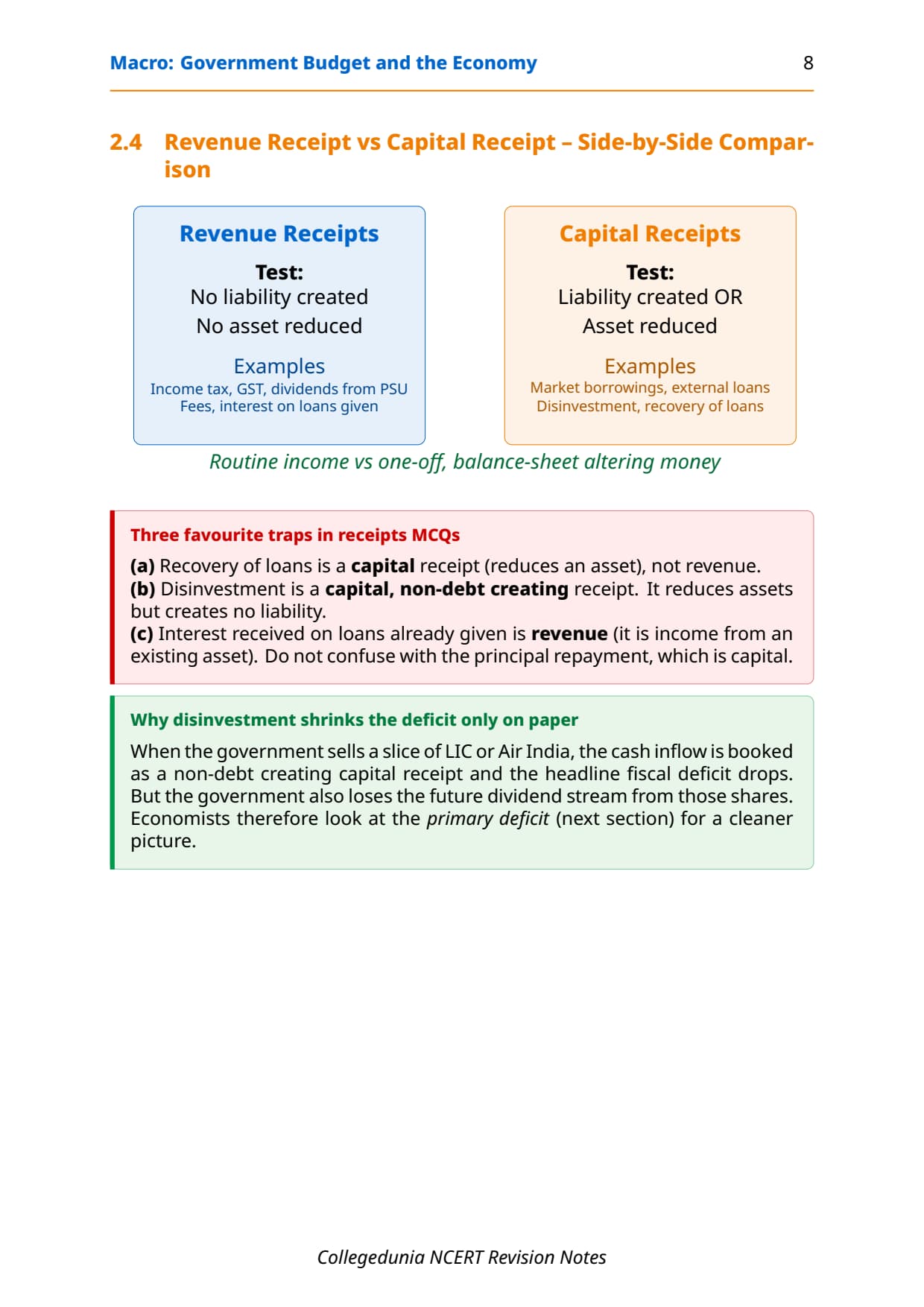
Two traps catch most students. Borrowings always create a liability, so they are capital receipts, not revenue. Disinvestment reduces a government asset, so it is also a capital receipt even though cash comes in. The table below is the one to memorise for expenditure.
| Expenditure item | Revenue | Capital |
|---|---|---|
| Salaries and pensions of govt employees | Yes | No |
| Interest payments on past debt | Yes | No |
| Subsidies (food, fuel, fertiliser) | Yes | No |
| Construction of roads, bridges, schools | No | Yes |
| Purchase of machinery, defence equipment | No | Yes |
| Loans given to state govts and PSUs | No | Yes |
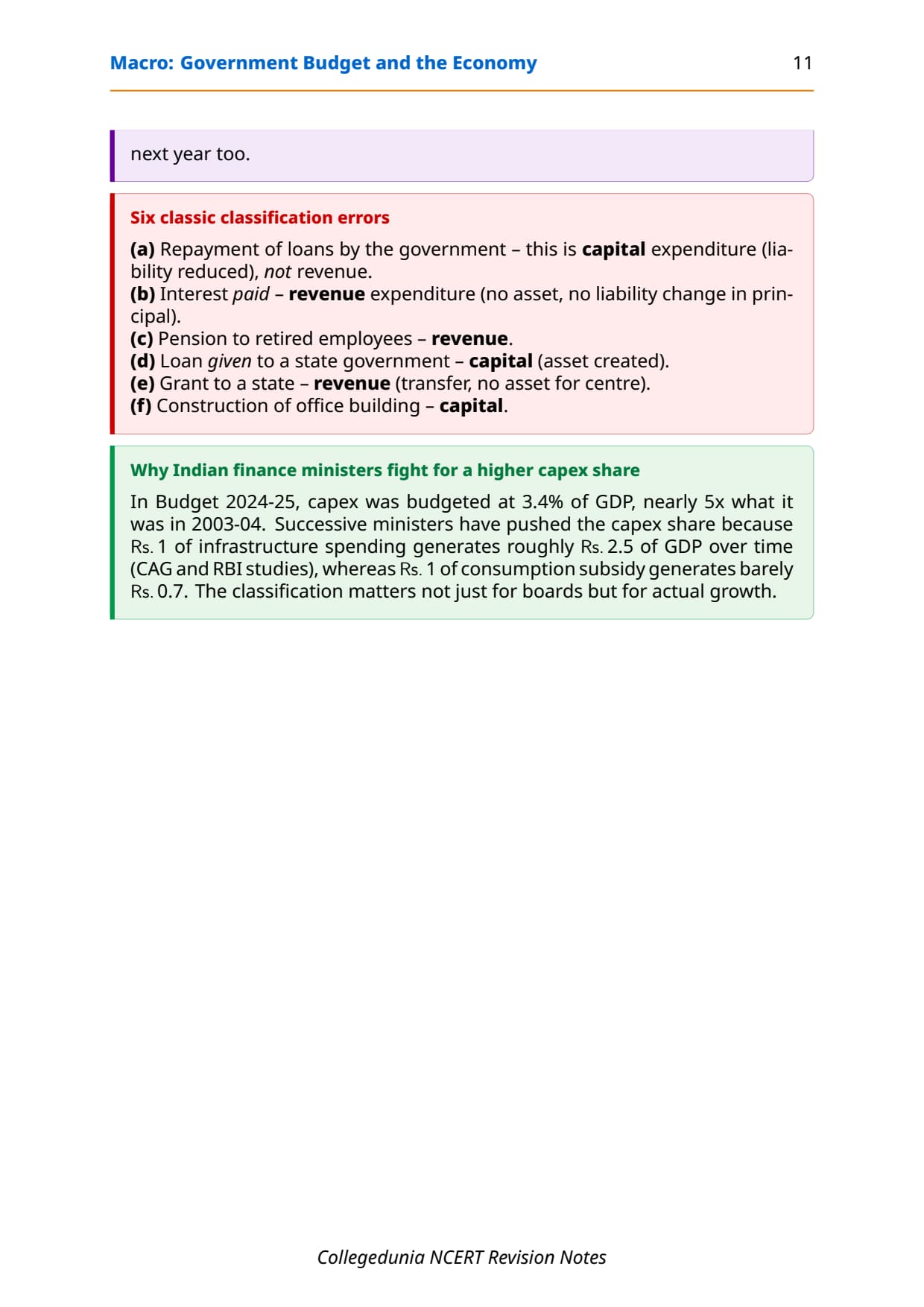
| Repayment of past loans (principal) | No | Yes |
Memory hook: the repayment of a loan's principal is capital expenditure, but the interest on it is revenue expenditure. Splitting the EMI this way is the single most-tested distinction in the chapter.
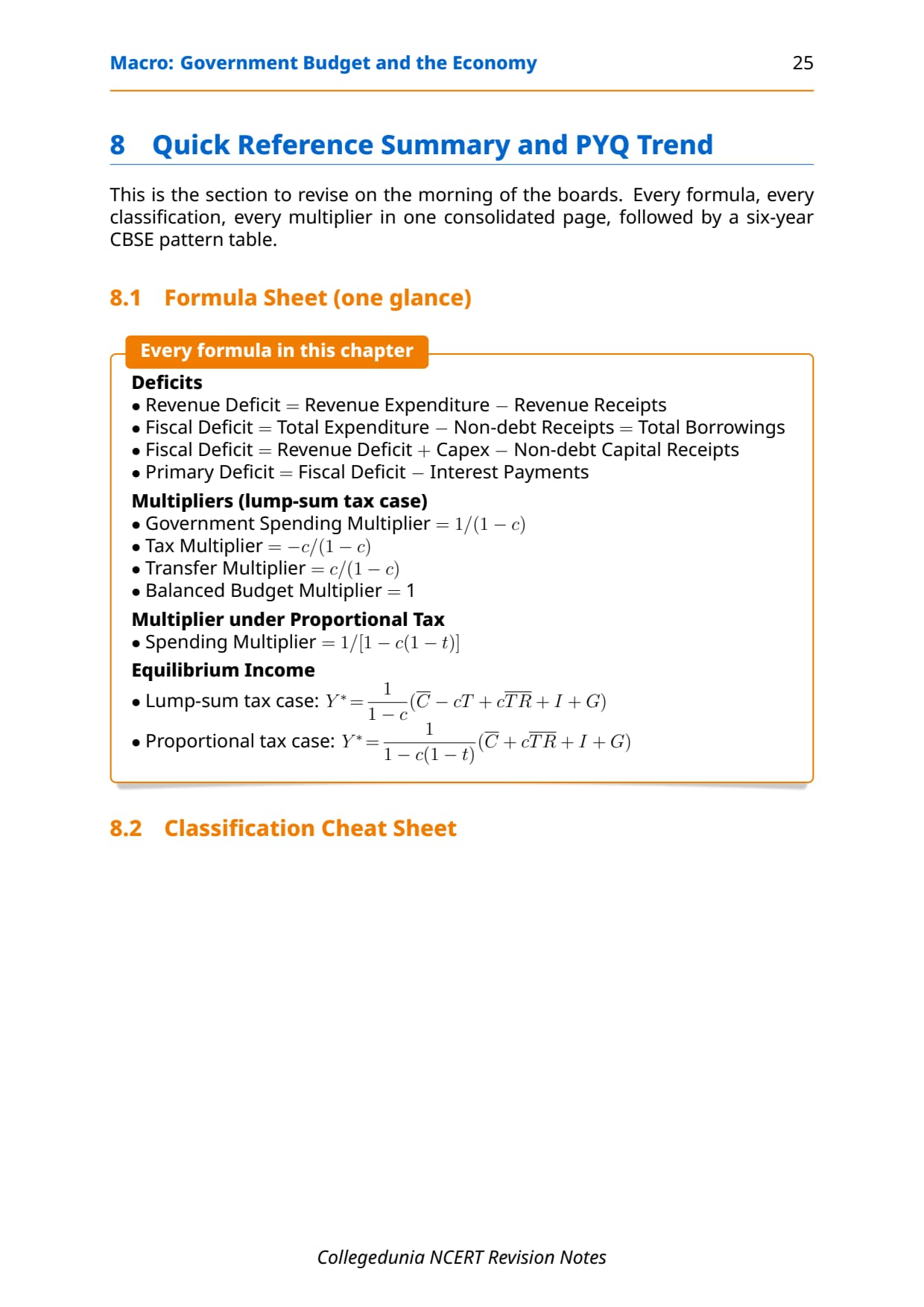
Formula Sheet for Government Budget Class 12 Notes
This is the block to revise in the last 20 minutes before the exam. Every formula here is used in at least one NCERT exercise question or a recent CBSE paper.
| Concept | Formula |
|---|---|
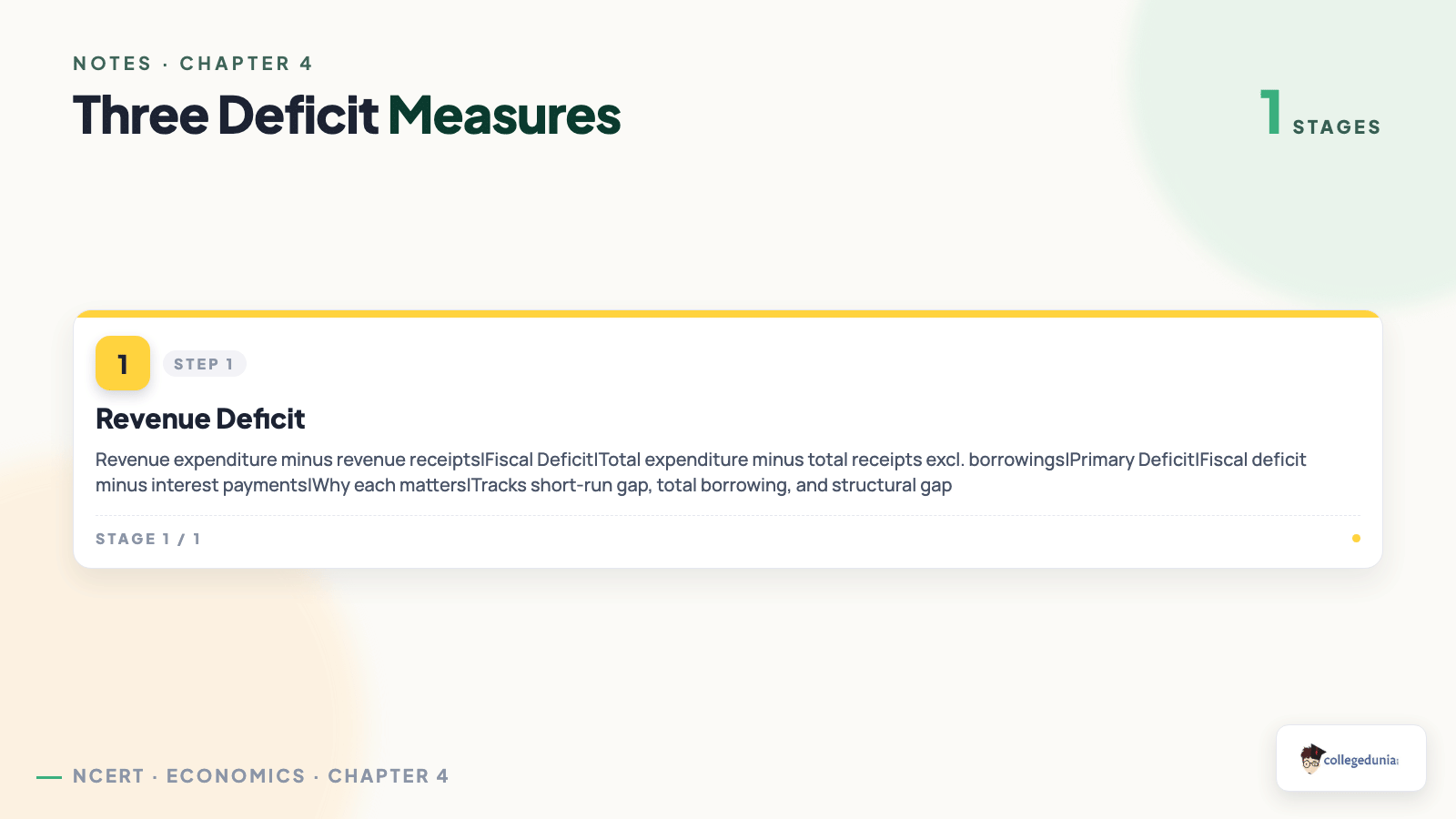
| Revenue Deficit | Revenue Expenditure minus Revenue Receipts |
| Fiscal Deficit | Total Expenditure minus Total Receipts excluding Borrowings |
| Primary Deficit | Fiscal Deficit minus Interest Payments |
| Total Budget Receipts | Revenue Receipts + Capital Receipts |
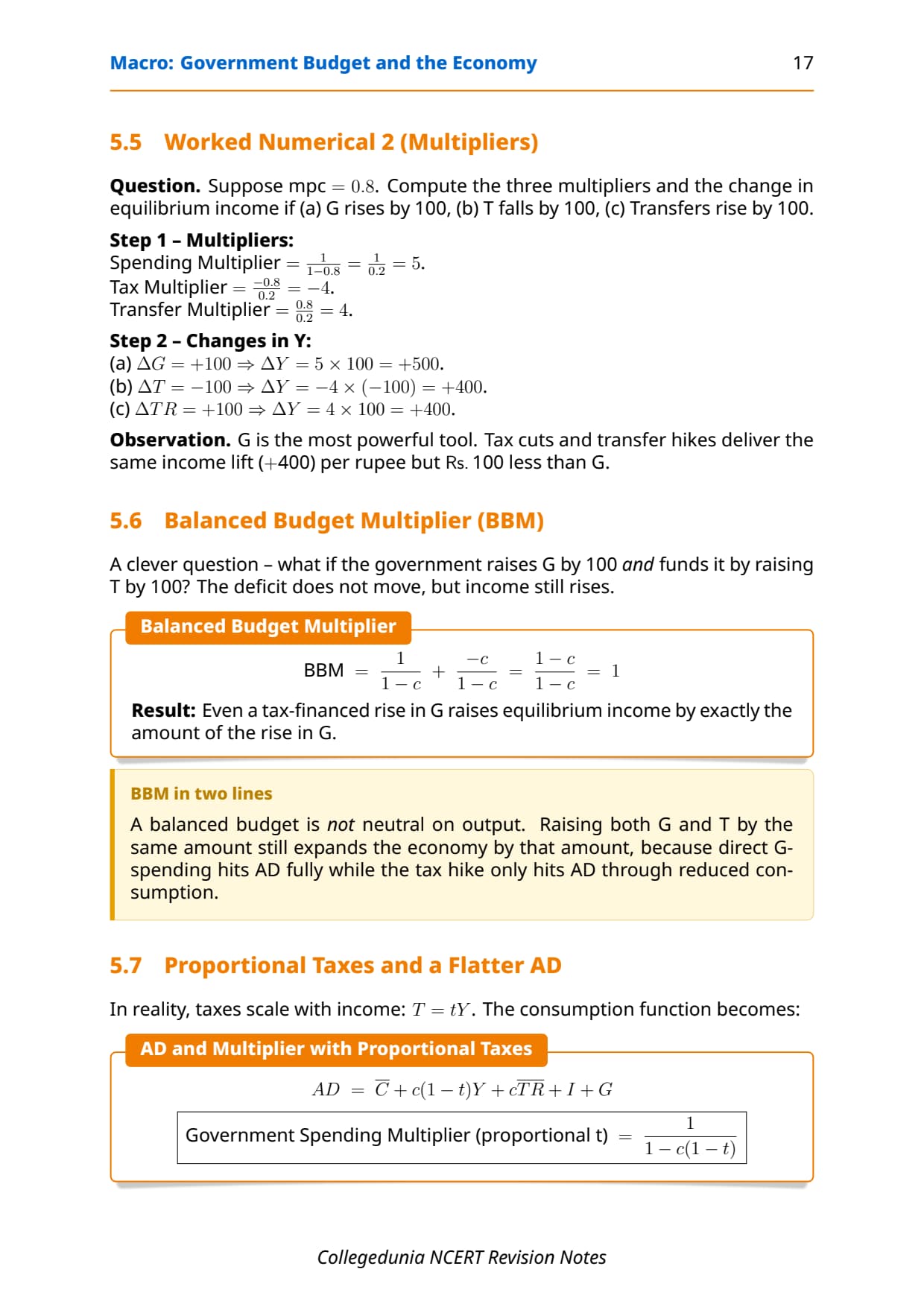
| Government Expenditure Multiplier | Δ Y / Δ G = 1 / (1 - MPC) |
| Tax Multiplier | Δ Y / Δ T = -MPC / (1 - MPC) |
| Balanced Budget Multiplier | Δ Y / Δ G = 1 when Δ G = Δ T |
| Marginal Propensity to Consume | MPC = Δ C / Δ Y |
Worked sums on each formula sit in the matching NCERT Solutions for Class 12 Economics Chapter 5. The notes are for memorising the formulas, not for working numericals from scratch.
Fiscal Policy Multipliers in Government Budget Class 12
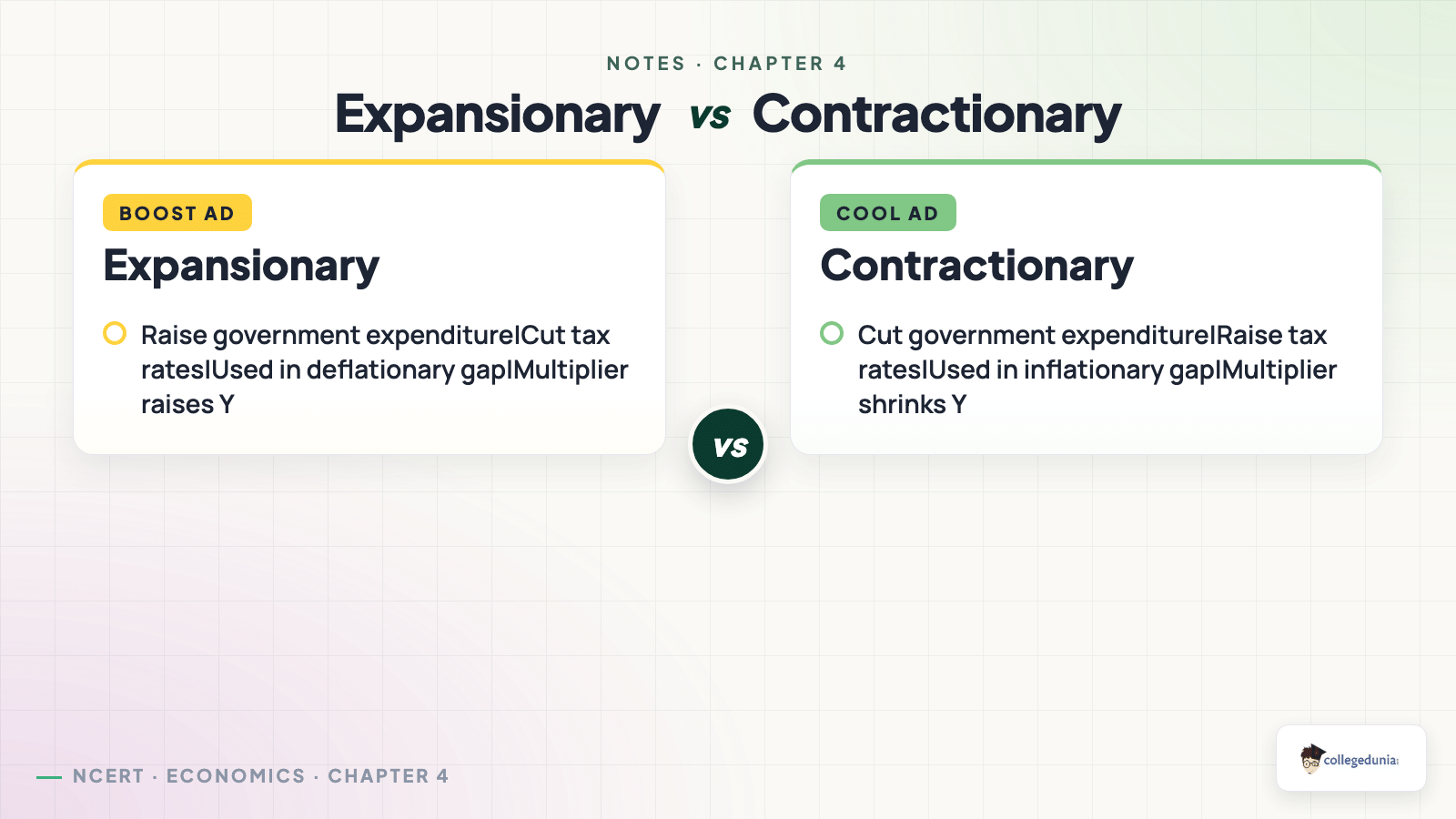
The government changes its spending (G) or taxes (T) to lift demand in a slump and cool it in a boom. The income response per rupee is measured by three multipliers.
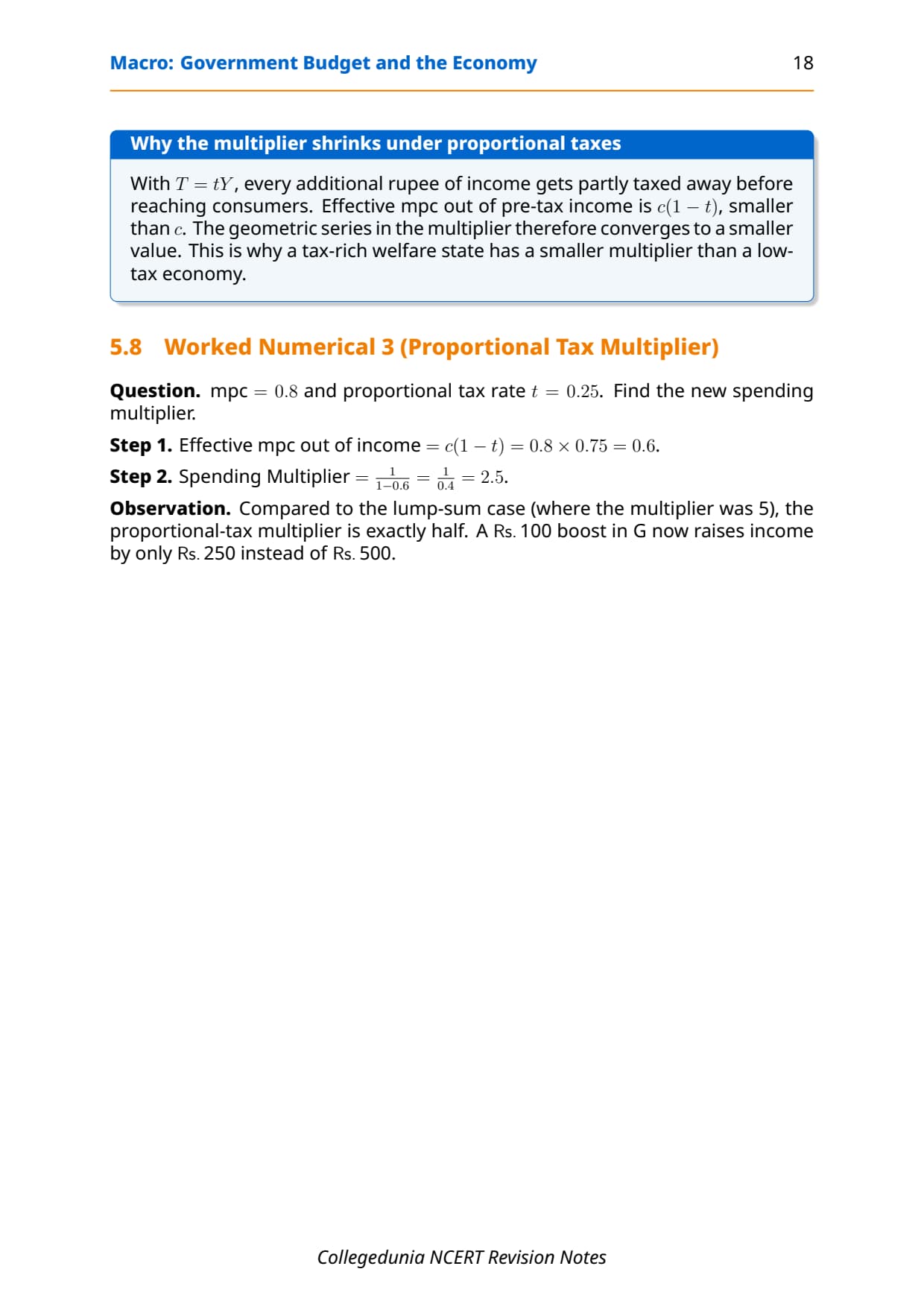
- Government expenditure multiplier: equals 1 / (1 - MPC). If MPC is 0.8, it is 5, so Rs 100 crore of extra G raises income by Rs 500 crore.
- Tax multiplier: equals -MPC / (1 - MPC). With MPC 0.8 it is minus 4. It is smaller because a tax cut leaks part into saving.
- Balanced budget multiplier: always equals 1. An equal rise in G and T raises income by exactly that amount, whatever the MPC.
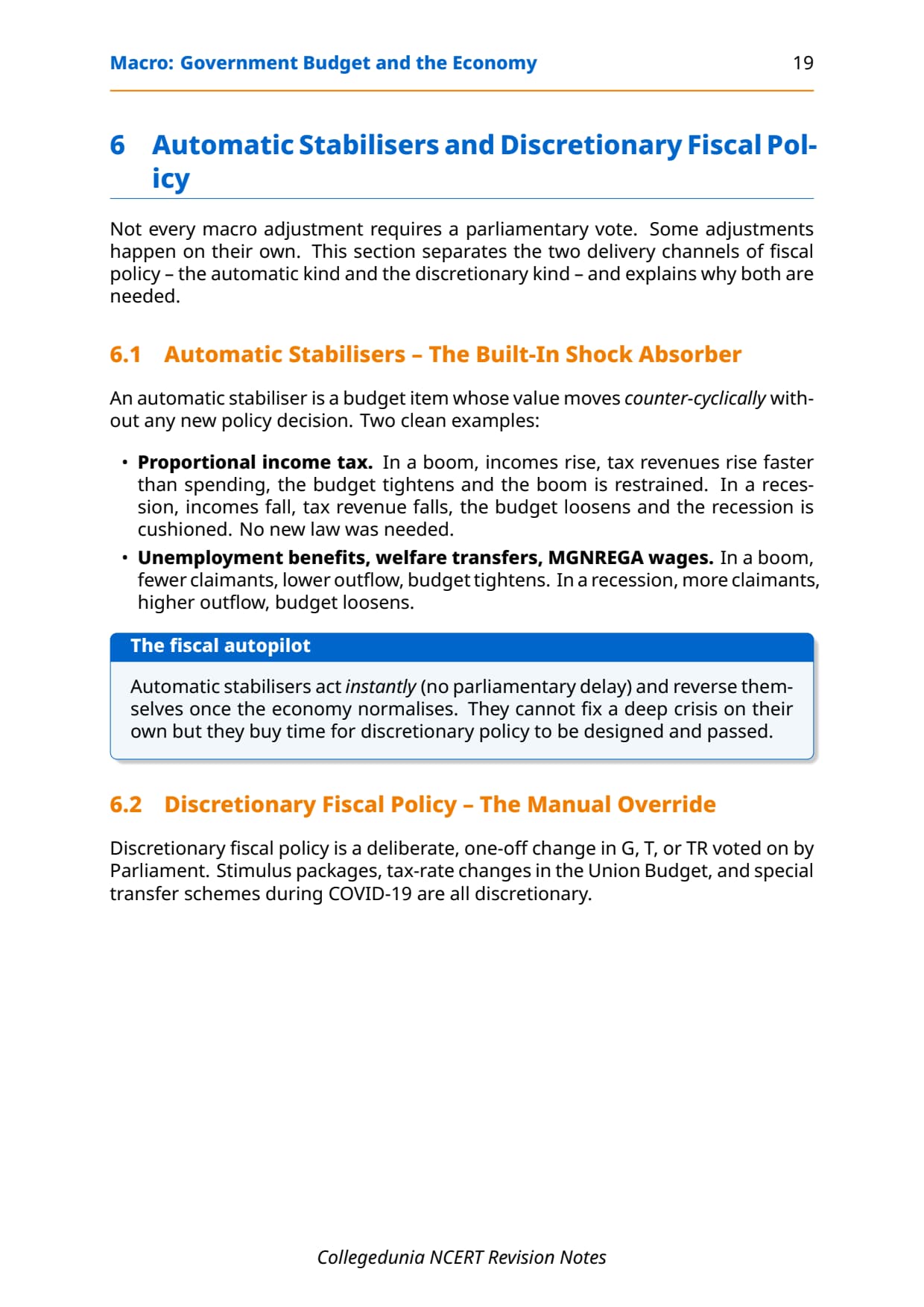
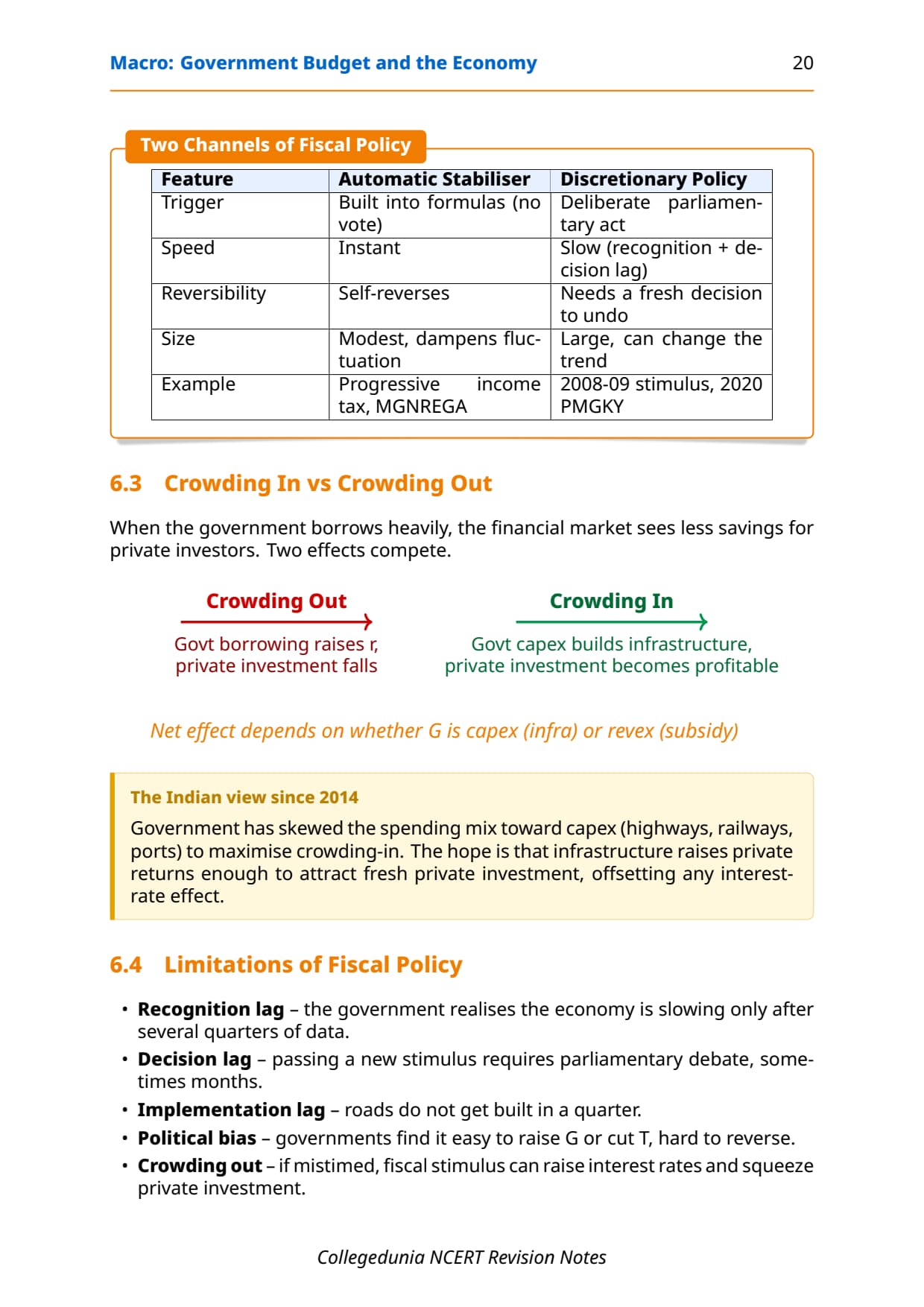
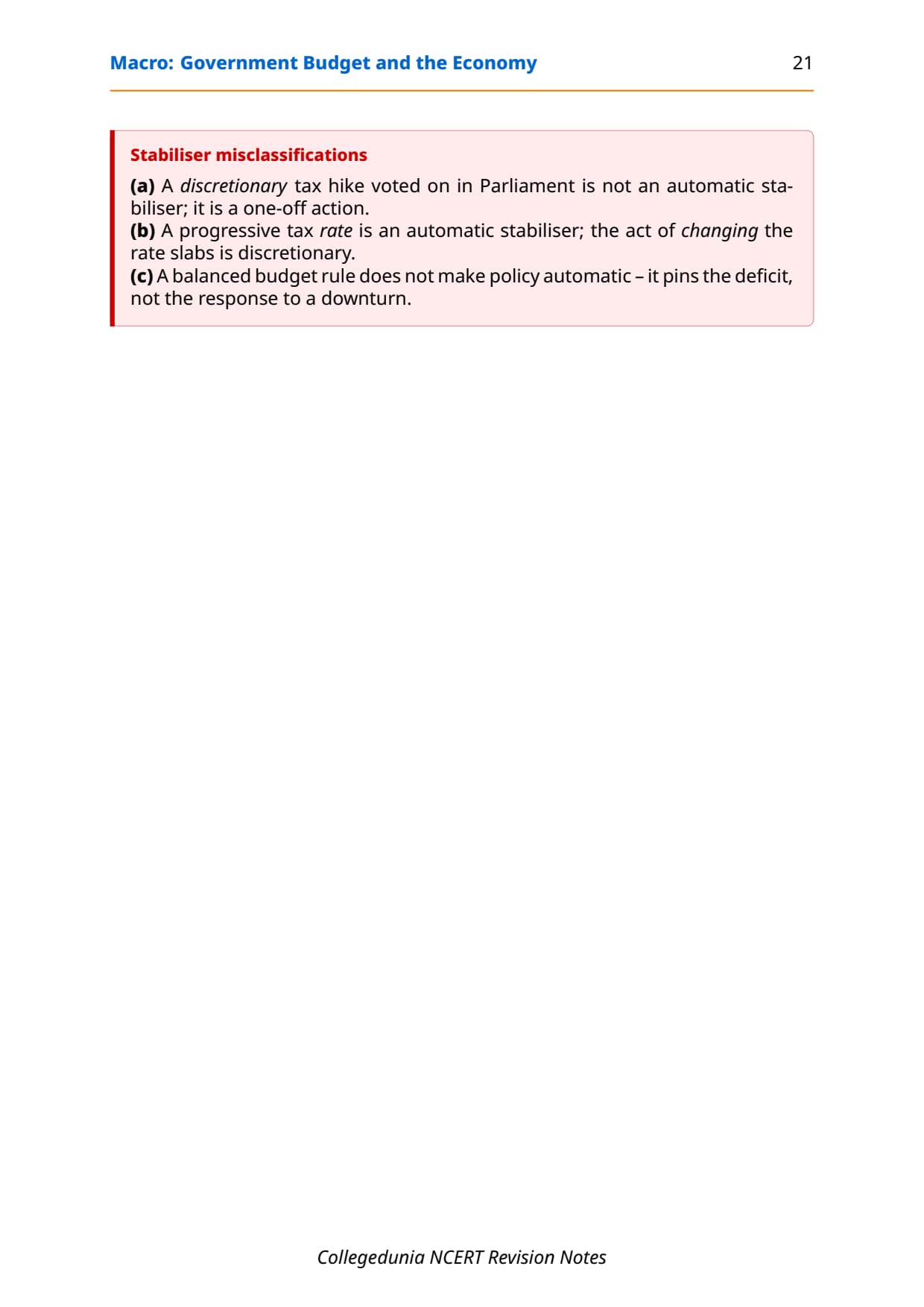
Automatic stabilisers work in the background too. Progressive taxes and welfare transfers move on their own with the cycle. In a slump, taxes fall and transfers rise, so the deficit widens and props up demand without any new decision. In a boom they do the reverse.
Government Budget Class 12 Video Lesson
Source: Magnet Brains on YouTube
Common Mistakes in Government Budget and the Economy
- Calling borrowings a revenue receipt. They always create a liability, so they are capital.
- Treating disinvestment as revenue. It reduces an asset, so it is a capital receipt.
- Mixing up revenue deficit and fiscal deficit. They use different receipts and are not the same number.
- Adding interest payments instead of subtracting them in the primary deficit.
- Dropping the minus sign on the tax multiplier.
- Thinking the balanced budget multiplier is 0. It is 1.
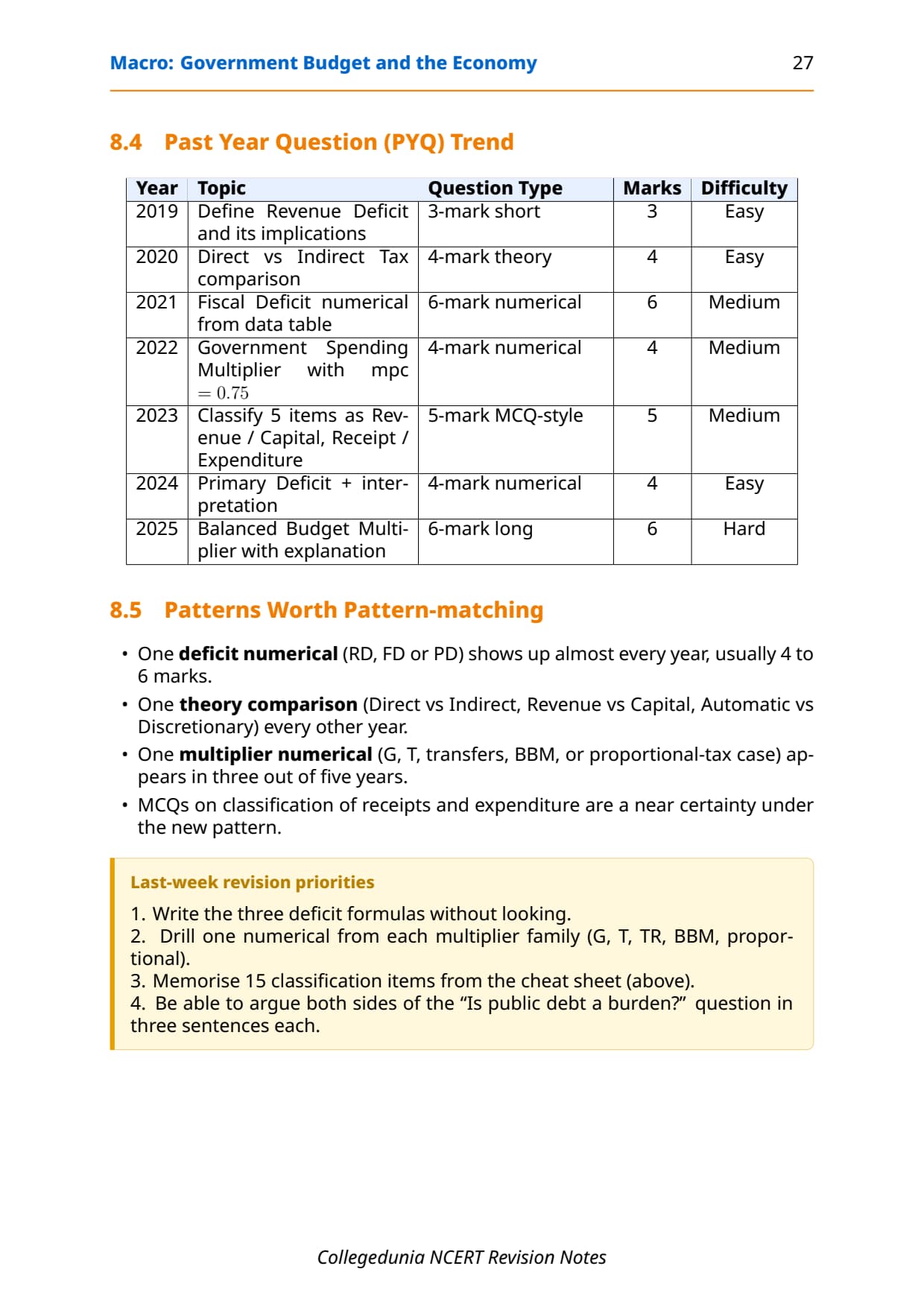
Government Budget Class 12 Weightage in CBSE and CUET
The chapter carries a steady 9 to 10 marks in CBSE each year. The table maps what the board has asked recently.
| Year | CBSE question | Marks |
|---|---|---|
| 2025 | Calculate fiscal deficit, plus define primary deficit | 4 + 3 |
| 2024 | Classify 8 budget items into capital vs revenue expenditure | 6 |
| 2023 | Government expenditure multiplier numerical, plus balanced budget MCQ | 4 + 1 |
| 2022 | Revenue deficit numerical, plus effects of a high fiscal deficit | 3 + 4 |
| 2021 | Direct vs indirect taxes, plus objectives of the budget | 3 + 6 |
Student Feedback
We asked 11,260 Class 12 students about this chapter. 71% found the three deficit measures the hardest part to recall, and 3 out of 4 said the revenue vs capital classification was the part most worth revising from a notes sheet. The average student finished these notes in 31 minutes.
Other Resources for Class 12 Economics Chapter 5 Government Budget and the Economy
Pair these notes with the Solutions, handwritten notes and the official NCERT chapter below.
| Resource | What it covers | Open |
|---|---|---|
| Notes | Concept-first revision of the full chapter. | Chapter 5 Notes |
| NCERT Solutions | Step-by-step answers to every exercise question. | Chapter 5 NCERT Solutions |
| Handwritten Notes | Scanned notebook pages for last-mile revision. | Chapter 5 Handwritten Notes |
| NCERT Book PDF | Official NCERT Macroeconomics Chapter 5 textbook. | Chapter 5 NCERT Book PDF |
All Chapters Notes for Class 12 Economics Macroeconomics
| Chapter | Notes link |
|---|---|
| Chapter 1 | Introduction to Macroeconomics |
| Chapter 2 | National Income Accounting |
| Chapter 3 | Money and Banking |
| Chapter 4 | Income Determination |
| Chapter 5 | Government Budget and the Economy |
| Chapter 6 | Open Economy Macroeconomics |
NCERT Notes Class 12 Economics Chapter 5 Government Budget and the Economy FAQs
Ques. What are these Class 12 Economics Chapter 5 notes for?
Ans. They are a short revision sheet for NCERT Chapter 5. They cover the budget, the revenue vs capital split of receipts and expenditure, the three deficits, the fiscal-policy multipliers and common mistakes, with a formula table. Worked numericals sit in the matching NCERT Solutions PDF.
Ques. What are the three deficit measures in government budget class 12?
Ans. Revenue deficit is revenue expenditure minus revenue receipts. Fiscal deficit is total expenditure minus total receipts excluding borrowings. Primary deficit is fiscal deficit minus interest payments. All three formulas sit in the formula sheet above.
Ques. What is the difference between revenue and capital receipts?
Ans. Revenue receipts neither create a liability nor reduce an asset, like tax revenue and fees. Capital receipts either create a liability (borrowings) or reduce an asset (disinvestment, recovery of loans). Borrowings and disinvestment are the two items students most often misclassify.
Ques. How is the government expenditure multiplier calculated?
Ans. It is Δ Y / Δ G = 1 / (1 - MPC). With MPC of 0.8 the multiplier is 5, so Rs 100 crore of extra government spending raises equilibrium income by Rs 500 crore.
Ques. Why is the balanced budget multiplier equal to 1?
Ans. An equal rise in spending and taxes does not cancel out. The spending multiplier is bigger than the tax multiplier by exactly 1, so the net effect is always 1, whatever the MPC. This is a common 3-mark CBSE question.



Comments