




Class 12 Economics Chapter 5 Government Budget and the Economy is the fifth chapter of the Macroeconomics book. It covers the budget structure, the three deficit measures and fiscal policy. This page has scanned handwritten revision notes and a free PDF to download.
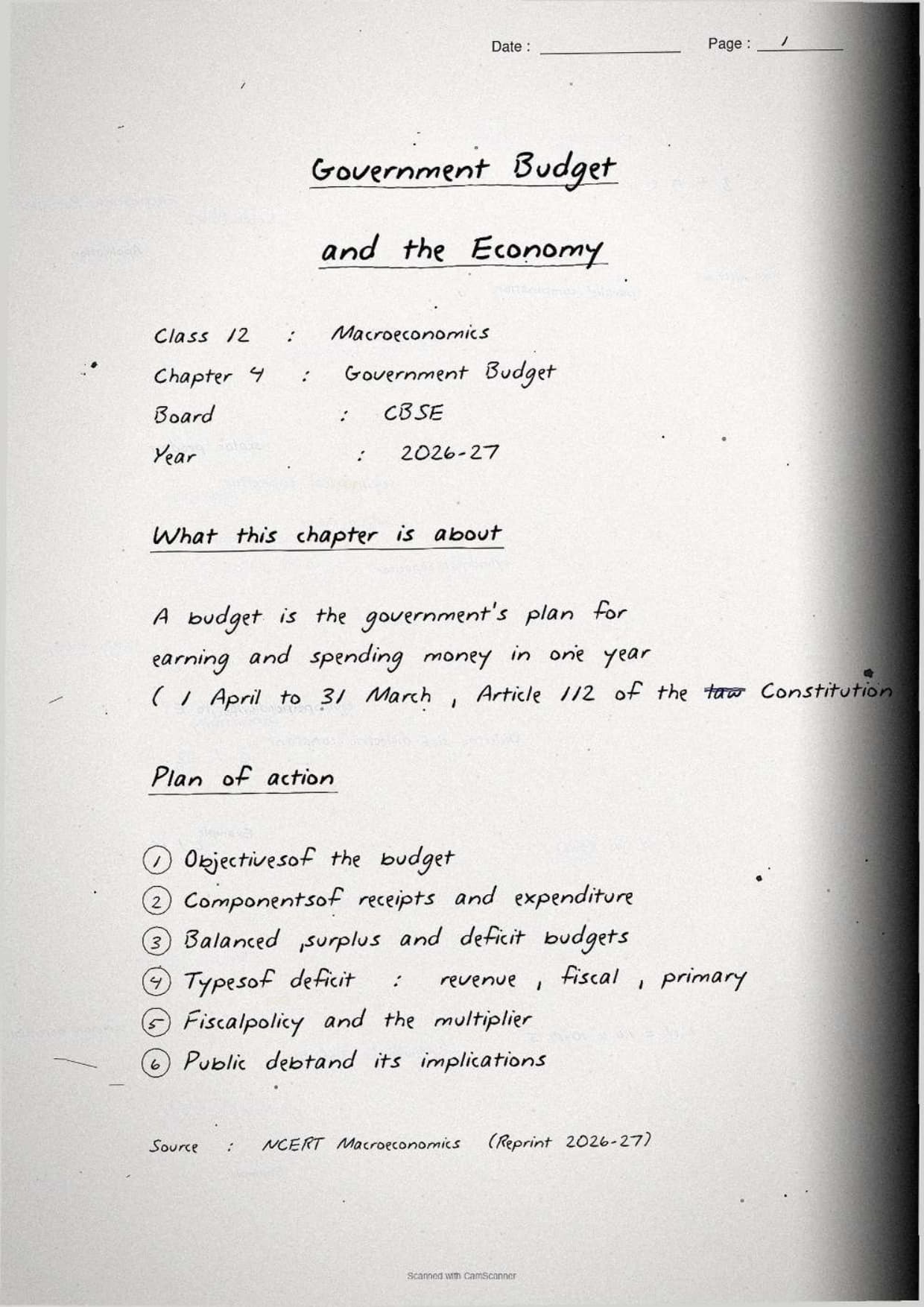
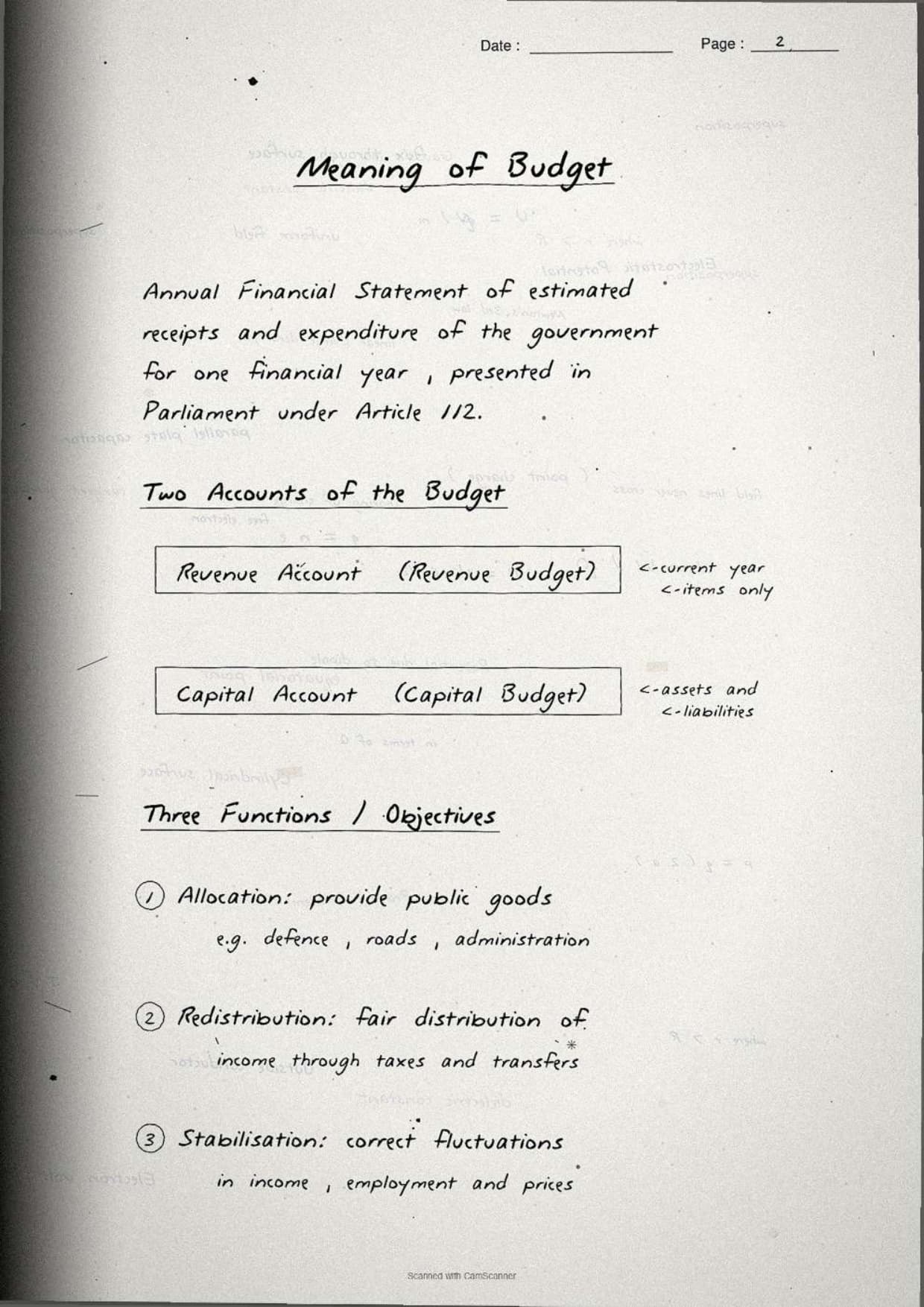
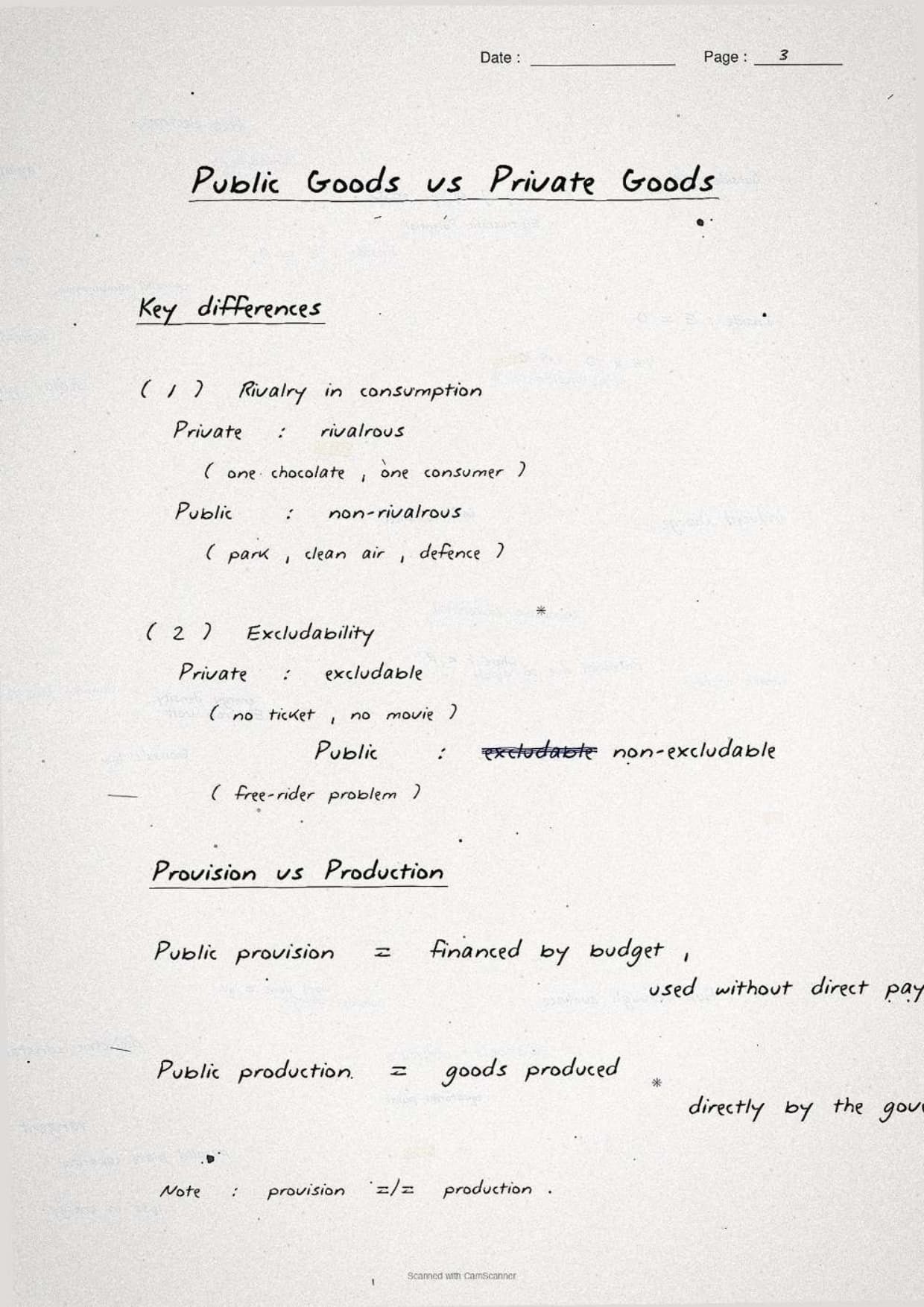
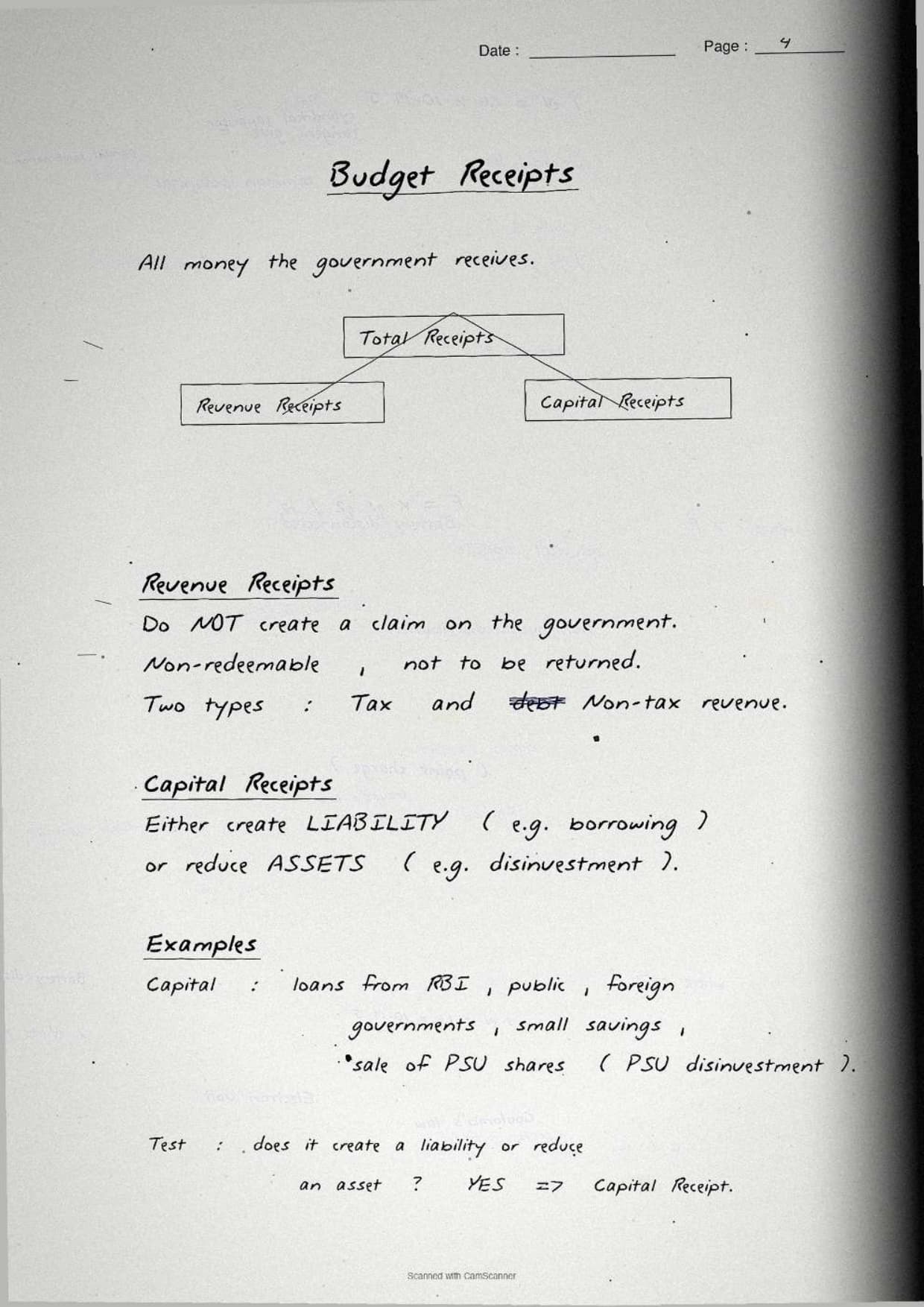
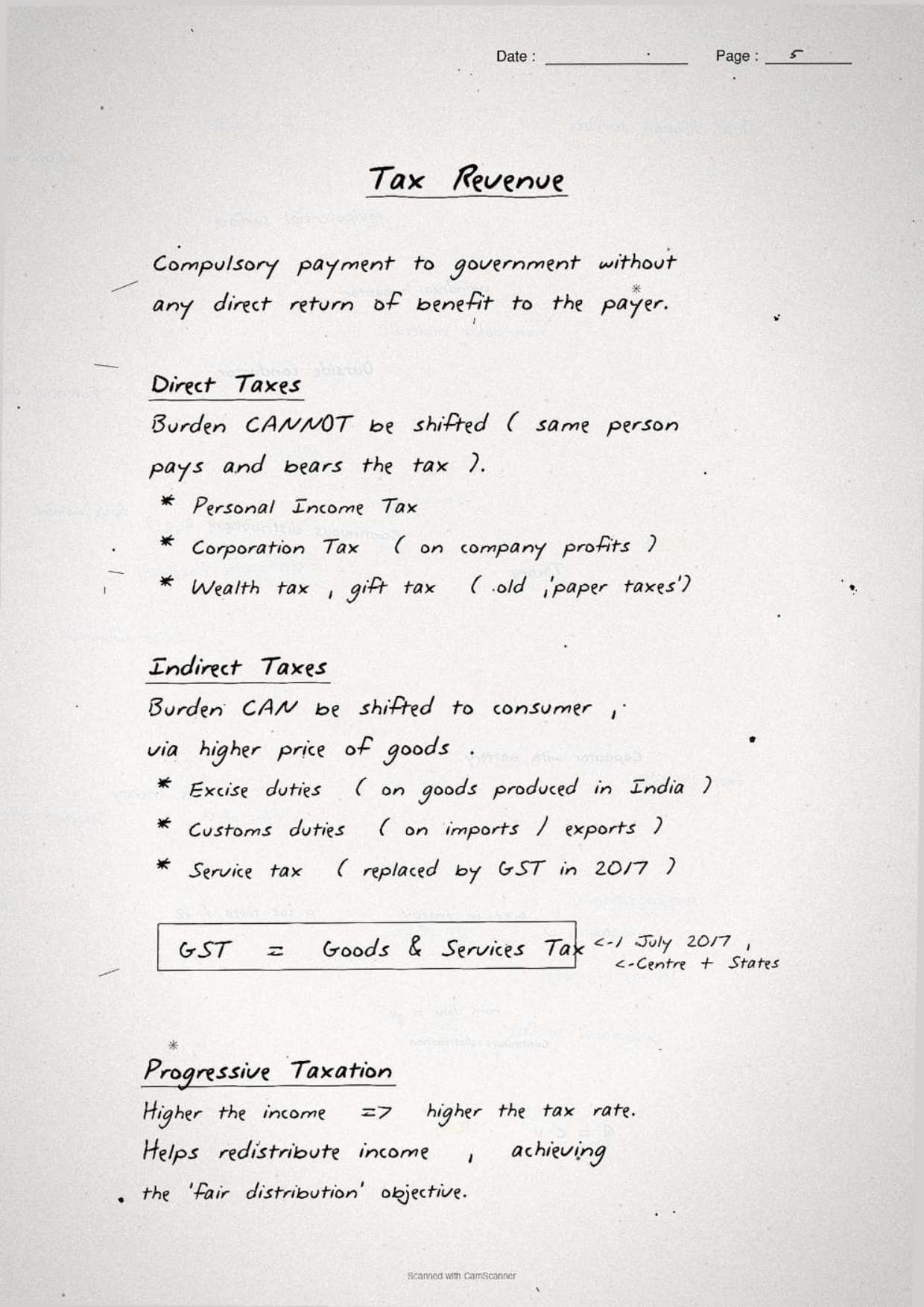
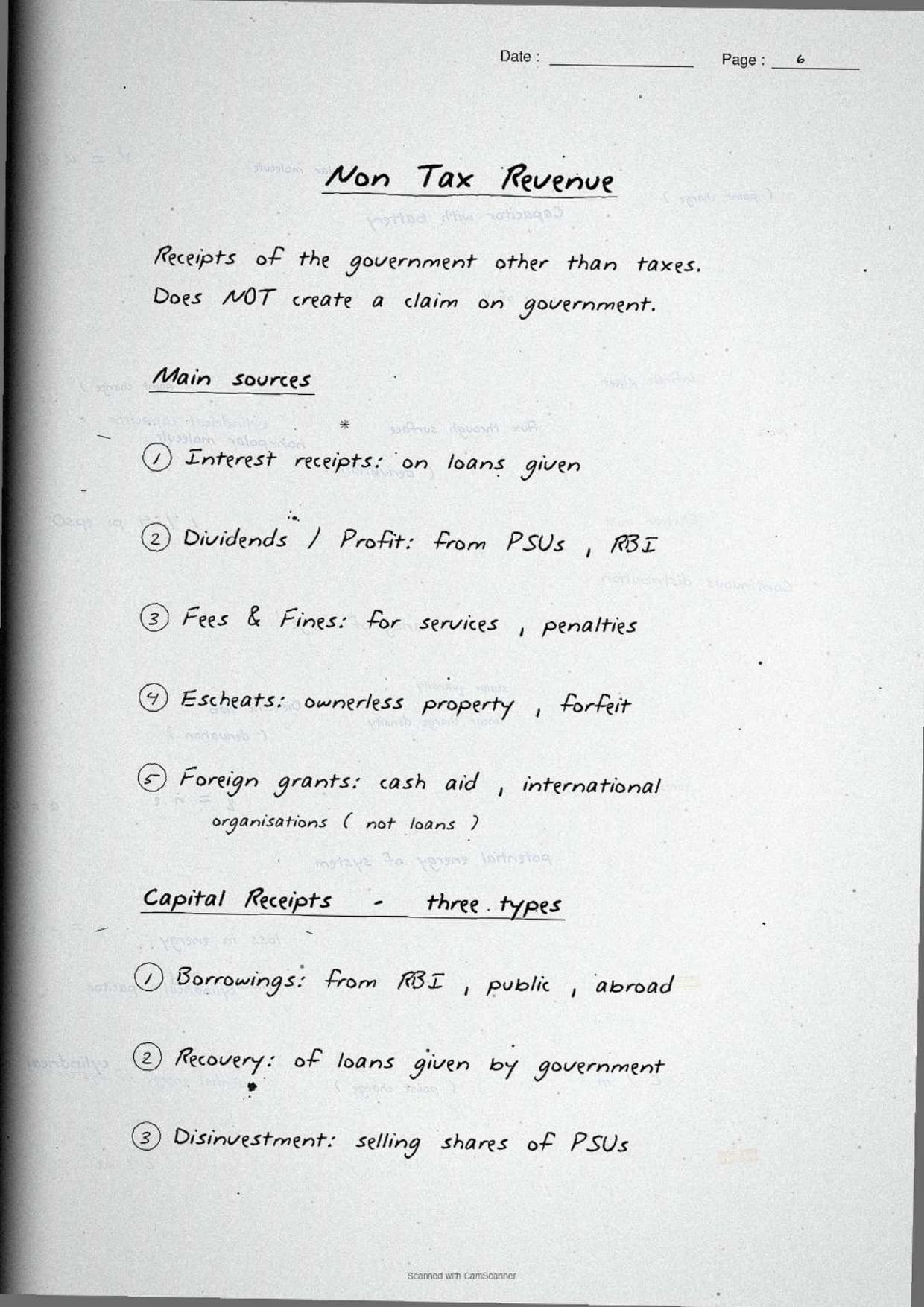
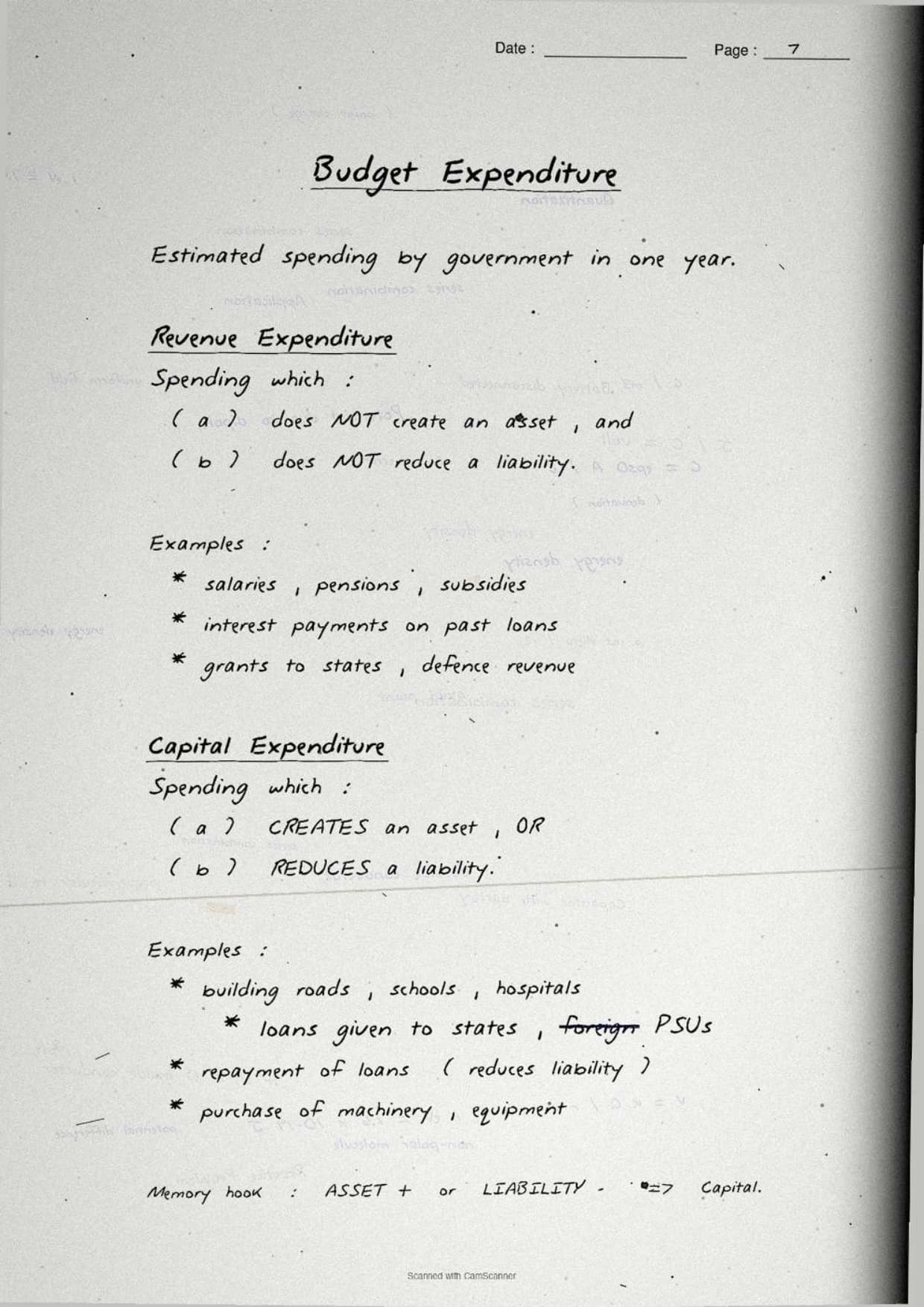
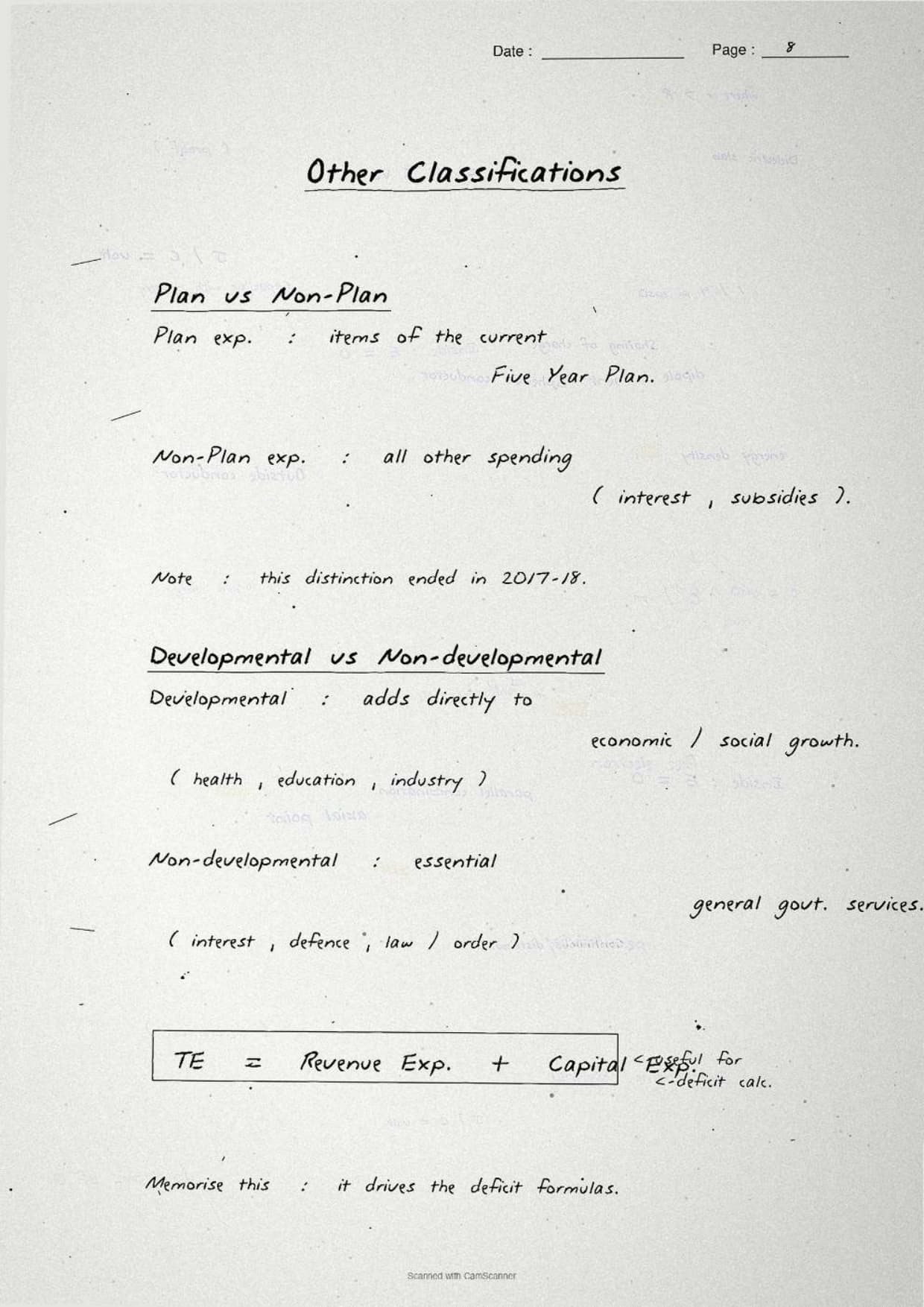
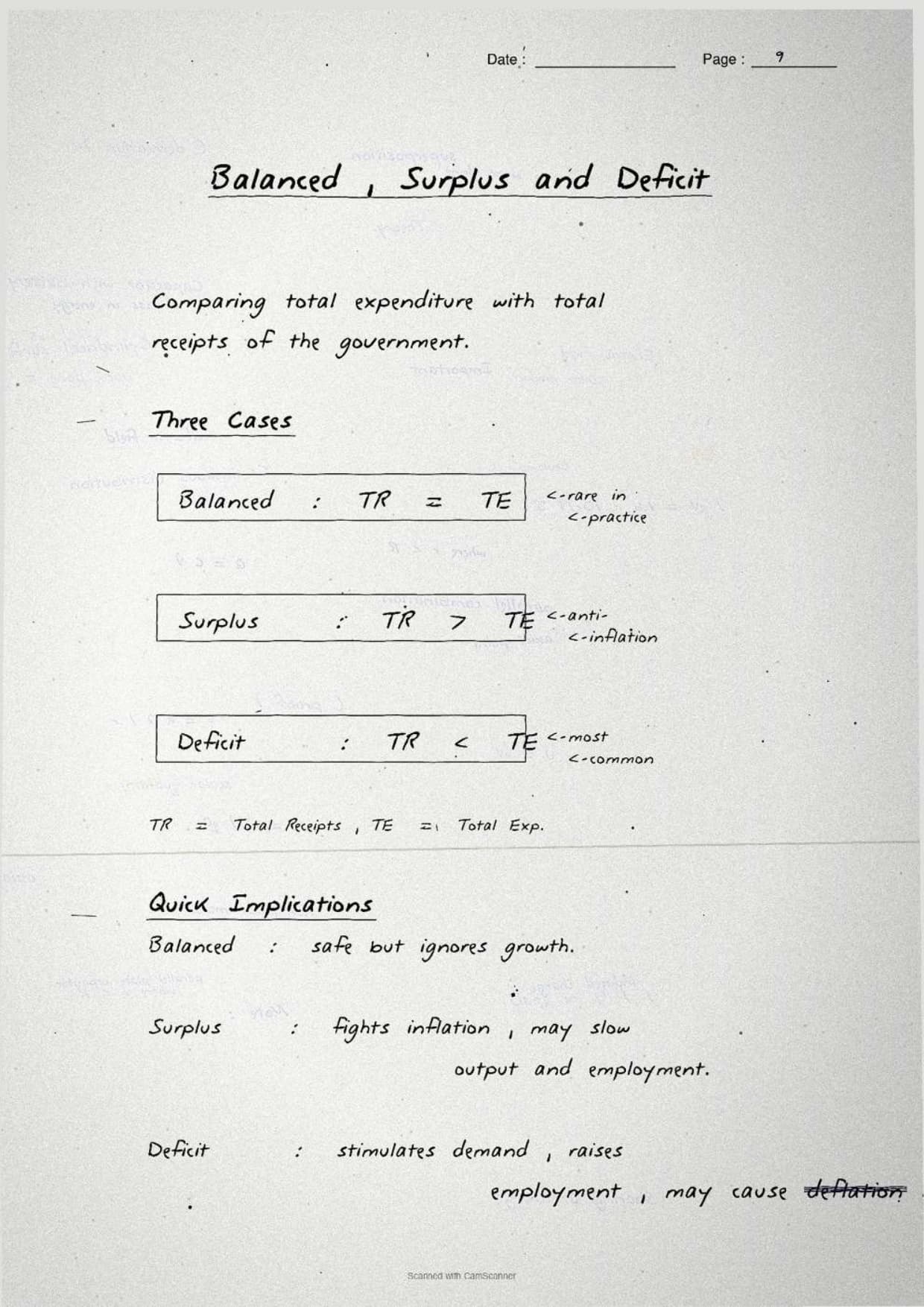
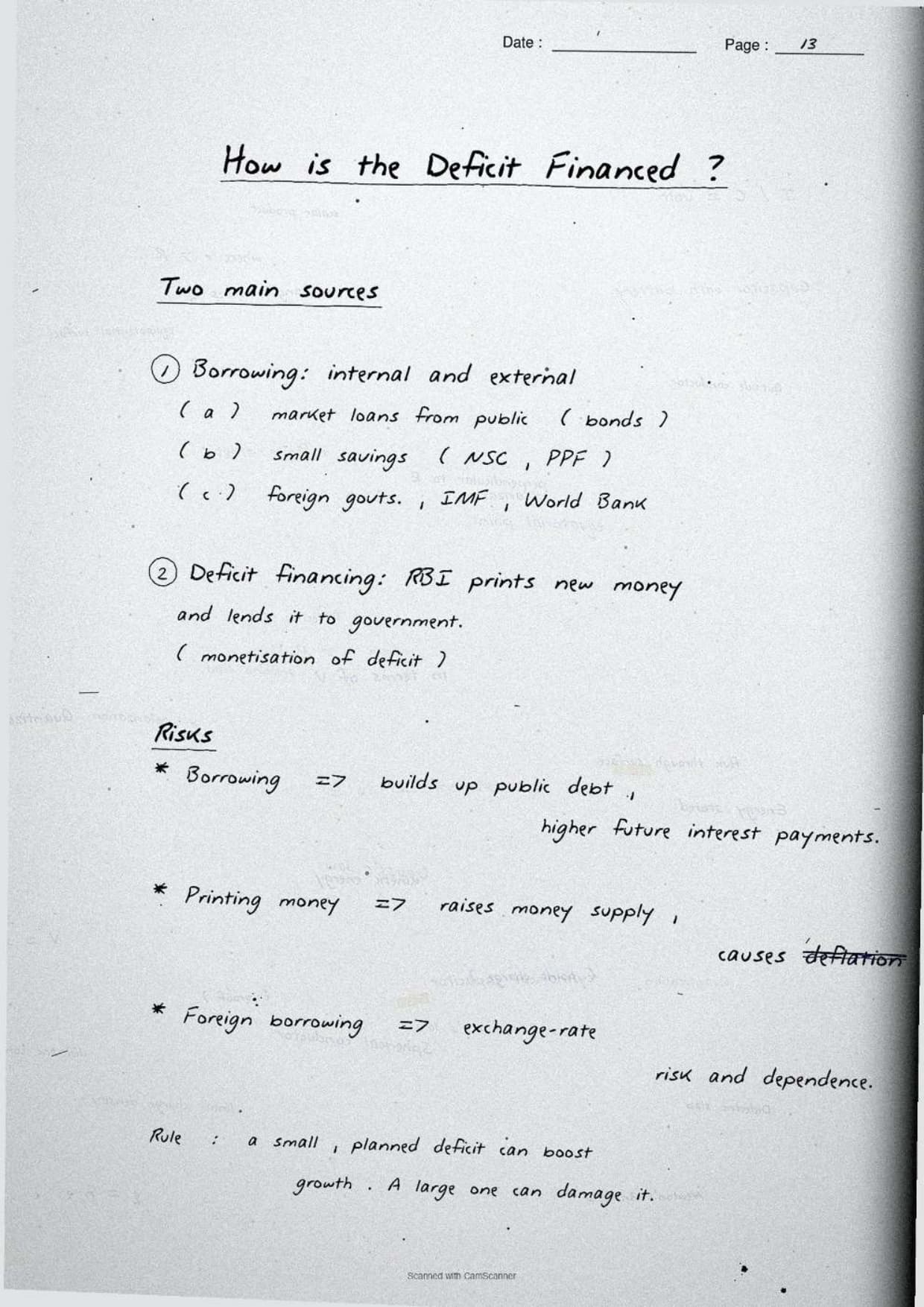
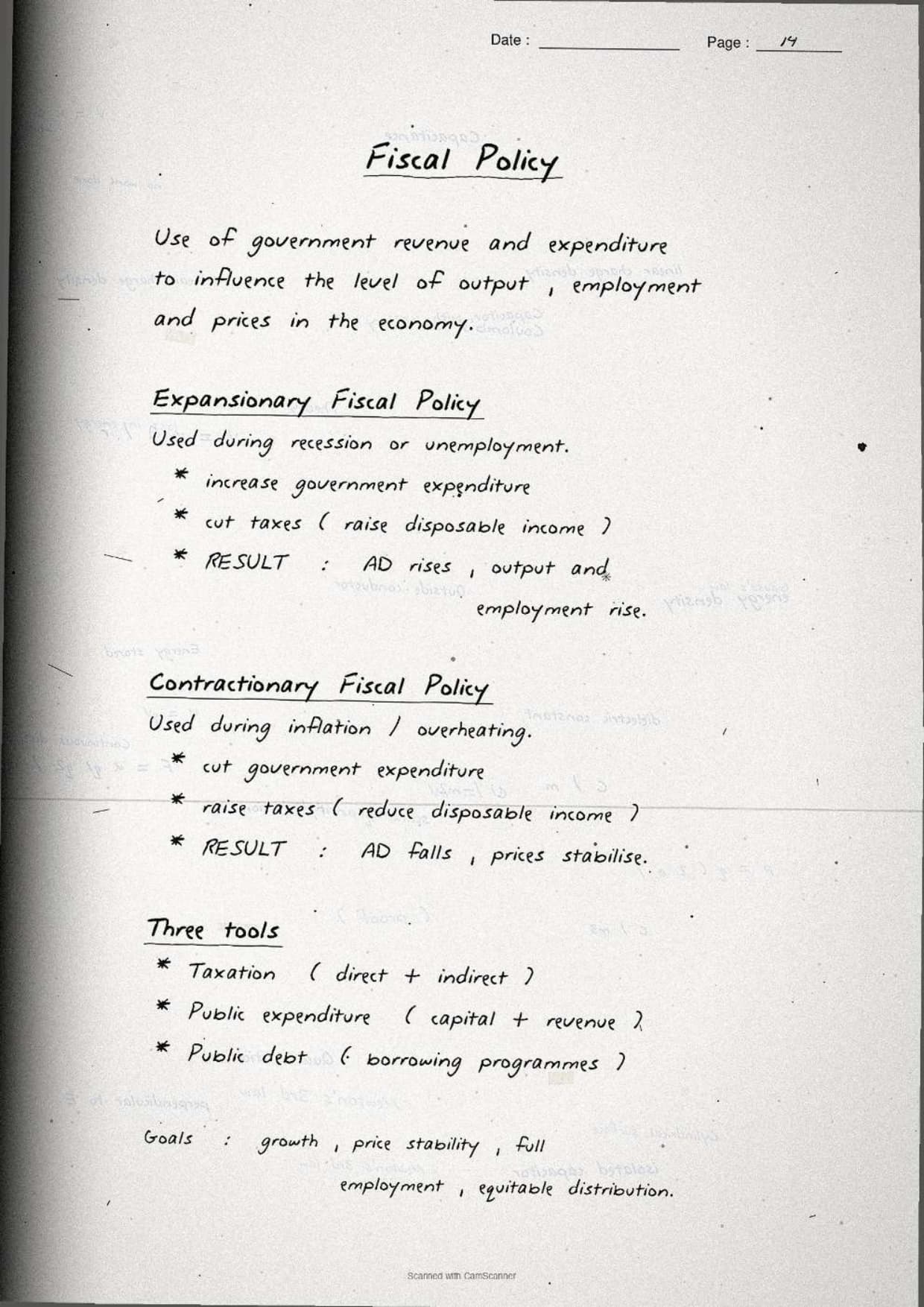
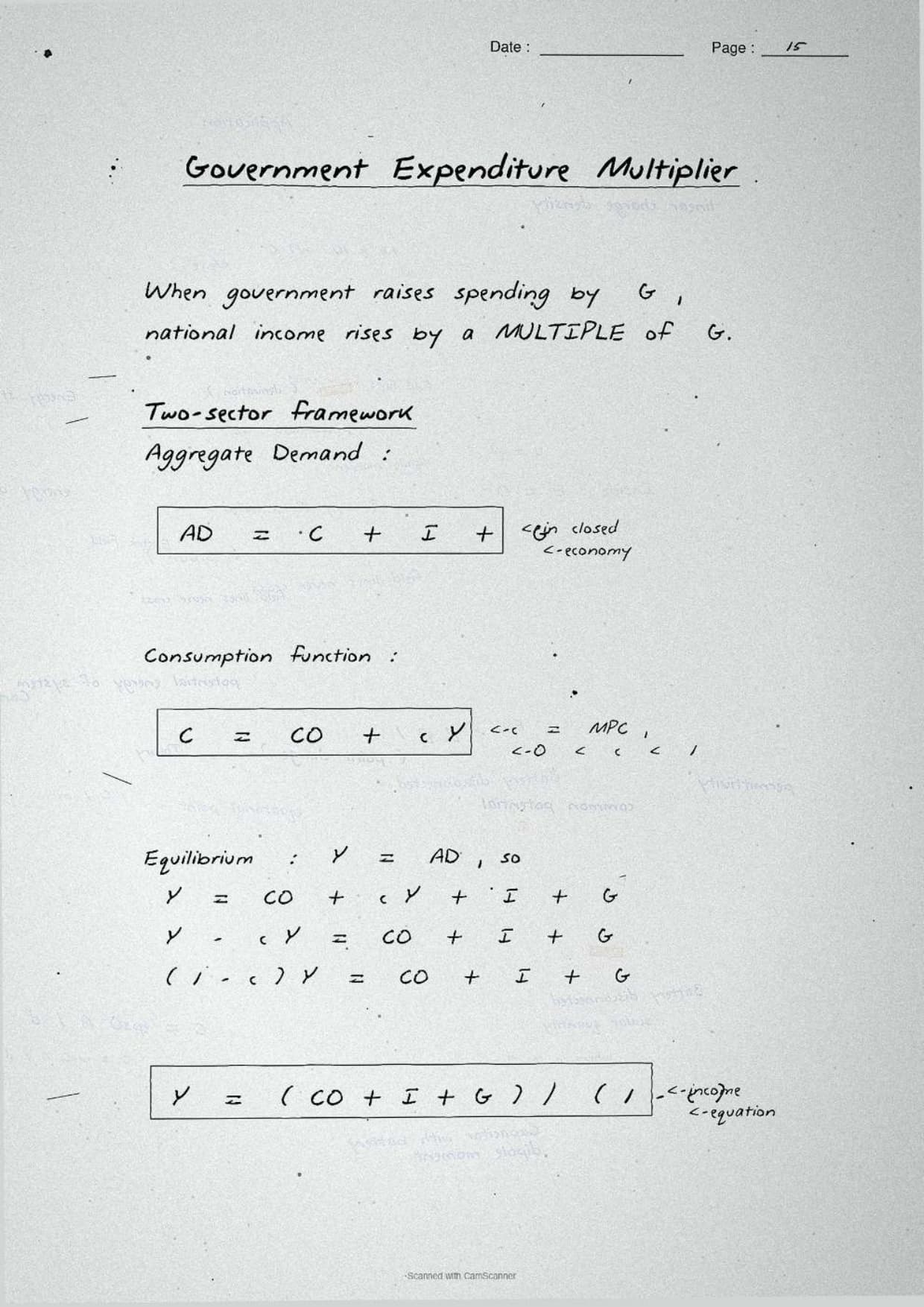
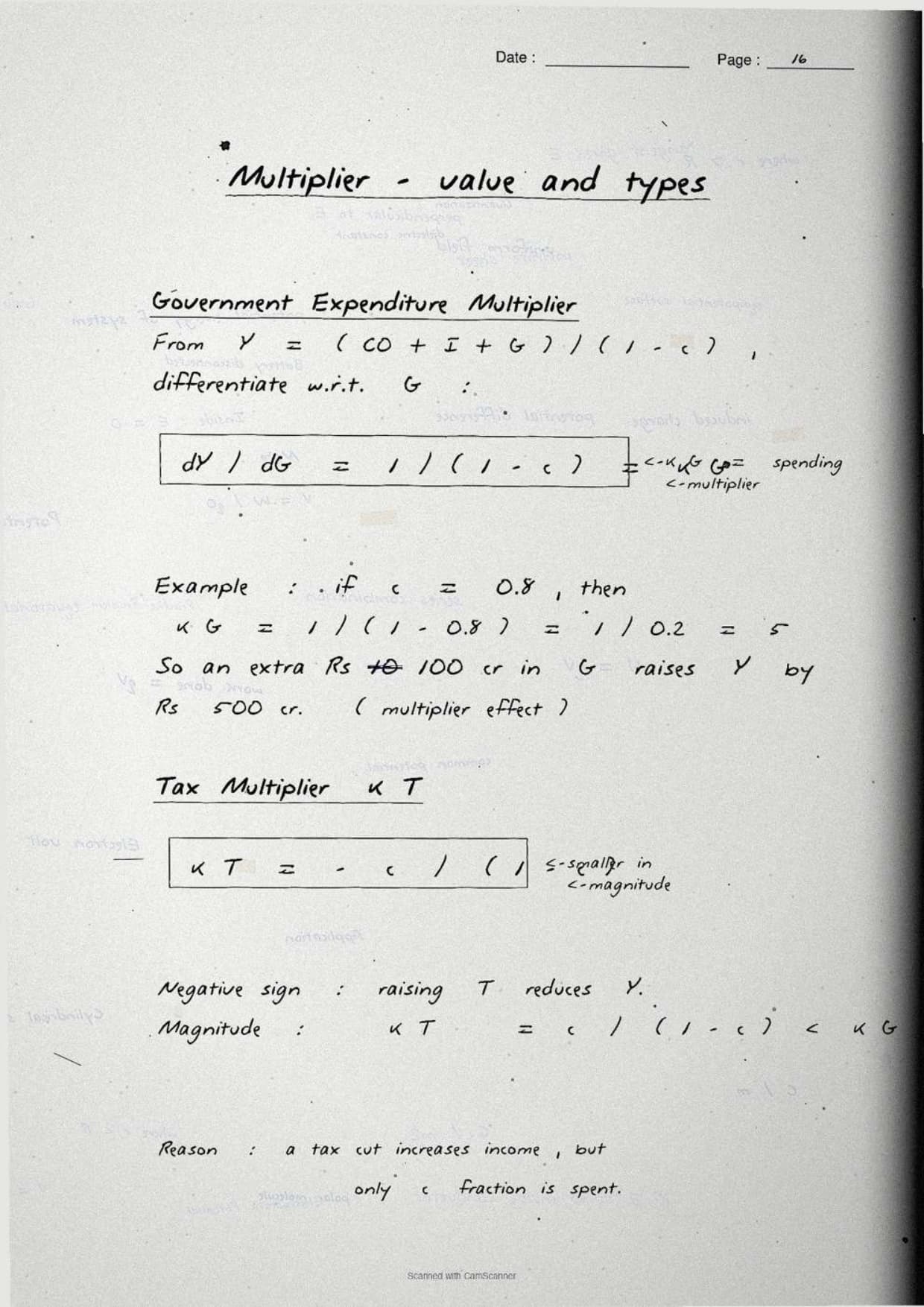
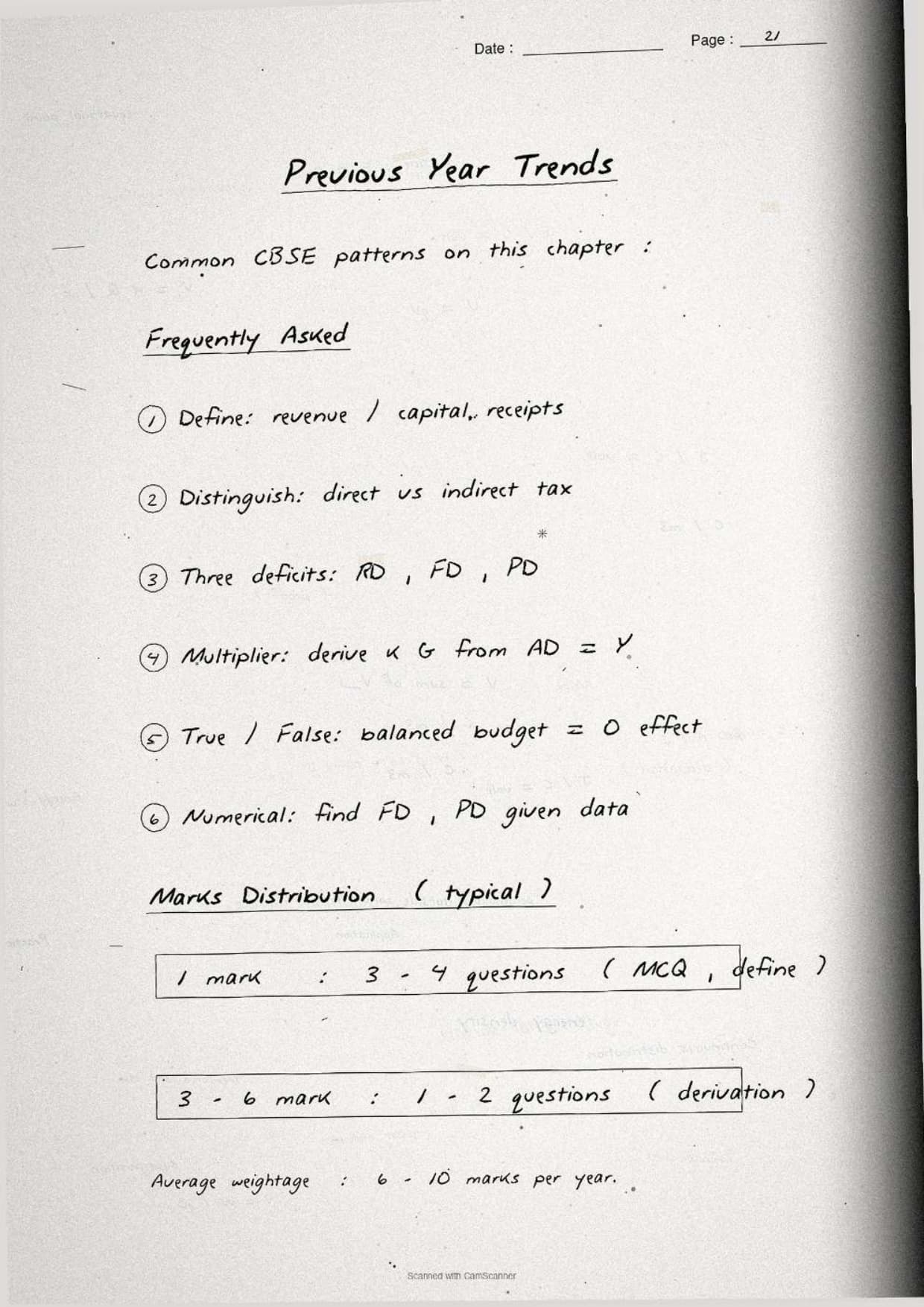
Here is what this chapter is worth in the exam:
- CBSE Boards: about 6 to 8 marks, mostly the three deficits and one fiscal-deficit numerical.
- CUET: 2 to 3 questions each year on budget terms and deficit formulas.
- Revision time: about 25 minutes with these scanned notes.

What These Government Budget Class 12 Handwritten Notes Cover
These scanned notes are a 3 to 4 page revision file in ballpoint pen on ruled paper. They are built for last-mile revision, not first-time learning. Each page maps to the NCERT Class 12 Economics Chapter 5 content.
- Budget basics: meaning of the budget and its three objectives.
- Receipts and expenditure: the revenue vs capital split with a hand-drawn tree.
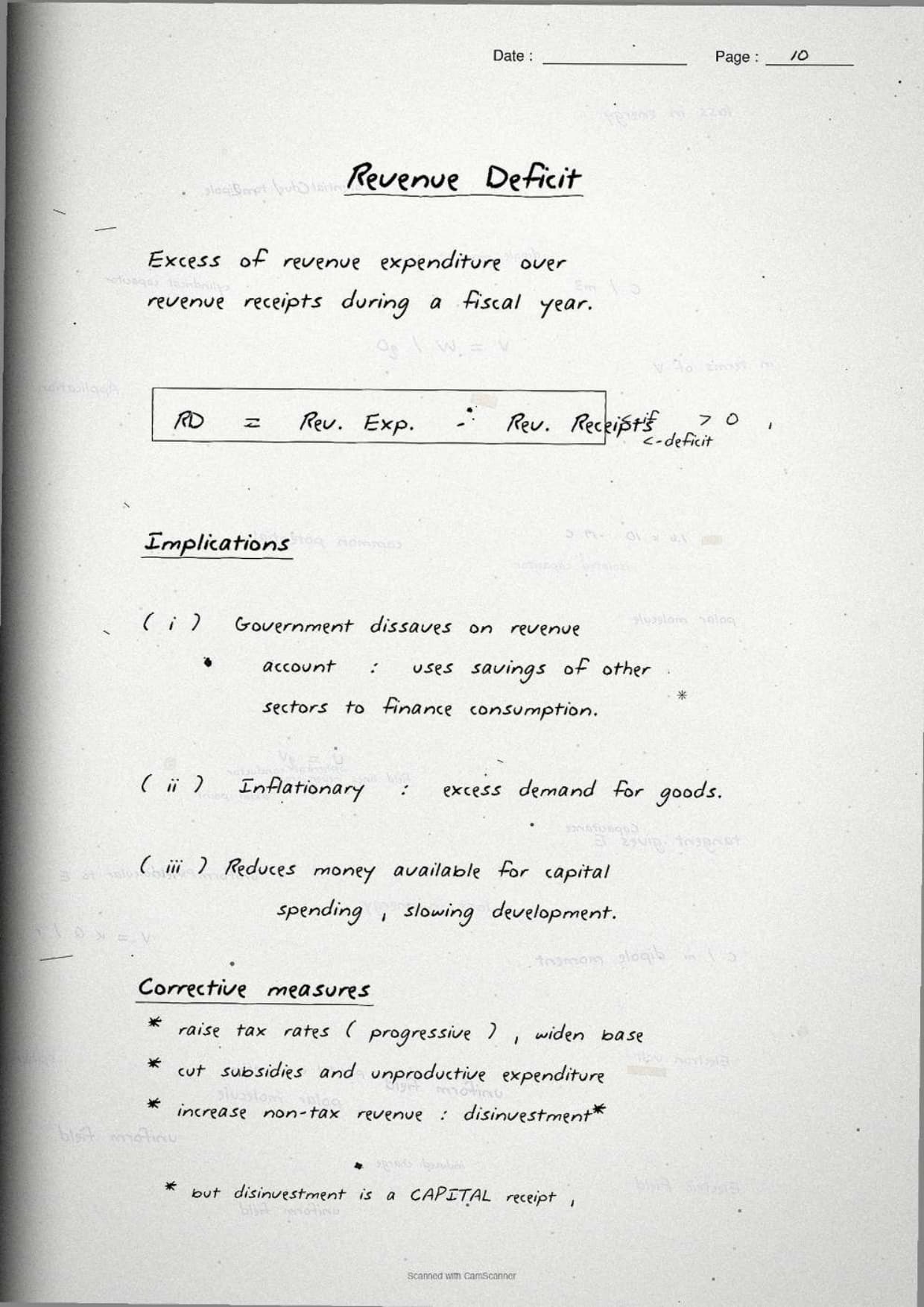
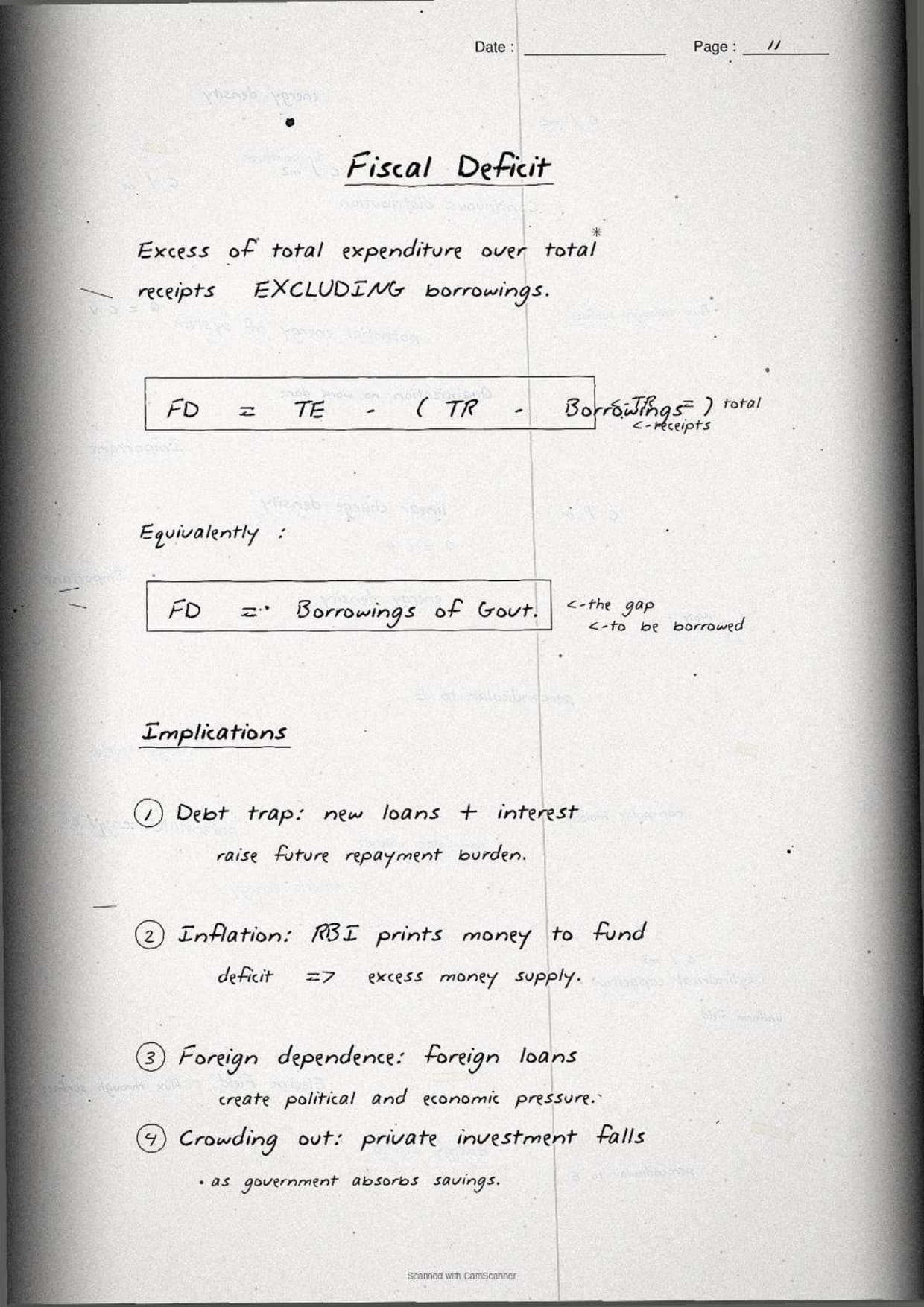
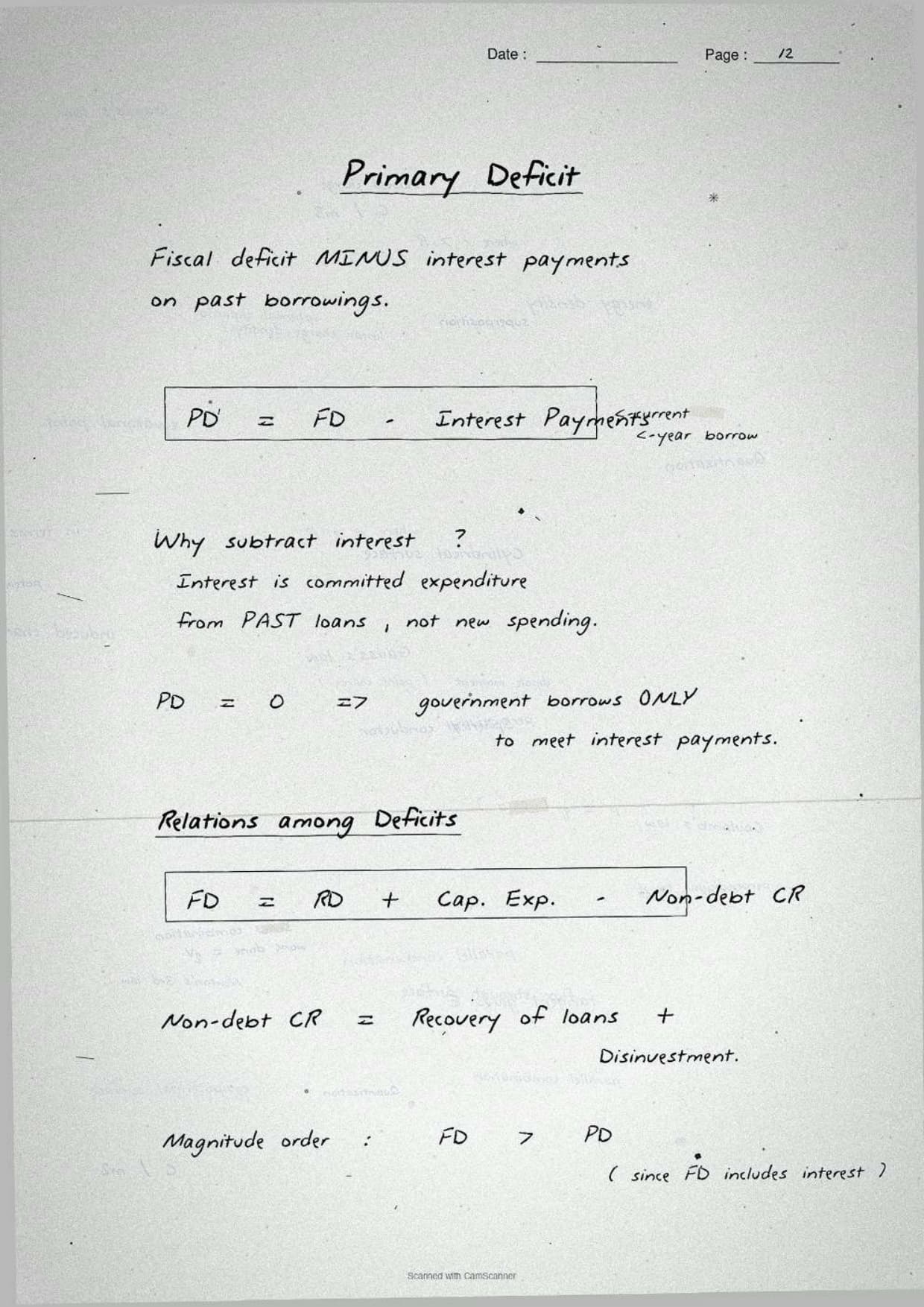
- Three deficits: revenue, fiscal and primary, in ruler-drawn formula boxes.
- Fiscal policy: the spending multiplier and its recall page.
| Page | What the page covers | Time |
|---|---|---|
| Page 1 | Meaning of budget, three objectives, direct vs indirect taxes. | 5 min |
| Page 2 | Receipts side: revenue vs capital, with a classification tree. | 6 min |
| Page 3 | Expenditure side and the three deficit formulas side by side. | 7 min |
| Page 4 | Fiscal policy stance and the government-spending multiplier. | 5 min |
Key Formulas in Government Budget Class 12 Handwritten Notes
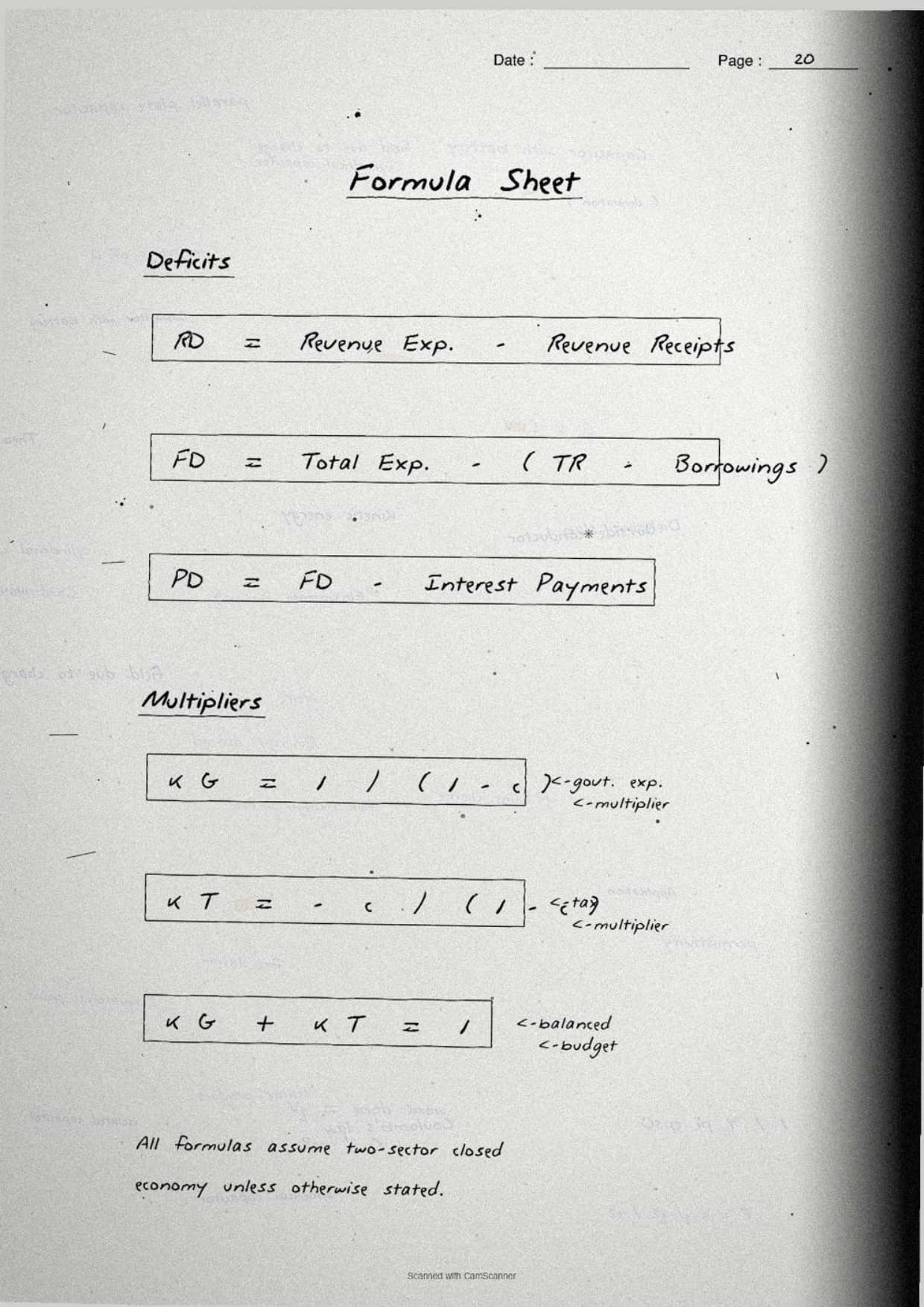
The formula sheet is the highest-value block in the file. Each formula sits in a hand-drawn box for quick visual recall. The table below lists the ones you must memorise.
| Concept | Formula |
|---|---|
| Revenue receipts | Tax revenue + Non-tax revenue |
| Capital receipts | Borrowings + Disinvestment + Recovery of loans |
| Total receipts | Revenue receipts + Capital receipts |
| Total expenditure | Revenue expenditure + Capital expenditure |
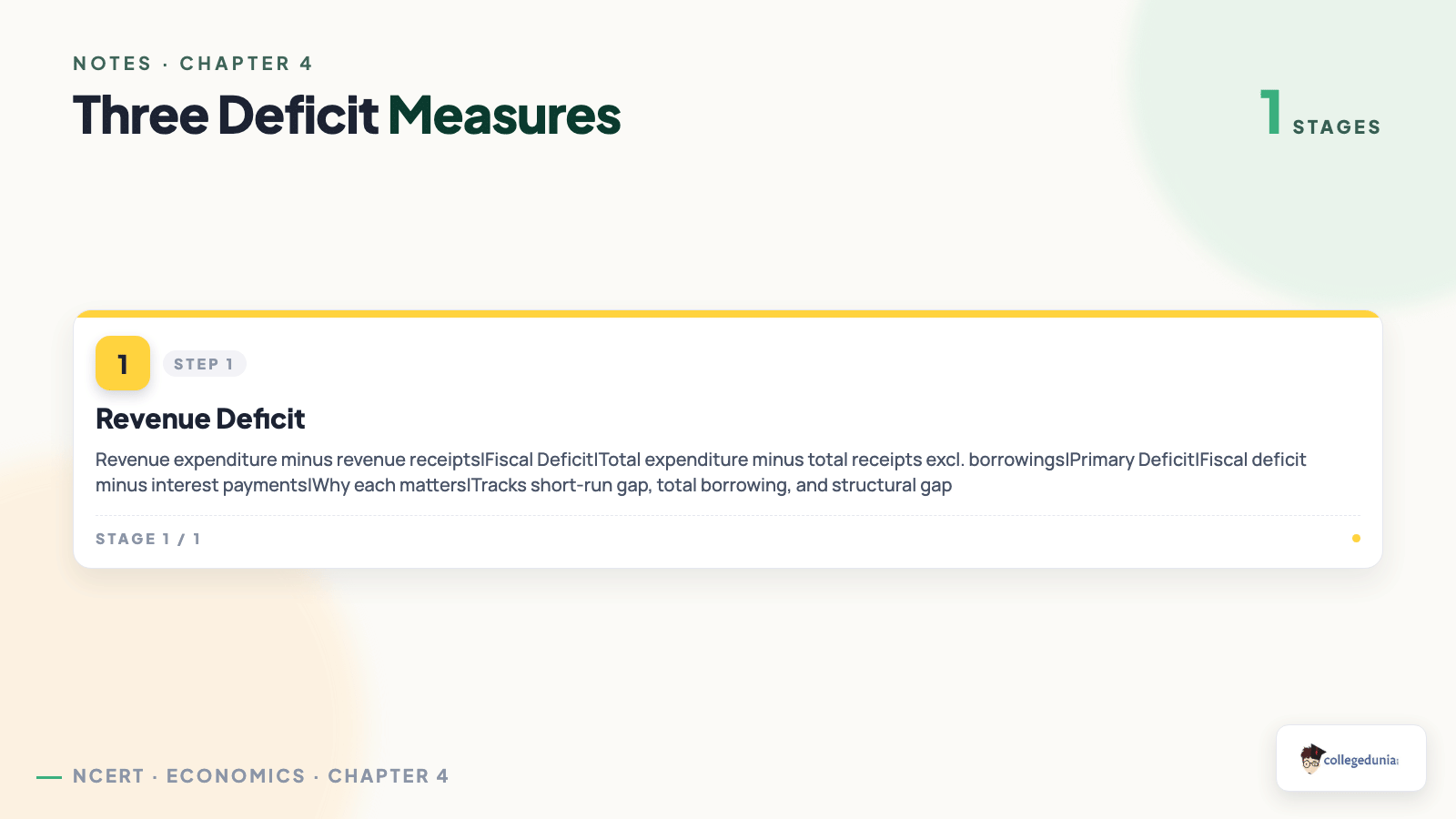
| Revenue Deficit (RD) | Revenue Expenditure minus Revenue Receipts |
| Fiscal Deficit (FD) | Total Expenditure minus Total Receipts (excluding borrowings) |
| Primary Deficit (PD) | Fiscal Deficit minus Interest Payments |
| Spending multiplier | 11 - MPC , where MPC is the marginal propensity to consume |

Budget Structure: Receipts and Expenditure in Class 12 Economics Chapter 5
You must know the budget structure before you can solve any deficit numerical. The notebook draws it as a single tree with two branches: receipts and expenditure.
| Item | Type | Examples |
|---|---|---|
| Revenue receipts | Tax + non-tax | Income tax, GST, interest, dividends, fees |
| Capital receipts | Debt + non-debt | Borrowings, disinvestment, loan recovery |
| Revenue expenditure | No asset, no liability change | Salaries, subsidies, interest payments |
| Capital expenditure | Creates assets or cuts liabilities | Highways, equity in PSUs, loans to states |
Memory hook: revenue items do not change assets or liabilities; capital items do. Loan repayment is capital expenditure (it cuts a liability), but the interest on that loan is revenue expenditure.
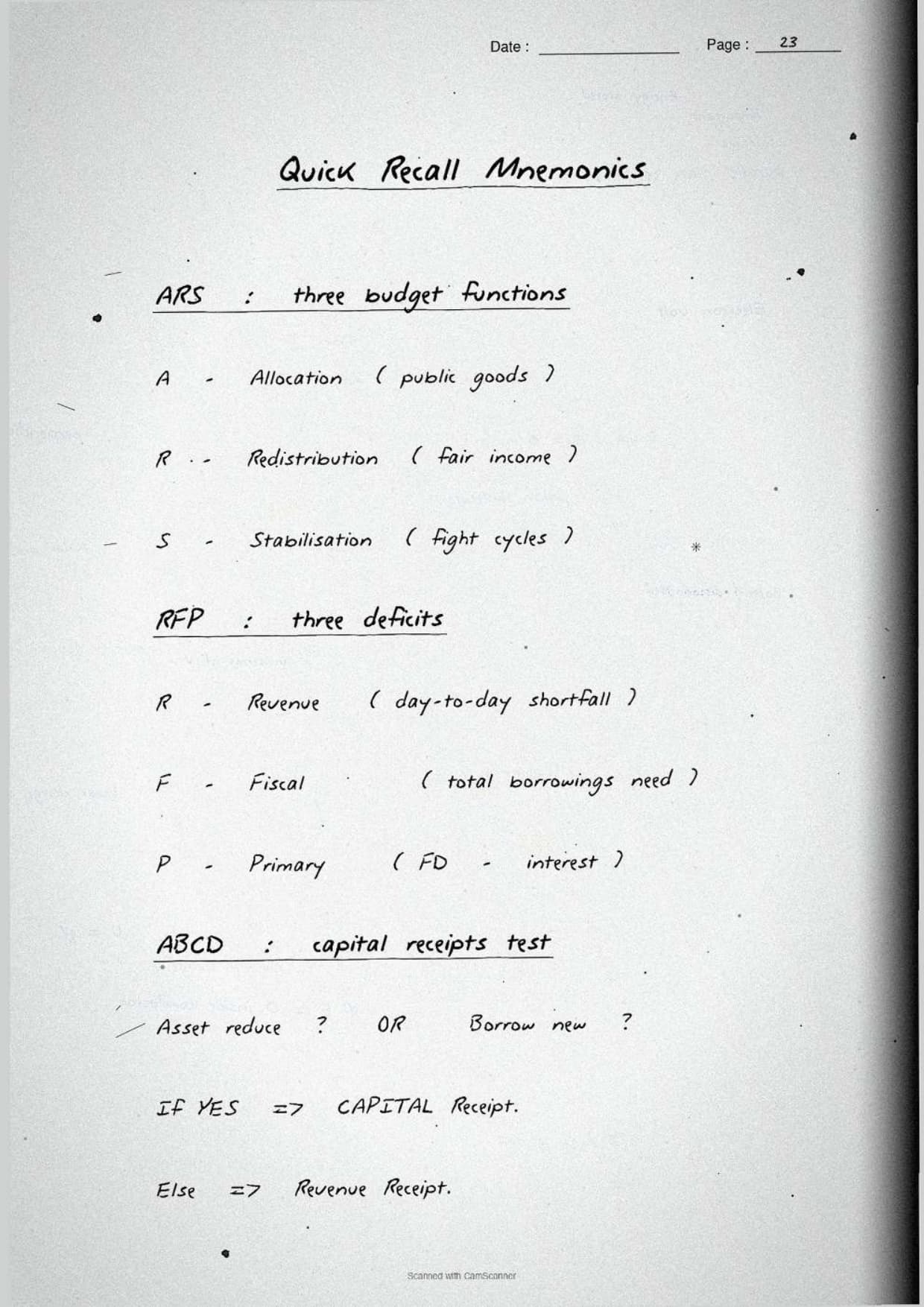
Three Deficit Measures in Government Budget Class 12
At least one numerical asks you to find a deficit from a budget extract every year. The notebook draws all three as boxes on Page 3, with arrows linking each one to the next.
| Deficit | Formula | What it signals |
|---|---|---|
| Revenue Deficit | Revenue Expenditure minus Revenue Receipts | Borrowing to pay for current consumption. |
| Fiscal Deficit | Total Expenditure minus Total Receipts (excluding borrowings) | Total borrowing the government needs in a year. |
| Primary Deficit | Fiscal Deficit minus Interest Payments | Fresh borrowing only, without the legacy interest. |
The three link as one chain: Primary Deficit + Interest Payments = Fiscal Deficit. So FD minus PD always equals interest payments, which is the cross-check CBSE markers reward most.
Fiscal Policy and the Multiplier in Class 12 Economics Chapter 5
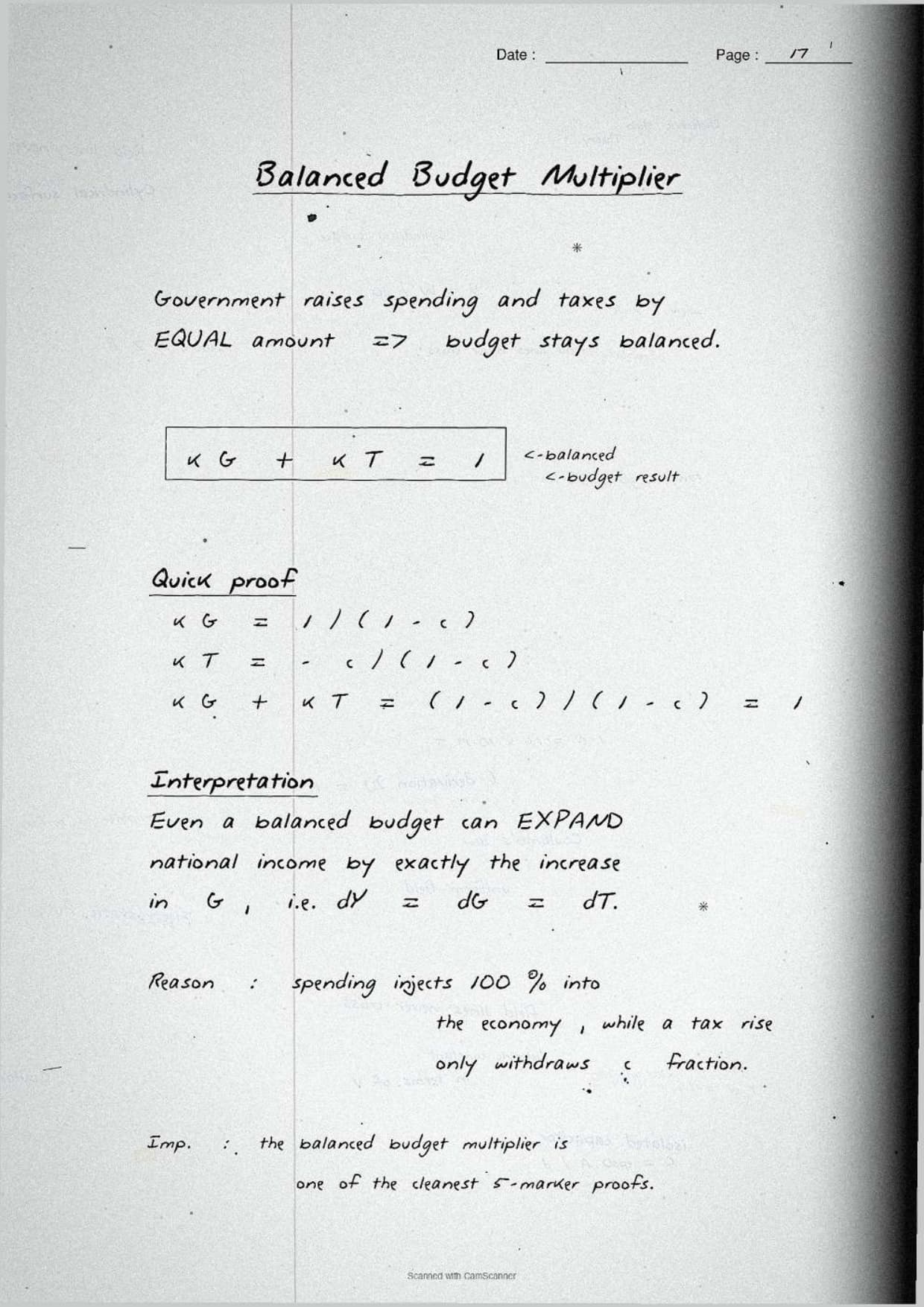
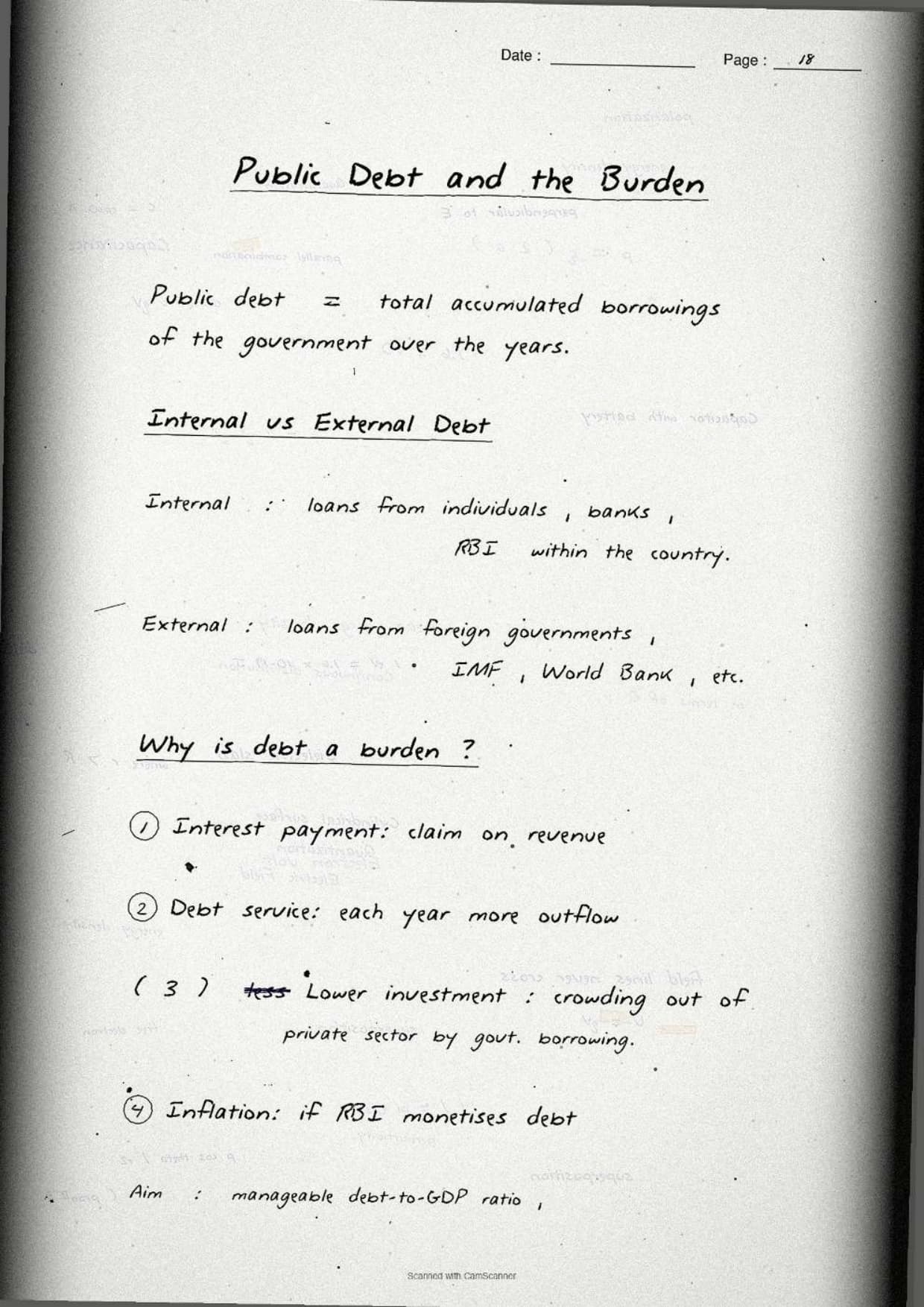
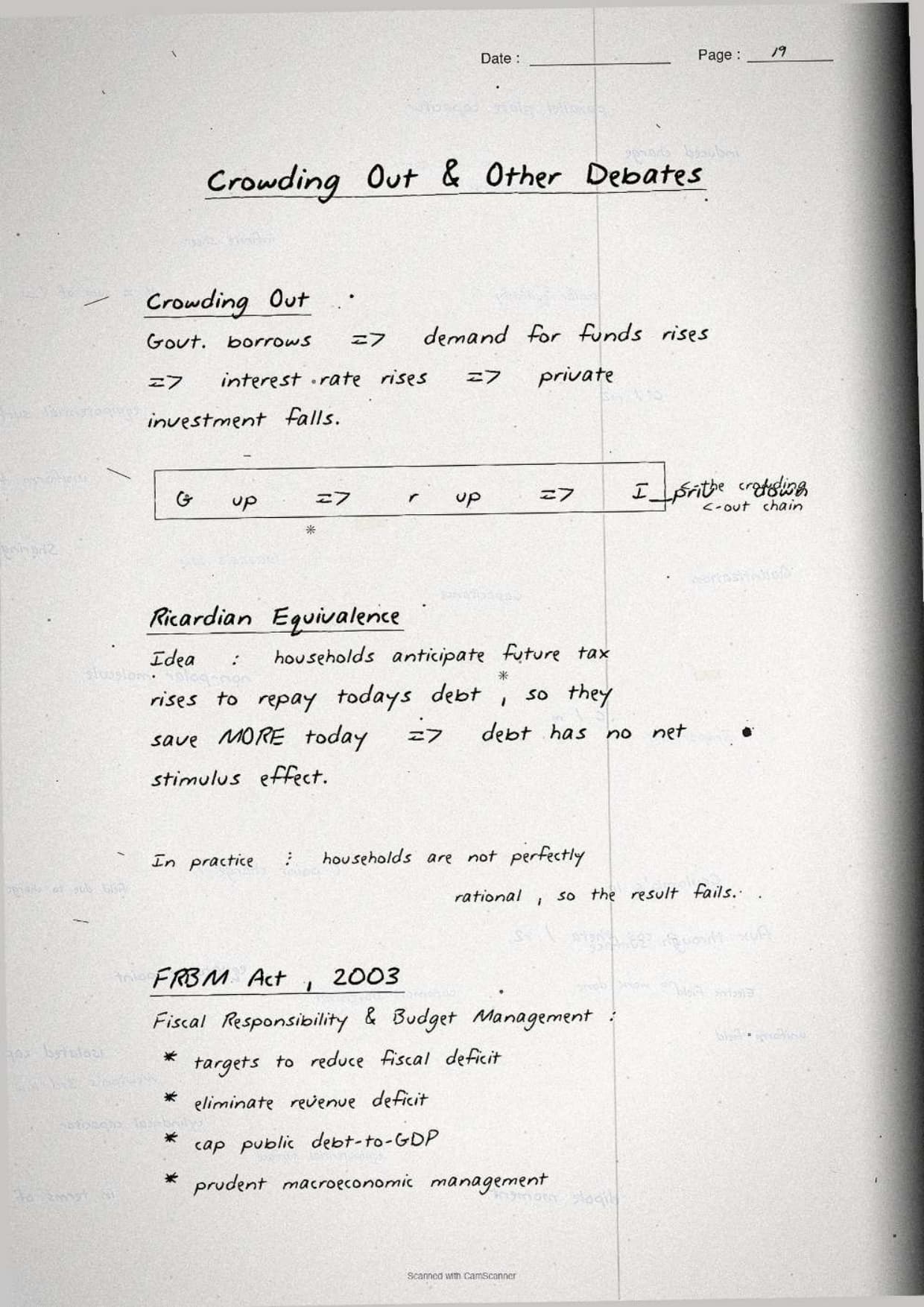
The last page links Chapter 5 back to income determination. An expansionary stance raises spending or cuts taxes in a recession; a contractionary stance does the opposite during a boom.
The multiplier is k = 1 divided by (1 minus MPC). With MPC = 0.8, k = 5, so a 100-crore rise in government spending raises national income by 500 crore, as long as the economy is below full employment.
Source: Magnet Brains on YouTube
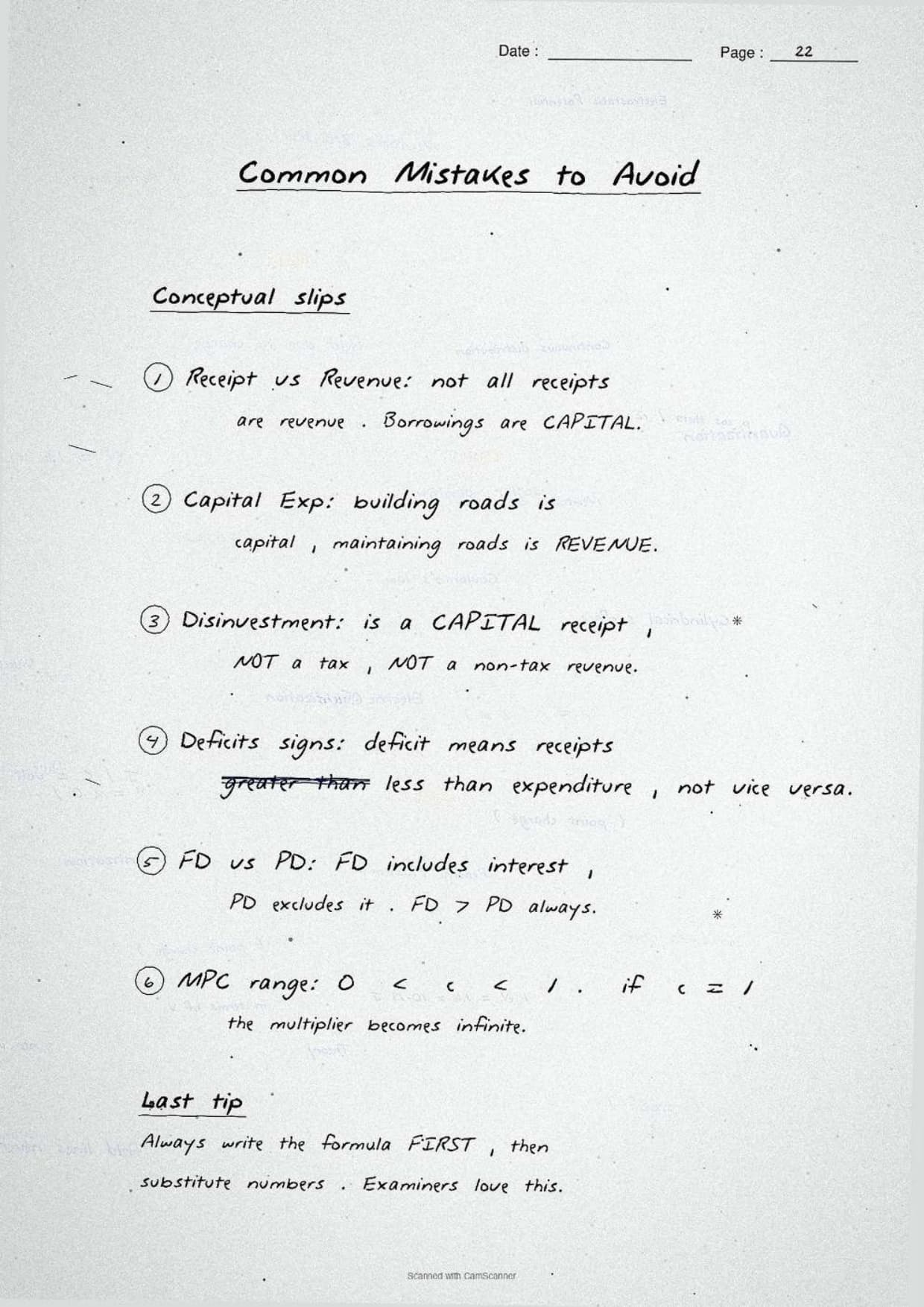
Common Mistakes in Government Budget Class 12 Economics
- Including borrowings in total receipts for the fiscal-deficit formula.
- Confusing revenue deficit with fiscal deficit; they measure different things.
- Treating loan repayment as revenue expenditure instead of capital.
- Forgetting that disinvestment is a capital receipt, not a revenue receipt.
- Dropping interest payments from the primary-deficit definition.
Government Budget Weightage in CBSE and CUET
The chapter has carried a steady 6 to 8 marks in CBSE over the last five years. The table shows where the marks came from.
| Year | CBSE question | Marks |
|---|---|---|
| 2025 | Calculate Fiscal Deficit and Primary Deficit + define revenue receipts | 6 + 1 |
| 2024 | Distinguish revenue and capital expenditure + meaning of disinvestment | 3 + 1 |
| 2023 | Three objectives of the budget + numerical on revenue deficit | 3 + 4 |
| 2022 | Fiscal-deficit numerical + implications of a high fiscal deficit | 4 + 3 |
Student Feedback
We asked 12,640 Class 12 students about budget revision. 73% said scanned handwritten pages feel faster to scan than typed PDFs in the last 48 hours, and 4 out of 5 said the hand-drawn boxes around the three deficit formulas stick in memory better than typed equations.
Other Resources for Class 12 Economics Chapter 5 Government Budget and the Economy
Pair these scanned notes with the Solutions, typed Notes and the official NCERT chapter below.
| Resource | What it covers | Open |
|---|---|---|
| Handwritten Notes | Scanned ballpoint-on-ruled-paper revision pages for last-mile prep. | Class 12 Economics Chapter 5 Handwritten Notes |
| NCERT Solutions | Step-by-step answers to all exercise questions. | Class 12 Economics Chapter 5 NCERT Solutions |
| Notes | Concept-first typed revision notes with definitions and formulas. | Class 12 Economics Chapter 5 Notes |
| NCERT Book PDF | Official NCERT Macroeconomics Chapter 5 textbook in PDF. | Class 12 Economics Chapter 5 NCERT Book PDF |
All Chapters Handwritten Notes for Class 12 Economics Macroeconomics
| Chapter | Topic | Handwritten Notes link |
|---|---|---|
| Chapter 1 | Introduction to Macroeconomics | Introduction to Macroeconomics |
| Chapter 2 | National Income Accounting | National Income Accounting Handwritten Notes |
| Chapter 3 | Money and Banking | Money and Banking Handwritten Notes |
| Chapter 4 | Income Determination | Income Determination Handwritten Notes |
| Chapter 5 | Government Budget and the Economy | Government Budget and the Economy Handwritten Notes |
| Chapter 6 | Open Economy Macroeconomics | Open Economy Macroeconomics Handwritten Notes |
Government Budget Class 12 Handwritten Notes FAQs
Ques. What are these government budget class 12 handwritten notes for?
Ans. They are a scanned-notebook revision file. They compress NCERT Class 12 Macroeconomics Chapter 5 into 3 to 4 pages of formula boxes, the receipts-vs-expenditure tree, the three deficit identities and margin-callout common mistakes. Students use the file for last-mile revision before the board paper, paired with the typed Notes and the NCERT Solutions.
Ques. What is the fiscal-deficit formula students must learn first?
Ans. Fiscal Deficit = Total Expenditure minus Total Receipts excluding borrowings. The rearranged form is FD = Revenue Deficit + Capital Expenditure minus Non-debt-creating Capital Receipts. The notebook draws both forms on Page 3 with an arrow linking the cross-check, plus a worked numerical in the margin.
Ques. What is the difference between revenue deficit and fiscal deficit?
Ans. Revenue Deficit is the shortfall on the revenue account only (Revenue Expenditure minus Revenue Receipts), so it measures borrowing for current consumption. Fiscal Deficit is the shortfall on the whole budget (Total Expenditure minus Total Receipts excluding borrowings), so it measures total fresh borrowing. The fiscal deficit is always larger than or equal to the revenue deficit.
Ques. What is the primary deficit formula?
Ans. Primary Deficit = Fiscal Deficit minus Interest Payments. It strips out the legacy interest burden, leaving only the borrowing needed for current-year fresh spending. The notebook draws the primary-deficit box on Page 3 right below the fiscal-deficit box, with an arrow marked "minus Interest Payments".
Ques. Are these handwritten notes enough for the CBSE board exam?
Ans. They are enough for formula recall, which is roughly 5 to 6 of the 6 to 8 marks the chapter usually carries. For full numerical practice, pair the file with the matching NCERT Solutions PDF, where every exercise question is worked end-to-end. Both are linked in the cross-resource table on this page.



Comments