




The NCERT Notes for Class 12 Legal Studies Chapter 1 Judiciary bring together every constitutional article, court and landmark case that the CBSE board paper actually tests. The notes are free to download as a 32-page PDF and follow the 2026-27 textbook order, starting from the court hierarchy and ending with judicial review.
- Length: 32 pages covering the whole Judiciary unit, every article number and every named case.
- Case load: Kesavananda Bharati (1973), Golaknath (1967), Minerva Mills (1980), S. R. Bommai (1994) and six more.
- Board focus: the five writs under Article 32, the collegium, and tribunals under Articles 323-A and 323-B.
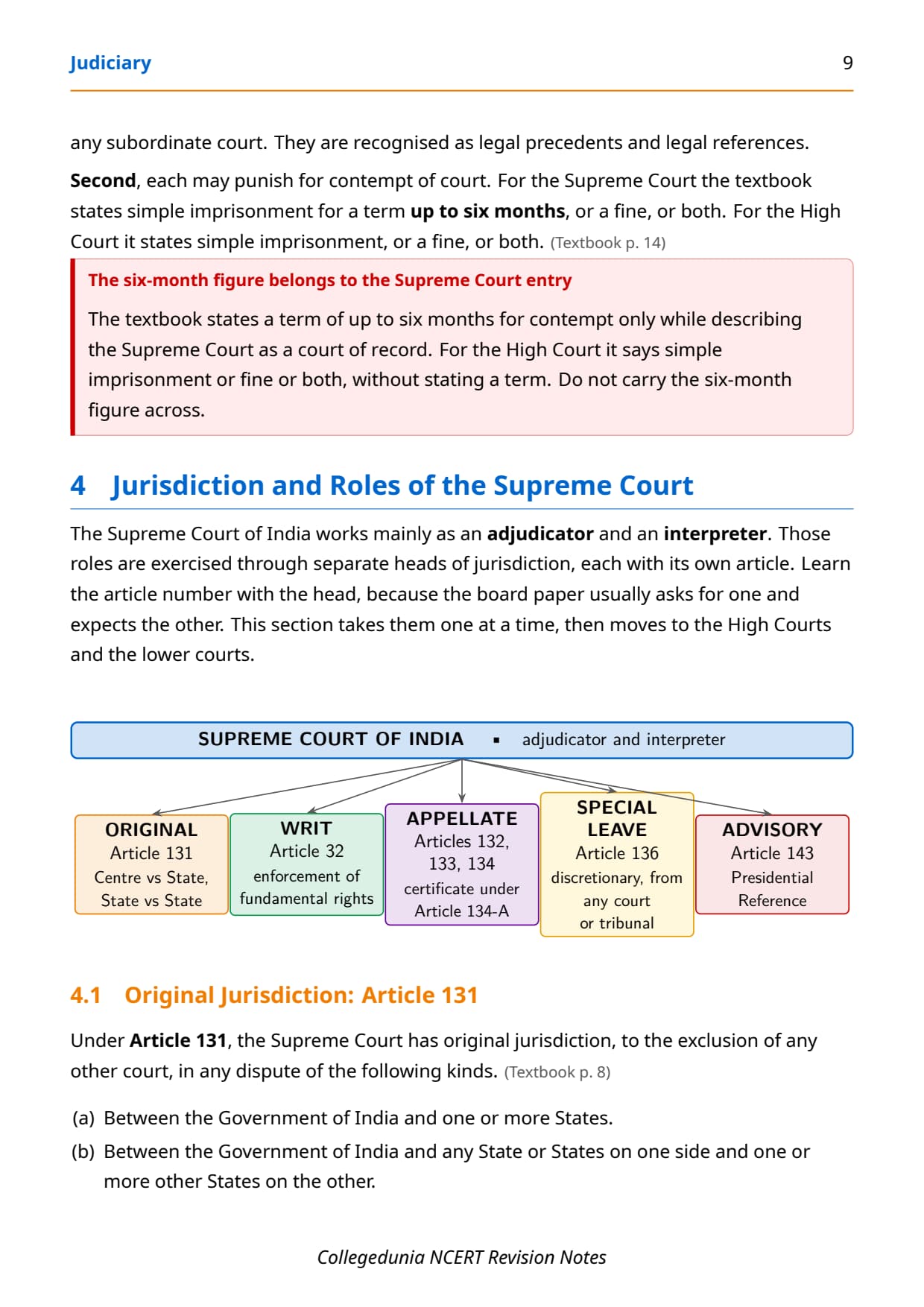
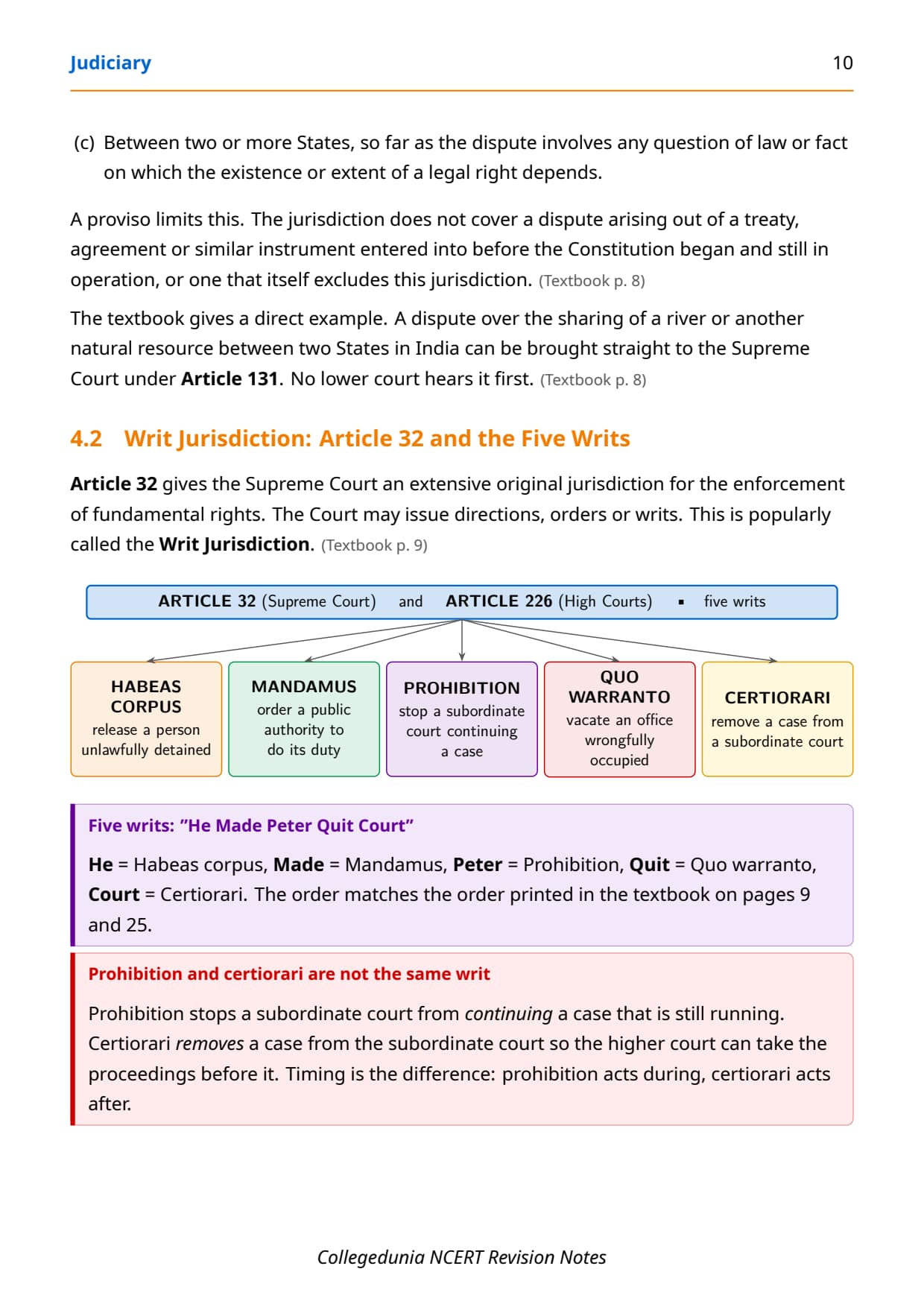
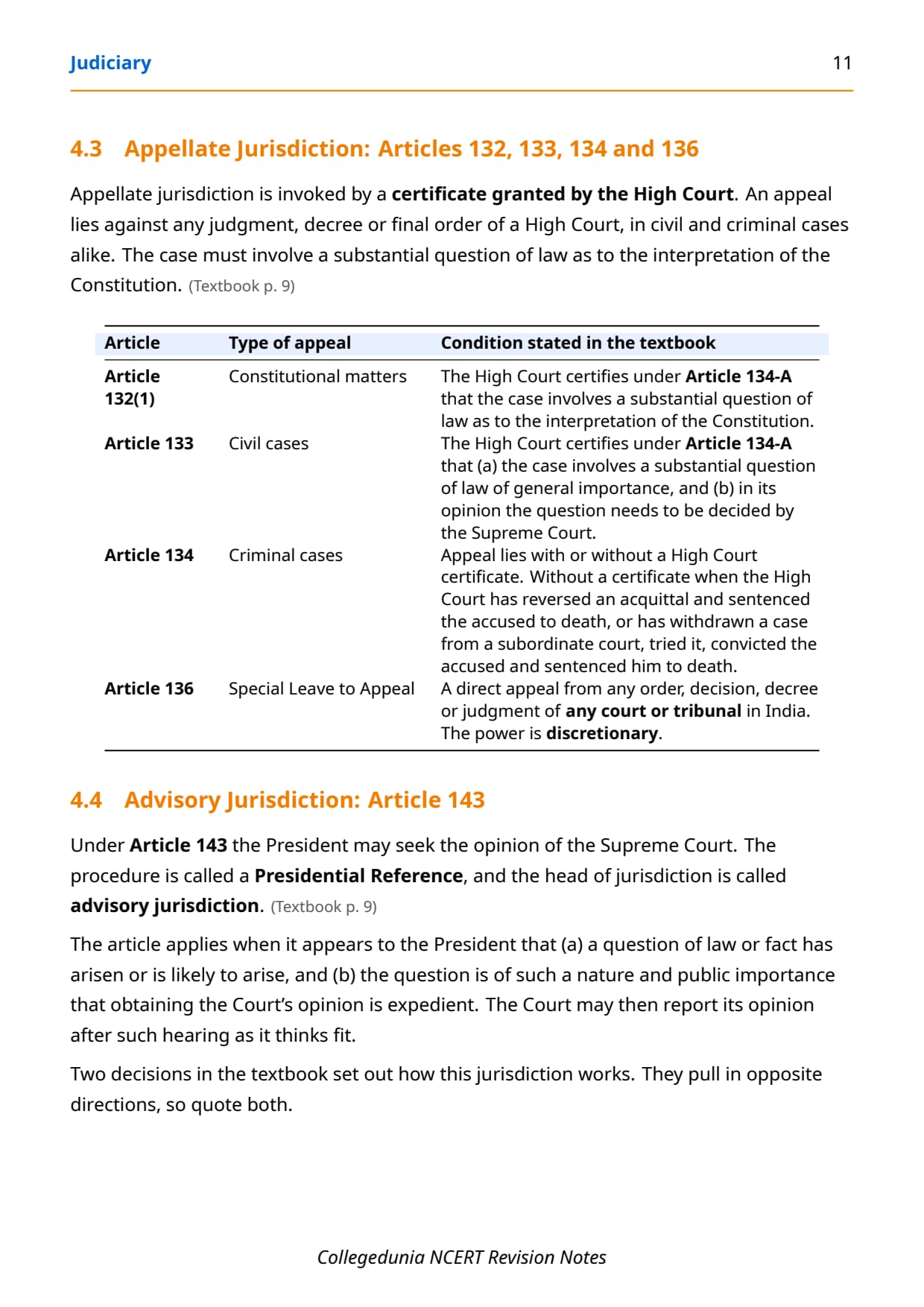
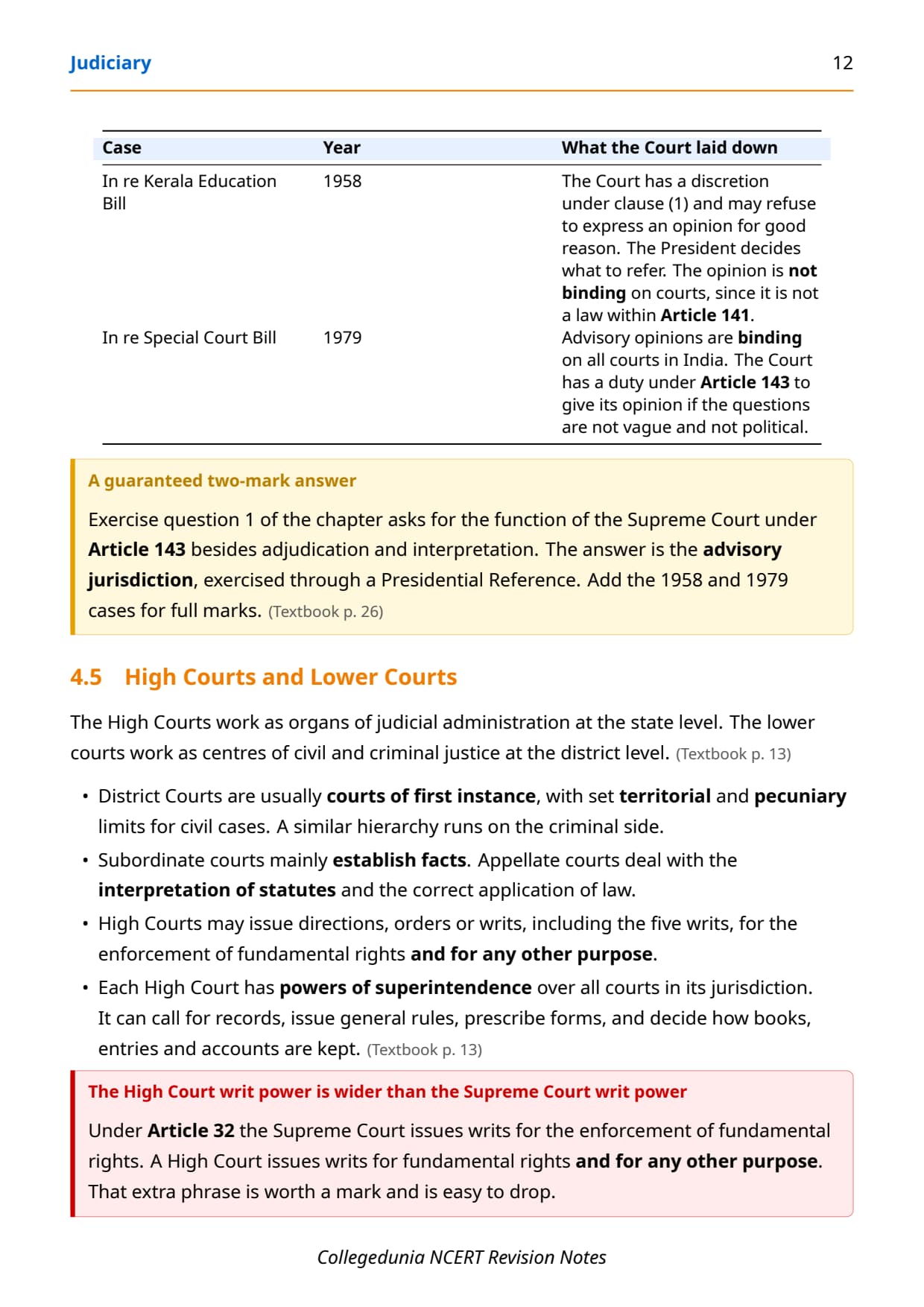
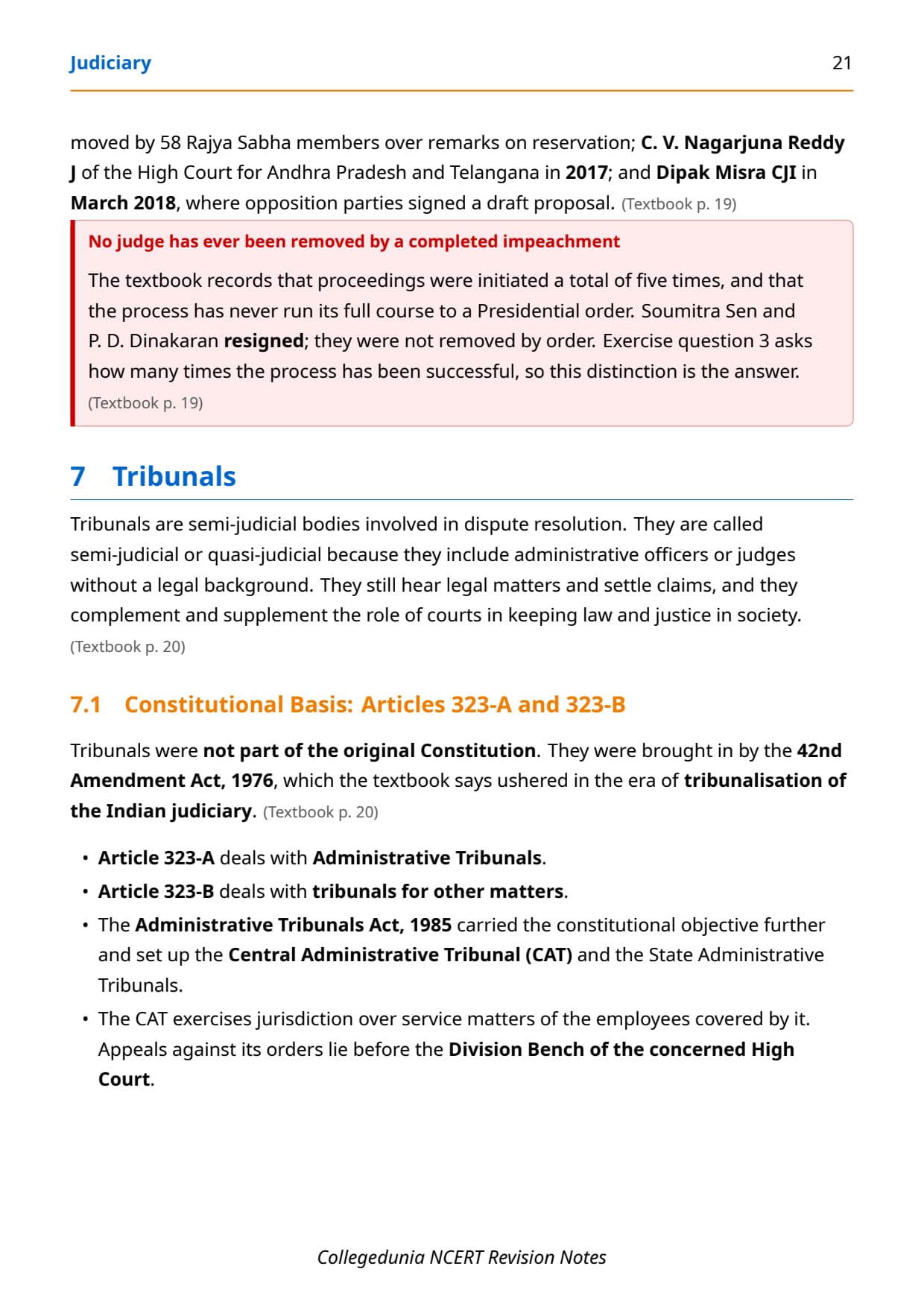
Every article number, case name and case year in these Judiciary notes is checked line by line against the 2026-27 Class 12 Legal Studies textbook, so nothing you write in the board paper comes from a paraphrase.
Student Feedback: In a Collegedunia survey of 12,460 Class 12 Legal Studies students conducted before the 2026 boards, 68% said the basic structure case line is the hardest block in this chapter. The same students rated the five writs the easiest four marks in the paper.
Students who wrote the case names and years on one card, and the article numbers on a second card, said the mix-ups stopped within a week.
Source: 2026-27 Class 12 Legal Studies student poll. Sample of 12,460 students from CBSE schools across 18 states.
Structure and Hierarchy of Courts in India for the Judiciary Chapter
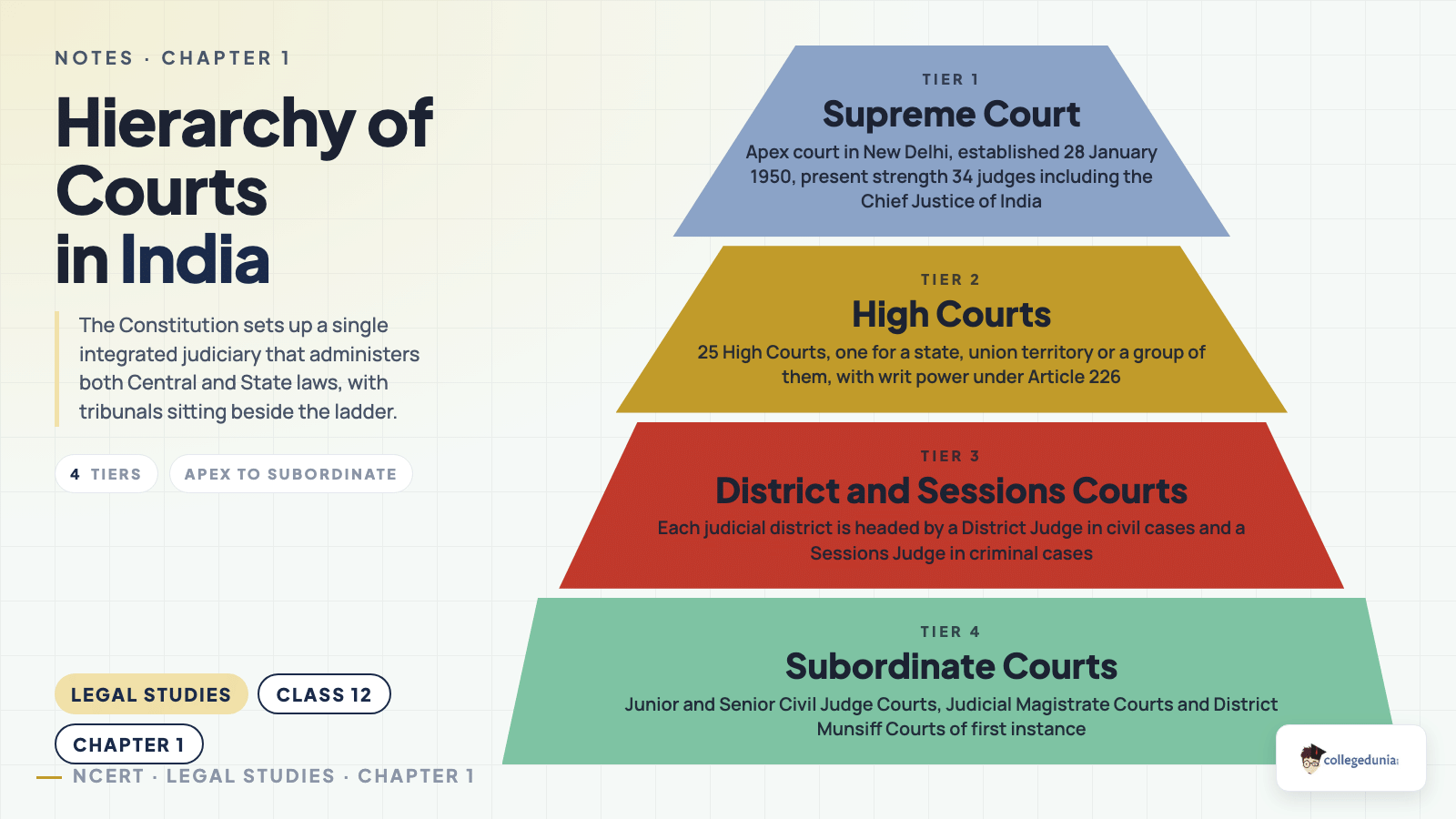
India runs a federal system, so law-making power is split between the Centre and the States. Even so, the Constitution sets up one single integrated judiciary that administers both Central and State laws. There is no separate ladder of courts for Union law.
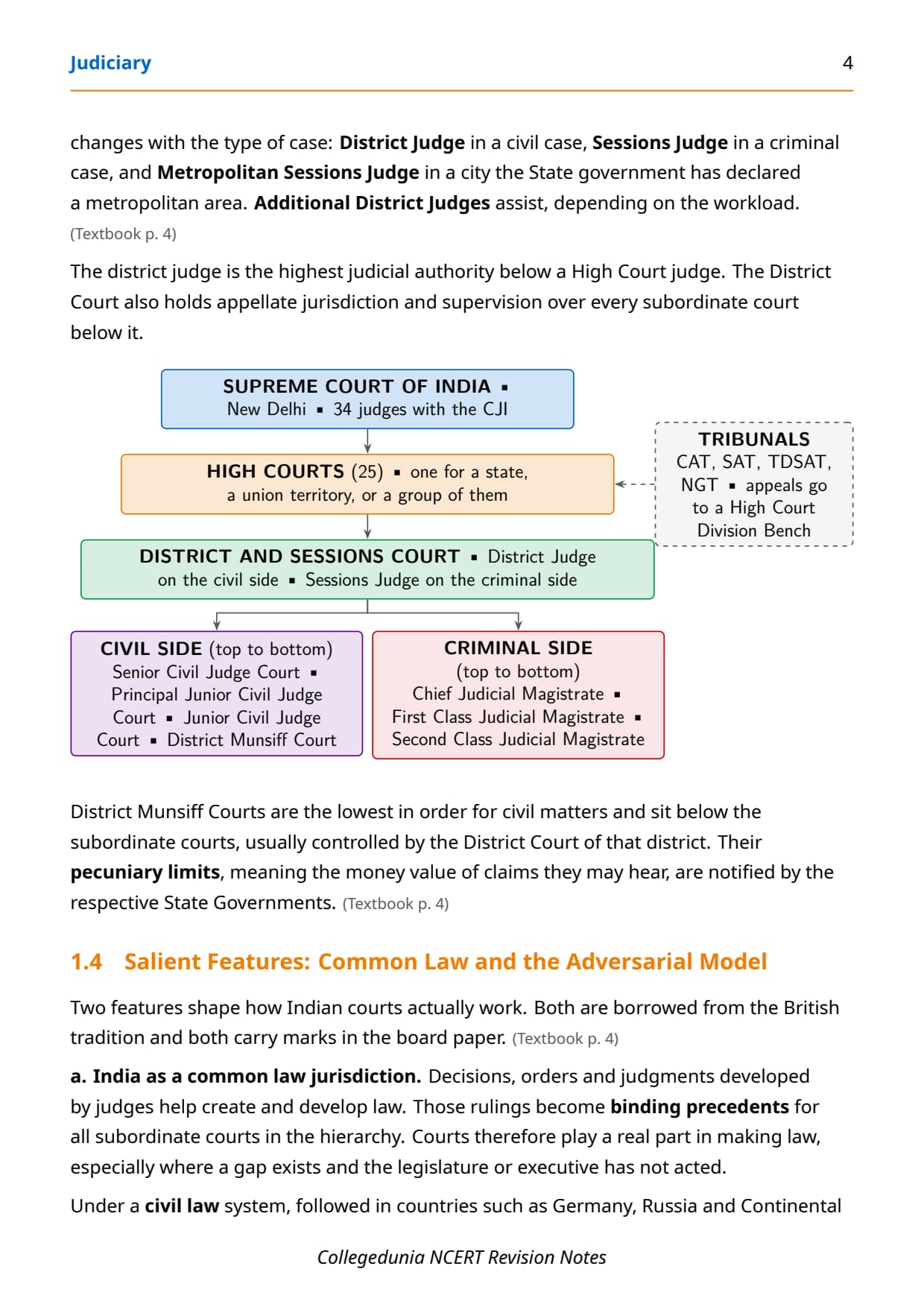
The Supreme Court in New Delhi sits at the top. Below it come the High Courts, then the district and subordinate courts, popularly called the lower courts. Tribunals sit beside this ladder to settle sector-specific claims such as labour, consumer and service matters.
| Level | Court or body | What it does |
|---|---|---|
| 1 | Supreme Court | Apex court, New Delhi, established 28 January 1950 |
| 2 | High Courts | 25 in India, one per state, union territory or group of them |
| 3 | District and subordinate courts | Civil and criminal courts of first instance below the High Court |
| Beside the ladder | Tribunals | Semi-judicial bodies for labour, consumer, service and other sector disputes |
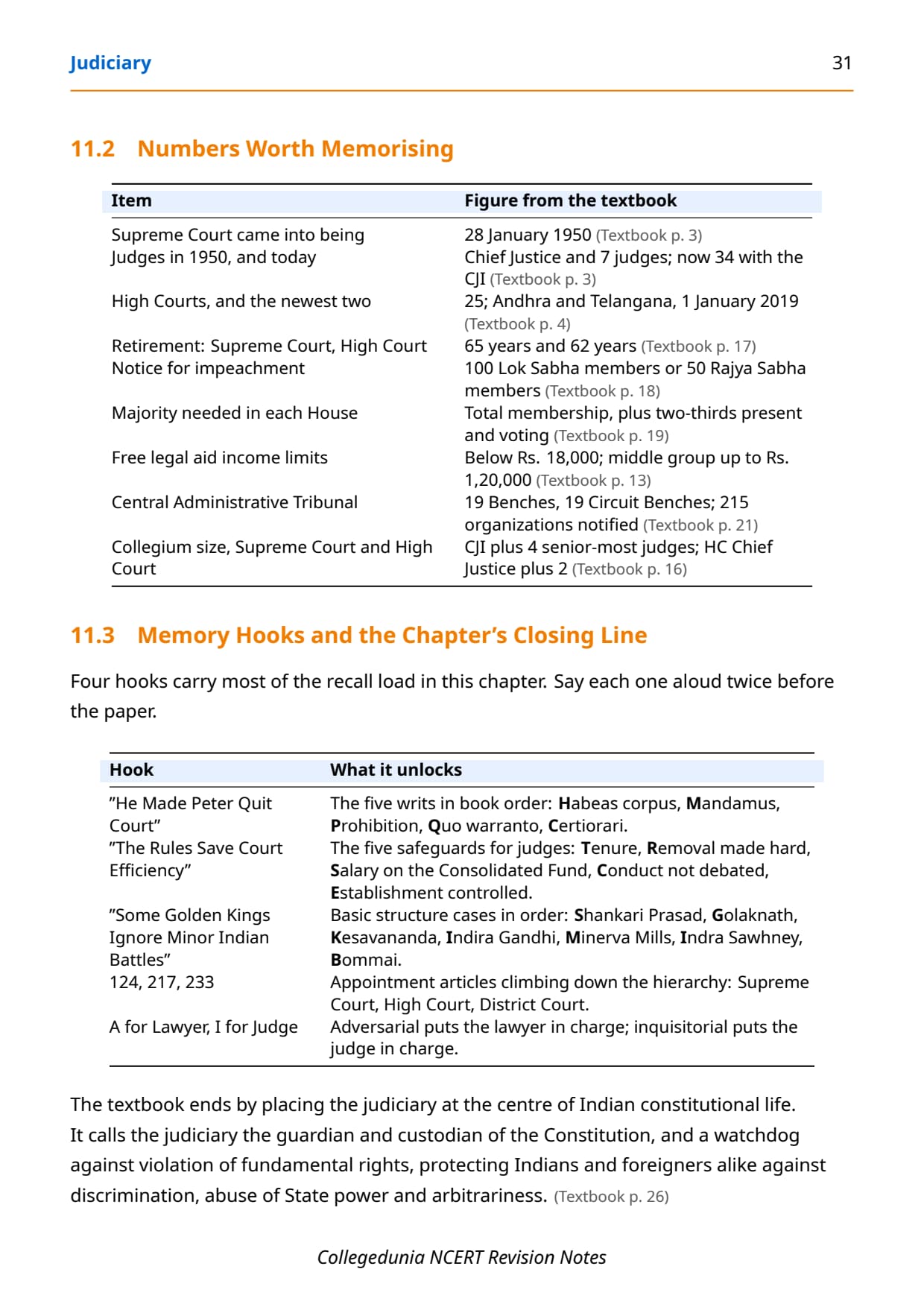
The Supreme Court replaced two colonial bodies at once, the Federal Court of India and the Judicial Committee of the Privy Council. The Constitution as it stood in 1950 planned for a Chief Justice and 7 judges. The present strength is 34 judges including the Chief Justice of India. The Supreme Court (Number of Judges) Amendment Bill, 2019 was introduced in the Lok Sabha on 5 August 2019 and raised the number fixed by the Supreme Court (Number of Judges) Act, 1956 from 30 to 33, not counting the Chief Justice.
The textbook also names the oldest and the newest High Courts. The first four are the Madras High Court in Chennai, the Bombay High Court in Mumbai, the Calcutta High Court in Kolkata and the Allahabad High Court in Allahabad. The Andhra High Court and the Telangana High Court are the newest, both established on 1 January 2019 according to the Andhra Pradesh Reorganisation Act, 2014.
Below the High Courts, each state is split into judicial districts headed by a District and Sessions Judge. The same person is called a District Judge in a civil case and a Sessions Judge in a criminal case, and a Metropolitan Sessions Judge when the district court sits in a city notified as a metropolitan area.
- Civil side, in ascending order: Junior Civil Judge Court, Principal Junior Civil Judge Court, Senior Civil Judge Court (also called sub-Courts).
- Criminal side, in ascending order: Second Class Judicial Magistrates Court, First Class Judicial Magistrate Court, Chief Judicial Magistrate Court.
- District Munsiff Courts: lowest in order for civil matters, controlled by the district court of that district.
- Pecuniary limits: the money value of claims a court can hear, notified by the respective State Government.
Salient Features of the Indian Judiciary: Common Law Roots and the Adversarial Model
Two features decide how Indian courts work day to day. The first is that India is a common law jurisdiction, taken from the British tradition. Decisions, orders and judgments of judges create and develop law, and they become binding precedent for every subordinate court in the hierarchy.
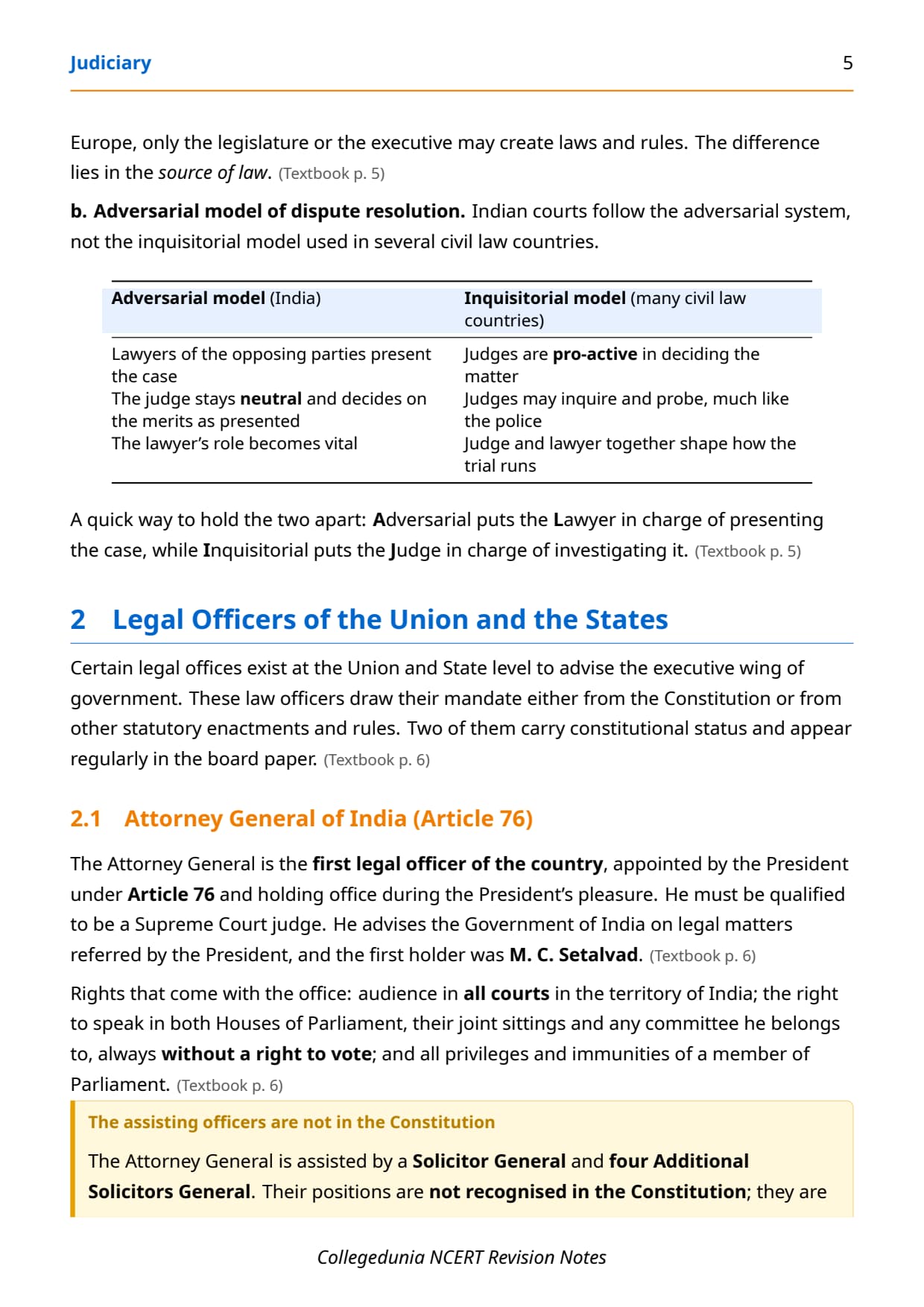
The second is the adversarial model of dispute resolution. Lawyers for the two sides argue before a neutral judge, who decides on the merits as presented. Under the inquisitorial model used in several civil law countries, the judge is far more active and can inquire and probe into the matter, much like the police.
| Feature | India follows | The contrast |
|---|---|---|
| Source of law | Common law, judges make law through decisions | Civil law in Germany, Russia and Continental Europe, only the legislature or executive makes law |
| Trial method | Adversarial, lawyers argue before a neutral judge | Inquisitorial, the judge inquires and probes into the matter |
Tip: a three-mark question on this section wants the difference stated in one line about the source of law, then one example country on each side. Do not describe both systems in full.
Judiciary Class 12 Full Chapter Explanation
Source: Magnet Brains on YouTube
Legal Officers in India: Attorney General under Article 76 and Advocate General under Article 165
Certain law offices at the Union and State level advise the executive wing of the government. They take their mandate from the Constitution or from other statutes and rules.
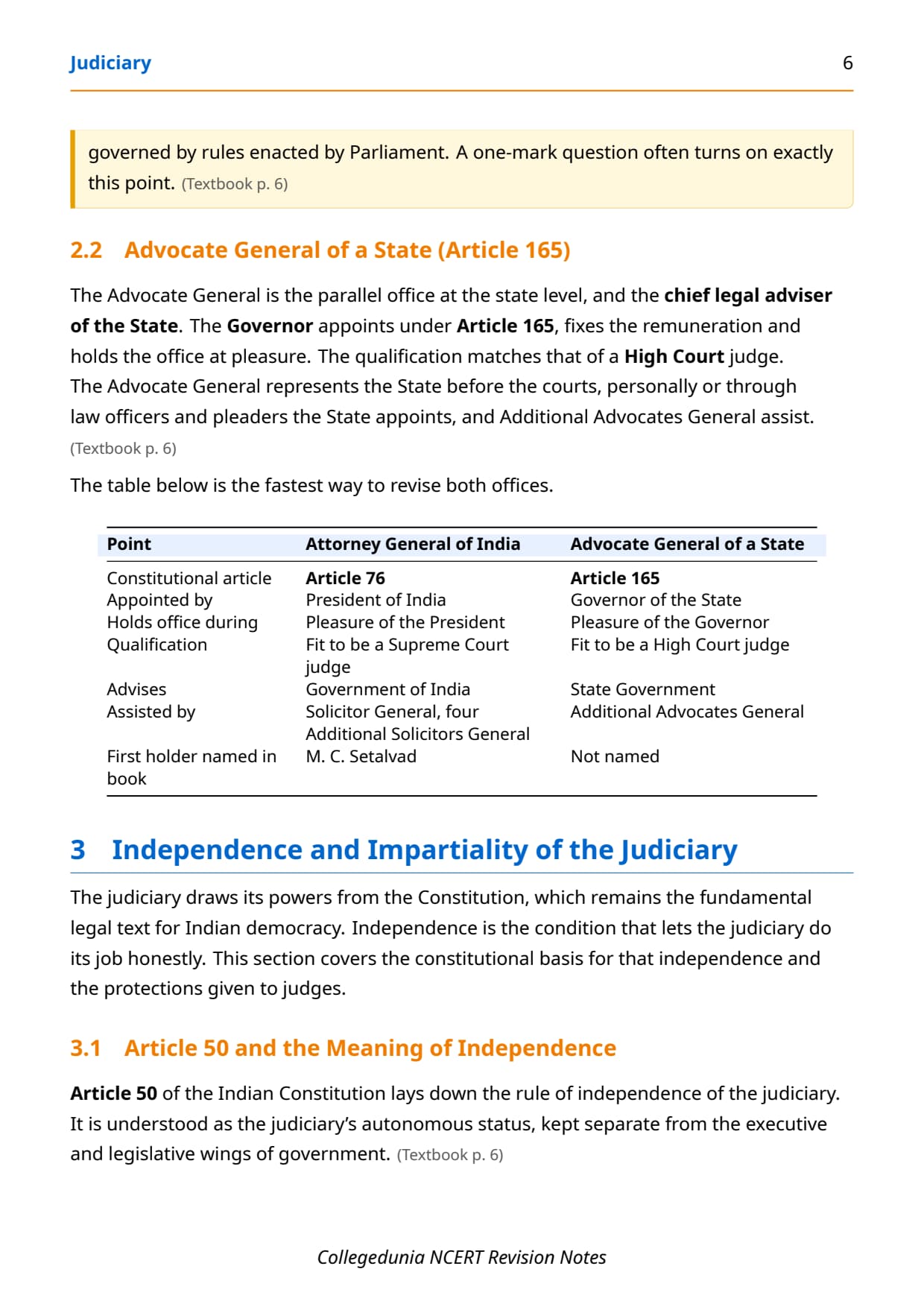
The Attorney General is the first legal officer of the country, appointed by the President under Article 76 and holding office during the pleasure of the President. He must be qualified to be appointed a judge of the Supreme Court. The first Attorney General of India was M. C. Setalvad.
- Advises the Government of India on legal matters referred to him by the President.
- Has the right to appear and be heard in all courts in the territory of India.
- May speak in both Houses of Parliament, their joint sittings and any parliamentary committee he belongs to, but cannot vote.
- Enjoys the privileges and immunities available to a Member of Parliament.
- Is assisted by a Solicitor General and four Additional Solicitors General, posts the Constitution does not recognise.
At the state level, the Advocate General is appointed by the Governor under Article 165 and is the chief legal adviser of the State. The qualification is the same as that of a High Court judge, the office is held during the pleasure of the Governor, and Additional Advocate Generals assist the office.
Independence of the Judiciary under Article 50 and the Five Protections Given to Judges
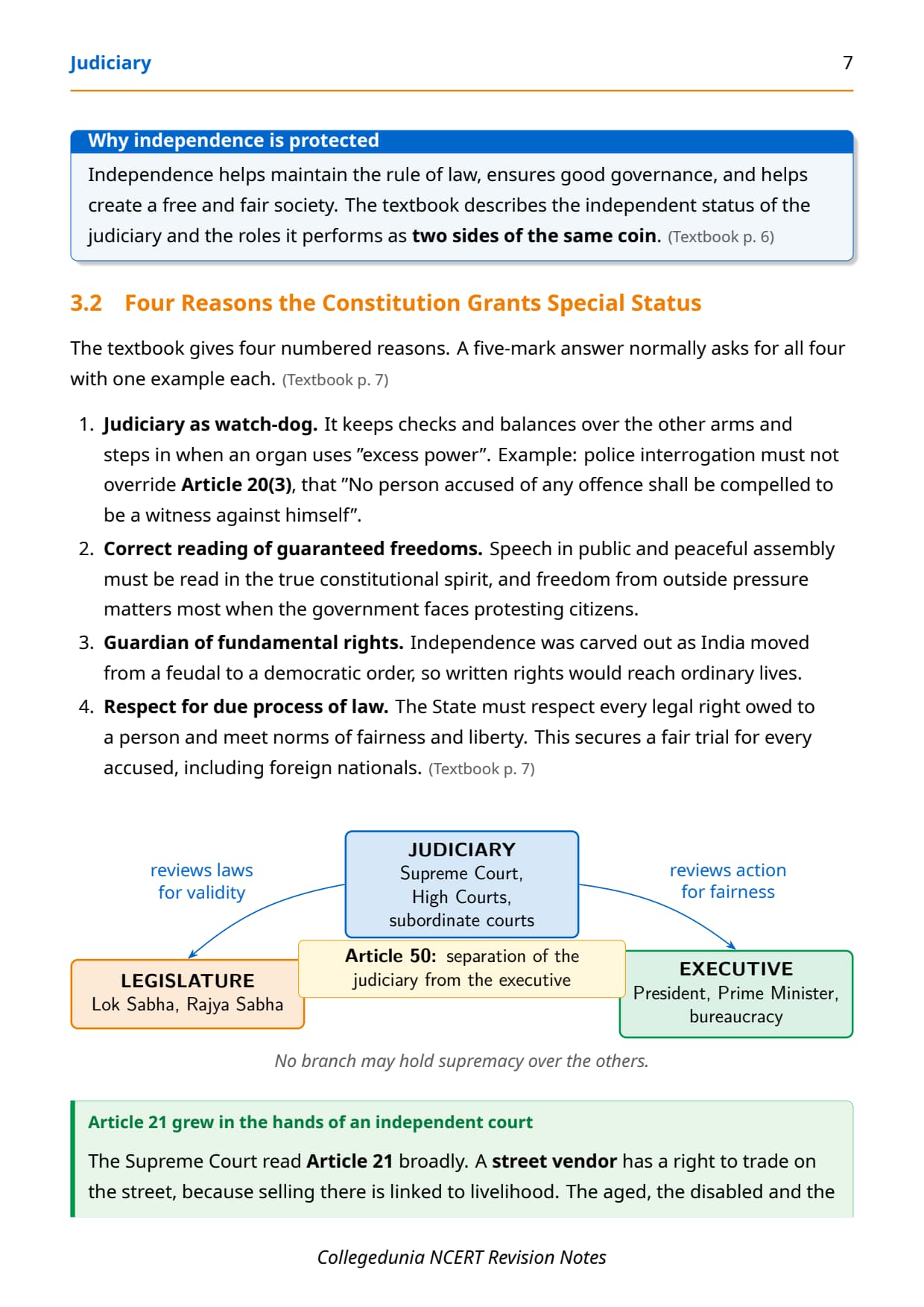
Article 50 of the Constitution lays down the rule of independence of the judiciary, which means the judiciary is autonomous and separate from the executive and legislative wings. The textbook gives four reasons why this matters.
- Watchdog role. The judiciary keeps checks and balances over the other arms of government and steps in when an organ uses excess power. The example given is police interrogation set against Article 20(3), which says no person accused of any offence shall be compelled to be a witness against himself.
- Free interpretation of freedoms. Guaranteed freedoms such as speech and peaceful assembly must be read in the true constitutional spirit, so the courts are kept away from outside pressure.
- Guardian of fundamental rights. Under Article 21, the Supreme Court has held that a street vendor has a right to sell on the street because it is linked to livelihood, and that the aged, disabled and destitute have a right to food.
- Due process of law. The State must respect all the legal rights owed to a person, and only an independent judiciary can make that workable, including a fair trial for an accused.
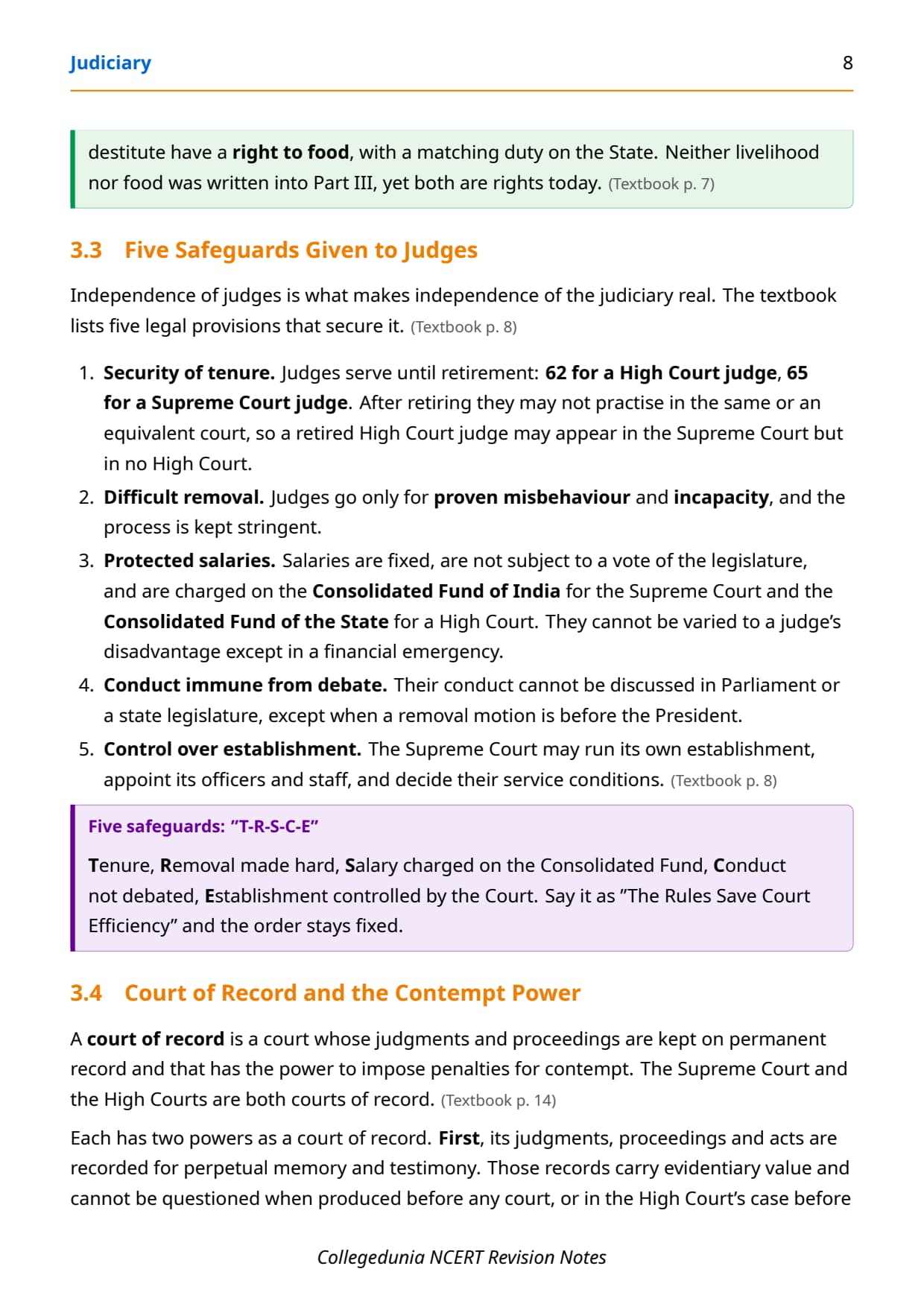
To make that independence real, five legal protections apply to judges. This is a favourite five-mark question, so the points are worth learning as a numbered list.
- Security of tenure: judges serve till retirement, which is 62 for High Court judges and 65 for Supreme Court judges. A retired judge cannot practise in the same or an equivalent court, so a retired High Court judge may appear in the Supreme Court but not in any High Court.
- Hard removal: a judge can be removed only for proven misbehaviour and incapacity, through a deliberately stringent process.
- Fixed pay: salaries come from the Consolidated Fund of India for the Supreme Court and the Consolidated Fund of the State for High Courts, are not subject to a vote of the legislature, and cannot be altered to a judge's disadvantage except during a financial emergency.
- No legislative discussion: the conduct of Supreme Court and High Court judges cannot be discussed in Parliament or a state legislature, except when a removal motion is being presented to the President.
- Control of its own house: the Supreme Court appoints its own officers and staff and decides their service conditions.
Jurisdiction of the Supreme Court: Articles 131, 132, 133, 134, 136 and 143
This is the most exam-heavy part of the Judiciary chapter. The Supreme Court is primarily an adjudicator and an interpreter, and each role is carried by a named article. Learn which article triggers which route, because scenario questions expect the jurisdiction named correctly.
| Article | Jurisdiction | What it covers |
|---|---|---|
| Article 131 | Original | Disputes between the Government of India and one or more States, or between two or more States, such as river water sharing |
| Article 32 | Writ | Enforcement of Fundamental Rights through directions, orders and the five writs |
| Article 132(1) | Constitutional appeal | Appeal from a High Court judgment on a High Court certificate under Article 134-A involving interpretation of the Constitution |
| Article 133 | Civil appeal | Civil appeal where the High Court certifies a substantial question of law of general importance |
| Article 134 | Criminal appeal | Criminal appeal, allowed without a certificate where the High Court reversed an acquittal and gave a death sentence, or withdrew a case to itself and gave a death sentence |
| Article 136 | Special Leave to Appeal | Discretionary appeal directly from any court or tribunal in India |
| Article 143 | Advisory | Presidential Reference on a question of law or fact of public importance |
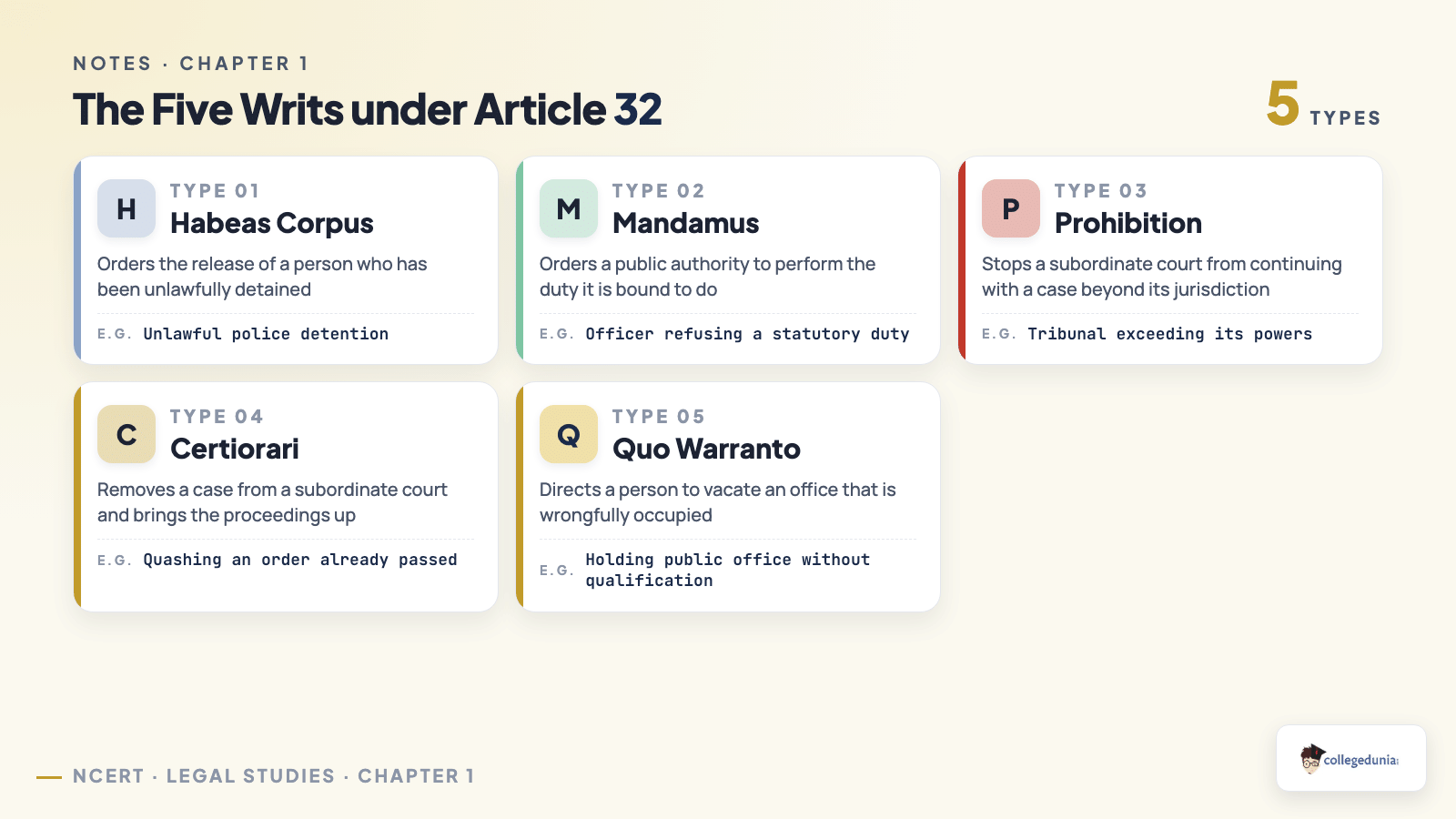
The five writs under Article 32 carry a near-certain question. Each one needs a single accurate line, not a paragraph.
- Habeas corpus: orders the release of a person who is unlawfully detained.
- Mandamus: orders a public authority to do its duty.
- Prohibition: prevents a subordinate court from continuing with a case.
- Quo warranto: directs a person to vacate an office wrongfully occupied.
- Certiorari: removes a case from a subordinate court and brings the proceedings up for review.
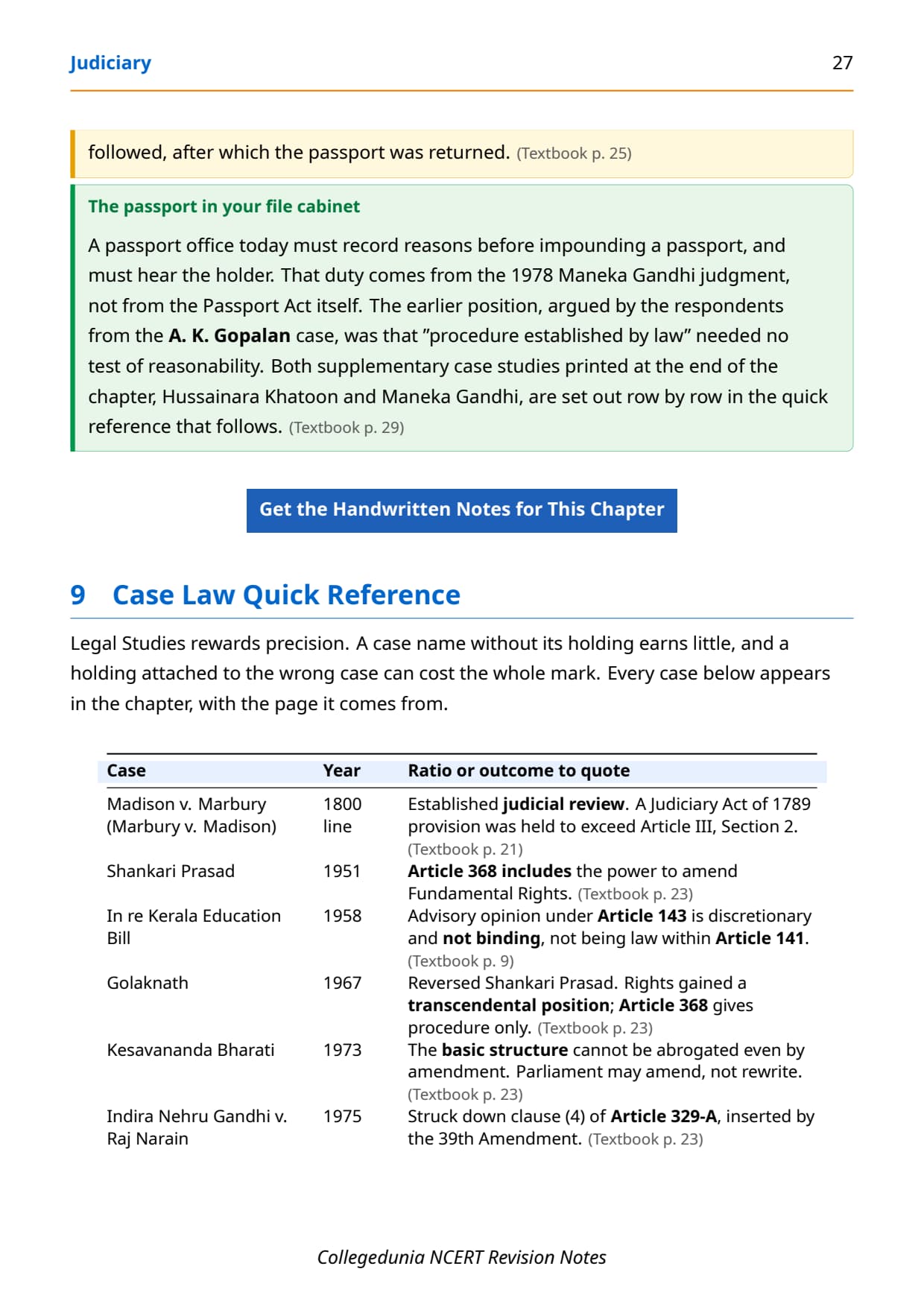
Two named cases sit on the advisory jurisdiction. In In re Kerala Education Bill (1958) the Court held that it has a discretion to refuse to answer, that the President decides what to refer, and that an advisory opinion does not bind courts because it is not a law within the meaning of Article 141. In In re Special Court Bill (1979) the Court held that its advisory opinions are binding on all courts in the territory of India, and that it has a duty to answer a reference when the question is neither vague nor political.
Public Interest Litigation, Suo Motu Power and the Supreme Court as an Activist
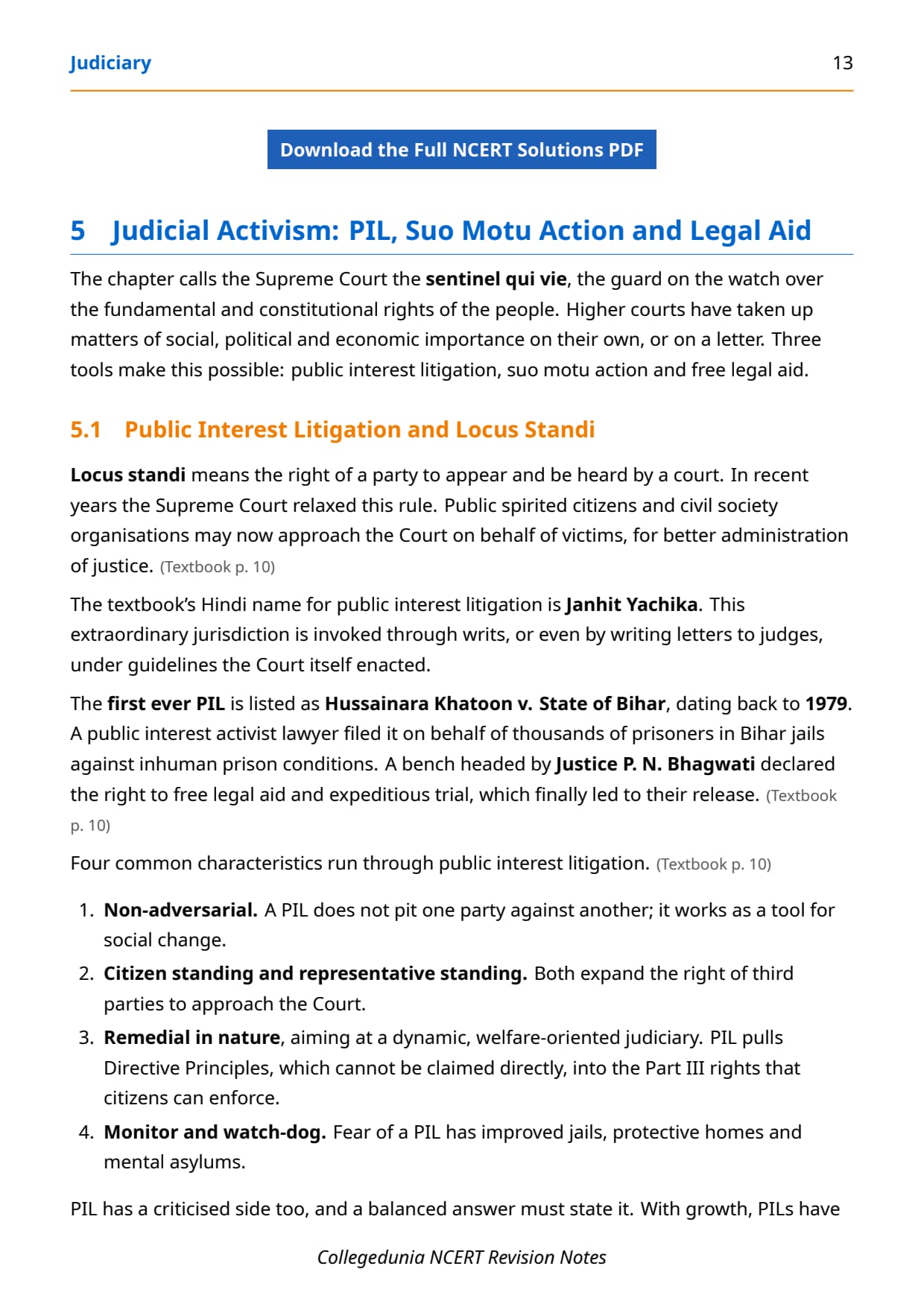
The textbook calls the Supreme Court the sentinel qui vive, the protector of fundamental and constitutional rights. The Court relaxed locus standi, the right of a party to appear and be heard, so public-spirited citizens and civil society groups can approach it on behalf of victims.
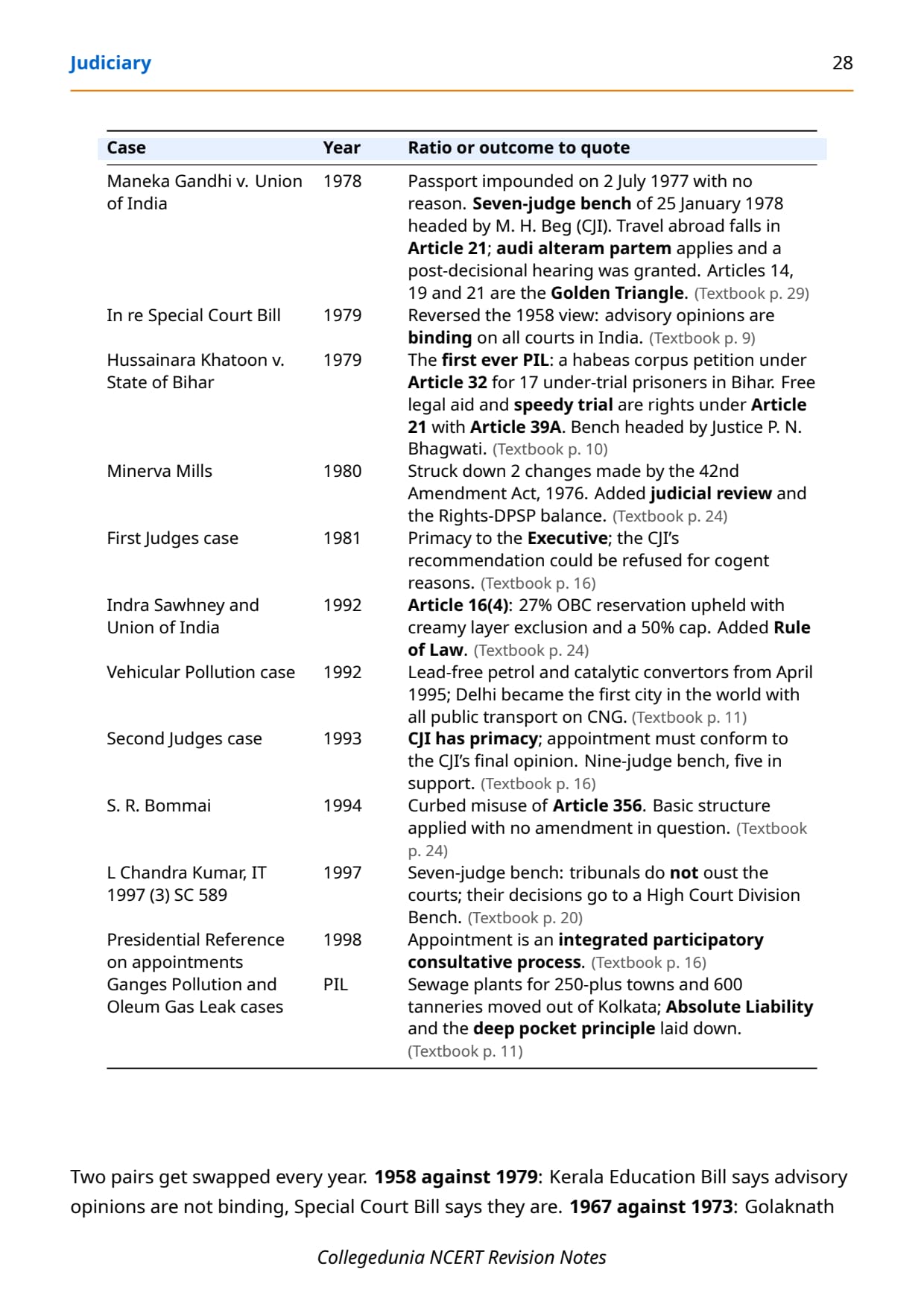
The first ever PIL is Hussainara Khatoon v. State of Bihar, dating back to 1979. A public interest lawyer filed it for thousands of prisoners in Bihar jails against inhuman prison conditions. A bench headed by Justice P. N. Bhagwati declared the right to free legal aid and to an expeditious trial, which finally led to their release.
The chapter lists four features that every PIL shares. These are the marker's checklist for a five-mark answer.
- Non-adversarial: a PIL is not one party pitted against another, it is a tool for social change.
- Citizen and representative standing: third parties are allowed to approach the Court on behalf of others.
- Remedial in nature: it pulls the Directive Principles, which cannot be claimed directly, into the space of Part III fundamental rights that can be claimed in court.
- Monitor and watchdog: the fear of a PIL has improved jails, protective homes and mental asylums.
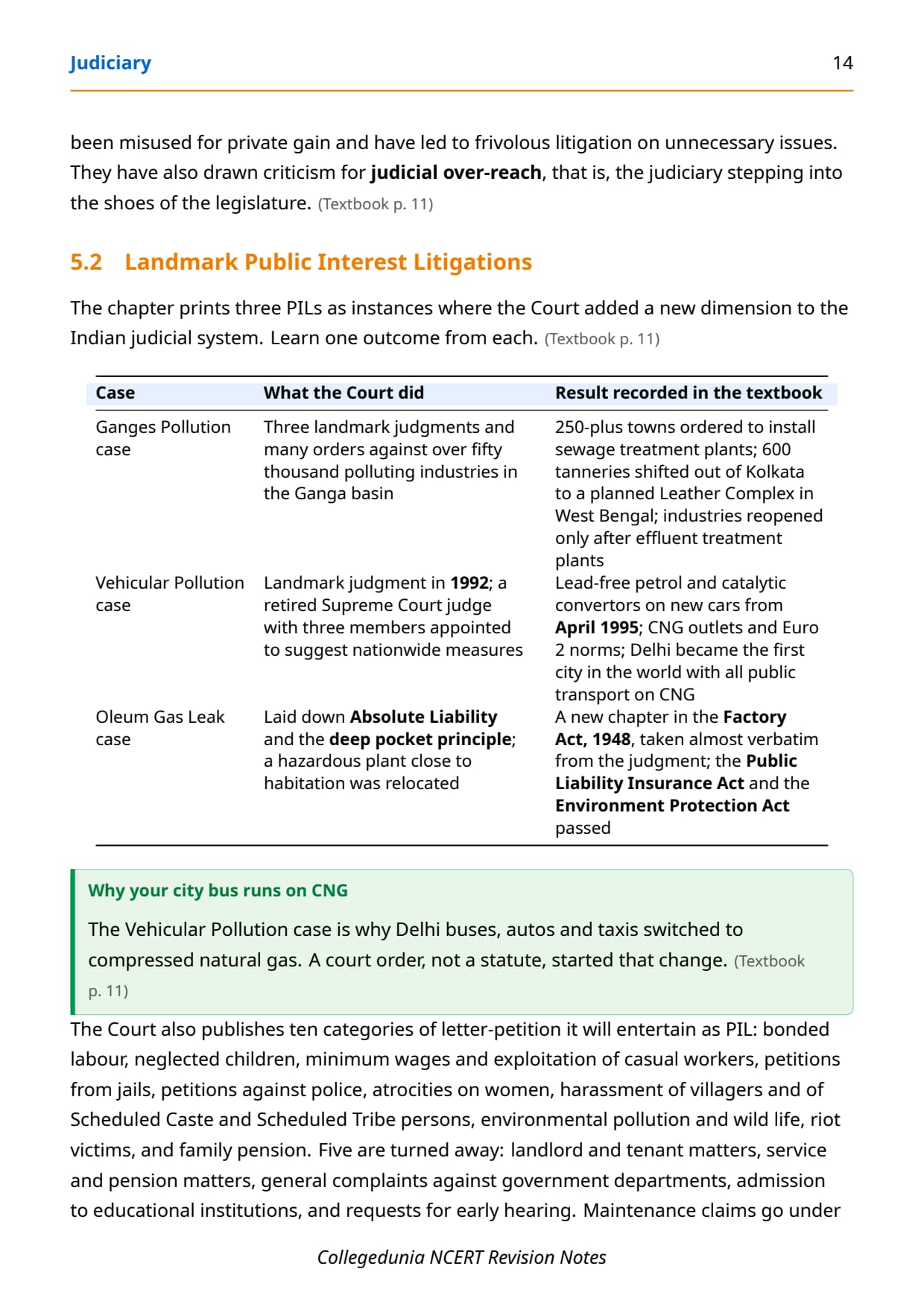
Three PIL matters are named in the chapter. The Ganges Pollution Case produced three landmark judgments and orders against more than fifty thousand polluting industries in the Ganga basin, made over 250 towns and cities install sewage treatment plants, and moved six hundred tanneries out of congested Kolkata into a planned leather complex in West Bengal. The Vehicular Pollution Case saw a landmark judgment in 1992, orders for lead-free petrol from April 1995, catalytic convertors on new cars, and CNG outlets, which made Delhi the first city in the world with fully CNG public transport. The Oleum Gas Leak Case laid down the principle of absolute liability and the deep pocket principle, and led to a new chapter in the Factory Act of 1948, the Public Liability Insurance Act and the Environment Protection Act.
PIL is not open to every complaint. The Court's own guidelines admit ten categories and reject five.
| Entertained as a PIL | Not entertained as a PIL |
|---|---|
| Bonded labour matters, neglected children | Landlord and tenant matters |
| Non-payment of minimum wages, violation of labour laws | Service matters, pension and gratuity |
| Jail petitions on harassment, premature release, custodial death, speedy trial | Complaints against government departments and local bodies outside the listed categories |
| Petitions against police for refusing to register a case or for custodial death | Admission to medical and other educational institutions |
| Atrocities on women, harassment of Scheduled Caste and Scheduled Tribe persons, riot victims, family pension, environmental pollution | Petitions for early hearing of cases already pending |
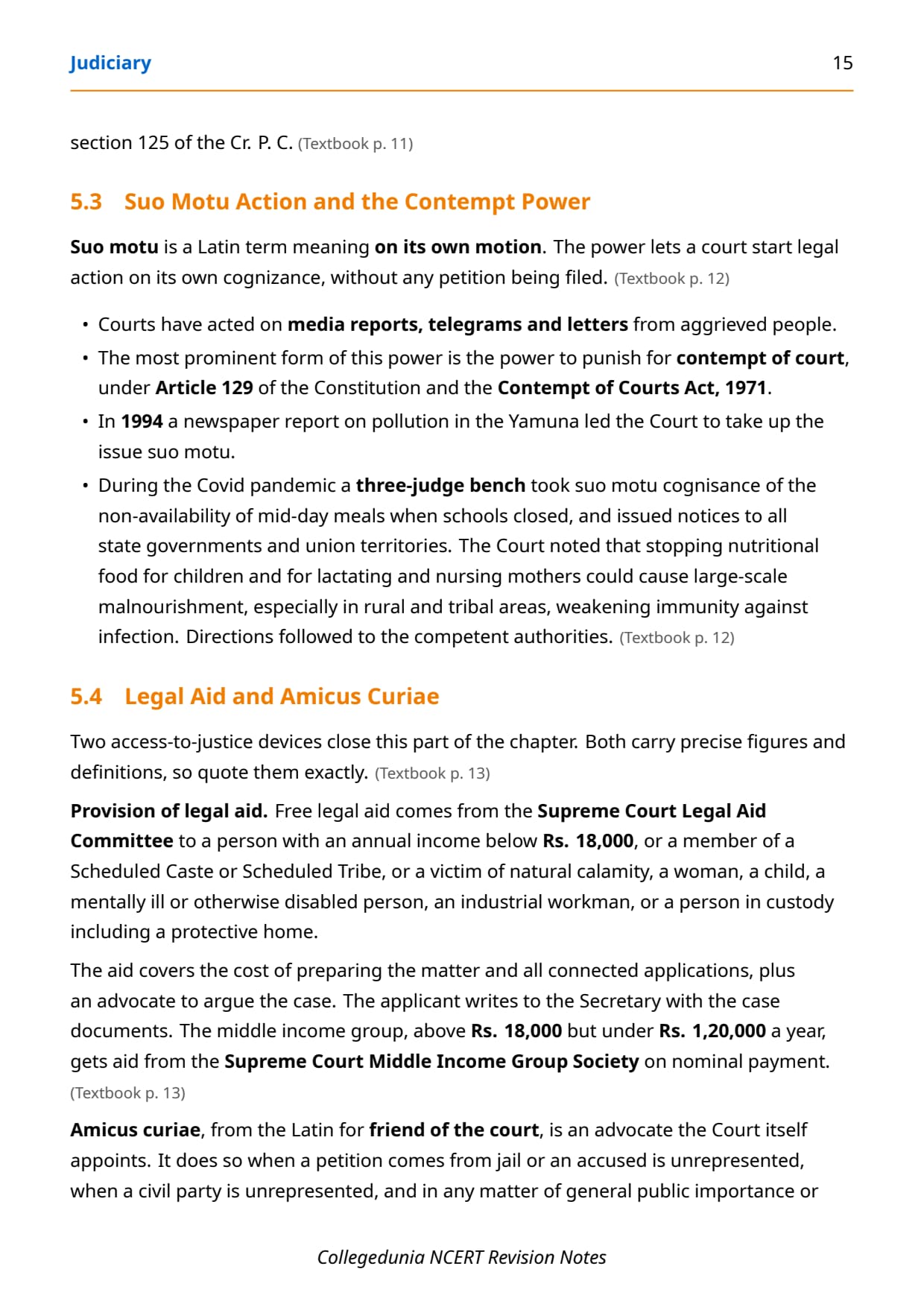
Suo motu is Latin for "on its own motion". It lets a court start proceedings on its own cognisance, without any petition. The Court has used it on the strength of media reports, telegrams and letters. In 1994 a newspaper report on pollution in the Yamuna led the Court to take up the issue suo motu, and during the Covid pandemic a three-judge bench took suo motu cognisance of mid-day meals not reaching children after schools closed. The most prominent form of this power is the contempt power under Article 129 read with the Contempt of Courts Act, 1971.
The chapter is honest about the other side too. PILs have been misused for private gain, have led to frivolous litigation, and have been criticised for judicial over-reach into the legislature's space.
Court of Record under Article 129, Legal Aid and Amicus Curiae
A court of record is a court whose judgments and proceedings are kept on permanent record and that can punish for contempt. Both the Supreme Court and the High Courts are courts of record. Their records carry evidentiary value, cannot be questioned when produced before another court, and are recognised as legal precedent.
- Supreme Court contempt power: simple imprisonment for a term up to six months, or a fine, or both.
- High Court contempt power: simple imprisonment, or a fine, or both.
- Free legal aid: available from the Supreme Court Legal Aid Committee to a person with an annual income below Rs. 18,000, or a member of a Scheduled Caste or Scheduled Tribe, a victim of natural calamity, a woman, a child, a person who is mentally ill or disabled, an industrial workman, or a person in custody.
- Middle income group: a person earning above Rs. 18,000 and under Rs. 1,20,000 a year gets aid from the Supreme Court Middle Income Group Society on nominal payment.
- Amicus curiae: Latin for "friend of the court", an advocate the Court appoints for an unrepresented accused, or in any matter of general public importance.
High Courts carry the same writ power as the Supreme Court under Article 226, and it is wider in one way. Article 226 covers enforcement of Fundamental Rights and any other purpose. Each High Court also has power of superintendence over all courts within its jurisdiction, so it can call for records, issue general rules and prescribe forms.
Appointment of Judges under Articles 124, 217 and 233 and the Three Judges Cases
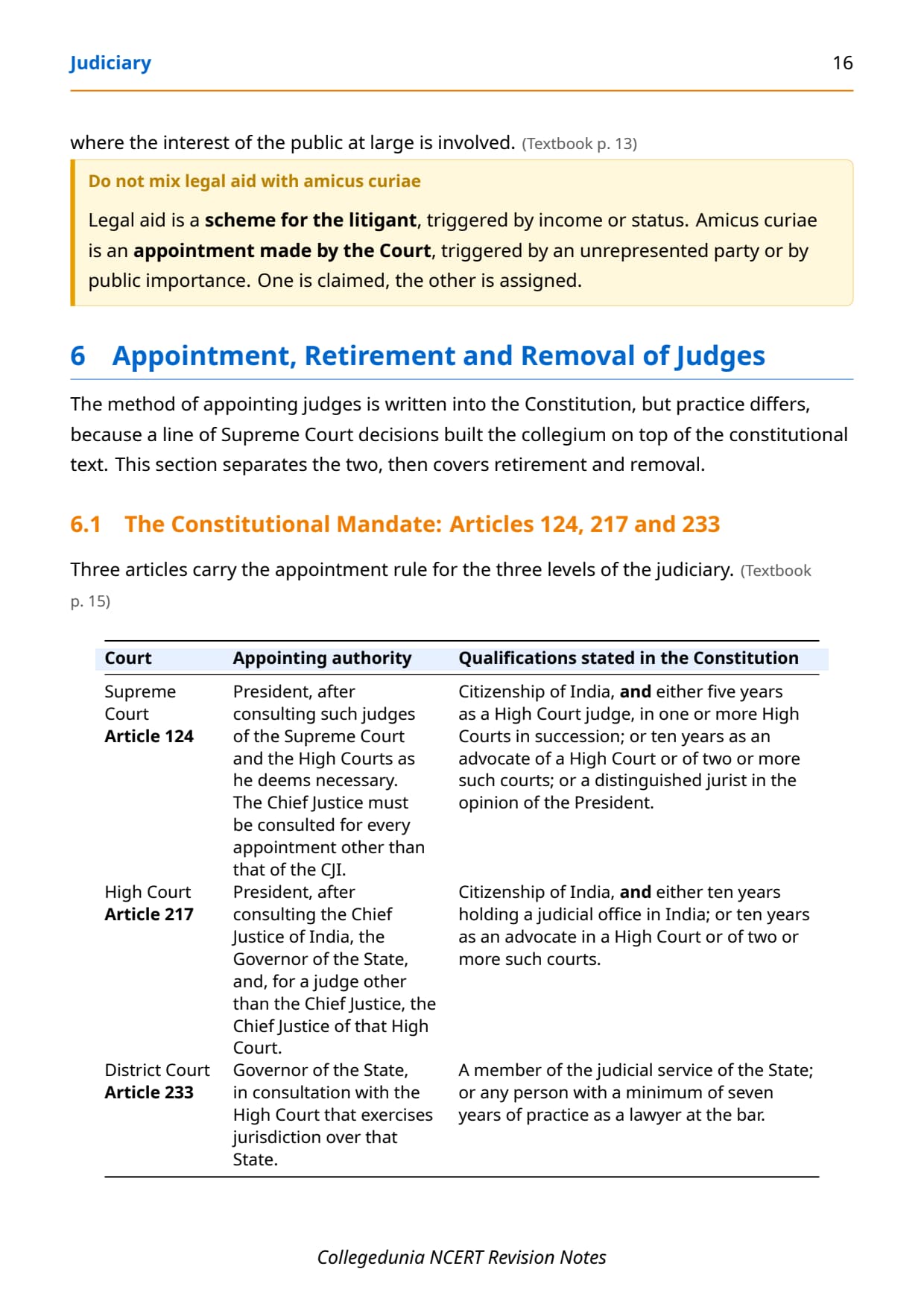
Three articles fix who appoints judges at which level. The qualification lists below are exactly what a two-mark or three-mark question asks for.
| Article | Post and appointing authority | Qualifications |
|---|---|---|
| Article 124 | Supreme Court judge, appointed by the President after consultation with judges of the Supreme Court and the High Courts. The Chief Justice must be consulted for any judge other than the Chief Justice of India. | Citizen of India, and either 5 years as a High Court judge, or 10 years as an advocate of a High Court, or a distinguished jurist in the opinion of the President |
| Article 217 | High Court judge, appointed by the President after consultation with the Chief Justice of India, the Governor of the State, and the Chief Justice of that High Court | Citizen of India, and either 10 years holding judicial office in India, or 10 years as an advocate in a High Court |
| Article 233 | District judge, appointed by the Governor of the State in consultation with the High Court exercising jurisdiction over that State | Member of the judicial service of the State, or a minimum of seven years of practice as a lawyer at the bar |
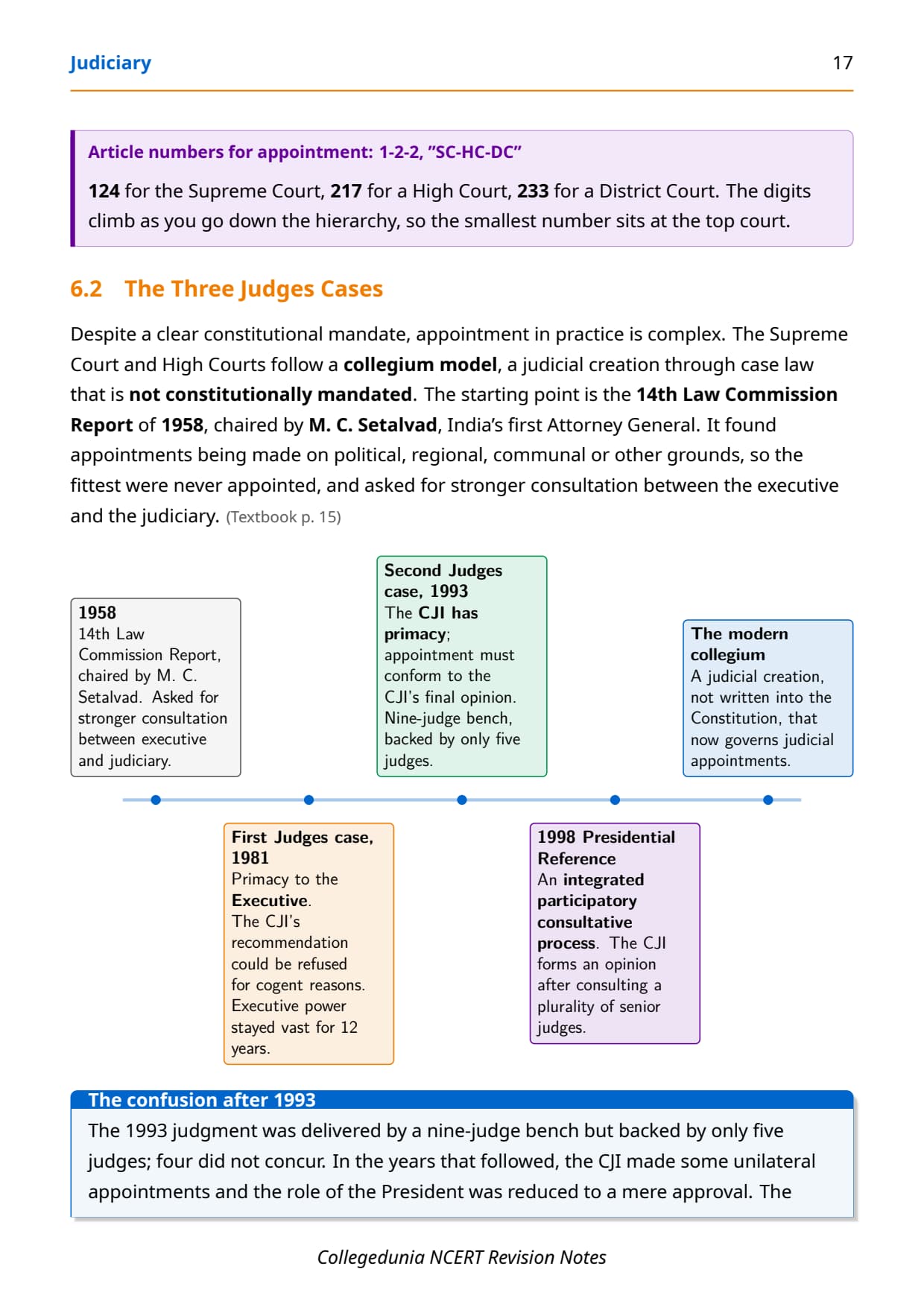
In practice, appointments follow the collegium model, which is a judicial creation through case law and is not written into the Constitution. The problem is old. The 14th Law Commission Report of 1958, under the chairmanship of M. C. Setalvad, noted that appointments were being made on political, regional and communal grounds, so the fittest were never appointed.
Three decisions, known as the Three Judges Cases, built the modern collegium. Getting the order and the outcome of these three right is worth full marks on its own.
- First Judges Case (1981): gave primacy to the Executive and held that the Chief Justice of India's recommendation could be refused for cogent reasons. It governed appointments for the next 12 years.
- Second Judges Case (1993): held that the Chief Justice of India has primacy and that an appointment has to conform to the final opinion of the Chief Justice of India. The nine-judge bench decision was supported by only five judges, and the executive element was cut to a minimum.
- Presidential Reference (1998): called the process an integrated participatory consultative process, where the Chief Justice of India firms up an opinion only after consulting a plurality of senior judges.
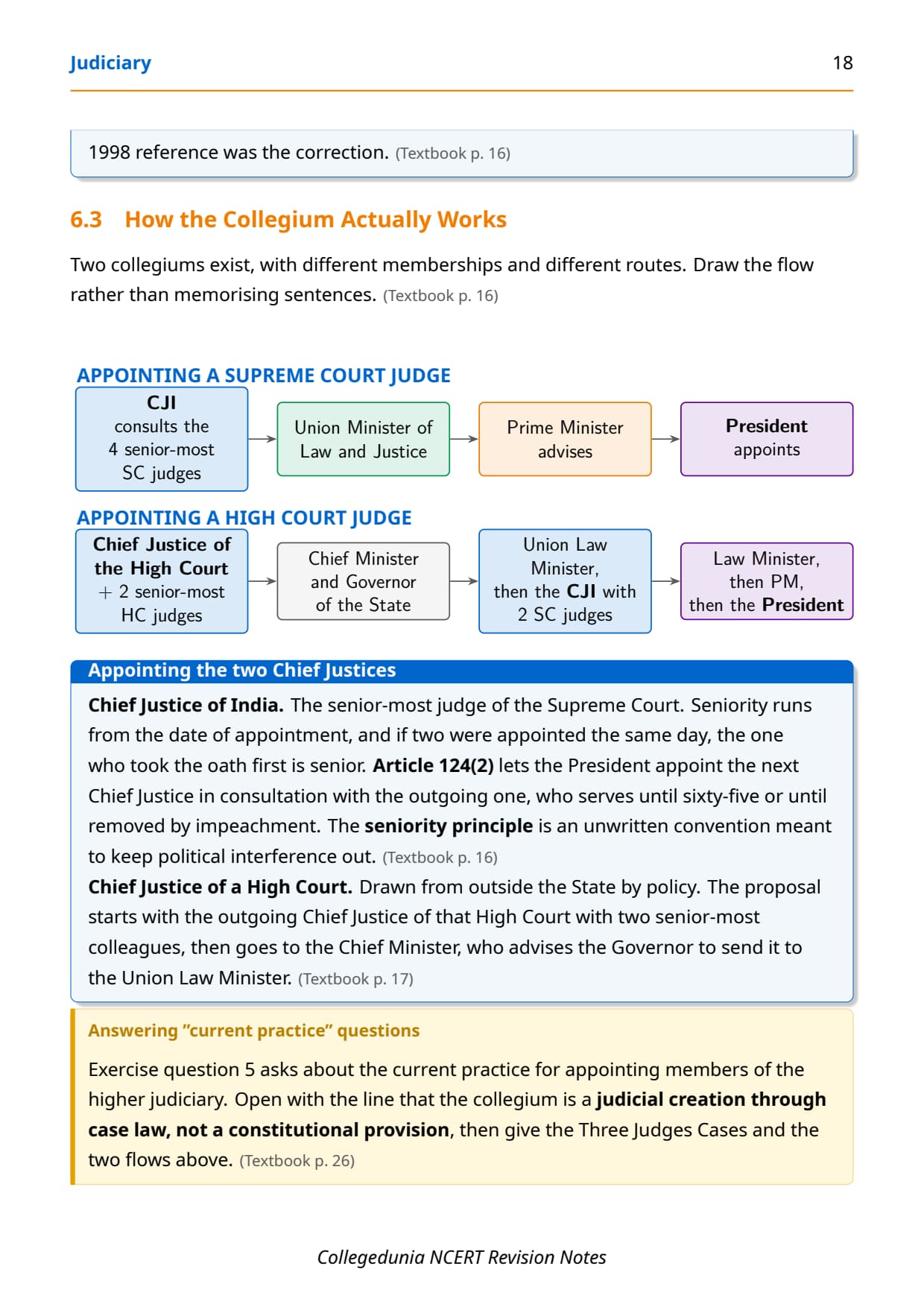
Under the present model, the collegium for Supreme Court appointments is the Chief Justice of India with the four senior-most judges of the Supreme Court, and the recommendation travels to the Union Minister of Law and Justice, then the Prime Minister, then the President. For a High Court, the collegium is the Chief Justice of that High Court with its two senior-most judges, and the file passes through the Chief Minister and Governor before reaching the Chief Justice of India, who consults a collegium of two Supreme Court judges. The Chief Justice of India is the senior-most judge of the Supreme Court, appointed under Article 124(2), and seniority is fixed by the date of appointment to the Court. Where two judges join on the same day, the one who takes the oath first is senior.
Retirement and Removal of Judges under Article 124(4) and Article 218
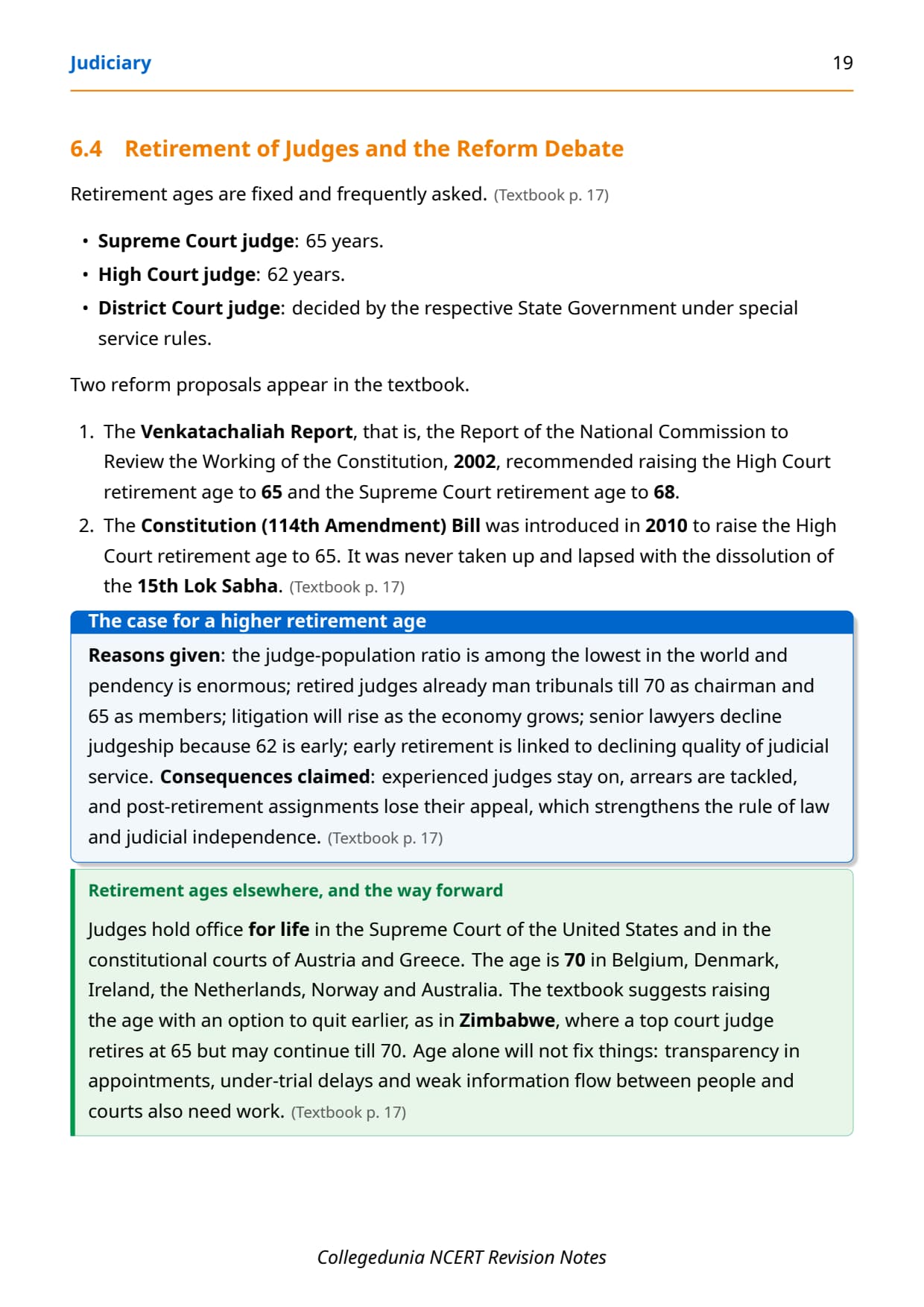
The retirement age is 65 years for a Supreme Court judge and 62 years for a High Court judge. District Court judges retire at an age fixed by their State Government under special service rules.
- Venkatachaliah Report (2002): the Report of the National Commission to review the working of the Constitution recommended 65 years for High Court judges and 68 years for Supreme Court judges.
- Constitution (114th Amendment) Bill: introduced in 2010 to raise the High Court retirement age to 65, it was never taken up and lapsed with the dissolution of the 15th Lok Sabha.
- Judges appointed for life: the Supreme Court of the United States, and the constitutional courts of Austria and Greece.
- Retirement at 70: Belgium, Denmark, Ireland, the Netherlands, Norway and Australia.
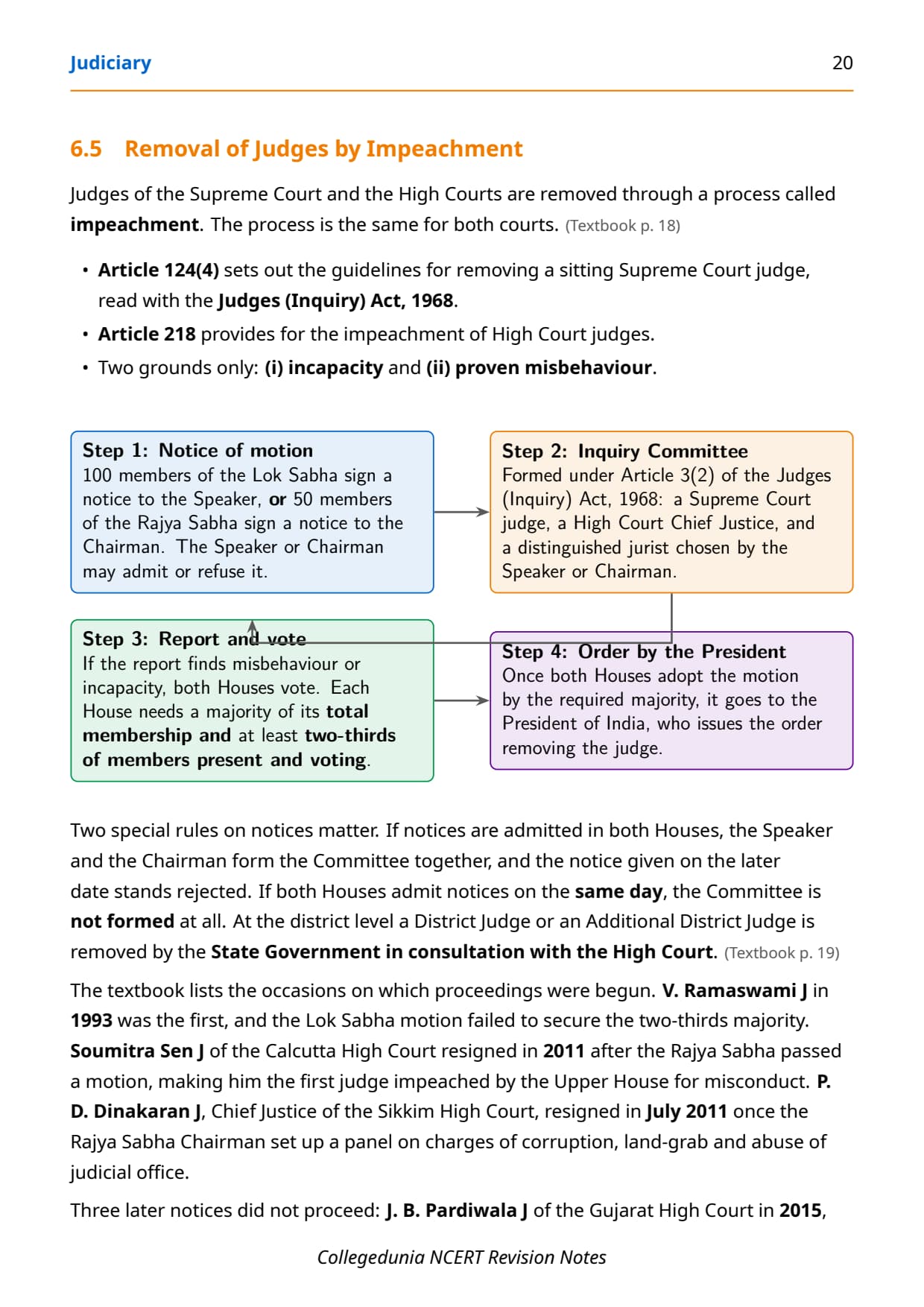
Removal is called impeachment, and the process is the same for both courts. Article 124(4) sets out the guidelines for a sitting Supreme Court judge, read with the Judges (Inquiry) Act, 1968, and Article 218 applies the same process to High Court judges. The only two grounds are incapacity and proven misbehaviour.
- Notice of motion: 100 members of the Lok Sabha sign a notice to the Speaker, or 50 members of the Rajya Sabha sign a notice to the Chairman. The Speaker or Chairman may admit or refuse it.
- Inquiry Committee: formed under Article 3(2) of the Judges (Inquiry) Act, 1968, made up of a Supreme Court judge, a High Court Chief Justice and a distinguished jurist.
- Inquiry report: if the report finds misbehaviour or incapacity, the motion goes to a vote in both Houses. Each House needs a majority of its total membership and a majority of not less than two-thirds of members present and voting.
- Order by the President: once both Houses pass the motion, the President issues the removal order.
A District Judge or an Additional District Judge is removed by the State Government in consultation with the High Court, not by Parliament. The textbook records that impeachment proceedings against a Supreme Court or High Court judge have been initiated five times, and names V. Ramaswami (motion brought in the Lok Sabha in 1993, failed to get the two-thirds majority), Soumitra Sen of the Calcutta High Court (resigned in 2011 after the Rajya Sabha passed the motion), J. B. Pardiwala of the Gujarat High Court (notice by 58 Rajya Sabha members in 2015), C. V. Nagarjuna Reddy (motion moved in 2017) and Dipak Misra (draft proposal signed in March 2018). P. D. Dinakaran of the Sikkim High Court resigned in July 2011 before proceedings could be initiated.
Tribunals under Articles 323-A and 323-B and the L Chandra Kumar Ruling
Tribunals are semi-judicial or quasi-judicial bodies for dispute resolution. They are staffed by administrative officers or judges without a legal background, yet they hear legal matters and settle claims. They complement and supplement the courts.
Tribunals were not part of the original Constitution. They were brought in by the 42nd Amendment Act, 1976, which started what the textbook calls the era of tribunalisation of the Indian judiciary. The Administrative Tribunals Act, 1985 then set up the Central Administrative Tribunal and the State Administrative Tribunals.
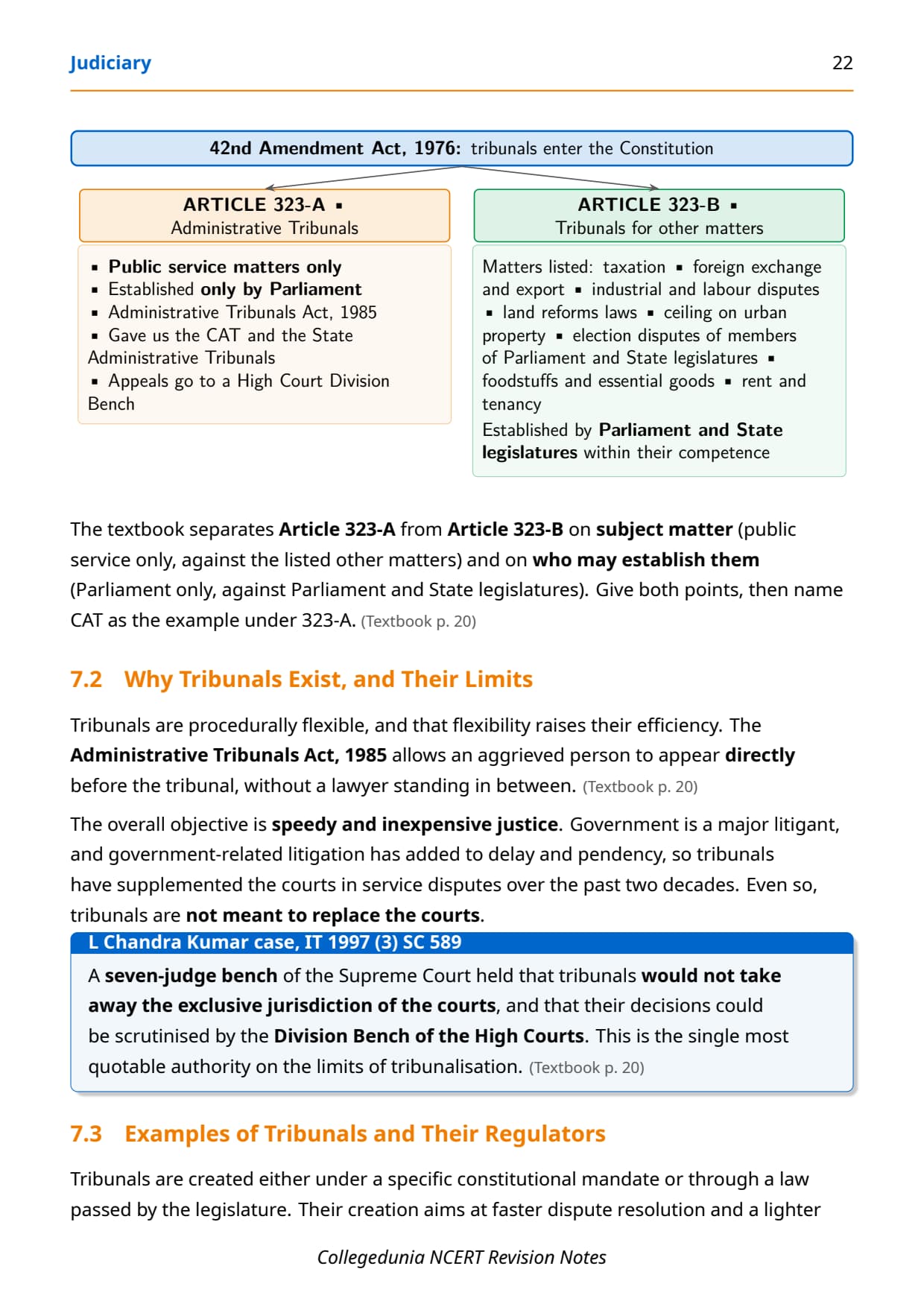
| Point of difference | Article 323-A | Article 323-B |
|---|---|---|
| Subject matter | Administrative tribunals for public service matters only | Tribunals for taxation, foreign exchange and export, industrial and labour disputes, land reforms, ceiling on urban property, election disputes, food and essential goods, rent and tenancy |
| Who can set them up | Parliament only | Parliament and State legislatures, within their legislative competence |
| Example bodies | Central Administrative Tribunal, State Administrative Tribunals | Telecom Dispute Settlement Appellate Tribunal, National Green Tribunal |
Tribunals do not replace the courts. A seven-judge bench held in the L Chandra Kumar case (1997) that tribunals would not take away the exclusive jurisdiction of the courts, and that their decisions can be scrutinised by the Division bench of the High Courts. Appeals against orders of administrative tribunals lie before the Division bench of the concerned High Court.
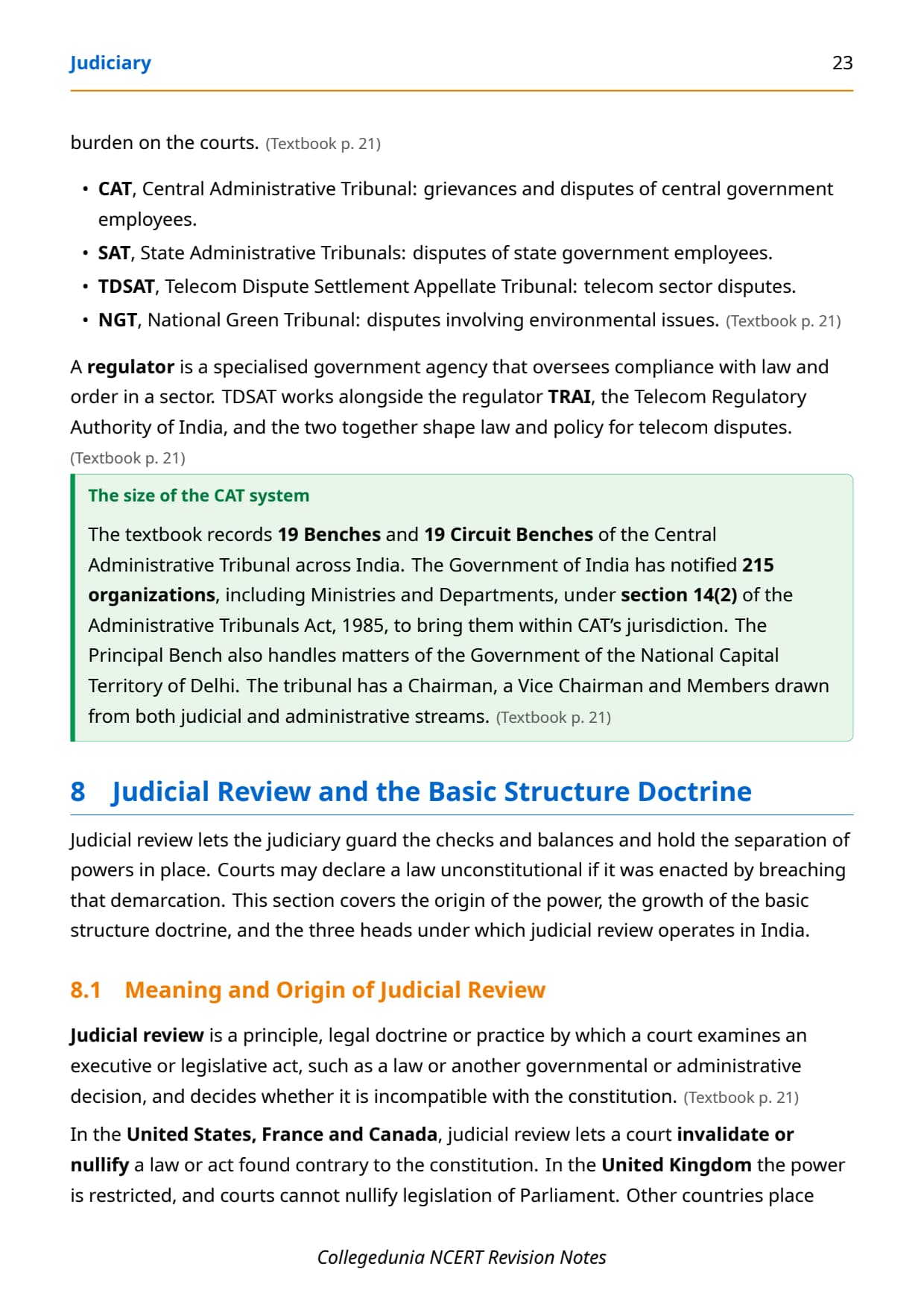
Some tribunals work alongside a regulator. The Telecom Dispute Settlement Appellate Tribunal works with the Telecom Regulatory Authority of India on telecom disputes. The Central Administrative Tribunal has 19 Benches and 19 Circuit Benches across India, covers 215 organisations notified under section 14(2) of the Administrative Tribunals Act, 1985, and is made up of a Chairman, a Vice Chairman and Members drawn from both judicial and administrative streams.
Judicial Review from Marbury v. Madison to the Basic Structure Doctrine
Judicial review is the doctrine under which a court can examine an executive or legislative act and decide whether it is incompatible with the Constitution. It protects the checks and balances and keeps the separation of powers between the three branches intact.
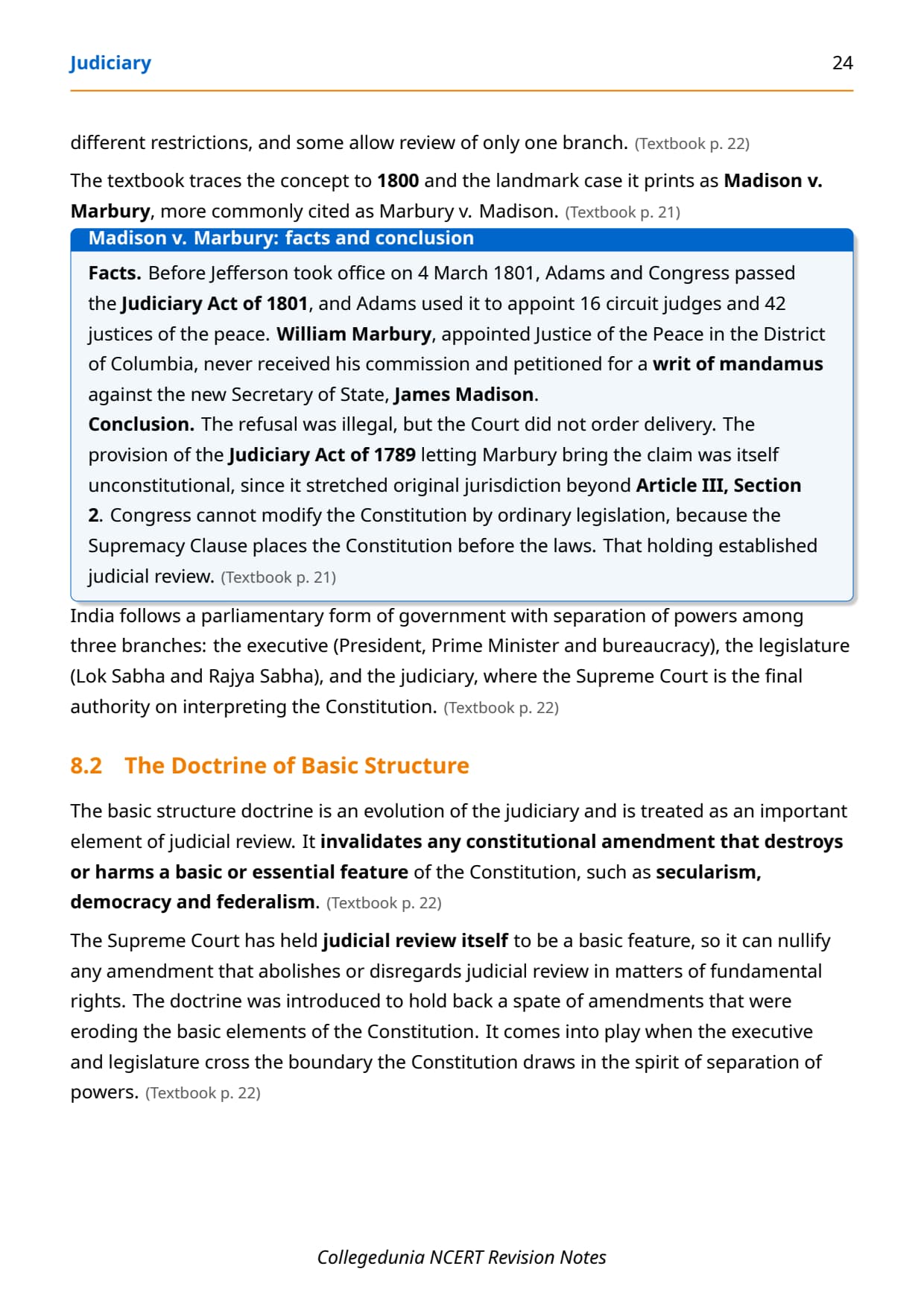
The principle was applied for the first time in the American case Marbury v. Madison (1803). William Marbury had been appointed Justice of the Peace in the District of Columbia under the Judiciary Act of 1801, but his commission was never delivered, so he asked the Supreme Court for a writ of mandamus against Secretary of State James Madison. Chief Justice John Marshall held that Madison's refusal was illegal, but that the provision of the Judiciary Act of 1789 which let Marbury come straight to the Supreme Court was itself unconstitutional, because it stretched the Court's original jurisdiction beyond Article III, Section 2. In holding this, Marshall established the power to declare a law unconstitutional.
Note: the case name is written Marbury v. Madison, with the petitioner Marbury first and the Secretary of State Madison second. Write it in that order in the board paper.
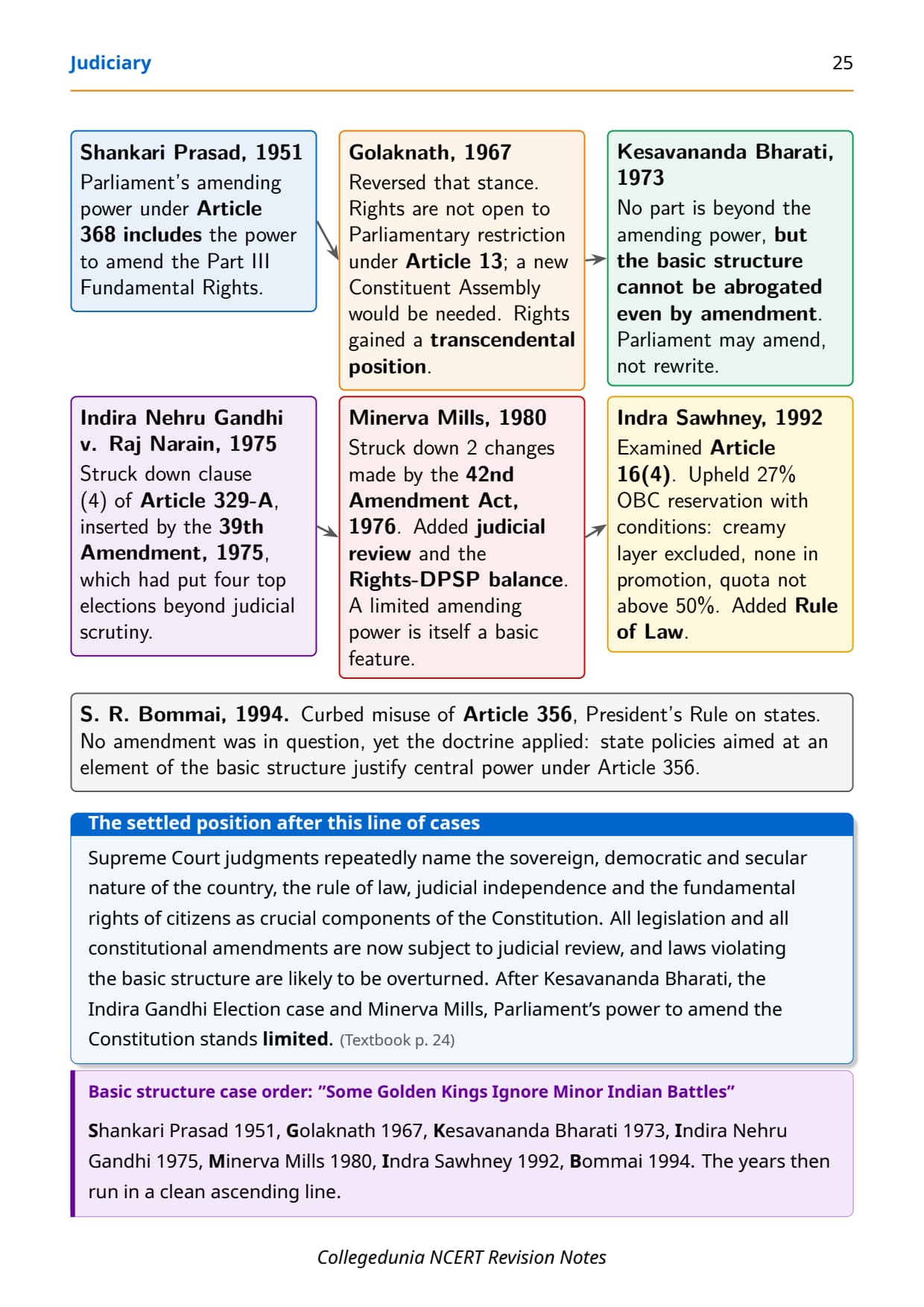
How far judicial review reaches in India was settled case by case, and the sequence below is the basic structure doctrine. The doctrine invalidates any constitutional amendment that destroys an essential feature such as secularism, democracy or federalism.
| Case | Year | What it held |
|---|---|---|
| Shankari Prasad | 1951 | Parliament's power to amend the Constitution under Article 368 includes the power to amend the Fundamental Rights in Part III |
| Golaknath | 1967 | Reversed that stand. Fundamental Rights are not open to parliamentary restriction under Article 13, a new Constituent Assembly would be needed, and Article 368 gives only the procedure and not the power to amend. Fundamental Rights were given a transcendental position |
| Kesavananda Bharati | 1973 | No part of the Constitution, including Fundamental Rights, is beyond the amending power, but the basic structure cannot be abrogated even by a constitutional amendment. The power to amend is not a power to destroy |
| Indira Nehru Gandhi v. Raj Narain | 1975 | Struck down Clause (4) of Article 329-A, inserted by the 39th Amendment in 1975, for destroying basic features |
| Minerva Mills | 1980 | Struck down two changes made by the 42nd Amendment Act, 1976. Added judicial review and the balance between Fundamental Rights and Directive Principles to the basic structure, and held that a limited amending power is itself a basic feature |
| Indra Sawhney | 1992 | Examined Article 16(4) and upheld 27% reservation for Other Backward Classes with conditions such as creamy layer exclusion, no reservation in promotion and a 50% cap. Added Rule of Law to the basic features |
| S. R. Bommai | 1994 | Curbed the misuse of Article 356. State policies aimed against an element of the basic structure are a valid ground for the Centre to act |
The takeaway the textbook draws is short. All legislation and all constitutional amendments are now subject to judicial review, and Parliament's power to amend the Constitution is limited.
Scope of Judicial Review in India: Rights, Centre-State Relations and Fair Executive Action
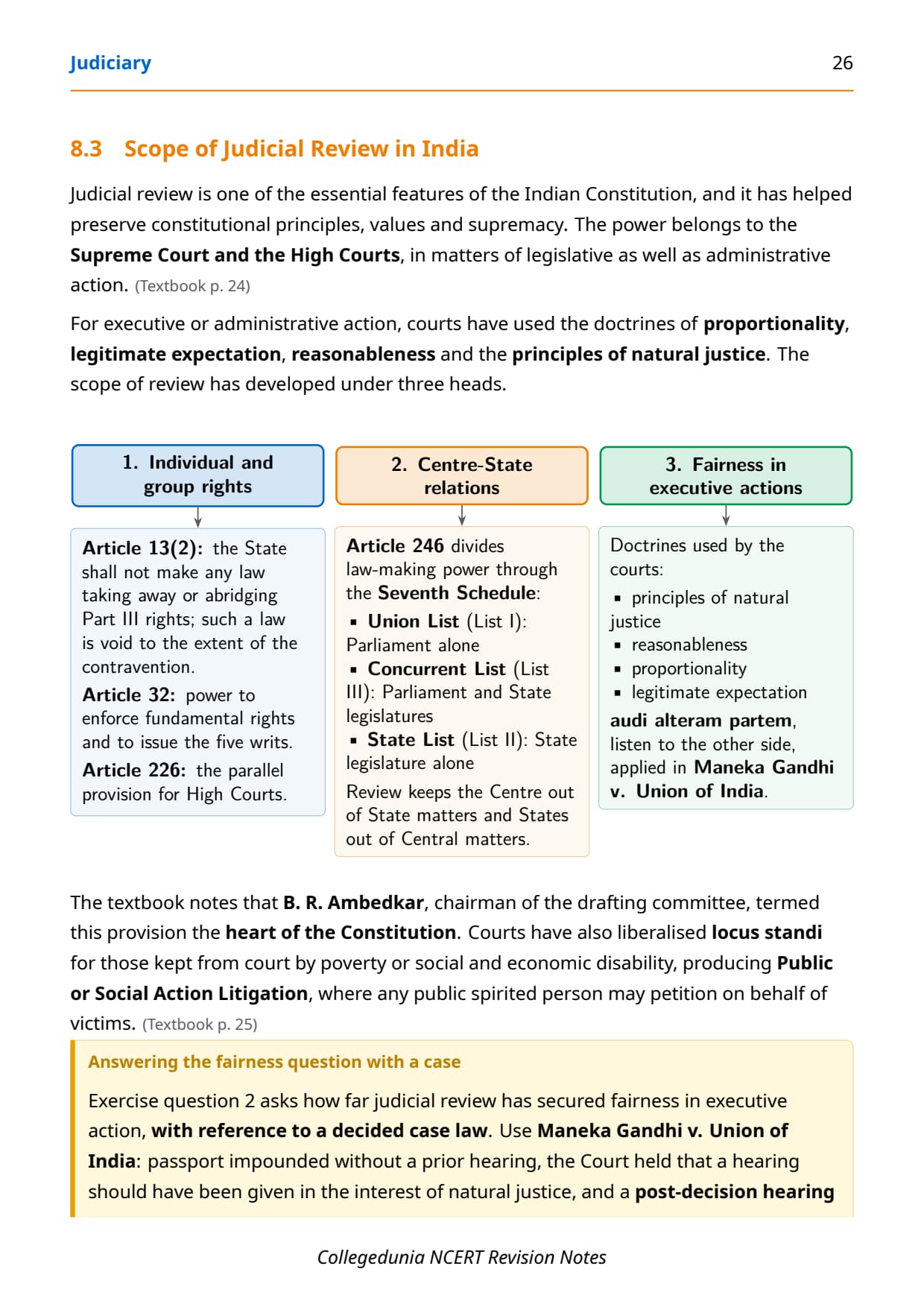
Judicial review is available to both the Supreme Court and the High Courts, over both legislative and administrative action. The textbook groups its growth under three headings.
- Individual and group rights. Article 13(2) says the State shall not make any law that takes away or abridges the rights conferred by Part III, and any law made in contravention is void to the extent of the contravention. Article 32 lets a person move the Supreme Court to enforce those rights, and Article 226 is the parallel provision for the High Courts. Liberalising locus standi under these articles is what produced Public Interest Litigation.
- Centre and State relations. Article 246 gives Parliament exclusive power over the Union List (List I of the Seventh Schedule), gives Parliament and the State legislatures power over the Concurrent List (List III), and gives a State legislature exclusive power over the State List (List II). Judicial review keeps each side inside its own lane.
- Fairness in executive action. Courts apply the doctrines of proportionality, legitimate expectation, reasonableness and the principles of natural justice.
The named case here is Maneka Gandhi v. Union of India (1978). Her passport was impounded under the Passport Act of 1967 without any prior hearing. The unanimous judgment of a seven-judge bench, delivered on 25 January 1978, held that personal liberty under Article 21 is very wide and includes the right to travel abroad, and that the maxim audi alteram partem, meaning "listen to the other side", had not been followed. She was given a post-decisional hearing and the passport was returned.
The same judgment held that Articles 14, 19 and 21 form the Golden Triangle of the Constitution, so a law taking away personal liberty must also satisfy Articles 14 and 19. The mere existence of a law is not enough. It has to be just, fair and reasonable.
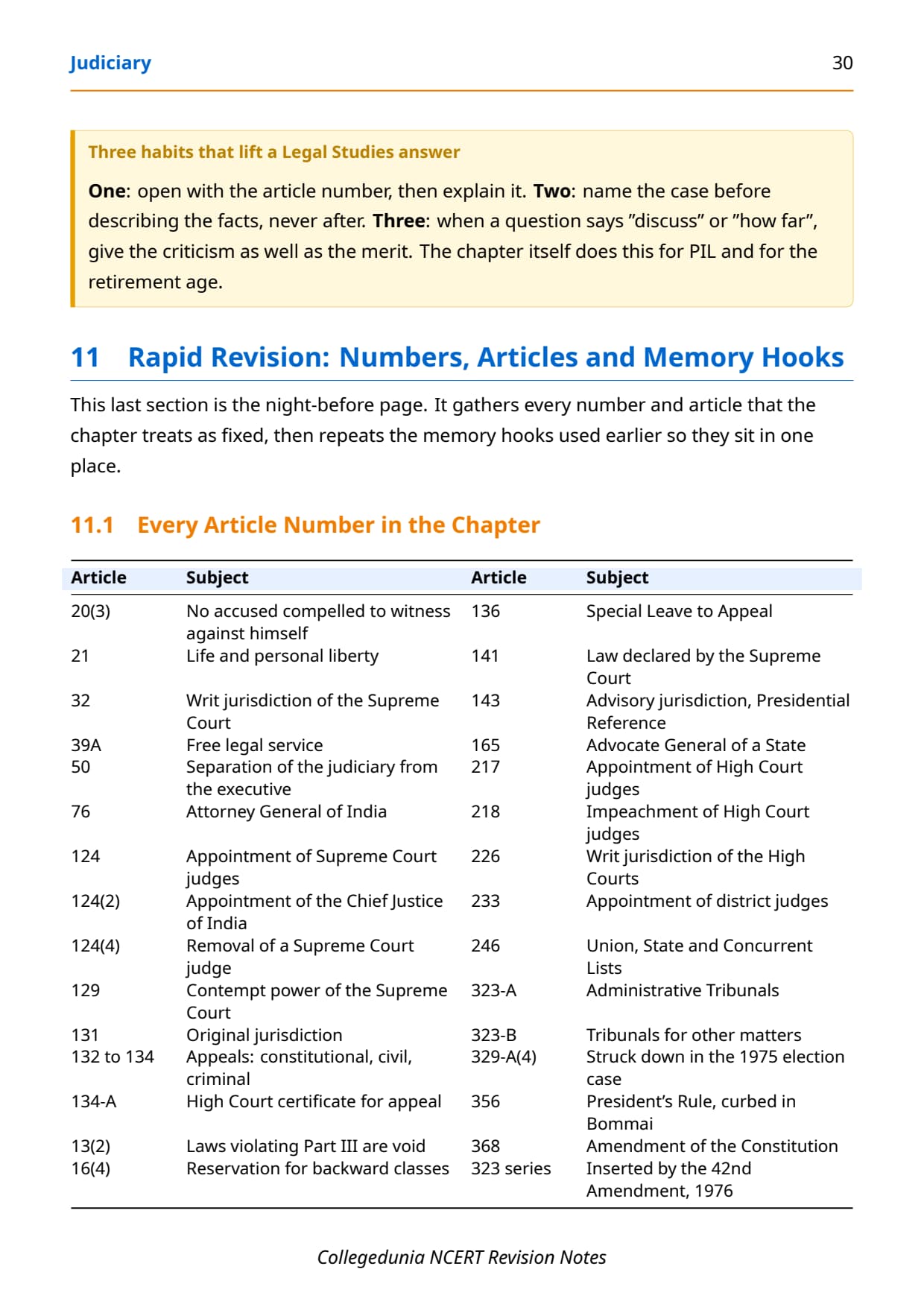
Article-Wise Quick Revision Table for the Judiciary Chapter
Article numbers are where most marks leak in this chapter. Revise this table last, on the morning of the paper.
| Article | What it deals with |
|---|---|
| Article 32 | Right to move the Supreme Court to enforce Fundamental Rights, and the five writs |
| Article 50 | Independence of the judiciary, separation from the executive |
| Article 76 | Attorney General of India, appointed by the President |
| Article 124 | Appointment of Supreme Court judges, and Article 124(4) for removal |
| Article 129 | Supreme Court as a court of record and its contempt power |
| Article 131 | Original jurisdiction of the Supreme Court in Centre and State disputes |
| Article 136 | Special Leave to Appeal from any court or tribunal in India |
| Article 141 | Law declared by the Supreme Court, the provision used to explain why an advisory opinion does not bind courts |
| Article 143 | Advisory jurisdiction, the Presidential Reference |
| Article 165 | Advocate General of a State, appointed by the Governor |
| Article 217 | Appointment of High Court judges |
| Article 218 | Removal of High Court judges, applying the Article 124(4) process |
| Article 226 | Writ power of the High Courts, for Fundamental Rights and any other purpose |
| Article 233 | Appointment of district judges by the Governor |
| Article 323-A | Administrative tribunals for public service matters, set up by Parliament only |
| Article 323-B | Tribunals for taxation, labour, land reforms and other listed matters |
| Article 368 | Power and procedure to amend the Constitution, limited by the basic structure |
Common Mistakes Students Make in the Judiciary Chapter
Six traps that cost easy marks in the Class 12 Legal Studies paper:
- Swapping 62 and 65. High Court judges retire at 62, Supreme Court judges at 65. The Venkatachaliah Report of 2002 only recommended 65 and 68, it never became law.
- Reversing the case name. It is Marbury v. Madison (1803), the petitioner first. Reversing it costs the mark for naming the case.
- Mixing Shankari Prasad and Golaknath. Shankari Prasad (1951) allowed Fundamental Rights to be amended, Golaknath (1967) reversed that.
- Confusing the first two Judges Cases. The First Judges Case (1981) gave the Executive primacy, the Second (1993) gave the Chief Justice of India primacy.
- Mixing up Articles 323-A and 323-B. Article 323-A is public service matters and Parliament only, Article 323-B covers the other listed subjects and both Parliament and State legislatures.
- Calling a tribunal a court. After L Chandra Kumar (1997), a tribunal decision can still be scrutinised by the Division bench of a High Court.
What the Class 12 Legal Studies Judiciary Notes PDF Contains
The PDF follows the same order as the textbook unit, so it can sit open beside the book while you revise.
- Pages 1 to 7: court structure, the Supreme Court's origin and strength, the High Court list and the subordinate court ladder.
- Pages 8 to 13: common law and the adversarial model, the Attorney General, the Advocate General and Article 50 independence.
- Pages 14 to 20: Supreme Court jurisdiction article by article, the five writs, and the advisory jurisdiction cases.
- Pages 21 to 26: Public Interest Litigation, suo motu power, court of record, legal aid, amicus curiae and the appointment of judges.
- Pages 27 to 32: retirement and removal, tribunals, judicial review, the basic structure case table and the article-wise revision sheet.
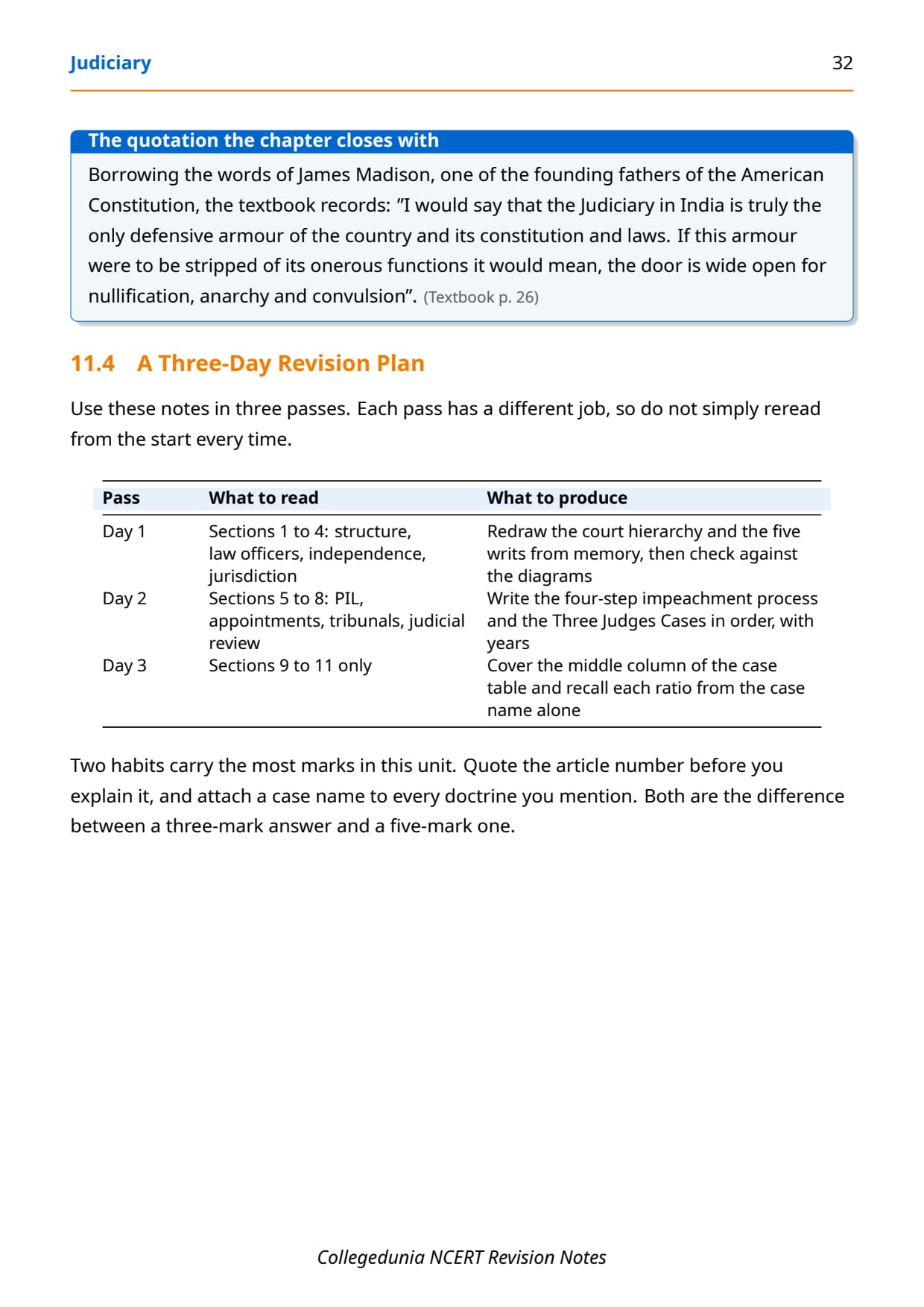
How to Use the Judiciary Notes Page Most Effectively Before the Board Paper
The Judiciary chapter is dense with articles, cases and years rather than hard ideas. Spacing it over four short blocks works better than one long sitting.
- Block 1, 45 minutes. Court hierarchy, the Supreme Court, the High Courts, the subordinate court ladder, common law and the adversarial model.
- Block 2, 45 minutes. Article 50 independence, the five protections for judges, the legal officers, and Supreme Court jurisdiction with the five writs.
- Block 3, 45 minutes. Public Interest Litigation, suo motu power, legal aid, and the appointment of judges with the Three Judges Cases.
- Block 4, 40 minutes. Retirement and removal, tribunals under Articles 323-A and 323-B, judicial review and the basic structure table.
- Morning of the paper, 15 minutes. The article-wise revision table and the six common mistakes, nothing else.
Judiciary Class 12 Notes and Law Entrance Exams like CLAT and CUET
This chapter does double duty. It is a scoring unit in the CBSE Class 12 Legal Studies board paper, and it is also the legal reasoning and legal awareness base that law entrance papers test.
- CLAT and AILET legal reasoning: the writs, PIL, locus standi and the basic structure doctrine appear as passage-based questions almost every year.
- CUET (UG) Legal Studies: the objective paper leans on exactly the facts in the article-wise table above, article numbers, case names and case years.
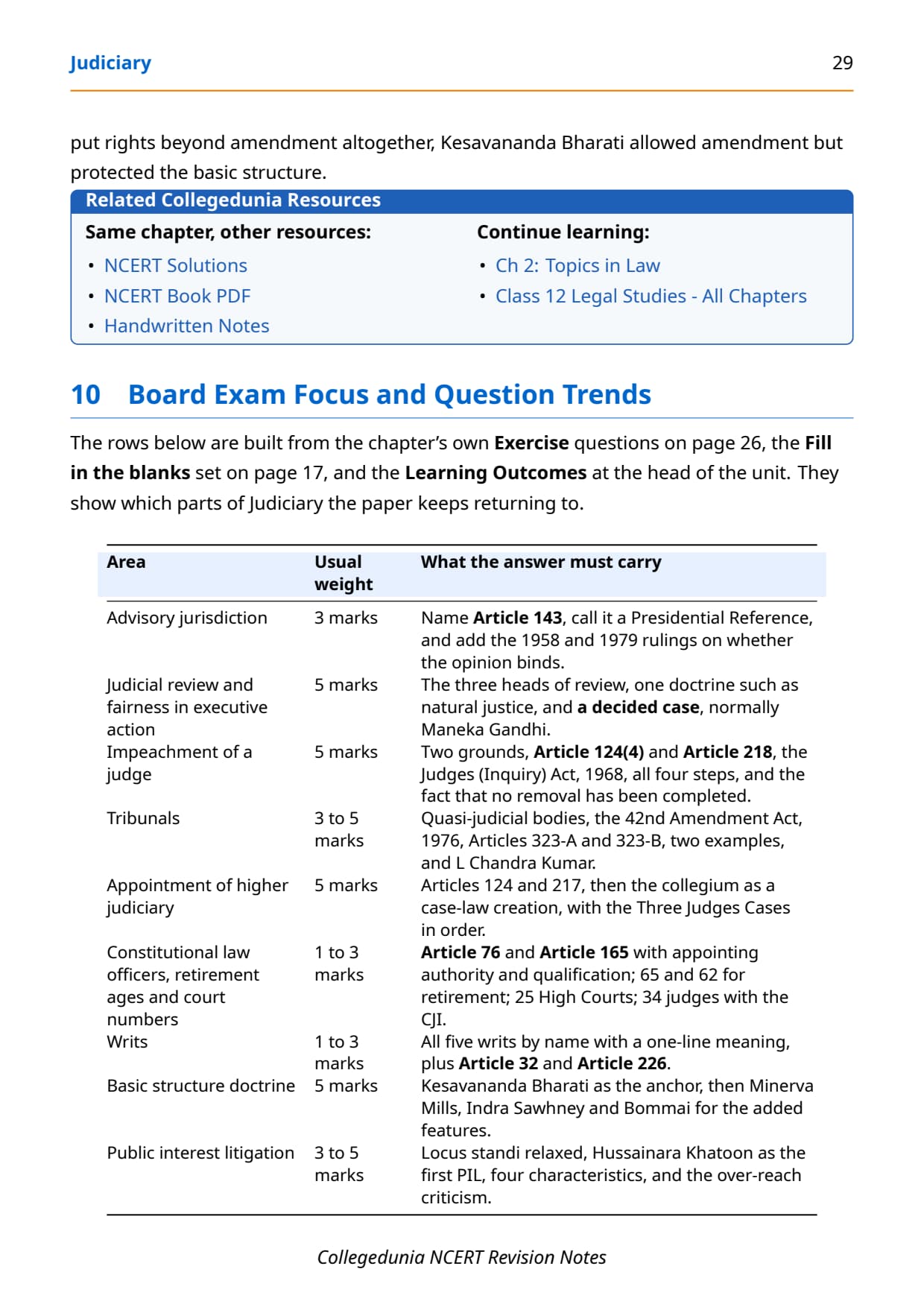
- Board paper: the six textbook exercise questions cover advisory jurisdiction under Article 143, judicial review with a decided case, impeachment, tribunals, appointment of higher judiciary and the two constitutional law offices.
Learn the case name with its year in one breath. A five-year law programme interview is far more likely to ask what Kesavananda Bharati (1973) decided than to ask you to define a court.
How the Judiciary Notes Pair with Other Class 12 Legal Studies Resources
Also Check: the handwritten revision notes for the next two units of the same textbook are already live, and they use the same order as these notes. Open Topics in Law Class 12 Handwritten Notes after this chapter, and Legal Profession in India Class 12 Handwritten Notes when you reach the legal profession unit.
| Resource | Open it | Best used for |
|---|---|---|
| NCERT Solutions | Judiciary Class 12 NCERT Solutions (coming soon) | Answers to all six textbook exercise questions of the Judiciary chapter. |
| Handwritten Notes | Judiciary Class 12 Handwritten Notes | A topper's handwritten revision notes on courts, writs and landmark cases. |
| NCERT Book PDF | Judiciary Class 12 Legal Studies Book Chapter PDF (coming soon) | The official CBSE Legal Studies textbook chapter, free to download. |
NCERT Notes for Class 12 Legal Studies: All Chapters
Related Links: revision notes for the Class 12 Legal Studies textbook, written according to the 2026-27 CBSE syllabus.
| Chapter | Title | Class 12 Legal Studies Notes |
|---|---|---|
| Chapter 1 | Judiciary | You are here |
| Chapter 2 | Topics in Law | Topics in Law Class 12 Notes (coming soon) |
| Chapter 4 | Human Rights in India | Human Rights in India Class 12 Notes (coming soon) |
| Chapter 5 | Legal Profession in India | Legal Profession in India Class 12 Notes (coming soon) |
| Chapter 6 | Legal Services | Legal Services Class 12 Notes (coming soon) |
| Chapter 7 | International Context | International Context Class 12 Notes (coming soon) |
FAQs on Judiciary Class 12 Legal Studies Notes
Questions Students Ask Most About the Judiciary Chapter
Ques. When was the Supreme Court of India established and what did it replace?
Ans. The Supreme Court of India came into being on 28 January 1950. It replaced the Federal Court of India and the Judicial Committee of the Privy Council, which were at the top of the Indian court system in the colonial era. It began with a Chief Justice and 7 judges, and the present strength is 34 judges including the Chief Justice of India.
Ques. What are the five writs the Supreme Court can issue under Article 32?
Ans. Habeas corpus orders the release of a person unlawfully detained. Mandamus orders a public authority to do its duty. Prohibition prevents a subordinate court from continuing with a case. Quo warranto directs a person to vacate an office wrongfully occupied. Certiorari removes a case from a subordinate court and brings the proceedings up. Article 226 gives the High Courts the same writ power, for Fundamental Rights and for any other purpose.
Ques. Which articles cover the jurisdiction of the Supreme Court?
Ans. Article 131 gives original jurisdiction in disputes between the Government of India and the States. Article 32 gives writ jurisdiction. Article 132(1) covers constitutional appeals on a High Court certificate under Article 134-A, Article 133 covers civil appeals and Article 134 covers criminal appeals. Article 136 is Special Leave to Appeal from any court or tribunal in India, and Article 143 is advisory jurisdiction through a Presidential Reference.
Ques. What is the basic structure doctrine and which case established it?
Ans. The basic structure doctrine invalidates any constitutional amendment that destroys an essential feature of the Constitution, such as secularism, democracy or federalism. It was laid down in the Kesavananda Bharati case (1973), which held that no part of the Constitution is beyond the amending power under Article 368, but that the basic structure cannot be abrogated even by an amendment.
Ques. How did the basic structure doctrine develop before and after 1973?
Ans. Shankari Prasad (1951) held that the Article 368 amending power covers Fundamental Rights. Golaknath (1967) reversed that. Kesavananda Bharati (1973) laid down the basic structure. Indira Nehru Gandhi v. Raj Narain (1975) struck down Clause (4) of Article 329-A. Minerva Mills (1980) struck down two changes made by the 42nd Amendment Act, 1976 and added judicial review to the basic structure. Indra Sawhney (1992) added Rule of Law and S. R. Bommai (1994) applied the doctrine to Article 356.
Ques. What is judicial review and which case applied it for the first time?
Ans. Judicial review is the doctrine under which a court examines an executive or legislative act and decides whether it is incompatible with the Constitution. The principle was applied for the first time in Marbury v. Madison (1803), where Chief Justice John Marshall held that the provision of the Judiciary Act of 1789 letting Marbury come straight to the Supreme Court was unconstitutional, and established the power to declare a law unconstitutional.
Ques. How does the collegium system work and which cases created it?
Ans. The collegium is a judicial creation through the Three Judges Cases and is not written into the Constitution. The First Judges Case (1981) gave the Executive primacy. The Second Judges Case (1993) gave the Chief Justice of India primacy. The 1998 Presidential Reference described the process as an integrated participatory consultative process. Today the Chief Justice of India consults the four senior-most Supreme Court judges for Supreme Court appointments.
Ques. How are judges of the Supreme Court and High Courts removed?
Ans. Removal is by impeachment on two grounds only, incapacity and proven misbehaviour. Article 124(4) read with the Judges (Inquiry) Act, 1968 governs Supreme Court judges, and Article 218 applies the same process to High Court judges. A notice signed by 100 Lok Sabha members or 50 Rajya Sabha members starts it, an Inquiry Committee investigates, each House must pass the motion by a majority of its total membership and two-thirds of members present and voting, and the President then orders the removal.
Ques. What is the difference between Article 323-A and Article 323-B?
Ans. Article 323-A allows tribunals for public service matters only, and only Parliament can set them up. Article 323-B allows tribunals for taxation, foreign exchange and export, industrial and labour disputes, land reforms, ceiling on urban property, election disputes, food and essential goods, and rent and tenancy, and both Parliament and State legislatures can set them up. Both articles were inserted by the 42nd Amendment Act, 1976.
Ques. What did the L Chandra Kumar case decide about tribunals?
Ans. In the L Chandra Kumar case (1997), a seven-judge bench of the Supreme Court held that tribunals would not take away the exclusive jurisdiction of the courts, and that tribunal decisions can be scrutinised by the Division bench of the High Courts. Tribunals therefore supplement the courts, they do not replace them.
Ques. Why is Hussainara Khatoon v. State of Bihar important?
Ans. It is listed as the first ever Public Interest Litigation and dates back to 1979. A public interest lawyer filed it for thousands of prisoners in Bihar jails against inhuman prison conditions. A bench headed by Justice P. N. Bhagwati declared the right to free legal aid and to a speedy trial under Article 21, read with Article 39A, which led to the release of the under-trial prisoners.
Ques. What did Maneka Gandhi v. Union of India decide?
Ans. In Maneka Gandhi v. Union of India (1978), the petitioner's passport was impounded under the Passport Act of 1967 without a prior hearing. A seven-judge bench held on 25 January 1978 that personal liberty under Article 21 is very wide and includes the right to travel abroad, that the maxim audi alteram partem had been ignored, and that Articles 14, 19 and 21 form the Golden Triangle. She was given a post-decisional hearing and the passport was returned.
Ques. What is the retirement age of judges in India?
Ans. A Supreme Court judge retires at 65 years and a High Court judge at 62 years. District Court judges retire at an age fixed by their State Government under special service rules. The Venkatachaliah Report of 2002 recommended raising these to 68 and 65, and the Constitution (114th Amendment) Bill of 2010 tried to raise the High Court age to 65 but lapsed with the dissolution of the 15th Lok Sabha.
Ques. Where can I download the Class 12 Legal Studies Chapter 1 Judiciary notes PDF?
Ans. Use the download option at the top of this page. The file is free and printable, runs to 32 pages, and follows the 2026-27 chapter order, so you can keep it open beside the textbook while revising the Judiciary chapter.



Comments