




These Attitude and Social Cognition Class 12 Notes give a quick, exam-ready summary of Psychology Chapter 6, set to the 2026-27 CBSE syllabus. They pull together every key term, from the A-B-C components of an attitude to prejudice and discrimination, in a short point-wise form. Students can use them for a fast revision the night before a test or to fix the main ideas before they attempt the Review Questions.
- Covers attitudes, their formation and change, the attitude-behaviour link and prejudice in one place.
- This Class 12 Psychology chapter usually carries 5 to 6 marks in the board paper.
- Pairs with the NCERT Solutions, Handwritten Notes and Book PDF linked lower on this page.
These Attitude and Social Cognition Class 12 notes are written from the official NCERT Psychology textbook and checked against the last five years of CBSE board papers.
Student Feedback: In a Collegedunia poll of 6,240 Class 12 Psychology students taken before the 2026 boards, 71% of students said short, point-wise notes on attitudes and prejudice were the fastest way to revise this chapter. Most students kept the A-B-C components and the five learning routes on a single sheet for last-minute recall.
Source: 2026-27 Class 12 Psychology student poll. Sample of 6,240 students from CBSE schools across 11 states.
What the Attitude and Social Cognition Notes Cover
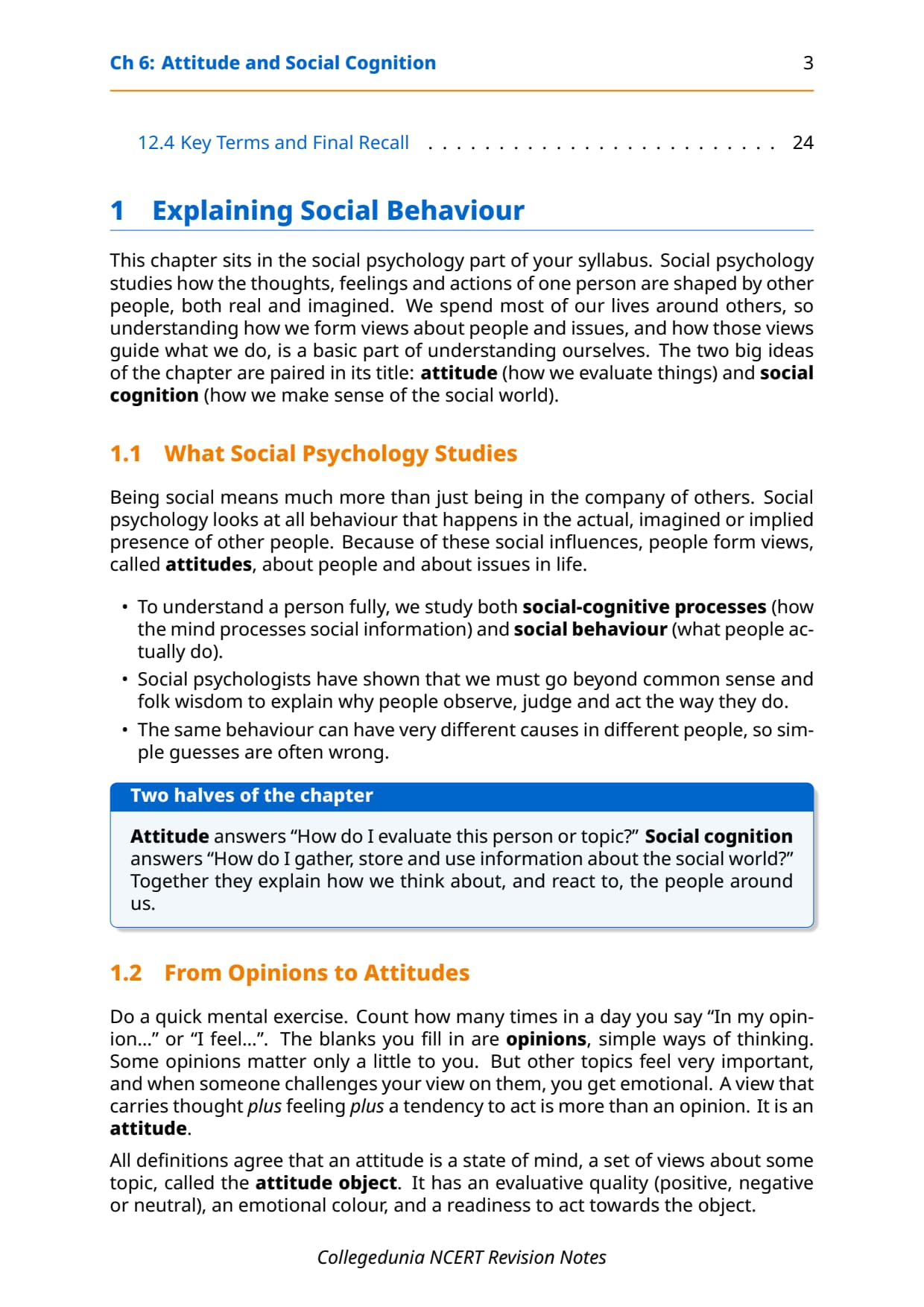
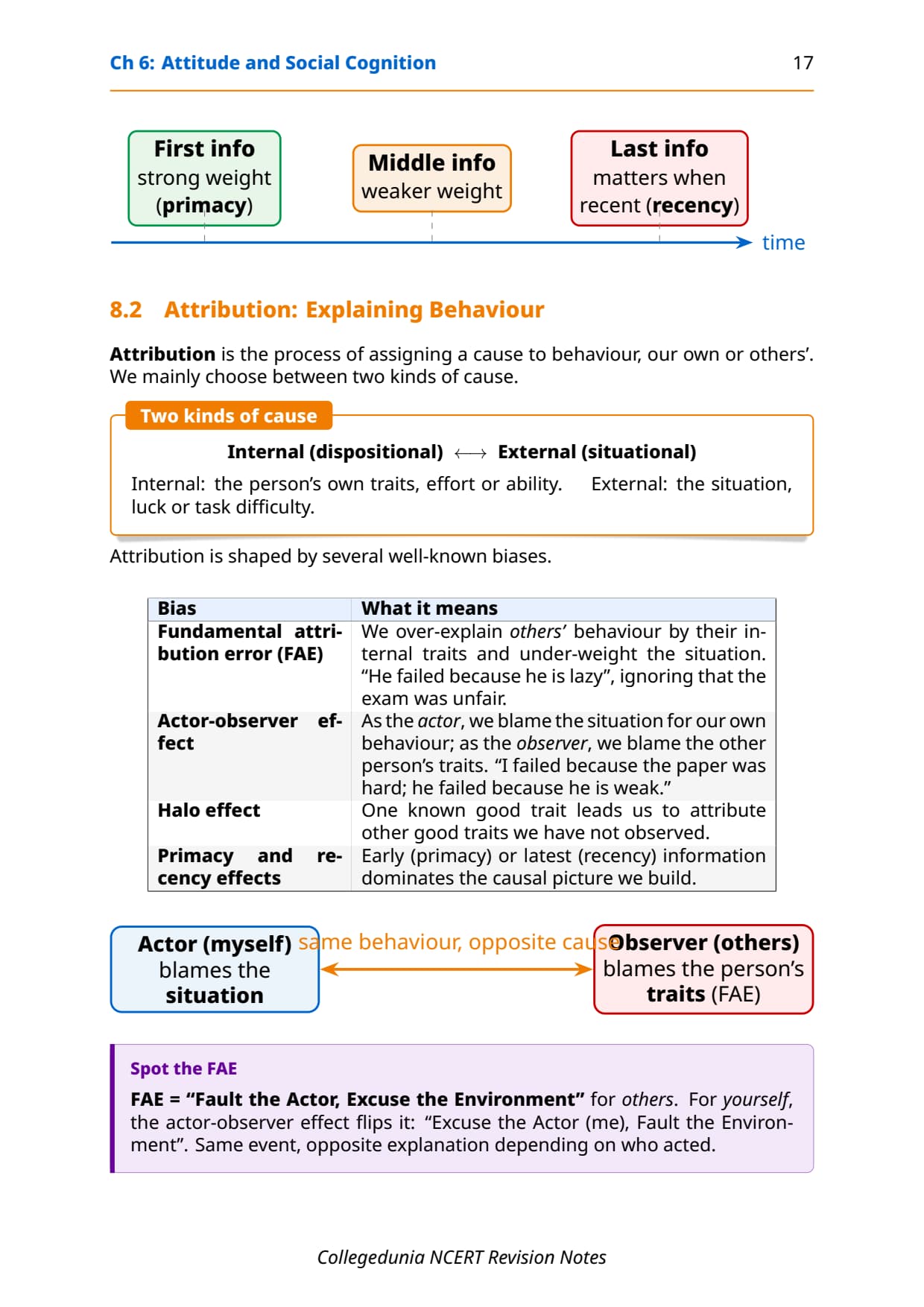
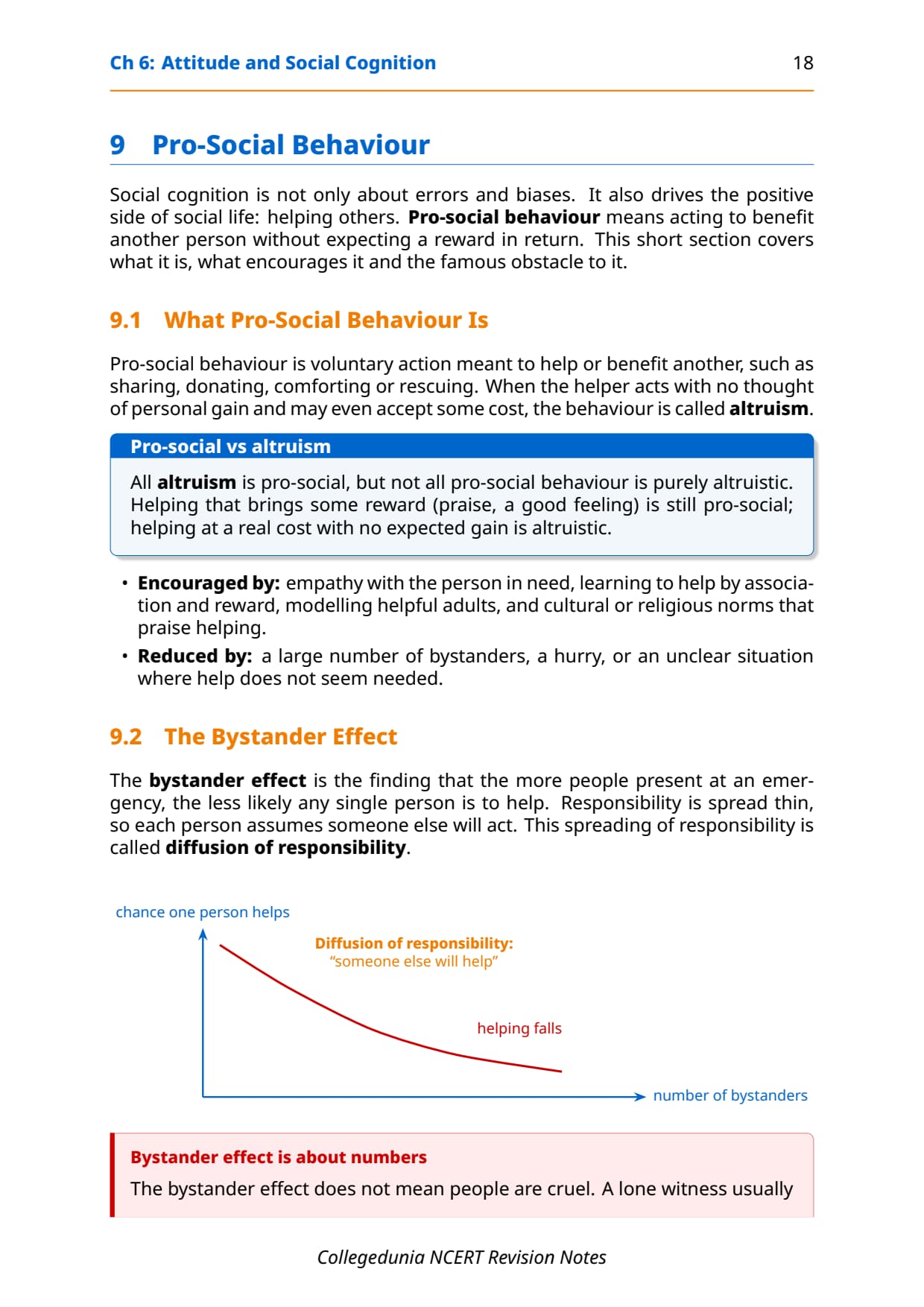
Attitude and Social Cognition is the sixth chapter of Class 12 Psychology. It studies how a person's behaviour is shaped by others and by the social world. The easiest way to organise your revision is to split the chapter into three threads, and slot every new fact into one of them.
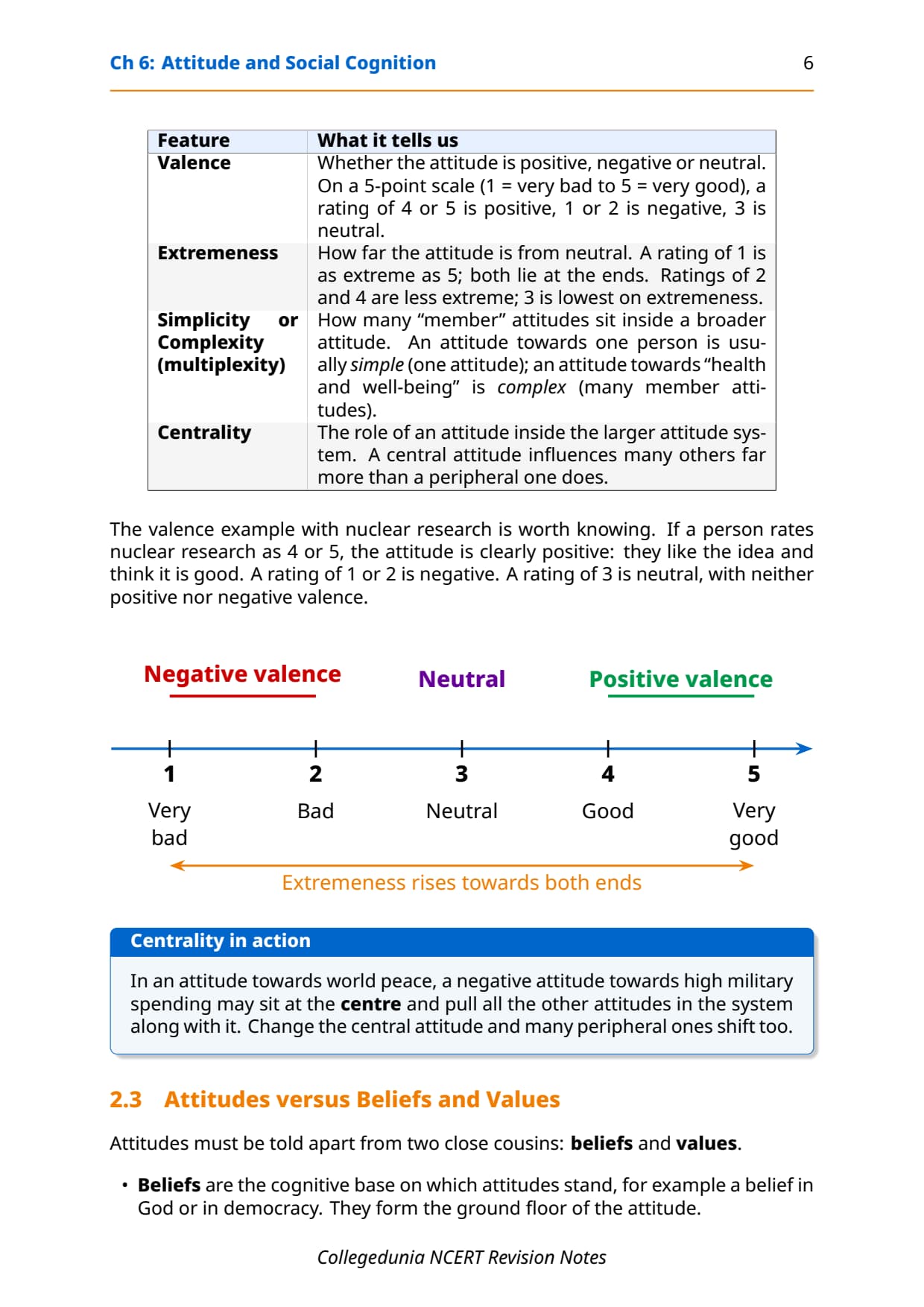
- Attitudes: what an attitude is, its A-B-C components and its four features.
- Formation and change: how attitudes are learnt and how they can be changed.
- Social cognition: prejudice, stereotype, discrimination and how to handle them.
So these notes are really about how we form views, act on them, and sometimes judge whole groups unfairly. If you sort each fact under attitude, formation or prejudice first, almost every question in Attitude and Social Cognition class 12 becomes easier to answer. Keep this three-part frame at the top of your revision sheet.
Nature of Attitudes and the A-B-C Components
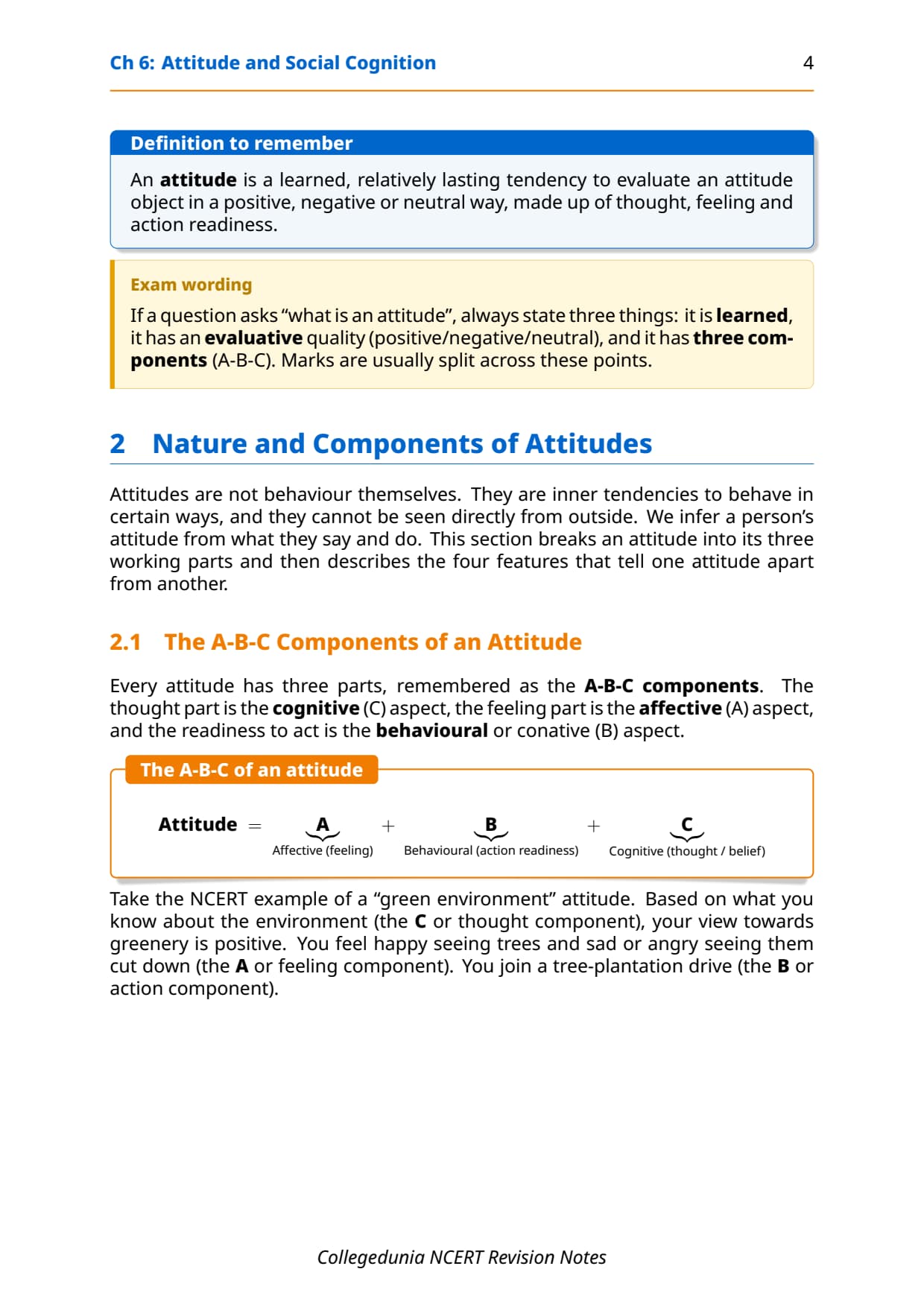
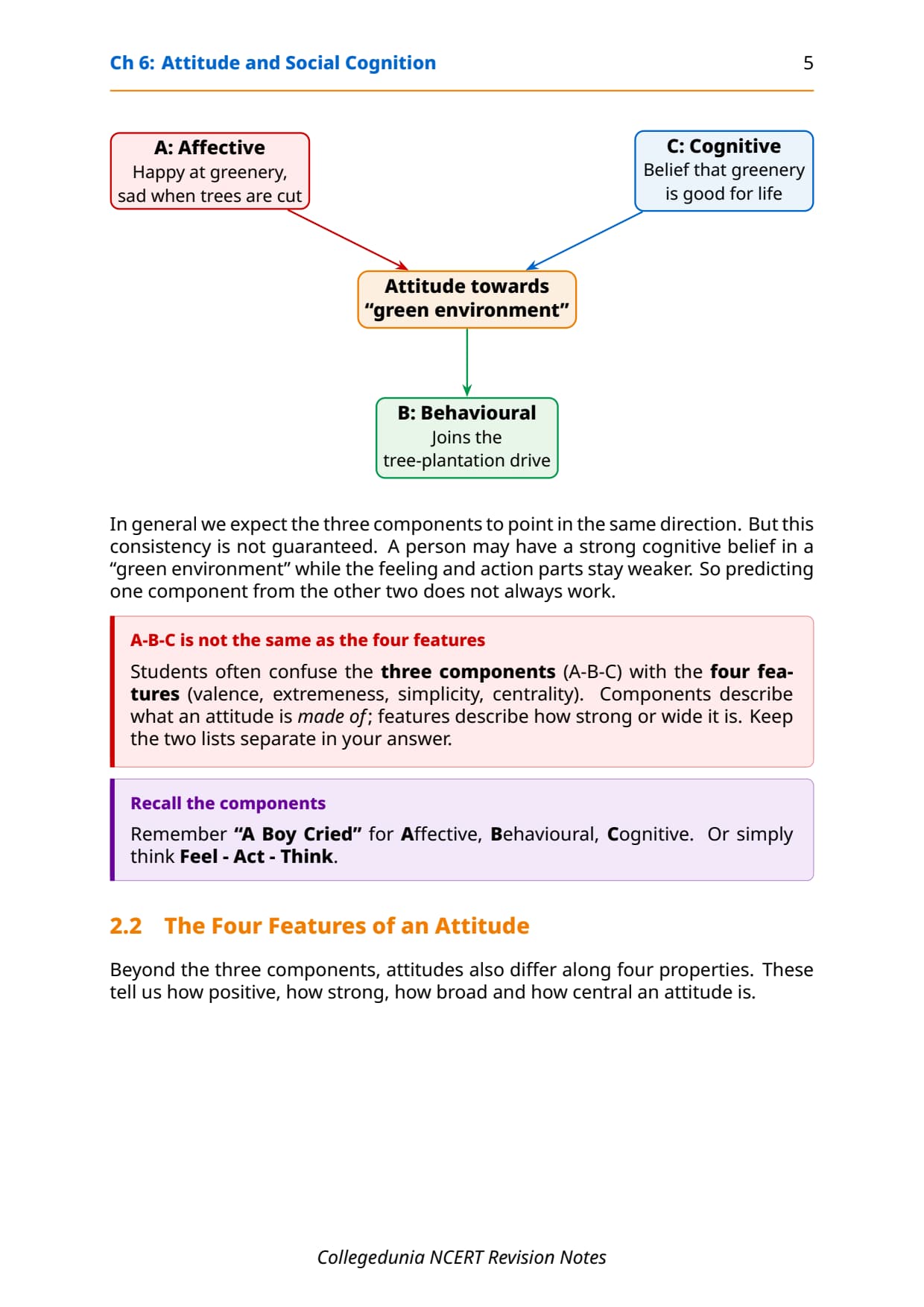
An attitude is an evaluative state of mind about an attitude object, a topic, person or issue. It carries thought, feeling and a readiness to act, so it is more than an opinion. For quick revision, learn the three components as a boxed list you can copy onto the answer sheet.
- Affective (A): the feeling part, the emotion the object stirs up.
- Behavioural (B): the conative part, a tendency or readiness to act.
- Cognitive (C): the thought part, the beliefs and ideas about the object.
The point examiners test most is that an attitude is a tendency to act, not the action itself. The three components usually point the same way, but not always: the cognitive part can be strong while the feeling and action parts stay weak. Keep both the A-B-C list and this consistency point ready for the long answer.
How Attitudes Are Formed and Changed
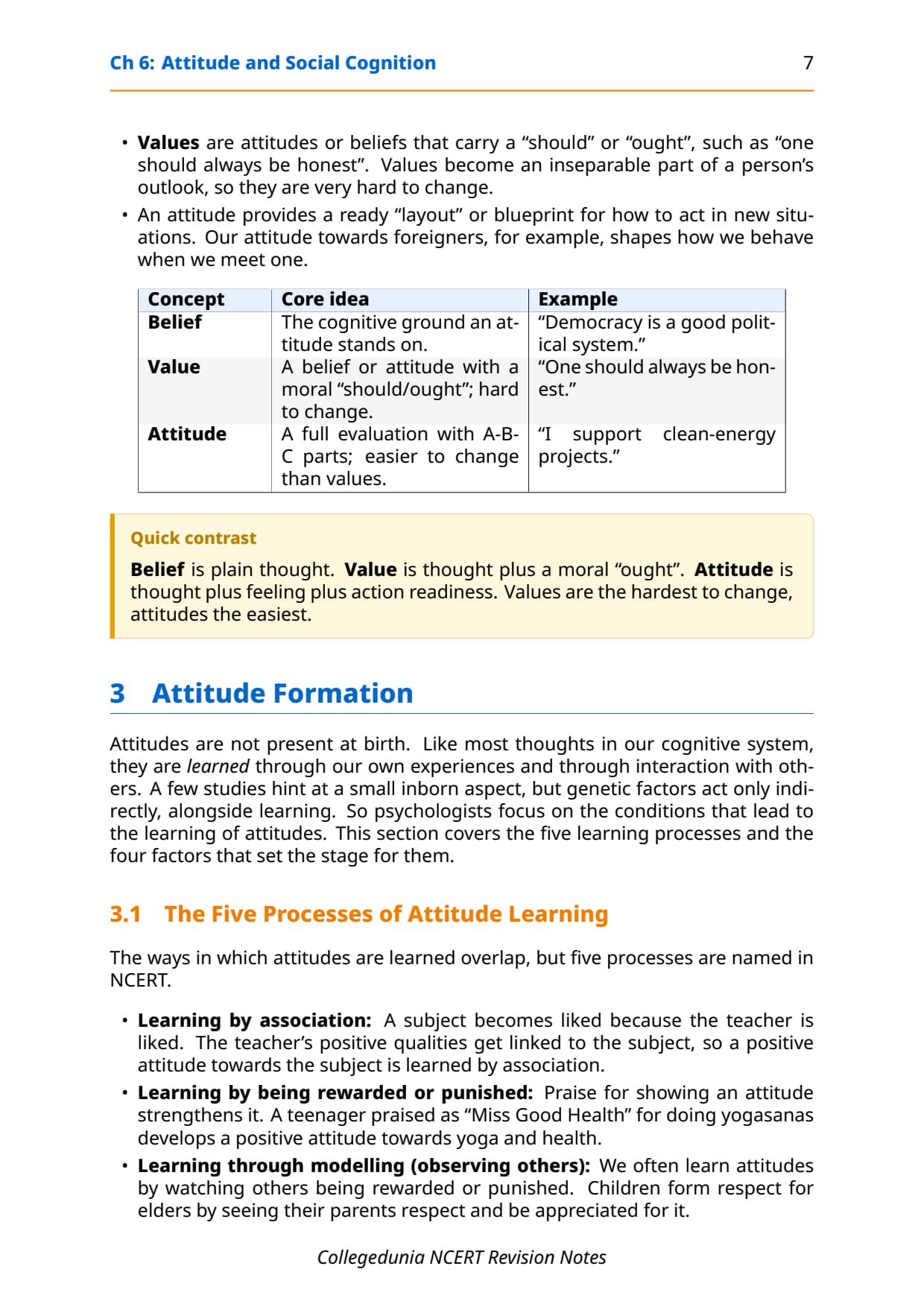
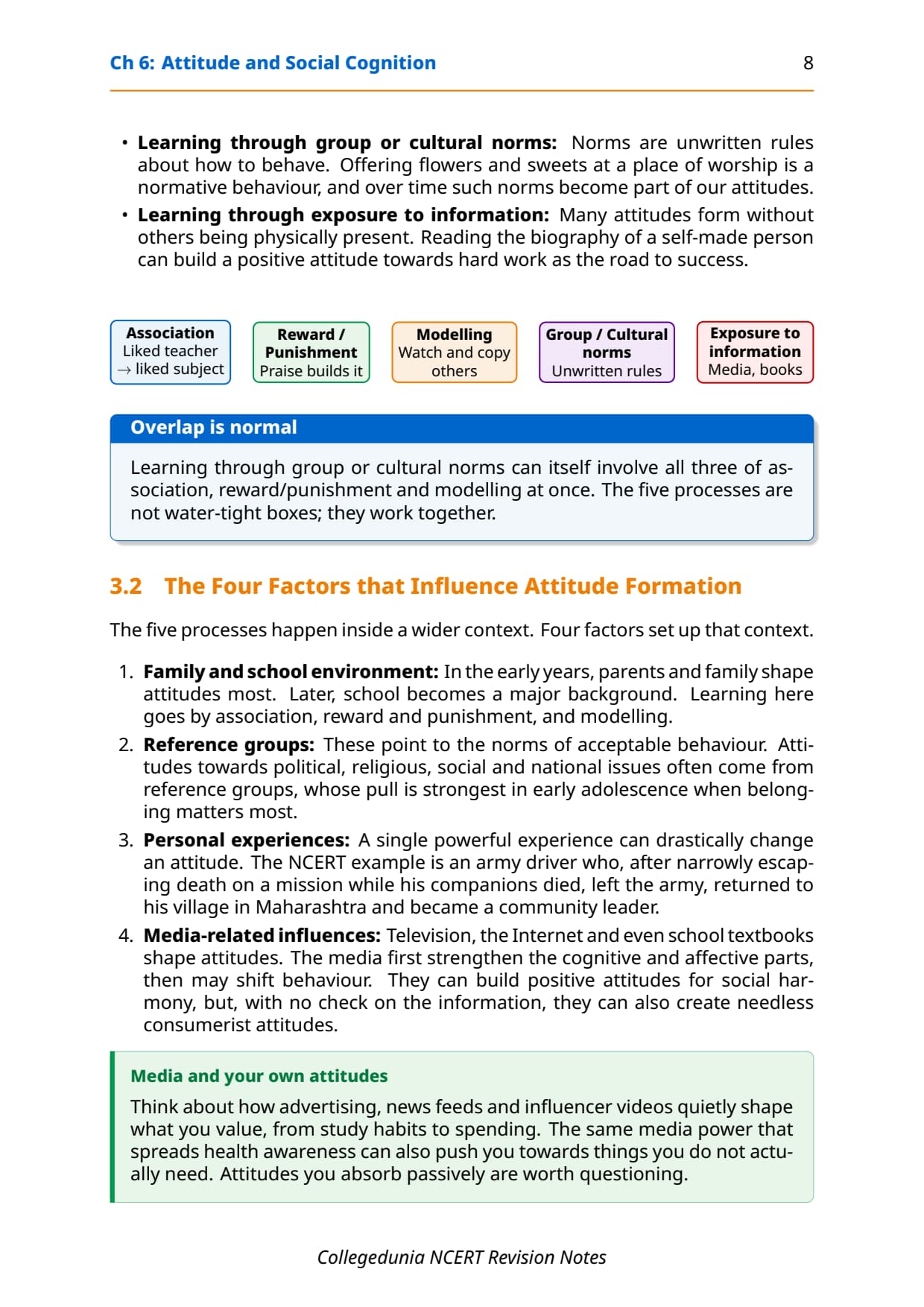
Attitudes are mostly learnt, with only a small, indirect inborn part. These notes keep the five learning routes and the change processes as clear lists. Learn them this way and you can answer any version of the formation question.
| Route or process | What it means |
|---|---|
| Association | An object is linked with something already liked or disliked. |
| Reward and punishment | An attitude grows stronger when it is praised or rewarded. |
| Modelling | We pick up attitudes by watching others being rewarded. |
| Group and cultural norms | Unwritten group rules slowly harden into settled attitudes. |
| Exposure to information | Books and media build attitudes without others present. |
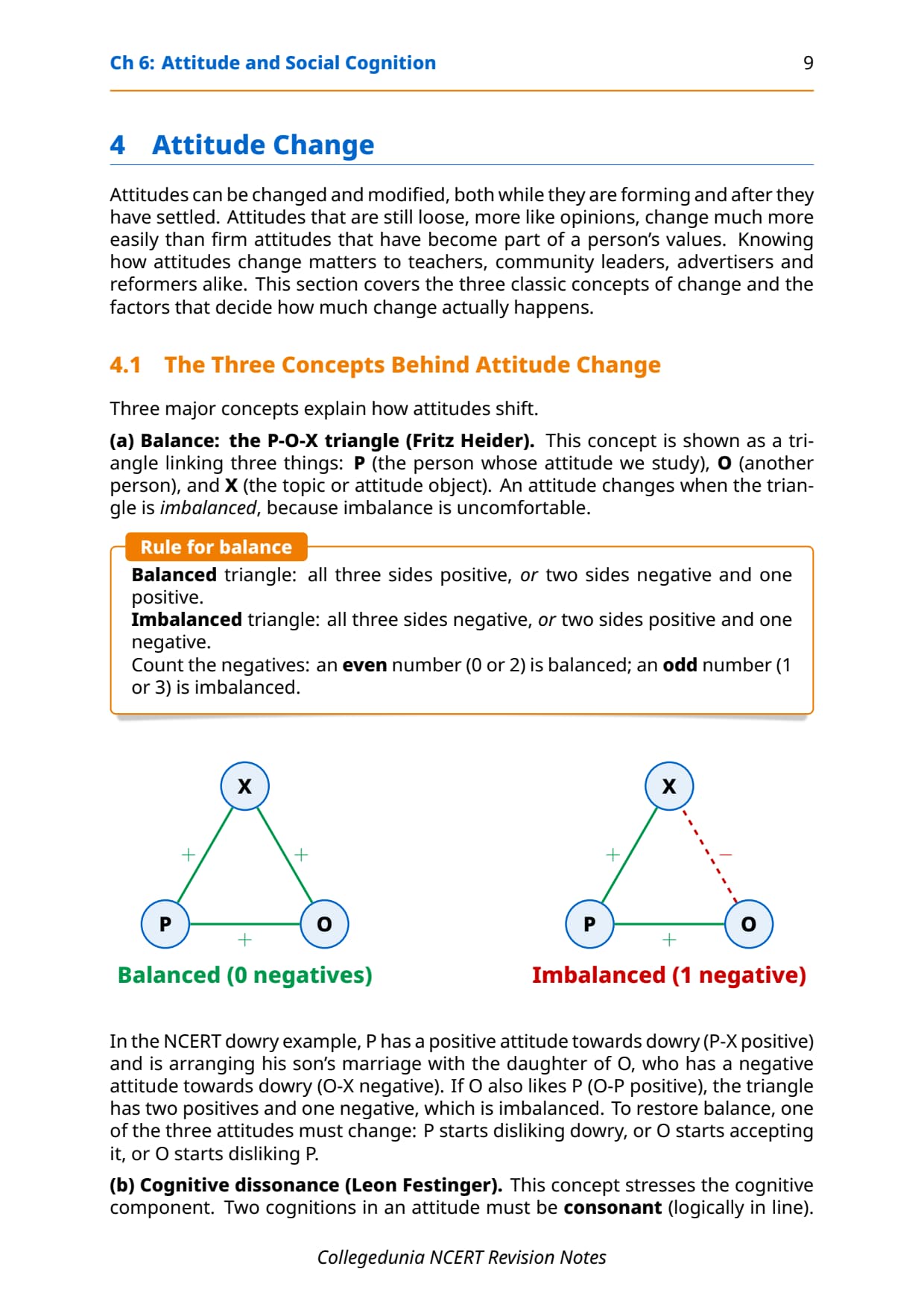
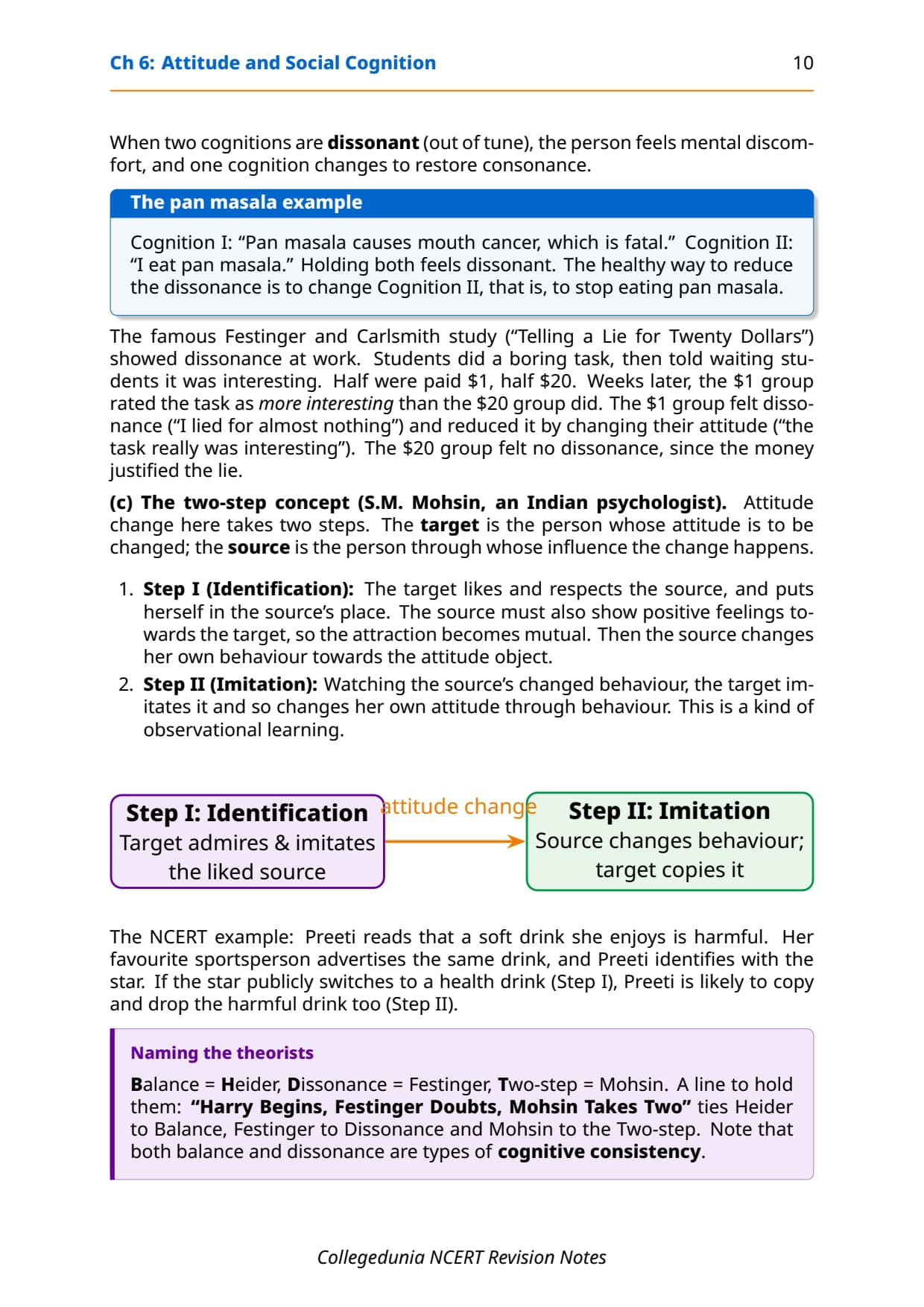
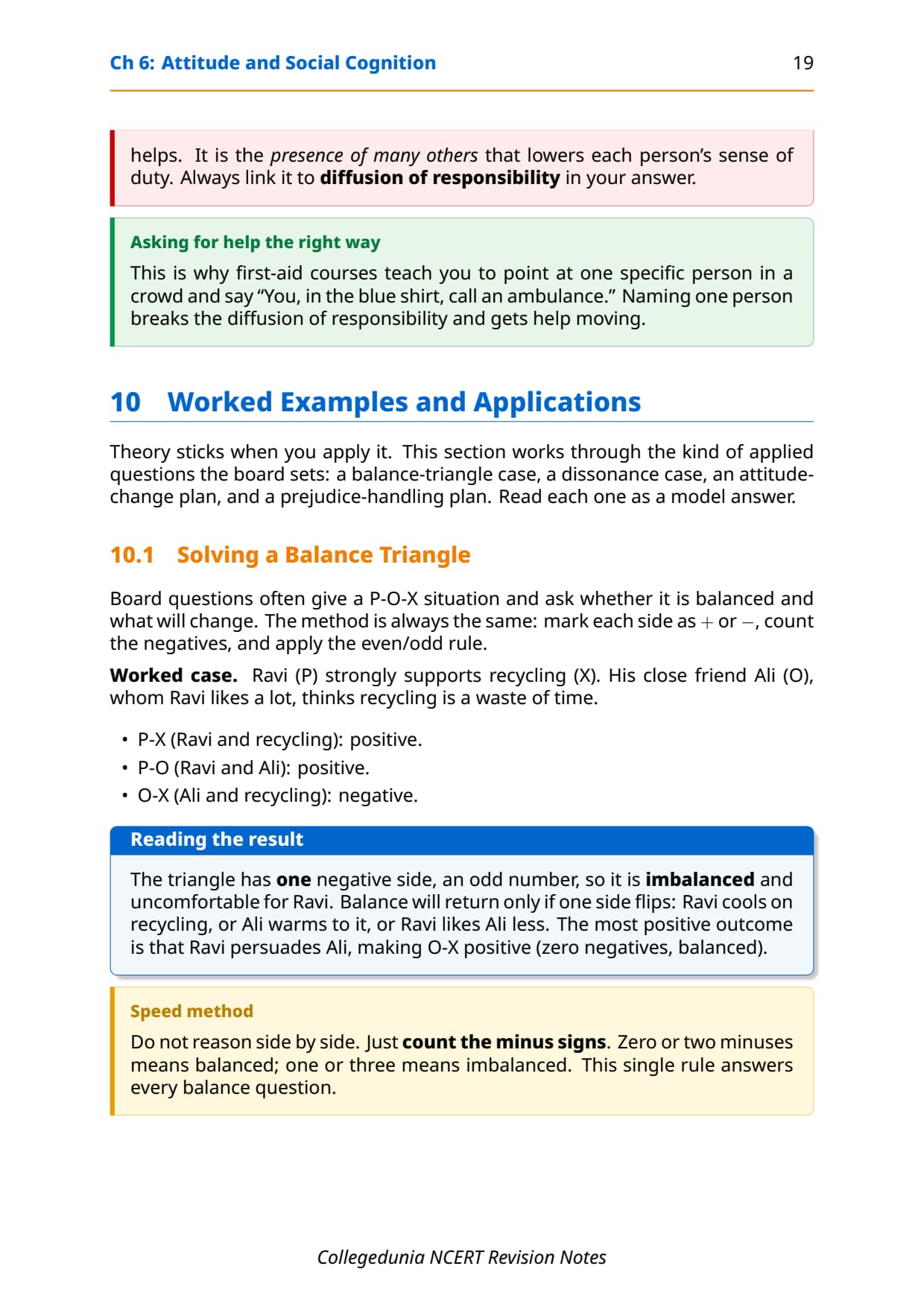
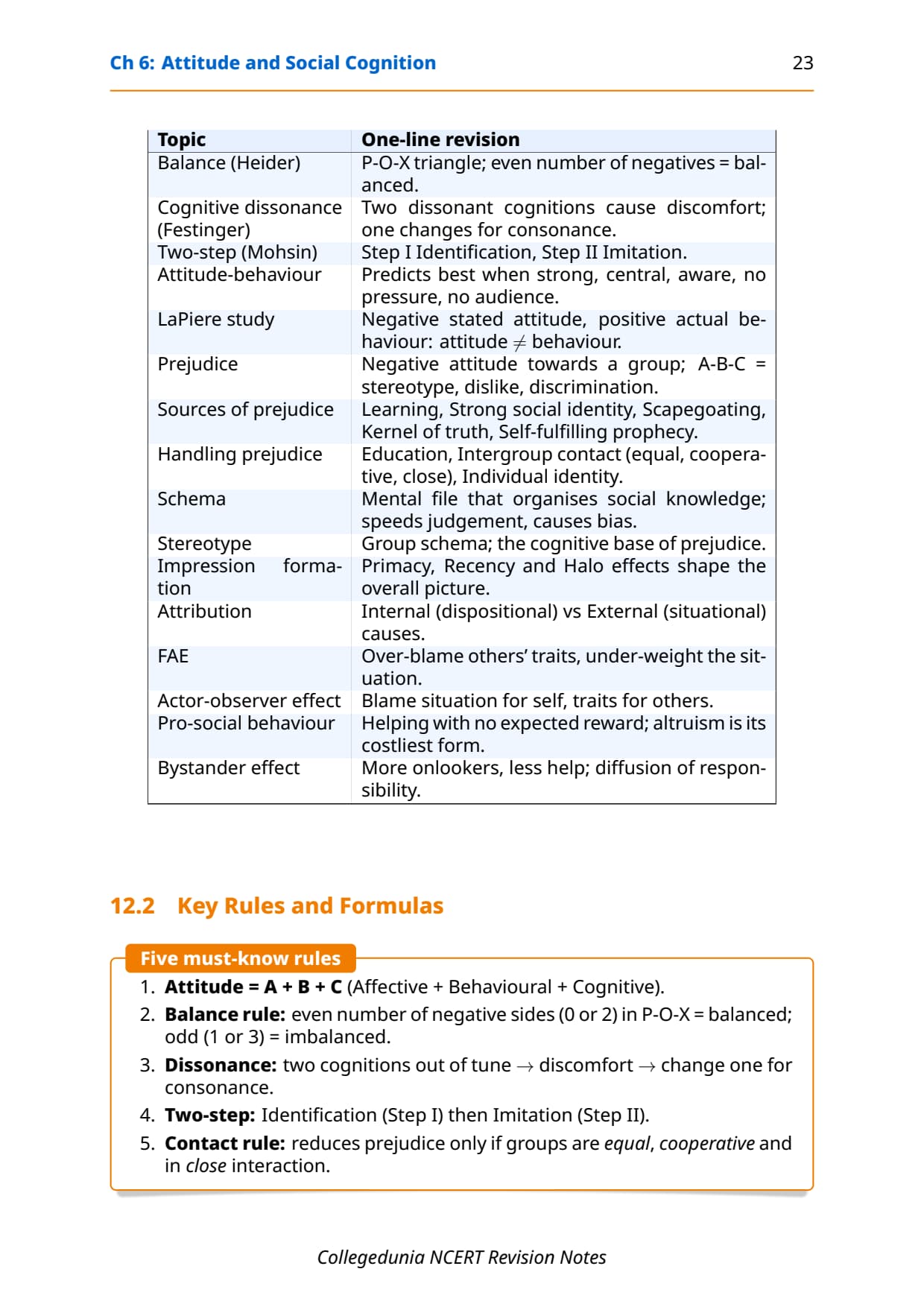
For attitude change, remember the three NCERT processes: the balance concept (Heider's P-O-X triangle), cognitive dissonance (Festinger), and the two-step concept (S.M. Mohsin). The four context factors of formation are family and school, reference groups, personal experience and the media. Keep the routes, the change processes and the factors as three separate lists so you never mix them up.
The Attitude-Behaviour Link
Behaviour does not always follow attitude. This is a favourite short and long answer, so these notes give the rule and the proof side by side. The exam wants both before any judgement.
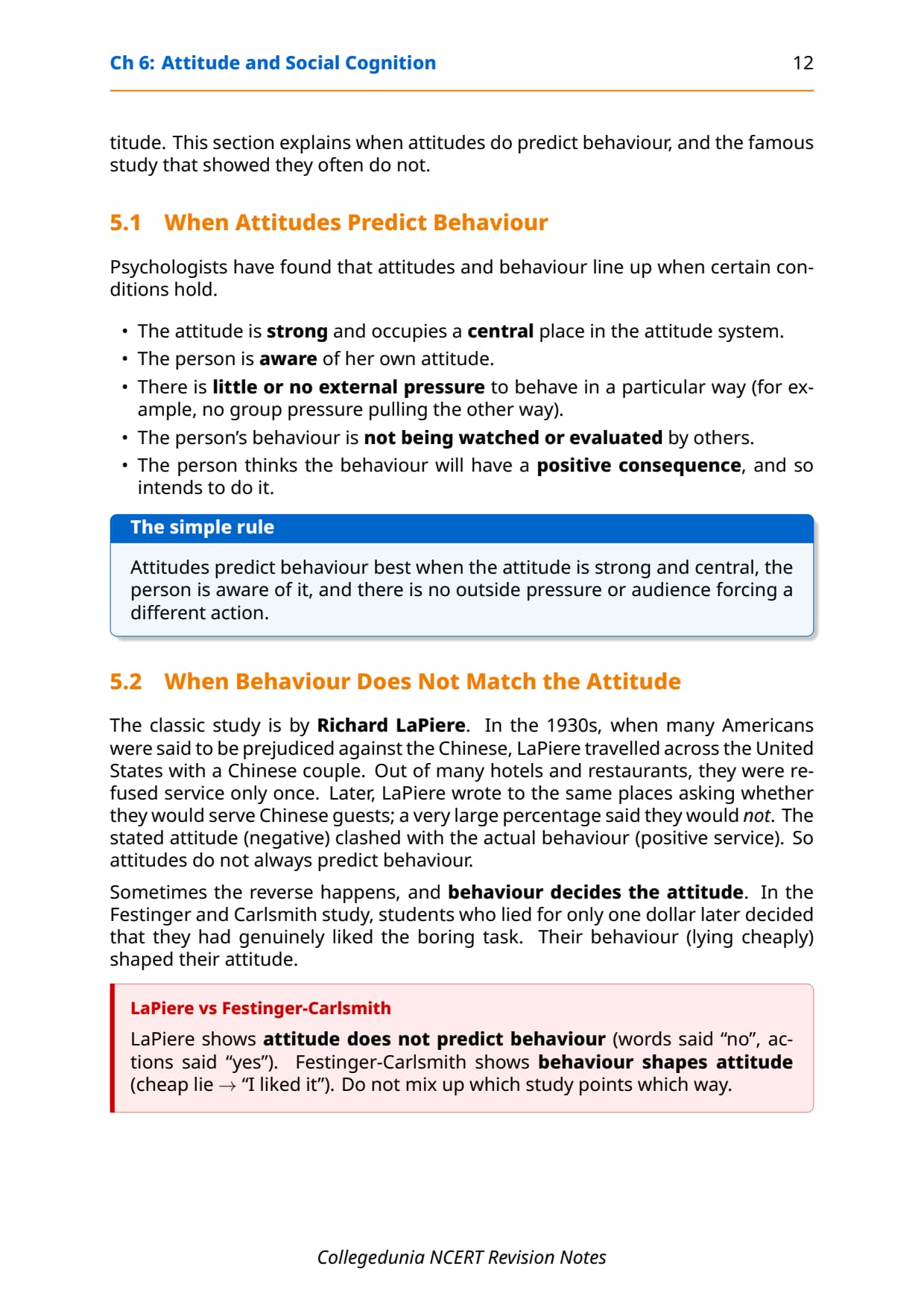
- The gap: a person can hold one attitude and act in the opposite way.
- The proof: the LaPiere study, where hotels served a Chinese couple in person but said on paper they would refuse Chinese guests.
- When they match: when the attitude is strong, central, conscious, unpressured and the behaviour is unobserved.
- The reverse: behaviour can also shape attitude, as in the Festinger and Carlsmith one-dollar study.
The judgement to remember is that attitude and behaviour can come apart. Naming the LaPiere study and the five conditions for a match is what earns the marks here, so keep both ready for the long answer.
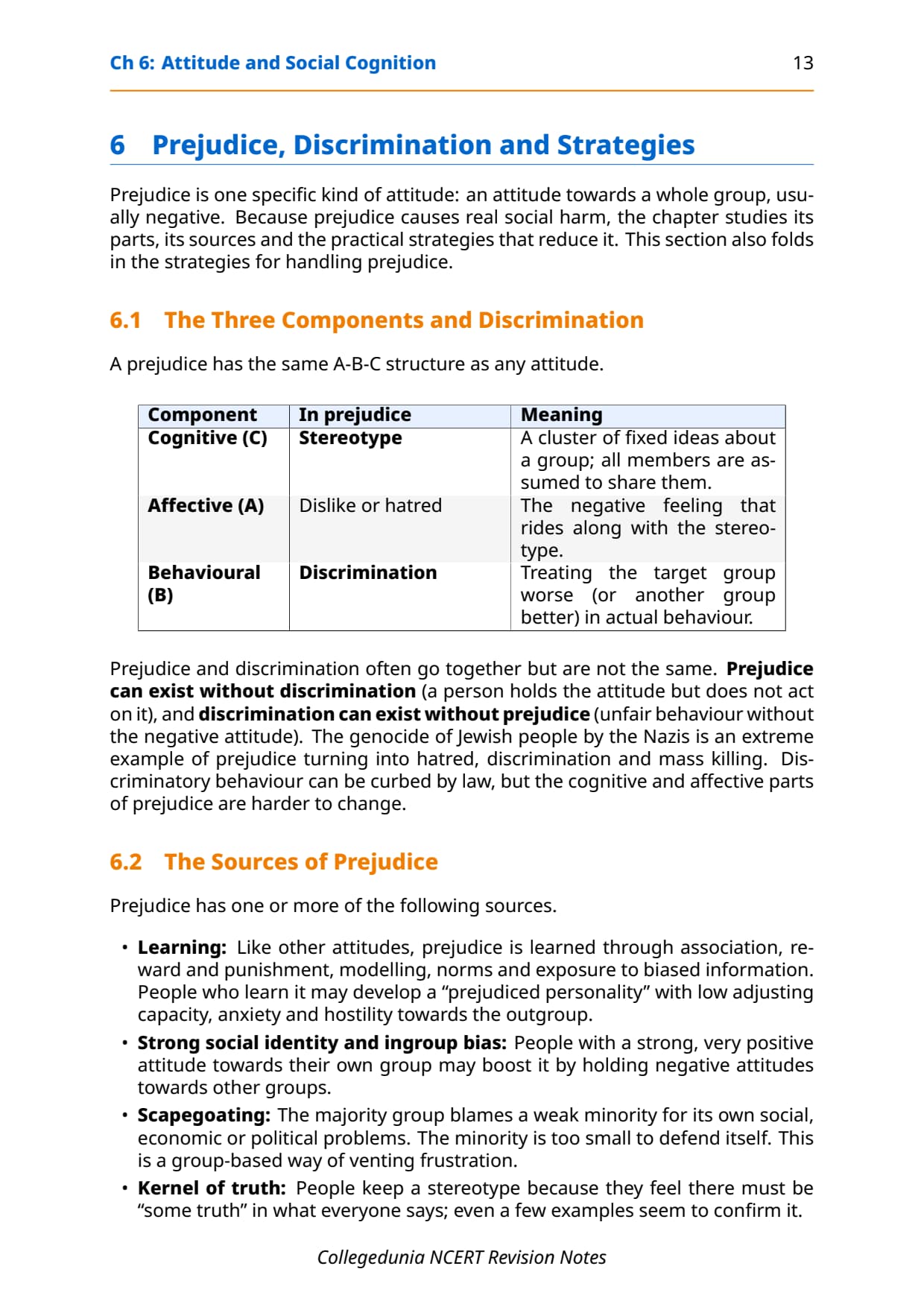
Prejudice, Stereotype and Discrimination
The last part of the chapter is social cognition: how we judge whole groups. These three terms are close, so these notes keep them apart in a clear table. Learning the contrast first makes every prejudice answer easier.
| Term | What it is |
|---|---|
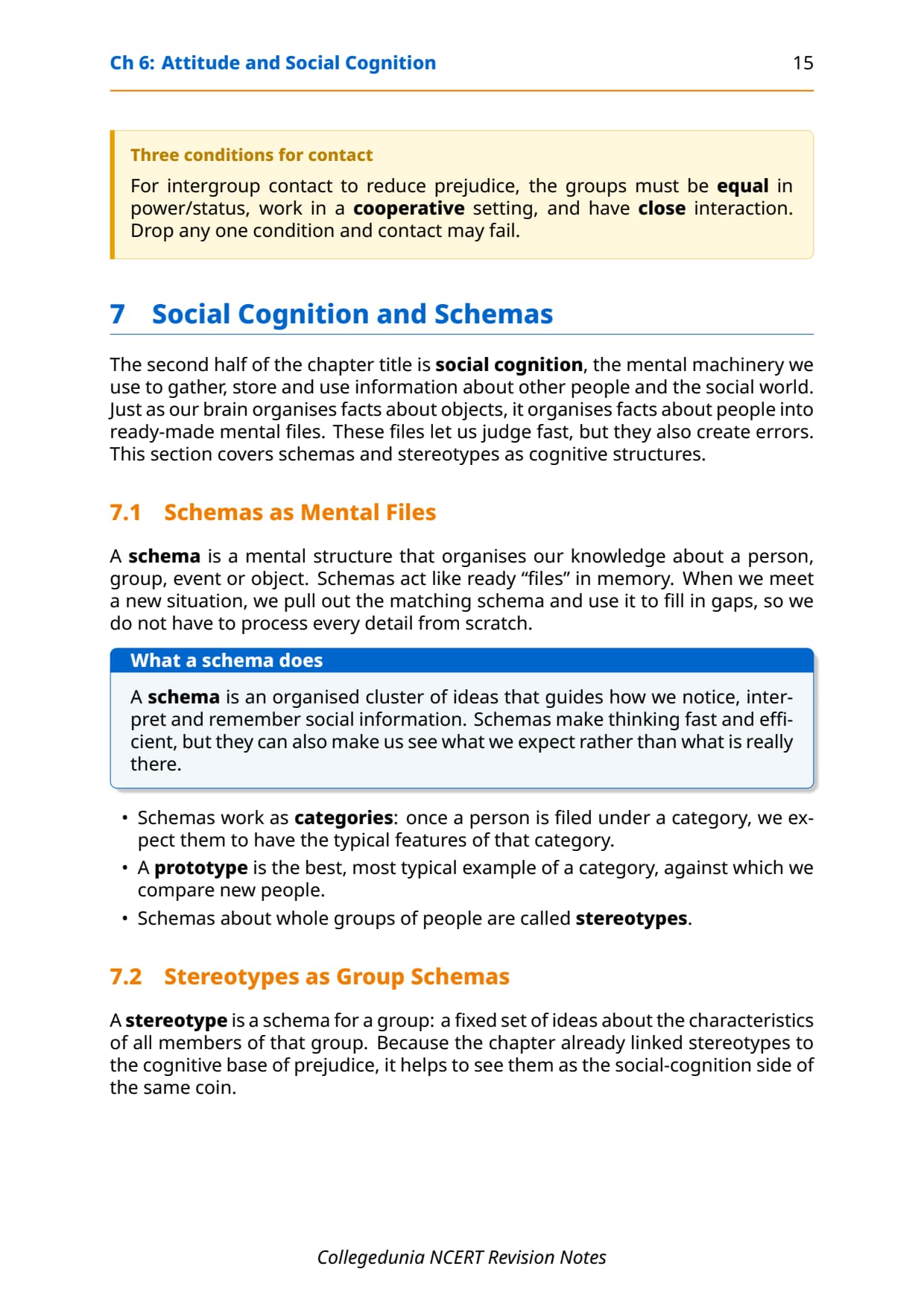
| Stereotype | A cluster of ideas about a group; the cognitive belief, any charge. |
| Prejudice | A usually negative attitude towards the group, built on the stereotype. |
| Discrimination | The behaviour: treating the target group less favourably. |
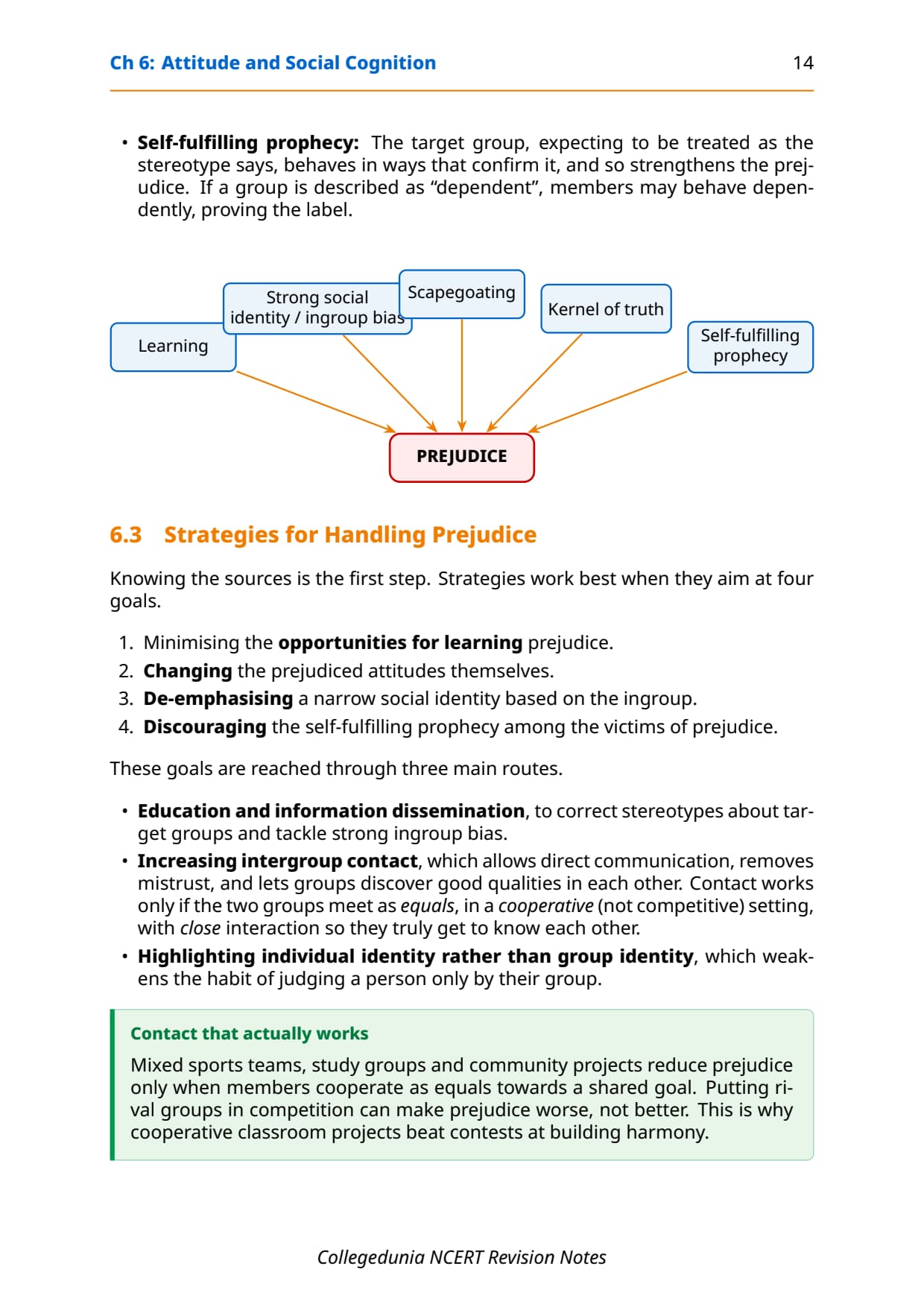
The sharp point for your sheet is that prejudice is the attitude and discrimination is the behaviour, so each can occur without the other. The sources of prejudice include learning from family and group norms, a strong us-and-them feeling, and self-fulfilling beliefs. Prejudice can be handled by correct information, more contact between groups, and changing the norms that support it.
Attitude and Social Cognition Important Questions and Exam Pointers
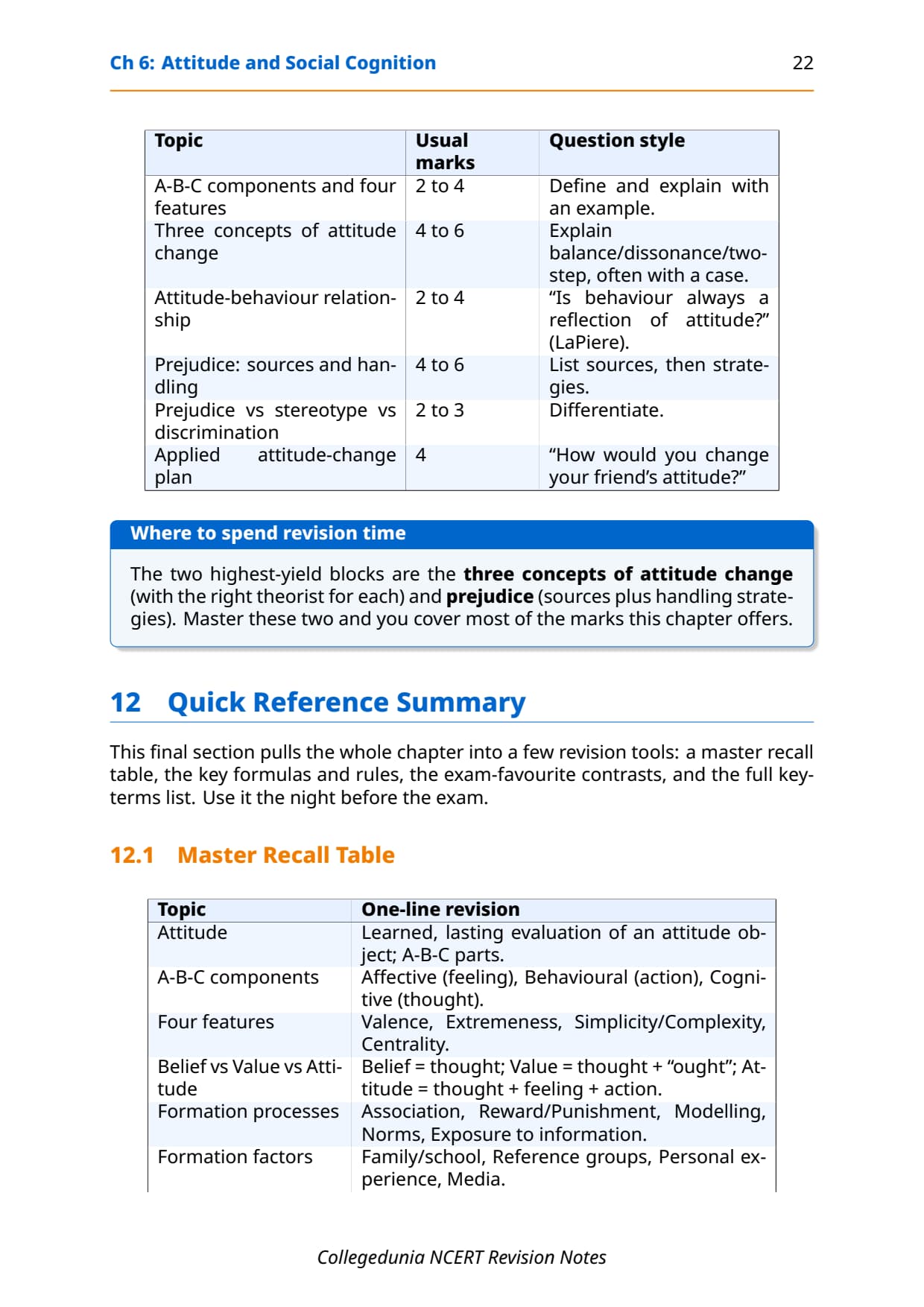
CBSE sets a steady mix of objective, short and long answers from this chapter. Knowing the pattern helps students decide how much to write and which topics to revise first. A focused list of attitude and social cognition important questions saves a lot of time before the board exam.
- Long answer (5 to 6 marks): define an attitude with its components, or how attitudes are learnt.
- Short answer (4 marks): the factors of attitude formation, or the attitude-behaviour link.
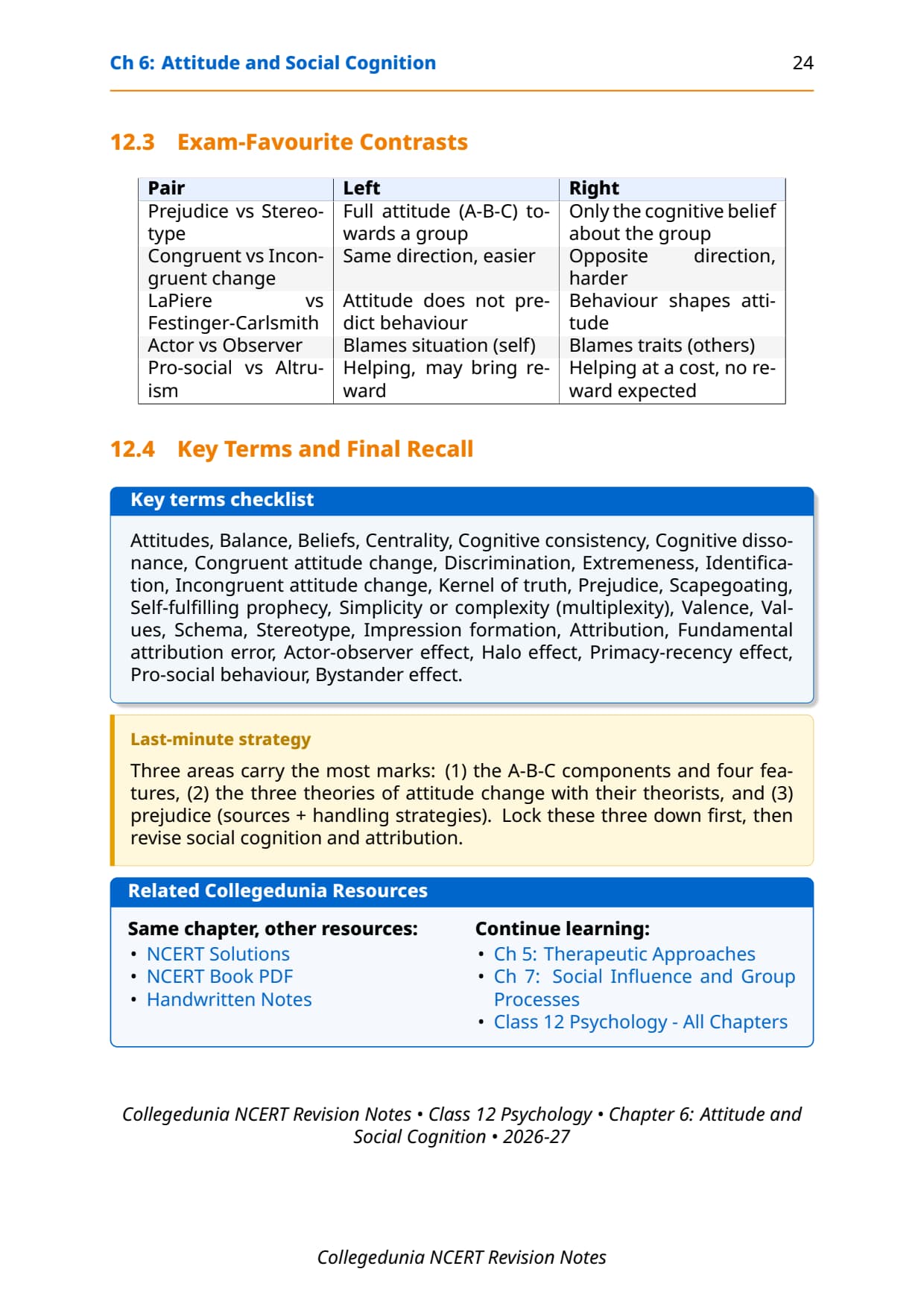
- Differentiate: prejudice versus stereotype, a near-certain repeat.
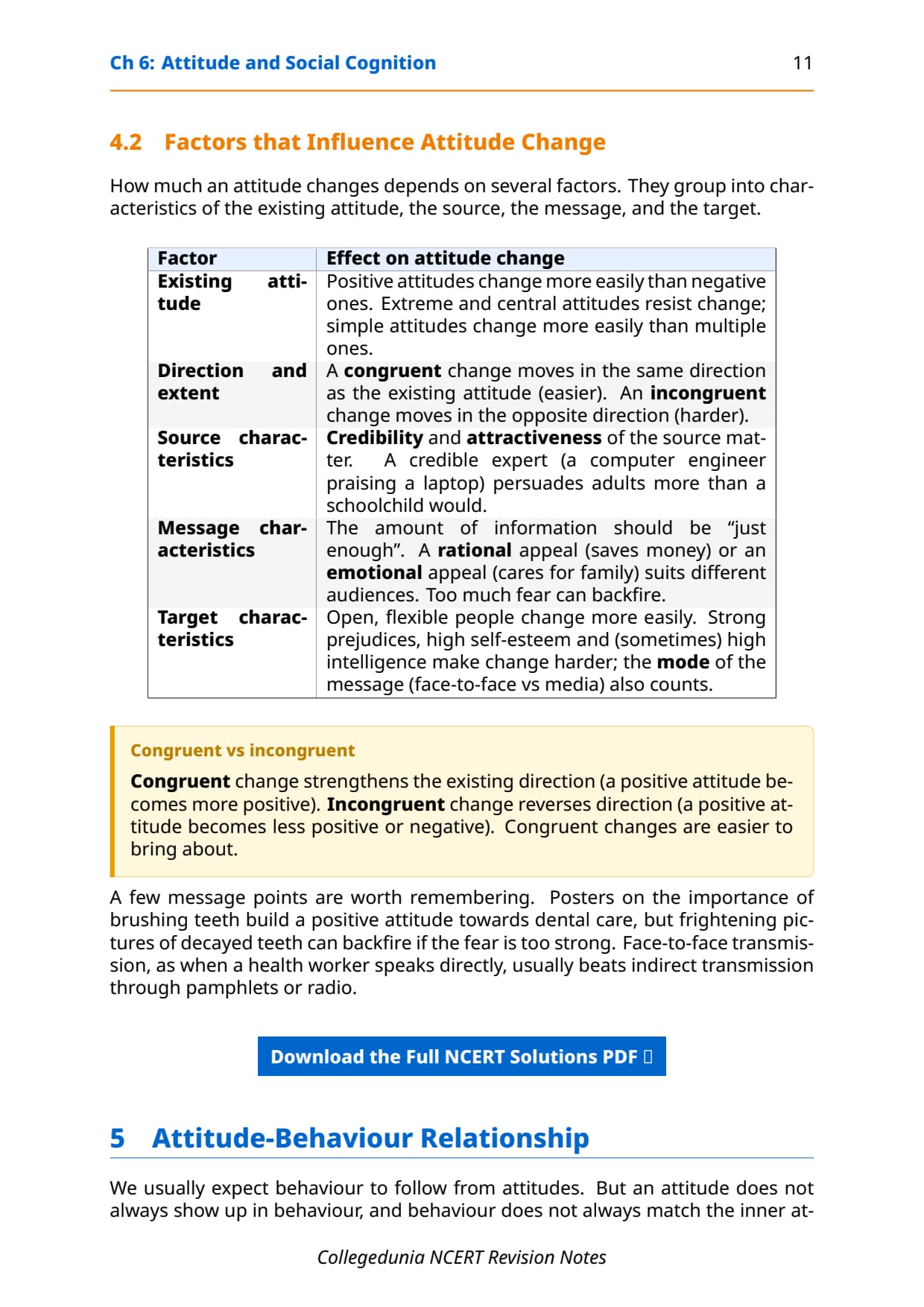
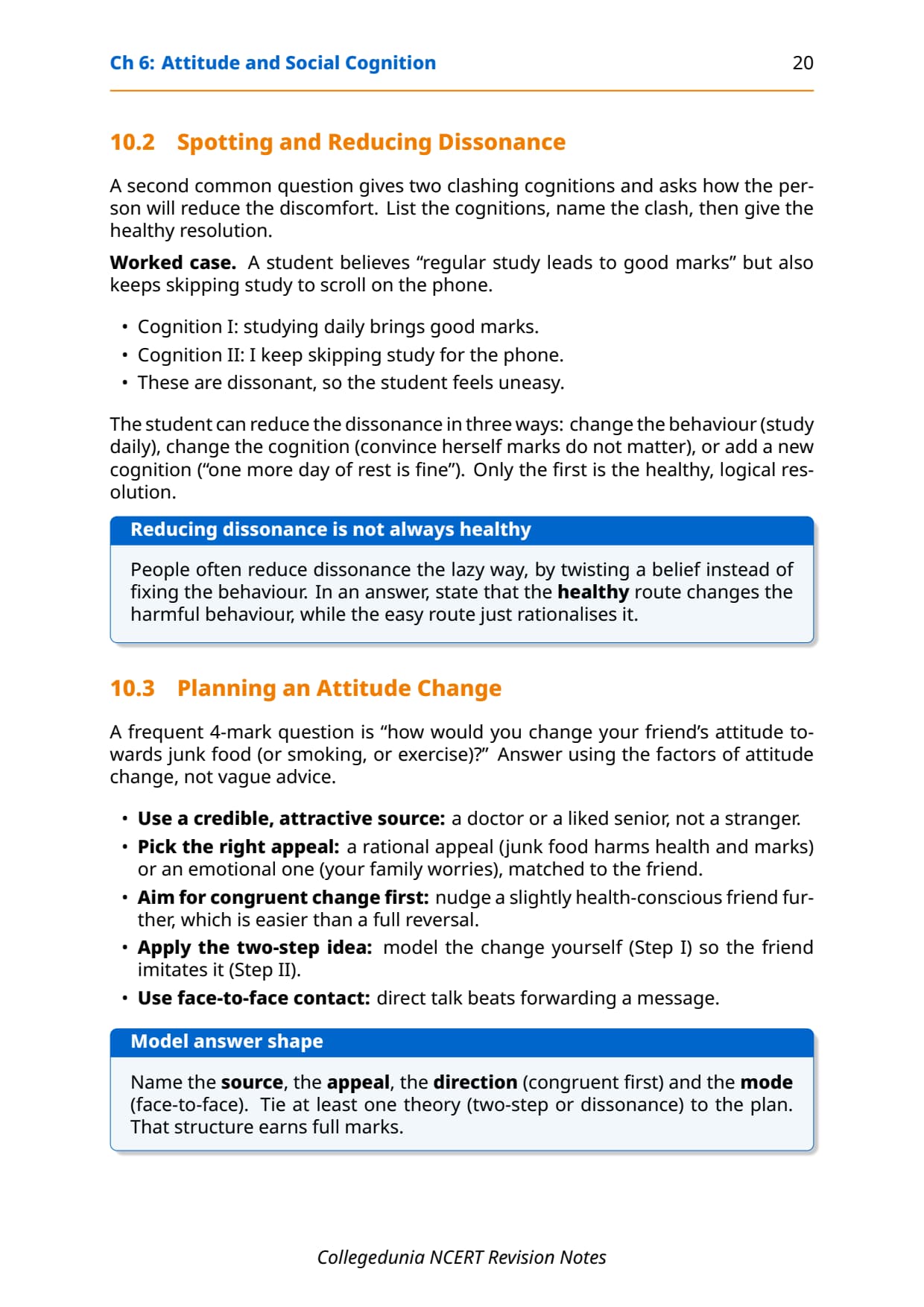
- Apply it: changing a friend's attitude, using dissonance and a credible model.
For quick recall, students often practise a short class 12 psychology chapter 6 mcq drill and a list of attitude and social cognition class 12 important questions. The most repeated items are the A-B-C components and the prejudice-versus-stereotype contrast, so keep those points ready in your own words.
Common Mistakes Students Make in This Chapter
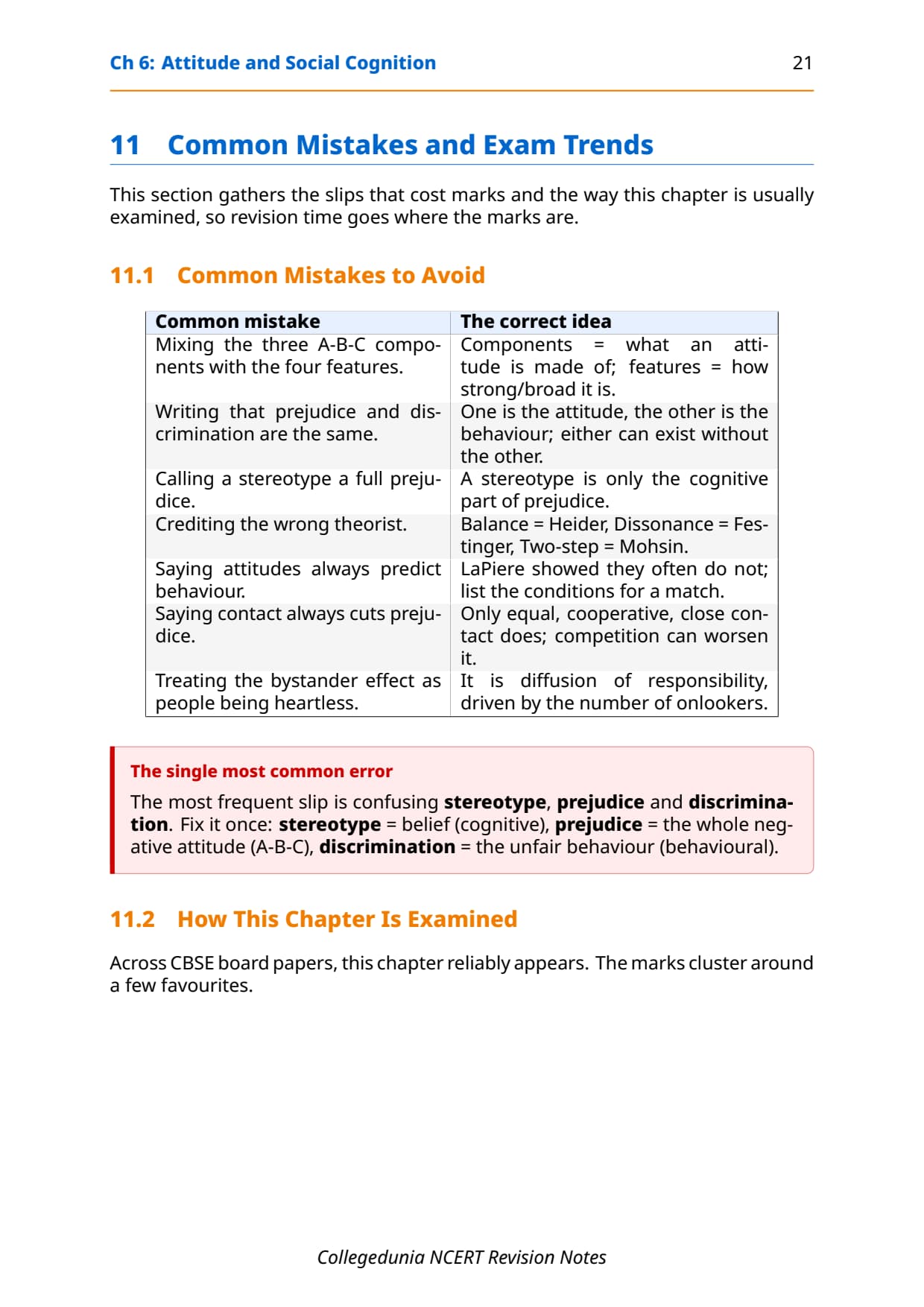
A few errors cost marks every year. Most come from blurring close terms or dropping one item from a list. Fixing these five points is the quickest way to lift a score, so add them to the end of your revision sheet.
- Naming only two A-B-C components; you must give all three, affective, behavioural and cognitive.
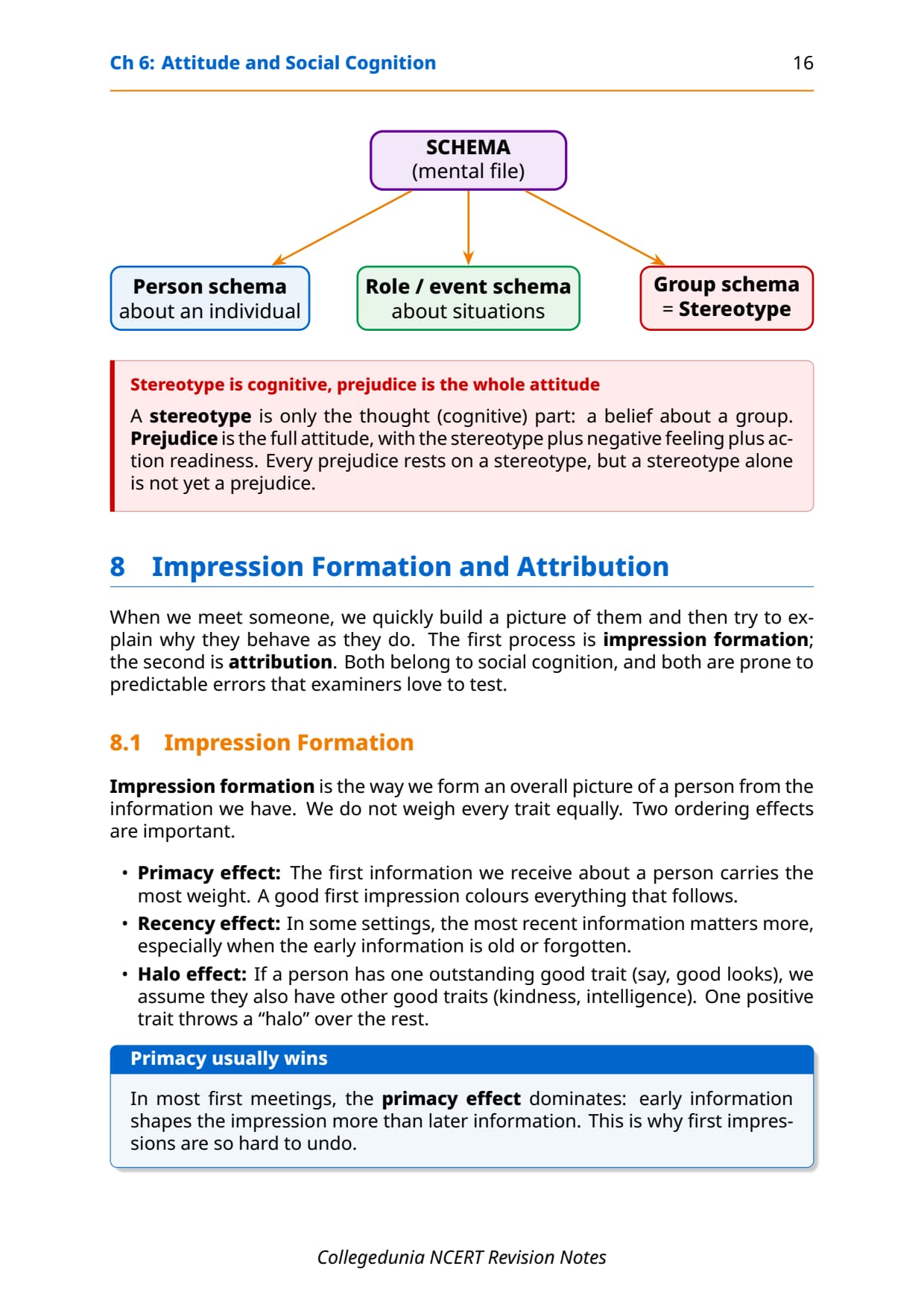
- Treating stereotype and prejudice as the same thing.
- Mixing the factors of formation with the processes of learning.
- Saying behaviour always follows attitude; the LaPiere study proves it does not.
- Forgetting that discrimination is the behaviour, while prejudice is the attitude.
Students who fix these five points usually move from average to high marks. The exam rewards precise terms and a balanced view, so name each idea exactly and give one clear example.
How These Notes Pair with the Solutions and Book PDF
These revision notes summarise the chapter. To prepare fully, students should use them alongside the other resources for the same chapter, all linked in the table below. Read the notes first, then test yourself with the solutions, and open the Book PDF whenever you need the original text.
| Resource | Best used for |
|---|---|
| Attitude and Social Cognition NCERT Solutions | Step-by-step answers to all 7 Review Questions |
| Attitude and Social Cognition Handwritten Notes | Last-minute, one-shot revision in a scanned notebook style |
| Attitude and Social Cognition NCERT Book PDF | Reading the original NCERT chapter text |
Tip: read these notes first, then attempt the solutions on your own, and only then check the model answers. That order builds memory faster than copying answers straight away.
All Class 12 Psychology Notes by Chapter
The table links the revision notes for every chapter in Class 12 Psychology, so students can move across the course in one click. Attitude and Social Cognition is highlighted.
| Chapter | Notes |
|---|---|
| Chapter 1 | Variations in Psychological Attributes |
| Chapter 2 | Self and Personality |
| Chapter 3 | Meeting Life Challenges |
| Chapter 4 | Psychological Disorders |
| Chapter 5 | Therapeutic Approaches |
| Chapter 6 | Attitude and Social Cognition |
| Chapter 7 | Social Influence and Group Processes |
FAQs on Attitude and Social Cognition Class 12 Notes
Attitude and Social Cognition Class 12 Psychology Notes Common Questions
Ques. Where can I download the Attitude and Social Cognition Class 12 notes PDF?
Ans. You can download the Attitude and Social Cognition Class 12 Psychology notes PDF directly from this page. It is free, follows the 2026-27 NCERT, and covers attitudes, their formation and change, the attitude-behaviour link and prejudice in a short, point-wise format.
Ques. What does the Attitude and Social Cognition chapter cover for Class 12?
Ans. It covers the nature of attitudes and their A-B-C components, the four features of an attitude, how attitudes are formed and changed, the attitude-behaviour link, and prejudice, stereotype and discrimination, with ways to handle prejudice.
Ques. What are the three components of an attitude?
Ans. An attitude has three A-B-C components: affective (feeling), behavioural or conative (a tendency to act), and cognitive (thought or belief). The three usually point the same way but not always, and a full answer names all three.
Ques. Why is Attitude and Social Cognition important for the board exam?
Ans. Because it is a high-scoring theory chapter. The A-B-C components, the LaPiere study and the prejudice-versus-stereotype contrast appear almost every year, so revising these notes well secures both objective and long-answer marks.
Ques. How should I use these notes to revise quickly?
Ans. Read the notes once under the attitude, formation and prejudice frame, keep the A-B-C components and the five learning routes on one sheet, then write the key lists from memory. Finish by attempting a short class 12 psychology chapter 6 mcq drill to test the small facts.



Comments