



Number Play Class 6 notes help students revise taller-neighbour puzzles, supercells, number-line positions, digit patterns, palindromes, Kaprekar steps, Collatz chains, estimation, and winning game strategies from the 2026-27 NCERT Ganita Prakash book. These notes keep each rule short and connect every activity with a clear checking habit.
- Core focus: patterns, local rules, place value, digit puzzles, and strategy games.
- Best use: read one idea, test one example, then solve the matching NCERT question.
- Revision habit: explain why a rule works before writing the final answer.
Chapter3NumberPlayNotes.pdf?page=1&dpi=150)
Chapter3NumberPlayNotes.pdf?page=2&dpi=150)
Chapter3NumberPlayNotes.pdf?page=3&dpi=150)
Chapter3NumberPlayNotes.pdf?page=4&dpi=150)
Chapter3NumberPlayNotes.pdf?page=5&dpi=150)
Chapter3NumberPlayNotes.pdf?page=6&dpi=150)
Chapter3NumberPlayNotes.pdf?page=7&dpi=150)
Chapter3NumberPlayNotes.pdf?page=8&dpi=150)
Chapter3NumberPlayNotes.pdf?page=9&dpi=150)
Chapter3NumberPlayNotes.pdf?page=10&dpi=150)
Chapter3NumberPlayNotes.pdf?page=11&dpi=150)
Chapter3NumberPlayNotes.pdf?page=12&dpi=150)
Chapter3NumberPlayNotes.pdf?page=13&dpi=150)
Chapter3NumberPlayNotes.pdf?page=14&dpi=150)
Chapter3NumberPlayNotes.pdf?page=15&dpi=150)
Chapter3NumberPlayNotes.pdf?page=16&dpi=150)
Chapter3NumberPlayNotes.pdf?page=17&dpi=150)
Chapter3NumberPlayNotes.pdf?page=18&dpi=150)
Chapter3NumberPlayNotes.pdf?page=19&dpi=150)
Chapter3NumberPlayNotes.pdf?page=20&dpi=150)
Chapter3NumberPlayNotes.pdf?page=21&dpi=150)
Chapter3NumberPlayNotes.pdf?page=22&dpi=150)
Chapter3NumberPlayNotes.pdf?page=23&dpi=150)
Chapter3NumberPlayNotes.pdf?page=24&dpi=150)
Chapter3NumberPlayNotes.pdf?page=25&dpi=150)
Chapter3NumberPlayNotes.pdf?page=26&dpi=150)
Chapter3NumberPlayNotes.pdf?page=27&dpi=150)
Chapter3NumberPlayNotes.pdf?page=28&dpi=150)
Chapter3NumberPlayNotes_flat_MobileCard.pdf?page=1&dpi=150)
Chapter3NumberPlayNotes_flat_MobileCard.pdf?page=2&dpi=150)
Chapter3NumberPlayNotes_flat_MobileCard.pdf?page=3&dpi=150)
Chapter3NumberPlayNotes_flat_MobileCard.pdf?page=4&dpi=150)
Chapter3NumberPlayNotes_flat_MobileCard.pdf?page=5&dpi=150)
Chapter3NumberPlayNotes_flat_MobileCard.pdf?page=6&dpi=150)
Chapter3NumberPlayNotes_flat_MobileCard.pdf?page=7&dpi=150)
Chapter3NumberPlayNotes_flat_MobileCard.pdf?page=8&dpi=150)
Chapter3NumberPlayNotes_flat_MobileCard.pdf?page=9&dpi=150)
Chapter3NumberPlayNotes_flat_MobileCard.pdf?page=10&dpi=150)
Chapter3NumberPlayNotes_flat_MobileCard.pdf?page=11&dpi=150)
Chapter3NumberPlayNotes_flat_MobileCard.pdf?page=12&dpi=150)
Chapter3NumberPlayNotes_flat_MobileCard.pdf?page=13&dpi=150)
Chapter3NumberPlayNotes_flat_MobileCard.pdf?page=14&dpi=150)
Chapter3NumberPlayNotes_flat_MobileCard.pdf?page=15&dpi=150)
Chapter3NumberPlayNotes_flat_MobileCard.pdf?page=16&dpi=150)
Chapter3NumberPlayNotes_flat_MobileCard.pdf?page=17&dpi=150)
Chapter3NumberPlayNotes_flat_MobileCard.pdf?page=18&dpi=150)
Chapter3NumberPlayNotes_flat_MobileCard.pdf?page=19&dpi=150)
Chapter3NumberPlayNotes_flat_MobileCard.pdf?page=20&dpi=150)
Chapter3NumberPlayNotes_flat_MobileCard.pdf?page=21&dpi=150)
Chapter3NumberPlayNotes_flat_MobileCard.pdf?page=22&dpi=150)
Chapter3NumberPlayNotes_flat_MobileCard.pdf?page=23&dpi=150)
Chapter3NumberPlayNotes_flat_MobileCard.pdf?page=24&dpi=150)
Chapter3NumberPlayNotes_flat_MobileCard.pdf?page=25&dpi=150)
Chapter3NumberPlayNotes_flat_MobileCard.pdf?page=26&dpi=150)
Chapter3NumberPlayNotes_flat_MobileCard.pdf?page=27&dpi=150)
Chapter3NumberPlayNotes_flat_MobileCard.pdf?page=28&dpi=150)
Chapter3NumberPlayNotes_flat_MobileCard.pdf?page=29&dpi=150)
Chapter3NumberPlayNotes_flat_MobileCard.pdf?page=30&dpi=150)
Chapter3NumberPlayNotes_flat_MobileCard.pdf?page=31&dpi=150)
Chapter3NumberPlayNotes_flat_MobileCard.pdf?page=32&dpi=150)
Chapter3NumberPlayNotes_flat_MobileCard.pdf?page=33&dpi=150)
Chapter3NumberPlayNotes_flat_MobileCard.pdf?page=34&dpi=150)
Chapter3NumberPlayNotes_flat_MobileCard.pdf?page=35&dpi=150)
Chapter3NumberPlayNotes_flat_MobileCard.pdf?page=36&dpi=150)
Chapter3NumberPlayNotes_flat_MobileCard.pdf?page=37&dpi=150)
Each note follows the 2026-27 NCERT Ganita Prakash chapter and keeps number patterns easy to revise.
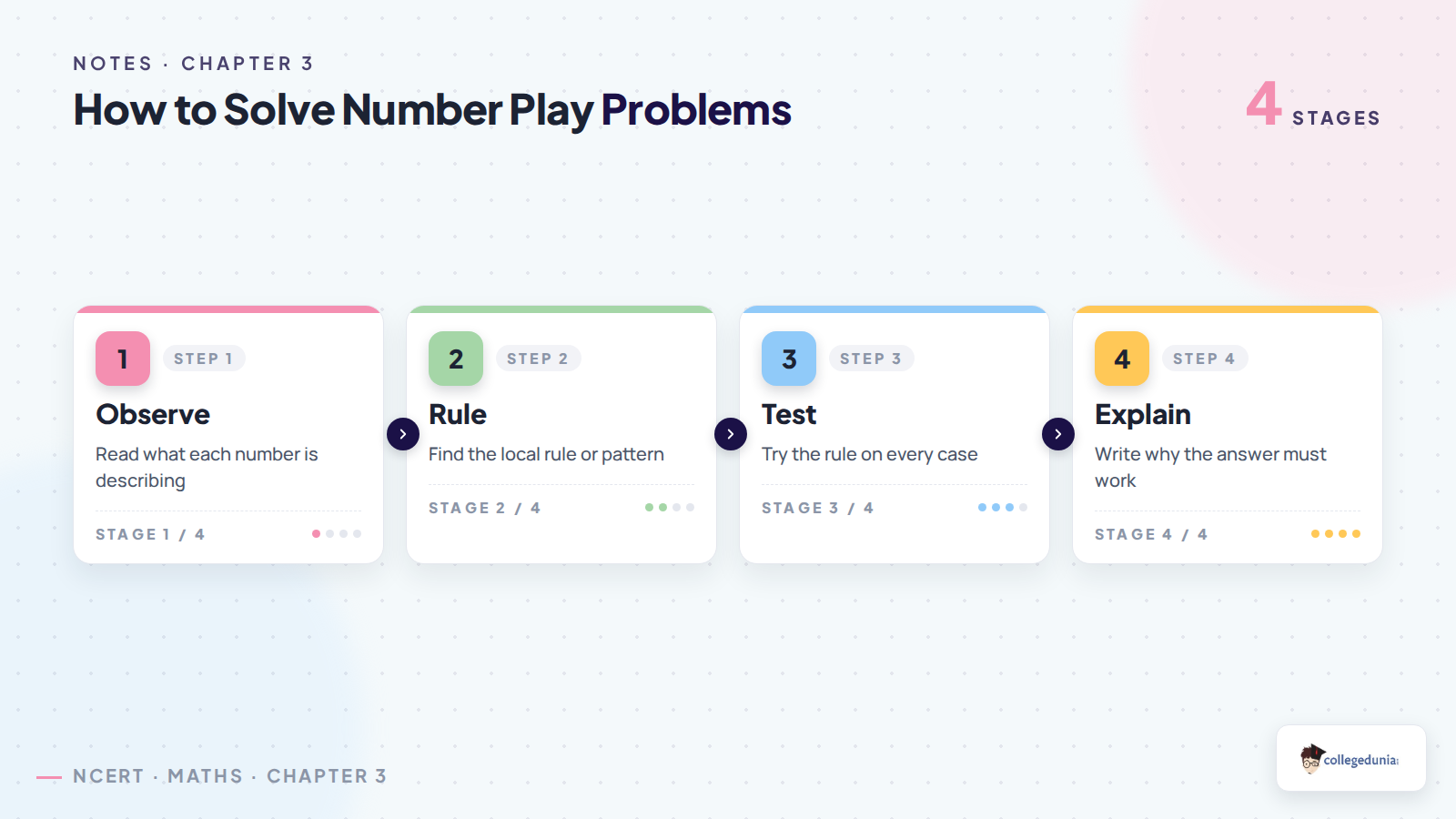
Student Feedback: In a Collegedunia poll of 11,080 Class 6 students conducted before the 2026 school exams, most students said Chapter 3 became easier after they separated observation, rule, test, and explanation into four steps.
Source: 2026-27 Class 6 Mathematics student poll.
Number Play Ideas Every Class 6 Student Should Know
Number Play is not only about arithmetic. The chapter asks students to notice what a number is describing. A number may count people, mark a place on a line, label a cell, show a pattern, or help a player choose a strategy.
| Idea | What to check | Example habit |
|---|---|---|
| Observation | What does the number describe? | Height, position, digit, or move |
| Local rule | Which nearby values matter? | Immediate neighbours only |
| Pattern rule | What repeats or changes? | Same gap, reversed digits, or key numbers |
| Explanation | Why must the answer work? | Use the rule on every case |
Do not rush to addition or subtraction. Many questions in this chapter need a reason, a counterexample, or a planned strategy.
Number Play Class 6 Quick Video Recap
Source: Magnet Brains on YouTube
Taller-Neighbour and Supercell Rules in Number Play
The first activities show that numbers can describe a situation. In the taller-neighbour puzzle, a child says how many taller children stand immediately next to them. A middle child can say 0, 1, or 2, but an end child cannot say 2 because only one neighbour exists.
- Taller-neighbour rule: count only immediate taller neighbours.
- End position check: an end has only one neighbour.
- Supercell rule: a cell is a supercell if its number is greater than every direct neighbour.
- Grid neighbour rule: left, right, top, and bottom count; diagonals do not count.
For maximum supercells in a row, place larger and smaller values alternately. The high values become local peaks because each one is greater than the values beside it.
Digit Patterns and Palindromes in Number Play Notes
Digit activities train students to use place value carefully. The same digits can make different numbers, and the position of a digit decides its value. This is why the chapter asks students to build, reverse, compare, and count digits.
| Topic | Rule | Quick check |
|---|---|---|
| Digit sum | Add all digits of a number. | 176 has digit sum 14. |
| Counting a digit | Count every occurrence separately. | 77 contributes two sevens. |
| Palindrome | Reads the same forward and backward. | 575 and 12421 are palindromes. |
| Reverse and add | Reverse digits, add, and check again. | 57 plus 75 gives 132. |
When a number has commas, the commas do not change its value. They only help students read place value groups correctly.
Kaprekar, Collatz, and Estimation in Class 6 Number Play
Some Number Play activities look simple but lead to deep patterns. Kaprekar's routine starts with a four-digit number that has at least two different digits. Arrange the digits in descending and ascending order, subtract, and repeat. Many examples reach 6174.
- Kaprekar step: largest digit arrangement minus smallest digit arrangement.
- Clock pattern: a time may form a palindrome when written as digits.
- Collatz rule: for a positive whole number, halve it if even and use triple plus one if odd.
- Estimation: use benchmarks and rounding when exact counting is slow.
Estimation answers should include the method. For example, estimate breaths in a day by counting breaths in one minute, multiplying by 60, multiplying by 24, and then rounding to a sensible value.
Winning Game Strategy in Number Play
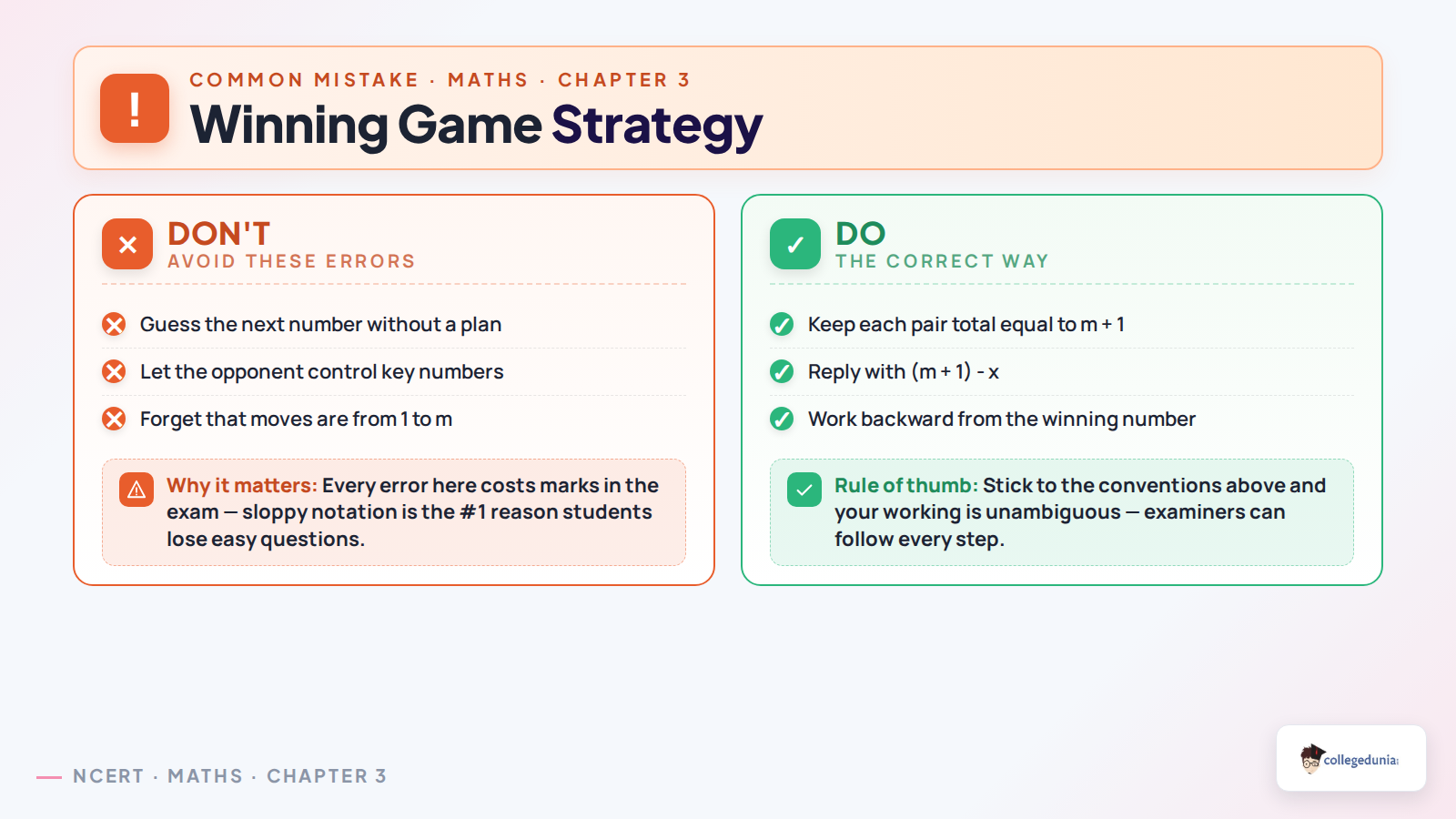
The chapter ends with games such as reaching 21 or 99. These games are not about guessing. They are about controlling key numbers. If each player may add from 1 to m, then the useful pair total is m plus 1.
- Find the maximum allowed move.
- Add 1 to get the pair total.
- Work backward from the winning number.
- If the opponent adds x, reply with the pair total minus x.
In the Game of 21, moves are 1, 2, or 3, so the pair total is 4. Key numbers are 1, 5, 9, 13, 17, and 21.
Common Mistakes in Number Play Notes
Most mistakes happen when students apply a rule too broadly. In this chapter, every rule has a setting. A rule for a row may not work in a grid, and a rule for positive whole numbers should not be applied to 0.
- Do not count diagonal neighbours in the supercell grid.
- Do not let an end child have two neighbours.
- Do not write spaced comma notation such as 18, 670.
- Do not call 0 a valid starting value for the Collatz statement used in these notes.
- Do not use a game rule before defining the allowed move range.
The safest method is to write the rule in words first. A clear sentence usually prevents the arithmetic mistake.
Related Resources for Number Play Class 6
| Resource | How it helps |
|---|---|
| Number Play Class 6 NCERT Solutions | Step-by-step answers to NCERT questions. |
| Number Play NCERT Book PDF | Official chapter text and classroom activities. |
| Number Play Handwritten Notes | Quick revision in notebook style. |
NCERT Notes for Class 6 Mathematics Ganita Prakash: All Chapters
| Chapter | NCERT Notes |
|---|---|
| Chapter 1 | Patterns in Mathematics Notes |
| Chapter 2 | Lines and Angles Notes |
| Chapter 3 | Number Play Notes |
| Chapter 4 | Data Handling and Presentation Notes |
| Chapter 5 | Prime Time Notes |
| Chapter 6 | Perimeter and Area Notes |
| Chapter 7 | Fractions Notes |
| Chapter 8 | Playing with Constructions Notes |
| Chapter 9 | Symmetry Notes |
| Chapter 10 | The Other Side of Zero Notes |
Number Play Class 6 Notes FAQs
Ques. What do Number Play Class 6 notes cover?
Ans. These notes cover taller-neighbour puzzles, supercells, number lines, digit sums, palindromes, Kaprekar steps, Collatz chains, estimation, and winning game strategies.
Ques. What is a supercell in Class 6 Number Play?
Ans. A supercell is a cell whose number is greater than every direct neighbour. In a grid, left, right, top, and bottom count as direct neighbours.
Ques. Why is the taller-neighbour rule important?
Ans. The rule teaches students to read what a number describes. It counts only immediate taller neighbours, not every taller child in the line.
Ques. How should students revise Number Play?
Ans. Students should write the rule in words, test it on one example, and then solve the matching NCERT question without looking back.
Ques. Are these notes based on the 2026-27 NCERT book?
Ans. Yes. The notes follow Class 6 Mathematics Ganita Prakash Chapter 3 for the 2026-27 session.



Comments