



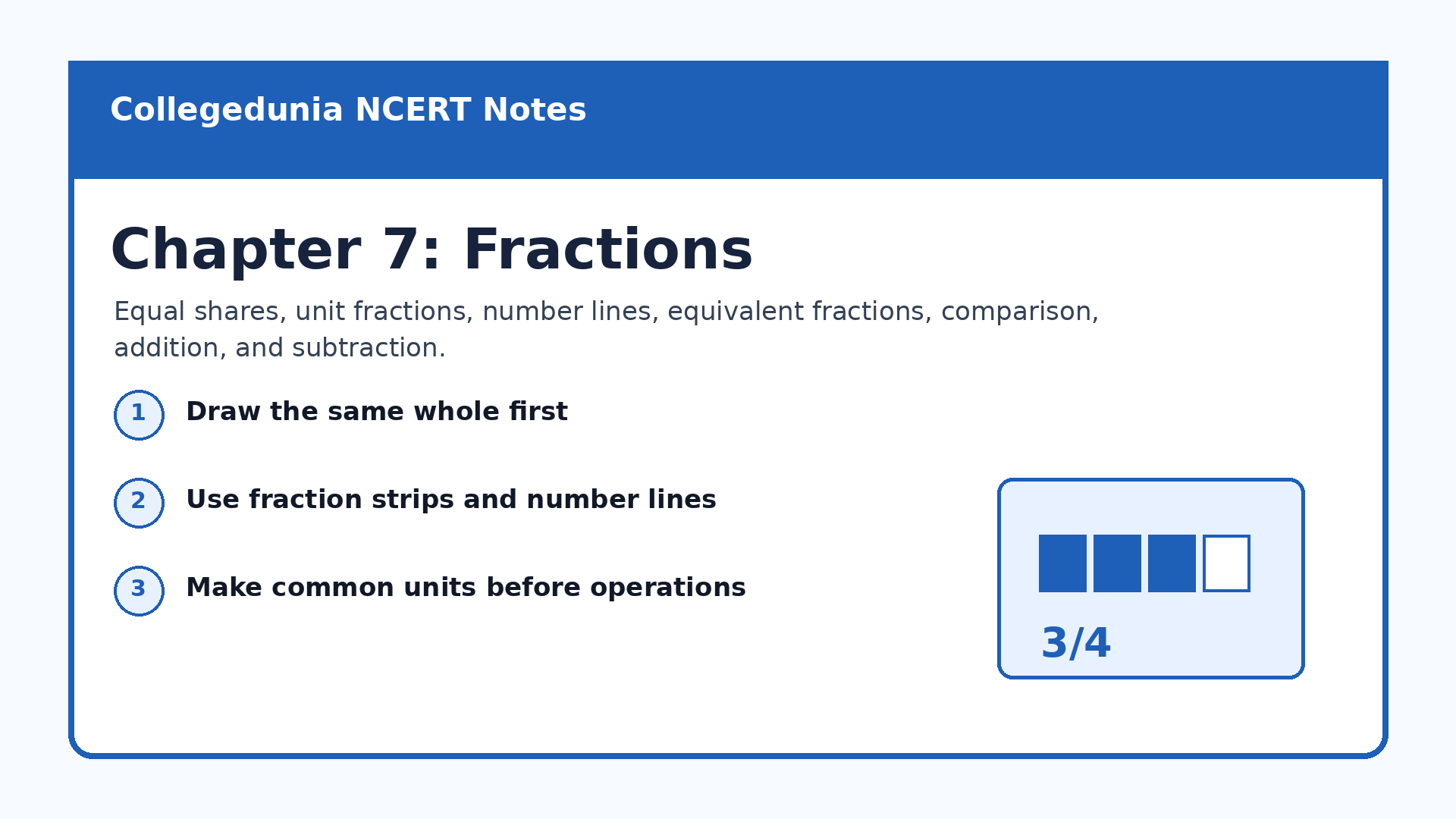
Fractions Class 6 notes help students revise equal shares, unit fractions, number lines, mixed numbers, equivalent fractions, comparison, addition, and subtraction from the 2026-27 NCERT Ganita Prakash book. The PDF keeps every rule visual, so students can draw the whole before writing the fraction.
- Core focus: equal parts, fractional units, mixed numbers, equivalent fractions, and fraction operations.
- Best use: read one model, draw two examples, then solve the matching NCERT question.
- Revision habit: check that the whole is fixed and the parts are equal.
Chapter7FractionsNotes.pdf?page=1&dpi=150)
Chapter7FractionsNotes.pdf?page=2&dpi=150)
Chapter7FractionsNotes.pdf?page=3&dpi=150)
Chapter7FractionsNotes.pdf?page=4&dpi=150)
Chapter7FractionsNotes.pdf?page=5&dpi=150)
Chapter7FractionsNotes.pdf?page=6&dpi=150)
Chapter7FractionsNotes.pdf?page=7&dpi=150)
Chapter7FractionsNotes.pdf?page=8&dpi=150)
Chapter7FractionsNotes.pdf?page=9&dpi=150)
Chapter7FractionsNotes.pdf?page=10&dpi=150)
Chapter7FractionsNotes.pdf?page=11&dpi=150)
Chapter7FractionsNotes.pdf?page=12&dpi=150)
Chapter7FractionsNotes.pdf?page=13&dpi=150)
Chapter7FractionsNotes.pdf?page=14&dpi=150)
Chapter7FractionsNotes.pdf?page=15&dpi=150)
Chapter7FractionsNotes.pdf?page=16&dpi=150)
Chapter7FractionsNotes.pdf?page=17&dpi=150)
Chapter7FractionsNotes.pdf?page=18&dpi=150)
Chapter7FractionsNotes.pdf?page=19&dpi=150)
Chapter7FractionsNotes.pdf?page=20&dpi=150)
Chapter7FractionsNotes.pdf?page=21&dpi=150)
Chapter7FractionsNotes.pdf?page=22&dpi=150)
Chapter7FractionsNotes.pdf?page=23&dpi=150)
Chapter7FractionsNotes.pdf?page=24&dpi=150)
Chapter7FractionsNotes.pdf?page=25&dpi=150)
Chapter7FractionsNotes_flat_MobileCard.pdf?page=1&dpi=150)
Chapter7FractionsNotes_flat_MobileCard.pdf?page=2&dpi=150)
Chapter7FractionsNotes_flat_MobileCard.pdf?page=3&dpi=150)
Chapter7FractionsNotes_flat_MobileCard.pdf?page=4&dpi=150)
Chapter7FractionsNotes_flat_MobileCard.pdf?page=5&dpi=150)
Chapter7FractionsNotes_flat_MobileCard.pdf?page=6&dpi=150)
Chapter7FractionsNotes_flat_MobileCard.pdf?page=7&dpi=150)
Chapter7FractionsNotes_flat_MobileCard.pdf?page=8&dpi=150)
Chapter7FractionsNotes_flat_MobileCard.pdf?page=9&dpi=150)
Chapter7FractionsNotes_flat_MobileCard.pdf?page=10&dpi=150)
Chapter7FractionsNotes_flat_MobileCard.pdf?page=11&dpi=150)
Chapter7FractionsNotes_flat_MobileCard.pdf?page=12&dpi=150)
Chapter7FractionsNotes_flat_MobileCard.pdf?page=13&dpi=150)
Chapter7FractionsNotes_flat_MobileCard.pdf?page=14&dpi=150)
Chapter7FractionsNotes_flat_MobileCard.pdf?page=15&dpi=150)
Chapter7FractionsNotes_flat_MobileCard.pdf?page=16&dpi=150)
Chapter7FractionsNotes_flat_MobileCard.pdf?page=17&dpi=150)
Chapter7FractionsNotes_flat_MobileCard.pdf?page=18&dpi=150)
Chapter7FractionsNotes_flat_MobileCard.pdf?page=19&dpi=150)
Chapter7FractionsNotes_flat_MobileCard.pdf?page=20&dpi=150)
Chapter7FractionsNotes_flat_MobileCard.pdf?page=21&dpi=150)
Chapter7FractionsNotes_flat_MobileCard.pdf?page=22&dpi=150)
Chapter7FractionsNotes_flat_MobileCard.pdf?page=23&dpi=150)
Chapter7FractionsNotes_flat_MobileCard.pdf?page=24&dpi=150)
Chapter7FractionsNotes_flat_MobileCard.pdf?page=25&dpi=150)
Chapter7FractionsNotes_flat_MobileCard.pdf?page=26&dpi=150)
Chapter7FractionsNotes_flat_MobileCard.pdf?page=27&dpi=150)
Chapter7FractionsNotes_flat_MobileCard.pdf?page=28&dpi=150)
Chapter7FractionsNotes_flat_MobileCard.pdf?page=29&dpi=150)
Chapter7FractionsNotes_flat_MobileCard.pdf?page=30&dpi=150)
Chapter7FractionsNotes_flat_MobileCard.pdf?page=31&dpi=150)
Chapter7FractionsNotes_flat_MobileCard.pdf?page=32&dpi=150)
Chapter7FractionsNotes_flat_MobileCard.pdf?page=33&dpi=150)
Chapter7FractionsNotes_flat_MobileCard.pdf?page=34&dpi=150)
Chapter7FractionsNotes_flat_MobileCard.pdf?page=35&dpi=150)
Chapter7FractionsNotes_flat_MobileCard.pdf?page=36&dpi=150)
Chapter7FractionsNotes_flat_MobileCard.pdf?page=37&dpi=150)
Chapter7FractionsNotes_flat_MobileCard.pdf?page=38&dpi=150)
Student Feedback: In a Collegedunia poll of 10,860 Class 6 students preparing with Ganita Prakash, 73% said Fractions became easier after they drew a strip or number line before comparing answers.
Source: 2026-27 Class 6 Mathematics student poll.
Fractions Ideas Every Class 6 Student Should Know
Fractions begin with equal sharing. A fraction names one or more equal parts of a whole. The denominator names the fractional unit, and the numerator counts how many such units are taken.
| Idea | Meaning | Quick example |
|---|---|---|
| Unit fraction | One equal part of the whole. | 1/4 of a chikki. |
| Numerator | Counts the selected parts. | 3 in 3/4. |
| Denominator | Names total equal parts. | 4 in 3/4. |
| Equivalent fractions | Different names for the same amount. | 1/2 = 2/4. |
Fractions Class 6 Video for Visual Revision
Source: Magnet Brains on YouTube
Equal Shares and Fractional Units
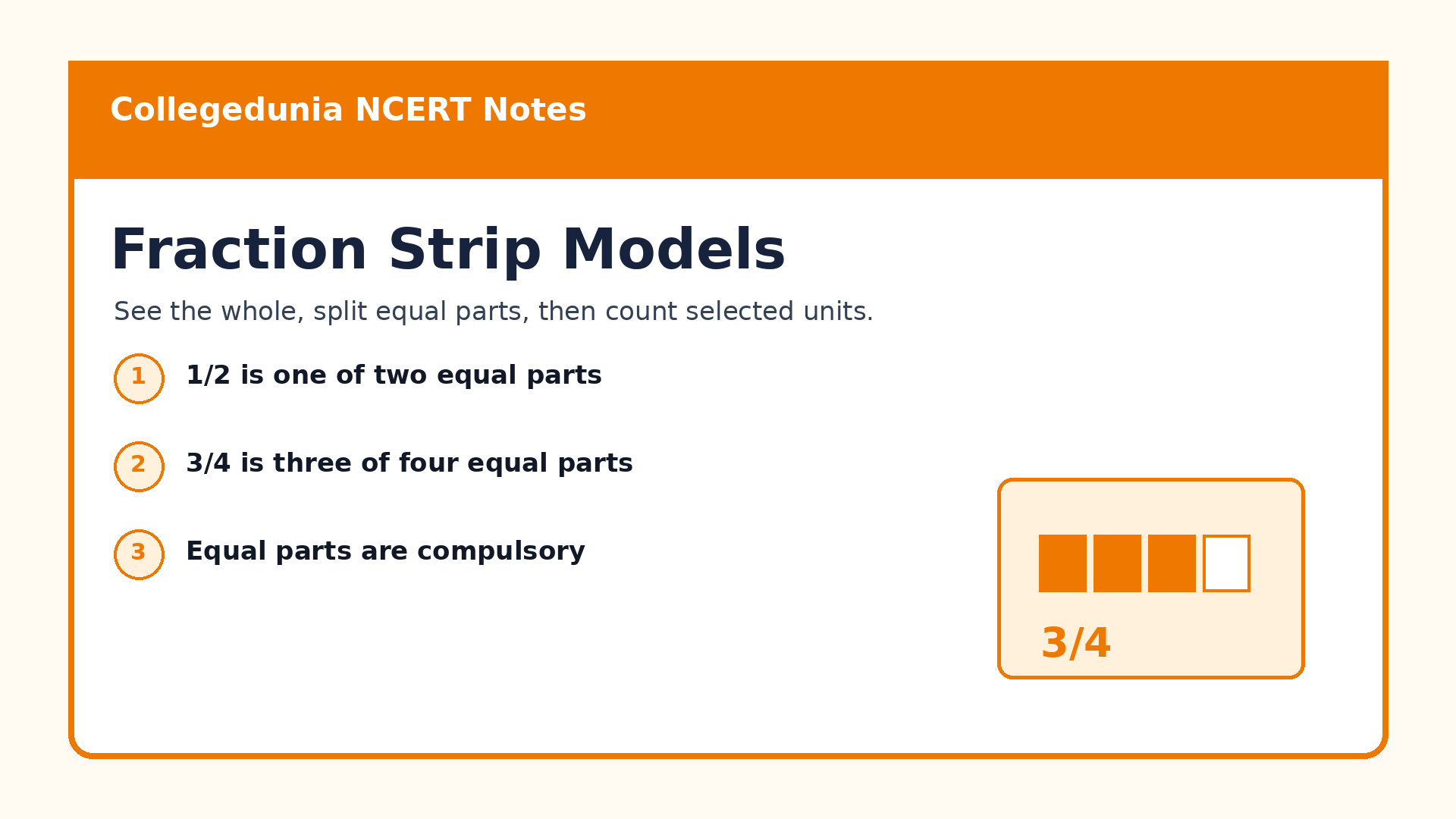
NCERT starts with sharing rotis and chikki pieces. When the same whole is shared among more people, each person's unit share becomes smaller. This is why 1/2 is greater than 1/4.
- Same whole: compare fractions only when the whole is fixed.
- Equal parts: unequal pieces cannot be named by a simple fraction.
- Unit fraction: one part out of equal parts, such as 1/5 or 1/9.
Fractions on the Number Line and Mixed Numbers
A number line shows fractions as lengths from zero. First mark 0 and 1, then split the unit interval equally. Fractions greater than one move beyond 1 and can be written as mixed numbers.
| Fraction | Meaning | Mixed form |
|---|---|---|
| 5/4 | Five fourths | 1 and 1/4 |
| 7/4 | Seven fourths | 1 and 3/4 |
| 7/3 | Seven thirds | 2 and 1/3 |
Equivalent Fractions and Comparing Fractions
Equivalent fractions represent the same quantity. Students can multiply the numerator and denominator by the same number to make an equivalent fraction. This helps in comparison because both fractions can be changed to a common denominator.
- 1/2, 2/4, and 3/6 show the same amount.
- 2/3 and 3/4 can be compared as 8/12 and 9/12.
- When denominators are the same, compare numerators.
- When numerators are the same, the smaller denominator gives the larger fraction.
Addition and Subtraction of Fractions
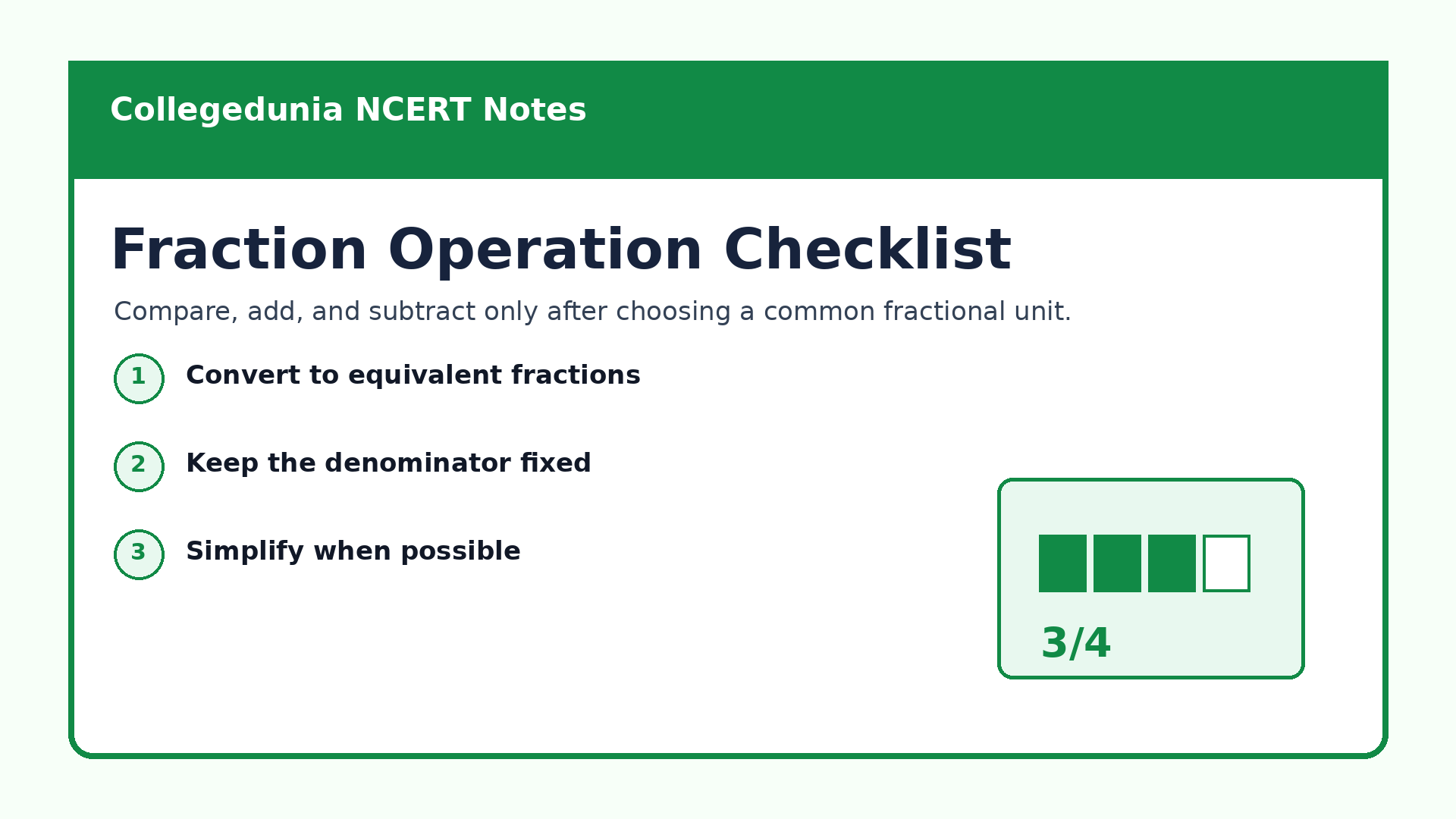
Fractions can be added or subtracted directly only when they use the same fractional unit. If denominators differ, rewrite them as equivalent fractions with a common denominator first.
| Operation | Common unit step | Answer |
|---|---|---|
| 1/2 + 1/4 | 2/4 + 1/4 | 3/4 |
| 2/3 + 1/6 | 4/6 + 1/6 | 5/6 |
| 5/6 - 1/3 | 5/6 - 2/6 | 3/6 or 1/2 |
Common Mistakes in Fractions Notes
Most mistakes happen because students change the whole, use unequal parts, or add denominators. The PDF explains each step with strips and number lines so the unit stays visible.
- Do not compare fractions drawn on different-sized wholes.
- Do not say 1/9 is greater than 1/5 just because 9 is larger than 5.
- Do not add denominators when adding fractions with the same denominator.
- Do not mark fractions on a number line with unequal spacing.
Related Resources for Fractions Class 6
| Resource | How it helps |
|---|---|
| Fractions Class 6 NCERT Solutions | Step-by-step answers to NCERT questions. |
| Fractions NCERT Book PDF | Official chapter text and classroom activities. |
| Fractions Handwritten Notes | Notebook-style visual recap for quick revision. |
NCERT Notes for Class 6 Mathematics Ganita Prakash: All Chapters
| Chapter | NCERT Notes |
|---|---|
| Chapter 1 | Patterns in Mathematics Notes |
| Chapter 2 | Lines and Angles Notes |
| Chapter 3 | Number Play Notes |
| Chapter 4 | Data Handling and Presentation Notes |
| Chapter 5 | Prime Time Notes |
| Chapter 6 | Perimeter and Area Notes |
| Chapter 7 | Fractions Notes |
| Chapter 8 | Playing with Constructions Notes |
| Chapter 9 | Symmetry Notes |
| Chapter 10 | The Other Side of Zero Notes |
Fractions Class 6 Notes FAQs
Ques. What do Fractions Class 6 notes cover?
Ans. These notes cover equal shares, fractional units, number lines, mixed numbers, equivalent fractions, comparison, addition, and subtraction from Ganita Prakash Chapter 7.
Ques. What is a unit fraction?
Ans. A unit fraction has numerator 1. It names one equal part of a whole, such as 1/2, 1/4, or 1/9.
Ques. How do students compare fractions?
Ans. Students should use the same whole, draw a number line or strip, and convert to equivalent fractions when denominators are different.
Ques. How are unlike fractions added?
Ans. Unlike fractions are first changed to equivalent fractions with a common denominator. Then the numerators are added.
Ques. Are these notes based on the 2026-27 NCERT book?
Ans. Yes. The notes follow Class 6 Mathematics Ganita Prakash Chapter 7 Fractions for the 2026-27 session.



Comments