



Symmetry Class 6 notes help students revise line symmetry, paper folding tests, mirror images, grids, reflection, and rotational symmetry from the 2026-27 NCERT Ganita Prakash book. The PDF explains how to test a figure by exact overlap instead of guessing from appearance.
- Core focus: line symmetry, reflection, equal distances, grids, and turns.
- Best use: draw the possible line, fold mentally, then check both halves.
- Revision habit: write the reason, not only the number of symmetry lines.
Chapter9SymmetryNotes.pdf?page=1&dpi=150)
Chapter9SymmetryNotes.pdf?page=2&dpi=150)
Chapter9SymmetryNotes.pdf?page=3&dpi=150)
Chapter9SymmetryNotes.pdf?page=4&dpi=150)
Chapter9SymmetryNotes.pdf?page=5&dpi=150)
Chapter9SymmetryNotes.pdf?page=6&dpi=150)
Chapter9SymmetryNotes.pdf?page=7&dpi=150)
Chapter9SymmetryNotes.pdf?page=8&dpi=150)
Chapter9SymmetryNotes.pdf?page=9&dpi=150)
Chapter9SymmetryNotes.pdf?page=10&dpi=150)
Chapter9SymmetryNotes.pdf?page=11&dpi=150)
Chapter9SymmetryNotes.pdf?page=12&dpi=150)
Chapter9SymmetryNotes.pdf?page=13&dpi=150)
Chapter9SymmetryNotes.pdf?page=14&dpi=150)
Chapter9SymmetryNotes.pdf?page=15&dpi=150)
Chapter9SymmetryNotes.pdf?page=16&dpi=150)
Chapter9SymmetryNotes.pdf?page=17&dpi=150)
Chapter9SymmetryNotes.pdf?page=18&dpi=150)
Chapter9SymmetryNotes.pdf?page=19&dpi=150)
Chapter9SymmetryNotes.pdf?page=20&dpi=150)
Chapter9SymmetryNotes_flat_MobileCard.pdf?page=1&dpi=150)
Chapter9SymmetryNotes_flat_MobileCard.pdf?page=2&dpi=150)
Chapter9SymmetryNotes_flat_MobileCard.pdf?page=3&dpi=150)
Chapter9SymmetryNotes_flat_MobileCard.pdf?page=4&dpi=150)
Chapter9SymmetryNotes_flat_MobileCard.pdf?page=5&dpi=150)
Chapter9SymmetryNotes_flat_MobileCard.pdf?page=6&dpi=150)
Chapter9SymmetryNotes_flat_MobileCard.pdf?page=7&dpi=150)
Chapter9SymmetryNotes_flat_MobileCard.pdf?page=8&dpi=150)
Chapter9SymmetryNotes_flat_MobileCard.pdf?page=9&dpi=150)
Chapter9SymmetryNotes_flat_MobileCard.pdf?page=10&dpi=150)
Chapter9SymmetryNotes_flat_MobileCard.pdf?page=11&dpi=150)
Chapter9SymmetryNotes_flat_MobileCard.pdf?page=12&dpi=150)
Chapter9SymmetryNotes_flat_MobileCard.pdf?page=13&dpi=150)
Chapter9SymmetryNotes_flat_MobileCard.pdf?page=14&dpi=150)
Chapter9SymmetryNotes_flat_MobileCard.pdf?page=15&dpi=150)
Chapter9SymmetryNotes_flat_MobileCard.pdf?page=16&dpi=150)
Chapter9SymmetryNotes_flat_MobileCard.pdf?page=17&dpi=150)
Chapter9SymmetryNotes_flat_MobileCard.pdf?page=18&dpi=150)
Chapter9SymmetryNotes_flat_MobileCard.pdf?page=19&dpi=150)
Chapter9SymmetryNotes_flat_MobileCard.pdf?page=20&dpi=150)
Chapter9SymmetryNotes_flat_MobileCard.pdf?page=21&dpi=150)
Chapter9SymmetryNotes_flat_MobileCard.pdf?page=22&dpi=150)
Chapter9SymmetryNotes_flat_MobileCard.pdf?page=23&dpi=150)
Chapter9SymmetryNotes_flat_MobileCard.pdf?page=24&dpi=150)
Chapter9SymmetryNotes_flat_MobileCard.pdf?page=25&dpi=150)
Chapter9SymmetryNotes_flat_MobileCard.pdf?page=26&dpi=150)
Chapter9SymmetryNotes_flat_MobileCard.pdf?page=27&dpi=150)
Chapter9SymmetryNotes_flat_MobileCard.pdf?page=28&dpi=150)
Chapter9SymmetryNotes_flat_MobileCard.pdf?page=29&dpi=150)
Student Feedback: In a Collegedunia poll of 8,760 Class 6 students using Ganita Prakash, 72% said symmetry questions became easier after they used folding and grid counting together.
Source: 2026-27 Class 6 Mathematics student poll.
In This Article
Symmetry Ideas Every Class 6 Student Should Know
Symmetry means a figure has matching parts by a clear rule. In Class 6, the most common rule is a line of symmetry. If folding on a line makes both halves cover exactly, that line is a symmetry line.
| Idea | Meaning | Quick check |
|---|---|---|
| Line symmetry | Two halves match across a line. | Use a folding test. |
| Reflection | A mirror image forms across a line. | Compare equal distances. |
| Grid symmetry | Matching points sit on equal grid spaces. | Count squares from the line. |
| Rotational symmetry | A turn makes the figure match itself. | Turn around the centre. |
Symmetry Class 6 Video for Folding and Mirror Checks
Source: Magnet Brains on YouTube
Line Symmetry and Folding Tests in Chapter 9
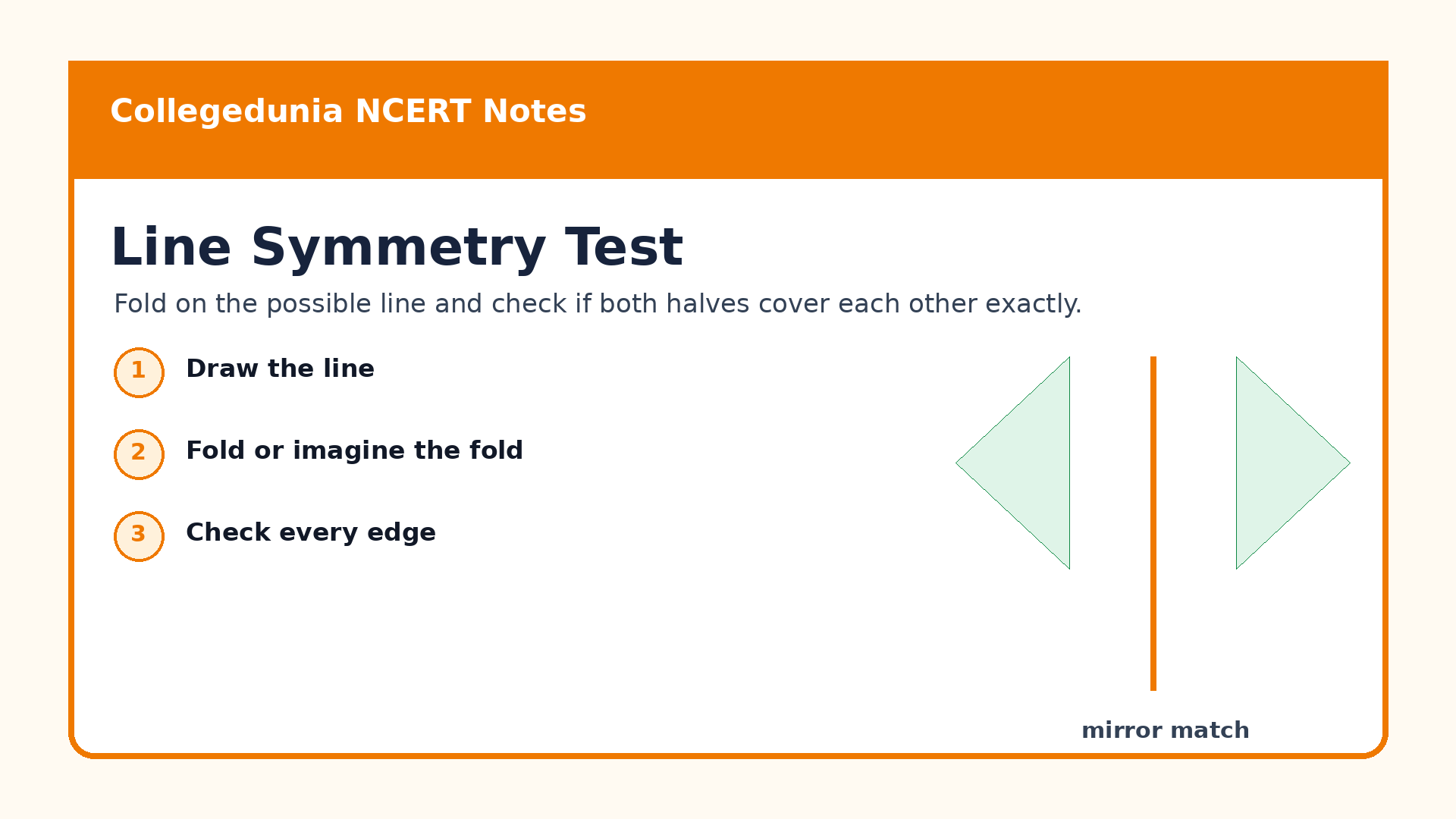
The folding test is the safest way to answer line symmetry questions. Students should draw the possible line, imagine the fold, and check whether every edge, corner, and curve matches on the other side.
- One line: the figure folds exactly in one way.
- More than one line: several distinct folds work.
- No line: every possible fold fails at least one part.
A close match is not symmetry. Exact overlap is required.
Reflection, Grids and Completing the Other Half
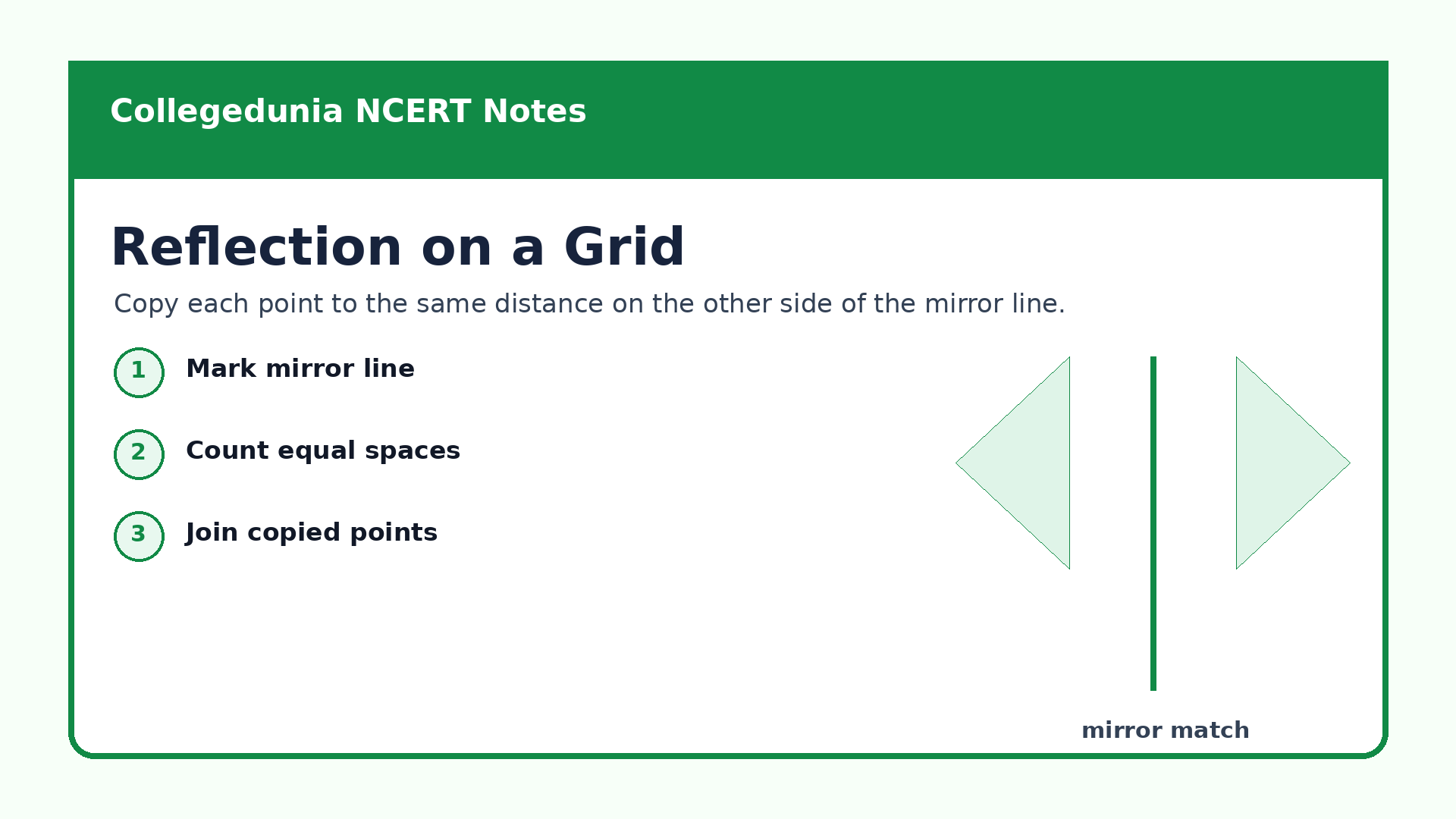
Reflection questions ask students to copy points across a line. The copied point must be the same distance from the line as the original point. Grid paper makes this simple because students can count equal squares.
- Mark the mirror line clearly.
- Count the distance of each point from the line.
- Place the matching point on the other side.
- Join the new points in the same order.
Common Mistakes in Symmetry Notes
Most wrong answers in this chapter come from guessing. Students may draw a line through the centre and assume it works. The NCERT method asks for a test, so every answer needs a short reason.
- Do not count a diagonal unless both halves overlap exactly.
- Do not ignore small unequal corners or curves.
- Do not use a different font when checking alphabet symmetry.
- Do not confuse line symmetry with rotational symmetry.
Related Resources for Symmetry Class 6
| Resource | How it helps |
|---|---|
| Symmetry Class 6 NCERT Solutions | Step-by-step answers to NCERT symmetry questions. |
| Symmetry NCERT Book PDF | Official chapter text, activities, and diagrams. |
| Symmetry Handwritten Notes | Topper-style revision for folding and reflection checks. |
NCERT Notes for Class 6 Mathematics Ganita Prakash: All Chapters
| Chapter | NCERT Notes |
|---|---|
| Chapter 1 | Patterns in Mathematics Notes |
| Chapter 2 | Lines and Angles Notes |
| Chapter 3 | Number Play Notes |
| Chapter 4 | Data Handling and Presentation Notes |
| Chapter 5 | Prime Time Notes |
| Chapter 6 | Perimeter and Area Notes |
| Chapter 7 | Fractions Notes |
| Chapter 8 | Playing with Constructions Notes |
| Chapter 9 | Symmetry Notes |
| Chapter 10 | The Other Side of Zero Notes |
Symmetry Class 6 Notes FAQs
Ques. What do Symmetry Class 6 notes cover?
Ans. These notes cover line symmetry, folding tests, mirror images, grids, reflection, and rotational symmetry from Ganita Prakash Chapter 9.
Ques. What is a line of symmetry?
Ans. A line of symmetry divides a figure into two matching halves that cover each other exactly on folding.
Ques. How can students check symmetry on a grid?
Ans. Students can count equal squares from the mirror line to matching points on both sides.
Ques. Is rotational symmetry the same as line symmetry?
Ans. No. Line symmetry uses a fold or mirror line, while rotational symmetry uses a turn around a centre.
Ques. Are these notes based on the 2026-27 NCERT book?
Ans. Yes. The notes follow Class 6 Mathematics Ganita Prakash Chapter 9 Symmetry for the 2026-27 session.



Comments