




NCERT Class 11 Fine Arts Chapter 7 Indian Bronze Sculpture PDF gives students the official NCERT chapter from An Introduction to Indian Art Part I for the 2026-27 syllabus. The chapter covers lost-wax casting, Jain bronzes, Gupta and Pala images, Chola Nataraja and Vijayanagar portrait bronzes.
- Download the complete 6-page official NCERT chapter PDF for Class 11 Fine Arts.
- Revise the bronze timeline from Dancing Girl to Chola and Vijayanagar icons.
- Use the casting process chart and quick tables for board and CUET revision.




This NCERT Book PDF is the official Class 11 Fine Arts Chapter 7 source for 2026-27, with bronze examples and casting terms kept in the NCERT order.
Student Feedback: In a Collegedunia check of more than 10,000 Class 11 Fine Arts students, most students understood this chapter faster after separating process, region and icon examples instead of memorising every bronze name at once.
Indian Bronze Sculpture NCERT Book PDF: What This Chapter Covers
The chapter begins with the bronze medium and the cire-perdu or lost-wax process. It explains how copper, zinc and tin form bronze, and how Indian artists used the alloy for icons, ritual images and daily-use objects. Indian Bronze Sculpture is mainly a timeline of metal casting and sacred image-making in India.
Students should first learn the major examples. Dancing Girl, Daimabad Chariot, Chausa tirthankaras, Akota bronzes, Sultanganj Buddha, Pala bronzes and Chola Nataraja are the safest names to revise before attempting the exercise questions.
Indian Bronze Sculpture Explained for Class 11
Source: Examrace (UPSC, NET, NCERT, ICSE ...) on YouTube
Lost-Wax Casting Process in Indian Bronze Sculpture

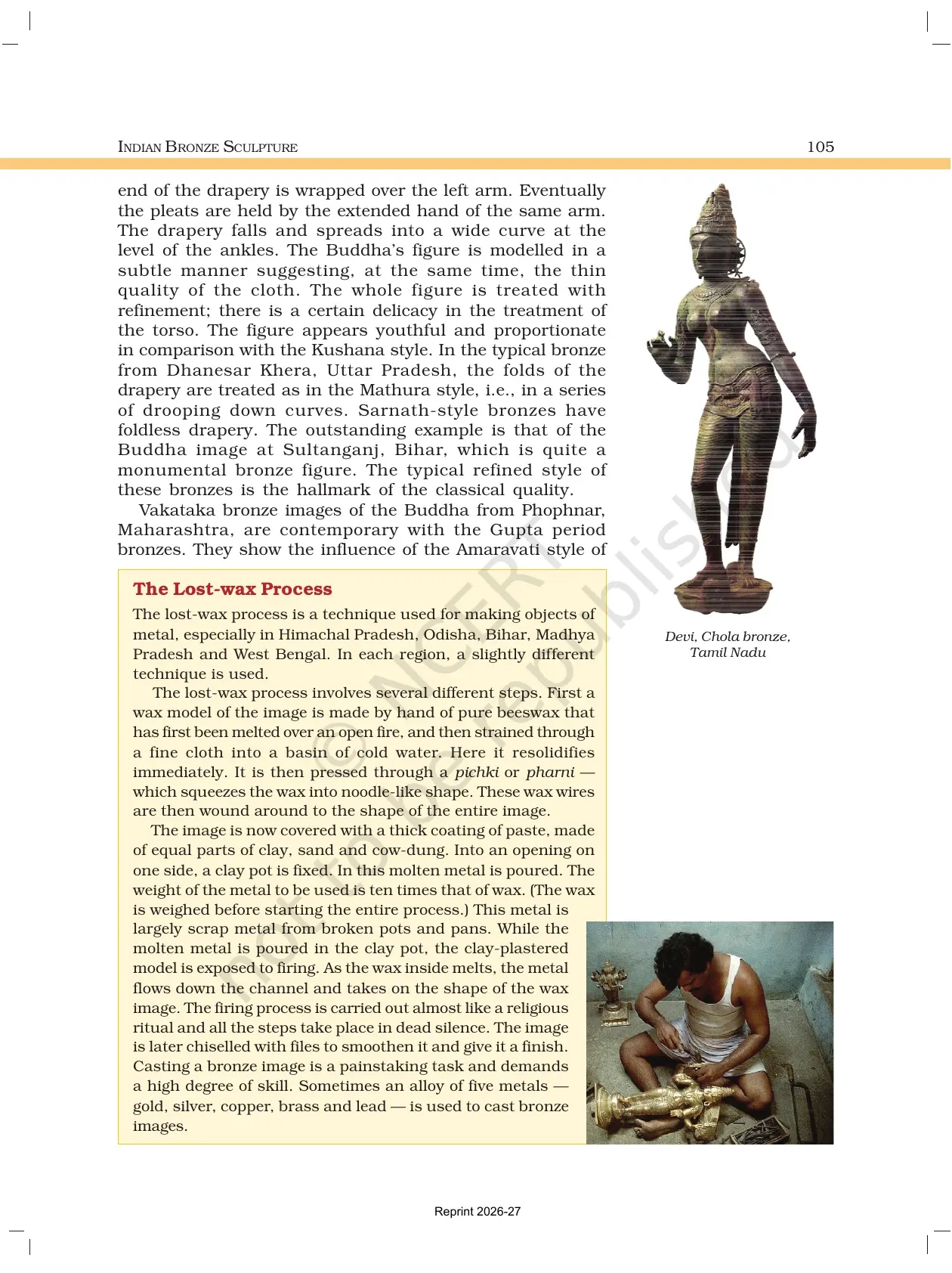
The lost-wax process is the key technical idea in this chapter. NCERT describes it as a hand process where the artist prepares a wax model, covers it with clay, heats it and pours molten metal into the empty space left by the wax.
| Stage | What happens | Exam cue |
|---|---|---|
| Wax model | Pure beeswax is shaped by hand and built into the image form. | Write this as the first visible design stage. |
| Clay coating | The wax image is covered with clay, sand and cow-dung paste. | Remember that the mould is made around the wax. |
| Heating and pouring | Wax melts out, while molten bronze flows into the hollow channel. | Use this to explain why each bronze is unique. |
| Finishing | The cooled figure is chiselled, filed and polished after the mould breaks. | Connect skill, patience and ritual silence with the process. |
Indian Bronze Sculpture Timeline for Class 11 Fine Arts

The chapter moves from prehistoric and early historic finds to medieval icons. A timeline helps students avoid mixing regions and periods. Start with Indus Valley and Daimabad, then move to Kushana, Gupta, Pala and Chola examples.
- Dancing Girl: Mohenjodaro bronze dated to about 2500 BCE.
- Daimabad Chariot: bronze group from Maharashtra dated to about 1500 BCE.
- Chausa and Akota: Jain bronze traditions from Bihar and Gujarat.
- Chola Nataraja: the most refined bronze icon type in the chapter.
Jain, Buddhist and Hindu Bronzes in the NCERT Chapter
NCERT shows that bronze sculpture was not limited to one religion or region. Jain tirthankara images appear in Chausa, Akota, Hansi and western India. Buddhist images appear in North India, Nalanda, Kurkihar, Kashmir and Himachal Pradesh. Hindu bronze traditions grow strongly in South India.
The Akota hoard is important because it proves that bronze casting was active in western India between the sixth and ninth centuries. Students should connect Akota with Jain tirthankaras, silver and copper inlay, and yakshini images like Chakreshvari and Ambika.
| Bronze group | Region or site | What to remember |
|---|---|---|
| Jain tirthankaras | Chausa, Akota, Hansi, Gujarat and Rajasthan | Seated or standing icons, often with refined metal details. |
| Buddha and Avalokitesvara | Uttar Pradesh, Bihar, Nalanda, Kurkihar and Phophnar | Abhaya mudra, robe style and portable worship images. |
| Vishnu and Durga forms | Himachal Pradesh and Kashmir | Vaikuntha Vishnu, Narasimha and Mahishasuramardini icons. |
| Shiva and Parvati forms | Tamil Nadu and South India | Nataraja, ardhaparyanka Shiva, kalyanasundara and ardhanarisvara. |
Chola Nataraja and South Indian Bronze Sculpture
South India gives the chapter its most famous section. Chola artists shaped bronze icons for temples, processions and ritual worship. Nataraja is the central example, because the figure joins movement, symbolism and refined metal casting in one image.
For exam answers, students should describe Shiva standing on the apasmara figure, raising one leg and holding the damaru and flame. The circle of flames, flying hair locks and abhaya hasta make the image easy to identify. Do not write only "dancing Shiva"; mention the details that NCERT names.
How to Use the Indian Bronze Sculpture PDF for Exam Preparation
Begin with the four NCERT exercise questions at the end of the PDF. They ask students to explain continuity in bronze casting, compare stone and metal sculpture, explain Chola refinement and search for non-Chola Buddha bronzes.
- Make one page for the lost-wax process with four clear stages.
- Prepare one timeline from Dancing Girl to Vijayanagar portrait statues.
- Compare stone and bronze through technique, style and function.
- Write a separate Chola Nataraja answer with mudra, posture and symbolism.
Fine Arts Chapter 7 Resources
| Resource | Use it for | Link |
|---|---|---|
| NCERT Book PDF | Official source chapter for 2026-27 | Open book PDF page |
| NCERT Notes | Quick topic-wise revision | Open notes page |
| Handwritten Notes | Fast recall before tests | Open handwritten notes page |
NCERT Book PDF for Class 11 Fine Arts: All Chapters
| Chapter | NCERT Book PDF |
|---|---|
| Chapter 1 Prehistoric Rock Paintings | Open Chapter 1 PDF |
| Chapter 2 Arts of the Indus Valley | Open Chapter 2 PDF |
| Chapter 3 Arts of the Mauryan Period | Open Chapter 3 PDF |
| Chapter 4 Post-Mauryan Trends in Indian Art and Architecture | Open Chapter 4 PDF |
| Chapter 5 Later Mural Traditions | Open Chapter 5 PDF |
| Chapter 6 Temple Architecture and Sculpture | Open Chapter 6 PDF |
| Chapter 7 Indian Bronze Sculpture | Open Chapter 7 PDF |
| Chapter 8 Some Aspects of Indo-Islamic Architecture | Open Chapter 8 PDF |
NCERT Class 11 Fine Arts Indian Bronze Sculpture PDF FAQs
Ques. Is the Indian Bronze Sculpture PDF the official NCERT chapter?
Ans. Yes. The PDF used here is the official NCERT Class 11 Fine Arts Chapter 7 chapter from An Introduction to Indian Art Part I for the 2026-27 syllabus.
Ques. How many pages are in Class 11 Fine Arts Chapter 7 Indian Bronze Sculpture?
Ans. The chapter PDF has 6 pages. It covers lost-wax casting, early bronze finds, Jain and Buddhist bronzes, Chola icons and Vijayanagar portrait sculpture.
Ques. What is the lost-wax process in Indian Bronze Sculpture?
Ans. The lost-wax process makes a wax model, covers it with clay, melts the wax out and pours bronze into the hollow mould. The finished icon is then cleaned and polished.
Ques. Why are Chola bronzes important in this chapter?
Ans. Chola bronzes are important because they show refined casting, graceful posture and rich iconography. Nataraja is the most famous example discussed by NCERT.



Comments