NCERT Solutions for Class 11 Business Studies Chapter 7 Formation of a Company cover all short and long answer questions from the latest 2026-27 NCERT book. The chapter explains how promoters turn a business idea into a legal company through promotion, incorporation and capital subscription.
PDF coverage: 12 textbook questions with detailed answers and expert explanations.
Best for: revising promoters, MOA, AOA, prospectus and capital subscription steps.
Use this with: the official NCERT book and the all-chapters solutions table below.
Student Feedback: In a Collegedunia poll of 10,940 Class 11 Business Studies students preparing for the 2026-27 school exams, 72% said Chapter 7 became easier after they revised promotion, incorporation and capital subscription as one flow.
Source: 2026-27 Class 11 Business Studies student poll across CBSE schools.
Every answer in this chapter set is checked against the 2026-27 NCERT Business Studies textbook and written so students can revise the definition, legal document and stage together.
Formation of a Company Stages for Class 11 Business Studies
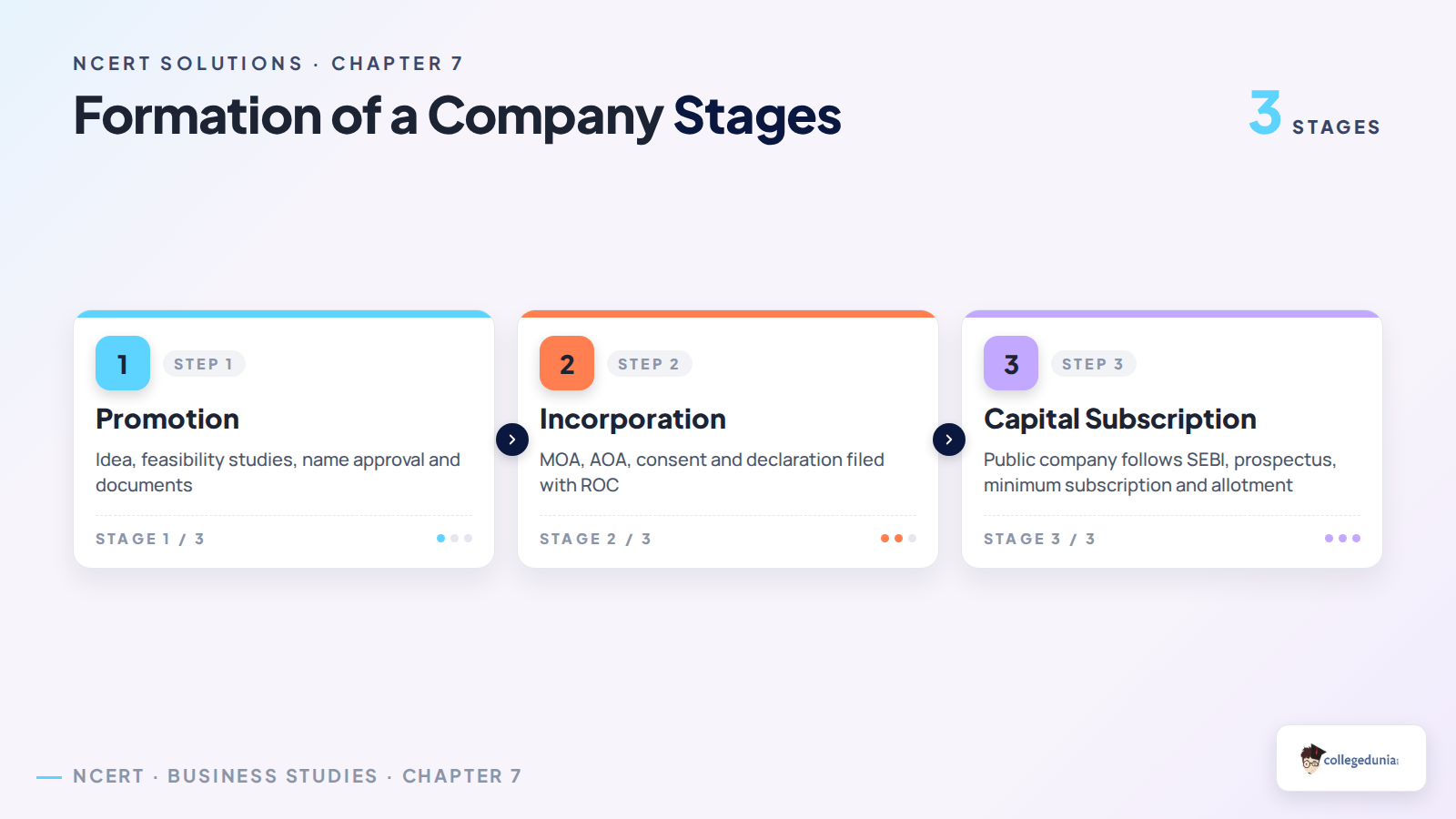
The Formation of a Company chapter is built around three clear stages. Promotion tests the idea. Incorporation gives legal birth. Capital subscription helps a public company raise funds from the public.
Stage
What happens
Key exam words
Promotion
Promoters identify the idea, check feasibility and prepare documents.
Promoter, feasibility, name approval
Incorporation
Documents are filed with the Registrar of Companies.
MOA, AOA, statutory declaration
Capital subscription
A public company raises capital and allots shares.
Promoters and Their Role in Formation of a Company
Promoters are the people who discover a business opportunity and take steps to form the company. NCERT expects students to write both the meaning and the work done by promoters. The safest answer order is opportunity, feasibility, name approval, signatories, professionals and documents.
Opportunity: promoters find a product, service or business idea with investment potential.
Feasibility: they check technical, financial and economic feasibility before moving ahead.
Name approval: they apply to the Registrar with suitable company names.
Documents: they prepare MOA, AOA, directors' consent and statutory declaration.
MOA and AOA Difference in Formation of a Company
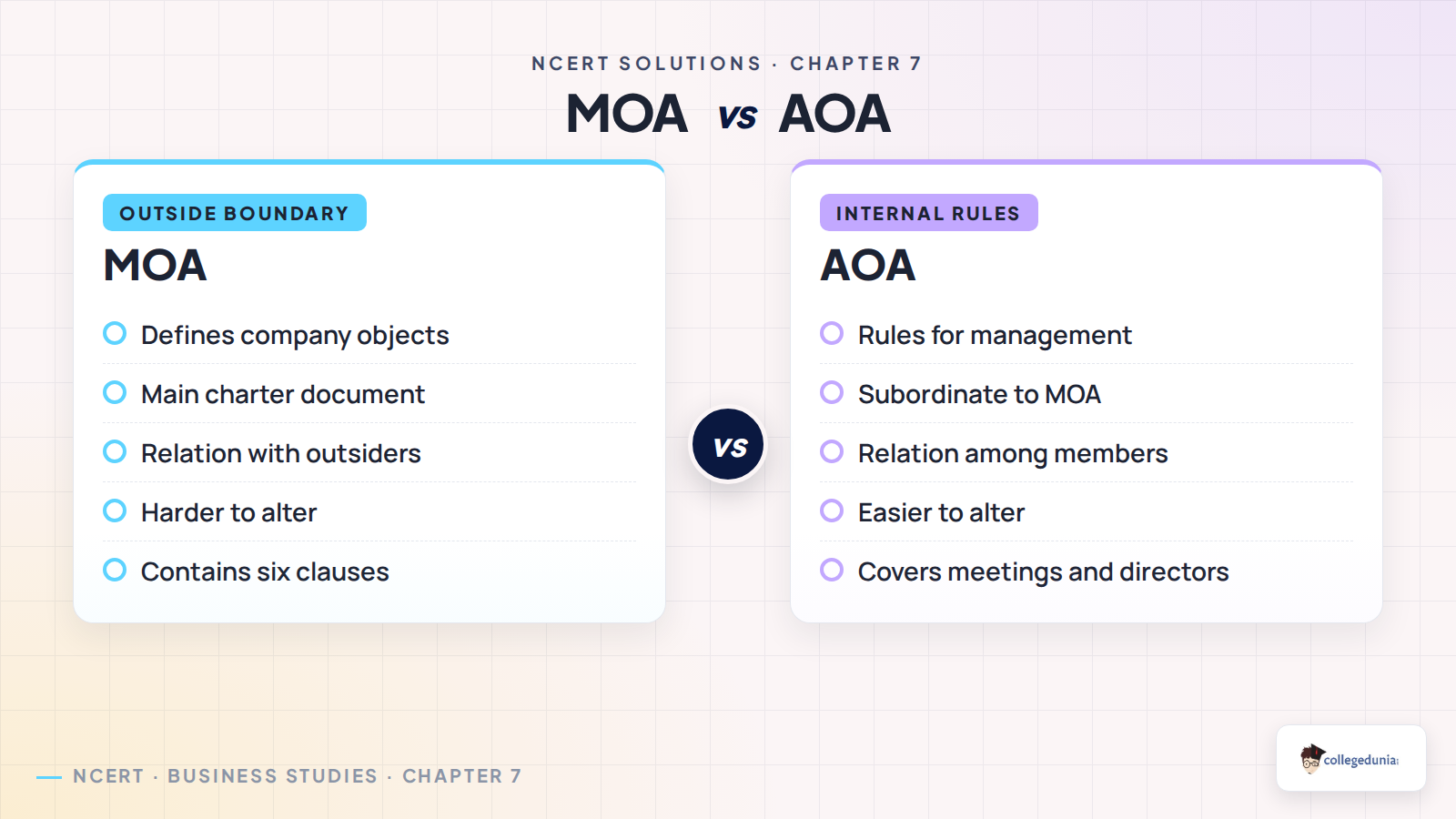
The Memorandum of Association and Articles of Association are both important, but they do different work. The MOA defines the company's outside boundary. The AOA gives internal management rules. If an AOA rule conflicts with the MOA, the MOA has the higher position.
Point
Memorandum of Association
Articles of Association
Meaning
Defines objectives and powers
Defines internal management rules
Position
Main charter document
Subordinate to the MOA
Relation
Company and outsiders
Members, directors and officers
Contents
Name, office, objects, liability, capital and association clauses
Calls, transfer, meetings, voting, directors and dividends
Capital Subscription Steps for a Public Company
Capital subscription applies mainly when a public company raises funds from the public. A private company does not need these public issue steps because it cannot invite the public to subscribe for shares.
SEBI approval: the public issue must follow investor-protection rules.
Prospectus filing: the company files the invitation document with the Registrar.
Issue support: brokers, bankers and underwriters help run the share issue.
Minimum subscription: the company checks whether enough applications have been received.
Allotment: successful applicants get shares, and return of allotment is filed.
How to Write Formation of a Company Answers in Exams
Most Chapter 7 questions are theory-based, so headings matter more than long paragraphs. Write the direct NCERT term first, then add two or three clear points. For long answers, use a stage-wise format instead of one running paragraph.
Stage questions: write promotion, incorporation and capital subscription in the same order.
Document questions: name MOA and AOA before smaller filing papers.
Promoter questions: include legal position, no agency and fiduciary duty.
Public issue questions: connect SEBI, prospectus, minimum subscription and allotment.
Related Business Studies Resources for Formation of a Company
Use the solutions PDF for solved answers. The handwritten notes page helps with quick last-minute recall for the same chapter.
All NCERT Solutions for Class 11 Business Studies Chapter 7 Formation of a Company with Step-by-Step Solutions
Short Answer Questions
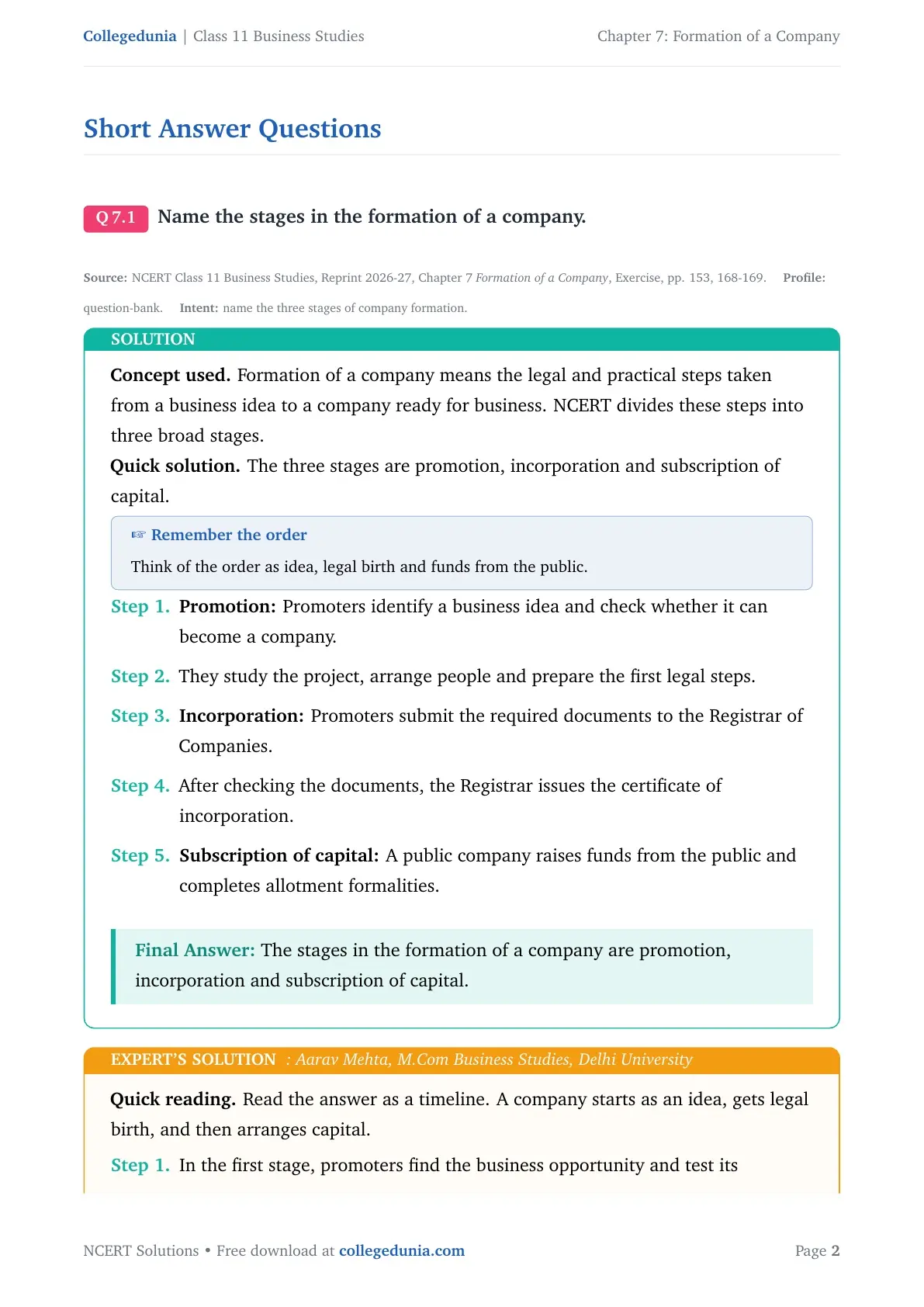
Q 7.1
Name the stages in the formation of a company.
Concept used. Formation of a company means the legal and practical steps taken from a business idea to a company ready for business. NCERT divides these steps into three broad stages.
The three stages are promotion, incorporation and subscription of capital.
Remember the order
Think of the order as idea, legal birth and funds from the public.
Promotion: Promoters identify a business idea and check whether it can become a company.
They study the project, arrange people and prepare the first legal steps.
Incorporation: Promoters submit the required documents to the Registrar of Companies.
After checking the documents, the Registrar issues the certificate of incorporation.
Subscription of capital: A public company raises funds from the public and completes allotment formalities.
The stages in the formation of a company are promotion, incorporation and subscription of capital.
AM
Aarav Mehta
M.Com Business Studies, Delhi University
Verified Expert
Quick reading. Read the answer as a timeline. A company starts as an idea, gets legal birth, and then arranges capital.
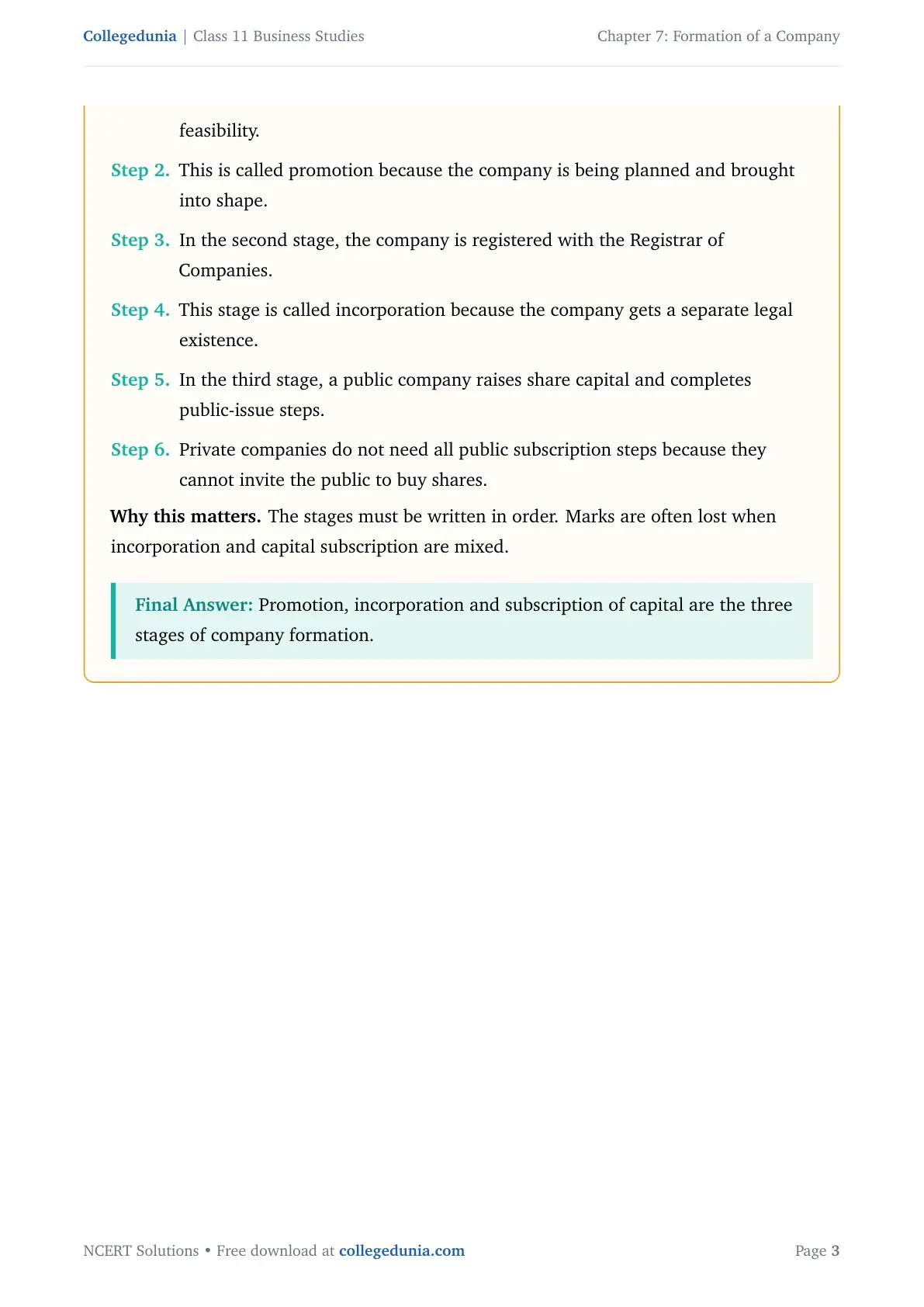
In the first stage, promoters find the business opportunity and test its feasibility.
This is called promotion because the company is being planned and brought into shape.
In the second stage, the company is registered with the Registrar of Companies.
This stage is called incorporation because the company gets a separate legal existence.
In the third stage, a public company raises share capital and completes public-issue steps.
Private companies do not need all public subscription steps because they cannot invite the public to buy shares.
Why this matters. The stages must be written in order. Marks are often lost when incorporation and capital subscription are mixed.
Promotion, incorporation and subscription of capital are the three stages of company formation.
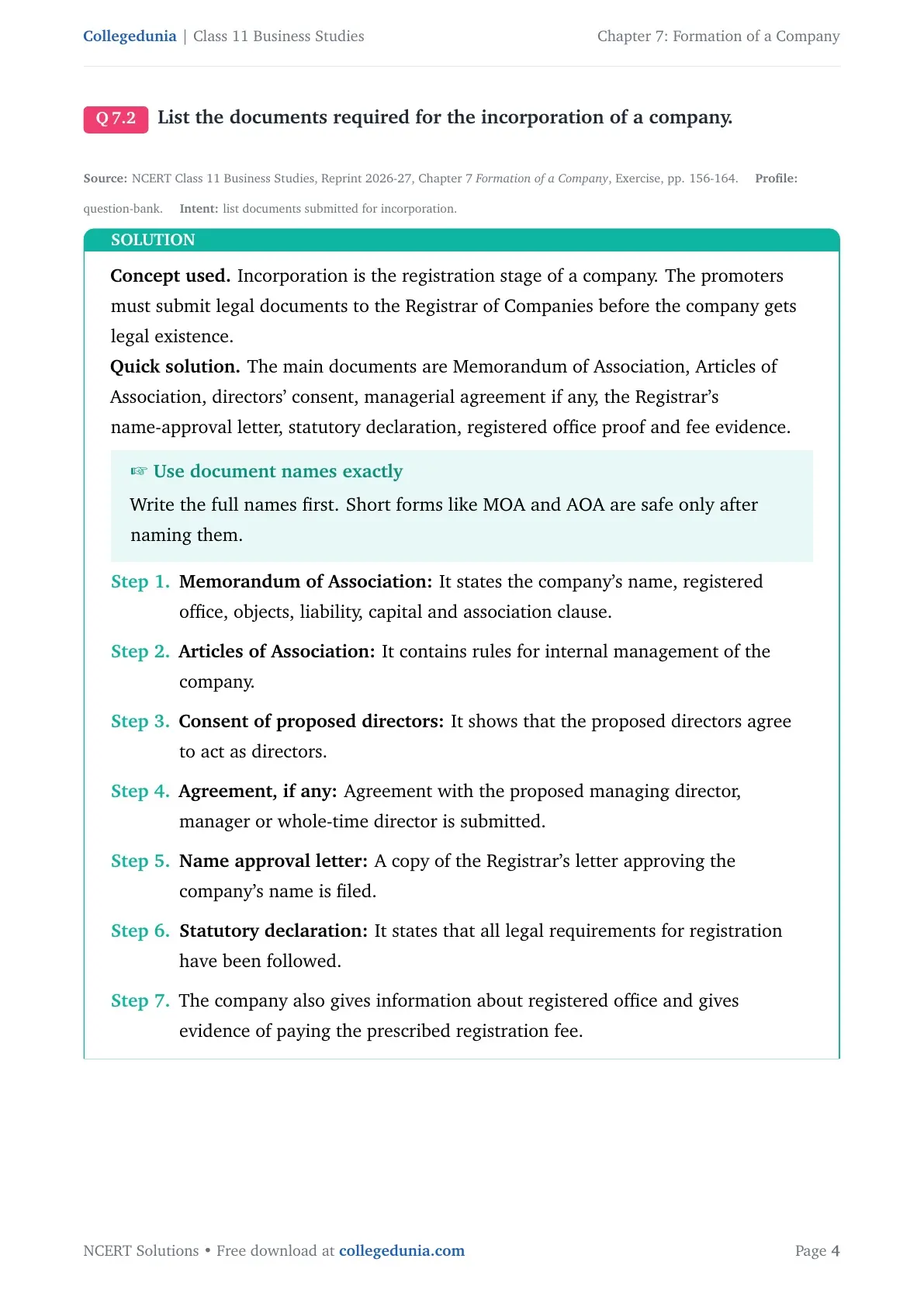
Q 7.2
List the documents required for the incorporation of a company.
Concept used. Incorporation is the registration stage of a company. The promoters must submit legal documents to the Registrar of Companies before the company gets legal existence.
The main documents are Memorandum of Association, Articles of Association, directors' consent, managerial agreement if any, the Registrar's name-approval letter, statutory declaration, registered office proof and fee evidence.
Use document names exactly
Write the full names first. Short forms like MOA and AOA are safe only after naming them.
Memorandum of Association: It states the company's name, registered office, objects, liability, capital and association clause.
Articles of Association: It contains rules for internal management of the company.
Consent of proposed directors: It shows that the proposed directors agree to act as directors.
Agreement, if any: Agreement with the proposed managing director, manager or whole-time director is submitted.
Name approval letter: A copy of the Registrar's letter approving the company's name is filed.
Statutory declaration: It states that all legal requirements for registration have been followed.
The company also gives information about registered office and gives evidence of paying the prescribed registration fee.
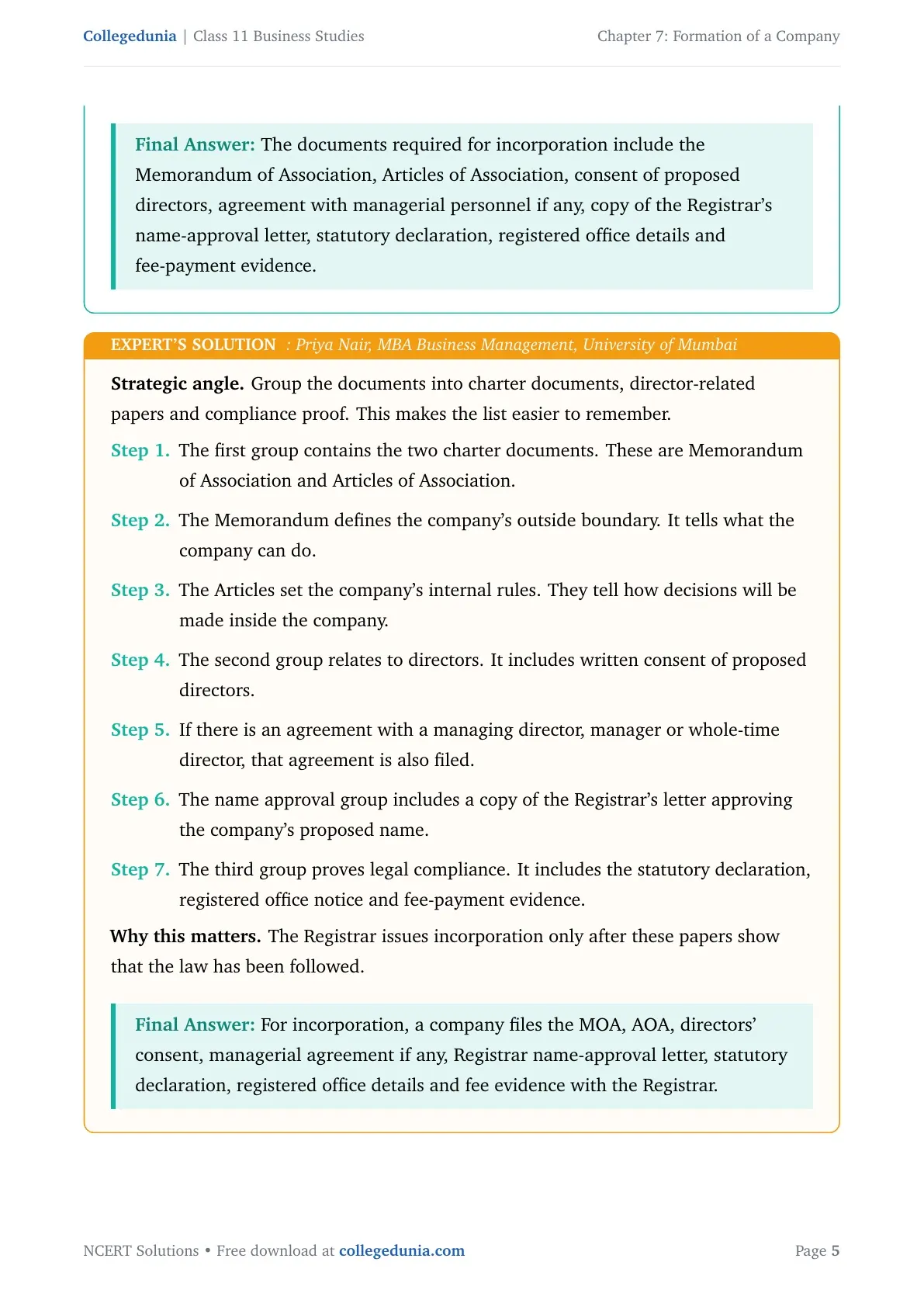
The documents required for incorporation include the Memorandum of Association, Articles of Association, consent of proposed directors, agreement with managerial personnel if any, copy of the Registrar's name-approval letter, statutory declaration, registered office details and fee-payment evidence.
PN
Priya Nair
MBA Business Management, University of Mumbai
Verified Expert
Strategic angle. Group the documents into charter documents, director-related papers and compliance proof. This makes the list easier to remember.
The first group contains the two charter documents. These are Memorandum of Association and Articles of Association.
The Memorandum defines the company's outside boundary. It tells what the company can do.
The Articles set the company's internal rules. They tell how decisions will be made inside the company.
The second group relates to directors. It includes written consent of proposed directors.
If there is an agreement with a managing director, manager or whole-time director, that agreement is also filed.
The name approval group includes a copy of the Registrar's letter approving the company's proposed name.
The third group proves legal compliance. It includes the statutory declaration, registered office notice and fee-payment evidence.
Why this matters. The Registrar issues incorporation only after these papers show that the law has been followed.
For incorporation, a company files the MOA, AOA, directors' consent, managerial agreement if any, Registrar name-approval letter, statutory declaration, registered office details and fee evidence with the Registrar.
Q 7.3
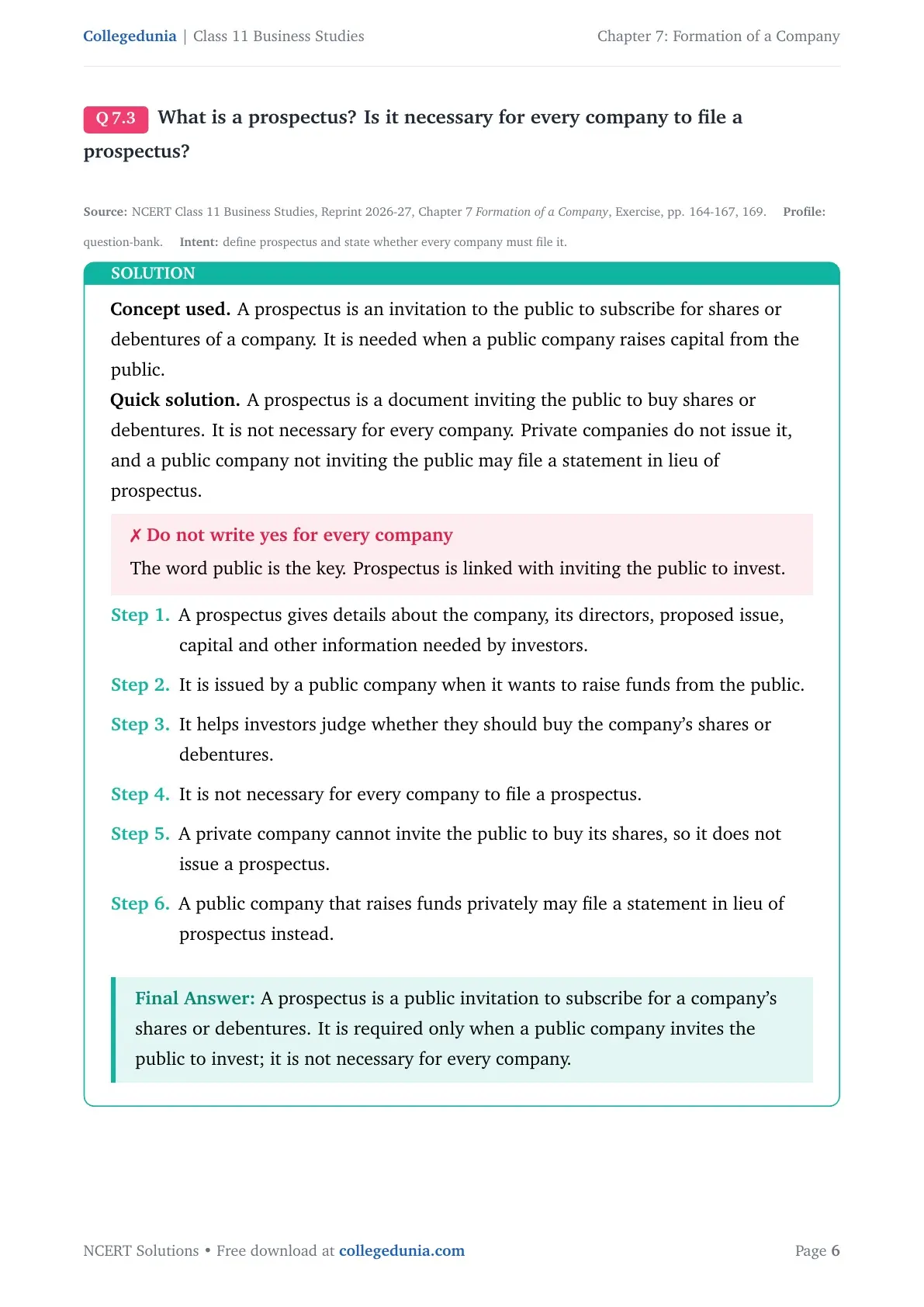
What is a prospectus? Is it necessary for every company to file a prospectus?
Concept used. A prospectus is an invitation to the public to subscribe for shares or debentures of a company. It is needed when a public company raises capital from the public.
A prospectus is a document inviting the public to buy shares or debentures. It is not necessary for every company. Private companies do not issue it, and a public company not inviting the public may file a statement in lieu of prospectus.
Do not write yes for every company
The word public is the key. Prospectus is linked with inviting the public to invest.
A prospectus gives details about the company, its directors, proposed issue, capital and other information needed by investors.
It is issued by a public company when it wants to raise funds from the public.
It helps investors judge whether they should buy the company's shares or debentures.
It is not necessary for every company to file a prospectus.
A private company cannot invite the public to buy its shares, so it does not issue a prospectus.
A public company that raises funds privately may file a statement in lieu of prospectus instead.
A prospectus is a public invitation to subscribe for a company's shares or debentures. It is required only when a public company invites the public to invest; it is not necessary for every company.
KS
Kabir Sethi
BBA Business Studies, Christ University
Verified Expert
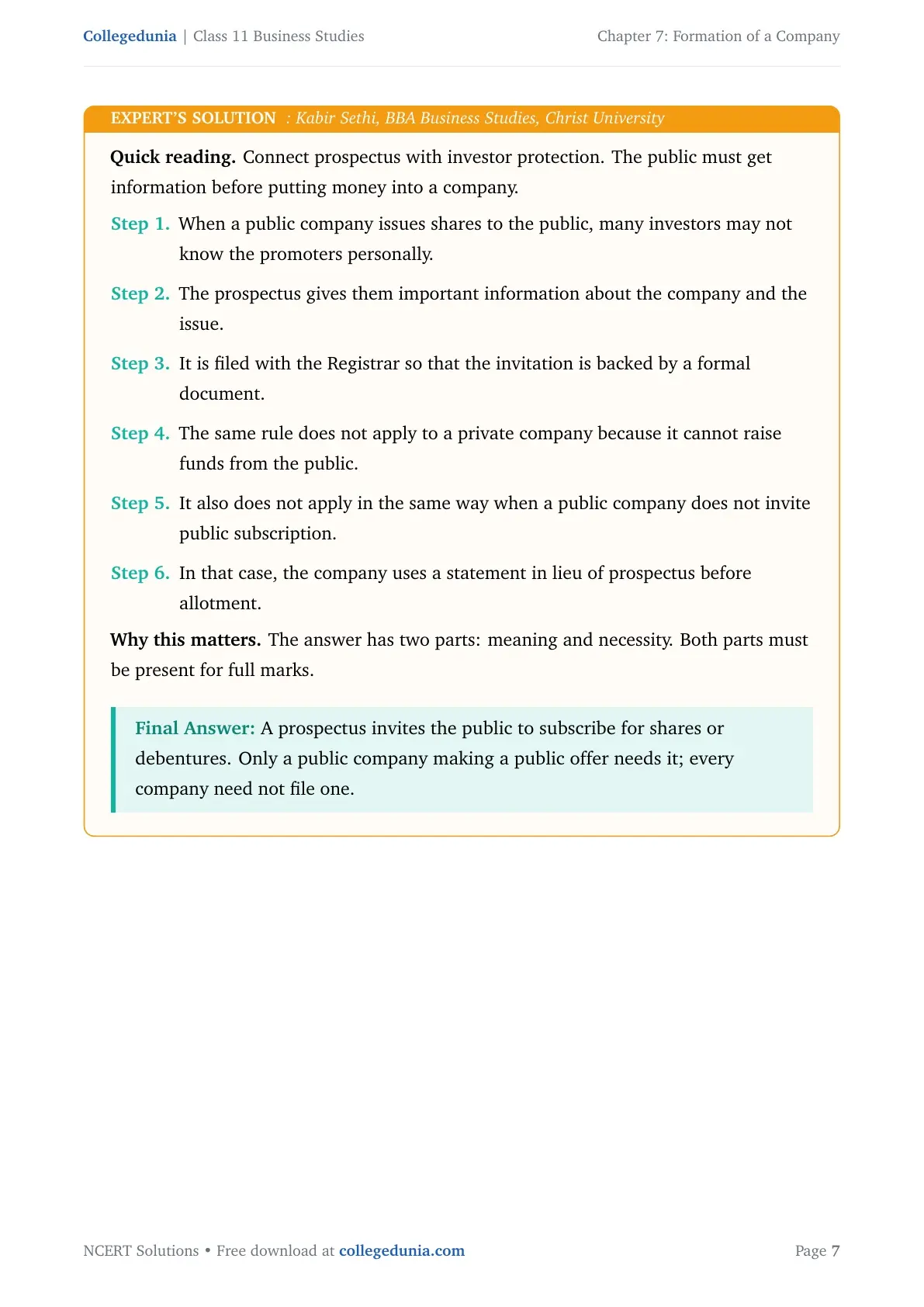
Quick reading. Connect prospectus with investor protection. The public must get information before putting money into a company.
When a public company issues shares to the public, many investors may not know the promoters personally.
The prospectus gives them important information about the company and the issue.
It is filed with the Registrar so that the invitation is backed by a formal document.
The same rule does not apply to a private company because it cannot raise funds from the public.
It also does not apply in the same way when a public company does not invite public subscription.
In that case, the company uses a statement in lieu of prospectus before allotment.
Why this matters. The answer has two parts: meaning and necessity. Both parts must be present for full marks.
A prospectus invites the public to subscribe for shares or debentures. Only a public company making a public offer needs it; every company need not file one.
Q 7.4
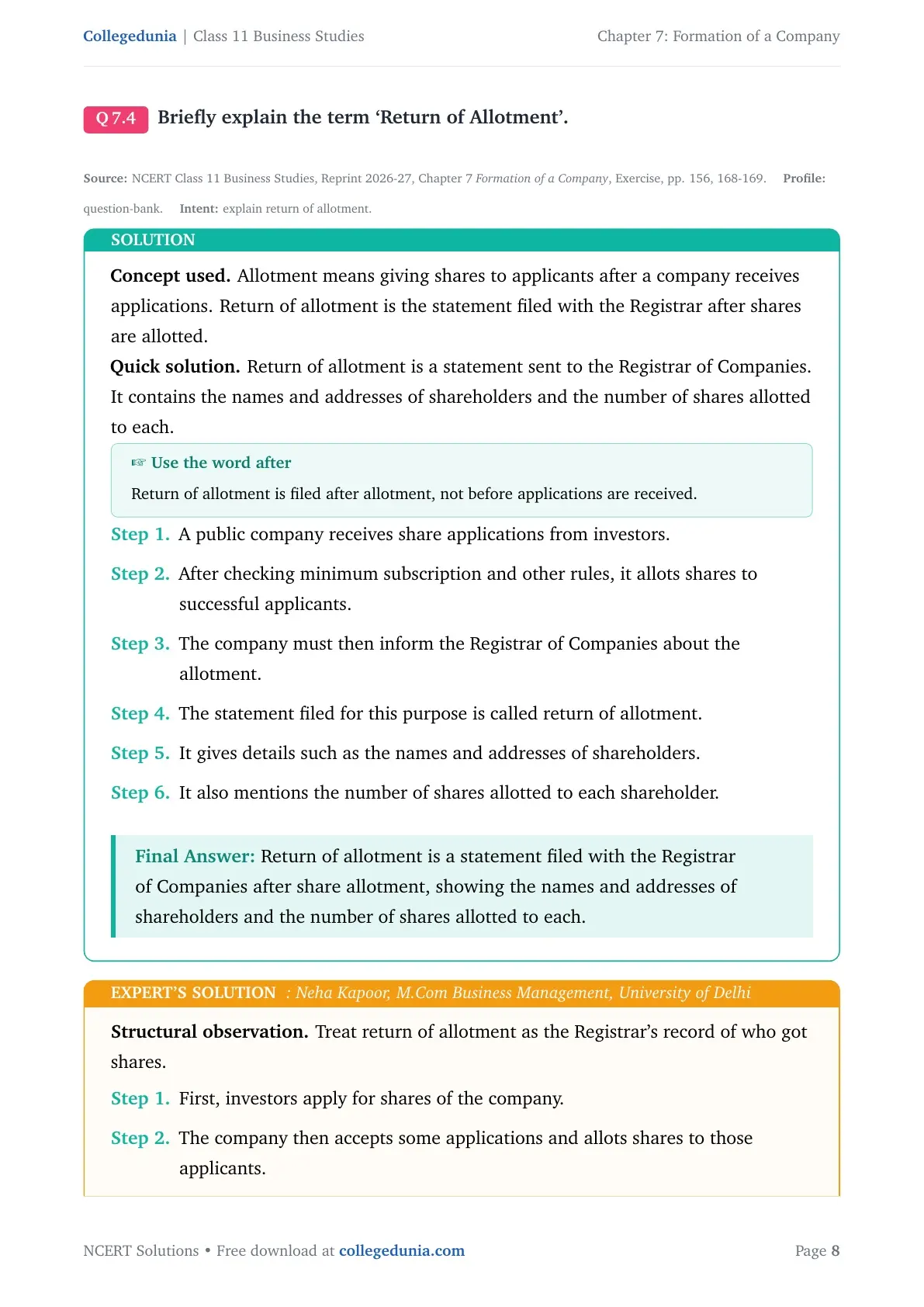
Briefly explain the term `Return of Allotment'.
Concept used. Allotment means giving shares to applicants after a company receives applications. Return of allotment is the statement filed with the Registrar after shares are allotted.
Return of allotment is a statement sent to the Registrar of Companies. It contains the names and addresses of shareholders and the number of shares allotted to each.
Use the word after
Return of allotment is filed after allotment, not before applications are received.
A public company receives share applications from investors.
After checking minimum subscription and other rules, it allots shares to successful applicants.
The company must then inform the Registrar of Companies about the allotment.
The statement filed for this purpose is called return of allotment.
It gives details such as the names and addresses of shareholders.
It also mentions the number of shares allotted to each shareholder.
Return of allotment is a statement filed with the Registrar of Companies after share allotment, showing the names and addresses of shareholders and the number of shares allotted to each.
NK
Neha Kapoor
M.Com Business Management, University of Delhi
Verified Expert
Structural observation. Treat return of allotment as the Registrar's record of who got shares.
First, investors apply for shares of the company.
The company then accepts some applications and allots shares to those applicants.
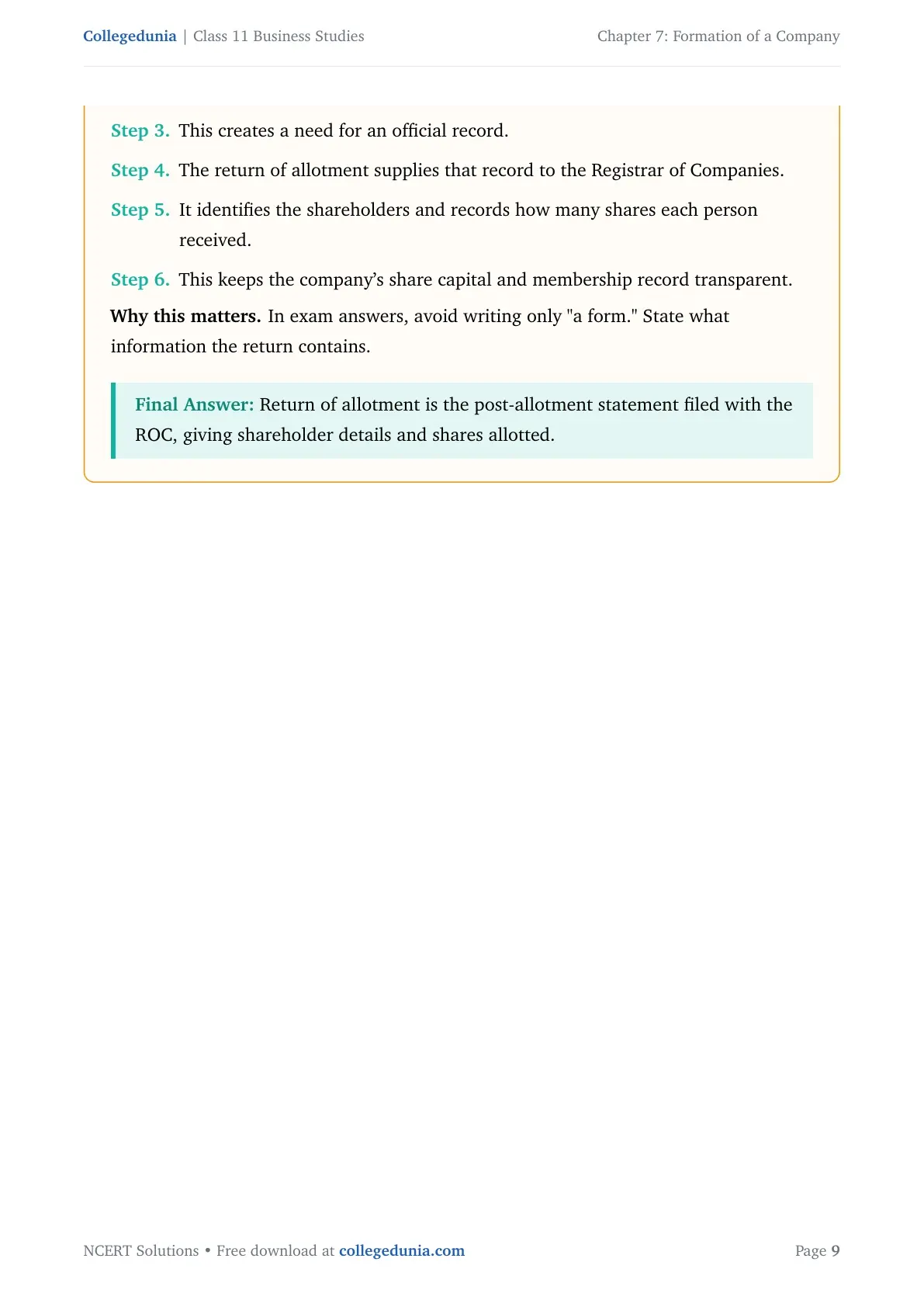
This creates a need for an official record.
The return of allotment supplies that record to the Registrar of Companies.
It identifies the shareholders and records how many shares each person received.
This keeps the company's share capital and membership record transparent.
Why this matters. In exam answers, avoid writing only "a form." State what information the return contains.
Return of allotment is the post-allotment statement filed with the ROC, giving shareholder details and shares allotted.
Q 7.5
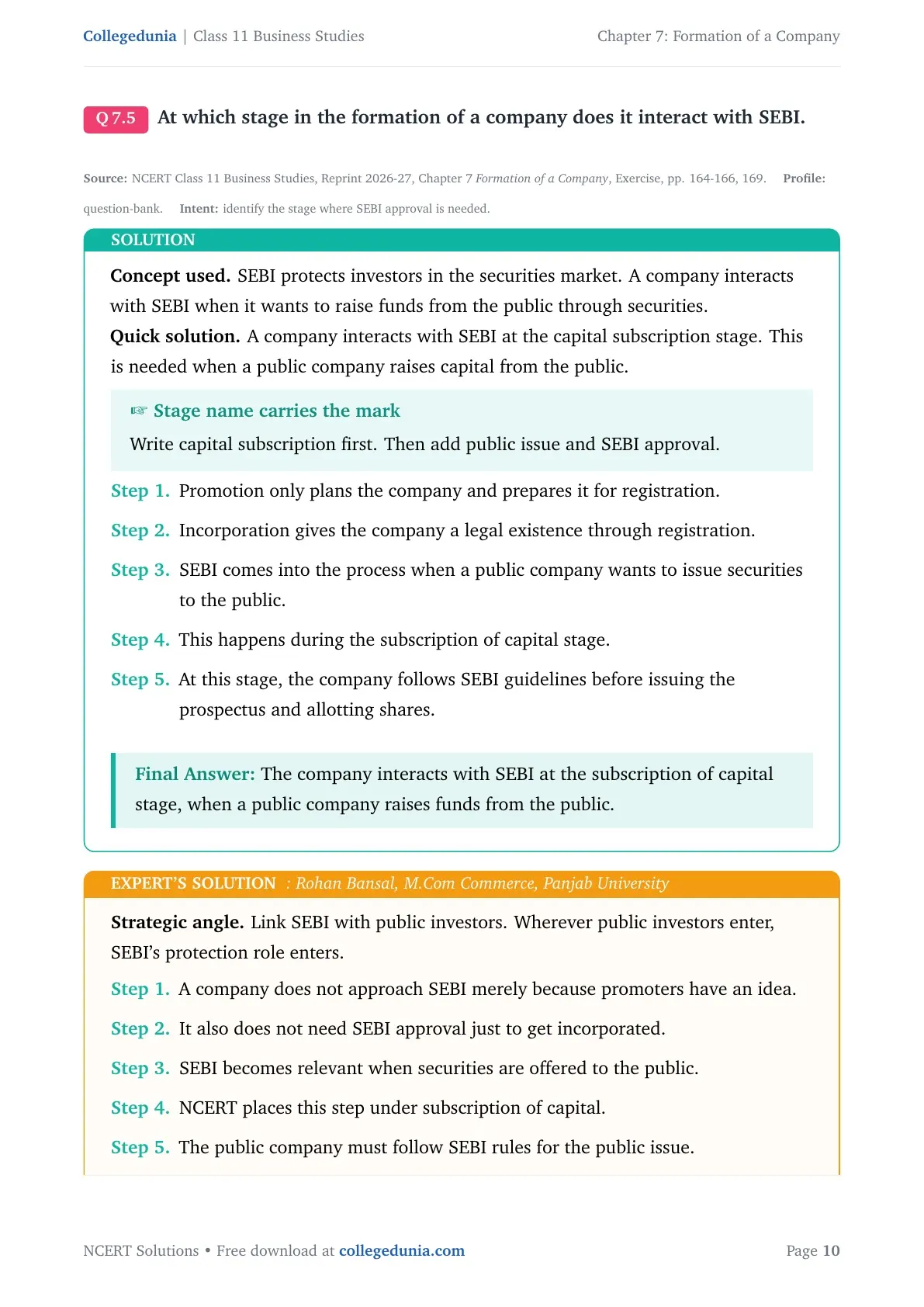
At which stage in the formation of a company does it interact with SEBI.
Concept used. SEBI protects investors in the securities market. A company interacts with SEBI when it wants to raise funds from the public through securities.
A company interacts with SEBI at the capital subscription stage. This is needed when a public company raises capital from the public.
Stage name carries the mark
Write capital subscription first. Then add public issue and SEBI approval.
Promotion only plans the company and prepares it for registration.
Incorporation gives the company a legal existence through registration.
SEBI comes into the process when a public company wants to issue securities to the public.
This happens during the subscription of capital stage.
At this stage, the company follows SEBI guidelines before issuing the prospectus and allotting shares.
The company interacts with SEBI at the subscription of capital stage, when a public company raises funds from the public.
RB
Rohan Bansal
M.Com Commerce, Panjab University
Verified Expert
Strategic angle. Link SEBI with public investors. Wherever public investors enter, SEBI's protection role enters.
A company does not approach SEBI merely because promoters have an idea.
It also does not need SEBI approval just to get incorporated.
SEBI becomes relevant when securities are offered to the public.
NCERT places this step under subscription of capital.
The public company must follow SEBI rules for the public issue.
It then files the prospectus, receives applications, checks minimum subscription and allots shares.
Why this matters. If the answer says incorporation, it confuses company registration with investor-market regulation.
SEBI interaction happens during subscription of capital for a public issue of shares or debentures.
Long Answer Questions
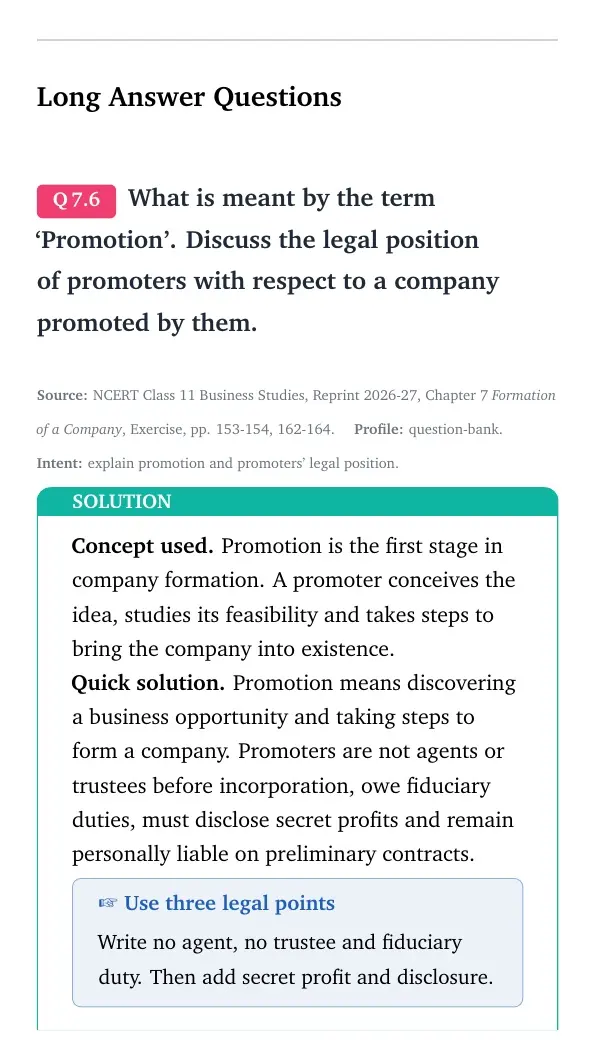
Q 7.6
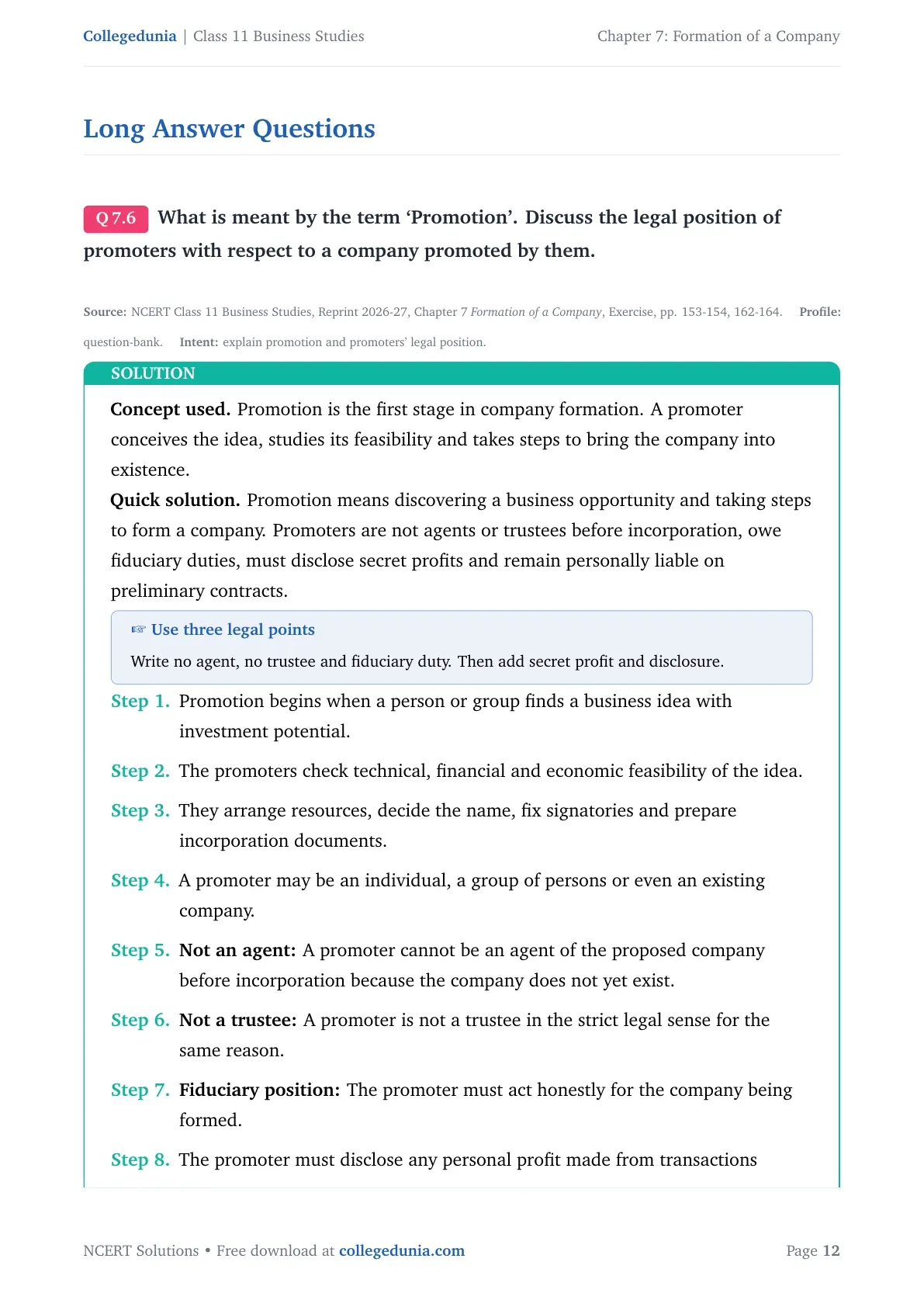
What is meant by the term `Promotion'. Discuss the legal position of promoters with respect to a company promoted by them.
Concept used. Promotion is the first stage in company formation. A promoter conceives the idea, studies its feasibility and takes steps to bring the company into existence.
Promotion means discovering a business opportunity and taking steps to form a company. Promoters are not agents or trustees before incorporation, owe fiduciary duties, must disclose secret profits and remain personally liable on preliminary contracts.
Use three legal points
Write no agent, no trustee and fiduciary duty. Then add secret profit and disclosure.
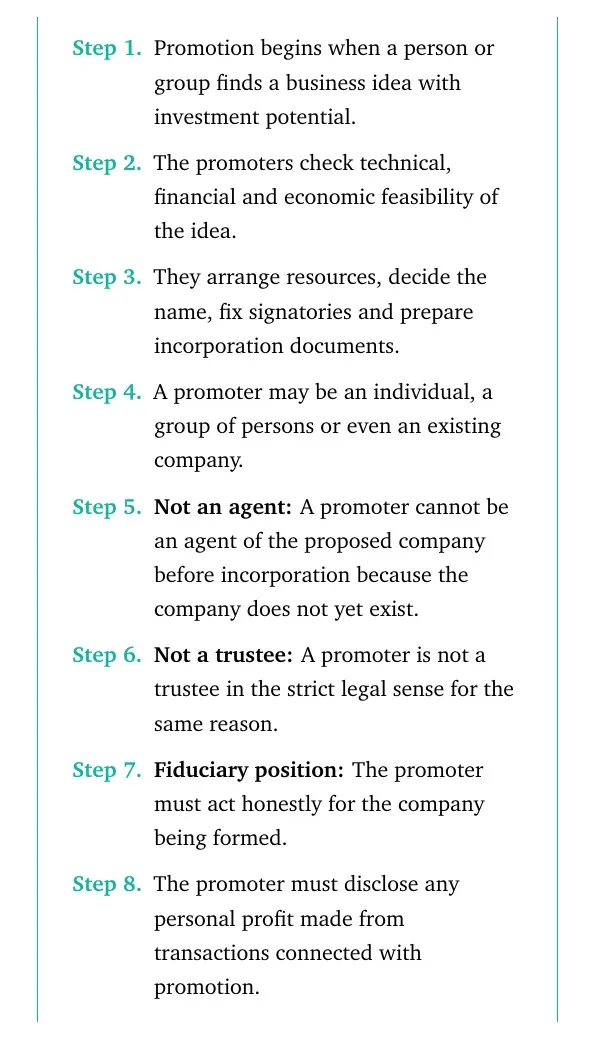
Promotion begins when a person or group finds a business idea with investment potential.
The promoters check technical, financial and economic feasibility of the idea.
They arrange resources, decide the name, fix signatories and prepare incorporation documents.
A promoter may be an individual, a group of persons or even an existing company.
Not an agent: A promoter cannot be an agent of the proposed company before incorporation because the company does not yet exist.
Not a trustee: A promoter is not a trustee in the strict legal sense for the same reason.
Fiduciary position: The promoter must act honestly for the company being formed.
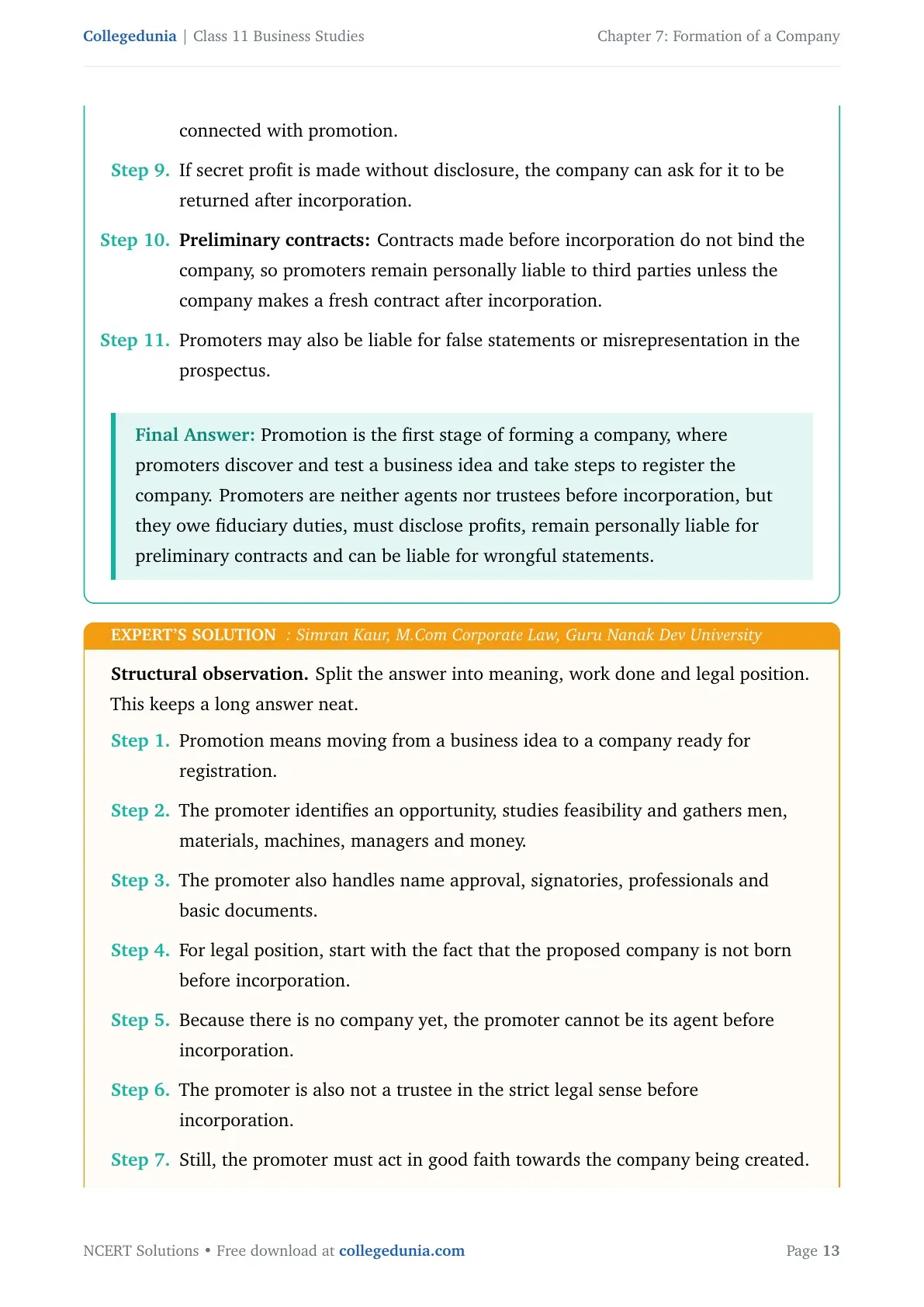
The promoter must disclose any personal profit made from transactions connected with promotion.
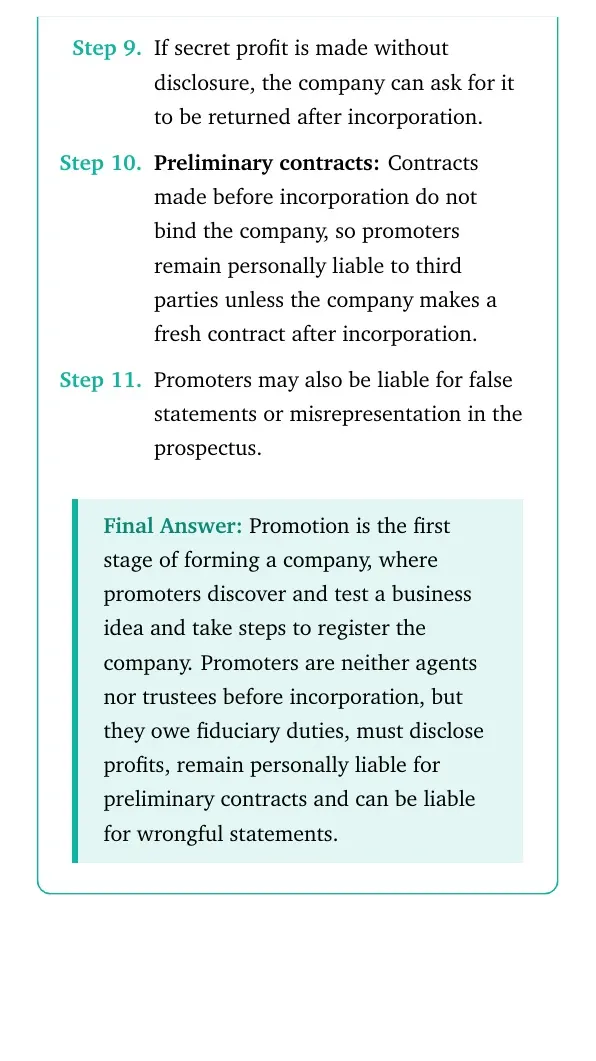
If secret profit is made without disclosure, the company can ask for it to be returned after incorporation.
Preliminary contracts: Contracts made before incorporation do not bind the company, so promoters remain personally liable to third parties unless the company makes a fresh contract after incorporation.
Promoters may also be liable for false statements or misrepresentation in the prospectus.
Promotion is the first stage of forming a company, where promoters discover and test a business idea and take steps to register the company. Promoters are neither agents nor trustees before incorporation, but they owe fiduciary duties, must disclose profits, remain personally liable for preliminary contracts and can be liable for wrongful statements.
SK
Simran Kaur
M.Com Corporate Law, Guru Nanak Dev University
Verified Expert
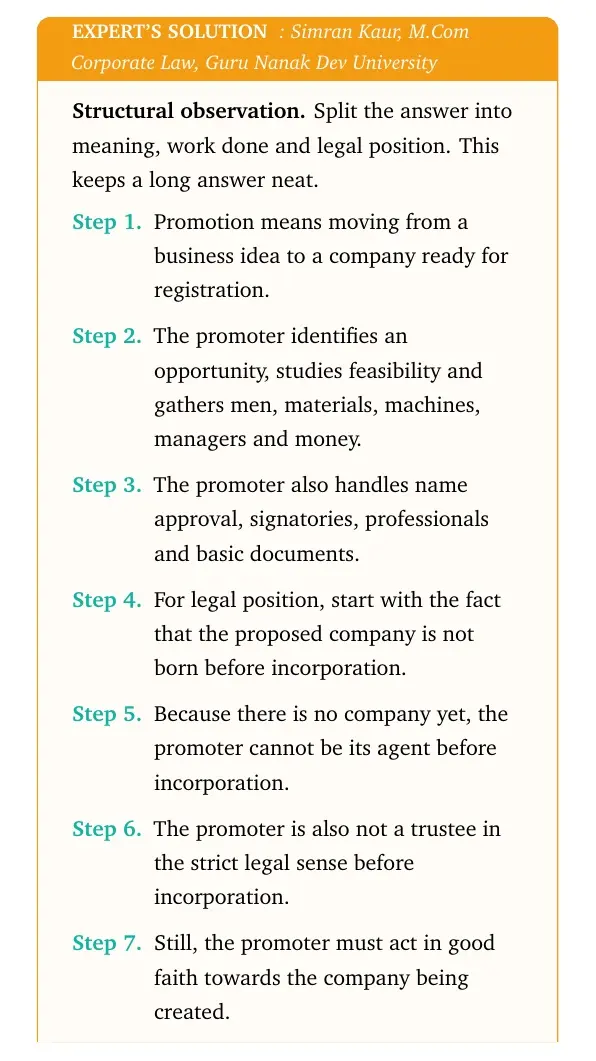
Structural observation. Split the answer into meaning, work done and legal position. This keeps a long answer neat.
Promotion means moving from a business idea to a company ready for registration.
The promoter identifies an opportunity, studies feasibility and gathers men, materials, machines, managers and money.
The promoter also handles name approval, signatories, professionals and basic documents.
For legal position, start with the fact that the proposed company is not born before incorporation.
Because there is no company yet, the promoter cannot be its agent before incorporation.
The promoter is also not a trustee in the strict legal sense before incorporation.
Still, the promoter must act in good faith towards the company being created.
This fiduciary position means the promoter cannot hide personal gains from the company.
Any secret profit must be disclosed. If not, the company may recover it.
If a promoter signs a preliminary contract before incorporation, the company is not bound by it and the promoter remains personally liable unless a fresh contract is made after incorporation.
A promoter must also be careful about statements made in the prospectus.
Why this matters. The legal position is a balance. Promoters are not agents, but they are not free to act dishonestly.
Promotion is the process of bringing a company into existence. Promoters are not agents or trustees before incorporation, but they must act in good faith, disclose profits, bear personal liability for preliminary contracts and avoid misleading statements.
Q 7.7
Explain the steps taken by promoters in the promotion of a company.
Concept used. Promoters perform the early planning and legal-preparation work of a company. Their work turns a business opportunity into a proposed company.
Promoters identify the business opportunity, conduct feasibility studies, obtain name approval, fix signatories to the Memorandum, appoint professionals and prepare documents for registration.
Write functions in sequence
Use the NCERT order: opportunity, feasibility, name, signatories, professionals and documents.
Identification of business opportunity: Promoters first find a product, service or business idea with investment potential.
They study whether the idea has a real market and can be turned into a project.
Feasibility studies: They check technical feasibility, financial feasibility and economic feasibility.
Technical feasibility checks whether raw material, technology and production methods are available.
Financial feasibility checks whether the required funds can be arranged.
Economic feasibility checks whether the project can earn profit after meeting costs.
Name approval: Promoters choose a suitable company name and apply to the Registrar of Companies.
The name should not be identical, misleading or against the Emblems and Names law.
Fixing signatories: Promoters decide who will sign the Memorandum of Association.
These signatories usually become the first directors and give consent.
Appointment of professionals: Promoters appoint bankers, auditors, legal experts and other professionals.
Preparation of documents: They prepare the Memorandum, Articles, directors' consent, statutory declaration and other required documents.
Promoters promote a company by identifying the opportunity, conducting feasibility studies, getting name approval, fixing signatories, appointing professionals and preparing the documents required for incorporation.
AR
Ananya Rao
M.Com Business Policy, University of Rajasthan
Verified Expert
Quick reading. Treat promotion as a checklist that proves the idea is worth registering as a company.
The first duty is to identify a workable business opportunity.
The opportunity may be a new product, a new service or a new way to sell an existing product.
Next, promoters conduct feasibility studies with the help of specialists.
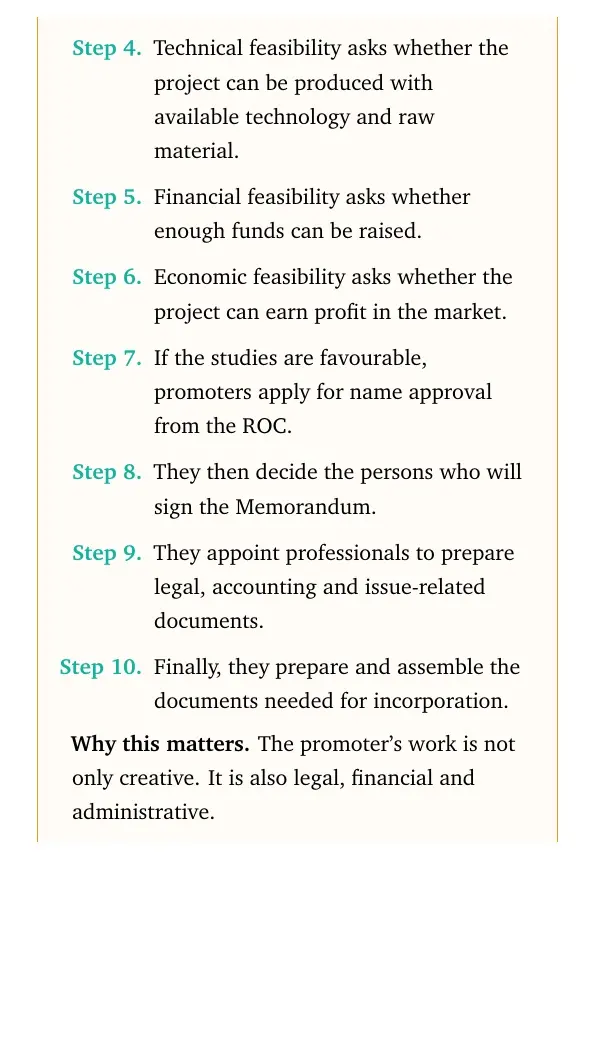
Technical feasibility asks whether the project can be produced with available technology and raw material.
Financial feasibility asks whether enough funds can be raised.
Economic feasibility asks whether the project can earn profit in the market.
If the studies are favourable, promoters apply for name approval from the ROC.
They then decide the persons who will sign the Memorandum.
They appoint professionals to prepare legal, accounting and issue-related documents.
Finally, they prepare and assemble the documents needed for incorporation.
Why this matters. The promoter's work is not only creative. It is also legal, financial and administrative.
The main promotion steps are opportunity identification, feasibility checking, name approval, fixing signatories, appointing professionals and preparing incorporation documents.
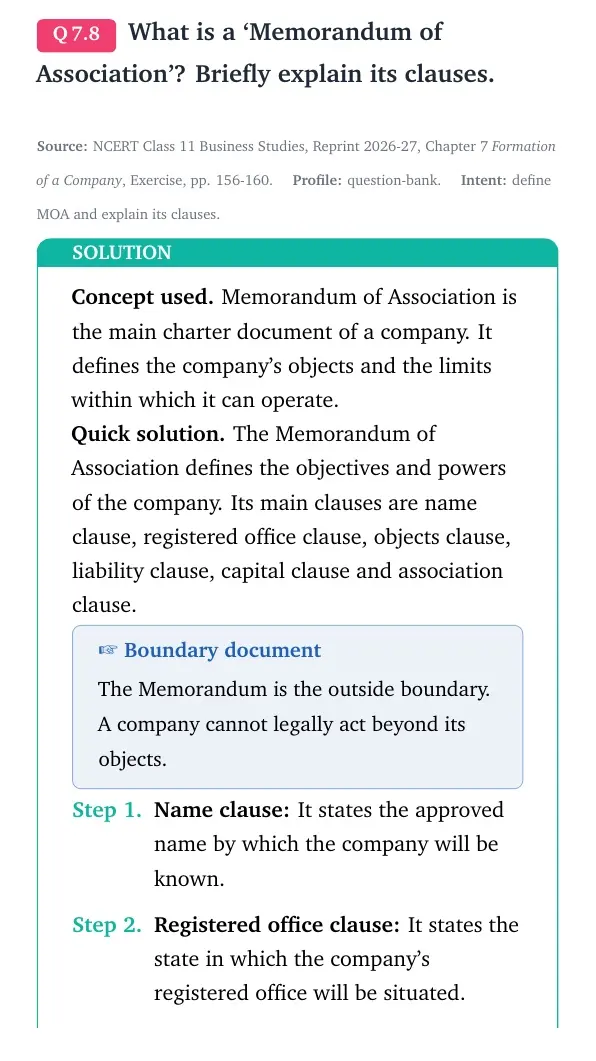
Q 7.8
What is a `Memorandum of Association'? Briefly explain its clauses.
Concept used. Memorandum of Association is the main charter document of a company. It defines the company's objects and the limits within which it can operate.
The Memorandum of Association defines the objectives and powers of the company. Its main clauses are name clause, registered office clause, objects clause, liability clause, capital clause and association clause.
Boundary document
The Memorandum is the outside boundary. A company cannot legally act beyond its objects.
Name clause: It states the approved name by which the company will be known.
Registered office clause: It states the state in which the company's registered office will be situated.
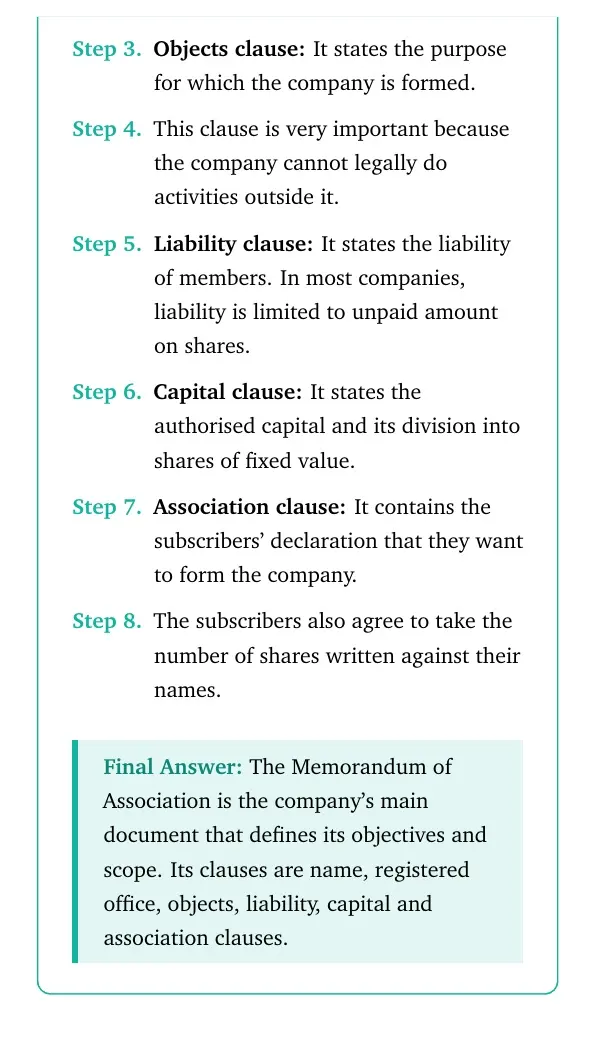
Objects clause: It states the purpose for which the company is formed.
This clause is very important because the company cannot legally do activities outside it.
Liability clause: It states the liability of members. In most companies, liability is limited to unpaid amount on shares.
Capital clause: It states the authorised capital and its division into shares of fixed value.
Association clause: It contains the subscribers' declaration that they want to form the company.
The subscribers also agree to take the number of shares written against their names.
The Memorandum of Association is the company's main document that defines its objectives and scope. Its clauses are name, registered office, objects, liability, capital and association clauses.
MK
Meera Krishnan
M.Com Management, University of Madras
Verified Expert
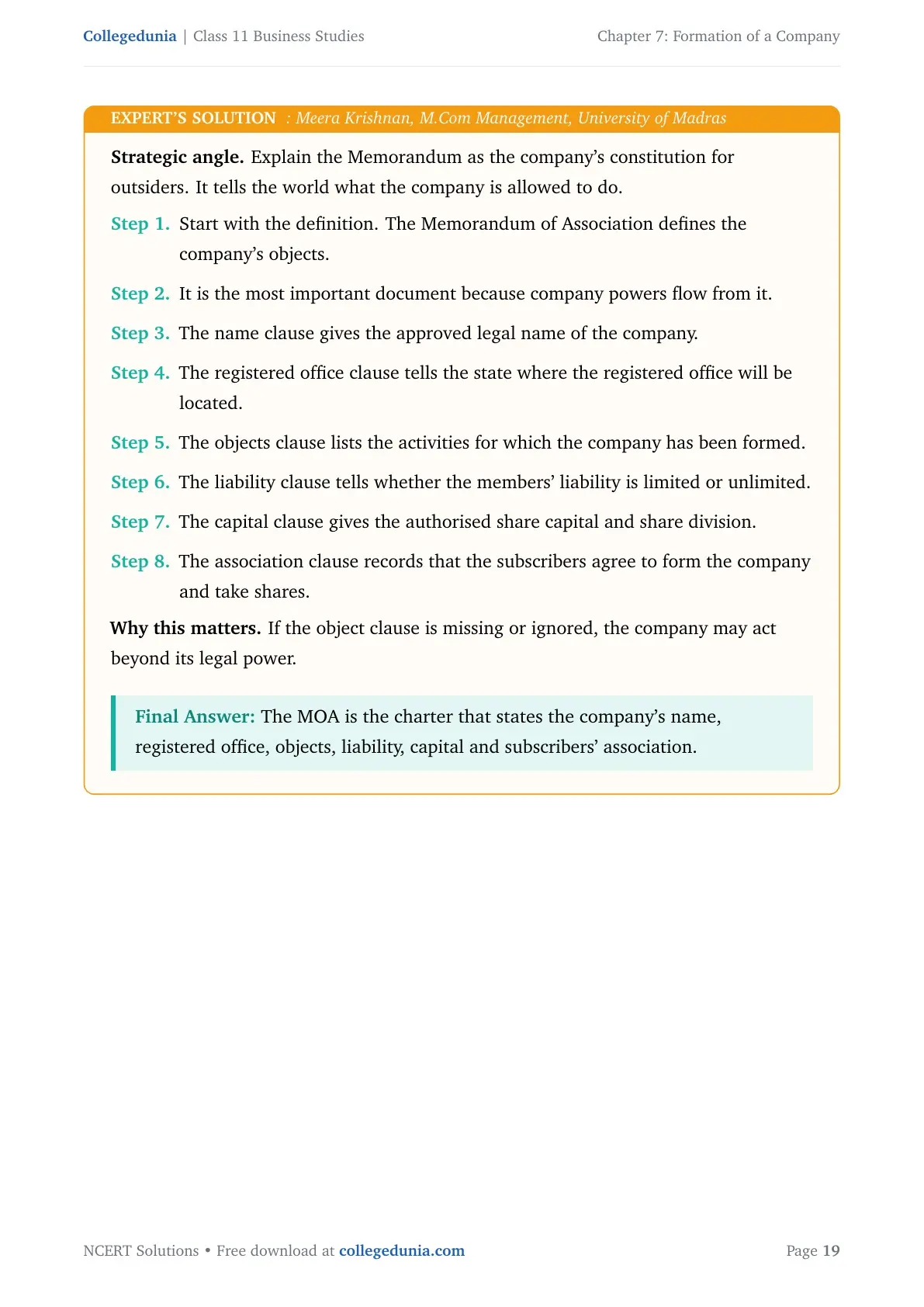
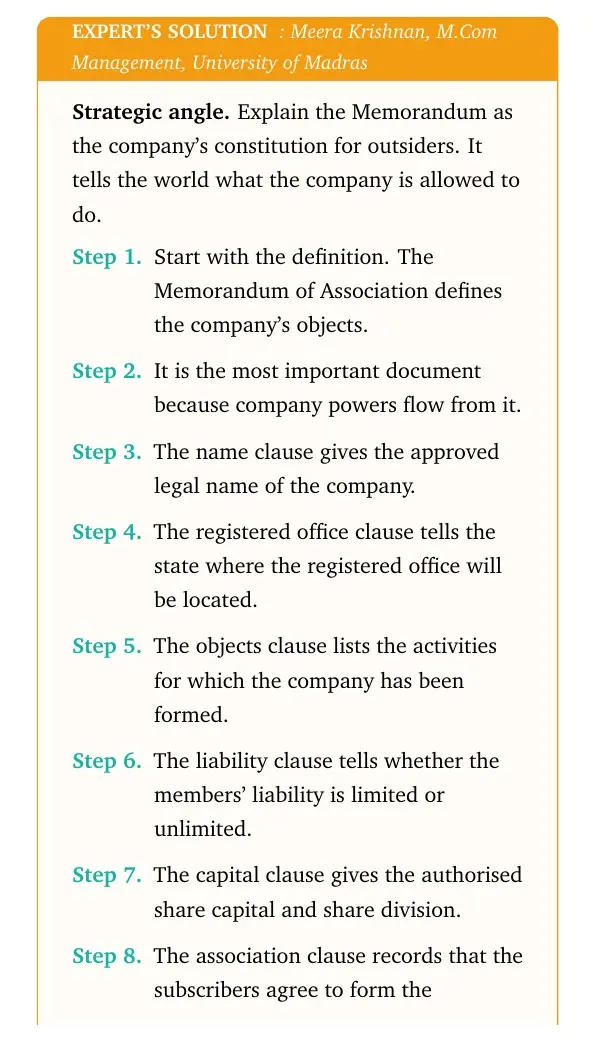
Strategic angle. Explain the Memorandum as the company's constitution for outsiders. It tells the world what the company is allowed to do.
Start with the definition. The Memorandum of Association defines the company's objects.
It is the most important document because company powers flow from it.
The name clause gives the approved legal name of the company.
The registered office clause tells the state where the registered office will be located.
The objects clause lists the activities for which the company has been formed.
The liability clause tells whether the members' liability is limited or unlimited.
The capital clause gives the authorised share capital and share division.
The association clause records that the subscribers agree to form the company and take shares.
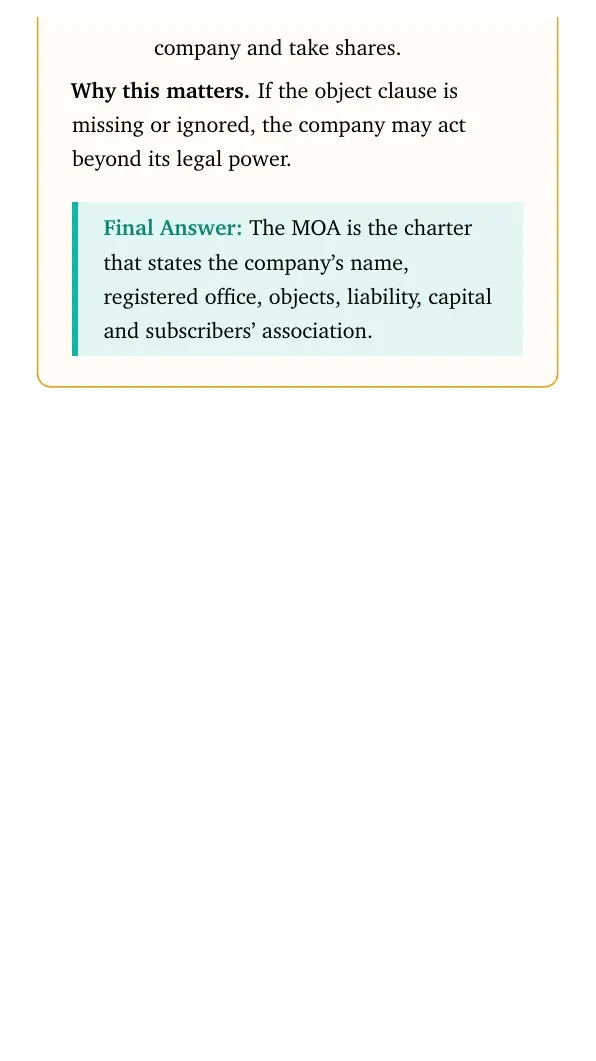
Why this matters. If the object clause is missing or ignored, the company may act beyond its legal power.
The MOA is the charter that states the company's name, registered office, objects, liability, capital and subscribers' association.
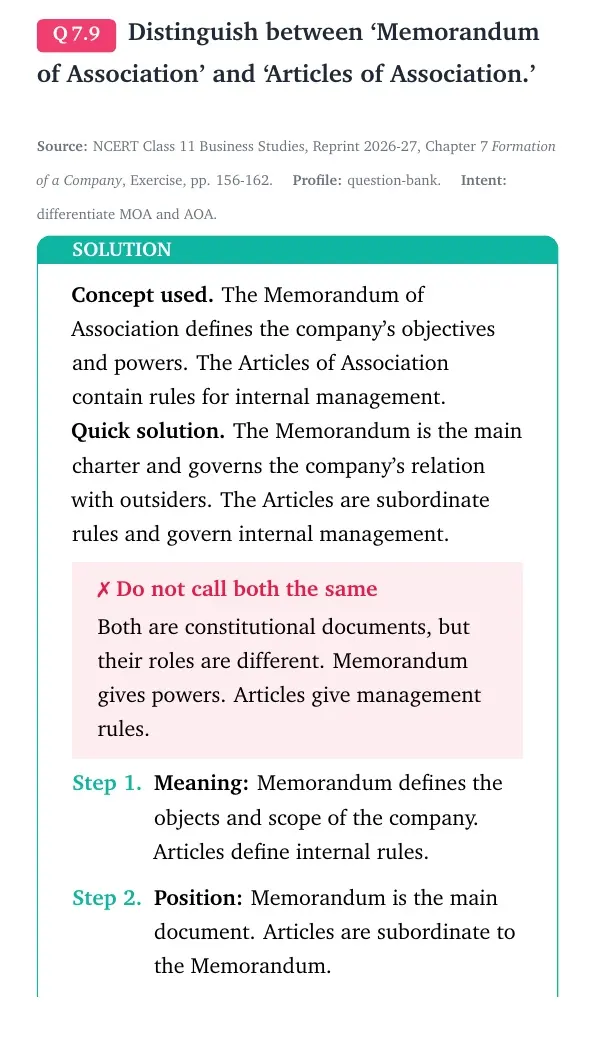
Q 7.9
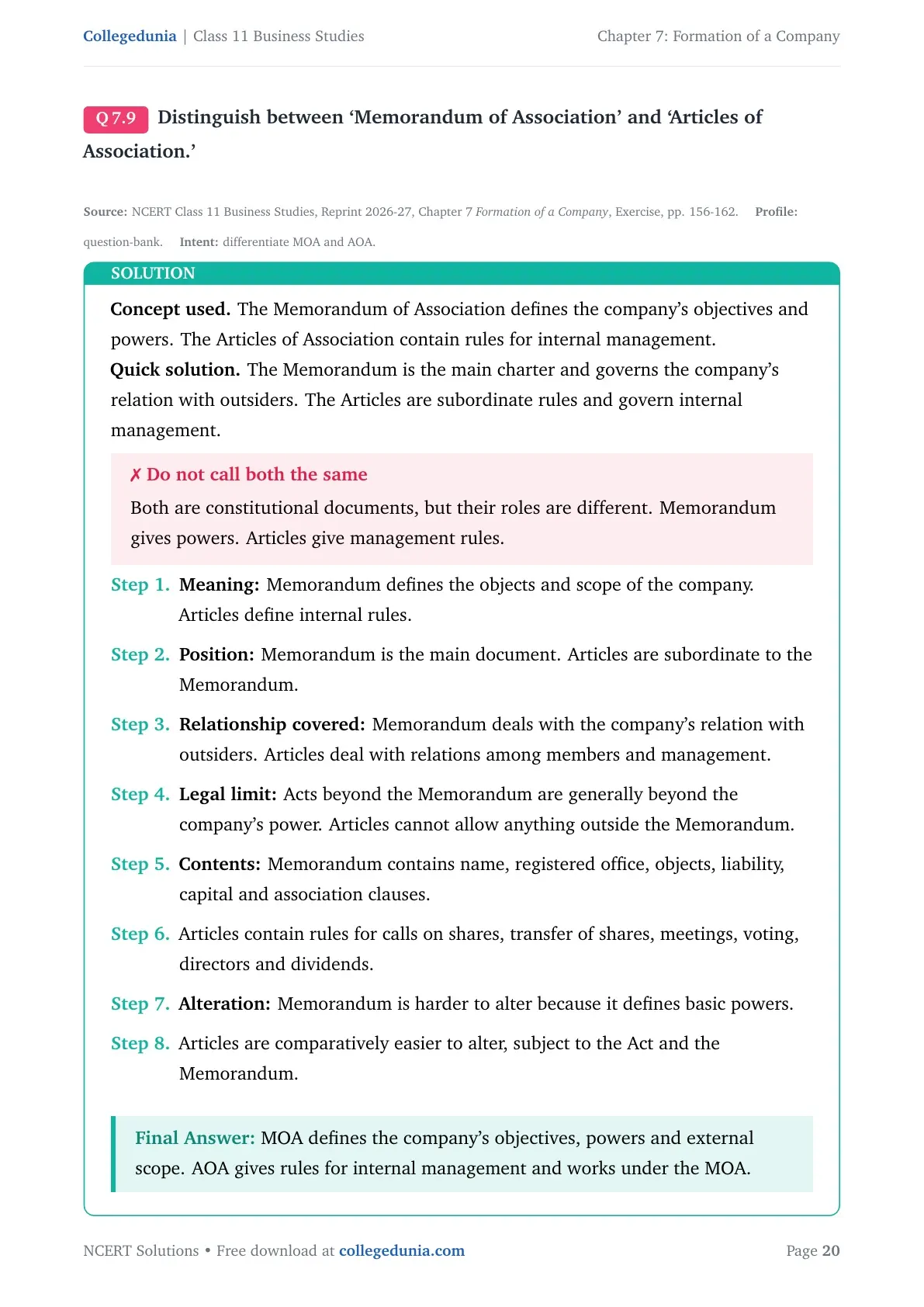
Distinguish between `Memorandum of Association' and `Articles of Association.'
Concept used. The Memorandum of Association defines the company's objectives and powers. The Articles of Association contain rules for internal management.
The Memorandum is the main charter and governs the company's relation with outsiders. The Articles are subordinate rules and govern internal management.
Do not call both the same
Both are constitutional documents, but their roles are different. Memorandum gives powers. Articles give management rules.
Meaning: Memorandum defines the objects and scope of the company. Articles define internal rules.
Position: Memorandum is the main document. Articles are subordinate to the Memorandum.
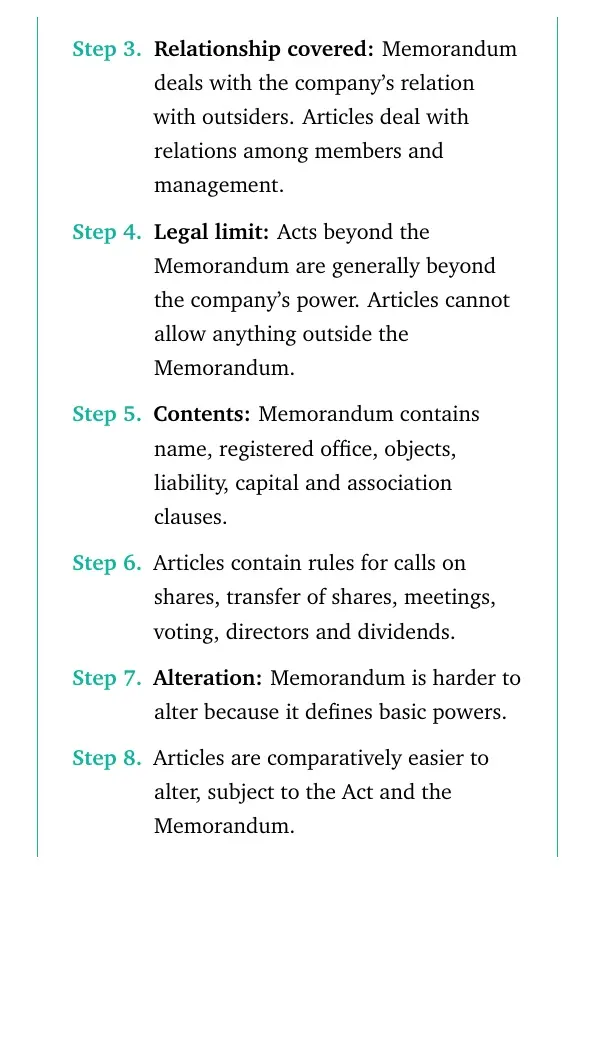
Relationship covered: Memorandum deals with the company's relation with outsiders. Articles deal with relations among members and management.
Legal limit: Acts beyond the Memorandum are generally beyond the company's power. Articles cannot allow anything outside the Memorandum.
Contents: Memorandum contains name, registered office, objects, liability, capital and association clauses.
Articles contain rules for calls on shares, transfer of shares, meetings, voting, directors and dividends.
Alteration: Memorandum is harder to alter because it defines basic powers.
Articles are comparatively easier to alter, subject to the Act and the Memorandum.
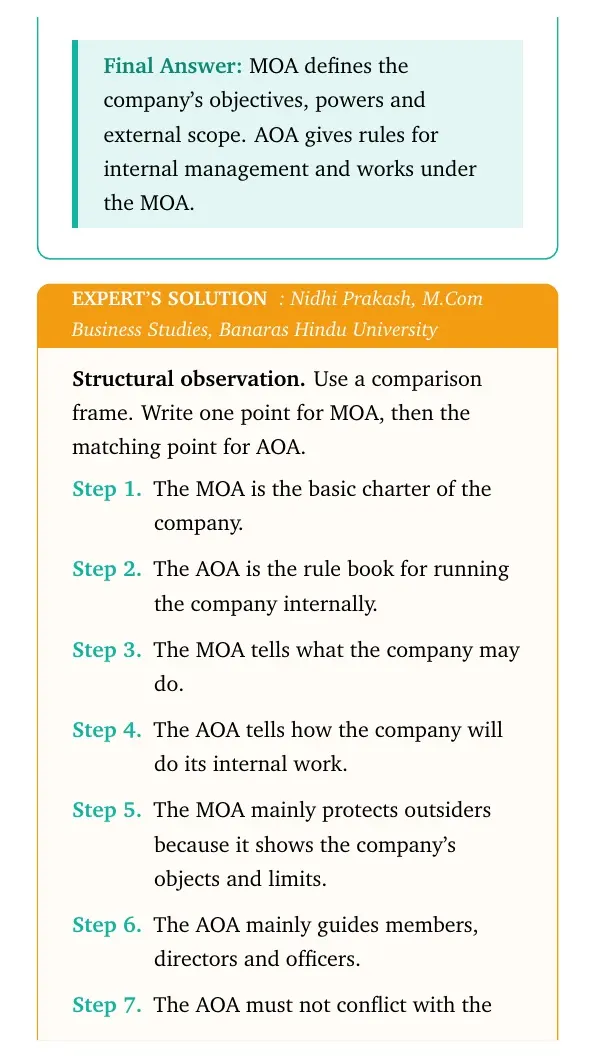
MOA defines the company's objectives, powers and external scope. AOA gives rules for internal management and works under the MOA.
NP
Nidhi Prakash
M.Com Business Studies, Banaras Hindu University
Verified Expert
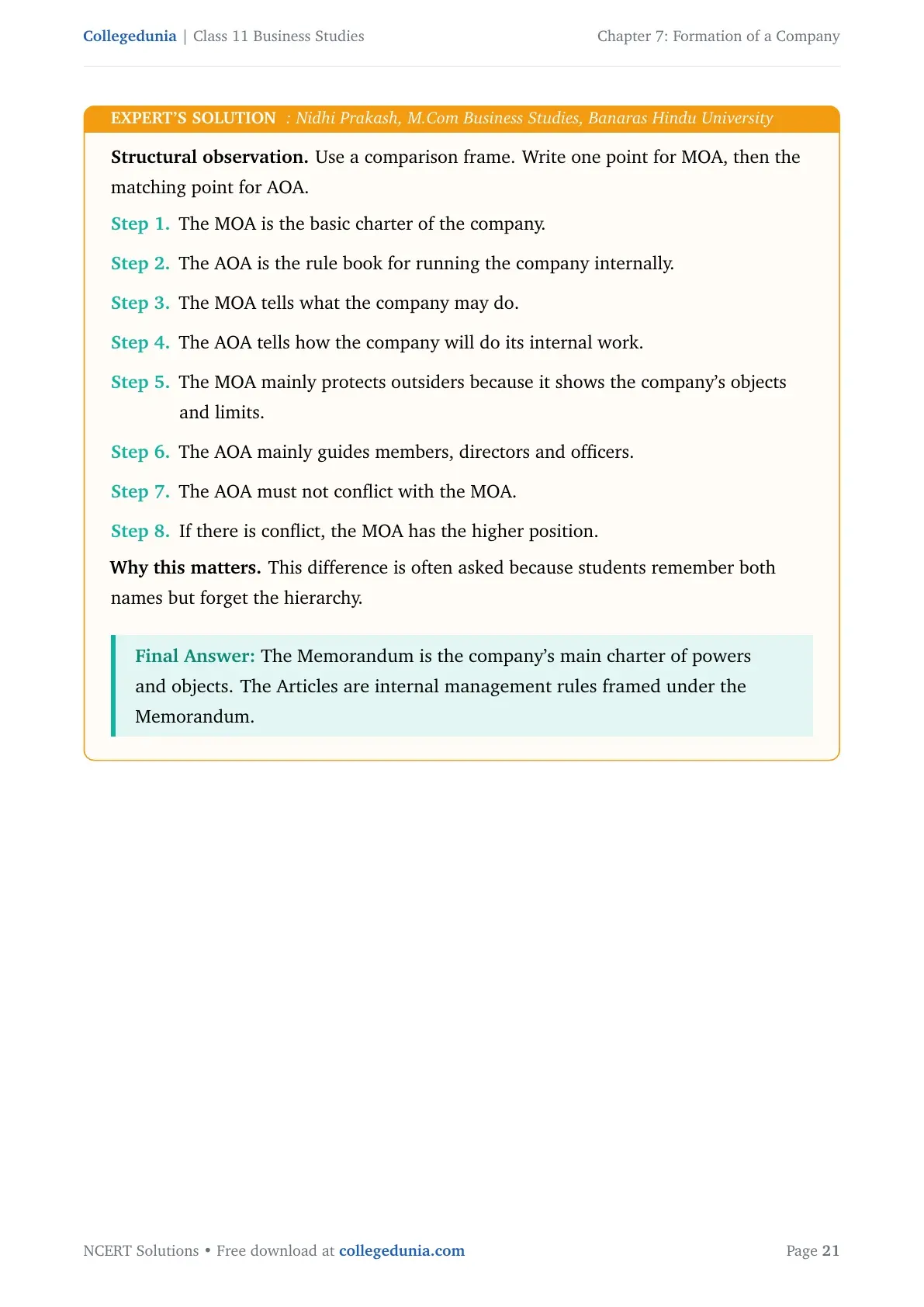
Structural observation. Use a comparison frame. Write one point for MOA, then the matching point for AOA.
The MOA is the basic charter of the company.
The AOA is the rule book for running the company internally.
The MOA tells what the company may do.
The AOA tells how the company will do its internal work.
The MOA mainly protects outsiders because it shows the company's objects and limits.
The AOA mainly guides members, directors and officers.
The AOA must not conflict with the MOA.
If there is conflict, the MOA has the higher position.
Why this matters. This difference is often asked because students remember both names but forget the hierarchy.
The Memorandum is the company's main charter of powers and objects. The Articles are internal management rules framed under the Memorandum.
Q 7.10
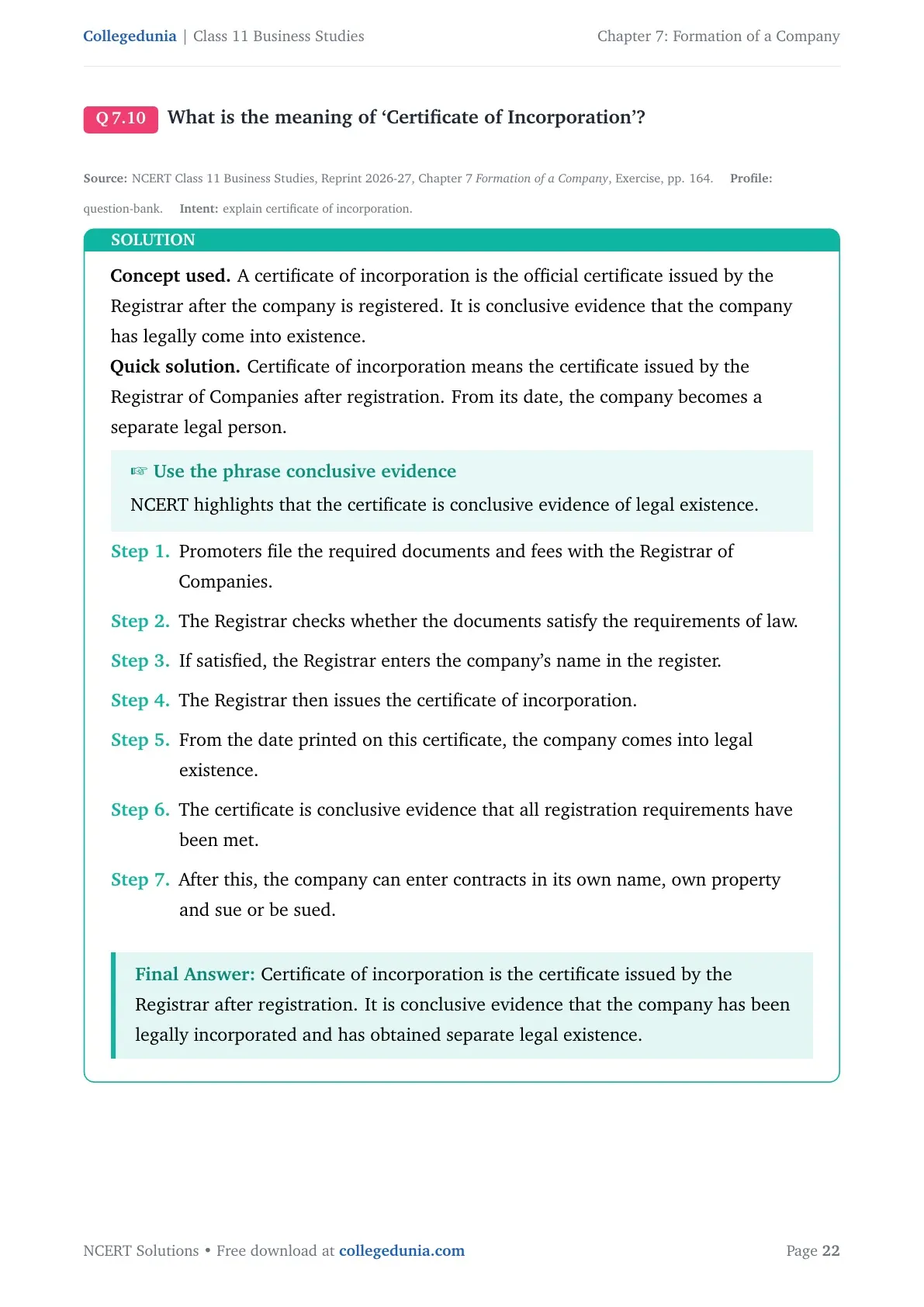
What is the meaning of `Certificate of Incorporation'?
Concept used. A certificate of incorporation is the official certificate issued by the Registrar after the company is registered. It is conclusive evidence that the company has legally come into existence.
Certificate of incorporation means the certificate issued by the Registrar of Companies after registration. From its date, the company becomes a separate legal person.
Use the phrase conclusive evidence
NCERT highlights that the certificate is conclusive evidence of legal existence.
Promoters file the required documents and fees with the Registrar of Companies.
The Registrar checks whether the documents satisfy the requirements of law.
If satisfied, the Registrar enters the company's name in the register.
The Registrar then issues the certificate of incorporation.
From the date printed on this certificate, the company comes into legal existence.
The certificate is conclusive evidence that all registration requirements have been met.
After this, the company can enter contracts in its own name, own property and sue or be sued.
Certificate of incorporation is the certificate issued by the Registrar after registration. It is conclusive evidence that the company has been legally incorporated and has obtained separate legal existence.
VD
Vikram Desai
MBA Corporate Strategy, IIM Indore
Verified Expert
Quick reading. Think of this certificate as the company's birth certificate in law.
Before incorporation, the proposed company is only an idea and a set of documents.
The promoters submit documents such as the MOA, AOA and statutory declaration.
The Registrar checks these documents and registers the company if the law is followed.
The certificate of incorporation is then issued.
This certificate creates the company's legal existence from its stated date.
The company becomes distinct from its members after this date.
Because the certificate is conclusive evidence, its validity is not lightly questioned later.
Why this matters. The answer should show both issue by Registrar and legal effect.
It is the ROC certificate that proves the company is legally formed and has separate legal existence from the date of incorporation.
Q 7.11
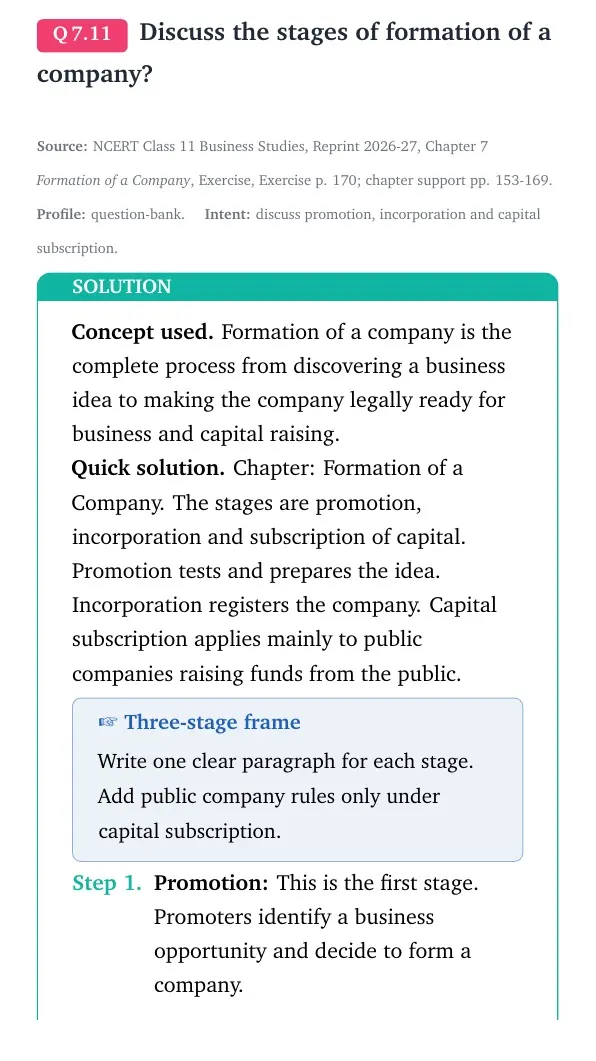
Discuss the stages of formation of a company?
Concept used. Formation of a company is the complete process from discovering a business idea to making the company legally ready for business and capital raising.
Chapter: Formation of a Company. The stages are promotion, incorporation and subscription of capital. Promotion tests and prepares the idea. Incorporation registers the company. Capital subscription applies mainly to public companies raising funds from the public.
Three-stage frame
Write one clear paragraph for each stage. Add public company rules only under capital subscription.
Promotion: This is the first stage. Promoters identify a business opportunity and decide to form a company.
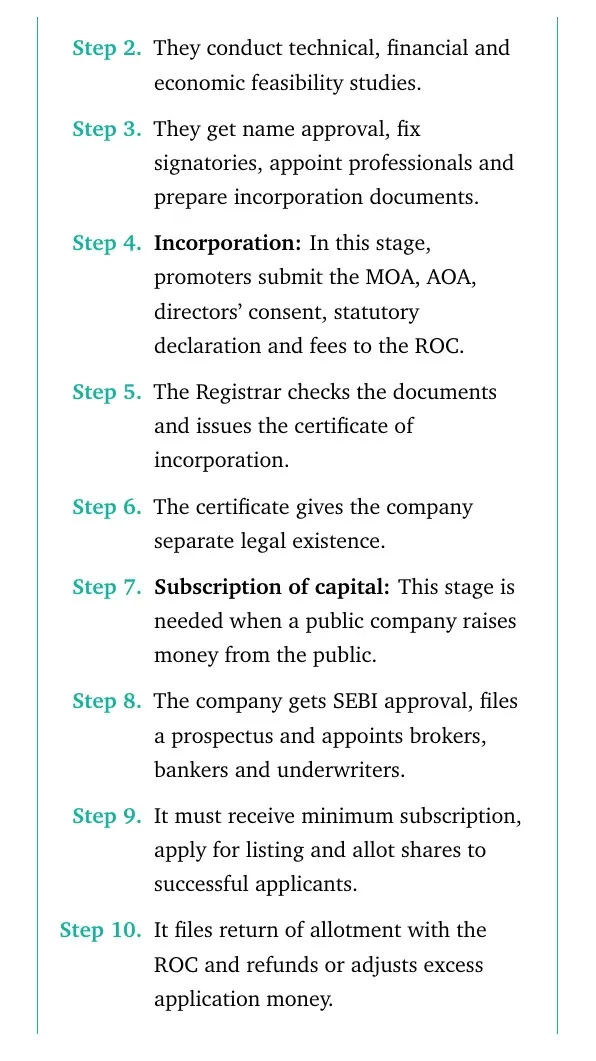
They conduct technical, financial and economic feasibility studies.
They get name approval, fix signatories, appoint professionals and prepare incorporation documents.
Incorporation: In this stage, promoters submit the MOA, AOA, directors' consent, statutory declaration and fees to the ROC.
The Registrar checks the documents and issues the certificate of incorporation.
The certificate gives the company separate legal existence.
Subscription of capital: This stage is needed when a public company raises money from the public.
The company gets SEBI approval, files a prospectus and appoints brokers, bankers and underwriters.
It must receive minimum subscription, apply for listing and allot shares to successful applicants.
It files return of allotment with the ROC and refunds or adjusts excess application money.
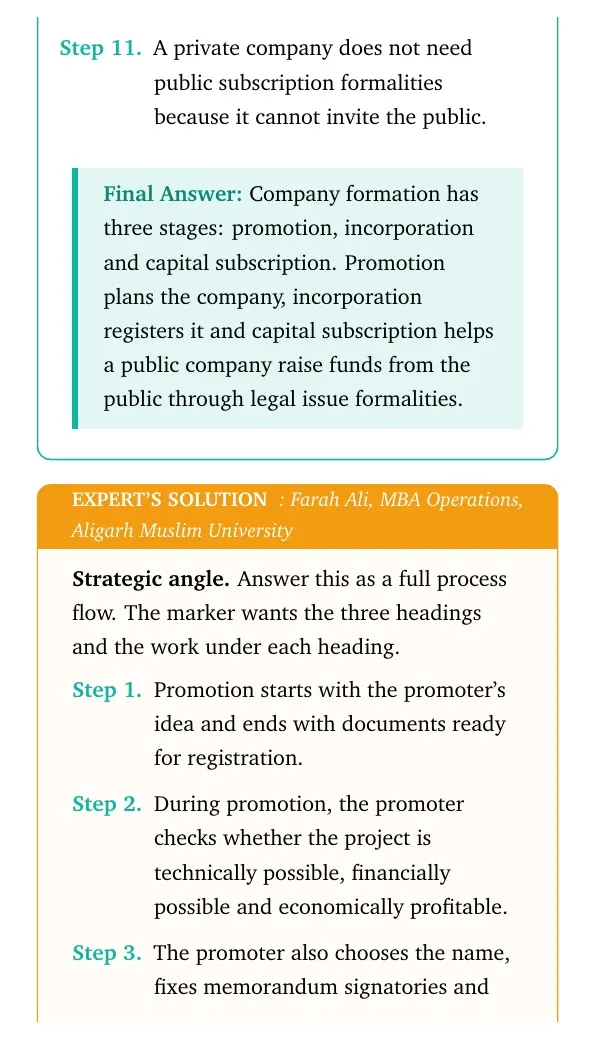
A private company does not need public subscription formalities because it cannot invite the public.
Company formation has three stages: promotion, incorporation and capital subscription. Promotion plans the company, incorporation registers it and capital subscription helps a public company raise funds from the public through legal issue formalities.
FA
Farah Ali
MBA Operations, Aligarh Muslim University
Verified Expert
Strategic angle. Answer this as a full process flow. The marker wants the three headings and the work under each heading.
Promotion starts with the promoter's idea and ends with documents ready for registration.
During promotion, the promoter checks whether the project is technically possible, financially possible and economically profitable.
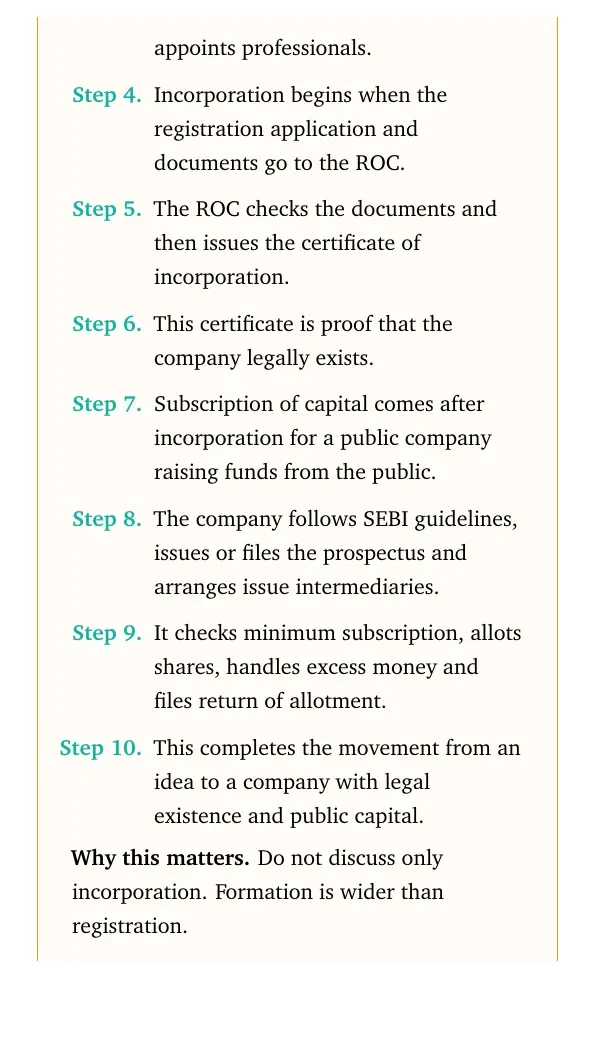
The promoter also chooses the name, fixes memorandum signatories and appoints professionals.
Incorporation begins when the registration application and documents go to the ROC.
The ROC checks the documents and then issues the certificate of incorporation.
This certificate is proof that the company legally exists.
Subscription of capital comes after incorporation for a public company raising funds from the public.
The company follows SEBI guidelines, issues or files the prospectus and arranges issue intermediaries.
It checks minimum subscription, allots shares, handles excess money and files return of allotment.
This completes the movement from an idea to a company with legal existence and public capital.
Why this matters. Do not discuss only incorporation. Formation is wider than registration.
The stages are promotion, incorporation and subscription of capital, moving from business idea to legal registration and then public capital raising where required.
Project/Assignment
Q 7.12
Find out from the office of the Registrar of Companies, the actual procedure for formation of companies. Does it match with what you have studied. What are the obstacles which companies face in getting themselves registered.
Concept used. This is a field-work question. The answer should compare the actual ROC registration process with the textbook stages of promotion, incorporation and capital subscription.
The project can state that the actual ROC process broadly matches the NCERT stages, but it is now more form-based and digital. Common obstacles include name rejection, incomplete documents, digital signature issues, errors in MOA or AOA and delay in professional certification.
Project answer format
Use report headings: method, findings, comparison and obstacles.
Method: Visit the ROC office website or consult a company secretary, chartered accountant or legal professional.
Note the forms, documents and approvals used for company registration.
Match with NCERT: The process starts with promotion, where promoters choose the business idea and proposed name.
The next stage matches incorporation, where MOA, AOA, directors' consent, registered office details and declarations are filed.
If the company raises money from the public, the capital subscription stage also applies.
Obstacles: The proposed name may be rejected because it is similar to an existing name.
Documents may be incomplete or may not match the Companies Act requirements.
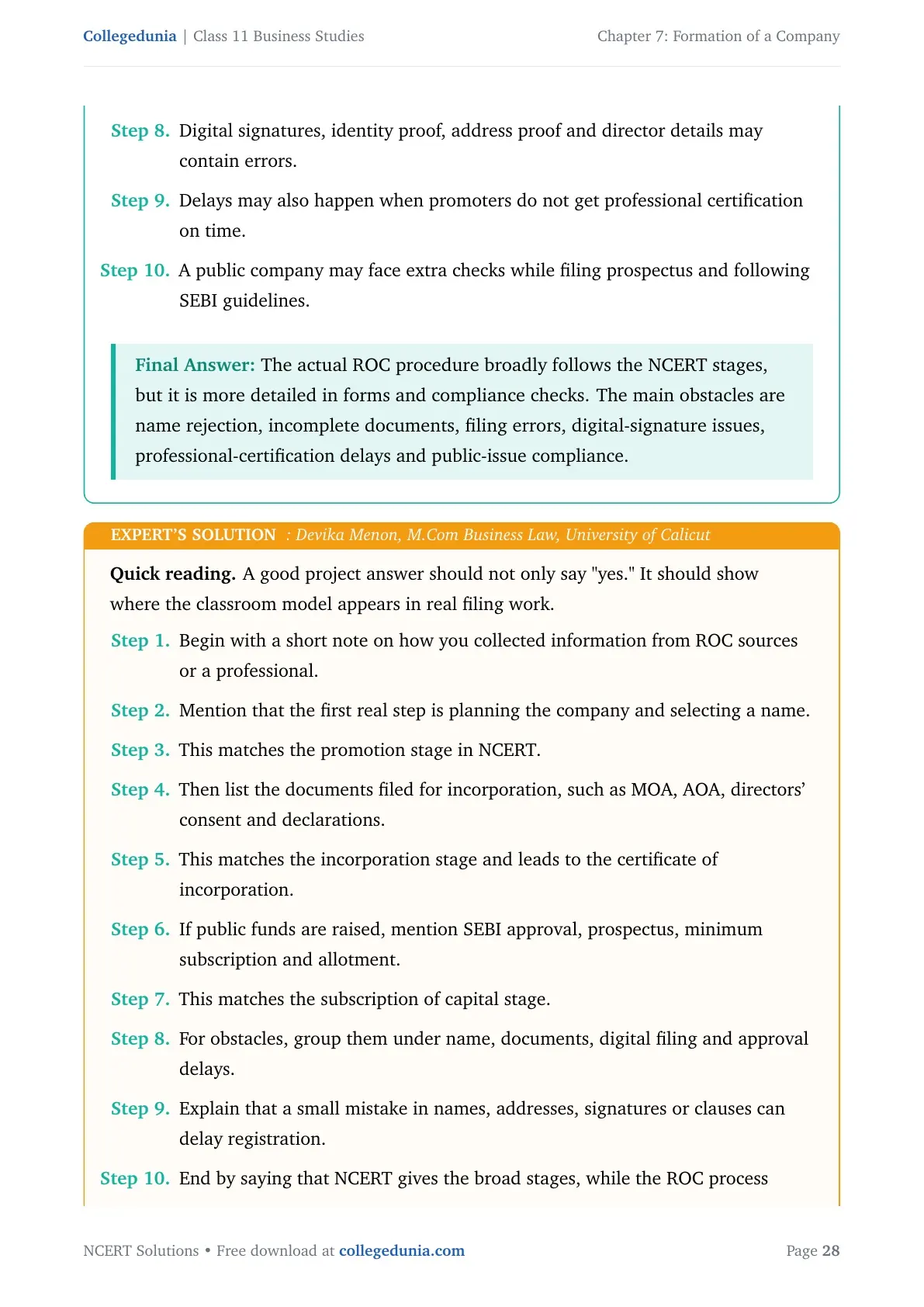
Digital signatures, identity proof, address proof and director details may contain errors.
Delays may also happen when promoters do not get professional certification on time.
A public company may face extra checks while filing prospectus and following SEBI guidelines.
The actual ROC procedure broadly follows the NCERT stages, but it is more detailed in forms and compliance checks. The main obstacles are name rejection, incomplete documents, filing errors, digital-signature issues, professional-certification delays and public-issue compliance.
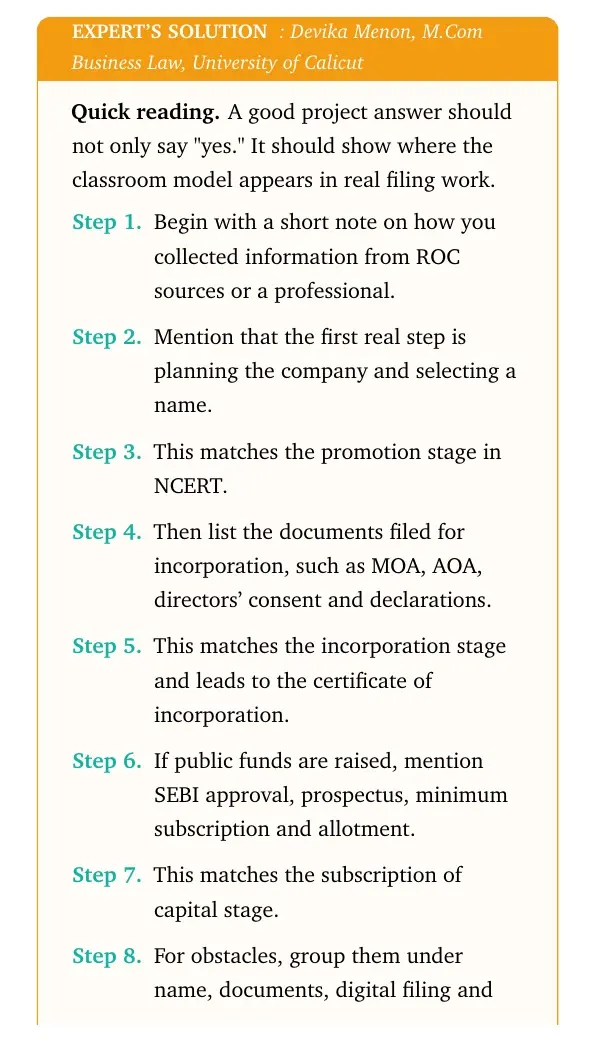
DM
Devika Menon
M.Com Business Law, University of Calicut
Verified Expert
Quick reading. A good project answer should not only say "yes." It should show where the classroom model appears in real filing work.
Begin with a short note on how you collected information from ROC sources or a professional.
Mention that the first real step is planning the company and selecting a name.
This matches the promotion stage in NCERT.
Then list the documents filed for incorporation, such as MOA, AOA, directors' consent and declarations.
This matches the incorporation stage and leads to the certificate of incorporation.
If public funds are raised, mention SEBI approval, prospectus, minimum subscription and allotment.
This matches the subscription of capital stage.
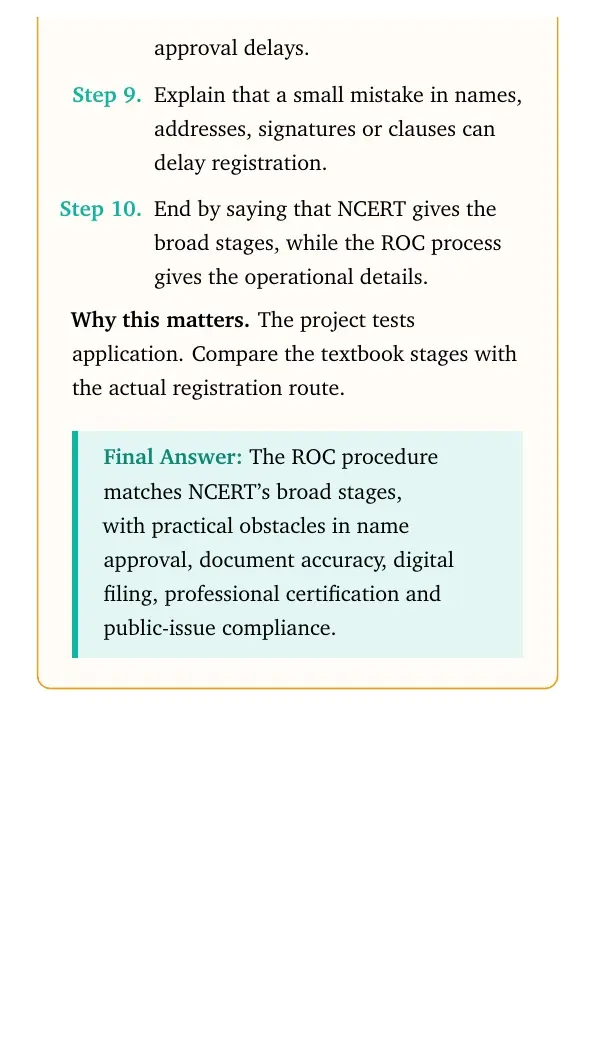
For obstacles, group them under name, documents, digital filing and approval delays.
Explain that a small mistake in names, addresses, signatures or clauses can delay registration.
End by saying that NCERT gives the broad stages, while the ROC process gives the operational details.
Why this matters. The project tests application. Compare the textbook stages with the actual registration route.
The ROC procedure matches NCERT's broad stages, with practical obstacles in name approval, document accuracy, digital filing, professional certification and public-issue compliance.
Formation of a Company Class 11 Business Studies NCERT Solutions FAQs
Ques. What are the three stages in formation of a company?
Ans. The three stages are promotion, incorporation and capital subscription. Promotion plans the company, incorporation registers it, and capital subscription helps a public company raise funds.
Ques. What is the role of a promoter in Class 11 Business Studies Chapter 7?
Ans. A promoter identifies the business opportunity, checks feasibility, gets name approval, fixes signatories, appoints professionals and prepares documents for incorporation.
Ques. Is a prospectus needed for every company?
Ans. No. A prospectus is needed when a public company invites the public to subscribe for shares or debentures. A private company does not issue it.
Ques. What is the difference between MOA and AOA?
Ans. MOA defines the company's objects and powers. AOA contains rules for internal management and must work within the limits set by the MOA.
Ques. When does a company interact with SEBI?
Ans. A company interacts with SEBI during capital subscription, when a public company raises funds from the public through a securities issue.












Comments