The NCERT Solutions for Class 11 English Woven Words Chapter 1 The Lament answer every textbook question from the 2026-27 NCERT reader. The page covers Iona's grief, public indifference, the snowy setting, the horse as companion and the language work printed after the story.
The chapter has 13 answerable prompts across text, discussion, appreciation and vocabulary sections.
Use the PDF for long answers on alienation, empathy and Chekhov's narrative frame.
The story is from the Short Stories section of Woven Words, Class 11 English elective.
Student Feedback: In a Collegedunia student poll of 8,420 Class 11 English students before the 2026 exams, many students said the hardest part of The Lament was explaining why Iona speaks to his horse at the end.
Every answer here is written for the latest 2026-27 NCERT Woven Words text and keeps the wording short enough for school answer sheets.
The exercise after The Lament is not a single back exercise. It has four sections: Understanding the Text, Talking about the Text, Appreciation and Language Work. Students should prepare both theme-based answers and vocabulary-based answers.
NCERT section
Number of prompts
What it tests
Understanding the Text
3
Iona's grief, character and the horse's role
Talking about the Text
2
Empathy, alienation and hidden personal suffering
Appreciation
4
Setting, passenger details, single-event plot and narrative frame
Language Work
4
Sound words, word groups, white imagery and idiom meaning
Iona Potapov's Grief and the City's Indifference
Iona is a cabdriver, but the story asks students to see the grieving father behind that public role. He tries to tell the officer, the young passengers and another driver that his son has died. Each attempt fails.
The officer listens for a moment, then tells Iona to hurry.
The young men are noisy and insulting, so they cannot receive his sorrow.
The sleeping driver at the yard is too tired to become a listener.
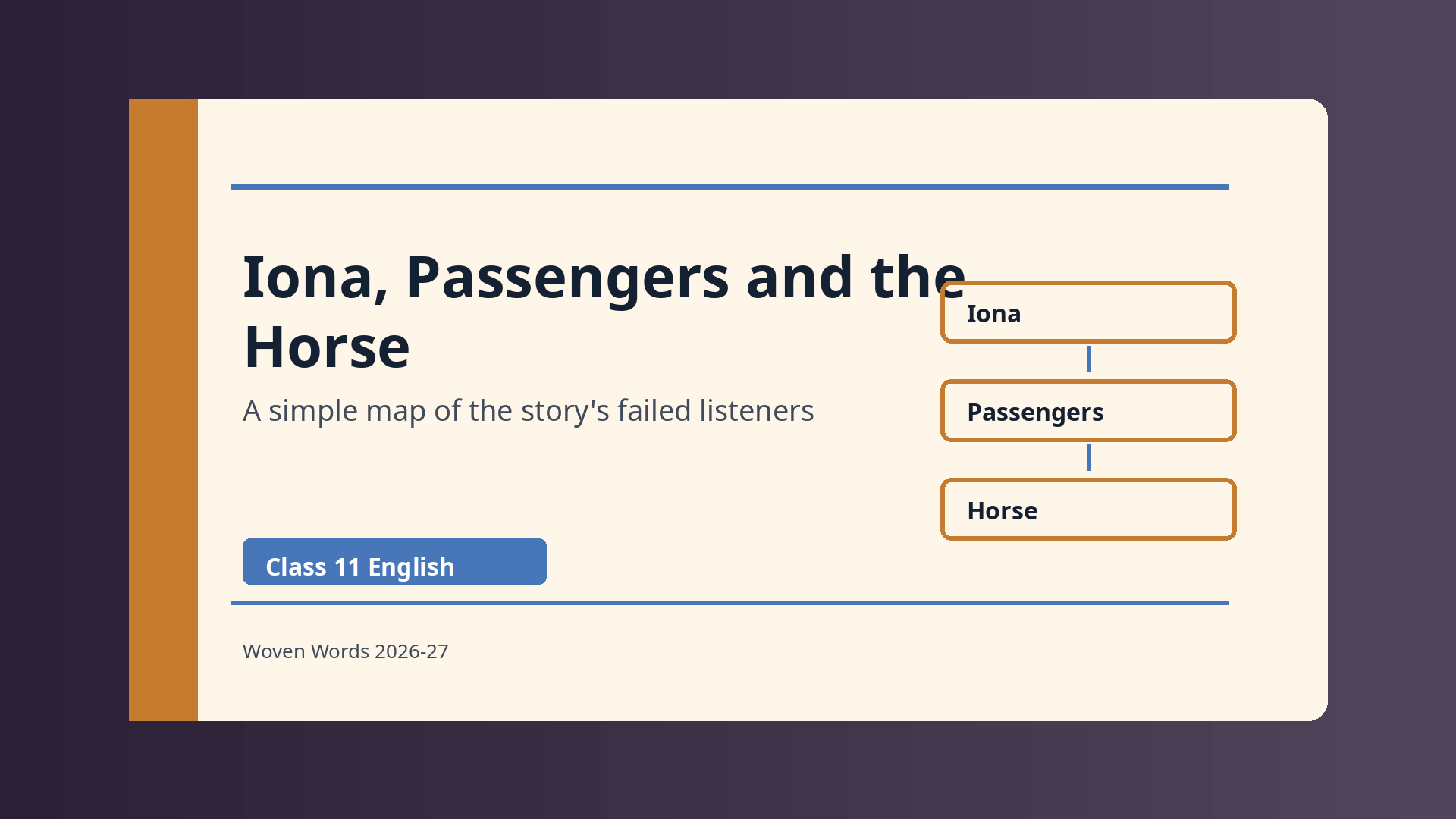
The horse becomes important because it gives Iona silent attention.
The Horse as Iona's True Companion in The Lament
The horse is present at the start and at the end of the story. This frame matters. It shows that the animal is not just part of Iona's job. It is the only living presence that lets him speak.
Story moment
What the horse does
Why it matters
Opening snow scene
Stands still beside Iona
Links the two as lonely figures
Working day
Carries passengers with him
Shares the burden of labour
Stable scene
Munches, listens and breathes over his hand
Receives the grief that people reject
Chekhov's Setting, Passenger Details and Single-Event Plot
The snowy twilight is a fitting prelude because it turns cold weather into emotional coldness. Iona and the horse look almost buried under snow, while the city around them keeps moving.
Setting: snow, twilight and street noise prepare the mood of loneliness.
Passenger detail: the officer and young men show hurry, mockery and self-interest.
Plot structure: one fact, the son's death, controls every scene.
Frame: the story starts and ends with Iona and the horse.
The Lament Language Work Answers
The Language Work section is easy to score if the word groups are learned by meaning. Keep the answer compact and classify words by action type.
Base word
Close words
Meaning group
snigger
titter, chuckle, giggle, chortle, guffaw
Types of laughter
wriggle
sneak, sidle, scramble, straggle, plod
Ways of moving
squeak
squawk, shriek, croak
Sharp or rough sounds
jeer
boo
Mocking or disapproval
sigh
pant, gasp
Breath sounds
Common Mistakes Students Make in The Lament Answers
Avoid these answer-sheet mistakes:
Writing only a summary when the question asks for indifference or alienation.
Calling the horse a symbol but not explaining how it listens.
Ignoring the snowy setting in the Appreciation question.
Confusing ``white'' with purity only. In this story it mainly suggests coldness and numbness.
Missing the difference between a passenger's public face and private suffering.
How to Revise The Lament in 30 Minutes
The chapter is short, but the answers need clear theme links. A focused 30-minute plan is enough before a school test if the story has already been read once.
10 minutes: read the last stable scene and mark why the horse matters.
10 minutes: write three theme lines: indifference, alienation and hidden private suffering.
10 minutes: revise the five Language Work groups and the phrase ``on pins and needles''.
More Class 11 English Woven Words Chapter 1 Resources
Use the related Woven Words resources when you need the chapter text, quick notes or handwritten revision pages along with these solved answers.
All NCERT Solutions for Class 11 English Woven Words Chapter 1 The Lament with Step-by-Step Solutions
Questions
Q 1.1
Comment on the indifference that meets Iona's attempts to share his grief with his fellow human beings.
Concept used. Indifference means lack of concern for another person's pain. In this story, Iona is surrounded by people, yet none of them gives him the simple human attention he needs. Chekhov shows that loneliness can exist even in a crowded city.
Central idea
Iona does not ask for money or advice. He only wants one listener for his grief.
Iona first tries to speak to the officer in his cab. He says that his son died that week.
The officer only asks what the son died of, then pushes Iona to drive faster.
Later, three young men hire the cab. Iona again tries to tell them about his son's death.
They are noisy, impatient and self-centred. They treat him as part of the cab, not as a grieving father.
At the yard, Iona tries to speak to another cabdriver. That man is sleepy and not ready to listen.
The city crowd is full of movement, lights and noise, but it has no sympathy for him.
The result is painful. Iona finally tells the whole story to his horse because human beings have failed him.
Iona's grief is met by hurry, irritation and careless curiosity. The passengers hear his words but do not receive his sorrow. Chekhov uses this indifference to show the cruelty of a society where a grieving man can find sympathy only from his horse.
MS
Meera Sanyal
M.A English, University of Delhi
Verified Expert
Quick reading. The tragedy is not only that Iona's son has died. The deeper tragedy is that Iona cannot get his grief acknowledged by another human being.
Chekhov places Iona in public spaces: streets, cabs and the drivers' yard.
These spaces should connect people, but here they expose their distance.
The officer uses Iona's service and ignores his inner life.
The young men laugh, quarrel and mock, so Iona's sorrow has no room to enter.
The sleepy cabdriver shows that even people from Iona's own occupation are too tired to respond.
The horse listens silently, which is more humane than the speech of the passengers.
The story therefore attacks emotional indifference, not merely bad manners.
It also explains why the ending feels so sharp. The horse does not answer in
words, but its quiet presence is still more humane than the passengers'
brief questions and commands.
The indifference is total: people use Iona, interrupt him or ignore him. Their failure to listen makes the horse the only true receiver of his grief.
Q 1.2
What impression of the character of Iona do you get from this story?
Concept used. A character sketch should combine action, speech and emotional state. Iona is not heroic in an outward way, but his quiet suffering makes him deeply moving.
Character answer
Write Iona as a person, not just as ``a cabdriver''. His job matters because people see only the job.
Iona is an old cabdriver who works in harsh winter conditions.
He is poor and tired, yet he continues to drive because he must earn food for himself and his horse.
He is gentle by nature. Even when people abuse him on the street, he does not answer violently.
He is emotionally broken by his son's death. He cannot think about it alone because the pain is too strong.
He has a deep need to share. He wants to describe the illness, the hospital and the funeral.
He is also tender. His final conversation with the horse shows his capacity for affection.
His tragedy is that he has more feeling than the world around him can notice.
Iona appears as a poor, patient, gentle and grief-stricken old man. His need is simple and human: he wants someone to listen while he speaks about his dead son. His tenderness becomes clearest when he turns to his horse as his only companion.
RM
Raghav Menon
M.A English, EFLU Hyderabad
Verified Expert
Structural observation. Chekhov builds Iona through contrasts. Iona is slow, bent and silent, while the city is loud, bright and hurried. That contrast tells us a great deal about him.
His body seems frozen under the snow, which reflects emotional numbness.
His few sentences are broken and hesitant, so we sense a man unable to carry grief alone.
He keeps returning to the same subject, his son, because grief has narrowed his world.
He does not demand sympathy. He asks for it indirectly, almost apologetically.
He cares for the horse and speaks to it like a fellow sufferer.
Iona is therefore humble and deeply human. He is not weak because he grieves. He is wounded because nobody will receive that grief.
Iona is patient, lonely, affectionate and crushed by bereavement. The story makes him memorable through his helpless search for one sympathetic listener.
Q 1.3
How does the horse serve as a true friend and companion to Iona?
Concept used. A companion is someone who stays near in suffering. The horse cannot speak, but it gives Iona the attention and nearness that human beings refuse.
Key contrast
The horse is silent, but it listens. The passengers speak, but they do not hear.
The story begins with Iona and the horse standing together in the snow.
Both seem still, tired and cut off from the city around them.
Iona thinks about the horse's food and shelter even when he is grieving.
At the end, he goes to the stable because he cannot bear to think alone.
He speaks to the horse as if it can understand the loss of a child.
The horse munches, listens and breathes over his hand. That physical nearness matters.
Iona finally tells the whole story to the horse. The animal becomes the listener he needed.
The horse is Iona's true companion because it stays with him, receives his words and gives silent comfort. It cannot solve his grief, but it gives him the sympathy of presence, which no human passenger offers.
AR
Aditi Rao
Ph.D English, University of Hyderabad
Verified Expert
Picture-first reading. Chekhov frames the story with Iona and the horse. That framing makes the animal more than a working animal. It becomes Iona's emotional double.
At the opening, snow covers both Iona and the horse. They share the same frozen stillness.
Through the day, the horse carries the passengers while Iona carries grief.
In the stable, the horse's bright eyes give Iona a point of contact.
Iona imagines the horse as a mother losing a foal. This lets him translate his own loss.
The horse's silence is not rejection. It becomes the safe silence of a companion.
The horse serves as Iona's friend by sharing his loneliness and silently accepting his story. Chekhov uses it to expose the failure of human sympathy.
Q 1.4
Discuss the idea that empathy and understanding are going out of modern society, and that the individual experiences intense alienation from the society around him or her.
Concept used. Empathy is the ability to feel with another person. Alienation is the feeling of being cut off from society. The story presents both ideas through Iona's day in the city.
Alienation
Alienation is not simply being alone. Iona is alienated because he is among people who still cannot meet him as a person.
Iona is never physically alone. He drives passengers, moves through streets and returns to a yard with other drivers.
Yet he is emotionally alone because nobody is willing to pause for his grief.
The officer and the young men behave like modern city people under pressure. They want quick service, not human contact.
The noisy street creates the appearance of social life, but it hides inner isolation.
Chekhov suggests that people in public roles are reduced to functions: cabdriver, passenger, worker.
When Iona cannot speak to human beings, he speaks to an animal. This is the strongest sign of alienation.
The story shows a society where people are close in space but far in feeling. Empathy has weakened because everyone is hurried, self-absorbed and unable to listen. Iona's alienation is so intense that his only listener is his horse.
KT
Kavya Thomas
M.A English, Christ University
Verified Expert
Exam angle. Connect the prompt to city life. The story is not saying every person is evil. It shows how modern speed and self-interest make sympathy disappear.
The city is lit, crowded and active, but its activity is mechanical.
Each passenger treats Iona as transport rather than as a person with a private life.
Iona's grief has no public value, so people refuse it space.
This creates alienation: he belongs to society as a worker, but not as a sufferer.
Chekhov makes the horse's listening shame the human characters.
This answer should not become a general complaint about modern society only.
Keep returning to Iona. His cab brings him into contact with many people,
but contact without sympathy deepens the loneliness.
Yes, the story supports the idea. It shows a modern society rich in contact but poor in empathy, where a man can serve others all evening and still remain emotionally unseen.
Q 1.5
Behind the public face of the people in various occupations is a whole saga of personal suffering and joy which they wish to share with others. Discuss.
Concept used. A public face is the role society sees. A private life is the story hidden behind that role. Chekhov asks us to look beyond the role of cabdriver and see the father inside it.
Answer method
Start with Iona, then widen the answer to other occupations. This keeps the discussion tied to the story.
To the passengers, Iona is only a cabdriver. His job is to take them where they want to go.
The story slowly reveals that he is also a father mourning his son.
His occupation hides his suffering because passengers are interested only in the service.
This idea applies to many occupations. A driver, waiter, guard, nurse or clerk may carry private sorrow while working.
People often assume that public workers have no emotional story beyond their task.
Chekhov corrects that assumption by making Iona's private grief the centre of the story.
The story shows that every public role hides a private human life. Iona is not merely a cabdriver. He is a bereaved father with a story to tell, and the tragedy is that society refuses to see beyond his occupation.
NK
Nisha Kapoor
M.A English, Jamia Millia Islamia
Verified Expert
Human reading. The prompt asks us to revise how we look at working people. Chekhov makes the invisible life visible.
A uniform, vehicle or counter can make a worker look like a function.
Iona's cab creates that effect. Passengers enter, give orders and complain.
His sentence about his dead son breaks that surface.
For a moment, the reader sees the full human being behind the occupation.
The passengers fail to respond, so the reader must supply the sympathy they lack.
The story also warns the reader. We may meet many workers briefly each day,
but brief contact does not mean they have brief lives. Their joys and losses
continue even when they are serving others.
People in public occupations often carry hidden stories of sorrow and joy. Iona's grief proves that a worker's public role never cancels his private humanity.
Q 1.6
The story begins with a description of the setting. How does this serve as a fitting prelude to the events described in the story?
Concept used. A prelude prepares the mood and meaning of what follows. The snowy twilight setting prepares us for coldness, loneliness and emotional numbness.
Setting answer
Do not write only that it is winter. Explain how the weather matches the emotional world.
The story opens at twilight, a time between day and night. This half-light suits Iona's confused grief.
Wet snow covers roofs, horses and people. It makes the world look cold and muffled.
Iona is described as white and ghost-like, almost buried under snow.
His little horse also stands still and white. The image links master and animal from the start.
The street is full of lamps, noise and movement, but Iona remains motionless.
This contrast prepares the central event: a grieving man stuck inside a busy, uncaring city.
The setting is a fitting prelude because the cold snow, twilight and noisy street reflect Iona's loneliness. The city is active, but emotionally frozen. This prepares us for a story where grief finds no human warmth.
PB
Prerna Bhagat
M.A English, Banaras Hindu University
Verified Expert
Atmospheric reading. Chekhov does not use setting as decoration. The opening landscape already contains the story's emotional argument.
Snow blurs people and objects, just as the city blurs individual suffering.
Iona's ghost-like appearance suggests a man half-erased by sorrow.
The horse's stillness beside him introduces the silent companionship that will matter at the end.
The street lamps and hubbub create a public world that is bright but not kind.
So the setting is both outer weather and inner weather. Before Iona tells
anyone about his son, the reader has already entered a world without warmth,
clarity or rest.
The opening setting prepares the reader for emotional coldness. It turns weather into mood and makes Iona's isolation visible before he even speaks.
Q 1.7
Comment on the graphic detail with which the various passengers who took Iona's cab are described.
Concept used. Graphic detail means vivid, concrete description. Chekhov gives quick physical and behavioural details so that each passenger feels real and also reveals social indifference.
Detail and purpose
The passengers are vivid because their gestures, clothes and speech show the city that refuses Iona sympathy.
The officer is described through his greatcoat, hood and impatient commands.
He seems practical and cold. His main concern is reaching his destination quickly.
The three young men are described as noisy, careless and quarrelsome.
Their speech, movement and insults create a sense of restless city energy.
The passers-by and other drivers are also harsh. They shout at Iona rather than notice his distress.
These details make the city feel crowded and alive, but also emotionally rough.
The graphic descriptions sharpen the contrast between public noise and private grief.
Chekhov describes the passengers with sharp details of clothing, speech and behaviour. These details make them vivid, but they also show how hurried, rude and self-absorbed the public world around Iona is.
DN
Devika Nair
M.A English, University of Calicut
Verified Expert
Style note. Chekhov's detail is economical. He gives enough for a social type to appear, then moves on.
The officer represents official impatience and emotional dryness.
The young men represent noisy youth and casual cruelty.
The crowd represents anonymous public pressure.
None of them needs a long backstory because their treatment of Iona reveals their function.
Their details are graphic because they are seen from the cabdriver's painful closeness.
Chekhov's method is selective. He does not describe every feature. He chooses
the detail that tells us how the passenger behaves toward Iona at that moment.
That is why the details feel sharp rather than decorative.
The passenger descriptions are vivid and purposeful. They create a living city while exposing its failure to recognise Iona's private sorrow.
Q 1.8
This short story revolves around a single important event. Discuss how the narrative is woven around this central fact.
Concept used. A short story often grows from one central fact. In ``The Lament'', that fact is the death of Iona's son and Iona's need to tell someone about it.
Plot answer
Name the central fact first. Then show how each scene returns to it.
The son's death is mentioned early when Iona speaks to the officer.
After that, every scene is shaped by Iona's wish to return to the subject.
The officer, the young men and the yard driver all become possible listeners.
Each possible listener fails. This repeated failure gives the story its structure.
The plot does not move toward an external action. It moves toward a listener.
The final listener is the horse, so the ending completes the pattern.
The narrative is woven around one central fact: Iona's son has died. Each episode shows Iona trying and failing to share that fact with another human being, until he finally tells the whole story to his horse.
AD
Arunima Das
M.A English, Presidency University
Verified Expert
Structural observation. The story is circular rather than adventurous. It begins with Iona and the horse, moves through failed human contacts, and returns to Iona and the horse.
The central fact is not narrated in one full flashback.
Instead, it appears in broken attempts at speech.
This broken form matches Iona's grief. He cannot tell the story because nobody lets him.
The repetition of failed listening builds tension.
The stable scene releases that tension when Iona finally speaks fully.
Chekhov builds the story through repeated failed tellings of one grief. The single event, the son's death, controls the whole narrative pattern.
Notice that this structure is different from a story of action. The suspense is
not what will happen next outside Iona. The suspense is whether anyone will
finally make room for the one event already inside him.
Q 1.9
The story begins and ends with Iona and his horse. Comment on the significance of this to the plot of the story.
Concept used. A frame gives shape and meaning to a story. The horse-frame shows that Iona's closest companion is not a human being but the animal beside him.
Frame
A frame means the opening and closing images echo each other and guide the meaning of the whole story.
At the beginning, Iona and the horse stand together in the snow.
Both are silent, still and almost buried by the weather.
The middle of the story brings many people into the cab, but none of them becomes a companion.
At the end, Iona returns to the horse in the stable.
He imagines the horse's possible grief for a foal and then tells it the whole story.
This frame proves that the horse is not incidental. It is the emotional centre of Iona's world.
The beginning and ending with Iona and his horse give the story a circular shape. The frame shows that while human contact fails in the middle, the horse remains Iona's only steady companion and listener.
SK
Samar Khanna
M.A Comparative Literature, Jadavpur University
Verified Expert
Plot reading. The frame also changes the meaning of the title. The story is called a lament, but the lament is heard only by the horse.
The opening pairs Iona and the horse visually.
The middle tests whether human beings can replace that silent bond.
They cannot. Each human scene ends in interruption.
The ending restores the opening pair and gives Iona's grief a listener.
The frame makes the human failure more painful because the animal succeeds where people fail.
The frame is significant because it makes the horse the true companion in the plot. Iona begins with it, loses himself among indifferent people, and returns to it for comfort.
The frame also keeps the plot simple. It tells us that the day's journeys have
not brought Iona anywhere emotionally until he returns to the one listener who
does not interrupt him.
Q 1.10
Look at the words snuffle, snort, sniffle and snore. What is common to them both in form and meaning?
Concept used. Some words share sound patterns and meaning fields. These four words begin with the sound cluster ``sn'' and refer to sounds or actions connected with the nose or breathing.
Language clue
When words begin with the same sound and describe related sounds, group them by both form and meaning.
In form, all four words start with ``sn''.
They also have short, sound-imitating shapes.
In meaning, each word is connected with breath, the nose or throat sounds.
``Snuffle'' and ``sniffle'' suggest nasal breathing or blocked-nose sounds.
``Snort'' suggests a sudden rough sound through the nose.
``Snore'' is the rough sound made while sleeping.
They share the initial ``sn'' sound and belong to a related sound group. All four words suggest nasal or breathing sounds: snuffling, snorting, sniffling and snoring.
LM
Leena Mathew
M.A Linguistics, University of Kerala
Verified Expert
Language angle. English often groups words through sound symbolism. The ``sn'' cluster commonly appears in words linked with nose sounds.
The form is similar because each word begins with the same consonant cluster.
The meaning is similar because all describe air passing noisily through the nose or throat.
The words are not synonyms, but they share the same semantic field.
Their common feature is the ``sn'' cluster plus a shared meaning-area of nose, breath and sleep sounds.
This is why the answer should mention both sides of the question. Form alone
would mean spelling. Meaning alone would mean definition. NCERT asks for both.
Q 1.11
Classify the given words according to their closeness in meaning to snigger, wriggle, squeak, jeer and sigh.
Concept used. This language task asks for semantic grouping. Put each word with the nearest base word by meaning: kinds of laughter, kinds of movement, high sounds, mocking sounds and breath sounds.
Sorting words
Do not memorise the list as one block. Sort each word by the action it names.
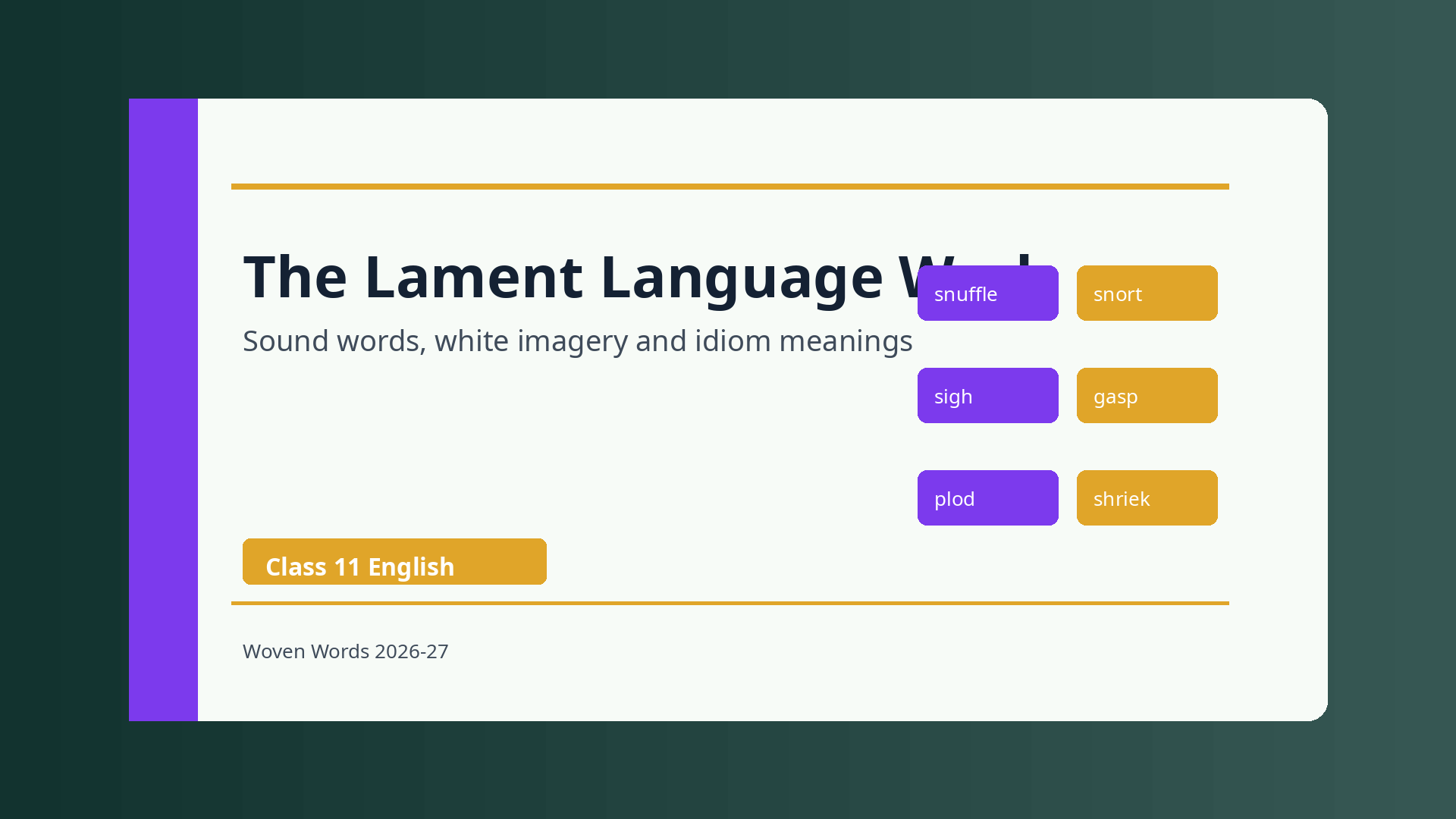
Words close to snigger: titter, chuckle, giggle, chortle and guffaw. These are types of laughter.
Words close to wriggle: sneak, sidle, scramble, straggle and plod. These are forms of movement.
Words close to squeak: squawk, shriek and croak. These are sharp, rough or high sounds.
Words close to jeer: boo. It is a sound of public disapproval or mockery.
Words close to sigh: pant and gasp. These are breath-related sounds.
Sorting method. First ask what the body does: laugh, move, cry out, mock or breathe. Then place each word in that action group.
Laughter words go with snigger because they describe different kinds of laughing.
Movement words go with wriggle because they describe ways of moving the body.
Animal-like or sharp sounds go with squeak.
Social disapproval goes with jeer.
Breath sounds go with sigh.
The best grouping is by action type: laughter, movement, sharp sound, mockery and breath.
If a word seems doubtful, use context. ``Guffaw'' is loud laughter, so it cannot
go with ``sigh''. ``Plod'' is slow walking, so it belongs with movement, not
with sound.
Q 1.12
Explain the associations that the colour white has in the story.
Concept used. Colour imagery can create mood. In this story, white is linked with snow, coldness, stillness, ghostliness and emotional blankness.
Colour imagery
In this chapter, white does not mainly mean purity. It means snow, coldness and Iona's ghost-like grief.
The story opens with thick wet snow lying on roofs, people and horses.
Iona himself is described as quite white and like a phantom.
His horse is also quite white and still.
White usually suggests purity, but here it mainly suggests coldness and numbness.
It also makes Iona look ghost-like, as if grief has removed him from ordinary life.
The white snow covers everything, just as Iona's grief covers his whole world.
White in the story is associated with snow, coldness, silence, death-like stillness and ghostliness. It creates the mood of emotional numbness around Iona and his horse.
MS
Mitali Sen
M.A English, University of Mumbai
Verified Expert
Image reading. The colour white is not cheerful here. Chekhov uses it to drain warmth from the scene.
Snow makes the city visually white, but not peaceful.
Iona's white, phantom-like body suggests he is almost invisible to others.
The white horse mirrors him and shares his isolation.
The colour therefore joins setting, character and theme.
The repeated whiteness also makes Iona nearly disappear into the scene.
This supports the story's social point: the city sees him as a cabdriver,
not as a grieving father who needs to be noticed.
White carries the feeling of cold grief. It makes Iona and his horse look still, ghostly and emotionally frozen.
Q 1.13
What does the phrase ``as if he were on needles'' mean? Can you think of another phrase with a similar meaning substituting the word ``needles''?
Concept used. Idioms use images to express feelings. ``As if he were on needles'' means being restless, uncomfortable and unable to sit calmly.
Idiom clue
Picture the literal image first. Sitting on needles would make a person shift and flinch.
The phrase appears when Iona shifts about on his seat.
He is nervous because the street is crowded and people are shouting at him.
The image of needles suggests sharp discomfort.
So the phrase means that he is uneasy, anxious and physically restless.
A similar phrase is ``as if he were on pins''.
The common idiom is ``on pins and needles'', which means anxious or tense.
``As if he were on needles'' means restless, uneasy and uncomfortable. A similar phrase is ``as if he were on pins'', or the common expression ``on pins and needles''.
IM
Ira Mukherjee
M.A English, University of Hyderabad
Verified Expert
Usage note. The phrase turns emotional tension into a physical image.
A person sitting on needles would keep shifting because of sharp discomfort.
Iona's movements show that same unease.
The idiom therefore expresses anxiety through body language.
``On pins and needles'' keeps the same image and is the nearest modern phrase.
In the story, the idiom also suits Iona's social discomfort. He is not only
driving badly through a crowded street. He is carrying grief that has no safe
place to settle.
It means extremely uneasy or tense. The closest substitute is ``on pins and needles''.
The Lament Class 11 English Woven Words NCERT Solutions FAQs
Ques. Who wrote The Lament in Class 11 Woven Words?
Ans. Anton Chekhov wrote The Lament. The story appears in the Short Stories section of the Class 11 English Woven Words textbook for the 2026-27 session.
Ques. What is the main theme of The Lament?
Ans. The main theme is grief ignored by society. Iona wants to speak about his son's death, but every human listener turns away or interrupts him.
Ques. Why does Iona speak to his horse at the end?
Ans. Iona speaks to his horse because no human being has listened to him. The horse's silent presence becomes more sympathetic than the passengers' speech.
Ques. What does the snowy setting suggest in The Lament?
Ans. The snow suggests coldness, stillness and emotional numbness. It prepares the reader for a city that is active but lacking in human warmth.
Ques. What does the phrase on needles mean in the chapter?
Ans. It means restless, uneasy and uncomfortable. A similar expression is on pins and needles, which means anxious or tense.





Chapter1TheLamentSolutions.pdf?page=1&dpi=150)
Chapter1TheLamentSolutions.pdf?page=2&dpi=150)
Chapter1TheLamentSolutions.pdf?page=3&dpi=150)
Chapter1TheLamentSolutions.pdf?page=4&dpi=150)
Chapter1TheLamentSolutions.pdf?page=5&dpi=150)
Chapter1TheLamentSolutions.pdf?page=6&dpi=150)
Chapter1TheLamentSolutions.pdf?page=7&dpi=150)
Chapter1TheLamentSolutions.pdf?page=8&dpi=150)
Chapter1TheLamentSolutions.pdf?page=9&dpi=150)
Chapter1TheLamentSolutions.pdf?page=10&dpi=150)
Chapter1TheLamentSolutions.pdf?page=11&dpi=150)
Chapter1TheLamentSolutions.pdf?page=12&dpi=150)
Chapter1TheLamentSolutions.pdf?page=13&dpi=150)
Chapter1TheLamentSolutions.pdf?page=14&dpi=150)
Chapter1TheLamentSolutions.pdf?page=15&dpi=150)
Chapter1TheLamentSolutions.pdf?page=16&dpi=150)
Chapter1TheLamentSolutions.pdf?page=17&dpi=150)
Chapter1TheLamentSolutions.pdf?page=18&dpi=150)
Chapter1TheLamentSolutions.pdf?page=19&dpi=150)
Chapter1TheLamentSolutions_flat_MobileCard.pdf?page=1&dpi=150)
Chapter1TheLamentSolutions_flat_MobileCard.pdf?page=2&dpi=150)
Chapter1TheLamentSolutions_flat_MobileCard.pdf?page=3&dpi=150)
Chapter1TheLamentSolutions_flat_MobileCard.pdf?page=4&dpi=150)
Chapter1TheLamentSolutions_flat_MobileCard.pdf?page=5&dpi=150)
Chapter1TheLamentSolutions_flat_MobileCard.pdf?page=6&dpi=150)
Chapter1TheLamentSolutions_flat_MobileCard.pdf?page=7&dpi=150)
Chapter1TheLamentSolutions_flat_MobileCard.pdf?page=8&dpi=150)
Chapter1TheLamentSolutions_flat_MobileCard.pdf?page=9&dpi=150)
Chapter1TheLamentSolutions_flat_MobileCard.pdf?page=10&dpi=150)
Chapter1TheLamentSolutions_flat_MobileCard.pdf?page=11&dpi=150)
Chapter1TheLamentSolutions_flat_MobileCard.pdf?page=12&dpi=150)
Chapter1TheLamentSolutions_flat_MobileCard.pdf?page=13&dpi=150)
Chapter1TheLamentSolutions_flat_MobileCard.pdf?page=14&dpi=150)
Chapter1TheLamentSolutions_flat_MobileCard.pdf?page=15&dpi=150)
Chapter1TheLamentSolutions_flat_MobileCard.pdf?page=16&dpi=150)
Chapter1TheLamentSolutions_flat_MobileCard.pdf?page=17&dpi=150)
Chapter1TheLamentSolutions_flat_MobileCard.pdf?page=18&dpi=150)
Chapter1TheLamentSolutions_flat_MobileCard.pdf?page=19&dpi=150)
Chapter1TheLamentSolutions_flat_MobileCard.pdf?page=20&dpi=150)
Chapter1TheLamentSolutions_flat_MobileCard.pdf?page=21&dpi=150)
Chapter1TheLamentSolutions_flat_MobileCard.pdf?page=22&dpi=150)
Chapter1TheLamentSolutions_flat_MobileCard.pdf?page=23&dpi=150)
Chapter1TheLamentSolutions_flat_MobileCard.pdf?page=24&dpi=150)
Chapter1TheLamentSolutions_flat_MobileCard.pdf?page=25&dpi=150)
Chapter1TheLamentSolutions_flat_MobileCard.pdf?page=26&dpi=150)
Chapter1TheLamentSolutions_flat_MobileCard.pdf?page=27&dpi=150)
Chapter1TheLamentSolutions_flat_MobileCard.pdf?page=28&dpi=150)
Chapter1TheLamentSolutions_flat_MobileCard.pdf?page=29&dpi=150)
Chapter1TheLamentSolutions_flat_MobileCard.pdf?page=30&dpi=150)
Chapter1TheLamentSolutions_flat_MobileCard.pdf?page=31&dpi=150)
Chapter1TheLamentSolutions_flat_MobileCard.pdf?page=32&dpi=150)
Chapter1TheLamentSolutions_flat_MobileCard.pdf?page=33&dpi=150)
Chapter1TheLamentSolutions_flat_MobileCard.pdf?page=34&dpi=150)
Chapter1TheLamentSolutions_flat_MobileCard.pdf?page=35&dpi=150)
Chapter1TheLamentSolutions_flat_MobileCard.pdf?page=36&dpi=150)
Chapter1TheLamentSolutions_flat_MobileCard.pdf?page=37&dpi=150)
Chapter1TheLamentSolutions_flat_MobileCard.pdf?page=38&dpi=150)
Chapter1TheLamentSolutions_flat_MobileCard.pdf?page=39&dpi=150)



Comments