The NCERT Solutions for Class 11 English Woven Words Chapter 4 The Adventure of the Three Garridebs answer every textbook question from the 2026-27 NCERT reader. The page covers Holmes' clues, John Garrideb's false legacy, Watson's wound, the structure of the mystery and the language work printed after the story.
The chapter has 12 answerable prompts across text, discussion, appreciation and language work.
Use the PDF for answers on the false inheritance ruse, Holmes' deduction and Watson's view of Holmes.
The story is from the Short Stories section of Woven Words, Class 11 English elective.
Student Feedback: In a Collegedunia student poll of 7,940 Class 11 English students before the 2026 exams, many students said the hardest part of The Adventure of the Three Garridebs was connecting Holmes' casual questions with the final solution.
Every answer here is written for the latest 2026-27 NCERT Woven Words text and keeps the wording short enough for school answer sheets.
The Adventure of the Three Garridebs Class 11 Question Pattern
The exercise after The Adventure of the Three Garridebs moves from direct plot questions to discussion, appreciation and language work. Students should prepare the clue chain and the Holmes-Watson relationship together.
NCERT section
Number of prompts
What it tests
Understanding the Text
5
Holmes' clues, John's objective, Presbury and Little Ryder Street
Talking about the Text
3
Holmes and Watson, criminal clues and Holmes' digressions
Appreciation
2
Story structure and subtle humour
Language Work
2
American/British spelling and figurative expressions
Holmes' Clue Chain in The Adventure of the Three Garridebs
Holmes does not solve the case through one lucky guess. He builds a chain from John's behaviour, speech, written advertisement and motive. The key is that every clue points toward the same purpose: Nathan Garrideb must be sent away from his room.
John dislikes Holmes' involvement because the story cannot bear close testing.
The fake Kansas reference exposes John's weak background story.
The advertisement carries American wording and links back to John.
The Birmingham trip gives John time to enter Little Ryder Street.
John Garrideb's False Legacy and Real Motive
The promised legacy from Alexander Hamilton Garrideb is a trap. It flatters Nathan's rare surname and sends him on a useless journey. John's real motive is access to the room connected with Roger Presbury and the hidden criminal equipment.
Surface story
Hidden purpose
Holmes' reading
Three Garridebs must be found
Nathan must leave London
The inheritance is bait
Howard Garrideb is in Birmingham
The room becomes empty
The advertisement is planted
John is helping Nathan
John wants concealed material
The helper is the criminal
Holmes and Watson Relationship in the Chapter
Watson's wound changes the emotional temperature of the story. Holmes is usually controlled and sharp, but when Watson is hurt, the cold mask breaks. This moment proves that their partnership is also a deep friendship.
Professional partnership: Watson observes and records Holmes' cases.
Shared danger: both men face Killer Evans in the room.
Hidden affection: Holmes' worry reveals loyalty and love.
Story Structure and Subtle Humour
The story has a classic Holmes structure: a strange opening problem, a suspicious visitor, indirect tests, a risky visit to the crime scene and a final explanation. Subtle humour comes from the odd surname, the unlikely legacy and Holmes' dry handling of a serious criminal plot.
The narrator is Dr Watson, so suspense is filtered through his partial knowledge.
The climax at Little Ryder Street turns detection into physical danger.
The resolution explains both the crime and Holmes' emotional reaction.
Language Work Answers for The Adventure of the Three Garridebs
The Language Work section connects English usage with detection. American spelling and idiom expose the advertisement, while the figurative phrases fit the story's search-and-trap pattern.
All NCERT Solutions for Class 11 English Woven Words Chapter 4 The Adventure of the Three Garridebs with Step-by-Step Solutions
Questions
Q 4.1
What clues did Sherlock Holmes work upon to get at the fact that the story of the three Garridebs was a ruse?
Concept used. A detective clue is a small inconsistency that does not fit the suspect's story. Holmes notices language, behaviour, background and motive together.
Answer focus
Do not list only one clue. The answer needs a chain of clues that grows stronger.
John Garrideb becomes uneasy when Nathan says that Holmes has been consulted. A truthful helper would welcome a detective.
Holmes notices that John claims to be American, but his appearance and manner do not fully support that claim.
Holmes tests him with Dr Lysander Starr. John pretends to recognise a person who does not exist.
The advertisement about Howard Garrideb is written in American spelling and idiom, although it is placed in an English setting.
The plan conveniently sends Nathan away from his room, which is exactly what John needs.
These points show that the legacy story is not real. It is a bait to remove Nathan from Little Ryder Street.
Holmes sees the ruse through John's irritation, false American background, careless response to a fake name, American wording in the advertisement and the convenient plan to send Nathan away.
RM
Rhea Malhotra
M.A English, University of Delhi
Verified Expert
Concept used. This expert route reads the question through clue, motive and narrative purpose, then ties the point back to the chapter.
The strongest clue is not one fact by itself, but the pattern created by all the facts.
Holmes first studies John's reaction. His annoyance at Holmes' involvement shows fear, not cooperation.
Then Holmes tests his claimed background indirectly. The false Dr Starr trap proves that John is inventing familiarity with Kansas.
The advertisement supplies written evidence. Its American usage points back to John.
Finally, the timing explains motive. Nathan's journey to Birmingham leaves the room free for a criminal search.
Holmes treats every odd detail as part of one design. John Garrideb wants Nathan out of the room, so the third Garrideb story must be a fraud.
Q 4.2
What was John Garrideb's objective in inventing the story of Alexander Hamilton Garrideb and his legacy?
Concept used. Objective means the real purpose behind an action. John's story is a cover for a planned burglary, not a search for an heir.
Answer focus
Keep the legacy in quotation marks in your mind. It is the bait, not the truth.
John knows that Nathan Garrideb owns a room once connected with Roger Presbury.
Below or near that room is the hidden criminal equipment John wants to recover.
He cannot search the place while Nathan is present.
So he invents Alexander Hamilton Garrideb and a large legacy for three people with the same surname.
He then manufactures the Birmingham lead so Nathan will leave London.
The false inheritance story is therefore a device to gain private access to Nathan's rooms.
John invents the Alexander Garrideb legacy to send Nathan away and enter his room. His real aim is to recover the hidden criminal equipment linked with Presbury.
KS
Kunal Sen
M.A English, Jadavpur University
Verified Expert
Concept used. This expert route reads the question through clue, motive and narrative purpose, then ties the point back to the chapter.
John's plan works because it flatters Nathan's unusual surname and collector's curiosity.
The inheritance sounds harmless, so Nathan does not suspect danger.
The Birmingham advertisement gives the lie a practical next step.
Once Nathan leaves, John can search the room without interruption.
This is why Holmes calls the story a ruse. It creates movement for Nathan and opportunity for John.
The legacy is a false trail. John's actual objective is entry into Nathan's room and access to the concealed criminal material there.
Q 4.3
Why didn't John Garrideb like the idea of including Holmes in the hunt for the third Garrideb?
Concept used. A guilty person fears independent investigation. Holmes is dangerous to John because he can test the story instead of merely believing it.
Answer focus
The question is about John's fear, not about Holmes' fame alone.
John's plan depends on Nathan accepting the Garrideb story without close checking.
Holmes is known for noticing contradictions in speech, dress and documents.
If Holmes joins the search, he may examine the advertisement and John's background.
John also risks being identified as a criminal with another name.
So he tries to keep the matter between himself and Nathan.
John dislikes Holmes' involvement because a real detective can expose the false legacy, the planted advertisement and John's criminal identity.
MS
Meera Sanyal
M.A English, University of Delhi
Verified Expert
Concept used. This expert route reads the question through clue, motive and narrative purpose, then ties the point back to the chapter.
John wants a passive victim, not an active investigator.
Nathan is gentle, bookish and easily excited by the rare surname.
Holmes is the opposite. He asks lateral questions and verifies tiny details.
John understands that Holmes may see the plan as a staged absence from the room.
His discomfort therefore becomes the first signal that he has something to hide.
John fears Holmes because Holmes can turn a simple surname hunt into a criminal investigation.
Q 4.4
Who was Roger Presbury and how was John Garrideb connected with him?
Concept used. This answer needs the hidden backstory. Roger Presbury is connected to the earlier crime and to the room John wants to search.
Answer focus
Use both names: Roger Presbury and Killer Evans. That makes the link clear.
Roger Presbury was linked with the place where Nathan Garrideb now lives.
He was connected with the hidden printing equipment that John Garrideb wants.
John Garrideb is not an innocent American heir-hunter. He is Killer Evans under a false identity.
Evans had earlier shot Presbury during a criminal quarrel.
He now returns under the name John Garrideb to recover what Presbury left behind.
Roger Presbury was the earlier occupant connected with the hidden press. John Garrideb, really Killer Evans, had shot him and came back to recover the concealed criminal equipment.
AT
Arvind Thomas
M.A English, EFLU Hyderabad
Verified Expert
Concept used. This expert route reads the question through clue, motive and narrative purpose, then ties the point back to the chapter.
The Presbury detail changes the story from comic inheritance hunt to crime story.
John is not merely lying about the third Garrideb. He is hiding a violent past.
Presbury's old connection with the room explains why Nathan's address matters so much.
The hidden press gives John a material motive.
The false name lets him approach Nathan without revealing that motive.
Presbury is the missing link between the room, the old crime and John's present deception.
Q 4.5
How did Holmes guess that John Garrideb would go to 136, Little Ryder Street? Did he expect to find what he ultimately did before he went there?
Concept used. Inference means drawing a conclusion from motive and timing. Holmes predicts John's movement because he understands the purpose of the ruse.
Answer focus
Answer both parts: why Holmes went there and whether he knew the exact discovery.
Holmes realises that the Birmingham journey is designed to remove Nathan from his room.
If Nathan is away, John must use that same period to search the room.
The address at 136, Little Ryder Street is therefore the centre of the plot.
Holmes and Watson wait there because John is likely to arrive when the room is empty.
Holmes expects criminal activity, but he may not know every detail of the hidden object before entry.
What he finally finds confirms that the inheritance tale was only a cover.
Holmes guesses the address from motive. John needs Nathan's room empty, so he must come to Little Ryder Street. Holmes expects a criminal search, though the exact discovery is confirmed only at the scene.
AR
Aditi Rao
Ph.D English, University of Hyderabad
Verified Expert
Concept used. This expert route reads the question through clue, motive and narrative purpose, then ties the point back to the chapter.
Holmes' prediction is a study of opportunity.
A false appointment in Birmingham has no value unless it creates an empty room in London.
So the detective reverses the plan: instead of following Nathan, he watches the place John wants.
This is why Holmes reaches 136, Little Ryder Street before the criminal can complete his work.
The discovery is not a lucky accident. It is the logical result of reading the plan backwards.
Holmes goes to the room because the whole plot is designed around gaining access to that room.
Q 4.6
It was worth a wound, it was worth many wounds, to know the depth of loyalty and love that lay behind that cold mask. How does this comment throw light on the kind of relationship between Holmes and Watson?
Concept used. Character relationship is shown through crisis. Watson's wound reveals Holmes' hidden affection beneath his controlled exterior.
Answer focus
Do not call Holmes emotionless. The line proves that his emotion is hidden, not absent.
Watson is shot when Killer Evans fires during the confrontation.
Holmes immediately shows intense anxiety for Watson's safety.
Watson notices that Holmes' usually calm face changes under emotional pressure.
The cold mask means Holmes' normal self-control and reserve.
The loyalty and love behind it show a deep friendship built through shared danger.
Watson values this revelation so much that even the wound seems worth it.
The comment shows that Holmes and Watson share a deep friendship. Holmes may appear cold, but Watson's injury reveals his loyalty, affection and fear of losing his friend.
KT
Kavya Thomas
M.A English, Christ University
Verified Expert
Concept used. This expert route reads the question through clue, motive and narrative purpose, then ties the point back to the chapter.
The line is important because Watson rarely receives open emotional proof from Holmes.
Their partnership is professional on the surface: detective and doctor, reason and record.
Yet danger exposes the private bond beneath that surface.
Holmes' concern is spontaneous, so Watson trusts it completely.
The wound becomes a painful but precious moment of emotional truth.
Watson sees that Holmes' reserve hides strong love and loyalty. Their friendship is therefore deeper than their formal partnership.
Q 4.7
The cleverest of criminals leave behind clues to their crime. Discuss.
Concept used. Crime fiction often depends on the idea that no deception is perfect. Human pride, haste and habit leave traces.
Answer focus
Use John Garrideb as the main example, then widen the point.
John Garrideb prepares a clever story about a rare surname and a large inheritance.
He also plants an advertisement to make the Birmingham lead look real.
Yet his irritation at Holmes' involvement betrays anxiety.
His false background fails when Holmes tests him with invented details.
His American spelling and wording in the advertisement become another clue.
Thus the clever plan fails because small traces expose its maker.
The story proves that clever criminals still leave clues. John hides behind a false name and legacy, but his behaviour, speech, spelling and motive reveal the crime.
NK
Nisha Kapoor
M.A English, Jamia Millia Islamia
Verified Expert
Concept used. This expert route reads the question through clue, motive and narrative purpose, then ties the point back to the chapter.
A clever criminal often controls the main story but overlooks side details.
John controls Nathan's imagination with the Garrideb legacy.
He does not control Holmes' attention to language and reaction.
The advertisement is especially revealing because writing carries habit.
Holmes solves the case by reading those neglected traces.
Criminal intelligence is limited by carelessness. Holmes wins because he studies the small details John assumes are unimportant.
Q 4.8
How did Holmes' digressions sometimes prove in the end to have a bearing on the matter on hand?
Concept used. A digression seems unrelated, but in detective work it may be an indirect test. Holmes uses casual talk as a trap.
Answer focus
Explain the method. Holmes does not wander away from the case. He appears to wander.
Holmes asks questions that may look casual or irrelevant to Watson and to the suspect.
He talks about background, names, places and professional details.
These remarks test whether John's claimed identity is genuine.
The false reference to Dr Lysander Starr is one such trap.
John's confident response shows that he is pretending knowledge.
So the apparent digressions are really tools for verification.
Holmes' digressions matter because they are disguised tests. They make John reveal false knowledge, weak preparation and anxiety without realising that he is being examined.
DN
Devika Nair
M.A English, University of Calicut
Verified Expert
Concept used. This expert route reads the question through clue, motive and narrative purpose, then ties the point back to the chapter.
Holmes' method is indirect because direct questions warn a criminal.
A suspect can prepare for obvious questions about motive.
He is less prepared for casual remarks about places, names and habits.
Holmes uses this weakness to test John's American story.
By the end, each apparently stray point has helped expose the ruse.
Holmes' digressions are part of the investigation. They gather proof while appearing harmless.
Q 4.9
Examine the structure of the short story The Adventure of the Three Garridebs with the help of the given framework.
Concept used. Structure means how the story is arranged: narrator, introduction, development, climax and resolution.
Answer focus
Use the framework headings in your answer. It keeps the response organised.
The narrator is Dr Watson, who tells the story in first person and filters events through friendship with Holmes.
The topic is introduced through the strange surname Garrideb and the promised legacy.
The main characters appear through their roles: Holmes the detective, Watson the narrator, Nathan the victim and John the impostor.
The plot develops as Holmes tests John's claims and follows the Birmingham advertisement clue.
The climax comes at Little Ryder Street, where John is caught and Watson is wounded.
The resolution explains John's identity, Presbury's link, the hidden criminal object and Holmes' affection for Watson.
The story moves from mystery to exposure. Watson narrates, the Garrideb legacy introduces the puzzle, Holmes tests the clues, the Little Ryder Street scene provides the climax and the final explanation resolves the case.
SK
Samar Khanna
M.A Comparative Literature, Jadavpur University
Verified Expert
Concept used. This expert route reads the question through clue, motive and narrative purpose, then ties the point back to the chapter.
The structure is typical of a Holmes story but also emotionally rich.
The opening creates curiosity through a strange surname and an incomplete backstory.
The middle gives the reader enough clues to suspect deception.
The climax turns intellectual detection into physical danger.
The ending solves the crime and reveals Holmes' hidden feeling for Watson.
The structure balances suspense, detection and emotion. The mystery is solved, and the friendship is deepened.
Q 4.10
Examine the subtle humour in the narration of the story that lightens the gravity of the subject matter.
Concept used. Subtle humour is quiet wit that reduces heaviness without destroying suspense. Doyle uses it through Holmes' tone, odd names and ironic situations.
Answer focus
Mention humour and gravity together. The story is funny in places, but the crime is serious.
The surname Garrideb itself sounds unusual and creates a comic surface.
The idea of finding three people with the same rare name for a fortune has an absurd quality.
Holmes' dry comments and calm manner add wit to tense investigation.
His casual traps make John look foolish without open mockery.
Nathan's excitement over the name and legacy also has gentle humour.
This humour lightens the story until the serious criminal truth appears.
The humour comes from the odd surname, the unlikely legacy, Holmes' dry wit and the contrast between comic surface and serious crime. It makes the suspense lively without weakening the danger.
LM
Leena Mathew
M.A Linguistics, University of Kerala
Verified Expert
Concept used. This expert route reads the question through clue, motive and narrative purpose, then ties the point back to the chapter.
The story would be grim if it were only about murder, hidden criminal tools and a shooting.
Doyle prevents that heaviness by giving the case an eccentric outer shape.
Holmes' humour is controlled. He does not turn the case into farce.
Instead, he lets the absurdity of John's invented story expose the criminal mind.
The result is a mystery that entertains while still delivering danger and justice.
Subtle humour works as a contrast. It keeps the narration light until the grave truth behind the ruse is revealed.
Q 4.11
Identify the words in the advertisement that gave away the fact that it was placed by John Garrideb, and make a list of words spelt differently in American and British English.
Concept used. Language can reveal identity. Spelling and usage often show whether a writer follows American or British English.
Answer focus
Answer the advertisement clue first, then give a small table of spelling pairs.
The advertisement gives itself away through American wording and spelling habits.
The phrase noted in the text points to a writer using American English rather than natural British usage.
This matters because John claims a background that Holmes is already testing.
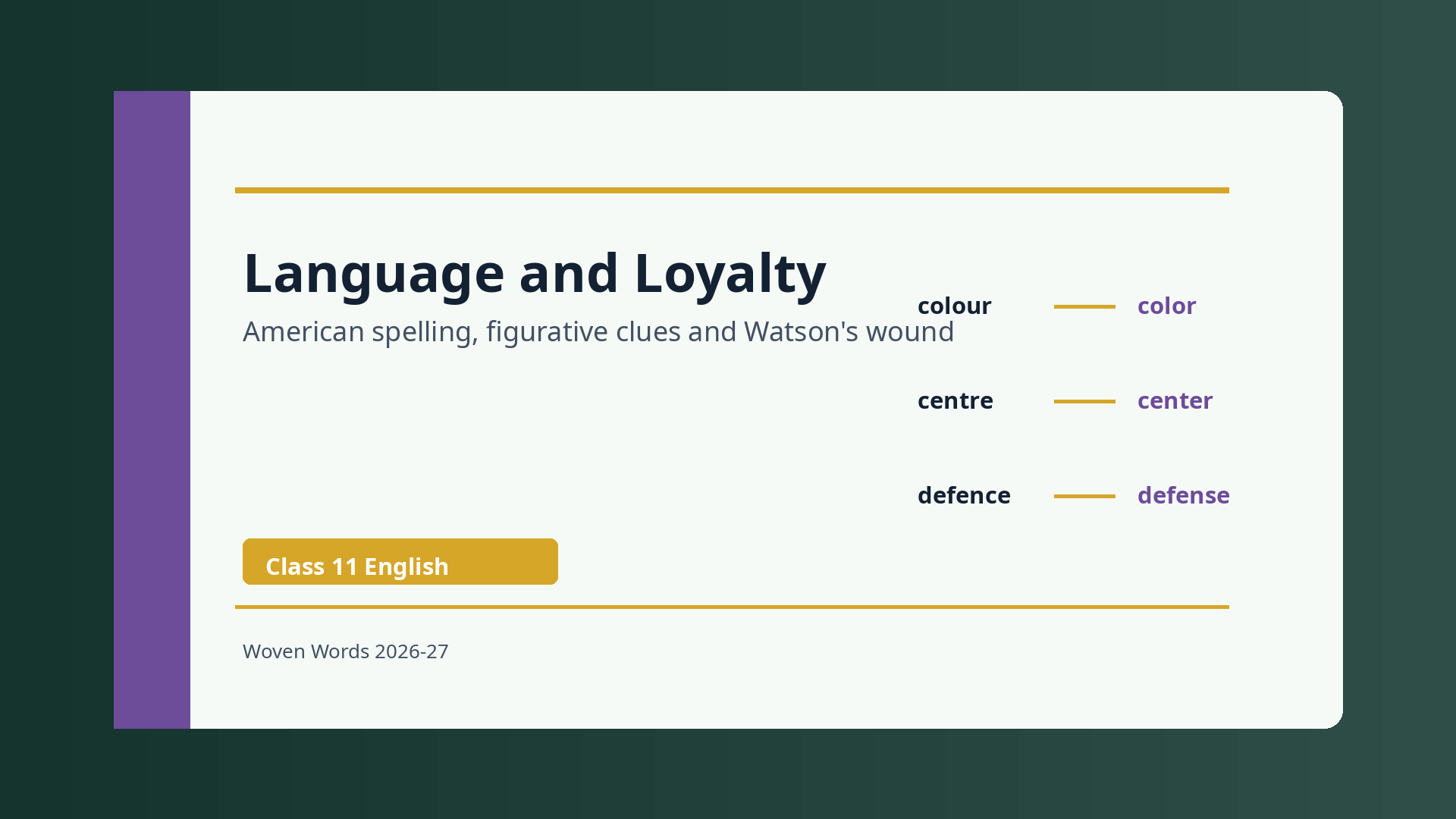
Common spelling pairs include colour and color, honour and honor, defence and defense.
Other pairs are centre and center, theatre and theater, traveller and traveler.
Such differences help Holmes connect the advertisement with John.
The advertisement is exposed by American usage. Examples of spelling differences are colour/color, honour/honor, defence/defense, centre/center, theatre/theater and traveller/traveler.
IM
Ira Mukherjee
M.A English, University of Hyderabad
Verified Expert
Concept used. This expert route reads the question through clue, motive and narrative purpose, then ties the point back to the chapter.
This language-work question links grammar to detection.
Holmes does not treat spelling as a school exercise only.
He treats it as evidence of habit and origin.
A person can invent a story, but everyday spelling patterns often remain automatic.
That is why the advertisement helps reveal John's hand in the plot.
American wording in the advertisement becomes linguistic evidence against John Garrideb.
Q 4.12
Explain the figurative meanings of fine-toothed comb, putting up a bird, cock pheasant, bolt-hole and castle in the air.
Concept used. Figurative meaning is the non-literal meaning of an expression. These phrases come from search, hunting, escape and imagination.
Answer focus
A table is the cleanest way to answer phrase-meaning questions.
Fine-toothed comb means a very careful and detailed search.
Putting up a bird means flushing something hidden into view, like a hunter making a bird rise.
Cock pheasant means a striking or obvious find that should not be missed.
Bolt-hole means a secret place of escape or hiding.
Castle in the air means an unrealistic dream or imaginary plan.
In the story, these phrases suit detection because Holmes is searching for what is hidden.
Fine-toothed comb means minute search. Putting up a bird means bringing a hidden thing out. Cock pheasant means an obvious find. Bolt-hole means escape place. Castle in the air means unrealistic dream.
PB
Parth Banerjee
M.A English Language, University of Calcutta
Verified Expert
Concept used. This expert route reads the question through clue, motive and narrative purpose, then ties the point back to the chapter.
The expressions also fit the story's action.
Holmes searches the case with a fine-toothed comb.
John hopes for a bolt-hole, but Holmes denies him one.
The invented legacy is a castle in the air because it collapses when tested.
The hunting images match Holmes' method of flushing out hidden truth.
The phrases are figurative shortcuts for careful search, exposure, obvious evidence, escape and false dreaming.
The Adventure of the Three Garridebs Class 11 English Woven Words NCERT Solutions FAQs
Ques. What is the main mystery in The Adventure of the Three Garridebs?
Ans. The main mystery is the false Garrideb inheritance story. John invents it to send Nathan away and search his room.
Ques. Why does John Garrideb fear Holmes?
Ans. John fears Holmes because Holmes can test his background, read the advertisement and expose the false legacy plan.
Ques. How many NCERT questions are solved in this PDF?
Ans. The PDF solves 12 NCERT prompts from Understanding the Text, Talking about the Text, Appreciation and Language Work.
Ques. What does Watson's wound reveal about Holmes?
Ans. Watson's wound reveals Holmes' hidden love and loyalty. His cold mask breaks when his friend is in danger.





Chapter4TheAdventureoftheThreeGarridebsSolutions.pdf?page=1&dpi=150)
Chapter4TheAdventureoftheThreeGarridebsSolutions.pdf?page=2&dpi=150)
Chapter4TheAdventureoftheThreeGarridebsSolutions.pdf?page=3&dpi=150)
Chapter4TheAdventureoftheThreeGarridebsSolutions.pdf?page=4&dpi=150)
Chapter4TheAdventureoftheThreeGarridebsSolutions.pdf?page=5&dpi=150)
Chapter4TheAdventureoftheThreeGarridebsSolutions.pdf?page=6&dpi=150)
Chapter4TheAdventureoftheThreeGarridebsSolutions.pdf?page=7&dpi=150)
Chapter4TheAdventureoftheThreeGarridebsSolutions.pdf?page=8&dpi=150)
Chapter4TheAdventureoftheThreeGarridebsSolutions.pdf?page=9&dpi=150)
Chapter4TheAdventureoftheThreeGarridebsSolutions.pdf?page=10&dpi=150)
Chapter4TheAdventureoftheThreeGarridebsSolutions.pdf?page=11&dpi=150)
Chapter4TheAdventureoftheThreeGarridebsSolutions.pdf?page=12&dpi=150)
Chapter4TheAdventureoftheThreeGarridebsSolutions.pdf?page=13&dpi=150)
Chapter4TheAdventureoftheThreeGarridebsSolutions.pdf?page=14&dpi=150)
Chapter4TheAdventureoftheThreeGarridebsSolutions.pdf?page=15&dpi=150)
Chapter4TheAdventureoftheThreeGarridebsSolutions.pdf?page=16&dpi=150)
Chapter4TheAdventureoftheThreeGarridebsSolutions_flat_MobileCard.pdf?page=1&dpi=150)
Chapter4TheAdventureoftheThreeGarridebsSolutions_flat_MobileCard.pdf?page=2&dpi=150)
Chapter4TheAdventureoftheThreeGarridebsSolutions_flat_MobileCard.pdf?page=3&dpi=150)
Chapter4TheAdventureoftheThreeGarridebsSolutions_flat_MobileCard.pdf?page=4&dpi=150)
Chapter4TheAdventureoftheThreeGarridebsSolutions_flat_MobileCard.pdf?page=5&dpi=150)
Chapter4TheAdventureoftheThreeGarridebsSolutions_flat_MobileCard.pdf?page=6&dpi=150)
Chapter4TheAdventureoftheThreeGarridebsSolutions_flat_MobileCard.pdf?page=7&dpi=150)
Chapter4TheAdventureoftheThreeGarridebsSolutions_flat_MobileCard.pdf?page=8&dpi=150)
Chapter4TheAdventureoftheThreeGarridebsSolutions_flat_MobileCard.pdf?page=9&dpi=150)
Chapter4TheAdventureoftheThreeGarridebsSolutions_flat_MobileCard.pdf?page=10&dpi=150)
Chapter4TheAdventureoftheThreeGarridebsSolutions_flat_MobileCard.pdf?page=11&dpi=150)
Chapter4TheAdventureoftheThreeGarridebsSolutions_flat_MobileCard.pdf?page=12&dpi=150)
Chapter4TheAdventureoftheThreeGarridebsSolutions_flat_MobileCard.pdf?page=13&dpi=150)
Chapter4TheAdventureoftheThreeGarridebsSolutions_flat_MobileCard.pdf?page=14&dpi=150)
Chapter4TheAdventureoftheThreeGarridebsSolutions_flat_MobileCard.pdf?page=15&dpi=150)
Chapter4TheAdventureoftheThreeGarridebsSolutions_flat_MobileCard.pdf?page=16&dpi=150)
Chapter4TheAdventureoftheThreeGarridebsSolutions_flat_MobileCard.pdf?page=17&dpi=150)
Chapter4TheAdventureoftheThreeGarridebsSolutions_flat_MobileCard.pdf?page=18&dpi=150)
Chapter4TheAdventureoftheThreeGarridebsSolutions_flat_MobileCard.pdf?page=19&dpi=150)
Chapter4TheAdventureoftheThreeGarridebsSolutions_flat_MobileCard.pdf?page=20&dpi=150)
Chapter4TheAdventureoftheThreeGarridebsSolutions_flat_MobileCard.pdf?page=21&dpi=150)
Chapter4TheAdventureoftheThreeGarridebsSolutions_flat_MobileCard.pdf?page=22&dpi=150)
Chapter4TheAdventureoftheThreeGarridebsSolutions_flat_MobileCard.pdf?page=23&dpi=150)
Chapter4TheAdventureoftheThreeGarridebsSolutions_flat_MobileCard.pdf?page=24&dpi=150)
Chapter4TheAdventureoftheThreeGarridebsSolutions_flat_MobileCard.pdf?page=25&dpi=150)
Chapter4TheAdventureoftheThreeGarridebsSolutions_flat_MobileCard.pdf?page=26&dpi=150)
Chapter4TheAdventureoftheThreeGarridebsSolutions_flat_MobileCard.pdf?page=27&dpi=150)
Chapter4TheAdventureoftheThreeGarridebsSolutions_flat_MobileCard.pdf?page=28&dpi=150)
Chapter4TheAdventureoftheThreeGarridebsSolutions_flat_MobileCard.pdf?page=29&dpi=150)
Chapter4TheAdventureoftheThreeGarridebsSolutions_flat_MobileCard.pdf?page=30&dpi=150)
Chapter4TheAdventureoftheThreeGarridebsSolutions_flat_MobileCard.pdf?page=31&dpi=150)
Chapter4TheAdventureoftheThreeGarridebsSolutions_flat_MobileCard.pdf?page=32&dpi=150)




Comments