The NCERT Solutions for Class 11 English Woven Words Chapter 5 Pappachi's Moth answer every textbook question from the 2026-27 NCERT reader. The page covers Mammachi and Pappachi's relationship, Mammachi's resilience, John Ipe's retirement, the moth discovery, social issues, irony and the Language Work tasks.
The chapter has 12 answerable prompts across Understanding the Text, Talking about the Text, Appreciation and Language Work.
Use the PDF for answers on domestic power, wounded pride, social respectability and Roy's concise narration.
The story is from the Short Stories section of Woven Words, Class 11 English elective.
Student Feedback: In a Collegedunia student poll of 7,940 Class 11 English students before the 2026 exams, many students said the hardest part of Pappachi's Moth was explaining social criticism without turning the answer into a general essay.
Every answer here is written for the latest 2026-27 NCERT Woven Words text and keeps the wording short enough for school answer sheets.
The exercise after Pappachi's Moth moves from direct character questions to discussion, appreciation and vocabulary work. Students should prepare Mammachi's resilience and Pappachi's pride together because both ideas explain the chapter's social critique.
NCERT section
Number of prompts
What it tests
Understanding the Text
4
Mammachi, Pappachi, retirement and the moth
Talking about the Text
3
Chacko's firmness, public elegance and family approval
Mammachi and Pappachi Relationship in Pappachi's Moth
Mammachi and Pappachi's relationship is unequal and painful. Pappachi cannot accept Mammachi's business success or musical promise because both make her visible when he feels stripped of status. The key point is that Roy criticises patriarchy by showing daily behaviour, not by adding a lecture.
Pappachi refuses to help with pickle-making because he thinks it is beneath his rank.
Mammachi still manages production despite weak eyesight and household hostility.
Chacko stops physical violence, but emotional silence remains.
Mammachi's grief at the funeral is linked to habit, not simple love.
Why the Moth Matters in John Ipe's Life
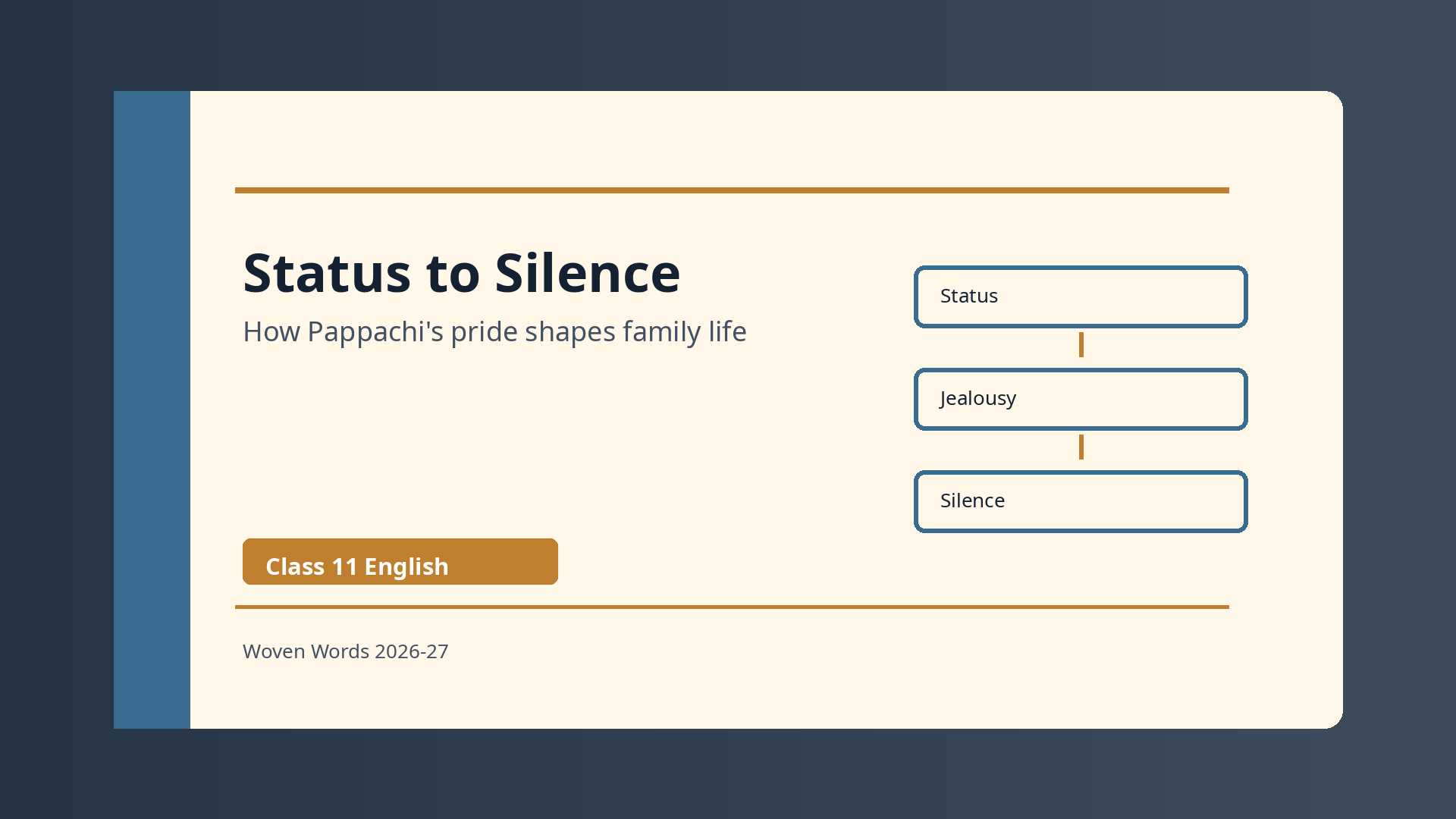
The moth is the emotional centre of Pappachi's bitterness. He discovers it, loses recognition for it and later watches the credit go elsewhere. This professional wound turns into a private resentment that affects his wife, children and grandchildren.
Event
Meaning
Answer point
Moth falls into Pappachi's drink
Discovery begins
He expects fame and taxonomic credit
Initial identification dismisses it
Pride is wounded
He feels the world has not recognised him
Later reshuffle names it after another officer
Recognition is lost
The moth becomes a symbol of permanent resentment
Social Issues Raised Through Subtle Suggestion
Roy raises domestic violence, patriarchy, public hypocrisy and the need for approval through small details. The brass flower vase, the broken violin bow, the tailored suits and the skyblue Plymouth all carry social meaning.
Domestic power: Pappachi uses violence and silence to control Mammachi.
Public image: his polished clothes hide private cruelty.
Irony: the respectable man is morally smaller than the woman he humiliates.
Language Work Answers for Pappachi's Moth
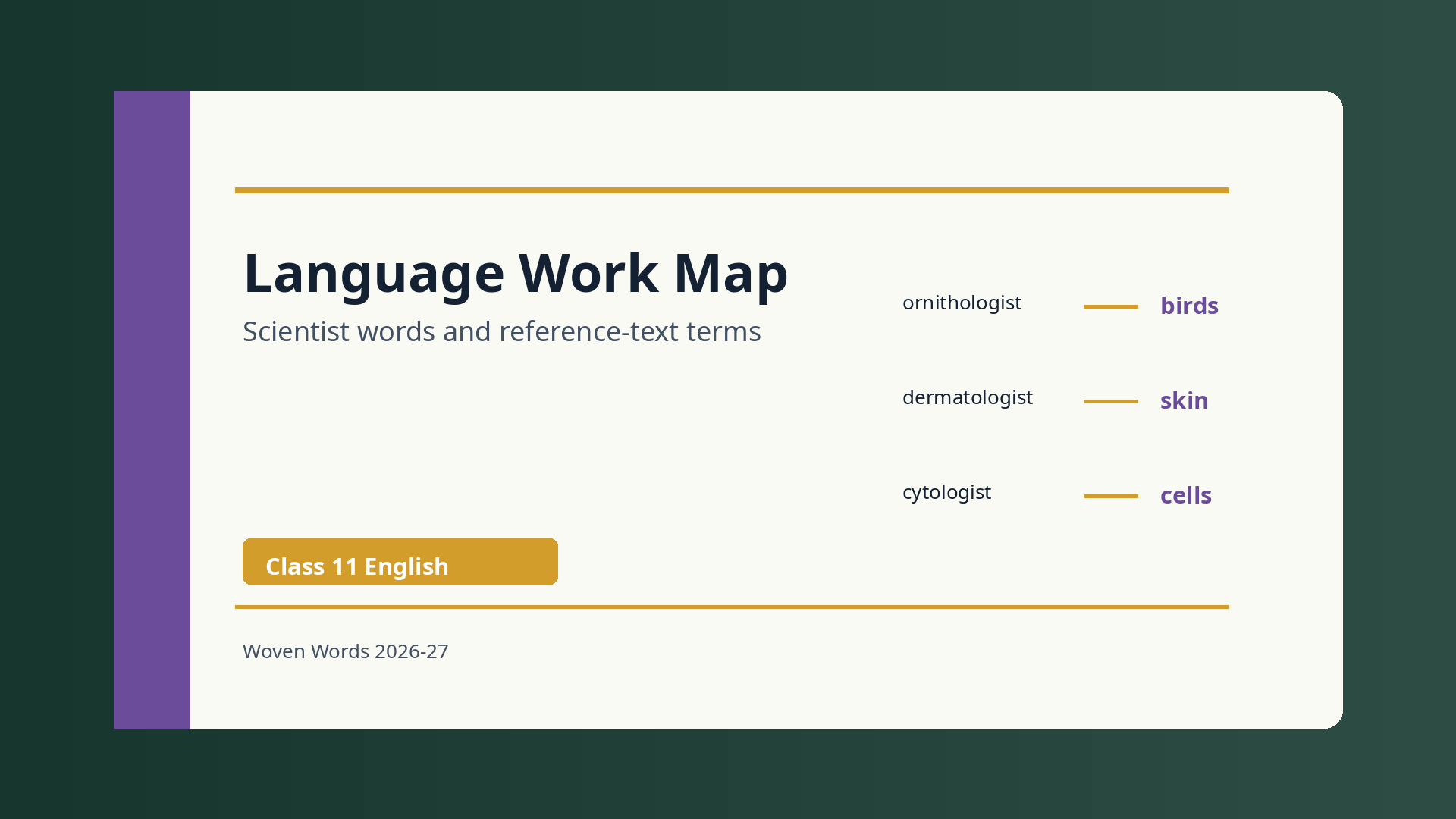
The Language Work section asks students to connect specialist words with fields of study and to identify common reference-text terms. These answers are short, but they should still be precise.
Term
Where or what it means
Ornithologist
Scientist who studies birds
Dermatologist
Scientist or doctor who studies skin
Cytologist
Scientist who studies cells
Epitaph
Text found on a tombstone or memorial
Abstract
Summary found before a research paper or report
Common Mistakes Students Make in Pappachi's Moth Answers
Avoid these answer-sheet mistakes:
Writing only that Pappachi was angry without explaining his wounded pride.
Forgetting Mammachi's independence as a businesswoman and musician.
Calling Chacko's scene only physical strength and missing the moral boundary.
Explaining irony without examples from the suits, buttons, Plymouth or funeral.
Mixing up ornithologist, dermatologist and cytologist in Language Work.
More Class 11 English Woven Words Chapter 5 Resources
Use the related Woven Words resources when you need the chapter text, quick notes or handwritten revision pages along with these solved answers.
All NCERT Solutions for Class 11 English Woven Words Chapter 5 Pappachi's Moth with Step-by-Step Solutions
Questions
Q 5.1
Comment on the relationship shared by Mammachi and Pappachi.
Concept used. Relationship analysis means looking at power, behaviour and emotional distance. Mammachi and Pappachi share a marriage shaped by fear, resentment and habit rather than tenderness.
Answer focus
Do not describe it as only unhappy. Show the social power that allows Pappachi to control her.
Pappachi is much older than Mammachi and expects authority inside the family.
He resents Mammachi's success in the pickle business after his retirement.
He refuses to help her because he thinks pickle-making is beneath a former government officer.
His jealousy turns violent, and he beats her regularly with a brass flower vase.
When Chacko stops the violence, Pappachi does not become affectionate. He stops speaking to Mammachi.
Mammachi's tears at his funeral show habit and long conditioning more than real love.
Mammachi and Pappachi share a deeply unequal relationship. Pappachi controls, humiliates and hurts her, while Mammachi endures the marriage through habit, social pressure and domestic dependence.
RM
Rhea Menon
M.A English, University of Delhi
Verified Expert
Concept used. This expert route reads the answer through character, social setting and exam purpose, then connects the point back to the NCERT prompt.
The relationship is built on patriarchy and wounded male pride.
Pappachi cannot accept that Mammachi has public value after his own official life ends.
Her talent in business and music becomes a threat to his self-image.
The violence and silence are both forms of control.
Roy shows that a marriage can continue physically while emotional companionship has almost disappeared.
The marriage reveals domestic oppression. Pappachi's jealousy and violence reduce Mammachi's life, but they do not erase her resilience.
Q 5.2
How does Mammachi stand out as an independent and resilient woman in the text?
Concept used. Resilience means the ability to keep working and creating despite pain. Mammachi shows independence through skill, enterprise and endurance.
Answer focus
Use both the pickle business and the violin reference. Both show her talent.
Mammachi begins making pickles and jam commercially after a fair creates demand.
She manages orders, buying, weighing, salting, drying and production despite poor eyesight.
Her work succeeds so well that she remains busy all year round.
She also has musical talent, and her violin teacher considers her potentially concert class.
Pappachi tries to crush both her public success and her artistic gift.
Even then, Mammachi continues the business and becomes the centre of useful labour in the household.
Mammachi stands out because she builds a successful pickle business, shows musical ability and survives a harsh marriage. Her strength is quiet, practical and persistent.
AR
Ananya Rao
M.A English, Jadavpur University
Verified Expert
Concept used. This expert route reads the answer through character, social setting and exam purpose, then connects the point back to the NCERT prompt.
Mammachi's independence is not loud rebellion. It is visible in competence.
She turns domestic knowledge into commercial work.
She does this while nearly blind, which makes the achievement stronger.
Her resilience also appears in the fact that Pappachi's jealousy cannot make her useless.
The text lets her labour speak against the household's patriarchal judgement.
Mammachi's resilience lies in productive work, artistic promise and the ability to continue despite humiliation.
Q 5.3
Why does John Ipe consider retirement to be a dishonour?
Concept used. Dishonour here comes from status loss. John Ipe has tied his identity to rank, title and official importance.
Answer focus
Name him as Pappachi too, so the answer stays connected to the story.
John Ipe, or Pappachi, has been a high-ranking entomologist in government service.
He is used to official authority, respect and public recognition.
Retirement removes the role that made him feel important.
He also sees his wife still active and successful while he feels old.
This contrast wounds his pride and makes retirement feel like public defeat.
So he experiences retirement not as rest but as loss of masculine and social status.
John Ipe considers retirement dishonourable because it strips him of rank, public respect and purpose. Mammachi's success makes his loss of importance feel sharper.
KS
Kunal Sen
M.A English, EFLU Hyderabad
Verified Expert
Concept used. This expert route reads the answer through character, social setting and exam purpose, then connects the point back to the NCERT prompt.
Pappachi's idea of honour is external.
He needs title, designation and official position to feel valuable.
After retirement, he cannot accept ordinary domestic life.
Mammachi's work exposes his insecurity because she becomes useful while he feels discarded.
His anger is therefore a response to wounded pride, not real dishonour.
Retirement humiliates Pappachi because his self-worth depends on office, hierarchy and recognition.
Q 5.4
What was the underlying reason for John Ipe's disgust with the world?
Concept used. Underlying reason means the deeper cause beneath visible anger. Pappachi's bitterness comes from wounded ambition and denied recognition.
Answer focus
Connect the moth to his moods, but do not say it is the only reason.
Pappachi has always been ill-humoured, but the moth deepens his bitterness.
He discovers a moth that later proves to be a new species and genus.
At first, it is dismissed as only a race of a known species.
When experts later recognise its importance, the species is not named after him.
It is named after a junior officer whom Pappachi dislikes.
This lost claim to fame becomes a symbol of his anger against the world.
John Ipe's disgust comes from frustrated pride. He believes the world has denied him the honour of the moth discovery and has failed to recognise his importance.
MS
Meera Sanyal
Ph.D English, University of Hyderabad
Verified Expert
Concept used. This expert route reads the answer through character, social setting and exam purpose, then connects the point back to the NCERT prompt.
The moth is more than an insect in the story.
It represents the public recognition Pappachi wanted but did not receive.
Because he cannot process disappointment, he turns it into permanent resentment.
That resentment spreads into family life and darkens his behaviour.
Roy suggests that unhealed pride can become a destructive household force.
The real reason is injured ego. Pappachi's lost scientific credit becomes the emotional ghost haunting his family.
Q 5.5
Discuss Chacko's firmness in dealing with the irrational behaviour of his father.
Concept used. Firmness means decisive action against wrong behaviour. Chacko intervenes when Pappachi's violence crosses a moral limit.
Answer focus
Avoid praising violence as a general solution. Focus on stopping abuse.
Chacko returns from Oxford physically strong and confident.
He finds Pappachi beating Mammachi in the study.
He immediately catches Pappachi's vase-hand and twists it behind his back.
His words are direct: he never wants this to happen again.
The firmness works because Pappachi never touches Mammachi again.
However, Pappachi replaces physical violence with silence and emotional punishment.
Chacko's firmness stops Pappachi's physical abuse. His intervention is decisive because he names the behaviour as unacceptable and prevents its repetition.
AT
Arvind Thomas
M.A English, University of Calicut
Verified Expert
Concept used. This expert route reads the answer through character, social setting and exam purpose, then connects the point back to the NCERT prompt.
Chacko's action is important because the household has normalised Mammachi's suffering.
He breaks that pattern with a clear boundary.
The scene also shows how patriarchal violence often stops only when challenged by another male authority.
This is uncomfortable, but it is central to the passage.
Roy therefore shows both the necessity and the limits of Chacko's intervention.
Chacko is firm because he interrupts abuse directly, but the family's deeper power imbalance remains unresolved.
Q 5.6
Discuss the contrast between the outward elegance of a person and his private behaviour.
Concept used. Contrast means difference between appearance and reality. Pappachi looks refined in public but behaves cruelly in private.
Answer focus
Use the suit and Plymouth as outward symbols.
Pappachi wears immaculately tailored suits even in the heat of Ayemenem.
He owns a skyblue Plymouth and moves through the village with outward importance.
His official past and polished dress create an image of respectability.
Inside the home, he beats Mammachi and resents her success.
He destroys her violin bow and later uses silence as punishment.
The contrast exposes how public polish can hide domestic cruelty.
Pappachi's suits, car and official dignity create outward polish, but his private behaviour is violent, jealous and emotionally cruel. Roy exposes the gap between status and character.
KT
Kavya Thomas
M.A English, Christ University
Verified Expert
Concept used. This expert route reads the answer through character, social setting and exam purpose, then connects the point back to the NCERT prompt.
Roy uses elegance ironically.
The suit and car should suggest refinement, but they become costumes for pride.
Pappachi's private behaviour reveals the truth that public image conceals.
The contrast also criticises a society that respects rank while ignoring domestic suffering.
The chapter asks students to judge character by conduct, not appearance.
The polished exterior hides a damaged private self. Pappachi's elegance cannot make his behaviour honourable.
Q 5.7
Discuss approval from the outside world and approval within the family.
Concept used. Approval means recognition or validation. The chapter shows that public approval and family approval do not always support the same person.
Answer focus
Compare Mammachi's success with Pappachi's hunger for recognition.
Mammachi receives outside approval when her banana jam and mango pickle become popular.
Her violin teacher also recognises her exceptional musical talent.
Pappachi resents both forms of approval because they make Mammachi visible.
Inside the family, approval is controlled by gender and authority.
Pappachi wants respect as husband, officer and father even when his behaviour is unjust.
The story shows that family life can deny value to the very person the outside world recognises.
Outside approval recognises Mammachi's skill, but family approval is distorted by Pappachi's pride. The chapter shows how public success can create private resentment.
AR
Aditi Rao
M.A English, University of Mumbai
Verified Expert
Concept used. This expert route reads the answer through character, social setting and exam purpose, then connects the point back to the NCERT prompt.
The text separates achievement from acceptance.
Mammachi achieves success, yet that success does not bring emotional safety at home.
Pappachi wants approval without earning affection.
His failure to celebrate Mammachi reveals his insecurity.
Roy suggests that a family can become unjust when pride matters more than love.
Approval outside the family can empower a person, but approval inside the family depends on emotional generosity. Pappachi lacks that generosity.
Q 5.8
How does the author succeed in raising crucial social issues not through open criticism but through subtle suggestion?
Concept used. Subtle suggestion means criticism through selected detail rather than direct preaching. Roy lets objects, gestures and irony reveal social problems.
Answer focus
Mention domestic violence, patriarchy and social respectability.
The text does not deliver a speech against patriarchy.
Instead, it shows Pappachi refusing to help Mammachi with work he considers beneath him.
It shows regular domestic violence through the brass flower vase.
It shows public respectability through suits, car and official rank.
It shows social judgement when Pappachi pretends Mammachi neglects him.
These details quietly expose gender inequality, pride, violence and hypocrisy.
Roy raises social issues through detail and irony. Pappachi's actions reveal patriarchy, domestic abuse, jealousy and public hypocrisy without the narrator openly lecturing the reader.
NK
Nisha Kapoor
M.A English, Jamia Millia Islamia
Verified Expert
Concept used. This expert route reads the answer through character, social setting and exam purpose, then connects the point back to the NCERT prompt.
Roy trusts the reader to understand the criticism.
A brass vase, a broken violin bow and a carefully worn suit carry moral meaning.
The objects show how power operates in everyday domestic life.
The humour and irony sharpen the criticism because they expose absurd pride.
This indirect method makes the social critique stronger and less mechanical.
The story criticises society by staging its cruelty in ordinary scenes. Suggestion makes the critique precise and memorable.
Q 5.9
Within a few pages the author has packed the important events in the lives of John Ipe and his wife. Discuss how conciseness and economy of expression can achieve effective portrayal of entire lives.
Concept used. Economy of expression means saying much with few carefully chosen details. Roy compresses decades into selected incidents and images.
Answer focus
Use examples: pickle business, violin, moth, retirement, funeral.
The chapter does not narrate every year of Pappachi and Mammachi's marriage.
It selects key moments that reveal the whole pattern of their lives.
Mammachi's pickle business shows skill, labour and independence.
The broken violin bow reveals how Pappachi destroys her talent.
The moth episode condenses Pappachi's ambition and lifelong bitterness.
The funeral scene sums up habit, suffering and emotional damage in one comment.
Roy portrays entire lives through compact, charged details. Each selected incident reveals character, marriage, ambition, violence and habit without long explanation.
LM
Leena Mathew
M.A Linguistics, University of Kerala
Verified Expert
Concept used. This expert route reads the answer through character, social setting and exam purpose, then connects the point back to the NCERT prompt.
Conciseness works because Roy chooses representative details.
A single car, suit or violin bow suggests a social world.
The moth story gives Pappachi's professional history and emotional wound together.
Mammachi's business gives her public identity in a few lines.
The result is a compressed biography that still feels complete.
Economy succeeds when details are exact. Roy's chosen images carry the weight of whole lives.
Q 5.10
Identify instances of ironical comment in the story.
Concept used. Irony is a contrast between what appears to be true and what is actually true. Roy uses irony to expose pride and social hypocrisy.
Answer focus
Give several short instances instead of one long explanation.
Pappachi looks refined in suits, but his conduct at home is brutal.
He thinks pickle-making is beneath him, yet Mammachi's work is productive and respected.
He tries to prove Mammachi neglects him by sewing buttons that are not missing.
The Plymouth is called his revenge, although a car should be a sign of comfort or progress.
The moth that should bring fame becomes a ghost of frustration.
Mammachi cries at his funeral more from habit than love, which turns mourning into painful irony.
Irony appears in Pappachi's polished exterior, his useless pride, fake button-sewing, the Plymouth as revenge, the moth as lost fame and Mammachi's habitual grief.
PB
Parth Banerjee
M.A English Language, University of Calcutta
Verified Expert
Concept used. This expert route reads the answer through character, social setting and exam purpose, then connects the point back to the NCERT prompt.
Roy's irony is quiet but sharp.
She does not announce that Pappachi is ridiculous. She lets his behaviour reveal it.
The buttons are especially ironic because he manufactures evidence of neglect.
The moth is also ironic because a scientific discovery becomes a family curse.
These comments make the social criticism more powerful.
The story's irony exposes the distance between Pappachi's self-image and the truth of his behaviour.
Q 5.11
Match the kinds of scientists with the work they do: ornithologist, gerontologist, ergonomist, dermatologist and cytologist.
Concept used. This is a vocabulary matching task. Each word contains a field clue: ornitho for birds, derma for skin and cyto for cells.
Answer focus
A table keeps all five matches clear.
An ornithologist studies birds.
A gerontologist studies old age and ageing.
An ergonomist studies the design of equipment for efficient and safe human use.
A dermatologist studies the skin and treats skin conditions.
Concept used. This expert route reads the answer through character, social setting and exam purpose, then connects the point back to the NCERT prompt.
The roots help you remember the answers.
Ornithology is linked with birds.
Dermatology is linked with skin.
Cytology is linked with cells.
Gerontology and ergonomics are best memorised through use: ageing and human-centred equipment design.
The correct matches are birds, old age, equipment design, skin and cells in that order.
Q 5.12
Where would you find a citation, an epitaph, a glossary, an abstract and a postscript?
Concept used. This language-work task tests names of short reference or add-on texts and the places where they usually appear.
Answer focus
Connect each word to its normal location.
A citation is found in an academic book, article, footnote, endnote or bibliography.
An epitaph is found on a tombstone or memorial.
A glossary is found at the end of a book or chapter to explain special words.
An abstract is found at the beginning of a research paper, thesis or report.
A postscript is found at the end of a letter after the main message.
Citation: academic writing or bibliography; epitaph: tombstone; glossary: end of a book; abstract: beginning of a research paper; postscript: end of a letter.
SK
Samar Khanna
M.A Comparative Literature, Jadavpur University
Verified Expert
Concept used. This expert route reads the answer through character, social setting and exam purpose, then connects the point back to the NCERT prompt.
Each term names a different text function.
A citation acknowledges a source.
An epitaph remembers a dead person.
A glossary explains difficult words.
An abstract summarises a longer study, and a postscript adds something after a letter ends.
These five words refer to source reference, memorial writing, word explanation, research summary and letter add-on.
Pappachi's Moth Class 11 English Woven Words NCERT Solutions FAQs
Ques. Who wrote Pappachi's Moth in Class 11 Woven Words?
Ans. Arundhati Roy wrote Pappachi's Moth. The extract is selected from her novel The God of Small Things.
Ques. What is the main conflict in Pappachi's Moth?
Ans. The main conflict is Pappachi's wounded pride and jealousy, which turn into cruelty toward Mammachi and resentment toward the world.
Ques. How many NCERT questions are solved in this PDF?
Ans. The PDF solves 12 NCERT prompts from Understanding the Text, Talking about the Text, Appreciation and Language Work.
Ques. What does Pappachi's moth symbolise?
Ans. The moth symbolises Pappachi's lost recognition, wounded ego and the bitterness that haunts his family life.





Chapter5Pappachi'sMothSolutions.pdf?page=1&dpi=150)
Chapter5Pappachi'sMothSolutions.pdf?page=2&dpi=150)
Chapter5Pappachi'sMothSolutions.pdf?page=3&dpi=150)
Chapter5Pappachi'sMothSolutions.pdf?page=4&dpi=150)
Chapter5Pappachi'sMothSolutions.pdf?page=5&dpi=150)
Chapter5Pappachi'sMothSolutions.pdf?page=6&dpi=150)
Chapter5Pappachi'sMothSolutions.pdf?page=7&dpi=150)
Chapter5Pappachi'sMothSolutions.pdf?page=8&dpi=150)
Chapter5Pappachi'sMothSolutions.pdf?page=9&dpi=150)
Chapter5Pappachi'sMothSolutions.pdf?page=10&dpi=150)
Chapter5Pappachi'sMothSolutions.pdf?page=11&dpi=150)
Chapter5Pappachi'sMothSolutions.pdf?page=12&dpi=150)
Chapter5Pappachi'sMothSolutions.pdf?page=13&dpi=150)
Chapter5Pappachi'sMothSolutions.pdf?page=14&dpi=150)
Chapter5Pappachi'sMothSolutions.pdf?page=15&dpi=150)
Chapter5Pappachi'sMothSolutions_flat_MobileCard.pdf?page=1&dpi=150)
Chapter5Pappachi'sMothSolutions_flat_MobileCard.pdf?page=2&dpi=150)
Chapter5Pappachi'sMothSolutions_flat_MobileCard.pdf?page=3&dpi=150)
Chapter5Pappachi'sMothSolutions_flat_MobileCard.pdf?page=4&dpi=150)
Chapter5Pappachi'sMothSolutions_flat_MobileCard.pdf?page=5&dpi=150)
Chapter5Pappachi'sMothSolutions_flat_MobileCard.pdf?page=6&dpi=150)
Chapter5Pappachi'sMothSolutions_flat_MobileCard.pdf?page=7&dpi=150)
Chapter5Pappachi'sMothSolutions_flat_MobileCard.pdf?page=8&dpi=150)
Chapter5Pappachi'sMothSolutions_flat_MobileCard.pdf?page=9&dpi=150)
Chapter5Pappachi'sMothSolutions_flat_MobileCard.pdf?page=10&dpi=150)
Chapter5Pappachi'sMothSolutions_flat_MobileCard.pdf?page=11&dpi=150)
Chapter5Pappachi'sMothSolutions_flat_MobileCard.pdf?page=12&dpi=150)
Chapter5Pappachi'sMothSolutions_flat_MobileCard.pdf?page=13&dpi=150)
Chapter5Pappachi'sMothSolutions_flat_MobileCard.pdf?page=14&dpi=150)
Chapter5Pappachi'sMothSolutions_flat_MobileCard.pdf?page=15&dpi=150)
Chapter5Pappachi'sMothSolutions_flat_MobileCard.pdf?page=16&dpi=150)
Chapter5Pappachi'sMothSolutions_flat_MobileCard.pdf?page=17&dpi=150)
Chapter5Pappachi'sMothSolutions_flat_MobileCard.pdf?page=18&dpi=150)
Chapter5Pappachi'sMothSolutions_flat_MobileCard.pdf?page=19&dpi=150)
Chapter5Pappachi'sMothSolutions_flat_MobileCard.pdf?page=20&dpi=150)
Chapter5Pappachi'sMothSolutions_flat_MobileCard.pdf?page=21&dpi=150)
Chapter5Pappachi'sMothSolutions_flat_MobileCard.pdf?page=22&dpi=150)
Chapter5Pappachi'sMothSolutions_flat_MobileCard.pdf?page=23&dpi=150)
Chapter5Pappachi'sMothSolutions_flat_MobileCard.pdf?page=24&dpi=150)
Chapter5Pappachi'sMothSolutions_flat_MobileCard.pdf?page=25&dpi=150)
Chapter5Pappachi'sMothSolutions_flat_MobileCard.pdf?page=26&dpi=150)
Chapter5Pappachi'sMothSolutions_flat_MobileCard.pdf?page=27&dpi=150)
Chapter5Pappachi'sMothSolutions_flat_MobileCard.pdf?page=28&dpi=150)
Chapter5Pappachi'sMothSolutions_flat_MobileCard.pdf?page=29&dpi=150)
Chapter5Pappachi'sMothSolutions_flat_MobileCard.pdf?page=30&dpi=150)



Comments