The NCERT Solutions for Class 11 English Woven Words Chapter 6 The Third and Final Continent answer every textbook question from the 2026-27 NCERT reader. The page covers the narrator's journeys through London and Cambridge, Mrs Croft, Mala, Indian and American family life, gentle humour and British-American English differences.
The chapter has 18 answerable prompts across Understanding the Text, Talking about the Text, Appreciation and Language Work.
Use the PDF for answers on migration, old age, family security, conversation and cultural adjustment.
The story is from the Short Stories section of Woven Words, Class 11 English elective.
Student Feedback: In a Collegedunia student poll of 8,120 Class 11 English students before the 2026 exams, many students said the hardest part of The Third and Final Continent was connecting migration details with character growth.
Every answer here is written for the latest 2026-27 NCERT Woven Words text and keeps the wording short enough for school answer sheets.
The Third and Final Continent Class 11 Question Pattern
The exercise after The Third and Final Continent moves from direct story comprehension to discussion, appreciation and language work. Students should prepare Mrs Croft and the narrator together because their relationship explains the emotional centre of the chapter.
NCERT section
Number of prompts
What it tests
Understanding the Text
6
London, Cambridge, Mrs Croft, Helen, Mala and affection
Talking about the Text
3
Living abroad, care for the aged and eccentricity
Appreciation
4
Narrative weaving, bond with a stranger, dialogue and humour
Language Work
5
British-American vocabulary and house-related words
Migration and Adjustment in The Third and Final Continent
The narrator adjusts to foreign life through thrift, observation and routine. The key point is that Lahiri presents migration through ordinary details, not dramatic speeches.
London gives him a Bengali community but very little comfort.
Cambridge gives him a job, solitude and unfamiliar American habits.
Mala's arrival turns adjustment into a shared marital experience.
Mrs Croft's approval helps the narrator see America as a place of human connection.
Watch a Short Guide to Jhumpa Lahiri's Immigrant Fiction
Source: Khan Academy
Mrs Croft and Human Bonding
Mrs Croft begins as a strict landlady, but she becomes the first American life the narrator truly admires. Her commands, old age, patriotism and approval of Mala turn a rented room into the narrator's first remembered home in America.
Character detail
Meaning
Answer point
103 years old
Extreme endurance
She is frail but fierce
Strict commands
Need for order
She controls her small world
Approval of Mala
Unexpected warmth
She helps the narrator accept his new life
Language Work Answers for The Third and Final Continent
The Language Work section focuses on words that change across places. The narrator learns English again through American shops, guidebooks, rented rooms and spoken accents.
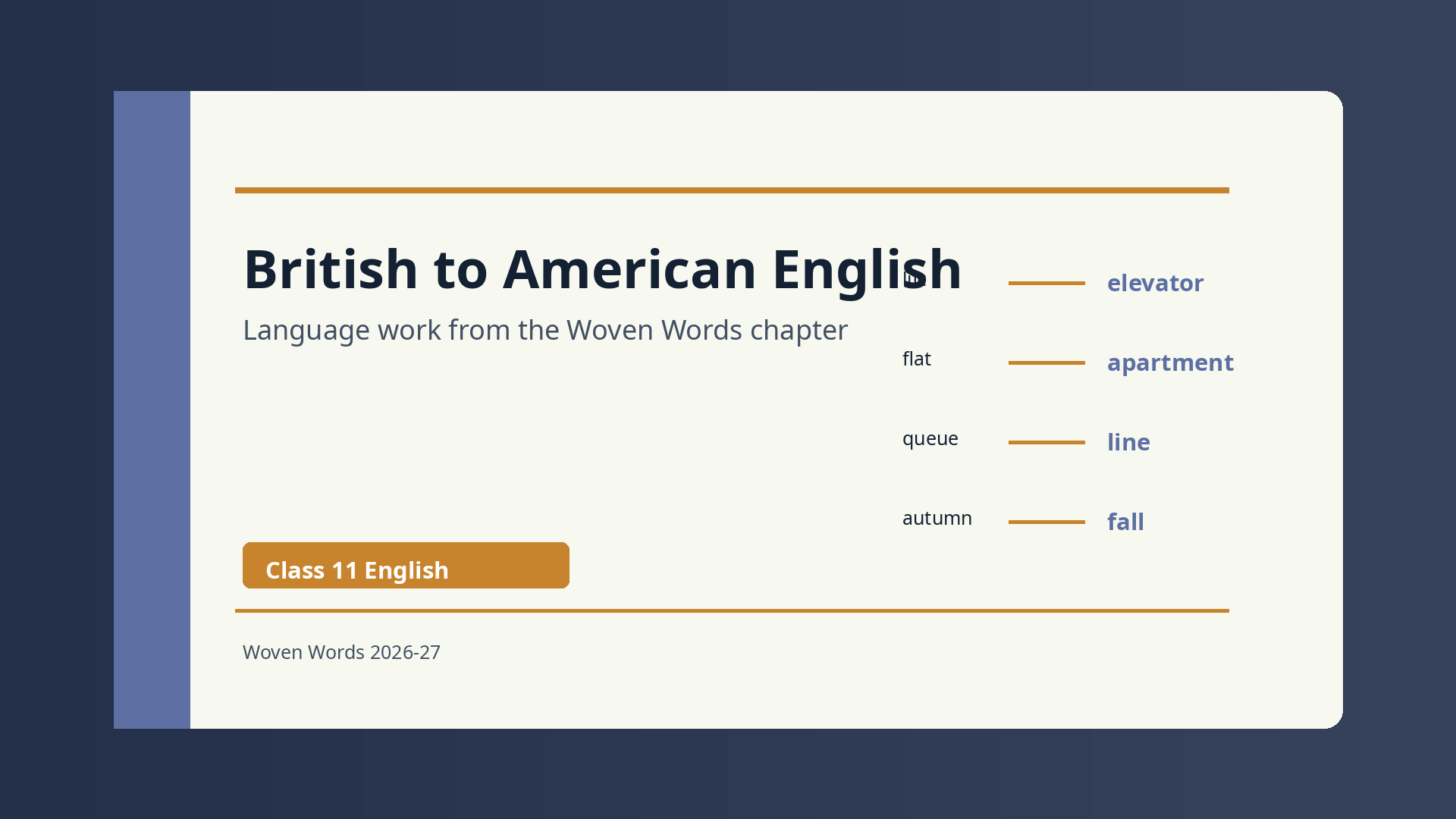
British English
American English
Lift
Elevator
Flat
Apartment
Lorry
Truck
Petrol
Gasoline
Queue
Line
Common Mistakes Students Make in The Third and Final Continent Answers
Avoid these answer-sheet mistakes:
Writing only a plot summary without explaining adjustment and belonging.
Calling Mrs Croft merely funny and missing her courage and independence.
Forgetting Mala's slow adjustment after her arrival in America.
Discussing Indian and American family systems as stereotypes rather than contrasts in the story.
Mixing up British and American English examples in Language Work.
More Class 11 English Woven Words Chapter 6 Resources
Use the related Woven Words resources when you need the chapter text, quick notes or handwritten revision pages along with these solved answers.
All NCERT Solutions for Class 11 English Woven Words Chapter 6 The Third and Final Continent with Step-by-Step Solutions
Questions
Q 6.1
Indicate the details that tell us that the narrator was not very financially comfortable during his stay in London.
Concept used. Financial discomfort is shown through living conditions, food, shared facilities and small economies. The narrator remembers London as a period of strict thrift.
Answer focus
Use concrete details, not only the phrase poor student life.
He arrives in England with the equivalent of ten dollars and a commerce certificate.
He lives in Finsbury Park with many Bengali bachelors who are all trying to educate and establish themselves.
Three or four men share one room, which shows cramped and inexpensive lodging.
They share a single cold toilet and cook simple egg curry in large pots.
They eat with their hands on newspaper-covered tables and soak dirty dishes in the bathtub.
Their weekends are simple, with tea, cricket, music and shared company rather than costly entertainment.
The narrator was not comfortable financially because he lived in crowded rooms, shared basic facilities, cooked cheap meals and managed life with very little money.
RM
Rhea Menon
M.A English, University of Delhi
Verified Expert
Strategic angle. This expert route reads the answer through migration, culture and classroom answer structure before returning to the exact NCERT prompt.
The London section builds poverty through ordinary routine instead of complaint.
The house of Bengali bachelors becomes a picture of immigrant survival.
Shared rooms, shared food and shared utensils show that privacy and comfort are luxuries.
The narrator does not dramatise his hardship, which makes the account more believable.
His calm tone also shows the discipline that later helps him survive in America.
This also gives the answer a clear exam shape: identify the situation, name the cultural detail, then explain how the narrator changes.
Read this point with the whole chapter in mind, because Lahiri often turns small routines into signs of belonging.
The London details show modest means, community support and disciplined adjustment in a foreign city.
Q 6.2
How did the narrator adjust to the ways of life first in London and then in Cambridge, U.S.A.?
Concept used. Adjustment means learning unfamiliar routines without losing self-control. The narrator adapts by observing, economising and building habits.
Answer focus
Compare the two cities directly: London has shared Indian life, Cambridge has solitary American life.
In London, he adjusts by living with other Bengali bachelors who share language, food and immigrant anxieties.
He attends lectures at LSE and works at the university library to survive.
He accepts crowded rooms, shared cooking and simple weekend routines.
In Cambridge, he first stays at the YMCA and learns the city through guidebooks, shops and newspapers.
He buys cornflakes, milk, tea bags and a thermos, then creates a cheap daily routine.
He learns American words, prices, traffic habits and housing customs step by step.
The narrator adjusts in London through community life and in Cambridge through observation, thrift and routine. He accepts discomfort without panic and slowly learns each new place.
KS
Kunal Sen
M.A English, Jadavpur University
Verified Expert
Strategic angle. This expert route reads the answer through migration, culture and classroom answer structure before returning to the exact NCERT prompt.
London offers cultural support because other Bengali men surround him.
Cambridge is lonelier because he must decode American life almost alone.
The guidebook, newspaper, supermarket and rented room become tools of adaptation.
His strength lies in noticing small rules and following them patiently.
This steady method prepares him for marriage, work and long settlement in America.
This also gives the answer a clear exam shape: identify the situation, name the cultural detail, then explain how the narrator changes.
Read this point with the whole chapter in mind, because Lahiri often turns small routines into signs of belonging.
His adjustment is practical: he studies each society through food, housing, language and daily conduct.
Q 6.3
What do you understand of the character of Mrs Croft from the story?
Concept used. Character analysis uses behaviour, speech and relationships. Mrs Croft is old, strict, patriotic, eccentric and unexpectedly warm.
Answer focus
Do not make her only comic. Her dignity and courage matter.
Mrs Croft is 103 years old but still alert, commanding and mentally sharp.
She insists that the narrator lock the door properly and pay rent punctually.
She is proud of America and repeatedly calls the moon landing splendid.
Her speech is loud, direct and sometimes comic, which makes her eccentric.
She still values rules, manners and independence, even though she needs care.
She gradually accepts the narrator and later praises Mala, showing hidden tenderness.
Mrs Croft is fierce, disciplined, patriotic and eccentric. Beneath her commanding manner, she has dignity and a capacity for affection.
MS
Meera Sanyal
Ph.D English, University of Hyderabad
Verified Expert
Strategic angle. This expert route reads the answer through migration, culture and classroom answer structure before returning to the exact NCERT prompt.
Mrs Croft is not written as a helpless old woman.
She controls her little world through rules, commands and fixed opinions.
Her admiration for the moon landing links her old life to modern American achievement.
At the same time, her approval of Mala reveals generosity.
The narrator admires her because she combines frailty with moral force.
This also gives the answer a clear exam shape: identify the situation, name the cultural detail, then explain how the narrator changes.
Read this point with the whole chapter in mind, because Lahiri often turns small routines into signs of belonging.
Mrs Croft stands for endurance, independence and stern kindness in an unfamiliar country.
Q 6.4
What kind of a relationship did Mrs Croft share with her daughter Helen?
Concept used. A family relationship can contain duty, irritation and care together. Mrs Croft and Helen share responsibility but not sentimental ease.
Answer focus
Mention both Helen helping her mother and the tension between them.
Helen visits Mrs Croft regularly and helps her with food and household needs.
She worries about her mother because Mrs Croft is extremely old and vulnerable.
Helen also seems tired by her mother's demands and rigid habits.
Mrs Croft does not behave like a dependent child. She continues to command and judge.
Their exchanges show affection hidden under impatience and habit.
The relationship is caring, but it lacks the everyday closeness associated with joint family living.
Mrs Croft and Helen share a dutiful but strained relationship. Helen cares for her mother, while Mrs Croft remains proud, demanding and independent.
AR
Ananya Rao
M.A English, University of Mumbai
Verified Expert
Strategic angle. This expert route reads the answer through migration, culture and classroom answer structure before returning to the exact NCERT prompt.
The story avoids a simple mother-daughter portrait.
Helen is responsible, but she is also practical and sometimes exasperated.
Mrs Croft expects attention without surrendering authority.
Their bond therefore reflects a Western pattern of separate households with periodic care.
This contrast helps the narrator think about ageing and family security.
This also gives the answer a clear exam shape: identify the situation, name the cultural detail, then explain how the narrator changes.
Read this point with the whole chapter in mind, because Lahiri often turns small routines into signs of belonging.
The relationship has care without softness, and duty without constant companionship.
Q 6.5
How does the narrator bring out the contrast between the Indian way of life and American society? Do you think his wife Mala adjusted comfortably to the new way of life?
Concept used. Cultural contrast appears through marriage, food, family, speech, housing and public behaviour. Mala's adjustment is gradual, not immediate.
Answer focus
Answer both parts: contrast first, then Mala's adjustment.
The narrator contrasts arranged marriage in Calcutta with solitary life in American rented rooms.
Indian life is shown through family rituals, sari, head covering, shared language and cooked food.
American life is shown through supermarkets, privacy, room rentals, exact rent and unfamiliar speech.
The elderly in America often live separately, while Indian family life imagines more direct support.
Mala initially feels shy, silent and displaced in Cambridge.
She adjusts more comfortably after Mrs Croft praises her and after she and the narrator begin sharing daily life as companions.
The story contrasts Indian family customs with American independence and privacy. Mala does adjust, but slowly, through patience, shared routine and Mrs Croft's unexpected approval.
LM
Leena Mathew
M.A English, University of Kerala
Verified Expert
Strategic angle. This expert route reads the answer through migration, culture and classroom answer structure before returning to the exact NCERT prompt.
Mala's adjustment is emotional as much as practical.
She has left a known world immediately after marriage and entered a room with a near-stranger husband.
The narrator also has to learn marriage, not only America.
Mrs Croft's approval becomes a bridge between the two cultures.
After that moment, the couple begin to see each other with tenderness.
This also gives the answer a clear exam shape: identify the situation, name the cultural detail, then explain how the narrator changes.
Read this point with the whole chapter in mind, because Lahiri often turns small routines into signs of belonging.
Mala adjusts because the new country becomes less strange when human approval and marital companionship appear.
Q 6.6
How does the bond of affection between Mrs Croft and the narrator evolve?
Concept used. A bond evolves when repeated contact changes strangers into people who matter to each other. The narrator and Mrs Croft begin with rules and end with affection.
Answer focus
Trace the movement: tenant, routine visitor, respectful companion, mourner.
At first, the narrator meets Mrs Croft only as a landlady who demands punctual rent and strict rules.
He obeys her instructions and visits the parlour each evening as expected.
Their repeated conversations about the moon landing create a small ritual.
The narrator begins to admire her strength, age and fierce self-command.
When Mala visits, Mrs Croft's approval helps the narrator see Mala with fresh affection.
After Mrs Croft dies, he mourns her as the first American life he had truly admired.
Their bond grows from formal tenant-landlady contact into quiet affection. Routine, respect and Mrs Croft's approval of Mala make her unforgettable to the narrator.
AR
Aditi Rao
M.A English, University of Calicut
Verified Expert
Strategic angle. This expert route reads the answer through migration, culture and classroom answer structure before returning to the exact NCERT prompt.
The relationship is unusual because it crosses age, culture and nationality.
Mrs Croft never becomes openly sentimental, but her acceptance matters deeply.
The narrator recognises courage in her old age and loneliness.
Her household becomes his first true American home.
That is why her death feels personal rather than merely local news.
This also gives the answer a clear exam shape: identify the situation, name the cultural detail, then explain how the narrator changes.
Read this point with the whole chapter in mind, because Lahiri often turns small routines into signs of belonging.
Affection grows through ritual, respect and recognition between two lonely people in a new world.
Q 6.7
Discuss the statement: Living abroad is challenging in many ways.
Concept used. This discussion asks for generalisation from the story. Living abroad challenges money, language, food, housing, climate and emotional security.
Answer focus
Use the narrator's experiences as evidence, then widen the point.
The narrator faces financial hardship in London and must share cramped housing.
In America, he faces loneliness, traffic noise and unfamiliar food habits.
He must learn new words, prices, coins, housing rules and social expectations.
He has to begin married life with Mala in a culture both of them barely understand.
Living abroad also creates emotional distance from family and familiar customs.
Yet the story shows that patience, work and human connection can make survival possible.
Living abroad is challenging because ordinary tasks become unfamiliar. The narrator must relearn food, language, money, housing, relationships and belonging.
IM
Ira Mukherjee
M.A English, University of Hyderabad
Verified Expert
Strategic angle. This expert route reads the answer through migration, culture and classroom answer structure before returning to the exact NCERT prompt.
The challenge of migration is not only dramatic homesickness.
It is also the daily labour of decoding a society.
The narrator must learn how to buy milk, rent a room and speak across accents.
These small adjustments accumulate into a new life.
The story respects that ordinary courage.
This also gives the answer a clear exam shape: identify the situation, name the cultural detail, then explain how the narrator changes.
Read this point with the whole chapter in mind, because Lahiri often turns small routines into signs of belonging.
The migrant challenge lies in turning unknown routines into a livable world.
Q 6.8
Discuss the statement: The Indian family system offers more security to the aged than what is found in the West.
Concept used. This discussion compares family structures. The story suggests that Indian families often imagine closer support for elders, while Mrs Croft's life shows Western independence and loneliness.
Answer focus
Keep the answer balanced. Do not reduce either culture to one fixed rule.
Mrs Croft lives separately even at the age of 103, which shows a high value placed on independence.
Helen visits and helps, but she does not live with her mother.
This arrangement gives Mrs Croft freedom, but it also leaves her alone for long hours.
In the Indian context, aged parents are often expected to remain within the family circle.
Such a system can provide companionship, care and emotional security.
The story still shows that individual relationships matter more than slogans about culture.
The Indian family system may offer more daily security to the aged through shared living and family duty. Mrs Croft's life shows dignity, but also solitude.
SK
Samar Khanna
M.A English, EFLU Hyderabad
Verified Expert
Strategic angle. This expert route reads the answer through migration, culture and classroom answer structure before returning to the exact NCERT prompt.
The contrast is one of the story's quiet social observations.
Mrs Croft is admired because she survives independently, but independence has a cost.
Helen's visits are dutiful, not continuous care.
The narrator comes from a culture where ageing is usually imagined inside family presence.
The best answer recognises both security and autonomy.
This also gives the answer a clear exam shape: identify the situation, name the cultural detail, then explain how the narrator changes.
Read this point with the whole chapter in mind, because Lahiri often turns small routines into signs of belonging.
The story values Mrs Croft's independence while making the reader notice the loneliness around it.
Q 6.9
Discuss the statement: The eccentricities of the old are often endearing.
Concept used. Eccentricity means unusual habits or speech. In old age, such habits can seem touching when they reveal personality, courage and memory.
Answer focus
Use Mrs Croft's repeated lines and rules as examples.
Mrs Croft repeatedly commands the narrator to lock the door and sit properly.
She asks him to say that the moon landing is splendid.
Her loud voice, old-fashioned dress and strict rules seem unusual at first.
These habits become endearing because they show her vitality at 103.
The narrator stops seeing her as merely strange and begins to admire her.
Her eccentricity helps create affection between two people who might otherwise remain strangers.
Mrs Croft's eccentricities are endearing because they reveal energy, dignity and a strong will. Her odd habits become signs of life and character.
PB
Parth Banerjee
M.A English Language, University of Calcutta
Verified Expert
Strategic angle. This expert route reads the answer through migration, culture and classroom answer structure before returning to the exact NCERT prompt.
The humour around Mrs Croft is never cruel.
Her repeated words create a rhythm that the narrator remembers for decades.
Her strangeness makes her vivid, not ridiculous.
Old age has not erased her authority or judgement.
That is why her eccentricity becomes lovable.
This also gives the answer a clear exam shape: identify the situation, name the cultural detail, then explain how the narrator changes.
Read this point with the whole chapter in mind, because Lahiri often turns small routines into signs of belonging.
Mrs Croft's oddness is memorable because it carries courage, humour and human warmth.
Q 6.10
Discuss the manner in which the author interweaves details of the narrator's family with the flow of the main narrative.
Concept used. Interweaving means blending background details into the main story without stopping the narrative. Lahiri moves between migration, marriage and memory smoothly.
Answer focus
Mention the arranged marriage, Mala's arrival and the son near the end.
The story begins with the narrator's journey from India to London and then America.
His arranged marriage is introduced as part of the same movement across continents.
Details about Calcutta, Mala's passport and their first awkward days enter naturally into the American narrative.
Mrs Croft's approval of Mala becomes a turning point in the marriage.
At the end, the narrator includes his son, showing the next generation of the family.
Family details therefore deepen the migration story instead of interrupting it.
Lahiri interweaves family details by placing marriage, Mala's arrival and the son inside the narrator's journey. Private family life and migration develop together.
NK
Nisha Kapoor
M.A English, Jamia Millia Islamia
Verified Expert
Strategic angle. This expert route reads the answer through migration, culture and classroom answer structure before returning to the exact NCERT prompt.
The narrative does not separate public success from intimate life.
Work at MIT, rented rooms and arranged marriage all belong to the same immigrant experience.
Mala's gradual closeness gives emotional shape to the external journey.
The son at the end shows continuity after displacement.
This structure makes the story feel like a whole life, not a travel report.
This also gives the answer a clear exam shape: identify the situation, name the cultural detail, then explain how the narrator changes.
Read this point with the whole chapter in mind, because Lahiri often turns small routines into signs of belonging.
Family details turn the migrant journey into a story of settlement, companionship and generational change.
Q 6.11
How do the lines about Mrs Croft's death encapsulate the bond that is possible between two strangers?
Concept used. Encapsulate means express the whole meaning briefly. The lines show that admiration and mourning can grow between strangers through shared time.
Answer focus
Quote the idea, not the whole sentence. Focus on first death and first admired life.
Mrs Croft and the narrator begin as strangers separated by age, culture and nationality.
Their contact is limited, but it becomes regular and meaningful.
The narrator admires her fierce independence and long survival.
Her approval of Mala gives the narrator a private emotional gift.
When she dies, he mourns her because she has become part of his first American home.
The lines show that deep human bonds can form without long history or family ties.
Mrs Croft's death matters because she is the first American life the narrator admires. Their bond proves that strangers can become emotionally significant.
MN
Malavika Nair
M.A English, University of Madras
Verified Expert
Strategic angle. This expert route reads the answer through migration, culture and classroom answer structure before returning to the exact NCERT prompt.
The sentence is powerful because it joins loneliness with gratitude.
Mrs Croft is ancient and alone, yet she has affected the narrator permanently.
He does not mourn her as a relative, but as a person who helped him belong.
The bond is quiet, brief and real.
Lahiri suggests that migration depends on such unexpected recognitions.
This also gives the answer a clear exam shape: identify the situation, name the cultural detail, then explain how the narrator changes.
Read this point with the whole chapter in mind, because Lahiri often turns small routines into signs of belonging.
The lines show that affection can arise from respect, ritual and one generous moment between strangers.
Q 6.12
Examine the pieces of conversation in the story. How do they reflect the worldview of each of the speakers?
Concept used. Dialogue reveals worldview because speakers expose values through repeated words, questions and tone.
Answer focus
Discuss Mrs Croft, the narrator, Helen and Mala rather than only one speaker.
Mrs Croft's commands show a worldview based on discipline, punctuality, patriotism and self-command.
Her repeated praise of the moon landing shows pride in American achievement.
The narrator's polite replies show respect, caution and immigrant self-control.
Helen's practical speech shows responsibility mixed with fatigue.
Mala's silence and modest replies show shyness and cultural reserve at first.
Together, the conversations reveal differences in age, culture, gender and social confidence.
The conversations show Mrs Croft's stern patriotism, the narrator's respectful restraint, Helen's practical duty and Mala's initial shyness.
DI
Devika Iyer
M.A English, University of Delhi
Verified Expert
Strategic angle. This expert route reads the answer through migration, culture and classroom answer structure before returning to the exact NCERT prompt.
Lahiri uses dialogue sparingly, so each line has weight.
Mrs Croft speaks in commands because authority is part of her identity.
The narrator speaks carefully because he is still learning the society around him.
Mala's quietness signals both discomfort and dignity.
The story's worldview emerges from these small exchanges.
This also gives the answer a clear exam shape: identify the situation, name the cultural detail, then explain how the narrator changes.
Read this point with the whole chapter in mind, because Lahiri often turns small routines into signs of belonging.
Speech in the story is a social map: each voice reveals position, habit and belief.
Q 6.13
There are many instances of gentle humour in the story. Point out some of these and state how this contributes to the interest of the narration.
Concept used. Gentle humour is quiet amusement without mockery. It makes the narration warm and human.
Answer focus
Choose examples that are funny because of misunderstanding, repetition or contrast.
The narrator's confusion between a flask and a thermos creates mild humour from language difference.
Mrs Croft's repeated demand that the moon landing be called splendid is comic and memorable.
Her strict rent and door-locking instructions sound exaggerated but affectionate in memory.
The narrator's careful formal behaviour during ordinary room-hunting also creates humour.
His son later finds the eight-dollar rent more astonishing than Mrs Croft's age.
Such humour lightens the immigrant struggle and makes the characters more lovable.
Gentle humour appears in language mistakes, Mrs Croft's repeated commands and the son's reaction to cheap rent. It makes the story warm, vivid and balanced.
HV
Harsh Vardhan
M.A English, Banaras Hindu University
Verified Expert
Strategic angle. This expert route reads the answer through migration, culture and classroom answer structure before returning to the exact NCERT prompt.
The humour prevents the story from becoming only a tale of hardship.
Lahiri smiles at human awkwardness without humiliating anyone.
The narrator's calm voice makes the comic details even more effective.
Mrs Croft becomes memorable partly because she is funny and formidable at once.
Humour therefore deepens affection in the narrative.
This also gives the answer a clear exam shape: identify the situation, name the cultural detail, then explain how the narrator changes.
Read this point with the whole chapter in mind, because Lahiri often turns small routines into signs of belonging.
Gentle humour keeps the migration story humane, tender and easy to remember.
Q 6.14
How does the phrase 'Don't expect an English cup of tea' bring out the contrast between English and American attitudes?
Concept used. A phrase can carry cultural contrast. Here it suggests that American life is faster, less formal and less attached to British habits.
Answer focus
Connect tea with habit, pace and national difference.
The guidebook tells the narrator that North America has a different pace of life from Britain.
An English cup of tea suggests a familiar British ritual of pause, comfort and civility.
The warning tells him not to expect the same habits in America.
American life is presented as urgent, competitive and practical.
The narrator experiences this difference through traffic, shops, new words and work routines.
The phrase prepares him for cultural adjustment before he even lands.
The phrase contrasts British familiarity and ritual with American speed and practicality. It tells the narrator that America will not feel like England.
RD
Rohini Das
M.A English, Presidency University
Verified Expert
Strategic angle. This expert route reads the answer through migration, culture and classroom answer structure before returning to the exact NCERT prompt.
Tea is a small object with large cultural meaning.
For the narrator, England has already become a partially learned world.
America will require a new adjustment, not a continuation of British habits.
The phrase also has quiet humour because he later creates his own tea routine with a thermos.
Thus the line marks difference and adaptation together.
This also gives the answer a clear exam shape: identify the situation, name the cultural detail, then explain how the narrator changes.
Read this point with the whole chapter in mind, because Lahiri often turns small routines into signs of belonging.
The phrase uses tea to show that America has its own pace, vocabulary and social habits.
Q 6.15
How did the narrator learn to distinguish between 'a flask' and 'a thermos'?
Concept used. This is a vocabulary-in-context question. The narrator learns the American use of thermos through a shop interaction.
Answer focus
Keep the answer short and factual.
The narrator buys tea bags and a container for hot water at Woolworth's.
He calls the container a flask, using the word he already knows.
The salesman tells him that in America it is called a thermos.
The salesman also explains that flask is used for storing whiskey.
Through this exchange, the narrator learns the difference between the two terms.
The incident shows how everyday shopping teaches him American English.
He learns the difference at Woolworth's when the salesman says the hot-water container is a thermos, while a flask is used for whiskey.
SM
Suhani Mehta
M.A Linguistics, University of Delhi
Verified Expert
Strategic angle. This expert route reads the answer through migration, culture and classroom answer structure before returning to the exact NCERT prompt.
The episode is a small example of language adjustment.
The narrator does not learn vocabulary from a lesson, but from use.
The salesman's correction gives both the American word and the cultural distinction.
This helps the narrator function in daily life.
Such details make the migration experience concrete.
This also gives the answer a clear exam shape: identify the situation, name the cultural detail, then explain how the narrator changes.
Read this point with the whole chapter in mind, because Lahiri often turns small routines into signs of belonging.
The narrator learns by practical correction during shopping, one ordinary word at a time.
Q 6.16
What caused the narrator's difficulty with words such as 'piper' for 'paper' and 'mind the gap' in the Tube?
Concept used. The difficulty comes from accent, pronunciation and unfamiliar public expressions. Language changes across places even when it is called English.
Answer focus
Mention accent and context together.
The narrator is new to British and American varieties of English.
Different accents change vowel sounds, so paper may sound like piper to him.
Public phrases such as mind the gap are fixed expressions that require local context.
He is also under pressure because everything around him is unfamiliar.
The problem is not lack of intelligence, but unfamiliar pronunciation and usage.
Over time, listening and repetition help him understand such expressions.
The problem was caused by accent, pronunciation and unfamiliar local expressions. He had to learn how English sounded and functioned in each new place.
AB
Aparna Bose
M.A English Language Teaching, EFLU Hyderabad
Verified Expert
Strategic angle. This expert route reads the answer through migration, culture and classroom answer structure before returning to the exact NCERT prompt.
The question shows that knowing textbook English is not the same as living inside spoken English.
Accent can make familiar words sound strange.
Local public phrases also carry meanings that outsiders must learn by experience.
The narrator's confusion is therefore a normal migrant experience.
It adds realism to his adjustment story.
This also gives the answer a clear exam shape: identify the situation, name the cultural detail, then explain how the narrator changes.
Read this point with the whole chapter in mind, because Lahiri often turns small routines into signs of belonging.
His difficulty comes from spoken variation, local idiom and the pressure of a new environment.
Q 6.17
Make a list of items that are referred to differently in British and American English.
Concept used. This language task asks for equivalent words in two varieties of English. The story itself gives lift and elevator as an example.
Answer focus
A two-column table is the clearest answer.
Lift in British English is elevator in American English.
Flat is apartment.
Lorry is truck.
Petrol is gas or gasoline.
Biscuit is cookie.
Post is mail.
Queue is line.
Autumn is fall.
Examples include lift/elevator, flat/apartment, lorry/truck, petrol/gasoline, biscuit/cookie, post/mail, queue/line and autumn/fall.
NS
Neelabh Saxena
M.A English, University of Lucknow
Verified Expert
Strategic angle. This expert route reads the answer through migration, culture and classroom answer structure before returning to the exact NCERT prompt.
The list shows that English changes with place.
Some differences name everyday objects, while others name habits or services.
Students should learn the pair, not judge one as more correct.
In the story, such differences remind the narrator that America is not England.
Vocabulary becomes part of cultural adjustment.
This also gives the answer a clear exam shape: identify the situation, name the cultural detail, then explain how the narrator changes.
Read this point with the whole chapter in mind, because Lahiri often turns small routines into signs of belonging.
British and American English often use different everyday words for the same object or action.
Q 6.18
Explain the meaning of parlour, foyer, lounge, lobby, attic, portico and porch.
Concept used. These are house-related words. The answer should define each space clearly and briefly.
Answer focus
Define each term in one phrase so the list stays easy to revise.
A parlour is a sitting room or formal room for receiving visitors.
A foyer is an entrance hall just inside a building.
A lounge is a room or area for relaxing and sitting.
A lobby is a hall or waiting area near the entrance of a building.
An attic is a room or storage space under the roof.
A portico is a covered entrance supported by columns.
A porch is a covered area at the entrance of a house.
Parlour: sitting room; foyer: entrance hall; lounge: relaxing area; lobby: waiting hall; attic: space under the roof; portico: columned covered entrance; porch: covered house entrance.
FK
Farah Khan
M.A English, Aligarh Muslim University
Verified Expert
Strategic angle. This expert route reads the answer through migration, culture and classroom answer structure before returning to the exact NCERT prompt.
The words differ by position and use inside or outside a building.
Parlour and lounge are sitting spaces.
Foyer and lobby are entry or waiting spaces.
Attic is above the main rooms.
Portico and porch are entrance structures outside or at the front of a house.
This also gives the answer a clear exam shape: identify the situation, name the cultural detail, then explain how the narrator changes.
Read this point with the whole chapter in mind, because Lahiri often turns small routines into signs of belonging.
The terms describe living rooms, entry spaces, roof space and covered entrances.
The Third and Final Continent Class 11 English Woven Words NCERT Solutions FAQs
Ques. Who wrote The Third and Final Continent in Class 11 Woven Words?
Ans. Jhumpa Lahiri wrote The Third and Final Continent. The story is from her collection Interpreter of Maladies.
Ques. What is the main theme of The Third and Final Continent?
Ans. The main theme is immigrant adjustment across cultures, shown through work, marriage, old age, routine and unexpected human affection.
Ques. How many NCERT questions are solved in this PDF?
Ans. The PDF solves 18 NCERT prompts from Understanding the Text, Talking about the Text, Appreciation and Language Work.
Ques. Why is Mrs Croft important in the story?
Ans. Mrs Croft is important because she becomes the narrator's first admired American life and helps him recognise dignity and connection in a new country.





Chapter6TheThirdandFinalContinentSolutions.pdf?page=1&dpi=150)
Chapter6TheThirdandFinalContinentSolutions.pdf?page=2&dpi=150)
Chapter6TheThirdandFinalContinentSolutions.pdf?page=3&dpi=150)
Chapter6TheThirdandFinalContinentSolutions.pdf?page=4&dpi=150)
Chapter6TheThirdandFinalContinentSolutions.pdf?page=5&dpi=150)
Chapter6TheThirdandFinalContinentSolutions.pdf?page=6&dpi=150)
Chapter6TheThirdandFinalContinentSolutions.pdf?page=7&dpi=150)
Chapter6TheThirdandFinalContinentSolutions.pdf?page=8&dpi=150)
Chapter6TheThirdandFinalContinentSolutions.pdf?page=9&dpi=150)
Chapter6TheThirdandFinalContinentSolutions.pdf?page=10&dpi=150)
Chapter6TheThirdandFinalContinentSolutions.pdf?page=11&dpi=150)
Chapter6TheThirdandFinalContinentSolutions.pdf?page=12&dpi=150)
Chapter6TheThirdandFinalContinentSolutions.pdf?page=13&dpi=150)
Chapter6TheThirdandFinalContinentSolutions.pdf?page=14&dpi=150)
Chapter6TheThirdandFinalContinentSolutions.pdf?page=15&dpi=150)
Chapter6TheThirdandFinalContinentSolutions.pdf?page=16&dpi=150)
Chapter6TheThirdandFinalContinentSolutions.pdf?page=17&dpi=150)
Chapter6TheThirdandFinalContinentSolutions.pdf?page=18&dpi=150)
Chapter6TheThirdandFinalContinentSolutions.pdf?page=19&dpi=150)
Chapter6TheThirdandFinalContinentSolutions.pdf?page=20&dpi=150)
Chapter6TheThirdandFinalContinentSolutions.pdf?page=21&dpi=150)
Chapter6TheThirdandFinalContinentSolutions.pdf?page=22&dpi=150)
Chapter6TheThirdandFinalContinentSolutions.pdf?page=23&dpi=150)
Chapter6TheThirdandFinalContinentSolutions.pdf?page=24&dpi=150)
Chapter6TheThirdandFinalContinentSolutions.pdf?page=25&dpi=150)
Chapter6TheThirdandFinalContinentSolutions_flat_MobileCard.pdf?page=1&dpi=150)
Chapter6TheThirdandFinalContinentSolutions_flat_MobileCard.pdf?page=2&dpi=150)
Chapter6TheThirdandFinalContinentSolutions_flat_MobileCard.pdf?page=3&dpi=150)
Chapter6TheThirdandFinalContinentSolutions_flat_MobileCard.pdf?page=4&dpi=150)
Chapter6TheThirdandFinalContinentSolutions_flat_MobileCard.pdf?page=5&dpi=150)
Chapter6TheThirdandFinalContinentSolutions_flat_MobileCard.pdf?page=6&dpi=150)
Chapter6TheThirdandFinalContinentSolutions_flat_MobileCard.pdf?page=7&dpi=150)
Chapter6TheThirdandFinalContinentSolutions_flat_MobileCard.pdf?page=8&dpi=150)
Chapter6TheThirdandFinalContinentSolutions_flat_MobileCard.pdf?page=9&dpi=150)
Chapter6TheThirdandFinalContinentSolutions_flat_MobileCard.pdf?page=10&dpi=150)
Chapter6TheThirdandFinalContinentSolutions_flat_MobileCard.pdf?page=11&dpi=150)
Chapter6TheThirdandFinalContinentSolutions_flat_MobileCard.pdf?page=12&dpi=150)
Chapter6TheThirdandFinalContinentSolutions_flat_MobileCard.pdf?page=13&dpi=150)
Chapter6TheThirdandFinalContinentSolutions_flat_MobileCard.pdf?page=14&dpi=150)
Chapter6TheThirdandFinalContinentSolutions_flat_MobileCard.pdf?page=15&dpi=150)
Chapter6TheThirdandFinalContinentSolutions_flat_MobileCard.pdf?page=16&dpi=150)
Chapter6TheThirdandFinalContinentSolutions_flat_MobileCard.pdf?page=17&dpi=150)
Chapter6TheThirdandFinalContinentSolutions_flat_MobileCard.pdf?page=18&dpi=150)
Chapter6TheThirdandFinalContinentSolutions_flat_MobileCard.pdf?page=19&dpi=150)
Chapter6TheThirdandFinalContinentSolutions_flat_MobileCard.pdf?page=20&dpi=150)
Chapter6TheThirdandFinalContinentSolutions_flat_MobileCard.pdf?page=21&dpi=150)
Chapter6TheThirdandFinalContinentSolutions_flat_MobileCard.pdf?page=22&dpi=150)
Chapter6TheThirdandFinalContinentSolutions_flat_MobileCard.pdf?page=23&dpi=150)
Chapter6TheThirdandFinalContinentSolutions_flat_MobileCard.pdf?page=24&dpi=150)
Chapter6TheThirdandFinalContinentSolutions_flat_MobileCard.pdf?page=25&dpi=150)
Chapter6TheThirdandFinalContinentSolutions_flat_MobileCard.pdf?page=26&dpi=150)
Chapter6TheThirdandFinalContinentSolutions_flat_MobileCard.pdf?page=27&dpi=150)
Chapter6TheThirdandFinalContinentSolutions_flat_MobileCard.pdf?page=28&dpi=150)
Chapter6TheThirdandFinalContinentSolutions_flat_MobileCard.pdf?page=29&dpi=150)
Chapter6TheThirdandFinalContinentSolutions_flat_MobileCard.pdf?page=30&dpi=150)
Chapter6TheThirdandFinalContinentSolutions_flat_MobileCard.pdf?page=31&dpi=150)
Chapter6TheThirdandFinalContinentSolutions_flat_MobileCard.pdf?page=32&dpi=150)
Chapter6TheThirdandFinalContinentSolutions_flat_MobileCard.pdf?page=33&dpi=150)
Chapter6TheThirdandFinalContinentSolutions_flat_MobileCard.pdf?page=34&dpi=150)
Chapter6TheThirdandFinalContinentSolutions_flat_MobileCard.pdf?page=35&dpi=150)
Chapter6TheThirdandFinalContinentSolutions_flat_MobileCard.pdf?page=36&dpi=150)
Chapter6TheThirdandFinalContinentSolutions_flat_MobileCard.pdf?page=37&dpi=150)
Chapter6TheThirdandFinalContinentSolutions_flat_MobileCard.pdf?page=38&dpi=150)
Chapter6TheThirdandFinalContinentSolutions_flat_MobileCard.pdf?page=39&dpi=150)
Chapter6TheThirdandFinalContinentSolutions_flat_MobileCard.pdf?page=40&dpi=150)
Chapter6TheThirdandFinalContinentSolutions_flat_MobileCard.pdf?page=41&dpi=150)
Chapter6TheThirdandFinalContinentSolutions_flat_MobileCard.pdf?page=42&dpi=150)
Chapter6TheThirdandFinalContinentSolutions_flat_MobileCard.pdf?page=43&dpi=150)
Chapter6TheThirdandFinalContinentSolutions_flat_MobileCard.pdf?page=44&dpi=150)
Chapter6TheThirdandFinalContinentSolutions_flat_MobileCard.pdf?page=45&dpi=150)
Chapter6TheThirdandFinalContinentSolutions_flat_MobileCard.pdf?page=46&dpi=150)
Chapter6TheThirdandFinalContinentSolutions_flat_MobileCard.pdf?page=47&dpi=150)
Chapter6TheThirdandFinalContinentSolutions_flat_MobileCard.pdf?page=48&dpi=150)
Chapter6TheThirdandFinalContinentSolutions_flat_MobileCard.pdf?page=49&dpi=150)




Comments