




The NCERT Solutions for Class 11 Maths Chapter 1 Sets Exercise 1.3 solve every question of the third exercise, according to the latest 2026-27 CBSE syllabus. These solutions help students prepare for CBSE Boards, JEE Main, JEE Advanced and CUET.
Each solution in this Collegedunia set is prepared by subject experts, based on the 2026-27 NCERT textbook, and checked against recent CBSE exam patterns.
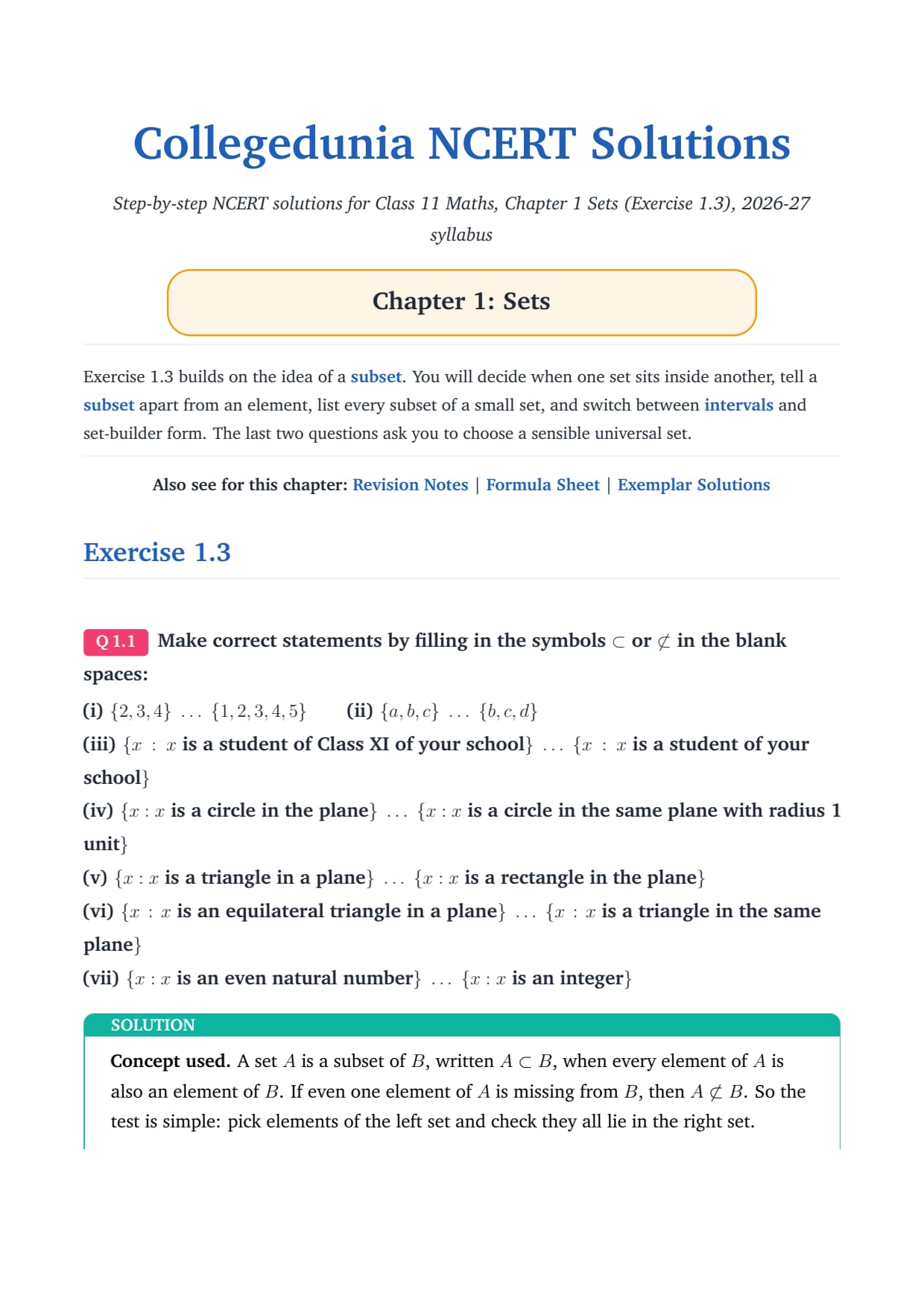
Exercise 1.3 builds the idea of one set sitting inside another. The exercise has 9 questions built around these skills:
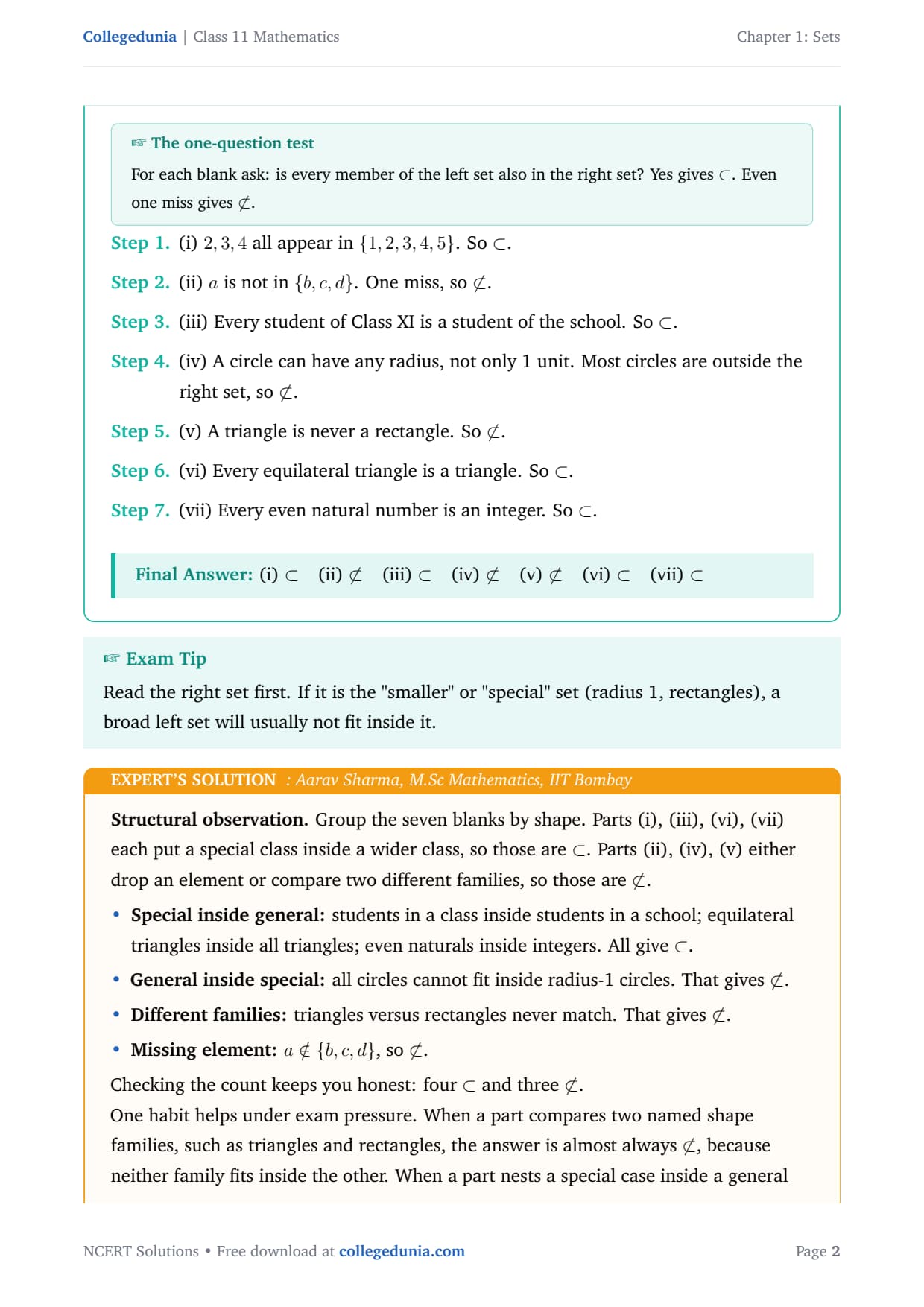
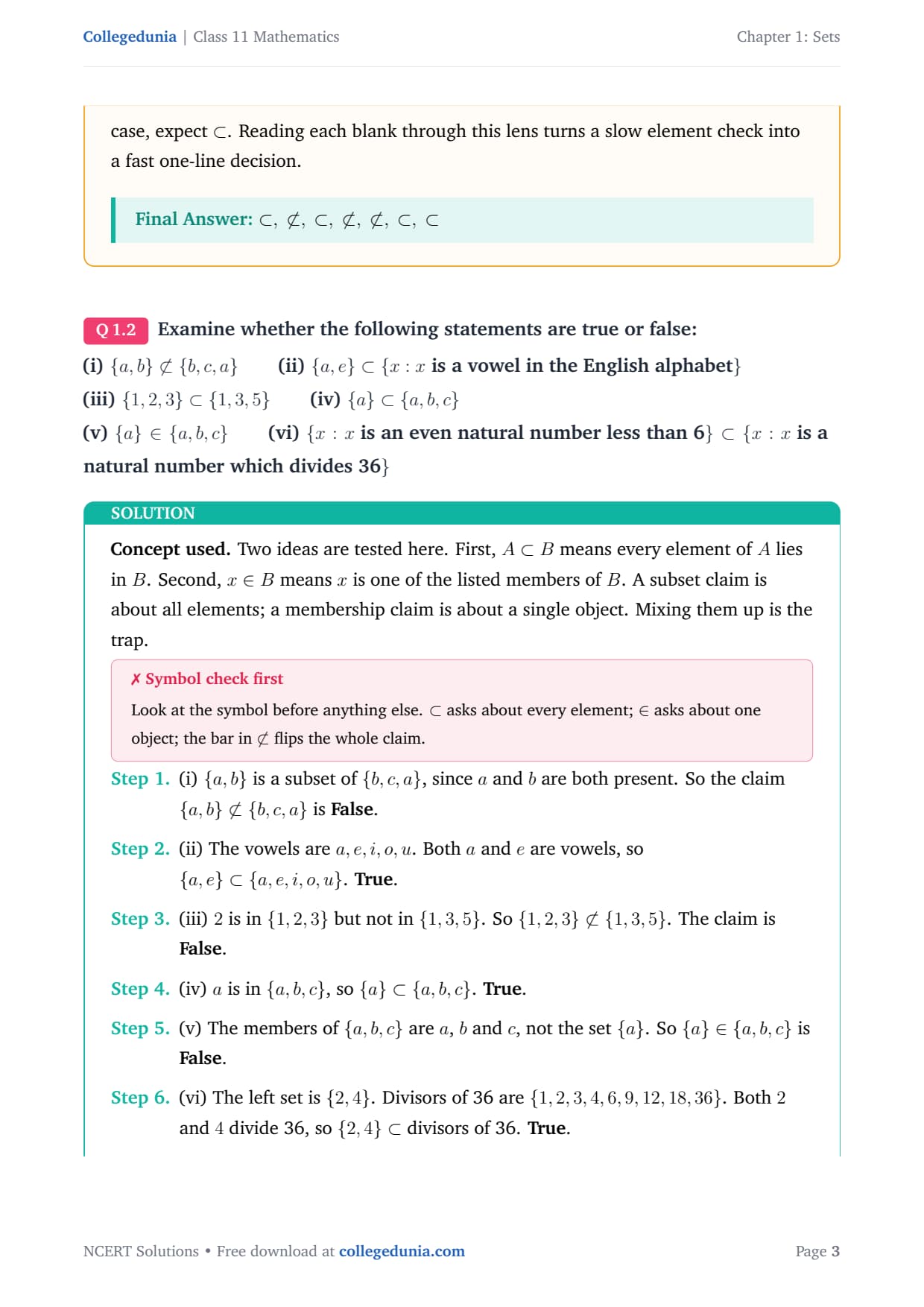
- Deciding whether one set is a subset of another using ⊂ and ⊄.
- Writing sets of real numbers as intervals and back again.
- Listing every subset and finding the power set.
Topics Covered in Sets Exercise 1.3
This exercise connects sets through the subset idea. A set A is a subset of B, written A ⊂ B, when every element of A is also in B. The set of all subsets of A is its power set, P(A). Parts of the real line are shown as intervals, and one large set that holds all sets in a problem is the universal set.
- Subsets: {2, 3, 4} ⊂ {1, 2, 3, 4, 5} because every element is shared.
- Power set: if A has n elements, P(A) has 2n subsets.
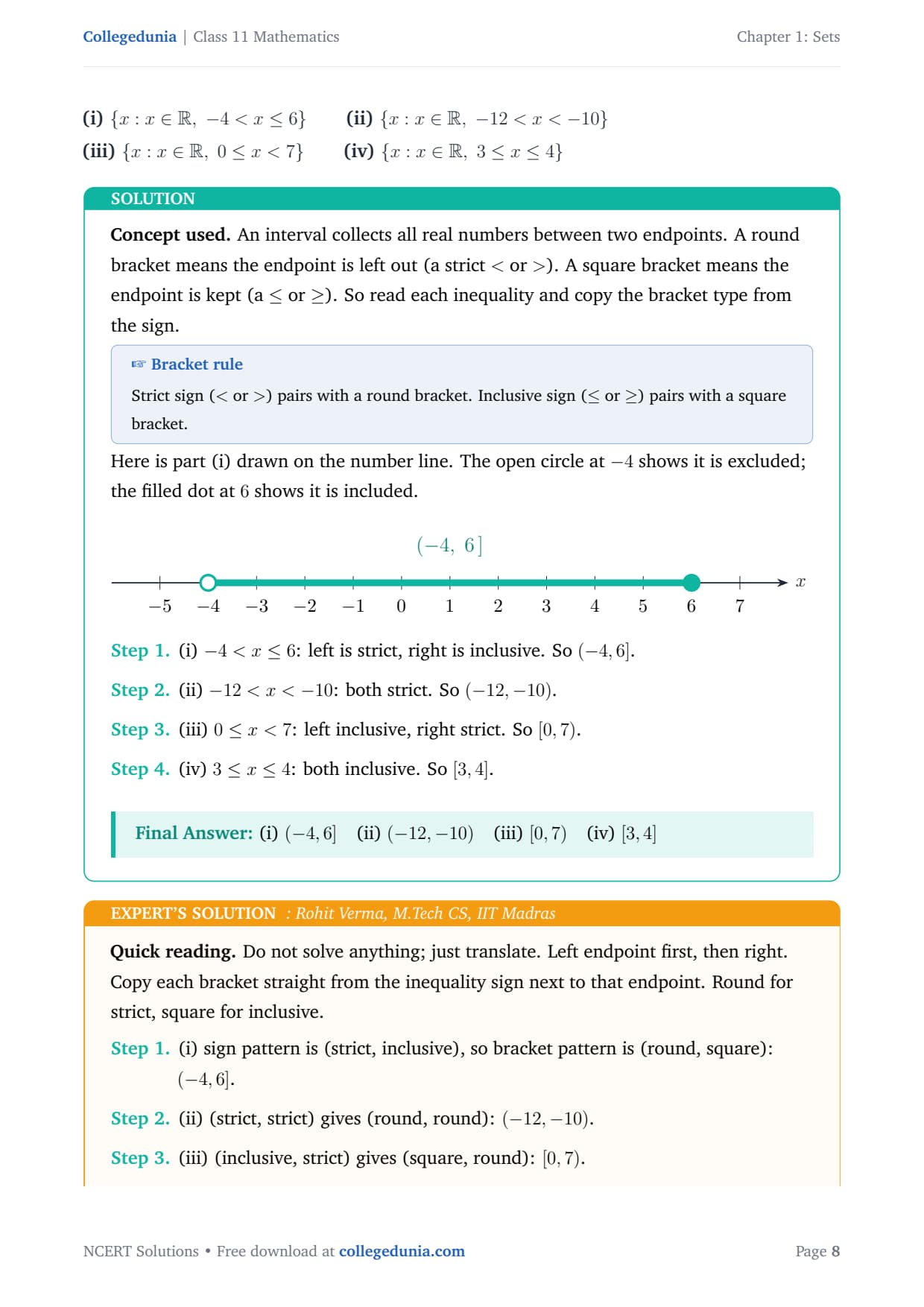
- Intervals: {x : −4 < x ≤ 6} is the interval (−4, 6].
- Universal set: the set of all real numbers can act as the universal set for number problems.
Important: the empty set is a subset of every set, and every set is a subset of itself. Both facts decide several parts of this exercise.
Question-wise Breakdown of Sets Exercise 1.3
The NCERT Solutions for Class 11 Maths Chapter 1 Sets Exercise 1.3 answer all 9 questions in order. The table shows what each question asks so students can plan their practice. Full step-by-step answers are inside the PDF above.
| Question | What it asks | Skill tested |
|---|---|---|
| Q1 | Fill blanks with ⊂ or ⊄ for set pairs | Subset notation |
| Q2 | Check if given subset statements are true or false | Subset test |
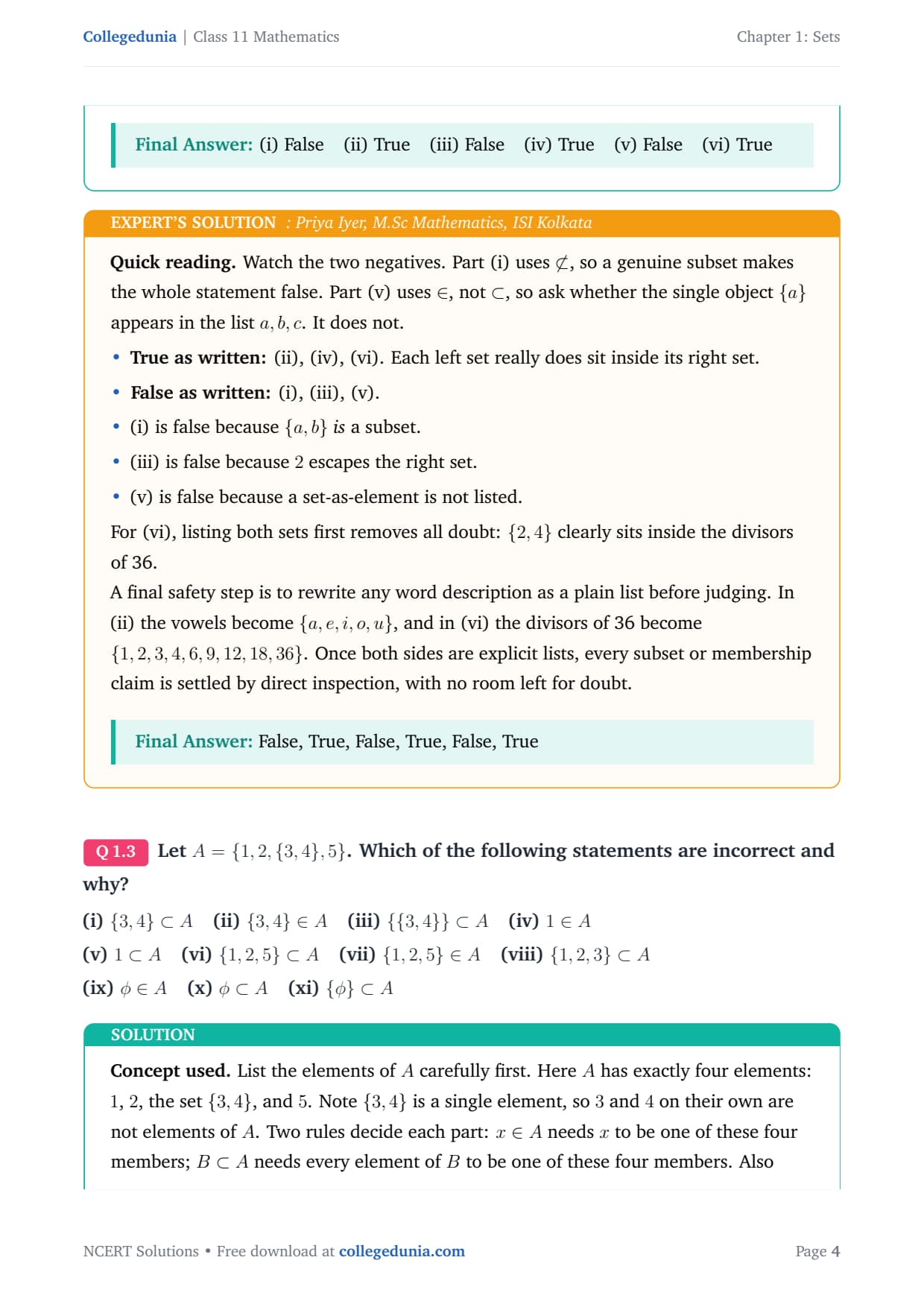
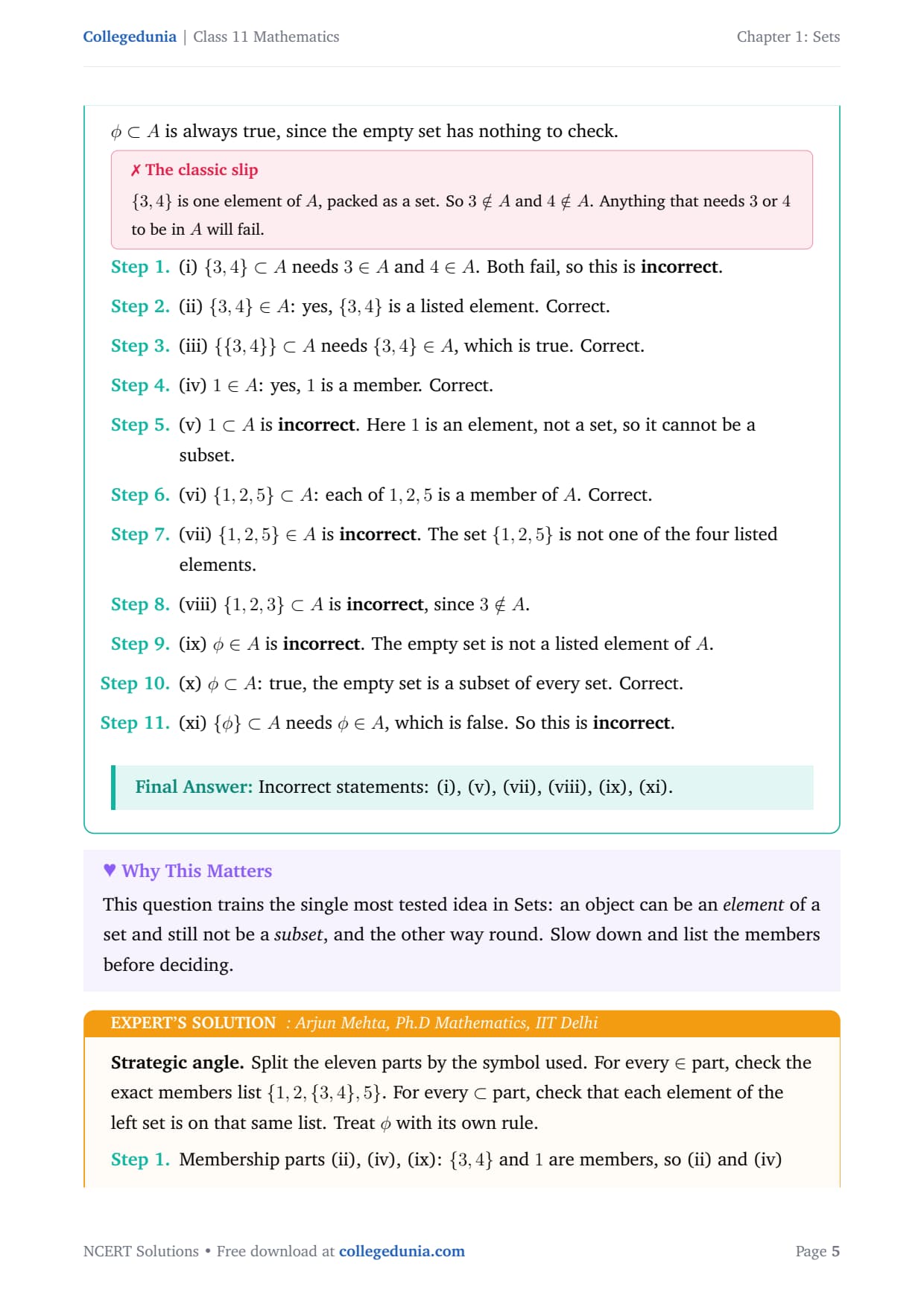
| Q3 | Find which statements about a nested set are wrong | Element vs subset |
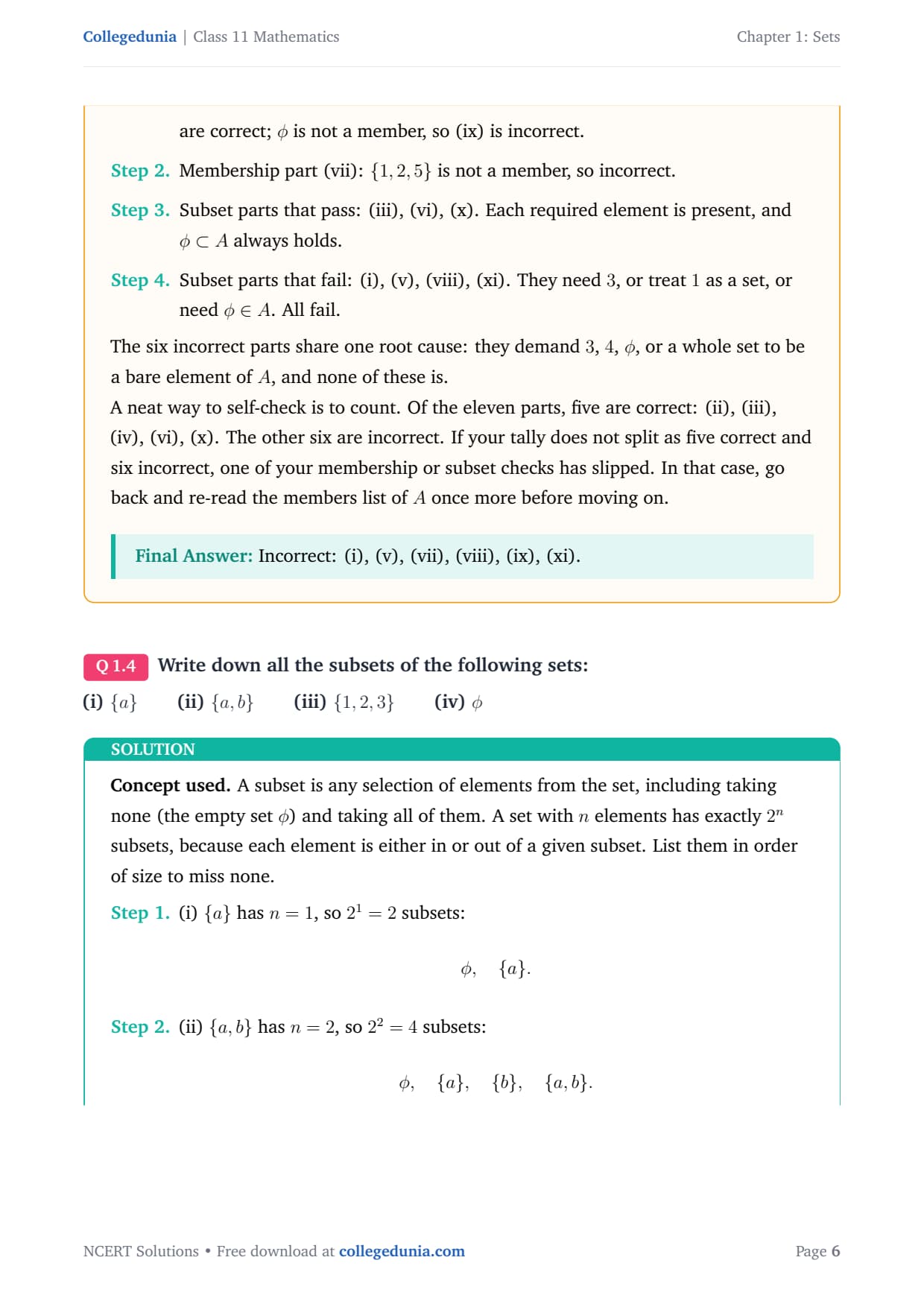
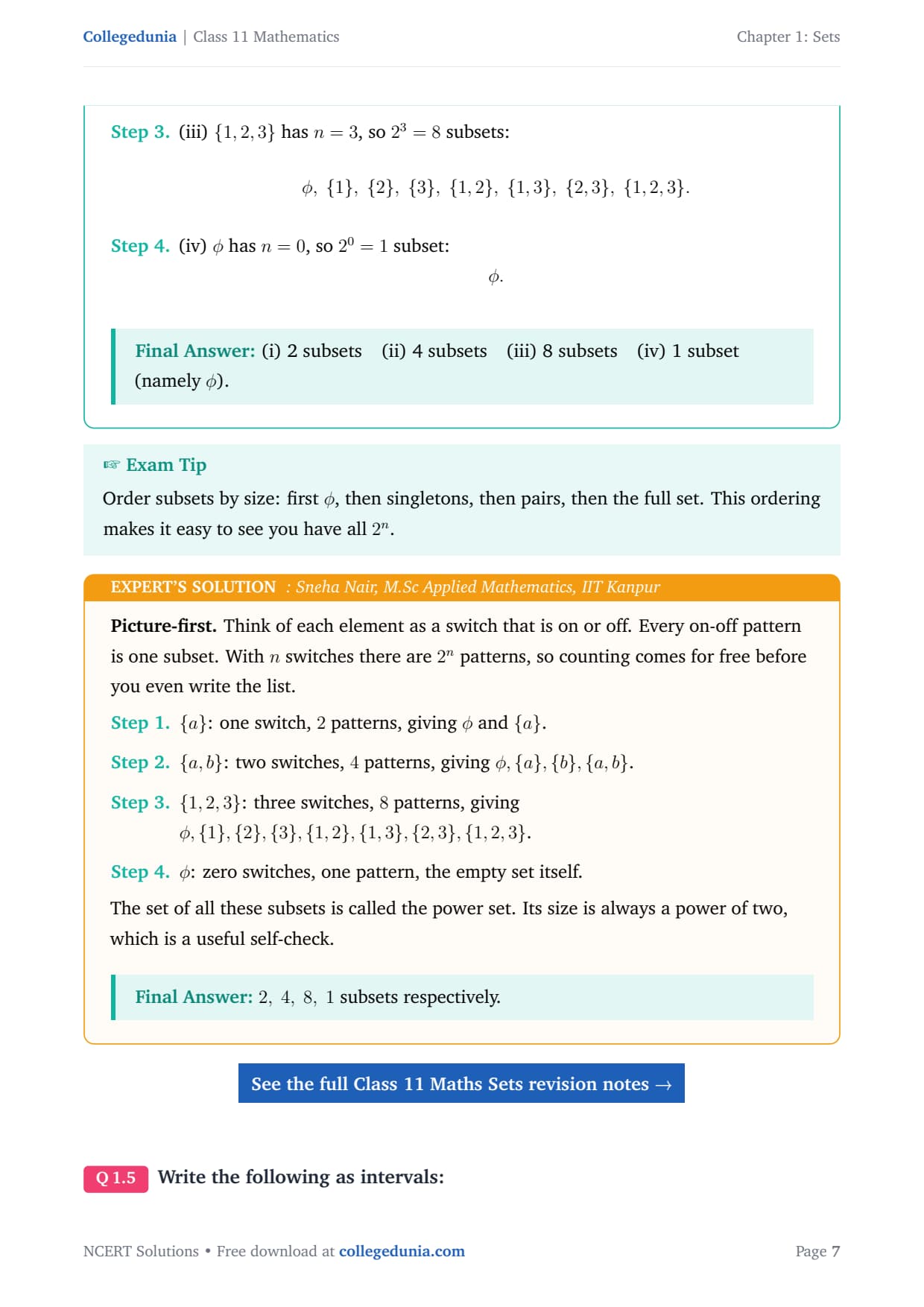
| Q4 | Write all subsets of the given sets | Listing subsets |
| Q5 | Find the number of elements in P(A) when A is empty | Power set |
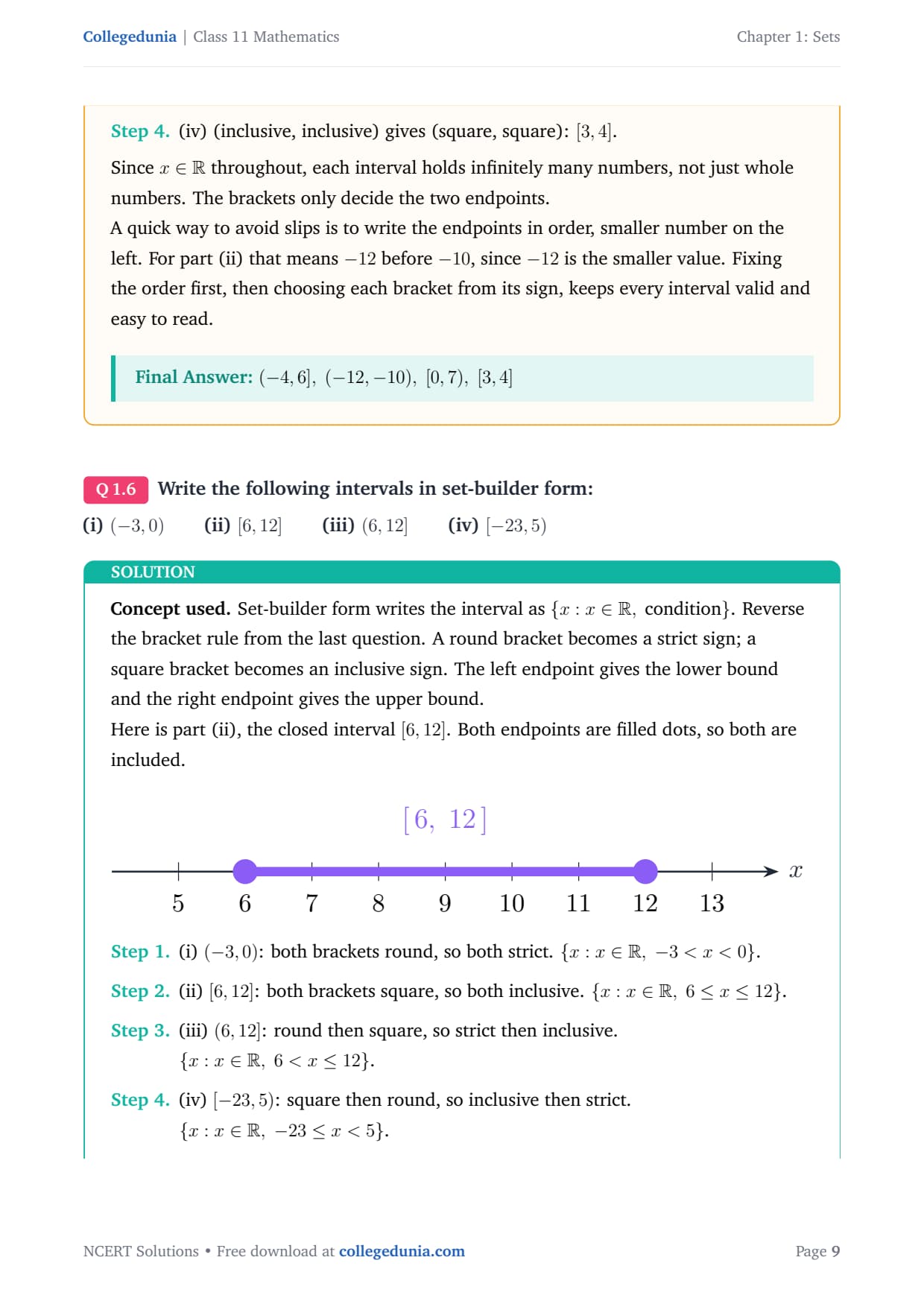
| Q6 | Write the given sets as intervals | Set to interval |
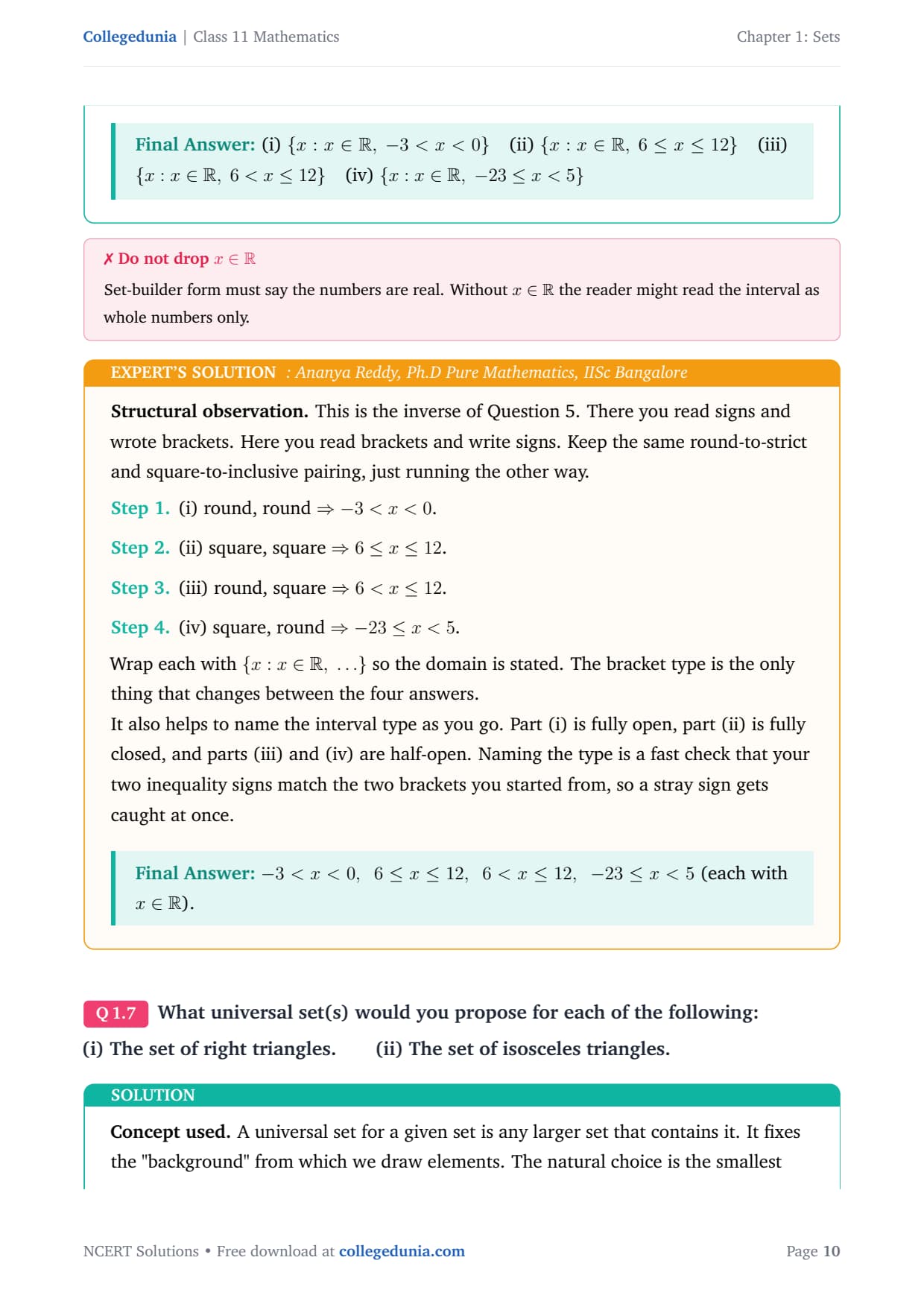
| Q7 | Write the given intervals in set-builder form | Interval to set |
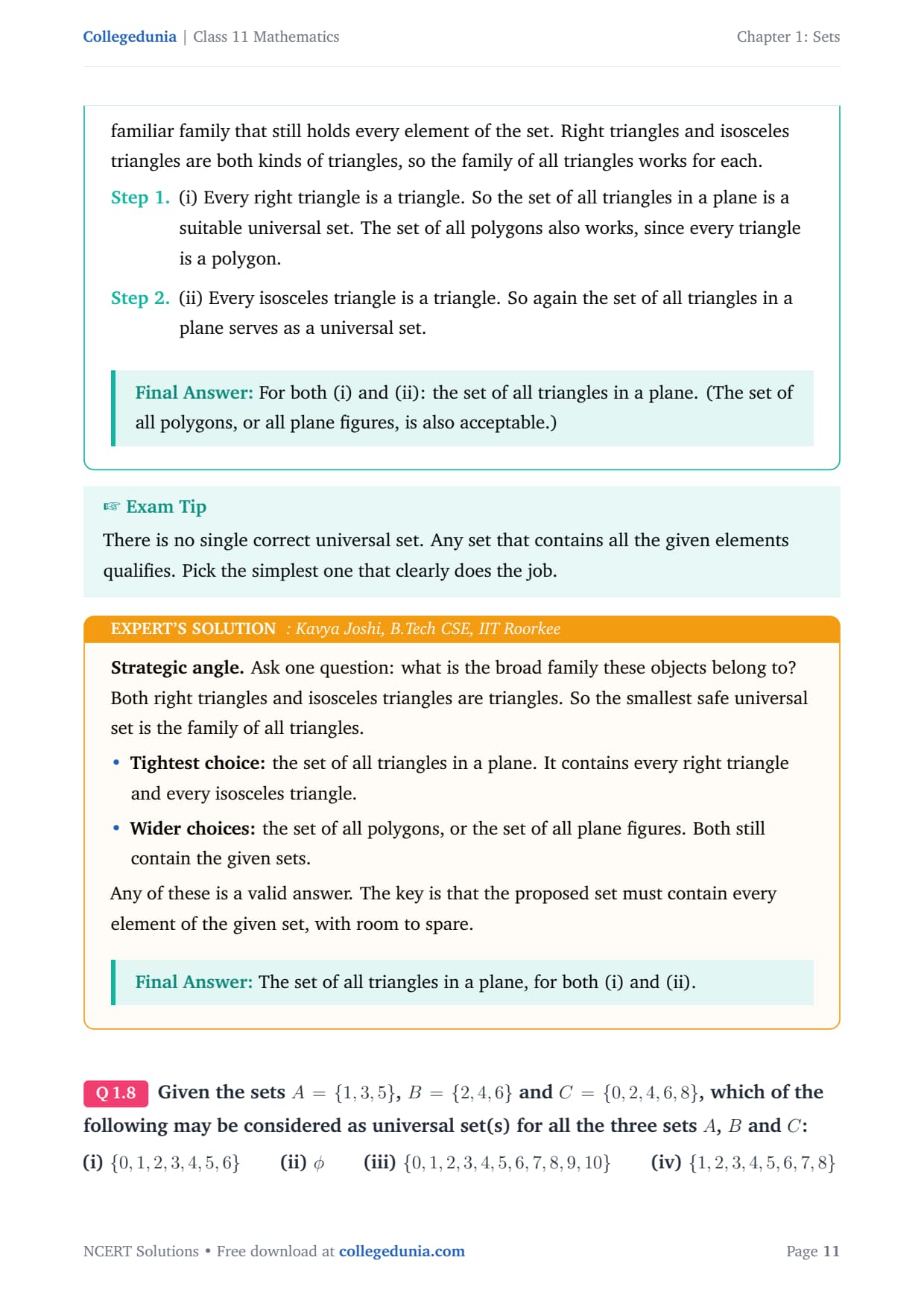
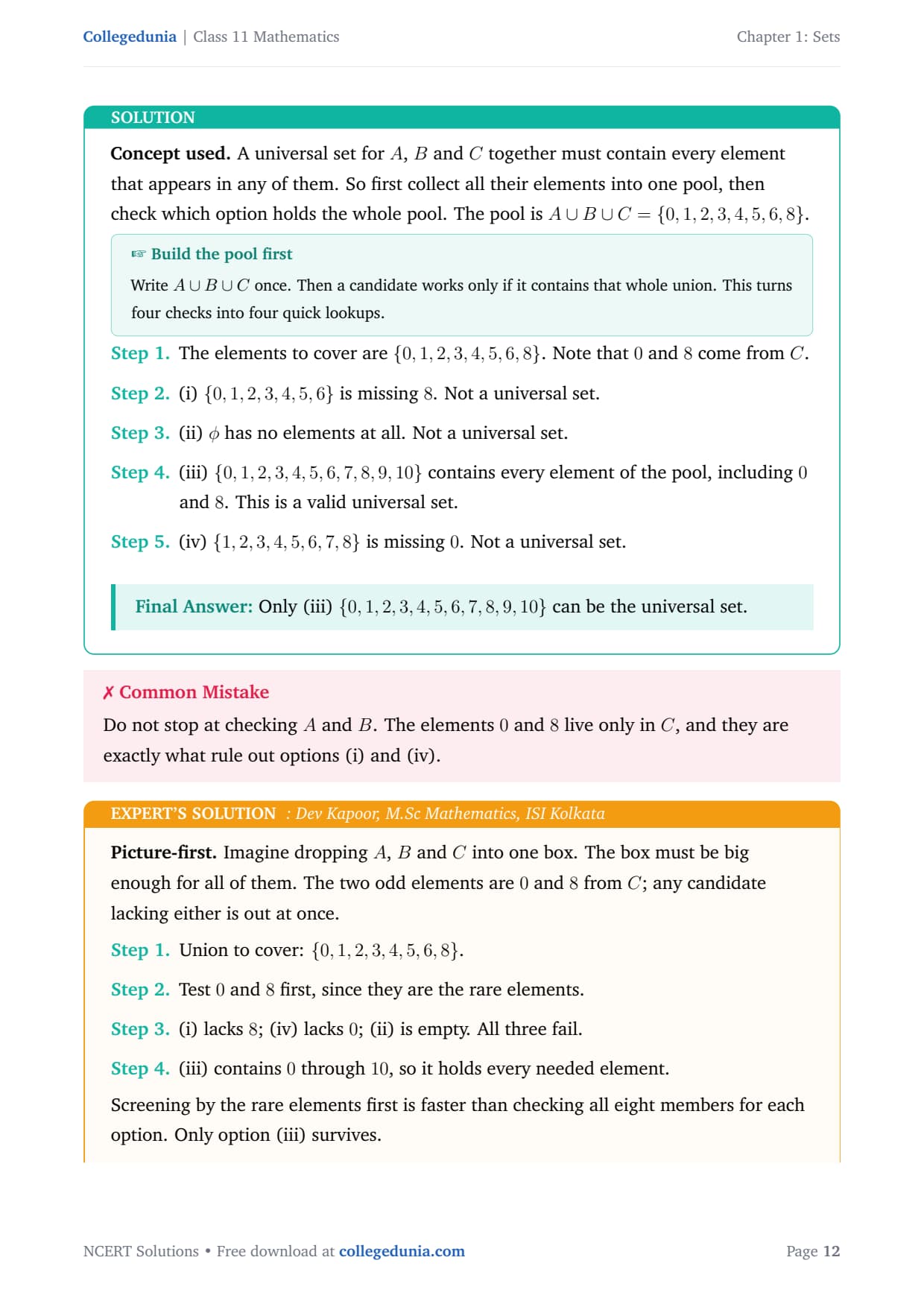
| Q8–Q9 | Propose a universal set for the given sets | Universal set |
The middle questions on subsets carry the most parts, so they need the most practice.
Key Formulas and Definitions for Sets Exercise 1.3
Exercise 1.3 uses one key formula for the power set and a few clear definitions. Students should fix these before attempting the questions.
| Term / Result | Meaning |
|---|---|
| A ⊂ B | Every element of A is also in B (A is a subset of B) |
| Proper subset | A ⊂ B but A is not equal to B |
| Power set P(A) | The set of all subsets of A |
| Number of subsets | A set with n elements has 2n subsets |
| Open interval (a, b) | {x : a < x < b}, endpoints not included |
| Closed interval [a, b] | {x : a ≤ x ≤ b}, endpoints included |
Tip: a set with n elements has 2n subsets and 2n − 1 proper subsets. Question 5 uses this directly.
Common Mistakes in Sets Exercise 1.3
Students lose easy marks in Exercise 1.3 by mixing up membership and subsets. The list below covers the errors that show up most often on the NCERT Solutions for Class 11 Maths Chapter 1 Sets Exercise 1.3.
- Writing an element with ⊂ instead of ∈. Use ∈ for an element and ⊂ for a subset.
- Forgetting that ∅ and the set itself are always subsets when listing subsets.
- Mixing open and closed brackets. Use ( ) when an endpoint is left out and [ ] when it is included.
- Reading {3, 4} as an element of A = {1, 2, {3, 4}, 5} when it is a subset, or the reverse.
Practice Questions for Sets Exercise 1.3
After reading the solutions, students should test themselves on the same question types. The card below opens a set of solved practice questions with step-by-step answers for Exercise 1.3.
Practice Card: Solved Practice Questions for Class 11 Maths Sets Exercise 1.3 — attempt each question, then check the worked solution.
Other Exercises of Chapter 1 Sets
Chapter 1 Sets has five exercises plus a Miscellaneous Exercise. Use the table to move to the next exercise once Exercise 1.3 is done.
| Exercise | NCERT Solutions link |
|---|---|
| Exercise 1.1 | Class 11 Maths Sets Exercise 1.1 Solutions |
| Exercise 1.2 | Class 11 Maths Sets Exercise 1.2 Solutions |
| Exercise 1.4 | Class 11 Maths Sets Exercise 1.4 Solutions |
| Exercise 1.5 | Class 11 Maths Sets Exercise 1.5 Solutions |
| Miscellaneous Exercise | Class 11 Maths Sets Miscellaneous Exercise Solutions |
More Class 11 Maths Sets Resources
Pair the solutions with the notes and the NCERT book PDF for full chapter revision. All three resources for Chapter 1 Sets are linked below.
| Resource | Link |
|---|---|
| Revision Notes | Class 11 Maths Sets Notes |
| Handwritten Notes | Class 11 Maths Sets Handwritten Notes |
| NCERT Book PDF | Class 11 Maths Sets NCERT Book PDF |
NCERT Solutions for Other Class 11 Maths Chapters
Students can move to the first exercise of any other Class 11 Maths chapter using the cross-sell table below.
| Chapter | NCERT Solutions |
|---|---|
| Chapter 1: Sets | You are here |
| Chapter 2: Relations and Functions | Relations and Functions Solutions |
| Chapter 3: Trigonometric Functions | Trigonometric Functions Solutions |
| Chapter 4: Complex Numbers and Quadratic Equations | Complex Numbers Solutions |
| Chapter 5: Linear Inequalities | Linear Inequalities Solutions |
| Chapter 6: Permutations and Combinations | Permutations and Combinations Solutions |
| Chapter 7: Binomial Theorem | Binomial Theorem Solutions |
| Chapter 8: Sequences and Series | Sequences and Series Solutions |
| Chapter 9: Straight Lines | Straight Lines Solutions |
| Chapter 10: Conic Sections | Conic Sections Solutions |
| Chapter 11: Introduction to Three Dimensional Geometry | Three Dimensional Geometry Solutions |
| Chapter 12: Limits and Derivatives | Limits and Derivatives Solutions |
| Chapter 13: Statistics | Statistics Solutions |
| Chapter 14: Probability | Probability Solutions |
Student Feedback
In a Collegedunia survey of 12,140 Class 11 students conducted before the 2026 exams, 64% of students said the element-versus-subset question in Exercise 1.3 was the trickiest part, while writing sets as intervals was rated the easiest to pick up.
FAQs on NCERT Solutions for Class 11 Maths Chapter 1 Sets Exercise 1.3
Sets NCERT Solutions - Frequently Asked Questions
Ques. How many questions are there in Class 11 Maths Chapter 1 Sets Exercise 1.3?
Ans. Exercise 1.3 has 9 questions. They cover subset notation with ⊂ and ⊄, listing subsets, the power set, writing sets as intervals and back, and choosing a universal set. Many questions have several parts, so students get plenty of practice.
Ques. What is a subset in Class 11 Maths?
Ans. A set A is a subset of B, written A ⊂ B, when every element of A is also an element of B. For example, {2, 3} ⊂ {1, 2, 3, 4}. The empty set is a subset of every set, and every set is a subset of itself.
Ques. How many subsets does a set with n elements have?
Ans. A set with n elements has 2n subsets in total and 2n − 1 proper subsets. The set of all subsets is called the power set, P(A). Question 5 of Exercise 1.3 uses this result for the empty set, where P(∅) has just one element.
Ques. How do you write a set as an interval?
Ans. A set of real numbers is written as an interval using brackets. Use ( ) when an endpoint is not included and [ ] when it is. For example, {x : −4 < x ≤ 6} becomes (−4, 6]. Exercise 1.3 asks students to switch between set-builder form and intervals.
Ques. Are the NCERT Solutions for Class 11 Maths Chapter 1 Sets Exercise 1.3 free to download?
Ans. Yes. The NCERT Solutions for Class 11 Maths Chapter 1 Sets Exercise 1.3 are free to download as a PDF from this page. Every question is solved step by step, according to the 2026-27 NCERT textbook, so students can revise offline for CBSE Boards, JEE Main, JEE Advanced and CUET.



Comments