




The NCERT Solutions for Class 11 Maths Chapter 14 Probability Exercise 14.2 solve every question of the second exercise, according to the latest 2026-27 CBSE syllabus. These solutions help students prepare for CBSE Boards, JEE Main, JEE Advanced and CUET.
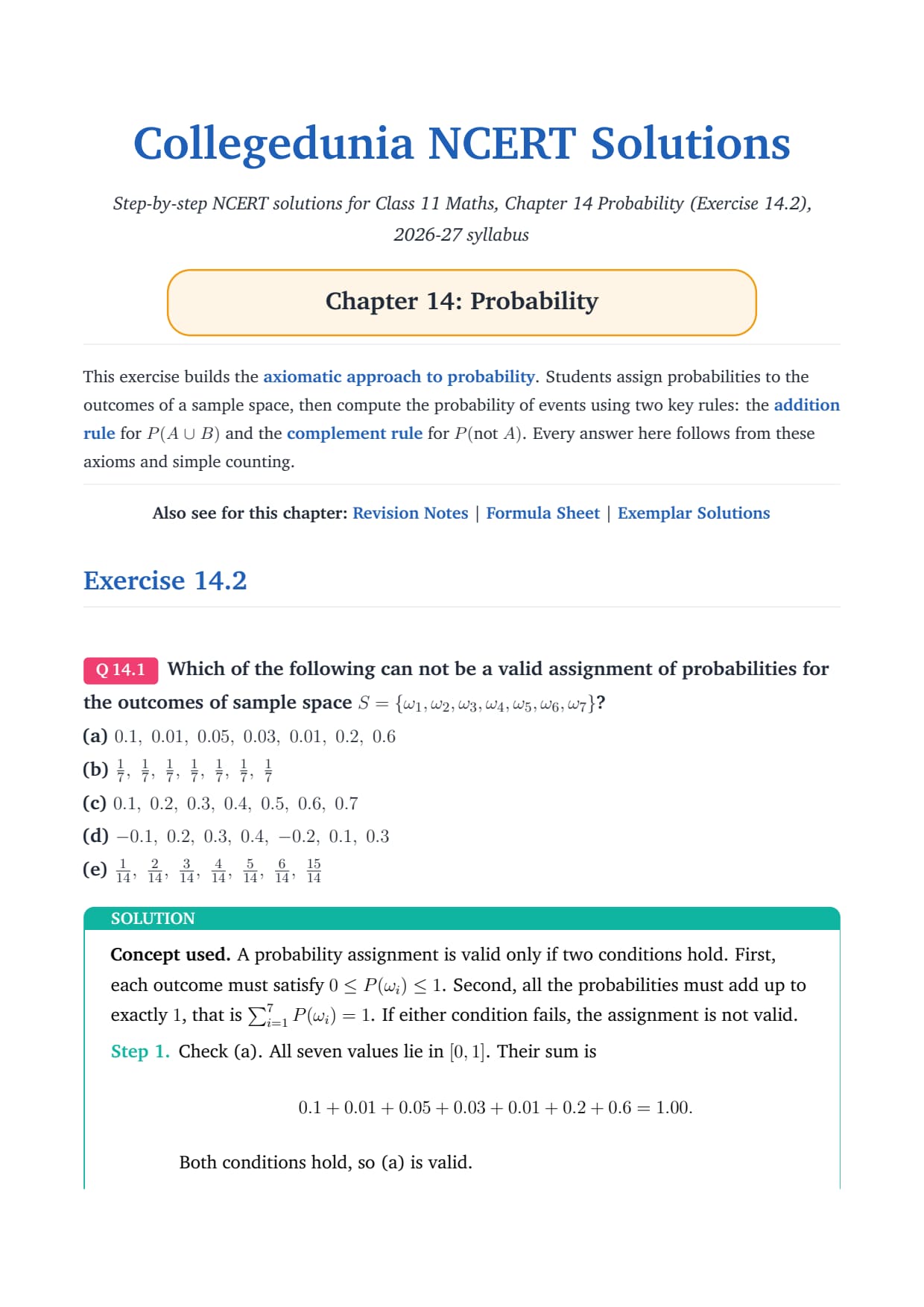
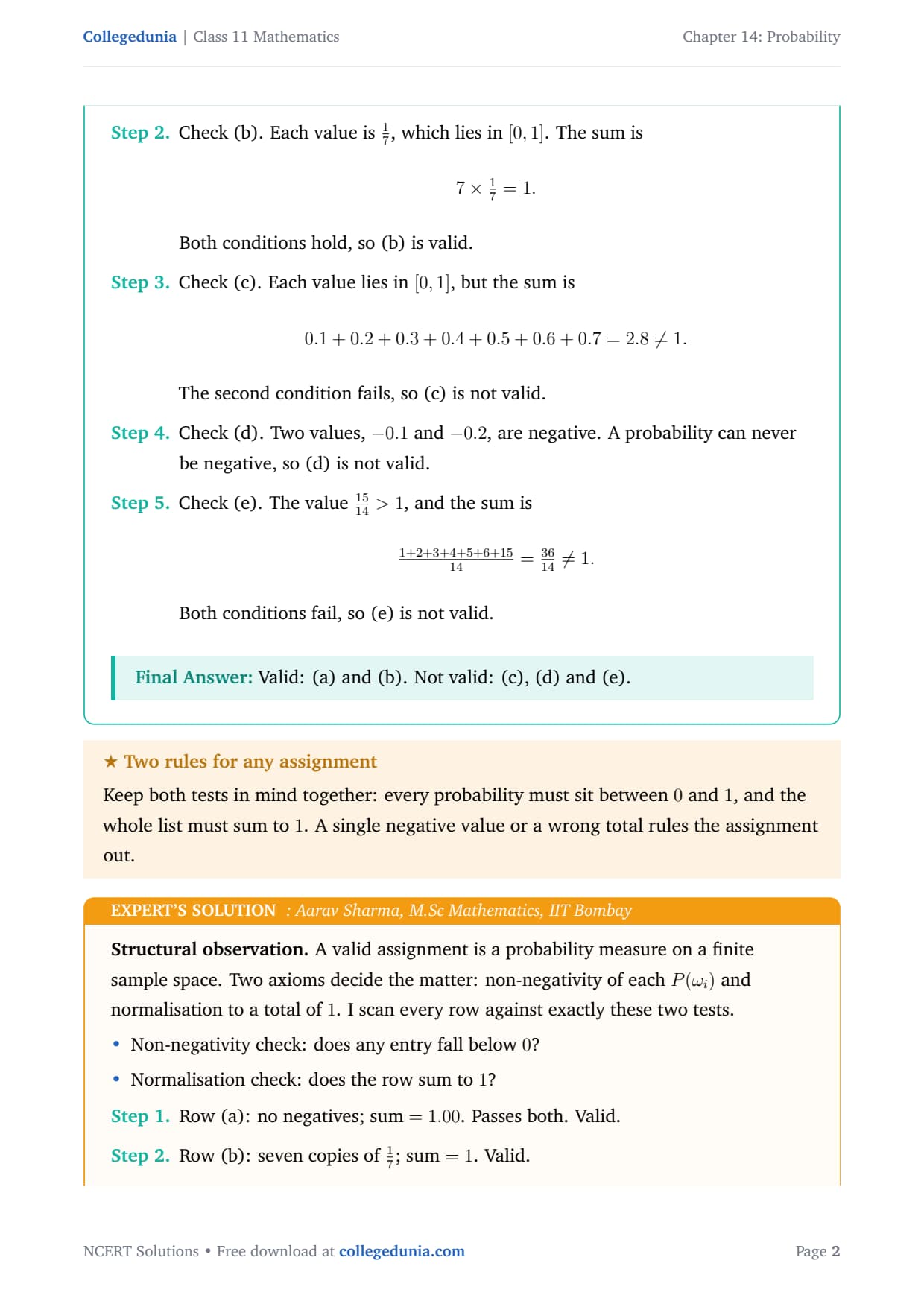
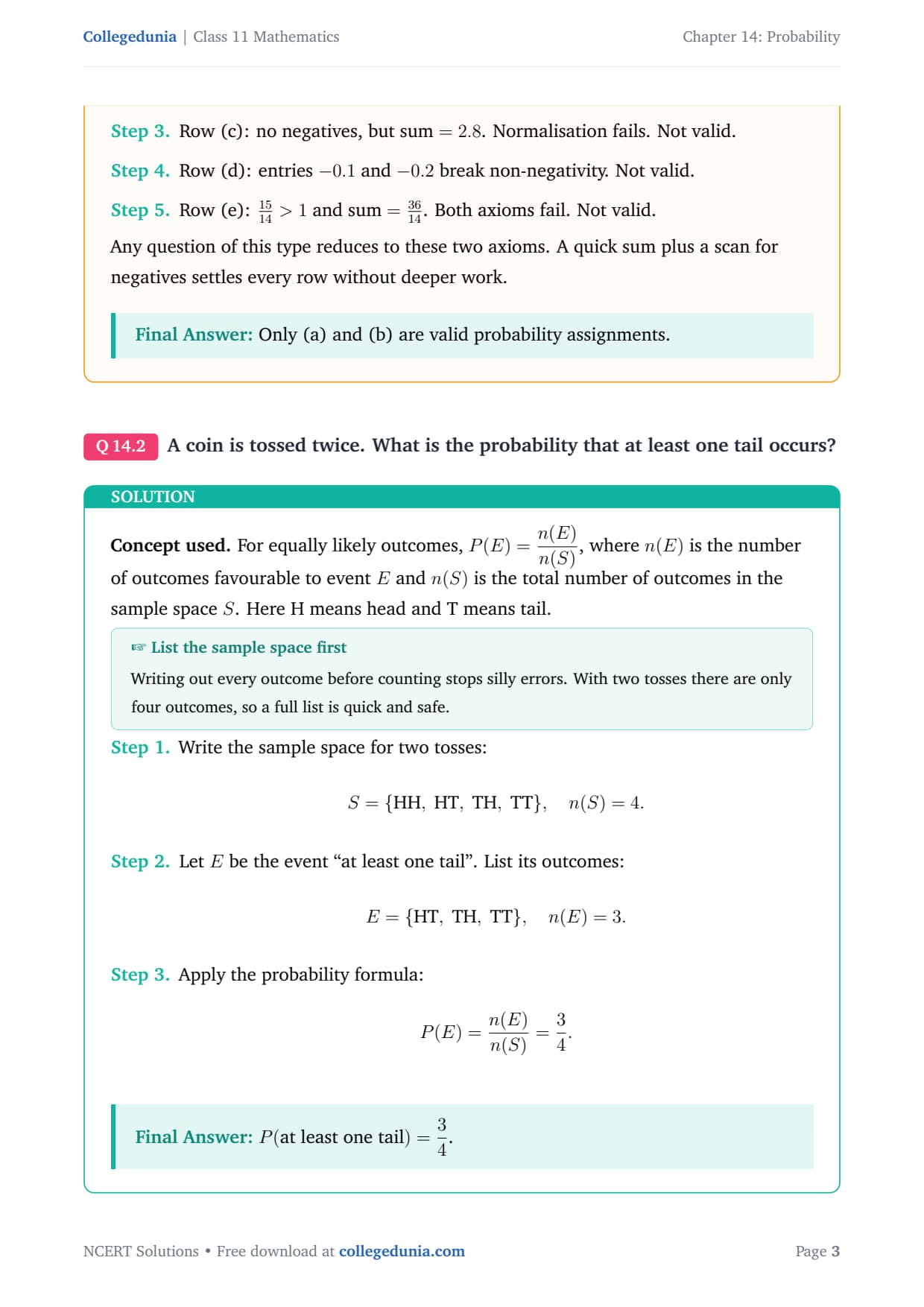
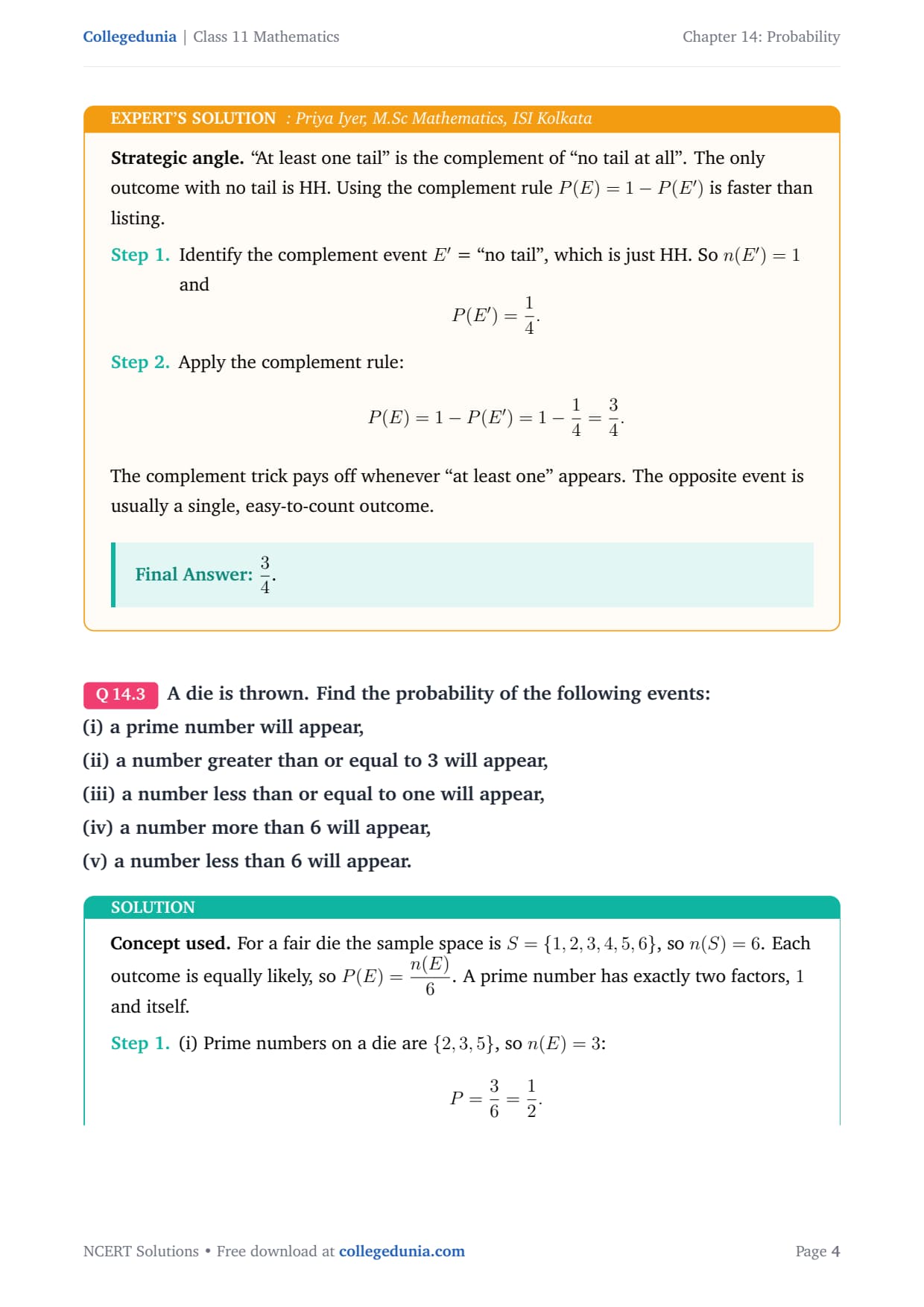
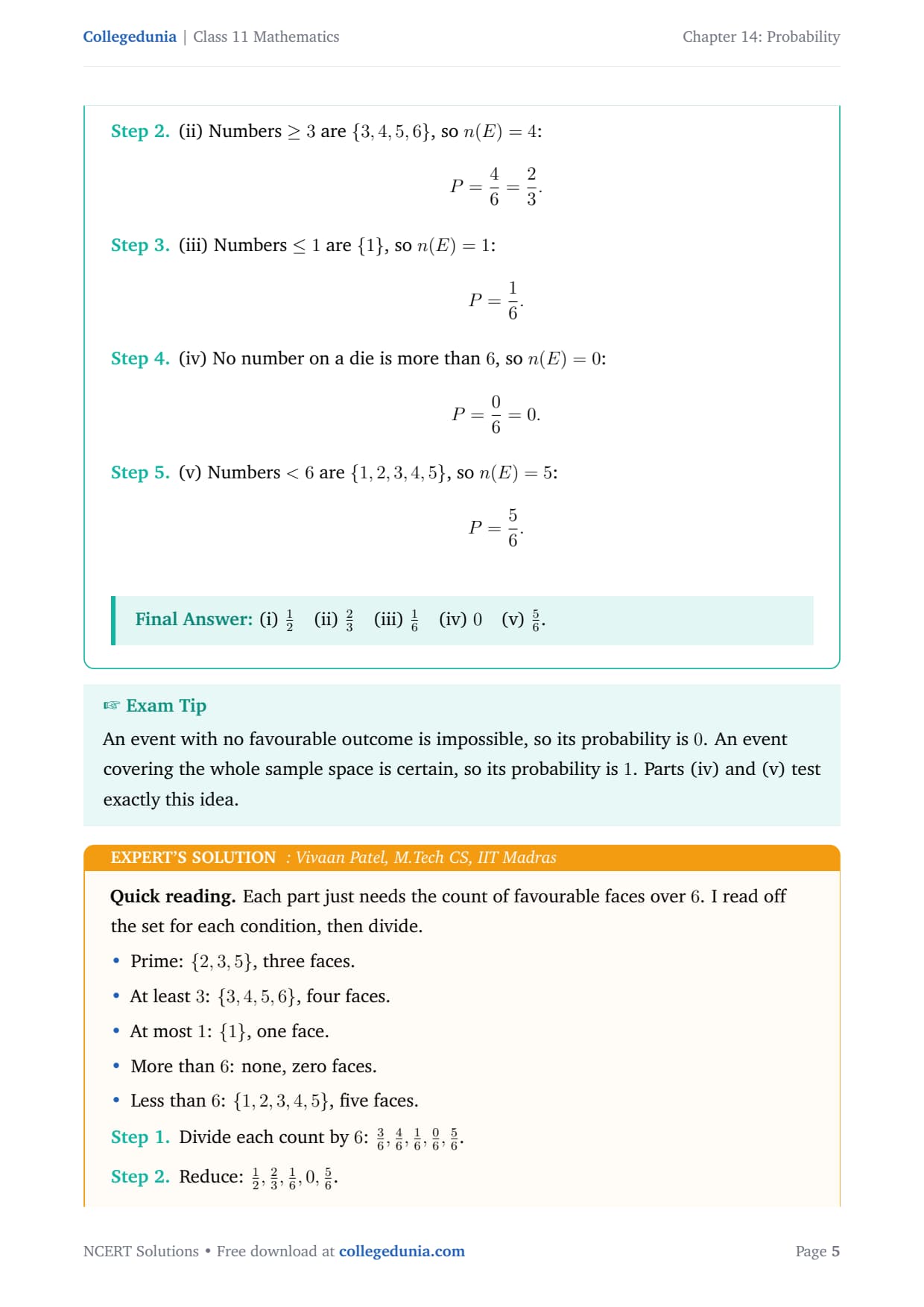
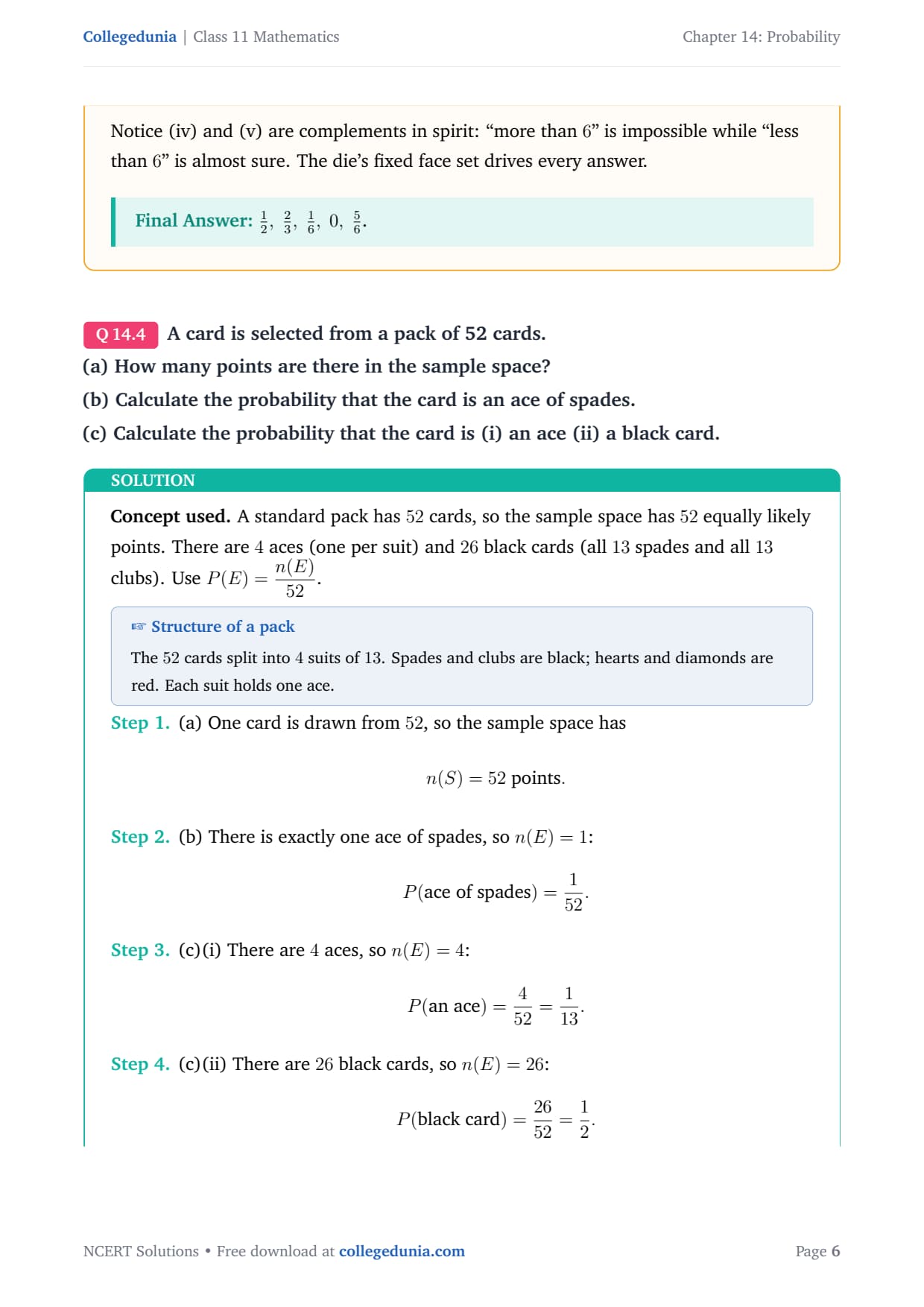
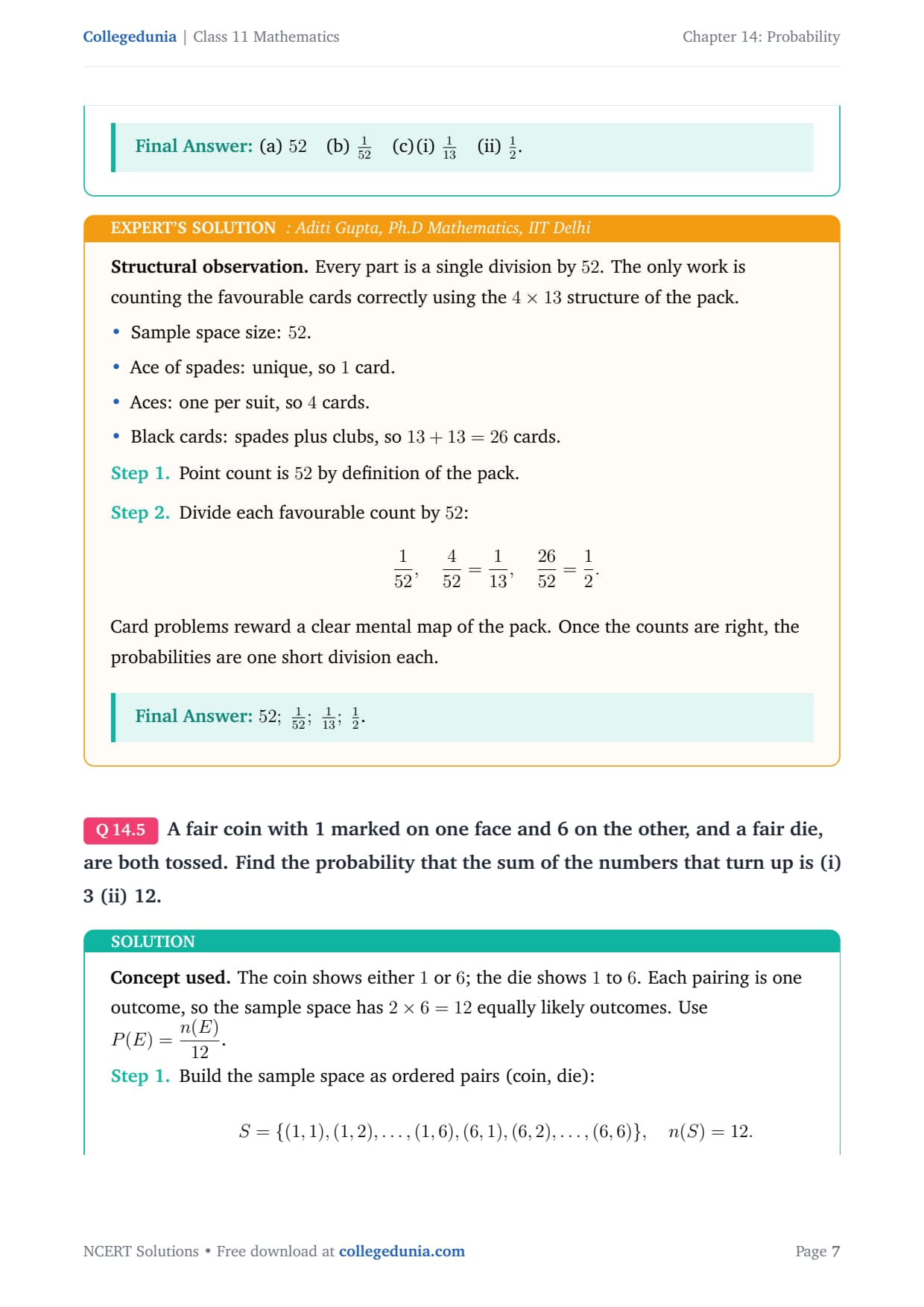
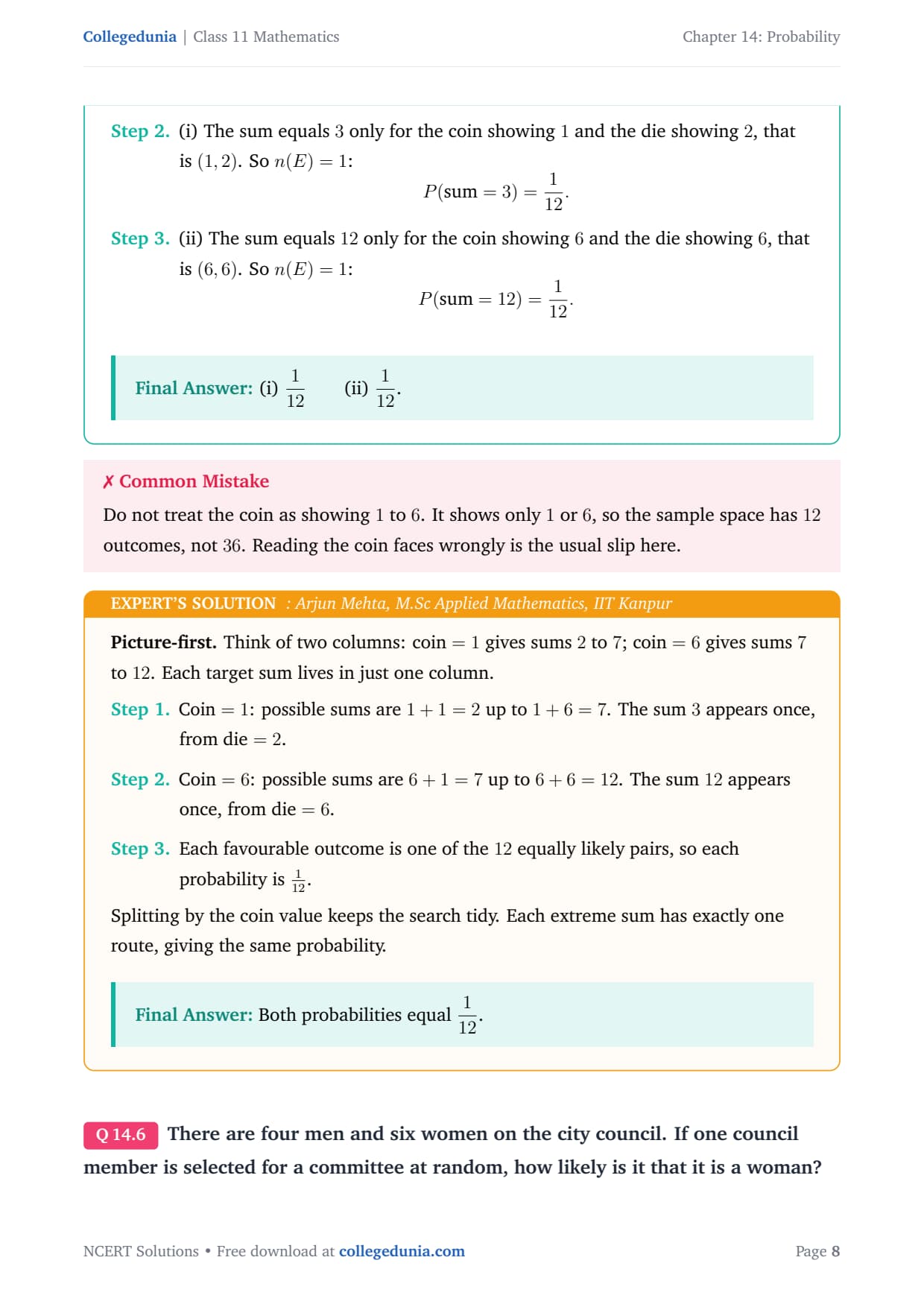
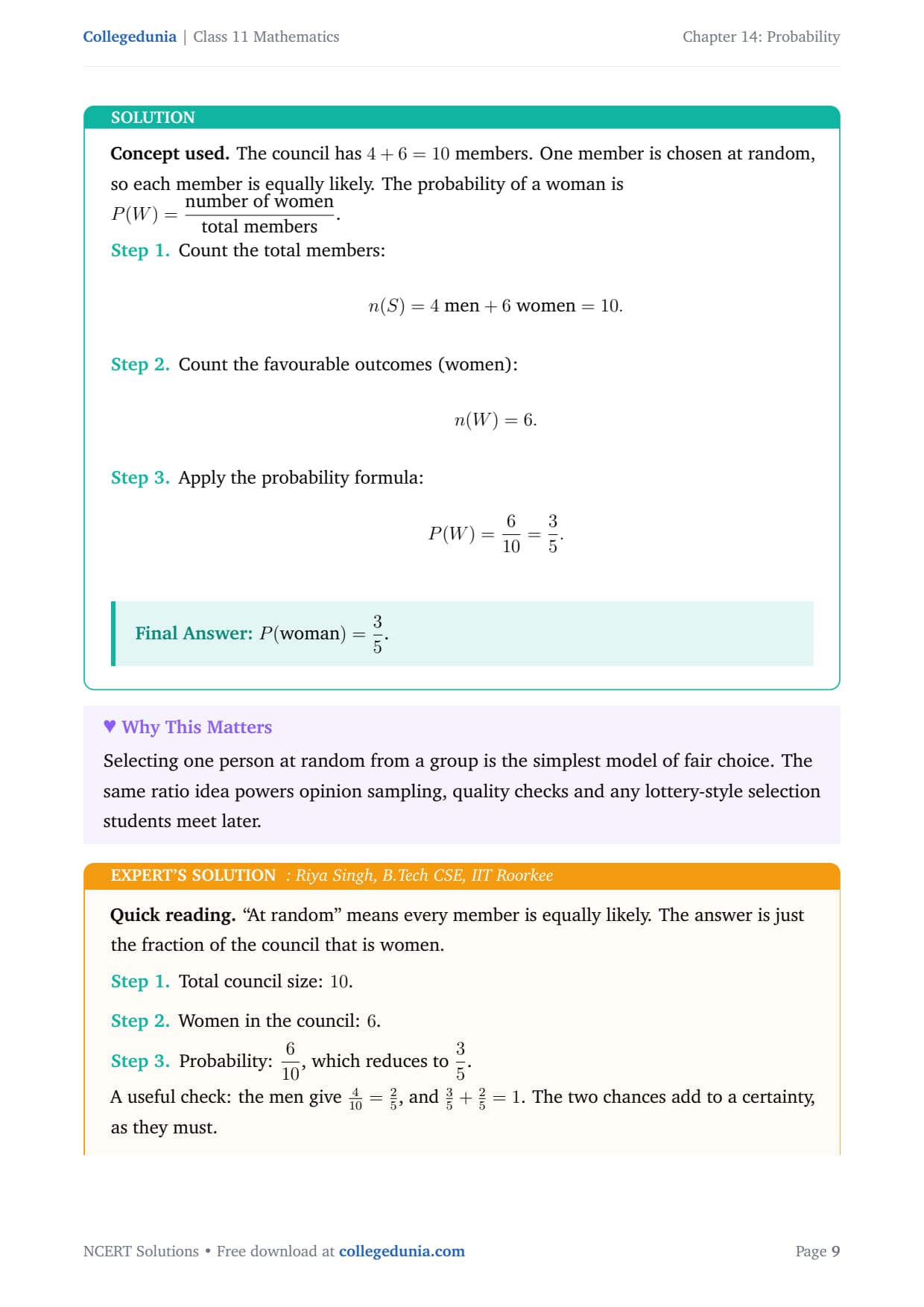
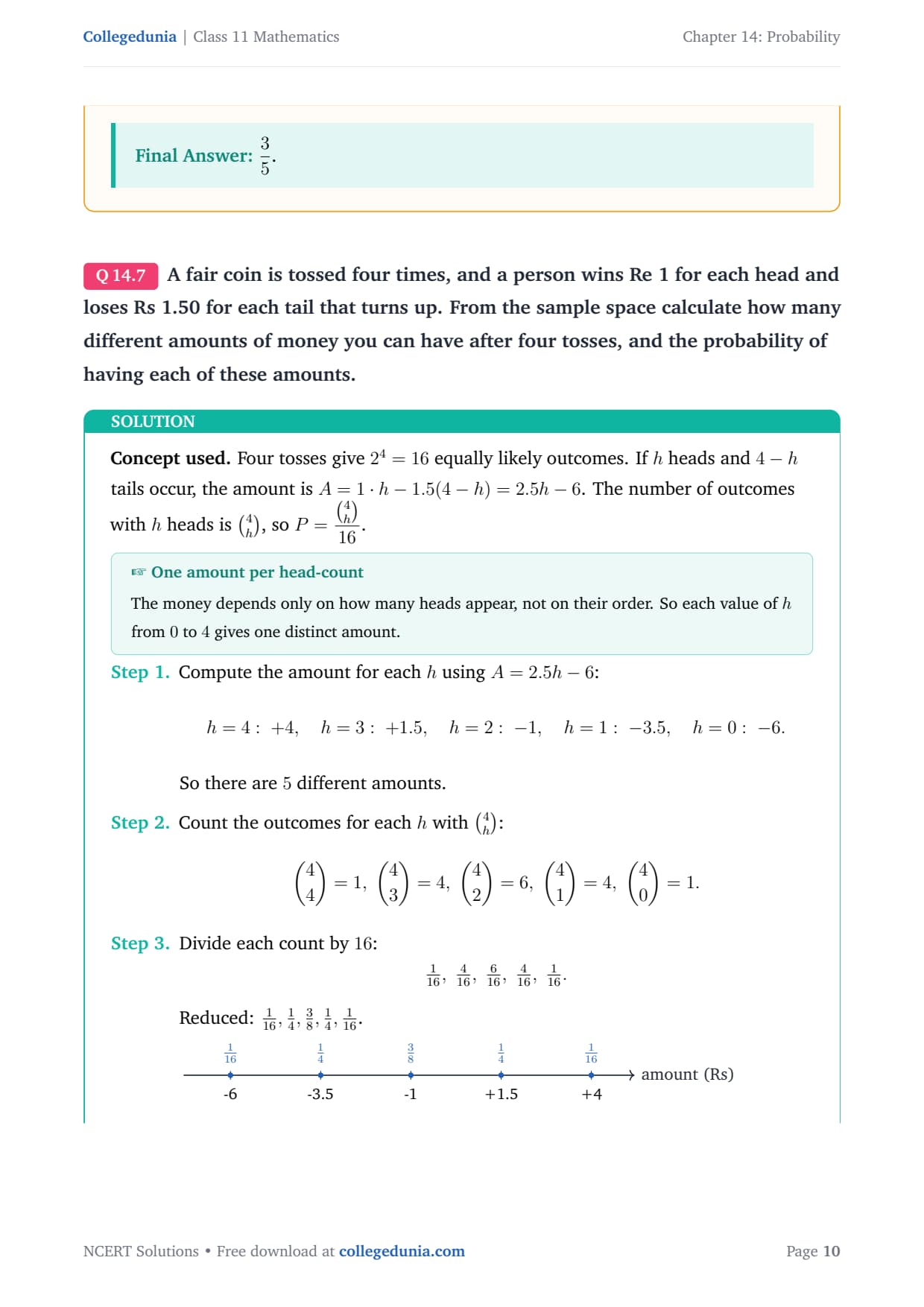
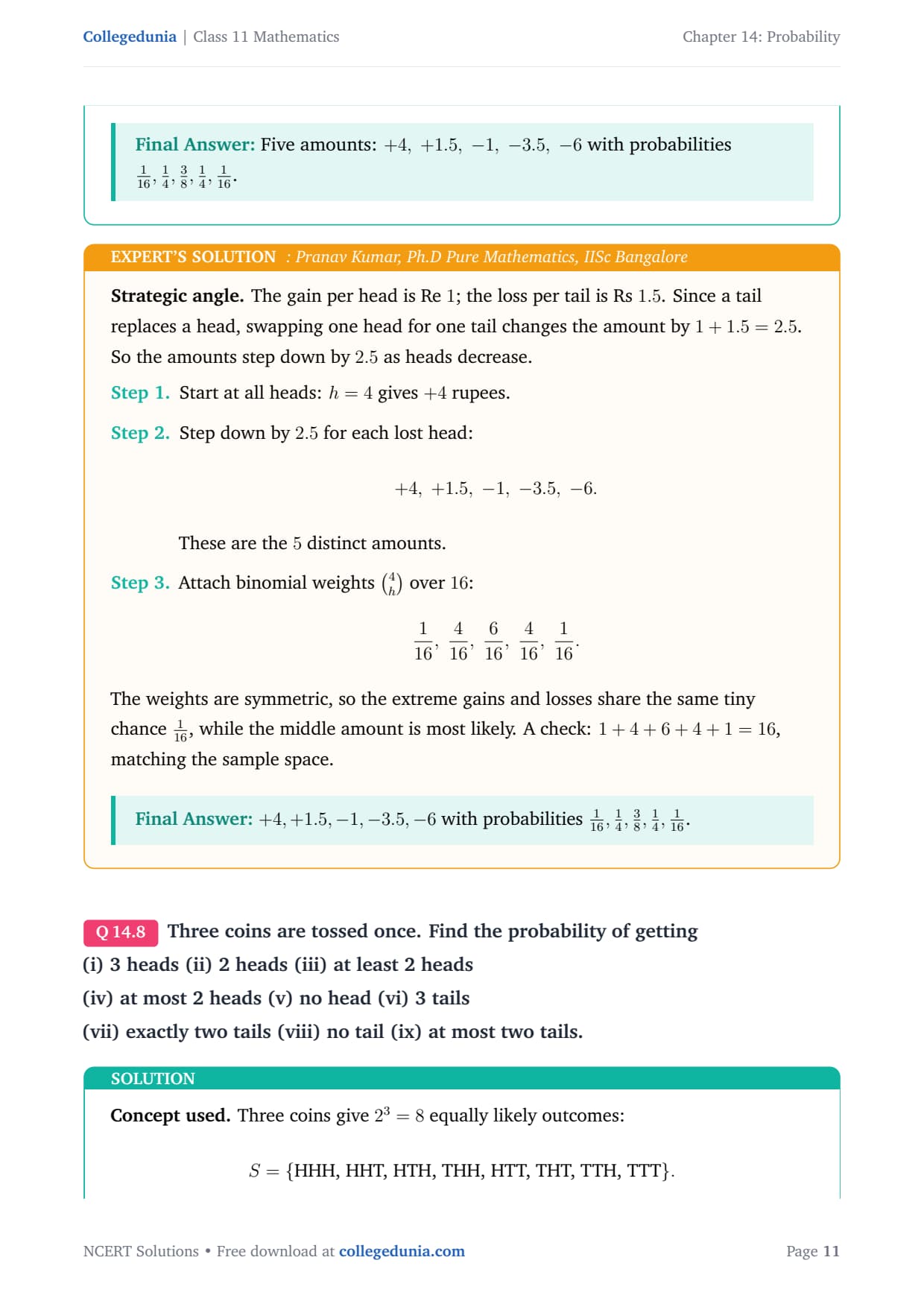
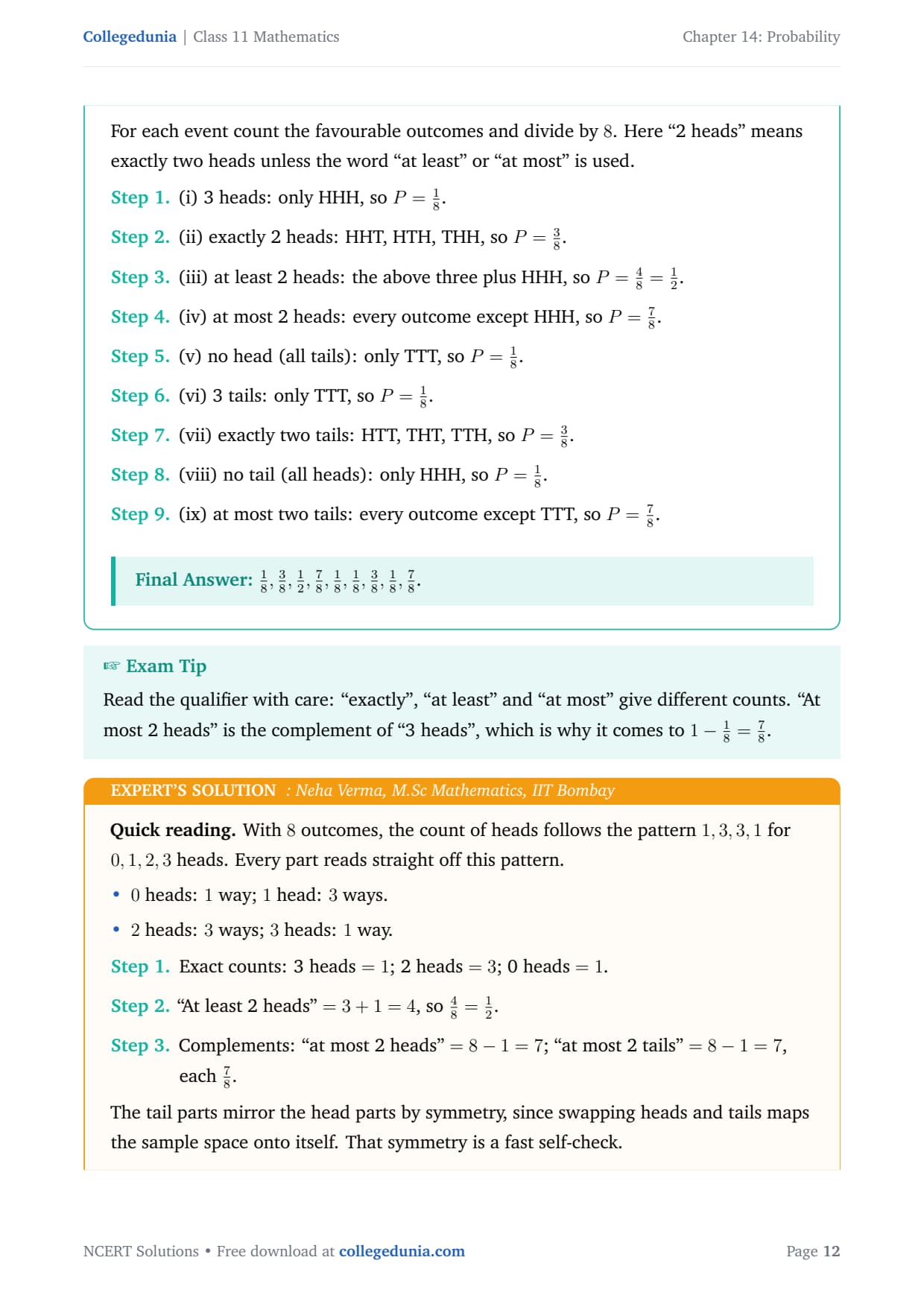
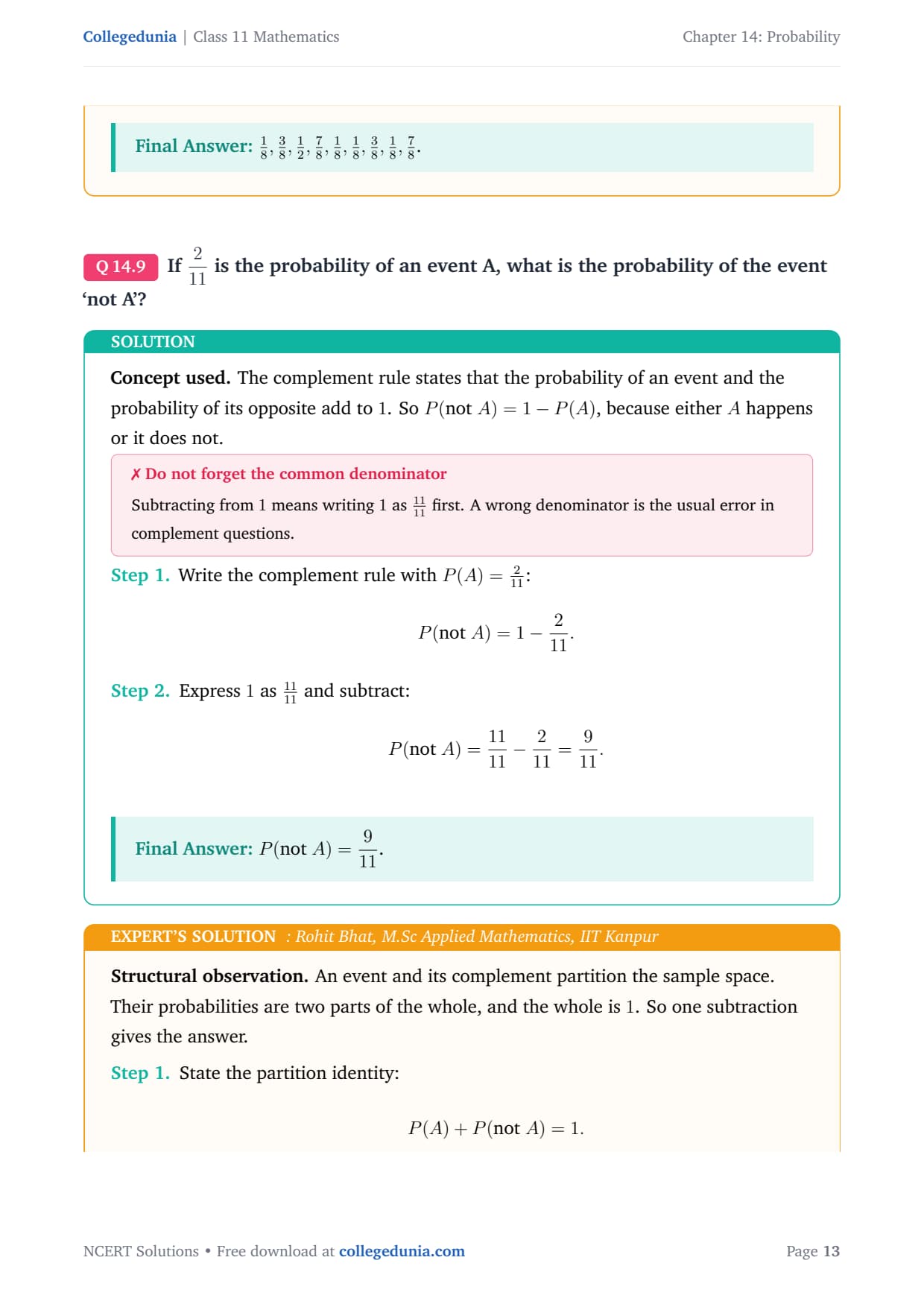
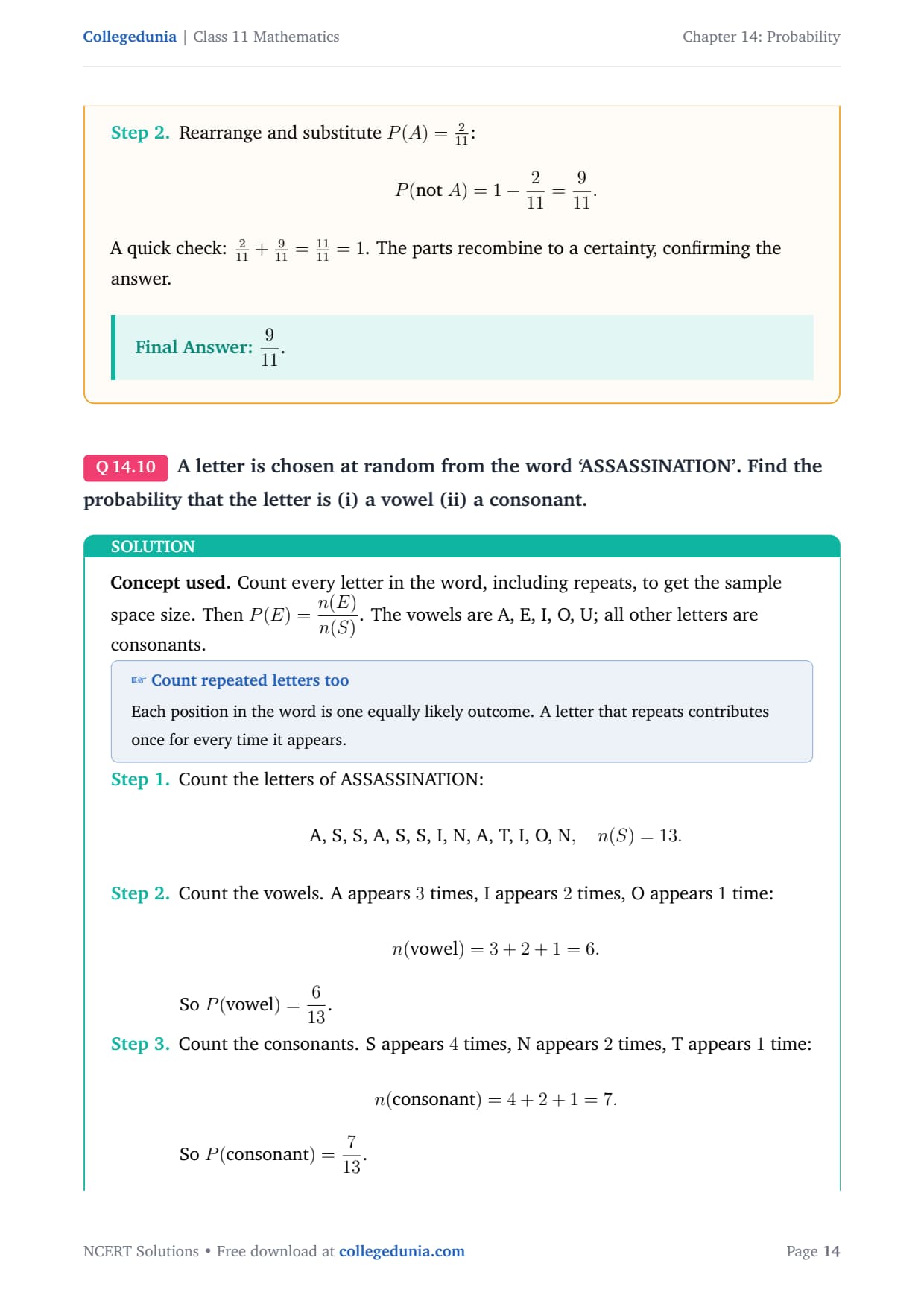
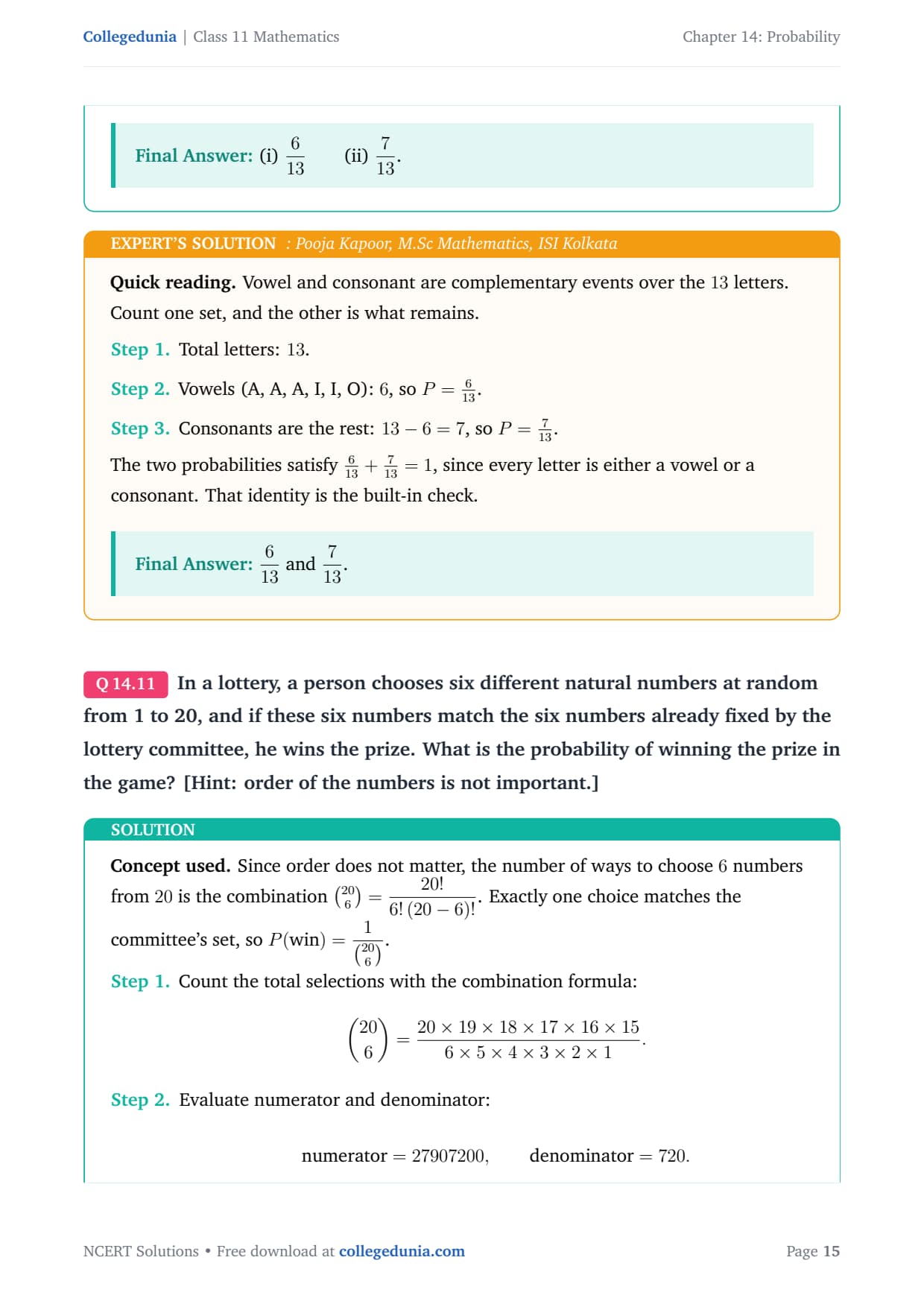
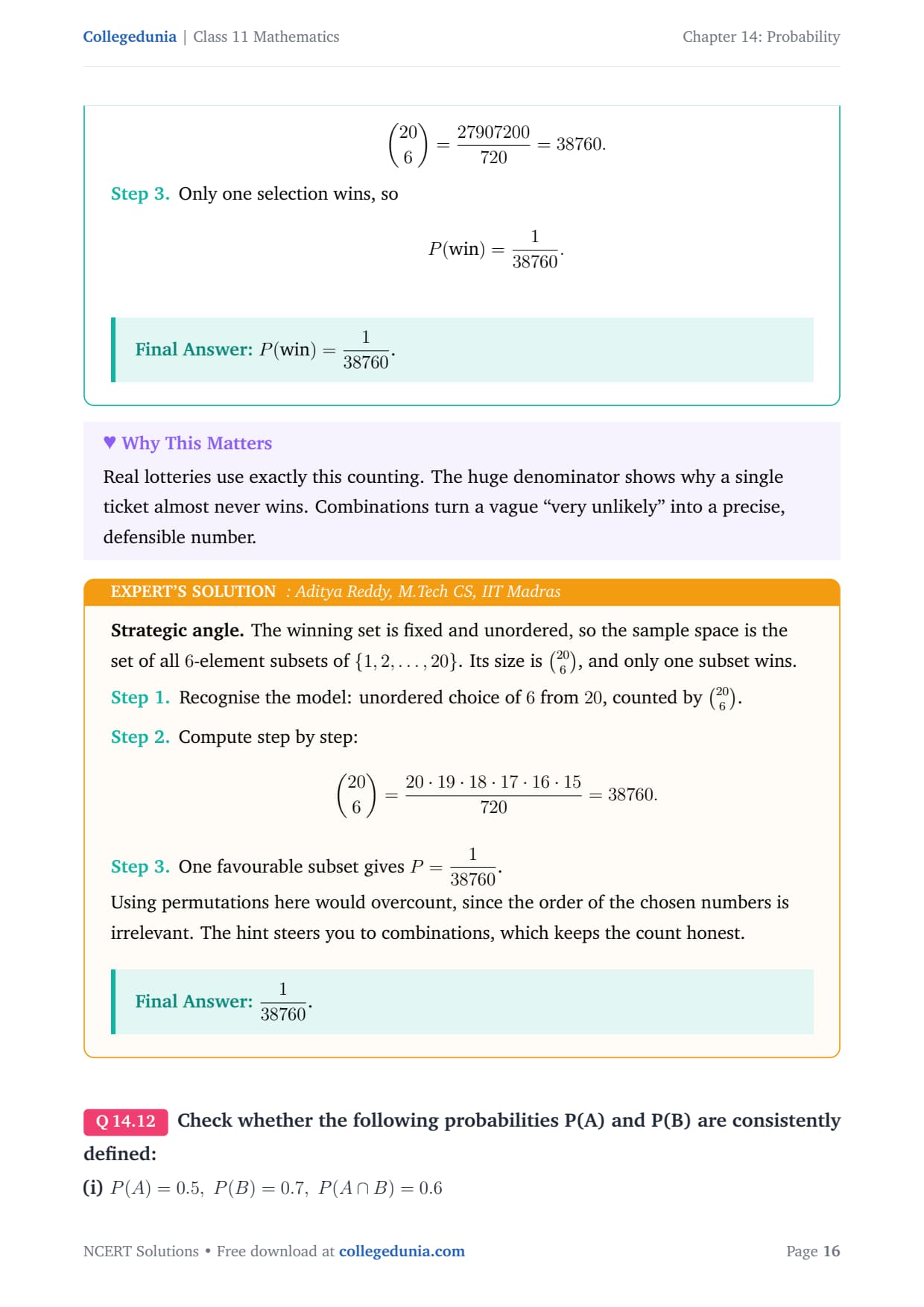
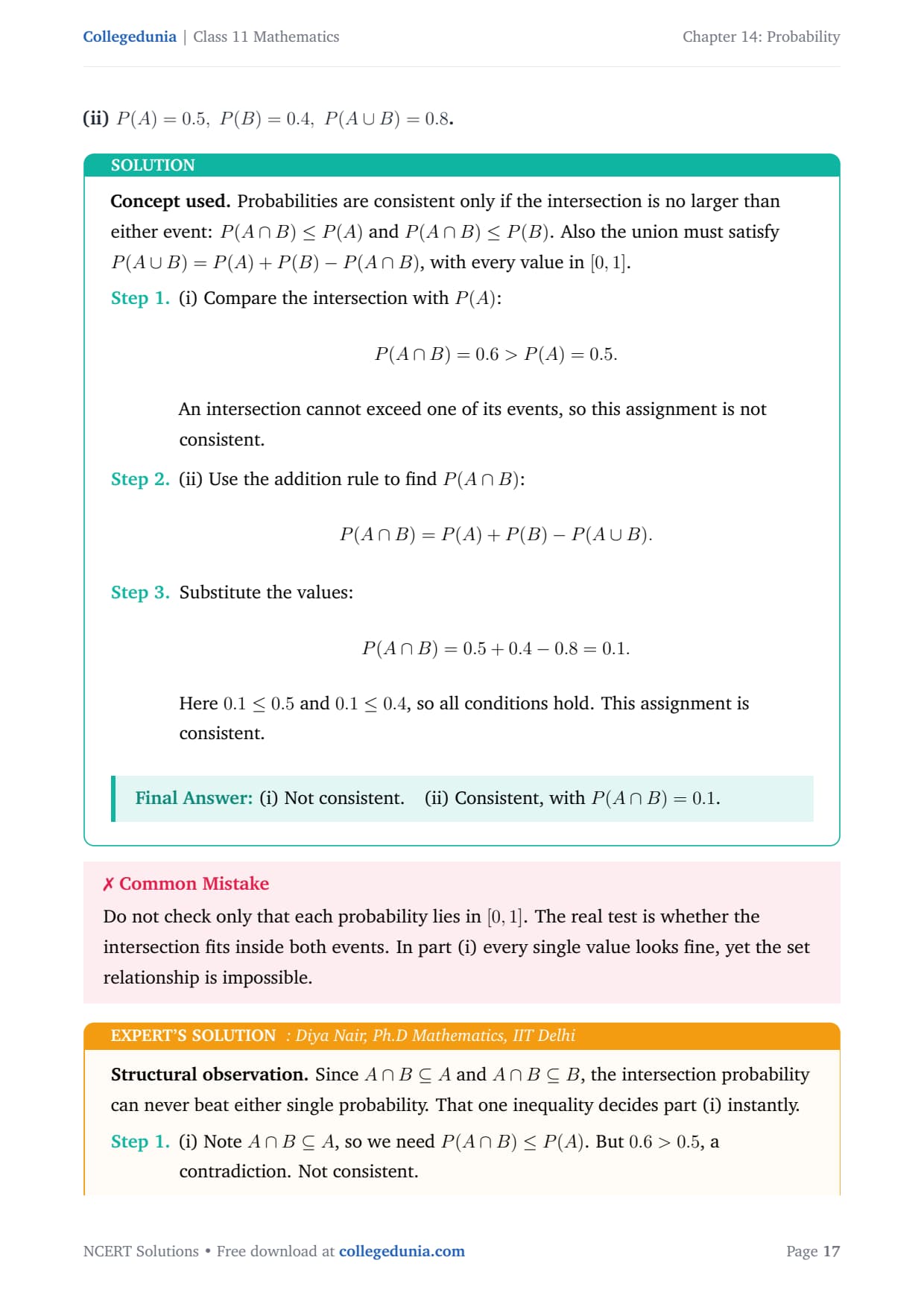
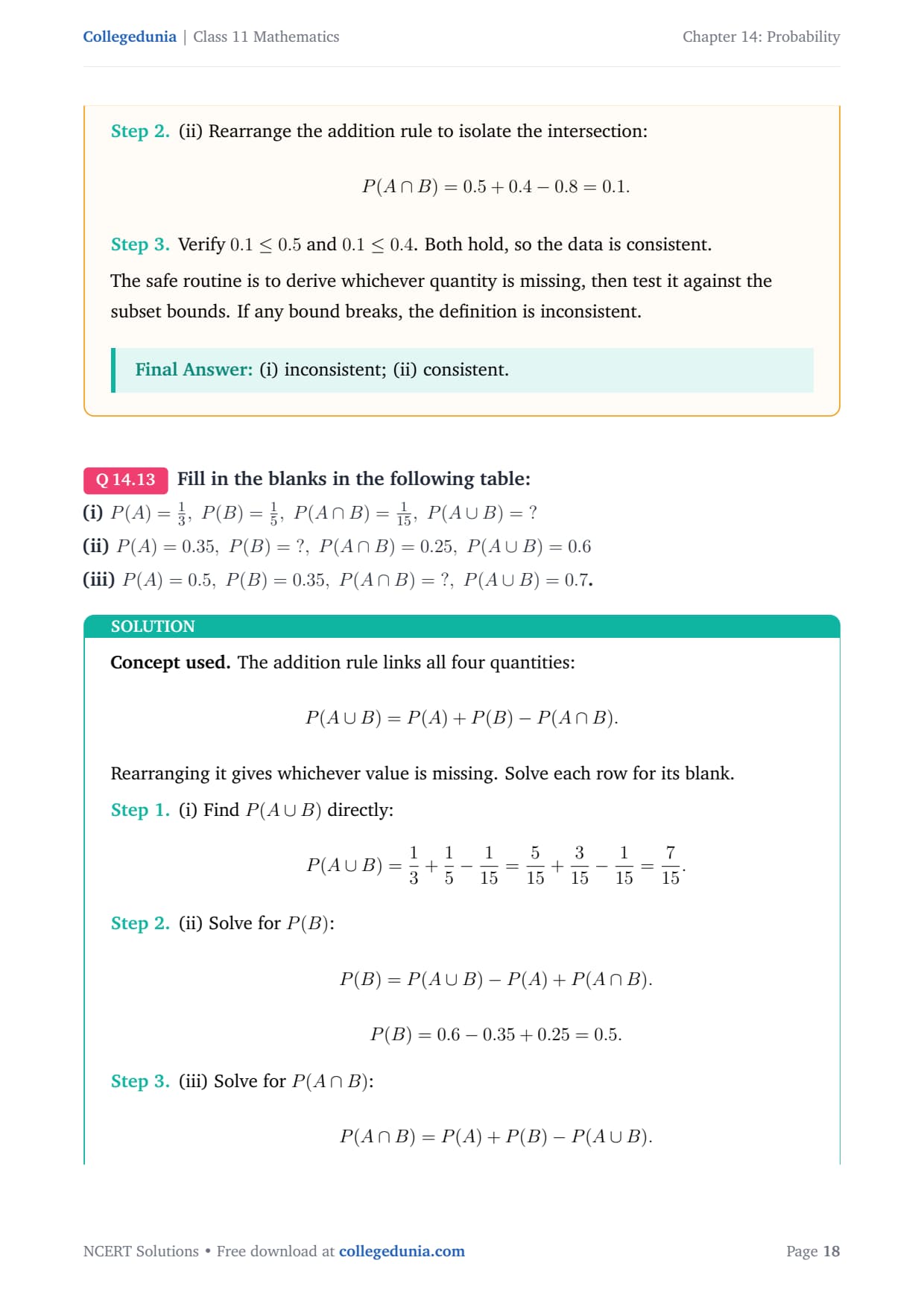
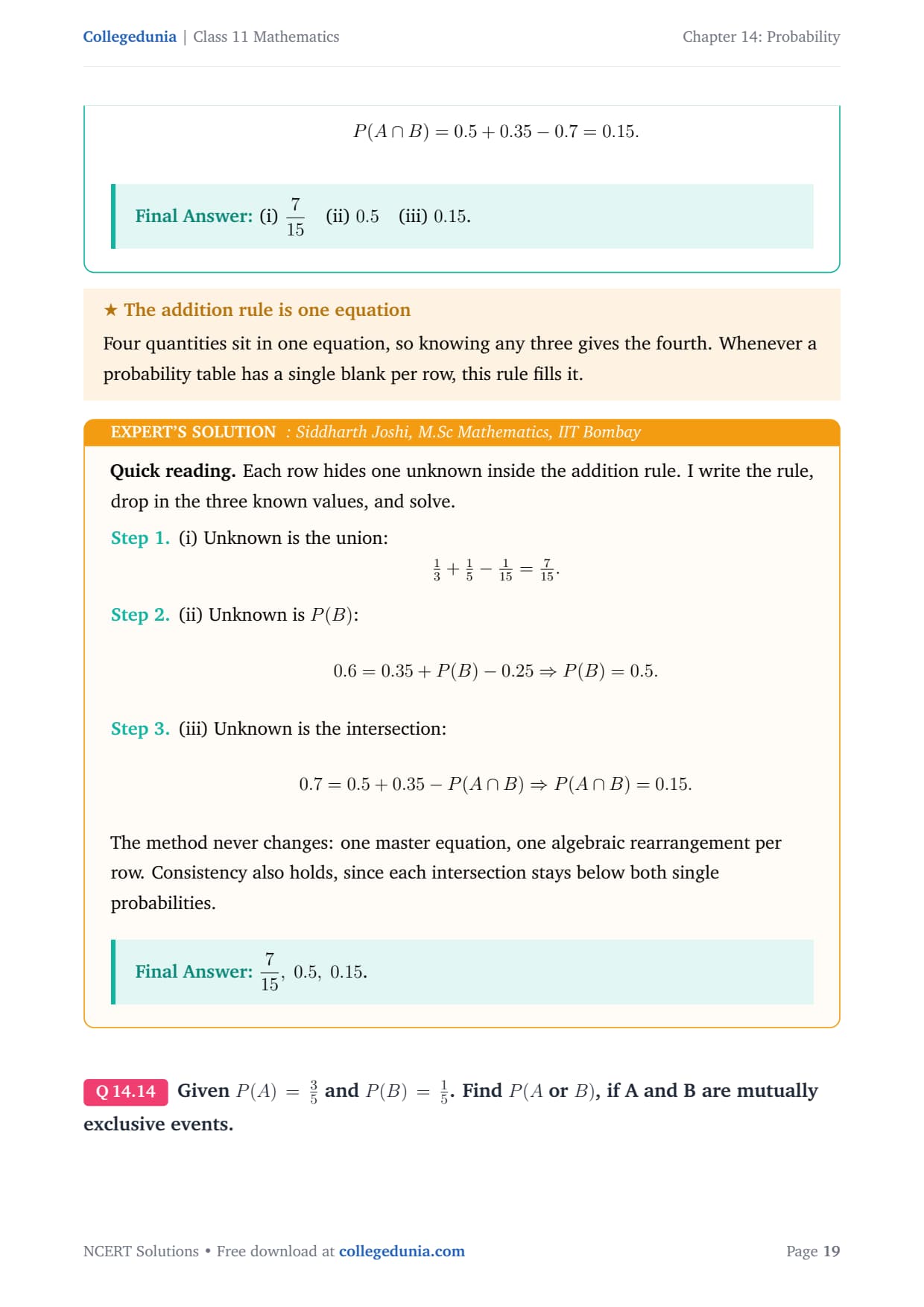
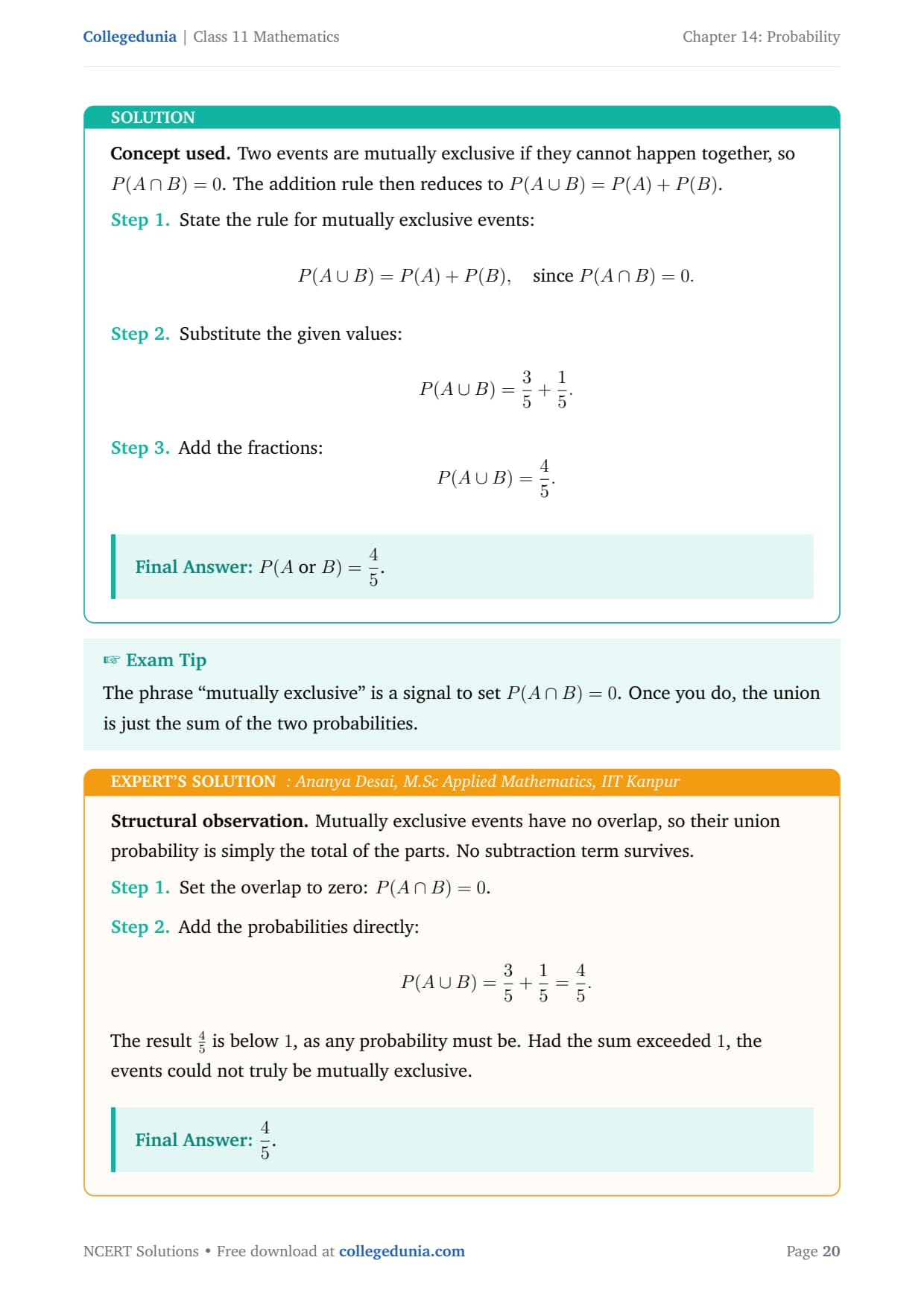
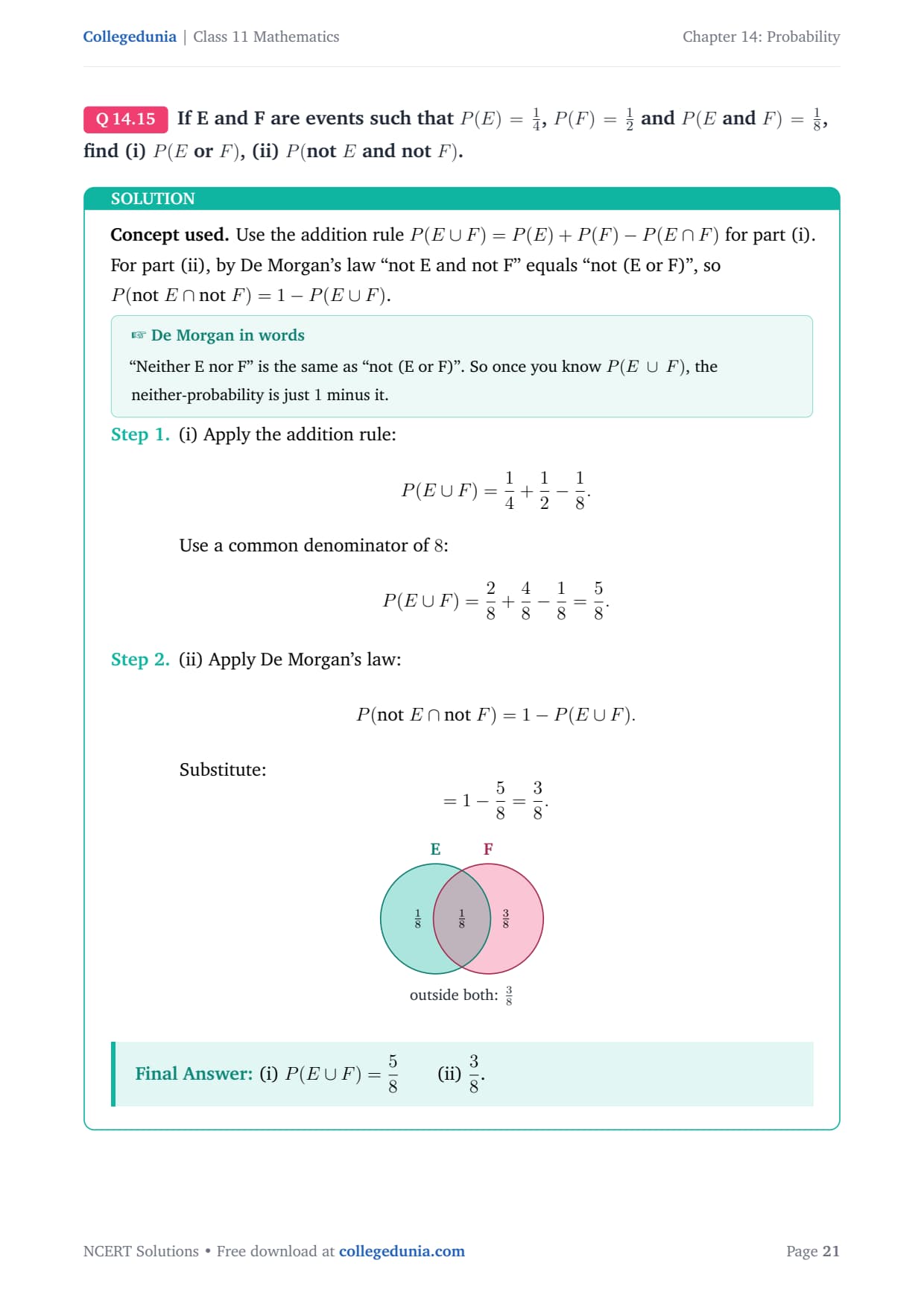
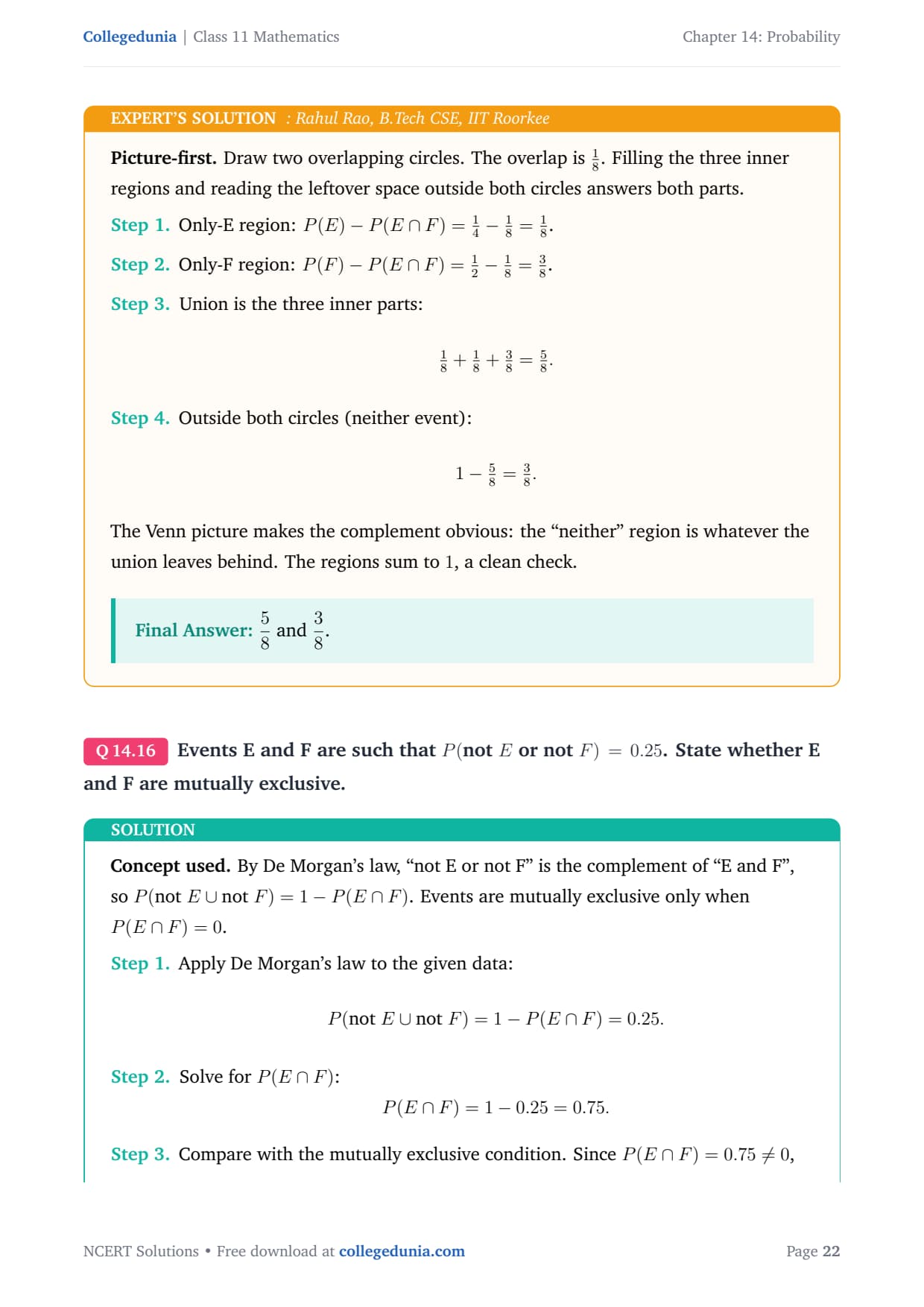
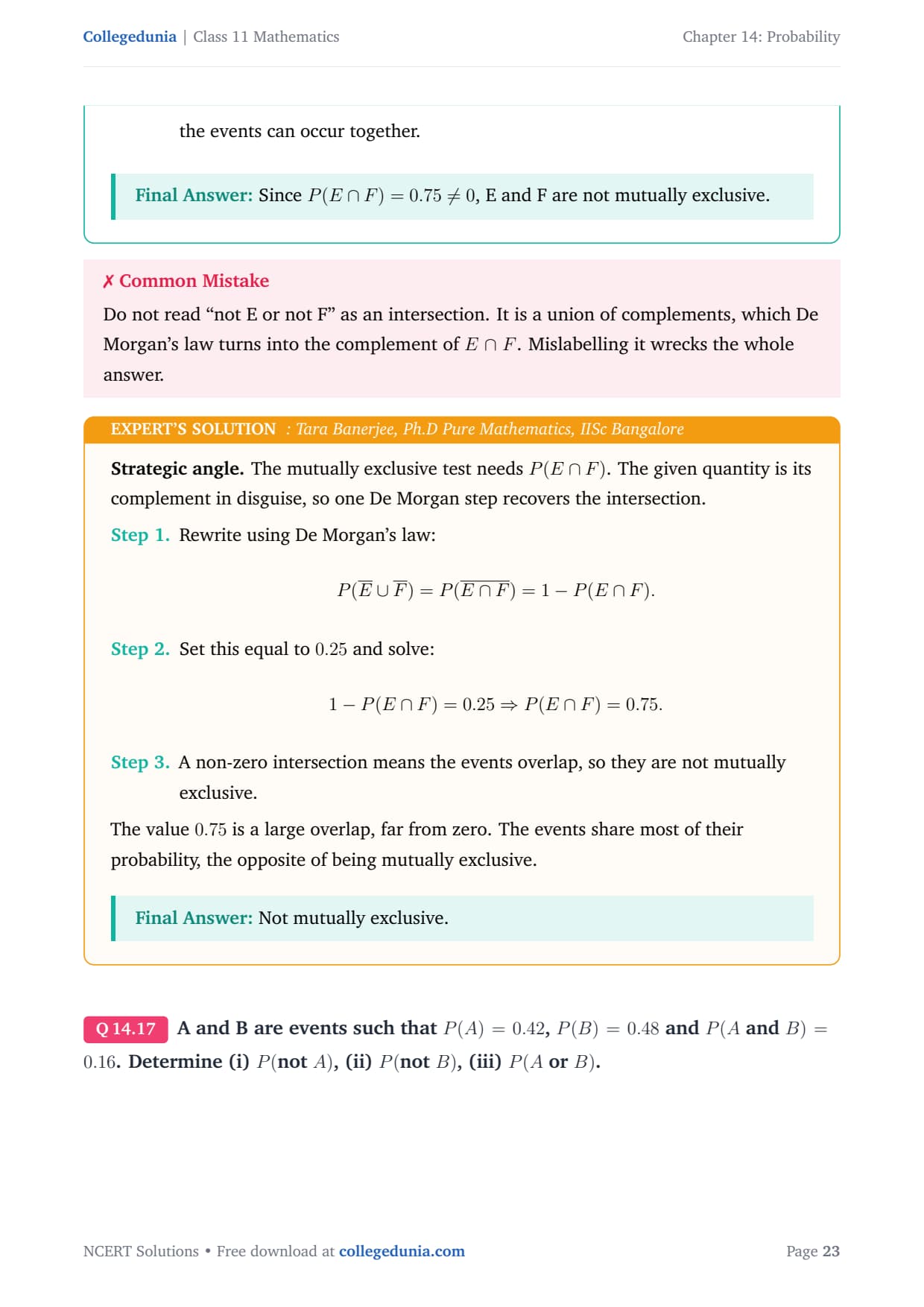
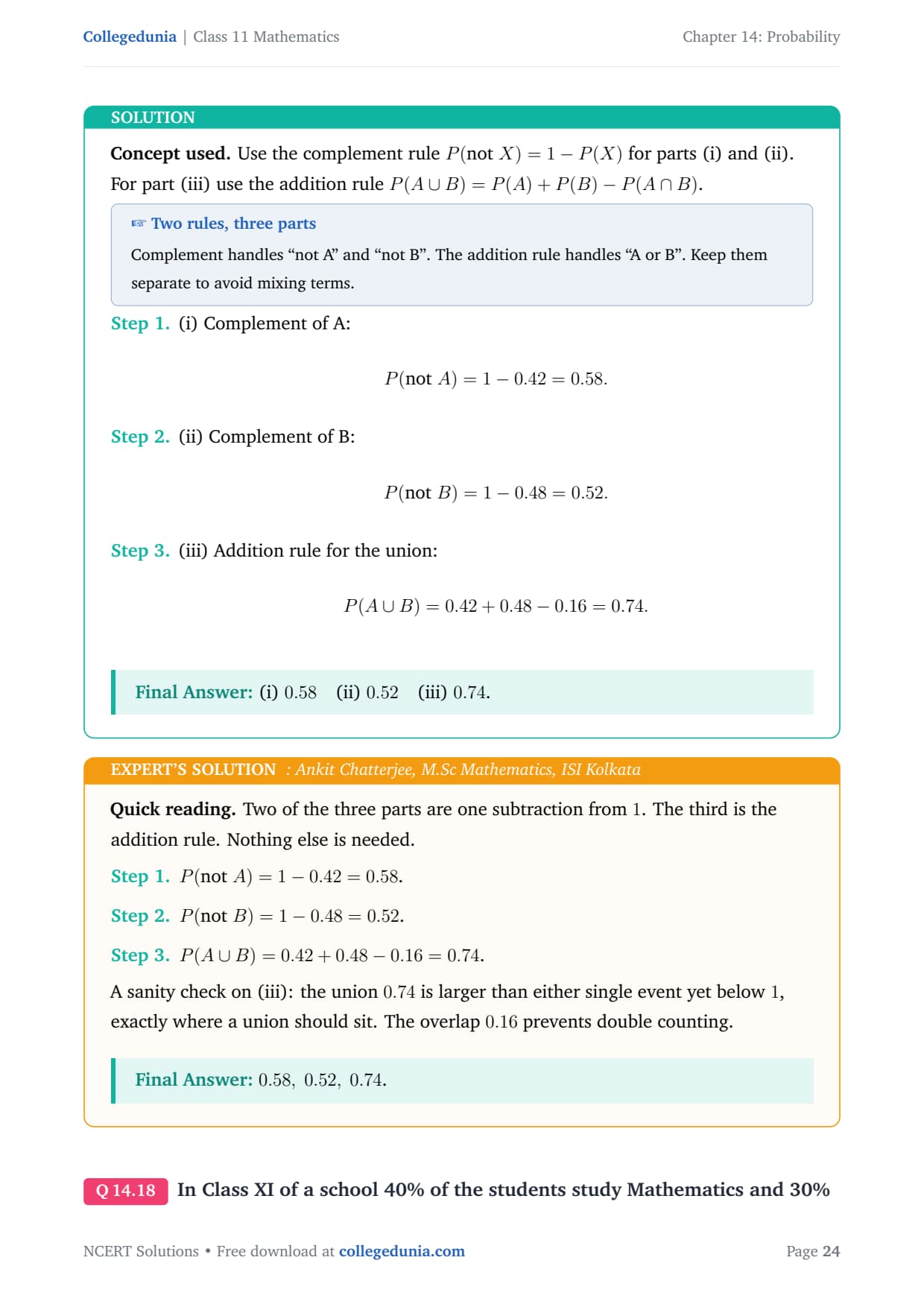
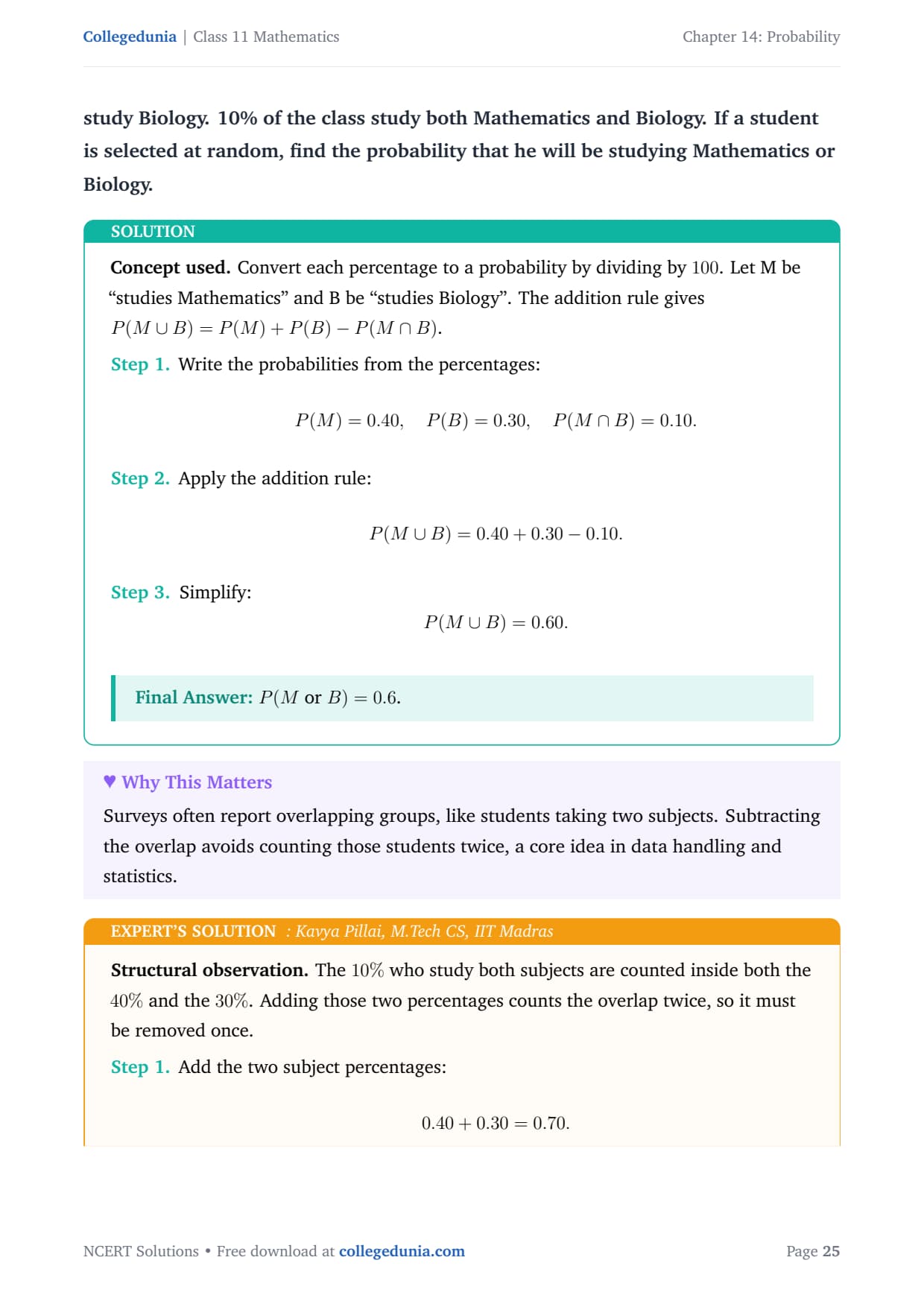
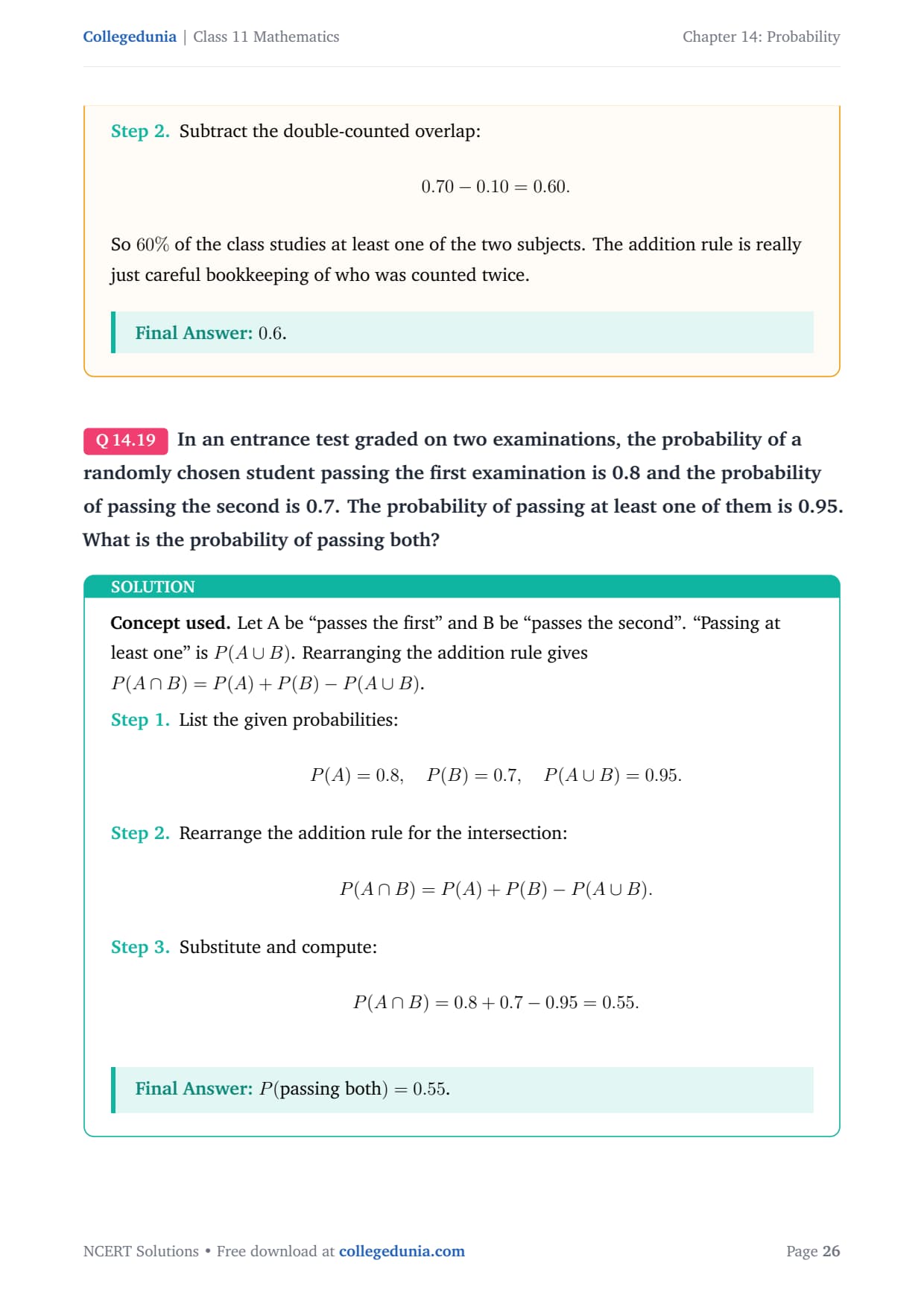
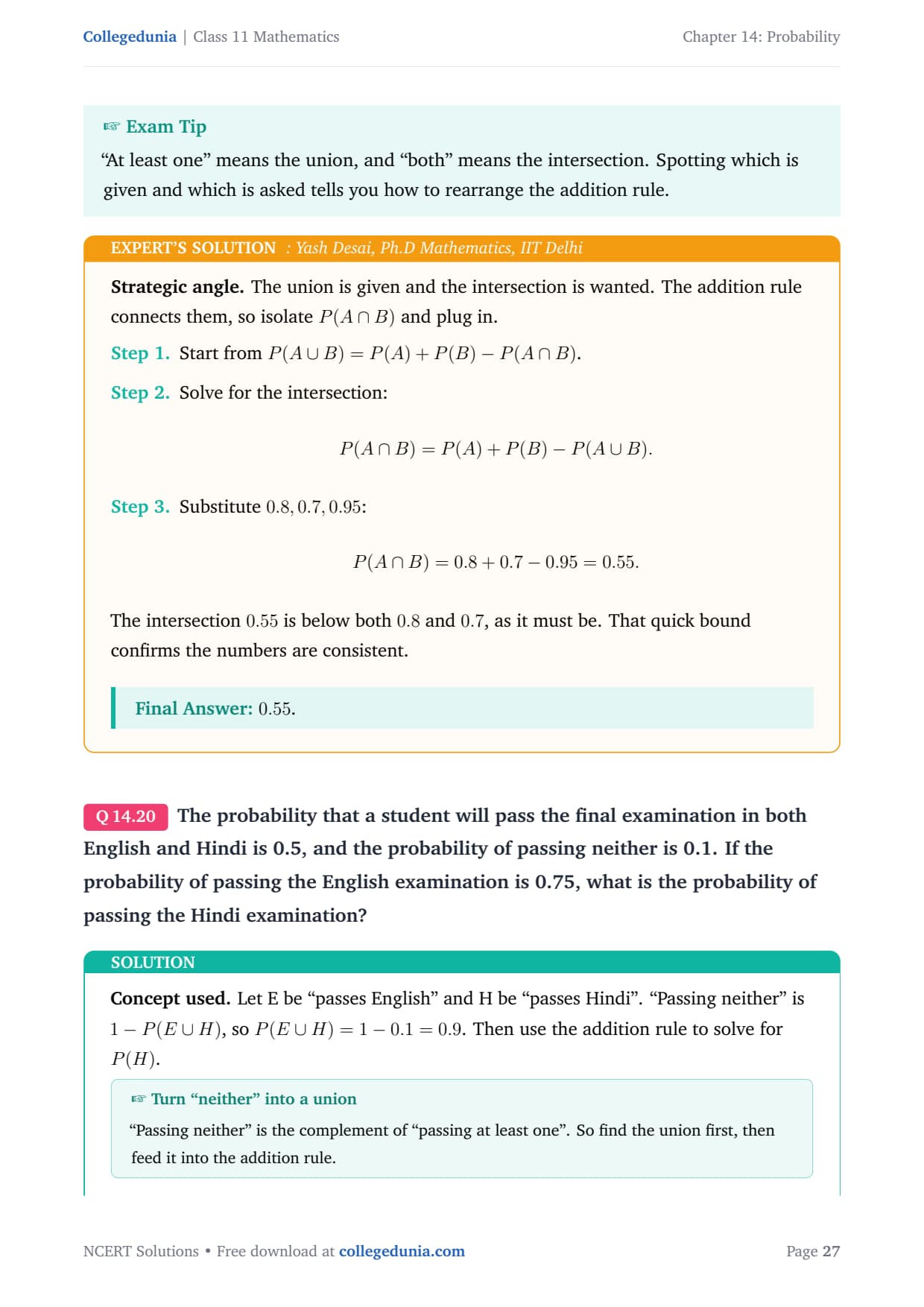
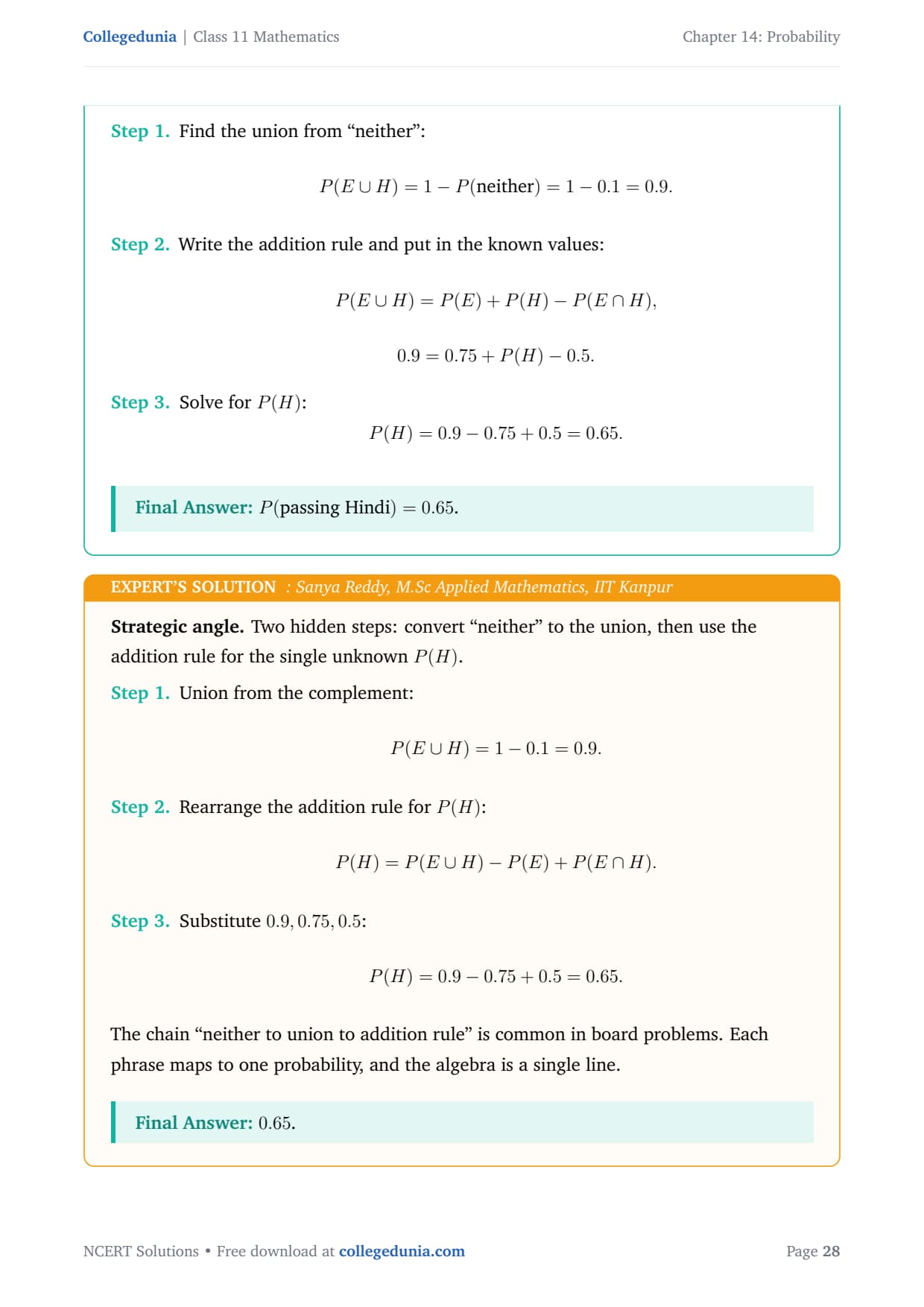
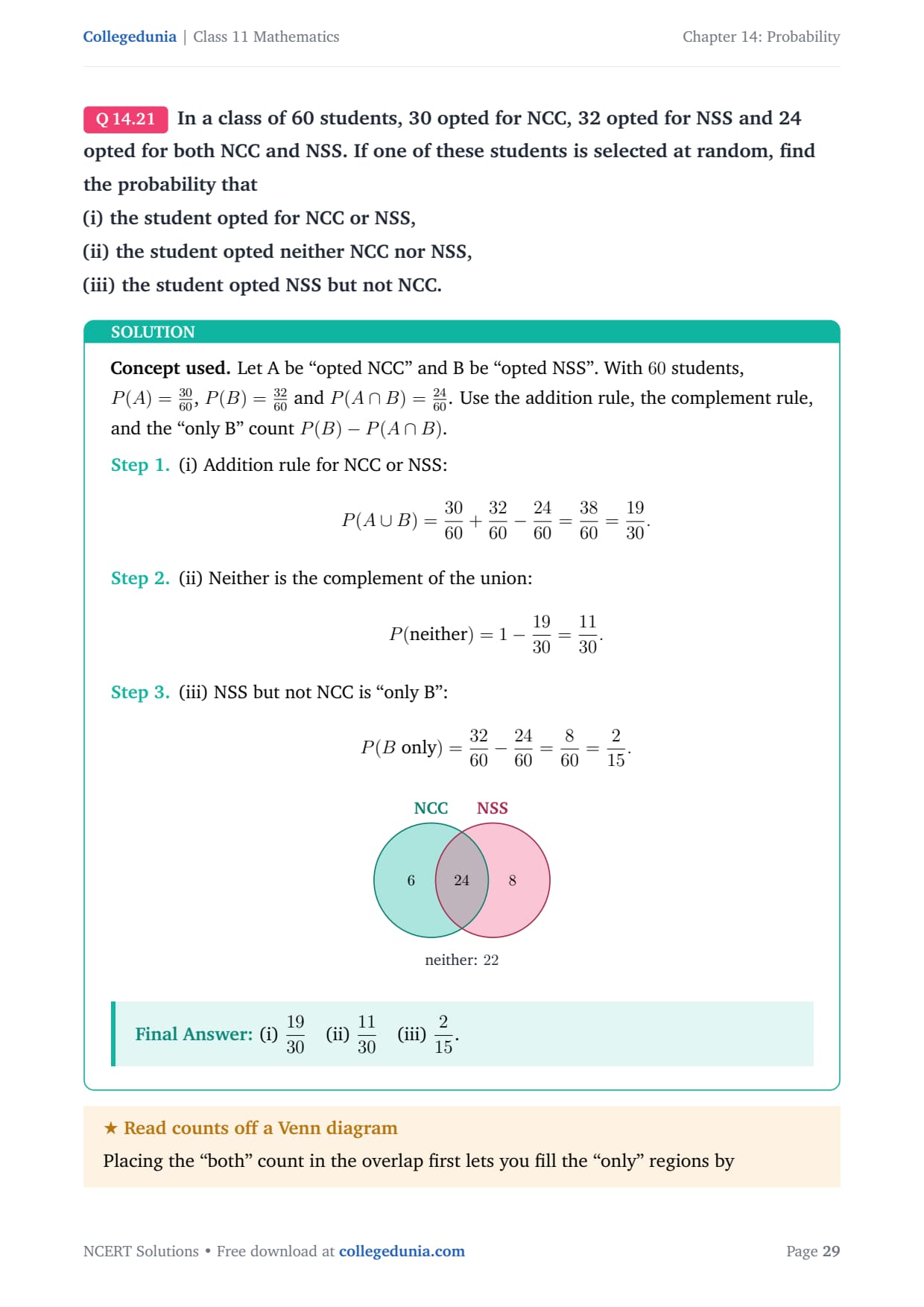
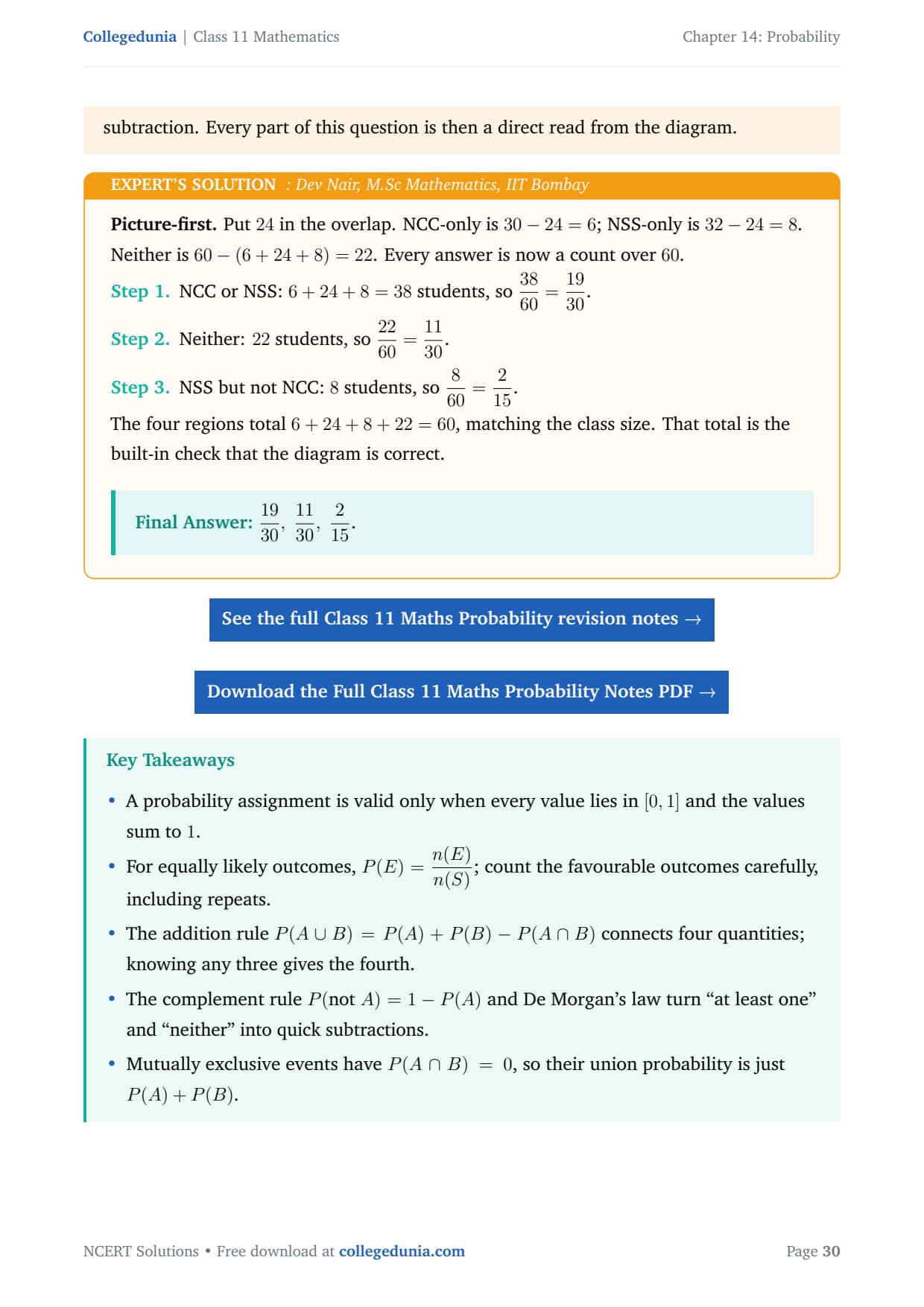
Each solution in this Collegedunia set is prepared by subject experts, based on the 2026-27 NCERT textbook, and checked against recent CBSE exam patterns.
Exercise 14.2 is where students first put numbers on events using the axiomatic idea of probability. The exercise builds these core skills:
- Finding probability of an event from equally likely outcomes.
- Applying the addition rule P(A ∪ B) = P(A) + P(B) − P(A ∩ B).
- Using the complement rule P(A′) = 1 − P(A).
Topics Covered in Probability Exercise 14.2
This exercise moves from listing outcomes to measuring their chance. The axiomatic approach assigns each event a number between 0 and 1 that follows three rules. When all outcomes are equally likely, the probability of an event A is the number of favourable outcomes divided by the total. Exercise 14.2 tests this idea across coins, dice, cards and letters.
- Axioms of probability: P(A) is between 0 and 1, and P(S) = 1 for the sure event.
- Equally likely outcomes: using P(A) = n(A)/n(S) when every outcome has the same chance.
- Addition rule: finding P(A or B) for events that may overlap.
- Mutually exclusive events: P(A ∪ B) = P(A) + P(B) when A ∩ B = ∅.
- Complement rule: reading "at least one" or "not" through P(A′) = 1 − P(A).
Important: the formula P(A) = n(A)/n(S) works only when the outcomes are equally likely. Checking that condition first is what most questions of Exercise 14.2 turn on.
Question-wise Breakdown of Probability Exercise 14.2
The NCERT Solutions for Class 11 Maths Chapter 14 Probability Exercise 14.2 work through all 21 questions in order. The table below groups the questions by type so students can plan their practice. Full step-by-step answers are inside the PDF above.
| Questions | What they ask | Skill tested |
|---|---|---|
| Q1 to Q5 | Basic probability of events with dice, coins and cards | P(A) = n(A)/n(S) |
| Q6 to Q10 | Probability using the addition rule for two events | P(A ∪ B) with overlap |
| Q11 to Q15 | Complement and "at least one" type questions | P(A′) = 1 − P(A) |
| Q16 to Q21 | Mixed word problems on letters, committees and outcomes | Applying all rules together |
Several questions combine two rules in one problem, so the exercise is strong practice for the CBSE board and entrance patterns.
Key Formulas and Definitions for Probability Exercise 14.2
Exercise 14.2 rests on a small set of formulas that students use again in Class 12. Learning them by heart makes every question quicker.
| Formula / Rule | Meaning |
|---|---|
| P(A) = n(A)/n(S) | Probability with equally likely outcomes |
| 0 ≤ P(A) ≤ 1 | Every probability lies between 0 and 1 |
| P(S) = 1, P(∅) = 0 | Sure event has probability 1, impossible event 0 |
| P(A ∪ B) = P(A) + P(B) − P(A ∩ B) | Addition rule for any two events |
| P(A ∪ B) = P(A) + P(B) | Addition rule when A and B are mutually exclusive |
| P(A′) = 1 − P(A) | Complement rule (probability of "not A") |
| P(A − B) = P(A) − P(A ∩ B) | Probability that A happens but B does not |
Tip: for "at least one" questions it is almost always faster to find P(none) first and subtract from 1 using the complement rule.
Common Mistakes in Probability Exercise 14.2
Students lose marks in Exercise 14.2 on rule choice and counting. The list below covers the errors that show up most often in tests on the NCERT Solutions for Class 11 Maths Chapter 14 Probability Exercise 14.2.
- Forgetting the − P(A ∩ B) term in the addition rule when the two events overlap.
- Using P(A) = n(A)/n(S) when the outcomes are not equally likely, which breaks the formula.
- Miscounting n(S). A deck has 52 cards, two dice give 36 outcomes, and three coins give 8.
- Reading "at least one" as "exactly one". "At least one" means one or more, so use the complement of "none".
Practice Questions for Probability Exercise 14.2
After reading the solutions, students should test themselves on the same question types. The card below opens a set of solved practice questions with step-by-step answers for Exercise 14.2.
Practice Card: Solved Practice Questions for Class 11 Maths Probability Exercise 14.2 — attempt each question, then check the worked solution.
Other Exercises of Chapter 14 Probability
Chapter 14 Probability has two exercises plus a Miscellaneous Exercise. Use the table to move to another exercise once Exercise 14.2 is done.
| Exercise | NCERT Solutions link |
|---|---|
| Exercise 14.1 | Class 11 Maths Probability Exercise 14.1 Solutions |
| Miscellaneous Exercise | Class 11 Maths Probability Miscellaneous Exercise Solutions |
More Class 11 Maths Probability Resources
Pair the solutions with the notes and the NCERT book PDF for full chapter revision. All three resources for Chapter 14 Probability are linked below.
| Resource | Link |
|---|---|
| Revision Notes | Class 11 Maths Probability Notes |
| Handwritten Notes | Class 11 Maths Probability Handwritten Notes |
| NCERT Book PDF | Class 11 Maths Probability NCERT Book PDF |
NCERT Solutions for Other Class 11 Maths Chapters
Students can move to the first exercise of any other Class 11 Maths chapter using the cross-sell table below.
| Chapter | NCERT Solutions |
|---|---|
| Chapter 1: Sets | Sets Solutions |
| Chapter 2: Relations and Functions | Relations and Functions Solutions |
| Chapter 3: Trigonometric Functions | Trigonometric Functions Solutions |
| Chapter 4: Complex Numbers and Quadratic Equations | Complex Numbers Solutions |
| Chapter 5: Linear Inequalities | Linear Inequalities Solutions |
| Chapter 6: Permutations and Combinations | Permutations and Combinations Solutions |
| Chapter 7: Binomial Theorem | Binomial Theorem Solutions |
| Chapter 8: Sequences and Series | Sequences and Series Solutions |
| Chapter 9: Straight Lines | Straight Lines Solutions |
| Chapter 10: Conic Sections | Conic Sections Solutions |
| Chapter 11: Introduction to Three Dimensional Geometry | Three Dimensional Geometry Solutions |
| Chapter 12: Limits and Derivatives | Limits and Derivatives Solutions |
| Chapter 13: Statistics | Statistics Solutions |
| Chapter 14: Probability | You are here |
Student Feedback
In a Collegedunia survey of 13,210 Class 11 students conducted before the 2026 exams, 71% of students said the addition rule with the P(A ∩ B) term was the part of Exercise 14.2 they revised most, while simple single-event probability was rated the easiest to score.
FAQs on NCERT Solutions for Class 11 Maths Chapter 14 Probability Exercise 14.2
Probability NCERT Solutions - Frequently Asked Questions
Ques. How many questions are there in Class 11 Maths Chapter 14 Probability Exercise 14.2?
Ans. Exercise 14.2 has 21 questions. They cover finding the probability of an event from equally likely outcomes, the addition rule for two events, the complement rule, and mixed word problems on cards, dice and committees. Several questions combine two rules in one problem.
Ques. What is the formula for the probability of an event in Exercise 14.2?
Ans. When every outcome is equally likely, the probability of an event A is P(A) = n(A)/n(S), where n(A) is the number of favourable outcomes and n(S) is the total number of outcomes. For example, the probability of an even number on a die is 3/6 = 1/2.
Ques. What is the addition rule of probability?
Ans. The addition rule finds the probability that A or B happens. For any two events P(A ∪ B) = P(A) + P(B) − P(A ∩ B). If the events are mutually exclusive, then A ∩ B = ∅, so the last term is 0 and P(A ∪ B) = P(A) + P(B).
Ques. How do you solve "at least one" probability questions?
Ans. The quickest way is the complement rule. For "at least one", first find the probability that the event happens none of the time, then use P(at least one) = 1 − P(none). This avoids adding up many separate cases and is a common shortcut in Exercise 14.2.
Ques. Are the NCERT Solutions for Class 11 Maths Chapter 14 Probability Exercise 14.2 free to download?
Ans. Yes. The NCERT Solutions for Class 11 Maths Chapter 14 Probability Exercise 14.2 are free to download as a PDF from this page. Every question is solved step by step, based on the 2026-27 NCERT textbook, so students can revise offline for CBSE Boards, JEE Main, JEE Advanced and CUET.



Comments