NCERT Solutions for Class 12 English (Suppl.) Chapter 14 Kaleidoscope: Freedom cover all Stop and Think, Understanding the Text, Talking, Appreciation and Language Work tasks for the 2026-27 NCERT book. The PDF explains Shaw's idea of social freedom and Krishnamurti's idea of inner freedom in direct exam-ready answers.
Includes 22 solved question blocks from the full Freedom chapter.
Covers G.B. Shaw, J. Krishnamurti, clauses, rhetorical questions and sound sequences.
Uses the latest 2026-27 NCERT page order for Class 12 English Elective.
The downloadable PDF keeps the NCERT sequence intact and adds expert solution tabs for deeper work on freedom, discipline and language tasks.
Student Feedback: In a Collegedunia survey of 12,940 Class 12 English students conducted before the 2026 boards, many students said Freedom was harder than a poem because it mixes political argument, philosophy and grammar. This page separates the two authors and the Language Work tasks.
Freedom by Shaw and Krishnamurti: Important Ideas for Class 12
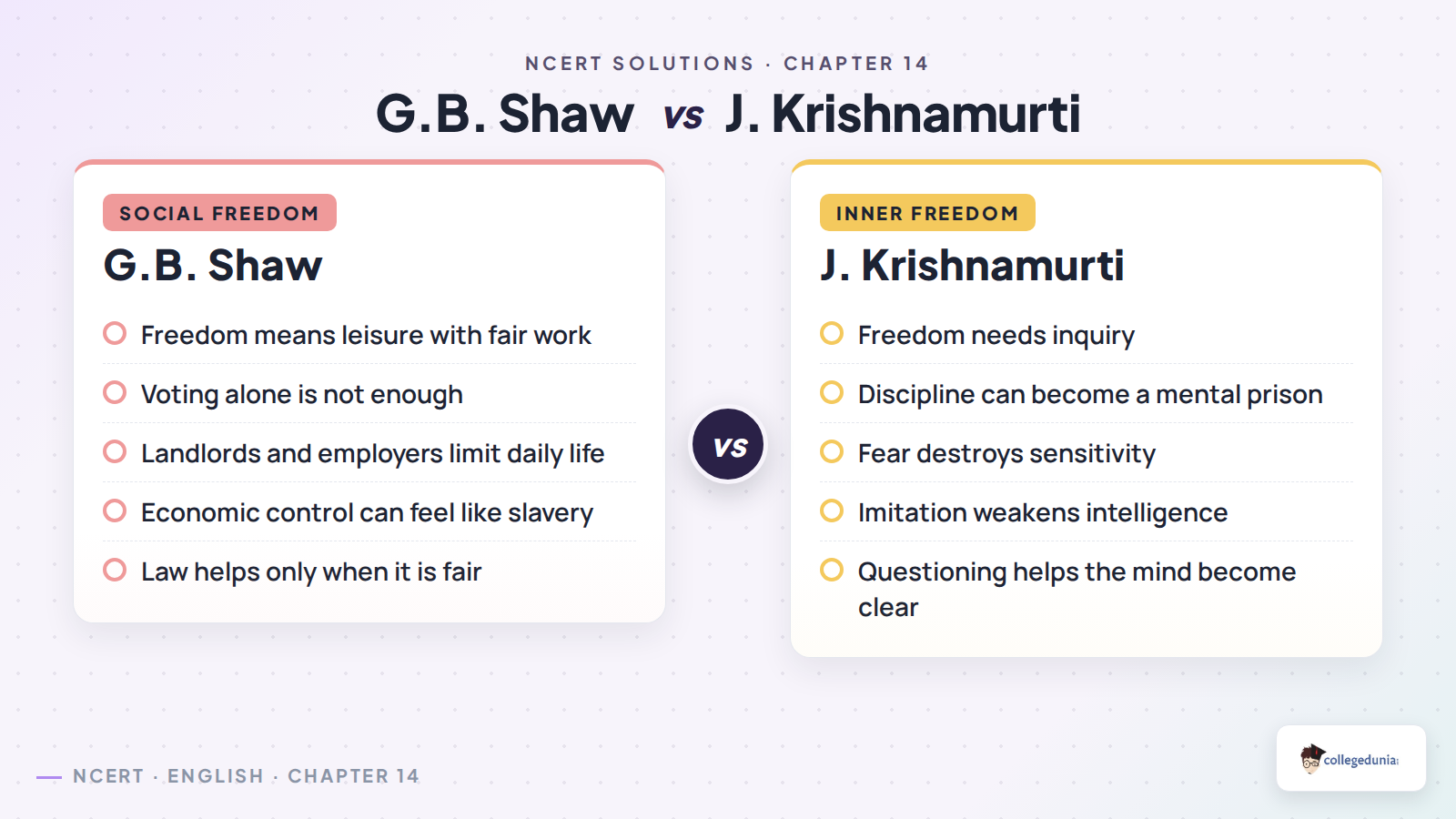
Freedom uses two different routes to ask the same question. Shaw looks at work, wages, voting and leisure. Krishnamurti looks at fear, discipline, inquiry and sensitivity. The best answers show which writer is talking about society and which writer is talking about the mind.
How Shaw Builds the Freedom Argument in Class 12 English
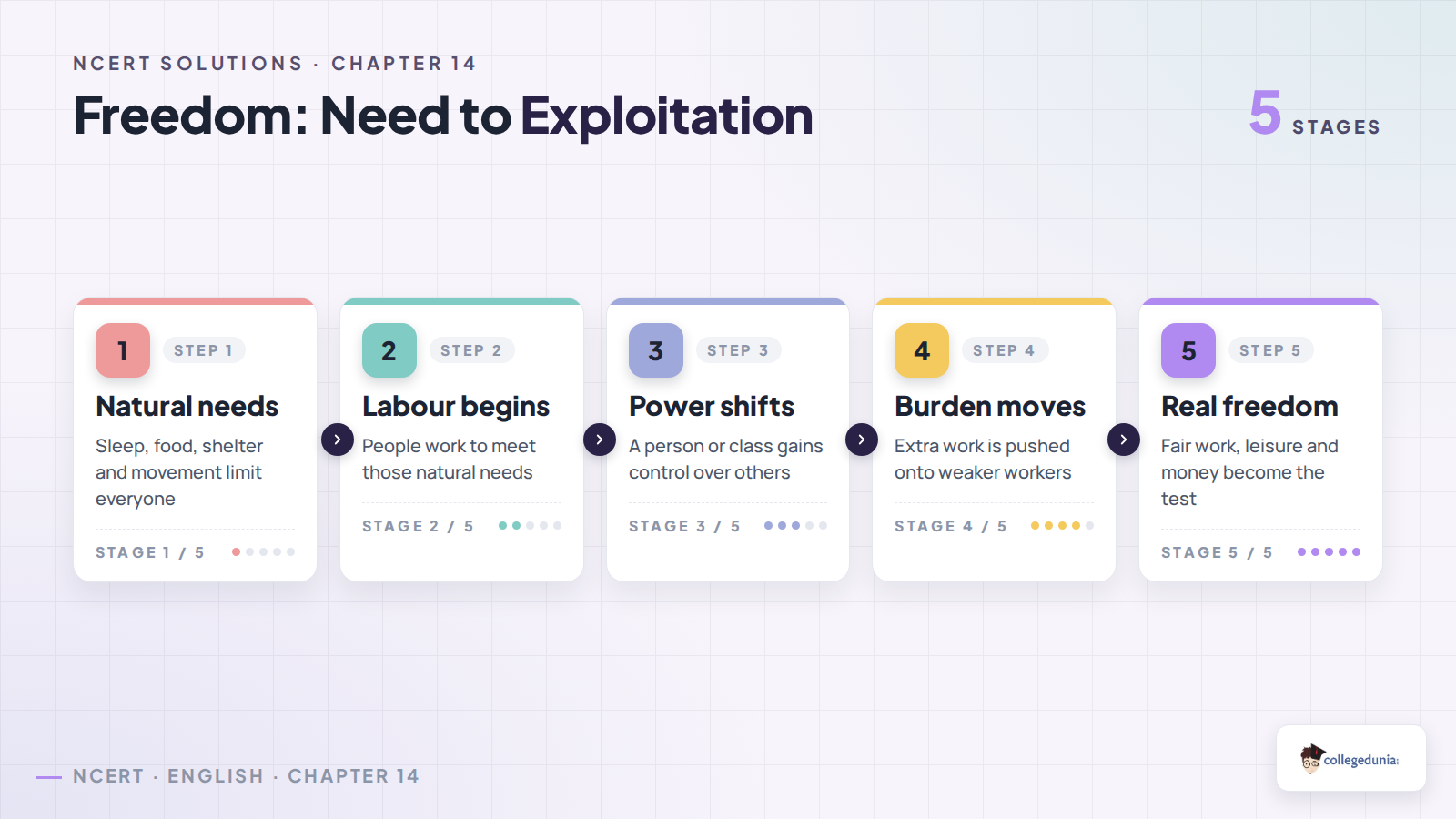
Shaw starts with natural needs, then moves to labour and exploitation. This flow helps students answer questions on natural jobs, slavery, government and the vote without mixing all points together.
Natural limits include food, sleep, clothing and shelter.
Unfair labour begins when one class shifts its burden to another.
Real freedom needs leisure, money and fair laws.
Shaw and Krishnamurti Comparison for Freedom Answers
Students often write one general answer on freedom for both writers. That loses marks. Shaw is satirical and public. Krishnamurti is reflective and inward. Keep their styles separate before writing the common theme.
Area
Shaw
Krishnamurti
Style
Satirical, argumentative and example-heavy
Questioning, inward and reflective
Problem
Economic control in daily life
Mental control through fear and imitation
Solution
More leisure and fair work
Inquiry, intelligence and sensitivity
Freedom Language Work: Clauses, Rhetorical Questions and Sounds
The Language Work section asks students to split clauses, identify rhetorical questions and write C-V sound sequences. Treat it as a scoring section. The tasks are short, but they need exact terms.
Clauses: find the finite verbs first.
Rhetorical questions: convert each question into its hidden statement.
Sound sequences: count sounds, not printed letters.
Freedom Class 12 English Supplementary Resource Links
Use these related resources when you want the same chapter in another format. The table is placed above the FAQ so students can move from solutions to notes, book PDF and handwritten revision without losing the chapter context.
All NCERT Solutions for Class 12 English Supplementary Chapters
The table below keeps the same resource type together, so students can move chapter by chapter through the Class 12 English supplementary Kaleidoscope question set.
All NCERT Solutions for Class 12 English (Suppl.) Chapter 14 Kaleidoscope: Freedom with Step-by-Step Solutions
The expandable cards below reproduce the full solution set from the PDF. Use the Solution tab for a direct exam-ready answer and the Expert Solution tab for deeper notes on Shaw, Krishnamurti and Language Work.
Q 14.1
What are the links between natural jobs, labour and slavery?
Concept used. Shaw uses the word slavery in two ways. Natural slavery means the unavoidable work imposed by the body and by Nature. Social slavery begins when one person shifts that work onto another person.
Follow the chain
Write the answer as need, labour, then exploitation. That order follows Shaw's logic.
Natural jobs are the tasks no one can escape: sleeping, eating, washing, dressing and moving from place to place.
These jobs create further needs, such as food, clothing, shelter and fuel.
Food, clothes and houses do not appear by themselves. They need labour.
If each person did only a fair share of that labour, natural necessity would remain bearable.
Slavery begins when stronger people make others carry more than their fair share.
Shaw gives the examples of bees, horses and human beings to show how labour can be stolen.
So natural jobs produce necessary labour, but unfair control turns labour into slavery.
Natural jobs create human needs. Those needs require labour. When one person or class forces another to do more than its fair share of that labour, natural necessity becomes slavery.
AM
Ananya Menon
M.A English, University of Delhi
Verified Expert
Quick reading. Shaw uses the word slavery in two ways. Natural slavery means the unavoidable work imposed by the body and by Nature. Social slavery begins when one person shifts that work onto another person.
Shaw begins with the body because it is the simplest limit on freedom.
No one can refuse sleep, food or shelter for long.
These needs create work, and work has to be distributed in society.
The problem starts when distribution becomes unfair.
A master class may live comfortably by making workers carry its burden.
This is why Shaw connects ordinary necessity with political and economic slavery.
The link is not that all labour is evil. The link is that stolen labour becomes slavery.
The answer should keep Shaw's distinction clear. Nature demands work from everyone, but man-made exploitation makes some people work for others.
Natural jobs create human needs. Those needs require labour. When one person or class forces another to do more than its fair share of that labour, natural necessity becomes slavery.
Q 14.2
What ought to be the object of all governments, and what do we actually find it to be?
Concept used. Shaw judges government by whether it protects ordinary people from exploitation. He then contrasts the ideal with actual government practice.
Two-part answer
State what governments should do first. Then state what Shaw says they usually do.
The object of honest government should be to stop people from being imposed upon.
It should prevent one person or class from shifting its burden onto another.
It should protect workers from being made to labour for another person's greed.
According to Shaw, most actual governments do the opposite.
They enforce slavery and call it freedom.
They regulate exploitation only enough to keep it within workable limits.
They may replace chattel slavery with wage slavery and then call the change a triumph of freedom.
They offer voting as proof of freedom, though workers' daily labour may not become lighter.
All honest governments should protect people from exploitation. Shaw says most actual governments enforce or regulate slavery, call it freedom, and give people political forms that do not remove economic dependence.
RI
Rohit Iyer
M.A English, EFLU Hyderabad
Verified Expert
Structural observation. Shaw judges government by whether it protects ordinary people from exploitation. He then contrasts the ideal with actual government practice.
Shaw's argument attacks false political comfort.
A government may call citizens free, but still preserve the economic power of masters.
The ideal government would prevent one class from living on another class's labour.
The actual government, in Shaw's view, often protects the arrangement instead.
It gives votes, laws and slogans, but leaves long working hours and low wages unchanged.
The result is a controlled slavery rather than real freedom.
This is why Shaw distrusts grand claims about democracy unless they change daily life.
For Shaw, a government proves its honesty by reducing exploitation, not by merely praising liberty.
All honest governments should protect people from exploitation. Shaw says most actual governments enforce or regulate slavery, call it freedom, and give people political forms that do not remove economic dependence.
Q 14.3
What causes the master class to be more deluded than the enslaved classes?
Concept used. A delusion is a false belief accepted as truth. Shaw says the ruling class believes its own flattering education more completely than workers do.
Education and self-interest
The master class benefits from the story, so it finds the story easy to believe.
The enslaved classes suffer harsh facts in daily life.
They feel rent, low wages, unemployment and social insult directly.
The master class is educated to see itself as superior.
Its schools teach falsified history, dishonest political economy and snobbery.
A gentleman is taught that common people should serve him.
This education flatters his comfort and his pride.
Because the system benefits him, he honestly believes it is just.
So the propaganda meant to fool workers ends up fooling the privileged more deeply.
The master class is more deluded because its education flatters it. It is taught that its comfort, status and command over others are natural and deserved. Workers face harsher facts, so the illusion is less complete for them.
MN
Meera Nair
Ph.D English, JNU
Verified Expert
Quick reading. A delusion is a false belief accepted as truth. Shaw says the ruling class believes its own flattering education more completely than workers do.
Shaw's point is psychological as well as political.
A false idea is strongest when it serves the believer's interest.
The gentleman's education turns privilege into merit in his own mind.
He is told that his manners, accent, clothes and schooling prove superiority.
He does not see the labour that supports his income.
The worker, by contrast, meets the system as fatigue, rent and insecurity.
This makes the worker's belief in patriotic freedom less stable.
The delusion is therefore produced by class education and protected by class advantage.
The master class is more deluded because its education flatters it. It is taught that its comfort, status and command over others are natural and deserved. Workers face harsher facts, so the illusion is less complete for them.
Q 14.4
According to Aristotle, what are the conditions to be fulfilled for the common people to accept law and order, and government, and all that they imply?
Concept used. Shaw refers to Aristotle to explain an old defence of hierarchy. The argument says common people obey better when rulers appear almost godlike.
Do not endorse it
The answer should report Shaw's argument, not praise social hierarchy.
Shaw says Aristotle held that law, order and government need visible hierarchy.
People in authority must appear different from common people.
They should be beautifully dressed, decorated, robed or uniformed.
They should speak with a special accent.
They should travel in first-class carriages, expensive cars or on fine horses.
They should avoid ordinary manual tasks, such as cleaning their own boots.
This display makes them seem superior.
Common people then become obedient because they are made to admire or fear that superiority.
According to the view Shaw attributes to Aristotle, common people accept law and order when rulers look grand, speak differently, live richly and appear almost godlike. Such display turns obedience into social habit.
AR
Aditi Rao
M.A English, Jadavpur University
Verified Expert
Structural observation. Shaw refers to Aristotle to explain an old defence of hierarchy. The argument says common people obey better when rulers appear almost godlike.
The passage is satirical because Shaw exposes the theatrical side of power.
Authority is made to look natural through costume, accent, transport and servants.
These details create distance between rulers and ordinary workers.
The common person is encouraged to admire what should really be questioned.
The system needs wealthy display because display produces obedience.
Shaw therefore treats such hierarchy as manufactured, not sacred.
The answer should show that the so-called condition for order is really idolatry of class.
Shaw's deeper criticism is that law and order should not depend on making people ignorant worshippers of rank.
According to the view Shaw attributes to Aristotle, common people accept law and order when rulers look grand, speak differently, live richly and appear almost godlike. Such display turns obedience into social habit.
Q 14.5
How can reasonable laws, impartially administered, contribute to one's freedom?
Concept used. Freedom is not the absence of every rule. Shaw accepts laws that protect people equally from violence, robbery and disorder.
Law can protect freedom
A fair rule can increase freedom by stopping stronger people from harming weaker people.
Shaw says laws restrict people in obvious ways.
Police, courts, taxes and public rules tell citizens what they may or may not do.
Yet reasonable laws can increase freedom when they protect everyone fairly.
A law against assault protects the body.
A law against robbery protects property and safety.
Laws against disorder protect ordinary movement and work.
The key condition is impartial administration.
If law applies equally, it prevents private force from taking over public life.
Reasonable and impartial laws contribute to freedom by protecting people from assault, robbery and disorder. They restrict harmful action so that ordinary people can live, move and work without fear.
KS
Karan Sharma
M.A English, University of Mumbai
Verified Expert
Quick reading. Freedom is not the absence of every rule. Shaw accepts laws that protect people equally from violence, robbery and disorder.
Shaw is not an anarchist in the simple sense.
He knows that some restrictions are necessary for shared life.
If there were no fair laws, the powerful could threaten the weak directly.
Impartial law limits that private power.
It makes streets safer and gives citizens protection against violence.
Such law is different from laws that defend landlords and employers unfairly.
So the value of law depends on reasonableness and equal enforcement.
The answer should distinguish protective law from oppressive control.
Reasonable and impartial laws contribute to freedom by protecting people from assault, robbery and disorder. They restrict harmful action so that ordinary people can live, move and work without fear.
Q 14.6
What are the ways in which individual freedom gets restricted?
Concept used. Shaw lists several limits on individual freedom: Nature, law, landlord, employer, money, fatigue and social class.
List the layers
Begin with Nature, then move to law, landlord, employer and poverty.
Nature restricts freedom through sleep, hunger, clothing, shelter and bodily need.
The laws of the land restrict actions through police, courts, taxes and penalties.
Landlords may restrict where a person lives and how a tenant behaves.
Employers restrict working hours, dress, conduct and livelihood.
A person can lose employment and be forced into unemployment.
Low wages restrict leisure because people lack money to enjoy free time.
Hard physical work restricts mental freedom because exhaustion produces sleep.
Social propaganda also restricts freedom by making people accept their condition as natural.
Individual freedom is restricted by natural needs, laws, landlords, employers, low wages, fatigue, unemployment and social propaganda. Shaw shows that economic power can limit a person more closely than political power.
SK
Sanya Kapoor
M.A English, University of Hyderabad
Verified Expert
Structural observation. Shaw lists several limits on individual freedom: Nature, law, landlord, employer, money, fatigue and social class.
Shaw's list moves from unavoidable limits to avoidable social limits.
We cannot escape the body's needs.
We can justify some fair laws because they protect society.
But landlord and employer control are more intimate and unequal.
They decide where one may live, how one works and whether one earns at all.
Money also decides whether leisure can be meaningful.
Thus Shaw argues that freedom is restricted most sharply in daily economic life.
The strongest point is that political voting alone does not remove private economic control.
Individual freedom is restricted by natural needs, laws, landlords, employers, low wages, fatigue, unemployment and social propaganda. Shaw shows that economic power can limit a person more closely than political power.
Q 14.7
Why do most people find it easier to conform, imitate, and follow a self-appointed guru?
Concept used. Krishnamurti says independent inquiry is difficult. Most people prefer the comfort of being told what is right.
Use Krishnamurti's keywords
Bring in fear, tradition, low energy and the habit of following.
People find it easier to conform because questioning demands energy.
Independent thinking requires alert perception and constant inquiry.
Many people feel safer inside ready-made beliefs.
Parents, teachers, priests, tradition and society provide those beliefs.
Following a guru transfers responsibility to someone else.
It also reduces fear because the follower feels guided.
Krishnamurti argues that this habit weakens intelligence.
Conformity may feel secure, but it prevents real freedom and happiness.
Most people conform because inquiry is hard and frightening. A guru or tradition gives ready-made answers, so people avoid the work of thinking, questioning and discovering truth for themselves.
DP
Devika Pillai
Ph.D English, IIT Madras
Verified Expert
Quick reading. Krishnamurti says independent inquiry is difficult. Most people prefer the comfort of being told what is right.
Krishnamurti's criticism is aimed at mental dependence.
A follower need not examine values deeply.
He can accept what a teacher, parent or tradition says.
This acceptance feels peaceful because it removes uncertainty.
But that peace is not freedom.
It is a closed frame in which intelligence becomes passive.
True freedom begins only when a person looks, questions and discovers directly.
The answer should show that conformity is easier because it avoids both fear and responsibility.
Most people conform because inquiry is hard and frightening. A guru or tradition gives ready-made answers, so people avoid the work of thinking, questioning and discovering truth for themselves.
Q 14.8
What is the inward struggle that the author refers to?
Concept used. The inward struggle is the conflict between intelligence that wants to inquire and social pressure that demands conformity.
Inside versus outside
Krishnamurti's struggle is not physical. It is a mental and moral conflict.
The inward struggle arises when a young person wants to think freely.
Parents, society and tradition place walls around that mind.
The person may feel one thing inwardly and do another thing outwardly.
He or she may want to question, but fear prevents action.
This creates conflict between intelligence and obedience.
It also creates pain, sorrow and frustration.
Krishnamurti says the struggle must be resolved through inquiry.
Only then can one live as an integrated individual.
The inward struggle is the conflict between the desire to question and the pressure to conform. A person feels one truth inside, but acts according to parents, tradition or society outside.
RS
Rahul Sen
M.A English, Presidency University
Verified Expert
Structural observation. The inward struggle is the conflict between intelligence that wants to inquire and social pressure that demands conformity.
Krishnamurti describes a split self.
One part of the mind seeks freedom, perception and truth.
Another part is afraid of disobeying family and social rules.
This split prevents clear intelligence.
The person becomes outwardly obedient but inwardly restless.
Such conflict continues until the mind begins to inquire on its own.
The inward struggle is therefore the struggle to become whole.
The answer should connect struggle with fear, tradition and the need for independent discovery.
The inward struggle is the conflict between the desire to question and the pressure to conform. A person feels one truth inside, but acts according to parents, tradition or society outside.
Q 14.9
Point out the difference between the slavery of man to Nature and the unnatural slavery of man to Man.
Concept used. This comparison is central to Shaw. Natural slavery comes from bodily needs. Unnatural slavery comes from human exploitation.
Use a table in exams
Compare cause, feeling and social result.
The slavery of man to Nature is unavoidable.
It comes from sleep, hunger, thirst, shelter, clothing and movement.
Nature's slavery is often pleasant because eating, sleeping, home and family can give joy.
This slavery falls on everyone, though not always equally.
The slavery of man to man is unnatural and unjust.
It begins when one person or class makes others bear its labour.
It is hateful to body and spirit because it produces exploitation.
It creates class war between workers and masters.
Nature makes humans work to live, but man-made slavery makes some people work so others may live idly.
Natural slavery is the unavoidable dependence on food, sleep, shelter and bodily need. The unnatural slavery of man to man is exploitation, where one person or class shifts its labour burden onto another.
PV
Priya Verma
M.A English, Banaras Hindu University
Verified Expert
Quick reading. This comparison is central to Shaw. Natural slavery comes from bodily needs. Unnatural slavery comes from human exploitation.
Shaw does not use slavery as a single flat term.
Natural necessity is universal and partly pleasurable.
We may even enjoy satisfying Nature's demands.
Human slavery is different because it is imposed by force, fraud, law or custom.
It allows masters to avoid work by making others do it.
This second slavery is morally wrong because it is avoidable.
The comparison helps Shaw show that freedom must mean social justice, not escape from all necessity.
A complete answer must include both inevitability and injustice.
Natural slavery is the unavoidable dependence on food, sleep, shelter and bodily need. The unnatural slavery of man to man is exploitation, where one person or class shifts its labour burden onto another.
Q 14.10
What are the ways in which people are subjected to greater control in the personal spheres than in the wider political sphere?
Concept used. Shaw argues that private economic power can control a person more closely than the state does.
Landlord and employer
Name both because Shaw treats them as everyday dictators.
In the wider political sphere, citizens may vote and obey public laws.
Those laws may restrict conduct, taxes and public order.
In the personal sphere, Shaw says the landlord and employer have deeper power.
A landlord may control where a tenant lives and what social choices are allowed.
An employer may control clothes, hours, behaviour and livelihood.
The employer can dismiss a worker and push him into unemployment.
Low wages also control leisure because a worker cannot use free time without money.
Hard labour controls the mind by causing exhaustion.
So private economic power enters the home, body, habits and choices.
People are more closely controlled by landlords, employers, wages, hours of work, dress rules, dismissal and fatigue than by distant political institutions. Shaw says these private powers shape daily life more sharply than voting does.
AM
Arjun Mehta
M.A English, University of Calcutta
Verified Expert
Structural observation. Shaw argues that private economic power can control a person more closely than the state does.
Shaw challenges the idea that the vote is enough.
A worker may be politically a citizen, yet economically dependent.
The landlord decides shelter.
The employer decides work, wages, clothing and survival.
These decisions affect daily life immediately.
A political dictator may seem more dramatic, but Shaw says private masters can be more intimate.
Freedom therefore must be measured in the workplace and home, not only at election time.
The answer should stress the contrast between formal citizenship and practical dependence.
People are more closely controlled by landlords, employers, wages, hours of work, dress rules, dismissal and fatigue than by distant political institutions. Shaw says these private powers shape daily life more sharply than voting does.
Q 14.11
List the common misconceptions about 'freedom' that Shaw tries to debunk.
Concept used. Shaw attacks slogans about freedom. He says real freedom needs leisure, money, fair work and protection from exploitation.
Use numbered points
This answer is best written as a compact list with brief explanations.
The first misconception is that freedom means doing whatever one likes all the time.
Shaw says Nature makes that impossible.
The second misconception is that voting alone makes people free.
A vote does not automatically reduce working hours or poverty.
The third misconception is that wage slavery is full freedom because chattel slavery ended.
The fourth misconception is that patriotic victories prove freedom.
The fifth misconception is that laws and elections remove the power of landlords and employers.
The sixth misconception is that being content with a vote and a dole is enough for real freedom.
For Shaw, freedom must be called leisure, with enough money to enjoy it after honest work.
Shaw debunks the ideas that freedom means doing as one pleases, that voting alone or a dole makes people free, that wage labour is automatically free, that patriotic history proves liberty, and that private economic control is harmless.
TJ
Tara Joshi
M.A English, University of Delhi
Verified Expert
Quick reading. Shaw attacks slogans about freedom. He says real freedom needs leisure, money, fair work and protection from exploitation.
Shaw's essay is a demolition of false liberty.
He begins by removing the dream of limitless choice.
Then he attacks political language that hides economic slavery.
He shows that elections may change rulers without changing labour conditions.
He also rejects contentment with a vote and a dole as a substitute for real leisure and money.
He also mocks patriotic myths that teach workers to cheer their own condition.
Finally, he defines practical freedom as leisure plus money.
This definition brings the debate back to daily working life.
The best answer names each misconception and links it with Shaw's practical test of freedom.
Shaw debunks the ideas that freedom means doing as one pleases, that voting alone or a dole makes people free, that wage labour is automatically free, that patriotic history proves liberty, and that private economic control is harmless.
Q 14.12
Why, according to Krishnamurti, are the concepts of freedom and discipline contradictory to one another?
Concept used. Krishnamurti treats discipline as imposed resistance or conformity. True freedom needs direct inquiry, not a mental prison.
Discipline means enclosure here
He is not talking about punctual habits only. He means imposed mental control.
Most people think discipline will eventually produce freedom.
Krishnamurti rejects this idea.
He says discipline is the cultivation of resistance.
It creates walls of do's and don'ts inside the mind.
Freedom cannot exist inside a fixed frame.
A person who merely conforms, imitates or follows cannot discover truth.
True freedom needs the ability to question and experiment.
Discipline imposed from outside blocks that free inquiry.
So discipline and freedom contradict each other when discipline means fear-based conformity.
Krishnamurti sees freedom and discipline as contradictory because imposed discipline encloses the mind in rules, fear and imitation. Freedom begins only when one can question, inquire and discover truth directly.
VB
Vivaan Bhat
Ph.D English, JNU
Verified Expert
Strategic angle. Krishnamurti treats discipline as imposed resistance or conformity. True freedom needs direct inquiry, not a mental prison.
Krishnamurti is careful about the word freedom.
For him, freedom is not disorder.
It is the active state of a mind that can see clearly.
Discipline, as commonly used, trains the mind to resist, obey and conform.
Such training may produce outward order, but it weakens intelligence.
A framed mind cannot discover what is true.
Thus real freedom brings its own clarity, while imposed discipline produces imitation.
The contradiction lies between living inquiry and mechanical obedience.
Krishnamurti sees freedom and discipline as contradictory because imposed discipline encloses the mind in rules, fear and imitation. Freedom begins only when one can question, inquire and discover truth directly.
Q 14.13
How does the process of inquiry lead to true freedom?
Concept used. Inquiry means looking, questioning and discovering for oneself. Krishnamurti sees it as the path to intelligence.
Use the words look and discover
Krishnamurti values direct perception more than borrowed answers.
Inquiry makes the mind active.
It asks a person to examine values instead of accepting them.
It breaks the prison walls of tradition.
It helps one see fear, imitation and self-interest clearly.
Through inquiry, a person discovers what is true from direct perception.
This awakens intelligence.
An intelligent person is not inwardly split between fear and outward conformity.
Such a person can respond to life with sensitivity.
Therefore inquiry leads to freedom because it removes dependence on borrowed authority.
Inquiry leads to true freedom by making the mind question, observe and discover truth for itself. It breaks blind conformity and awakens intelligence, so one is no longer ruled by fear, tradition or imitation.
KR
Kavya Rao
M.A English, EFLU Hyderabad
Verified Expert
Quick reading. Inquiry means looking, questioning and discovering for oneself. Krishnamurti sees it as the path to intelligence.
For Krishnamurti, freedom is a living movement of intelligence.
Inquiry begins when a person stops accepting values mechanically.
The person observes tradition, fear and social pressure.
This observation is not rebellion for show.
It is careful seeing.
As the mind sees clearly, it no longer depends on a guru or rulebook.
That independence is true freedom.
The answer should show inquiry as inner awakening, not as mere argument.
Inquiry leads to true freedom by making the mind question, observe and discover truth for itself. It breaks blind conformity and awakens intelligence, so one is no longer ruled by fear, tradition or imitation.
Q 14.14
According to the author, the masses are prevented from realising their slavery; the masses are also continually reminded that they have the right to vote. Do you think this idea holds good for our country too?
Concept used. This is an opinion answer. A balanced response should connect Shaw's warning with present democratic life without dismissing the value of voting.
Balanced view
Do not say voting is useless. Say voting is necessary but not sufficient.
The idea can hold good in any country where formal rights exist but social inequality remains strong.
Voting is important because it gives citizens a political voice.
However, voting alone cannot remove poverty, poor education, caste prejudice, unemployment or unfair labour conditions.
People may be told they are free because elections take place.
Yet they may still depend on landlords, contractors, employers, moneylenders or social pressure.
Media slogans and party campaigns can also distract voters from economic questions.
In India, democracy has expanded many rights and protections.
But Shaw's warning remains useful when citizens mistake the act of voting for complete freedom.
Real freedom needs informed voting, fair law, education, livelihood security and social dignity.
Yes, the idea can partly hold good. Voting is vital, but it does not by itself end poverty, dependence, prejudice or exploitation. Citizens must use democratic rights to demand real social and economic freedom.
AN
Aditya Nair
M.A English, Jadavpur University
Verified Expert
Structural observation. This is an opinion answer. A balanced response should connect Shaw's warning with present democratic life without dismissing the value of voting.
A mature answer should defend democracy and still examine its limits.
The right to vote gives citizens a tool.
A tool works only when people are informed and organised.
If voters remain economically dependent, their choices may be pressured.
If political debate avoids wages, education and dignity, formal freedom stays thin.
India's democratic institutions matter deeply, but they need active citizens.
Shaw's point is useful because it asks whether freedom reaches daily life.
Thus the answer should say that voting is a beginning, not the full meaning of freedom.
Yes, the idea can partly hold good. Voting is vital, but it does not by itself end poverty, dependence, prejudice or exploitation. Citizens must use democratic rights to demand real social and economic freedom.
Q 14.15
Nature may have tricks up her sleeve to check us if the chemists exploit her too greedily. Discuss.
Concept used. Shaw warns that scientific production must respect natural limits. Human greed can trigger ecological consequences.
Connect to today
Use examples such as soil damage, pollution, climate change and health effects.
Shaw accepts that chemistry and machinery can increase production.
He also warns that Nature is not a passive storehouse.
If people exploit soil, air, water and living systems greedily, consequences may follow.
Chemical fertilisers can raise yield, but overuse can damage soil and water.
Industrial production can create goods, but also pollution and waste.
Modern examples include climate change, biodiversity loss, poisoned rivers and food-chain contamination.
Nature's tricks are the hidden limits that appear after careless exploitation.
Shaw's warning is therefore ecological before the word became common.
The statement means that scientific power must be used with restraint. Greedy exploitation of Nature may produce pollution, soil damage, climate stress and health risks that check human progress.
IG
Ishita Gupta
M.A English, University of Mumbai
Verified Expert
Quick reading. Shaw warns that scientific production must respect natural limits. Human greed can trigger ecological consequences.
Shaw is not anti-science.
He is against greed disguised as progress.
The chemist can draw nitrogen from the air and improve agriculture.
But nature works through delicate balances.
If those balances are ignored, increased production may bring new harm.
The line feels modern because it anticipates ecological limits.
It asks humans to combine knowledge with humility.
A good discussion should show that science needs ethical and environmental restraint.
The statement means that scientific power must be used with restraint. Greedy exploitation of Nature may produce pollution, soil damage, climate stress and health risks that check human progress.
Q 14.16
Respect for elders is not to be confused with blind obedience. Discuss.
Concept used. This question applies Krishnamurti's idea of free inquiry to family and social life.
Respect plus inquiry
The strongest answer keeps affection and independent thinking together.
Respect for elders means listening with attention, gratitude and courtesy.
Elders may have experience that helps younger people avoid mistakes.
Blind obedience is different because it refuses to question.
It makes a person follow even when a rule is unfair, outdated or harmful.
Krishnamurti argues that intelligence grows through inquiry.
A young person should be free to examine values and decide responsibly.
Respect should therefore include honest conversation.
It should not become fear of parents, teachers or tradition.
A healthy relationship allows guidance without killing independent thought.
Respect means listening and valuing experience. Blind obedience means surrendering thought. A free and intelligent person can respect elders while still questioning, discussing and choosing responsibly.
PK
Pranav Kumar
Ph.D English, University of Hyderabad
Verified Expert
Strategic angle. This question applies Krishnamurti's idea of free inquiry to family and social life.
The issue is not whether elders matter.
They do matter because they carry memory, care and experience.
The issue is whether their authority should replace one's intelligence.
Krishnamurti would say no.
A mind trained only to obey becomes fearful and mechanical.
Respect becomes meaningful when both sides allow truth to be examined.
Thus genuine respect is compatible with thoughtful disagreement.
The answer should reject both rudeness and blind surrender.
Respect means listening and valuing experience. Blind obedience means surrendering thought. A free and intelligent person can respect elders while still questioning, discussing and choosing responsibly.
Q 14.17
Both the texts are on 'freedom'. Comment on the difference in the style of treatment of the topic in them.
Concept used. Shaw treats freedom through satire, examples and political argument. Krishnamurti treats it through direct reflection on the mind.
Style words matter
Use terms such as satirical, argumentative, reflective, direct and inward.
Shaw's style is argumentative, satirical and public.
He uses sharp examples from labour, voting, landlords, employers, history and class.
His tone is witty, ironic and often provocative.
He exposes false political freedom by showing economic dependence.
Krishnamurti's style is reflective, direct and inward.
He asks questions about discipline, tradition, fear and sensitivity.
His tone is calm but urgent.
He wants the student to look within and discover freedom through intelligence.
Thus Shaw treats freedom as a social and economic problem, while Krishnamurti treats it as a mental and spiritual problem.
Shaw uses satire, political argument and concrete social examples. Krishnamurti uses a reflective, questioning and inward style. Shaw attacks economic slavery; Krishnamurti examines mental conformity.
DP
Diya Patel
M.A English, Presidency University
Verified Expert
Structural observation. Shaw treats freedom through satire, examples and political argument. Krishnamurti treats it through direct reflection on the mind.
The two texts work like two lenses.
Shaw looks outward at society.
He names institutions, classes, laws and economic controls.
His energy comes from wit and attack.
Krishnamurti looks inward at consciousness.
He uses questions to make students examine fear and imitation.
His prose is less comic, but more meditative.
Together the texts make freedom both a social demand and an inner awakening.
The answer should compare treatment, not merely repeat the themes.
Shaw uses satire, political argument and concrete social examples. Krishnamurti uses a reflective, questioning and inward style. Shaw attacks economic slavery; Krishnamurti examines mental conformity.
Q 14.18
When Shaw makes a statement he supports it with a number of examples. Identify two sections in the text which explain a statement with examples. Write down the main statement and the examples. Notice how this contributes to the effectiveness of the writing.
Concept used. Shaw persuades by piling up examples. This makes abstract ideas concrete and comic.
Choose clear sections
Pick sections where Shaw names many examples one after another.
First main statement: no one is perfectly free because Nature imposes necessities.
Examples: we must sleep, wash, dress, undress, eat, drink and move from place to place.
These examples make the idea of natural limitation easy to see.
Second main statement: people are taught that their freedom was won by famous historical events.
Examples: Magna Charta, the Spanish Armada, King Charles's execution, the Bill of Rights, the American Declaration of Independence, Waterloo and Trafalgar.
Shaw uses the long list to expose patriotic storytelling.
Another possible section is the employer and landlord passage.
There Shaw shows personal control through estate rules, voting pressure, clothes, hours and dismissal.
One section states that perfect freedom is impossible, supported by examples of sleep, food, washing, dressing and travel. Another states that patriotic history is used to teach freedom, supported by examples such as Magna Charta, the Armada, the Bill of Rights and Waterloo.
YV
Yash Verma
M.A English, Banaras Hindu University
Verified Expert
Quick reading. Shaw persuades by piling up examples. This makes abstract ideas concrete and comic.
Shaw's examples do two jobs.
They prove the point, and they create rhythm.
The first list makes bodily necessity seem obvious and comic.
The historical list sounds grand, but its very length makes it suspicious.
The reader begins to feel how slogans are built.
This method is effective because Shaw does not argue abstractly for long.
He keeps returning to everyday or familiar evidence.
The answer should show how examples strengthen the writing, not just list them.
One section states that perfect freedom is impossible, supported by examples of sleep, food, washing, dressing and travel. Another states that patriotic history is used to teach freedom, supported by examples such as Magna Charta, the Armada, the Bill of Rights and Waterloo.
Q 14.19
Notice the use of personal pronouns in the two texts. Did this make you identify yourself more with the topic than if it had been written in an impersonal style? As you read the texts, were you able to relate the writer's thoughts with the way you lead your own life?
Concept used. Personal pronouns bring the reader or listener into the argument. Both writers use direct address to make freedom feel personal.
Mention you and we
Explain how direct address changes the reader's involvement.
Both texts use personal pronouns such as you, we, us and our.
Shaw uses you to confront the listener directly.
He makes the reader feel involved in labour, voting, wages and leisure.
Krishnamurti uses you to ask inward questions.
He makes students examine fear, conformity and sensitivity in their own lives.
This direct address is stronger than an impersonal style.
It prevents freedom from remaining only an abstract topic.
The reader feels personally questioned and responsible.
So the use of pronouns helps identification with the subject.
It also helps students relate the writers' thoughts on freedom, fear, conformity and responsibility to their own lives.
Yes. The personal pronouns make the topic immediate. Shaw's you confronts the citizen-worker, while Krishnamurti's you questions the student's mind. They also make students relate freedom, fear, conformity and responsibility to their own lives.
NI
Neha Iyer
M.A Linguistics, University of Delhi
Verified Expert
Structural observation. Personal pronouns bring the reader or listener into the argument. Both writers use direct address to make freedom feel personal.
Pronouns create a speaking situation.
The text no longer sounds like a distant essay.
It sounds like an address to a living listener.
Shaw's address can be sharp and mocking.
Krishnamurti's address can be probing and intimate.
Both styles make the reader answer silently.
This is why the topic of freedom becomes experiential rather than only theoretical.
A reader can therefore connect the writers' ideas with personal choices about work, fear, tradition and responsibility.
A good response may use first person briefly, but it should still analyse the effect.
Yes. The personal pronouns make the topic immediate. Shaw's you confronts the citizen-worker, while Krishnamurti's you questions the student's mind. They also make students relate freedom, fear, conformity and responsibility to their own lives.
Q 14.20
Split the following sentences into their constituent clauses: There is no freedom if you are enclosed by self interest or by various walls of discipline. When you see a servant carrying a heavy carpet, do you give him a helping hand? Very young children will eat needles and matches eagerly but the diet is not a nourishing one. We must sleep or go mad: but then sleep is so pleasant that we have great difficulty in getting up in the morning. Always call freedom by its old English name of leisure, and keep clamouring for more leisure and more money to enjoy it in return for an honest share of work.
Concept used. A clause contains a finite verb or a verb group. Splitting long sentences helps students find the main idea and dependent ideas.
Find the verbs
First locate the finite verbs. Then decide which clause can stand alone.
Sentence 1: There is no freedom / if you are enclosed by self interest or by various walls of discipline.
Sentence 2: When you see a servant carrying a heavy carpet / do you give him a helping hand?
Sentence 3: Very young children will eat needles and matches eagerly / but the diet is not a nourishing one.
Sentence 4: We must sleep / or go mad / but then sleep is so pleasant / that we have great difficulty in getting up in the morning.
Sentence 5: Always call freedom by its old English name of leisure / and keep clamouring for more leisure and more money to enjoy it in return for an honest share of work.
In sentence 1, the if clause is subordinate.
In sentence 2, the when clause is subordinate.
Sentence 3 contains two main clauses joined by but.
In sentence 4, but joins the larger clauses, while that we have great difficulty is a subordinate result clause depending on so pleasant.
Sentence 5 has two main imperative clauses; to enjoy it in return for an honest share of work is a non-finite purpose phrase within the second imperative.
The sentences split into the clauses shown above. The main method is to identify the finite verb groups, mark subordinate clauses such as if, when and that clauses, and avoid treating purpose phrases as full finite clauses.
SK
Siddharth Kapoor
M.A English, EFLU Hyderabad
Verified Expert
Quick reading. A clause contains a finite verb or a verb group. Splitting long sentences helps students find the main idea and dependent ideas.
Clause splitting is a reading skill, not only a grammar exercise.
The main clause carries the central action.
Subordinate clauses add condition, time, result or purpose.
In the first sentence, freedom is the main idea and the if clause gives condition.
In the second, the question is main and the when clause gives time.
Sentence 3 has two main clauses joined by but.
Sentence 4 has coordinated ideas, but the that clause is a subordinate result clause.
Sentence 5 has two imperatives, while to enjoy it is a purpose phrase rather than a separate finite clause.
This method makes Shaw's and Krishnamurti's long sentences easier to understand.
The answer should show clause boundaries clearly and avoid changing the meaning.
The sentences split into the clauses shown above. The main method is to identify the finite verb groups, mark subordinate clauses such as if, when and that clauses, and avoid treating purpose phrases as full finite clauses.
Q 14.21
Pick out examples of such rhetorical questions from the text and understand what the writer or speaker wishes to communicate through them.
Concept used. A rhetorical question has the form of a question but communicates a statement. Krishnamurti uses it to awaken self-examination.
Question to statement
For each example, write the hidden statement after it.
Example 1: Do you have any feeling for them? The implied statement is that many students are not sensitive to poor workers.
Example 2: Do you feel you are much better than they? The implied statement is that class pride makes people look down on others.
Example 3: Don't you want to help them? The implied statement is that the listener should feel compassion and help.
Example 4: Are you actually so blinded that you do not know what is happening around you? The implied statement is that tradition and fear have blinded the listener.
Example 5: Can a man ever be free as long as he lives in a prison? The implied statement is that a framed or enclosed mind cannot be free.
These questions do not mainly seek factual answers.
They push the listener into moral awareness.
Rhetorical questions such as Do you have any feeling for them? and Can a man ever be free as long as he lives in a prison? imply statements. They say that insensitivity, class pride and mental enclosure destroy freedom.
PD
Pooja Desai
M.A English, Jadavpur University
Verified Expert
Structural observation. A rhetorical question has the form of a question but communicates a statement. Krishnamurti uses it to awaken self-examination.
Krishnamurti's questions are direct and uncomfortable.
They do not allow the listener to remain neutral.
Each question points toward an inward fact.
The listener is expected to notice fear, self-interest or blindness.
The tradition and blindness questions show how habit can dull sympathy.
The device is persuasive because the answer must arise inside the reader.
That inner answer matches his theme of inquiry.
The answer should convert the question form into the intended statement.
Rhetorical questions such as Do you have any feeling for them? and Can a man ever be free as long as he lives in a prison? imply statements. They say that insensitivity, class pride and mental enclosure destroy freedom.
Q 14.22
Write the sound sequences for the words sleep, thrift, snake, task, smear, facts, sweet, boasts, strain, street, strangle and strengths.
Concept used. A sound sequence marks consonant sounds as C and vowel sounds as V. Consonant clusters count by sound, not by letters.
Think sounds, not spelling
The letters ee, ai and oa usually represent one vowel sound.
sleep: CCVC, with sl as two consonants and ee as one vowel sound.
thrift: CCVCC, with th and r before the vowel, then f and t after it.
snake: CCVC, with sn before the vowel.
task: CVCC, with one vowel followed by sk.
smear: CCVC, with sm before the vowel sound.
facts: CVCCC, with c, t and s sounds after the vowel.
sweet: CCVC, with sw before the vowel.
boasts: CVCCC, with oa as one vowel and sts after it.
strain: CCCVC, with str before the vowel.
street: CCCVC, with str before ee.
strangle: CCCVCCVC, split by sounds as str plus a plus ng plus g plus l plus a reduced vowel sound.
strengths: CCCVCCCC, with str before the vowel and ng, th and s after it.




Chapter14Kaleidoscope:FreedomSolutions.pdf?page=1&dpi=150)
Chapter14Kaleidoscope:FreedomSolutions.pdf?page=2&dpi=150)
Chapter14Kaleidoscope:FreedomSolutions.pdf?page=3&dpi=150)
Chapter14Kaleidoscope:FreedomSolutions.pdf?page=4&dpi=150)
Chapter14Kaleidoscope:FreedomSolutions.pdf?page=5&dpi=150)
Chapter14Kaleidoscope:FreedomSolutions.pdf?page=6&dpi=150)
Chapter14Kaleidoscope:FreedomSolutions.pdf?page=7&dpi=150)
Chapter14Kaleidoscope:FreedomSolutions.pdf?page=8&dpi=150)
Chapter14Kaleidoscope:FreedomSolutions.pdf?page=9&dpi=150)
Chapter14Kaleidoscope:FreedomSolutions.pdf?page=10&dpi=150)
Chapter14Kaleidoscope:FreedomSolutions.pdf?page=11&dpi=150)
Chapter14Kaleidoscope:FreedomSolutions.pdf?page=12&dpi=150)
Chapter14Kaleidoscope:FreedomSolutions.pdf?page=13&dpi=150)
Chapter14Kaleidoscope:FreedomSolutions.pdf?page=14&dpi=150)
Chapter14Kaleidoscope:FreedomSolutions.pdf?page=15&dpi=150)
Chapter14Kaleidoscope:FreedomSolutions.pdf?page=16&dpi=150)
Chapter14Kaleidoscope:FreedomSolutions.pdf?page=17&dpi=150)
Chapter14Kaleidoscope:FreedomSolutions.pdf?page=18&dpi=150)
Chapter14Kaleidoscope:FreedomSolutions.pdf?page=19&dpi=150)
Chapter14Kaleidoscope:FreedomSolutions.pdf?page=20&dpi=150)
Chapter14Kaleidoscope:FreedomSolutions.pdf?page=21&dpi=150)
Chapter14Kaleidoscope:FreedomSolutions.pdf?page=22&dpi=150)
Chapter14Kaleidoscope:FreedomSolutions.pdf?page=23&dpi=150)
Chapter14Kaleidoscope:FreedomSolutions.pdf?page=24&dpi=150)
Chapter14Kaleidoscope:FreedomSolutions.pdf?page=25&dpi=150)
Chapter14Kaleidoscope:FreedomSolutions.pdf?page=26&dpi=150)
Chapter14Kaleidoscope:FreedomSolutions.pdf?page=27&dpi=150)
Chapter14Kaleidoscope:FreedomSolutions.pdf?page=28&dpi=150)
Chapter14Kaleidoscope:FreedomSolutions.pdf?page=29&dpi=150)
Chapter14Kaleidoscope:FreedomSolutions.pdf?page=30&dpi=150)
Chapter14Kaleidoscope:FreedomSolutions.pdf?page=31&dpi=150)
Chapter14Kaleidoscope:FreedomSolutions.pdf?page=32&dpi=150)
Chapter14Kaleidoscope:FreedomSolutions.pdf?page=33&dpi=150)
Chapter14Kaleidoscope:FreedomSolutions.pdf?page=34&dpi=150)
Chapter14Kaleidoscope:FreedomSolutions.pdf?page=35&dpi=150)
Chapter14Kaleidoscope:FreedomSolutions.pdf?page=36&dpi=150)
Chapter14Kaleidoscope:FreedomSolutions.pdf?page=37&dpi=150)
Chapter14Kaleidoscope:FreedomSolutions_flat_MobileCard.pdf?page=1&dpi=150)
Chapter14Kaleidoscope:FreedomSolutions_flat_MobileCard.pdf?page=2&dpi=150)
Chapter14Kaleidoscope:FreedomSolutions_flat_MobileCard.pdf?page=3&dpi=150)
Chapter14Kaleidoscope:FreedomSolutions_flat_MobileCard.pdf?page=4&dpi=150)
Chapter14Kaleidoscope:FreedomSolutions_flat_MobileCard.pdf?page=5&dpi=150)
Chapter14Kaleidoscope:FreedomSolutions_flat_MobileCard.pdf?page=6&dpi=150)
Chapter14Kaleidoscope:FreedomSolutions_flat_MobileCard.pdf?page=7&dpi=150)
Chapter14Kaleidoscope:FreedomSolutions_flat_MobileCard.pdf?page=8&dpi=150)
Chapter14Kaleidoscope:FreedomSolutions_flat_MobileCard.pdf?page=9&dpi=150)
Chapter14Kaleidoscope:FreedomSolutions_flat_MobileCard.pdf?page=10&dpi=150)
Chapter14Kaleidoscope:FreedomSolutions_flat_MobileCard.pdf?page=11&dpi=150)
Chapter14Kaleidoscope:FreedomSolutions_flat_MobileCard.pdf?page=12&dpi=150)
Chapter14Kaleidoscope:FreedomSolutions_flat_MobileCard.pdf?page=13&dpi=150)
Chapter14Kaleidoscope:FreedomSolutions_flat_MobileCard.pdf?page=14&dpi=150)
Chapter14Kaleidoscope:FreedomSolutions_flat_MobileCard.pdf?page=15&dpi=150)
Chapter14Kaleidoscope:FreedomSolutions_flat_MobileCard.pdf?page=16&dpi=150)
Chapter14Kaleidoscope:FreedomSolutions_flat_MobileCard.pdf?page=17&dpi=150)
Chapter14Kaleidoscope:FreedomSolutions_flat_MobileCard.pdf?page=18&dpi=150)
Chapter14Kaleidoscope:FreedomSolutions_flat_MobileCard.pdf?page=19&dpi=150)
Chapter14Kaleidoscope:FreedomSolutions_flat_MobileCard.pdf?page=20&dpi=150)
Chapter14Kaleidoscope:FreedomSolutions_flat_MobileCard.pdf?page=21&dpi=150)
Chapter14Kaleidoscope:FreedomSolutions_flat_MobileCard.pdf?page=22&dpi=150)
Chapter14Kaleidoscope:FreedomSolutions_flat_MobileCard.pdf?page=23&dpi=150)
Chapter14Kaleidoscope:FreedomSolutions_flat_MobileCard.pdf?page=24&dpi=150)
Chapter14Kaleidoscope:FreedomSolutions_flat_MobileCard.pdf?page=25&dpi=150)
Chapter14Kaleidoscope:FreedomSolutions_flat_MobileCard.pdf?page=26&dpi=150)
Chapter14Kaleidoscope:FreedomSolutions_flat_MobileCard.pdf?page=27&dpi=150)
Chapter14Kaleidoscope:FreedomSolutions_flat_MobileCard.pdf?page=28&dpi=150)
Chapter14Kaleidoscope:FreedomSolutions_flat_MobileCard.pdf?page=29&dpi=150)
Chapter14Kaleidoscope:FreedomSolutions_flat_MobileCard.pdf?page=30&dpi=150)
Chapter14Kaleidoscope:FreedomSolutions_flat_MobileCard.pdf?page=31&dpi=150)
Chapter14Kaleidoscope:FreedomSolutions_flat_MobileCard.pdf?page=32&dpi=150)
Chapter14Kaleidoscope:FreedomSolutions_flat_MobileCard.pdf?page=33&dpi=150)
Chapter14Kaleidoscope:FreedomSolutions_flat_MobileCard.pdf?page=34&dpi=150)
Chapter14Kaleidoscope:FreedomSolutions_flat_MobileCard.pdf?page=35&dpi=150)
Chapter14Kaleidoscope:FreedomSolutions_flat_MobileCard.pdf?page=36&dpi=150)
Chapter14Kaleidoscope:FreedomSolutions_flat_MobileCard.pdf?page=37&dpi=150)
Chapter14Kaleidoscope:FreedomSolutions_flat_MobileCard.pdf?page=38&dpi=150)
Chapter14Kaleidoscope:FreedomSolutions_flat_MobileCard.pdf?page=39&dpi=150)
Chapter14Kaleidoscope:FreedomSolutions_flat_MobileCard.pdf?page=40&dpi=150)
Chapter14Kaleidoscope:FreedomSolutions_flat_MobileCard.pdf?page=41&dpi=150)
Chapter14Kaleidoscope:FreedomSolutions_flat_MobileCard.pdf?page=42&dpi=150)
Chapter14Kaleidoscope:FreedomSolutions_flat_MobileCard.pdf?page=43&dpi=150)
Chapter14Kaleidoscope:FreedomSolutions_flat_MobileCard.pdf?page=44&dpi=150)
Chapter14Kaleidoscope:FreedomSolutions_flat_MobileCard.pdf?page=45&dpi=150)
Chapter14Kaleidoscope:FreedomSolutions_flat_MobileCard.pdf?page=46&dpi=150)
Chapter14Kaleidoscope:FreedomSolutions_flat_MobileCard.pdf?page=47&dpi=150)
Chapter14Kaleidoscope:FreedomSolutions_flat_MobileCard.pdf?page=48&dpi=150)
Chapter14Kaleidoscope:FreedomSolutions_flat_MobileCard.pdf?page=49&dpi=150)
Chapter14Kaleidoscope:FreedomSolutions_flat_MobileCard.pdf?page=50&dpi=150)
Chapter14Kaleidoscope:FreedomSolutions_flat_MobileCard.pdf?page=51&dpi=150)
Chapter14Kaleidoscope:FreedomSolutions_flat_MobileCard.pdf?page=52&dpi=150)
Chapter14Kaleidoscope:FreedomSolutions_flat_MobileCard.pdf?page=53&dpi=150)
Chapter14Kaleidoscope:FreedomSolutions_flat_MobileCard.pdf?page=54&dpi=150)
Chapter14Kaleidoscope:FreedomSolutions_flat_MobileCard.pdf?page=55&dpi=150)
Chapter14Kaleidoscope:FreedomSolutions_flat_MobileCard.pdf?page=56&dpi=150)
Chapter14Kaleidoscope:FreedomSolutions_flat_MobileCard.pdf?page=57&dpi=150)
Chapter14Kaleidoscope:FreedomSolutions_flat_MobileCard.pdf?page=58&dpi=150)
Chapter14Kaleidoscope:FreedomSolutions_flat_MobileCard.pdf?page=59&dpi=150)
Chapter14Kaleidoscope:FreedomSolutions_flat_MobileCard.pdf?page=60&dpi=150)
Chapter14Kaleidoscope:FreedomSolutions_flat_MobileCard.pdf?page=61&dpi=150)
Chapter14Kaleidoscope:FreedomSolutions_flat_MobileCard.pdf?page=62&dpi=150)
Chapter14Kaleidoscope:FreedomSolutions_flat_MobileCard.pdf?page=63&dpi=150)
Chapter14Kaleidoscope:FreedomSolutions_flat_MobileCard.pdf?page=64&dpi=150)
Chapter14Kaleidoscope:FreedomSolutions_flat_MobileCard.pdf?page=65&dpi=150)
Chapter14Kaleidoscope:FreedomSolutions_flat_MobileCard.pdf?page=66&dpi=150)
Chapter14Kaleidoscope:FreedomSolutions_flat_MobileCard.pdf?page=67&dpi=150)
Chapter14Kaleidoscope:FreedomSolutions_flat_MobileCard.pdf?page=68&dpi=150)
Chapter14Kaleidoscope:FreedomSolutions_flat_MobileCard.pdf?page=69&dpi=150)
Chapter14Kaleidoscope:FreedomSolutions_flat_MobileCard.pdf?page=70&dpi=150)
Chapter14Kaleidoscope:FreedomSolutions_flat_MobileCard.pdf?page=71&dpi=150)
Chapter14Kaleidoscope:FreedomSolutions_flat_MobileCard.pdf?page=72&dpi=150)
Chapter14Kaleidoscope:FreedomSolutions_flat_MobileCard.pdf?page=73&dpi=150)
Chapter14Kaleidoscope:FreedomSolutions_flat_MobileCard.pdf?page=74&dpi=150)
Chapter14Kaleidoscope:FreedomSolutions_flat_MobileCard.pdf?page=75&dpi=150)



Comments