The NCERT Solutions for Psychology Class 12 Chapter 1 Variations in Psychological Attributes answer every review question on intelligence, its theories, IQ and creativity, set to the latest 2026-27 CBSE syllabus. Each answer explains how psychologists define and measure intelligence, the psychometric and information-processing models, and how aptitude, emotional intelligence and creativity fit into human variation. These solutions help students prepare for the Class 12 Psychology board paper in 2026-27.
Covers all 12 review questions from Chapter 1, with full point-wise answers.
This Class 12 Psychology chapter usually carries 6 to 7 marks per board paper.
Pairs with the Notes, Handwritten Notes and NCERT Book PDF linked lower on this page.
Every solution for Class 12 Psychology Chapter 1 in this Collegedunia compilation is written by subject experts from the official NCERT Psychology textbook, and checked against the last five years of CBSE board papers.
Student Feedback: In a Collegedunia poll of 9,180 Class 12 Psychology students taken before the 2026 boards, 74% of students rated the theories of intelligence as the part of Variations in Psychological Attributes they most wanted model answers for. Most students said a clear split between the psychometric and information-processing models made the answer easy to write.
Source: 2026-27 Class 12 Psychology student poll. Sample of 9,180 students from CBSE schools across 13 states.
What the Variations in Psychological Attributes Class 12 Chapter Is About
Variations in Psychological Attributes is the first chapter of the Class 12 Psychology book. It studies how people differ from one another on psychological qualities, with the main spotlight on intelligence. The chapter is built around how psychologists define, measure and explain these differences, and how culture shapes what counts as intelligent.
The chapter answers three big questions that students must keep in mind:
What is a psychological attribute? A quality like intelligence, aptitude, interest or personality on which people vary and which can be measured.
How is it measured? Through psychological tests, interviews, case studies, observation and self-reports.
How is intelligence explained? Through psychometric models (Spearman, Thurstone, Guilford) and information-processing models (Sternberg, Gardner, Das).
So the chapter is really about human variation and the science of measuring it. A student who keeps these three threads in mind can connect almost any question in Variations in Psychological Attributes class 12 back to one of them. This is why revision works best when you sort each fact under "what it is", "how it is measured" or "how it is explained" first.
Individual Differences, Situationism and Assessment
The chapter opens by explaining why people differ and how those differences are assessed. Understanding this gives you the frame for the whole chapter, so learn it as a clear list rather than a story.
Individual differences: the distinctiveness and variations among people's characteristics and behaviour patterns.
Situationism: the view that external situations, not just stable traits, often shape how a person behaves.
Assessment methods: psychological tests, interviews, case studies, observation and self-reports measure these attributes.
The point examiners test most is that formal assessment is objective, standardised and organised. A good psychological test must be reliable, valid and standardised before it can be trusted. Keep this idea ready, because questions on assessment turn on whether a method gives the same result each time and measures what it claims to measure.
Theories of Intelligence: Psychometric and Information-Processing
The heart of the chapter is the set of theories that explain intelligence. The two families of theory are a regular long answer, so students should learn them as a clear contrast. The table below sorts the main models for fast revision.
Theory
Core idea
Spearman (two-factor)
A general factor (g) underlies all tasks, plus specific factors (s) for each task.
Thurstone (PMA)
Intelligence is seven primary mental abilities, each fairly independent.
Guilford (SOI)
A structure-of-intellect model crossing operations, contents and products.
Gardner (multiple)
Eight independent intelligences that still interact to solve problems.
Sternberg (triarchic)
Componential, experiential and contextual processing.
Das, Naglieri, Kirby (PASS)
Planning, Attention-arousal and Simultaneous-successive processing.
A key insight for the exam is that psychometric models ask "how much" intelligence a person has, while information-processing models ask "how" the person processes information. The shift from Spearman to Sternberg and Das is the shift from a single score to a set of mental processes. A balanced answer names a model from each family and shows what each one adds.
IQ, the Normal Curve and Its Classification
IQ is the single most tested idea in this chapter, so students should know both the formula and the classification table. Learn the formula and its bands as a clear set of points.
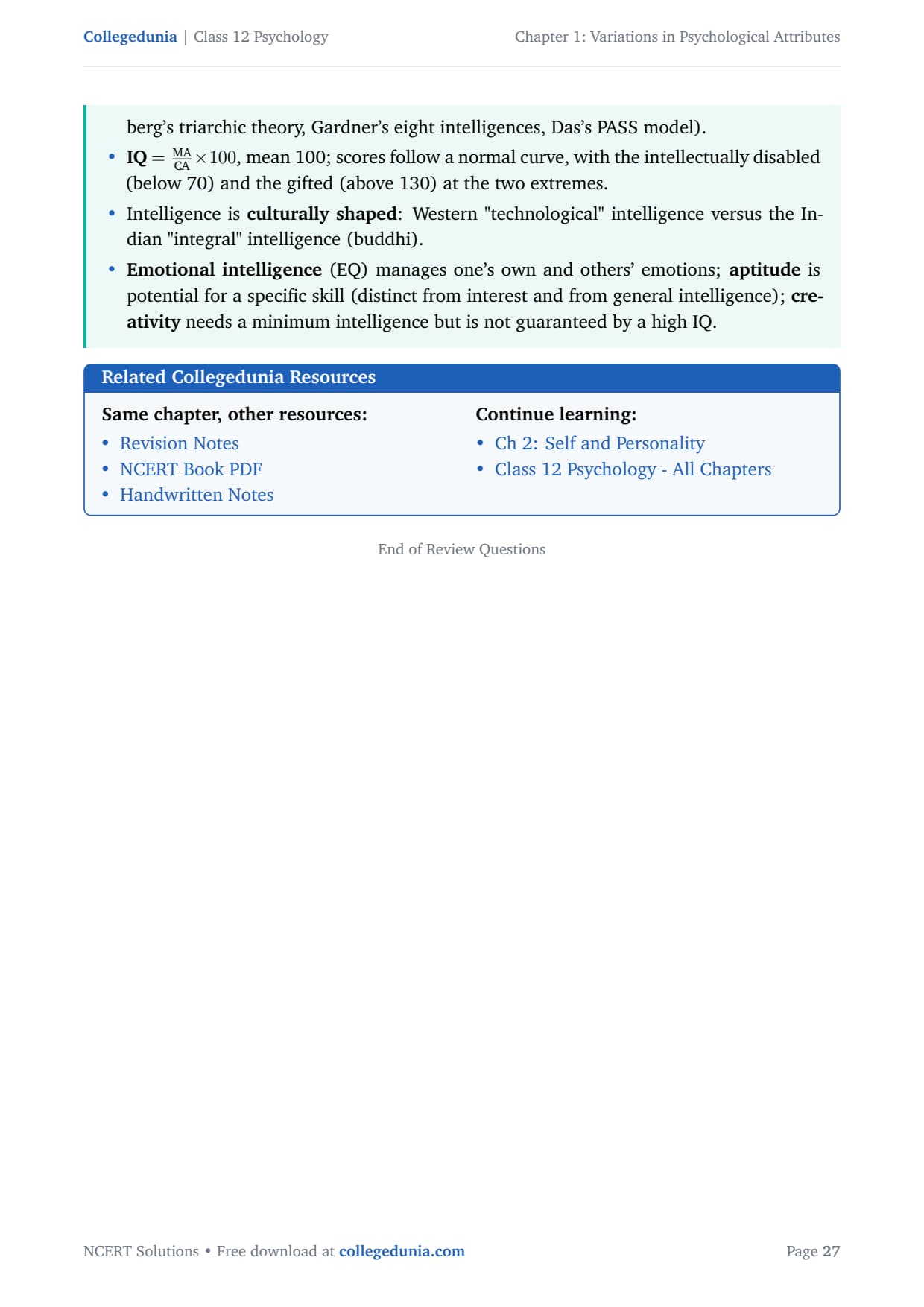
The formula: IQ equals mental age divided by chronological age, multiplied by 100. William Stern devised it in 1912.
Reading it: when mental age is above chronological age, IQ is above 100; the population average is always 100.
The spread: IQ scores follow a bell-shaped normal curve, symmetrical around the mean of 100.
The bands: from "Very superior" (above 130) down through "Average" (90 to 109) to "Intellectually disabled" (below 70).
The judgement most answers should reach is that about 50 per cent of people fall in the average band, with only about 2.2 per cent at each extreme. The curve is symmetrical, so the same percentage sits at the top and the bottom. Always show the substitution line, such as 12 over 10 times 100, before the final IQ number, because markers award a separate mark for the working.
Culture, Emotional Intelligence and Creativity
The closing part of the chapter widens the idea of intelligence beyond a single test score. This topic links culture, emotional intelligence and creativity, so it is a regular short and long answer. The lists below keep the key ideas side by side.
Culture and intelligence: Western culture prizes "technological" intelligence (analysis, speed, achievement); the Indian tradition holds an "integral" intelligence (buddhi) that blends cognitive and non-cognitive skills.
Emotional intelligence (EQ): the ability to perceive, express, understand and regulate one's own and others' emotions, first described by Salovey and Mayer.
Aptitude versus interest: aptitude is the potential for a specific skill; interest is a preference; success needs both together.
Creativity: a certain level of intelligence is necessary for creativity, but a high IQ does not guarantee it.
One sharp point for the answer is that intelligence is conceptualised differently across cultures, so a test built inside one culture can unfairly judge another. This is exactly why the chapter distinguishes culture-fair from culture-biased tests. Keep the Western "technological" and Indian "integral" labels ready, because the culture question turns on this contrast.
The Variations in Psychological Attributes Class 12 Review Questions Coverage
The chapter review has 12 questions. The table maps each one to its topic so students can plan revision and find the right NCERT answer fast. The full point-wise solution for each sits in the question set lower on this page.
Question
Topic it tests
Q 1
How psychologists characterise and define intelligence
Q 2
Heredity versus environment in intelligence (nature-nurture)
Q 3
Gardner's multiple intelligences
Q 4
Sternberg's triarchic theory
Q 5
The PASS model and the three neurological systems
Q 6
Cultural differences in conceptualising intelligence
Q 7
What IQ is and how people are classified by IQ score
Q 8
Verbal versus performance tests of intelligence
Q 9
How individuals vary: deficiency and giftedness
Q 10
IQ versus EQ and success in life
Q 11
Aptitude versus interest and intelligence, and its measurement
Q 12
How creativity is related to intelligence
Questions 3, 5 and 7 are the most-asked long answers, so students preparing Variations in Psychological Attributes class 12 important questions should learn those three first. The shorter contrasts (Q8 and Q11) are quick marks, so revise the verbal-performance and aptitude-interest distinctions well to secure them.
Students who want the offline copy can save the class 12 psychology chapter 1 pdf from the download card above and tick off each question as they finish it.
Variations in Psychological Attributes Important Questions and Previous Year Trends
CBSE sets a steady mix of MCQ, short and long answers from this chapter. Knowing the pattern helps students decide how much to write. The chapter is a regular source of one 4-mark or 6-mark question, which is why a focused list of Variations in Psychological Attributes important questions saves a lot of revision time.
Long answer (6 marks): Gardner's eight intelligences, the PASS model, or the IQ classification table.
Short answer (4 marks): the triarchic theory, verbal versus performance tests, or aptitude versus interest.
Opinion-based: IQ versus EQ for success in life, or how creativity relates to intelligence.
Objective and MCQ: the IQ formula, the normal curve, the eight Gardner types, and the PASS units.
For quick recall before the exam, students often practise the class 12 psychology chapter 1 mcq set and a list of Variations in Psychological Attributes class 12 important questions. The most repeated items are the theories of intelligence and the IQ table, so keep those answer points ready in your own words.
Working through the ncert solutions class 12 psychology chapter 1 set twice, once open-book and once from memory, fixes the names and numbers well before the board exam.
Common Mistakes Students Make in This Chapter
A few errors cost marks every year in this chapter. Most come from flipping the IQ formula or naming only some of Gardner's eight intelligences. Avoiding them is the fastest way to lift a score.
Flipping the IQ formula. It is always mental age over chronological age times 100, never the reverse.
Naming only six or seven of Gardner's intelligences. The exam needs all eight, since a missing type costs marks.
Confusing aptitude with interest. Aptitude is potential for a skill; interest is a preference.
Saying high IQ guarantees creativity. A minimum intelligence is needed, but high IQ does not ensure creativity.
Treating the PASS units as fully separate. They are independent in function but interdependent in action.
Students who fix these five points usually move from average to high marks on the long answers. The exam rewards precise names and numbers, so always show the IQ working and list all eight Gardner types in full.
Variations in Psychological Attributes PDF Download Formats and Languages
The solutions are free to download in more than one format, so students can pick what suits their device and revision style. The download card at the top of the page carries each option for this chapter.
Normal and HD PDF: the class 12 psychology chapter 1 pdf comes in a normal size for quick downloads and an HD version for clear printing.
English medium: all 12 answers are written in simple English for the CBSE board paper.
Question-only set: a print-and-practise sheet of Variations in Psychological Attributes extra questions for self-testing.
Whole-book pack: the solutions sit in one set that runs through every Class 12 Psychology chapter, so you can revise from Chapter 1 onwards in one place.
Many students search for class 12 psychology chapter 1 answers on their phone the night before a test, so a saved PDF means you can revise even without internet. Keep both the question set and the solved version handy for a full self-check.
How the Variations in Psychological Attributes Solutions Pair with Notes and the Book PDF
These NCERT Solutions answer the review questions. To revise the full chapter, students should use them alongside the other resources for the same chapter, all linked in the table below.
Reading the original NCERT chapter text and figures
Tip: read the Notes first, then attempt these solutions on your own, and only then check the model answers here. That order builds memory faster than copying answers straight away.
All NCERT Solutions for Class 12 Psychology
The table links the NCERT Solutions for every chapter in Class 12 Psychology, so students can move across the course in one click. Variations in Psychological Attributes is highlighted.
All NCERT Solutions for Variations in Psychological Attributes with Step-by-Step Solutions
Below are all 12 NCERT exercise questions for this chapter, exactly as they appear in the textbook. Tap Check Solution for the model answer or Expert Solution for the topper-style approach.
Q 1.1
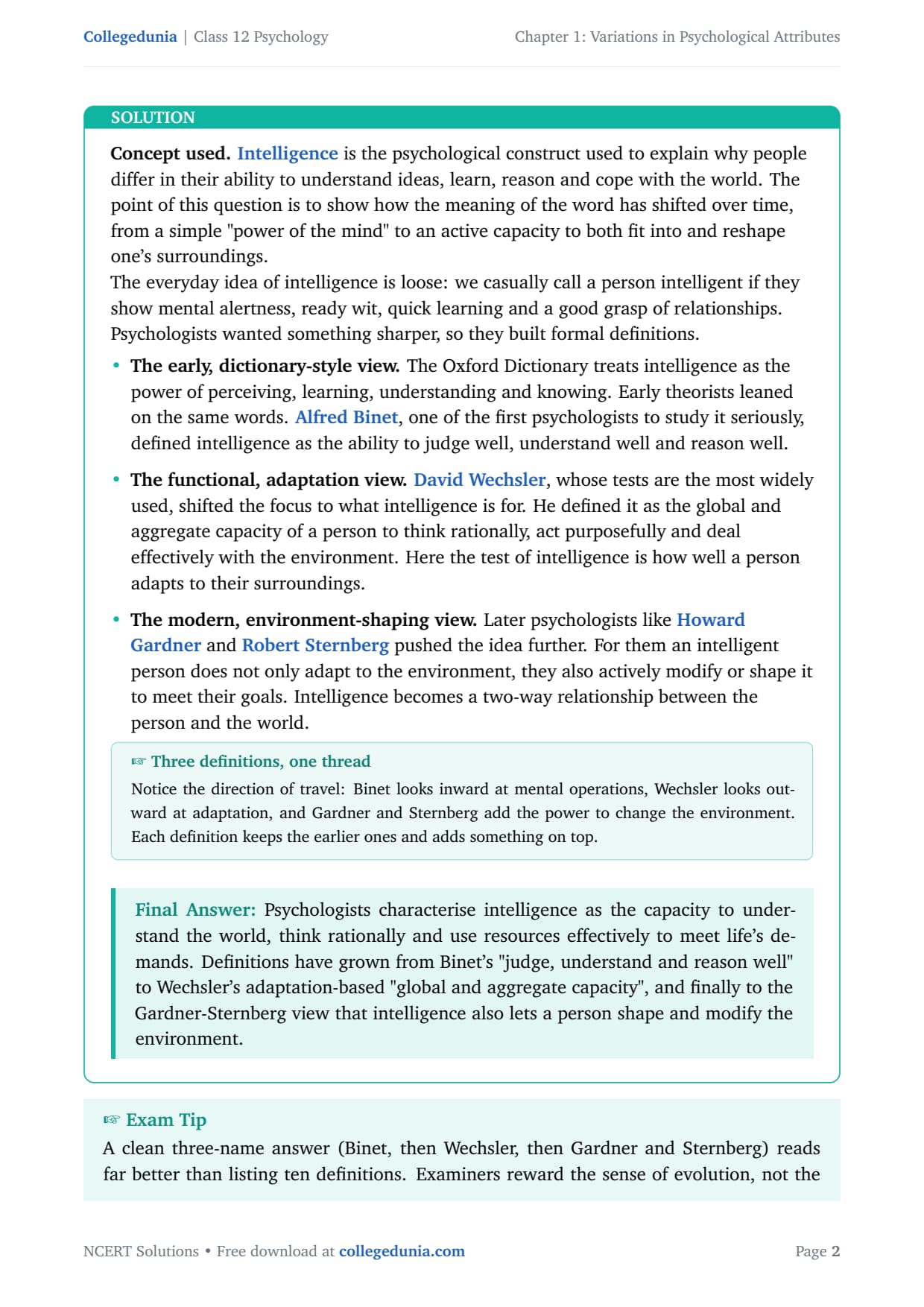
How do psychologists characterise and define intelligence?
Concept used.Intelligence is the psychological
construct used to explain why people differ in their ability to
understand ideas, learn, reason and cope with the world. The point of
this question is to show how the meaning of the word has shifted over
time, from a simple "power of the mind" to an active capacity to both
fit into and reshape one's surroundings.
The everyday idea of intelligence is loose: we casually call a person
intelligent if they show mental alertness, ready wit, quick learning and
a good grasp of relationships. Psychologists wanted something sharper, so
they built formal definitions.
The early, dictionary-style view. The Oxford Dictionary
treats intelligence as the power of perceiving, learning,
understanding and knowing. Early theorists leaned on the same
words. Alfred Binet, one of the first psychologists to
study it seriously, defined intelligence as the ability to judge
well, understand well and reason well.
The functional, adaptation view.David
Wechsler, whose tests are the most widely used, shifted the
focus to what intelligence is for. He defined it as the global
and aggregate capacity of a person to think rationally, act
purposefully and deal effectively with the environment. Here the
test of intelligence is how well a person adapts to their
surroundings.
The modern, environment-shaping view. Later
psychologists like Howard Gardner and Robert
Sternberg pushed the idea further. For them an intelligent
person does not only adapt to the environment, they also actively
modify or shape it to meet their goals. Intelligence becomes a
two-way relationship between the person and the world.
Three definitions, one thread
Notice the direction of travel: Binet looks inward at mental operations,
Wechsler looks outward at adaptation, and Gardner and Sternberg add the
power to change the environment. Each definition keeps the earlier ones
and adds something on top.
Psychologists characterise intelligence as the capacity to
understand the world, think rationally and use resources effectively to
meet life's demands. Definitions have grown from Binet's "judge, understand
and reason well" to Wechsler's adaptation-based "global and aggregate
capacity", and finally to the Gardner-Sternberg view that intelligence
also lets a person shape and modify the environment.
DA
Dr. Ananya Bose
PhD Psychology, University of Delhi
Verified Expert
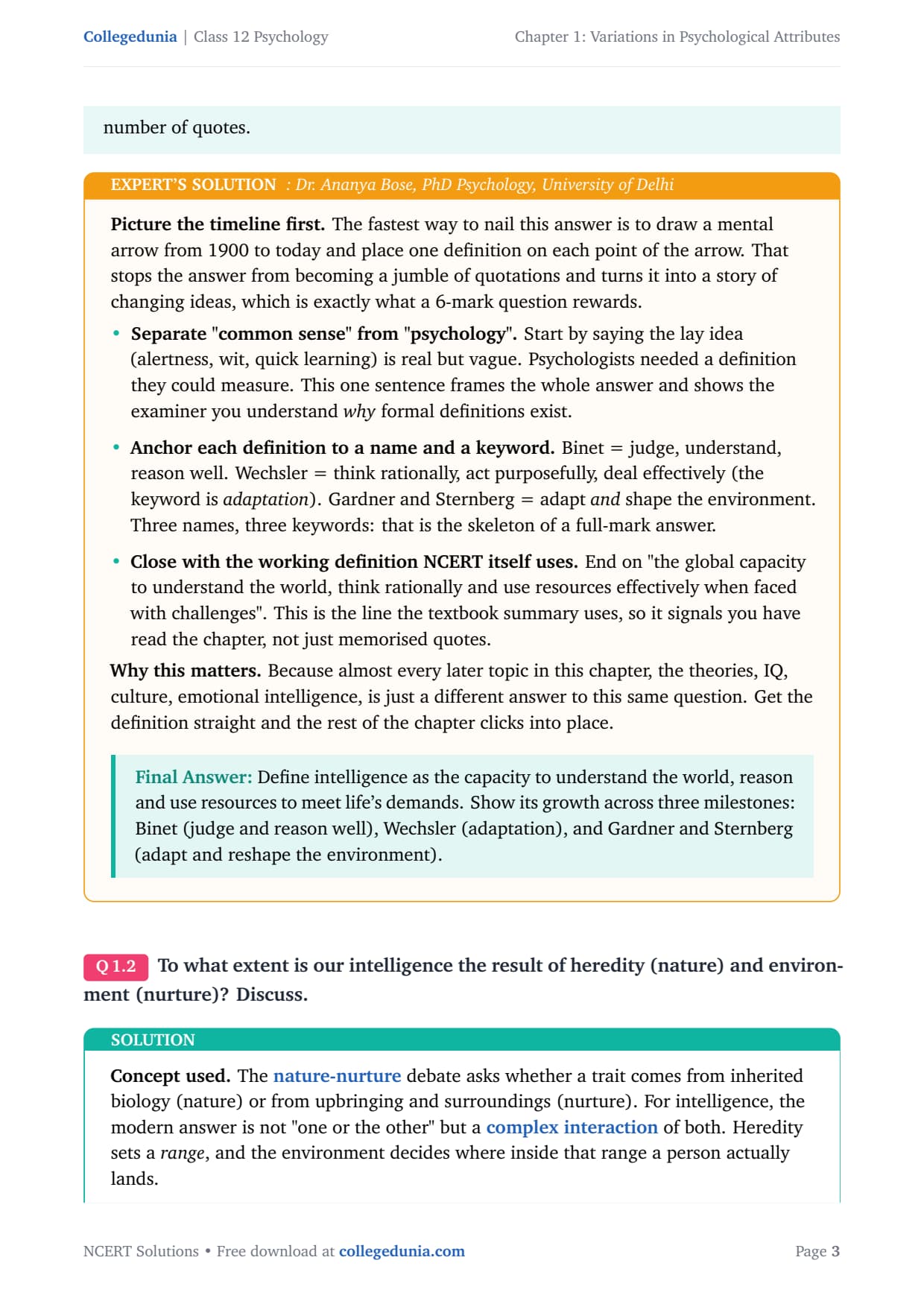
Picture the timeline first. The fastest way to nail this answer
is to draw a mental arrow from 1900 to today and place one definition on
each point of the arrow. That stops the answer from becoming a jumble of
quotations and turns it into a story of changing ideas, which is exactly
what a 6-mark question rewards.
Separate "common sense" from "psychology". Start by
saying the lay idea (alertness, wit, quick learning) is real but
vague. Psychologists needed a definition they could measure. This
one sentence frames the whole answer and shows the examiner you
understand why formal definitions exist.
Anchor each definition to a name and a keyword. Binet =
judge, understand, reason well. Wechsler = think rationally, act
purposefully, deal effectively (the keyword is adaptation).
Gardner and Sternberg = adapt and shape the environment.
Three names, three keywords: that is the skeleton of a full-mark
answer.
Close with the working definition NCERT itself uses.
End on "the global capacity to understand the world, think
rationally and use resources effectively when faced with
challenges". This is the line the textbook summary uses, so it
signals you have read the chapter, not just memorised quotes.
Why this matters. Because almost every later topic in this
chapter, the theories, IQ, culture, emotional intelligence, is just a
different answer to this same question. Get the definition straight and
the rest of the chapter clicks into place.
Define intelligence as the capacity to understand the world,
reason and use resources to meet life's demands. Show its growth across
three milestones: Binet (judge and reason well), Wechsler (adaptation),
and Gardner and Sternberg (adapt and reshape the environment).
Q 1.2
To what extent is our intelligence the result of heredity
(nature) and environment (nurture)? Discuss.
Concept used. The nature-nurture debate asks whether a
trait comes from inherited biology (nature) or from upbringing and
surroundings (nurture). For intelligence, the modern answer is not "one
or the other" but a complex interaction of both. Heredity sets
a range, and the environment decides where inside that range a
person actually lands.
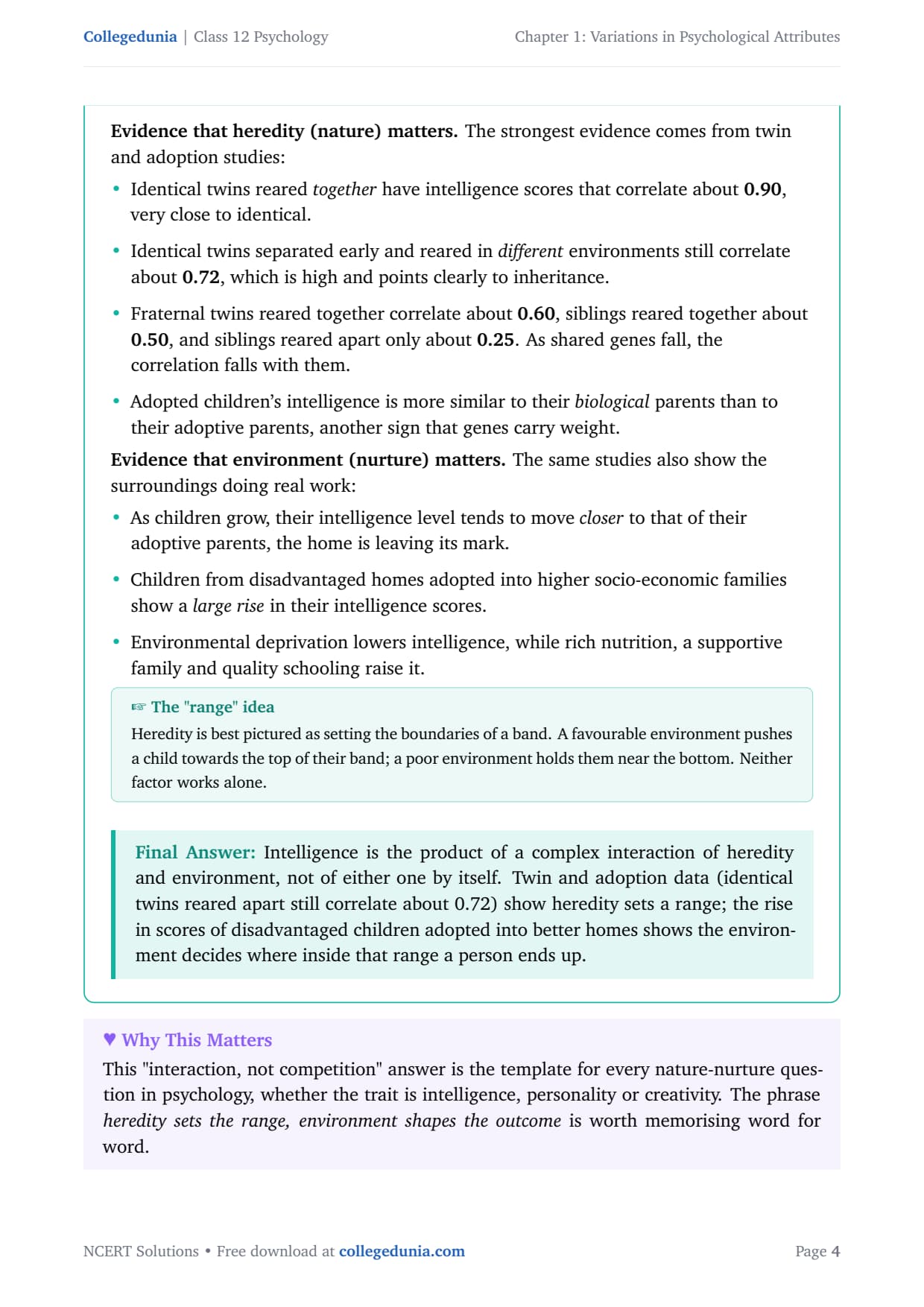
Evidence that heredity (nature) matters. The strongest evidence
comes from twin and adoption studies:
Identical twins reared together have intelligence scores
that correlate about 0.90, very close to identical.
Identical twins separated early and reared in different
environments still correlate about 0.72, which is high
and points clearly to inheritance.
Fraternal twins reared together correlate about 0.60,
siblings reared together about 0.50, and siblings reared
apart only about 0.25. As shared genes fall, the
correlation falls with them.
Adopted children's intelligence is more similar to their
biological parents than to their adoptive parents,
another sign that genes carry weight.
Evidence that environment (nurture) matters. The same studies
also show the surroundings doing real work:
As children grow, their intelligence level tends to move
closer to that of their adoptive parents, the home is
leaving its mark.
Children from disadvantaged homes adopted into higher
socio-economic families show a large rise in their
intelligence scores.
Environmental deprivation lowers intelligence, while rich
nutrition, a supportive family and quality schooling raise it.
The "range" idea
Heredity is best pictured as setting the boundaries of a band. A
favourable environment pushes a child towards the top of their band; a
poor environment holds them near the bottom. Neither factor works alone.
Intelligence is the product of a complex interaction of heredity
and environment, not of either one by itself. Twin and adoption data
(identical twins reared apart still correlate about 0.72) show heredity
sets a range; the rise in scores of disadvantaged children adopted into
better homes shows the environment decides where inside that range a
person ends up.
RI
Rohan Iyer
MA Psychology, Tata Institute of Social Sciences
Verified Expert
Two columns, one verdict. Split your answer page mentally into a
"nature" column and a "nurture" column, fill each with two or three pieces
of evidence, then write a single closing line that fuses them. This
structure guarantees you give both sides their due, which is exactly what
the word "Discuss" in the question is asking for.
Lead with the twin-study staircase. The correlations
0.90, 0.72, 0.60, 0.50, 0.25 form a neat descending staircase as
shared genes shrink. Quoting even two of these numbers
(especially 0.72 for identical twins reared apart) instantly
proves the heredity side with hard data.
Match it with the adoption evidence for environment. The
big jump in IQ when disadvantaged children move into supportive
homes is the single most persuasive nurture finding. Pair it with
the point that scores drift towards adoptive parents over time.
Finish with the interaction verdict. State plainly that
psychologists now agree intelligence is a product of the
interaction of the two, with heredity setting a range and
environment determining the actual level reached. Do not pick a
winner, the right answer is "both, working together".
Why this matters. Examiners use this question to test whether you
can hold two ideas at once instead of taking a side. The mark is in the
synthesis, the closing sentence that says heredity and environment are
partners, not rivals.
Both nature and nurture shape intelligence and they work
together. Twin and adoption studies prove heredity sets a range (identical
twins reared apart still correlate ≈0.72), while gains from
enriched environments prove nurture decides the final level within that
range.
Q 1.3
Explain briefly the multiple intelligences identified by Gardner.
Concept used.Howard Gardner's theory of multiple
intelligences rejects the idea that intelligence is one single thing.
Instead he argues there are several distinct and independent types
of intelligence. Being high on one does not make you high on another, yet
the different types interact and work together to solve a problem. By
studying extremely talented people, Gardner described eight
intelligences.
Linguistic (word-smart): the ability to use language
fluently and flexibly to express thinking and understand others.
Strong in poets and writers.
Logical-Mathematical: the ability to think logically and
critically, reason abstractly and manipulate symbols to solve
problems. Strong in scientists and Nobel Prize winners.
Spatial: the ability to form, use and transform mental
images and visual patterns. Strong in pilots, sailors, sculptors,
painters, architects, interior decorators and surgeons.
Musical: the capacity to produce, create and manipulate
musical rhythms and patterns, with great sensitivity to sounds
and vibrations.
Bodily-Kinaesthetic: the ability to use the whole body,
or parts of it, flexibly and creatively. Strong in athletes,
dancers, actors, sportspersons, gymnasts and surgeons.
Interpersonal: the ability to understand the motives,
feelings and behaviour of other people and bond with them. Strong
in psychologists, counsellors, politicians, social workers and
religious leaders.
Intrapersonal: the ability to understand one's own
feelings, motives and desires, and know one's inner strengths and
limits. Strong in philosophers and spiritual leaders.
Naturalistic: the ability to recognise the features of
the natural world and make fine discriminations among flora and
fauna. Strong in hunters, farmers, tourists, botanists, zoologists
and bird watchers.
Two anchors per type
To recall all eight under exam pressure, store each one as a pair: a
one-line ability plus one example occupation (spatial → architect,
naturalistic → bird watcher). The occupation jogs the ability.
Gardner's theory of multiple intelligences holds that
intelligence is not one entity but eight independent kinds: Linguistic,
Logical-Mathematical, Spatial, Musical, Bodily-Kinaesthetic,
Interpersonal, Intrapersonal and Naturalistic. They are independent of
each other yet interact to solve real problems.
MK
Meera Krishnan
MSc Applied Psychology, University of Hyderabad
Verified Expert
Group the eight before you list them. Eight items are hard to
recall as a flat list, so cluster them: two "symbol" intelligences
(Linguistic, Logical-Mathematical), two "art and body" (Musical,
Bodily-Kinaesthetic), one "space" (Spatial), two "self and others"
(Interpersonal, Intrapersonal), and one "nature" (Naturalistic). Recalling
four small groups beats trying to recall eight loose words.
Open with the core claim, not the list. The single most
important sentence is that intelligence is not a single entity but
a set of independent intelligences that still cooperate. Lead with
this; the examiner is checking that you grasp the idea, not
just that you memorised eight labels.
Pair each label with an ability and a profession. Write
"Spatial: forming and transforming mental images, e.g. architects
and pilots." That two-part formula keeps every entry short while
proving you understand each type, and it fills the page evenly.
Mention the interaction point to finish. Note that
Gardner says these intelligences work together to solve a
problem, a surgeon, for instance, blends spatial, bodily-kinaesthetic
and logical intelligence. This shows you understand independence
does not mean isolation.
Why this matters. Gardner's theory is the textbook's best example
of the information-processing or "many abilities" view that opposes the
single-IQ psychometric view. Knowing it well sets up the comparison
questions later in the chapter. It also carries a practical message
students relate to: a child who is poor at language or mathematics may
still be outstanding in music, sport or understanding people, so schools
should value many kinds of talent, not just the two the exam rewards.
Mentioning this real-world implication turns a list-style answer into one
that shows genuine understanding, which is what earns the top band of
marks.
Gardner identifies eight independent intelligences, Linguistic,
Logical-Mathematical, Spatial, Musical, Bodily-Kinaesthetic, Interpersonal,
Intrapersonal and Naturalistic, that are separate yet interact to solve
problems. Cluster them into symbol, art-and-body, space, self-and-others
and nature groups for quick recall.
Q 1.4
How does the triarchic theory help us to understand intelligence?
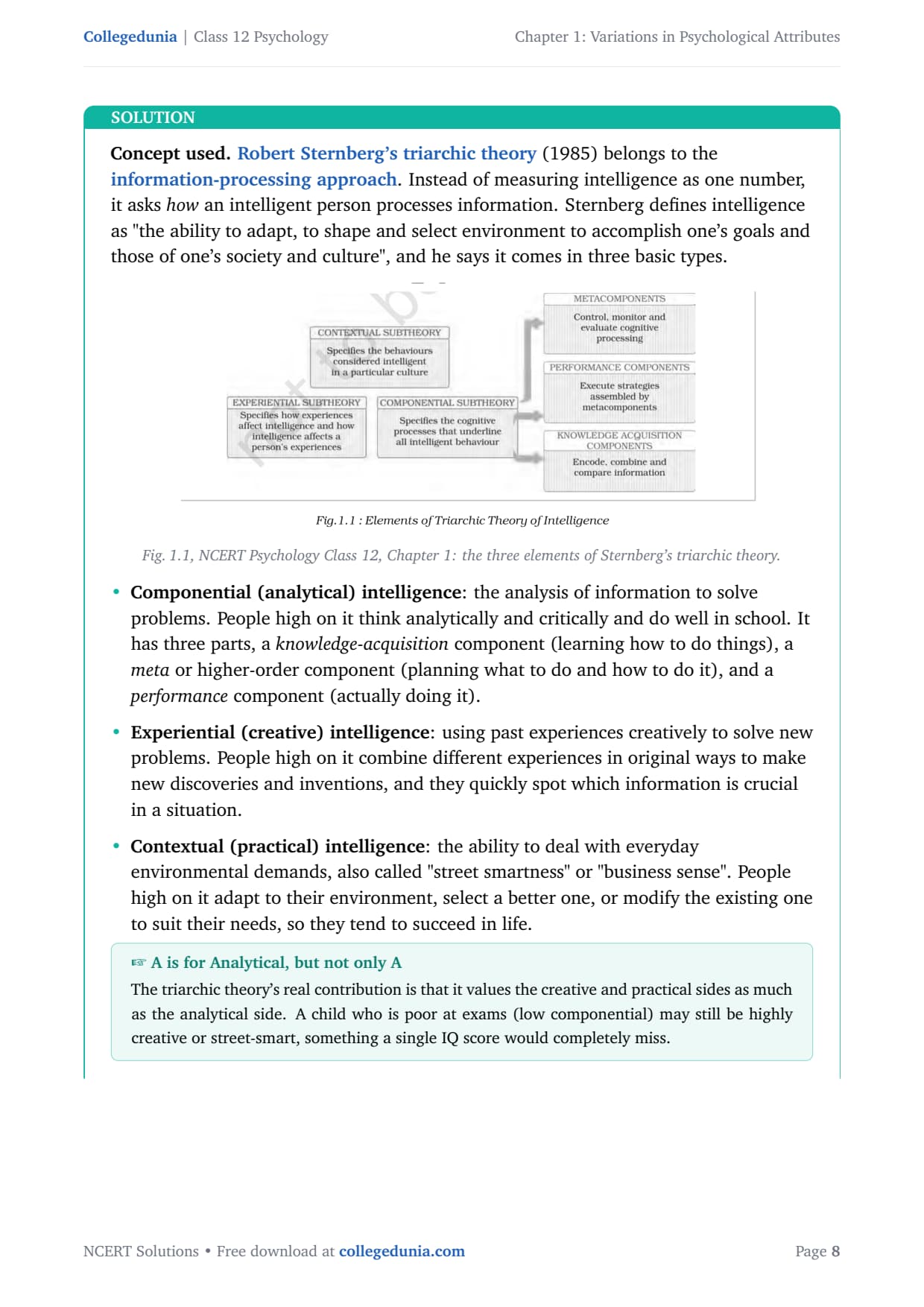
Concept used.Robert Sternberg's triarchic theory
(1985) belongs to the information-processing approach. Instead
of measuring intelligence as one number, it asks how an intelligent
person processes information. Sternberg defines intelligence as "the
ability to adapt, to shape and select environment to accomplish one's
goals and those of one's society and culture", and he says it comes in
three basic types.
Fig. 1.1, NCERT Psychology Class 12, Chapter 1: the three elements of Sternberg's triarchic theory.
Componential (analytical) intelligence: the analysis of
information to solve problems. People high on it think
analytically and critically and do well in school. It has three
parts, a knowledge-acquisition component (learning how to
do things), a meta or higher-order component (planning what
to do and how to do it), and a performance component
(actually doing it).
Experiential (creative) intelligence: using past
experiences creatively to solve new problems. People high on it
combine different experiences in original ways to make new
discoveries and inventions, and they quickly spot which
information is crucial in a situation.
Contextual (practical) intelligence: the ability to deal
with everyday environmental demands, also called "street
smartness" or "business sense". People high on it adapt to their
environment, select a better one, or modify the existing one to
suit their needs, so they tend to succeed in life.
A is for Analytical, but not only A
The triarchic theory's real contribution is that it values the creative
and practical sides as much as the analytical side. A child who is poor at
exams (low componential) may still be highly creative or street-smart,
something a single IQ score would completely miss.
The triarchic theory helps us understand intelligence by
breaking it into three processes instead of one score: componential
(analytical, exam-style problem solving), experiential (creative,
using experience to crack novel problems) and contextual (practical,
coping with and shaping daily life). It shows intelligence is not just
"book-smart" but also creative and practical.
DS
Dr. Sameer Qureshi
PhD Cognitive Psychology, Jamia Millia Islamia
Verified Expert
Lead with the three-word skeleton. Componential, Experiential,
Contextual, or in plainer words Analytical, Creative, Practical. If you can
write those three pairs at the top of your answer, the rest is just one
short paragraph each. The figure from the textbook (Fig. 1.1) lays the
three out visually, so describing it in words is half the answer.
Tie the theory to its approach in the first line. Say
clearly that this is an information-processing theory, so
it studies the processes of intelligent behaviour, not its
structure. That single sentence earns the conceptual mark and
separates Sternberg from the psychometric crowd.
Give each type a function and a real example.
Componential → the student who tops exams; experiential →
the inventor who repurposes old ideas; contextual → the
street-smart entrepreneur. Concrete examples make abstract labels
stick and fill the answer naturally.
Unpack the three sub-components of componential.
Knowledge-acquisition, meta-component and performance, this extra
detail is exactly the kind of depth that lifts a good answer to a
full-mark answer, because most students stop at the three main
types.
Why this matters. The triarchic theory is the textbook's flagship
information-processing model alongside the PASS model. Understanding it
deeply lets you answer comparison questions and justify why a single IQ
number is an incomplete picture of a person.
Sternberg's triarchic theory understands intelligence as three
processes, componential (analytical), experiential (creative) and
contextual (practical), so it captures exam ability, inventiveness and
real-world street-smartness together, which a single IQ score cannot.
Q 1.5
``Any intellectual activity involves the independent functioning
of three neurological systems''. Explain with reference to PASS model.
Concept used. The PASS model (Planning,
Attention-arousal, Simultaneous-successive processing) was developed by
J.P. Das, Jack Naglieri and Kirby (1994). It is an
information-processing theory which says intellectual activity rests on
the interdependent functioning of three neurological systems,
called the functional units of the brain. These units handle
arousal/attention, coding (processing) and planning. The quotation in the
question points to exactly these three systems.
Arousal/Attention. A state of arousal is basic to any
behaviour because it helps us attend to stimuli. The right
level of arousal focuses our attention on the relevant parts of a
problem, too much or too little arousal interferes with attention.
Example: a teacher announcing a test arouses you to attend to the
right chapters.
Simultaneous and Successive Processing. This is the
coding or processing unit. In simultaneous processing you
grasp the relationships between things and integrate them into a
whole pattern, as in Raven's Progressive Matrices, where you see
how the parts of a design fit together. In successive
processing you take in information serially, so recalling one item
cues the next, as in learning digits, the alphabet or
multiplication tables.
Planning. After information is attended to and processed,
planning is activated. It lets us think of possible courses of
action, carry them out to reach a target, and judge how well they
worked. If a plan fails, we modify it, for example, reworking your
study timetable when the first plan does not cover the syllabus in
time.
Interdependent, not isolated
The word in the quotation is "independent", but NCERT stresses these units
are also interactive and dynamic: arousal feeds processing, and
processing feeds planning. Each has its own job, yet they constantly work
together on a shared knowledge base.
These processes run on a knowledge base built up formally (reading,
writing, experimenting) and informally (from the environment). Das and
Naglieri turned the model into a real test, the Cognitive
Assessment System (CAS), with verbal and non-verbal tasks for ages 5 to
18, whose results can help remedy children's cognitive deficits.
The PASS model explains intellectual activity through three brain
systems working together: Arousal/Attention (staying alert to relevant
stimuli), Simultaneous-successive processing (coding information as a whole
pattern or as a serial chain), and Planning (forming, executing and
revising a course of action). The Cognitive Assessment System (CAS) puts
the model to practical use.
DK
Dr. Kavita Menon
PhD Neuropsychology, NIMHANS Bengaluru
Verified Expert
Decode the acronym, then defend the quotation. PASS literally
spells out three of the four ideas (Planning, Attention, Simultaneous,
Successive), so write the acronym first, then explain each letter, then
return to the quotation to confirm the "three systems" claim. This loops
the answer back to what the question actually asked.
Name the authors and the "functional units" idea up
front. Das, Naglieri and Kirby (1994), three functional units of
the brain. Crediting the model and its core concept in the first
sentence frames the whole answer and earns the knowledge mark
immediately.
Give each unit a crisp definition plus a school example.
Arousal → alertness for the test; Simultaneous → Raven's
Matrices pattern; Successive → learning tables in order;
Planning → building and revising a study schedule. Examples
from a student's own life make an abstract brain model concrete
and memorable.
Add the CAS application as your finishing flourish.
Stating that the model led to the Cognitive Assessment System for
ages 5 to 18, used to remedy learning problems, shows the theory
is not just abstract, it has real clinical use. This kind of
closing detail is what separates a top answer from an average one.
Why this matters. The PASS model is the second pillar of the
information-processing approach in this chapter (the triarchic theory being
the first). Together they show the modern shift from asking "how much
intelligence?" to asking "how does intelligence work?". One subtle point
worth adding is that the quotation says the systems are "independent", but
NCERT immediately stresses they are also interactive and dynamic, running
on a shared knowledge base built both formally and informally. Pointing out
this tension, independent in function yet interdependent in action, shows
the examiner you have read the section carefully rather than just learning
the four letters of the acronym, and it is exactly the kind of nuance that
lifts an answer into the top mark band.
The PASS model supports the quotation by locating intellectual
activity in three interacting brain systems, Attention-arousal,
Simultaneous-successive processing and Planning, each with its own
function yet feeding the others, and operationalised through the Cognitive
Assessment System (CAS).
Q 1.6
Are there cultural differences in the conceptualisation of
intelligence?
Concept used.Culture is the collective system of
customs, beliefs, attitudes and achievements of a group. The claim here
is that what counts as "intelligent" is not fixed worldwide, it is
tuned by cultural parameters. So yes, there are clear cultural
differences in how intelligence is understood.
Why culture matters at all. A major job of intelligence is to
help a person adapt to their environment, and culture provides that
environment. Lev Vygotsky argued that culture gives the social
context in which people live, grow and understand the world. While
elementary mental functions (crying, walking, sensitivity to smells) are
universal, higher mental functions like problem solving and thinking are
largely culture-produced.
Technological intelligence (Western view).
Technologically advanced societies raise children to value skills
of generalisation, abstraction, speed, minimal moves and mental
manipulation. They prize attention, observation, analysis,
performance, speed and achievement orientation. Western
intelligence tests look exactly for these skills. This is called
technological intelligence.
The non-Western contrast. Many Asian and African
societies do not value technological intelligence as highly.
Beyond individual cognitive competence, they look for skills to
relate to others, social and emotional skills, self-reflection
and a collectivistic orientation rather than personal achievement
and individualism.
Integral intelligence (Indian tradition). Indian thought
offers integral intelligence, a holistic view that gives
equal weight to cognitive and non-cognitive processes and their
integration, and stresses connectivity with the social and world
environment. The Sanskrit word buddhi (J.P. Das) is wider
than the Western term: it includes mental effort, determined
action, feelings and opinions alongside knowledge and
discrimination. Indian tradition names four competencies of
intelligence: cognitive capacity, social competence, emotional
competence and entrepreneurial competence.
One word to remember each culture by
Western culture="technological" intelligence (analysis, speed,
achievement). Indian culture="integral" intelligence (connectivity,
holism, buddhi). Pairing each culture with its keyword makes this answer
quick to recall and quick to write.
Yes. Intelligence is conceptualised differently across cultures.
Western, technologically advanced societies prize "technological
intelligence" (analysis, speed, achievement), many non-Western societies
value social and emotional competence and self-reflection, and the Indian
tradition holds an "integral intelligence" (buddhi) that connects
cognitive and non-cognitive skills with the wider social world.
DN
Dr. Nandini Rao
PhD Cultural Psychology, University of Mysore
Verified Expert
Answer "yes", then prove it with three cultures. The question is
a yes/no opener, so say yes in the first line and spend the rest
contrasting three settings: Western, broader non-Western, and Indian. A
clear three-way contrast is far stronger than a vague "it depends".
Ground the answer in Vygotsky first. State that culture
supplies the context for intelligence and that higher mental
functions are culture-produced. This theoretical anchor earns the
concept mark and explains why differences exist, not just
that they exist.
Set technological against integral intelligence. The
cleanest contrast is Western "technological" intelligence (speed,
analysis, achievement) versus Indian "integral" intelligence
(connectivity, holism, buddhi). Defining both terms precisely is
what lifts the answer above a generic "cultures differ" response.
List the four Indian competencies for depth. Cognitive,
social, emotional and entrepreneurial competence. Naming these
four shows you read the Indian-tradition section closely and gives
the examiner concrete, chapter-specific content to award marks
for.
Why this matters. This question is the bridge between abstract
theories of intelligence and the social reality of testing. It also sets
up the emotional-intelligence topic, which NCERT says "builds on the
concept of intelligence in the Indian tradition". A strong answer also
notes that the boundaries between cultures are "gradually vanishing under
the influence of western cultures", so the distinction is a tendency, not
a hard wall. Adding that the Western test built for speed and abstraction
will systematically under-rate a child raised to value patience, social
duty and self-reflection makes the point land: a single, culture-blind
test cannot fairly capture intelligence everywhere. That observation is
the reason psychologists work so hard on culture-fair tests, and writing
it shows the examiner you can connect a theory question to its practical
consequences, which is precisely what the top mark band rewards.
Yes, cultures conceptualise intelligence differently: Western
"technological" intelligence emphasises analysis, speed and achievement,
non-Western cultures value social and emotional competence, and the
Indian "integral" intelligence (buddhi) blends cognitive and non-cognitive
skills with social connectivity.
Q 1.7
What is IQ? How do psychologists classify people on the basis
of their IQ scores?
Concept used.IQ (Intelligence Quotient) is a single
number that expresses a person's intelligence relative to their age. It
was devised by William Stern (1912) and is built from two ideas
introduced by Binet and Simon: Mental Age (MA), a measure of
intellectual development relative to one's age group, and
Chronological Age (CA), the actual age from birth. The formula
is:
IQ = MACA × 100.
The 100 is a multiplier that removes the decimal point.
Reading the formula. When MA equals CA, IQ is exactly
100. When MA is greater than CA (a bright child), IQ is above 100.
When MA is less than CA (a slow child), IQ is below 100. For
example, a 10-year-old with a mental age of 12 has an IQ of
1210× 100 = 120; the same child with MA of 7 has
an IQ of 710× 100 = 70. The average IQ in the
population is 100, whatever the age.
How the scores spread out. IQ scores follow a bell-shaped
normal curve: most people cluster in the middle and only
a few have very high or very low scores. The curve is symmetrical
around the mean of 100.
The classification table. Psychologists slot people into
descriptive labels by IQ band. Table 1.1 below gives the standard
classification and the percentage of the population in each band.
1.3
tabular|c|l|c|
cdPrimaryIQ Range & cdPrimaryDescriptive Label & cdPrimary% in Population
Above 130 & Very superior & 2.2
120–130 & Superior & 6.7
110–119 & High average & 16.1
90–109 & Average & 50.0
80–89 & Low average & 16.1
70–79 & Borderline & 6.7
Below 70 & Intellectually disabled & 2.2
tabular [3pt]
cdMutedTable 1.1: Classification of People on the Basis of IQ (NCERT Psychology Class 12, Chapter 1).
Don't flip the formula
A frequent error is writing IQ = CAMA × 100.
It is always mental age over chronological age. A quick sanity
check: a bright child must score above 100, so the larger number
(MA) sits on top.
IQ is mental age divided by chronological age, multiplied by 100
(IQ = MACA × 100), with a
population average of 100. Psychologists classify people into bands from
"Very superior" (above 130) down through "Average" (90–109) to
"Intellectually disabled" (below 70), with about 50% of people in the
average band and only about 2.2% at each extreme.
AN
Arvind Nair
MA Psychology, University of Calicut
Verified Expert
Two halves: define, then classify. The question literally has two
parts, so structure your answer in two halves. Part one is the IQ formula
with one worked example; part two is the classification table. Answering
both halves explicitly is the easiest way to secure full marks.
State the formula and credit Stern. Write
IQ = MACA× 100, name William Stern
(1912), and define MA and CA. Definitions of MA and CA are
themselves mark-worthy, do not skip them.
Anchor it with one number. Use the textbook's own case:
a 10-year-old with MA 12 gives IQ 120. One clean worked example
proves you can apply the formula, not just quote it.
Reproduce the bands, not just the extremes. Many students
only mention "above 130 gifted, below 70 disabled". The stronger
answer lists the full ladder, Very superior, Superior, High
average, Average, Low average, Borderline, Intellectually disabled,
and notes that 50% fall in the average band.
Why this matters. IQ and its classification are the most heavily
tested ideas in this chapter and feed directly into the deficiency and
giftedness topics. A student who knows the table cold can answer three or
four different questions from it. Two extra points are worth weaving in.
First, the table is symmetrical: the same percentage (2.2%) sits at each
extreme, and the same 16.1% in both "high average" and "low average",
which is just the bell curve in numbers. Spotting that symmetry shows you
understand why the bands are shaped the way they are. Second, it is
worth flagging that this is the "ratio IQ" formula, which works neatly for
children but breaks down for adults, whose mental age stops climbing,
which is why modern tests use deviation IQ instead. Mentioning this limit
signals a depth of understanding well beyond rote learning of the formula,
and that is exactly what separates a full-mark answer from a routine one.
IQ = MACA× 100 (Stern, 1912), mean
100. Classification runs from Very superior (above 130, 2.2%) through
Average (90–109, 50%) to Intellectually disabled (below 70, 2.2%),
following the normal curve.
Q 1.8
How can you differentiate between verbal and performance tests
of intelligence?
Concept used. Intelligence tests can be sorted by the
nature of the items they use. A verbal test needs
language-based responses, while a performance test needs the
test-taker to physically manipulate objects. (A third category,
non-verbal tests, uses pictures and is closely related to
performance tests.) The differences run across several dimensions.
Mode of response. Verbal tests require subjects to give
responses in language, either orally or in writing. Performance
tests require subjects to manipulate objects and materials to
carry out a task; written language is not needed to answer.
Who can take them. Because verbal tests depend on
language, they can be given only to literate people.
Performance tests do not need reading or writing, so they suit
illiterate test-takers as well.
Examples. A typical performance test is Kohs'
Block Design Test, where the subject arranges wooden blocks
within a time limit to reproduce a given design. Verbal tests, by
contrast, pose questions to be answered in words.
Cultural reach. A major advantage of performance tests is
that they can be easily administered to people from
different cultures, since they do not rely on a particular
language. Verbal tests carry more cultural and linguistic bias.
The litmus test
Ask one question: does the test-taker answer with words or with hands? If
words (spoken or written), it is verbal. If hands (arranging blocks,
completing patterns), it is performance. That single distinction unlocks
every other difference.
Verbal tests need language-based answers (oral or written), so
they suit only literate people and carry cultural and language bias.
Performance tests need the manipulation of objects (e.g. Kohs' Block
Design Test), need no reading or writing, suit illiterate people, and can
be given across cultures with little language bias.
DP
Dr. Priya Deshmukh
PhD Psychometrics, Savitribai Phule Pune University
Verified Expert
Differentiate means contrast, so think in pairs. Every point you
make should be a pair: "verbal does X, performance does Y." Listing
features of only one type is half an answer. Pick three or four dimensions
and contrast both types on each.
Start with the defining feature. Verbal = language
responses; performance = manipulating objects. This is the root
difference from which every other contrast (literacy, culture)
follows, so state it first and clearly.
Drive home the literacy consequence. Verbal tests need
literacy; performance tests do not. This is the most exam-favoured
difference because it has a real-world impact, performance tests
let psychologists assess people who cannot read.
Finish with the cross-cultural advantage and an example.
Name Kohs' Block Design Test for performance, and note that
performance tests travel across cultures because they shed
language. A named example plus the cultural point rounds the
answer off at full marks.
Why this matters. This contrast connects straight to the
culture-fair versus culture-biased discussion: performance and non-verbal
tests are the tools psychologists use to reduce the cultural bias built
into verbal tests.
Verbal tests use language responses, need literacy and carry
language bias; performance tests use object-manipulation (e.g. Kohs'
Block Design Test), need no literacy and travel well across cultures.
Q 1.9
All persons do not have the same intellectual capacity. How do
individuals vary in their intellectual ability? Explain.
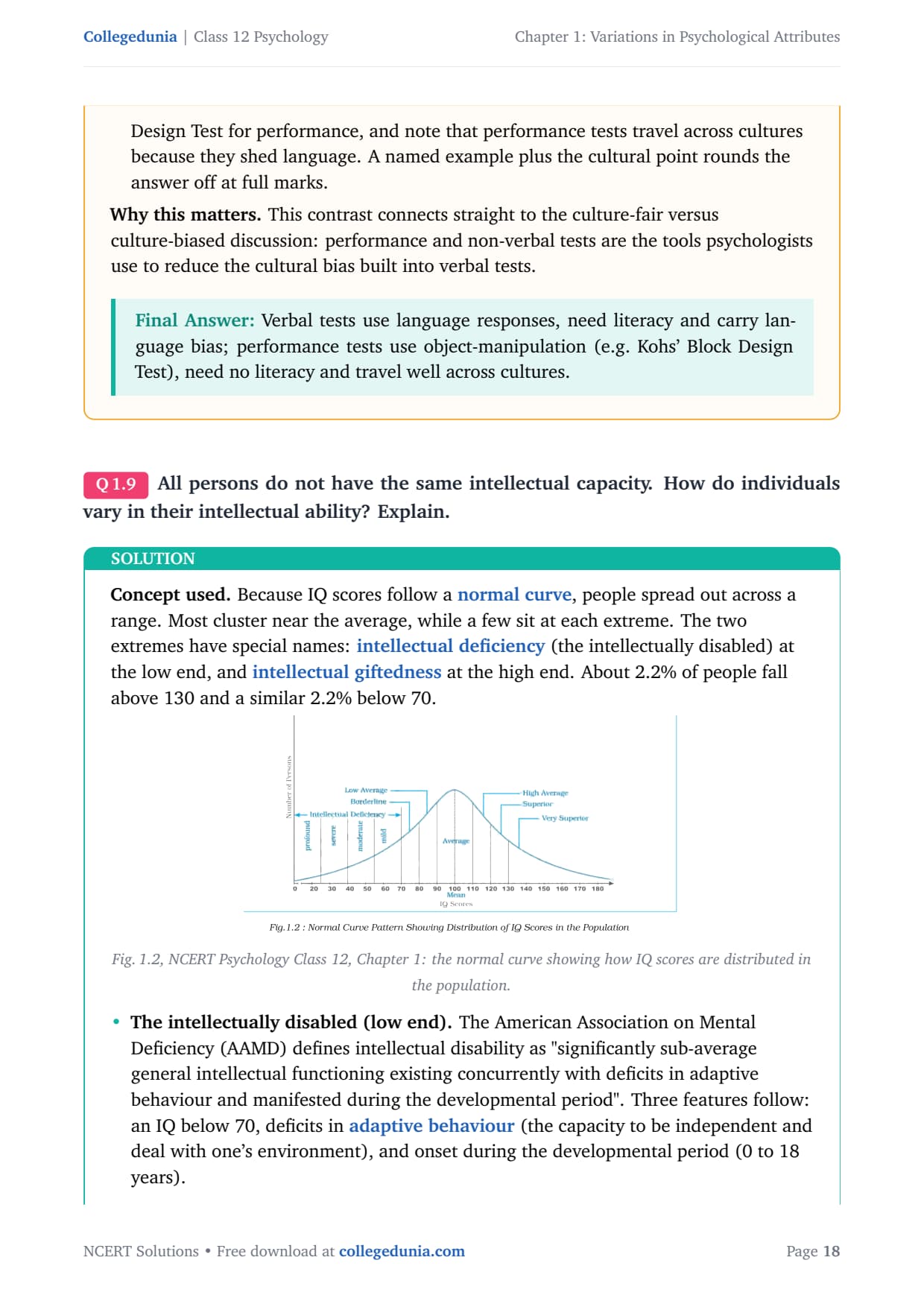
Concept used. Because IQ scores follow a normal curve,
people spread out across a range. Most cluster near the average, while a
few sit at each extreme. The two extremes have special names:
intellectual deficiency (the intellectually disabled) at the low
end, and intellectual giftedness at the high end. About 2.2% of
people fall above 130 and a similar 2.2% below 70.
Fig. 1.2, NCERT Psychology Class 12, Chapter 1: the normal curve showing how IQ scores are distributed in the population.
The intellectually disabled (low end). The American
Association on Mental Deficiency (AAMD) defines intellectual
disability as "significantly sub-average general intellectual
functioning existing concurrently with deficits in adaptive
behaviour and manifested during the developmental period". Three
features follow: an IQ below 70, deficits in adaptive
behaviour (the capacity to be independent and deal with one's
environment), and onset during the developmental period (0 to 18
years).
Levels of disability. Disability is not all-or-nothing.
It runs from mild (IQ 55 to about 70, can live fairly
independently and hold jobs), through moderate (IQ about
35–40 to 50–55, trainable in self-care and simple communication),
to severe (IQ about 20–25 to 35–40) and profound
(IQ below 20–25), who need constant care for life.
The intellectually gifted (high end). Giftedness is
exceptional general ability shown across a wide variety of areas;
it differs from talent, which is remarkable ability in one
specific field. From a teacher's view, giftedness combines
high ability, high creativity and high commitment.
Gifted children show early signs: large attention span, good
recognition memory, preference for novelty, advanced logical
thinking, fast information processing, high intrinsic motivation
and independent, non-conformist thinking.
Read the curve from both ends
The normal curve is the single picture that ties this answer together: a
fat middle (average), a thin tail on the left (disability, from profound
to mild) and a thin tail on the right (giftedness). Describing the curve
first gives your answer a clear spine.
Individuals vary along the normal curve of intelligence. At the
low extreme are the intellectually disabled (IQ below 70, with deficits in
adaptive behaviour appearing before age 18), graded mild, moderate, severe
and profound. At the high extreme are the intellectually gifted (about
2.2%), who combine high ability, high creativity and high commitment and
show early signs of intellectual superiority.
DF
Dr. Faisal Khan
PhD Clinical Psychology, NIMHANS Bengaluru
Verified Expert
Use the curve as a map of the whole answer. Open by saying
intelligence is normally distributed, then walk the examiner from the low
tail to the high tail. This turns a sprawling topic into a tidy left-to-right
journey that is easy to write and easy to mark.
Define disability with the three AAMD features. Sub-average
IQ (below 70), deficits in adaptive behaviour, and onset before 18.
Quoting all three features, not just the low IQ, is what earns the
full deficiency mark.
Show the four severity levels. Mild, moderate, severe,
profound, with a one-line capability note for each. This detail
demonstrates that disability is a spectrum, a point weaker answers
miss entirely.
Define giftedness as a three-way combination. High
ability + high creativity + high commitment, plus two or three
early signs (large attention span, fast processing, non-conformist
thinking). Distinguishing giftedness from narrow "talent" adds a
precise, mark-worthy contrast.
Why this matters. This question pulls together the normal curve,
the IQ table and adaptive behaviour into one integrated answer, which is
exactly the kind of synthesis long-answer questions reward. It also links
forward to Chapter 4, where the disabled are studied in more depth. One
detail that elevates the answer is the point on adaptive behaviour:
NCERT is clear that a low IQ alone is not enough to label someone
intellectually disabled, the person must also struggle to function
independently in daily life, and the difficulty must appear before age 18.
Stressing that disability is judged by real-life coping, not just a test
score, shows a humane and accurate grasp of the concept. On the gifted
side, noting that intelligence-test performance is "not the only measure",
that teacher judgments, school records and peer ratings are also used,
proves you understand identification is broad, not narrow. Both points are
the kind of careful, source-faithful detail that earns the top mark band.
People vary across the normal curve: the intellectually disabled
(IQ below 70, adaptive deficits before 18, graded mild to profound) at the
low end, and the gifted (high ability, creativity and commitment) at the
high end, with most people clustered around the average of 100.
Q 1.10
Which of the two, IQ or EQ, do you think would be more related
to success in life and why?
Concept used. This question asks you to weigh two constructs.
IQ (Intelligence Quotient) measures general cognitive ability,
reasoning, memory and problem solving. EQ (Emotional Quotient)
expresses emotional intelligence, the set of skills behind the
accurate appraisal, expression and regulation of emotions, first described
by Salovey and Mayer. A balanced answer argues that EQ tends to
matter more for life success, while granting that IQ still counts.
Why IQ alone is not enough. A good IQ and a strong
academic record do not guarantee success in life. The chapter
notes many people who are academically talented yet struggle in
family, workplace and interpersonal relationships. Their gap is
often a lack of emotional intelligence, not a lack of brains.
What EQ adds. Emotional intelligence is the ability to
perceive and manage one's own and others' feelings, to motivate
oneself, restrain one's impulses, and handle interpersonal
relationships effectively. These skills decide how well a person
cooperates, leads, copes with stress and bounces back, the very
things daily success depends on.
The reasoned verdict. Since success in life rests heavily
on relationships, self-control and resilience, EQ is
generally more related to success in life than IQ. A certain
level of IQ is necessary to function, but beyond that, emotional
intelligence makes the larger difference. The ideal, of course, is
a healthy measure of both.
Take a stand, then qualify it
"Which do you think" invites your opinion, so commit to one (EQ) and
defend it. But add a qualifying line that IQ still matters. A reasoned
opinion with a balanced caveat scores better than sitting on the fence.
EQ would generally be more related to success in life. IQ secures
the cognitive baseline, but real-world success depends on managing
emotions, motivating oneself, restraining impulses and handling
relationships, all of which are emotional-intelligence skills. Many
high-IQ people fail in life for want of EQ, so beyond a necessary level of
IQ, EQ makes the bigger difference, while both together are ideal.
SR
Sneha Rajput
MA Psychology, Banaras Hindu University
Verified Expert
Define both, choose one, justify with the chapter. The marker
wants three things: a clear definition of IQ and EQ, a definite choice,
and a reason rooted in the text. Deliver them in that order and the answer
writes itself.
Set the two constructs side by side. IQ = cognitive
ability; EQ = perceiving, managing and using emotions
(Salovey and Mayer). Crisp parallel definitions show you are not
confusing the two terms.
Use the textbook's own argument for EQ. The strongest
line is that "a good IQ and scholastic record is not enough to be
successful in life", many academically able people falter in
relationships and work. This sentence, almost from the book,
justifies choosing EQ.
Close with a both-matter caveat. State that a baseline IQ
is necessary but EQ drives success beyond it, and that the best
outcomes come from combining the two. This nuance signals mature,
balanced thinking, which examiners reward on opinion questions.
Why this matters. The IQ-versus-EQ debate is a favourite because
it tests whether you can argue a position with evidence rather than just
recite definitions. It also showcases emotional intelligence, a topic
NCERT links to the Indian "integral" view of intelligence.
Choose EQ as more related to life success: IQ provides the
cognitive floor, but managing emotions, self-motivation, impulse control
and relationships, all EQ skills, decide real-world outcomes. Beyond a
necessary level of IQ, EQ matters more, though both together are best.
Q 1.11
How is `aptitude' different from `interest' and `intelligence'?
How is aptitude measured?
Concept used. Three related but distinct ideas need separating
here. Aptitude is an individual's underlying potential for
acquiring a specific skill after training. Interest is a
person's preference for engaging in one activity over others.
Intelligence is general mental ability, the global capacity to
understand and reason. Aptitude is special and skill-specific; interest is
about liking; intelligence is general.
Aptitude versus intelligence. Intelligence tests assess
a general mental ability that applies across the board.
Aptitude refers to a special ability in a particular field.
Psychologists noticed that people with similar intelligence often
differ widely in acquiring particular skills, that difference is
aptitude. A person with high mechanical aptitude can be trained
into a good engineer; a person with high language aptitude into a
good writer.
Aptitude versus interest. Interest is a preference
for an activity; aptitude is the potential to perform that
activity well. The two do not always go together. A person may be
interested in a job but lack the aptitude for it, or have the
aptitude but no interest in doing it. In both cases the outcome is
unsatisfactory. To succeed, a person needs both aptitude
and interest, a student with high mechanical aptitude and a strong
interest in engineering is most likely to become a successful
mechanical engineer.
How aptitude is measured. Aptitude is assessed with
specially designed aptitude tests, which predict an
individual's future performance given proper training and
environment. These tests come in two forms:
Independent (specialised) aptitude tests, which measure
one area at a time, for example Clerical Aptitude, Mechanical
Aptitude, Numerical Aptitude and Typing Aptitude tests.
Multiple (generalised) aptitude tests, which come as test
batteries measuring several separate but homogeneous areas
at once, for example the Differential Aptitude Tests (DAT), the
General Aptitude Tests Battery (GATB) and the Armed Services
Vocational Aptitude Battery (ASVAB). DAT is the most commonly used
in educational settings and has eight subtests (verbal reasoning,
numerical reasoning, abstract reasoning, clerical speed and
accuracy, mechanical reasoning, space relations, spelling and
language usage).
Potential, preference, general
Lock the three apart with one word each: aptitude =potential
(for a specific skill), interest =preference (a liking), and
intelligence =general ability. Aptitude predicts; interest
motivates; intelligence underlies.
Aptitude is the potential to acquire a specific skill after
training; interest is a preference for an activity; intelligence is
general mental ability. Aptitude differs from intelligence by being
special rather than general, and from interest by being potential rather
than liking, and success needs both aptitude and interest together.
Aptitude is measured by specially designed aptitude tests, either
independent (e.g. mechanical, clerical) or multiple test batteries (DAT,
GATB, ASVAB).
DV
Dr. Vikram Sethi
PhD Psychology, Aligarh Muslim University
Verified Expert
Two contrasts and one method. The question has three parts folded
into two: contrast aptitude with intelligence, contrast aptitude with
interest, then explain measurement. Tackle them in that order and label
each clearly so the marker can tick all three.
Nail the aptitude-intelligence line. Intelligence is
general, aptitude is specific. Add the textbook insight that people
of similar intelligence still differ in specific skills, that gap
is aptitude. This precise framing earns the first contrast
mark cleanly.
Use the "both needed" rule for interest. Interest is
liking, aptitude is capability, and you need both to succeed. The
mechanical-engineer example makes the abstract distinction
concrete and memorable, which is what scores marks.
List both test types with named examples. Independent
tests (mechanical, clerical) and multiple batteries (DAT, GATB,
ASVAB). Naming DAT as the most common educational battery shows
textbook precision and completes the "how is aptitude measured"
part.
Add a sentence on what aptitude tests are for.
Aptitude tests predict future performance, what a person will be
able to do given the right training and environment, rather than
what they can do now. Stating this purpose explicitly shows you
understand aptitude as potential, the very idea that
separates it from a present-performance intelligence test, and it
ties the whole answer back to the definition.
Why this matters. Aptitude is the practical, career-guidance side
of this chapter: it is what school counsellors actually test to advise
students on courses and vocations. Getting the three constructs straight is
essential for the special-abilities section of the syllabus. A good answer
also notes the everyday consequence of the "both needed" rule: a student
who loves music but has no musical aptitude, or one who has the aptitude
but no interest, will end up dissatisfied either way, which is exactly why
career counselling measures both before recommending a path. Spelling out
this real outcome shows the examiner you can move from textbook definitions
to a lived situation, and that jump from definition to application is what
lifts an answer into the top mark band.
Aptitude (specific potential) differs from intelligence (general
ability) and from interest (preference); success needs both aptitude and
interest. Aptitude is measured by specially designed aptitude tests,
independent ones (mechanical, clerical, numerical) or multiple batteries
(DAT, GATB, ASVAB).
Q 1.12
How is creativity related to intelligence?
Concept used.Creativity is the ability to produce
ideas, objects or problem solutions that are novel, appropriate and
useful. The question is whether being intelligent and being creative go
together. The short answer: a certain level of intelligence is
necessary for creativity, but high intelligence does not guarantee it.
The relationship is positive but only up to a point.
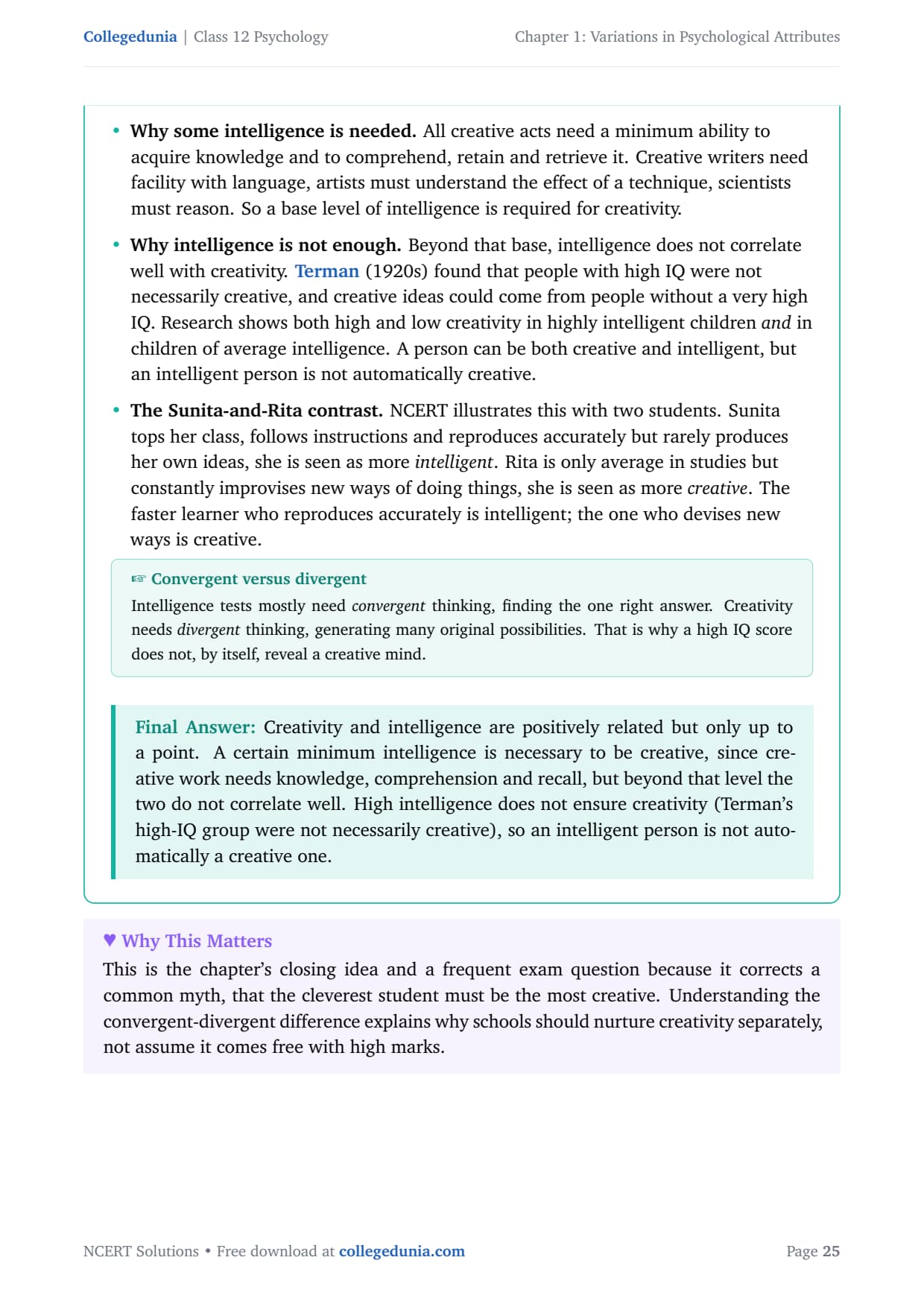
Why some intelligence is needed. All creative acts need a
minimum ability to acquire knowledge and to comprehend, retain and
retrieve it. Creative writers need facility with language, artists
must understand the effect of a technique, scientists must reason.
So a base level of intelligence is required for creativity.
Why intelligence is not enough. Beyond that base,
intelligence does not correlate well with creativity.
Terman (1920s) found that people with high IQ were not
necessarily creative, and creative ideas could come from people
without a very high IQ. Research shows both high and low
creativity in highly intelligent children and in children
of average intelligence. A person can be both creative and
intelligent, but an intelligent person is not automatically
creative.
The Sunita-and-Rita contrast. NCERT illustrates this with
two students. Sunita tops her class, follows instructions and
reproduces accurately but rarely produces her own ideas, she is
seen as more intelligent. Rita is only average in studies
but constantly improvises new ways of doing things, she is seen as
more creative. The faster learner who reproduces accurately
is intelligent; the one who devises new ways is creative.
Convergent versus divergent
Intelligence tests mostly need convergent thinking, finding the one
right answer. Creativity needs divergent thinking, generating many
original possibilities. That is why a high IQ score does not, by itself,
reveal a creative mind.
Creativity and intelligence are positively related but only up to
a point. A certain minimum intelligence is necessary to be creative, since
creative work needs knowledge, comprehension and recall, but beyond that
level the two do not correlate well. High intelligence does not ensure
creativity (Terman's high-IQ group were not necessarily creative), so an
intelligent person is not automatically a creative one.
DL
Dr. Leela Pillai
PhD Educational Psychology, University of Kerala
Verified Expert
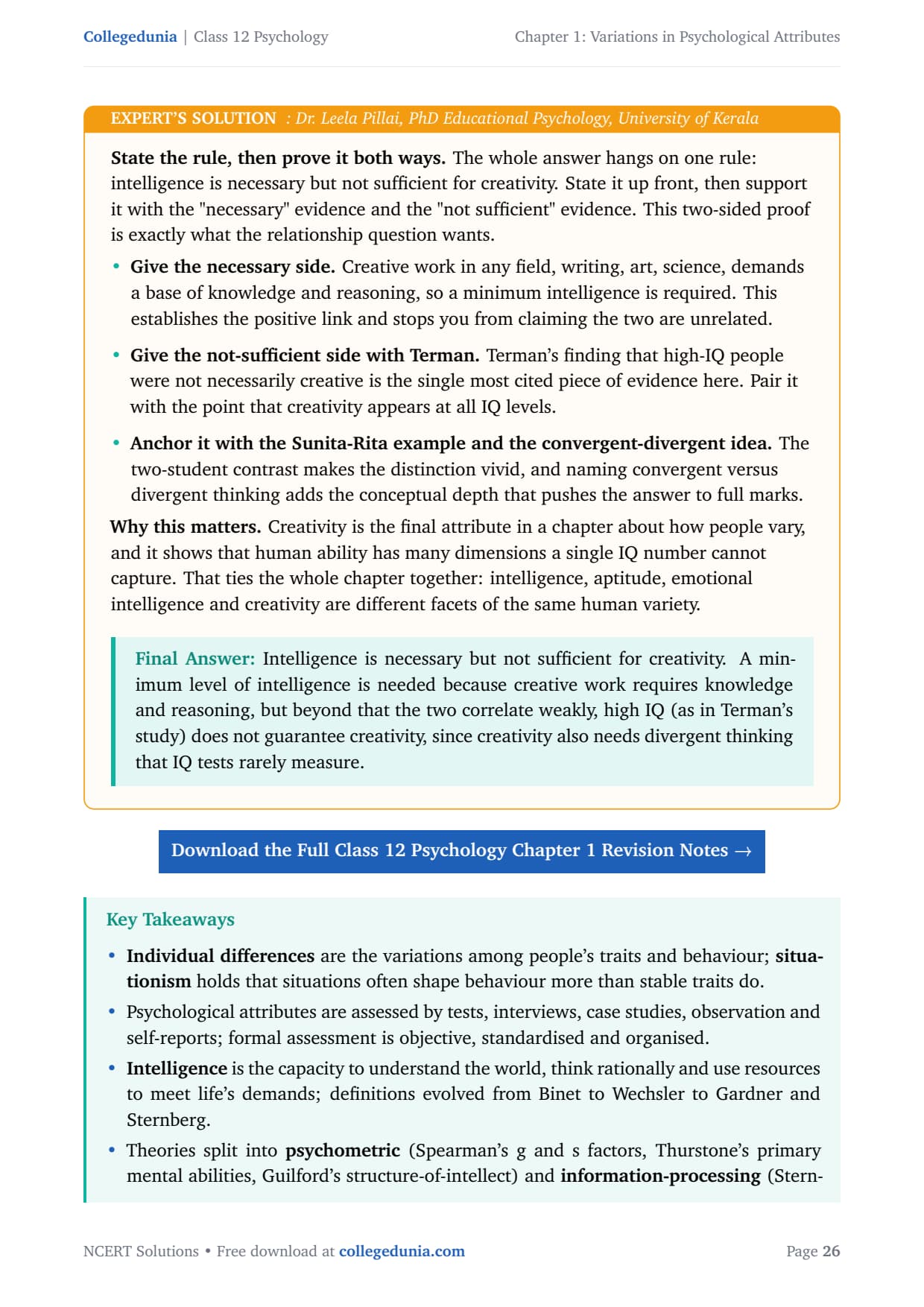
State the rule, then prove it both ways. The whole answer hangs
on one rule: intelligence is necessary but not sufficient for creativity.
State it up front, then support it with the "necessary" evidence and the
"not sufficient" evidence. This two-sided proof is exactly what the
relationship question wants.
Give the necessary side. Creative work in any field, writing,
art, science, demands a base of knowledge and reasoning, so a
minimum intelligence is required. This establishes the positive
link and stops you from claiming the two are unrelated.
Give the not-sufficient side with Terman. Terman's
finding that high-IQ people were not necessarily creative is the
single most cited piece of evidence here. Pair it with the point
that creativity appears at all IQ levels.
Anchor it with the Sunita-Rita example and the
convergent-divergent idea. The two-student contrast makes the
distinction vivid, and naming convergent versus divergent thinking
adds the conceptual depth that pushes the answer to full marks.
Why this matters. Creativity is the final attribute in a chapter
about how people vary, and it shows that human ability has many
dimensions a single IQ number cannot capture. That ties the whole chapter
together: intelligence, aptitude, emotional intelligence and creativity
are different facets of the same human variety.
Intelligence is necessary but not sufficient for creativity. A
minimum level of intelligence is needed because creative work requires
knowledge and reasoning, but beyond that the two correlate weakly, high
IQ (as in Terman's study) does not guarantee creativity, since
creativity also needs divergent thinking that IQ tests rarely measure.
FAQs on Variations in Psychological Attributes Class 12 NCERT Solutions
Variations in Psychological Attributes Class 12 Psychology Common Questions
Ques. Where can I get the class 12 psychology chapter 1 NCERT Solutions PDF?
Ans. You can download the Variations in Psychological Attributes Class 12 Psychology NCERT Solutions PDF directly from this page. It is free, follows the 2026-27 NCERT, and answers all 12 review questions step by step.
Ques. How many questions are there in Variations in Psychological Attributes class 12 questions and answers?
Ans. The chapter has 12 review questions. They cover the definition of intelligence, the nature-nurture debate, Gardner's and Sternberg's theories, the PASS model, IQ and its classification, verbal versus performance tests, deficiency and giftedness, IQ versus EQ, aptitude, and creativity.
Ques. What is the IQ formula in Class 12 Psychology Chapter 1?
Ans. IQ equals mental age divided by chronological age, multiplied by 100. William Stern devised it in 1912. The population average IQ is 100, and scores follow a bell-shaped normal curve with about 2.2 per cent of people at each extreme.
Ques. What are the eight intelligences in Gardner's theory?
Ans. Gardner's eight intelligences are Linguistic, Logical-Mathematical, Spatial, Musical, Bodily-Kinaesthetic, Interpersonal, Intrapersonal and Naturalistic. They are independent of each other yet interact to solve real problems, so a missing type in your answer costs marks.
Ques. What is the difference between the psychometric and information-processing theories of intelligence?
Ans. Psychometric theories (Spearman, Thurstone, Guilford) ask how much intelligence a person has and measure it as factors or abilities. Information-processing theories (Sternberg, Gardner, Das) ask how a person processes information. The shift from one family to the other is the shift from a single score to mental processes.
Ques. Is class 12 psychology chapter 1 easy to score in the board exam?
Ans. Yes. It is one of the easier scoring chapters if you keep the IQ formula straight and learn the theories of intelligence in full. Practise the IQ classification table and the eight Gardner types, and keep the PASS model and the culture-fair point ready for the long answers.








Comments