The NCERT Solutions for Meeting Life Challenges Class 12 Psychology Chapter 3 answer every textbook review question on how stress works and how we stay healthy in spite of it, set to the latest 2026-27 CBSE syllabus. Each answer explains the nature and sources of stress, Lazarus's appraisal, Selye's General Adaptation Syndrome, coping styles and life skills. These solutions help students prepare for the Class 12 Psychology board paper in 2026-27.
Covers all 12 review questions from Chapter 3, with full point-wise answers and an Expert's Solution.
This Class 12 Psychology chapter usually carries 6 to 7 marks in the board paper.
Pairs with the Notes, Handwritten Notes and NCERT Book PDF linked lower on this page.
Every solution for Class 12 Psychology Chapter 3 in this Collegedunia compilation is written by subject experts from the official NCERT Psychology textbook, and checked against the last five years of CBSE board papers.
Student Feedback: In a Collegedunia poll of 8,720 Class 12 Psychology students taken before the 2026 boards, 69% of students rated the General Adaptation Syndrome question as the part they got wrong most often in Meeting Life Challenges. Most students said tagging the three GAS stages as alarm, then resistance, then exhaustion made the answer easy to recall.
Source: 2026-27 Class 12 Psychology student poll. Sample of 8,720 students from CBSE schools across 13 states.
What the Meeting Life Challenges Class 12 Chapter Is About
Meeting Life Challenges is the third chapter of Class 12 Psychology. It studies how stress shapes our lives and how we can stay healthy in spite of it. The big idea is that stress is neither just the event nor just our reaction, but a transaction between the person and the environment, shaped by how we appraise the demand.
The chapter answers three threads that students should keep in mind:
What is stress? Its nature, types and sources, and how appraisal decides whether a demand feels stressful.
What does stress do? Its effects on the mind and body, the GAS model, and how it weakens the immune system.
What do we do about it? Coping styles, stress-management techniques, life skills and positive health.
So the chapter is really about understanding stress and then managing it. A student who keeps these three threads in mind can connect almost any question in meeting life challenges class 12 back to one of them. Sort each fact under "nature", "effects" or "managing" first, and revision gets much faster.
The Concept of Stress and Its Sources
The first questions in the exercise ask students to explain stress and list its symptoms and sources. The chapter defines stress as the pattern of responses we make to a demand that disturbs our balance and exceeds our coping. The list below keeps the key ideas together.
Selye's definition: stress is the "non-specific response of the body to any demand", and the reaction is called strain.
Eustress and distress: good stress energises us, while harmful stress overwhelms our coping.
Sources: life events, daily hassles and traumatic events.
The point examiners look for is that stress is a transaction, not just an event or a reaction. Whenever a question asks "what is stress", the safe answer links Selye's definition with the appraisal idea, and shows that the same event stresses people differently. Keeping symptoms and sources in separate columns avoids the most common slip.
The General Adaptation Syndrome and Its Stages
Selye's General Adaptation Syndrome (GAS) is the most-asked long answer in this chapter. It describes what happens to the body when stress is prolonged, and it runs through three stages. The table below lines up the stages so students can write them in order.
Stage
What happens in the body
Alarm reaction
The stressor activates the adrenal-pituitary-cortex system; the body readies for "fight or flight".
Resistance
If stress continues, the body settles in to cope and uses its resources more cautiously.
Exhaustion
Resources drain, the body's defences fail, and the risk of stress-related disease rises.
A key insight for the exam is that long, unrelenting stress, not a single shock, is what wears the body down. The "illustrate with an example" instruction is where students drop marks, so anchor GAS to a relatable case, such as a student under months of exam pressure. Adding the standard criticism, that Selye gave too small a role to psychological factors, lifts a recall answer into an evaluative one.
Coping Styles, Life Skills and Positive Health
The later questions move from what stress does to what we do about it. The chapter sets out two coping schemes, six life skills and five buffers for positive health. The list below keeps the management toolkit together for revision.
Coping (Endler and Parker): task-oriented, emotion-oriented and avoidance-oriented strategies.
Coping (Lazarus and Folkman): problem-focused and emotion-focused styles.
Life skills: assertiveness, time management, rational thinking, improving relationships, self-care and overcoming unhelpful habits.
Positive health buffers: balanced diet, regular exercise, a positive attitude, optimistic thinking and social support.
The honest exam point is that problem-focused, task-oriented coping is used more often and solves the problem, while avoidance gives only short-term relief. For positive health, lead with the definition (a healthy body, good relationships, purpose and resilience), then run through the five buffers, and close with hardiness (the three Cs) and resilience. That arc reads as a complete discussion.
Meeting Life Challenges Class 12 Exercise-wise Coverage
The chapter exercise has 12 review questions. The table maps each one to its topic so students can plan revision and find the right NCERT answer fast. The full point-wise solution for each sits in the question set lower on this page.
Question
Topic it tests
Q 1
Concept of stress with daily-life examples
Q 2
Symptoms and sources of stress
Q 3
GAS model with a worked example
Q 4
Different ways of coping with stress
Q 5
Effect of stress on psychological functioning
Q 6
How life skills help meet life's challenges
Q 7
Factors that lead to positive health and well-being
Q 8
How stress affects the immune system
Q 9
A stressful life event and why degrees of stress differ
Q 10
Suggestions to friends to avoid everyday stress
Q 11
Environmental factors with positive and negative impact
Q 12
Why we cannot change harmful lifestyle behaviour
Questions 1, 3, 5, 6 and 7 are the most-asked long answers, so students preparing meeting life challenges class 12 important questions should learn those first. The remaining questions reward clear, point-wise structure, so practise the symptom-versus-source and coping lists well to secure them.
Students who want the offline copy can save the class 12 psychology chapter 3 pdf from the download card above and tick off each question as they finish it.
Meeting Life Challenges Important Questions and Previous Year Trends
CBSE sets a steady mix of short, long and case-based answers from this chapter. Knowing the pattern helps students decide how much to write. The chapter is a regular source of one 6-mark question, which is why a focused list of meeting life challenges important questions saves a lot of revision time.
Long answer (6 marks): the GAS model with an example, the four effects of stress, or the life skills.
Short answer (3 to 4 marks): coping strategies, sources of stress, or stress and the immune system.
Case-based: a short scene where students label symptoms, sources or coping styles.
Objective and recall: Selye, Lazarus, the three Cs of hardiness, and psychoneuroimmunology.
For quick recall before the exam, students often practise the class 12 psychology chapter 3 mcq set and a list of meeting life challenges class 12 important questions. The most repeated items are the GAS stages and the coping schemes, so keep those answer points ready in your own words. Working through the meeting life challenges ncert solutions set twice, once open-book and once from memory, fixes the names and terms well before the board exam.
Common Mistakes Students Make in This Chapter
A few errors cost marks every year in this chapter. Most come from mixing up symptoms with sources, or giving the GAS model without an example. Avoiding them is the fastest way to lift a score.
Listing "anxiety" as a source of stress, when it is a symptom; the source is the event that produced it.
Describing the GAS model but forgetting to illustrate it with an example, which loses the application mark.
Giving only one coping scheme, when the full answer needs both Endler and Parker and Lazarus and Folkman.
Treating "psychological functioning" as emotion only, and skipping the cognitive effects (concentration, memory, decisions).
Reducing harmful lifestyle habits to "weak willpower", when the point is reward now versus distant, underestimated risk.
Students who fix these five points usually move from average to high marks on the long answers. The exam rewards precise vocabulary, so always use the chapter's own terms, such as psychoneuroimmunology, appraisal and burnout, where they fit.
Meeting Life Challenges PDF Download Formats and Languages
The solutions are free to download in more than one format, so students can pick what suits their device and revision style. The download card at the top of the page carries each option for this chapter.
Normal and HD PDF: the class 12 psychology chapter 3 pdf comes in a normal size for quick downloads and an HD version for clear printing.
English medium: all 12 answers are written in simple English for the CBSE board paper.
Question-only set: a print-and-practise sheet of meeting life challenges extra questions for self-testing.
Whole-book pack: the solutions sit in one set that runs through every Class 12 Psychology chapter, so you can revise in one place.
Many students search for class 12 psychology chapter 3 answers on their phone the night before a test, so a saved PDF means you can revise even without internet. Keep both the question set and the solved version handy for a full self-check.
How These Solutions Pair with the Notes and Book PDF
These NCERT Solutions answer the back-exercise review questions. To revise the full chapter, students should use them alongside the other resources for the same chapter, all linked in the table below.
Reading the original NCERT chapter text and figures
Tip: read the Notes first, then attempt these solutions on your own, and only then check the model answers here. That order builds memory faster than copying answers straight away.
All NCERT Solutions for Class 12 Psychology
The table links the NCERT Solutions for every Class 12 Psychology chapter, so students can move across the course in one click. Meeting Life Challenges is highlighted.
All NCERT Solutions for Meeting Life Challenges with Step-by-Step Solutions
Below are all 12 NCERT exercise questions for this chapter, exactly as they appear in the textbook. Tap Check Solution for the model answer or Expert Solution for the topper-style approach.
Q 3.1
Explain the concept of stress. Give examples from daily life.
Concept used. Stress is the pattern of responses an organism makes
to a stimulus event that disturbs its equilibrium and exceeds its ability to
cope. The word comes from the Latin strictus (tight) and stringere
(to tighten). Hans Selye, the father of modern stress research, defined stress
as ``the non-specific response of the body to any demand''. The reaction to
an external stressor is called strain.
Stress is not just a cause or just an effect. It is best understood as an
ongoing transactional process: the individual keeps interacting with
the environment, appraising what is happening, and trying to cope. So stress
is a disruption in homeostasis, an imbalance that the person then works
to restore.
Stress is like electricity
The textbook compares stress to electricity. A little gives energy and lifts
performance. Too much can ``fuse the bulb''. Too little leaves us listless.
Good stress is called eustress; harmful stress is distress.
A few points make the idea clear:
Whether a challenge becomes stressful depends on how we appraise
it. A number-11 batsman facing a fast bowler feels it very differently
from a confident opener. The event is the same; the perception differs.
Stressors are events that trigger the stress response, such as noise,
crowding, a bad relationship, or the daily commute to school.
The same event can stress one person and not another, because each of
us judges the demand and our resources through our own eyes.
Examples from daily life. Waiting to cross a busy road on a Monday
morning briefly stresses us, but our alertness helps us cross safely. A
student staying up till 1 a.m. before an exam, unable to sleep, with a
pounding heart and a blank mind, is under heavy stress. Other everyday
examples are a quarrel with a friend, a traffic jam, an unexpected exam, or
money worries at home.
Stress is the body's response to a demand that disturbs balance and
strains coping. It is a transaction between person and environment, shaped by
appraisal. Daily examples: crossing a busy road, exam pressure, a fight with
a friend, or a traffic jam.
AI
Ananya Iyer
M.A Psychology, University of Delhi
Verified Expert
Strategic angle. The marks here sit in one phrase: ``neither a
stimulus nor a response''. Many students wrongly write that stress is the
event, or that stress is the reaction. The examiner wants the transactional
view, so make that the spine of your answer and hang the examples on it.
A clean way to build the answer:
Open with the definition (Selye's ``non-specific response to any
demand'') and the Latin root strictus / stringere to
show you know the origin of the word.
State the transactional idea plainly: stress lives in the
process between the person and the environment, not in either
one alone. This single sentence usually earns the conceptual mark.
Add the eustress versus distress contrast. It shows stress is not
always bad, which is exactly the nuance NCERT highlights.
Close with two or three crisp daily-life examples so the answer is
grounded, not abstract.
Why this matters. Stress is the anchor concept for the whole chapter.
Appraisal, GAS, coping and life skills all flow from this definition. If you
frame stress as a transaction here, the later answers (especially appraisal
and coping) become much easier to write. One more nuance the textbook stresses:
the same life challenge is not stressful for everyone. The opening
batsman welcomes the fast bowler that the number-11 dreads. Adding this line
shows the examiner that stress depends on perception, not just on the event,
which is the single idea most likely to earn the conceptual mark in a board
answer.
Define stress as the non-specific response to a demand, stress the
person-environment transaction, contrast eustress and distress, and give
everyday examples such as exam pressure or a traffic jam.
Q 3.2
State the symptoms and sources of stress.
Concept used. Stress shows itself through symptoms (the signs
that warn us we are under strain) and arises from sources (the events
and conditions that generate it). The way we respond depends on our
personality, early upbringing and life experiences, so everyone has their own
pattern. Any of these symptoms, if left unresolved, can have serious effects.
Symptoms of stress. They fall into three groups, and any of them can
signal trouble:
Physical symptoms: headache, backache, stomach upset,
difficulty in sleeping, difficulty in eating, frantic bursts of
energy, and even physical illness.
Behavioural symptoms: lack of concentration, memory loss,
poor decision-making, irregular attendance and timekeeping, and misuse
of drugs.
Sources of stress. A wide range of events and conditions can generate
stress. The most important ones are:
Life events: major changes that disturb our routine, such as
moving house, the break-up of a long relationship, or a death in the
family. Several such events in a short time make coping hard.
Hassles: the small, personal, everyday irritations, such as
noisy surroundings, commuting, quarrelsome neighbours, water shortage
and traffic snarls. More hassles mean poorer well-being.
Traumatic events: extreme events such as a fire, an accident,
a robbery or an earthquake. Their effects can appear later and persist
as anxiety, flashbacks and intrusive thoughts.
Keep symptoms and sources in separate columns. A common slip is to list
``anxiety'' as a source. Anxiety is a symptom; the source is the event
(say, a traumatic accident) that produced it.
Symptoms of stress are physical (headache, sleep and eating
problems), emotional (anxiety, fear, mood swings, depression) and behavioural
(poor concentration, memory loss, drug misuse). The main sources are life
events, daily hassles and traumatic events.
RV
Rahul Verma
M.A Applied Psychology, TISS Mumbai
Verified Expert
Structural observation. This is a two-part listing question, so
structure earns the marks. Split your page cleanly into ``Symptoms'' and
``Sources'', and inside each use the textbook's own three-way split. Markers
reward the headings as much as the content.
How to pin down each half:
Symptoms travel in three lanes: physical, emotional, behavioural. Give
two or three concrete signs in each lane.
Sources also travel in three lanes: life events, hassles, traumatic
events. One vivid example each is enough.
Write the symptom triad first, with examples, so the answer opens with
what the student can directly observe.
Then turn to sources, defining each before the example, since the
examiner checks that you can tell a hassle (small, daily) from a life
event (big, routine-disturbing) from a trauma (extreme, delayed).
Why this matters. Telling symptom from source is the skill the rest
of the chapter assumes. In a case-based question you will be handed a scene
and asked to label parts of it; this triad-versus-triad map is what lets you
do that quickly.
Present symptoms as a physical / emotional / behavioural triad and
sources as a life-events / hassles / traumatic-events triad, with one clear
example in each lane.
Q 3.3
Describe the GAS model and illustrate the relevance of this model
with the help of an example.
Concept used. The General Adaptation Syndrome (GAS) is
Selye's model of what happens to the body when stress is prolonged. Selye
subjected animals to many stressors (high temperature, X-rays, insulin
injections) over a long period, and also observed injured and ill patients.
He noticed the same pattern of bodily response in all of them and named
it the General Adaptation Syndrome. GAS unfolds in three stages: alarm
reaction, resistance and exhaustion.
Fig. 3.3, The General Adaptation Syndrome,
NCERT Psychology Class 12, Chapter 3. The body's resistance dips in the alarm
stage, holds above normal during resistance, then collapses in exhaustion.
The three stages are:
Alarm reaction stage: the noxious stimulus or stressor
activates the adrenal-pituitary-cortex system. Hormones are released
and the body is readied for ``fight or flight''.
Resistance stage: if the stress continues, the body settles
in to cope. The parasympathetic nervous system calls for more cautious
use of the body's resources as the organism makes efforts to confront
the threat.
Exhaustion stage: continued exposure to the same or extra
stressors drains the body's resources. The systems used in alarm and
resistance become ineffective, and the person becomes prone to
stress-related diseases such as high blood pressure.
A noted limitation
Selye's model has been criticised for giving a very limited role to
psychological factors. Researchers point out that how we appraise an
event, along with our personality and biological make-up, also shapes the
stress response.
Example showing its relevance. Think of a student preparing for the
board exams over several months. On first hearing the exam dates, the heart
races and the body is on alert (alarm). Through the long study weeks the
student settles into a routine and copes, though strained (resistance). If the
pressure never lets up, by the end the student is run down, falling ill with
fevers and stomach upsets (exhaustion). The model is relevant because it
explains why long, unrelenting stress, not a single shock, is what wears the
body down.
GAS is Selye's three-stage model of the body's response to prolonged
stress: alarm reaction (fight-or-flight readiness), resistance (sustained
coping) and exhaustion (resources drained, disease risk rises). A student
under months of exam pressure moves through all three stages.
AS
Aditya Sharma
M.A Psychology, Jamia Millia Islamia
Verified Expert
Picture-first. Draw the GAS curve in your head before you write:
resistance dips below normal in alarm, climbs above normal through resistance,
then crashes in exhaustion. If you can describe that shape, the three stages
write themselves and you will not mix up their order.
Lock the three stages to three bodily themes:
Alarm = mobilise (adrenal-pituitary-cortex, fight or flight).
Name the model and credit Selye, and mention how he found it (same
pattern across many different stressors and patients). This one line
often carries the ``describe the model'' mark.
March through alarm, resistance and exhaustion in order, one
physiological idea each, so the sequence is unmistakable.
Anchor it with a single sustained-stress example (exams, a long
illness, a demanding job) to earn the ``illustrate relevance'' mark.
Why this matters. GAS is a favourite long-answer in board papers, and
the ``illustrate with an example'' instruction is where students drop marks by
giving the model without applying it. A relatable, prolonged-stress example is
the part the examiner is hunting for. It also helps to add the standard
criticism of the model in a single line: Selye gave too small a role to
psychological factors, since appraisal, personality and biological make-up all
shape the response. That one sentence converts a recall answer into an
evaluative one, and evaluation is what separates the top band from the rest in
a long-answer question on GAS.
Credit Selye, describe alarm then resistance then exhaustion in
order, and apply it to one prolonged-stress example to show why unrelenting
stress, not a single shock, damages the body.
Q 3.4
Enumerate the different ways of coping with stress.
Concept used.Coping is a dynamic, situation-specific
reaction to stress. It is a set of concrete responses to stressful events that
aim to resolve the problem and reduce stress. The textbook describes coping in
two well-known schemes: the three coping strategies of Endler and Parker, and
the two coping styles of Lazarus and Folkman.
Endler and Parker's three strategies. People show consistent
individual differences in how they handle stress:
Task-oriented strategy: gathering information about the
problem and the options, deciding priorities, and acting to deal
directly with the situation. For example, ``schedule my time better''.
Emotion-oriented strategy: managing one's feelings, keeping
hope, or venting anger and frustration. For example, ``tell myself it
is not really happening to me''.
Avoidance-oriented strategy: denying or minimising the
seriousness of the situation, and suppressing stressful thoughts. For
example, watching TV or phoning a friend to avoid the issue.
Lazarus and Folkman's two styles. They saw coping as a changing
process rather than a fixed trait, and divided coping responses into two
types:
Problem-focused coping: attacking the problem itself,
gathering information, altering the event, and reducing its threat
value. For example, ``I made a plan of action and followed it''.
Emotion-focused coping: making inner changes to limit the
emotional disruption, with little effort to change the event. For
example, ``I did some things to let it out of my system''.
Research notes that people generally use problem-focused coping more often than
emotion-focused coping, though both are needed in stressful situations. A line
like this lifts an enumeration answer into an analysis answer.
Coping can be enumerated two ways. Endler and Parker: task-oriented,
emotion-oriented and avoidance-oriented strategies. Lazarus and Folkman:
problem-focused and emotion-focused coping.
PN
Priya Nair
M.A Psychology, Christ University Bangalore
Verified Expert
Strategic angle. ``Enumerate'' tells you the examiner wants a labelled
list, not an essay. The trap is to give only one scheme. The full-mark answer
gives both: the Endler-Parker trio and the Lazarus-Folkman pair. Naming both
sources signals you know the literature.
Define coping in one line (a dynamic, situation-specific reaction) so
the list has a frame.
List Endler and Parker's three strategies with a one-phrase example
each, since examples separate the strategies cleanly.
List Lazarus and Folkman's two styles, and add the research note that
problem-focused coping is used more often.
Why this matters. Coping is the chapter's bridge from ``what stress
does'' to ``what we do about it''. The same task / emotion / avoidance labels
reappear in case studies, so a clean enumeration here pays off later. A small
addition that lifts the answer: note that avoidance-oriented coping (watching
TV, phoning a friend to dodge the issue) gives only short-term relief, whereas
task-oriented coping actually solves the problem. Showing that you can rank the
strategies, not just name them, is exactly the kind of detail that earns the
final mark in an enumeration question.
Give both schemes: task-, emotion- and avoidance-oriented (Endler &
Parker) and problem- versus emotion-focused (Lazarus & Folkman), each with a
short example.
Q 3.5
Explain the effect of stress on psychological functioning.
Concept used. When the body is under stress, many changes occur inside
the stressed individual. There are four major effects associated with the
stressed state: emotional, physiological, cognitive and behavioural. While the
question asks about psychological functioning, the textbook treats these four
together, since each disturbs how a person thinks, feels and acts.
The four effects are:
Emotional effects: mood swings and erratic behaviour that can
alienate the person from family and friends, anxiety, depression, and
increased physical and psychological tension. This can start a vicious
circle of falling confidence.
Physiological effects: the body releases hormones such as
adrenaline and cortisol, raising heart rate and blood pressure. Other
signs are slowing of digestion, expansion of air passages in the lungs,
and constriction of blood vessels. Helpful briefly, harmful long term.
Cognitive effects: mental overload, poor concentration and
reduced short-term memory. High stress makes people lose the ability to
make sound decisions, which can lead to arguments, failure or loss of a
job.
Behavioural effects: eating less nutritious food, more
caffeine, cigarettes, alcohol and tranquillisers, disrupted sleep,
increased absenteeism and reduced work performance.
Do not stop at ``feeling tense''
Psychological functioning is more than emotion. Mention the cognitive load
(poor concentration, weak short-term memory, faulty decisions) clearly, since
that is the part that most directly answers ``psychological functioning''.
When stress is prolonged. Continued stress causes physical, emotional
and psychological exhaustion known as burnout: chronic fatigue and
low energy, with irritability, anxiety, and feelings of helplessness and
hopelessness. Prolonged stress also weakens the immune system and raises the
risk of illness.
Stress disturbs psychological functioning through four effects:
emotional (anxiety, mood swings, depression), physiological (raised heart rate
and blood pressure), cognitive (poor concentration, weak memory, faulty
decisions) and behavioural (poor diet, substance use, disrupted sleep).
Prolonged stress leads to burnout.
KM
Karan Mehta
M.A Clinical Psychology, NIMHANS Bangalore
Verified Expert
Quick reading. The word ``psychological'' tempts students to write
only about emotions. Read it as ``how stress disturbs the mind and behaviour''
and you unlock all four effects. The cognitive and emotional lanes are the
core; physiological and behavioural round it off.
Group the four effects by what they touch:
Mind: cognitive (concentration, memory, decisions) and emotional
(anxiety, mood swings).
Body and conduct: physiological (hormones, heart rate) and behavioural
(diet, substance use, sleep).
Lead with the emotional and cognitive effects, since those answer
``psychological functioning'' most directly.
Add the physiological and behavioural effects to show stress spreads
across the whole person.
Finish with burnout as the end-point of prolonged stress; it is the
term examiners look for and ties the answer together.
Why this matters. This four-effect map is the backbone of the
``effects of stress'' family of questions. Once you can recite emotional /
physiological / cognitive / behavioural plus burnout, you can adapt it to
exam-anxiety or health questions with almost no extra learning. Keep one caution
in mind: many students describe only the negatives and forget that the
physiological reaction is actually helpful for short bursts and only
turns damaging when it is prolonged. Stating that short-versus-long contrast
shows you understand the mechanism, not just the symptom list.
Explain the four effects (emotional, physiological, cognitive,
behavioural), leading with the cognitive and emotional ones for the
psychological angle, and close with burnout as the result of prolonged stress.
Q 3.6
Describe how life skills can help meet life's challenges.
Concept used.Life skills are abilities for adaptive and
positive behaviour that let us deal effectively with the demands and challenges
of everyday life. They help us keep our balance (equilibrium) when life pushes
back. The good news is that life skills can be learned and improved upon. The
main ones in the chapter are assertiveness, time management, rational thinking,
improving relationships, self-care and overcoming unhelpful habits.
Each skill helps in a specific way:
Assertiveness: the skill of communicating our feelings,
needs and thoughts clearly and confidently, and of saying no without
guilt. It builds self-esteem and a solid sense of identity.
Time management: planning time and learning to delegate, so
we spend time on what we value and reduce time pressure. The key is to
change how we perceive time.
Rational thinking: challenging distorted thinking and
irrational beliefs, driving out negative anxiety-provoking thoughts,
and making positive statements. The way we think shapes the way we feel.
Improving relationships: sound, lasting relationships rest on
communication, which means listening to the other person, expressing
how we feel, and accepting the other's views even when they differ.
Self-care: keeping ourselves healthy, fit and relaxed so we
are better prepared to face stress. Slow, stomach-centred breathing
from the diaphragm is the most relaxed way to breathe.
Overcoming unhelpful habits: dropping perfectionism,
avoidance and procrastination, which help in the short term but make us
more vulnerable to stress over time.
Life skills work because they tackle the appraisal stage. By changing how we
think about a demand and how confidently we meet it, they turn a potential
threat into a manageable challenge.
Life skills are learnable abilities that help us meet life's
challenges: assertiveness, time management, rational thinking, improving
relationships, self-care and overcoming unhelpful habits. Each one strengthens
how we communicate, think, organise and care for ourselves under pressure.
SD
Sneha Desai
M.A Psychology, Fergusson College Pune
Verified Expert
Structural observation. ``Describe how'' asks for skill plus benefit,
not just a list of names. For each life skill, pair the definition with the
challenge it solves. That pairing is what separates a 3-mark answer from a
full-mark one.
Relationships and self-care fix isolation and neglect.
Define life skills in one line as learnable, adaptive abilities, so the
examiner sees the umbrella idea first.
Take the six skills in turn, each as a short skill-then-benefit pair,
which keeps the answer tight and scoreable.
Close with the point that life skills act at the appraisal stage,
turning threats into challenges; this shows understanding, not just
recall.
Why this matters. Life skills connect this chapter to real student
life: exam stress, friendships, time pressure. Examiners like answers that
show the skill being used, so the skill-plus-benefit format is exactly
what earns marks. It also helps to add the textbook's reassurance that life
skills can be learned and improved, since this is the optimistic note
the chapter ends on. Closing with that idea, that anyone can build these skills
with practice, rounds the answer off and signals that you have grasped the
chapter's wider message about meeting life's challenges.
Describe each life skill (assertiveness, time management, rational
thinking, improving relationships, self-care, overcoming unhelpful habits) as
a skill-then-benefit pair, and note that they work by reshaping appraisal.
Q 3.7
Discuss the factors that lead to positive health and well-being.
Concept used.Positive health is defined as ``a healthy
body; high quality of personal relationships; a sense of purpose in life;
self-regard, mastery of life's tasks; and resilience to stress, trauma and
change''. Health itself is a state of complete physical, mental, social and
spiritual well-being, not merely the absence of disease. Several factors act as
stress buffers and build positive health.
The main factors are:
Diet: a balanced diet lifts mood, gives energy, strengthens
the immune system and helps us cope. The key is three balanced meals a
day, since under stress we tend to reach for unhealthy ``comfort
foods''.
Exercise: regular exercise improves fitness and works as a
stress buffer. Stretching exercises such as yogic asanas calm the body,
while aerobic exercises such as jogging and swimming raise arousal.
Positive attitude: an accurate perception of reality, a sense
of purpose, tolerance for other views, taking credit for success and
accepting blame for failure, openness to new ideas, and a sense of
humour.
Positive thinking (optimism): optimism is the tendency to
expect favourable outcomes. Optimists assume adversity can be handled,
use problem-focused coping, and seek help, whereas pessimists expect
disaster.
Social support: the existence of people we can rely on, who
let us know they value and care for us. Perceived (quality) support is
positively related to health, and helps protect us against stress.
Hardiness and resilience
A stress-resistant (hardy) personality shows ``the three Cs'':
commitment, control and challenge (Kobasa). Resilience, the capacity
to ``bounce back'' from adversity, is built on the resources I HAVE, I AM and
I CAN.
Positive health and well-being come from balanced diet, regular
exercise, a positive attitude, positive optimistic thinking and social support,
all acting as stress buffers. A hardy personality (commitment, control,
challenge) and resilience strengthen them further.
IK
Ishaan Kapoor
M.A Health Psychology, University of Hyderabad
Verified Expert
Strategic angle. ``Discuss'' invites a little more than a list. Lead
with the WHO-style definition of positive health, then run through the five
buffer factors, and lift the answer with hardiness and resilience at the end.
That arc, definition then factors then trait, reads as a complete discussion.
Keep the five buffers on one mental shelf:
Body inputs: diet and exercise.
Mind-set: positive attitude and optimistic thinking.
People: social support.
Start with the definition of positive health (body, relationships,
purpose, self-regard, resilience) to set the scope.
Discuss the five buffer factors, giving each a sentence of how it
protects health, not just its name.
Add the hardiness three Cs and resilience as the personality side, so
the answer covers both habits and traits.
Why this matters. This question and the life-skills question overlap,
so examiners watch for repetition. Anchoring this answer on the five stress
buffers plus hardiness keeps it distinct from the life-skills answer and shows
you can discuss, not just enumerate. A useful distinction to slip in: it is the
quality of social support (perceived support) that helps health, while
the sheer quantity of contacts (the social network) does not, because a
large network is time-consuming to maintain. That precise point shows you have
read the section closely rather than relying on common sense.
Open with the definition of positive health, discuss the five buffers
(diet, exercise, positive attitude, optimistic thinking, social support), and
close with hardiness (the three Cs) and resilience.
Q 3.8
How does stress affect the immune system?
Concept used. The immune system guards the body against
attackers, both from within and outside. Psychoneuroimmunology is the
field that studies the links between the mind, the brain and the immune system,
and the effects of stress on it. Stress can cause illness by impairing how the
immune system works.
How the immune system works. White blood cells, or leucocytes,
identify and destroy foreign bodies (antigens) such as viruses, and produce
antibodies. There are several kinds:
T cells destroy invaders, and T-helper cells increase
immunological activity. It is these T-helper cells that are attacked by
the HIV virus that causes AIDS.
B cells produce antibodies.
Natural killer (NK) cells fight both viruses and tumours.
What stress does to it. Stress can reduce natural killer cell
cytotoxicity, which matters in defending the body against infections and
cancer. Reduced NK-cell cytotoxicity has been found in highly stressed people:
students facing important examinations, bereaved persons, and the severely
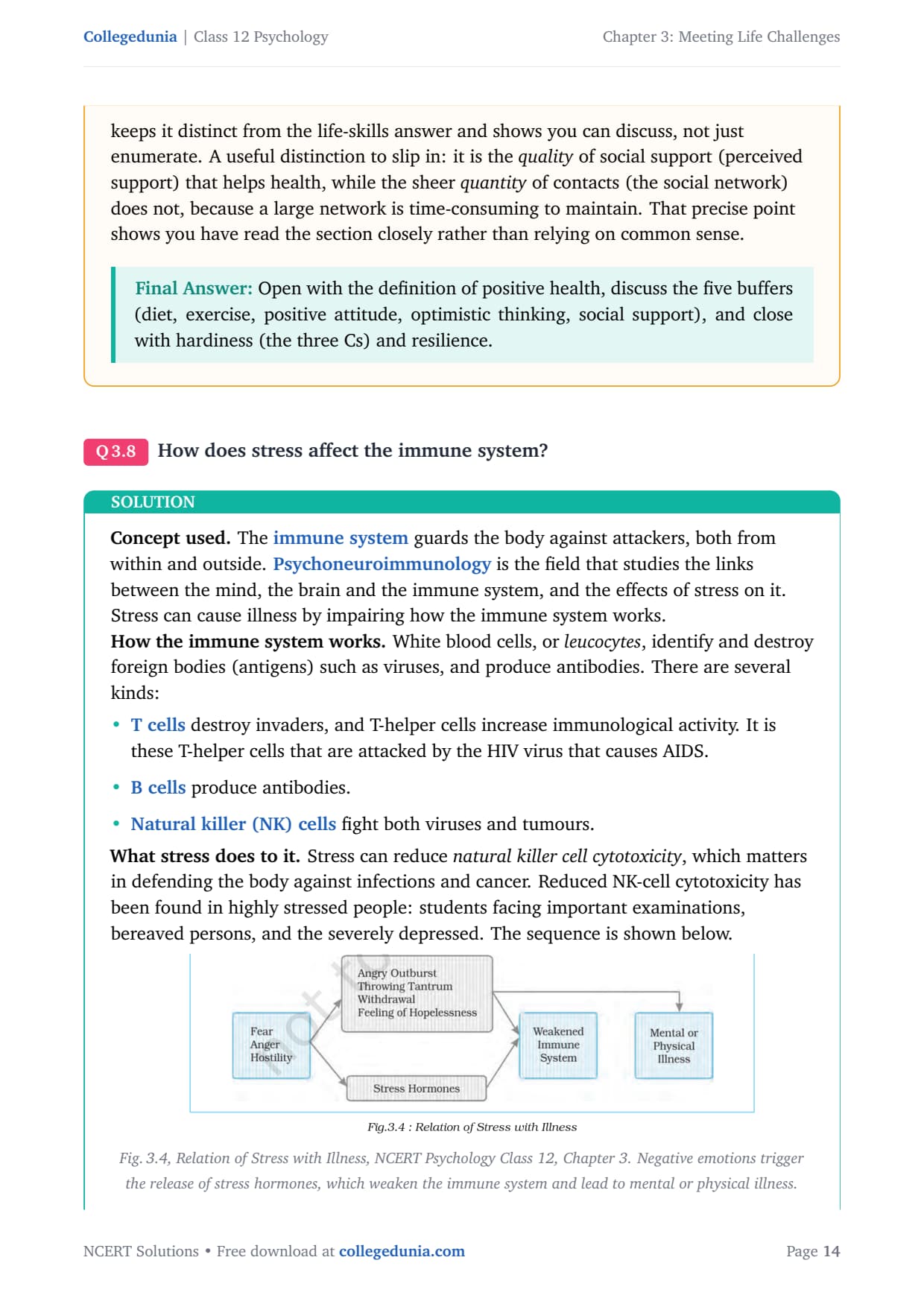
depressed. The sequence is shown below.
Fig. 3.4, Relation of Stress with Illness,
NCERT Psychology Class 12, Chapter 3. Negative emotions trigger the release of
stress hormones, which weaken the immune system and lead to mental or physical
illness.
As the figure shows, negative emotions such as fear, anger and hostility (with
reactions like angry outbursts and withdrawal) release stress hormones. These
weaken the immune system, which in turn raises the risk of mental or physical
illness.
Two extra marks-worthy facts: immune functioning is better in people who
receive social support, and a weakened immune system is hit harder by further
stress. Mention both to show stress and immunity are two-way.
Stress impairs the immune system, studied under psychoneuroimmunology.
It lowers natural killer cell cytotoxicity (seen in exam-stressed students and
bereaved or depressed people), so negative emotions release stress hormones
that weaken immunity and raise the risk of illness. Social support improves
immune functioning.
RB
Riya Banerjee
M.Sc Psychology, Presidency University Kolkata
Verified Expert
Picture-first. The whole answer is one arrow chain: negative emotions
to stress hormones to weakened immune system to illness. Fix that chain first,
then hang the cell biology (T, B, NK cells) and the keyword
psychoneuroimmunology onto it.
NK cells: fight viruses and tumours; stress lowers their cytotoxicity.
Define psychoneuroimmunology and the immune system's job, since the
keyword almost always carries a mark.
Name the leucocytes (T, B, NK) so the answer shows mechanism, not just
a vague ``stress lowers immunity''.
State that stress reduces NK-cell cytotoxicity, give the at-risk groups
(exam-stressed students, bereaved, depressed), and close with the
social-support buffer.
Why this matters. This is the most ``biological'' answer in the
chapter, and examiners reward the precise vocabulary: psychoneuroimmunology,
leucocytes, natural killer cell cytotoxicity. Getting those exact terms in is
what lifts the marks. A neat way to finish is to note that the effect runs both
ways: a weakened immune system is hit harder by further stress, while social
support and a positive outlook strengthen immunity. Showing that the
stress-immunity link is a two-way street, not a one-way slide, is the detail
that pushes a good answer into the top band.
Stress lowers immune defence (psychoneuroimmunology): it reduces
natural killer cell cytotoxicity, so negative emotions release stress hormones
that weaken immunity and raise illness risk. Name T, B and NK cells, and note
that social support strengthens immune functioning.
Q 3.9
Give an example of a life event which is likely to be stressful.
Suggest reasons why it is likely to cause different degrees of stress to the
person experiencing it.
Concept used. A life event is a major change, planned or
unpredicted, that disturbs our routine and causes upheaval. Whether such an
event feels mildly or severely stressful depends on the person's
appraisal: how they judge the demand and their own resources to meet
it. So the same event can stress two people to very different degrees.
Example.The break-up of a long-term relationship is a clear
life event. So is the death of a close family member or failure in an important
examination. Take the relationship break-up: it suddenly removes a source of
support and forces big changes in daily life.
Why the degree of stress differs. Several reasons, drawn from the
chapter, explain why one person is shaken and another copes:
Appraisal: a person who appraises the event as a manageable
challenge feels less stress than one who appraises it as a serious
threat or harm.
Past experience: someone who has handled a similar situation
well before finds it less threatening.
Controllability: believing one has control over the event or
its consequences (a sense of self-efficacy) lowers the stress felt.
Resources: money, social skills, coping style and support
networks all soften the impact. More resources, less stress.
Personal and cultural factors: mental health, temperament,
self-concept, physical constitution and the cultural meaning of the
event all shape the response.
Dimensions of the stressor
The event's intensity, duration, complexity and predictability also matter. An
intense, prolonged, complex and unexpected loss hits harder than a mild,
short-term, simple and expected one.
A stressful life event is, for example, the break-up of a long-term
relationship (or a bereavement, or exam failure). It causes different degrees
of stress because people differ in appraisal, past experience,
controllability, resources, and personal and cultural factors.
VR
Vivaan Reddy
M.A Psychology, EFLU Hyderabad
Verified Expert
Strategic angle. This is a two-part question: a clear example, then
reasons for the variation. The example is the easy mark; the variation is where
the analysis marks sit. Pull your reasons straight from the appraisal section,
because that is the chapter's explanation for individual differences.
The reasons cluster naturally:
Inside the person: appraisal, past experience, sense of control,
temperament.
Around the person: resources, social support, cultural meaning.
Pick one vivid life event and say in a line why it disturbs routine, so
the example is concrete.
Give the appraisal-based reasons (threat versus challenge, past
experience, control), which the examiner treats as the core.
Add resources and cultural context, and the stressor dimensions
(intensity, duration, complexity, predictability), to round it off.
Why this matters. This question is really a test of the appraisal
model in disguise. If you can explain why the same event stresses people
differently, you have shown you understand that stress is a transaction, which
is the chapter's central claim.
Choose a life event such as a relationship break-up, then explain the
variation through appraisal, past experience, controllability, resources and
cultural factors, plus the stressor's intensity, duration, complexity and
predictability.
Q 3.10
Given what you know about coping strategies, what suggestions would
you give to your friends to avoid stress in their everyday lives?
Concept used. Sound advice for avoiding everyday stress draws on three
parts of the chapter: coping strategies (especially task-oriented and
problem-focused coping), stress-management techniques, and
life skills. The aim is to act on the problem, calm the body, and
build habits that keep stress low.
Here is what I would suggest to my friends:
Use task-oriented, problem-focused coping: face the problem
directly. Gather information, make a plan of action and follow it,
rather than avoiding the issue or only venting.
Manage time well: plan the day, set priorities and spend time
on what truly matters. Good time management is one of the simplest ways
to cut everyday pressure.
Practise relaxation and meditation: use deep breathing and
muscle relaxation, or meditation, to calm the mind and lower tension.
Exercise regularly: aim for sessions a few times a week.
Exercise improves the heart and lungs, lowers blood pressure and works
as a stress buffer.
Think rationally and stay positive: challenge irrational,
negative thoughts and replace them with positive statements. Optimism
helps in coping.
Build social support: talk to trusted friends and family.
Sharing worries reduces distress and provides emotional support.
Keep a healthy lifestyle: eat balanced meals, sleep well, and
avoid unhealthy escapes such as smoking, alcohol and drugs.
These suggestions work because they combine all three coping styles in a
healthy mix: task-oriented action for the problem, emotion-management for the
feelings, and habits that stop stress building up in the first place.
Advise friends to use task-oriented, problem-focused coping (plan and
act), manage time, practise relaxation, meditation and exercise, think
rationally and stay optimistic, lean on social support, and keep a healthy
lifestyle free of smoking, alcohol and drugs.
AJ
Aditi Joshi
M.A Counselling Psychology, Tata Institute of Social Sciences
Verified Expert
Quick reading. The phrase ``given what you know about coping
strategies'' is an instruction: tie each suggestion back to a coping idea. A
plain list of tips scores less than the same list labelled with the strategy it
comes from. Show the link and the marks follow.
Lifestyle buffers: exercise, diet, sleep, no substances.
Lead with problem-focused, task-oriented advice (make a plan and follow
it), since research says it is the more effective style.
Add the calming, emotion-management tips (relaxation, meditation,
talking to friends) for the feelings side.
Finish with lifestyle habits (exercise, balanced diet, sleep, avoiding
substances) that prevent stress from accumulating.
Why this matters. Application questions reward the student who can take
chapter theory and turn it into real advice. By naming the coping style behind
each tip, you prove the suggestions are grounded in psychology, not just common
sense.
Give practical tips and label each with its coping basis:
problem-focused planning, emotion-focused relaxation and sharing, and lifestyle
buffers like exercise, diet and sleep, while avoiding smoking, alcohol and
drugs.
Q 3.11
Reflect on the environmental factors that have (a) a positive impact
on the being, and (b) a negative effect.
Concept used. The chapter notes that environmental factors such as
noise, pollution, space, light and colour all influence our mood, and have a
noticeable effect on our ability to cope with stress and on our well-being.
Environmental stresses are the aspects of our surroundings that
strain us, while a calm, supportive environment supports positive health. So
the same kinds of factors can help or harm, depending on their quality.
(a) Environmental factors with a positive impact.
Calm, quiet surroundings: low noise levels make it easier to
relax, concentrate and cope.
Clean air and pleasant space: fresh air, enough personal
space, good natural light and soothing colours lift the mood.
Supportive social environment: the presence of people who
care for us provides social support and buffers stress.
(b) Environmental factors with a negative effect.
Noise and crowding: constant noise and crowded surroundings
are environmental stresses that wear us down.
Pollution and harsh conditions: air pollution, the heat of
summer or winter cold are unavoidable environmental stresses.
Catastrophic events: disasters such as fire, earthquakes and
floods are extreme environmental stressors with serious effects.
Why reflect on both sides
The point of this reflection is that our surroundings are not neutral. Small
changes, such as cutting noise, adding light or greenery, or removing clutter,
can shift an environment from stress-raising to stress-relieving.
Positive environmental factors include quiet surroundings, clean air,
adequate space, good light, pleasant colours and a supportive social setting.
Negative ones include noise, crowding, air pollution, extremes of weather and
catastrophic events such as fires, earthquakes and floods.
DP
Dev Pillai
M.A Environmental Psychology, University of Mumbai
Verified Expert
Structural observation. The question literally hands you the structure:
part (a) positive, part (b) negative. Answer in two labelled halves and reflect,
do not just list. Reflection means saying why a factor helps or harms,
not only naming it.
Use one set of factors and flip its quality:
Noise: quiet helps, loud harms.
Air and space: clean and open helps, polluted and crowded harms.
Events: a calm setting helps, a disaster harms.
Set the frame: surroundings such as noise, pollution, space, light and
colour shape mood and coping (this earns the conceptual mark).
List the positive factors with a short reason each (quiet aids
concentration, light lifts mood).
List the negative factors with a short reason each (noise and crowding
drain us, disasters overwhelm us).
Why this matters. Reflective questions reward personal yet
chapter-grounded thinking. Pairing each positive factor with its negative
opposite shows you understand that the environment is a two-way force on
well-being.
Answer in two halves: positive factors (quiet, clean air, space,
light, supportive setting) and negative factors (noise, crowding, pollution,
weather extremes, disasters), giving a brief reason for each.
Q 3.12
We know that certain lifestyle factors can cause stress and may lead
to diseases like cancer and coronary heart disease, yet we are unable to change
our behaviour. Explain why?
Concept used.Lifestyle is the overall pattern of decisions
and behaviours that determine a person's health and quality of life. The
chapter explains that health-impairing behaviours, such as poor
nutrition, smoking and alcohol abuse, develop gradually and feel pleasant in
the moment, which is exactly why they are so hard to give up even when we know
the risks.
The reasons we struggle to change are:
Immediate pleasure outweighs distant risk: health-damaging
habits are accompanied by pleasant experiences in the short term, so
the reward is felt now while the harm feels far away.
We underestimate the long-term danger: we tend to ignore the
long-term damaging effects and underestimate the risk these behaviours
pose to our lives.
Habits form slowly and set deep: because such behaviours
develop gradually, they become deep-seated routines that are difficult
to break.
Stress itself pushes us towards them: when stressed, we reach
for ``comfort foods'' high in fat, salt and sugar, and may turn to
smoking or alcohol as an escape, which feeds the very cycle we want to
stop.
Unhelpful habits give short-term relief: avoidance and
procrastination help us cope for the moment, so we keep using them even
though they make us more vulnerable to stress.
Not simply ``lack of willpower''
Do not reduce this to weak willpower. The chapter's point is psychological: the
balance of immediate reward against delayed, underestimated risk is what keeps
the behaviour in place.
We cannot easily change harmful lifestyle behaviour because it brings
immediate pleasure while the harm is distant and underestimated, the habits
form gradually and set deep, stress itself pushes us towards comfort foods and
escapes, and unhelpful habits like avoidance give short-term relief.
YC
Yash Chatterjee
M.A Psychology, Ashoka University
Verified Expert
Strategic angle. ``Explain why'' wants causes, not a description of bad
habits. The single strongest idea is the trade-off between immediate reward and
distant, underestimated risk. Make that the centre and arrange the other
reasons around it.
The causes line up as a short chain:
Reward now, risk later, so the now wins.
Risk is underestimated, so it feels safe to continue.
Habit is gradual and deep, so it resists change.
Stress drives the behaviour, so the cycle self-feeds.
Define lifestyle and health-impairing behaviour, so the answer is
rooted in the chapter's terms.
Give the reward-versus-risk reason first, since it is the core
explanation the examiner expects.
Add the gradual-habit, underestimated-risk and stress-driven reasons,
and note that unhelpful habits offer short-term relief.
Why this matters. This question links lifestyle to real public-health
problems such as heart disease and cancer. Explaining the psychology of why
people keep harmful habits, despite knowing better, is the kind of applied
insight board examiners reward.
Explain it through the reward-now versus risk-later trade-off, the
underestimation of long-term harm, the gradual and deep-set nature of habits,
and stress driving us towards comfort foods and escape behaviours.
FAQs on Meeting Life Challenges Class 12 NCERT Solutions
Meeting Life Challenges Class 12 Psychology Common Questions
Ques. Where can I get the class 12 psychology chapter 3 NCERT Solutions PDF?
Ans. You can download the Meeting Life Challenges Class 12 Psychology NCERT Solutions PDF directly from this page. It is free, follows the 2026-27 NCERT, and answers all 12 review questions step by step.
Ques. How many questions are there in Meeting Life Challenges class 12 questions and answers?
Ans. The chapter has 12 review questions. They range from short definitions, such as the concept of stress, to long answers like the GAS model, the effects of stress and the life skills, plus application and reflective questions on coping and lifestyle.
Ques. What are the three stages of the General Adaptation Syndrome?
Ans. Selye's GAS has three stages: the alarm reaction (the body readies for fight or flight), resistance (the body settles in to cope), and exhaustion (resources drain and the risk of disease rises). Always illustrate the model with a prolonged-stress example, such as a student under months of exam pressure.
Ques. What is the difference between problem-focused and emotion-focused coping?
Ans. Problem-focused coping attacks the problem itself, gathering information and reducing its threat value. Emotion-focused coping makes inner changes to limit emotional disruption, with little effort to change the event. Research notes that problem-focused coping is used more often, and both are needed.
Ques. How does stress affect the immune system?
Ans. Studied under psychoneuroimmunology, stress lowers natural killer cell cytotoxicity, seen in exam-stressed students and bereaved or depressed people. Negative emotions release stress hormones that weaken immunity and raise the risk of illness, while social support strengthens immune functioning.
Ques. Is class 12 psychology chapter 3 easy to score in the board exam?
Ans. Yes. It is a high-scoring chapter if you keep the GAS stages straight and remember the two coping schemes and the life skills. Practise the symptom-versus-source split and keep a relatable example ready for the GAS long answer.








Comments