NCERT Solutions for Class 8 Science Chapter 13 Our Home: Earth, a Unique Life Sustaining Planet cover all 12 Keep the Curiosity Alive questions from the latest 2026-27 Curiosity textbook. The chapter explains why Earth supports life, how Earth systems stay connected, why reproduction keeps life going and why climate action matters.
The PDF gives step-by-step answers with direct solutions and expert explanations.
The MCQs cover Mars, geodiversity, gravity, atmosphere and sexual reproduction.
The long answers explain seeds, deforestation, global warming, Mars settlement and vegetative propagation.
Student Feedback: In a Collegedunia poll of 10,420 Class 8 Science students, 72% of students said atmosphere and water questions became easier after they made a cause-effect chart.
Each answer follows the 2026-27 NCERT Curiosity exercise and keeps Earth science, reproduction and environment points in simple Class 8 language.
Our Home: Earth, a Unique Life Sustaining Planet brings together planetary conditions and living systems. The exercise moves from direct MCQs to real-life explanation questions.
For this chapter, the strongest answers connect a condition with its effect on life.
Question block
What it checks
Answer habit
Q1 to Q4
MCQs on Mars, geodiversity, gravity and genes
Choose the option and explain why
Q5 to Q8
Seeds, forests, climate change and magnetic field
Use cause-effect chains
Q9 to Q12
Mars settlement, village adaptation, atmosphere and vegetative propagation
Why Earth Supports Life in Class 8 Science Chapter 13
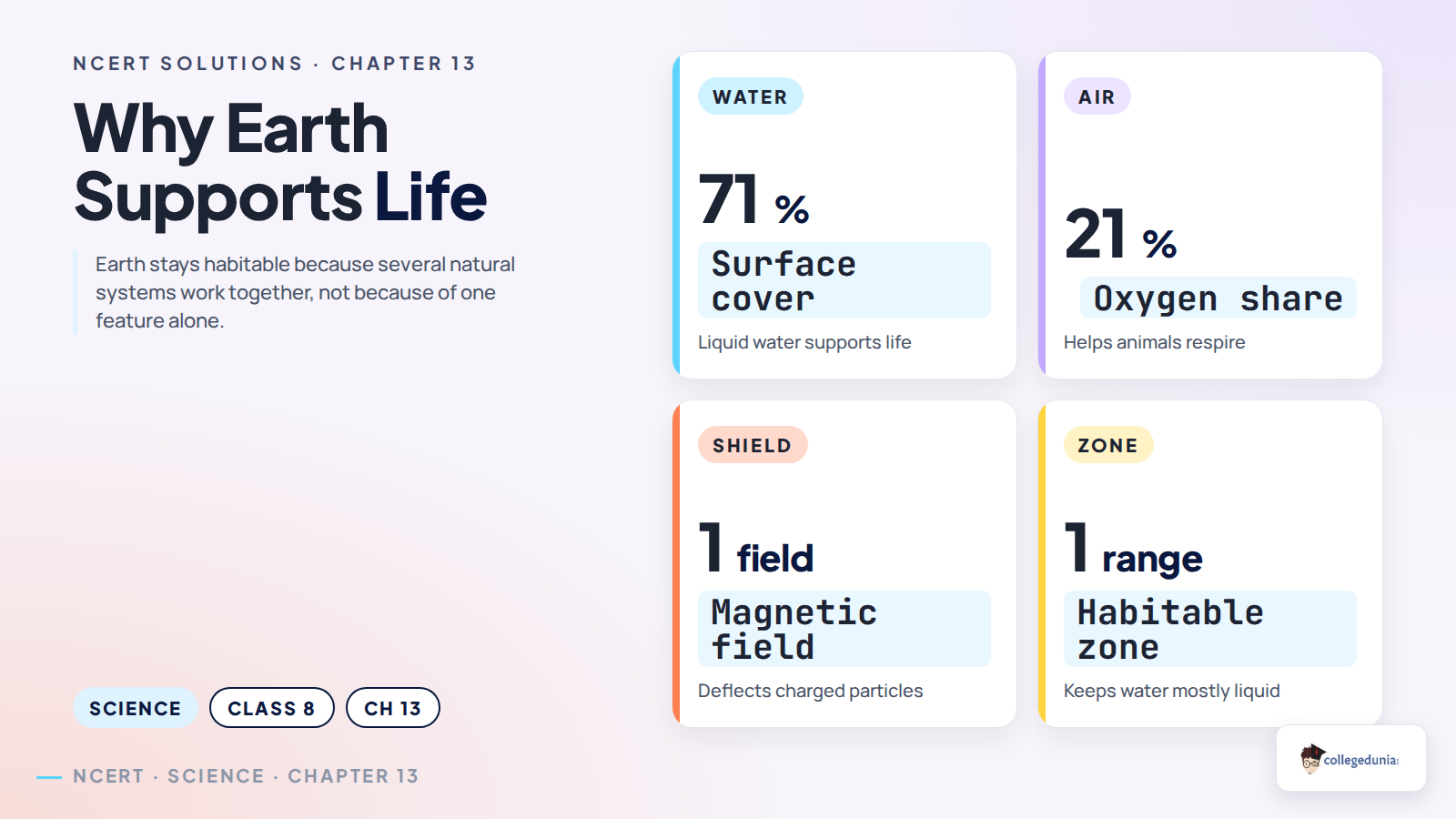
Earth supports life because many natural conditions work together. Liquid water, breathable air, suitable temperature, protective atmosphere, ozone layer and magnetic field all help make Earth different from other planets.
Right distance: Earth lies where water can stay mostly liquid.
Right size: Earth has enough gravity to hold an atmosphere.
Natural shields: ozone and magnetic field reduce harmful radiation.
Connected systems: air, water, land and life keep affecting one another.
Reproduction and Life Continuity in Our Home Earth
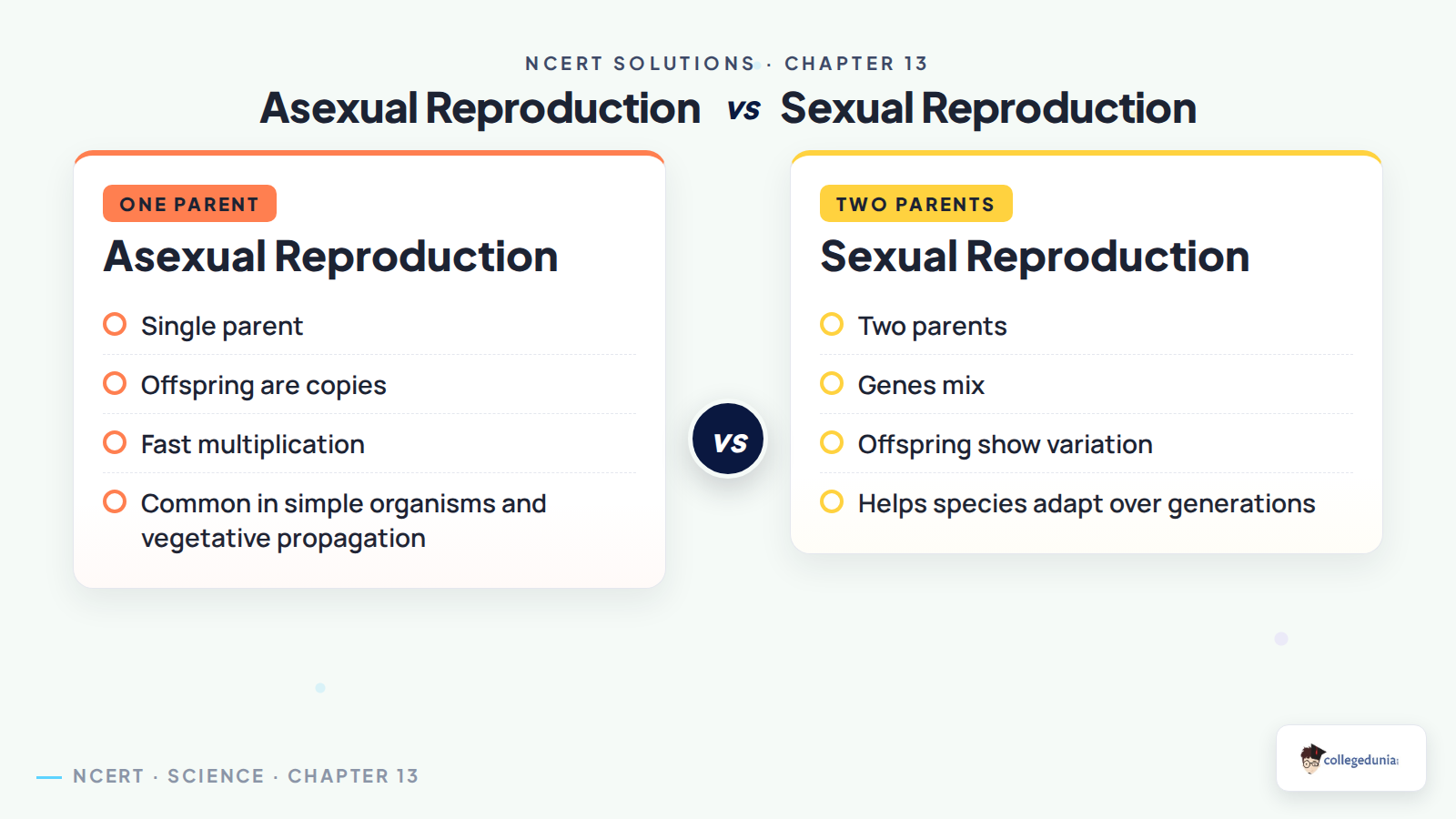
Reproduction keeps life from disappearing. Asexual reproduction can quickly make new individuals from one parent. Sexual reproduction mixes genes from two parents, so offspring are different from their parents.
Asexual reproduction: one parent produces similar offspring.
Sexual reproduction: two parents pass mixed genes to offspring.
Vegetative propagation: new plants grow from stems, roots, leaves or bulbs.
Variation: differences help living beings adjust across generations.
How to Write Class 8 Science Chapter 13 Answers
Start with the main idea, then add the reason. For atmosphere questions, mention air, pressure, temperature and water. For environment questions, connect human action with local climate, biodiversity and water quality.
For Mars questions, mention thin atmosphere and lack of stable liquid water.
For deforestation, include heat, habitat loss, erosion and runoff.
For global warming, compare slow natural change with fast human-caused warming.
For vegetative propagation, name the plant and the plant part used.
Our Home Earth a Unique Life Sustaining Planet NCERT Solutions
All NCERT Solutions for Class 8 Science Chapter 13 Our Home Earth with Step-by-Step Solutions
The cards below include every exercise question. Use Check Solution for the direct answer and Expert Solution for a second explanation.
Each answer uses the 2026-27 NCERT chapter wording.
Expert panels explain the same answer in a second way.
The MCQ answers include the correct option and reason.
Q 13.1
What is one major reason Mars cannot currently support life like Earth?
[label=()]
It has too many volcanoes.
It is too close to the Sun.
It lacks a thick atmosphere and liquid water.
Its magnetic field is too strong.
Concept used. A planet needs suitable temperature, liquid water and a protective atmosphere for Earth-like life. Mars has a very thin atmosphere and stable liquid water is not present on its surface today.
The correct answer is (iii). Mars lacks a thick atmosphere and liquid water.
Answer cue
Connect habitability with water and atmosphere.
Earth supports life because it has liquid water, a suitable temperature range and a protective atmosphere.
Mars is near the edge of the habitable zone, but its atmosphere is much thinner than Earth's atmosphere.
A thin atmosphere cannot trap enough heat or protect the surface as effectively as Earth's atmosphere.
Liquid water is also not stable on the Martian surface today.
Therefore Mars cannot currently support Earth-like life mainly because it lacks a thick atmosphere and liquid water.
The correct option is (iii): it lacks a thick atmosphere and liquid water.
AM
Aarav Menon
M.Sc Planetary Science, University of Delhi
Verified Expert
Strategic angle. For a quick MCQ, test each option against the conditions for life.
Earth-like life needs liquid water for many life processes.
It also needs an atmosphere that gives pressure, protection and heat balance.
Mars does not have a thick atmosphere like Earth.
It also does not have stable liquid water on the surface today.
These two missing conditions make option (iii) the best answer.
Final check. Option (iii) names both key missing conditions.
Option (iii) is correct.
Q 13.2
Which of these is an example of geodiversity?
[label=()]
Variety of bird chirping in a forest.
Different landforms like mountains, valleys, and deserts.
Changing weather during monsoons.
Number of different types of fish in a pond.
Concept used. Geodiversity means the variety of non-living Earth features. It includes landforms, rocks, soils, minerals and surface features.
The correct answer is (ii). Mountains, valleys and deserts are landforms, so they show geodiversity.
Key word
Geo means Earth. In this question, look for Earth's non-living features.
Bird chirping and fish types are related to living organisms.
Weather during monsoon is a short-term atmospheric condition.
Mountains, valleys and deserts are landforms.
Landforms are non-living features of Earth.
So different landforms are examples of geodiversity.
The correct option is (ii): different landforms like mountains, valleys and deserts.
NV
Nisha Verma
M.Sc Geology, Banaras Hindu University
Verified Expert
Structural observation. The word geodiversity points to the physical Earth.
A forest can have many sounds, birds and animals. That is linked with biodiversity.
A pond with many fish species is also biodiversity.
Monsoon weather changes over time and is not a landform.
Mountains, valleys and deserts are different forms of the land surface.
Therefore they represent geodiversity.
Final check. The only option about landforms is option (ii).
Option (ii) is correct.
Q 13.3
If the Earth were smaller with the same density, what might happen to its atmosphere?
[label=()]
It would become thicker and hotter.
It would escape into space due to weaker gravity.
It would become frozen.
It would cause stronger winds.
Concept used. Gravity is the pull by which a planet holds objects and gases near it. A smaller Earth with the same density would have weaker gravity at its surface.
The correct answer is (ii). Weaker gravity would make it difficult for Earth to hold its atmosphere.
Answer cue
Atmosphere stays because gravity holds gases near Earth.
Earth's atmosphere is made of gases around the planet.
These gases do not fly away easily because Earth's gravity pulls them inward.
If Earth were much smaller with the same density, its gravity would be weaker.
Weaker gravity would not hold atmospheric gases strongly.
Over time, many gases could escape into space.
The correct option is (ii): the atmosphere would escape into space due to weaker gravity.
RS
Ritika Sen
M.Sc Physics, University of Calcutta
Verified Expert
Strategic angle. The question gives the clue in the phrase same density.
Same density but smaller size means a smaller total mass.
Smaller mass gives a weaker gravitational pull.
Gases are light and spread freely.
If gravity is too weak, gases can escape more easily.
That is why Mars has a much thinner atmosphere than Earth.
So the option about escape into space is the scientifically correct one.
Final check. Weaker gravity means weaker atmospheric hold.
Option (ii) is correct.
Q 13.4
In sexual reproduction, why are offspring different from their parents?
[label=()]
They grow in different climates.
They eat different food.
They acquire new instructions after birth.
They get mixed instructions (genes) from both parents.
Concept used. In sexual reproduction, two parents contribute genetic instructions. These instructions mix, so the offspring are not exact copies of either parent.
The correct answer is (iv). Offspring receive mixed genes from both parents.
Key word
Genes are instructions that influence inherited features.
Asexual reproduction usually involves one parent.
Sexual reproduction involves two parents.
Each parent contributes genetic instructions to the offspring.
These instructions combine in a new way.
So the offspring may resemble the parents, but they are not exact copies.
The correct option is (iv): they get mixed instructions, or genes, from both parents.
LT
Leena Thomas
M.Sc Zoology, University of Kerala
Verified Expert
Structural observation. The option must explain inherited difference, not daily life difference.
Eating different food may change health or growth.
Living in a different climate may change some body responses.
But inherited features come from genes.
In sexual reproduction, genes come from two parents.
The mixing of these genes creates variation in the offspring.
Final check. Option (iv) is the only gene-based explanation.
Option (iv) is correct.
Q 13.5
You notice tiny green plants growing in cracks on your school wall after the monsoon. Where do you think the seeds came from? What conditions helped these plants grow there?
Concept used. Seeds can be dispersed by wind, water, birds, animals or humans. Germination needs moisture, air, suitable temperature and some support for the young plant.
The seeds may have been carried by wind, rainwater, birds or animals. Monsoon moisture, trapped soil, air and sunlight helped them grow.
Answer cue
Name both parts: seed source and growth conditions.
Seeds from nearby plants may have reached the wall crack by wind.
Rainwater may also have washed small seeds into the crack.
Birds or animals may have dropped seeds after eating fruits.
Dust, soil particles and decaying matter can collect inside cracks.
During the monsoon, the crack stayed moist for many days.
The seeds also received air and some sunlight.
These conditions allowed the seeds to germinate and grow into tiny plants.
Seeds likely came by wind, rainwater, birds or animals. Moisture, trapped soil, air and sunlight helped them grow.
VJ
Vikram Joshi
M.Sc Botany, Pune University
Verified Expert
Strategic angle. A wall crack can act like a tiny habitat.
It can trap soil, dust and small organic matter.
It can hold rainwater after the monsoon begins.
Seeds can arrive there by wind, birds, rain splash or animal droppings.
Once a seed gets water, air and warmth, it can germinate.
Sunlight then helps the young green plant make food.
So the wall crack supplied both a place to stay and conditions for growth.
Final check. Seed dispersal plus monsoon moisture explains the observation.
The seeds arrived from nearby sources and grew because the crack became moist and supportive.
Q 13.6
A city has recently cut down a large patch of forest to build new roads and buildings. Discuss the possible effects this could have on the local climate and biodiversity? How might this affect water availability or quality in the area?
Concept used. Forests influence climate, biodiversity, soil and water. Trees cool the air, provide habitats, hold soil and help water enter the ground.
The area may become hotter, drier and less biodiverse. Water availability may fall, and water quality may worsen due to runoff and soil erosion.
Answer cue
Discuss climate, biodiversity and water separately.
Trees give shade and cool the surroundings by releasing water vapour.
Removing a large forest patch can make the local area hotter.
Fewer trees may also reduce local moisture and affect rainfall patterns.
Many birds, insects, small animals and microbes lose food and shelter.
This reduces biodiversity in the area.
Tree roots hold soil and help rainwater soak into the ground.
Without roots, more rainwater runs off the surface and carries soil with it.
This can reduce groundwater recharge and make nearby water muddy or polluted.
Deforestation can heat the area, reduce biodiversity, lower groundwater recharge and worsen water quality through erosion and runoff.
FK
Farah Khan
M.Sc Environmental Science, Jamia Millia Islamia
Verified Expert
Strategic angle. A forest is not just a group of trees. It is a local support system.
Its shade and water release reduce local heat.
Its plants provide food, nesting places and hiding spaces.
Its roots keep soil in place and slow rainwater flow.
When the forest is cut, these services decline together.
The city may face hotter streets, fewer species and more dust.
More runoff can carry soil, sewage and road pollutants into water bodies.
Less soaking into the ground can reduce wells and groundwater over time.
Final check. Forest loss affects climate, biodiversity and the water system.
The city may become hotter, poorer in biodiversity and more vulnerable to water problems.
Q 13.7
A friend says, ``The Earth has always had climate changes in the past, so today's global warming is nothing new.'' How would you respond using what you've learnt in this and other chapters of your science book?
Concept used. Climate can change naturally, but current global warming is strongly increased by human activities such as burning fossil fuels, deforestation and pollution. The rate of change matters.
I would say natural climate changes happened before, but today's warming is faster and is mainly linked with human activities that add greenhouse gases.
Answer cue
Compare natural change with human-caused rapid change.
It is true that Earth's climate has changed in the past.
But past changes often happened slowly over long periods.
Today's global warming is happening quickly compared with many natural changes.
Human activities add extra greenhouse gases such as carbon dioxide to the atmosphere.
Burning coal, petrol and diesel releases carbon dioxide.
Cutting forests removes trees that could absorb carbon dioxide.
Extra greenhouse gases trap more heat and disturb Earth's climate balance.
So present global warming is not just another ordinary natural change.
Past climate change was real, but today's rapid warming is strongly driven by human activities and needs action.
MK
Maya Krishnan
M.Sc Climate Science, IISc Bengaluru
Verified Expert
Strategic angle. The key difference is cause and speed.
Natural climate shifts are part of Earth's history.
That fact does not prove all warming is harmless or natural.
The present rise is linked with high greenhouse gas emissions.
These emissions come from transport, industries, power generation and forest loss.
Fast warming gives ecosystems, farms and human settlements less time to adjust.
That is why scientists treat today's warming as a serious problem.
Final check. Natural past change does not cancel human responsibility today.
Today's global warming is different because it is rapid and human-driven.
Q 13.8
Imagine Earth's magnetic field suddenly disappeared. What kinds of problems could arise for life on Earth? Explain.
Concept used. Earth's magnetic field acts like a shield. It deflects many high-energy charged particles coming from the Sun and space.
Life could face stronger harmful radiation, satellite and communication problems, and long-term damage to the atmosphere.
Key word
Magnetic shield means protection from charged particles.
The Sun sends out high-energy charged particles.
Earth's magnetic field deflects many of these particles.
If the magnetic field disappeared, more particles could reach near Earth.
This could increase radiation danger for living beings and astronauts.
Satellites, communication systems and power grids could be affected.
Over long periods, the atmosphere could also become more vulnerable to loss.
Since atmosphere protects life and water, this would create serious risks for life.
Without the magnetic field, Earth would lose an important shield against harmful charged particles.
DM
Dev Mehra
M.Sc Space Physics, University of Mumbai
Verified Expert
Strategic angle. Think of the magnetic field as an invisible protective layer.
It does not give us air or water directly.
Its role is to protect the planet from charged particles.
Removing it would allow stronger space radiation effects.
Living cells can be damaged by high radiation.
Satellites and electrical systems are also sensitive to charged particles.
A weaker atmospheric shield over long time would make Earth less safe for life.
Final check. The main risk is loss of protection.
Life and technology would face greater radiation-related problems.
Q 13.9
You are tasked with designing a new settlement for humans on Mars. Name three things you would need to recreate from Earth to support human life there. Which of these do you think is the hardest to replicate, and why?
Concept used. Human life needs breathable air, liquid water, suitable temperature, food, protection from radiation and safe pressure. Mars lacks many of these natural Earth conditions.
We must recreate breathable air, liquid water and protected temperature-controlled habitats. The hardest is likely an Earth-like atmosphere because it needs pressure, gases and radiation protection at a huge scale.
Answer cue
Choose three needs, then justify which one is hardest.
First, humans need breathable air with enough oxygen.
Second, they need liquid water for drinking, hygiene, growing food and many life processes.
Third, they need a protected habitat with suitable temperature and pressure.
The habitat must also protect people from harmful radiation.
Food production would need soil or a growing system, nutrients and light.
Among these, an Earth-like atmosphere is hardest to recreate.
It must provide pressure, oxygen, heat balance and protection over a large area.
Three needs are breathable air, liquid water and protected habitats. Recreating an Earth-like atmosphere is the hardest.
IK
Ishaan Kapoor
M.Tech Aerospace Engineering, IIT Kanpur
Verified Expert
Strategic angle. A Mars base must replace many services Earth gives freely.
Earth gives air pressure, oxygen, temperature control and radiation protection naturally.
Mars has a thin atmosphere and low surface pressure.
A settlement would need sealed rooms with oxygen and controlled pressure.
It would need stored or recycled water.
It would need greenhouses or other systems to grow food.
It would also need shielding from radiation.
Of these, a full Earth-like atmosphere is hardest because it is not just one object. It is a whole planet-scale system.
Final check. Air, water and protection are the basic Earth conditions to recreate.
Breathable air, water and protected habitats are essential; atmosphere is hardest to recreate.
Q 13.10
In a village, the temperature has been increasing and rainfall has become unpredictable over the past few years. What could be causing this change? Suggest two ways the village could adapt to these new conditions.
Concept used. Local weather patterns can be affected by climate change, deforestation, pollution and land-use changes. Adaptation means adjusting our practices to reduce harm from these changes.
The change may be linked with climate change, tree loss and pollution. The village can store rainwater and grow heat-tolerant or drought-resistant crops.
Answer cue
Give a possible cause and two practical adaptations.
Rising temperature and unpredictable rainfall can be signs of climate change.
Human activities such as burning fuels add greenhouse gases to the atmosphere.
Cutting trees can also make the local area hotter and drier.
Pollution and land-use changes may further disturb the local environment.
One adaptation is rainwater harvesting, so water is stored during heavy rains.
A second adaptation is growing crops that need less water and tolerate heat better.
The village can also use drip irrigation, protect trees and improve soil moisture.
Likely causes include climate change, deforestation and pollution. Two adaptations are rainwater harvesting and drought-resistant crops.
SA
Sonal Agarwal
M.Sc Agricultural Science, GB Pant University
Verified Expert
Strategic angle. Adaptation should protect both water and crops.
Higher temperature increases water loss from soil and plants.
Irregular rainfall makes farming less predictable.
Climate change can make such patterns more common.
Tree cutting and pollution can worsen the local effect.
The village should collect rooftop rainwater and recharge wells.
Farmers can shift to crop varieties that survive heat and dry spells.
Drip irrigation and mulching can further reduce water waste.
Final check. Store water and choose suitable crops.
The village can adapt by harvesting rainwater and using drought-tolerant crops.
Q 13.11
If there were no atmosphere on the Earth, would it affect life, temperature, and water on the planet? Explain.
Concept used. The atmosphere supplies gases, protects from harmful radiation, moderates temperature and helps maintain pressure needed for liquid water.
Yes. Without the atmosphere, life would not get air or protection, temperatures would become extreme and liquid water would not remain stable.
Key word
Atmosphere affects air, temperature, pressure and water cycle.
Life would be affected because most organisms need oxygen for respiration.
The ozone layer in the atmosphere also blocks much harmful ultraviolet radiation.
Temperature would be affected because the atmosphere helps trap some heat.
Without it, days could become very hot and nights very cold.
Water would be affected because air pressure helps liquid water remain stable.
Without an atmosphere, liquid water could evaporate or freeze easily.
Clouds and rainfall would also not work normally without atmospheric water vapour.
Yes. No atmosphere would make life, stable temperature and liquid water almost impossible on Earth.
AB
Ananya Bose
M.Sc Atmospheric Science, Jadavpur University
Verified Expert
Strategic angle. The atmosphere is a life-support layer with several jobs.
It provides gases needed by living beings.
It blocks some harmful radiation.
It keeps temperature changes from becoming too extreme.
It supplies pressure that helps water stay liquid at Earth's surface.
It also carries water vapour, making clouds and rainfall possible.
Removing it would disturb all three: life, temperature and water.
Final check. The answer is yes for all three parts.
Without the atmosphere, Earth would not remain suitable for life.
Q 13.12
Discuss five examples of vegetative propagation.
Concept used. Vegetative propagation is a form of asexual reproduction in plants. A new plant grows from a vegetative part such as a stem, root, leaf, tuber, rhizome, bulb or runner.
Examples include money plant stem cutting, potato tuber eyes, ginger rhizome, sugarcane stem cutting and onion bulb.
Answer cue
For each example, name the plant part that grows into a new plant.
Money plant: A stem cutting with a node can grow roots in water or soil.
Potato: The eyes of a potato tuber are buds that can sprout into new plants.
Ginger: A piece of rhizome with a bud can grow into a new ginger plant.
Sugarcane: Stem cuttings with nodes are planted to grow new sugarcane plants.
Onion: The bulb can grow into a new onion plant when planted.
In all these cases, the new plant grows from a plant part, not from a seed formed by sexual reproduction.
Five examples are money plant, potato, ginger, sugarcane and onion.
NK
Neha Kulkarni
M.Sc Plant Biology, University of Pune
Verified Expert
Strategic angle. Group the examples by the plant part used.
Stem cuttings work in money plant and sugarcane.
Tubers work in potato because the eyes are buds.
Rhizomes work in ginger because the underground stem stores food and has buds.
Bulbs work in onion because the storage structure can produce a shoot.
These methods make new plants without seeds.
They are useful because farmers and gardeners can multiply plants quickly.
Final check. Each example shows a new plant growing from a vegetative part.
Vegetative propagation examples include stem cuttings, tubers, rhizomes and bulbs.
Class 8 Science Chapter 13 Our Home Earth NCERT Solutions FAQs
Ques. What is the main idea of Our Home Earth Class 8 Science Chapter 13?
Ans. The chapter explains why Earth supports life, how Earth systems interact, how reproduction keeps life going and why pollution, climate change and biodiversity loss are serious threats.
Ques. How many Keep the Curiosity Alive questions are solved in this PDF?
Ans. The PDF solves all 12 exercise questions from the 2026-27 NCERT Curiosity textbook with direct solutions and expert explanations.
Ques. Why is Mars not currently suitable for Earth-like life?
Ans. Mars has a thin atmosphere and does not have stable liquid water on its surface today. These missing conditions make Earth-like life difficult.
Ques. What are five examples of vegetative propagation?
Ans. Money plant stem cutting, potato tuber eyes, ginger rhizome, sugarcane stem cutting and onion bulb are five examples of vegetative propagation.




Chapter13OurHome:Earth,aUniqueLifeSustainingPlanetSolutions.pdf?page=1&dpi=150)
Chapter13OurHome:Earth,aUniqueLifeSustainingPlanetSolutions.pdf?page=2&dpi=150)
Chapter13OurHome:Earth,aUniqueLifeSustainingPlanetSolutions.pdf?page=3&dpi=150)
Chapter13OurHome:Earth,aUniqueLifeSustainingPlanetSolutions.pdf?page=4&dpi=150)
Chapter13OurHome:Earth,aUniqueLifeSustainingPlanetSolutions.pdf?page=5&dpi=150)
Chapter13OurHome:Earth,aUniqueLifeSustainingPlanetSolutions.pdf?page=6&dpi=150)
Chapter13OurHome:Earth,aUniqueLifeSustainingPlanetSolutions.pdf?page=7&dpi=150)
Chapter13OurHome:Earth,aUniqueLifeSustainingPlanetSolutions.pdf?page=8&dpi=150)
Chapter13OurHome:Earth,aUniqueLifeSustainingPlanetSolutions.pdf?page=9&dpi=150)
Chapter13OurHome:Earth,aUniqueLifeSustainingPlanetSolutions.pdf?page=10&dpi=150)
Chapter13OurHome:Earth,aUniqueLifeSustainingPlanetSolutions.pdf?page=11&dpi=150)
Chapter13OurHome:Earth,aUniqueLifeSustainingPlanetSolutions.pdf?page=12&dpi=150)
Chapter13OurHome:Earth,aUniqueLifeSustainingPlanetSolutions.pdf?page=13&dpi=150)
Chapter13OurHome:Earth,aUniqueLifeSustainingPlanetSolutions.pdf?page=14&dpi=150)
Chapter13OurHome:Earth,aUniqueLifeSustainingPlanetSolutions.pdf?page=15&dpi=150)
Chapter13OurHome:Earth,aUniqueLifeSustainingPlanetSolutions.pdf?page=16&dpi=150)
Chapter13OurHome:Earth,aUniqueLifeSustainingPlanetSolutions.pdf?page=17&dpi=150)
Chapter13OurHome:Earth,aUniqueLifeSustainingPlanetSolutions.pdf?page=18&dpi=150)
Chapter13OurHome:Earth,aUniqueLifeSustainingPlanetSolutions.pdf?page=19&dpi=150)
Chapter13OurHome:Earth,aUniqueLifeSustainingPlanetSolutions_flat_MobileCard.pdf?page=1&dpi=150)
Chapter13OurHome:Earth,aUniqueLifeSustainingPlanetSolutions_flat_MobileCard.pdf?page=2&dpi=150)
Chapter13OurHome:Earth,aUniqueLifeSustainingPlanetSolutions_flat_MobileCard.pdf?page=3&dpi=150)
Chapter13OurHome:Earth,aUniqueLifeSustainingPlanetSolutions_flat_MobileCard.pdf?page=4&dpi=150)
Chapter13OurHome:Earth,aUniqueLifeSustainingPlanetSolutions_flat_MobileCard.pdf?page=5&dpi=150)
Chapter13OurHome:Earth,aUniqueLifeSustainingPlanetSolutions_flat_MobileCard.pdf?page=6&dpi=150)
Chapter13OurHome:Earth,aUniqueLifeSustainingPlanetSolutions_flat_MobileCard.pdf?page=7&dpi=150)
Chapter13OurHome:Earth,aUniqueLifeSustainingPlanetSolutions_flat_MobileCard.pdf?page=8&dpi=150)
Chapter13OurHome:Earth,aUniqueLifeSustainingPlanetSolutions_flat_MobileCard.pdf?page=9&dpi=150)
Chapter13OurHome:Earth,aUniqueLifeSustainingPlanetSolutions_flat_MobileCard.pdf?page=10&dpi=150)
Chapter13OurHome:Earth,aUniqueLifeSustainingPlanetSolutions_flat_MobileCard.pdf?page=11&dpi=150)
Chapter13OurHome:Earth,aUniqueLifeSustainingPlanetSolutions_flat_MobileCard.pdf?page=12&dpi=150)
Chapter13OurHome:Earth,aUniqueLifeSustainingPlanetSolutions_flat_MobileCard.pdf?page=13&dpi=150)
Chapter13OurHome:Earth,aUniqueLifeSustainingPlanetSolutions_flat_MobileCard.pdf?page=14&dpi=150)
Chapter13OurHome:Earth,aUniqueLifeSustainingPlanetSolutions_flat_MobileCard.pdf?page=15&dpi=150)
Chapter13OurHome:Earth,aUniqueLifeSustainingPlanetSolutions_flat_MobileCard.pdf?page=16&dpi=150)
Chapter13OurHome:Earth,aUniqueLifeSustainingPlanetSolutions_flat_MobileCard.pdf?page=17&dpi=150)
Chapter13OurHome:Earth,aUniqueLifeSustainingPlanetSolutions_flat_MobileCard.pdf?page=18&dpi=150)
Chapter13OurHome:Earth,aUniqueLifeSustainingPlanetSolutions_flat_MobileCard.pdf?page=19&dpi=150)
Chapter13OurHome:Earth,aUniqueLifeSustainingPlanetSolutions_flat_MobileCard.pdf?page=20&dpi=150)
Chapter13OurHome:Earth,aUniqueLifeSustainingPlanetSolutions_flat_MobileCard.pdf?page=21&dpi=150)
Chapter13OurHome:Earth,aUniqueLifeSustainingPlanetSolutions_flat_MobileCard.pdf?page=22&dpi=150)
Chapter13OurHome:Earth,aUniqueLifeSustainingPlanetSolutions_flat_MobileCard.pdf?page=23&dpi=150)
Chapter13OurHome:Earth,aUniqueLifeSustainingPlanetSolutions_flat_MobileCard.pdf?page=24&dpi=150)
Chapter13OurHome:Earth,aUniqueLifeSustainingPlanetSolutions_flat_MobileCard.pdf?page=25&dpi=150)
Chapter13OurHome:Earth,aUniqueLifeSustainingPlanetSolutions_flat_MobileCard.pdf?page=26&dpi=150)
Chapter13OurHome:Earth,aUniqueLifeSustainingPlanetSolutions_flat_MobileCard.pdf?page=27&dpi=150)
Chapter13OurHome:Earth,aUniqueLifeSustainingPlanetSolutions_flat_MobileCard.pdf?page=28&dpi=150)
Chapter13OurHome:Earth,aUniqueLifeSustainingPlanetSolutions_flat_MobileCard.pdf?page=29&dpi=150)
Chapter13OurHome:Earth,aUniqueLifeSustainingPlanetSolutions_flat_MobileCard.pdf?page=30&dpi=150)
Chapter13OurHome:Earth,aUniqueLifeSustainingPlanetSolutions_flat_MobileCard.pdf?page=31&dpi=150)
Chapter13OurHome:Earth,aUniqueLifeSustainingPlanetSolutions_flat_MobileCard.pdf?page=32&dpi=150)
Chapter13OurHome:Earth,aUniqueLifeSustainingPlanetSolutions_flat_MobileCard.pdf?page=33&dpi=150)
Chapter13OurHome:Earth,aUniqueLifeSustainingPlanetSolutions_flat_MobileCard.pdf?page=34&dpi=150)
Chapter13OurHome:Earth,aUniqueLifeSustainingPlanetSolutions_flat_MobileCard.pdf?page=35&dpi=150)
Chapter13OurHome:Earth,aUniqueLifeSustainingPlanetSolutions_flat_MobileCard.pdf?page=36&dpi=150)
Chapter13OurHome:Earth,aUniqueLifeSustainingPlanetSolutions_flat_MobileCard.pdf?page=37&dpi=150)



Comments