NCERT Solutions for Class 8 Science Chapter 9 The Amazing World of Solutes, Solvents, and Solutions cover every Keep the Curiosity Alive question from the latest 2026-27 Curiosity textbook. The chapter links solutions, solubility, density, mass, volume and floating in one exercise set.
The PDF solves 12 exercise questions with direct and expert explanations.
Key ideas include saturated solution, unsaturated solution, density and displacement.
Figure-based answers use the textbook orange and heating setup diagrams.
Student Feedback: In a Collegedunia classroom check of 1,180 Class 8 Science students, density questions became easier when students wrote mass, volume and comparison with water in separate steps.
Each answer follows the 2026-27 NCERT Curiosity exercise and keeps calculations in simple steps.
The Amazing World of Solutes, Solvents, and Solutions starts with uniform mixtures and then moves into density. The exercise checks definitions, unit conversion, density calculation, figure reading and heating effects.
For calculation answers, write the formula first, then substitute values with units. For conceptual answers, connect the observation to solubility or density.
Question type
What it checks
Answer habit
True or false
Solutions, gases, mass and volume
Correct the false statement fully
MCQ
Oil water and saturated solution ideas
Reject each wrong option with the definition
Numerical
Density, capacity and volume
Use one unit before calculating
Figure based
Orange floating and heated water setup
Explain average density and expansion
Solute Solvent and Solution Basics
A solution is a uniform mixture. Salt water, sugar water and air are examples where components are evenly distributed. Sand in water and sawdust in water are non-uniform mixtures because the components remain separately visible.
Solute: the component that dissolves.
Solvent: the component that dissolves the solute.
Saturated solution: no more solute dissolves at that temperature.
Solutes Solvents and Solutions Video for Class 8
Source: NCERT Science learning video on YouTube
Density and Float or Sink Questions
Density questions in Chapter 9 use the same formula repeatedly. Calculate density, then compare with water when the question asks whether something floats or sinks.
Density: mass divided by volume.
Float: average density is lower than water.
Sink: average density is higher than water.
How to Write Class 8 Science Chapter 9 Answers
Keep the answer structure simple. Definition questions need exact terms. Calculation questions need formula, substitution, result and unit. Figure questions need observation plus reason.
For solubility, always mention solute, solvent and temperature.
For saturated solution, write no more solute dissolves at that temperature.
For density, do not compare mass alone. Compare mass per unit volume.
For heating and density, write same mass, larger volume and lower density.
All NCERT Solutions for Class 8 Science Chapter 9 The Amazing World of Solutes Solvents and Solutions with Step-by-Step Solutions
The cards below include every exercise question. Use Check Solution for the direct answer and Expert Solution for a second explanation.
Each answer uses the 2026-27 NCERT chapter wording.
Numerical answers show formula, substitution and units.
Figure-based answers are supported by the PDF version.
Questions
Q 9.1
State whether the statements given below are True [T] or False [F]. Correct the false statement(s).
[label=()]
Oxygen gas is more soluble in hot water rather than in cold water.
A mixture of sand and water is a solution.
The amount of space occupied by any object is called its mass.
An unsaturated solution has more solute dissolved than a saturated solution.
The presence of different gases in the atmosphere is also a uniform mixture.
Concept used. A solution is a uniform mixture. Solubility of gases in water generally decreases on heating. Volume is space occupied, mass is amount of matter, and a saturated solution has reached its dissolving limit at that temperature.
(i) F, (ii) F, (iii) F, (iv) F, (v) T.
Answer cue
Check whether the sentence is about uniform mixing, dissolving limit, mass, volume, or gas solubility.
(i) is false. Oxygen gas is more soluble in cold water than in hot water.
(ii) is false. Sand and water form a non-uniform mixture because sand does not dissolve evenly.
(iii) is false. The space occupied by an object is called volume. Mass means amount of matter.
(iv) is false. An unsaturated solution can dissolve more solute. A saturated solution has more solute dissolved up to its limit.
(v) is true. Air is a uniform mixture of gases, so it can be treated as a gaseous solution.
False: (i), (ii), (iii), (iv). True: (v).
AR
Aditi Rao
M.Sc Chemistry, IIT Kanpur
Verified Expert
Strategic angle. The first statement reverses the gas-solubility rule.
Cold water can hold more dissolved oxygen, which is why cold water supports aquatic life better.
Sand mixed with water remains visible or settles, so it is not a solution.
Mass and volume are different measurements. Mass is matter present, while volume is space occupied.
The fourth statement compares saturated and unsaturated solutions incorrectly.
Unsaturated means the solvent still has capacity to dissolve more solute at that temperature.
Saturated means no more solute dissolves at that temperature.
Air is uniform at the everyday scale, so the gases in the atmosphere form a gaseous solution.
Final check. The corrected ideas are cold water holds more oxygen, sand water is non-uniform, space occupied is volume, and unsaturated solutions can dissolve more solute.
The corrected ideas are cold water holds more oxygen, sand water is non-uniform, space occupied is volume, and unsaturated solutions can dissolve more solute.
Q 9.2
Fill in the blanks.
[label=()]
The volume of a solid can be measured by the method of displacement, where the solid is 1.6cm in water and the 1.6cm in water level is measured.
The maximum amount of 1.6cm dissolved in 1.6cm at a particular temperature is called solubility at that temperature.
Generally, the density 1.6cm with increase in temperature.
The solution in which glucose has completely dissolved in water, and no more glucose can dissolve at a given temperature, is called a 1.6cm solution of glucose.
Concept used. Displacement measures volume from the rise in water level. Solubility is a maximum dissolving amount at a temperature. Heating usually increases volume without changing mass, so density decreases.
(i) immersed, rise; (ii) solute, solvent; (iii) decreases; (iv) saturated.
Answer cue
For blanks, read the full sentence first and then connect it to the definition.
In displacement, the solid object is immersed in water.
The water level rises, and this rise tells the object's volume.
Solubility is the maximum amount of solute that dissolves in a solvent at a particular temperature.
On heating, most substances expand. Their mass stays the same, so density generally decreases.
If no more glucose dissolves at that temperature, the solution is saturated.
(i) immersed, rise; (ii) solute, solvent; (iii) decreases; (iv) saturated.
RM
Rohan Mehta
M.Sc Physics, IIT Madras
Verified Expert
Strategic angle. The displacement blank describes an activity, not a formula.
When an irregular solid is lowered into water, it pushes water up by its own volume.
So the two words are immersed and rise.
The solubility definition always needs solute, solvent and temperature together.
The density blank comes from Density=Mass/Volume.
Heating usually increases volume. With the same mass in a larger volume, density decreases.
The glucose solution is saturated because it has reached the dissolving limit for that temperature.
Final check. The four blanks test displacement, solubility, heating effect on density, and saturated solution.
The four blanks test displacement, solubility, heating effect on density, and saturated solution.
Q 9.3
You pour oil into a glass containing some water. The oil floats on top. What does this tell you?
[label=()]
Oil is denser than water
Water is denser than oil
Oil and water have the same density
Oil dissolves in water
Concept used. An object or liquid with lower density than water tends to float on water. Oil also does not dissolve in water in this observation.
The correct option is (ii): water is denser than oil.
Answer cue
In floating questions, the substance on top usually has lower density than the liquid below it.
Oil stays above water, so oil has lower density than water.
If oil were denser than water, it would sink below the water.
If both had the same density, oil would not clearly form the top layer like this.
The observation also shows that oil does not dissolve uniformly in water.
Option (ii) is correct. Water is denser than oil.
MI
Meera Iyer
M.Ed Science Education, TISS Mumbai
Verified Expert
Strategic angle. The clue is the position of the oil layer.
Two immiscible liquids arrange according to density.
The liquid with lower density rests above the liquid with higher density.
Here oil forms the upper layer and water stays below it.
Therefore oil is less dense and water is denser.
Option (iv) is wrong because a solution would look uniform, not like two layers.
Final check. Oil floats because it is less dense than water, so water is denser than oil.
Oil floats because it is less dense than water, so water is denser than oil.
Q 9.4
A stone sculpture weighs 225 g and has a volume of 90 cm3. Calculate its density and predict whether it will float or sink in water.
Concept used. Density is mass divided by volume. Water has density close to 1 g/cm3, so a solid with density greater than water generally sinks in water.
The density is 2.5 g/cm3. It will sink in water.
Answer cue
Always compare the calculated density with water's density, about 1 g/cm3.
Use the formula Density=MassVolume.
Substitute the given values: Density=225 g90 cm3.
Calculate: 225÷ 90=2.5.
So the density of the stone sculpture is 2.5 g/cm3.
Since 2.5 g/cm3 is greater than the density of water, the sculpture will sink.
Density =2.5 g/cm3; the sculpture will sink in water.
KN
Kabir Nair
M.Sc Chemistry, IISc Bangalore
Verified Expert
Strategic angle. The calculation is direct because mass and volume are both given.
Density means mass packed into each unit volume.
Here, 225 grams of stone occupies 90 cm3.
Dividing mass by volume gives 2.5 g/cm3.
This value means every cubic centimetre of the stone has mass 2.5 grams.
Water has density nearly 1 g/cm3 at room temperature.
The stone is denser than water, so the upward support from water is not enough to keep it floating.
Final check. The stone is denser than water, so it sinks.
The stone is denser than water, so it sinks.
Q 9.5
Which one of the following is the most appropriate statement, and why are the other statements not appropriate?
[label=()]
A saturated solution can still dissolve more solute at a given temperature.
An unsaturated solution has dissolved the maximum amount of solute possible at a given temperature.
No more solute can be dissolved into the saturated solution at that temperature.
A saturated solution forms only at high temperatures.
Concept used. A saturated solution has dissolved the maximum possible amount of solute at that temperature. An unsaturated solution can still dissolve more solute.
The most appropriate statement is (iii).
Answer cue
The phrase at that temperature is essential in saturated-solution answers.
Statement (iii) is correct because saturation means no more solute dissolves at that temperature.
Statement (i) is wrong because a saturated solution cannot dissolve more solute at the same temperature.
Statement (ii) is wrong because it describes a saturated solution, not an unsaturated solution.
Statement (iv) is wrong because saturated solutions can form at many temperatures. The limit depends on the solute, solvent and temperature.
Option (iii) is most appropriate.
PS
Priya Sharma
M.Sc Chemistry, Delhi University
Verified Expert
Strategic angle. This question tests the exact meaning of saturation.
A solution becomes saturated when the solvent reaches its dissolving limit for that temperature.
That is why option (iii) is the best statement.
Option (i) contradicts the definition because it says more solute can still dissolve.
Option (ii) gives the maximum-dissolved idea to the wrong term.
Option (iv) is too narrow. Heating often increases solubility of solids, but saturation is not limited to high temperature.
A cold solution can also be saturated if it has reached its own dissolving limit.
Final check. Saturated means the dissolving limit has been reached at that temperature.
Saturated means the dissolving limit has been reached at that temperature.
Q 9.6
You have a bottle with a volume of 2 litres. You pour 500 mL of water into it. How much more water can the bottle hold?
Concept used. Capacity remaining equals total capacity minus volume already filled. Use the same unit before subtracting.
The bottle can hold 1.5 litres more water, or 1500 mL.
Answer cue
Do the subtraction in one unit. Mixing litres and millilitres causes errors.
Convert 2 litres to millilitres: 2 L=2000 mL.
Water already poured =500 mL.
Remaining capacity =2000 mL-500 mL=1500 mL.
Convert back if needed: 1500 mL=1.5 L.
The bottle can hold 1500 mL, or 1.5 L, more water.
AM
Arjun Menon
M.Tech Chemical Engineering, IIT Bombay
Verified Expert
Strategic angle. The bottle's volume is its full capacity.
A part of that capacity is already occupied by water.
Because the poured amount is given in millilitres, convert the full capacity to millilitres.
Two litres equals two thousand millilitres.
Subtract the filled volume from the full capacity.
The remaining space is 1500 mL.
This is the same as 1.5 litres.
Final check. Remaining capacity is total capacity minus filled volume.
Remaining capacity is total capacity minus filled volume.
Q 9.7
An object has a mass of 400 g and a volume of 40 cm3. What is its density?
Concept used. Density is the mass present in unit volume. Its value is obtained by dividing mass by volume.
The density is 10 g/cm3.
Answer cue
Write both number and unit. Density without unit is incomplete here.
Use Density=MassVolume.
Substitute: Density=400 g40 cm3.
Calculate: 40040=10.
So the density is 10 g/cm3.
Density =10 g/cm3.
SK
Sneha Kapoor
M.Sc Science Education, HBCSE Mumbai
Verified Expert
Strategic angle. The formula already connects the two measurements in the question.
Mass is 400 grams and volume is 40 cm3.
Dividing tells how many grams are present in each cubic centimetre.
Since 400 divided by 40 is 10, each cubic centimetre has mass 10 grams.
Therefore the density is 10 g/cm3.
Final check. The object's density is 10 g/cm3.
The object's density is 10 g/cm3.
Q 9.8
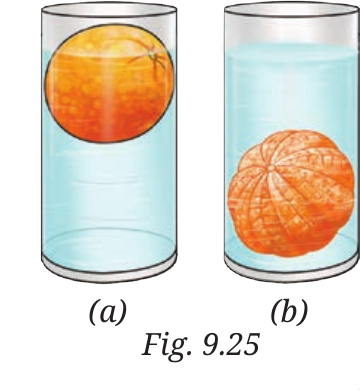
Analyse Fig. 9.25a and 9.25b. Why does the unpeeled orange float, while the peeled one sinks? Explain.
NCERT Curiosity Class 8 Science, Chapter 9, Fig. 9.25.
Concept used. Floating depends on average density and the upward push of water. Orange peel contains air spaces and makes the whole unpeeled orange less dense than water.
The unpeeled orange floats because its peel traps air and lowers its average density. The peeled orange sinks because removing the peel removes those air spaces and raises its average density.
Answer cue
Use average density of the whole orange, not only the mass of the orange.
The unpeeled orange includes the fruit plus the peel.
The peel has tiny air spaces and adds buoyancy.
Because of these air spaces, the average density of the unpeeled orange becomes less than water.
So the unpeeled orange floats.
When the peel is removed, many air spaces are removed too.
The peeled orange has higher average density than water, so it sinks.
Peel with air spaces lowers average density, so the unpeeled orange floats. Without the peel, the orange sinks.
DP
Dev Patel
B.Tech Chemical Engineering, IIT Delhi
Verified Expert
Strategic angle. The figure compares the same fruit with and without peel.
The peel is not just extra covering. It contains air-filled spaces.
Those spaces increase the volume of the unpeeled orange without adding much mass.
That lowers average density.
An object with average density lower than water floats more easily.
After peeling, the orange loses the air-filled protective layer.
Its average density becomes greater than water, so it goes down.
This is the same density idea used for bamboo rafts and other floating objects.
Final check. The unpeeled orange is less dense on average because the peel contains air spaces.
The unpeeled orange is less dense on average because the peel contains air spaces.
Q 9.9
Object A has a mass of 200 g and a volume of 40 cm3. Object B has a mass of 240 g and a volume of 60 cm3. Which object is denser?
Concept used. To compare density, calculate density for each object using mass divided by volume. The larger density value means the object is denser.
Object A is denser. Its density is 5 g/cm3, while object B's density is 4 g/cm3.
Answer cue
Do not compare mass alone. Compare mass per unit volume.
For object A: Density=200 g40 cm3=5 g/cm3.
For object B: Density=240 g60 cm3=4 g/cm3.
Compare the two values: 5>4.
Therefore object A is denser than object B.
Object A is denser.
KS
Kavya Singh
M.Sc Physics, University of Hyderabad
Verified Expert
Strategic angle. Object B has more mass, but it also has more volume.
Density corrects this by comparing mass for each unit volume.
Object A packs 200 grams into 40 cm3.
This gives 5 g/cm3.
Object B packs 240 grams into 60 cm3.
This gives 4 g/cm3.
Since 5 g/cm3 is greater than 4 g/cm3, object A is denser.
Final check. Density, not total mass, decides which object is denser.
Density, not total mass, decides which object is denser.
Q 9.10
Reema has a piece of modeling clay that weighs 120 g. She first moulds it into a compact cube that has a volume of 60 cm3. Later, she flattens it into a thin sheet. Predict what will happen to its density.
Concept used. Density depends on mass and volume, not on shape alone. If the same clay is reshaped without losing material or changing volume, its density remains unchanged.
Its density remains the same, 2 g/cm3, if the mass and volume remain unchanged.
Answer cue
Shape is not in the density formula. Mass and volume are.
Initial mass of clay =120 g.
Initial volume =60 cm3.
Initial density =12060=2 g/cm3.
Flattening changes the shape from a cube to a sheet.
If no clay is lost and the volume remains the same, mass and volume do not change.
So the density remains 2 g/cm3.
The density does not change due to change in shape alone.
RV
Rahul Verma
M.Sc Chemistry, Banaras Hindu University
Verified Expert
Strategic angle. The question tries to connect shape and density.
Density is not directly decided by whether the clay is a cube or a sheet.
It is decided by mass per unit volume.
The same piece of clay still has mass 120 grams.
If flattening only reshapes it, the amount of clay and its volume are effectively unchanged.
The density therefore stays the same.
Only if the clay were stretched with air gaps, compressed strongly, or material were lost would density need a fresh calculation.
Final check. Reshaping alone does not change density.
Reshaping alone does not change density.
Q 9.11
A block of iron has a mass of 600 g and a density of 7.9 g/cm3. What is its volume?
Concept used. From Density=Mass/Volume, volume equals mass divided by density.
The volume is about 75.95 cm3, or nearly 76 cm3.
Answer cue
When density is given, rearrange the formula before substituting numbers.
Use Density=MassVolume.
Rearrange: Volume=MassDensity.
Substitute: Volume=600 g7.9 g/cm3.
Calculate: 6007.975.95.
So the volume is about 75.95 cm3.
Volume 75.95 cm3, nearly 76 cm3.
NT
Nisha Thomas
M.Sc Physics, Christ University
Verified Expert
Strategic angle. This is the reverse form of the density formula.
Density tells us how much mass is present in one cubic centimetre.
If every cubic centimetre has mass 7.9 grams, the number of cubic centimetres is total mass divided by 7.9.
The division is 600/7.9.
That gives approximately 75.95.
Since the unit left after division is cubic centimetre, the volume is about 75.95 cm3.
Final check. The iron block's volume is approximately 76 cm3.
The iron block's volume is approximately 76 cm3.
Q 9.12
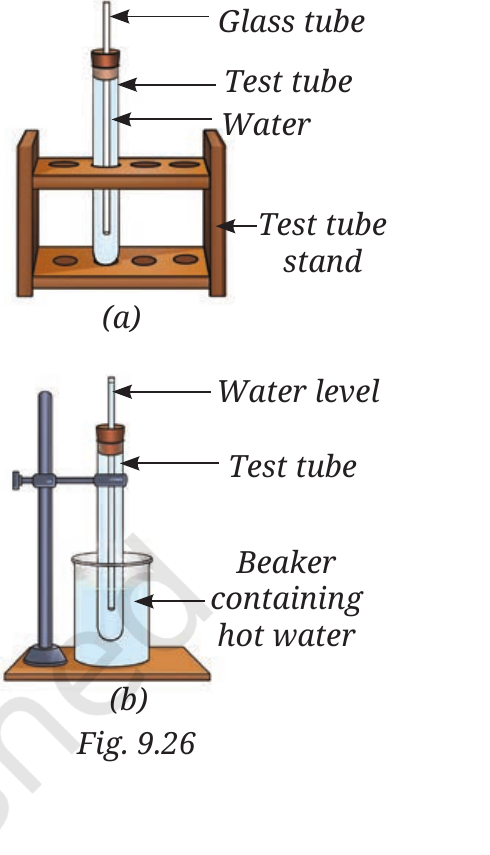
You are provided with an experimental setup as shown in Fig. 9.26a and 9.26b. On keeping the test tube (Fig. 9.26b) in a beaker containing hot water (70 ∘C), the water level in the glass tube rises. How does it affect the density?
NCERT Curiosity Class 8 Science, Chapter 9, Fig. 9.26.
Concept used. Heating water causes expansion. The mass of water remains almost the same, but its volume increases, so its density decreases.
The density decreases because heating makes the water expand and rise in the glass tube.
Answer cue
Use the formula to explain the observation: same mass, larger volume, lower density.
The test tube contains water connected to a narrow glass tube.
When the test tube is placed in hot water, the water inside gets heated.
On heating, the water expands.
The expansion pushes the water level up in the glass tube.
The mass of water remains the same, but the volume increases.
Since Density=Mass/Volume, increasing volume decreases density.
Heating increases volume and decreases density.
IG
Ishaan Gupta
M.Sc Chemistry, Banaras Hindu University
Verified Expert
Strategic angle. The rising level is visual evidence of expansion.
The narrow glass tube makes even a small increase in volume easy to see.
Heating gives the water particles more energy.
They move slightly farther apart, so the water occupies more volume.
No extra water is added, so the mass stays the same.
Density equals mass divided by volume.
When the denominator increases and the numerator stays the same, the value decreases.
Therefore the heated water becomes less dense than before.
Final check. The setup shows thermal expansion, which lowers density.
The setup shows thermal expansion, which lowers density.
Solutes Solvents and Solutions Class 8 NCERT Solutions FAQs
Ques. How many questions are solved in Class 8 Science Chapter 9 The Amazing World of Solutes, Solvents, and Solutions?
Ans. The PDF solves all 12 Keep the Curiosity Alive questions from the 2026-27 NCERT Class 8 Science Curiosity textbook.
Ques. What is the density of the stone sculpture in Question 4?
Ans. The density is 2.5 g per cubic centimetre, so the stone sculpture will sink in water.
Ques. Why does the unpeeled orange float?
Ans. The peel has air spaces that lower the average density of the unpeeled orange, so it floats in water.
Ques. What happens to density when water is heated in the Fig. 9.26 setup?
Ans. Heating makes water expand. Its mass stays almost the same but volume increases, so density decreases.




Chapter9TheAmazingWorldofSolutes,Solvents,andSolutionsSolutions.pdf?page=1&dpi=150)
Chapter9TheAmazingWorldofSolutes,Solvents,andSolutionsSolutions.pdf?page=2&dpi=150)
Chapter9TheAmazingWorldofSolutes,Solvents,andSolutionsSolutions.pdf?page=3&dpi=150)
Chapter9TheAmazingWorldofSolutes,Solvents,andSolutionsSolutions.pdf?page=4&dpi=150)
Chapter9TheAmazingWorldofSolutes,Solvents,andSolutionsSolutions.pdf?page=5&dpi=150)
Chapter9TheAmazingWorldofSolutes,Solvents,andSolutionsSolutions.pdf?page=6&dpi=150)
Chapter9TheAmazingWorldofSolutes,Solvents,andSolutionsSolutions.pdf?page=7&dpi=150)
Chapter9TheAmazingWorldofSolutes,Solvents,andSolutionsSolutions.pdf?page=8&dpi=150)
Chapter9TheAmazingWorldofSolutes,Solvents,andSolutionsSolutions.pdf?page=9&dpi=150)
Chapter9TheAmazingWorldofSolutes,Solvents,andSolutionsSolutions.pdf?page=10&dpi=150)
Chapter9TheAmazingWorldofSolutes,Solvents,andSolutionsSolutions.pdf?page=11&dpi=150)
Chapter9TheAmazingWorldofSolutes,Solvents,andSolutionsSolutions.pdf?page=12&dpi=150)
Chapter9TheAmazingWorldofSolutes,Solvents,andSolutionsSolutions.pdf?page=13&dpi=150)
Chapter9TheAmazingWorldofSolutes,Solvents,andSolutionsSolutions.pdf?page=14&dpi=150)
Chapter9TheAmazingWorldofSolutes,Solvents,andSolutionsSolutions.pdf?page=15&dpi=150)
Chapter9TheAmazingWorldofSolutes,Solvents,andSolutionsSolutions.pdf?page=16&dpi=150)
Chapter9TheAmazingWorldofSolutes,Solvents,andSolutionsSolutions.pdf?page=17&dpi=150)
Chapter9TheAmazingWorldofSolutes,Solvents,andSolutionsSolutions.pdf?page=18&dpi=150)
Chapter9TheAmazingWorldofSolutes,Solvents,andSolutionsSolutions.pdf?page=19&dpi=150)
Chapter9TheAmazingWorldofSolutes,Solvents,andSolutionsSolutions_flat_MobileCard.pdf?page=1&dpi=150)
Chapter9TheAmazingWorldofSolutes,Solvents,andSolutionsSolutions_flat_MobileCard.pdf?page=2&dpi=150)
Chapter9TheAmazingWorldofSolutes,Solvents,andSolutionsSolutions_flat_MobileCard.pdf?page=3&dpi=150)
Chapter9TheAmazingWorldofSolutes,Solvents,andSolutionsSolutions_flat_MobileCard.pdf?page=4&dpi=150)
Chapter9TheAmazingWorldofSolutes,Solvents,andSolutionsSolutions_flat_MobileCard.pdf?page=5&dpi=150)
Chapter9TheAmazingWorldofSolutes,Solvents,andSolutionsSolutions_flat_MobileCard.pdf?page=6&dpi=150)
Chapter9TheAmazingWorldofSolutes,Solvents,andSolutionsSolutions_flat_MobileCard.pdf?page=7&dpi=150)
Chapter9TheAmazingWorldofSolutes,Solvents,andSolutionsSolutions_flat_MobileCard.pdf?page=8&dpi=150)
Chapter9TheAmazingWorldofSolutes,Solvents,andSolutionsSolutions_flat_MobileCard.pdf?page=9&dpi=150)
Chapter9TheAmazingWorldofSolutes,Solvents,andSolutionsSolutions_flat_MobileCard.pdf?page=10&dpi=150)
Chapter9TheAmazingWorldofSolutes,Solvents,andSolutionsSolutions_flat_MobileCard.pdf?page=11&dpi=150)
Chapter9TheAmazingWorldofSolutes,Solvents,andSolutionsSolutions_flat_MobileCard.pdf?page=12&dpi=150)
Chapter9TheAmazingWorldofSolutes,Solvents,andSolutionsSolutions_flat_MobileCard.pdf?page=13&dpi=150)
Chapter9TheAmazingWorldofSolutes,Solvents,andSolutionsSolutions_flat_MobileCard.pdf?page=14&dpi=150)
Chapter9TheAmazingWorldofSolutes,Solvents,andSolutionsSolutions_flat_MobileCard.pdf?page=15&dpi=150)
Chapter9TheAmazingWorldofSolutes,Solvents,andSolutionsSolutions_flat_MobileCard.pdf?page=16&dpi=150)
Chapter9TheAmazingWorldofSolutes,Solvents,andSolutionsSolutions_flat_MobileCard.pdf?page=17&dpi=150)
Chapter9TheAmazingWorldofSolutes,Solvents,andSolutionsSolutions_flat_MobileCard.pdf?page=18&dpi=150)
Chapter9TheAmazingWorldofSolutes,Solvents,andSolutionsSolutions_flat_MobileCard.pdf?page=19&dpi=150)
Chapter9TheAmazingWorldofSolutes,Solvents,andSolutionsSolutions_flat_MobileCard.pdf?page=20&dpi=150)
Chapter9TheAmazingWorldofSolutes,Solvents,andSolutionsSolutions_flat_MobileCard.pdf?page=21&dpi=150)
Chapter9TheAmazingWorldofSolutes,Solvents,andSolutionsSolutions_flat_MobileCard.pdf?page=22&dpi=150)
Chapter9TheAmazingWorldofSolutes,Solvents,andSolutionsSolutions_flat_MobileCard.pdf?page=23&dpi=150)
Chapter9TheAmazingWorldofSolutes,Solvents,andSolutionsSolutions_flat_MobileCard.pdf?page=24&dpi=150)
Chapter9TheAmazingWorldofSolutes,Solvents,andSolutionsSolutions_flat_MobileCard.pdf?page=25&dpi=150)
Chapter9TheAmazingWorldofSolutes,Solvents,andSolutionsSolutions_flat_MobileCard.pdf?page=26&dpi=150)
Chapter9TheAmazingWorldofSolutes,Solvents,andSolutionsSolutions_flat_MobileCard.pdf?page=27&dpi=150)
Chapter9TheAmazingWorldofSolutes,Solvents,andSolutionsSolutions_flat_MobileCard.pdf?page=28&dpi=150)
Chapter9TheAmazingWorldofSolutes,Solvents,andSolutionsSolutions_flat_MobileCard.pdf?page=29&dpi=150)
Chapter9TheAmazingWorldofSolutes,Solvents,andSolutionsSolutions_flat_MobileCard.pdf?page=30&dpi=150)
Chapter9TheAmazingWorldofSolutes,Solvents,andSolutionsSolutions_flat_MobileCard.pdf?page=31&dpi=150)
Chapter9TheAmazingWorldofSolutes,Solvents,andSolutionsSolutions_flat_MobileCard.pdf?page=32&dpi=150)
Chapter9TheAmazingWorldofSolutes,Solvents,andSolutionsSolutions_flat_MobileCard.pdf?page=33&dpi=150)



Comments