




The NCERT Solutions for Class 9 Science Chapter 10 Sound Waves Characteristics and Applications help students prepare for the CBSE Class 9 exam and build a strong base for JEE and NEET later, as per the latest 2026-27 syllabus. This page solves all 15 questions from the Revise, Reflect, Refine exercise in plain, step-by-step language. Every numerical names the formula, shows each calculation, and adds an expert method, so sound, echo, reverberation, and sonar are all covered in one place.
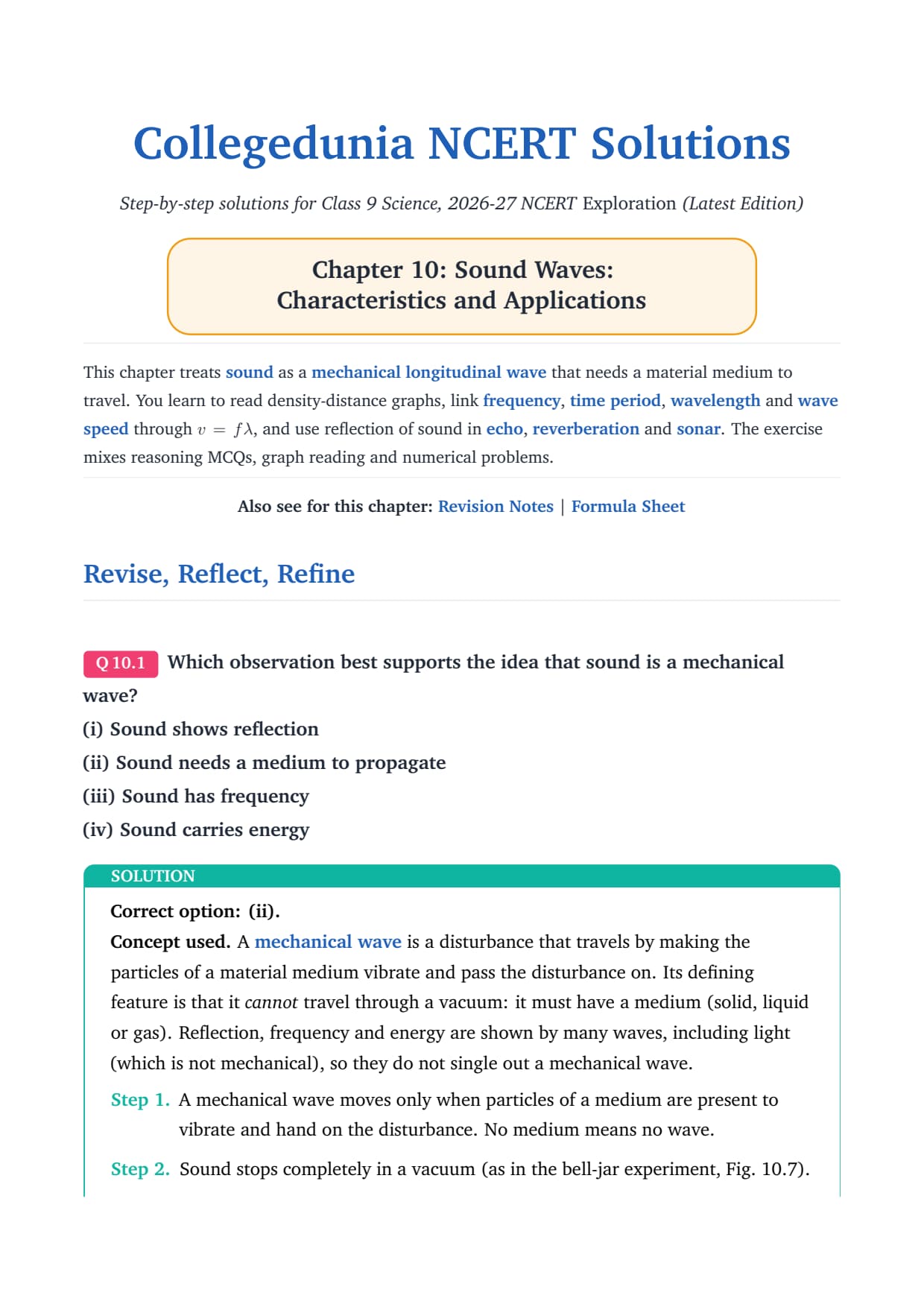
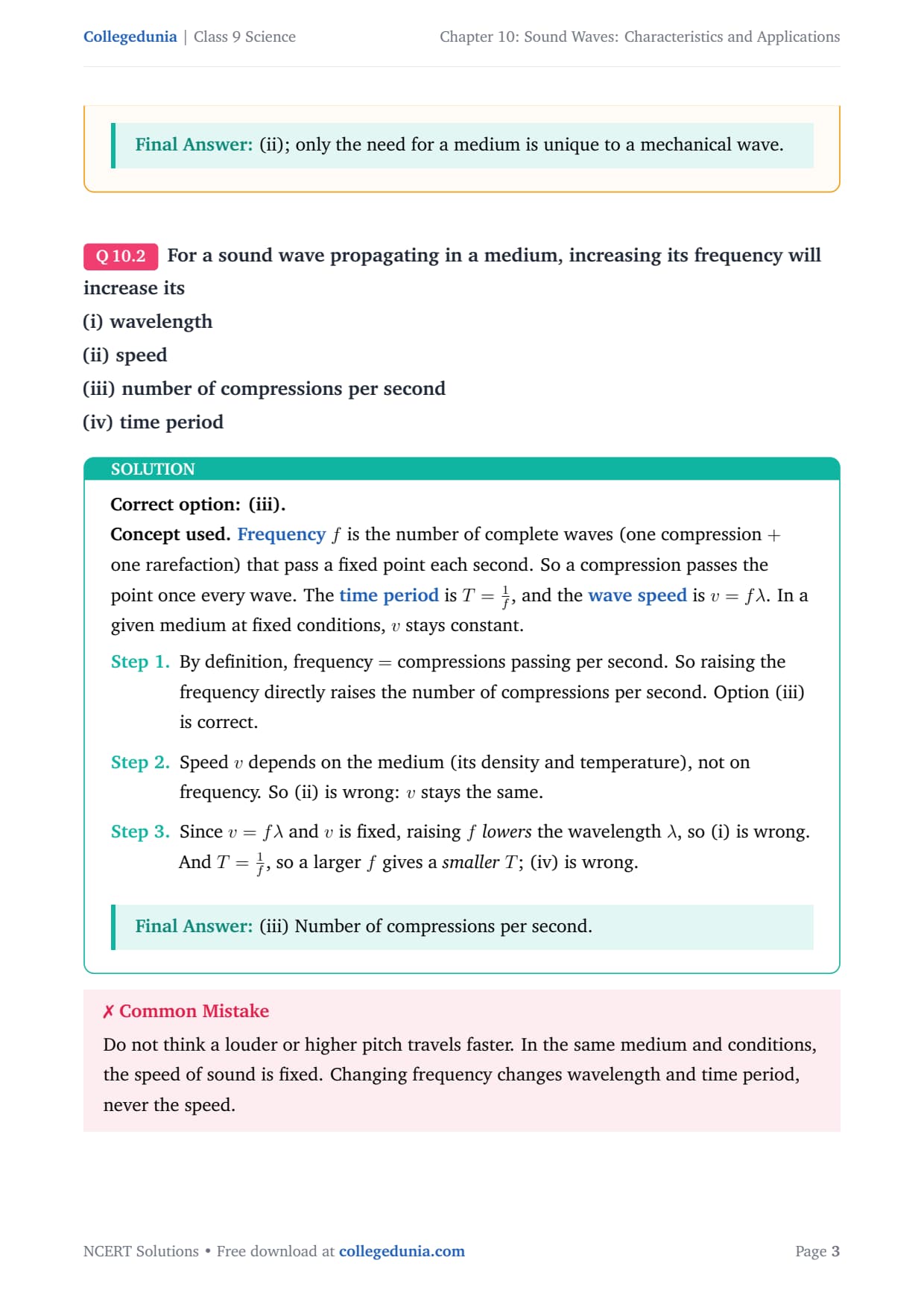
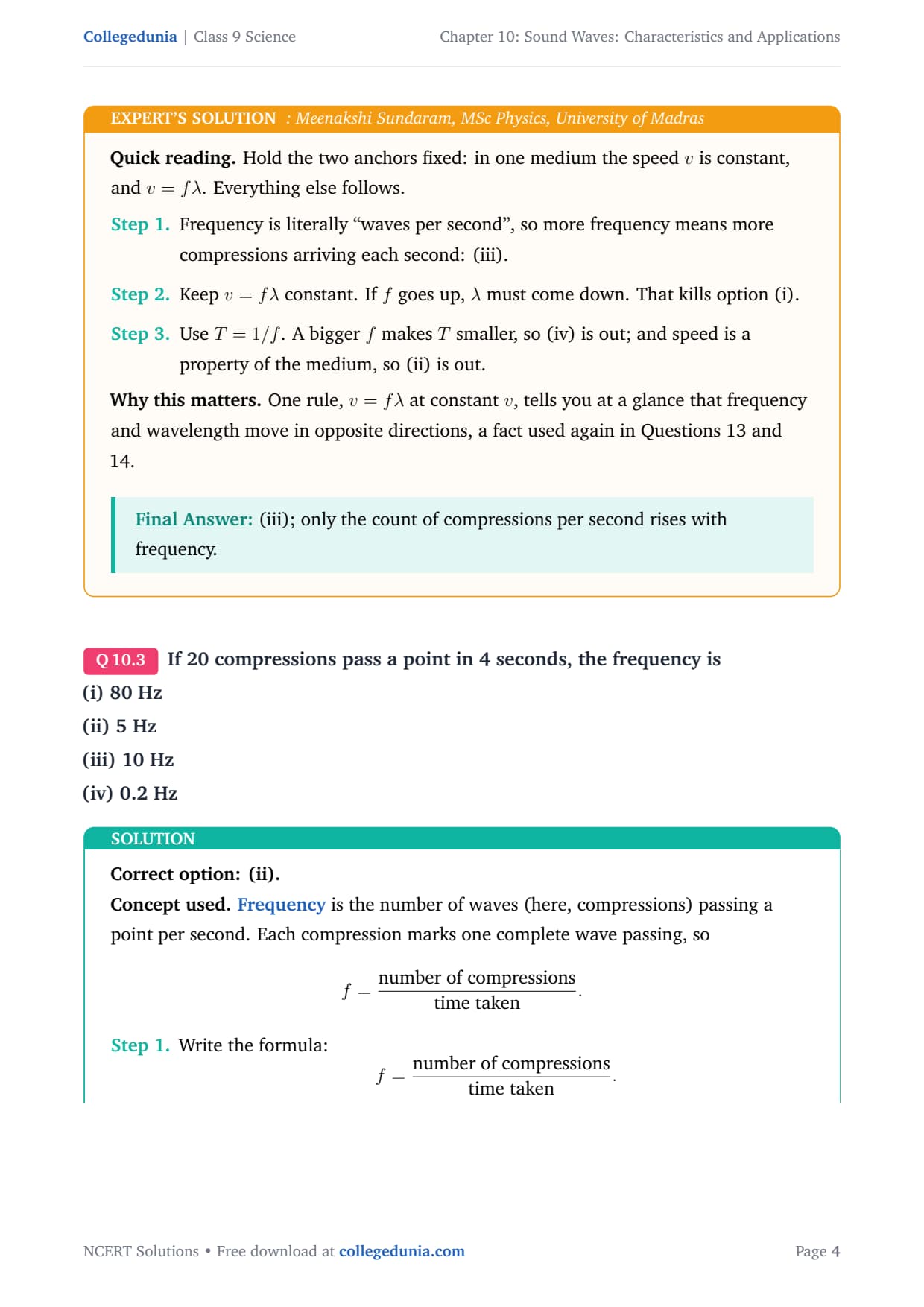
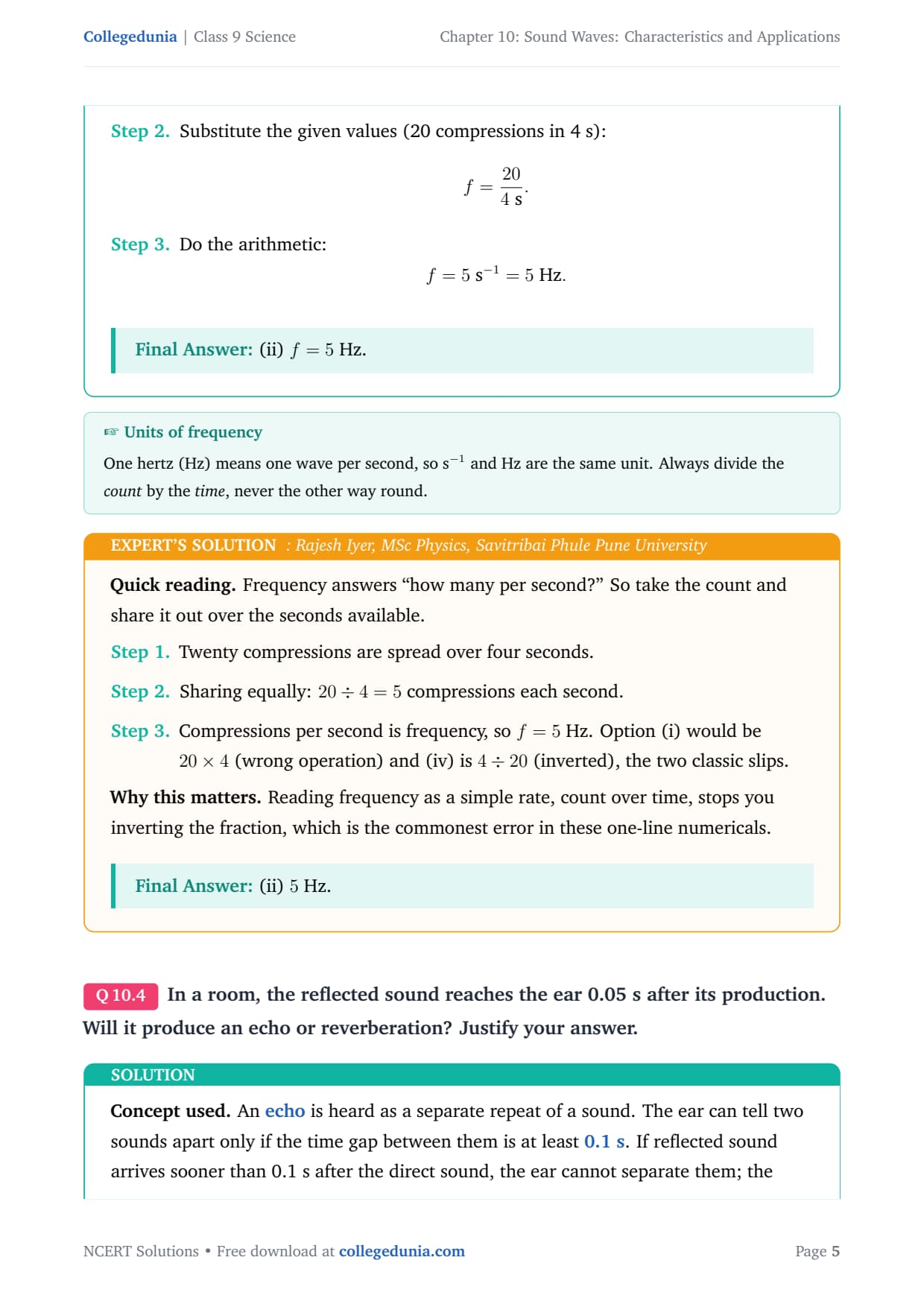
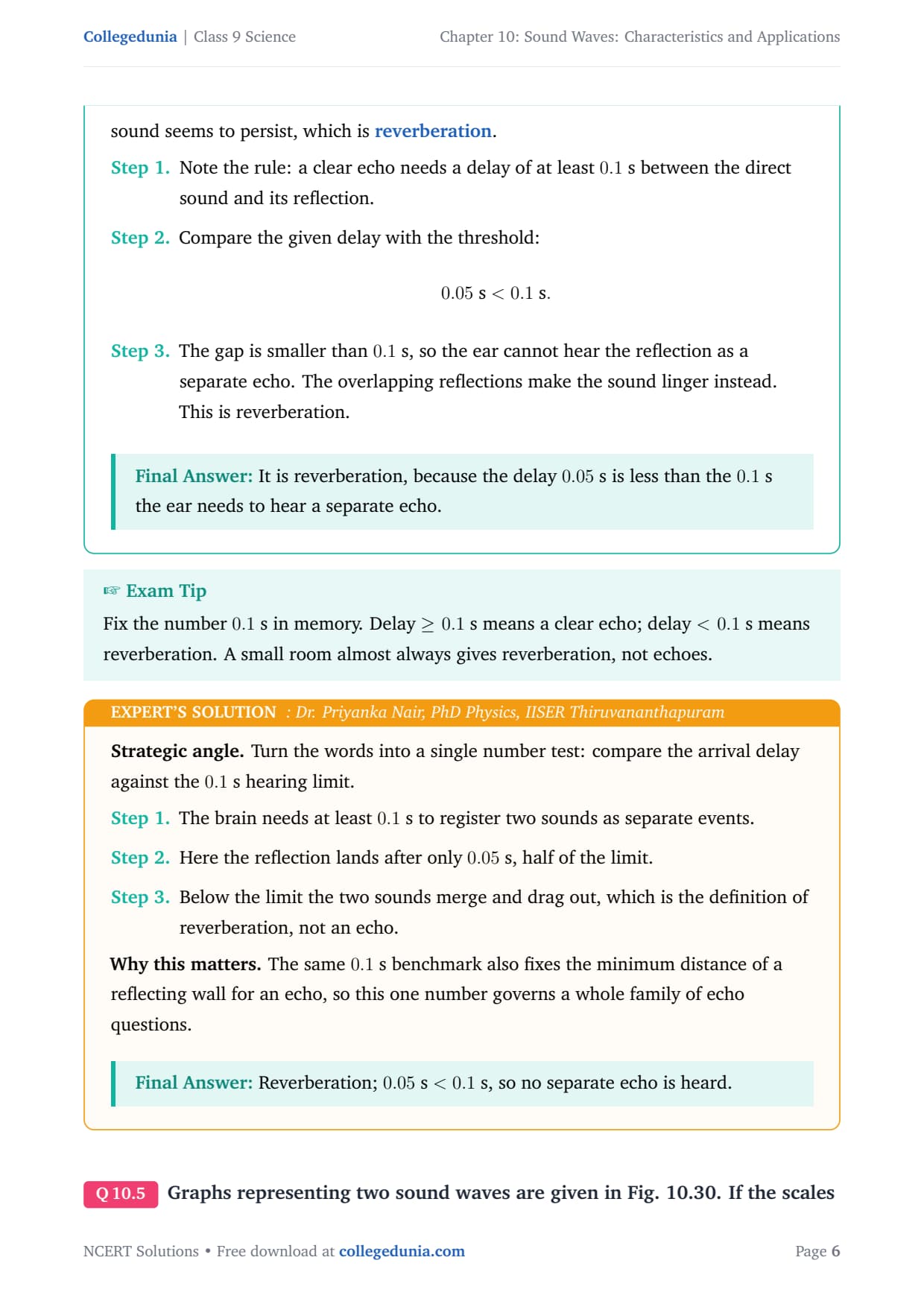
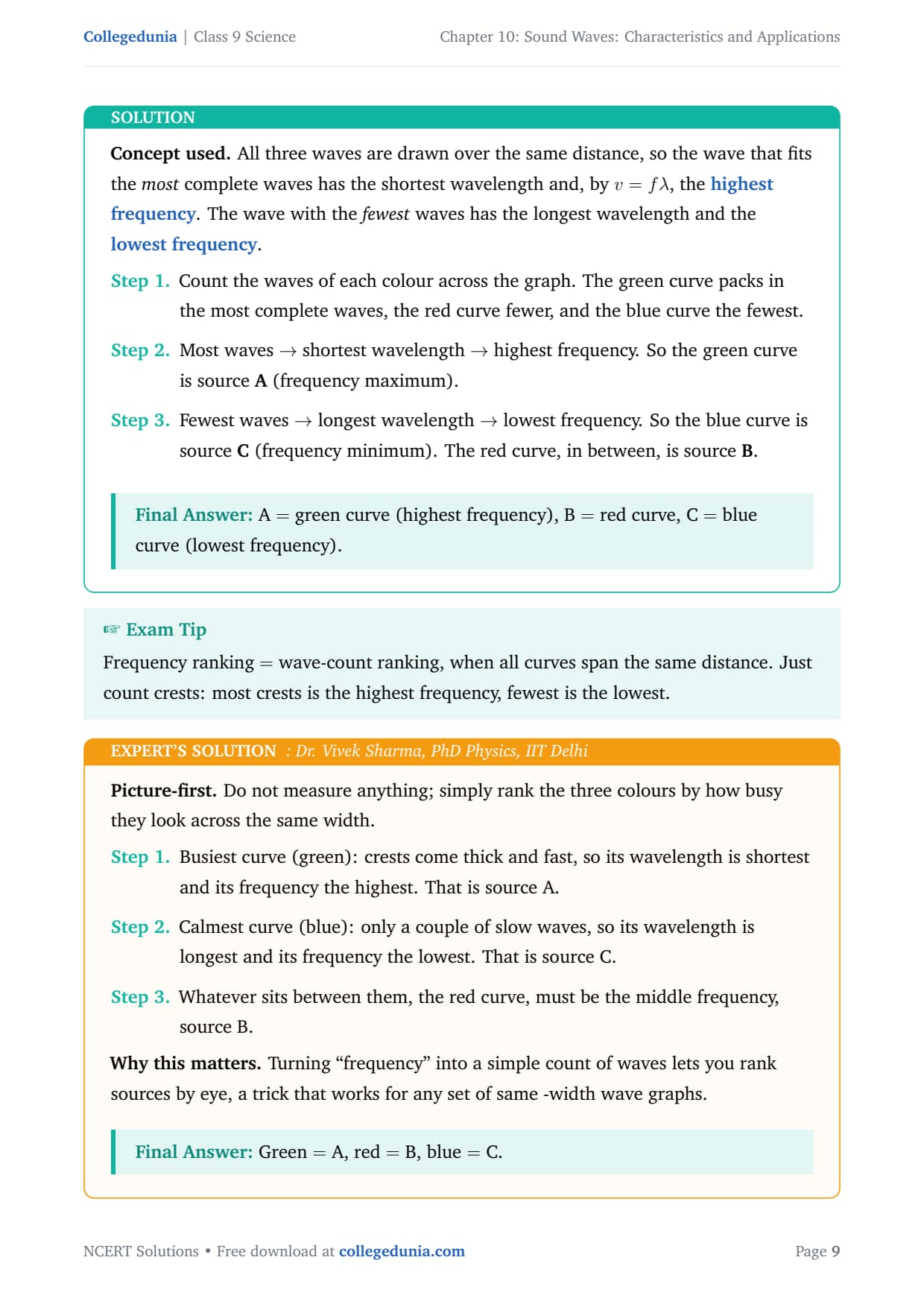
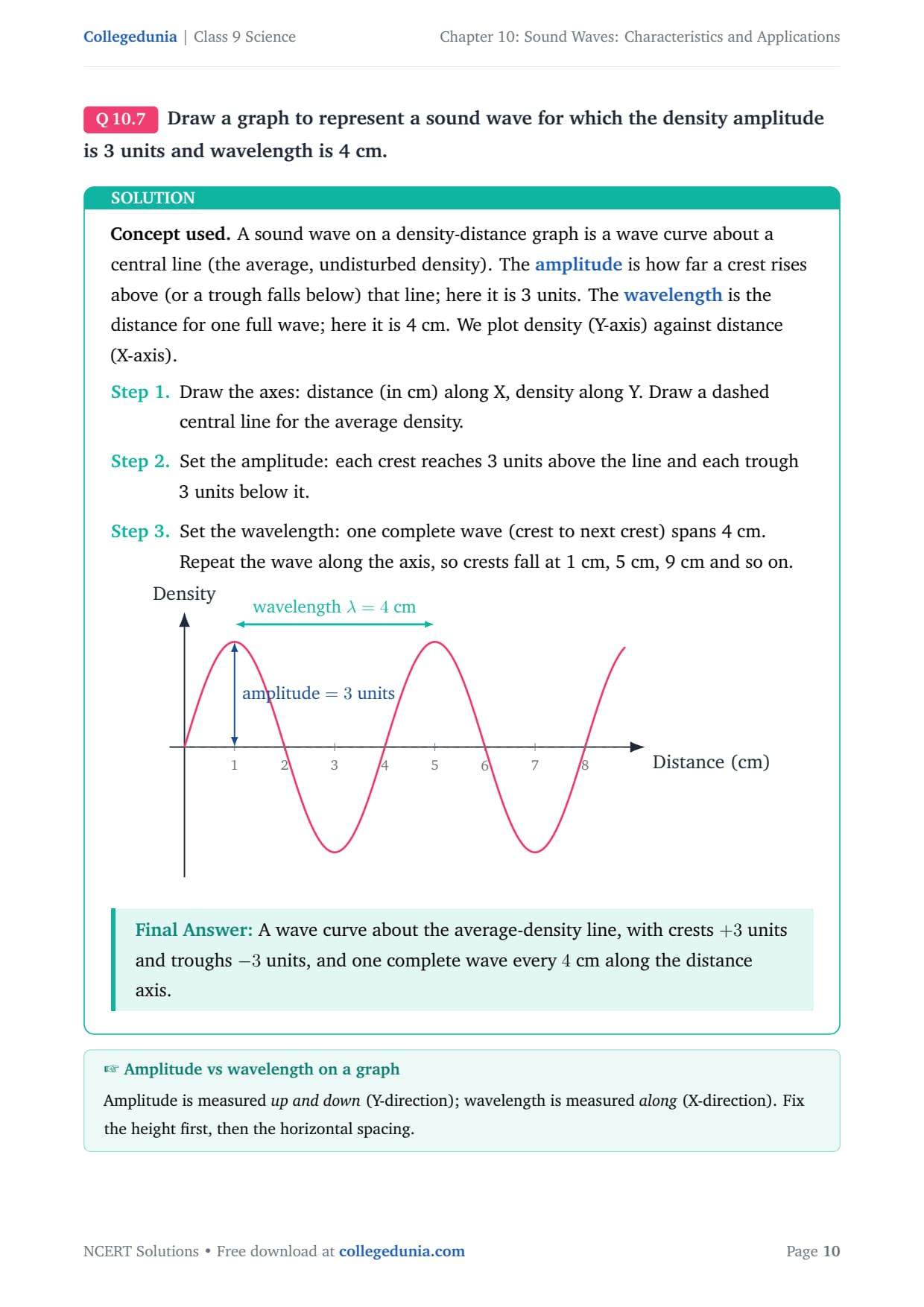
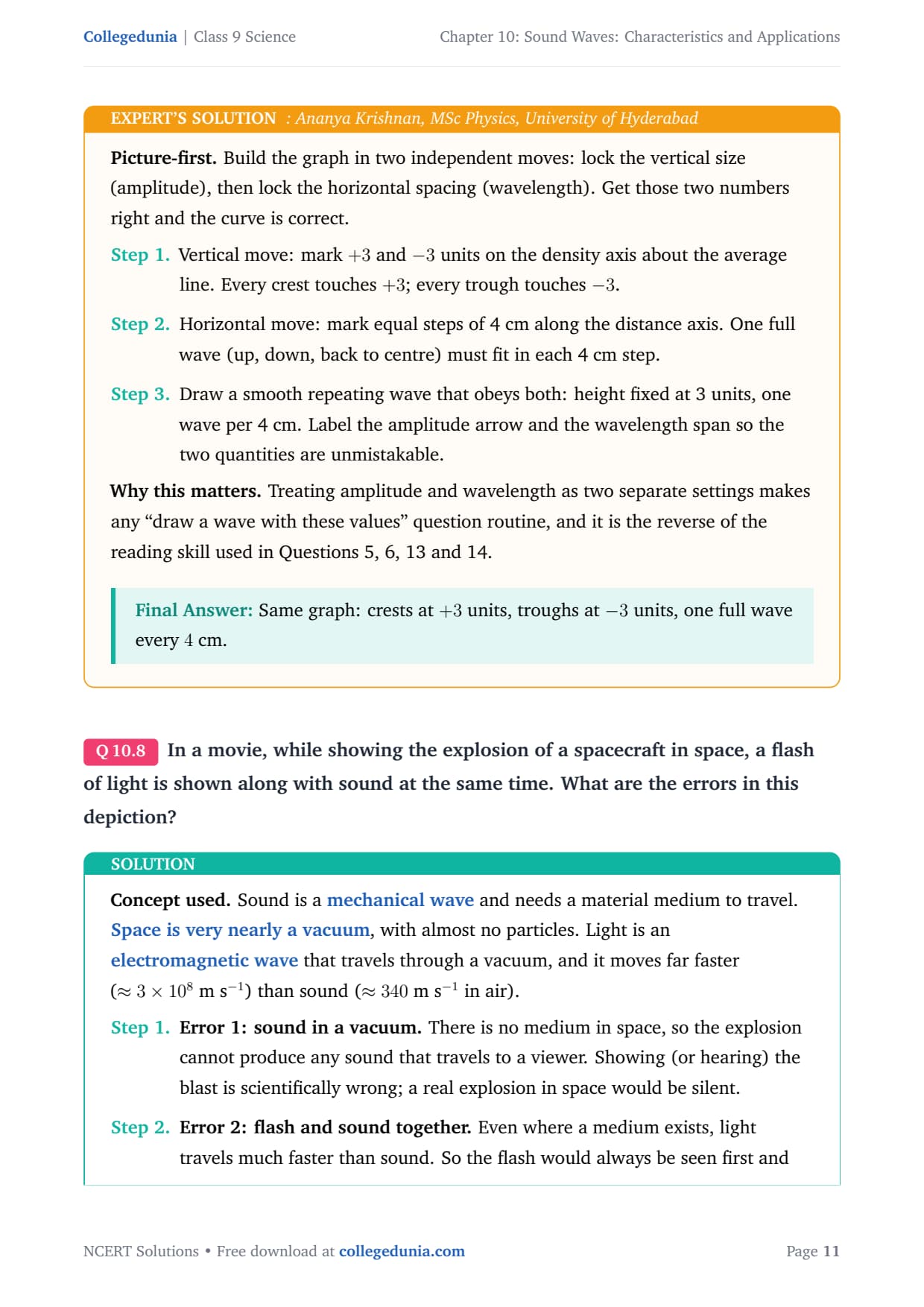
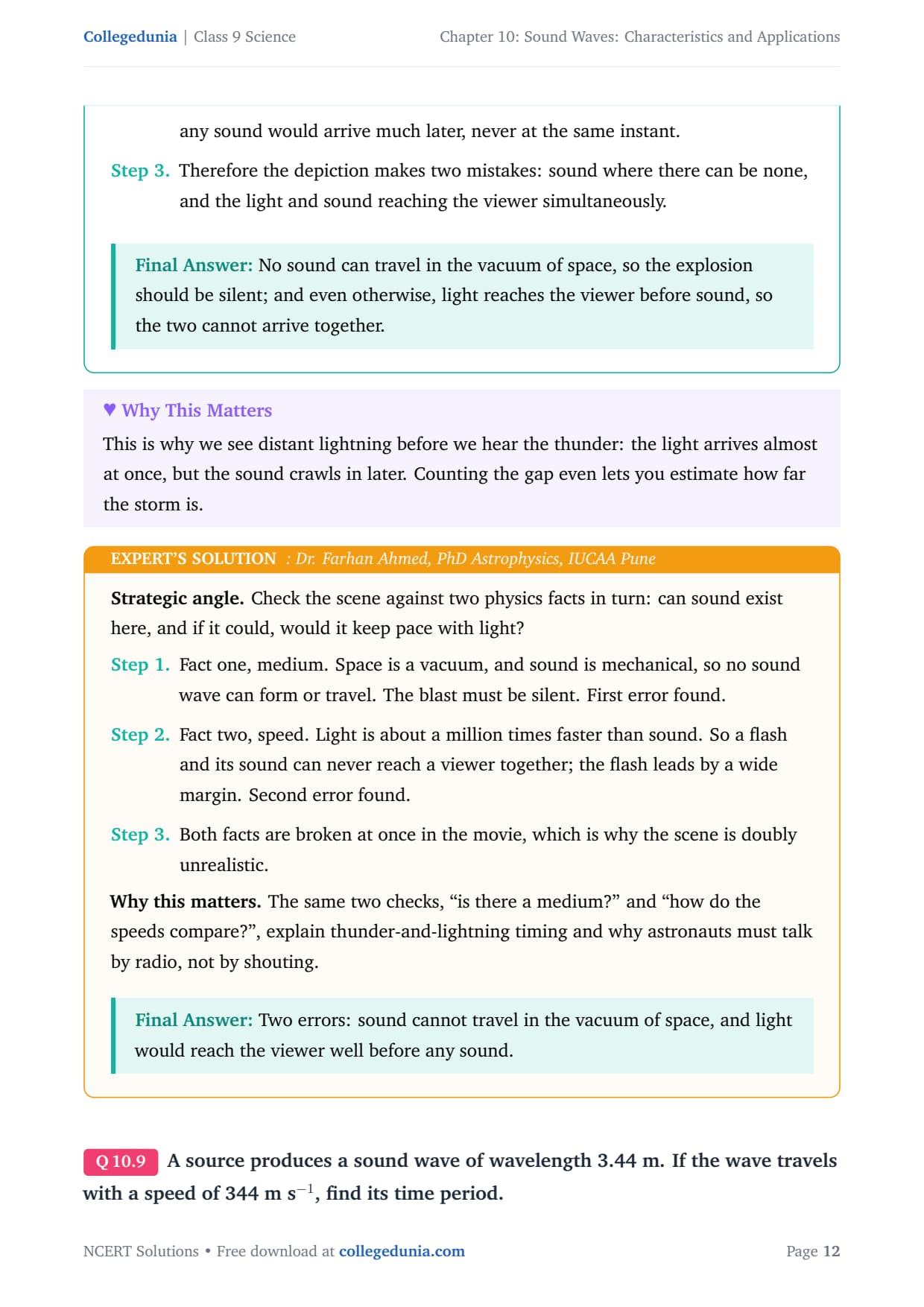
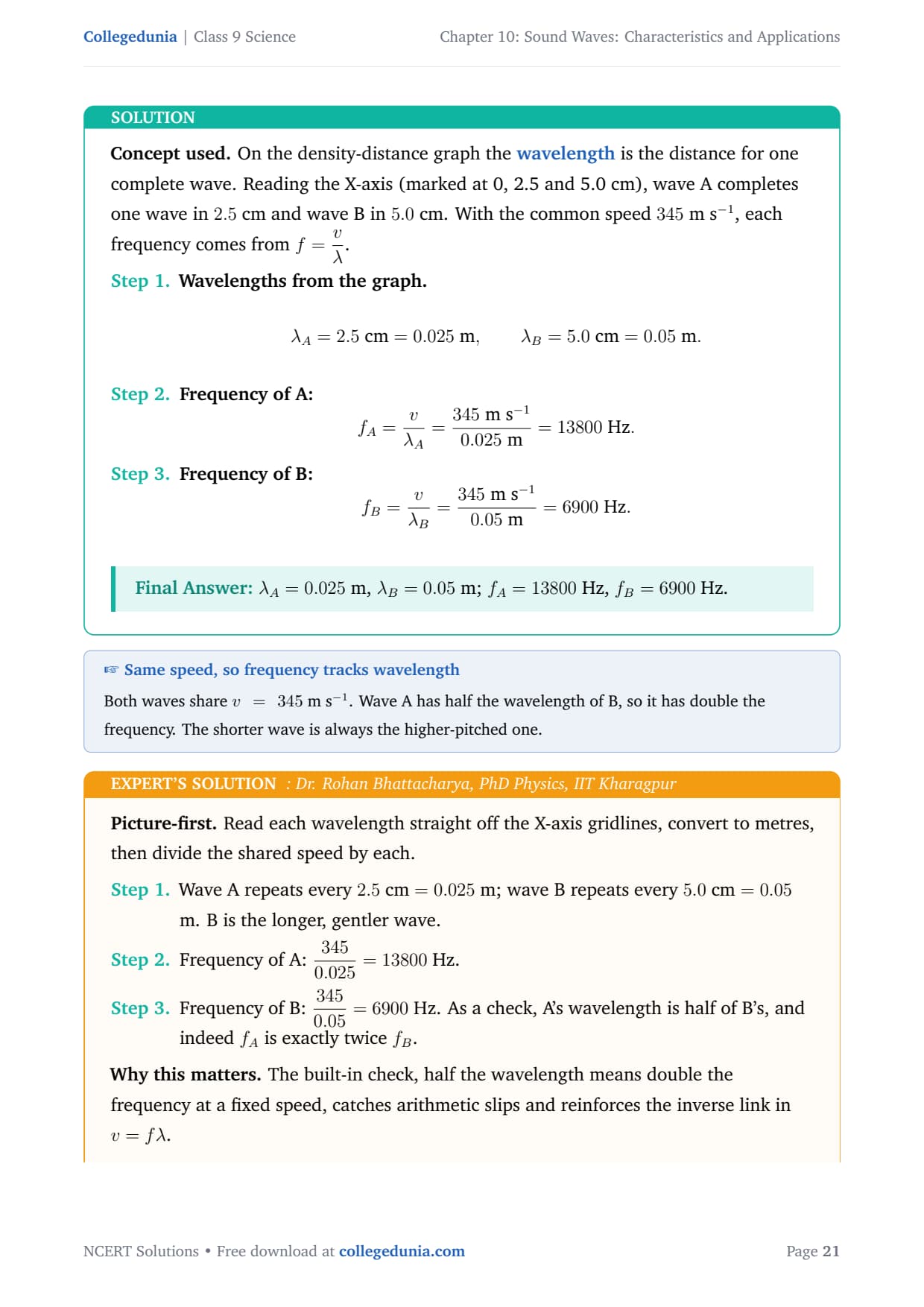
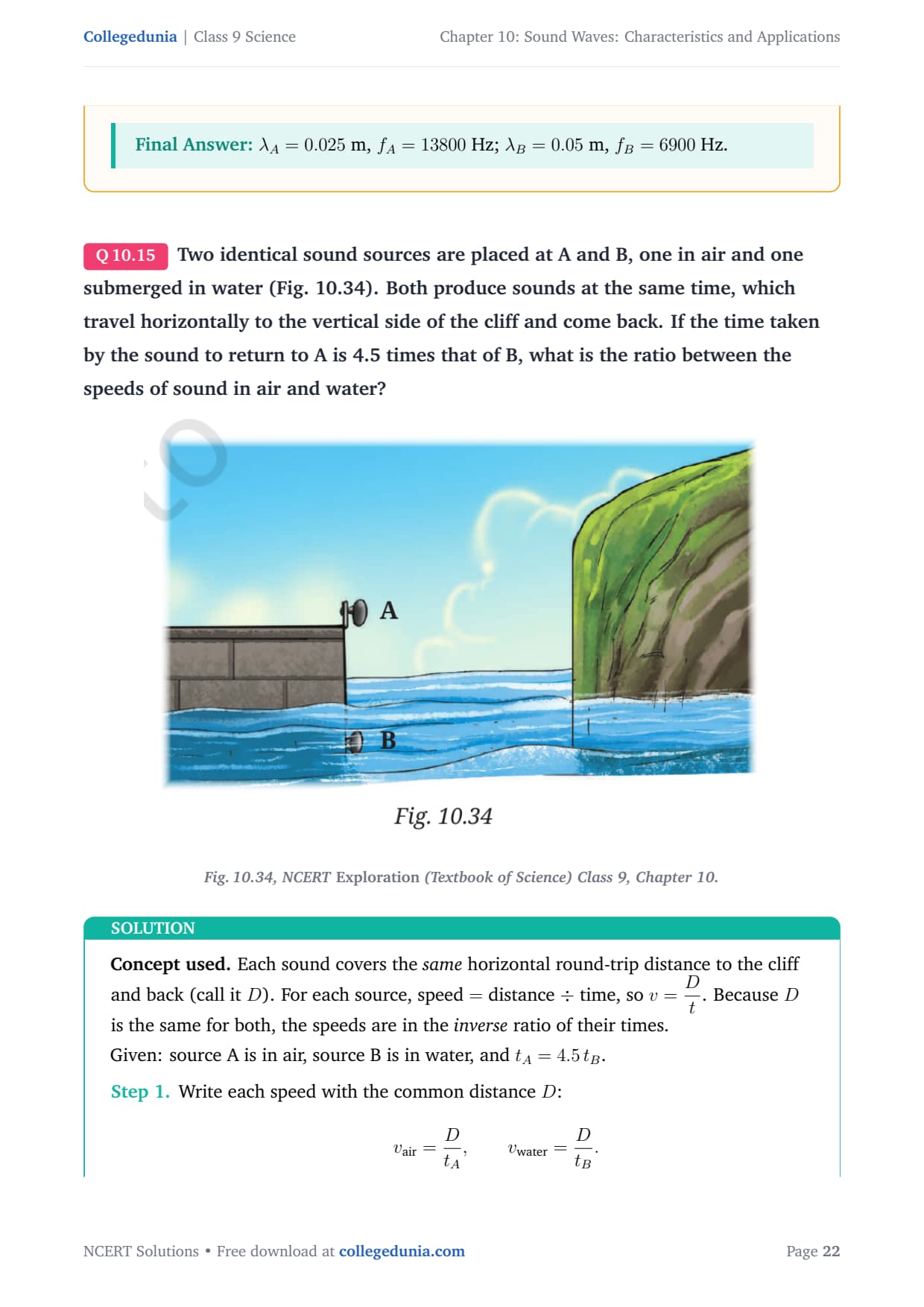
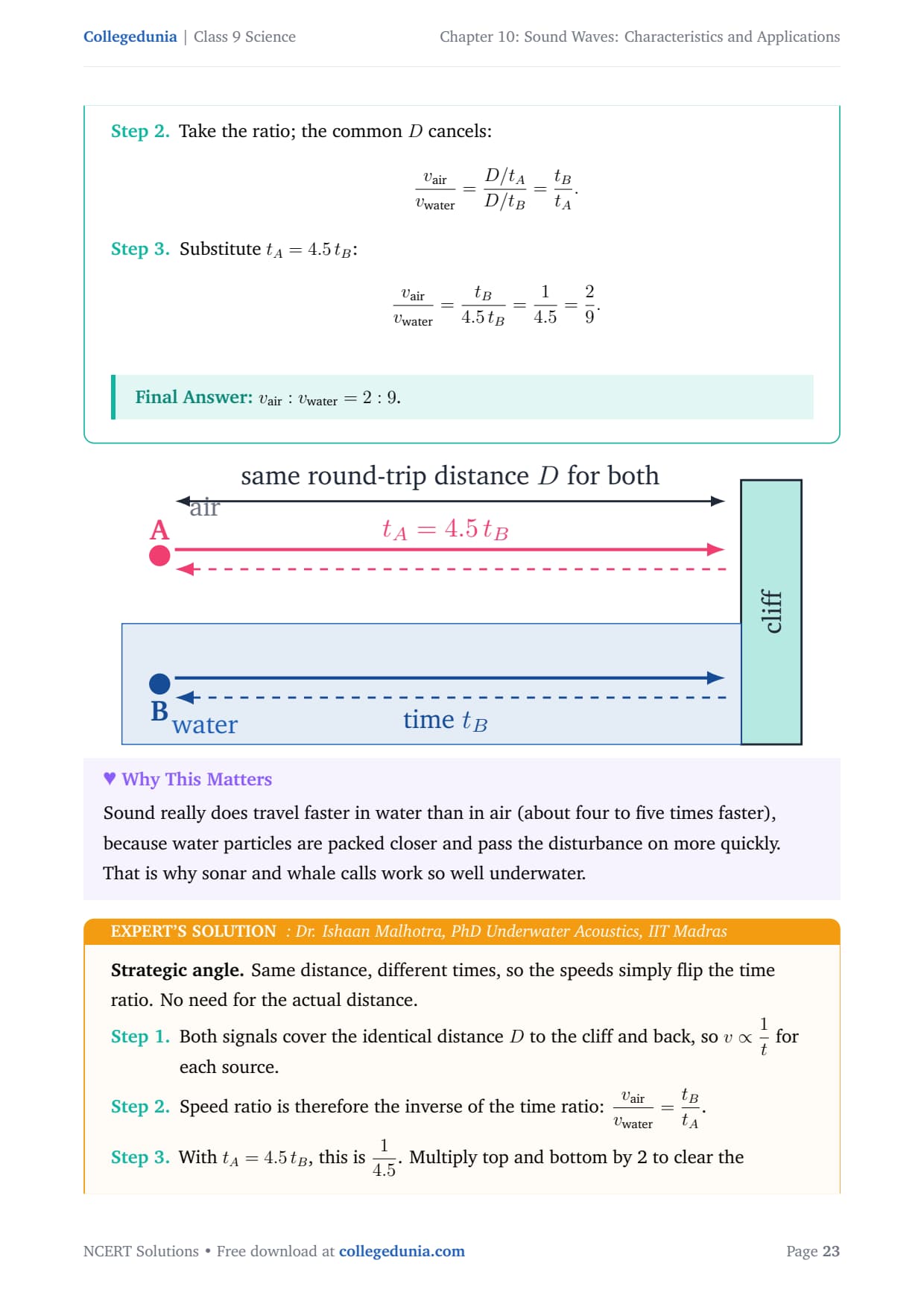
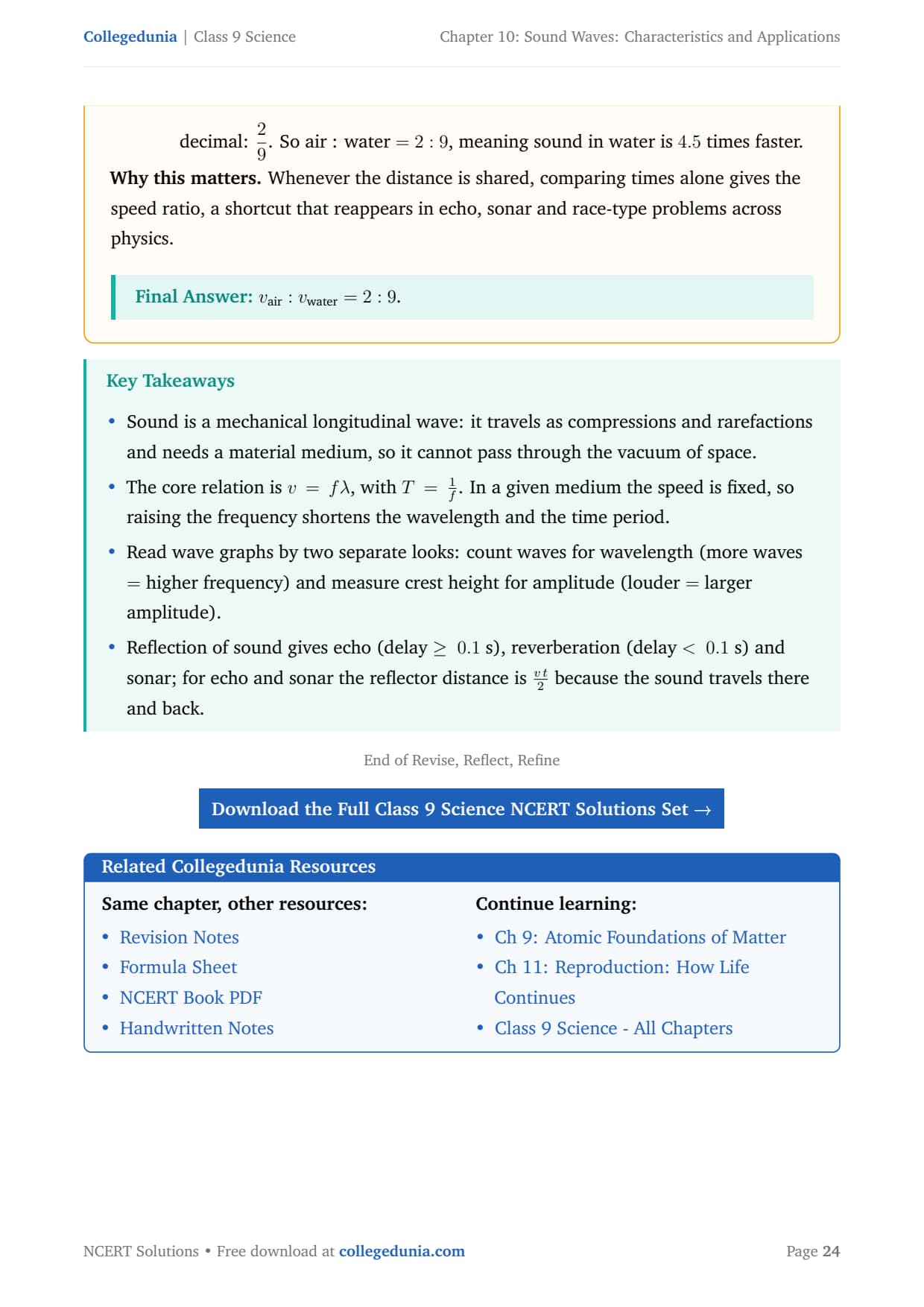
These NCERT Solutions for Class 9 Science Chapter 10 are prepared by subject experts, matched to the 2026-27 NCERT Exploration textbook, and checked against the official NCERT answer key.
- 15 solved questions from the Revise, Reflect, Refine exercise, covering sound as a wave, wave speed, echo, reverberation, and sonar.
- Every numerical shows the formula, substitution, and answer as separate steps, so no working is skipped.
- Based on the new 2026-27 NCERT Exploration textbook, with an expert method added to each question.
Student Feedback
In a Collegedunia poll of 11,460 Class 9 students taken before the 2026 exams, 68% said they most often mixed up echo and reverberation in this chapter. Most students rated the sonar and wave-speed numericals as the trickiest part. Students who solved all 15 Revise, Reflect, Refine questions said they felt far more confident with the graph-reading questions on exam day.
Source: 2026-27 Class 9 Science student poll. Sample of 11,460 students from CBSE schools across 14 states.
Sound Waves Class 9 Explained in Simple Language
Source: Magnet Brains on YouTube
This one-shot video walks through the whole chapter before you start the exercise. Watch it once, then use the step-by-step solutions below to practise each question.
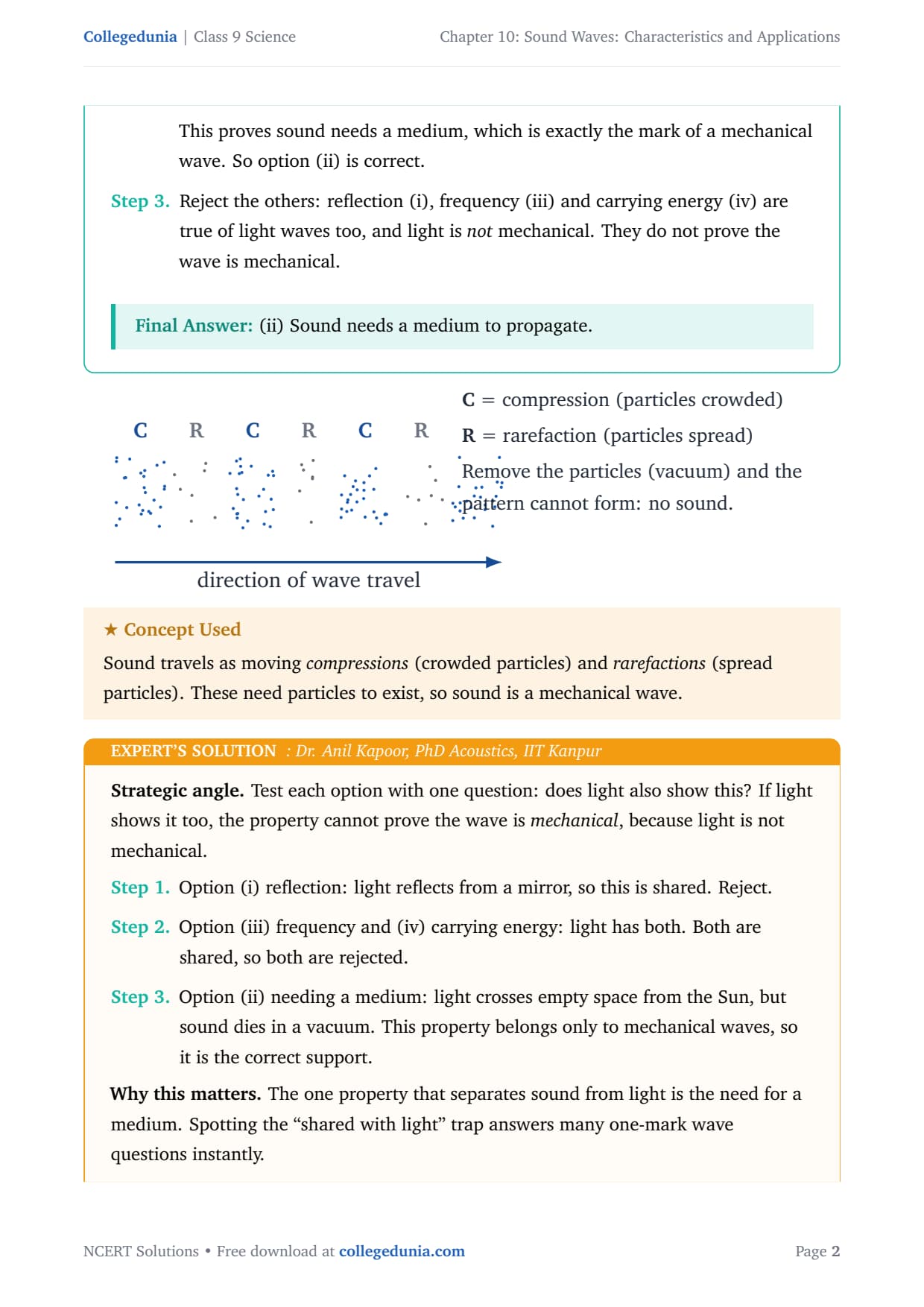
Sound is a mechanical wave, which means it needs a material medium such as air, water, or a solid to travel. It cannot pass through a vacuum, so a bell ringing inside an airless jar falls silent. Sound travels as a longitudinal wave, moving forward through repeating compressions (crowded particles) and rarefactions (spread-out particles).
- Compression: a region where particles of the medium are pushed close together, giving high pressure and density.
- Rarefaction: a region where particles are spread apart, giving low pressure and density.
- Longitudinal motion: the particles vibrate back and forth along the same line the wave travels, not across it.
This is the core idea that runs through the whole Chapter 10 exercise. Once you can picture sound as moving compressions and rarefactions, the graph-reading and numerical questions become much easier to attempt.
How Collegedunia's Class 9 Sound Waves NCERT Solutions Help You
Chapter 10 mixes reasoning questions, graph reading, and short numericals, so a clear method matters. These Class 9 Science Chapter 10 solutions make each question easy to attempt and easy to score.
- 2026-27 NCERT alignment: Every answer matches the new Exploration textbook and the official NCERT answer key.
- Full working shown: Formula, substitution, and final answer sit on separate lines, so you never lose method marks.
- Expert method added: A second, faster approach is given below each solution to save time in the exam.
- Concepts made clear: Each solution starts with the exact idea it uses, such as v = f λ or the 0.1 second echo rule.
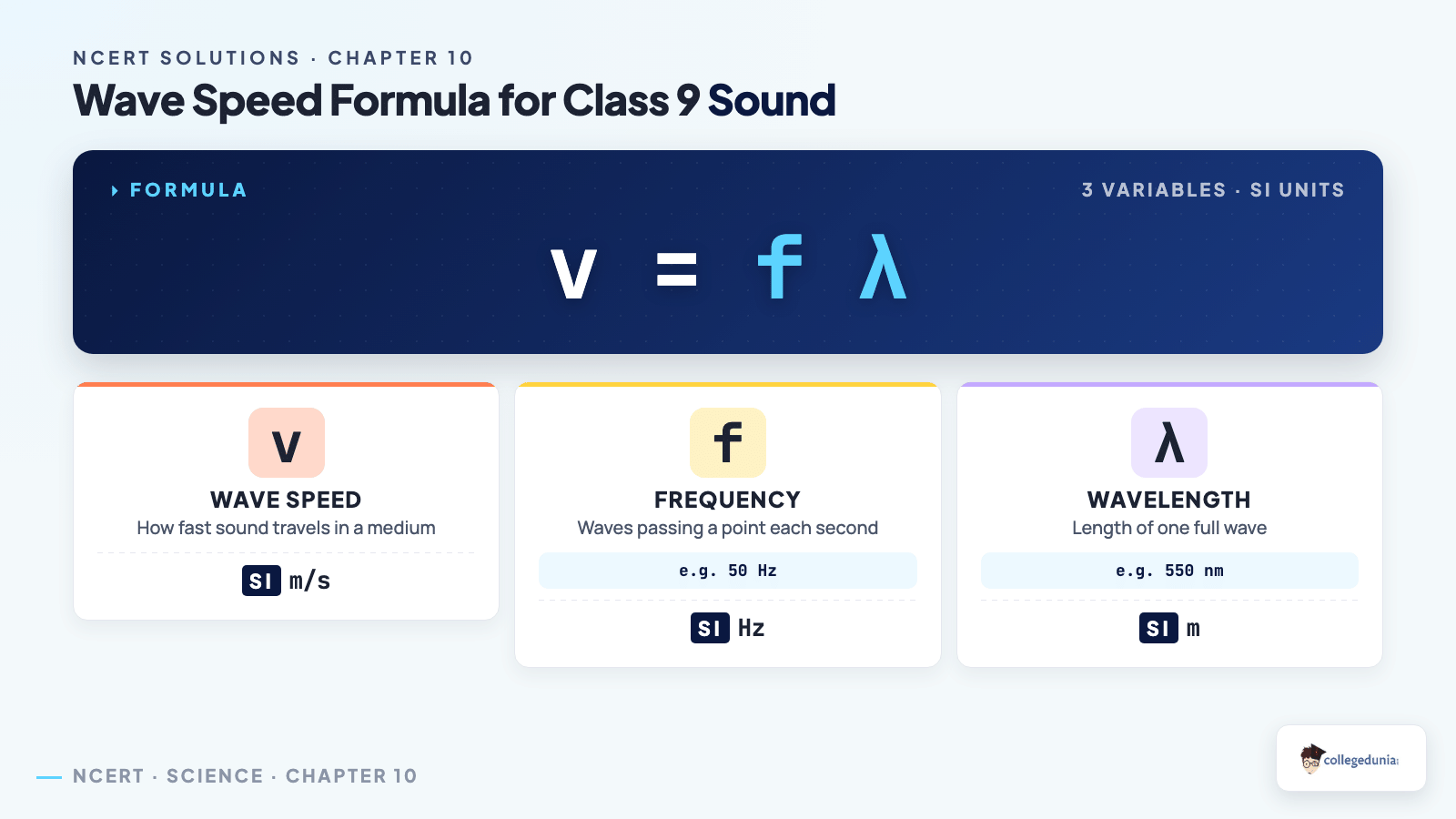
Sound Waves Characteristics and Applications Class 9 Important Formulas
Almost every numerical in this chapter uses one of the relations below. Learn them first, and know what each symbol means. Frequency is measured in hertz (Hz), wavelength and distance in metres (m), and speed in metres per second (m/s).
| Quantity | Formula | What it means |
|---|---|---|
| Wave speed | v = f × λ | Speed equals frequency times wavelength; the master relation for sound. |
| Time period | T = 1 / f | Time for one full wave; the reciprocal of frequency. |
| Frequency | f = compressions / time | Number of compressions (waves) passing a point each second. |
| Echo / sonar distance | d = (v × t) / 2 | Distance to a reflector; halved because sound travels there and back. |
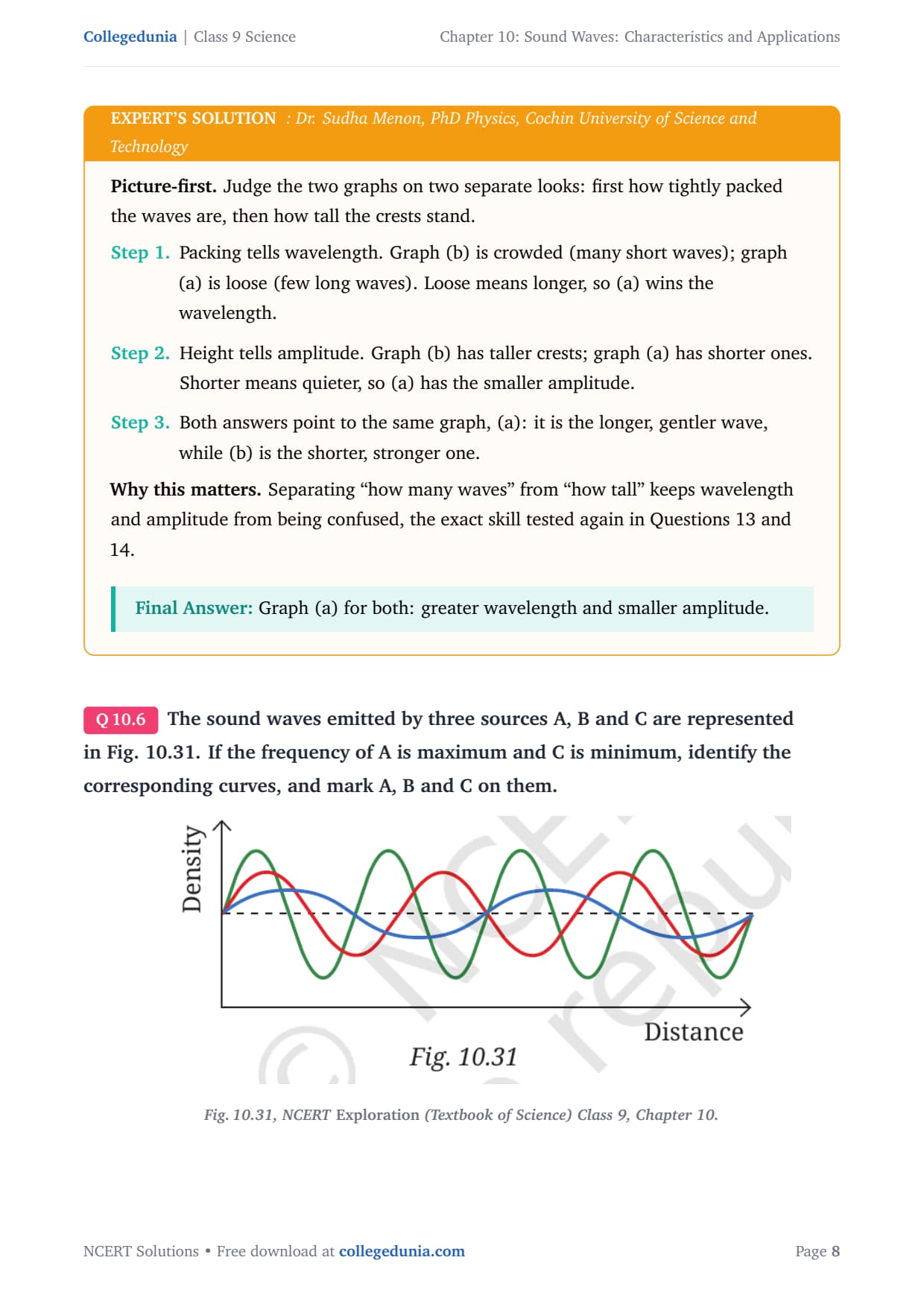
The one relation to fix firmly is v = f λ. In a given medium the speed of sound is constant, so raising the frequency shortens the wavelength, and lowering the frequency lengthens it. This single idea answers Questions 2, 13, and 14 of the exercise.
Revise, Reflect, Refine Exercise Breakdown for Class 9 Science Chapter 10
The Chapter 10 exercise is called Revise, Reflect, Refine and has 15 questions. The table shows what each question tests, so you can plan your practice.
| Questions | Type | What it tests |
|---|---|---|
| 1 to 3 | Reasoning MCQ | Sound as a mechanical wave, effect of frequency, and frequency from compressions. |
| 4 | Reasoning | Deciding between echo and reverberation using the 0.1 second rule. |
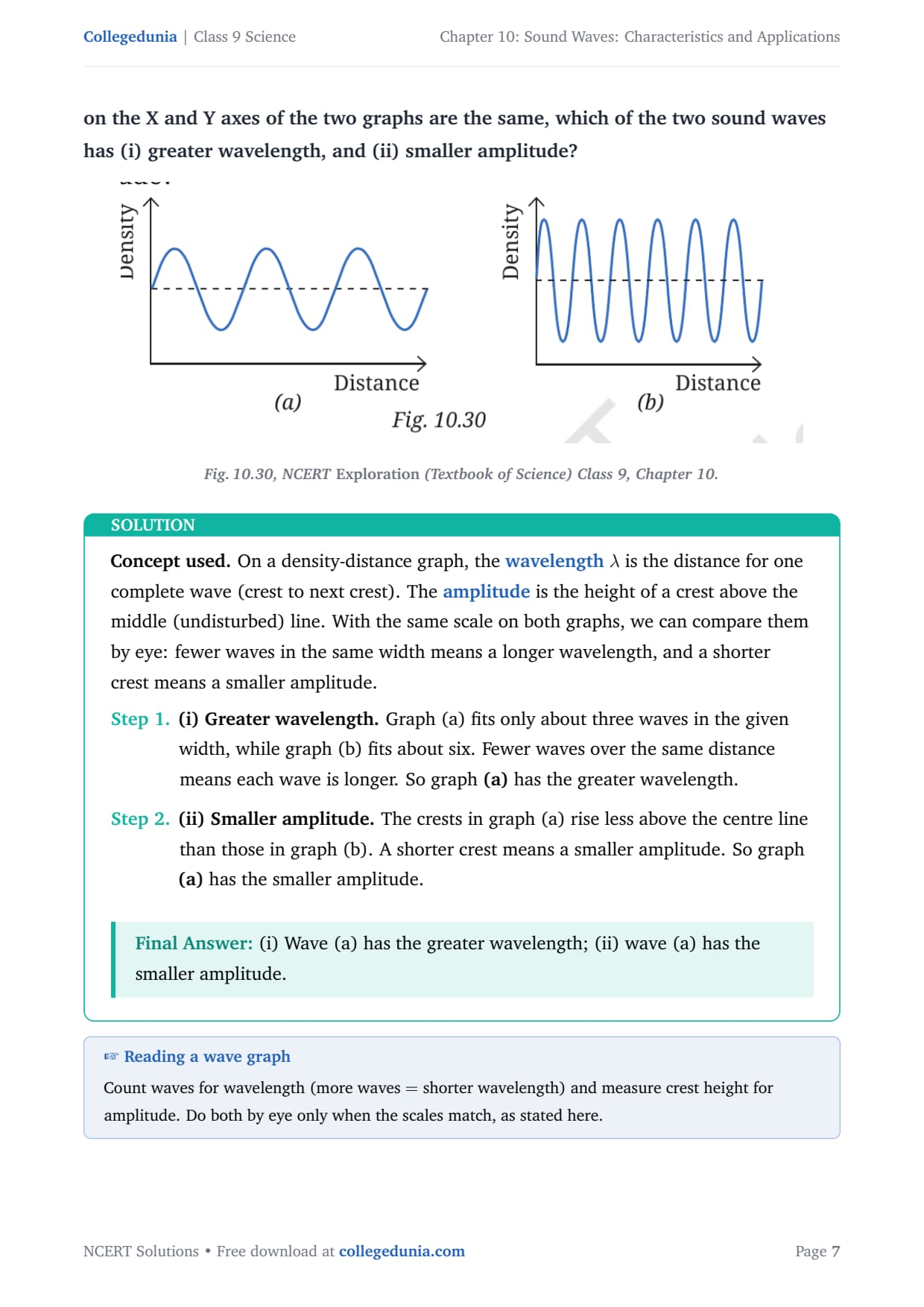
| 5 to 7 | Graph reading + drawing | Comparing wavelength and amplitude, and drawing a wave from given values. |
| 8 to 9 | Reasoning + numerical | Sound in space and finding time period from wave speed. |
| 10 to 15 | Numerical + graph | Sonar depth, echolocation time, temperature effect, and wave-speed calculations. |
Start with the reasoning questions, then move to the graph and numerical questions. All 15 fully solved answers, with an expert method for each, are given lower down this page.
Characteristics of Sound Waves: Frequency, Wavelength, and Amplitude
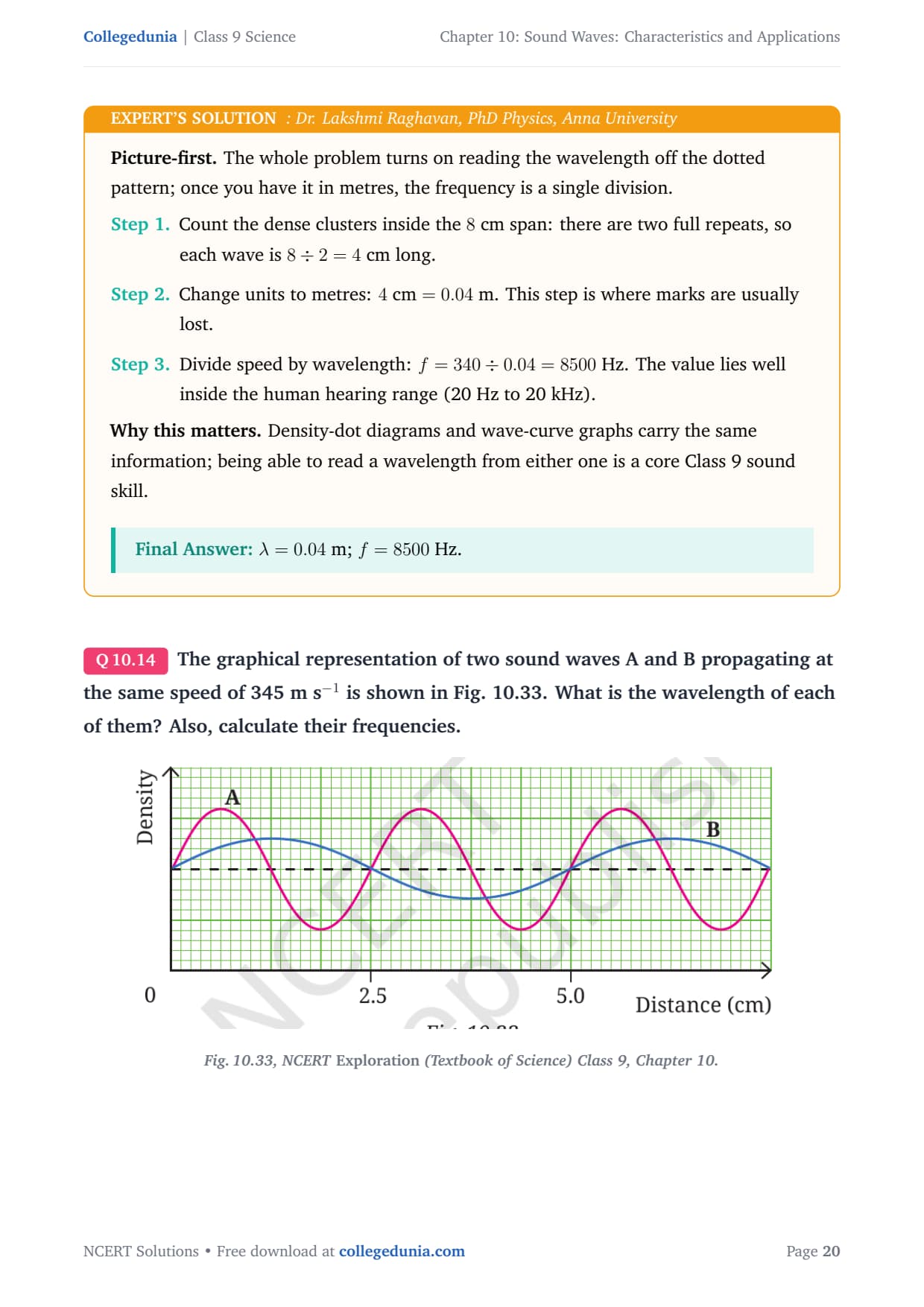
Three properties describe every sound wave, and each one controls something you can hear. Reading these correctly off a graph is a key skill tested in Questions 5, 6, and 14.
- Frequency (f): how many waves pass a point each second, measured in hertz. Higher frequency means a higher pitch.
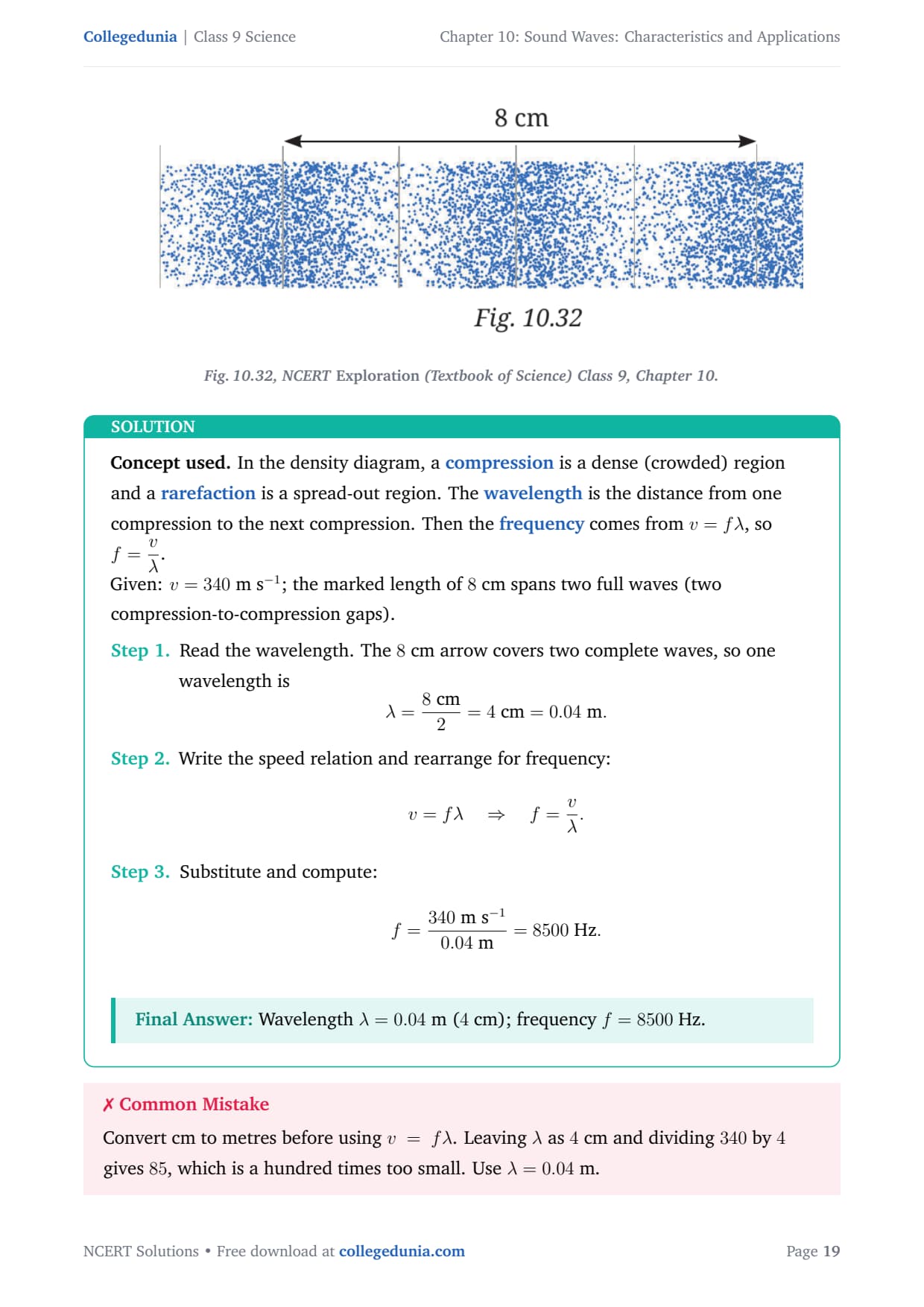
- Wavelength (λ): the length of one full wave, from one compression to the next. At a fixed speed, a shorter wavelength means a higher frequency.
- Amplitude: how far particles move from their rest position, shown by the height of a crest. A larger amplitude means a louder sound.
To read a wave graph, use two separate looks. Count the waves for wavelength, and measure the crest height for amplitude, but only compare two graphs by eye when their scales are the same, as the exercise states.
Reflection of Sound: Echo, Reverberation, and Sonar in Class 9 Science
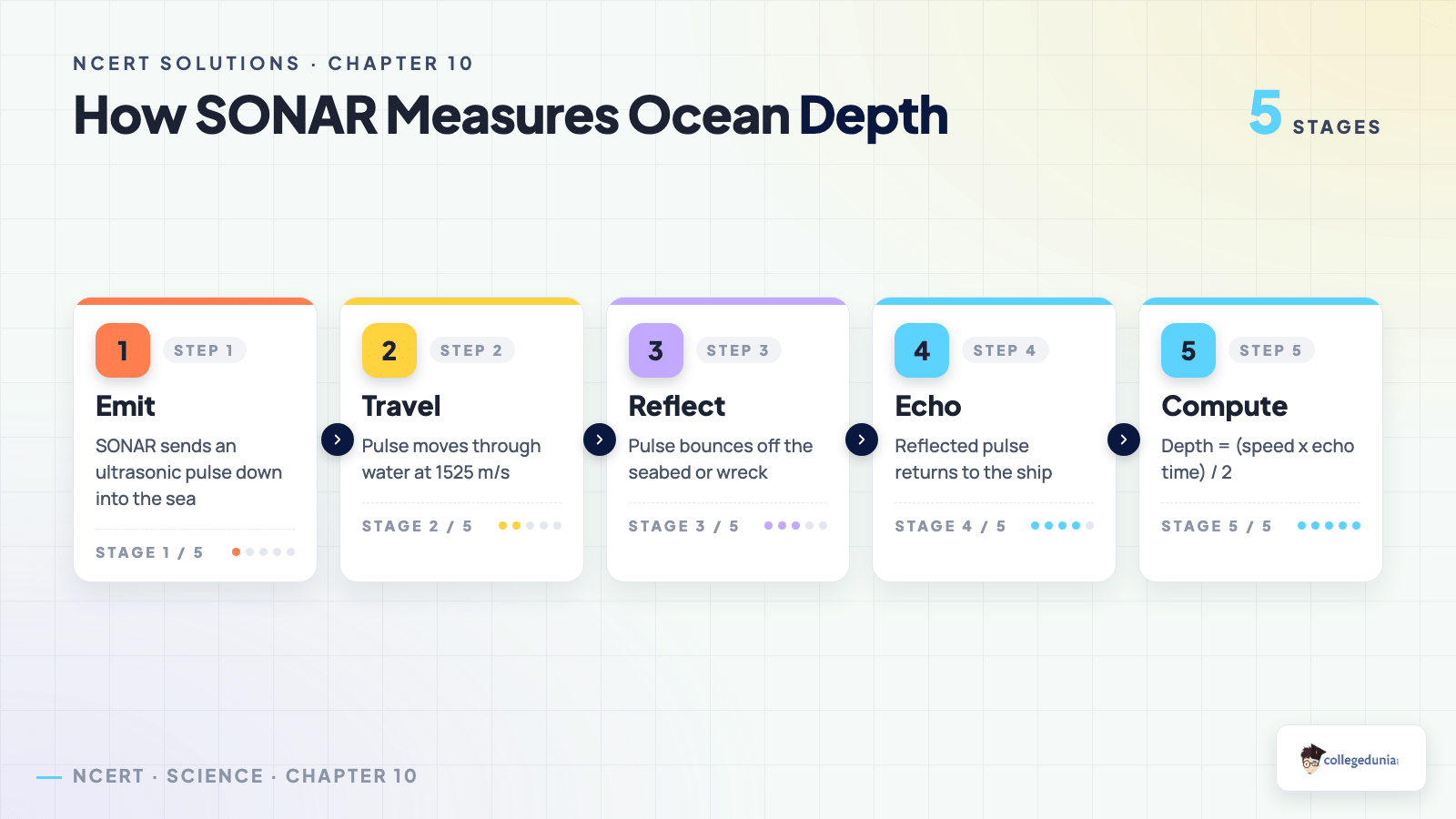
When sound hits a hard surface, it bounces back. This reflection of sound explains three important applications in the chapter.
- Echo: a clear, separate repeat of a sound. The ear needs a gap of at least 0.1 second between the direct sound and its reflection to hear an echo.
- Reverberation: when reflections arrive sooner than 0.1 second, they merge and the sound seems to linger. This is common in small rooms and large halls.
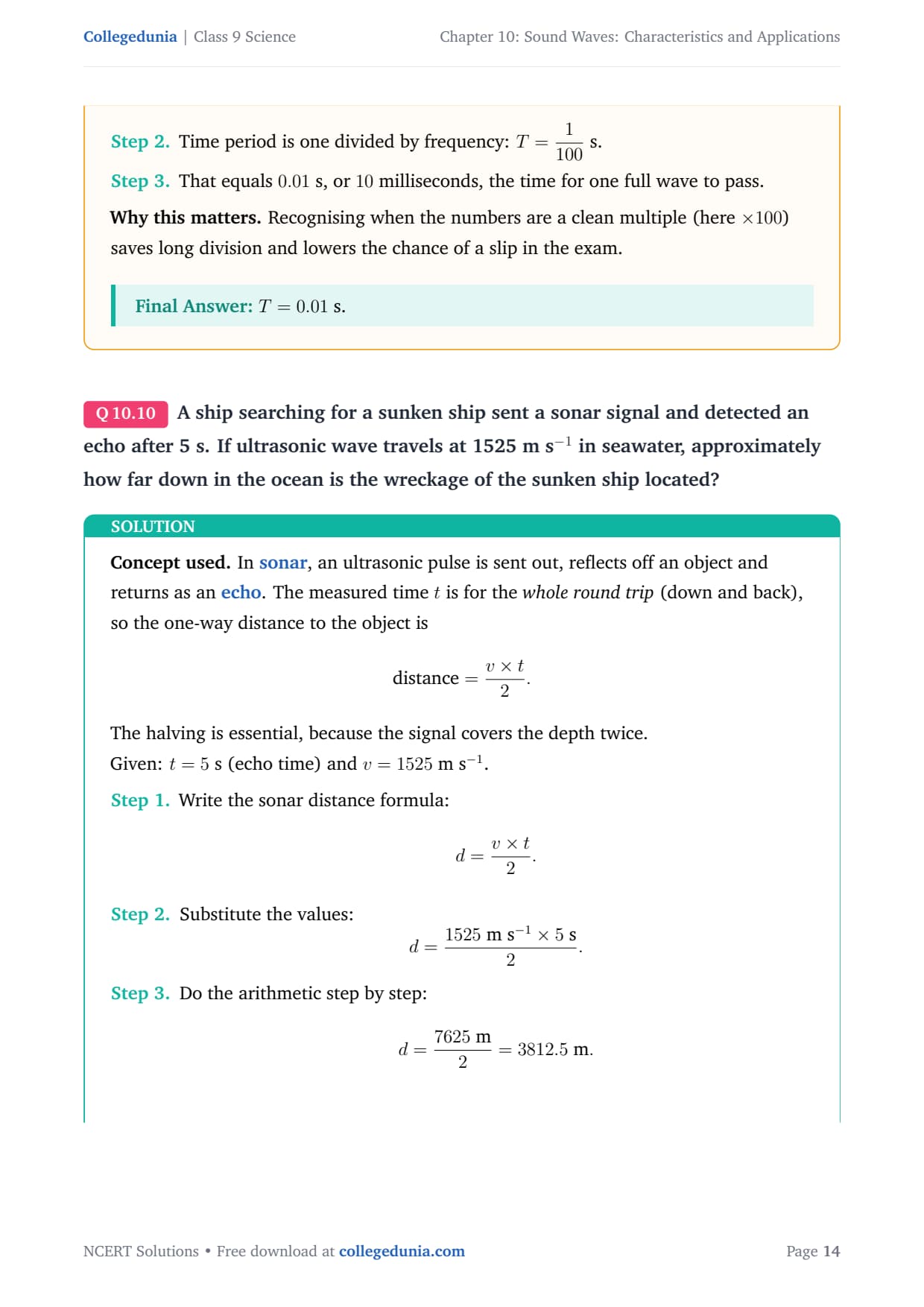
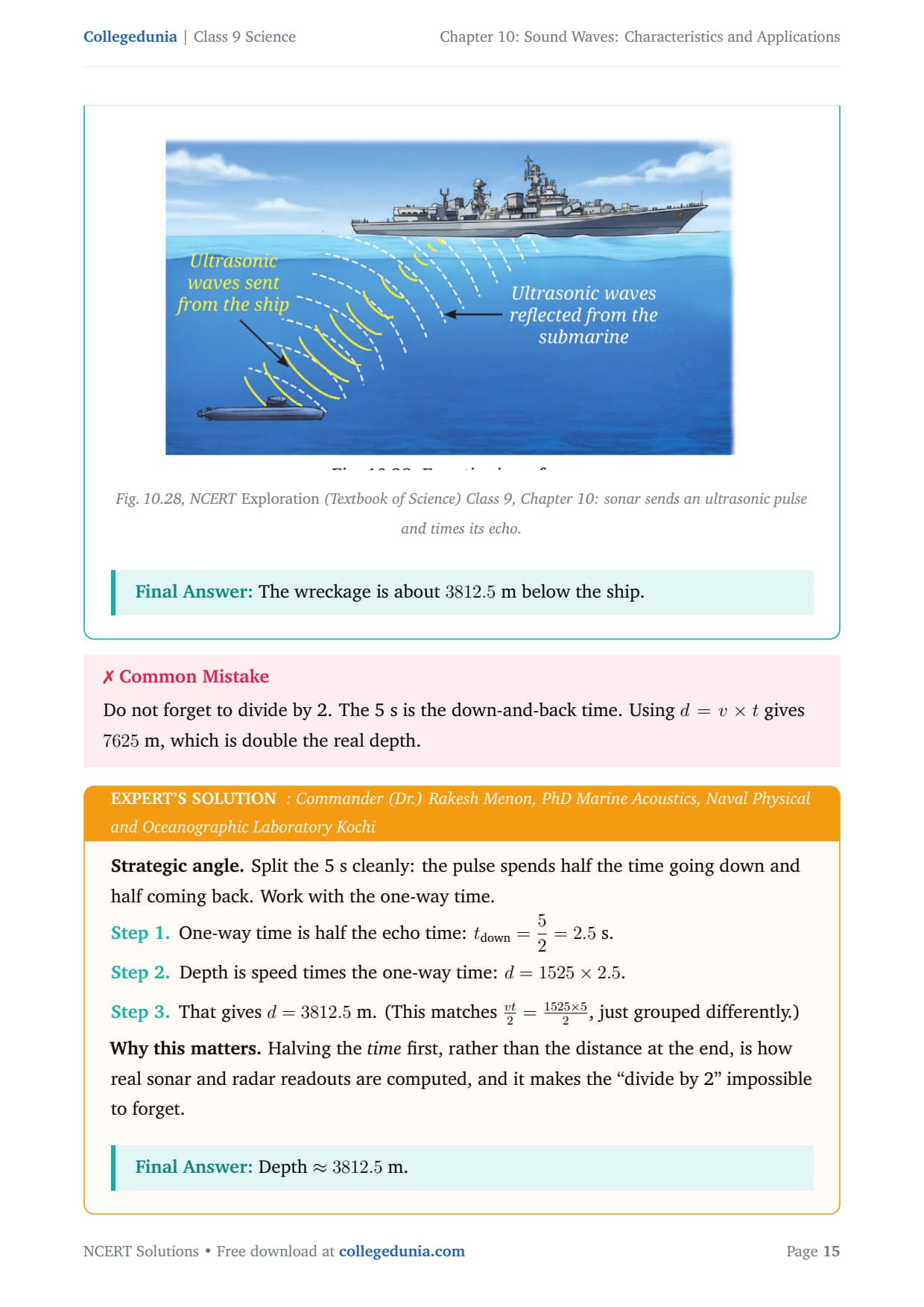
- Sonar: a device that sends an ultrasonic pulse and times its echo to find the depth of the sea or the distance of an object using d = (v × t) / 2.
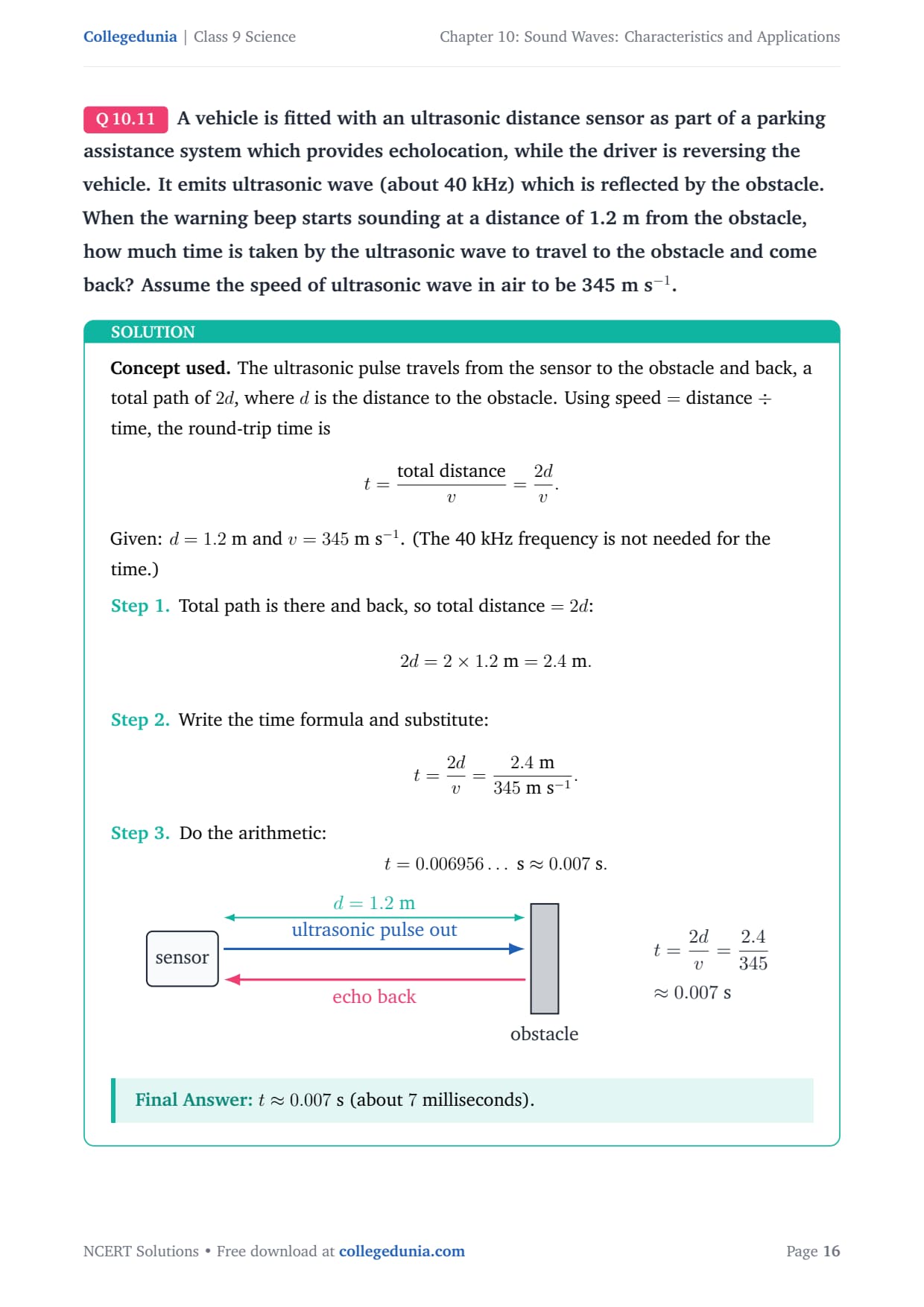
The number 0.1 second is worth memorising. A delay of 0.1 second or more gives an echo, while a shorter delay gives reverberation. The same halving idea, divide by 2 because the sound travels there and back, appears in the sonar and parking-sensor numericals of Questions 10 and 11.
Sound Waves Weightage in the Class 9 Science Exam
Chapter 10 sits in the physics part of Class 9 Science. It carries steady marks each year, split between short reasoning questions and numericals. The table compares it with the other physics chapters.
| Chapter | Topic | Typical marks |
|---|---|---|
| Chapter 4 | Describing Motion Around Us | 5 to 6 marks |
| Chapter 6 | How Forces Affect Motion | 5 to 6 marks |
| Chapter 7 | Work, Energy, and Simple Machines | 5 to 7 marks |
| Chapter 10 | Sound Waves Characteristics and Applications | 4 to 6 marks |
Because many questions are formula-based and the graph questions repeat every year, this chapter is one of the safer places to score full marks with a little practice.
Common Mistakes Students Make in the Sound Waves Chapter
Watch out for these slips:
- Thinking a louder or higher-pitched sound travels faster. In the same medium, the speed of sound is fixed.
- Forgetting to divide by 2 in sonar and echo problems. The measured time is for the round trip, there and back.
- Leaving the wavelength in centimetres when using v = f λ. Always convert to metres first, so 4 cm becomes 0.04 m.
- Confusing amplitude with wavelength on a graph. Amplitude is measured up and down; wavelength is measured along the distance axis.
Solved Example: Finding the Time Period from Wave Speed
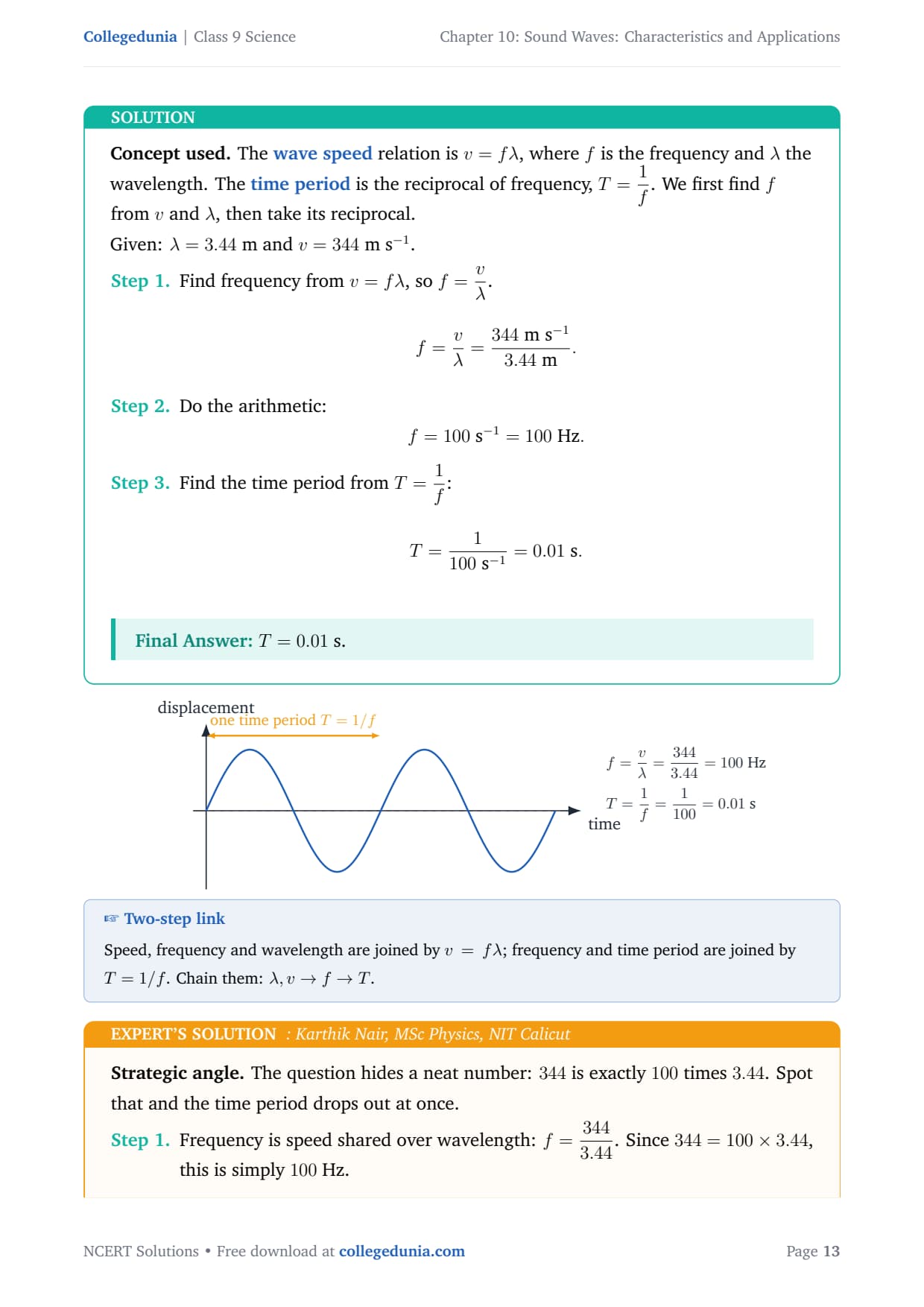
A source makes a sound wave of wavelength 3.44 m that travels at 344 m/s. Find its time period. This is Question 9 from the exercise, shown here as a model of the two-step method.
- Find the frequency using v = f λ: rearrange to f = v / λ = 344 / 3.44 = 100 Hz.
- Find the time period using T = 1 / f: T = 1 / 100 = 0.01 s.
- Read the answer: one full wave passes every 0.01 second, which is 10 milliseconds.
Every wave-speed numerical in this chapter follows this chain: use v = f λ to move between speed, frequency, and wavelength, then use T = 1 / f to reach the time period.
How to Use the Class 9 Sound Waves Solutions Most Effectively
Use a simple three-step routine so the chapter stays in your memory until the exam.
- Learn v = f λ and the 0.1 second echo rule first, and write down what each symbol means.
- Attempt each question yourself, then compare with the step-by-step solution below.
- Redo the graph and numerical questions you got wrong two days later, without looking at the answer.
Pair this page with the chapter notes and formula sheet for quick revision before the exam.
NCERT Class 9 Science Chapter 10 Sound Waves Other Study Resources
Use the other free resources for the same chapter alongside these solutions.
| Resource | Link |
|---|---|
| Revision Notes | Sound Waves Characteristics and Applications Class 9 Notes |
| Handwritten Notes | Sound Waves Characteristics and Applications Class 9 Handwritten Notes |
| NCERT Book PDF | Sound Waves Characteristics and Applications Class 9 NCERT Book PDF |
| Formula Sheet | Sound Waves Characteristics and Applications Class 9 Formula Sheet |
NCERT Solutions for Class 9 Science: All Chapters
Find the step-by-step NCERT Solutions for the other Class 9 Science chapters below.
| Chapter | Resource |
|---|---|
| Chapter 6 | How Forces Affect Motion NCERT Solutions |
| Chapter 7 | Work, Energy, and Simple Machines NCERT Solutions |
| Chapter 8 | Journey Inside the Atom NCERT Solutions |
| Chapter 9 | Atomic Foundations of Matter NCERT Solutions |
| Chapter 10 | Sound Waves Characteristics and Applications NCERT Solutions |
| Chapter 11 | Reproduction How Life Continues NCERT Solutions |
Sound Waves Characteristics and Applications Class 9 Science NCERT Solutions FAQs
Ques. Where can I download the Sound Waves Characteristics and Applications Class 9 Science NCERT Solutions PDF?
Ans. You can download the Sound Waves Characteristics and Applications Class 9 Science NCERT Solutions PDF free from this page. Both a normal and an HD version are available.
Ques. How many questions are solved in Class 9 Science Chapter 10?
Ans. All 15 questions from the Revise, Reflect, Refine exercise are solved, each with a step-by-step method and an expert method.
Ques. Are these solutions aligned with the 2026-27 NCERT syllabus?
Ans. Yes. Every answer matches the new 2026-27 NCERT Exploration textbook for Class 9 Science and the official NCERT answer key.
Ques. Why is sound called a mechanical wave in Class 9 Science?
Ans. Sound is a mechanical wave because it needs a material medium such as air, water, or a solid to travel. It cannot pass through a vacuum, which is why there is no sound in space.
Ques. What is the difference between an echo and reverberation?
Ans. An echo is a clear, separate repeat of a sound, heard when the reflection arrives at least 0.1 second after the direct sound. When the gap is less than 0.1 second, the reflections merge and the sound lingers, which is reverberation.
Ques. How does sonar measure the depth of the sea?
Ans. Sonar sends an ultrasonic pulse into the water and times its echo. The depth is found using d = (v × t) / 2, where the division by 2 is because the sound travels down and back.



Comments