




The NCERT Solutions for Class 9 Science Chapter 7 Work, Energy, and Simple Machines will help students prepare for the CBSE Class 9 exams and build a strong base for JEE and NEET later, according to the latest 2026-27 syllabus. This page solves all 15 questions from the Revise, Reflect, Refine exercise in plain, step-by-step language. Each answer names the formula, shows every calculation, and adds an expert method. You get work, energy, power, the work-energy theorem, and simple machines in one place.
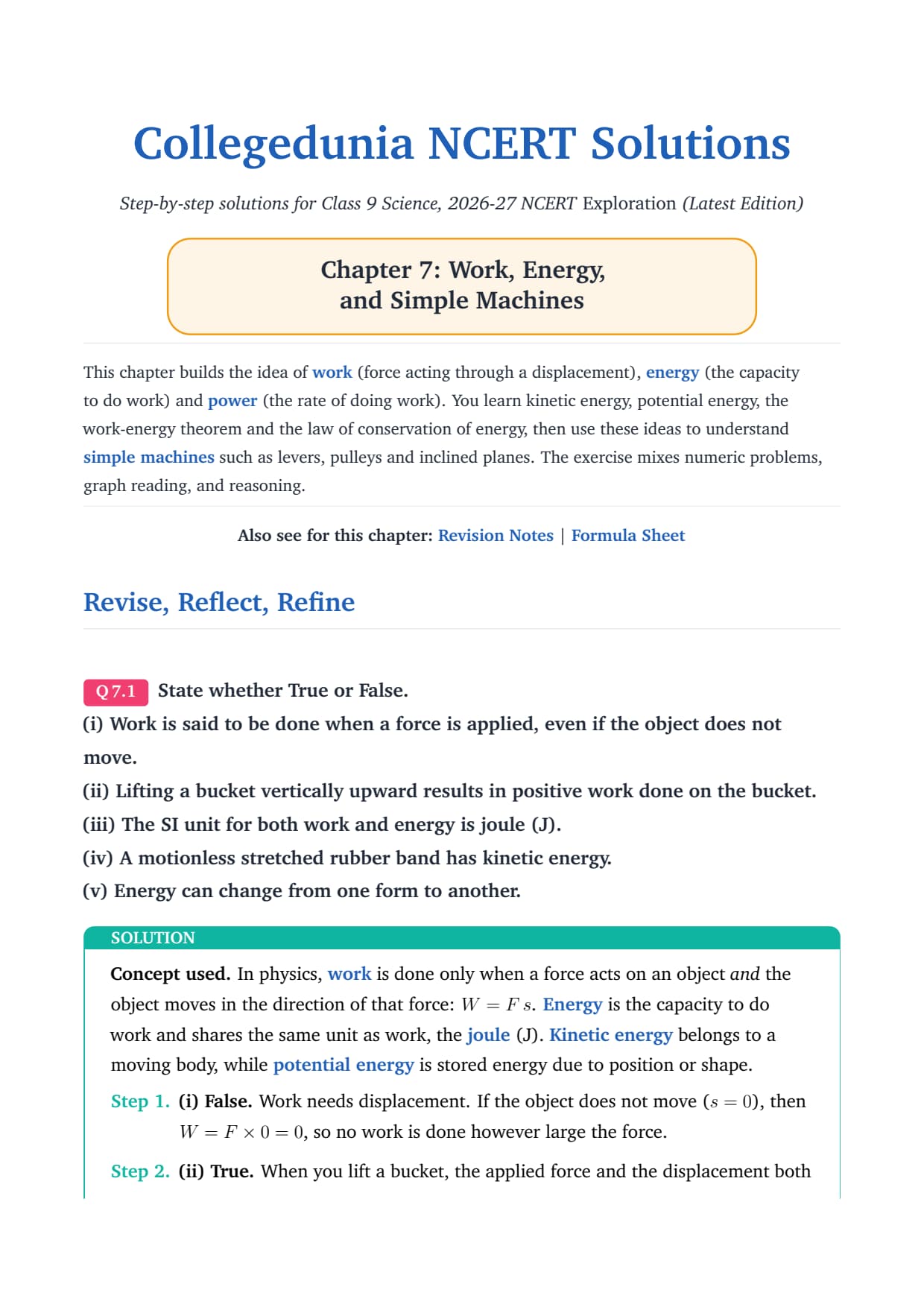
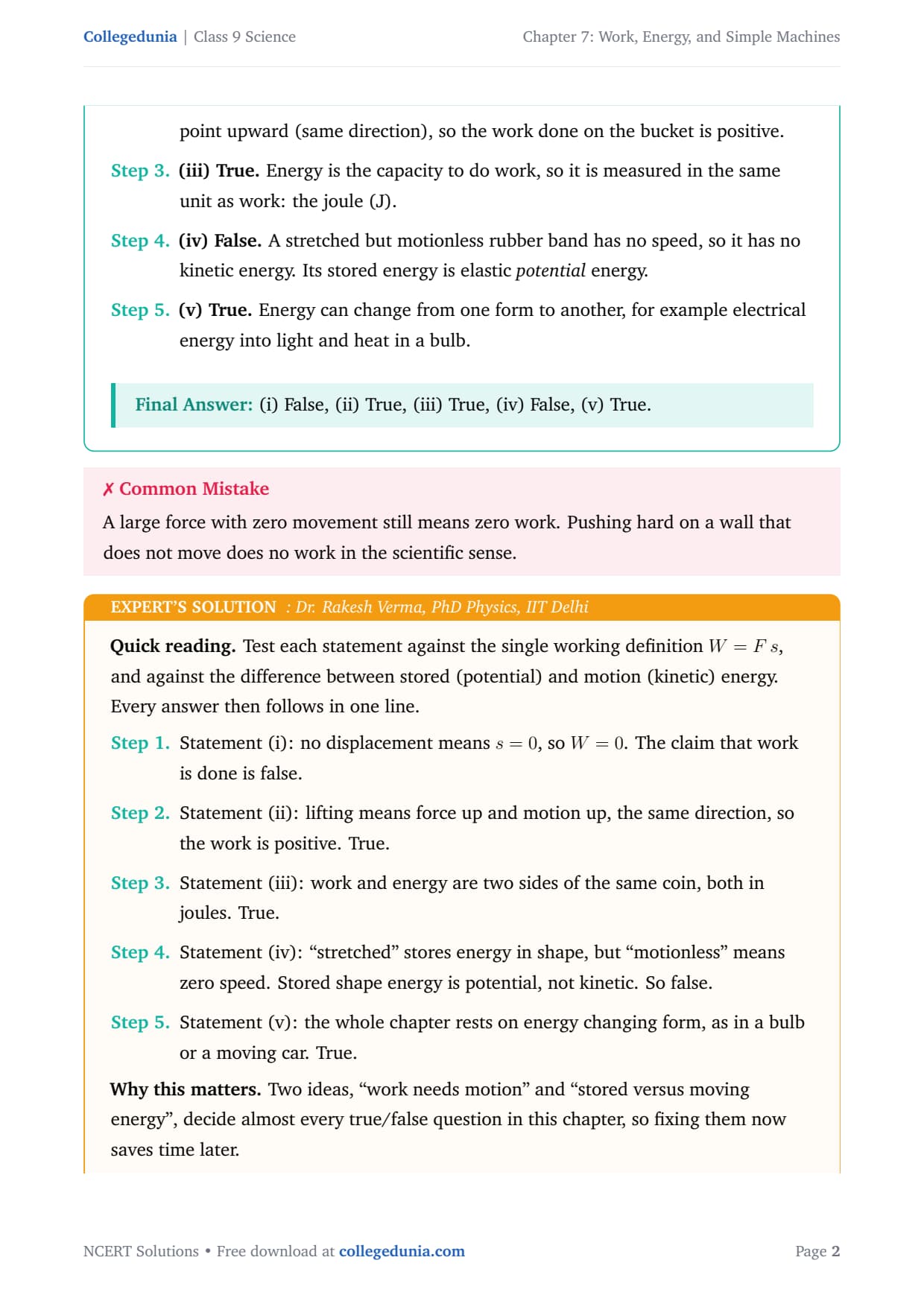
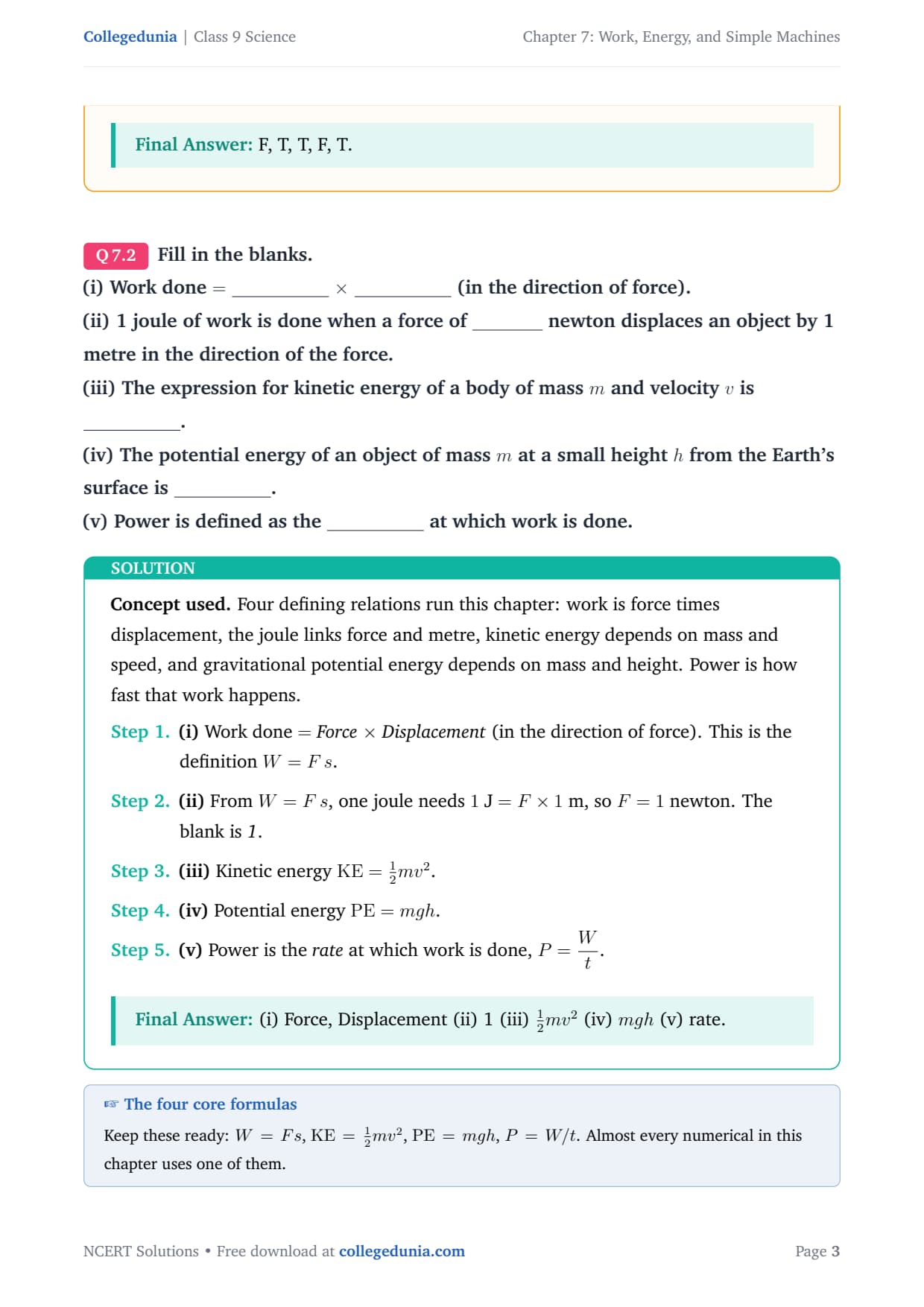
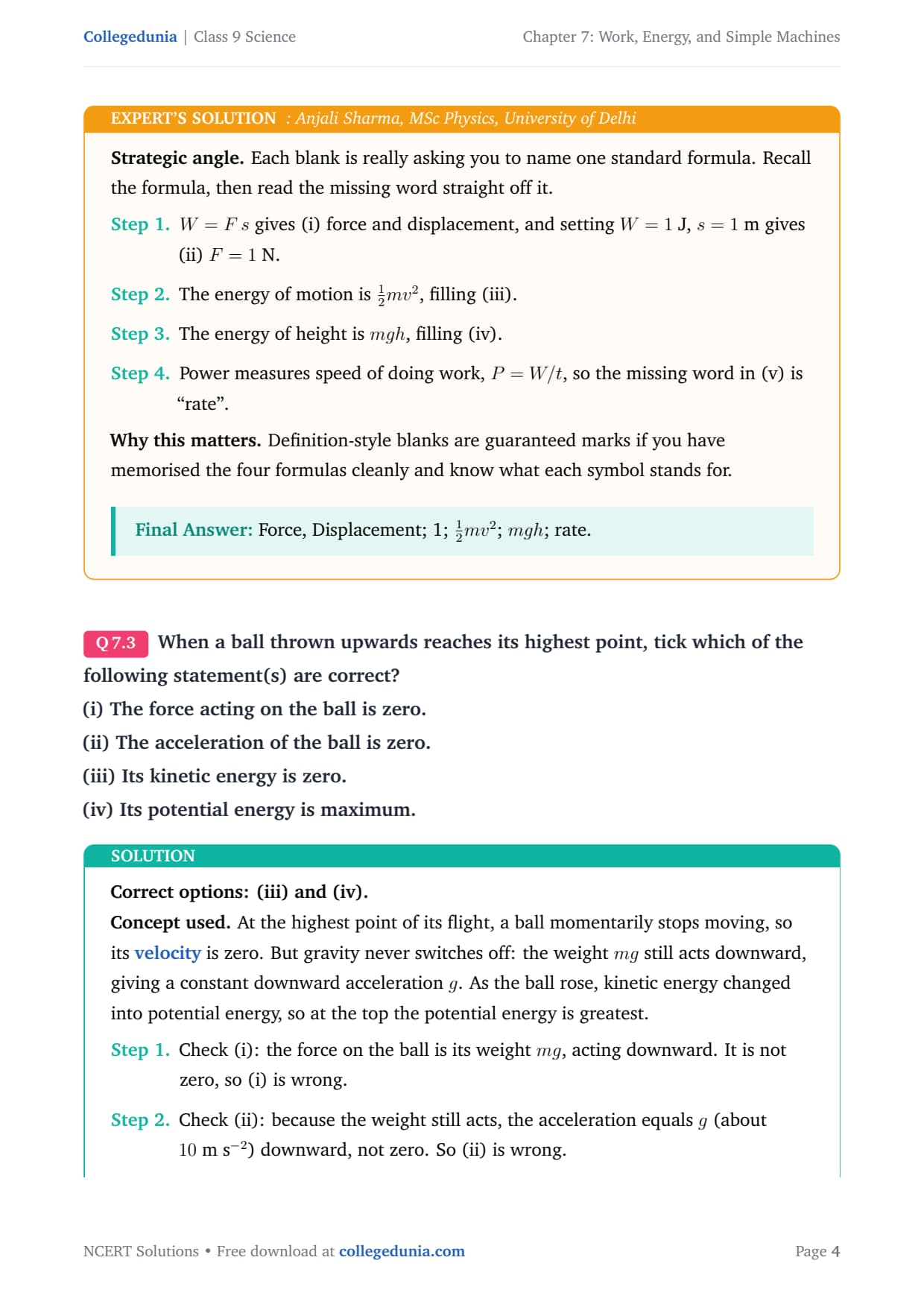
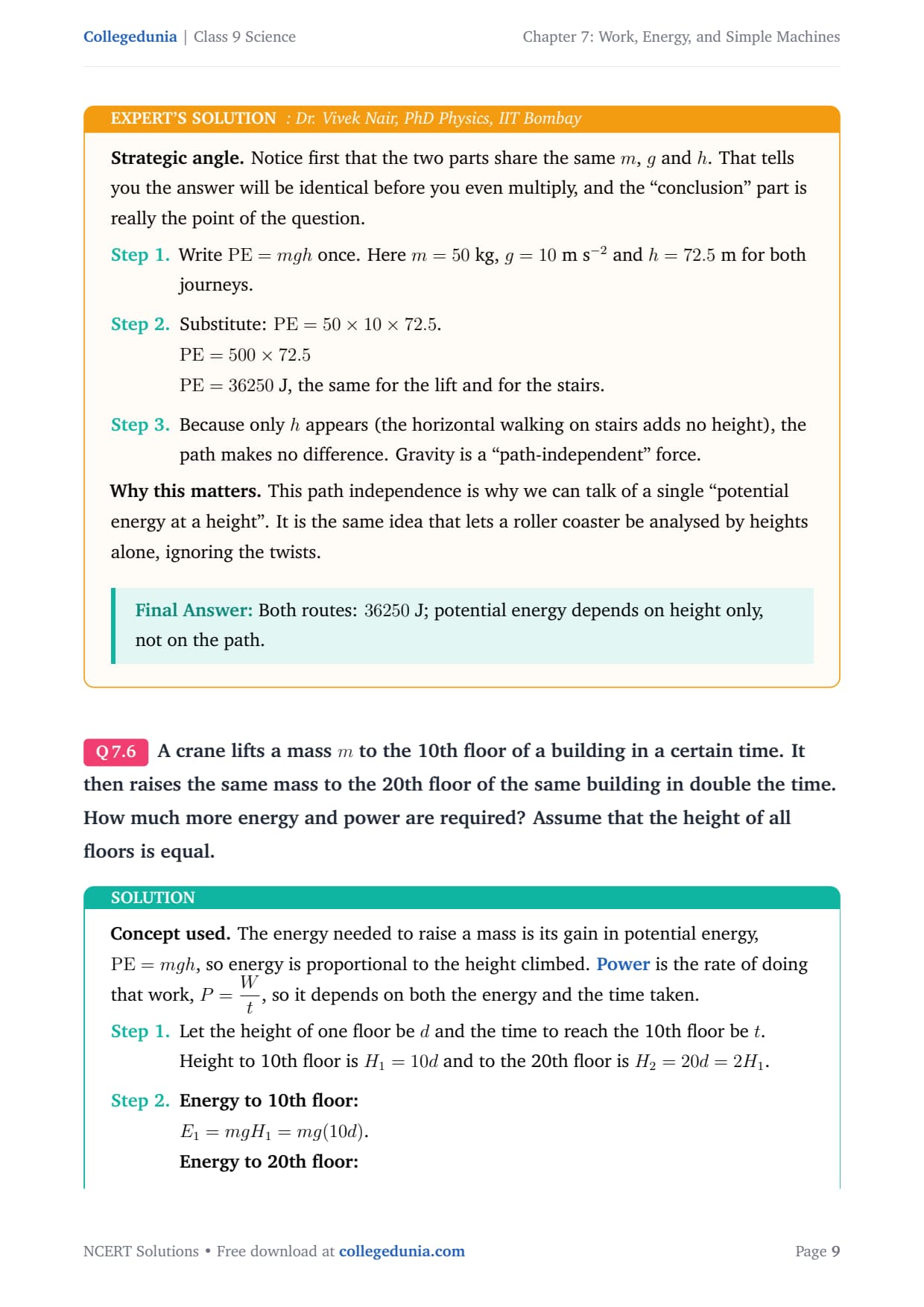
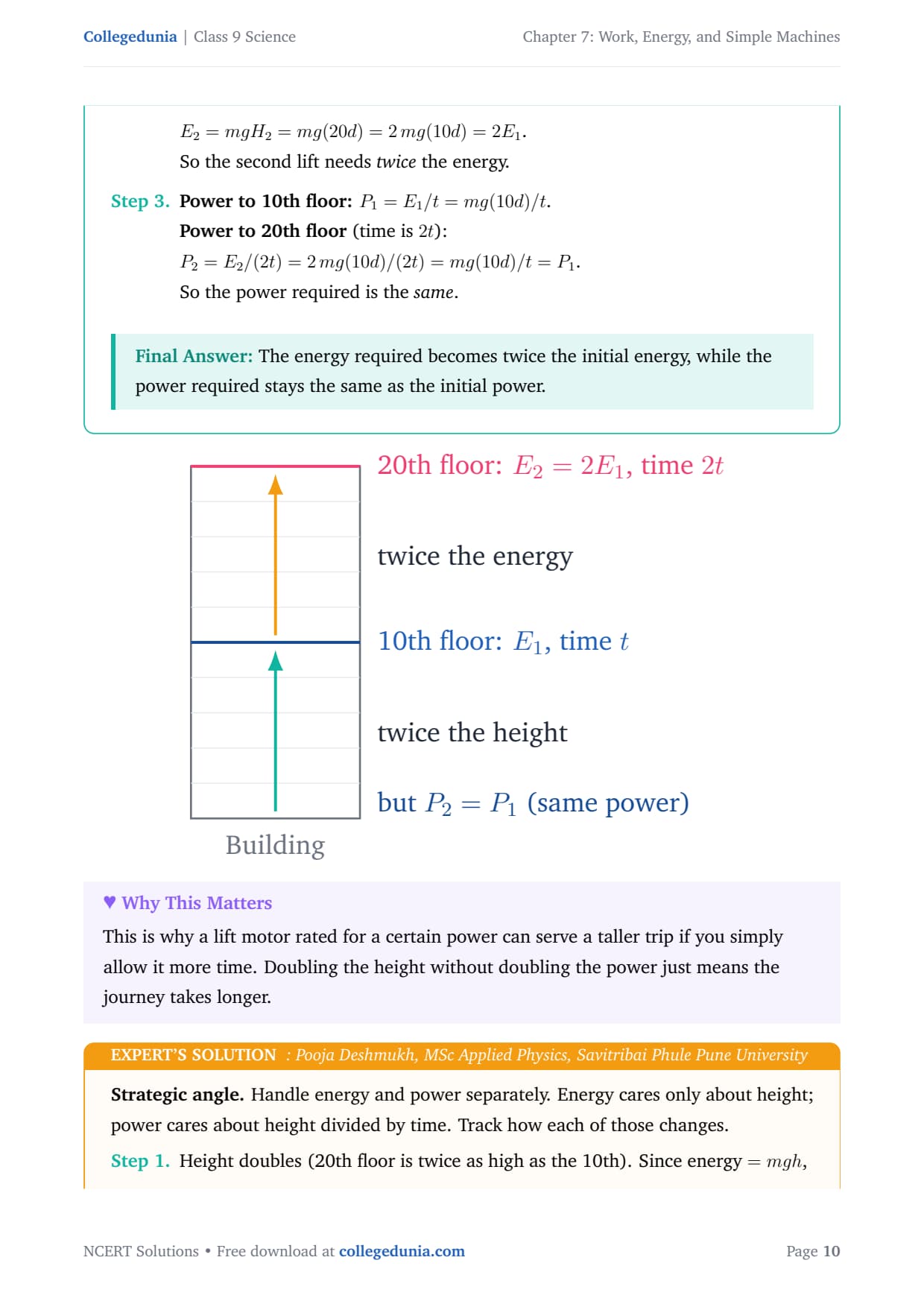
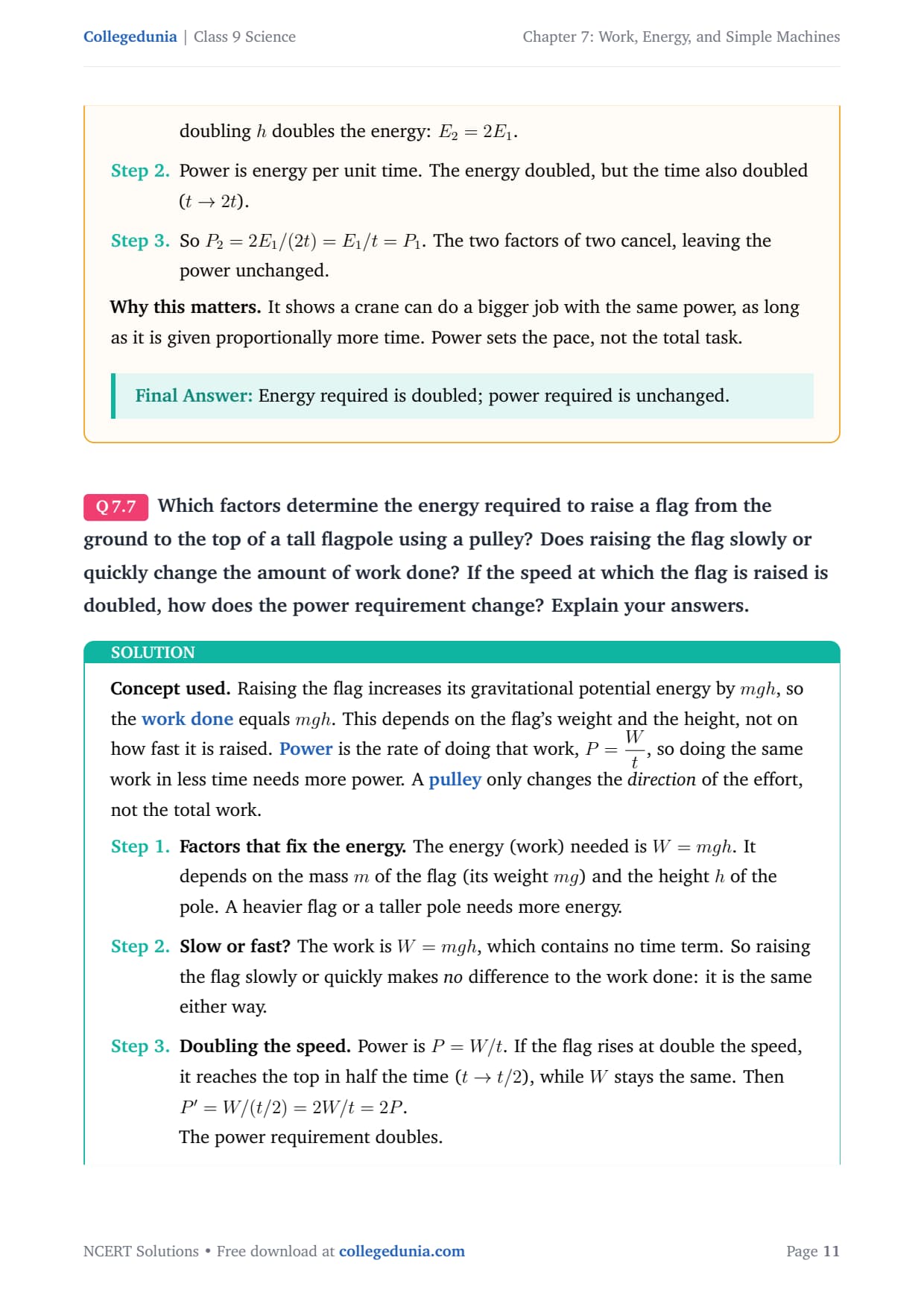
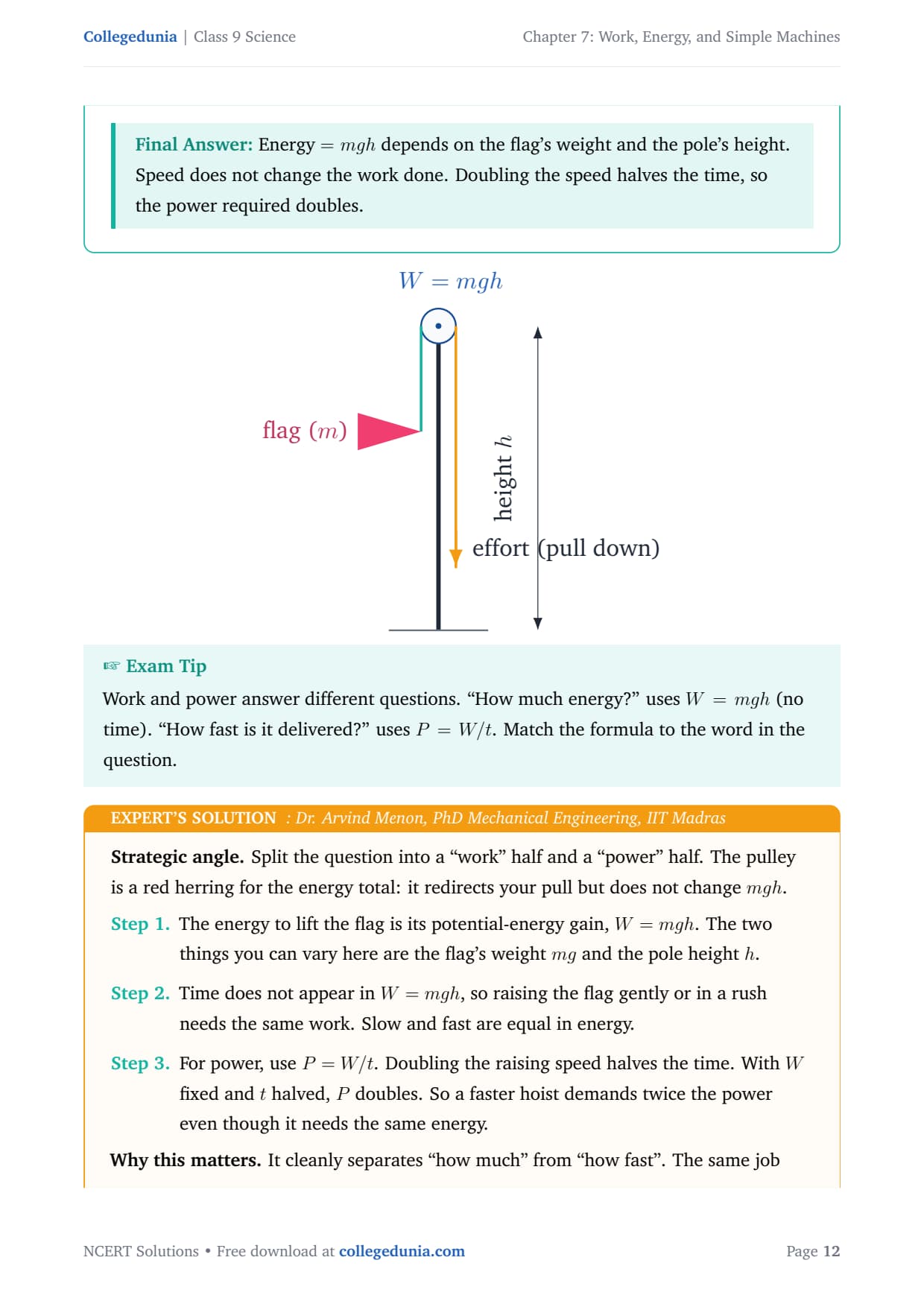
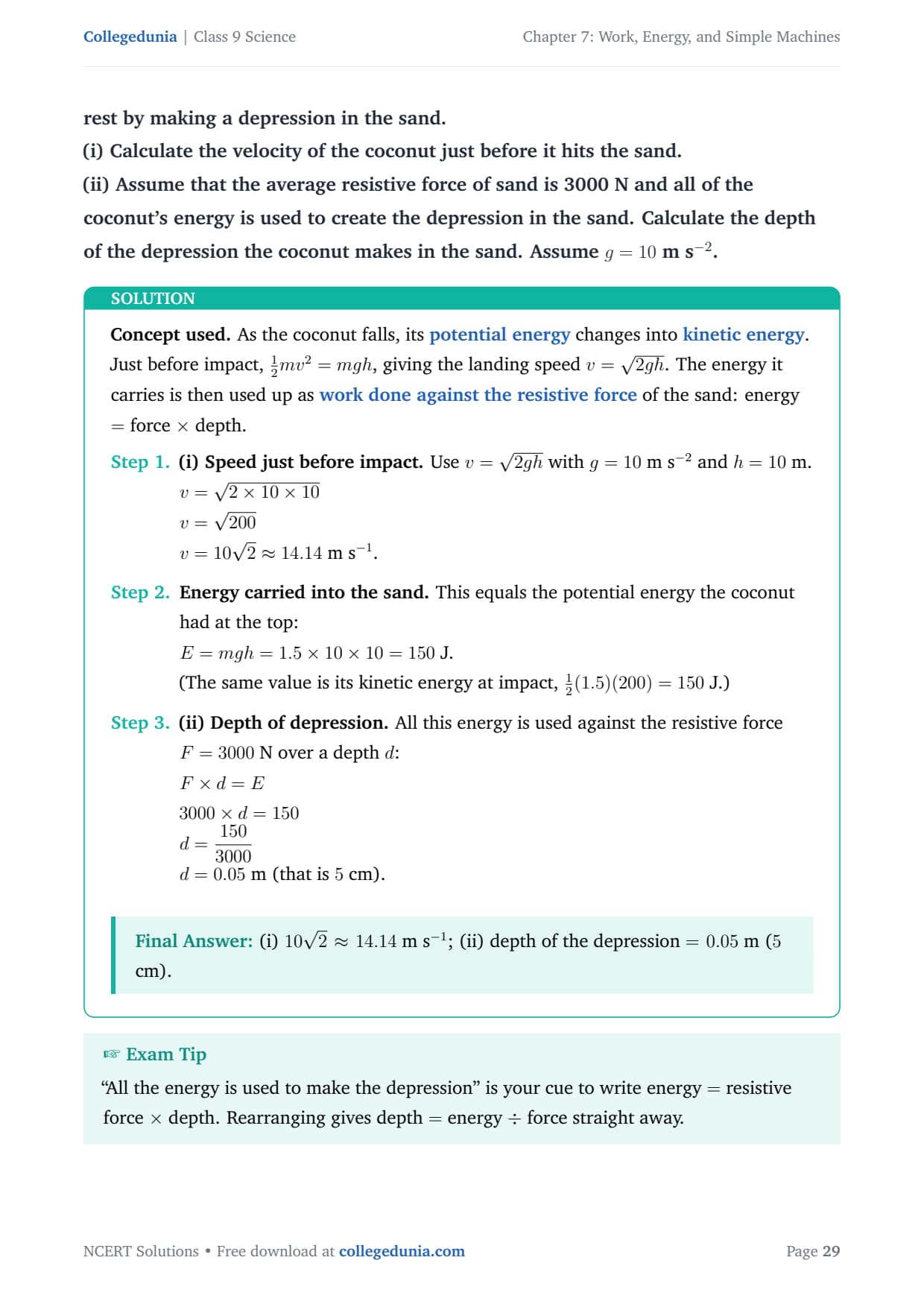
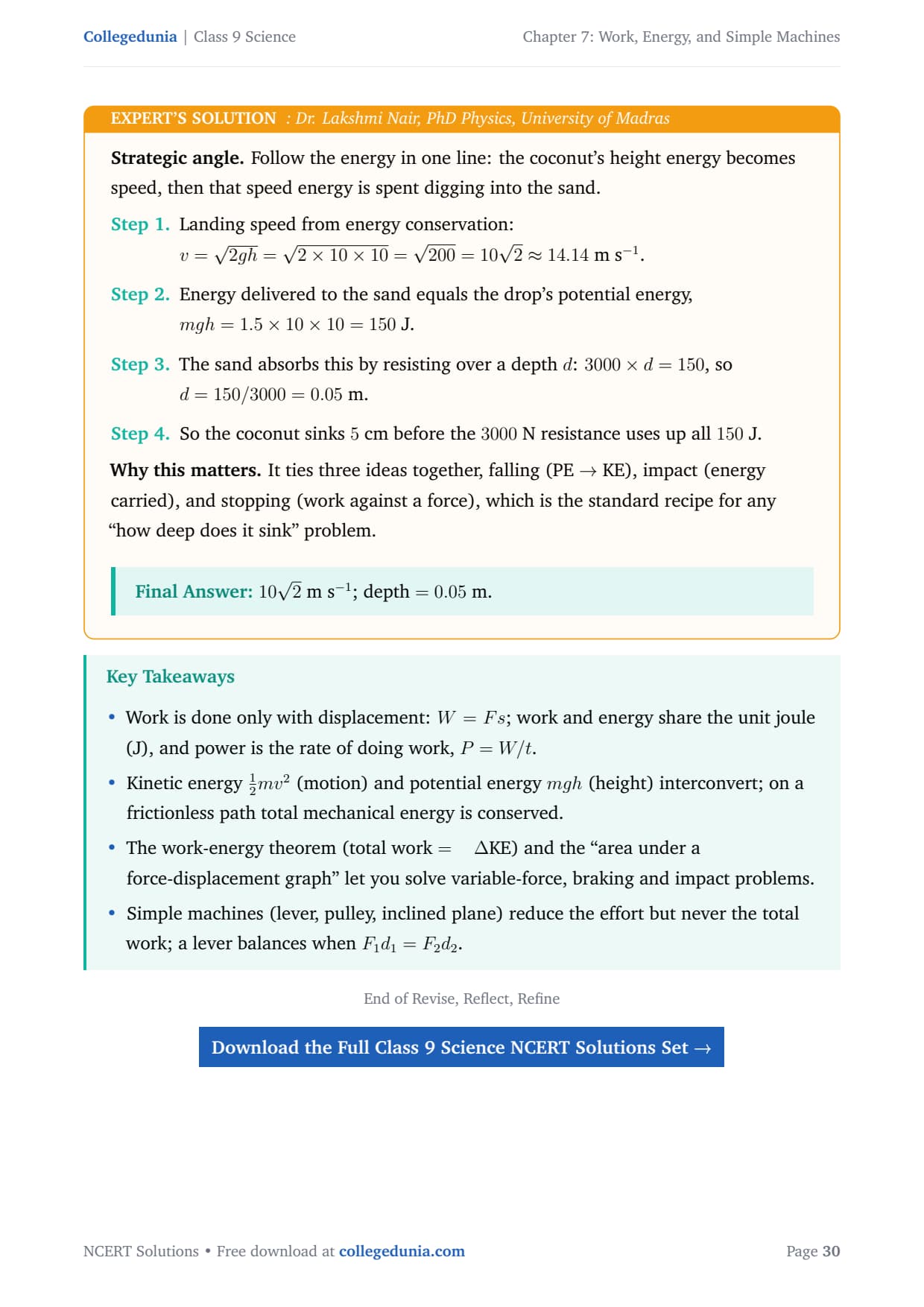
These NCERT Solutions for Class 9 Science Chapter 7 are prepared by subject experts, matched to the 2026-27 NCERT Exploration textbook, and checked against the official NCERT answer key.
- 15 solved questions from the Revise, Reflect, Refine exercise, covering work, energy, power, and simple machines.
- Every numerical shows the formula, substitution, and answer as separate steps, so nothing is skipped.
- Based on the new 2026-27 NCERT Exploration textbook, with an expert method added to each question.
Student Feedback
In a Collegedunia poll of 12,840 Class 9 students taken before the 2026 exams, 71% said they most often mixed up work and power in this chapter. Most students rated the work-energy theorem numericals as the hardest part. Students who solved all 15 Revise, Reflect, Refine questions said they felt the most confident on exam day.
Source: 2026-27 Class 9 Science student poll. Sample of 12,840 students from CBSE schools across 14 states.
Work and Energy Class 9 Explained in Simple Language
Source: Magnet Brains on YouTube
This one-shot video walks through the whole chapter before you start the exercise. Watch it once, then use the step-by-step solutions below to practise each question. The video and these solutions together cover work, energy, power, and the three simple machines you meet in Class 9.
How Collegedunia's Class 9 Work and Energy NCERT Solutions Help You
Chapter 7 is short but scoring, because most of its questions follow four formulas. These solutions make each question easy to attempt and easy to score.
- 2026-27 NCERT alignment: Every answer matches the new Exploration textbook and the official NCERT answer key.
- Full working shown: Formula, substitution, and final answer sit on separate lines, so you never lose method marks.
- Expert method added: A second, faster approach is given below each solution to save time in the exam.
- Concepts made clear: Each solution starts with the exact idea it uses, such as the work-energy theorem or conservation of energy.
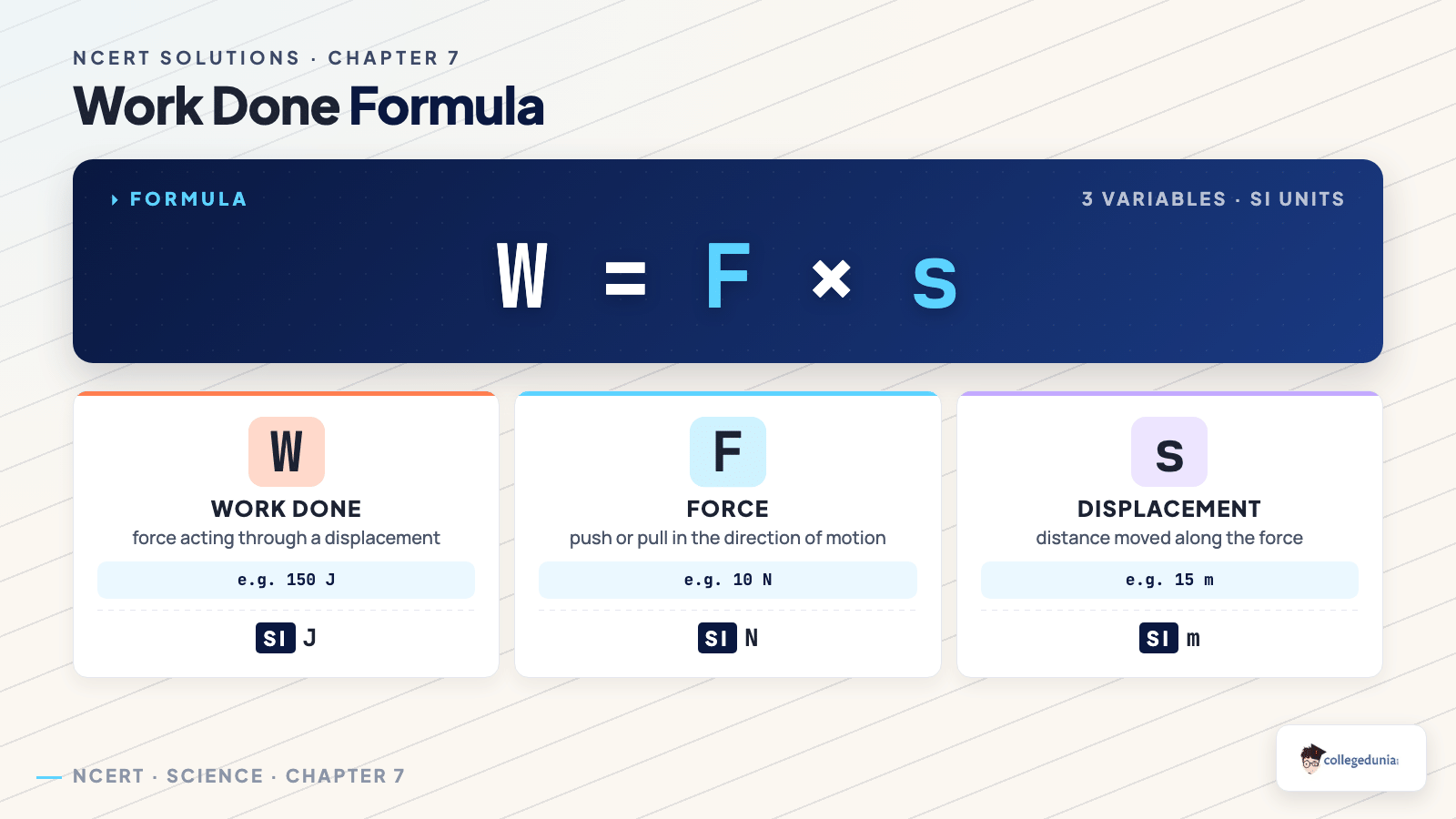
Work, Energy, and Simple Machines Class 9 Important Formulas
Almost every numerical in this chapter uses one of the four formulas below. Learn them first, and know what each symbol means. Work and energy share the same unit, the joule (J), while power is measured in watt (W).
| Quantity | Formula | What it means |
|---|---|---|
| Work | W = F × s | Force times displacement in the direction of force; unit joule (J). |
| Kinetic energy | KE = ½ m v2 | Energy of a moving body; grows with the square of speed. |
| Potential energy | PE = m g h | Energy stored due to height above the ground. |
| Power | P = W / t | Rate of doing work; unit watt (W). |
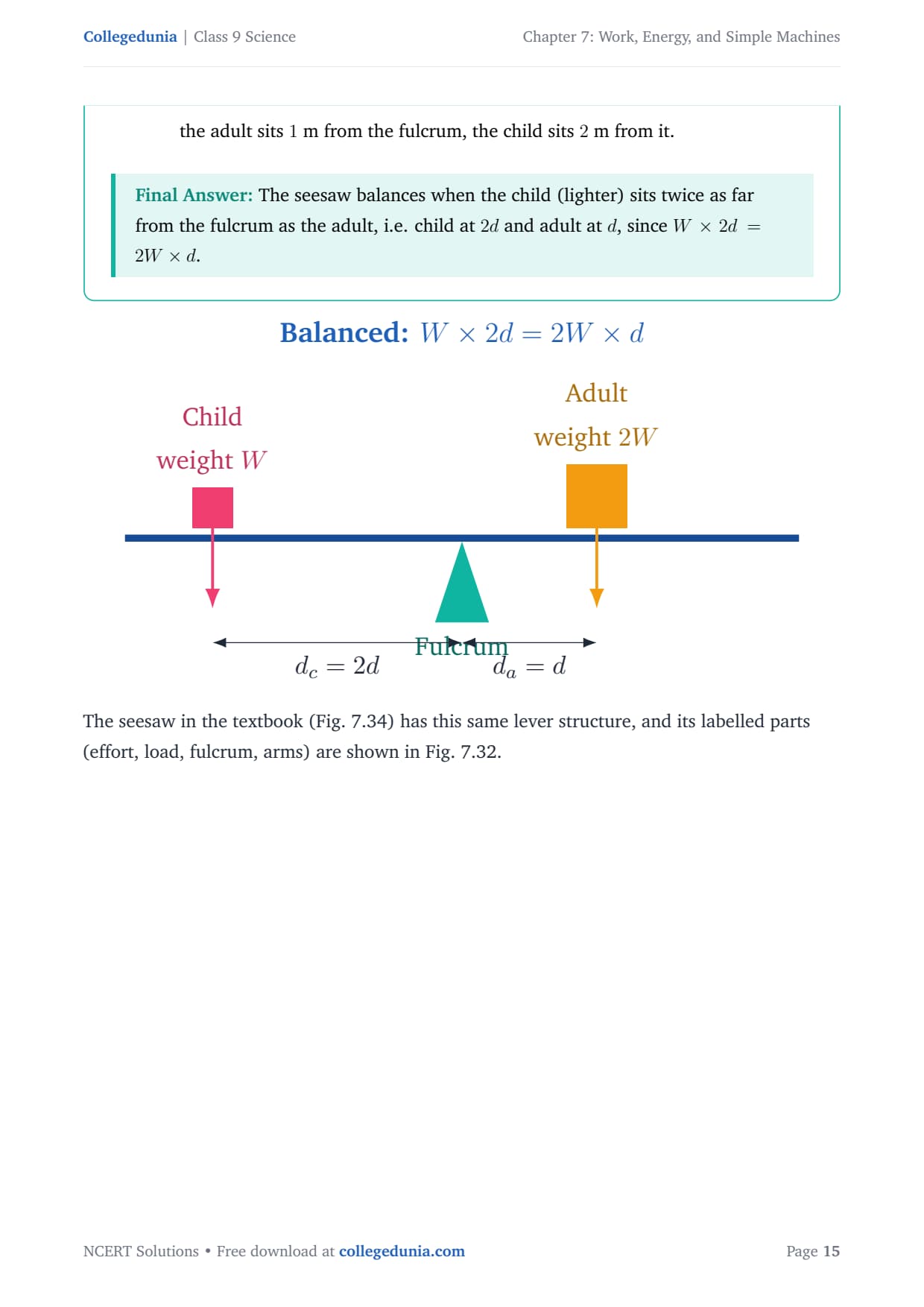
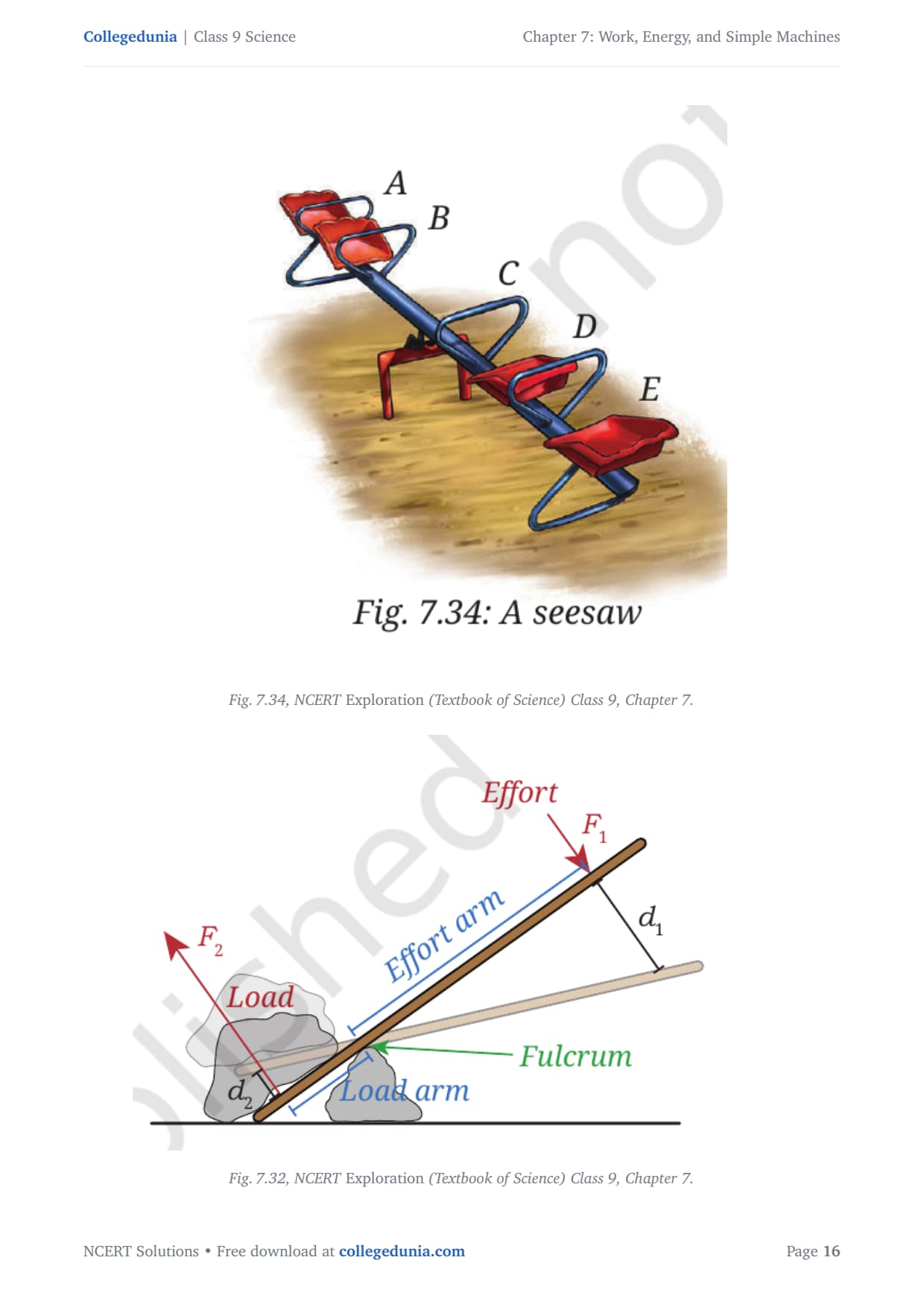
| Lever balance | F1d1 = F2d2 | A lever balances when weight times distance is equal on both sides. |
The work-energy theorem ties these together: the total work done on a body equals its change in kinetic energy. For a simple machine, the effort needed goes down, but the total work never does.
Revise, Reflect, Refine Exercise Breakdown for Class 9 Science Chapter 7
The Chapter 7 exercise is called Revise, Reflect, Refine and has 15 questions. The table shows what each question tests, so you can plan your practice.
| Questions | Type | What it tests |
|---|---|---|
| 1 to 3 | True/False, fill-ups, MCQ | Definitions of work, energy, power, and the joule. |
| 4 | Reasoning | Naming energy transformations in nine everyday cases. |
| 5 to 7 | Numerical + reasoning | Potential energy, path independence, and power scaling. |
| 8 to 10 | Numerical | Kinetic energy ratios, the lever balance, and signs of work. |
| 11 to 15 | Graph and impact numericals | Area under a force graph, braking, and conservation of energy. |
Start with the definition questions, then move to the numericals. All 15 fully solved answers, with an expert method for each, are given lower down this page.
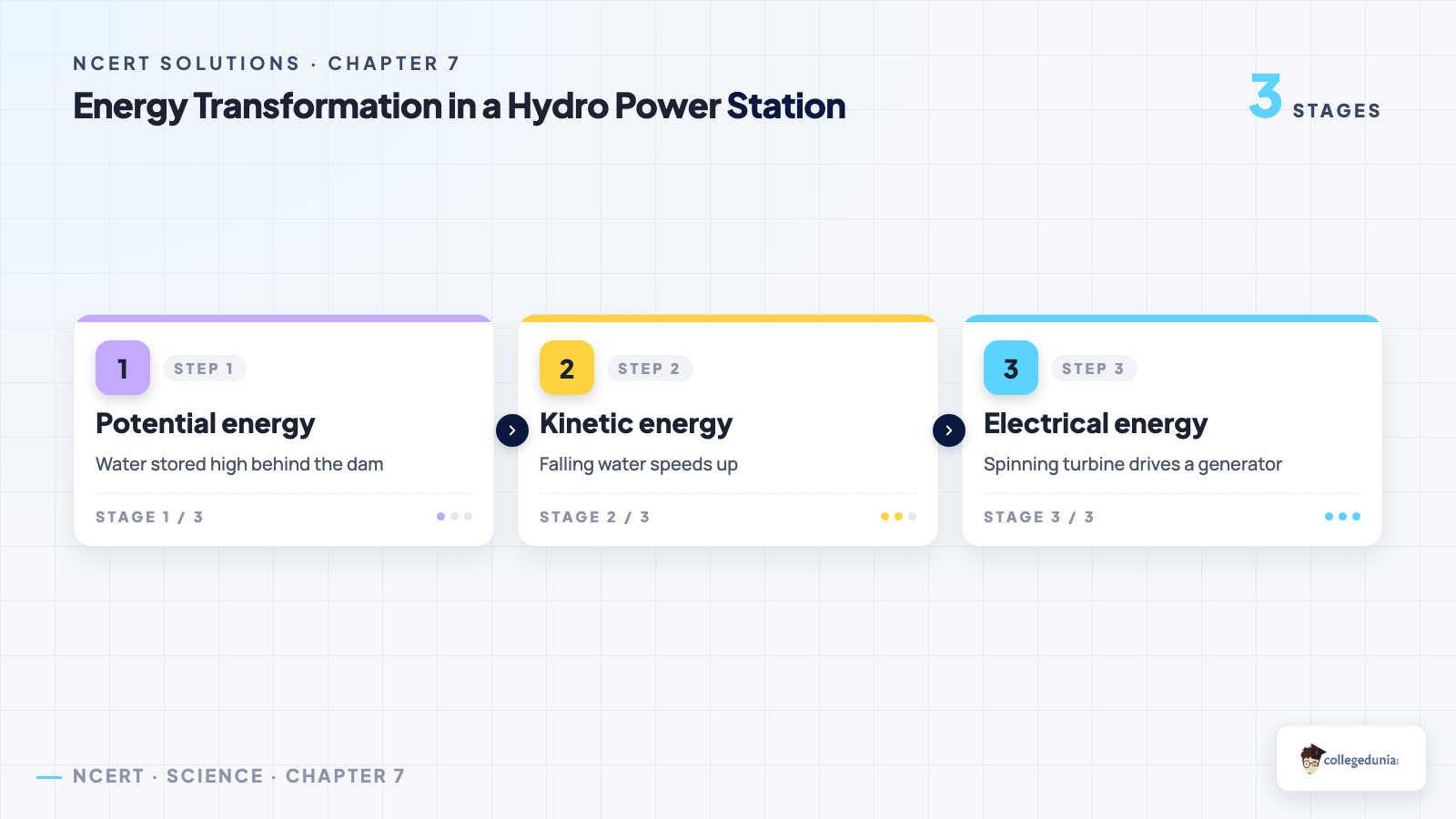
Energy Transformations and Conservation of Energy in Class 9 Science
Energy is never made or destroyed; it only changes form. This is the law of conservation of energy, and it explains many exercise questions in this chapter.
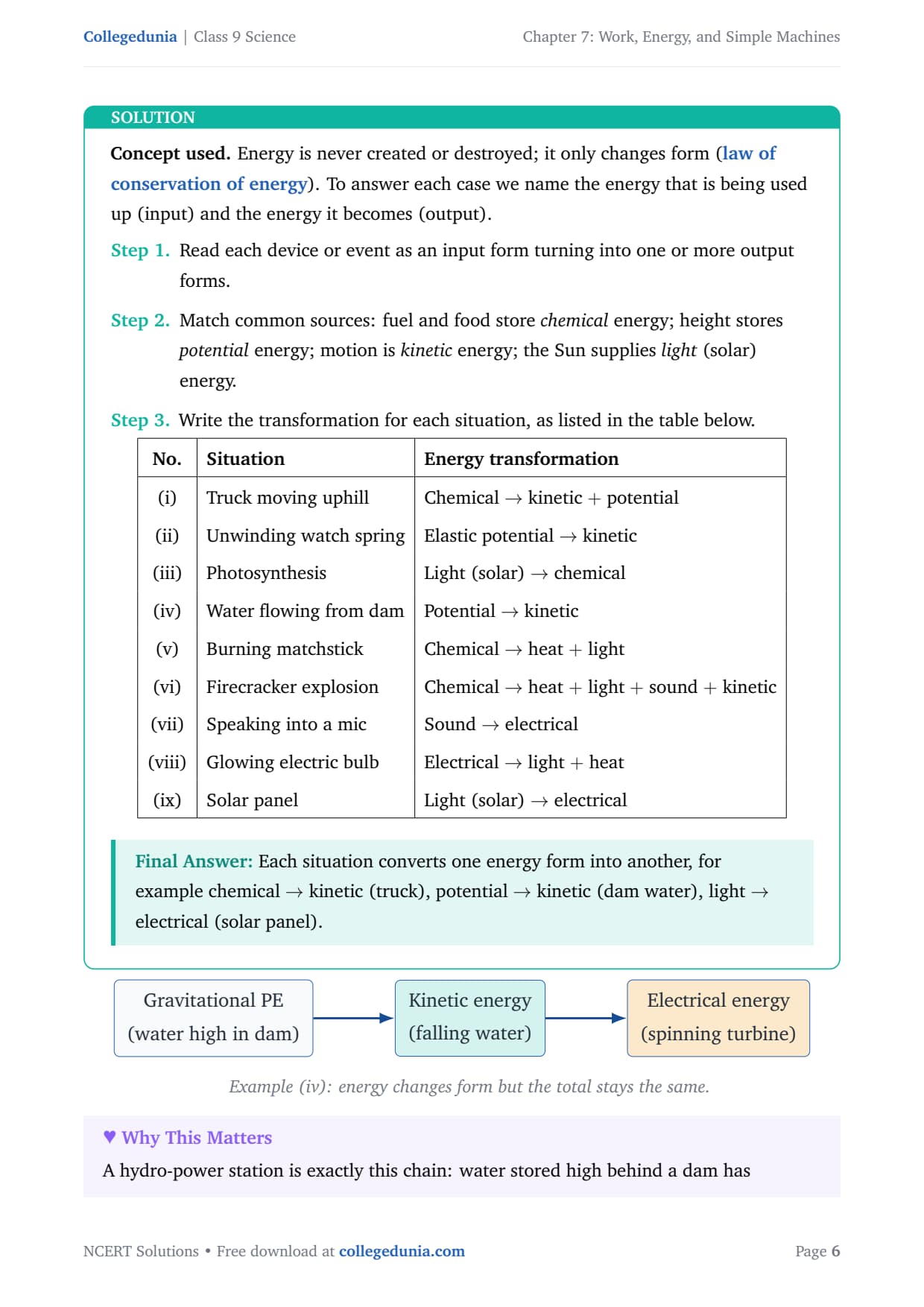
- Falling water: potential energy becomes kinetic energy, then electrical energy in a hydro power station.
- Burning fuel: chemical energy becomes heat and light, as in a matchstick or a car engine.
- Solar panel: light energy becomes electrical energy.
- Stretched rubber band: stores elastic potential energy, not kinetic energy, until it is released.
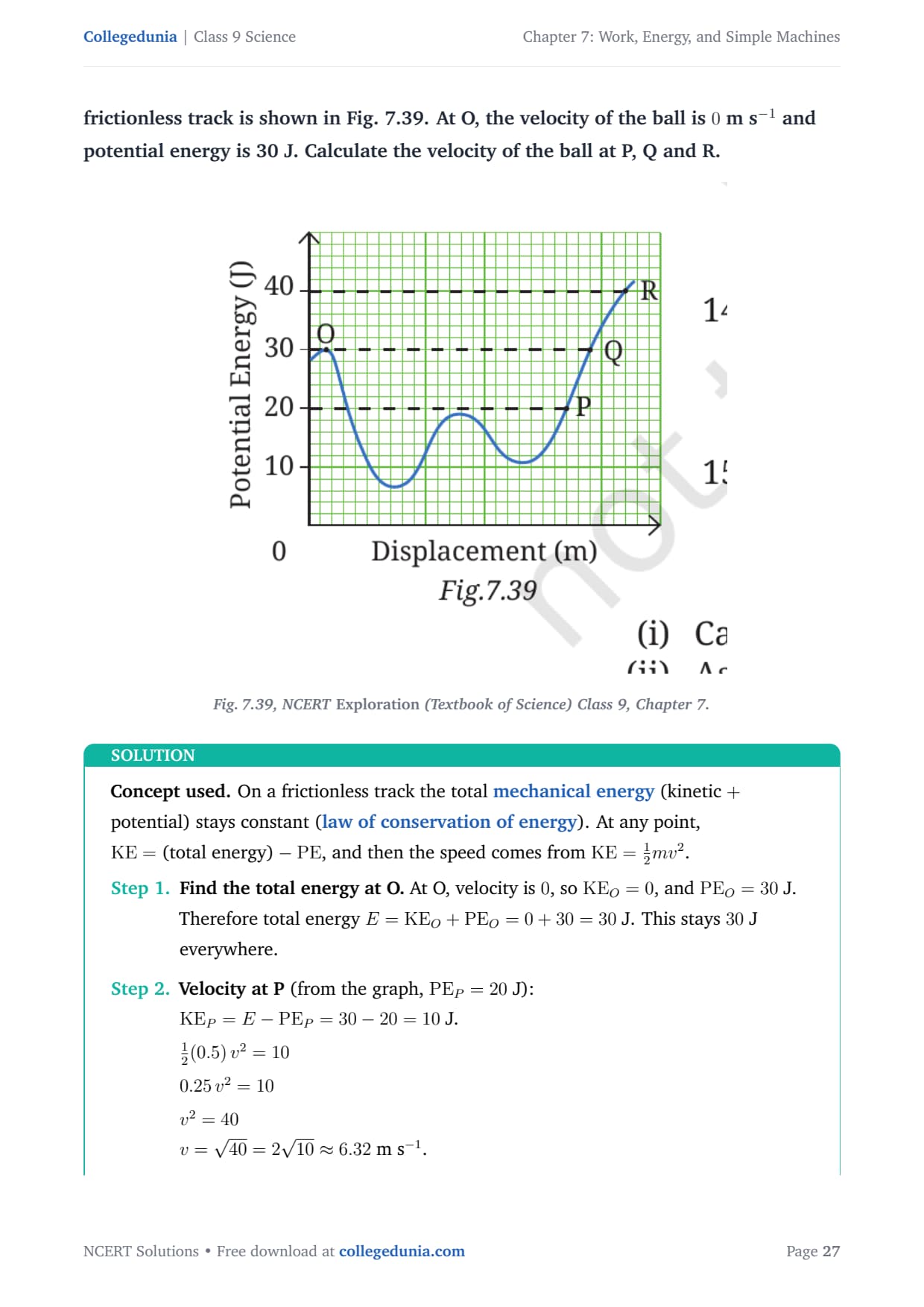
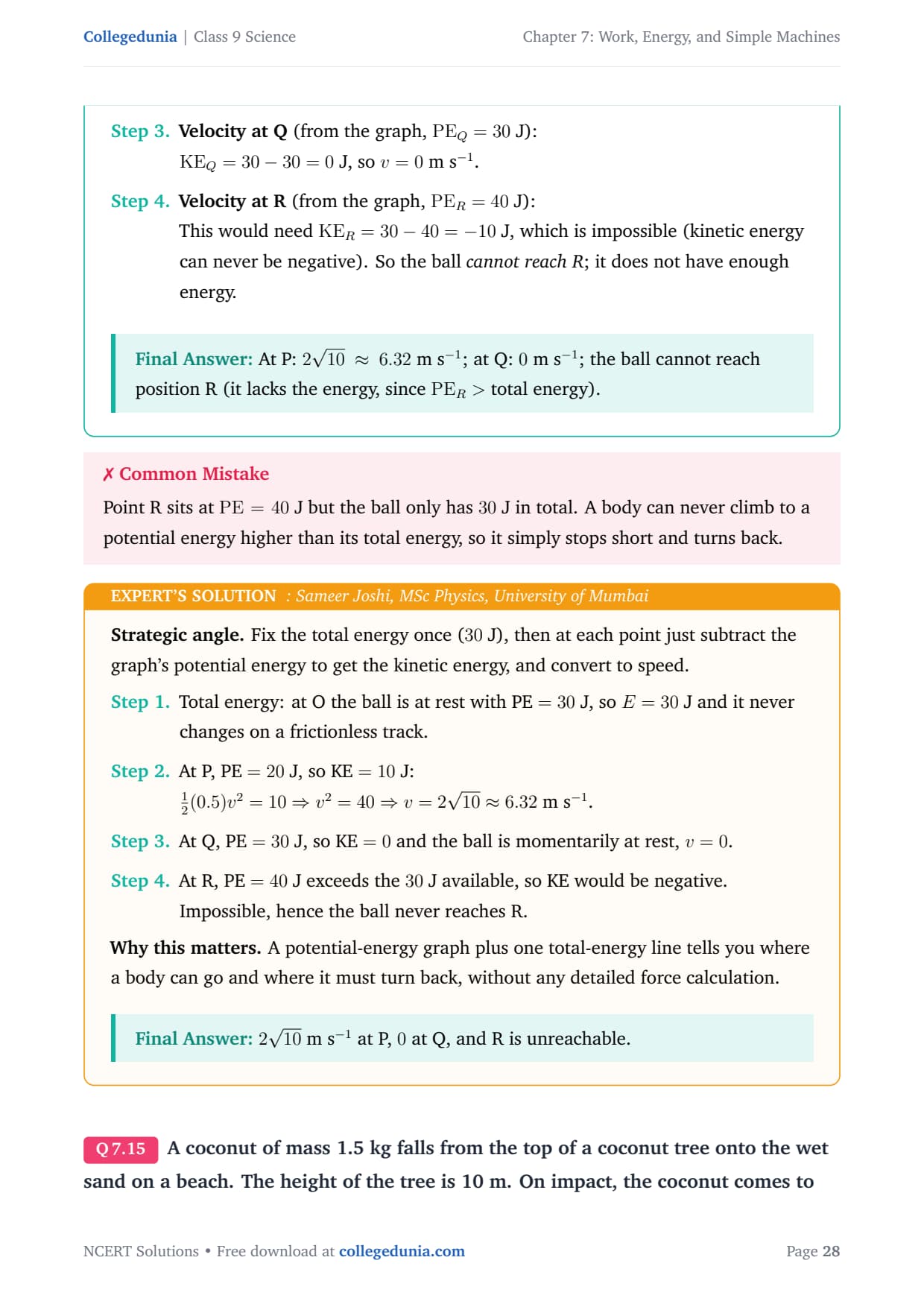
On a frictionless path the total mechanical energy stays the same, so kinetic energy plus potential energy is constant. Questions 4, 13, and 14 all use this idea.
Work and Energy Weightage for the Class 9 Science Exam
Chapter 7 sits in the physics part of Class 9 Science. It carries steady marks every year, mostly through numericals. The table compares it with the other physics chapters.
| Chapter | Topic | Typical marks |
|---|---|---|
| Chapter 4 | Describing Motion Around Us | 5 to 6 marks |
| Chapter 6 | How Forces Affect Motion | 5 to 6 marks |
| Chapter 7 | Work, Energy, and Simple Machines | 5 to 7 marks |
| Chapter 10 | Sound Waves | 4 to 5 marks |
Because the questions are formula-based, this chapter is one of the easiest places to score full marks with a little practice.
Common Mistakes Students Make in the Work and Energy Chapter
Watch out for these slips:
- Thinking work is done when a heavy object does not move. If displacement is zero, work is zero.
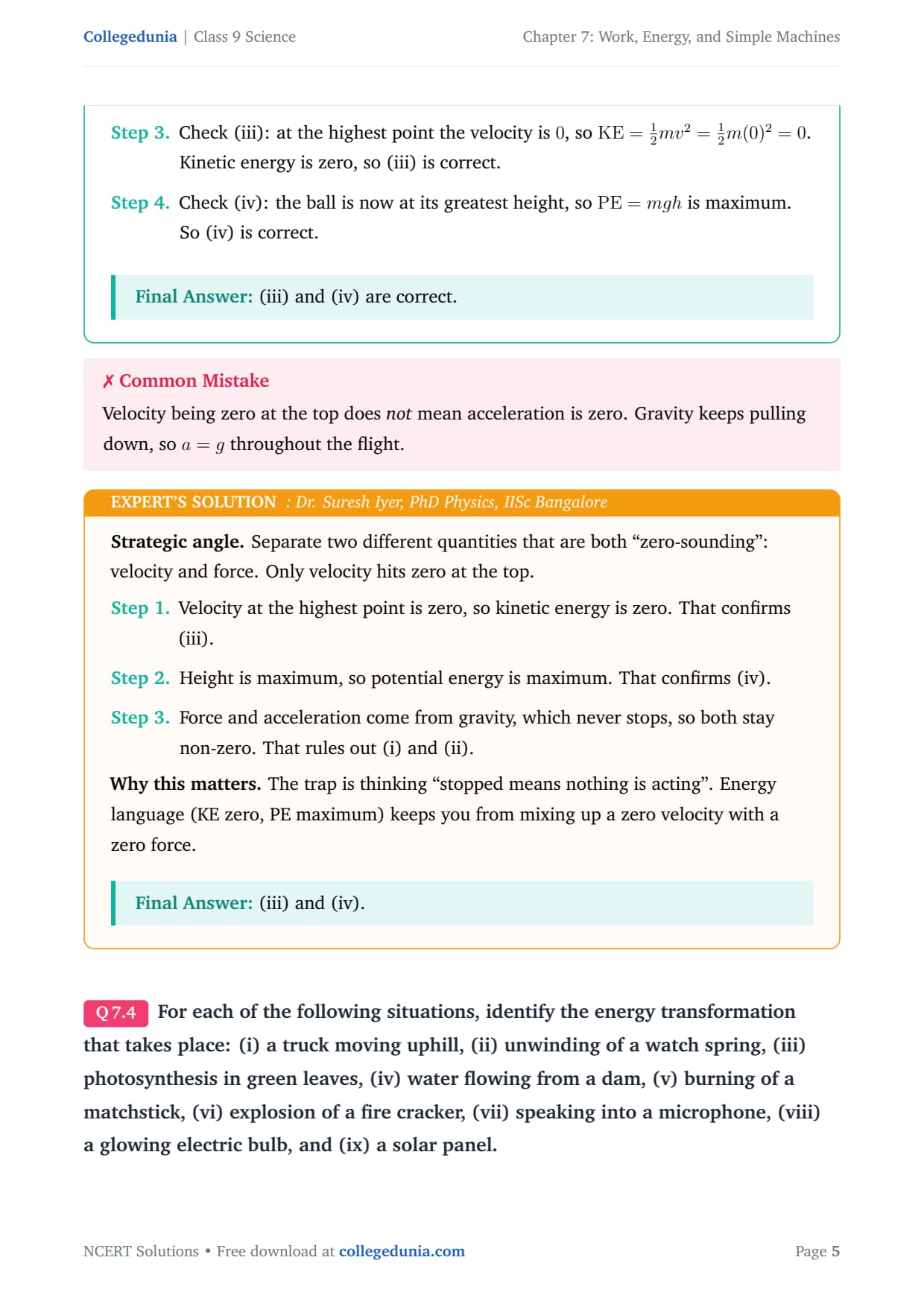
- Saying acceleration is zero at the top of a throw. Velocity is zero there, but gravity still acts, so acceleration equals g.
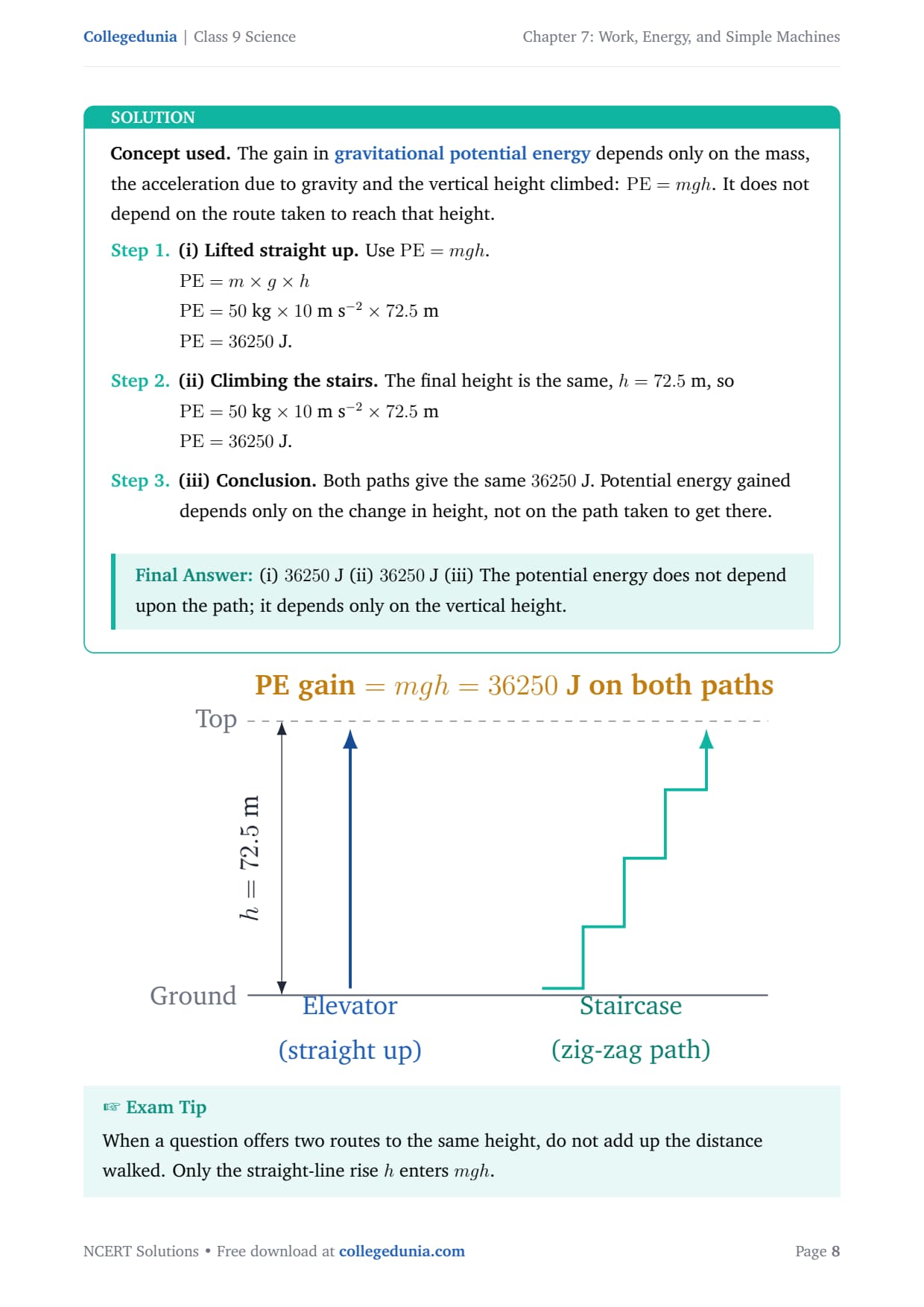
- Adding the distance walked on stairs into the potential energy. Only the vertical height h enters m g h.
- Forgetting the negative sign when a brake or air resistance opposes motion. A force against the motion does negative work.
Solved Example: Work-Energy Theorem for a Braking Car
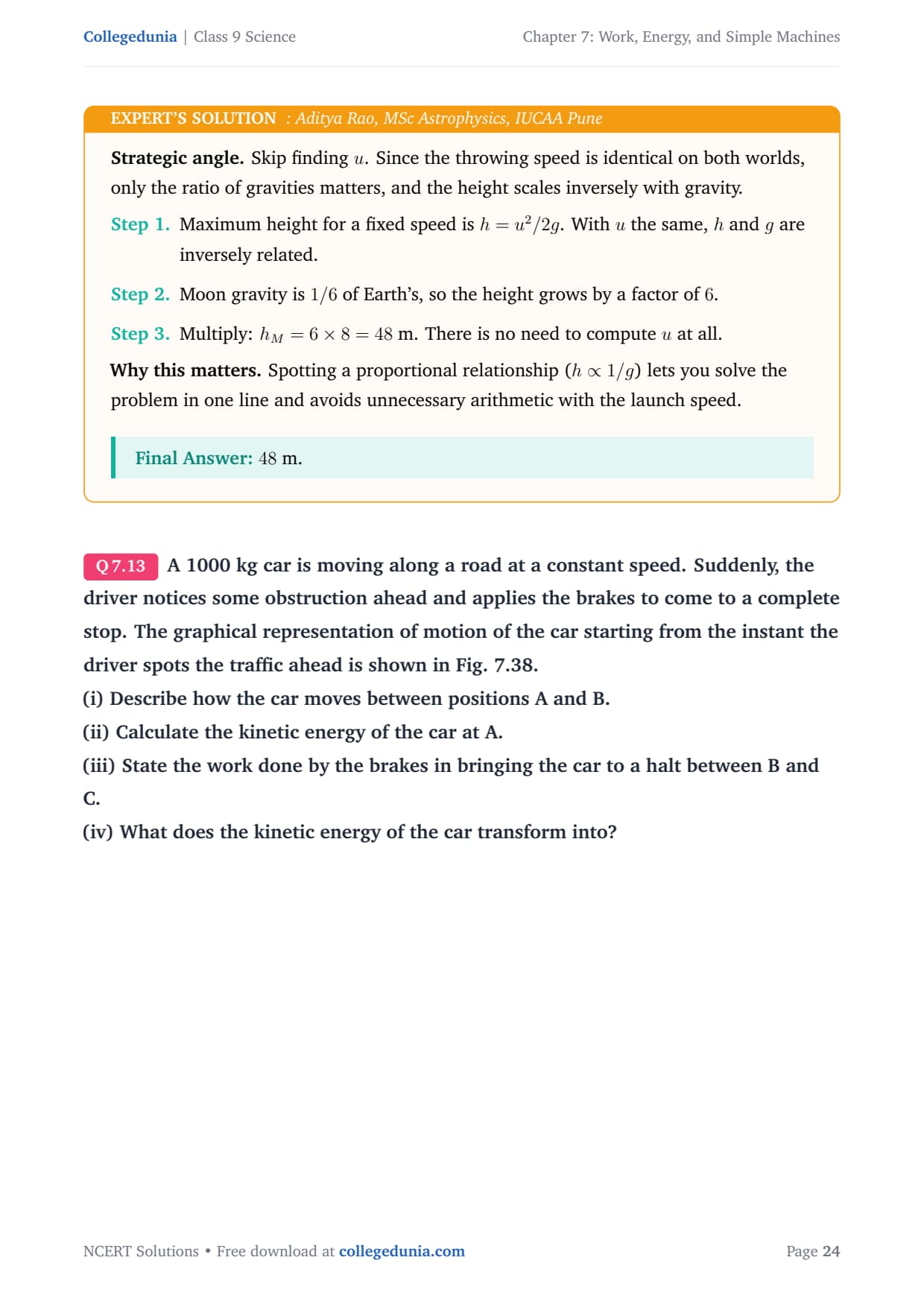
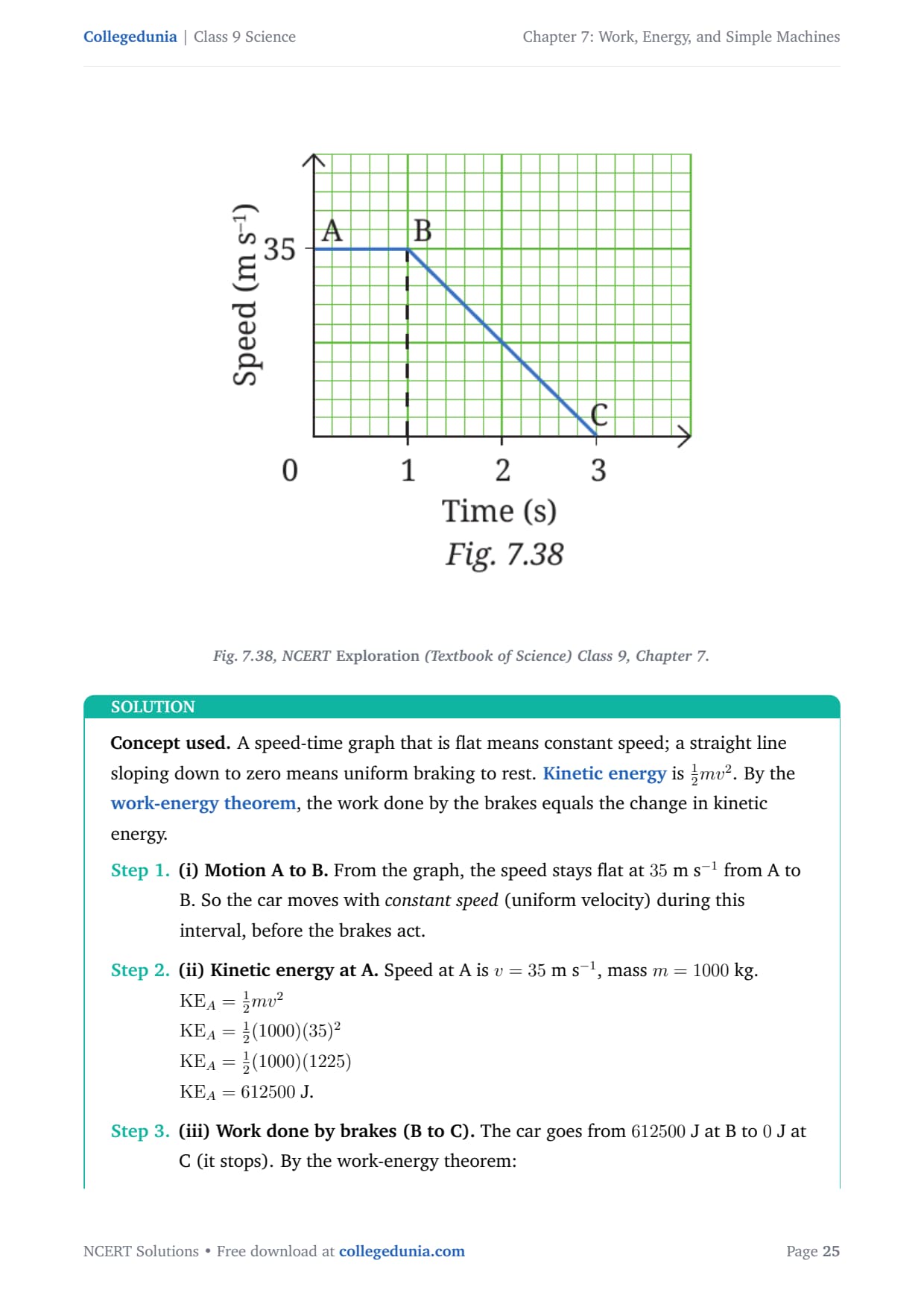
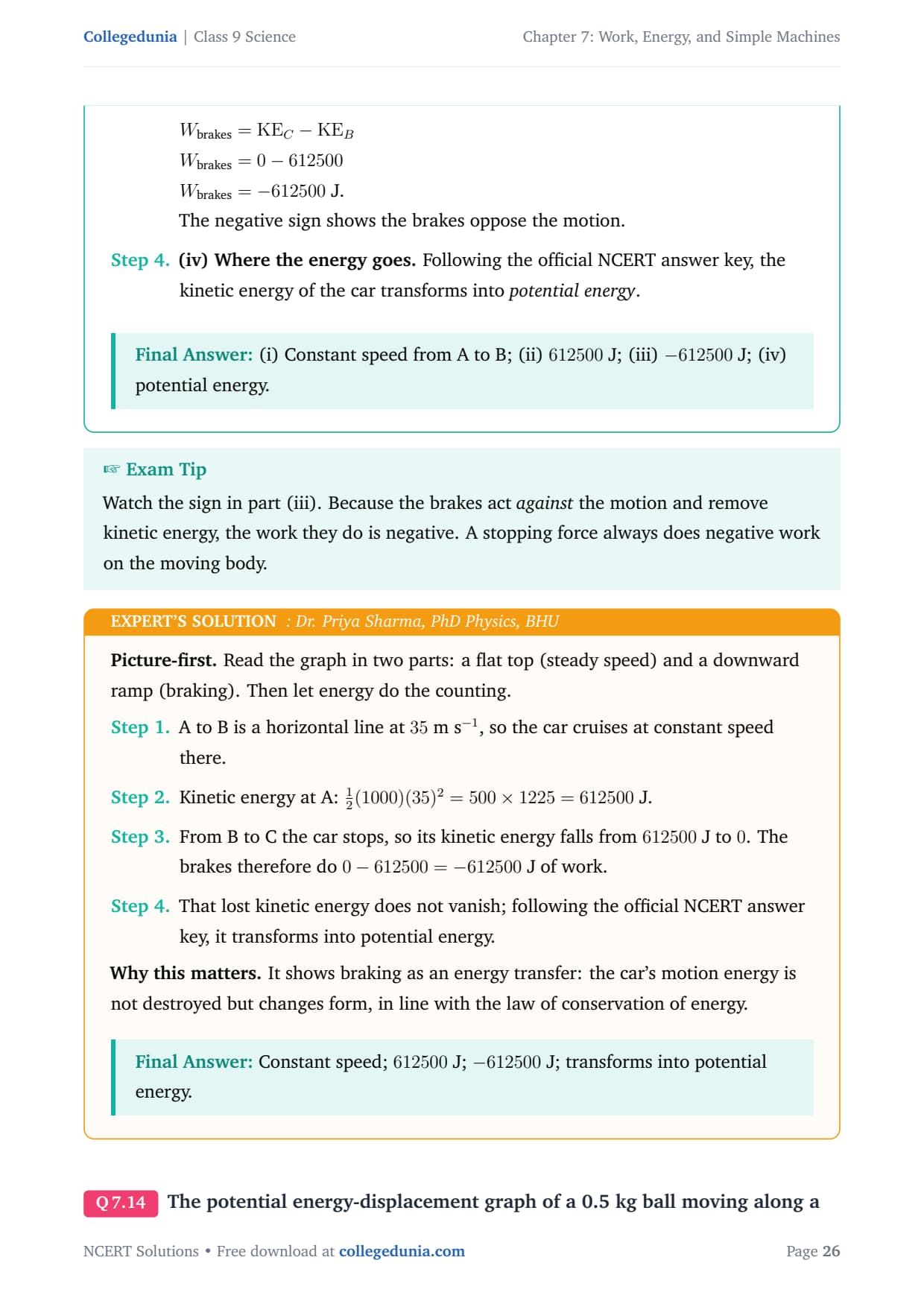
A 1000 kg car moving at 35 m/s brakes to a stop. Find the work done by the brakes. This is Question 13 from the exercise, shown here as a model of the method.
- Kinetic energy before braking: KE = ½ m v2 = ½ × 1000 × 352 = 612500 J.
- Kinetic energy after stopping: the car is at rest, so KE = 0 J.
- Work done by brakes (work-energy theorem): W = final KE minus initial KE = 0 minus 612500 = −612500 J.
- Read the sign: the minus sign shows the brakes act against the motion and remove the car's energy.
Every braking or impact numerical in this chapter follows this same three-line pattern: find the energy before, find it after, and the difference is the work done.
How to Use the Class 9 Work and Energy Solutions Most Effectively
Use a simple three-step routine so the chapter stays in your memory until the exam.
- Learn the four formulas first and write down what each symbol means.
- Attempt each question yourself, then compare with the step-by-step solution below.
- Redo the numericals you got wrong two days later, without looking at the answer.
Pair this page with the chapter notes and formula sheet for quick revision before the exam.
NCERT Class 9 Science Chapter 7 Other Study Resources
Use the other free resources for the same chapter alongside these solutions.
| Resource | Link |
|---|---|
| Revision Notes | Work, Energy, and Simple Machines Class 9 Notes |
| Handwritten Notes | Work, Energy, and Simple Machines Class 9 Handwritten Notes |
| NCERT Book PDF | Work, Energy, and Simple Machines Class 9 NCERT Book PDF |
| Formula Sheet | Work, Energy, and Simple Machines Class 9 Formula Sheet |
NCERT Solutions for Class 9 Science: All Chapters
Find the step-by-step NCERT Solutions for the other Class 9 Science chapters below.
| Chapter | Resource |
|---|---|
| Chapter 4 | Describing Motion Around Us NCERT Solutions |
| Chapter 5 | Exploring Mixtures and their Separation NCERT Solutions |
| Chapter 6 | How Forces Affect Motion NCERT Solutions |
| Chapter 7 | Work, Energy, and Simple Machines NCERT Solutions |
| Chapter 8 | Journey Inside the Atom NCERT Solutions |
| Chapter 10 | Sound Waves Characteristics and Applications NCERT Solutions |
Work, Energy, and Simple Machines Class 9 Science NCERT Solutions FAQs
Ques. Where can I download the Work, Energy, and Simple Machines Class 9 Science NCERT Solutions PDF?
Ans. You can download the Work, Energy, and Simple Machines Class 9 Science NCERT Solutions PDF free from this page. Both a normal and an HD version are available.
Ques. How many questions are solved in Class 9 Science Chapter 7?
Ans. All 15 questions from the Revise, Reflect, Refine exercise are solved, each with a step-by-step method and an expert method.
Ques. Are these solutions aligned with the 2026-27 NCERT?
Ans. Yes. Every answer matches the new 2026-27 NCERT Exploration textbook for Class 9 Science and the official NCERT answer key.
Ques. What is work in Class 9 Science?
Ans. Work is done when a force moves an object in the direction of the force. It equals force times displacement, W = F × s, and its unit is the joule (J).
Ques. How is power defined?
Ans. Power is the rate of doing work, P = W / t. It tells you how fast work is done, and its unit is the watt (W).
Ques. What are simple machines in Class 9 Science?
Ans. Simple machines like the lever, pulley, and inclined plane reduce the effort needed to do a job. They do not reduce the total work done.



Comments