




The NCERT Notes Class 9 Science Chapter 10 Sound Waves: Characteristics and Applications give you a clear, quick revision of the whole chapter from the new Exploration textbook. In one place you get every key idea: how vibrations produce sound, why sound needs a medium, compressions and rarefactions, sound as a longitudinal wave, wavelength, frequency, amplitude and speed, and how we use echoes, ultrasound and SONAR. The notes use short lines and simple words, so you can revise the full chapter fast before a class test or the 2026-27 exam.
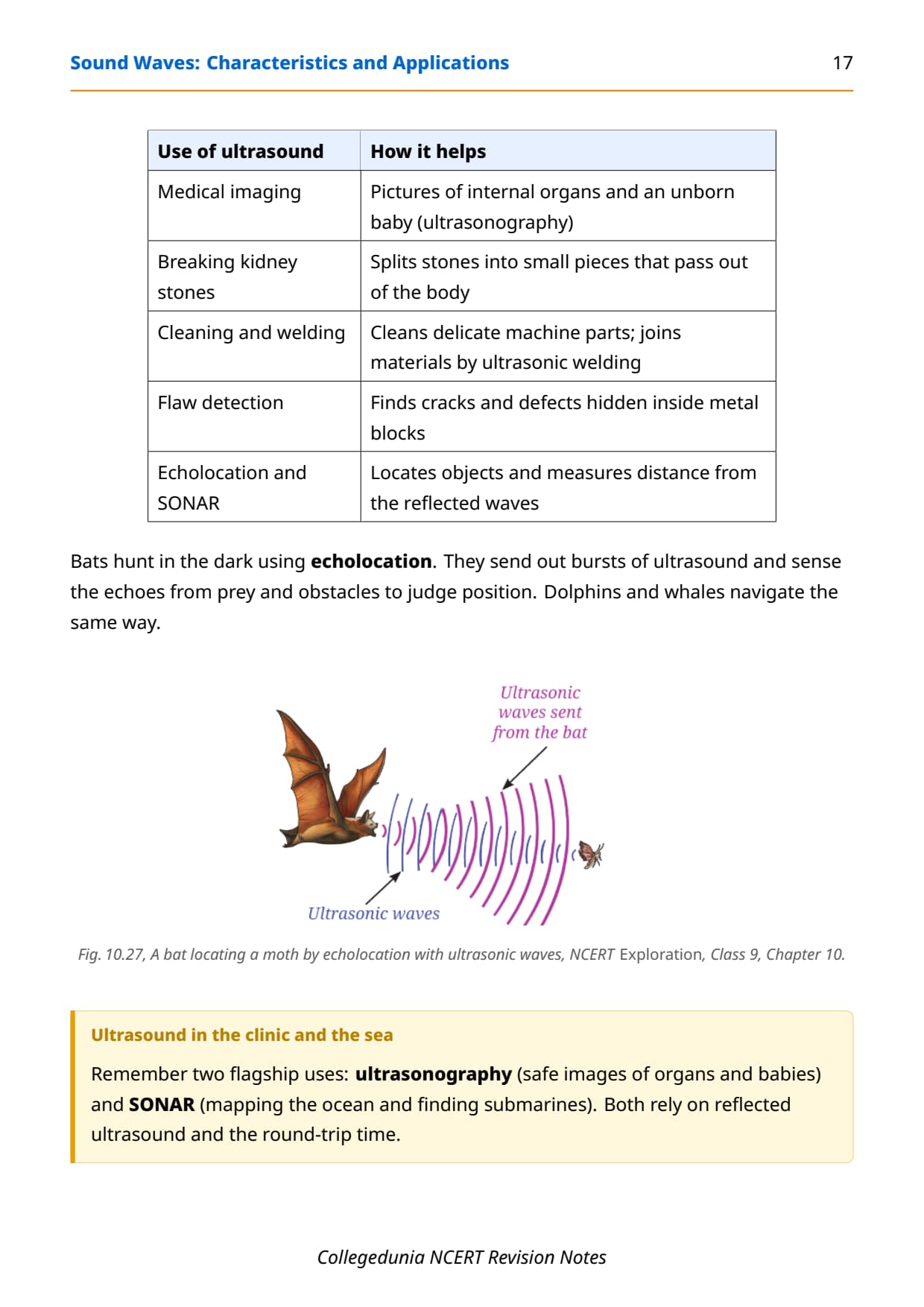
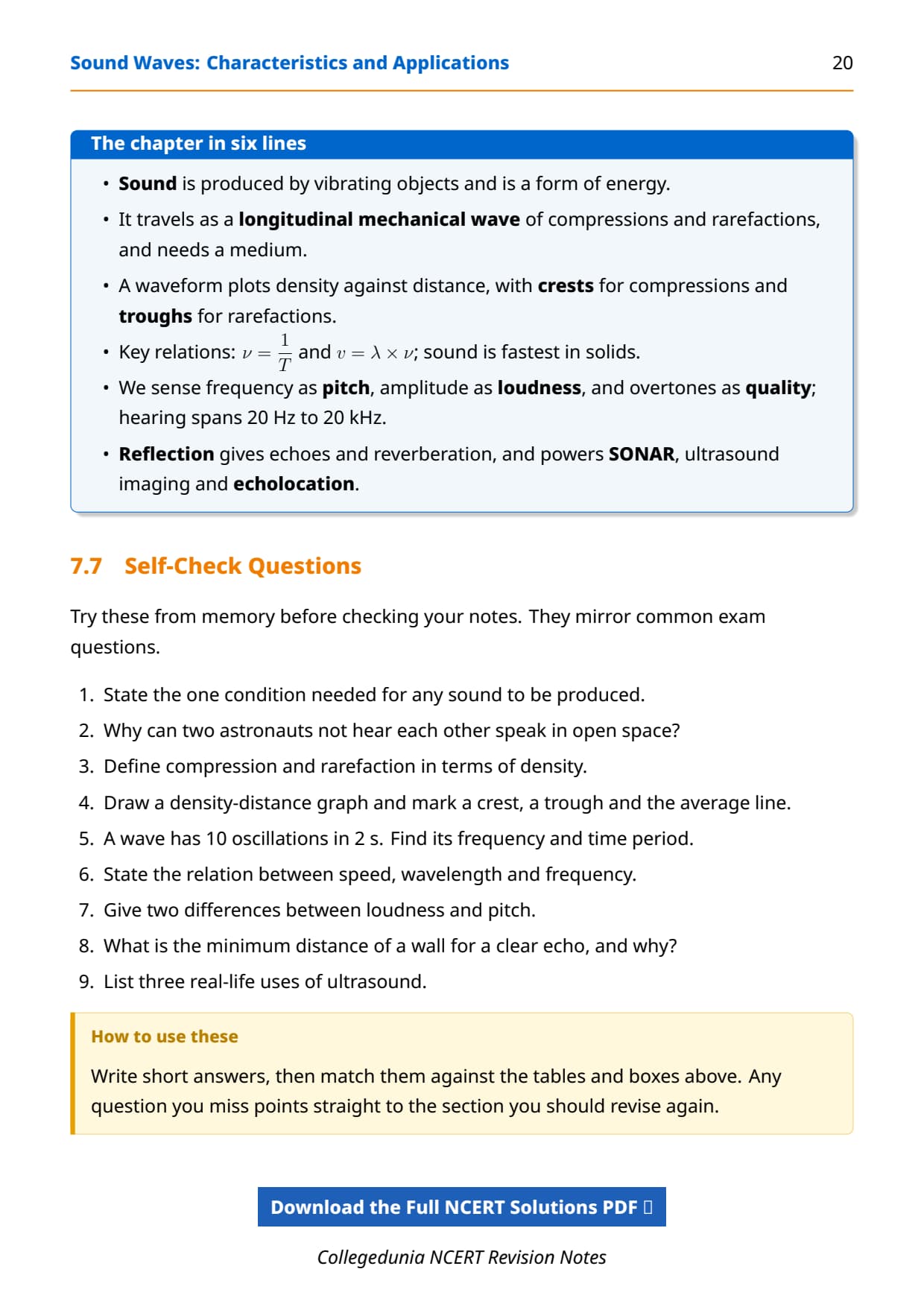

- Full concept revision: production of sound, propagation, compressions and rarefactions, longitudinal waves, wave characteristics, perception, and reflection in one set of notes.
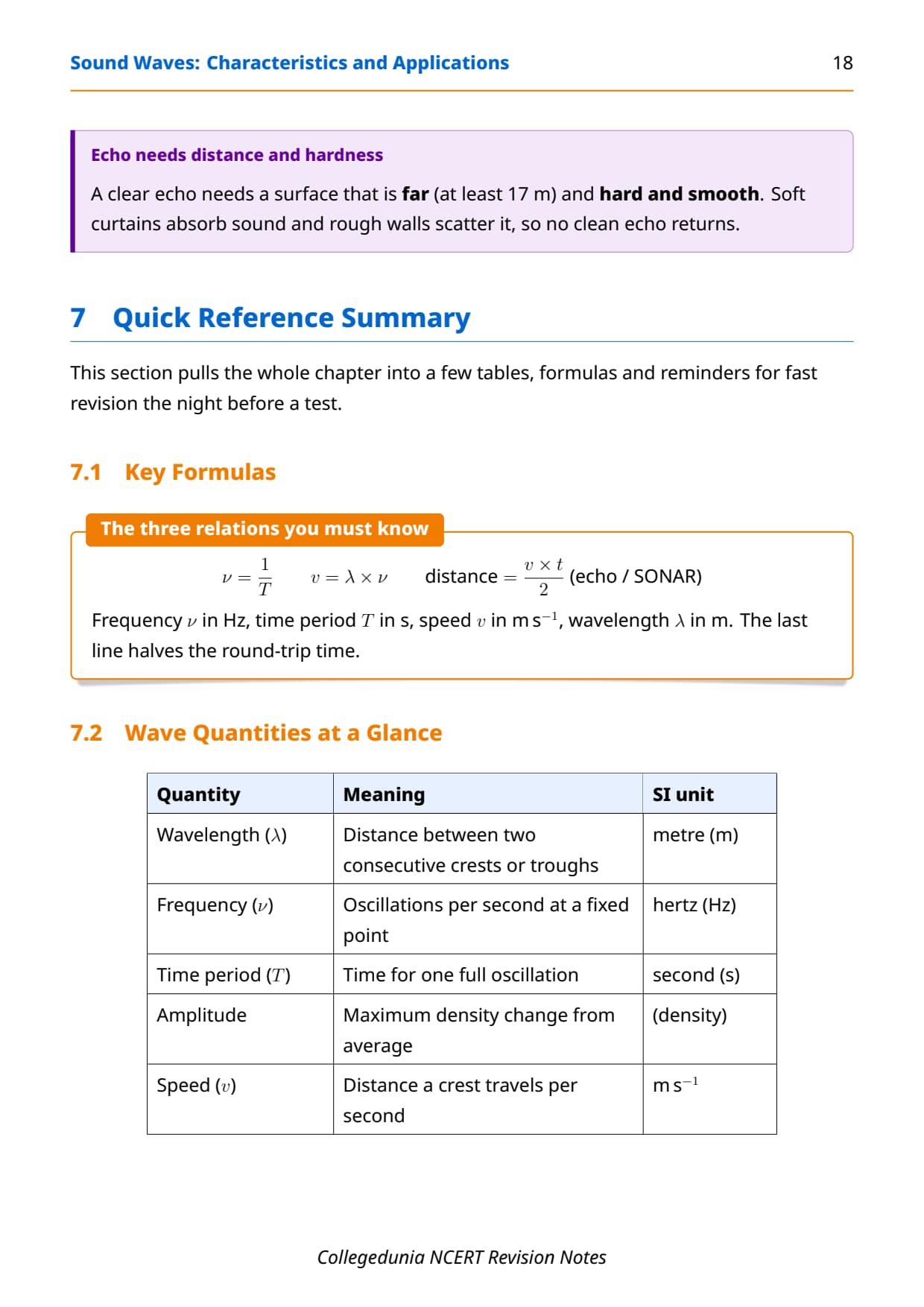
- Formula ready: the two key relations ν = 1/T and v = λ × ν, plus the echo and SONAR rule distance = v × t/2.
- Why it matters: Chapter 10 builds the base for waves, sound engineering, and later CBSE, JEE, and NEET physics.
Student Feedback
In a Collegedunia study of 1,240 Class 9 students, 81% said a one-page revision of compressions and rarefactions helped them read a sound waveform without slips. About 4 out of 5 rated the echo and SONAR distance rule the most useful part, and many said the solved numericals made the speed and time-period sums feel easy.
What You Revise in Class 9 Science Chapter 10 Sound Waves: Characteristics and Applications
Chapter 10 explains how every sound, from a whisper to a thunderclap, begins with something vibrating, and how that vibration travels to your ear as a wave. The NCERT Notes Class 9 Science Chapter 10 Sound Waves: Characteristics and Applications cover every idea in the order the Exploration book uses, so your revision follows the same flow as the chapter.
These notes help you recall the core points in minutes:
- Production and travel: sound is made by vibrations and needs a material medium to move through.
- How the wave looks: compressions and rarefactions, and why sound is a longitudinal mechanical wave.
- Wave characteristics: wavelength, frequency, time period, amplitude, and the speed formula.
- Hearing and uses: pitch, loudness, quality, the range of hearing, echoes, reverberation, ultrasound, and SONAR.
Sound Waves Class 9 Science in One Shot
Source: Alakh Pandey - Class 9th & 10th on YouTube
How Sound is Produced by Vibrations: Quick Revision Notes
Start your revision with the one rule behind every sound. Sound is produced by vibrating objects. A vibration is the rapid to and fro motion of an object about its rest position. When the vibration stops, the sound stops too.
- Everyday sources: a plucked string, a struck metal plate, and a stretched drum skin all vibrate to make sound.
- Your own voice: sound comes from the vocal cords, two stretched flaps inside the voice box (larynx). Touch your throat while speaking and you feel them vibrate.
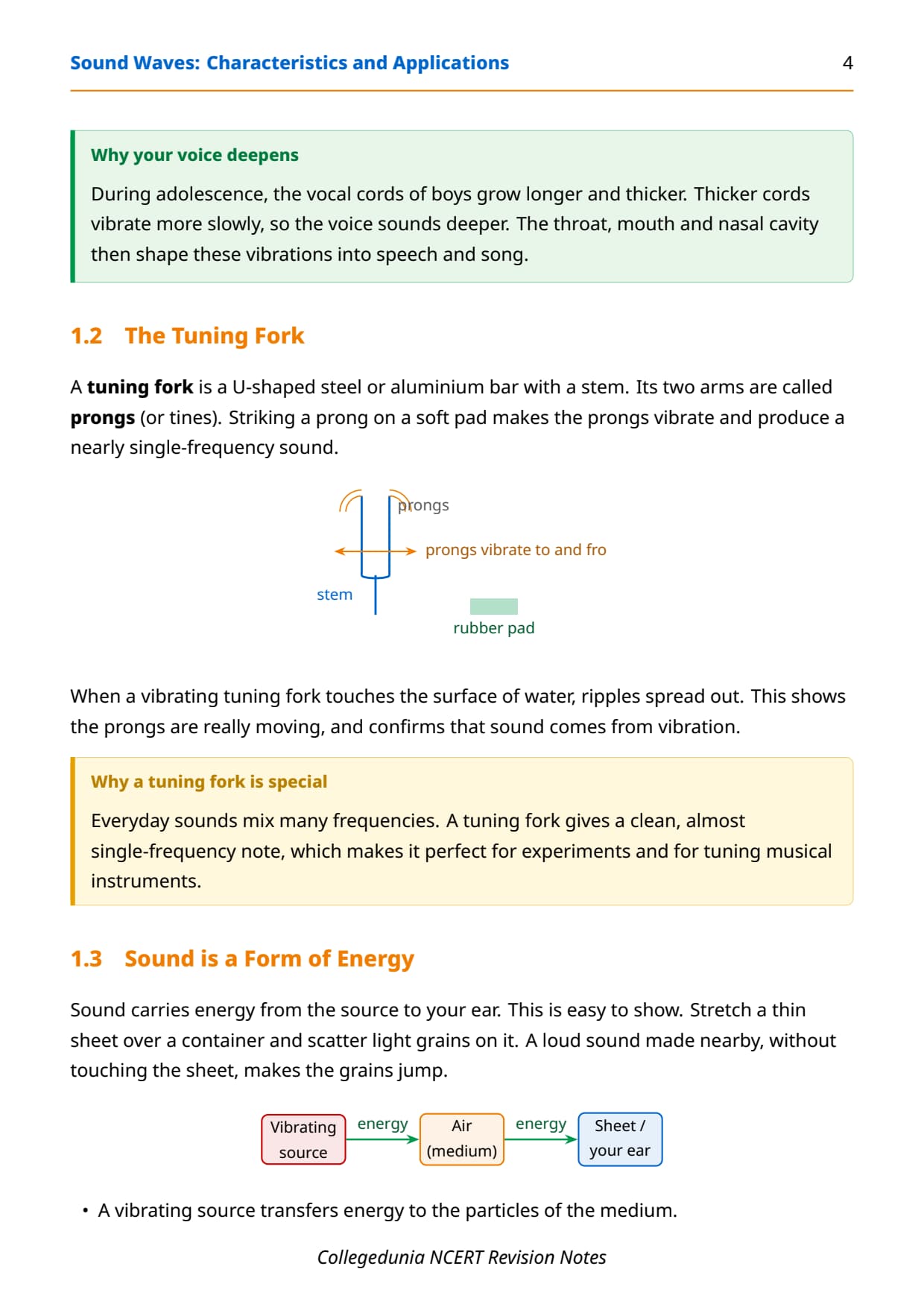
- A tuning fork: a U-shaped steel bar whose two arms, called prongs, vibrate when struck and give a clean, almost single-frequency note.
- Sound is energy: a loud sound near a stretched sheet makes light grains on it jump, even without touching it, because the sound carries energy to the sheet.
The object that produces sound is called the source. When a vibrating tuning fork touches water, ripples spread out, which proves the prongs are really moving.
Propagation of Sound: Why Sound Needs a Medium in Class 9
A source makes sound, but the sound must travel to reach your ear. The material that carries sound is called a medium, and sound can move through solids, liquids and gases.
- Through a solid: press your ear to a desk and a gentle scratch at the far end sounds clear, so sound travels through wood.
- Through a liquid: tap two spoons underwater and you still hear them, so sound travels through water.
- Through a gas: normal talking reaches you through the air around you.
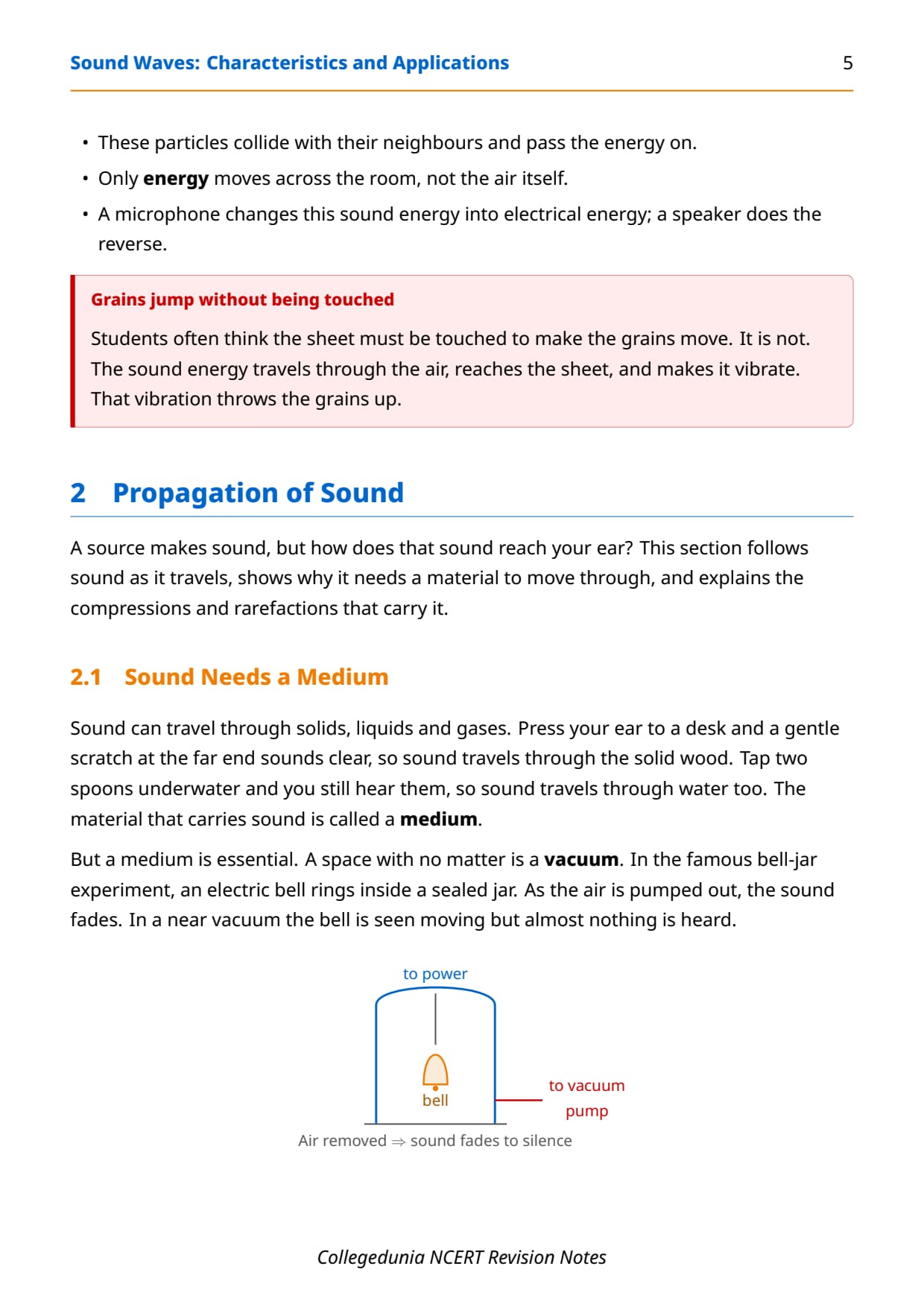
But a medium is essential. A space with no matter is a vacuum. In the bell-jar experiment, an electric bell rings inside a sealed jar. As the air is pumped out, the sound fades, and in a near vacuum the bell is seen moving but almost nothing is heard.
Compressions and Rarefactions in a Sound Wave
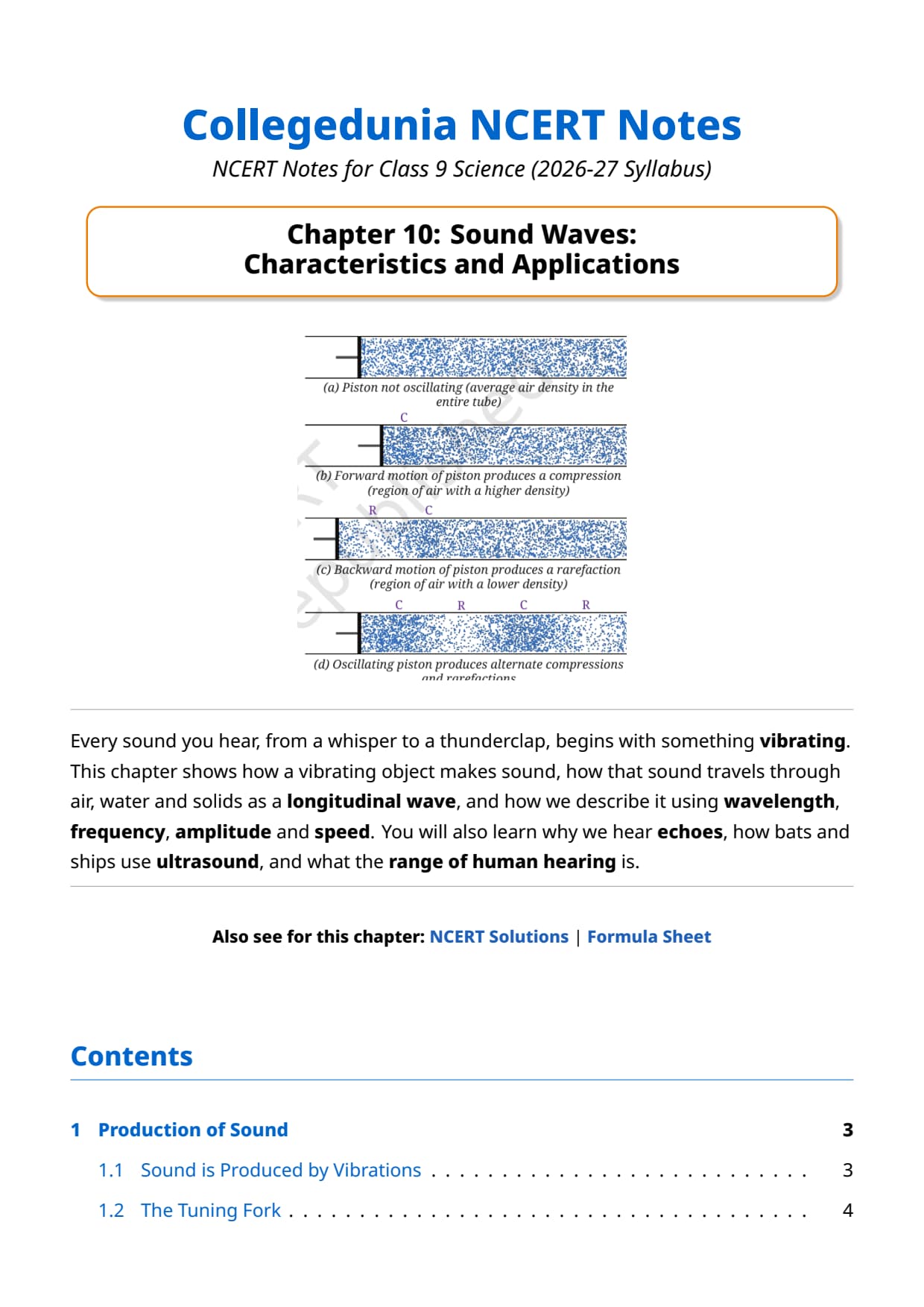
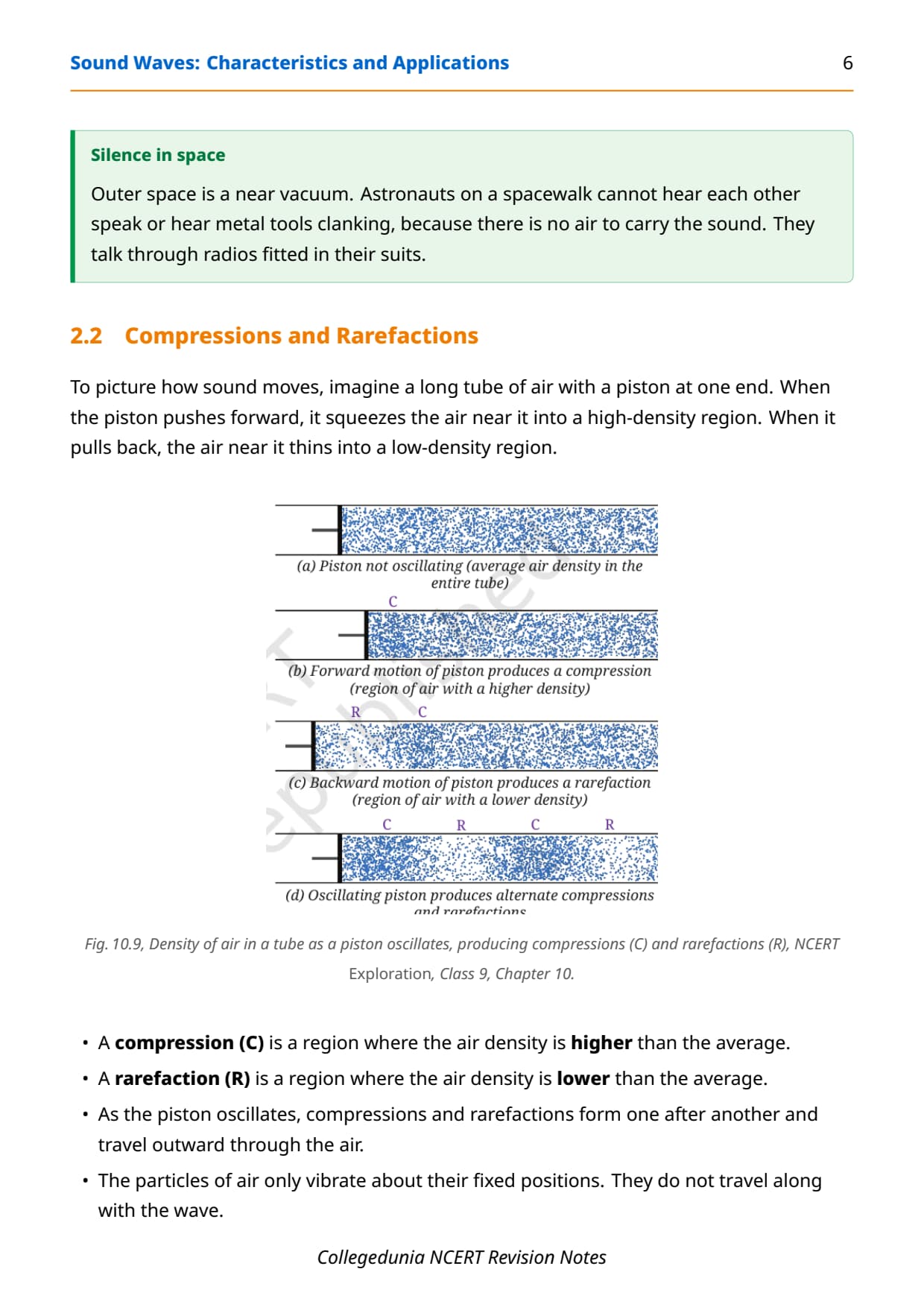
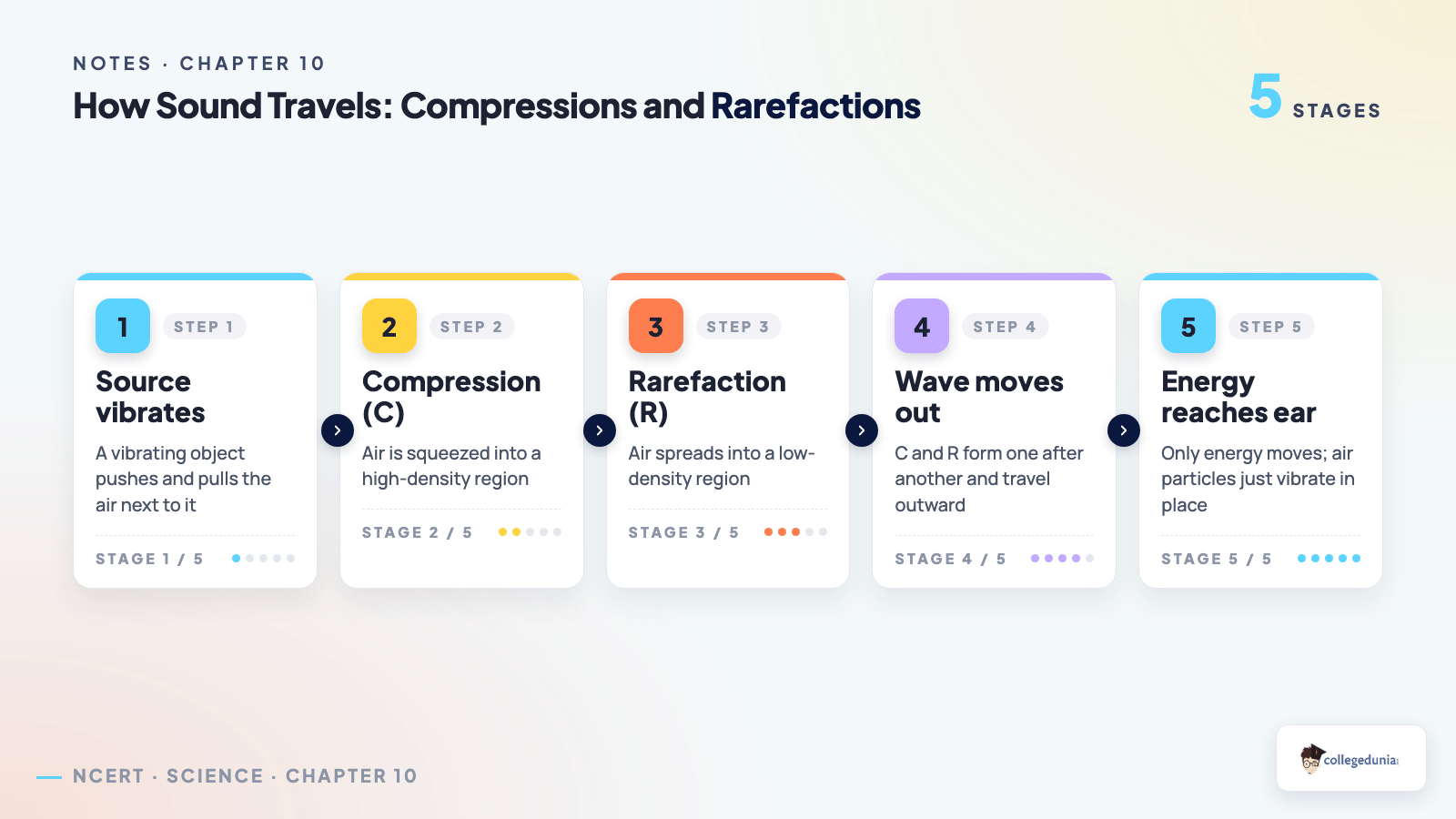
To picture how sound moves, imagine a long tube of air with a piston at one end. When the piston pushes forward it squeezes the air into a high-density region; when it pulls back the air thins into a low-density region. These two regions form again and again and travel outward.
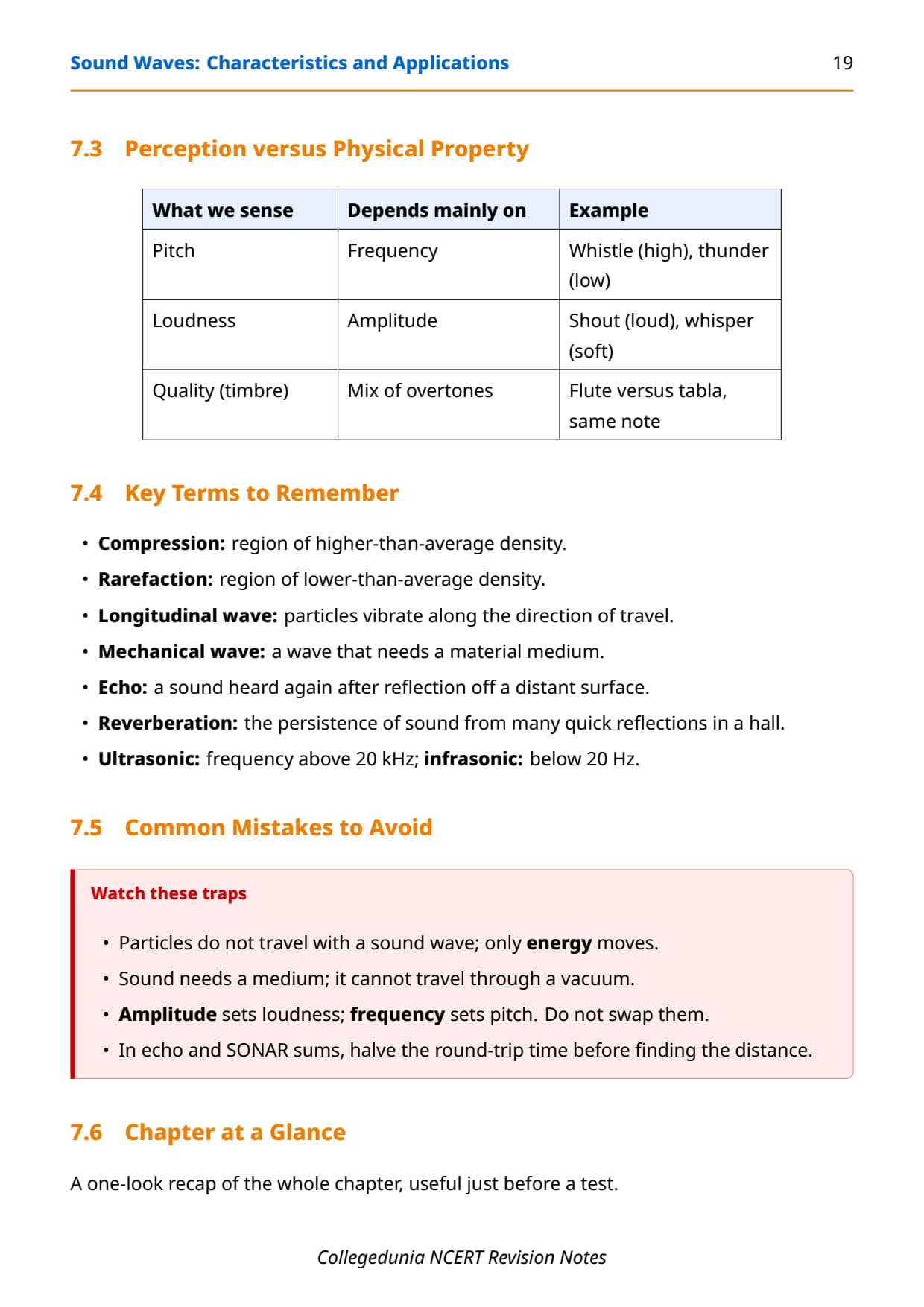
- A compression (C) is a region where the air density is higher than the average.
- A rarefaction (R) is a region where the air density is lower than the average.
- Compressions and rarefactions come one after the other and carry the sound forward.
- The air particles only vibrate about their fixed positions. They do not travel along with the wave; only the energy moves forward.
Sound is a Longitudinal Mechanical Wave: Class 9 Notes
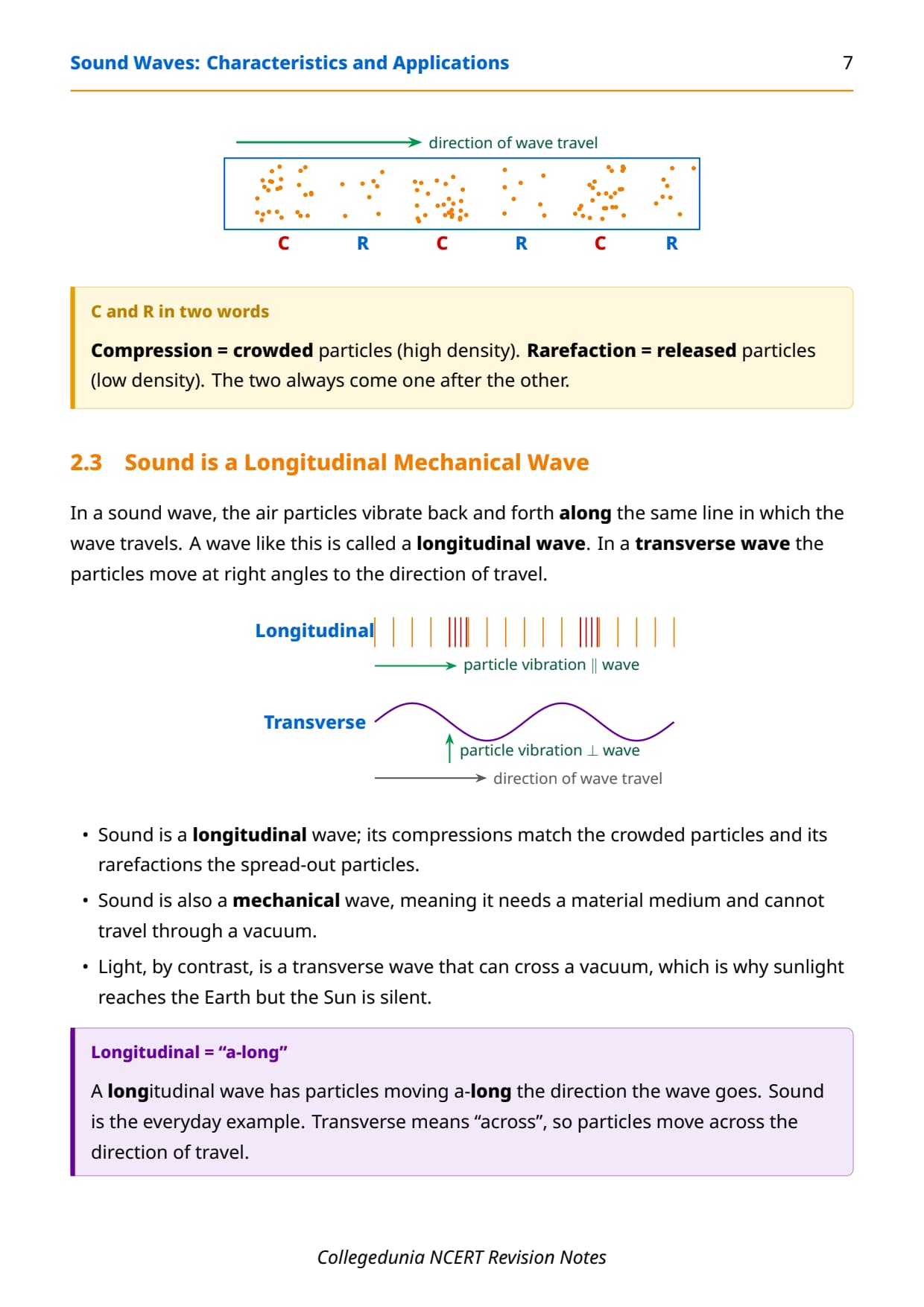
In a sound wave, the air particles vibrate back and forth along the same line in which the wave travels. A wave like this is a longitudinal wave. In a transverse wave, the particles move at right angles to the direction of travel.
| Feature | Longitudinal wave | Transverse wave |
|---|---|---|
| Particle motion | Along the direction of travel | At right angles to travel |
| Made of | Compressions and rarefactions | Crests and troughs |
| Needs a medium | Yes (mechanical wave) | Not always |
| Example | Sound in air | Light, ripples on water |
- Sound is also a mechanical wave, which means it needs a material medium and cannot cross a vacuum.
- Light, in contrast, is a transverse wave that can cross a vacuum, which is why sunlight reaches the Earth but the Sun is silent.
Characteristics of a Sound Wave: Wavelength, Frequency and Amplitude
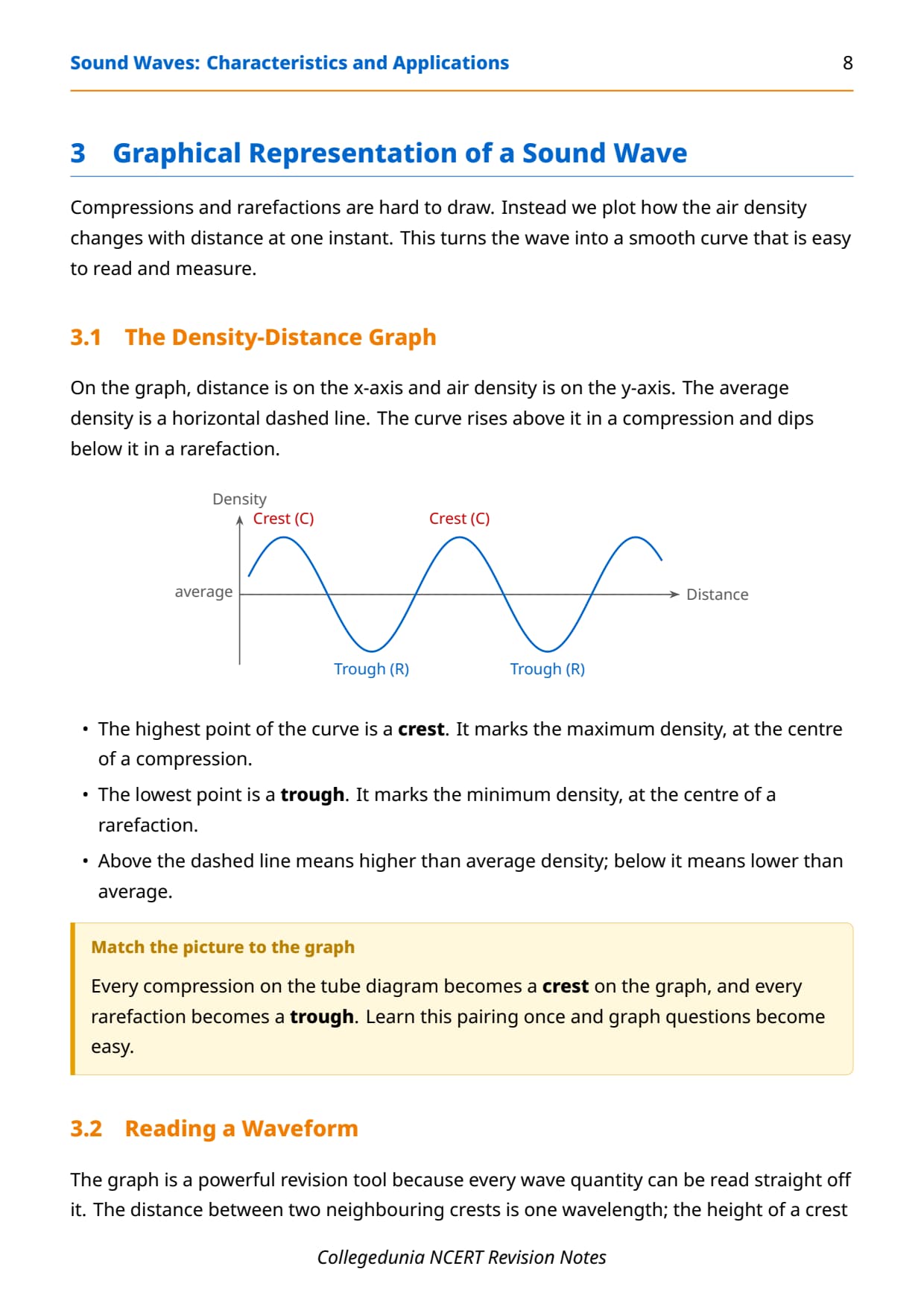
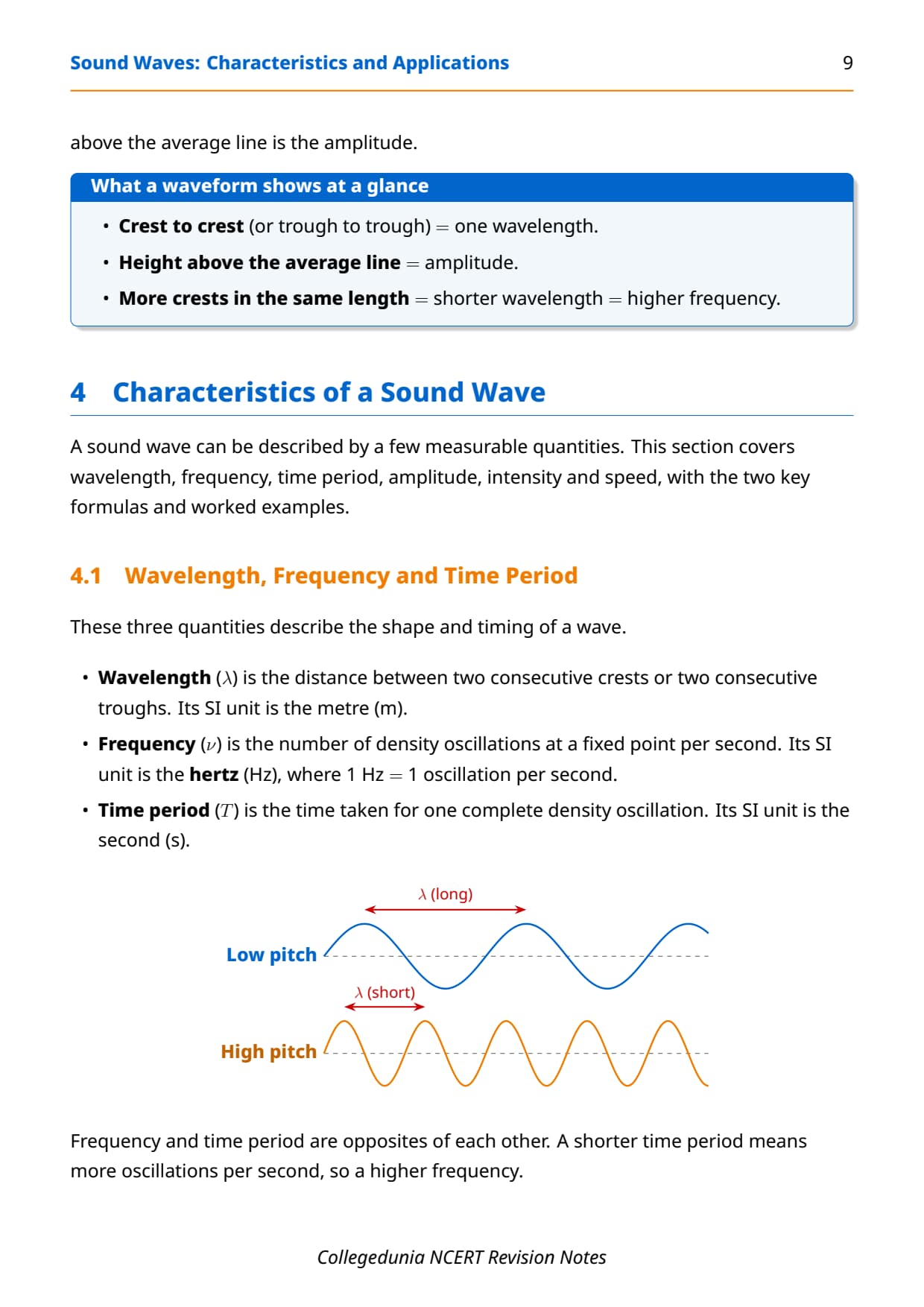
A sound wave is described by a few measurable quantities. Learn these well, as almost every exam set from this chapter tests them. It helps to first draw the wave as a density-distance graph, where a crest marks a compression and a trough marks a rarefaction.
| Quantity | Meaning | SI unit |
|---|---|---|
| Wavelength (λ) | Distance between two consecutive crests or troughs | metre (m) |
| Frequency (ν) | Number of oscillations per second at a fixed point | hertz (Hz) |
| Time period (T) | Time for one full oscillation | second (s) |
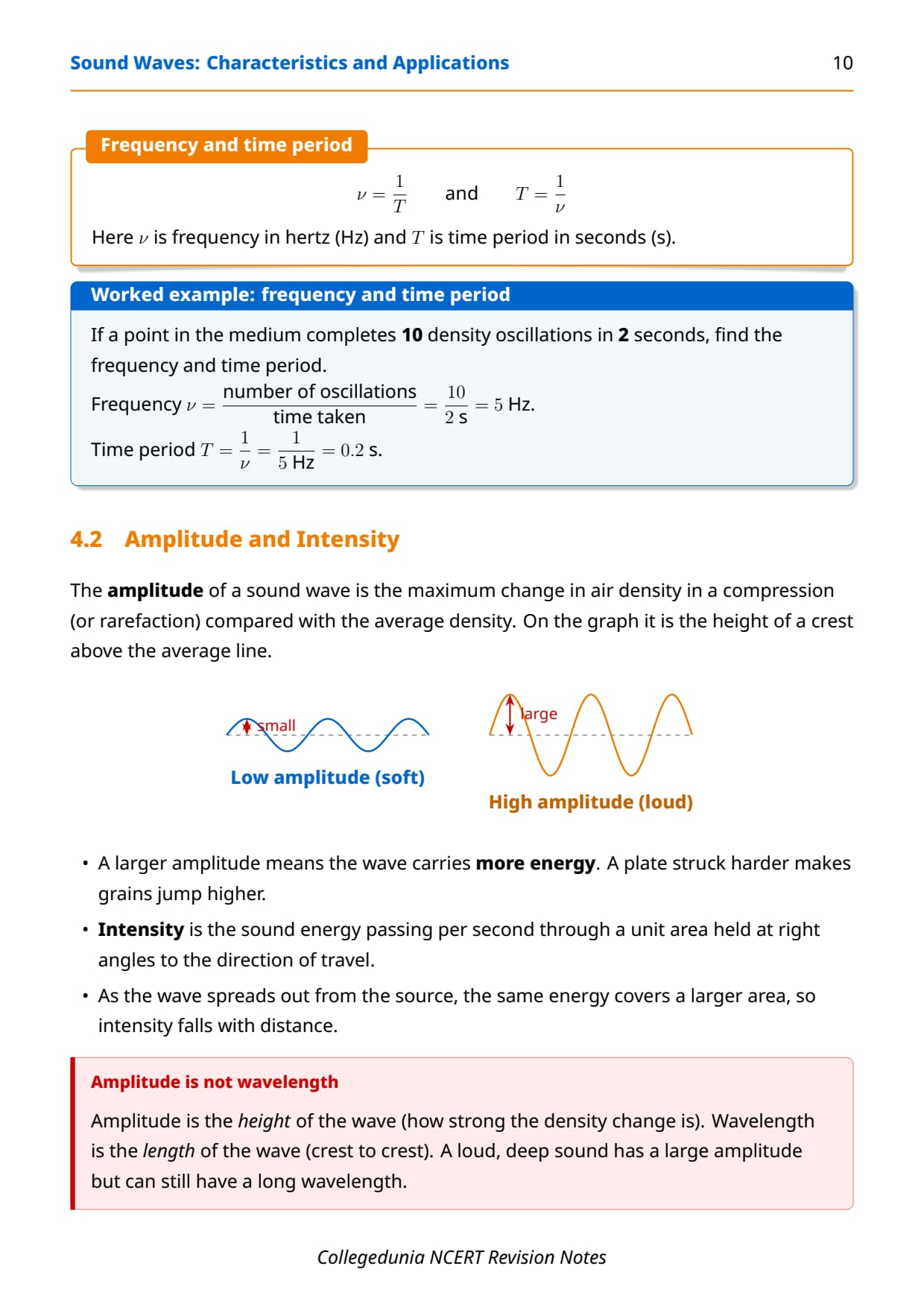
| Amplitude | Maximum change in density from the average | density |
- Frequency and time period are opposites. A shorter time period means more oscillations per second, so a higher frequency. They are linked by ν = 1/T.
- Amplitude and energy: a larger amplitude means the wave carries more energy, so a plate struck harder makes grains jump higher.
- Intensity is the sound energy passing per second through a unit area held at right angles to the wave. As the wave spreads out, the same energy covers more area, so intensity falls with distance.
Speed of Sound and the Wave Formula in Class 9 Science Chapter 10
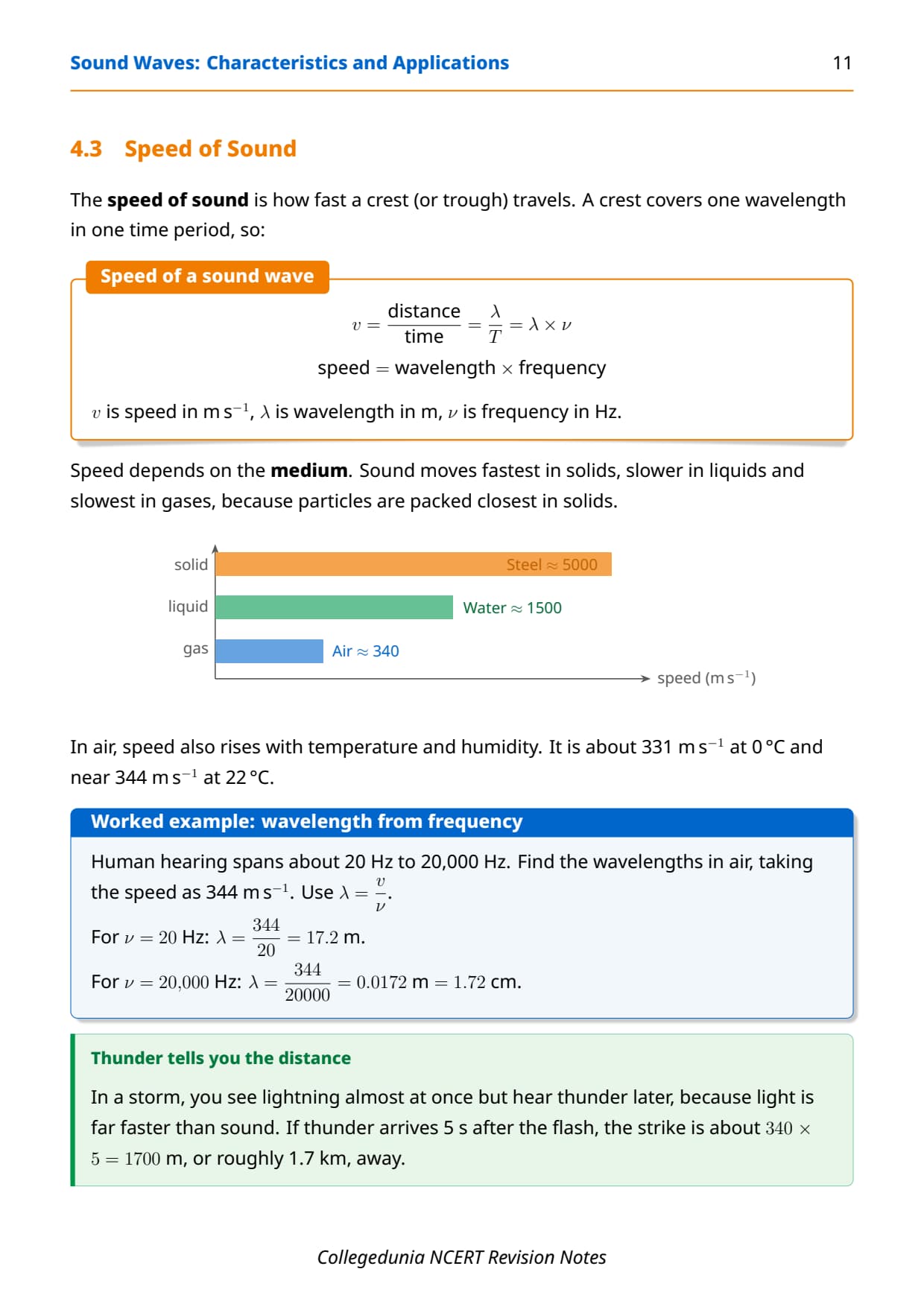
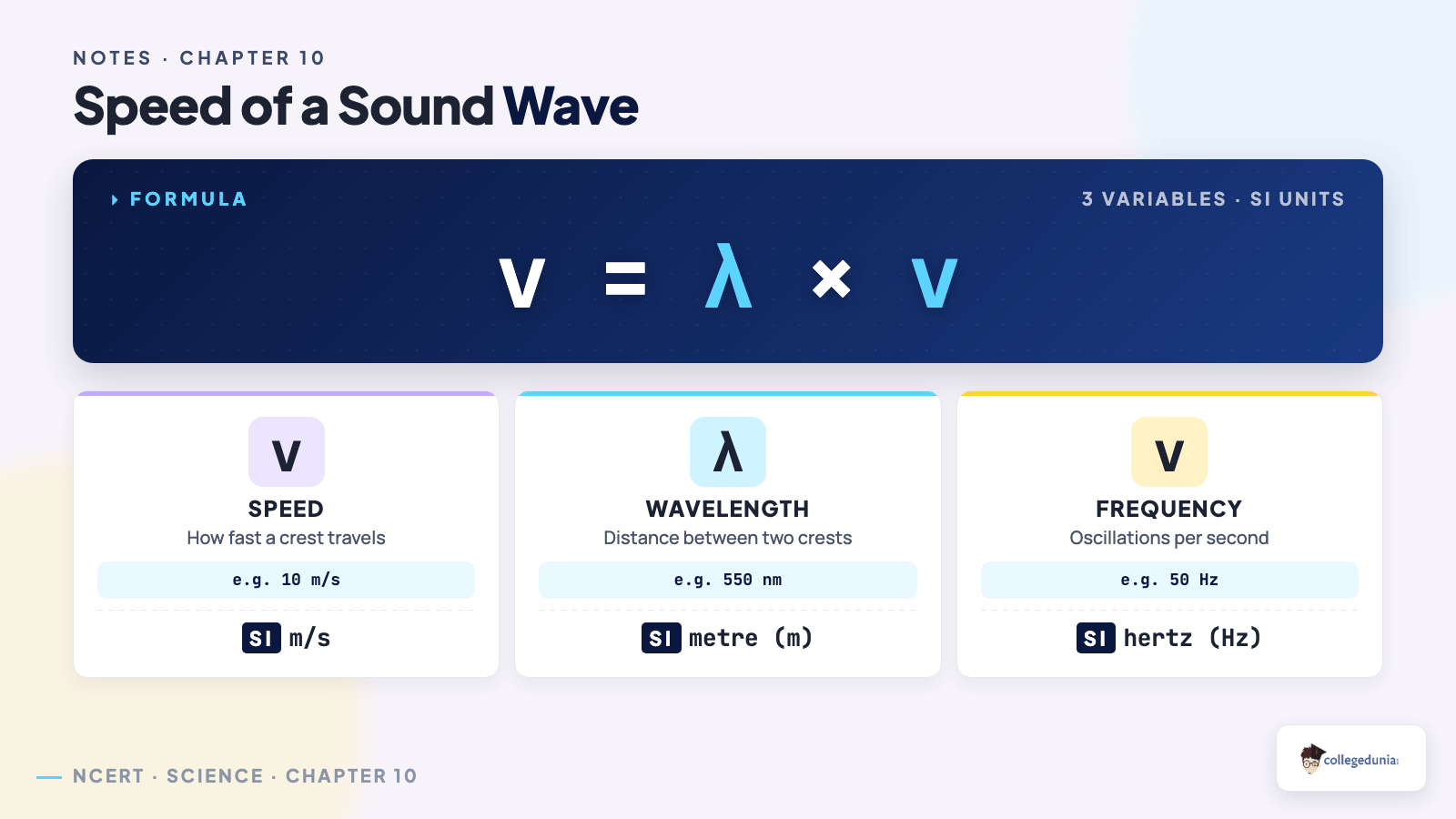
The speed of sound is how fast a crest (or trough) travels. A crest covers one wavelength in one time period, which gives the most important formula of the chapter.
Here v is speed in metre per second, λ is wavelength in metre, and ν is frequency in hertz. The relation can be rearranged three ways, so you can find any one quantity from the other two.
- Speed depends on the medium. Sound moves fastest in solids, slower in liquids and slowest in gases, because particles are packed closest in solids.
- Rough values: about 340 m/s in air, 1500 m/s in water and 5000 m/s in steel.
- In air, speed also rises with temperature. It is about 331 m/s at 0°C and near 344 m/s at 22°C.
In a storm you see lightning at once but hear thunder later, because light is far faster than sound. If thunder arrives 5 s after the flash, the strike is about 340 × 5 = 1700 m, or roughly 1.7 km, away.
Pitch, Loudness, Quality and the Range of Hearing
The physical quantities of a wave can be measured exactly, but how we hear them is more personal. These notes link each measurable property to what we actually sense.
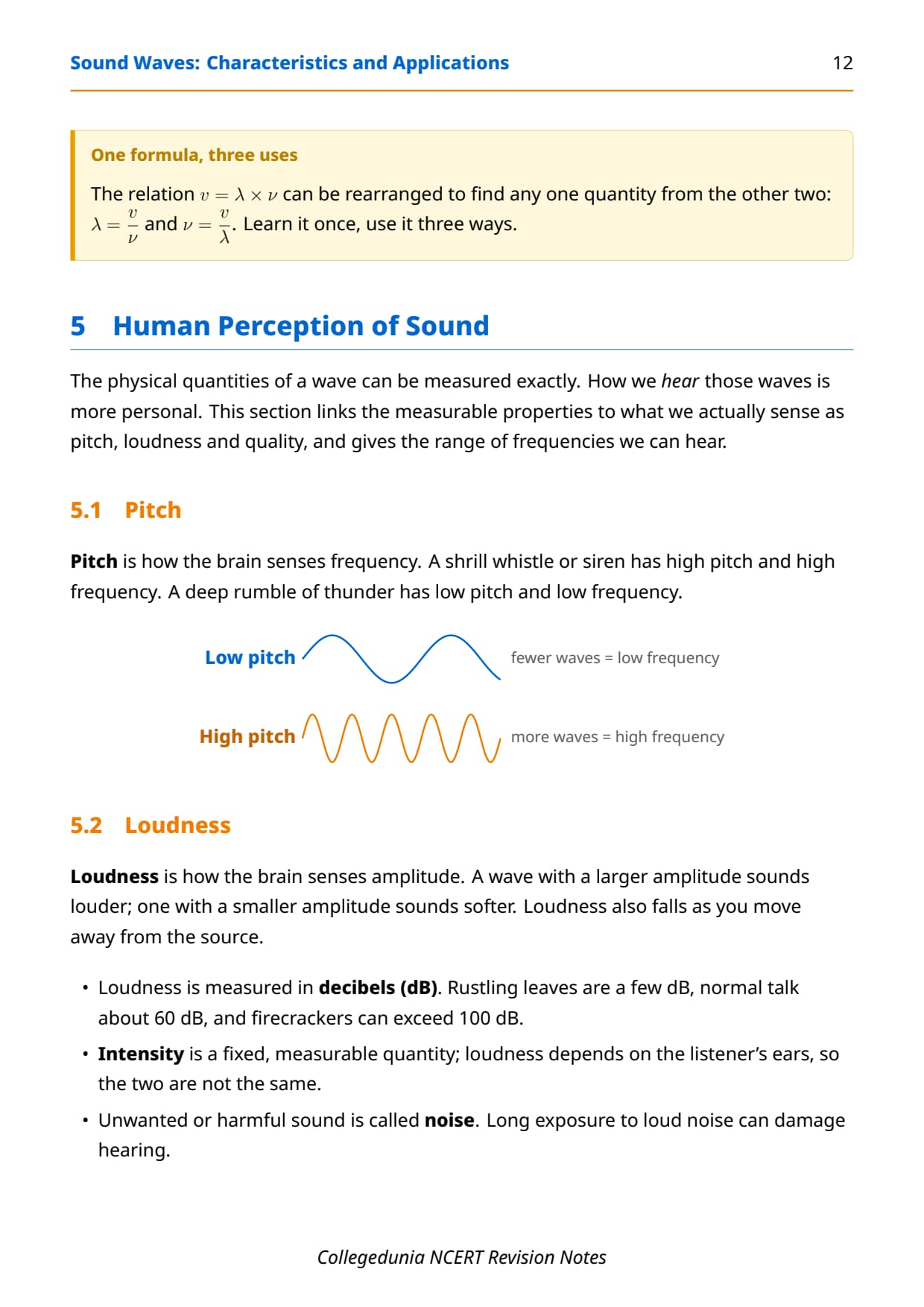
- Pitch is how the brain senses frequency. A shrill whistle has high pitch and high frequency; a deep rumble of thunder has low pitch and low frequency.
- Loudness is how the brain senses amplitude. A larger amplitude sounds louder. Loudness is measured in decibels (dB): normal talk is about 60 dB, while firecrackers can cross 100 dB.
- Quality (timbre) is what makes a flute and a tabla sound different on the same note. A musical note mixes a lowest frequency, the fundamental, with higher overtones.
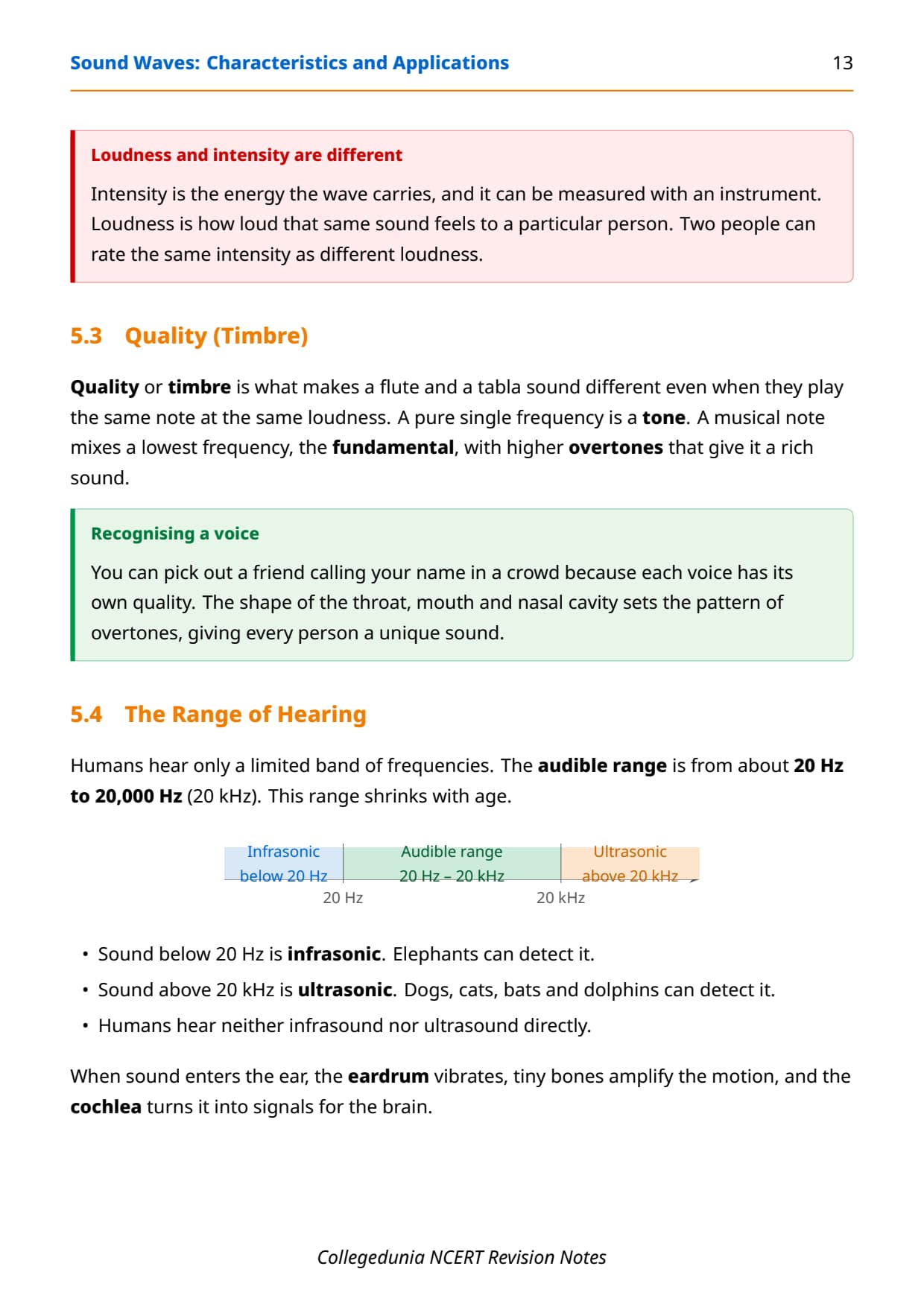
Humans hear only a limited band. The audible range is about 20 Hz to 20,000 Hz (20 kHz), and it shrinks with age.
- Sound below 20 Hz is infrasonic. Elephants can detect it.
- Sound above 20 kHz is ultrasonic. Dogs, bats and dolphins can detect it.
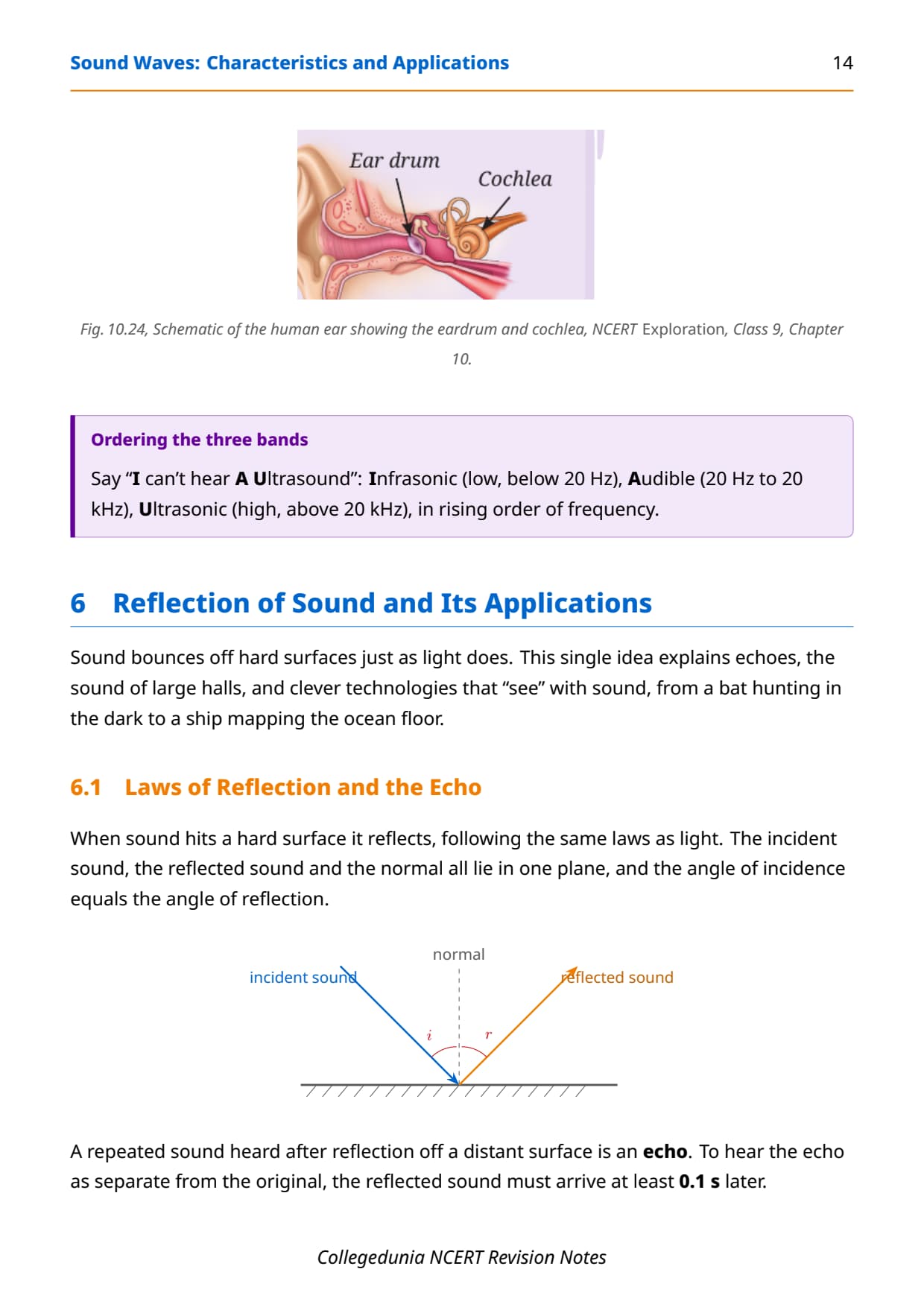
- When sound enters the ear, the eardrum vibrates, tiny bones amplify the motion, and the cochlea turns it into signals for the brain.
Reflection of Sound: Echo, Reverberation and SONAR Notes
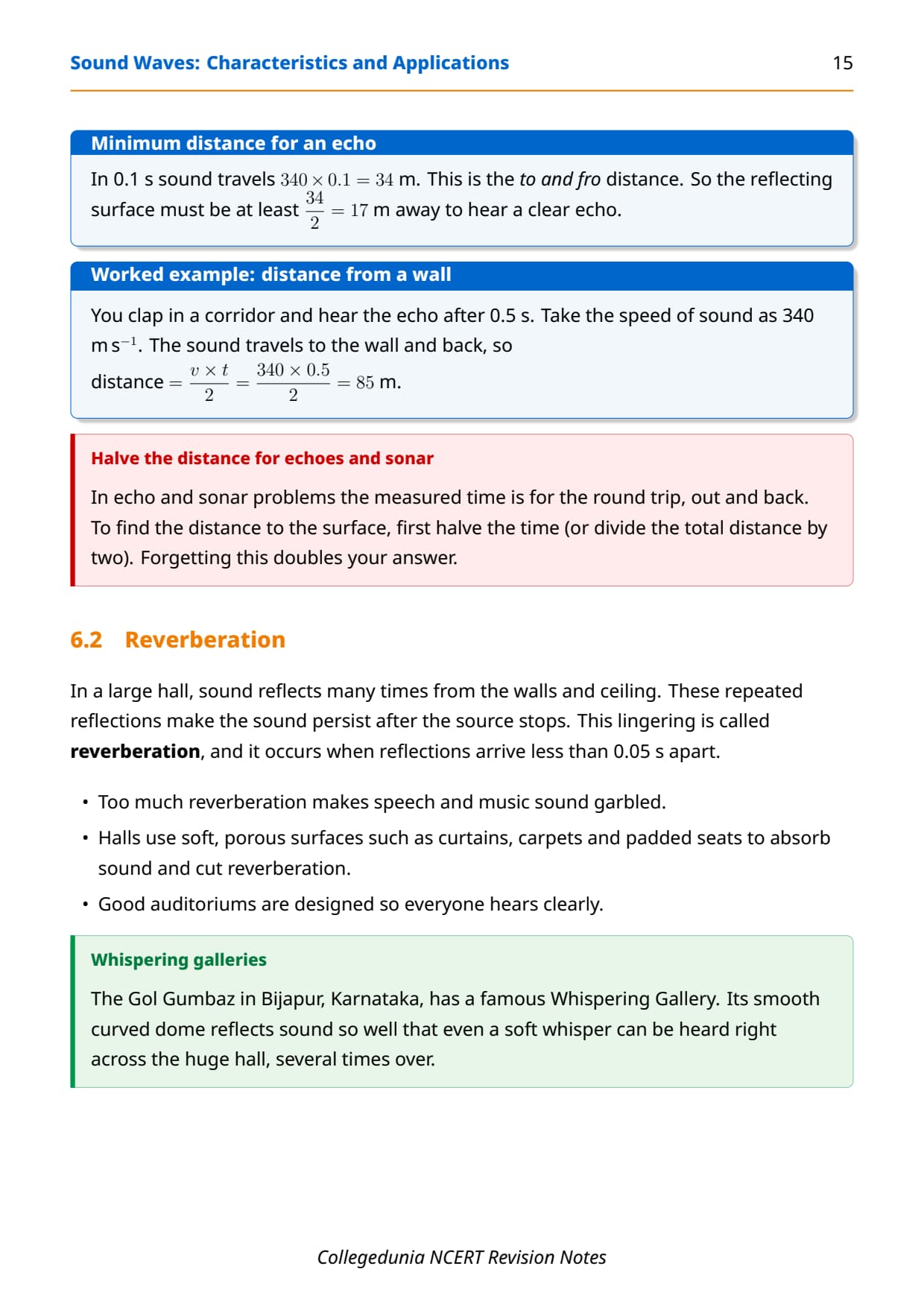
Sound bounces off hard surfaces just as light does, following the same laws of reflection: the angle of incidence equals the angle of reflection. This one idea explains echoes, the sound of large halls, and technologies that "see" with sound.
- Echo: a sound heard again after reflection off a distant surface. To hear it as separate from the original, the reflected sound must arrive at least 0.1 s later. In 0.1 s sound travels 340 × 0.1 = 34 m, so the surface must be at least 34/2 = 17 m away.
- Reverberation: in a large hall, sound reflects many times and lingers after the source stops. Halls use curtains, carpets and padded seats to absorb sound and cut reverberation.
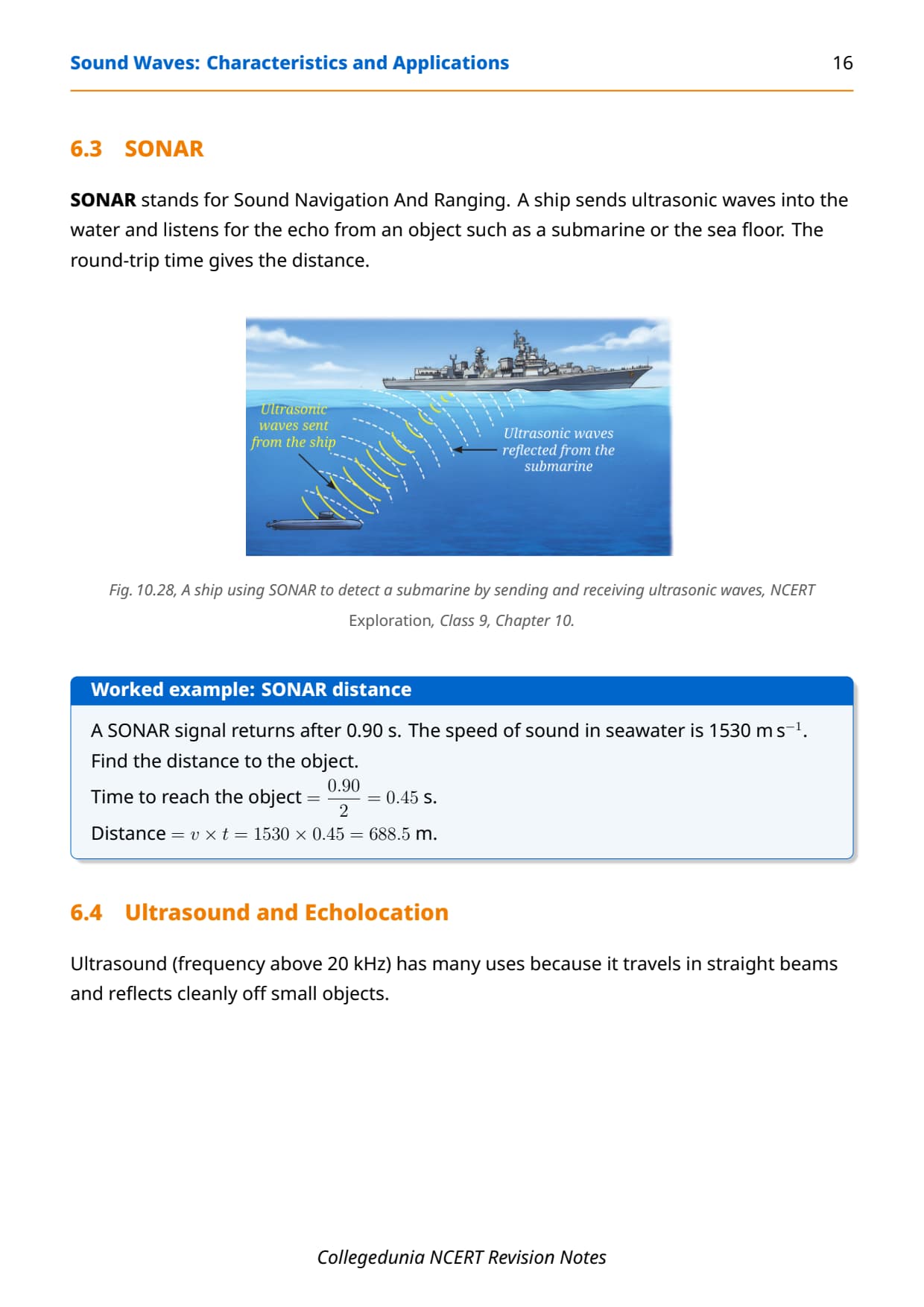
- SONAR (Sound Navigation And Ranging): a ship sends ultrasonic waves into the water and times the echo from a submarine or the sea floor to find the distance.
Ultrasound (frequency above 20 kHz) has many uses because it travels in straight beams and reflects cleanly off small objects.
| Use of ultrasound | How it helps |
|---|---|
| Medical imaging | Pictures of internal organs and an unborn baby (ultrasonography) |
| Breaking kidney stones | Splits stones into small pieces that pass out of the body |
| Cleaning and welding | Cleans delicate machine parts and joins materials |
| Flaw detection | Finds cracks and defects hidden inside metal blocks |
| Echolocation | Bats and dolphins locate prey and obstacles from echoes |
Common Mistakes and Quick Revision Tips for Sound Waves
Most lost marks in this chapter come from small slips, not hard ideas. Fix these while you revise and your answers stay clean.
- Forgetting that sound needs a medium and cannot travel through a vacuum.
- Swapping the two links: amplitude sets loudness, while frequency sets pitch.
- In echo and SONAR sums, forgetting to halve the round-trip time before finding the distance, which doubles the answer.
- Confusing a compression (high density) with a rarefaction (low density) on a waveform.
More Sound Waves Class 9 Science Resources
NCERT Notes for Class 9 Science: All Chapters
Use the table below to open the NCERT Notes for any other chapter of the new Class 9 Science Exploration book.
| Chapter | NCERT Notes |
|---|---|
| Chapter 2 | Cell The Building Block of Life |
| Chapter 3 | Tissues in Action |
| Chapter 4 | Describing Motion Around Us |
| Chapter 5 | Exploring Mixtures and their Separation |
| Chapter 6 | How Forces Affect Motion |
| Chapter 7 | Work, Energy, and Simple Machines |
| Chapter 8 | Journey Inside the Atom |
| Chapter 9 | Atomic Foundations of Matter |
| Chapter 10 | Sound Waves Characteristics and Applications |
| Chapter 11 | Reproduction How Life Continues |
| Chapter 12 | Patterns in Life Diversity and Classification |
| Chapter 13 | Earth as a System Energy, Matter, and Life |
Sound Waves Characteristics and Applications Class 9 Science Notes FAQs
Ques. Where can I download the NCERT Notes Class 9 Science Chapter 10 Sound Waves: Characteristics and Applications PDF?
Ans. You can download the Sound Waves Notes PDF free from this page. Both the Normal and HD versions match the 2026-27 Exploration book.
Ques. What topics do the Class 9 Science Chapter 10 notes cover?
Ans. The notes cover the production of sound by vibrations, propagation and the need for a medium, compressions and rarefactions, longitudinal waves, wavelength, frequency, time period, amplitude, speed, pitch, loudness, quality, the range of hearing, echoes, reverberation, ultrasound, and SONAR.
Ques. Why is sound called a longitudinal mechanical wave?
Ans. It is longitudinal because the air particles vibrate back and forth along the same direction the wave travels. It is mechanical because it needs a material medium and cannot travel through a vacuum.
Ques. What is the formula for the speed of a sound wave in Chapter 10?
Ans. The speed of a sound wave is v = λ × ν, that is speed = wavelength × frequency. Speed is in metre per second, wavelength in metre, and frequency in hertz.
Ques. What is the minimum distance needed to hear a clear echo?
Ans. The reflecting surface must be at least 17 m away. The reflected sound must arrive at least 0.1 s later, and since sound travels 34 m in 0.1 s for the round trip, the one-way distance is 34/2 = 17 m.



Comments