




The NCERT Solutions for Class 9 Science Chapter 9 Atomic Foundations of Matter help students master chemical bonding and formula writing for the CBSE Class 9 exams, and build a base for JEE and NEET later, as per the 2026-27 syllabus. This page solves all 15 questions from the Revise, Reflect, Refine exercise in plain, step-by-step language. Each answer names the concept, shows every step, and adds an expert method for atoms, molecules, ions, valency, and chemical formulae.
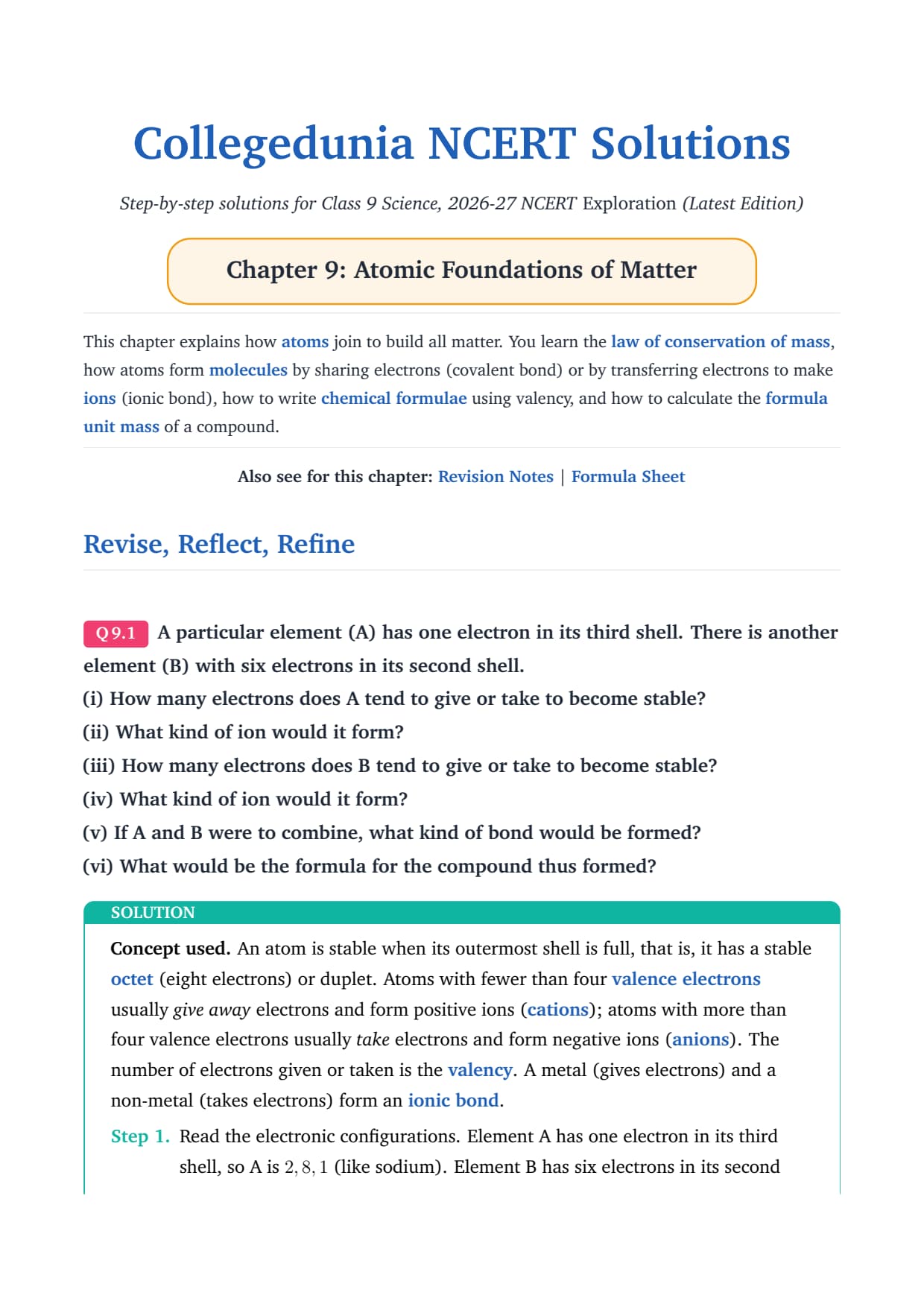
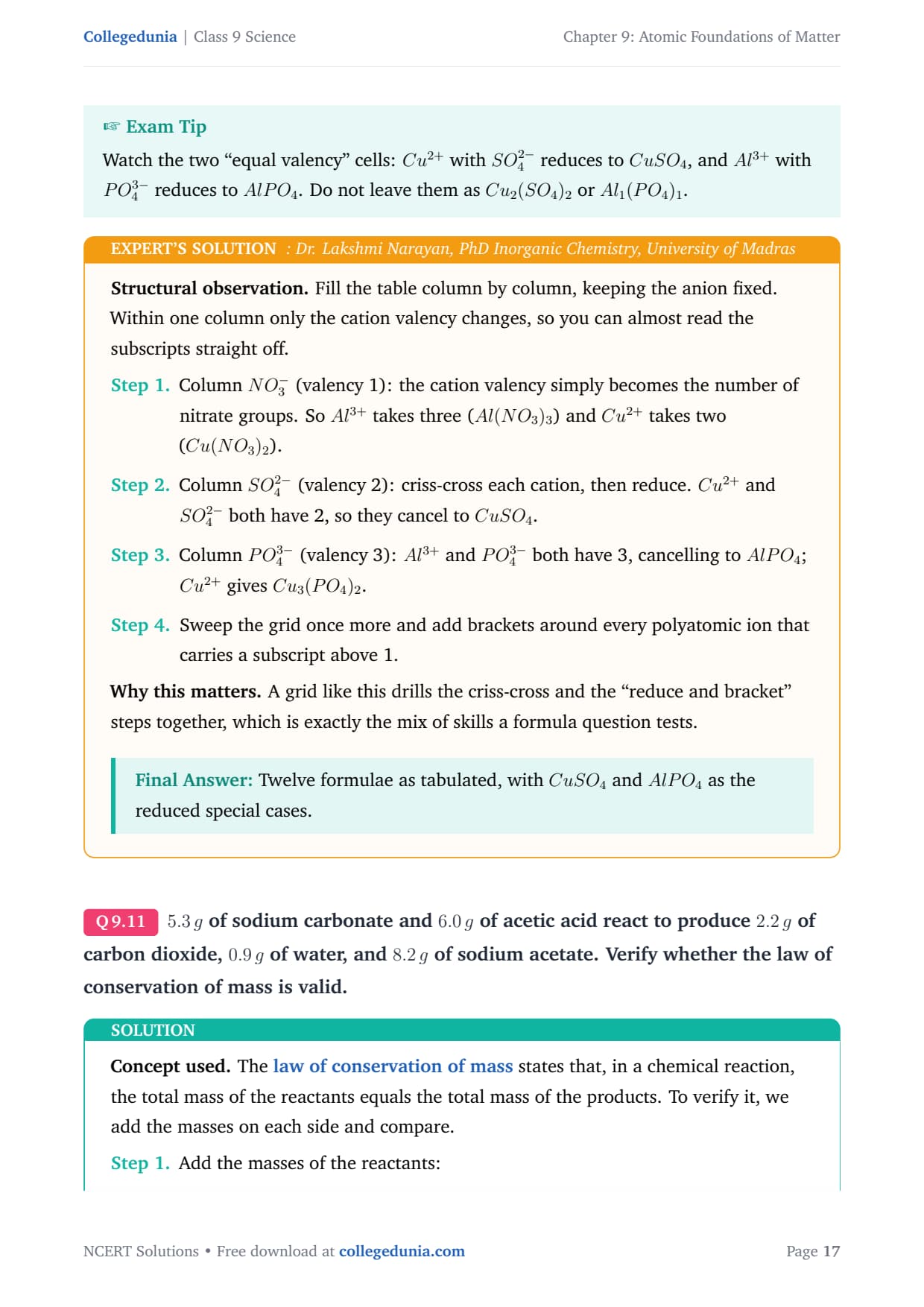
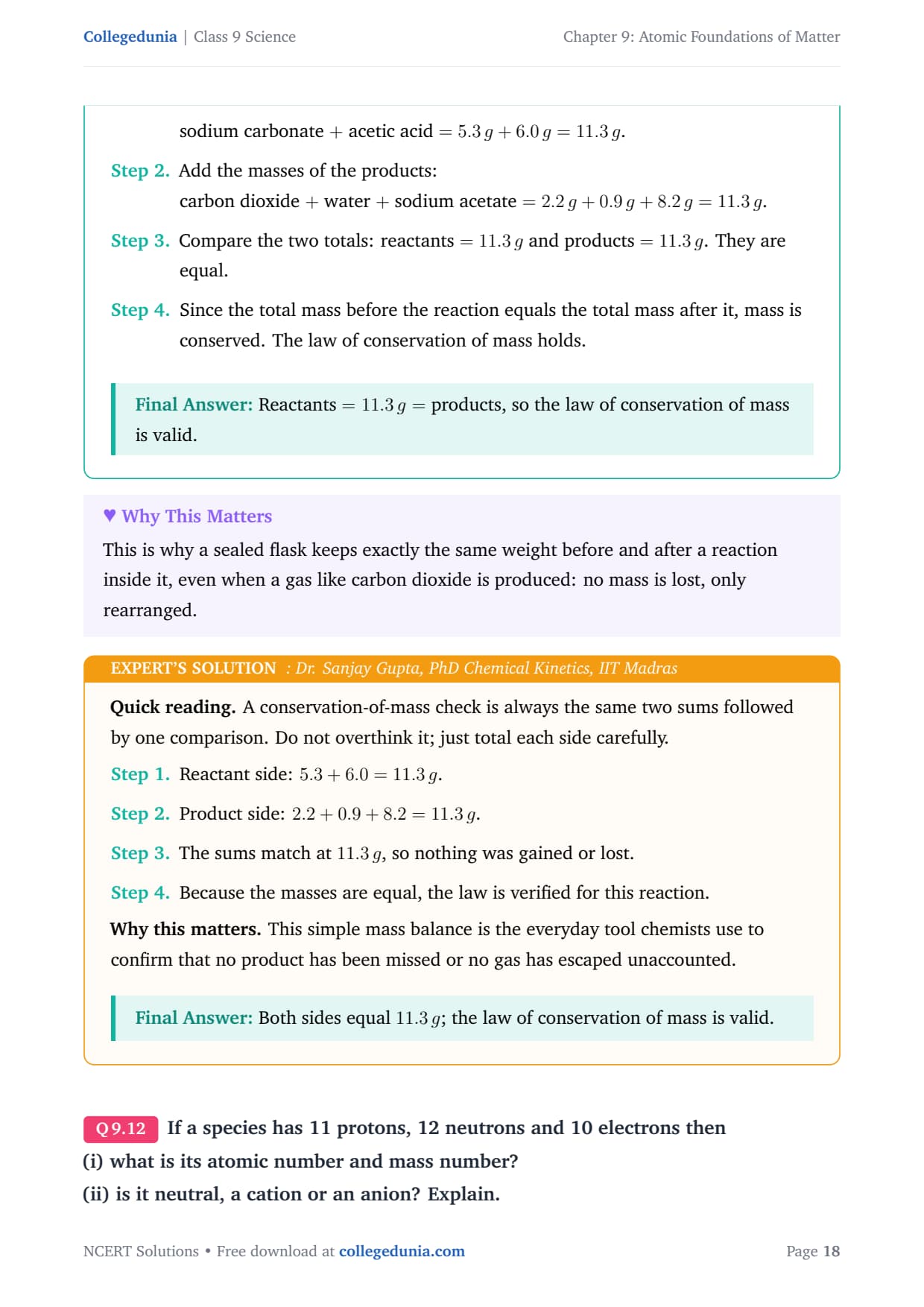
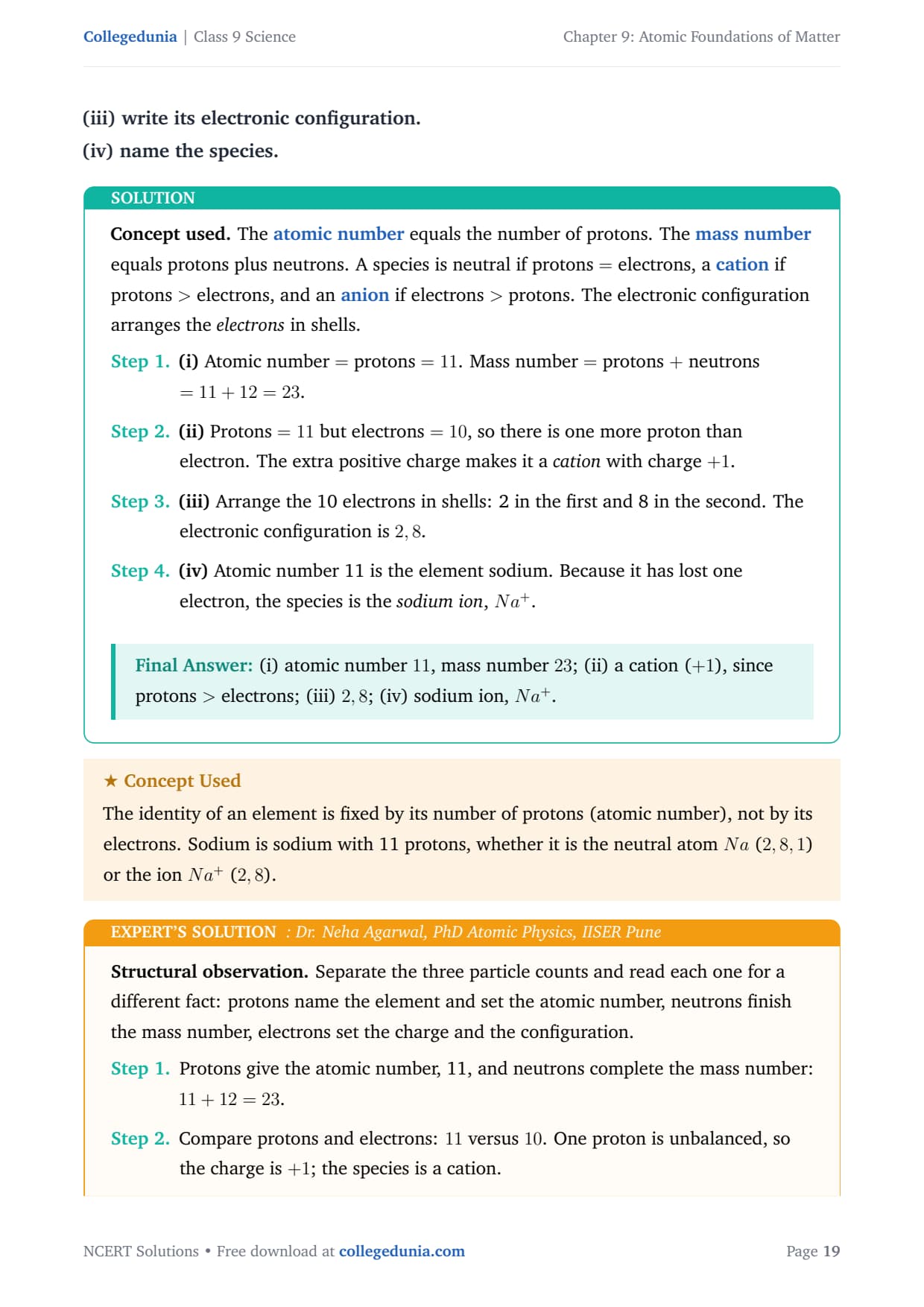
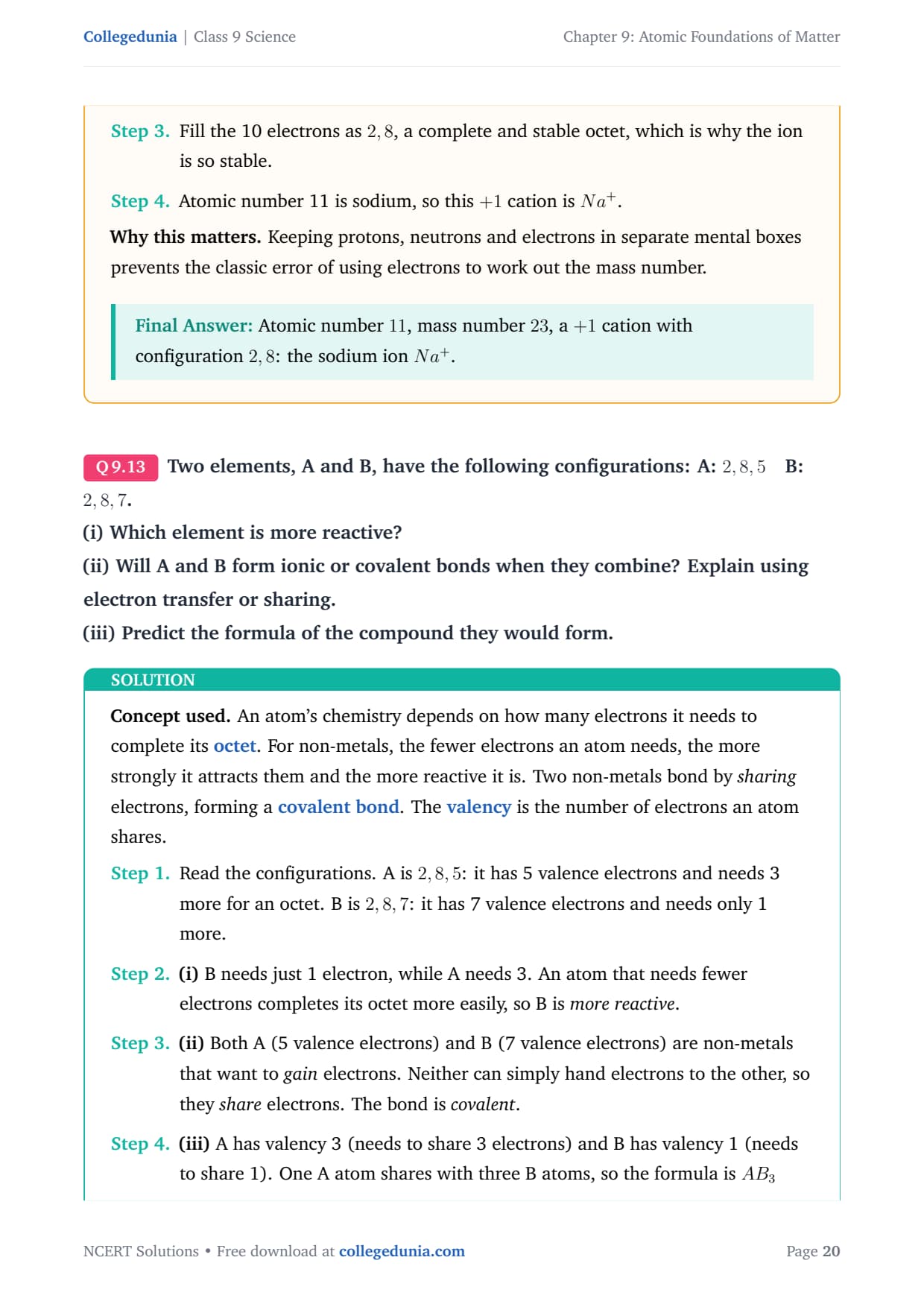
These NCERT Solutions for Class 9 Science Chapter 9 are prepared by subject experts, matched to the 2026-27 NCERT Exploration textbook, and checked against the official NCERT answer key.
- 15 solved questions from the Revise, Reflect, Refine exercise, covering ionic and covalent bonds, valency, and chemical formulae.
- Every formula question shows the criss-cross rule, the working, and the final answer as separate steps, so nothing is skipped.
- Based on the new 2026-27 NCERT Exploration textbook, with an expert method added to each question.
Student Feedback
In a Collegedunia poll of 13,200 Class 9 students taken before the 2026 exams, 68% said writing the correct chemical formula was the part they got wrong most often in this chapter. Most students rated the criss-cross rule and formula unit mass as the areas that need the most practice. Students who solved all 15 Revise, Reflect, Refine questions said formula writing finally felt automatic.
Source: 2026-27 Class 9 Science student poll. Sample of 13,200 students from CBSE schools across 15 states.
Atoms and Molecules Class 9 One-Shot Video Explanation
Source: Physics Wallah on YouTube
This one-shot video walks through atoms, molecules, ions, valency, and formula writing before you start the exercise. Watch it once, then use the step-by-step solutions below to practise each question. The video and these solutions together cover the whole of Chapter 9 Atomic Foundations of Matter.
What Atomic Foundations of Matter Class 9 Science Covers
Chapter 9 is the chemistry heart of Class 9 Science. It explains how tiny atoms join to build every material around us. The chapter runs on a few clear ideas, and once you know them, most questions become quick to solve.
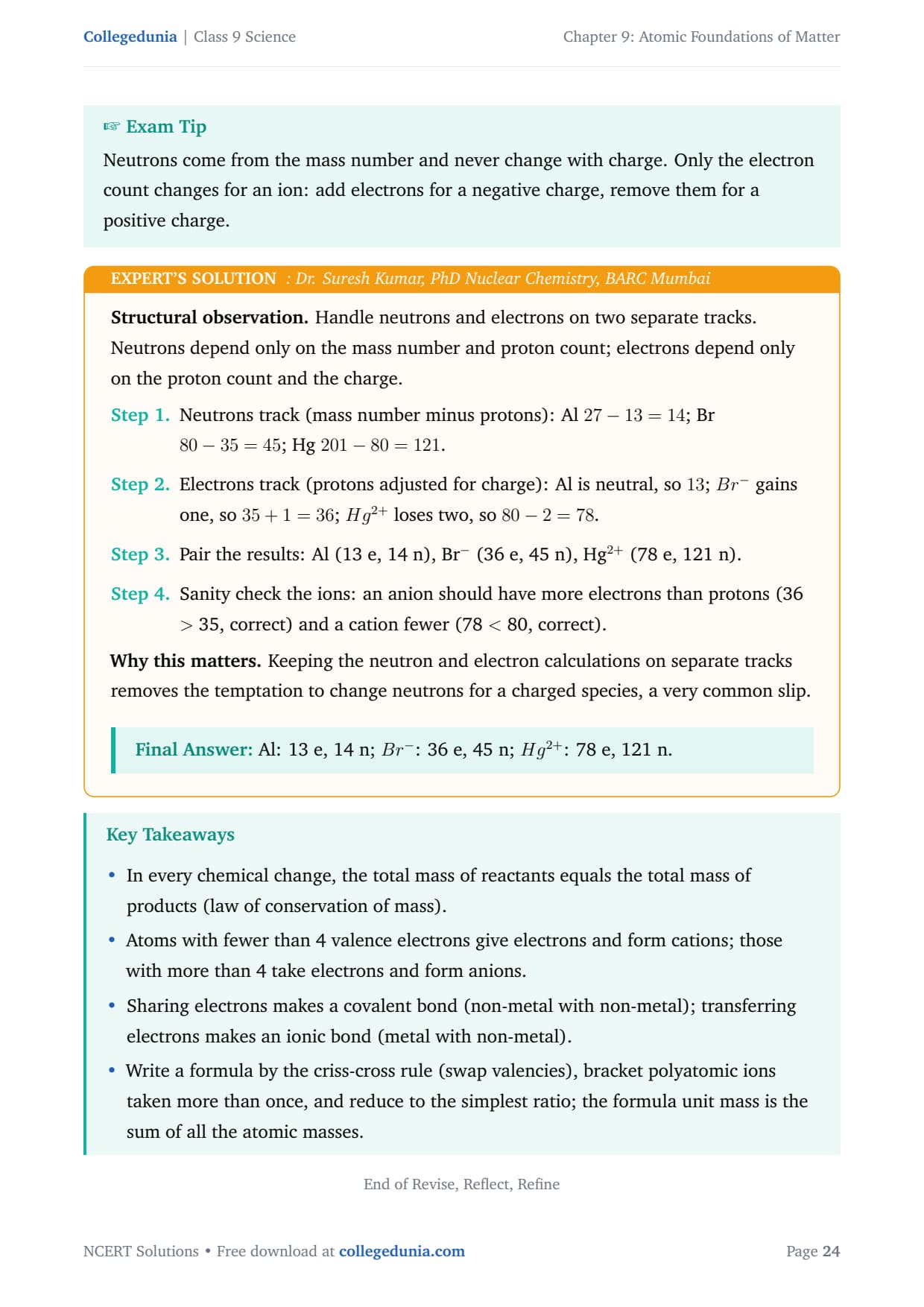
- Law of conservation of mass: in any chemical change, the total mass of the reactants equals the total mass of the products.
- Atoms, ions, and molecules: atoms gain, lose, or share electrons to become stable, forming cations, anions, and molecules.
- Bonding and formulae: ionic and covalent bonds, valency, the criss-cross rule, and the formula unit mass of a compound.
A stable atom has a full outer shell. Metals usually give away electrons and non-metals take or share them, and that single idea drives almost every answer in this chapter.
How Collegedunia's Class 9 Atomic Foundations NCERT Solutions Help You
This chapter mixes short reasoning questions with formula writing and simple sums. These solutions make each type easy to attempt and easy to score.
- 2026-27 NCERT alignment: Every answer matches the new Exploration textbook and the official NCERT answer key.
- Full working shown: The concept, the criss-cross or mass step, and the final answer sit on separate lines, so you never lose method marks.
- Expert method added: A second, faster approach is given below each solution to save time in the exam.
- Concepts made clear: Each solution starts with the exact idea it uses, such as valency, octet, or the law of conservation of mass.
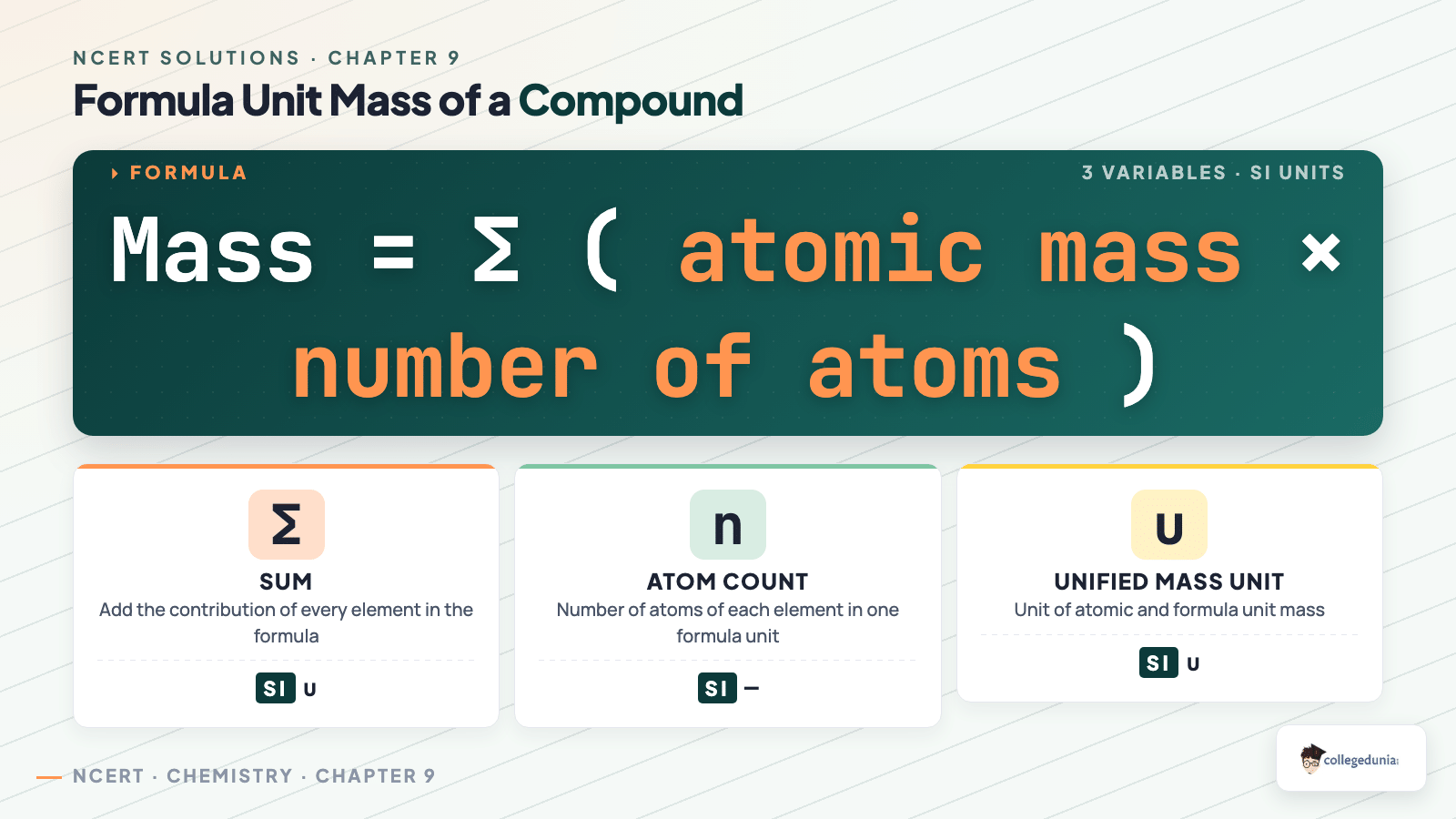
Atomic Foundations of Matter Class 9 Important Formulas and Rules
This chapter is built on three rules rather than many formulas. Learn these first, and most exercise questions fall into place. Formula unit mass is measured in the unified mass unit (u), the same unit used for atomic mass.
| Rule | How it works | What it means |
|---|---|---|
| Law of conservation of mass | Total mass of reactants = total mass of products | No mass is made or lost in a chemical change; it is only rearranged. |
| Valency | Electrons an atom gives, takes, or shares to fill its outer shell | Fewer than 4 outer electrons means give; more than 4 means take. |
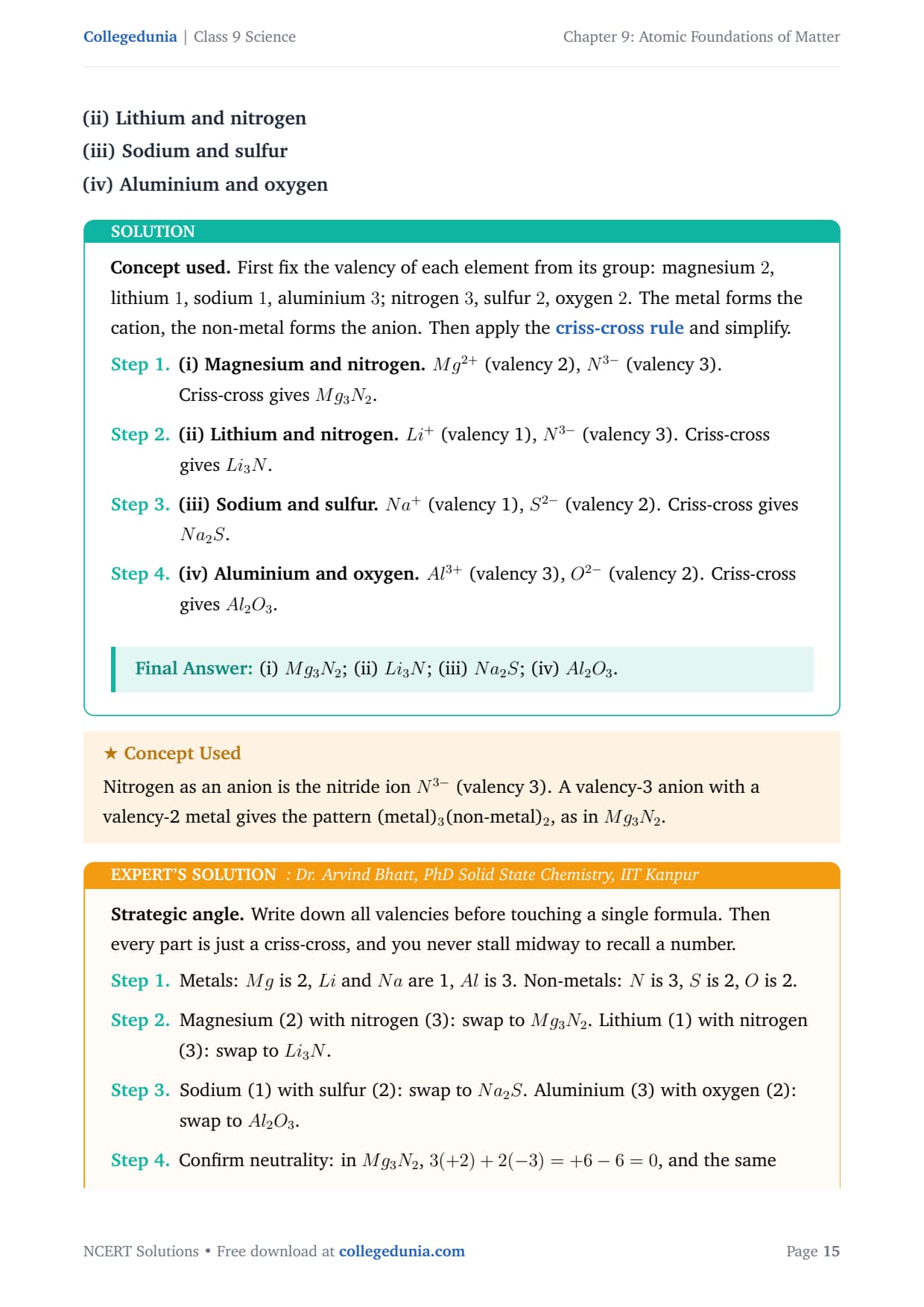
| Criss-cross rule | Swap the valencies to become the subscripts, then reduce | Turns a pair of ions into the correct chemical formula. |
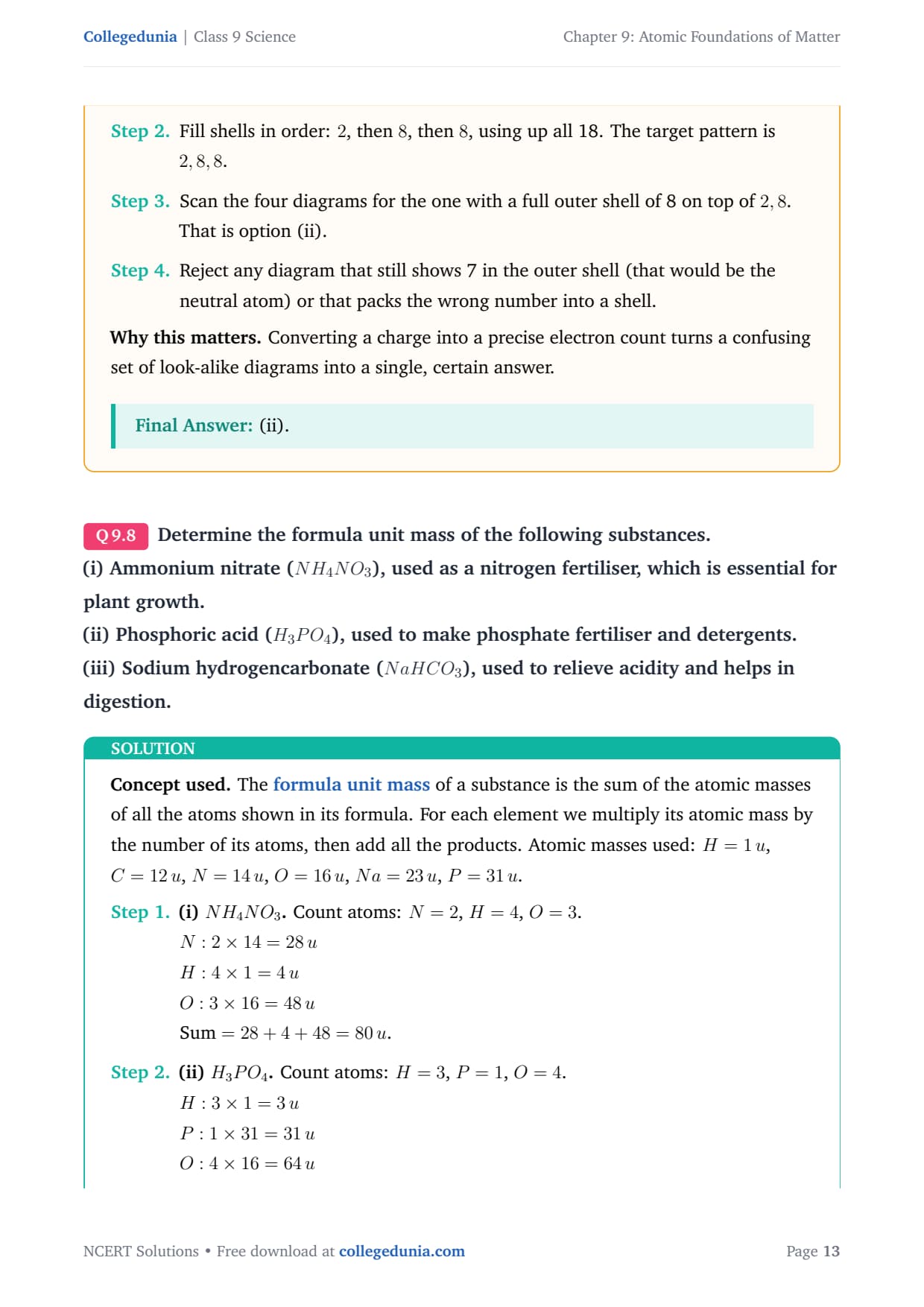
| Formula unit mass | Sum of (atomic mass × number of atoms) for every element | The total mass of one formula unit, measured in u. |
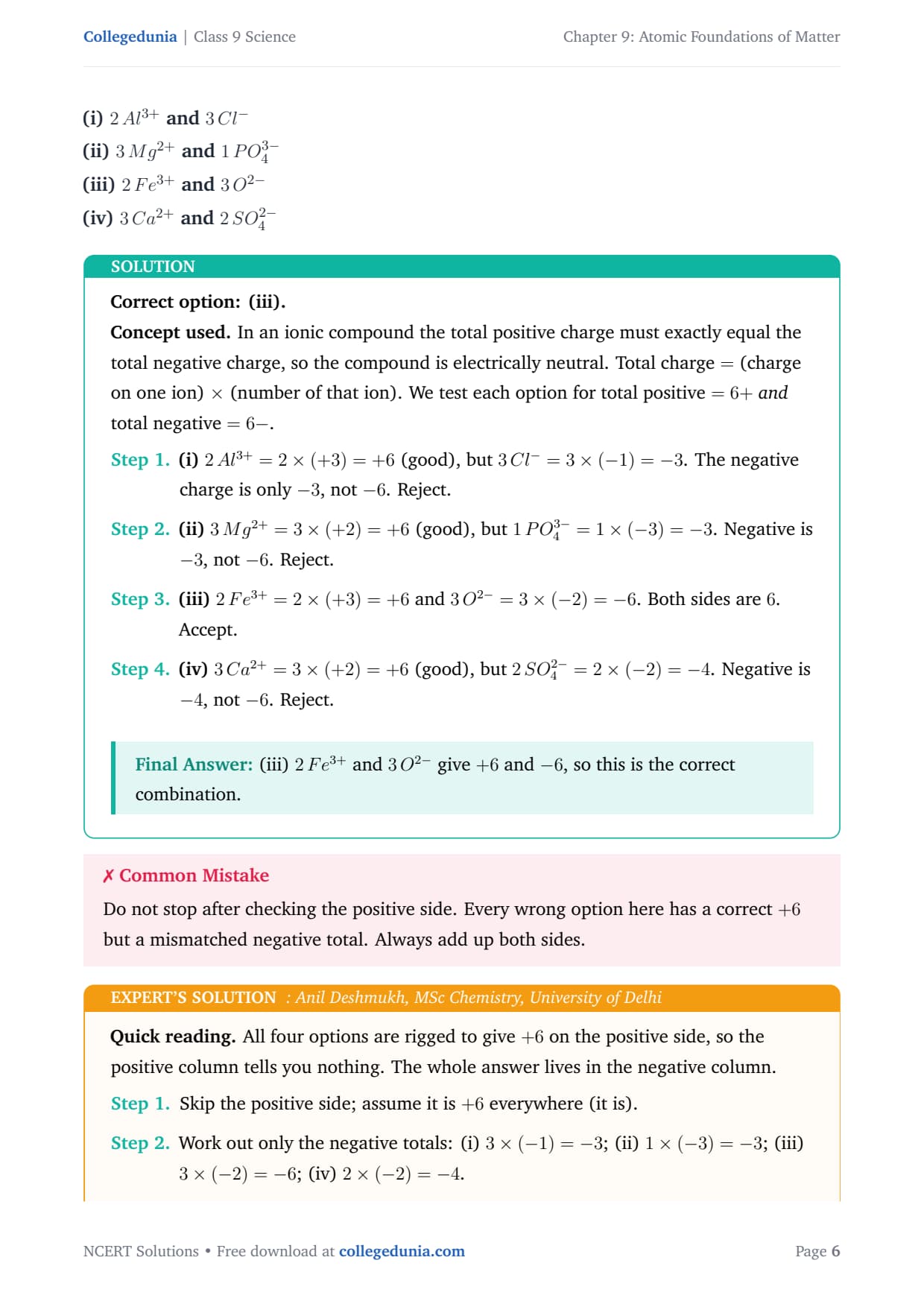
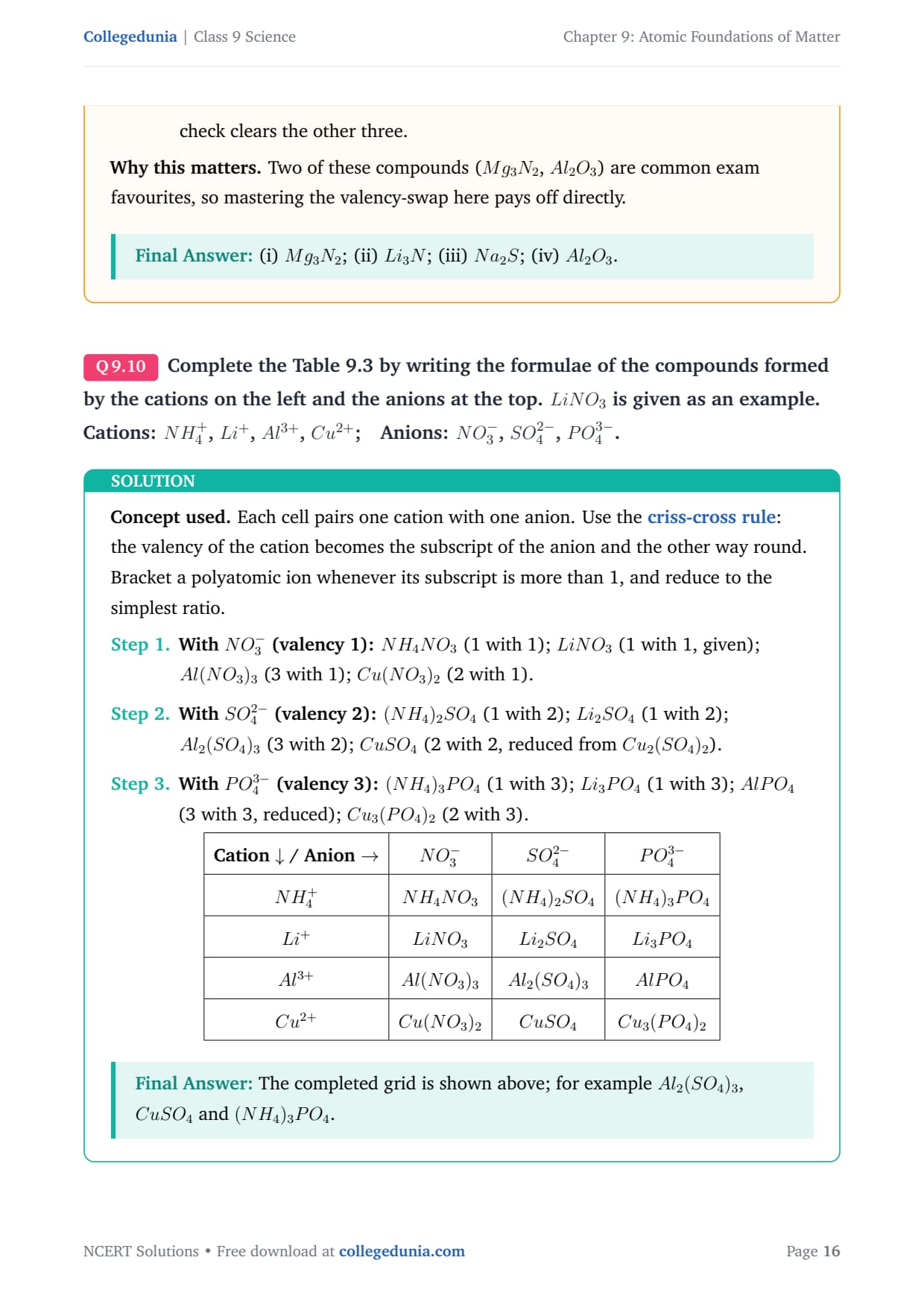
The criss-cross rule is the single most useful tool here. Write each ion with its valency, swap the numbers to become subscripts, bracket any polyatomic ion taken more than once, and reduce to the simplest ratio. Always check that the total positive charge equals the total negative charge.
Ionic Bond and Covalent Bond in Class 9 Science
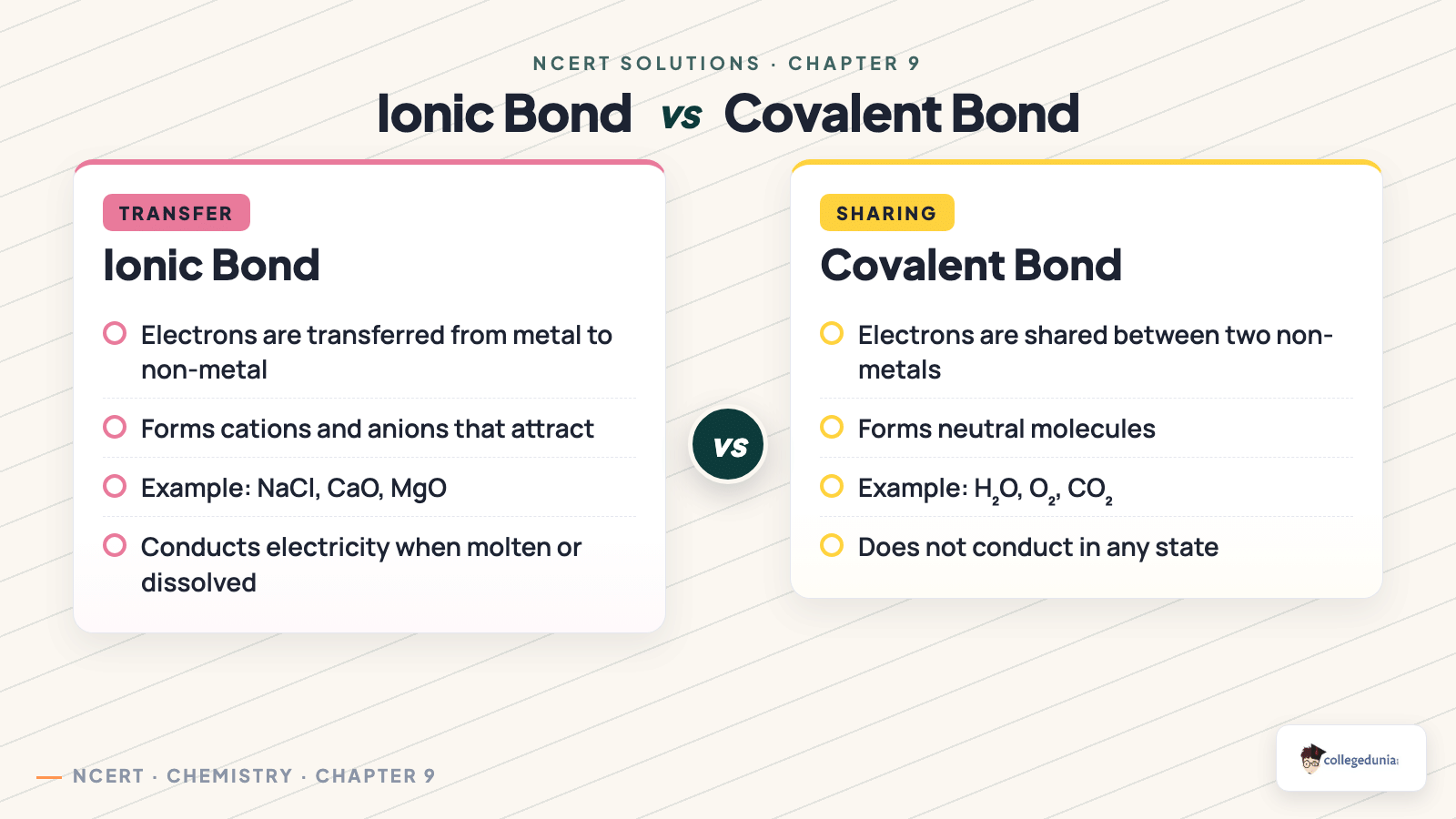
Atoms bond in two main ways, and telling them apart is key to answering the bonding questions in this chapter.
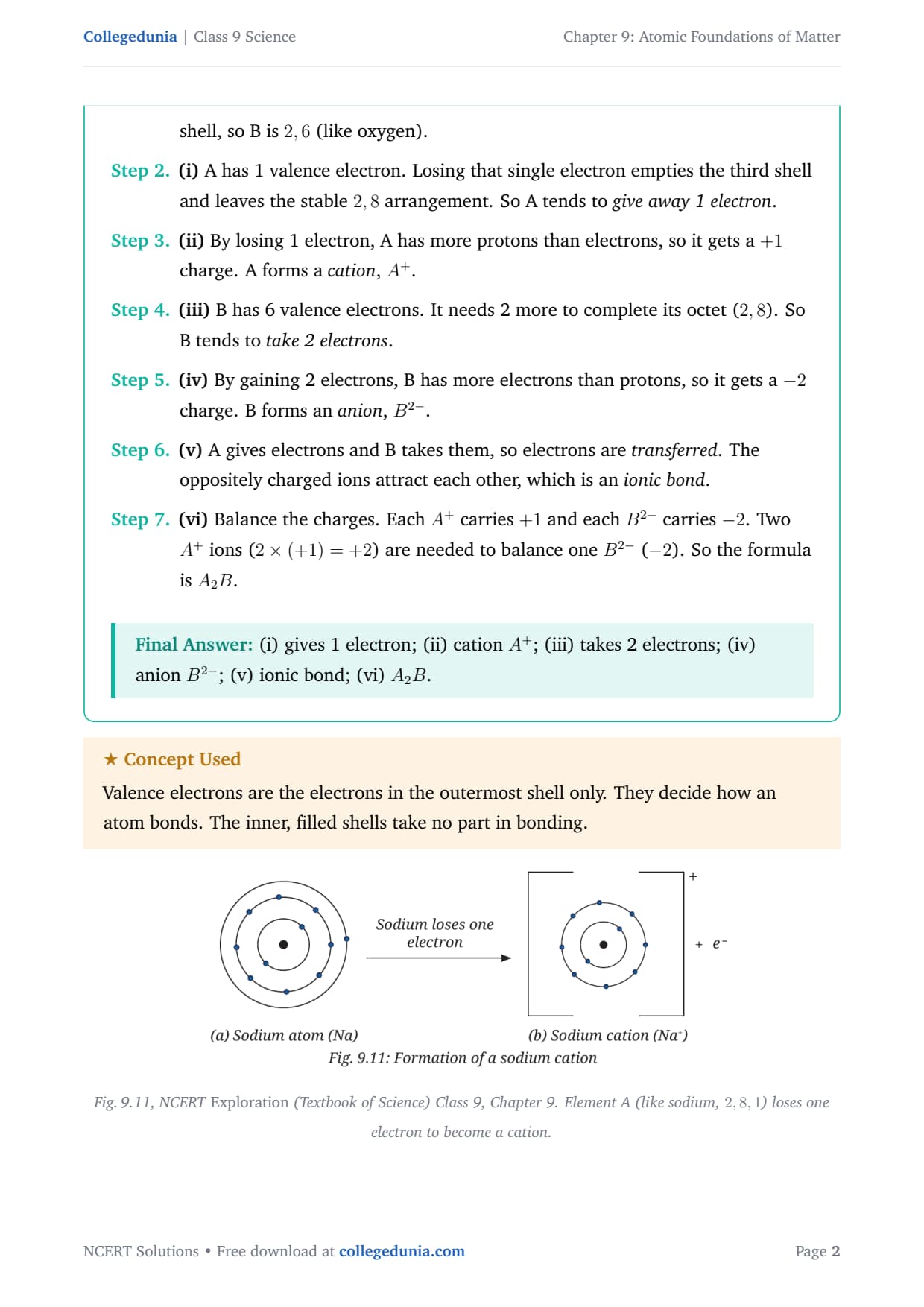
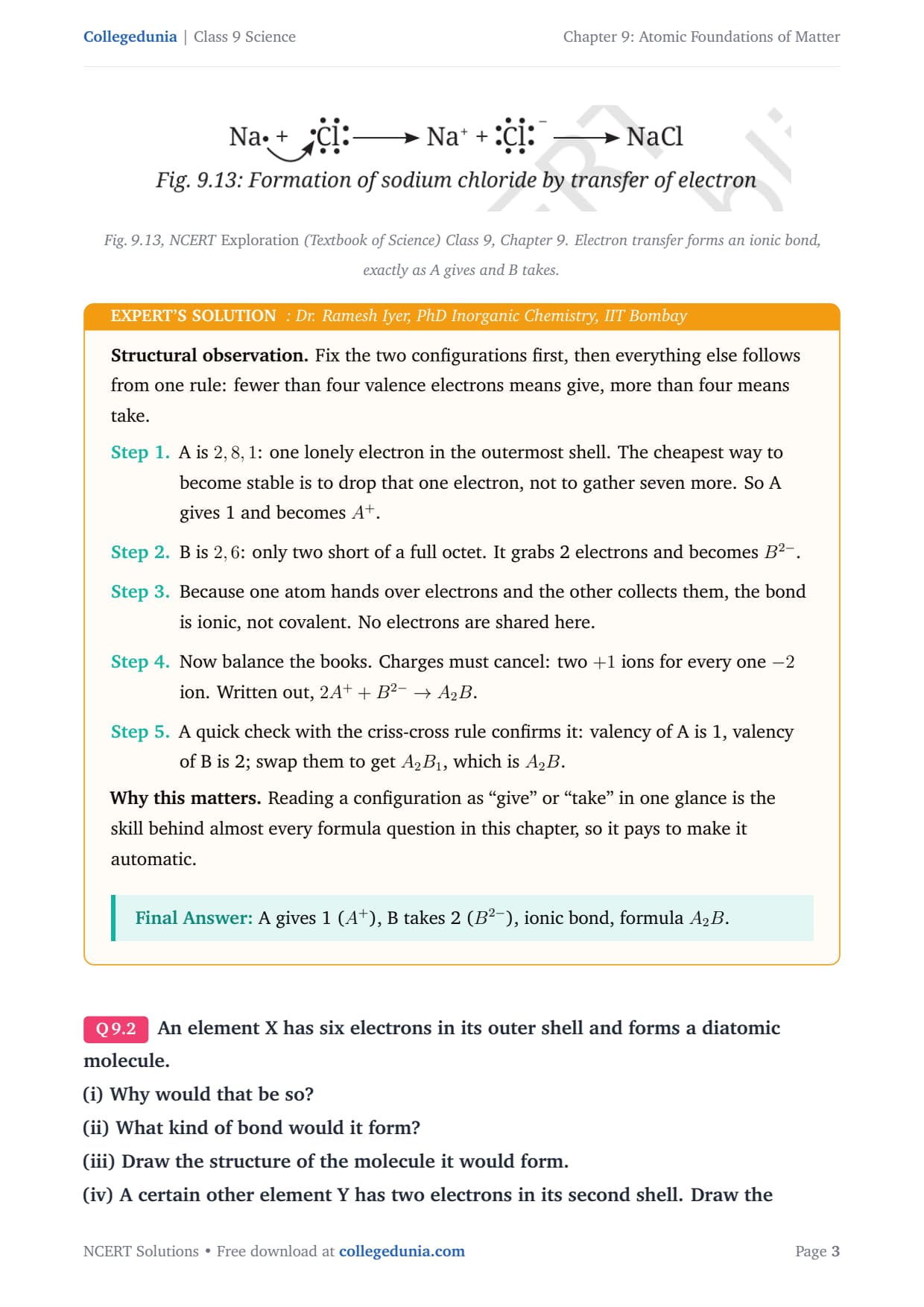
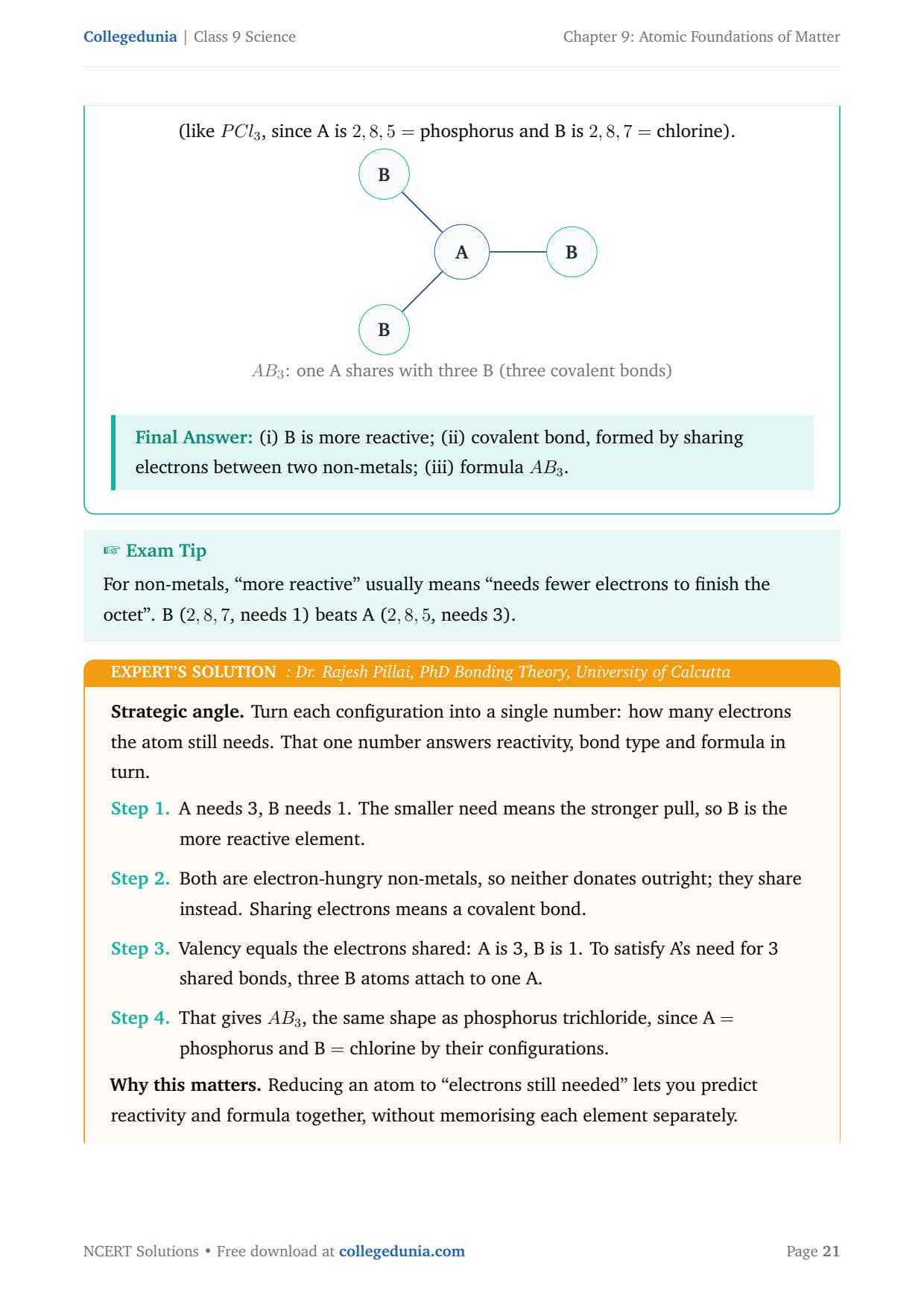
- Ionic bond: a metal gives electrons to a non-metal. This makes a positive cation and a negative anion that attract each other, as in sodium chloride.
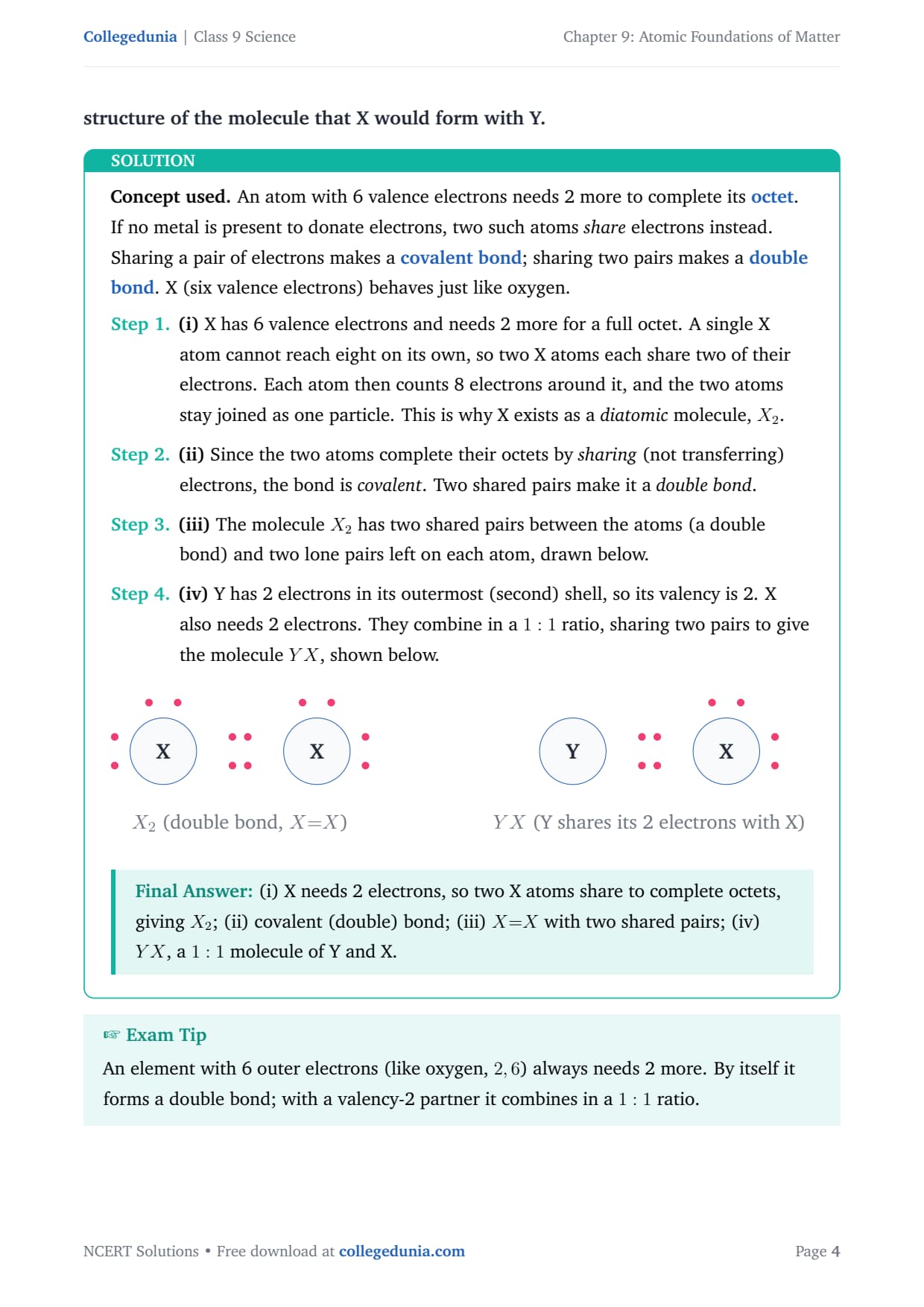
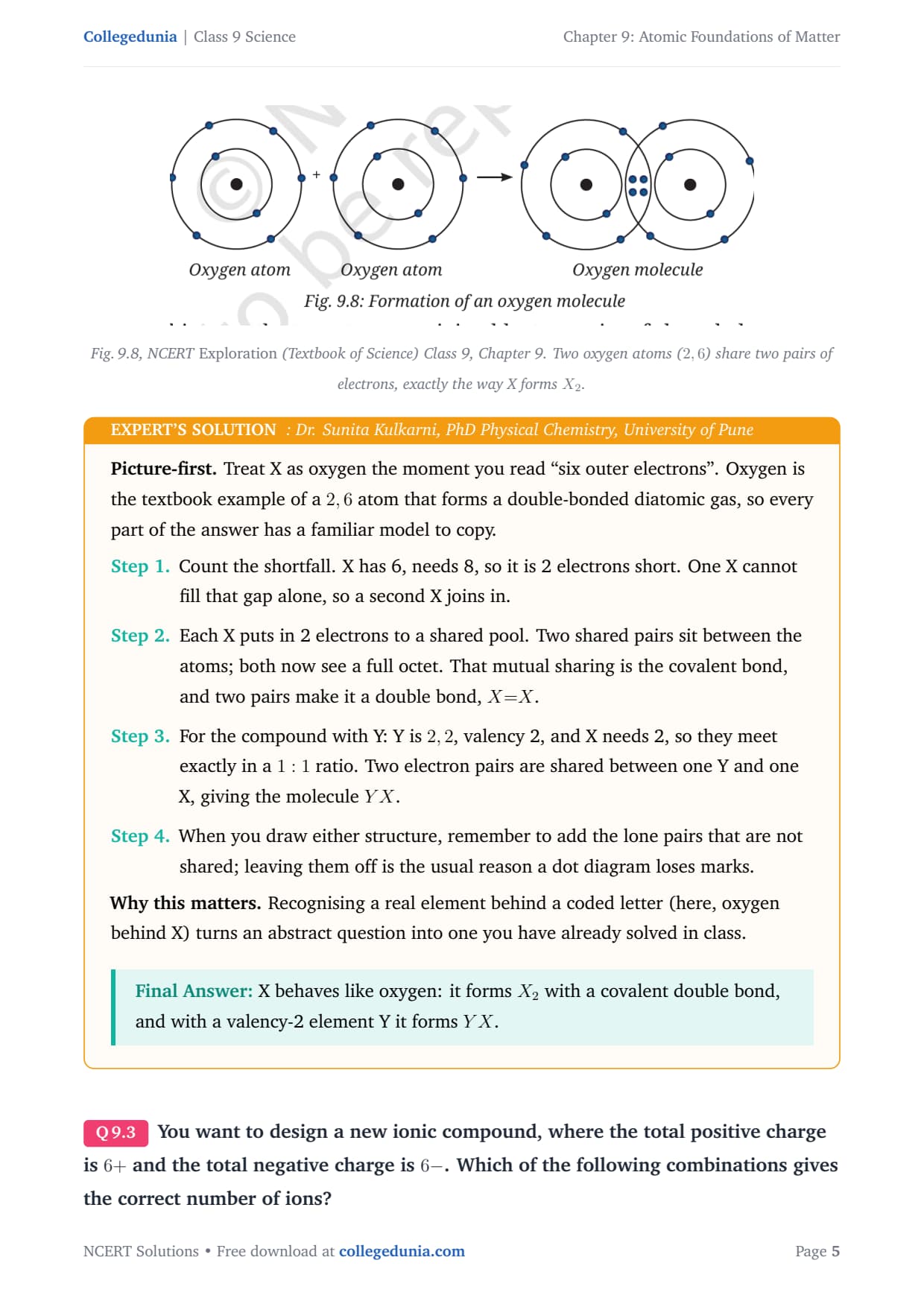
- Covalent bond: two non-metals share electrons. This makes a neutral molecule, as in water or oxygen gas.
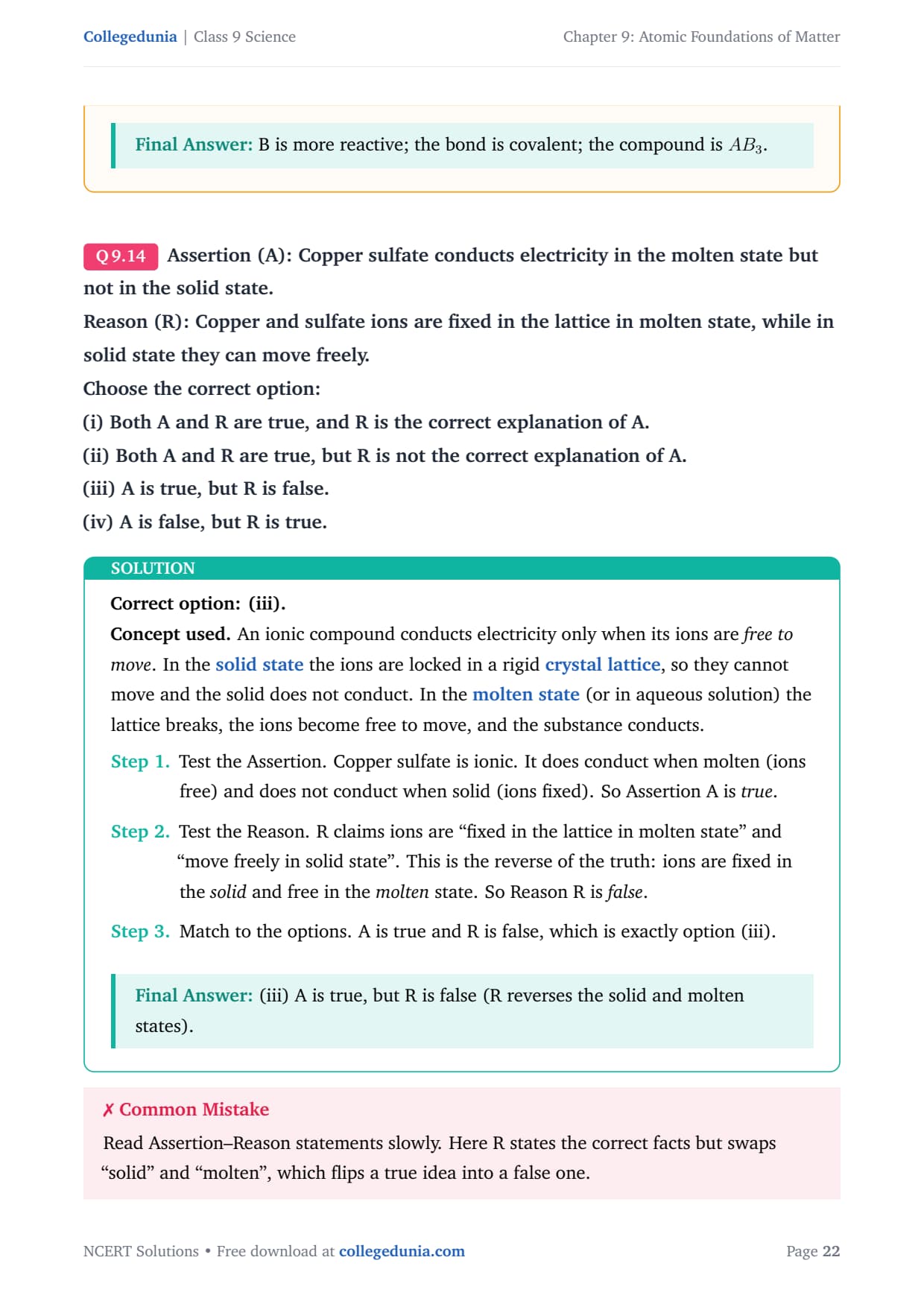
- Conductivity clue: ionic compounds conduct electricity when molten or dissolved, because their ions are then free to move. Solid ionic compounds and covalent compounds do not.
A quick test decides the bond type: metal plus non-metal usually means ionic, while non-metal plus non-metal means covalent. Questions on element A and B in the exercise use exactly this rule.
Revise, Reflect, Refine Exercise Breakdown for Class 9 Science Chapter 9
The Chapter 9 exercise is called Revise, Reflect, Refine and has 15 questions. The table shows what each question tests, so you can plan your practice.
| Questions | Type | What it tests |
|---|---|---|
| 1 to 2 | Reasoning + diagrams | Electron transfer, ion type, bond type, and drawing molecules. |
| 3 to 4 | MCQ + true or false | Charge balance in ionic compounds and atom, molecule, element ideas. |
| 5 to 7 | Formula writing | Criss-cross rule, polyatomic ions, and reading an ion diagram. |
| 8 to 10 | Numerical + grid | Formula unit mass and completing a cation and anion formula grid. |
| 11 to 15 | Applied reasoning | Conservation of mass, protons, neutrons, electrons, and conductivity. |
Start with the reasoning questions, then move to formula writing and the mass sums. All 15 fully solved answers, with an expert method for each, are given lower down this page.
Atomic Foundations of Matter Weightage for the Class 9 Science Exam
Chapter 9 sits in the chemistry part of Class 9 Science. It carries steady marks every year, mostly through formula writing and short reasoning. The table compares it with the other chemistry chapters.
| Chapter | Topic | Typical marks |
|---|---|---|
| Chapter 5 | Exploring Mixtures and their Separation | 5 to 6 marks |
| Chapter 8 | Journey Inside the Atom | 4 to 5 marks |
| Chapter 9 | Atomic Foundations of Matter | 5 to 7 marks |
| Chapter 12 | Patterns in Life Diversity and Classification | 4 to 5 marks |
Because formula writing is rule-based, this chapter is one of the easiest places to score full marks with a little practice.
Common Mistakes Students Make in the Atomic Foundations Chapter
Watch out for these slips:
- Checking only the positive charge in an ionic compound. Both the positive and negative totals must be equal.
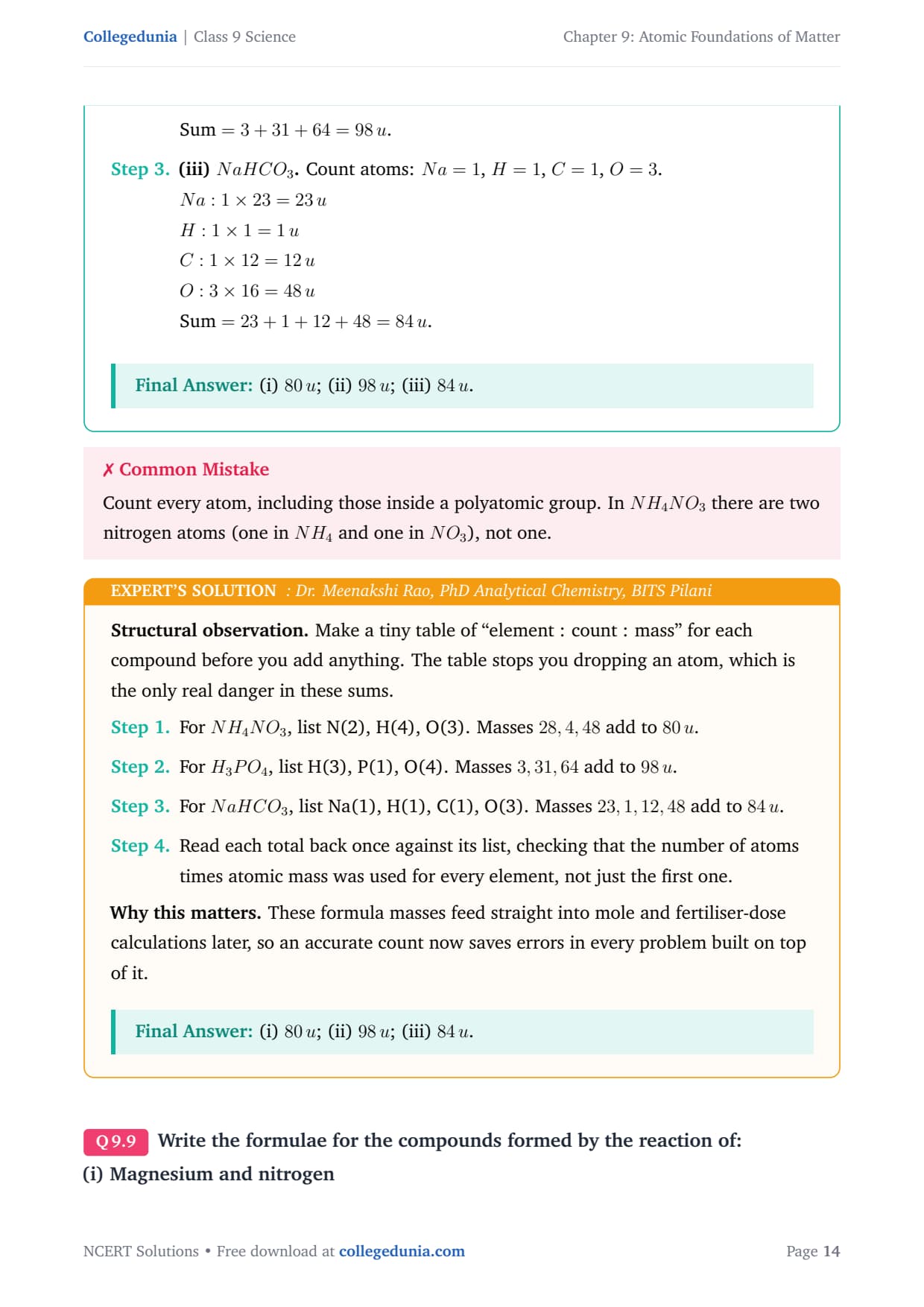
- Forgetting to count every atom in a polyatomic group. In NH4NO3 there are two nitrogen atoms, not one.
- Bracketing a polyatomic ion that is taken only once. Write K2SO4, not K2(SO4).
- Mixing up ferrous and ferric. Ferrous is Fe2+ and ferric is Fe3+.
Solved Example: Writing a Formula by the Criss-Cross Rule
Write the formula of aluminium oxide, made of Al3+ and O2- ions. This follows the same method used in Questions 5, 6, and 9 of the exercise.
- Write the ions with valencies: aluminium is Al3+ (valency 3) and oxide is O2- (valency 2).
- Criss-cross the valencies: the 3 from aluminium becomes the subscript of oxygen, and the 2 from oxygen becomes the subscript of aluminium, giving Al2O3.
- Reduce if needed: the subscripts 2 and 3 share no common factor, so the formula stays Al2O3.
- Check neutrality: 2 × (+3) + 3 × (−2) = +6 − 6 = 0, so the compound is neutral and correct.
Every formula question in this chapter follows this same four-step pattern: write the ions, criss-cross, reduce, and check that the charges cancel.
How to Use the Class 9 Atomic Foundations Solutions Most Effectively
Use a simple three-step routine so the chapter stays in your memory until the exam.
- Learn the valencies first of the common ions and the three main rules of the chapter.
- Attempt each question yourself, then compare with the step-by-step solution below.
- Redo the formula questions you got wrong two days later, without looking at the answer.
Pair this page with the chapter notes and formula sheet for quick revision before the exam.
NCERT Class 9 Science Chapter 9 Other Study Resources
Use the other free resources for the same chapter alongside these solutions.
| Resource | Link |
|---|---|
| Revision Notes | Atomic Foundations of Matter Class 9 Notes |
| Handwritten Notes | Atomic Foundations of Matter Class 9 Handwritten Notes |
| NCERT Book PDF | Atomic Foundations of Matter Class 9 NCERT Book PDF |
| Formula Sheet | Atomic Foundations of Matter Class 9 Formula Sheet |
NCERT Solutions for Class 9 Science: All Chapters
Find the step-by-step NCERT Solutions for the other Class 9 Science chapters below.
| Chapter | Resource |
|---|---|
| Chapter 5 | Exploring Mixtures and their Separation NCERT Solutions |
| Chapter 6 | How Forces Affect Motion NCERT Solutions |
| Chapter 7 | Work, Energy, and Simple Machines NCERT Solutions |
| Chapter 8 | Journey Inside the Atom NCERT Solutions |
| Chapter 9 | Atomic Foundations of Matter NCERT Solutions |
| Chapter 10 | Sound Waves Characteristics and Applications NCERT Solutions |
Atomic Foundations of Matter Class 9 Science NCERT Solutions FAQs
Ques. Where can I download the Atomic Foundations of Matter Class 9 Science NCERT Solutions PDF?
Ans. You can download the Atomic Foundations of Matter Class 9 Science NCERT Solutions PDF free from this page. Both a normal and an HD version are available.
Ques. How many questions are solved in Class 9 Science Chapter 9?
Ans. All 15 questions from the Revise, Reflect, Refine exercise are solved, each with a step-by-step method and an expert method.
Ques. Are these solutions aligned with the 2026-27 NCERT?
Ans. Yes. Every answer matches the new 2026-27 NCERT Exploration textbook for Class 9 Science and the official NCERT answer key.
Ques. What is the criss-cross rule in Class 9 Science Chapter 9?
Ans. The criss-cross rule writes a chemical formula by swapping the valencies of two ions to become their subscripts, then reducing to the simplest whole-number ratio. For example, Al3+ and O2- give Al2O3.
Ques. What is the difference between an ionic and a covalent bond?
Ans. An ionic bond forms when a metal transfers electrons to a non-metal, making cations and anions. A covalent bond forms when two non-metals share electrons, making a neutral molecule.
Ques. How do you find the formula unit mass of a compound?
Ans. Add the atomic mass of every atom in the formula. Multiply each element's atomic mass by the number of its atoms, then add all the products. For example, NaHCO3 has a formula unit mass of 84 u.



Comments